EP0687078A2 - System zur Datenpaketübertragung in einer TDMA-Telefunkanordnung - Google Patents
System zur Datenpaketübertragung in einer TDMA-Telefunkanordnung Download PDFInfo
- Publication number
- EP0687078A2 EP0687078A2 EP95303825A EP95303825A EP0687078A2 EP 0687078 A2 EP0687078 A2 EP 0687078A2 EP 95303825 A EP95303825 A EP 95303825A EP 95303825 A EP95303825 A EP 95303825A EP 0687078 A2 EP0687078 A2 EP 0687078A2
- Authority
- EP
- European Patent Office
- Prior art keywords
- packet
- channel
- mobile station
- burst
- time slots
- Prior art date
- Legal status (The legal status is an assumption and is not a legal conclusion. Google has not performed a legal analysis and makes no representation as to the accuracy of the status listed.)
- Granted
Links
- 230000005540 biological transmission Effects 0.000 claims abstract description 51
- 238000004891 communication Methods 0.000 claims description 3
- 238000012546 transfer Methods 0.000 claims description 3
- 238000001514 detection method Methods 0.000 claims description 2
- 230000001419 dependent effect Effects 0.000 claims 3
- 230000001413 cellular effect Effects 0.000 abstract description 8
- 238000000034 method Methods 0.000 abstract description 5
- 108091081062 Repeated sequence (DNA) Proteins 0.000 abstract 1
- 230000011664 signaling Effects 0.000 description 4
- 238000012549 training Methods 0.000 description 4
- 230000007704 transition Effects 0.000 description 4
- 238000010586 diagram Methods 0.000 description 3
- 239000000969 carrier Substances 0.000 description 2
- 230000003247 decreasing effect Effects 0.000 description 2
- 238000005516 engineering process Methods 0.000 description 2
- 238000011160 research Methods 0.000 description 2
- 239000012141 concentrate Substances 0.000 description 1
- 238000012937 correction Methods 0.000 description 1
- 230000000694 effects Effects 0.000 description 1
- 238000013507 mapping Methods 0.000 description 1
- 238000012544 monitoring process Methods 0.000 description 1
- 238000005457 optimization Methods 0.000 description 1
- CSRZQMIRAZTJOY-UHFFFAOYSA-N trimethylsilyl iodide Substances C[Si](C)(C)I CSRZQMIRAZTJOY-UHFFFAOYSA-N 0.000 description 1
Images



Classifications
-
- H—ELECTRICITY
- H04—ELECTRIC COMMUNICATION TECHNIQUE
- H04W—WIRELESS COMMUNICATION NETWORKS
- H04W72/00—Local resource management
- H04W72/20—Control channels or signalling for resource management
- H04W72/23—Control channels or signalling for resource management in the downlink direction of a wireless link, i.e. towards a terminal
-
- H—ELECTRICITY
- H04—ELECTRIC COMMUNICATION TECHNIQUE
- H04B—TRANSMISSION
- H04B7/00—Radio transmission systems, i.e. using radiation field
- H04B7/24—Radio transmission systems, i.e. using radiation field for communication between two or more posts
- H04B7/26—Radio transmission systems, i.e. using radiation field for communication between two or more posts at least one of which is mobile
- H04B7/2643—Radio transmission systems, i.e. using radiation field for communication between two or more posts at least one of which is mobile using time-division multiple access [TDMA]
- H04B7/2656—Radio transmission systems, i.e. using radiation field for communication between two or more posts at least one of which is mobile using time-division multiple access [TDMA] for structure of frame, burst
-
- H—ELECTRICITY
- H04—ELECTRIC COMMUNICATION TECHNIQUE
- H04W—WIRELESS COMMUNICATION NETWORKS
- H04W68/00—User notification, e.g. alerting and paging, for incoming communication, change of service or the like
-
- H—ELECTRICITY
- H04—ELECTRIC COMMUNICATION TECHNIQUE
- H04W—WIRELESS COMMUNICATION NETWORKS
- H04W72/00—Local resource management
- H04W72/20—Control channels or signalling for resource management
- H04W72/21—Control channels or signalling for resource management in the uplink direction of a wireless link, i.e. towards the network
Definitions
- This invention relates to the transmission of packet data having flexible variable rate reservation access for TDMA-based cellular systems.
- cellular systems offer efficient data and speech services based on circuit switched technology.
- circuit switching however, the use of transmission resources is not optimal since the transmission link is maintained for the whole duration of the connection independent of whether or not information is being sent at a given moment.
- Transmission resources are also shared by many other users, and therefore maintaining a circuit switched connection for one user unnecessarily wastes the transmission resources for other users.
- the fact that data services are transmitted in bursts is also a disadvantage in circuit switching.
- Channel utilization can be improved and optimized by using packet switched transmission of information.
- Time division multiple access was not utilized in older systems. More recent research projects have studied time division based packet radio systems capable of reserving multiple time slots per use; in other words, capable of data transmission with high data rates.
- a future third generation cellular system called the universal mobile telecommunication system (UMTS) has to be capable of performing both circuit switched and packet transmission, like integrated services digital network (ISDN) transmission and asynchronous transfer mode (ATM) transmission.
- the key factor is an air interface utilizing advanced multiple access technology for efficiently multiplexing, at the air interface, channels supporting various types of services to and from the radio path. Requirements set by the UMTS system for the air interface have been described in the article "A Reservation Based Multiple Access Scheme for a Future Universal Mobile Telecommunications System" by J.M. DeVille, published in the Mobile and Personal Communications, 13-15 December 1993, Conference Publication No. 387, IEE 1993.
- the multiple access has to be capable of utilizing the inactivity of the information source by assigning a physical channel only when there is activity on the logical channel and, furthermore, be capable of supporting various bit rates so that, when necessary, time slots in a frame are assigned for the logical channel.
- PRMA + + packet reservation multiple access
- the PRMA + + can be used as multiple access control both in packet switched and circuit switched transmission.
- the PRMA + + method concentrates on the use of one time slot in the transmission of packet data. This mechanism provides an efficient multi-slot/multi-user environment for a system having a high number of time slots in its TDMA frame.
- the PRMA + + uses time division multiple access TDMA in the radio channel. This makes it possible for a user to share radio channel transmission resources. Now follows a description of this system, with reference to Figure 1.
- a TDMA frame is divided into time slots in which a transmitted burst carries data and signalling associated with channel coding, detection, etc.
- R-slots which are used only for transmitting channel request bursts
- information time slots or, I-slots used only for transmitting information bursts.
- a mobile station uses a so-called air interface channel identifier including the mobile station's network address that identifies the logical channel and requesting one or more time slots of a frame for its use according to the need at that moment.
- the downlink direction ie. from a network (base station) to a mobile station
- time slots there are also two types of time slots: I-slots for transmitting information and A-slots, or, acknowledge time slots.
- the base station acknowledges the request with A-slots by sending the requesting station's address and the number of the I-slot. From then on, that I-slot is reserved for the mobile station.
- N of PRMA + + time slots available in one TDMA frame be a system configuration parameter.
- R-slot reservation time slot
- I-slots information time slots
- All mobile stations begin transmission by sending a channel request in the R-slot and if several mobile stations use the same R-slot for sending the request, collisions may occur.
- the downlink channel there is also in a TDMA frame, in addition to the I-slots and the above-mentioned A-slot for acknowledging channel reservation requests sent in the R-slot, a fast paging time slot (FP-slot) for informing a mobile station about an incoming data transmission and the information transmission time slots.
- FP-slot fast paging time slot
- a mobile station initiates a connection by sending a channel request on an uplink channel, in the R-slot used for this purpose by all mobile stations of a cell.
- the base station acknowledges the channel request with a downlink acknowledge burst in the A-slot. If no requests are sent in the R-slot or if there are collisions on the channel recognized by the base station, it sends an "idle" flag in the acknowledge burst of the corresponding A-slot and then the mobile station knows that it should send the channel request again after a while. In the case that a channel request sent in the R-slot was received without problems but there are no free time slots for transmission, the mobile station will be informed about the matter in the next downlink acknowledge time slot. The mobile station will queue for access until a free time slot is found.
- An R-slot includes a training sequence, the address of the mobile station, the number of requested information time slots, and the circuit switching flag.
- the flag tells whether the reservation is valid for the duration of the packet or for a longer time.
- the channel is reserved until an instruction is given to release the reservation.
- the acknowledge burst in the A-slot includes the address of the mobile station requesting a channel and the channels dedicated for traffic. The mobile station receives the acknowledge burst and then sets the receiver and transmitter to the defined channel. Traffic on the channel is begun and it continues as long as there are data or speech to transmit. In packet data transmission, the number of bursts - or, in this case, packets - sent after one channel request can be fixed.
- a base station uses the fast paging time slot (FP-slot) to inform a mobile station about an incoming packet.
- a mobile station listens to the fast paging channel and decodes all incoming messages to find its own code.
- the fast paging time slot includes a list of the I-slots that have been allocated to the mobile station.
- a mobile station acknowledges a paging call by sending an acknowledge in the fast paging acknowledge time slot (FP-ack).
- both uplink and downlink connections that are inactive at a given moment are not allocated physical channels during that time, which prevents unnecessary use of resources.
- Channels are always reserved using the same method independent of whether the connection is a circuit switched or a packet connection.
- One disadvantage of this known system is that the allocation of channels is not dynamic and, therefore, it is not easy to change the channels reserved for packet use.
- the reservation, paging, and acknowledge time slots are certain time slots and prior art systems take no position in the changing of those time slots.
- the known system does not particularly take into account the symmetry or asymmetry of the packet transmission when setting up a transmission channel.
- the disadvantage of the system not being very flexible. It is true the system is good with a great number of time slots but with a variable number of time slots, say, one or two, the system is not easily configurable.
- a time division multiple access (TDMA) radio telephone system for transmitting packet data including a base station and a mobile station, at least one logical channel comprising a TDMA slot for packet data communication between the base station and the mobile station, a control channel (C) comprising slots temporally spaced apart by a group of consecutive slots of at least one logical channel, and an information channel (I) comprising the group of consecutive slots separating the slots comprising the control channel (C).
- TDMA time division multiple access
- each logical channel reserved for packet data transmission is independent of any others. Thereby, facilitating the variation by a network of the number of packet data channels available to users. Thus, a network can dynamically allocate channels for packet data transmission according to need. Thus, only channels needed for packet data transmission are reserved as such.
- control channel (C) includes an acknowledge/retransmission request burst (ARQ) for indicating error-free received data.
- ARQ acknowledge/retransmission request burst
- the logical channel is a downlink logical channel for transmitting from the base station to the mobile station, and the control channel (C) is capable of transmitting packet paging (PP) data for informing the mobile station of incoming packet data.
- PP packet paging
- control channel (C) is capable of transmitting a packet access grant PAG signal for acknowledging a channel reservation request (PRA) transmitted from the mobile station.
- PRA channel reservation request
- the control channel is capable of acting as a reservation request acknowledge channel.
- This invention proposes a flexible system in which time slots reserved for packet data can be changed according to need.
- the multi-slot concept described below is based on channel independence: all physical radio channels are alike and one or more channels, up to the maximum number, can be dedicated for packet use.
- the media access control (MAC) algorithm of the layer above the physical layer is independent of the number of time slots in use. So the operator is free to launch the packet data transmission service using only a few time slots in a TDMA frame and, as the need arises, to upgrade the service using all time slots in a TDMA frame.
- the application is e.g. GSM or DCS 1800 or some such derivative, one frame includes 8 time slots and it is therefore possible to dedicate from one to eight time slots for packet data use.
- the network supports multi-slot transmission a mobile station is still free to use only one time slot. Then even a simple mobile station is able to use the packet data service provided by the network.
- a high-capacity cell can be built by dedicating more than one carrier wave for the packet radio service.
- the algorithm is independent of the number of time slots dedicated by the operator. An operator can start with one time slot and upgrade the service up to 8 time slots when the number of packet radio users grows.
- the number of carriers can also be increased, which means that multiple independent carriers are used.
- a "frame” in this description means consecutive time slots of a logical channel, not consecutive TDMA frames with their time slots unless specifically described as such, of which there are eight in the GSM system, for example.
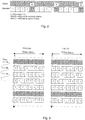
- Figure 3 shows downlink and uplink frames as seen from a base station in an 8-time-slot TDMA system.
- the structure in Figures 2 and 3 can be combined e.g. with GSM 51 multiframes if needed.
- the base station sends only control data C, and all time slots of the next four frames include information I that can be packet data. In such a case, the number ot information frames per unit time is decreased, resulting in a decrease in information rate also.
- one TDMA frame when the base station is receiving from the cell (uplink direction), one TDMA frame includes only control time slots C used for receiving requests, acknowledges, etc. sent by mobile stations. The next four TDMA frames include only time slots for receiving information I.
- a base station sends control or information to one mobile station in the same time slot of each TDMA frame. So the time slots sent to one mobile station are the time slots marked with the dotted arrow a.
- the mobile station receives one control burst in the time slot C and, after that, information I in four consecutive bursts if there is information for that mobile.
- This sequence is called a frame in this description. Frames are received as long as there is something to receive.
- a base station will receive from one mobile station in consecutive time slots marked with the dotted arrow b.
- the sequence consisting of a control time slot C and four consecutive information time slots I is called a frame in this description.
- FIG 2 shows the (dedicated) frame structure.
- Uplink frames consist of time slots marked with the dotted arrow b in Figure 3 as explained above and, correspondingly, downlink frames consist of time slots marked with the dotted arrow a.
- an I frame may also be longer or shorter.
- a four-burst I frame is only one alternative and it is possible to use TDMA frames of another length (8 bursts, for example). This is an optimization problem: the longer the frame, the longer the access delay and minimum packet size.
- the length of the frame in the physical layer is a system parameter.
- This code has a frame length of four bursts, or 456 bits. (A 228-bit block consisting of 184 bits of user data, 40 parity bits, and 4 tail bits is convolutionally encoded into 456 bits.)
- the interleaving depth is 4. The interleaving depth of 4, compared to 19 in circuit switched data transfer, reduces the transmission delay and minimum packet size.
- some other code like Reed-Solomon, could be used to encode the frames.
- an automatic retransmission request is used in a control time slot C to decrease the frame error rate when transferring from the physical layer to the upper layers.
- ARQ automatic retransmission request
- a data frame consists of 4 bursts which have had the error correction coding and frame check done for them.
- every fifth burst both in the downlink and uplink directions is used for control purposes.
- the frequency of control bursts may of course be increased from the proposed every fifth, optimizing efficiency and the power consumption of the mobile station.
- a control burst including a retransmission request ARQ, is transmitted as a normal burst.
- the ARQ is transmitted in an access-like burst with a long training sequence. Then the data part of the burst will not include a random number as usual but those bits will be replaced by ARQ bits. Hence, only a small part of an access-type control burst (here it is proposed 12 bits) is used for the retransmission request ARQ. A mobile station that does not know the exact timing advance is then able to transmit an ARQ burst. In the uplink direction, the control bursts include only ARQ bits.
- a transmitter/receiver Having transmitted the four-burst frame a transmitter/receiver will listen to the frame acknowledge. An erroneous frame will be immediately retransmitted and if the frame is correctly received, the transmission continues.
- the frames can be numbered to indicate the correct frames when requesting an automatic retransmission.
- the ARQ acknowledge has the same frame number which it will selectively acknowledge. It is even possible that every burst has a separately encoded block which is numbered.
- the raw information bit rate is about 19.7 kbps on one TCH/F channel with this configuration. By using all eight TDMA time slots for one Mobile Station (MS) the raw bit rate is about 158 kbps.
- the automatic retransmission request is used over the radio path, ie. between a MS and base station BTS.
- the control layer is used for transferring high level control messages. Still referring to Figure 3.
- the MAC algorithm is on top of layer 1, ie. every fifth burst is used for control purposes.
- Uplink and downlink channels are used asymmetrically and independently. The asymmetric use of a physical channel makes it possible to optimize the efficient use of channels. Data are usually sent in bursts with short intervals in one direction at a time. During another short interval the data flow may be in the opposite direction. This is carried out by separate channel allocation. Independence means that both uplink and downlink directions can be reserved independently of each other. The method can also be used symmetrically whereby uplink and downlink channels are reserved in pairs.
- the high level control messages carried in the downlink control time slots C are packet paging P and packet access grant PAG.
- PAG packet access grant
- PRA packet random access
- the uplink there is no special high level control time slot but a mobile station can send a packet random access (PRA) burst in any free I time slot to request a channel.
- PRA packet random access
- the physical layer there is a special control time slot in the uplink direction and it is used for the ARQ.
- Both the packet paging P and the packet access grant PAG can be combined in one burst of a control time slot C or the paging and request may be sent in separate control time slots C. Having the packet paging P and the packet access grant PAG in the same control burst is the optimal case, and that is possible if the number of bits available in one burst in the cellular system is sufficient. Control bursts are encoded independently, ie. no interleaving is used.
- a base station managing the radio resources monitors the states of the channels; in other words, which channels are free and which are reserved. It transmits a bitmap of free uplink channels in every downlink control burst as part of the burst; in Figure 4, right at the beginning of the burst.
- the bitmap indicates to the mobile station the idle channels at that moment on which it can send a packet channel request in the form of an access burst.
- Also included in the control burst are the packet paging, packet access grant, and the automatic retransmission request ARQ of the physical layer.
- the packet paging P part of the burst is used for informing the mobile station about incoming packet data transmission.
- the paging also includes the temporary packet mobile identity TMPI, temporary logical link identity TLLI in GSM GRPS, and a description of the channels reserved by the network for the mobile terminated data transmission.
- the third part of the control burst, the packet access grant PAG includes a random number used to distinguish various requesters, a bitmap of the channels reserved for the connection, and the timing advance TA.
- the last part of the burst includes an ARQ for acknowledging layer 1 messages.
- the bit contents of the burst fields could be as shown in the exemplary table of Figure 5.
- the P and PAG together would take up 55 bits and ARQ 12 bits, thus making up a total of 67 bits in the burst.
- the combined burst can be used in any application system provided that the number of information bits in the burst is sufficient, ie. the number of information bits is the same or higher than in the GSM system.
- FIGS 6 and 8 illustrate another alternative for transferring paging and acknowledge bursts.
- the bursts are sent separately with the P and PAG in their own control bursts.
- the P and PAG time slots share the downlink control channel. These time slots are sent alternately, for example. Every other control time slot C is for the paging P and every other for the acknowledge PAG.
- a mobile station will distinguish between paging and acknowledge by checking the steal bit in the burst.
- a P time slot will have "1" as the steal bit and a PAG time slot will have a "0" or vice versa.
- the separate packet paging burst structure includes first the bitmap to indicate free/reserved channels.
- the bitmap consists of 8 consecutive bits if the TDMA frame is 8 time slots.
- the next field is the paging field in which the first part is the temporary mobile identity TMPI and the second part a bitmap which indicates to the mobile station the channels reserved by the network for the transmission of packet data, which the mobile station has to use for receiving packet data.
- TMPI temporary mobile identity
- the second part a bitmap which indicates to the mobile station the channels reserved by the network for the transmission of packet data, which the mobile station has to use for receiving packet data.
- the field for the automatic retransmission request is shown as an example the bit contents of the paging field when the cellular network is a GSM network.
- the field includes 60 bits if the TMPI is the GSM's temporary mobile subscriber identity TMSI. A shorter TMPI, 25 bits, for example, will suffice.
- the separate packet access grant PAG burst includes first a bitmap to indicate free/reserved channels.
- the next field is the acknowledge field for the packet random access sent by a mobile station.
- There the first part is a random number included in the request sent by the MS.
- Then follows a bitmap that indicates to the mobile station the channels reserved by the network for the transmission of packet data. The mobile station will use these channels to send packet data.
- the random number used in the request is used to indicate the packet access grant to a specific mobile station (mapping of PRA to PAG). Mobile stations in the cell will listen during this time slot and the random number will tell a particular mobile station that the acknowledge is meant for it.
- the table in Figure 9 shows the bit contents of the control time slot presented in Figure 8 if the application system is the GSM.
- the bits indicating the number of requested time slots as well as those indicating the priority are optional.
- the base station schedules the reservation of an uplink channel. It has the knowledge of free and reserved channels and that information is transmitted in every downlink control burst, as explained above.
- the bitmap consists of 8 bits, one for each time slot in a TDMA frame if the frame is a TDMA frame with 8 time slots.
- the reserved channels are marked with bit 1 and idle channels with bit 0. If the network is not using all 8 time slots for the packet transmission service, then only those channels that are used may be marked idle. The rest of the channels are treated as if they were reserved, ie. bit 1 is sent.
- a mobile station which has data in its buffer and wants to send it monitors the control bursts sent in the downlink C time slots. Monitoring is continued until the bitmap shows that an uplink channel is marked idle. As soon as the idle channel is found, an access burst (channel request) according to Figure 10 is transmitted in an I time slot marked idle.
- This burst carrying the packet random access burst PRA is randomly selected as one of four, for example, if the frame used is four bursts.
- the packet random access PRA is similar to the access burst in the GSM system, for example, with a long training sequence. Then the data part of the burst will not include a random number as usual but those bits will be replaced by the PRA bits.
- An access burst consists of a random number sent back by the base station in the acknowledge burst, a number indicating how many time slots the mobile station wants, a four-level priority number, and finally a bit indicating whether or not the time slots have to be consecutive.
- the requirement for consecutive time slots is needed to support certain mobile classes. There might be a mobile station capable of handling, say, two packet time slots if they are consecutive in a TDMA frame but not if the time slots are a distance apart.
- Figure 11 shows the possible bit contents of the fields.
- the burst consists of at least 11 bits.
- a base station receives an access burst PRA, it sends a packet access grant PAG in a downlink control burst C. If multiple consecutive access bursts are received before the next packet access grant can be transmitted, the priority or random selection is used to assign the channel for a mobile station. If there are not as many time slots available as requested, the base station can give as many as there are free.
- a mobile station When a mobile station has received an acknowledge PAG sent by a base station for a channel request PRA it starts to transmit packet data on the reserved channel consisting of one or more time slots, up to the maximum amount. It is possible to transmit during one reservation at least 128 octets which is the usual X.25 maximum packet size. 128 octets equals six 4-octet blocks. This means that the maximum amount of data transmitted during one reservation depends on the number of time slots used and that there has to be a limit value set in case the transmission fails and a retransmission is required. The limit value has to be more than 6, because in the case of retransmission 6 frames will not be enough to transmit all.
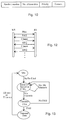
- Figure 12 shows a signalling chart for mobile originated packets.
- a mobile station MS sends a channel request PRA acknowledged by a base station in a packet access grant burst PAG.
- the mobile station transmits packet data in time slots of one frame and the base station acknowledges or sends a retransmission request. This goes on until all packet data have been transmitted or time-out occurs.
- Figure 13 is a state transition diagram illustrating the events in a mobile station during packet transmission from a base station to the network.
- the mobile station goes from idle state to receive state and receives the information in the first control time slot from the base station. It consults the bitmap to see whether there are any free channels, and if not, checks the information in the next control time slot. This goes on until a free channel is found. Immediately after that, a channel request is sent on the free channel and if the base station acknowledges, packet data is transmitted on the dedicated channel. If no acknowledge is received, the mobile station returns to receive control time slots and search for a free channel.
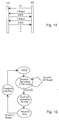
- Figure 14 illustrates a case where a network sends packet data addressed to a mobile station MS.
- a base station initiates a downlink transmission by sending a packet paging P in a control time slot C.
- the packet paging includes the mobile station identity and the reserved time slots. These time slots begin in the next TDMA frame. As soon as the MS receives the packet paging it starts receiving in the defined time slots.
- Packet pagings are transmitted in every consecutive time slot of a downlink control sequence to inform mobile stations about incoming packets. This means that a mobile station must listen to all packet paging channels in order to find out if there are packets coming to it. This of course uses energy stored in the mobile station's battery. To optimize the power consumption mobile stations can be divided into different paging groups according to the temporary identity or IMSI, for example. Then a mobile station has to listen to only one time slot in a TDMA frame instead of all the time slots. There can be eight time slots, so it is more practical to listen to one time slot only. The paging frequency can be still decreased to support discontinuous reception DRX.
- the DRX power saving function can also be combined with the paging burst used in the present GSM system by adding the code "incoming packet" in the burst. Then a mobile station will listen to standard pagings and the code will inform it about an incoming packet transmission. Then the mobile station will start listening to the packet paging channel P and receive the necessary information from that channel. Of course, the network needs to know whether the mobile station is listening to the standard paging channel or the packet paging channel. The mobile station sends this information in a short management message.
- the base station does not receive an ARQ acknowledge in a certain number of frames, say, in seven frames, it draws the conclusion that the mobile station is not receiving frames correctly. Then the packet paging will be repeated.
- Figure 15 shows a mobile station state transition diagram for the case presented in Figure 14. Understanding the diagram is easy on the basis of the description related to Figure 14, so further explanations are not needed. It is, however, pointed out that most of the time the mobile station is receiving control bursts and determining if there is a packet data transmission coming to it.
- the frame used in the data link layer may be variable in length.
- a maximum length of, say, 128 octets, as in the X.25 protocol, can be chosen.
- a variable length reduces the number of acknowledges in the link layer and thus the number of reservations.
- control time slots need not be as shown in Figure 3 but they can be moved diagonally, as illustrated by Figure 16.
- control time slot C In each frame, the control time slot C is moved forward one time slot, thus creating a diagonal pattern of control time slots both in the uplink and downlink frames as shown in Figure 16.
- a dedicated frame still consists of a control time slot C and four information time slots I, as in the case illustrated by Figure 3.
Landscapes
- Engineering & Computer Science (AREA)
- Computer Networks & Wireless Communication (AREA)
- Signal Processing (AREA)
- Mobile Radio Communication Systems (AREA)
- Radio Relay Systems (AREA)
- Time-Division Multiplex Systems (AREA)
Applications Claiming Priority (2)
| Application Number | Priority Date | Filing Date | Title |
|---|---|---|---|
| FI942702A FI98427C (fi) | 1994-06-08 | 1994-06-08 | Järjestelmäpakettidatan siirtämiseksi eri bittinopeuksilla TDMA-solukkojärjestelmässä |
| FI942702 | 1994-06-08 |
Related Child Applications (1)
| Application Number | Title | Priority Date | Filing Date |
|---|---|---|---|
| EP02077340 Division | 2002-06-10 |
Publications (3)
| Publication Number | Publication Date |
|---|---|
| EP0687078A2 true EP0687078A2 (de) | 1995-12-13 |
| EP0687078A3 EP0687078A3 (de) | 1997-11-05 |
| EP0687078B1 EP0687078B1 (de) | 2003-04-09 |
Family
ID=8540875
Family Applications (1)
| Application Number | Title | Priority Date | Filing Date |
|---|---|---|---|
| EP95303825A Expired - Lifetime EP0687078B1 (de) | 1994-06-08 | 1995-06-05 | System zur Datenpaketübertragung in einer TDMA-Telefunkanordnung |
Country Status (7)
| Country | Link |
|---|---|
| US (1) | US5729541A (de) |
| EP (1) | EP0687078B1 (de) |
| JP (1) | JP3880642B2 (de) |
| CN (1) | CN1088309C (de) |
| AT (1) | ATE237202T1 (de) |
| DE (1) | DE69530246T2 (de) |
| FI (1) | FI98427C (de) |
Cited By (39)
| Publication number | Priority date | Publication date | Assignee | Title |
|---|---|---|---|---|
| DE19605223A1 (de) * | 1996-02-13 | 1997-08-14 | Sel Alcatel Ag | Verfahren zum Betreiben einer Breitband-Verbindung zwischen einem Mobilfunk-Endgerät und einer netzseitigen Mobilfunkeinrichtung sowie Mobilfunk-Endgerät, netzseitige Mobilfunkeinrichtung und Mobilfunksystem |
| WO1998020632A1 (en) * | 1996-11-05 | 1998-05-14 | Ericsson Inc. | Power-saving method for providing synchronization in a communications system |
| DE19702028A1 (de) * | 1997-01-23 | 1998-08-06 | Bosch Gmbh Robert | Einrichtung für ein Funksystem, insbesondere für Punkt-zu-Mehrpunkt-Verbindungen |
| WO1998024250A3 (en) * | 1996-11-27 | 1998-10-01 | Ericsson Telefon Ab L M | Method and apparatus for improving performance of a packet communications system |
| EP0876715A1 (de) * | 1996-02-07 | 1998-11-11 | Lutron Electronics Co., Inc. | Fernsteuerung und fernzustandsüberwachung elektronischer geräte |
| WO1998056124A1 (en) * | 1997-06-03 | 1998-12-10 | British Telecommunications Public Limited Company | Channel allocation system |
| FR2764463A1 (fr) * | 1997-06-10 | 1998-12-11 | Alsthom Cge Alcatel | Procede d'allocation de canaux de transmission a une station mobile, notamment en mode semi-duplex, dans un reseau de telecommunications mobiles, en mode paquet |
| WO1998038818A3 (de) * | 1997-02-24 | 1998-12-23 | Siemens Ag | Verfahren und basisstationssystem zum rufen von mobilstationen für eine paketdatenübertragung |
| EP0889664A3 (de) * | 1997-06-09 | 1999-03-17 | Lucent Technologies Inc. | Überlastregelung auf einen Direkt-Zugriffskanal für Rückquittierungsnachrichten eines Rundsende-Teleservices |
| DE19747398A1 (de) * | 1997-10-27 | 1999-04-29 | Ericsson Telefon Ab L M | Kommunikationssystem |
| EP0917317A1 (de) * | 1997-10-14 | 1999-05-19 | Lucent Technologies Inc. | Verfahren zur Konfliktauflösung in einem Vielfachzugriffssystem für Kommunikationsnetze |
| WO1999043180A1 (en) * | 1998-02-19 | 1999-08-26 | Qualcomm Incorporated | A method and apparatus for maximizing standby time using a quick paging channel |
| EP0796025A3 (de) * | 1996-03-12 | 1999-09-29 | Ntt Mobile Communications Network Inc. | Intermittierender Empfang von Rufsignalen in einem mobilen Kommunikationssystem |
| WO1999049592A1 (en) * | 1998-03-24 | 1999-09-30 | Vistar Telecommunications Inc. | Tdma packet data communication system |
| EP1094636A1 (de) * | 1999-10-22 | 2001-04-25 | Alcatel | Vielfachzugriffübertragungsverfahren |
| EP0920226A3 (de) * | 1997-11-28 | 2001-04-25 | Nec Corporation | Zufallsbedingte Zugriffssteuerung in einem mobilen Kommunikationssystem ohne Unterbrechung der kontinuierlichen Übertragung |
| EP0925693A4 (de) * | 1997-02-21 | 2002-01-02 | Motorola Inc | Verfahren und gerät zum zuweisen von frequenzressourcen eines drahtlosen kommunikationssystem |
| EP1207709A1 (de) * | 2000-11-15 | 2002-05-22 | NTT DoCoMo, Inc. | Verfahren und Vorrichtung zum Steuern von Wiederübertragung |
| US6421540B1 (en) | 1997-05-30 | 2002-07-16 | Qualcomm Incorporated | Method and apparatus for maximizing standby time using a quick paging channel |
| EP0948149A3 (de) * | 1998-04-02 | 2002-10-23 | Lg Electronics Inc. | Verfahren zur Kommunikation zwischen einer mobile Station und einer Basisstation in einer mobile Kommunikationsanordnung |
| EP1109334A3 (de) * | 1999-12-10 | 2003-01-02 | Lucent Technologies Inc. | Burst Zugriffs- und Zuweisungs-Verfahren und System zur Bereitstellung von Echtzeitdiensten |
| US6522638B1 (en) | 1998-03-24 | 2003-02-18 | Vistar Telecommunications Inc. | Packet data communication system with buffered data and control channels |
| EP1289328A1 (de) * | 2001-08-28 | 2003-03-05 | Lucent Technologies Inc. | Verfahren zum Senden von Steuerungsinformation in einem drahtlosen Übertragungsnetzwerk und Vorrichtung dafür |
| EP1081981A4 (de) * | 1999-03-16 | 2004-04-21 | Mitsubishi Electric Corp | Mobiles kommunikationssystem |
| SG108329A1 (en) * | 2000-06-26 | 2005-01-28 | Ntt Docomo Inc | Communication system employing automatic repeat request |
| EP1587336A1 (de) * | 2004-04-14 | 2005-10-19 | Motorola, Inc. | Entfernte Einheit, Vorrichtung, Zellularkomminikationssystem und Betriebsverfahren dafür |
| WO2007050931A3 (en) * | 2005-10-27 | 2007-07-19 | Qualcomm Inc | Calculating rquickpage in wireless communication systems |
| EP1348261A4 (de) * | 2000-06-21 | 2007-09-26 | Motorola Inc | Verfahren und schneller aufwärtszugriff durch gsm-gprs/edge-mobilstationen, die am voice-over-internet-protokollpakettransfermodus beteiligt sind |
| WO2008070212A3 (en) * | 2006-07-14 | 2008-09-04 | Qualcomm Inc | Methods and apparatus related to resource allocation in a wireless communications system |
| CN1835640B (zh) * | 1999-01-11 | 2010-09-29 | 摩托罗拉公司 | 群交换分组移动寻呼方法 |
| EP2276282A1 (de) * | 1997-06-20 | 2011-01-19 | Tantivy Communications, Inc. | Protokollumwandlungs- und Bandbreitenreduzierungsverfahren mit mehreren nB+D-ISBN-Basisraten-Schnittstellenlinks über ein drahtloses Mehrfachzugangs-Codeteilungs-Kommunikationssystem |
| US8199661B2 (en) | 2005-10-27 | 2012-06-12 | Qualcomm Incorporated | Method and apparatus for processing supplemental and non supplemental assignments |
| EP1207637B1 (de) * | 2000-11-17 | 2012-08-29 | Thales | Verfahren zum erhöhen der datenrate in einem telekommunikationsnetz |
| US8457092B2 (en) | 2005-06-16 | 2013-06-04 | Qualcomm Incorporated | Quick paging channel with reduced probability of missed page |
| US8761080B2 (en) | 2005-03-15 | 2014-06-24 | Qualcomm Incorporated | Multiple other sector information combining for power control in a wireless communication system |
| US9055552B2 (en) | 2005-06-16 | 2015-06-09 | Qualcomm Incorporated | Quick paging channel with reduced probability of missed page |
| EP2881964A1 (de) * | 2013-11-11 | 2015-06-10 | Rockwell Automation Technologies, Inc. | Modulare Überlastrelaisanordnung mit modularer Kommunikation und menschliches Schnittstellenmodul |
| US9408216B2 (en) | 1997-06-20 | 2016-08-02 | Intel Corporation | Dynamic bandwidth allocation to transmit a wireless protocol across a code division multiple access (CDMA) radio link |
| EP3072272B1 (de) * | 2013-11-18 | 2018-07-18 | Qualcomm Incorporated | Bestimmung einer reichweite für drahtlose verbindung |
Families Citing this family (126)
| Publication number | Priority date | Publication date | Assignee | Title |
|---|---|---|---|---|
| US6301242B1 (en) * | 1998-07-24 | 2001-10-09 | Xircom Wireless, Inc. | Communication system with fast control traffic |
| US6041046A (en) * | 1995-07-14 | 2000-03-21 | Omnipoint Corporation | Cyclic time hopping in time division multiple access communication system |
| DE19549009C2 (de) * | 1995-12-28 | 1998-08-13 | Siemens Ag | Verfahren und Funkstation zum Übertragen von Informationen über ein GSM-Mobilfunknetz |
| EP0831612B1 (de) * | 1996-03-15 | 2009-06-17 | Ntt Mobile Communications Network Inc. | Mobiles nachrichtenübertragungssystem |
| US5790534A (en) * | 1996-09-20 | 1998-08-04 | Nokia Mobile Phones Limited | Load control method and apparatus for CDMA cellular system having circuit and packet switched terminals |
| ATE201118T1 (de) * | 1996-11-08 | 2001-05-15 | Cit Alcatel | Datenübertragungssynchronisierungsverfahren zwischen einem sender und einem empfänger |
| UA53669C2 (uk) * | 1996-11-18 | 2003-02-17 | Сіменс Акцієнгезельшафт | Спосіб та система базової станції для конфігурування радіоінтерфейсу між мобільною станцією та базовою станцією мобільної радіосистеми пакетної передачі даних з часовим мультиплексуванням |
| US6606309B1 (en) * | 1996-11-19 | 2003-08-12 | Ericsson Inc. | Time-multiplexed short message acknowledgement systems and methods |
| FI105371B (fi) * | 1996-12-31 | 2000-07-31 | Nokia Networks Oy | Radiojärjestelmä ja menetelmiä kaksisuuntaisen radioyhteyden muodostamiseksi |
| FI105136B (fi) | 1997-04-21 | 2000-06-15 | Nokia Mobile Phones Ltd | Yleinen pakettiradiopalvelu |
| FI103540B (fi) * | 1997-04-28 | 1999-07-15 | Nokia Mobile Phones Ltd | Menetelmä pakettikytkentäisen datan siirtoon matkapuhelinjärjestelmäss ä |
| FI103541B (fi) | 1997-04-28 | 1999-07-15 | Nokia Mobile Phones Ltd | Menetelmä pakettikytkentäisen datan siirtoon matkapuhelinjärjestelmäss ä |
| SE511770C2 (sv) * | 1997-06-12 | 1999-11-22 | Telia Ab | Kanalallokering för ett kommunikationssystem |
| US6542481B2 (en) * | 1998-06-01 | 2003-04-01 | Tantivy Communications, Inc. | Dynamic bandwidth allocation for multiple access communication using session queues |
| FI104135B1 (fi) * | 1997-06-24 | 1999-11-15 | Nokia Mobile Phones Ltd | Aikajakoiset monikäyttöradiojärjestelmät |
| US6157632A (en) * | 1997-07-16 | 2000-12-05 | Motorola, Inc. | Low complexity protocol method device and system robust in the presence of bursted |
| US7349333B2 (en) | 1997-07-30 | 2008-03-25 | At&T Delaware Intellectual Property, Inc. | Associated systems and methods for providing data services using idle cell resources |
| US7046643B1 (en) | 1997-07-30 | 2006-05-16 | Bellsouth Intellectual Property Corporation | Method for dynamic multi-level pricing for wireless communications according to quality of service |
| US7050445B1 (en) | 1997-07-30 | 2006-05-23 | Bellsouth Intellectual Property Corporation | System and method for dynamic allocation of capacity on wireless networks |
| US7065061B1 (en) * | 1997-07-30 | 2006-06-20 | Bellsouth Intellectual Property Corporation | System and method for providing data services using idle cell resources |
| US6069882A (en) * | 1997-07-30 | 2000-05-30 | Bellsouth Intellectual Property Corporation | System and method for providing data services using idle cell resources |
| FI105874B (fi) | 1997-08-12 | 2000-10-13 | Nokia Mobile Phones Ltd | Monipistematkaviestinlähetys |
| FI106175B (fi) | 1997-08-18 | 2000-11-30 | Nokia Mobile Phones Ltd | Datansiirto matkaviestinverkossa |
| US6038223A (en) * | 1997-10-22 | 2000-03-14 | Telefonaktiebolaget Lm Ericsson (Publ) | Access scheme for packet data in a digital cellular communication system |
| DE19746691B4 (de) * | 1997-10-22 | 2005-09-22 | Telefonaktiebolaget Lm Ericsson (Publ) | Übertragungsstation, Mobileinheiten und Verfahren zur Übertragung von Daten für ein drahtloses paketorientiertes Kommunikationssystem |
| US6157614A (en) | 1997-10-22 | 2000-12-05 | Netro Corporation | Wireless ATM network with high quality of service scheduling |
| US6044069A (en) * | 1997-10-29 | 2000-03-28 | Conexant Systems, Inc. | Power management system for a mobile station |
| FI105760B (fi) | 1997-10-30 | 2000-09-29 | Nokia Mobile Phones Ltd | Matkaviestinverkon aliverkkoriippuvainen konvergenssiprotokolla |
| FI110351B (fi) | 1997-11-11 | 2002-12-31 | Nokia Corp | Menetelmä radiosignaalin lähetyksen aikavälien tahdistamiseksi sekä menetelmän mukainen radiopuhelinverkko, tukiasema-alajärjestelmä ja matkaviestin |
| JP3204303B2 (ja) | 1997-11-28 | 2001-09-04 | 日本電気株式会社 | 無線atm通信方式 |
| US6301239B1 (en) * | 1997-12-17 | 2001-10-09 | Motorola, Inc. | Distributed packet communication network |
| FI974558A7 (fi) | 1997-12-18 | 1999-06-19 | Nokia Corp | Resurssin varaus liikkuvassa Internet-protokollassa |
| US6400698B1 (en) * | 1998-01-29 | 2002-06-04 | Northern Telecom Limited | State machine and random reserve access protocol for IS136 based TDMA packet date mobile stations |
| SE513950C2 (sv) * | 1998-02-12 | 2000-12-04 | Ericsson Telefon Ab L M | Förfarande och anordning i ett mobiltelekommunikationsnät för att åstadkomma en flerkanalsföbindelse |
| US6272117B1 (en) * | 1998-02-20 | 2001-08-07 | Gwcom, Inc. | Digital sensing multi access protocol |
| US6094429A (en) * | 1998-03-02 | 2000-07-25 | Motorola, Inc. | Method for accessing and providing access to a packet channel |
| CA2261548A1 (en) * | 1998-03-06 | 1999-09-06 | Lucent Technologies Inc. | Time division multiple access communication system |
| JPH11266215A (ja) * | 1998-03-16 | 1999-09-28 | Fujitsu Ltd | 地域型情報端末装置 |
| US6088578A (en) * | 1998-03-26 | 2000-07-11 | Nortel Networks Corporation | Burst request method and apparatus for CDMA high speed data |
| FI108829B (fi) | 1998-04-02 | 2002-03-28 | Nokia Corp | Menetelmä pakettiverkossa |
| FI106331B (fi) | 1998-04-30 | 2001-01-15 | Nokia Mobile Phones Ltd | Menetelmä ja laitteisto joutokehysten käytön ohjaamiseksi |
| US7123628B1 (en) * | 1998-05-06 | 2006-10-17 | Lg Electronics Inc. | Communication system with improved medium access control sub-layer |
| FI105743B (fi) | 1998-05-27 | 2000-09-29 | Nokia Mobile Phones Ltd | Menetelmä multimediaviestien välittämiseksi ja multimediaviestien välitysjärjestelmä |
| SE523431C2 (sv) * | 1998-06-26 | 2004-04-20 | Ericsson Telefon Ab L M | Metod och anordning i ett cellulärt radiokommunikationssystem |
| FI105734B (fi) * | 1998-07-03 | 2000-09-29 | Nokia Networks Oy | Automaattinen uudelleenlähetys |
| FI107861B (fi) | 1998-08-28 | 2001-10-15 | Nokia Mobile Phones Ltd | Naapurisolumittaukset solun uudelleenvalintaa varten |
| US7324544B1 (en) | 1998-09-11 | 2008-01-29 | Cirrus Logic, Inc. | Network slot synchronization scheme for a computer network communication channel |
| AU5910399A (en) * | 1998-09-11 | 2000-04-03 | Sharewave, Inc. | Method and apparatus for accessing a computer network communication channel |
| FI982000A7 (fi) | 1998-09-16 | 2000-03-17 | Nokia Mobile Phones Ltd | Parannettu menetelmä ja järjestely solun vaihtamiseksi |
| US6996088B1 (en) | 1998-09-18 | 2006-02-07 | Harris Corporation | Distributed trunking mechanism for VHF networking |
| WO2000018041A2 (en) * | 1998-09-18 | 2000-03-30 | Harris Corporation | Distributed trunking mechanism for vhf networking |
| US6621801B1 (en) * | 1998-09-29 | 2003-09-16 | Northrop Grumman Corporation | Distributed control DAMA protocol for use with a processing communications satellite |
| KR100563592B1 (ko) * | 1998-10-01 | 2006-09-22 | 엘지전자 주식회사 | 이동통신시스템에서의 데이터 분기방법 |
| US6539007B1 (en) * | 1998-11-16 | 2003-03-25 | Samsung Electronics Co., Ltd. | System and method for multiple single-phase access in a TDMA wireless network |
| US6504827B1 (en) * | 1998-12-18 | 2003-01-07 | Lucent Technologies Inc. | Discontinuous transmission on high speed data channels |
| US7123624B1 (en) * | 1999-01-14 | 2006-10-17 | Cape Range Wireless, Ltd. | System and method for single-point to fixed-multipoint data communication |
| FI106762B (fi) * | 1999-02-16 | 2001-03-30 | Nokia Mobile Phones Ltd | Menetelmä ja järjestelmä eräiden neuvottelujen toteuttamiseksi pakettidataverkossa |
| US6574267B1 (en) * | 1999-03-22 | 2003-06-03 | Golden Bridge Technology, Inc. | Rach ramp-up acknowledgement |
| US6891852B1 (en) * | 1999-04-08 | 2005-05-10 | Lucent Technologies Inc. | Method of dynamically adjusting the duration of a burst transmission in wireless communication systems |
| US6798744B1 (en) * | 1999-05-14 | 2004-09-28 | Pmc-Sierra, Inc. | Method and apparatus for interconnection of flow-controlled communication |
| US6665307B1 (en) * | 1999-07-02 | 2003-12-16 | Telefonaktiebolaget Lm Ericsson (Publ) | Variable fast page mode |
| US6185227B1 (en) * | 1999-07-22 | 2001-02-06 | Nokia Networks Oy | Method and packet radio system for transmitting modulation and signalling information |
| KR100424654B1 (ko) | 1999-08-02 | 2004-03-24 | 삼성전자주식회사 | 이동 통신시스템에서 라디오링크프로토콜에 따른 데이터 재전송 장치 및 방법 |
| US7545774B1 (en) | 1999-08-26 | 2009-06-09 | Nokia Corporation | Method for indicating power consumption in a packet switched communication system |
| US7023833B1 (en) * | 1999-09-10 | 2006-04-04 | Pulse-Link, Inc. | Baseband wireless network for isochronous communication |
| US20040090983A1 (en) * | 1999-09-10 | 2004-05-13 | Gehring Stephan W. | Apparatus and method for managing variable-sized data slots within a time division multiple access frame |
| FI109508B (fi) * | 1999-09-28 | 2002-08-15 | Nokia Corp | Menetelmä Abis-rajapinnan transmissiokanavien allokoimiseksi pakettisolukkoradioverkossa ja pakettisolukkoradioverkon verkko-osa |
| US7088795B1 (en) * | 1999-11-03 | 2006-08-08 | Pulse-Link, Inc. | Ultra wide band base band receiver |
| US6683853B1 (en) * | 1999-12-01 | 2004-01-27 | Telefonaktiebolaget Lm Ericsson (Publ) | Dynamic upgrade of quality of service in a packet switched network |
| US6567396B1 (en) * | 1999-12-13 | 2003-05-20 | Telefonaktiebolaget Lm Ericsson (Publ) | Adaptive throughput in packet data communication systems using idle time slot scheduling |
| JP3651340B2 (ja) * | 1999-12-28 | 2005-05-25 | ソニー株式会社 | 無線伝送方法および無線伝送装置 |
| US6654384B1 (en) * | 1999-12-30 | 2003-11-25 | Aperto Networks, Inc. | Integrated self-optimizing multi-parameter and multi-variable point to multipoint communication system |
| AU2756201A (en) * | 2000-01-07 | 2001-07-16 | Mdiversity, Inc. | Dynamic channel allocation in multiple-access communication systems |
| US20030214933A1 (en) * | 2000-01-13 | 2003-11-20 | Cape Range Wireless Malaysia Sdn | System and method for single-point to fixed-multipoint data communication |
| US6567397B1 (en) * | 2000-02-15 | 2003-05-20 | Sophia Communications, Inc. | System and method for wireless exchange of data in a non-real-time data communications system |
| DE10009401C2 (de) * | 2000-02-28 | 2003-07-24 | Siemens Ag | Verfahren, Mobilfunksystem und Station zur Ermittlung einer Vorhaltezeit für eine Verbindung zwischen zwei Stationen |
| US20020001296A1 (en) * | 2000-04-10 | 2002-01-03 | Yu-Ro Lee | Data transmission method for hybrid ARQ type II/III downlink of wide-band radio communication system |
| JP3569724B2 (ja) * | 2000-04-10 | 2004-09-29 | ユーティースターコム コリア リミテッド | 広帯域無線通信システムにおけるハイブリッド自動再伝送要求方式2/3のためのデータ伝送方法 |
| JP3507810B2 (ja) | 2000-04-10 | 2004-03-15 | ヒュンダイ エレクトロニクス インダストリーズ カムパニー リミテッド | 広帯域無線通信システムのダウンリンクにおけるハイブリッド自動再送要求2/3方式のためのデータ処理方法 |
| US20020021698A1 (en) * | 2000-04-10 | 2002-02-21 | Yu-Ro Lee | Data transmission method for hybrid ARQ type II/III uplink for a wide-band radio communication system |
| JP2001313646A (ja) * | 2000-04-27 | 2001-11-09 | Sony Corp | 電子機器およびその物理層回路のステート制御方法 |
| CA2313314A1 (en) * | 2000-06-30 | 2001-12-30 | Soma Networks, Inc. | Control channel for a wireless digital subscriber line system |
| US6996060B1 (en) | 2001-03-20 | 2006-02-07 | Arraycomm, Inc. | Closing a communications stream between terminals of a communications system |
| US6636488B1 (en) * | 2000-10-11 | 2003-10-21 | Aperto Networks, Inc. | Automatic retransmission and error recovery for packet oriented point-to-multipoint communication |
| US7085494B2 (en) | 2000-10-12 | 2006-08-01 | At & T Corp. | High-capacity packet-switched ring network |
| US7113494B1 (en) * | 2000-10-17 | 2006-09-26 | Sprint Communications Company L.P. | Broadband wireless communications using multiple contention channels |
| US7190685B2 (en) * | 2001-02-08 | 2007-03-13 | Lucent Technologies Inc. | Control information transmission in a wireless communication system |
| JP4724928B2 (ja) | 2001-02-27 | 2011-07-13 | ソニー株式会社 | 無線伝送装置及び無線伝送方法 |
| US6660948B2 (en) | 2001-02-28 | 2003-12-09 | Vip Investments Ltd. | Switch matrix |
| US7339906B1 (en) * | 2001-03-20 | 2008-03-04 | Arraycomm, Llc | Opening a communications stream between a user terminal and a base station |
| DE10122099A1 (de) * | 2001-05-07 | 2003-01-02 | Alcatel Sa | Verfahren zum Betreiben eines funkbasierten Kommunikationssystems |
| WO2002093950A2 (en) * | 2001-05-14 | 2002-11-21 | Marconi Communications Gmbh | Method of, and system for, reserving timeslots in a tdma system |
| US20040136334A1 (en) * | 2001-06-15 | 2004-07-15 | Gilat Satellite Networks, Ltd. | Efficient access in satellite communication system |
| US7457267B1 (en) * | 2001-10-10 | 2008-11-25 | Qualcomm Incorporated | Methods and apparatus for quickly exploiting a new link during hand-off in a wireless network |
| EP1326460A1 (de) * | 2001-12-21 | 2003-07-09 | Siemens Aktiengesellschaft | Verfahren und System zum Funkzellenwechsel in einem zellularen Paketnetzwerk |
| US20030125061A1 (en) * | 2001-12-31 | 2003-07-03 | Bysted Tommy Kristensen | Downlink access control |
| US20030123426A1 (en) * | 2001-12-31 | 2003-07-03 | Bysted Tommy Kristensen | Uplink access control |
| US7295624B2 (en) * | 2002-03-06 | 2007-11-13 | Texas Instruments Incorporated | Wireless system with hybrid automatic retransmission request in interference-limited communications |
| WO2003092213A1 (en) * | 2002-04-24 | 2003-11-06 | Samsung Electronics Co., Ltd. | Apparatus and method for supporting automatic repeat request in a high-speed wireless packet data communication system |
| US7164670B2 (en) * | 2002-06-11 | 2007-01-16 | Motorola, Inc. | Method for assigning inbound transmissions with minimal signaling overhead |
| KR20050069978A (ko) | 2002-08-13 | 2005-07-05 | 코닌클리즈케 필립스 일렉트로닉스 엔.브이. | 통신 시스템, 주 스테이션, 부 스테이션 및 통신 시스템동작 방법 |
| US7006831B2 (en) * | 2002-09-27 | 2006-02-28 | Bellsouth Intellectual Property Corporation | Apparatus and method for providing dynamic communications network traffic control |
| GB2394144B (en) * | 2002-10-10 | 2005-01-26 | Motorola Inc | Regulation of time intervals in a wireless communication system |
| EP2393250A1 (de) * | 2002-12-04 | 2011-12-07 | Interdigital Technology Corporation | Zuverlässigkeitserkennung des CQI und Anwendung zur Sendeleistungsregelung |
| KR101022066B1 (ko) * | 2003-05-17 | 2011-03-17 | 엘지전자 주식회사 | 이동통신 시스템에서의 하향링크 제어채널 구조 및 이를이용한 시간-코드 할당방법 |
| JP4195716B2 (ja) * | 2003-06-27 | 2008-12-10 | ノキア コーポレイション | 無線通信ネットワークでのパケット集約のための方法及び装置 |
| KR101009861B1 (ko) * | 2003-08-19 | 2011-01-19 | 삼성전자주식회사 | 이동통신 시스템에서의 데이터 전송 방법과 전송률 할당 방법 및 이를 위한 장치 |
| US7755506B1 (en) | 2003-09-03 | 2010-07-13 | Legrand Home Systems, Inc. | Automation and theater control system |
| US7307542B1 (en) | 2003-09-03 | 2007-12-11 | Vantage Controls, Inc. | System and method for commissioning addressable lighting systems |
| US7394451B1 (en) | 2003-09-03 | 2008-07-01 | Vantage Controls, Inc. | Backlit display with motion sensor |
| US7200405B2 (en) | 2003-11-18 | 2007-04-03 | Interdigital Technology Corporation | Method and system for providing channel assignment information used to support uplink and downlink channels |
| US7512068B1 (en) * | 2004-07-02 | 2009-03-31 | Nortel Networks Limited | Call admission control for a wireless network |
| US9240834B2 (en) * | 2005-03-22 | 2016-01-19 | Hughes Network Systems, Llc | Method and apparatus for providing open loop bandwidth allocation |
| JP4675167B2 (ja) | 2005-06-14 | 2011-04-20 | 株式会社エヌ・ティ・ティ・ドコモ | チャネル割り当て方法、無線通信システム、基地局装置、ユーザ端末 |
| US7778262B2 (en) | 2005-09-07 | 2010-08-17 | Vantage Controls, Inc. | Radio frequency multiple protocol bridge |
| USRE48984E1 (en) * | 2006-03-07 | 2022-03-22 | Electronics And Telecommunications Research Institute | Method for reducing power consumption of a terminal in cellular system |
| US20080062944A1 (en) * | 2006-09-08 | 2008-03-13 | Motorola, Inc. | Apparatus and Method For Automatic Repeat Request Signalling With Reduced Retransmission Indications in a Wireless VoIP Communication System |
| CA2613642A1 (en) * | 2006-12-06 | 2008-06-06 | Sr Telecom Inc. | Half duplex frequency division duplex scheduling |
| WO2009004681A1 (ja) * | 2007-06-29 | 2009-01-08 | Fujitsu Limited | 無線リソースの障害検出方法及び装置 |
| US8098645B2 (en) * | 2008-02-21 | 2012-01-17 | General Dynamics C4 Systems, Inc. | Random access slot selection in a communications system |
| US20090219916A1 (en) * | 2008-02-29 | 2009-09-03 | Motorola, Inc. | Method to scan for critical transmissions while transmitting on a conventional time division multiple access channel |
| US20130229965A1 (en) * | 2012-03-05 | 2013-09-05 | Qualcomm Incorporated | Paging during connected mode discontinuous reception (drx) operations |
| EP3024156A1 (de) * | 2014-11-19 | 2016-05-25 | Motorola Solutions, Inc. | Verfahren, Vorrichtung und System zum Senden von Kurzdaten während eines aktiven TDMA-Anrufs |
| US10368343B2 (en) * | 2015-05-27 | 2019-07-30 | Telefonaktiebolaget L M Ericsson (Publ) | Systems and methods for downlink scheduling that mitigate PDCCH congestion |
| DK4113821T3 (da) * | 2016-11-23 | 2024-10-21 | Kimidrive Llc | Pakkebaseret netværk af drivenheder med variabel frekvens |
| CN113039733A (zh) * | 2018-11-01 | 2021-06-25 | 诺基亚技术有限公司 | 装置、方法和计算机程序 |
Family Cites Families (25)
| Publication number | Priority date | Publication date | Assignee | Title |
|---|---|---|---|---|
| DE3036739A1 (de) * | 1980-09-29 | 1982-06-03 | Siemens AG, 1000 Berlin und 8000 München | Fernsprech-mobilfunksystem zur digitalen sprachuebertragung |
| DE3036707A1 (de) * | 1980-09-29 | 1982-05-19 | Siemens AG, 1000 Berlin und 8000 München | Universelles mobilfunk-digitalnetz zur paketvermittelten informationsuebertragung |
| US4763319A (en) * | 1986-05-19 | 1988-08-09 | Bell Communications Research, Inc. | Multi-rate synchronous virtual circuit network for voice and data communications |
| SE460749B (sv) * | 1988-03-15 | 1989-11-13 | Ericsson Telefon Ab L M | Foerfarande att oeverfoera datainformation i ett cellindelat mobilradiokommunikationssystem |
| US4887265A (en) * | 1988-03-18 | 1989-12-12 | Motorola, Inc. | Packet-switched cellular telephone system |
| US4837800A (en) * | 1988-03-18 | 1989-06-06 | Motorola, Inc. | Cellular data telephone system and cellular data telephone therefor |
| DE3814355A1 (de) * | 1988-04-28 | 1989-11-09 | Philips Patentverwaltung | Nachrichtenuebertragungssystem |
| JPH0618343B2 (ja) * | 1988-06-21 | 1994-03-09 | 富士通株式会社 | Mca無線データ通信方法および装置 |
| GB2225196A (en) * | 1988-11-16 | 1990-05-23 | Philips Electronic Associated | Cellular radio system |
| GB2232562A (en) * | 1989-05-26 | 1990-12-12 | Philips Electronic Associated | Data transmission over a tdm duplex channel |
| GB2232326A (en) * | 1989-05-26 | 1990-12-05 | Philips Electronic Associated | Data transmission over a tdm duplex frequency channel |
| SE464438B (sv) * | 1989-08-25 | 1991-04-22 | Eritel Ab | Foerfarande foer att anpassa radiokommunikationssystem med basstation och flera mobilstationer till trafik och prestandakrav |
| SE500827C2 (sv) * | 1989-09-13 | 1994-09-12 | Ericsson Telefon Ab L M | Förfarande för kommunikation mellan en mobilstation och en fast radiostation |
| JPH0822100B2 (ja) * | 1989-09-19 | 1996-03-04 | 日本電信電話株式会社 | 移動通信無線制御チャネル構成方式 |
| US5166929A (en) * | 1990-06-18 | 1992-11-24 | Northern Telecom Limited | Multiple access protocol |
| US5199031A (en) * | 1990-08-31 | 1993-03-30 | Telefonaktiebolaget L M Ericsson | Method and system for uniquely identifying control channel time slots |
| US5142533A (en) * | 1991-03-28 | 1992-08-25 | Motorola, Inc. | Method for controlling the scheduling of multiple access to communication resources |
| CA2040234C (en) * | 1991-04-11 | 2000-01-04 | Steven Messenger | Wireless coupling of devices to wired network |
| US5404392A (en) * | 1991-06-12 | 1995-04-04 | International Business Machines Corp. | Digital Cellular Overlay Network (DCON) |
| US5239678A (en) * | 1991-11-21 | 1993-08-24 | Motorola, Inc. | Method of assigning a control channel as a temporary voice/data channel in a radio communications system |
| GB2270815B (en) * | 1992-09-18 | 1996-05-08 | Roke Manor Research | Improvements in or relating to cellular mobile radio systems |
| US5404355A (en) * | 1992-10-05 | 1995-04-04 | Ericsson Ge Mobile Communications, Inc. | Method for transmitting broadcast information in a digital control channel |
| SE500565C2 (sv) * | 1992-10-26 | 1994-07-18 | Ericsson Telefon Ab L M | Metod att åstadkomma slumpmässig access i ett mobilradiosystem |
| JPH0761072B2 (ja) * | 1993-02-26 | 1995-06-28 | 日本電気株式会社 | 衛星通信システム |
| US5430724A (en) * | 1993-07-02 | 1995-07-04 | Telefonaktiebolaget L M Ericsson | TDMA on a cellular communications system PCM link |
-
1994
- 1994-06-08 FI FI942702A patent/FI98427C/fi not_active IP Right Cessation
-
1995
- 1995-06-05 DE DE69530246T patent/DE69530246T2/de not_active Expired - Lifetime
- 1995-06-05 EP EP95303825A patent/EP0687078B1/de not_active Expired - Lifetime
- 1995-06-05 US US08/462,160 patent/US5729541A/en not_active Expired - Lifetime
- 1995-06-05 AT AT95303825T patent/ATE237202T1/de active
- 1995-06-07 JP JP14093695A patent/JP3880642B2/ja not_active Expired - Lifetime
- 1995-06-08 CN CN95108589A patent/CN1088309C/zh not_active Expired - Lifetime
Non-Patent Citations (1)
| Title |
|---|
| "Mobile and Personal Communications", 13 December 1993, IEE, article J.M. DEVILLE: "A Reservation Based Multiple Access Scheme for a Future Universal Mobile Telecommunications System" |
Cited By (85)
| Publication number | Priority date | Publication date | Assignee | Title |
|---|---|---|---|---|
| EP0876715A1 (de) * | 1996-02-07 | 1998-11-11 | Lutron Electronics Co., Inc. | Fernsteuerung und fernzustandsüberwachung elektronischer geräte |
| US5901143A (en) * | 1996-02-13 | 1999-05-04 | Alcatel Alsthom Compagnie Generale D Electricite | Method of operating a broadband link between a mobile terminal and a network-side mobile radio facility, as well as mobile terminal, network-side mobile radio facility, and mobile radio system |
| DE19605223A1 (de) * | 1996-02-13 | 1997-08-14 | Sel Alcatel Ag | Verfahren zum Betreiben einer Breitband-Verbindung zwischen einem Mobilfunk-Endgerät und einer netzseitigen Mobilfunkeinrichtung sowie Mobilfunk-Endgerät, netzseitige Mobilfunkeinrichtung und Mobilfunksystem |
| US6138001A (en) * | 1996-03-12 | 2000-10-24 | Ntt Mobile Communications Network, Inc. | Scheme for intermittent reception of paging signals in mobile communication system |
| EP0796025A3 (de) * | 1996-03-12 | 1999-09-29 | Ntt Mobile Communications Network Inc. | Intermittierender Empfang von Rufsignalen in einem mobilen Kommunikationssystem |
| WO1998020632A1 (en) * | 1996-11-05 | 1998-05-14 | Ericsson Inc. | Power-saving method for providing synchronization in a communications system |
| CN1105436C (zh) * | 1996-11-05 | 2003-04-09 | 艾利森公司 | 在通信系统中提供同步的节省功率的方法 |
| WO1998024250A3 (en) * | 1996-11-27 | 1998-10-01 | Ericsson Telefon Ab L M | Method and apparatus for improving performance of a packet communications system |
| US6031832A (en) * | 1996-11-27 | 2000-02-29 | Telefonaktiebolaget L M Ericsson (Publ) | Method and apparatus for improving performance of a packet communications system |
| EP0855844A3 (de) * | 1997-01-23 | 2003-07-02 | Robert Bosch Gmbh | Einrichtung für ein Funksystem, insbesondere für Punkt-zu-Mehrpunkt-Verbindungen |
| DE19702028A1 (de) * | 1997-01-23 | 1998-08-06 | Bosch Gmbh Robert | Einrichtung für ein Funksystem, insbesondere für Punkt-zu-Mehrpunkt-Verbindungen |
| EP0925693A4 (de) * | 1997-02-21 | 2002-01-02 | Motorola Inc | Verfahren und gerät zum zuweisen von frequenzressourcen eines drahtlosen kommunikationssystem |
| WO1998038818A3 (de) * | 1997-02-24 | 1998-12-23 | Siemens Ag | Verfahren und basisstationssystem zum rufen von mobilstationen für eine paketdatenübertragung |
| US6600731B2 (en) | 1997-02-24 | 2003-07-29 | Siemens Aktiengesellschaft | Method and base station system for calling mobile stations for the transmission of packet data |
| US6421540B1 (en) | 1997-05-30 | 2002-07-16 | Qualcomm Incorporated | Method and apparatus for maximizing standby time using a quick paging channel |
| WO1998056124A1 (en) * | 1997-06-03 | 1998-12-10 | British Telecommunications Public Limited Company | Channel allocation system |
| US6690661B1 (en) | 1997-06-09 | 2004-02-10 | Lucent Technologies Inc. | Random access channel congestion control for broadcast teleservice acknowledgement messages |
| US6075779A (en) * | 1997-06-09 | 2000-06-13 | Lucent Technologies, Inc. | Random access channel congestion control for broadcast teleservice acknowledgment messages |
| EP0889664A3 (de) * | 1997-06-09 | 1999-03-17 | Lucent Technologies Inc. | Überlastregelung auf einen Direkt-Zugriffskanal für Rückquittierungsnachrichten eines Rundsende-Teleservices |
| FR2764463A1 (fr) * | 1997-06-10 | 1998-12-11 | Alsthom Cge Alcatel | Procede d'allocation de canaux de transmission a une station mobile, notamment en mode semi-duplex, dans un reseau de telecommunications mobiles, en mode paquet |
| EP0884864A1 (de) * | 1997-06-10 | 1998-12-16 | Alcatel | Verfahren zur Zuweisung von Übertragskanälen an eine Mobilstation, insbesondere in Halb-Duplex-Betriebsart, in einem mobilen Telekommunikationsnetz im Paket-Modusj |
| EP1505747A3 (de) * | 1997-06-10 | 2006-08-09 | Alcatel | Verfahren zur Zuweisung von Übertragskanälen an eine Mobilstation, insbesondere in Halb - Duplex - Betriebsart, in einem mobilen Telekommunikationsnetz in Paket - Modus |
| USRE43107E1 (en) | 1997-06-10 | 2012-01-17 | Alcatel Lucent | Method of allocating transmission channels to a mobile station, in particular in duplex mode, in a mobile packet-mode telecommunications network |
| AU745205B2 (en) * | 1997-06-10 | 2002-03-14 | Alcatel | A method of allocating transmission channels to a mobile station |
| US6469996B1 (en) | 1997-06-10 | 2002-10-22 | Alcatel | Method of allocating transmission channels to a mobile station, in particular in duplex mode, in a mobile packet-mode telecommunications network |
| US9408216B2 (en) | 1997-06-20 | 2016-08-02 | Intel Corporation | Dynamic bandwidth allocation to transmit a wireless protocol across a code division multiple access (CDMA) radio link |
| EP2276282A1 (de) * | 1997-06-20 | 2011-01-19 | Tantivy Communications, Inc. | Protokollumwandlungs- und Bandbreitenreduzierungsverfahren mit mehreren nB+D-ISBN-Basisraten-Schnittstellenlinks über ein drahtloses Mehrfachzugangs-Codeteilungs-Kommunikationssystem |
| US6115390A (en) * | 1997-10-14 | 2000-09-05 | Lucent Technologies, Inc. | Bandwidth reservation and collision resolution method for multiple access communication networks where remote hosts send reservation requests to a base station for randomly chosen minislots |
| EP0917317A1 (de) * | 1997-10-14 | 1999-05-19 | Lucent Technologies Inc. | Verfahren zur Konfliktauflösung in einem Vielfachzugriffssystem für Kommunikationsnetze |
| DE19747398C2 (de) * | 1997-10-27 | 2002-10-24 | Ericsson Telefon Ab L M | Kommunikationssystem |
| DE19747398A1 (de) * | 1997-10-27 | 1999-04-29 | Ericsson Telefon Ab L M | Kommunikationssystem |
| US6504836B1 (en) | 1997-10-27 | 2003-01-07 | Telefonaktiebolaget Lm Ericsson (Publ) | Communication system |
| EP0920226A3 (de) * | 1997-11-28 | 2001-04-25 | Nec Corporation | Zufallsbedingte Zugriffssteuerung in einem mobilen Kommunikationssystem ohne Unterbrechung der kontinuierlichen Übertragung |
| WO1999043180A1 (en) * | 1998-02-19 | 1999-08-26 | Qualcomm Incorporated | A method and apparatus for maximizing standby time using a quick paging channel |
| US6522638B1 (en) | 1998-03-24 | 2003-02-18 | Vistar Telecommunications Inc. | Packet data communication system with buffered data and control channels |
| WO1999049592A1 (en) * | 1998-03-24 | 1999-09-30 | Vistar Telecommunications Inc. | Tdma packet data communication system |
| AU760454B2 (en) * | 1998-03-24 | 2003-05-15 | Transcore Link Logistics Corporation | Tdma packet data communication system |
| US6920128B1 (en) | 1998-03-24 | 2005-07-19 | Transcore Link Logistics Corporation | TDMA packet data communication system |
| EP0948149A3 (de) * | 1998-04-02 | 2002-10-23 | Lg Electronics Inc. | Verfahren zur Kommunikation zwischen einer mobile Station und einer Basisstation in einer mobile Kommunikationsanordnung |
| US6614778B1 (en) | 1998-04-02 | 2003-09-02 | Lg Electronics Inc. | Method of communication between mobile station and base station in mobile communication system |
| US7907553B2 (en) * | 1998-04-02 | 2011-03-15 | Lg Electronics Inc. | Method of communication between mobile station and base station in mobile communication system |
| US7616592B2 (en) | 1998-04-02 | 2009-11-10 | Lg Electronics Inc. | Method of communication between mobile station and base station in mobile communication system |
| US7907554B2 (en) | 1998-04-02 | 2011-03-15 | Lg Electronics Inc. | Method of communication between mobile station and base station in mobile communication system |
| CN1835640B (zh) * | 1999-01-11 | 2010-09-29 | 摩托罗拉公司 | 群交换分组移动寻呼方法 |
| EP1081981A4 (de) * | 1999-03-16 | 2004-04-21 | Mitsubishi Electric Corp | Mobiles kommunikationssystem |
| EP1094636A1 (de) * | 1999-10-22 | 2001-04-25 | Alcatel | Vielfachzugriffübertragungsverfahren |
| EP1109334A3 (de) * | 1999-12-10 | 2003-01-02 | Lucent Technologies Inc. | Burst Zugriffs- und Zuweisungs-Verfahren und System zur Bereitstellung von Echtzeitdiensten |
| US6996083B1 (en) | 1999-12-10 | 2006-02-07 | Lucent Technologies Inc. | Burst based access and assignment method for providing real-time services |
| EP1348261A4 (de) * | 2000-06-21 | 2007-09-26 | Motorola Inc | Verfahren und schneller aufwärtszugriff durch gsm-gprs/edge-mobilstationen, die am voice-over-internet-protokollpakettransfermodus beteiligt sind |
| SG108329A1 (en) * | 2000-06-26 | 2005-01-28 | Ntt Docomo Inc | Communication system employing automatic repeat request |
| US7185256B2 (en) | 2000-06-26 | 2007-02-27 | Ntt Docomo, Inc. | Communication system and method employing automatic repeat request |
| SG135906A1 (en) * | 2000-11-15 | 2007-10-29 | Ntt Docomo Inc | Retransmission control method and the apparatus |
| EP1207709A1 (de) * | 2000-11-15 | 2002-05-22 | NTT DoCoMo, Inc. | Verfahren und Vorrichtung zum Steuern von Wiederübertragung |
| US6839559B2 (en) | 2000-11-15 | 2005-01-04 | Ntt Docomo, Inc. | Retransmission control method and the apparatus |
| EP1207637B1 (de) * | 2000-11-17 | 2012-08-29 | Thales | Verfahren zum erhöhen der datenrate in einem telekommunikationsnetz |
| EP1289328A1 (de) * | 2001-08-28 | 2003-03-05 | Lucent Technologies Inc. | Verfahren zum Senden von Steuerungsinformation in einem drahtlosen Übertragungsnetzwerk und Vorrichtung dafür |
| EP1587336A1 (de) * | 2004-04-14 | 2005-10-19 | Motorola, Inc. | Entfernte Einheit, Vorrichtung, Zellularkomminikationssystem und Betriebsverfahren dafür |
| US8761080B2 (en) | 2005-03-15 | 2014-06-24 | Qualcomm Incorporated | Multiple other sector information combining for power control in a wireless communication system |
| US9055552B2 (en) | 2005-06-16 | 2015-06-09 | Qualcomm Incorporated | Quick paging channel with reduced probability of missed page |
| US8750908B2 (en) | 2005-06-16 | 2014-06-10 | Qualcomm Incorporated | Quick paging channel with reduced probability of missed page |
| US8457092B2 (en) | 2005-06-16 | 2013-06-04 | Qualcomm Incorporated | Quick paging channel with reduced probability of missed page |
| US8289897B2 (en) | 2005-10-27 | 2012-10-16 | Qualcomm Incorporated | Method and apparatus for processing open state in wireless communication system |
| US8520628B2 (en) | 2005-10-27 | 2013-08-27 | Qualcomm Incorporated | Method and apparatus for monitoring other channel interference in wireless communication system |
| US8238289B2 (en) | 2005-10-27 | 2012-08-07 | Qualcomm Incorporated | Method and apparatus for requesting selected interlace mode in wireless communication systems |
| US8265066B2 (en) | 2005-10-27 | 2012-09-11 | Qualcomm Incorporated | Method and apparatus for reducing power consumption in wireless communication systems |
| US8289908B2 (en) | 2005-10-27 | 2012-10-16 | Qualcomm Incorporated | Method and apparatus for processing simultaneous assignment in wireless communication systems |
| WO2007050931A3 (en) * | 2005-10-27 | 2007-07-19 | Qualcomm Inc | Calculating rquickpage in wireless communication systems |
| US8326330B2 (en) | 2005-10-27 | 2012-12-04 | Qualcomm Incorporated | Method and apparatus for updating configuration attributes using FastRepage attribute in wireless communication systems |
| US8331285B2 (en) | 2005-10-27 | 2012-12-11 | Qualcomm Incorporated | Method and apparatus of establishing access channel in wireless communication systems |
| US8457042B2 (en) | 2005-10-27 | 2013-06-04 | Qualcomm Incorporated | Method and apparatus for transmitting and receiving a sectorparameters message in an active state in wireless communication system |
| US8218479B2 (en) | 2005-10-27 | 2012-07-10 | Qualcomm Incorporated | Method and apparatus for processing a multi-code word assignment in wireless communication systems |
| US8477808B2 (en) | 2005-10-27 | 2013-07-02 | Qualcomm Incorporated | Method and apparatus of assigning in wireless communication systems |
| US8248950B2 (en) | 2005-10-27 | 2012-08-21 | Qualcomm Incorporated | Method of transmitting and receiving a redirect message in a wireless communication system |
| US8599712B2 (en) | 2005-10-27 | 2013-12-03 | Qualcomm Incorporated | Method and apparatus for setting reverse link CQI reporting modes in wireless communication system |
| US8675549B2 (en) | 2005-10-27 | 2014-03-18 | Qualcomm Incorporated | Method of serving sector maintenance in a wireless communication systems |
| US8744444B2 (en) | 2005-10-27 | 2014-06-03 | Qualcomm Incorporated | Method and apparatus for transmitting a pilot report (PilotReport) message in wireless communication systems |
| US8199661B2 (en) | 2005-10-27 | 2012-06-12 | Qualcomm Incorporated | Method and apparatus for processing supplemental and non supplemental assignments |
| US9125078B2 (en) | 2005-10-27 | 2015-09-01 | Qualcomm Incorporated | Method and apparatus for setting reverse link CQI reporting modes in wireless communication system |
| US8923211B2 (en) | 2005-10-27 | 2014-12-30 | Qualcomm Incorporated | Method and apparatus of processing an access grant block in wireless communication systems |
| US8971222B2 (en) | 2005-10-27 | 2015-03-03 | Qualcomm Incorporated | Method and apparatus for decrementing assignments in wireless communication systems |
| EP2175685A3 (de) * | 2005-10-27 | 2010-12-29 | Qualcomm Incorporated | Berechnung von RQuickPage in drahtlosen Kommunikationssystemen |
| US8036672B2 (en) | 2006-07-14 | 2011-10-11 | Qualcomm Incorporated | Methods and apparatus related to resource allocation in a wireless communications system |
| WO2008070212A3 (en) * | 2006-07-14 | 2008-09-04 | Qualcomm Inc | Methods and apparatus related to resource allocation in a wireless communications system |
| EP2881964A1 (de) * | 2013-11-11 | 2015-06-10 | Rockwell Automation Technologies, Inc. | Modulare Überlastrelaisanordnung mit modularer Kommunikation und menschliches Schnittstellenmodul |
| EP3072272B1 (de) * | 2013-11-18 | 2018-07-18 | Qualcomm Incorporated | Bestimmung einer reichweite für drahtlose verbindung |
Also Published As
| Publication number | Publication date |
|---|---|
| EP0687078B1 (de) | 2003-04-09 |
| FI942702L (fi) | 1995-12-09 |
| FI98427B (fi) | 1997-02-28 |
| FI98427C (fi) | 1997-06-10 |
| US5729541A (en) | 1998-03-17 |
| EP0687078A3 (de) | 1997-11-05 |
| JP3880642B2 (ja) | 2007-02-14 |
| JPH07336774A (ja) | 1995-12-22 |
| CN1115164A (zh) | 1996-01-17 |
| ATE237202T1 (de) | 2003-04-15 |
| CN1088309C (zh) | 2002-07-24 |
| DE69530246D1 (de) | 2003-05-15 |
| FI942702A0 (fi) | 1994-06-08 |
| DE69530246T2 (de) | 2003-12-18 |
Similar Documents
| Publication | Publication Date | Title |
|---|---|---|
| EP0687078B1 (de) | System zur Datenpaketübertragung in einer TDMA-Telefunkanordnung | |
| EP1055296B1 (de) | Kommunikationsgerät und verfahren für datenpakete in einem mobilen kommunikationssystem | |
| US5640395A (en) | System for transmitting packet data in digital cellular time division multiple access (TDMA) air interface | |
| US6038223A (en) | Access scheme for packet data in a digital cellular communication system | |
| EP0889664B1 (de) | Überlastregelung auf einen Direkt-Zugriffskanal für Rückquittierungsnachrichten eines Rundsende-Teleservices | |
| EP1626594B1 (de) | Verfahren und Anordnung zur Übertragung in einem Funksystem | |
| US6226279B1 (en) | Allowing several multiple access schemes for packet data in a digital cellular communication system | |
| EP1060586B1 (de) | Zugangsverfahren und verfahren zur verfügungstellung von zugang zu einem paketkanal | |
| US5742592A (en) | Method for communicating data in a wireless communication system | |
| EP1248476B1 (de) | Verfahren für Übertragung/Empfang von Paketdaten in einem Mobilkommunikationssystem | |
| US6577618B2 (en) | Packet control channel feedback support for contention and reservation based access | |
| WO2001069947A2 (en) | Method and system for fast access to an uplink channel in a mobile communications network | |
| JP4446642B2 (ja) | 無線通信システム | |
| JPH10257569A (ja) | パケット・データの通信方法 | |
| HK1034148B (en) | Method for accessing and providing access to a packet channel |
Legal Events
| Date | Code | Title | Description |
|---|---|---|---|
| PUAI | Public reference made under article 153(3) epc to a published international application that has entered the european phase |
Free format text: ORIGINAL CODE: 0009012 |
|
| AK | Designated contracting states |
Kind code of ref document: A2 Designated state(s): AT CH DE FR GB IT LI NL SE |
|
| PUAL | Search report despatched |
Free format text: ORIGINAL CODE: 0009013 |
|
| AK | Designated contracting states |
Kind code of ref document: A3 Designated state(s): AT CH DE FR GB IT LI NL SE |
|
| 17P | Request for examination filed |
Effective date: 19980506 |
|
| 17Q | First examination report despatched |
Effective date: 19980811 |
|
| RAP1 | Party data changed (applicant data changed or rights of an application transferred) |
Owner name: NOKIA CORPORATION |
|
| GRAG | Despatch of communication of intention to grant |
Free format text: ORIGINAL CODE: EPIDOS AGRA |
|
| RIC1 | Information provided on ipc code assigned before grant |
Free format text: 7H 04B 7/26 A, 7H 04Q 7/22 B |
|
| GRAG | Despatch of communication of intention to grant |
Free format text: ORIGINAL CODE: EPIDOS AGRA |
|
| GRAH | Despatch of communication of intention to grant a patent |
Free format text: ORIGINAL CODE: EPIDOS IGRA |
|
| GRAH | Despatch of communication of intention to grant a patent |
Free format text: ORIGINAL CODE: EPIDOS IGRA |
|
| GRAA | (expected) grant |
Free format text: ORIGINAL CODE: 0009210 |
|
| AK | Designated contracting states |
Designated state(s): AT CH DE FR GB IT LI NL SE |
|
| REG | Reference to a national code |
Ref country code: GB Ref legal event code: FG4D |
|
| REG | Reference to a national code |
Ref country code: CH Ref legal event code: EP |
|
| REG | Reference to a national code |
Ref country code: CH Ref legal event code: NV Representative=s name: E. BLUM & CO. PATENTANWAELTE |
|
| REG | Reference to a national code |
Ref country code: SE Ref legal event code: TRGR |
|
| ET | Fr: translation filed | ||
| PLBE | No opposition filed within time limit |
Free format text: ORIGINAL CODE: 0009261 |
|
| STAA | Information on the status of an ep patent application or granted ep patent |
Free format text: STATUS: NO OPPOSITION FILED WITHIN TIME LIMIT |
|
| 26N | No opposition filed |
Effective date: 20040112 |
|
| REG | Reference to a national code |
Ref country code: CH Ref legal event code: PFA Owner name: NOKIA CORPORATION Free format text: NOKIA CORPORATION#KEILALAHDENTIE 4#02150 ESPOO (FI) -TRANSFER TO- NOKIA CORPORATION#KEILALAHDENTIE 4#02150 ESPOO (FI) |
|
| PGFP | Annual fee paid to national office [announced via postgrant information from national office to epo] |
Ref country code: GB Payment date: 20140604 Year of fee payment: 20 |
|
| PGFP | Annual fee paid to national office [announced via postgrant information from national office to epo] |
Ref country code: CH Payment date: 20140612 Year of fee payment: 20 Ref country code: AT Payment date: 20140528 Year of fee payment: 20 Ref country code: DE Payment date: 20140528 Year of fee payment: 20 Ref country code: IT Payment date: 20140620 Year of fee payment: 20 Ref country code: SE Payment date: 20140611 Year of fee payment: 20 |
|
| PGFP | Annual fee paid to national office [announced via postgrant information from national office to epo] |
Ref country code: NL Payment date: 20140610 Year of fee payment: 20 |
|
| PGFP | Annual fee paid to national office [announced via postgrant information from national office to epo] |
Ref country code: FR Payment date: 20140609 Year of fee payment: 20 |
|
| REG | Reference to a national code |
Ref country code: DE Ref legal event code: R071 Ref document number: 69530246 Country of ref document: DE |
|
| REG | Reference to a national code |
Ref country code: CH Ref legal event code: PL |
|
| REG | Reference to a national code |
Ref country code: NL Ref legal event code: V4 Effective date: 20150605 |
|
| REG | Reference to a national code |
Ref country code: GB Ref legal event code: PE20 Expiry date: 20150604 |
|
| REG | Reference to a national code |
Ref country code: AT Ref legal event code: MK07 Ref document number: 237202 Country of ref document: AT Kind code of ref document: T Effective date: 20150605 |
|
| PG25 | Lapsed in a contracting state [announced via postgrant information from national office to epo] |
Ref country code: GB Free format text: LAPSE BECAUSE OF EXPIRATION OF PROTECTION Effective date: 20150604 |
|
| REG | Reference to a national code |
Ref country code: SE Ref legal event code: EUG |