EP0687086A2 - Vorrichtung und Verfahren zur Synchronisierung von Informationsrahmen - Google Patents
Vorrichtung und Verfahren zur Synchronisierung von Informationsrahmen Download PDFInfo
- Publication number
- EP0687086A2 EP0687086A2 EP95108565A EP95108565A EP0687086A2 EP 0687086 A2 EP0687086 A2 EP 0687086A2 EP 95108565 A EP95108565 A EP 95108565A EP 95108565 A EP95108565 A EP 95108565A EP 0687086 A2 EP0687086 A2 EP 0687086A2
- Authority
- EP
- European Patent Office
- Prior art keywords
- information
- state
- frames
- frame
- alignment
- Prior art date
- Legal status (The legal status is an assumption and is not a legal conclusion. Google has not performed a legal analysis and makes no representation as to the accuracy of the status listed.)
- Granted
Links
- 238000000034 method Methods 0.000 title claims abstract description 30
- 230000007704 transition Effects 0.000 claims abstract description 19
- 238000001514 detection method Methods 0.000 claims abstract description 8
- 230000005540 biological transmission Effects 0.000 claims description 18
- 239000003550 marker Substances 0.000 claims description 10
- 238000004891 communication Methods 0.000 description 12
- 238000010586 diagram Methods 0.000 description 8
- 230000007246 mechanism Effects 0.000 description 7
- 230000004913 activation Effects 0.000 description 6
- 230000003213 activating effect Effects 0.000 description 4
- 238000009432 framing Methods 0.000 description 4
- 101000741965 Homo sapiens Inactive tyrosine-protein kinase PRAG1 Proteins 0.000 description 3
- 102100038659 Inactive tyrosine-protein kinase PRAG1 Human genes 0.000 description 3
- 230000009471 action Effects 0.000 description 3
- 238000011084 recovery Methods 0.000 description 2
- 230000008859 change Effects 0.000 description 1
- 238000010276 construction Methods 0.000 description 1
- 230000009977 dual effect Effects 0.000 description 1
- 230000006870 function Effects 0.000 description 1
- 238000012544 monitoring process Methods 0.000 description 1
- 230000008569 process Effects 0.000 description 1
- 230000003252 repetitive effect Effects 0.000 description 1
- 230000000630 rising effect Effects 0.000 description 1
- 230000001360 synchronised effect Effects 0.000 description 1
Images



Classifications
-
- H—ELECTRICITY
- H04—ELECTRIC COMMUNICATION TECHNIQUE
- H04L—TRANSMISSION OF DIGITAL INFORMATION, e.g. TELEGRAPHIC COMMUNICATION
- H04L7/00—Arrangements for synchronising receiver with transmitter
- H04L7/04—Speed or phase control by synchronisation signals
- H04L7/10—Arrangements for initial synchronisation
Definitions
- the present invention relates to a frame alignment method and an associated system for aligning frames of information which are communicated between two asynchronous devices.
- the two most prevalent data-link communication protocols that include a framing mechanism are ISO Standard DIS 3309.2 (HDLC) and ANSI Standard T1.107 (CCITT G.733). Each of these standards and their variations are insufficient with respect to achieving the mechanism presented above.
- Variations of HDLC include SDLC, LAPB, and LAPD. All of these protocols transmit data as a large block with framing overhead appended to the beginning and end of the block. These protocols effectively establish frame alignment prior to each transmission, unlike the present invention. Moreover, these protocols do not detect alignment errors until the entire block of information has been transmitted. The present frame alignment method and system does not reestablish frame alignment for each transmission, but rather only performs a frame alignment when a frame alignment error is detected. The frame alignment error is detected shortly after it occurs, allowing for faster recovery from the error. The present invention also contains less framing overhead for data transfers less than 122 bytes.
- the present invention allows a logical connection to be established or disestablished in the opposite direction of transmission, providing a true full-duplex communications path. Because HDLC sends data in a contiguous block, it is unable to send control information relating to data reception while the block is being transmitted.
- the ANSI T1.107 and the CCITT G.733 standards are commonly referred to in the art as "T1" standard in the United States.
- the T1 carrier system is a time division multiplex system for digitized information, and has frame alignment information contained in a constant serial bit stream. Although the framing information overhead is low, there is no built-in error notification protocol. Moreover, there is no mechanism to stop the physical transmission when there is no data to transmit. The present frame alignment method and system is able to only transmit when there is data to send, thereby reducing power consumption and system noise.
- a primary object of the present invention is to provide a frame alignment method for synchronous communication of frames of information between two asynchronous devices which achieves the desired goals of frame alignment, detection of alignment errors, notification of alignment errors and recovery from alignment errors.
- the invention achieves these goals by each device being initially set to a misaligned state, wherein each device when in the misaligned state repetitively transmits a 'start of a alignment sequence', wherein each device when in the misaligned state transitions to a realignment state upon receipt of a 'start of alignment sequence'; wherein each device in the realignment state transmits an 'end of alignment sequence' consisting at least of a single information unit in a second logic state; wherein each device in the realignment state remains in the realignment state until an 'end of alignment sequence' is received, at which time the device transitions to an aligned state, and wherein each device in the aligned state remains in the aligned state until a frame alignment error is detected, at which time the device enters the
- Another object of the present invention is such a frame alignment method wherein the size of the 'start of alignment sequence' is the same as the size of the frames of information.
- a still further object of the present invention is such a frame alignment method wherein the size of the 'end of alignment sequence' is the size of, or a multiple of, the size of the frames of information.
- the present invention is also directed to a system for frame alignment of frames of information performing the above-described methodology.
- One specific system is a system for aligning frames of information communicated synchronously between at least two devices, wherein each frame of information comprises a plurality of bits, with at least one bit in a second logic state designating the end of each frame, with the system having means for interconnecting the devices to each other, and further wherein the system comprises means for receiving and storing information units from the interconnecting means, means for detecting frame alignment errors with respect to each received frame of information, each device repetitively transitioning to a misaligned state and transmitting the 'start of alignment sequence', each sequence consisting of P information units all in a first logic state, if a frame alignment error is detected, each device having means for transitioning to a realignment state if a 'start of alignment sequence' is detected after detecting a frame alignment error is detected, each device having means for transmitting an 'end of alignment sequence', consisting at least of one unit of information in the second logic state when in the realignment state, and each device having means for transitioning to the aligned state if
- each device includes a receive shift register for receiving incoming units of information from another device, a receive storage register for temporary storage of the received units of information into frames of information, a decoder module that determines if a frame of information contains data or control information and for activating the code words if a control frame is detected. The decoder also determines the parity of the incoming frames of control information and determines if a code word is a legal or illegal code word.
- Each device further includes a transmit and receive control module connected to the decoder which can determine if a control frame having a legal code word has been received at an inappropriate time.
- Each device also includes an encoder module that encapsulates outgoing data into frames of information and also determines the correct coding for each outgoing control frame. If a frame alignment signal is not active, the encoder generates the 'start of alignment sequence' instead of control or data frames. It repeats this action until the frame alignment signal is active, at which time the encoder first sends the 'end of alignment sequence'.
- a transmit shift register provides data to the outgoing stream of information while a transmit frame control module manages the actual transmission of frames.
- a receive frame control module performs the frame alignment state transitions.
- This module causes the device to enter the misaligned state at power up or when a frame alignment error is detected. It deactivates the frame alignment signal at such times, which forces the generation of the ⁇ start of alignment sequence'.
- the receive frame control module clears the receive shift register such that it contains all '0's.
- the receive frame control module also monitors the receive shift register to determine when a 'start of alignment sequence' has been received. When this occurs, the receive frame control module transitions to the realignment state and activates the frame alignment signal. This activation in turn causes the encoder to send the 'end of alignment sequence'. When the 'end of alignment sequence' is detected, the receive frame control module enters the aligned state. When the receive frame control module is in the aligned state, it determines if each frame is properly received and provides for transmission of outgoing frames of information.
- Figure 1 is a block diagram showing the serial links between two asynchronous devices communicating synchronously with each other.
- Figure 2 is a diagrammatic representation of typical control codes and data communicated between two asynchronous devices which are communicating synchronously with each other.
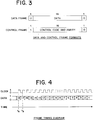
- Figure 3 is a diagram illustrating the difference between a data frame and a control frame used in accordance with the present invention.
- Figure 4 is a frame timing diagram for transmission of frames of information between two devices.
- Figure 5 is an alignment state diagram illustrating the states associated with a device depending upon perceived events, as well as the action taken by the device based upon its state.
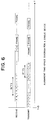
- Figure 6 is an alignment time-space diagram of a variation with respect to the end frame alignment sequence.
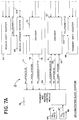
- Figure 7 is an overall block diagram for a system implementing the frame alignment method in each communicating device.
- device A and device B communicate clock signals on clock lines 20 and 22 and information signals on information lines 24 and 26 between each other as shown.
- These devices may represent cards forming part of communication switch, wherein each card can communicate with any other card via a serial communication link such as shown diagrammatically by reference numeral 28 .
- the clock signals on lines 20 and 22 provide timing information for the units of information transmitted as information signals on lines 24 and 26 .
- a device sends information to another device by establishing a logical connection and then transmitting the desired information.
- a typical manner of establishing a logical connection is shown in Figure 2.
- a connection is established using a plurality of information units called control frames and data is passed using a plurality of information units called data frames.
- Each control frame contains a code word.
- device A sends a control frame called a Connection Request code word to device B.
- device B Upon receipt of this code word by device B, device B sends a Connection Granted code word back to device A.
- device A transfers data, such as the three data frames shown, to device B.
- the logical connection is completed by the transfer of a Close Connection code word from device A to device B, with device B acknowledging receipt of the Close Connection code word by transmitting a Close Acknowledge code word back to device A.
- a block of data is encapsulated into one or more frames of information which are transferred from device A to device B, or vice versa . Because true full-duplex communication is supported, frames of information can be transferred from A to B and B to A simultaneously.
- Frames for the receiving entity e.g. Connection Granted code word
- Frames for the transmitting entity are multiplexed into the same information line as frames for the transmitting entity (e.g. data frames).
- FIG. 3 A preferred frame format is shown in Figure 3, where it is seen that both data frames and control frames each comprise 18 total bits of information, with the first bit of each frame distinguishing between the two frame types. As is also seen in Figure 3, the last bit of each frame, regardless of its type, is a '0' bit. This bit is called a frame ending marker. Other bit or bit patterns may be used to designate a frame ending marker.
- data frames therefore contain 16 bits of data while control frames contain control codes such as those shown in Figure 2.
- a complete set of control codes is presented in Table 1.
- Table 1 Legal Code Words ACRONYM CODE WORD RTS Connection Request CTS Connection Granted END Close Connection ACK Close Acknowledge NACK Negative Acknowledge BSI Buffer Swap Interrupt
- a parity bit is also used in conjunction with the control codes to protect the integrity of control frames. Such parity, although advantageous, is not required for the general implementation of the frame alignment method and system of the present invention.
- control and data frames are passed from one device to another over information lines 24 and 26, where the associated clock lines 20 and 22 are only active (that is, in the '1' single state) when a flame is being transmitted and otherwise, the value of the clock line is '0'.
- Data is received on the destination device starting at the rising edge of the associated clock signal.
- bit number 18 of the illustrated data frame is received by the receiving device at time instant 't a ' while bit 17 is received at time instant 't b '.
- a device In order to extract frames from the information line, a device must be able to delineate the start and end of individual frames. If a frame alignment error occurs, the error must be detected and the device must realign frames of the incoming data stream. Additionally, the transmitting device must be notified of any detected frame alignment error.
- the receiving device which may be a card or any other type of device, initializes to a misaligned state 30 after power up. While in this state, the device looks for what is termed the 'start of alignment sequence' in the serial data stream.
- This 'start of alignment sequence' for a preferred embodiment of the present invention is P consecutive bits all in logic state '1', where P is the number of bits in a frame; namely, 18. It is of course apparent that 'P' could be set to a different number.
- an 'end of alignment sequence' is defined as a single bit in the logic '0' state.
- the 'end of alignment sequence' is preferably defined as P-1 bits in logic state '1', followed by 1 bit in logic state '0', where P is the number of bits in one frame of information.
- This 'end of alignment sequence' may also comprise multiples of P bits in the logic '1' state before the P-1 bits in the logic '1' state followed by 1 bit in the logic '0' state. In this way, the overall alignment sequence ('start of alignment sequence' and 'end of alignment sequence') is always a multiple of the frame size. It has been found that this arrangement improves overall reliability by eliminating the possibility of a single bit error from corrupting the entire alignment sequence.
- a device in the realignment state detects 'the end of alignment sequence', event 36 , it transitions to the aligned state 38 .
- the device once in the aligned state, remains in that state provided no frame alignment error is detected, event 48 .
- the types of frame alignment errors are set forth in Table 2.
- the device which detects a frame alignment error repetitively sends the 'start of alignment sequence'.
- This sequence causes a frame alignment error to be detected on the other device, which in turn results in that other device entering the misaligned state.
- the other device While in the misaligned state, the other device also repetitively sends the 'start of alignment sequence'.
- a 'start of alignment sequence' is P '1's, where P is preferably equal to the number of bits in one frame; that is, 18.
- Table 3 illustrates a typical example of how the present frame alignment method operates when one of two devices detects a frame alignment error.
- Device B detects a frame alignment error and enters the misaligned state 30 . While in this state it transmits the 'start of alignment sequence' to Device A. Device B continues to transmit the 'start of alignment sequence' until it enters the realignment state.
- the first 'start of alignment sequence' sent by Device B to Device A causes Device A to transition to the misaligned state 30 since the 'start of alignment sequence' is an invalid frame ending marker (see Figures 3 and 5, event 44 ).
- Device A starts to transmit the 'start of alignment sequence' to Device B. It is important to note that as Device A is transmitting its first 'start of alignment sequence' to Device B, Device B is transmitting at least its second 'start of alignment sequence' to Device A. By so doing each device causes the other device to enter the realignment state 34 (see Figure 5, event 32 ).
- Device A and Device B When Device A and Device B are in the realignment state, they each transmit the 'end of alignment sequence' to the other device, which causes the other device to enter the aligned state 38 (see Figure 5, event 36 ).
- an automatic mechanism whereby a device detecting a frame alignment error of any type informs the other device of this error by causing that other device to enter the misaligned state.
- the 'start of alignment sequence' which may initiate this change of state is in fact the same message which then causes each device to enter the realignment state, where each device transmits an 'end of alignment sequence' that causes the other device to enter the aligned state.
- a mechanism can be provided to cause it to return to the misaligned state.
- a timer 35 can be added associated with the realignment state with the timer starting a countdown when the device transitions to the realignment state. If the timer times out (event 37 ), the device transitions to the misaligned state where it then causes the other device to transition to the misaligned state and thus re-initializes the frame alignment process.
- FIG. 7 A block diagram of a preferred embodiment of a system 15 corresponding to Device B for implementing the state diagram of Figure 5 is shown in Figure 7. Most of the frame alignment functionality is contained in the receive frame control module 60 and the encoder module 62 . A description of each module is presented below:
- the receive shift register 64 stores the most recent 18 bits received on the incoming data_in line 24 . This data is clocked by a clock signal on a clock_in line 20 . In the preferred embodiment one frame is dual to 18 bits.
- the contents of this shift register are cleared by activation of the receive register clear (rx_reg_clear) signal 66 generated by the receive frame control module 60 . This signal is active whenever frame alignment must be re-established; that is, at power up and whenever a frame alignment error is detected. The signal deactivates when the receive shift register contents have been cleared as indicated by the register output 106 .
- a receive storage register 68 is used to receive an entire frame of information units previously received by the receive shift register 64 .
- the load_storage_reg signal 70 activated by the receive frame control module 60 controls receipt of this information by the receive storage register. This register temporarily stores the frame of information while its contents are decoded.
- a decoder module 72 deciphers the contents of the frame of information whenever the load_storage_reg signal 70 activates.
- the decoder module determines if the frame of information contains data or control information (see Figure 3) by examining the state of the first bit of the frame. If the frame contains data, the rx_data_strobe signal 74 is activated and transferred to the transmit and receive control module 76 along with the data (rx_data [15:0] 77 ). If the frame contains control information, then the corresponding code word (rx_codewords[7:0] 78 ) is transferred to the transmit and receive control module.
- the decoder performs parity checking for code words and also determines if the code word is a legal or illegal code word, (see Table 1).
- a parity error is notified to the receive frame control module by activating the parity_error signal 80 (see event 45 , Figure 5) and an illegal code word is notified to the receive frame control module by activation of the decode_error signal 82 (see event 46 , Figure 5).
- the transmit and receive control module 76 passes data to and from receive FIFO (RX_FIFO) 84 and transmit FIFO (TX_FIFO) 85 so as to respectively communicate received data to other, unrelated, modules (not shown) and to obtain data for ultimate transmission on data_out line 26 with an associated outgoing clock signal on clock_out line 22 .
- Buses 86 and 87 respectively connect receive FIFO 84 and transmit FIFO 85 to the transmit and receive control module 76 . It also performs implementation of the communication protocol shown in Figure 2.
- the transmit and receive control module activates the inappropriate_codeword signal 88 so as to inform the receive frame control module 60 (see event 47 , Figure 5).
- An example of such a situation is when a Connection Granted code word is received when no Connection Request code word was issued.
- the activation of the inappropriate_codeword signal notifies the frame control module that a frame alignment error has been detected.
- Other inappropriate receipt of a code word scenarios are presented in Table 4. These scenarios may differ depending upon the communication protocol used in any implementation.
- TRANSMITTING DEVICE RECEIVING DEVICE CTS, ACK, or NACK is received while device is not sending or receiving information END or a frame of information is received when not sending or receiving information ACK received when the device has transmitted a RTS RTS received when the device has transmitted a CTS or NACK CTS or ACK received when the device has transmitted a frame of information RTS received while the device is receiving information CTS received when the device has transmitted an END
- the transmit and receive module transfers this data to encoder 62 via tx_data [15:0] lines 89 .
- the transmit and receive control module transfer the code words via tx_codewords[7:0] lines 91 .
- a tx_data_strobe line 93 is activated to notify encoder 62 of the control or data information.
- Encoder module 62 encapsulates outgoing frames of information for ultimate transmission on data_out line 26 . This module also determines the correct coding for an outgoing control frame. When the encoder has a frame to transmit, it activates the send_frame signal 90 .
- the transmit frame control module 92 handles the frame transmission and returns activation of the frame_sent signal 94 when the frame has been transmitted. It should be noted however, that if the receive frame control module determines that the device is not in the aligned state 38 (see Figure 5), it deactivates the frame_aligned signal 96 which in turn causes the encoder to repetitively generate the 'start of alignment sequence' (18 '1's) instead of control or data frames (see Figure 5). The encoder module continues this action until the frame_aligned signal 96 is activated, at which time the encoder generates the 'end of alignment sequence', which in the preferred embodiment of the present invention is 17 '1's followed by a '0'.
- the transmit shift register 98 provides data for the outgoing data stream on data_out line 26 . Eighteen bits of parallel data are loaded into this register from the encoder module via tx_frame[17:0] lines 100 . The data is then shifted out by the shift register onto data_out line 26 . Both the loading of data into the register and the shifting of serial data from the register are controlled by the transmit frame control module.
- the transmit frame control module 92 manages the transmission of frames. Thus when the encoder has a frame to transmit, the transmit frame control module causes the frame to be transferred to the transmit shift register by activating the tx_reg_load signal 102 . The output shifting of data from the shift register is controlled by the tx_reg_shift signal 104 .
- the receive frame control module 60 is responsible for frame alignment; that is, the transition of states shown in Figure 5.
- the receive frame control module enters the misaligned state 30 at power up or when a frame alignment error is detected.
- the frame_aligned signal 96 is deactivated at such times, forcing the repetitive transmission of the 'start of alignment sequence' on the data_out line 26 .
- the receive frame control module clears the receive shift register via activation of the rx_reg_clear signal 66 . At such a time, the receive shift register contains all '0's.
- the receive frame control module monitors the receive shift register 64 to determine when a 'start of alignment sequence' has been received. This monitoring is done via the rx_frame[17:0] lines 106 which also transfer frames of data to the receive storage register 68 . When a 'start of alignment sequence' has been received, the receive frame control module changes state from the misaligned state to the realignment state 34 . At this time, the frame_aligned signal 96 is activated.
- the transition to the realignment state and the activating of the frame_aligned signal 96 causes the encoder module 62 to generate the 'end of alignment sequence' which, in the preferred embodiment of the present invention, is 17 '1's followed by a single '0'.
- the 'end of alignment sequence' is detected by the receive frame control module, it enters the aligned state 38 and activates the frame_aligned signal 96 , thereby allowing encoder module to encapsulate and to cause the transmission of control and data frames on data_out line 26 .
- the receive frame control module When the receive frame control module is in the aligned state, it monitors the incoming frames via the rx_frame[17:0] lines to determine if each frame has the proper frame ending marker (see Figure 3). If the frame ending marker is not properly detected, the receive frame control enters the misaligned state (event 44 , Figure 5). As each frame of information is received by the receive frame control module, it also activates the load_storage_reg signal 70 so as to control movement of frames with respect to the receive storage register 68 and decoder module 72 .
- the detection of any of these frame alignment errors cause the receive frame control module to enter the misaligned state 30 which then initiates notification to the other device by generating the 'start of alignment sequence'.
- the 'start of alignment sequence' causes the other device to transition to the misaligned state, which in turn causes each device to enter the realignment and then the alignment state.
- the same 'start of alignment sequence' is used for both notifying and re-initializing each device, so that each device becomes aligned.
Landscapes
- Engineering & Computer Science (AREA)
- Computer Networks & Wireless Communication (AREA)
- Signal Processing (AREA)
- Communication Control (AREA)
- Mobile Radio Communication Systems (AREA)
- Synchronisation In Digital Transmission Systems (AREA)
- Container, Conveyance, Adherence, Positioning, Of Wafer (AREA)
- Small-Scale Networks (AREA)
Applications Claiming Priority (2)
| Application Number | Priority Date | Filing Date | Title |
|---|---|---|---|
| US08/255,377 US5420865A (en) | 1994-06-08 | 1994-06-08 | Method and apparatus for alignment of frames of information |
| US255377 | 1994-06-08 |
Publications (3)
| Publication Number | Publication Date |
|---|---|
| EP0687086A2 true EP0687086A2 (de) | 1995-12-13 |
| EP0687086A3 EP0687086A3 (de) | 1998-06-03 |
| EP0687086B1 EP0687086B1 (de) | 2003-01-08 |
Family
ID=22968049
Family Applications (1)
| Application Number | Title | Priority Date | Filing Date |
|---|---|---|---|
| EP95108565A Expired - Lifetime EP0687086B1 (de) | 1994-06-08 | 1995-06-03 | Vorrichtung und Verfahren zur Synchronisierung von Informationsrahmen |
Country Status (4)
| Country | Link |
|---|---|
| US (1) | US5420865A (de) |
| EP (1) | EP0687086B1 (de) |
| AT (1) | ATE230908T1 (de) |
| DE (1) | DE69529311T2 (de) |
Families Citing this family (7)
| Publication number | Priority date | Publication date | Assignee | Title |
|---|---|---|---|---|
| US5420865A (en) * | 1994-06-08 | 1995-05-30 | Alcatel Data Networks | Method and apparatus for alignment of frames of information |
| US5774704A (en) * | 1996-07-29 | 1998-06-30 | Silicon Graphics, Inc. | Apparatus and method for dynamic central processing unit clock adjustment |
| SE511389C2 (sv) * | 1997-01-21 | 1999-09-20 | Ericsson Telefon Ab L M | Ramlåsning |
| FR2760302B1 (fr) | 1997-03-03 | 2000-08-04 | Alsthom Cge Alcatel | Procede et dispositif pour la transmission de trames de donnees |
| FI107672B (fi) * | 1999-05-24 | 2001-09-14 | Nokia Networks Oy | Menetelmä ja järjestely TTI-tunnisteen käsittelyn parantamiseksi |
| DE10030393A1 (de) * | 2000-06-21 | 2002-01-03 | Siemens Ag | Verfahren zur schnellen Synchronisation von Blockcodierern und -decodierern bei einer blockcodierten, bidirektionalen Datenübertragung über in einen bitorientierten Kanal |
| US8963949B2 (en) * | 2009-04-22 | 2015-02-24 | Qualcomm Incorporated | Image selection and combination method and device |
Family Cites Families (7)
| Publication number | Priority date | Publication date | Assignee | Title |
|---|---|---|---|---|
| SE435011B (sv) * | 1982-12-30 | 1984-08-27 | Ellemtel Utvecklings Ab | Sett och anordning i ett telekommunikationssystem vid aktivering av abonnentterminaler |
| US4606023A (en) * | 1984-05-31 | 1986-08-12 | Applied Dynamic Research, Inc. | Guard time elimination in a time-division multiplexed, active star-coupled, half-duplex mode, synchronous communications network |
| US5110558A (en) * | 1988-07-26 | 1992-05-05 | Romer Labs, Inc. | Apparatus for adsorption detection |
| US4910754A (en) * | 1988-09-30 | 1990-03-20 | Data General Corporation | Initialization and synchronization method for a two-way communication link |
| GB2262415B (en) * | 1991-12-13 | 1995-08-16 | Digital Equipment Int | Handshake synchronization system |
| GB2265283B (en) * | 1992-03-18 | 1995-10-25 | Crystal Semiconductor Corp | Resynchronization of a synchronous serial interface |
| US5420865A (en) * | 1994-06-08 | 1995-05-30 | Alcatel Data Networks | Method and apparatus for alignment of frames of information |
-
1994
- 1994-06-08 US US08/255,377 patent/US5420865A/en not_active Expired - Lifetime
-
1995
- 1995-06-03 AT AT95108565T patent/ATE230908T1/de not_active IP Right Cessation
- 1995-06-03 DE DE69529311T patent/DE69529311T2/de not_active Expired - Lifetime
- 1995-06-03 EP EP95108565A patent/EP0687086B1/de not_active Expired - Lifetime
Non-Patent Citations (1)
| Title |
|---|
| None |
Also Published As
| Publication number | Publication date |
|---|---|
| US5420865A (en) | 1995-05-30 |
| ATE230908T1 (de) | 2003-01-15 |
| EP0687086A3 (de) | 1998-06-03 |
| DE69529311D1 (de) | 2003-02-13 |
| EP0687086B1 (de) | 2003-01-08 |
| DE69529311T2 (de) | 2003-05-22 |
Similar Documents
| Publication | Publication Date | Title |
|---|---|---|
| EP0513232B1 (de) | Verfahren zur fehlerkorrektur in einem datenkommunikationssystem | |
| EP0244117B1 (de) | Verfahren zur Duplex-Datenübertragung unter Verwendung eines Sende- und Warteprotokolls | |
| EP0525985B1 (de) | Hochgeschwindigkeitschnittstelle für eine Duplex-Datenverbindung | |
| US4225919A (en) | Advanced data link controller | |
| US4368512A (en) | Advanced data link controller having a plurality of multi-bit status registers | |
| EP0378401A2 (de) | Datenübertragungssystem | |
| EP0507884B1 (de) | Übertragung von kodierten daten über nichtfunktionssichere netze | |
| US4513370A (en) | Data transfer control system and method for a plurality of linked stations | |
| US4009469A (en) | Loop communications system with method and apparatus for switch to secondary loop | |
| EP0124594B1 (de) | Verfahren und vorrichtung zum senden und empfangen von datennachrichten | |
| US4346440A (en) | Advanced data link controller | |
| EP0324886B1 (de) | Steuerflussverminderung in selektiven Wiederholungsprotokollen | |
| US5933435A (en) | Optimized method of data communication and system employing same | |
| EP1311081A2 (de) | Robustes RLC-Rücksetzungsverfahren in einem drahtlosen Kommunikationsystem | |
| US4358825A (en) | Control circuitry for data transfer in an advanced data link controller | |
| EP0602806A2 (de) | HDLC-Empfänger | |
| US5420865A (en) | Method and apparatus for alignment of frames of information | |
| US5428611A (en) | Strong framing protocol for HDLC and other run-length codes | |
| AU609791B2 (en) | Improvements in or relating to data communication systems | |
| KR100267344B1 (ko) | 에이치.디.엘.씨(hdlc)버스 구조 교환기 시스템의 전송 데이터 충돌 방지 장치 및 그 방법 | |
| JP2928024B2 (ja) | 多重アクセス制御方法 | |
| JPS62137946A (ja) | デ−タ伝送方式 | |
| JPH0399538A (ja) | データ伝送方式 | |
| JPS5995643A (ja) | 割込デ−タ転送方式 | |
| EP0909492A2 (de) | Verfahren und vorrichtung für kommunikation |
Legal Events
| Date | Code | Title | Description |
|---|---|---|---|
| PUAI | Public reference made under article 153(3) epc to a published international application that has entered the european phase |
Free format text: ORIGINAL CODE: 0009012 |
|
| AK | Designated contracting states |
Kind code of ref document: A2 Designated state(s): AT BE CH DE ES FR GB IT LI NL SE |
|
| PUAL | Search report despatched |
Free format text: ORIGINAL CODE: 0009013 |
|
| AK | Designated contracting states |
Kind code of ref document: A3 Designated state(s): AT BE CH DE ES FR GB IT LI NL SE |
|
| 17P | Request for examination filed |
Effective date: 19980804 |
|
| 17Q | First examination report despatched |
Effective date: 20000706 |
|
| GRAH | Despatch of communication of intention to grant a patent |
Free format text: ORIGINAL CODE: EPIDOS IGRA |
|
| GRAH | Despatch of communication of intention to grant a patent |
Free format text: ORIGINAL CODE: EPIDOS IGRA |
|
| GRAA | (expected) grant |
Free format text: ORIGINAL CODE: 0009210 |
|
| AK | Designated contracting states |
Kind code of ref document: B1 Designated state(s): AT BE CH DE ES FR GB IT LI NL SE |
|
| PG25 | Lapsed in a contracting state [announced via postgrant information from national office to epo] |
Ref country code: NL Free format text: LAPSE BECAUSE OF FAILURE TO SUBMIT A TRANSLATION OF THE DESCRIPTION OR TO PAY THE FEE WITHIN THE PRESCRIBED TIME-LIMIT Effective date: 20030108 Ref country code: LI Free format text: LAPSE BECAUSE OF FAILURE TO SUBMIT A TRANSLATION OF THE DESCRIPTION OR TO PAY THE FEE WITHIN THE PRESCRIBED TIME-LIMIT Effective date: 20030108 Ref country code: CH Free format text: LAPSE BECAUSE OF FAILURE TO SUBMIT A TRANSLATION OF THE DESCRIPTION OR TO PAY THE FEE WITHIN THE PRESCRIBED TIME-LIMIT Effective date: 20030108 Ref country code: BE Free format text: LAPSE BECAUSE OF FAILURE TO SUBMIT A TRANSLATION OF THE DESCRIPTION OR TO PAY THE FEE WITHIN THE PRESCRIBED TIME-LIMIT Effective date: 20030108 Ref country code: AT Free format text: LAPSE BECAUSE OF FAILURE TO SUBMIT A TRANSLATION OF THE DESCRIPTION OR TO PAY THE FEE WITHIN THE PRESCRIBED TIME-LIMIT Effective date: 20030108 |
|
| REF | Corresponds to: |
Ref document number: 230908 Country of ref document: AT Date of ref document: 20030115 Kind code of ref document: T |
|
| REG | Reference to a national code |
Ref country code: GB Ref legal event code: FG4D |
|
| REG | Reference to a national code |
Ref country code: CH Ref legal event code: EP |
|
| REF | Corresponds to: |
Ref document number: 69529311 Country of ref document: DE Date of ref document: 20030213 Kind code of ref document: P |
|
| PG25 | Lapsed in a contracting state [announced via postgrant information from national office to epo] |
Ref country code: SE Free format text: LAPSE BECAUSE OF FAILURE TO SUBMIT A TRANSLATION OF THE DESCRIPTION OR TO PAY THE FEE WITHIN THE PRESCRIBED TIME-LIMIT Effective date: 20030408 |
|
| REG | Reference to a national code |
Ref country code: CH Ref legal event code: PL |
|
| PG25 | Lapsed in a contracting state [announced via postgrant information from national office to epo] |
Ref country code: ES Free format text: LAPSE BECAUSE OF FAILURE TO SUBMIT A TRANSLATION OF THE DESCRIPTION OR TO PAY THE FEE WITHIN THE PRESCRIBED TIME-LIMIT Effective date: 20030730 |
|
| ET | Fr: translation filed | ||
| PLBE | No opposition filed within time limit |
Free format text: ORIGINAL CODE: 0009261 |
|
| STAA | Information on the status of an ep patent application or granted ep patent |
Free format text: STATUS: NO OPPOSITION FILED WITHIN TIME LIMIT |
|
| 26N | No opposition filed |
Effective date: 20031009 |
|
| REG | Reference to a national code |
Ref country code: FR Ref legal event code: TP Owner name: ALCATEL LUCENT USA INC., US Effective date: 20130801 |
|
| REG | Reference to a national code |
Ref country code: FR Ref legal event code: GC Effective date: 20131126 |
|
| PGFP | Annual fee paid to national office [announced via postgrant information from national office to epo] |
Ref country code: GB Payment date: 20140618 Year of fee payment: 20 |
|
| PGFP | Annual fee paid to national office [announced via postgrant information from national office to epo] |
Ref country code: DE Payment date: 20140619 Year of fee payment: 20 Ref country code: IT Payment date: 20140626 Year of fee payment: 20 |
|
| REG | Reference to a national code |
Ref country code: FR Ref legal event code: RG Effective date: 20141015 |
|
| PGFP | Annual fee paid to national office [announced via postgrant information from national office to epo] |
Ref country code: FR Payment date: 20140619 Year of fee payment: 20 |
|
| REG | Reference to a national code |
Ref country code: DE Ref legal event code: R071 Ref document number: 69529311 Country of ref document: DE |
|
| REG | Reference to a national code |
Ref country code: GB Ref legal event code: PE20 Expiry date: 20150602 |
|
| PG25 | Lapsed in a contracting state [announced via postgrant information from national office to epo] |
Ref country code: GB Free format text: LAPSE BECAUSE OF EXPIRATION OF PROTECTION Effective date: 20150602 |