EP0687124A2 - Acheminement à destinations multiples dans un réseau à plusieurs étages et acheminement autonome - Google Patents
Acheminement à destinations multiples dans un réseau à plusieurs étages et acheminement autonome Download PDFInfo
- Publication number
- EP0687124A2 EP0687124A2 EP95303492A EP95303492A EP0687124A2 EP 0687124 A2 EP0687124 A2 EP 0687124A2 EP 95303492 A EP95303492 A EP 95303492A EP 95303492 A EP95303492 A EP 95303492A EP 0687124 A2 EP0687124 A2 EP 0687124A2
- Authority
- EP
- European Patent Office
- Prior art keywords
- multicast
- routing
- network
- cubes
- outlets
- Prior art date
- Legal status (The legal status is an assumption and is not a legal conclusion. Google has not performed a legal analysis and makes no representation as to the accuracy of the status listed.)
- Withdrawn
Links
Images



Classifications
-
- H—ELECTRICITY
- H04—ELECTRIC COMMUNICATION TECHNIQUE
- H04L—TRANSMISSION OF DIGITAL INFORMATION, e.g. TELEGRAPHIC COMMUNICATION
- H04L12/00—Data switching networks
- H04L12/54—Store-and-forward switching systems
- H04L12/56—Packet switching systems
- H04L12/5601—Transfer mode dependent, e.g. ATM
-
- H—ELECTRICITY
- H04—ELECTRIC COMMUNICATION TECHNIQUE
- H04L—TRANSMISSION OF DIGITAL INFORMATION, e.g. TELEGRAPHIC COMMUNICATION
- H04L12/00—Data switching networks
- H04L12/02—Details
- H04L12/16—Arrangements for providing special services to substations
- H04L12/18—Arrangements for providing special services to substations for broadcast or conference, e.g. multicast
- H04L12/1854—Arrangements for providing special services to substations for broadcast or conference, e.g. multicast with non-centralised forwarding system, e.g. chaincast
-
- H—ELECTRICITY
- H04—ELECTRIC COMMUNICATION TECHNIQUE
- H04L—TRANSMISSION OF DIGITAL INFORMATION, e.g. TELEGRAPHIC COMMUNICATION
- H04L49/00—Packet switching elements
- H04L49/10—Packet switching elements characterised by the switching fabric construction
- H04L49/104—Asynchronous transfer mode [ATM] switching fabrics
- H04L49/105—ATM switching elements
- H04L49/106—ATM switching elements using space switching, e.g. crossbar or matrix
-
- H—ELECTRICITY
- H04—ELECTRIC COMMUNICATION TECHNIQUE
- H04L—TRANSMISSION OF DIGITAL INFORMATION, e.g. TELEGRAPHIC COMMUNICATION
- H04L49/00—Packet switching elements
- H04L49/15—Interconnection of switching modules
- H04L49/1553—Interconnection of ATM switching modules, e.g. ATM switching fabrics
-
- H—ELECTRICITY
- H04—ELECTRIC COMMUNICATION TECHNIQUE
- H04L—TRANSMISSION OF DIGITAL INFORMATION, e.g. TELEGRAPHIC COMMUNICATION
- H04L49/00—Packet switching elements
- H04L49/15—Interconnection of switching modules
- H04L49/1553—Interconnection of ATM switching modules, e.g. ATM switching fabrics
- H04L49/1561—Distribute and route fabrics, e.g. Batcher-Banyan
-
- H—ELECTRICITY
- H04—ELECTRIC COMMUNICATION TECHNIQUE
- H04L—TRANSMISSION OF DIGITAL INFORMATION, e.g. TELEGRAPHIC COMMUNICATION
- H04L49/00—Packet switching elements
- H04L49/20—Support for services
- H04L49/201—Multicast operation; Broadcast operation
- H04L49/203—ATM switching fabrics with multicast or broadcast capabilities
-
- H—ELECTRICITY
- H04—ELECTRIC COMMUNICATION TECHNIQUE
- H04L—TRANSMISSION OF DIGITAL INFORMATION, e.g. TELEGRAPHIC COMMUNICATION
- H04L49/00—Packet switching elements
- H04L49/25—Routing or path finding in a switch fabric
- H04L49/256—Routing or path finding in ATM switching fabrics
-
- H—ELECTRICITY
- H04—ELECTRIC COMMUNICATION TECHNIQUE
- H04L—TRANSMISSION OF DIGITAL INFORMATION, e.g. TELEGRAPHIC COMMUNICATION
- H04L49/00—Packet switching elements
- H04L49/30—Peripheral units, e.g. input or output ports
- H04L49/3081—ATM peripheral units, e.g. policing, insertion or extraction
- H04L49/309—Header conversion, routing tables or routing tags
-
- H—ELECTRICITY
- H04—ELECTRIC COMMUNICATION TECHNIQUE
- H04L—TRANSMISSION OF DIGITAL INFORMATION, e.g. TELEGRAPHIC COMMUNICATION
- H04L12/00—Data switching networks
- H04L12/02—Details
- H04L12/16—Arrangements for providing special services to substations
- H04L12/18—Arrangements for providing special services to substations for broadcast or conference, e.g. multicast
- H04L12/1863—Arrangements for providing special services to substations for broadcast or conference, e.g. multicast comprising mechanisms for improved reliability, e.g. status reports
-
- H—ELECTRICITY
- H04—ELECTRIC COMMUNICATION TECHNIQUE
- H04L—TRANSMISSION OF DIGITAL INFORMATION, e.g. TELEGRAPHIC COMMUNICATION
- H04L12/00—Data switching networks
- H04L12/54—Store-and-forward switching systems
- H04L12/56—Packet switching systems
- H04L12/5601—Transfer mode dependent, e.g. ATM
- H04L2012/5638—Services, e.g. multimedia, GOS, QOS
- H04L2012/5646—Cell characteristics, e.g. loss, delay, jitter, sequence integrity
- H04L2012/5652—Cell construction, e.g. including header, packetisation, depacketisation, assembly, reassembly
Definitions
- This invention relates to a method and apparatus for providing self-routing in multistage networks and, more particularly, for providing multicast routing capabilities in such networks.
- Asynchronous Transfer Mode is to provide an integrated transport vehicle for a wide range of applications so that improved resource efficiency can be achieved. Many of these applications require multicast (one-to-many) connections in addition to conventional unicast (one-to-one) connections. Therefore, the capability of handling multicast connections is an essential ingredient to any switch architecture design and implementation aimed at ATM networks. Many of the switch architectures found in the prior art employ multistage interconnection networks (MINs), either buffered or not, as a core "routing network” (RN) for the support of unicast connections. To provide the multicast capability, two alternatives are possible. The first approach is to add a "copy network" (CN) at the front of an RN.
- CN copy network
- CN The function of CN, as its name implies, is to replicate the cell to obtain the number of copies requested by a given multicast connection. Those copies will then be transmitted through the RN to the desired outlets.
- the design of CN may be quite different from that of RN, and requires extra complex components. This is especially the case when designing a CN which can avoid conflicts inside an RN.
- the second approach is to exploit the inherent multicast capability of an RN by recycling the cell at the output of an RN to its input to generate extra copies.
- This approach is termed a "recursive scheme," since it simulates the logical function of a CN by using the RN recursively.
- This approach is advantageous when a routing network has already been implemented, since it does not require hardware modifications.
- the simplicity of the network control algorithm for self-routing and hardware implementation makes this scheme attractive.
- the general scheme is illustrated in FIG. 1 where a self-routing multistage routing network (RN) has expanders and concentrators which enable outlets (O) to be connected to inlets (I) through external links (L).
- Such a routing network may be based on a Log N-stage banyan network.
- the present invention teaches an apparatus and method for multicasting a received inlet data cell, received as part of an original multicast request, through a self-routing multistage switching or routing network RN to desired outlets when most original multicast requests cannot be multicasted through the network in a single pass without causing any undesired outlet to receive the cell.
- the original multicast request D defining a set of desired outlets, is decomposed into one or more intermediate multicast requests, each intermediate multicast request being a unique subset of the original multicast request which enables a non-blocking, self-routing distribution to a subset of the desired outlets of the original multicast request in one or two passes through the network.
- the invention then generates a non-blocking multicast tree based on the intermediate multicast requests and routes the received inlet data cell to the desired outlets.
- the invention decomposes the original multicast request and generates a non-blocking multicast tree using a cube routing algorithm, a copy routing algorithm, or a combined routing algorithm, which is a combination of the copy and cube routing algorithms.
- the cube routing algorithm decomposes the original multicast request into a plurality of cubes, each cube identifying a set of desired network outlets to which a received data cell can be routed in a single pass through the network; generates a non-blocking multicast tree based on the plurality of cubes; and routes the received inlet data cell to the desired outlets.
- the cube routing algorithm is recursive. The "distance" between two cubes gives rise to a necessary and sufficient condition required in order to achieve a non-blocking property of the cube routing algorithm.
- the copy routing algorithm decomposes the original multicast request by (a) generating 2 a i copies of the inlet data cell at contiguous outlets and (b) for each of the copies, addressing a desired outlet of D in either a decreasing or increasing order; and generates a non-blocking multicast tree by repeating steps (a) and (b), for any a i ⁇ 0, where the multicast request is defined as
- a n -1 , a n -2 ... a 0.
- the present invention addresses two conflicting requirements: (1) minimization of the number of passes through the network and (2) minimization of the number of internal links (network resources) used.
- SEs switching elements
- a 2 ⁇ 2 SE can be routed to one of the two, or to both, of the SEs to which it connects to support the multicast capability.
- D d 1, d 2,..., d k the set of desired outlet addresses of a multicast connection
- k
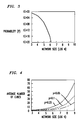
- has a truncated binomial distribution of order N , i.e., p k [ N k ] p k (1 - p ) N - k 1 - (1 - p ) N , 1 ⁇ k ⁇ N where p is the probability that an outlet belongs to a given multicast connection.
- p is the probability that an outlet belongs to a given multicast connection.
- the multicast routing tag scheme described in the previous section is not capable of performing any arbitrary multicast connection request.
- the first one is how many multicast connections can be routed through the network in a single pass.
- the second one is concerned with the conditions under which a multicast connection can be routed through the network in a single pass.
- the answer to the first question is the subject of this section.
- the answer to the second question is described in the following section.
- each outlet may be in a given multicast connection or not, thus there are 2 2 n possible multicast connections.
- the network has n stages, and the SE in each stage can be individually set to one of three states, there are 3 n different ways to set those SEs.
- the multicast routing tag scheme only allows an inlet to send a cell to a power of two number of outlets. Further, if there are 2 j (0 ⁇ j ⁇ n ) outlets for a single-pass multicast, given this scheme for computing and interpreting the tags, there must exist n - j bit positions in which all those outlet addresses agree and consequently there is a fixed set of j bit positions in which any two outlet addresses may disagree.
- a cube (implicant in logic minimization terminology) is a set of outlet addresses (integers) which can be reached through the network in a single pass using the routing tag scheme previously described. From the above discussion, a cube ( C ) must satisfy the following two conditions: (a)
- 2 j (0 ⁇ j ⁇ n ) and (b) ( n - j ) fixed set of bit positions in which all the elements of C agree.
- this 1-cube can be represented as the replacement of 1001 and 1011 by 10 x 1, where the x symbolizes a 'don't care' binary position (i.e., it can be 0 or 1). Then these 1-cubes are used to generate all possible 2-cubes. This process continues until all r -cubes are generated for some r (0 ⁇ r ⁇ n ) such that there are no ( r + 1)-cubes. The entire set of cubes are known as the "complex C" of the set D , while the original outlet addresses (0-cubes) are the "base” of D .
- Shown in FIG. 4 is the average of cubes for a given network size (Log N ) and probability p (from Equation 1).
- R can be any one of the outlet addresses belonging to the cube C.
- R could be 1000, 1010, 1100, or 1110.
- the sequence of passes through the network required to route a multicast connection can be modeled as a "multicast tree".
- a routing algorithm generates a multicast tree by properly choosing the outlets to be reached at each pass.
- the choice of the multicast tree is strongly dependent upon the multicast capability constraints imposed by banyan networks and by the traffic pattern present at the connection set-up time.
- the major objective is to design a routing algorithm which minimizes the number of network passes through the network to minimize the total number of cells circulating in the network while employing the minimal amount of network resources.
- Two performance measures, the average number of passes through the network and the average number of internal links used per outlet, are used to compare the proposed routing algorithms. The former serves as an indication of average delay each cell experiences through the network.
- the latter is a measure of the amount of network resources that an algorithm utilizes.
- the present invention describes three routing schemes: I, II and III. Except for the routing scheme III, we assume that any outlet receiving a cell must be either a desired outlet or a branching node which will recycle the received cell, or both.
- This method accomplishes an arbitrary multicast connection by decomposing the original multicast connection into one or more intermediate multicast connections (cubes), each of which can be routed in one pass.
- cubes intermediate multicast connections
- our next task is to build a multicast tree based on the cubes belonging to P .
- the distance defined above is equal to the most significant bit position in which the two cubes differ.
- the binary representation eases the computing of the distance d out or d in .
- Equation 4 it is evident from Equation 4 that any pair of inlets at distance of 0 can route any two disjoint cubes respectively without causing conflicts in the banyan network. It also holds that any two disjoint cubes at distance ( n - 1) can be addressed by any two inlets without conflicts.
- Procedure 2 gives an iterative algorithm which generates the multicast tree.
- this algorithm For each inlet in INPUT, this algorithm scans P for a largest cube which has no conflicts with other already selected cubes in OUTPUT. When one is found, the corresponding cube is removed from P and put into OUTPUT. When all the inlets in INPUT have been selected, the next iteration is performed by using OUTPUT as INPUT according to the recycling mechanism. This iterative process continues until all the cubes in P have been removed. Our results have indicated that performance is insensitive to the way that each inlet in INPUT is selected.
- the multicast request can be derived from signaling messages received at a source inlet port or directly received by the controller.
- the multicast request is received by the controller of the self-routing multistage network (e.g., a banyan network).
- the controller selects the cube routing algorithm.
- step 505 the controller generates the multicast tree using the cube routing algorithm of Procedure 2 and checks the distances between cubes to prevent blocking inside the network.
- step 506 the controller computes the routing tag ( R , M ⁇ information to implement the multicast tree.
- step 507 the controller sends the routing tag information to routing tables for each concentrator and expander (I/O controllers) identified in the multicast tree.
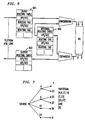
- FIG. 6 illustrates a particular implementation of a self-routing multistage network which includes the input, internal and output routing tables (601-603) used in the concentrator and expander units.
- the input and internal routing tables 601 and 602 can be part of the concentrator unit of FIG. 1 while the output routing table 603 can be part of the expander unit of FIG. 1.
- the three routing tables 601-603 can be implemented using one physical table means. These routing tables 601-603 can be part of a memory unit of the controller of FIG. 1.
- VPI/VCI Voice over IP
- VPI/VCI Call path and call cell identification in the cell header which is translated at each switch (self-routing multistage network RN) along the call path.
- the internal routing table can be eliminated and only input and output routing tables (601 and 603) are needed.
- the output routing table can be eliminated and hence only the input routing table 601 is needed (e.g., a unicast connection).
- This information includes the VPI/VCI information as well as the routing tag bits M and R.
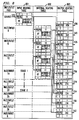
- the multicast outlets of the first stage are selected as inlets for the second stage (i.e., network outlets 4, 6, 12 and 14 from the first pass through the network become inlets for the second pass through the network.)
- the internal VPI/VCI number 11 is the unique multicast connection identifier from the routing network (RN).
- the internal routing tables 802 select outlets 7 and 23 for the second stage inlet 4; select outlets 25 and 27 for the second stage inlet 6; select outlet 28 for second stage inlet 12; and select outlet 8 for second stage inlet 14.
- the "-0" value following the M values indicates that these are only outlets, i.e., there is no recycling back to an inlet.
- the "-1" value following the R value also indicates an output-only function to the identified outlets.
- the output routing tables 803 convert the internal VPI/VCI number 11 to the VPI/VCI number identified by the destination routing network RN (or switch) to which the outlet is connected.
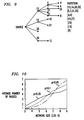
- the effectiveness of this routing scheme becomes clear when we compare the results of FIG. 4 and FIG. 10.
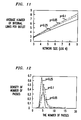
- FIG. 11 examines the average number of internal links per outlet for the settings used in FIG. 10, where in general the usage of internal links steadily increases with the size of network.
- p i.e., the size of a multicast connection
- steps 513-515 routing is performed in steps 513-515.
- the copy routing algorithm is selected.
- Steps 514 and 515 are performed recursively.
- the copy process takes place.
- this process generates 2 a i copies ( a i -cube) which appear contiguously at the output of the banyan network. This is to stimulate the function of a copy network.
- step 515 those 2 a i copies are recycled back to the network inlet and each copy is addressed, as a unicast connection, to an outlet of D in either a decreasing or an increasing order so that all these copies will not cause conflicts within the banyan network.
- steps 506 and 507 are performed to compute and distribute routing tag information as previously described.
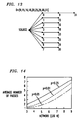
- FIG. 14 shows steady performance of this scheme for various values of p compared with FIG. 10. This is due to the fact that this scheme does not take advantage of cube property since it merely makes copies in the first step and sequentially transmits those copies in a unicast fashion during the second step. As illustrated in FIG. 15, the differences between average number of internal links per outlet for various p are marginal. It is also noticed that for the large product of p and n the performance is slightly improved.
- FIG. 16 Shown in FIG. 16 is a multicast tree generated by the combined routing algorithm (i.e., the copy routing algorithm for stage 1 and the cube routing algorithm for other stages).
- This algorithm is the combination of the previous two schemes in an attempt to keep the balance between the number of passes and the number of internal links per outlet.
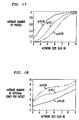
- This scheme is motivated by the observation from FIG. 10 that when the network size is large, the average number of passes is in inverse proportion to the value of p . This attributes to the exponential nature of multicast tree. To further enhance the performance for small p , it seems necessary to generate more copies at the initial stage of building up the multicast tree.
- the routing scheme II produces a rather different performance where the average number of passes is in direct proportion to the value of p .
- the idea is to generate as many copies as necessary at the initial stage in the build-up process of multicast tree. This in turn will benefit from the exponential property of the tree generated on the basis of cubes.
- the scheme proceeds exactly as the scheme I.
- the average number of passes has been significantly reduced as shown in FIG. 17.
- the performance lies in somewhere between the scheme I and scheme II.
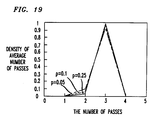
- FIG. 18 plots the average number of internal links per outlet for different values of p .
- the comparison between FIG. 11 and FIG. 18 reveals that the reduction in terms of the average number of passes for the combined routing scheme is achieved at the cost of slight increase of average number of internal links.
- the performance shown in FIG. 18 strongly favors the choice of large p . This shows that using this scheme the better utilization of network resources (internal links) will be achieved for large size of multicast connections (large p ).
- cube (implicant), utilized previously for logic minimization, has been shown to be useful to the problem of multicast routing for general multistage networks.
- the distance between cubes has enabled the constructing of multicast tree without internal blocking.
- the cube routing algorithm has significantly reduced the average number of passes required to accomplish a multicast connection.
- the potential multicast capability of multistage networks is greatly enhanced through the construction of multicast tree on the basis of cubes, often in the order of exponential increase.
- the copy routing algorithm is simple and easy to implement, but does not provide the desired performance.
- the provision of the initial copies as opposed to the cube routing algorithm has provided the steady performance for the average number of passes, as demonstrated by the combined routing scheme.
- This performance improvement is however achieved at the expense of slightly increasing the average number of internal links used.
- the optimal utilization of internal links can be achieved if the average size of multicast connection (the product of p and n ) is sufficiently large. This may in turn indicate that the presence of multicast connection for multistage networks will generally improve the throughput of network rather than degrade its performance as we may have first thought.
- the present invention can be used in all self-routing multistage switching networks including those that use electronic, optical, or combination type switches. Moreover, while the present invention has been described for switches that use switching elements of degree 2 (e.g., the banyan network of FIG. 2), it can more generally be used with switching elements of degree greater than 2. When a network with switching elements of degree larger than 2 is utilized, the decomposing step would use a multi-value logic minimization procedure to identify cubes. Furthermore, the distance and non-blocking procedure previously described can be generalized in a straightforward manner to such a network. Additionally, the switching element can be unbuffered or buffered and, if buffered, the memory can be dedicated to each input/output or shared among all the inputs and outputs.
- degree 2 e.g., the banyan network of FIG. 2
- the decomposing step would use a multi-value logic minimization procedure to identify cubes.
- the distance and non-blocking procedure previously described can be generalized in a straightforward manner to such a network
- the present invention has been described as using several passes through the same physical network, it could also utilize more than one physical network for implementing the multicast tree.
- a first separate physical network could be used to generate the copies while a second physical network, connected in series with the first network, may be used for the cube routing algorithm.
Landscapes
- Engineering & Computer Science (AREA)
- Computer Networks & Wireless Communication (AREA)
- Signal Processing (AREA)
- Physics & Mathematics (AREA)
- Mathematical Physics (AREA)
- Data Exchanges In Wide-Area Networks (AREA)
- Use Of Switch Circuits For Exchanges And Methods Of Control Of Multiplex Exchanges (AREA)
Applications Claiming Priority (2)
| Application Number | Priority Date | Filing Date | Title |
|---|---|---|---|
| US254089 | 1994-06-06 | ||
| US08/254,089 US5671222A (en) | 1994-06-06 | 1994-06-06 | Multicast routing in self-routing multistage networks |
Publications (2)
| Publication Number | Publication Date |
|---|---|
| EP0687124A2 true EP0687124A2 (fr) | 1995-12-13 |
| EP0687124A3 EP0687124A3 (fr) | 1998-02-11 |
Family
ID=22962886
Family Applications (1)
| Application Number | Title | Priority Date | Filing Date |
|---|---|---|---|
| EP95303492A Withdrawn EP0687124A3 (fr) | 1994-06-06 | 1995-05-24 | Acheminement à destinations multiples dans un réseau à plusieurs étages et acheminement autonome |
Country Status (5)
| Country | Link |
|---|---|
| US (2) | US5671222A (fr) |
| EP (1) | EP0687124A3 (fr) |
| JP (1) | JP2963366B2 (fr) |
| AU (1) | AU689242B2 (fr) |
| CA (1) | CA2148950C (fr) |
Cited By (3)
| Publication number | Priority date | Publication date | Assignee | Title |
|---|---|---|---|---|
| GB2316572A (en) * | 1996-08-14 | 1998-02-25 | Fujitsu Ltd | Multicast switch |
| US6016307A (en) * | 1996-10-31 | 2000-01-18 | Connect One, Inc. | Multi-protocol telecommunications routing optimization |
| EP0785699A3 (fr) * | 1996-01-16 | 2000-05-31 | AT&T Corp. | Routage point à multipoint dans des réseaux multi-étages |
Families Citing this family (37)
| Publication number | Priority date | Publication date | Assignee | Title |
|---|---|---|---|---|
| GB9412553D0 (en) * | 1994-06-22 | 1994-08-10 | At & T Global Solutions Intern | Method and apparatus for distributing software |
| US5787086A (en) | 1995-07-19 | 1998-07-28 | Fujitsu Network Communications, Inc. | Method and apparatus for emulating a circuit connection in a cell based communications network |
| US5917819A (en) * | 1996-04-26 | 1999-06-29 | Cascade Communications Corp. | Remapping of ATM cells for multicast transmission |
| US5850396A (en) * | 1996-06-24 | 1998-12-15 | Gateway 2000, Inc. | Multicast message distribution in a polynomial expansion manner |
| US6563819B1 (en) * | 1996-10-14 | 2003-05-13 | Samsung Electronics Co., Ltd. | Augmented ring-banyan network and method for controlling routing therein |
| US6473404B1 (en) | 1998-11-24 | 2002-10-29 | Connect One, Inc. | Multi-protocol telecommunications routing optimization |
| US5946316A (en) * | 1997-01-17 | 1999-08-31 | Lucent Technologies, Inc. | Dynamic distributed multicast routing protocol |
| KR100211123B1 (ko) * | 1997-05-23 | 1999-07-15 | 윤종용 | 고속 패킷 스위칭을 위한 다단 상호 연결 망 |
| KR100233103B1 (ko) * | 1997-05-27 | 1999-12-01 | 윤종용 | 순환구조를 갖는 광스위치장치 및 방법 |
| US6260072B1 (en) * | 1997-06-12 | 2001-07-10 | Lucent Technologies Inc | Method and apparatus for adaptive routing in packet networks |
| US6212179B1 (en) * | 1998-02-27 | 2001-04-03 | Lockheed Martin Corporation | Single-type fabric card networks and method of implementing same |
| US6125112A (en) * | 1998-03-23 | 2000-09-26 | 3Com Corporation | Non-buffered, non-blocking multistage ATM switch |
| US6201808B1 (en) * | 1998-03-27 | 2001-03-13 | Verizon Laboratories Inc. | Self-routing multicast network architecture |
| JP2000151708A (ja) * | 1998-11-18 | 2000-05-30 | Nec Corp | 同報通信方法および同報通信装置 |
| US6456620B1 (en) * | 1999-02-17 | 2002-09-24 | Verizon Laboratories Inc. | Method and apparatus for constructing a latin square matrix for network communication |
| US6643705B1 (en) * | 1999-03-29 | 2003-11-04 | Microsoft Corporation | Routing of electronic messages using a routing map and a stateful script engine |
| US6654371B1 (en) | 1999-04-15 | 2003-11-25 | Nortel Networks Limited | Method and apparatus for forwarding multicast data by relaying IGMP group membership |
| US6732189B1 (en) | 2000-03-20 | 2004-05-04 | International Business Machines Corporation | Method and apparatus for fault tolerant tunneling of multicast datagrams |
| US6735200B1 (en) | 2000-03-21 | 2004-05-11 | International Business Machines Corporation | Method and apparatus for monitoring the availability of nodes in a communications network |
| US6791981B1 (en) | 2000-03-21 | 2004-09-14 | International Business Machines Corporation | Method and apparatus for building a medium cost, self similar, self organizing multicast routing tree |
| US8463839B2 (en) | 2000-03-28 | 2013-06-11 | Cybernet Systems Corporation | Distributed computing environment |
| US7106728B1 (en) | 2000-05-01 | 2006-09-12 | Industrial Technology Research Institute | Switching by multistage interconnection of concentrators |
| US6591285B1 (en) * | 2000-06-16 | 2003-07-08 | Shuo-Yen Robert Li | Running-sum adder networks determined by recursive construction of multi-stage networks |
| US7609695B2 (en) * | 2001-06-15 | 2009-10-27 | Industrial Technology Research Institute | Optimizing switching element for minimal latency |
| US7103059B2 (en) * | 2001-06-15 | 2006-09-05 | Industrial Technology Research Institute | Scalable 2-stage interconnections |
| US7154887B2 (en) * | 2001-07-12 | 2006-12-26 | Lsi Logic Corporation | Non-blocking grooming switch |
| US7149195B2 (en) * | 2001-08-28 | 2006-12-12 | Nokia Corporation | Apparatus, and associated method, for multicasting data in a radio communications system |
| KR100418562B1 (ko) * | 2001-09-06 | 2004-02-14 | 주식회사 기지소프트 | 다중전송을 위한 중계경로 생성방법 |
| US7330428B2 (en) * | 2002-12-11 | 2008-02-12 | Lsi Logic Corporation | Grooming switch hardware scheduler |
| US7397796B1 (en) * | 2003-08-21 | 2008-07-08 | Smiljanic Aleksandra | Load balancing algorithms in non-blocking multistage packet switches |
| US8155125B1 (en) * | 2004-09-17 | 2012-04-10 | Cisco Technology, Inc. | Apparatus and method for utilizing aggregate network links for multicast switching |
| US7468952B2 (en) | 2005-11-29 | 2008-12-23 | Sony Computer Entertainment Inc. | Broadcast messaging in peer to peer overlay network |
| US7558209B2 (en) * | 2006-04-28 | 2009-07-07 | Alcatel-Lucent Usa Inc. | Maximum-throughput routing of traffic in the hose model |
| TW200816707A (en) * | 2006-07-31 | 2008-04-01 | Ibm | System, method and computer program for transferring information on network |
| US8270400B2 (en) * | 2007-03-06 | 2012-09-18 | Konda Technologies Inc. | Fully connected generalized multi-stage networks |
| KR101108161B1 (ko) * | 2009-12-24 | 2012-01-31 | 삼성모바일디스플레이주식회사 | 유기 발광 표시 장치 및 그 제조방법 |
| US8699486B1 (en) * | 2010-12-07 | 2014-04-15 | Juniper Networks, Inc. | Managing multicast distribution using multicast trees |
Family Cites Families (6)
| Publication number | Priority date | Publication date | Assignee | Title |
|---|---|---|---|---|
| US4661947A (en) * | 1984-09-26 | 1987-04-28 | American Telephone And Telegraph Company At&T Bell Laboratories | Self-routing packet switching network with intrastage packet communication |
| US5471623A (en) * | 1991-02-26 | 1995-11-28 | Napolitano, Jr.; Leonard M. | Lambda network having 2m-1 nodes in each of m stages with each node coupled to four other nodes for bidirectional routing of data packets between nodes |
| US5321813A (en) * | 1991-05-01 | 1994-06-14 | Teradata Corporation | Reconfigurable, fault tolerant, multistage interconnect network and protocol |
| WO1993006675A1 (fr) * | 1991-09-26 | 1993-04-01 | Communications Satellite Corporation | Reseaux a commutation rapide de paquets/circuits multidestinataires sans blocage |
| US5276425A (en) * | 1991-11-19 | 1994-01-04 | At&T Bell Laboratories | Method for broadcasting in Clos switching networks by limiting the number of point-to-multipoint connections |
| US5371735A (en) * | 1993-03-04 | 1994-12-06 | International Business Machines Corporation | Communication network with non-unique device identifiers and method of establishing connection paths in such a network |
-
1994
- 1994-06-06 US US08/254,089 patent/US5671222A/en not_active Expired - Fee Related
-
1995
- 1995-05-09 CA CA002148950A patent/CA2148950C/fr not_active Expired - Fee Related
- 1995-05-24 EP EP95303492A patent/EP0687124A3/fr not_active Withdrawn
- 1995-06-05 AU AU20505/95A patent/AU689242B2/en not_active Ceased
- 1995-06-06 JP JP16157495A patent/JP2963366B2/ja not_active Expired - Fee Related
- 1995-06-16 US US08/491,426 patent/US5666360A/en not_active Expired - Fee Related
Cited By (6)
| Publication number | Priority date | Publication date | Assignee | Title |
|---|---|---|---|---|
| EP0785699A3 (fr) * | 1996-01-16 | 2000-05-31 | AT&T Corp. | Routage point à multipoint dans des réseaux multi-étages |
| GB2316572A (en) * | 1996-08-14 | 1998-02-25 | Fujitsu Ltd | Multicast switch |
| GB2316572B (en) * | 1996-08-14 | 2000-12-20 | Fujitsu Ltd | Multicasting in switching apparatus |
| US6349097B1 (en) | 1996-08-14 | 2002-02-19 | Fujitsu Limited | Multicasting in switching apparatus |
| US6016307A (en) * | 1996-10-31 | 2000-01-18 | Connect One, Inc. | Multi-protocol telecommunications routing optimization |
| US9806988B2 (en) | 1996-10-31 | 2017-10-31 | Patentmarks Communications, Llc | Multi-protocol telecommunications routing optimization |
Also Published As
| Publication number | Publication date |
|---|---|
| JP2963366B2 (ja) | 1999-10-18 |
| CA2148950A1 (fr) | 1995-12-07 |
| CA2148950C (fr) | 2000-02-15 |
| AU689242B2 (en) | 1998-03-26 |
| EP0687124A3 (fr) | 1998-02-11 |
| US5671222A (en) | 1997-09-23 |
| US5666360A (en) | 1997-09-09 |
| JPH07336372A (ja) | 1995-12-22 |
| AU2050595A (en) | 1995-12-14 |
Similar Documents
| Publication | Publication Date | Title |
|---|---|---|
| EP0687124A2 (fr) | Acheminement à destinations multiples dans un réseau à plusieurs étages et acheminement autonome | |
| EP0698323B1 (fr) | Commutateur de circuit virtuel multidestinataires utilisant le recyclage de cellules | |
| US7023797B2 (en) | Flexible aggregation of output links | |
| Han et al. | Privacy-preserving genetic algorithms for rule discovery | |
| Bonuccelli | A fast time slot assignment algorithm for TDM hierarchical switching systems | |
| US6201755B1 (en) | Method and system for storing and retrieving information in a communications node | |
| Chen et al. | Multicast routing in self-routing multistage networks | |
| US6931014B2 (en) | Method for generating and transmitting a train packet in an ATM switch system | |
| Gargano et al. | Reliable broadcasting | |
| Law et al. | Multicast and self-routing in ATM radix trees and banyan networks | |
| Gavoille et al. | The compactness of interval routing for almost all graphs | |
| US5946314A (en) | Method of expanding the capacity of switching elements, and switching stage obtained by the method | |
| Chandramouli et al. | Nonblocking properties of interconnection switching networks | |
| Park et al. | Performance analysis of a multicast switch based on multistage interconnection networks | |
| Chen et al. | FB‐banyans and FB‐delta networks: Fault‐tolerant networks for broadband packet switching | |
| Li et al. | Efficient communication in metacube: A new interconnection network | |
| Bhargava et al. | Efficient multicast on a terabit router | |
| AU637988B2 (en) | Distributed router of connectionless packets over connection oriented networks | |
| Yener et al. | Convergence routing on disjoint spanning trees | |
| Bernhard et al. | Partitioning message patterns for bundled omega networks | |
| Yang et al. | Adaptive wormhole routing in k-ary n-cubes | |
| Yoshio et al. | Proposal of an N‐parallel computation method for a neural network for the N queens problem | |
| Pattavina | Broadband switching systems: First generation | |
| Shum | Design and evaluation of optical ATM switches | |
| Wu et al. | Multicasting in injured hypercubes using limited global information |
Legal Events
| Date | Code | Title | Description |
|---|---|---|---|
| PUAI | Public reference made under article 153(3) epc to a published international application that has entered the european phase |
Free format text: ORIGINAL CODE: 0009012 |
|
| AK | Designated contracting states |
Kind code of ref document: A2 Designated state(s): DE FR GB IT |
|
| PUAL | Search report despatched |
Free format text: ORIGINAL CODE: 0009013 |
|
| AK | Designated contracting states |
Kind code of ref document: A3 Designated state(s): DE FR GB IT |
|
| 17P | Request for examination filed |
Effective date: 19980731 |
|
| 17Q | First examination report despatched |
Effective date: 20050209 |
|
| GRAP | Despatch of communication of intention to grant a patent |
Free format text: ORIGINAL CODE: EPIDOSNIGR1 |
|
| STAA | Information on the status of an ep patent application or granted ep patent |
Free format text: STATUS: THE APPLICATION IS DEEMED TO BE WITHDRAWN |
|
| 18D | Application deemed to be withdrawn |
Effective date: 20051128 |