EP0687665A1 - Verfahren zur Herstellung von 2,2-Dichlor-malonsäure-diestern - Google Patents
Verfahren zur Herstellung von 2,2-Dichlor-malonsäure-diestern Download PDFInfo
- Publication number
- EP0687665A1 EP0687665A1 EP95105567A EP95105567A EP0687665A1 EP 0687665 A1 EP0687665 A1 EP 0687665A1 EP 95105567 A EP95105567 A EP 95105567A EP 95105567 A EP95105567 A EP 95105567A EP 0687665 A1 EP0687665 A1 EP 0687665A1
- Authority
- EP
- European Patent Office
- Prior art keywords
- acid
- process according
- reaction
- carried out
- dichloro
- Prior art date
- Legal status (The legal status is an assumption and is not a legal conclusion. Google has not performed a legal analysis and makes no representation as to the accuracy of the status listed.)
- Withdrawn
Links
- DUKLUIAXHKCMQI-UHFFFAOYSA-N 2,2-dichloropropanedioic acid Chemical class OC(=O)C(Cl)(Cl)C(O)=O DUKLUIAXHKCMQI-UHFFFAOYSA-N 0.000 title description 2
- 238000004519 manufacturing process Methods 0.000 title 1
- 238000006243 chemical reaction Methods 0.000 claims abstract description 24
- WQYVRQLZKVEZGA-UHFFFAOYSA-N hypochlorite Chemical compound Cl[O-] WQYVRQLZKVEZGA-UHFFFAOYSA-N 0.000 claims abstract description 23
- -1 2,2-dichloro-malonic acid diesters Chemical class 0.000 claims abstract description 20
- 238000000034 method Methods 0.000 claims abstract description 15
- 229910052784 alkaline earth metal Inorganic materials 0.000 claims abstract description 5
- 239000003513 alkali Substances 0.000 claims abstract description 4
- 238000002360 preparation method Methods 0.000 claims abstract description 4
- 239000000243 solution Substances 0.000 claims description 11
- VEXZGXHMUGYJMC-UHFFFAOYSA-N Hydrochloric acid Chemical compound Cl VEXZGXHMUGYJMC-UHFFFAOYSA-N 0.000 claims description 8
- 239000002253 acid Substances 0.000 claims description 8
- QTBSBXVTEAMEQO-UHFFFAOYSA-N Acetic acid Chemical compound CC(O)=O QTBSBXVTEAMEQO-UHFFFAOYSA-N 0.000 claims description 4
- NBIIXXVUZAFLBC-UHFFFAOYSA-N Phosphoric acid Chemical compound OP(O)(O)=O NBIIXXVUZAFLBC-UHFFFAOYSA-N 0.000 claims description 4
- QAOWNCQODCNURD-UHFFFAOYSA-N Sulfuric acid Chemical compound OS(O)(=O)=O QAOWNCQODCNURD-UHFFFAOYSA-N 0.000 claims description 4
- 150000007513 acids Chemical class 0.000 claims description 4
- BDAGIHXWWSANSR-UHFFFAOYSA-N methanoic acid Natural products OC=O BDAGIHXWWSANSR-UHFFFAOYSA-N 0.000 claims description 4
- 239000011541 reaction mixture Substances 0.000 claims description 4
- 125000003710 aryl alkyl group Chemical group 0.000 claims description 3
- 125000000753 cycloalkyl group Chemical group 0.000 claims description 3
- 125000003963 dichloro group Chemical group Cl* 0.000 claims description 3
- OSWFIVFLDKOXQC-UHFFFAOYSA-N 4-(3-methoxyphenyl)aniline Chemical compound COC1=CC=CC(C=2C=CC(N)=CC=2)=C1 OSWFIVFLDKOXQC-UHFFFAOYSA-N 0.000 claims description 2
- 229910000147 aluminium phosphate Inorganic materials 0.000 claims description 2
- 239000007864 aqueous solution Substances 0.000 claims description 2
- 239000007900 aqueous suspension Substances 0.000 claims description 2
- FOCAUTSVDIKZOP-UHFFFAOYSA-N chloroacetic acid Chemical group OC(=O)CCl FOCAUTSVDIKZOP-UHFFFAOYSA-N 0.000 claims description 2
- 229960005215 dichloroacetic acid Drugs 0.000 claims description 2
- 150000005690 diesters Chemical class 0.000 claims description 2
- 235000019253 formic acid Nutrition 0.000 claims description 2
- 125000004051 hexyl group Chemical group [H]C([H])([H])C([H])([H])C([H])([H])C([H])([H])C([H])([H])C([H])([H])* 0.000 claims description 2
- 229910052500 inorganic mineral Inorganic materials 0.000 claims description 2
- 239000011707 mineral Substances 0.000 claims description 2
- 235000019260 propionic acid Nutrition 0.000 claims description 2
- YNJBWRMUSHSURL-UHFFFAOYSA-N trichloroacetic acid Chemical compound OC(=O)C(Cl)(Cl)Cl YNJBWRMUSHSURL-UHFFFAOYSA-N 0.000 claims description 2
- XLYOFNOQVPJJNP-UHFFFAOYSA-N water Substances O XLYOFNOQVPJJNP-UHFFFAOYSA-N 0.000 claims description 2
- XBDQKXXYIPTUBI-UHFFFAOYSA-N dimethylselenoniopropionate Natural products CCC(O)=O XBDQKXXYIPTUBI-UHFFFAOYSA-N 0.000 claims 2
- 229960000583 acetic acid Drugs 0.000 claims 1
- 150000007933 aliphatic carboxylic acids Chemical class 0.000 claims 1
- 125000000217 alkyl group Chemical group 0.000 claims 1
- 125000004432 carbon atom Chemical group C* 0.000 claims 1
- IUVKMZGDUIUOCP-BTNSXGMBSA-N quinbolone Chemical compound O([C@H]1CC[C@H]2[C@H]3[C@@H]([C@]4(C=CC(=O)C=C4CC3)C)CC[C@@]21C)C1=CCCC1 IUVKMZGDUIUOCP-BTNSXGMBSA-N 0.000 claims 1
- 239000000376 reactant Substances 0.000 claims 1
- OFOBLEOULBTSOW-UHFFFAOYSA-N Propanedioic acid Natural products OC(=O)CC(O)=O OFOBLEOULBTSOW-UHFFFAOYSA-N 0.000 abstract description 8
- 239000000725 suspension Substances 0.000 abstract description 3
- 239000000047 product Substances 0.000 description 11
- 238000009835 boiling Methods 0.000 description 6
- 238000005660 chlorination reaction Methods 0.000 description 6
- SUKJFIGYRHOWBL-UHFFFAOYSA-N sodium hypochlorite Chemical compound [Na+].Cl[O-] SUKJFIGYRHOWBL-UHFFFAOYSA-N 0.000 description 5
- GEHJYWRUCIMESM-UHFFFAOYSA-L sodium sulfite Chemical compound [Na+].[Na+].[O-]S([O-])=O GEHJYWRUCIMESM-UHFFFAOYSA-L 0.000 description 4
- 239000007858 starting material Substances 0.000 description 4
- VZGDMQKNWNREIO-UHFFFAOYSA-N tetrachloromethane Chemical compound ClC(Cl)(Cl)Cl VZGDMQKNWNREIO-UHFFFAOYSA-N 0.000 description 4
- LTMRRSWNXVJMBA-UHFFFAOYSA-L 2,2-diethylpropanedioate Chemical compound CCC(CC)(C([O-])=O)C([O-])=O LTMRRSWNXVJMBA-UHFFFAOYSA-L 0.000 description 3
- HEMHJVSKTPXQMS-UHFFFAOYSA-M Sodium hydroxide Chemical compound [OH-].[Na+] HEMHJVSKTPXQMS-UHFFFAOYSA-M 0.000 description 3
- 239000005708 Sodium hypochlorite Substances 0.000 description 3
- 239000000203 mixture Substances 0.000 description 3
- 239000012074 organic phase Substances 0.000 description 3
- 239000012071 phase Substances 0.000 description 3
- ZAMOUSCENKQFHK-UHFFFAOYSA-N Chlorine atom Chemical compound [Cl] ZAMOUSCENKQFHK-UHFFFAOYSA-N 0.000 description 2
- IYXGSMUGOJNHAZ-UHFFFAOYSA-N Ethyl malonate Chemical compound CCOC(=O)CC(=O)OCC IYXGSMUGOJNHAZ-UHFFFAOYSA-N 0.000 description 2
- 229910019093 NaOCl Inorganic materials 0.000 description 2
- 235000011054 acetic acid Nutrition 0.000 description 2
- 239000008346 aqueous phase Substances 0.000 description 2
- 239000003795 chemical substances by application Substances 0.000 description 2
- 239000000460 chlorine Substances 0.000 description 2
- 229910052801 chlorine Inorganic materials 0.000 description 2
- 150000001875 compounds Chemical class 0.000 description 2
- QVRUXRSUYSWFJN-UHFFFAOYSA-N diethyl 2,2-dichloropropanedioate Chemical class CCOC(=O)C(Cl)(Cl)C(=O)OCC QVRUXRSUYSWFJN-UHFFFAOYSA-N 0.000 description 2
- 150000002148 esters Chemical class 0.000 description 2
- 235000010265 sodium sulphite Nutrition 0.000 description 2
- 239000002904 solvent Substances 0.000 description 2
- YBBRCQOCSYXUOC-UHFFFAOYSA-N sulfuryl dichloride Chemical compound ClS(Cl)(=O)=O YBBRCQOCSYXUOC-UHFFFAOYSA-N 0.000 description 2
- FYSNRJHAOHDILO-UHFFFAOYSA-N thionyl chloride Chemical compound ClS(Cl)=O FYSNRJHAOHDILO-UHFFFAOYSA-N 0.000 description 2
- 238000005292 vacuum distillation Methods 0.000 description 2
- OCOBFMZGRJOSOU-UHFFFAOYSA-N 3-o-tert-butyl 1-o-ethyl propanedioate Chemical compound CCOC(=O)CC(=O)OC(C)(C)C OCOBFMZGRJOSOU-UHFFFAOYSA-N 0.000 description 1
- HSHPFDOECAOMSR-UHFFFAOYSA-N 3-o-tert-butyl 1-o-methyl 2,2-dichloropropanedioate Chemical compound COC(=O)C(Cl)(Cl)C(=O)OC(C)(C)C HSHPFDOECAOMSR-UHFFFAOYSA-N 0.000 description 1
- XPSYZCWYRWHVCC-UHFFFAOYSA-N 3-o-tert-butyl 1-o-methyl propanedioate Chemical compound COC(=O)CC(=O)OC(C)(C)C XPSYZCWYRWHVCC-UHFFFAOYSA-N 0.000 description 1
- QTBSBXVTEAMEQO-UHFFFAOYSA-M Acetate Chemical compound CC([O-])=O QTBSBXVTEAMEQO-UHFFFAOYSA-M 0.000 description 1
- VEXZGXHMUGYJMC-UHFFFAOYSA-M Chloride anion Chemical compound [Cl-] VEXZGXHMUGYJMC-UHFFFAOYSA-M 0.000 description 1
- VYZAMTAEIAYCRO-UHFFFAOYSA-N Chromium Chemical compound [Cr] VYZAMTAEIAYCRO-UHFFFAOYSA-N 0.000 description 1
- 229920002943 EPDM rubber Polymers 0.000 description 1
- BZLVMXJERCGZMT-UHFFFAOYSA-N Methyl tert-butyl ether Chemical compound COC(C)(C)C BZLVMXJERCGZMT-UHFFFAOYSA-N 0.000 description 1
- 150000001243 acetic acids Chemical class 0.000 description 1
- 239000012190 activator Substances 0.000 description 1
- 239000000654 additive Substances 0.000 description 1
- 125000001931 aliphatic group Chemical group 0.000 description 1
- 150000004945 aromatic hydrocarbons Chemical class 0.000 description 1
- 239000002585 base Substances 0.000 description 1
- 230000015572 biosynthetic process Effects 0.000 description 1
- DIWZDDLJIJICLY-UHFFFAOYSA-N bis(2-methylpropyl) 2,2-dichloropropanedioate Chemical compound CC(C)COC(=O)C(Cl)(Cl)C(=O)OCC(C)C DIWZDDLJIJICLY-UHFFFAOYSA-N 0.000 description 1
- SWBJZPDGKVYSLT-UHFFFAOYSA-N bis(2-methylpropyl) propanedioate Chemical compound CC(C)COC(=O)CC(=O)OCC(C)C SWBJZPDGKVYSLT-UHFFFAOYSA-N 0.000 description 1
- 230000003139 buffering effect Effects 0.000 description 1
- 244000309464 bull Species 0.000 description 1
- 239000007795 chemical reaction product Substances 0.000 description 1
- 229910052804 chromium Inorganic materials 0.000 description 1
- 239000011651 chromium Substances 0.000 description 1
- 238000001816 cooling Methods 0.000 description 1
- 238000007334 copolymerization reaction Methods 0.000 description 1
- IELVZWLJMUPAEK-UHFFFAOYSA-N dimethyl 2,2-dichloropropanedioate Chemical compound COC(=O)C(Cl)(Cl)C(=O)OC IELVZWLJMUPAEK-UHFFFAOYSA-N 0.000 description 1
- BEPAFCGSDWSTEL-UHFFFAOYSA-N dimethyl malonate Chemical compound COC(=O)CC(=O)OC BEPAFCGSDWSTEL-UHFFFAOYSA-N 0.000 description 1
- CRIXFUQTKUGSBF-UHFFFAOYSA-N dipropan-2-yl 2,2-dichloropropanedioate Chemical compound CC(C)OC(=O)C(Cl)(Cl)C(=O)OC(C)C CRIXFUQTKUGSBF-UHFFFAOYSA-N 0.000 description 1
- QRVSDVDFJFKYKA-UHFFFAOYSA-N dipropan-2-yl propanedioate Chemical compound CC(C)OC(=O)CC(=O)OC(C)C QRVSDVDFJFKYKA-UHFFFAOYSA-N 0.000 description 1
- 230000032050 esterification Effects 0.000 description 1
- 238000005886 esterification reaction Methods 0.000 description 1
- 150000002170 ethers Chemical class 0.000 description 1
- 238000001704 evaporation Methods 0.000 description 1
- 239000000284 extract Substances 0.000 description 1
- 238000000605 extraction Methods 0.000 description 1
- 239000003063 flame retardant Substances 0.000 description 1
- 238000004817 gas chromatography Methods 0.000 description 1
- 150000008282 halocarbons Chemical class 0.000 description 1
- 238000009776 industrial production Methods 0.000 description 1
- 238000010327 methods by industry Methods 0.000 description 1
- 150000007524 organic acids Chemical class 0.000 description 1
- 235000005985 organic acids Nutrition 0.000 description 1
- UHZYTMXLRWXGPK-UHFFFAOYSA-N phosphorus pentachloride Chemical compound ClP(Cl)(Cl)(Cl)Cl UHZYTMXLRWXGPK-UHFFFAOYSA-N 0.000 description 1
- 238000007747 plating Methods 0.000 description 1
- 229920000515 polycarbonate Polymers 0.000 description 1
- 239000004417 polycarbonate Substances 0.000 description 1
- 150000004672 propanoic acids Chemical class 0.000 description 1
- 150000003839 salts Chemical class 0.000 description 1
- 238000007127 saponification reaction Methods 0.000 description 1
- 239000011734 sodium Substances 0.000 description 1
- 125000001424 substituent group Chemical group 0.000 description 1
- 238000003786 synthesis reaction Methods 0.000 description 1
- GRGCWBWNLSTIEN-UHFFFAOYSA-N trifluoromethanesulfonyl chloride Chemical compound FC(F)(F)S(Cl)(=O)=O GRGCWBWNLSTIEN-UHFFFAOYSA-N 0.000 description 1
- 238000010626 work up procedure Methods 0.000 description 1
Classifications
-
- C—CHEMISTRY; METALLURGY
- C07—ORGANIC CHEMISTRY
- C07C—ACYCLIC OR CARBOCYCLIC COMPOUNDS
- C07C67/00—Preparation of carboxylic acid esters
- C07C67/30—Preparation of carboxylic acid esters by modifying the acid moiety of the ester, such modification not being an introduction of an ester group
- C07C67/307—Preparation of carboxylic acid esters by modifying the acid moiety of the ester, such modification not being an introduction of an ester group by introduction of halogen; by substitution of halogen atoms by other halogen atoms
Definitions
- the present invention relates to a process for the preparation of 2,2-dichloro-malonic acid diesters by reacting malonic acid diesters with aqueous alkali hypochlorite solutions or alkaline earth metal hypochlorite suspensions in the pH range ⁇ 8 at low reaction temperatures.
- Dichloromalonic acid diethyl esters are used as activators in EPM / EPDM copolymerization (DE-OS 23 44 267 and CA-PS 1 014 299) or as flame retardants in polycarbonates (DE-OS 24 60 946). They are also used as photographic developers (DE-OS 21 46 430) or as additives to chromium plating baths (Trans. Int. Met. Finish 1985, 34).
- the object was therefore to find a process-technically simple, economical and economical process for the preparation of 2,2-dichloromonic acid diesters from the underlying and easily accessible malonic acid diesters.
- the reaction found can be described, for example, when using sodium hypochlorite solution by the following formal reaction equation: It was also surprising that the buffering of the sodium hydroxide solution released during the reaction by dilute mineral acids, such as hydrochloric, sulfuric or phosphoric acid, but also by suitable organic acids, such as formic acid, or substituted acetic and propionic acids, such as monochloro, dichloro or trichloroacetic acid, or aromatic carboxylic acids, which can be diluted with water and which optionally carry one or more inert substituents, and keeping the pH of the reaction mixture constant in the pH range 8 to 14, preferably in the pH range 8.5 to 14, and particularly preferably in the range 9 to 14, leads to extremely high dichloro malonic ester yields combined with extremely high product purities.
- suitable organic acids such as formic acid, or substituted acetic and propionic acids, such as monochloro, dichloro or trichloroacetic acid, or aromatic carboxylic acids
- the pH range in which the desired reaction is carried out is in a wide range.
- the stability of the hypochlorites used should be taken into account by a pH ⁇ 8
- the pH should be alkaline in order to achieve optimal yields, that is, to avoid loss of starting material and target product due to saponification reactions the reaction mixture are restricted; the upper limit of the reaction pH is therefore expediently limited to ⁇ 14.
- the pH range is preferably 8.5 to 14.
- reaction temperatures favor the achievable yield and product purity. It is therefore expedient to work in the temperature range from 0 to 50 ° C., preferably in the temperature range from 2 to 25 ° C. This temperature range ensures a quick and gentle conversion of the starting materials used; the use of lower temperatures is also possible.
- the reaction described can be carried out, for example, in such a way that the hypochlorite is introduced in the form of an aqueous solution or suspension and the starting material is metered in while maintaining the pH range, as described above, by metering in one of the acids described above, the acid metering also being carried out in the post-reaction phase can be continued to maintain the selected pH range.
- hypochlorite In the malonic ester chlorination to be carried out using hypochlorites, a slight excess of hypochlorite can advantageously be used, based on the malonic acid esters used; the excess to be used is not critical. In general 2 to 20%, preferably 5 to 10%, hypohalite excess is used.
- the malonic ester-hypochlorite ratios are from 1: 1 to 1: 2, preferably from 1: 1.05 to 1: 1.2. After the end of the reaction, this hypochlorite portion still present is destroyed in a known manner, for example by adding, if appropriate, aqueous sodium sulfite.
- these reactions result in a two-phase reaction mixture from which the organic phase can be easily separated. It is expedient to use the resulting aqueous phase a suitable extracting agent to free the target product from the solution.
- Suitable extractants are preferably water-immiscible solvents, such as halogenated hydrocarbons, aliphatic, cycloaliphatic and aromatic hydrocarbons, esters and ethers, which can be easily separated from the target product after extraction, for example by normal or fractional vacuum distillation.
- aqueous sodium hypochlorite solution (content: 8.55% NaOCl corresponding to 250 mmol NaOCl) are cooled to 5 ° C., the pH of the solution is brought to about 9.1 by adding aqueous 20% hydrochloric acid set.
- the mixture is left to react for 10 minutes while keeping the pH range constant. Excess sodium hypochlorite still present is then destroyed by adding sodium sulfite, the organic phase is separated from the 2-phase mixture, the aqueous phase is exhaustively extracted with tert-butyl methyl ether and the organic phase and extracts are combined.
- Example 2 Analogously to Example 1, but using 42.3 g of malonic acid diisopropyl ester (225 mmol). The reaction is started at pH 13 and carried out in the range 13.0 to 13.5, the post-reaction time being approximately 60 minutes.
Landscapes
- Chemical & Material Sciences (AREA)
- Organic Chemistry (AREA)
- Organic Low-Molecular-Weight Compounds And Preparation Thereof (AREA)
Abstract
Es wird ein Verfahren zur Herstellung von 2,2-Dichlor-malonsäure-diestern durch Umsetzung von Malonsäure-diestern mit wäßrigen Alkali-Hypochlorit-Lösungen oder Erdalkali-Hypochlorit-Suspensionen im pH-Bereich >= 8 bei niedrigen Reaktionstemperaturen beschrieben. Mit diesem Verfahren werden hohe Ausbeuten und sehr reine Produkte erzielt.
Description
- Die vorliegende Erfindung betrifft ein Verfahren zur Herstellung von 2,2-Dichlor-malonsäure-diestern durch Umsetzung von Malonsäure-diestern mit wäßrigen Alkali-Hypochlorit-Lösungen oder Erdalkali-Hypochlorit-Suspensionen im pH-Bereich ≧ 8 bei niedrigen Reaktionstemperaturen.
- Dichlor-malonsäure-diethylester werden als Aktivatoren bei der EPM/EPDM-Copolymerisation verwendet (DE-OS 23 44 267 und CA-PS 1 014 299) oder als Flammschutzmittel in Polycarbonaten (DE-OS 24 60 946). Auch als fotographische Entwickler (DE-OS 21 46 430) oder als Zusätze zu Verchromungsbädern (Trans. Int. Met. Finish 1985, 34) finden sie Verwendung.
- In der Literatur sind Beispiele für die Synthese von 2,2-Dichlor-malonsäure-diestern, ausgehend vom entsprechenden Malonsäure-diester, beschrieben:
Forster et al. [J. Chem. Soc. 97 (1910), 130] sowie Amriev et al. [Zh. Prikl. Khim. (Leningrad) 1985, 2504] berichten über die Chlorierung von Malonsäure-diethylester mit elementarem Chlor bei erhöhter Temperatur zu einem Gemisch von Monochlor- und überwiegend Dichlor-malonester. Conrad et al. [Chem. Ber. 35 (1902), 1815] führten die Chlorierung von Malonsäure mittels Sulfurylchlorid nebst nachfolgender Veresterung der gebildeten Dichlor-malonsäure durch. Über eine analoge Umsetzung, allerdings mit Thionylchlorid in Essigsäure als Solvens, wird in der CH-PS 599 092 berichtet. - Andere Autoren, wie Just et al. [Tetrahedron Lett. 1979, 3643], führen die Chlorierung von Malonsäure-diethylester mit Trifluormethansulfonsäurechlorid, Hori et al. [Chem. Abstr. 93, 95 231 h (1988)] mit Tetrachlorkohlenstoff in Gegenwart organischer tertiärer N-Basen, Terpighorev et al. [Zh Org. Khim. 1980, 2545] von Malondiester-Mono-Na-Salzen mit Tetrachlorkohlenstoff, Yonemura et al. [Bull. Chem. soc. Jap. 1987, 809] mit dem Redox-System Mn(III)-Acetat/Chlorid durch.
- Auch über die Chlorierungen von Monochlor-malonsäure-diester wird berichtet:
So wurde Monochlor-malonsäure-diester von Conrad et al. [Chem. Ber. 24 (1981), 2993] mit elementarem Chlor, von Macbeth et al. [J. Chem. Soc. 121 (1922), 1120 und 2177] mit Sulfurylchlorid, von Shevchenko et al. [Zhur. Obshch. Khim. 32 (1962), 2994] mit Phosphorpentachlorid zum Zielpunkt chloriert. - Allen in der Literatur beschriebenen Verfahren ist gemein, daß die Ausbeuten der gewünschten Zielprodukte meist nur unbefriedigend sind, wobei die Dichlor-Derivate mit unterschiedlichen Mengen Monochlor-Verbindungen verunreinigt sind und daß zur Herstellung der gewünschten Zielprodukte Chlorierungsmittel eingesetzt werden, die aufgrund ihrer Natur oder ihrer bei der gewünschten Umsetzung entstehenden Reaktionsprodukte aus verfahrenstechnischer, wirtschaftlicher und ökologischer Sicht für eine industrielle Fertigung der Zielprodukte wenig geeignet sind.
- Es bestand daher die Aufgabe, ein verfahrenstechnisch einfaches, wirtschaftliches und ergiebiges Verfahren zur Herstellung von 2,2-Dichlormalonsäure-diestern aus den zugrundeliegenden und bequem zugänglichen Malonsäure-diestern zu finden.
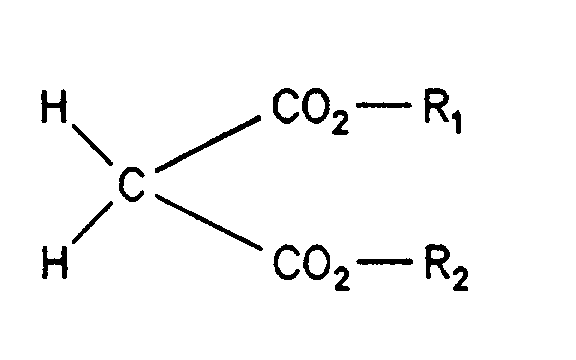
- Überraschenderweise wurde diese Aufgabe durch das erfindungsgemäße Verfahren gelöst, bei dem Malonsäure-diester der allgemeinen Formel I

worin R₁ und R₂ die Bedeutung geradkettiges oder verzweigtes C₁- bis C₆-Alkyl, Cycloalkyl und Aralkyl besitzen und die Reste R₁ und R₂ gleich oder verschieden sein können, mit wäßrigen Alkali-Hypochlorit-Lösungen oder Erdalkali-Hypochlorit-Suspensionen bei pH-Werten ≧ 8 bei niedrigen Temperaturen zu den Zielprodukten der allgemeinen Formel II
worin R₁ und R₂ die vorgenannte Bedeutung haben, umgesetzt werden. - Die aufgefundene Umsetzung kann beispielsweise bei Verwendung von Natrium-Hypochlorit-Lösung durch folgende formale Reaktionsgleichung beschrieben werden:

Überraschend war auch, daß das Abpuffern der bei der Umsetzung freiwerdenden Natronlauge durch verdünnte Mineralsäuren, wie Salz-, Schwefel- oder Phosphorsäure, aber auch durch geeignete organische Säuren, wie Ameisensäure, oder substituierte Essig- und Propionsäuren, wie beispielsweise Monochlor-, Dichlor- oder Trichloressigsäure, oder aromatische Carbonsäuren, die mit Wasser verdünnt sein können und die gegebenenfalls einen oder mehrere inerte Substituenten tragen, und Konstanthalten des pH-Werts der Reaktionsmischung im pH-Bereich 8 bis 14, vorzugsweise im pH-Bereich 8,5 bis 14, und besonders bevorzugt im Bereich 9 bis 14, zu extrem hohen Dichlor-malonester-Ausbeuten verbunden mit extrem hohen Produkt-Reinheiten führt. - Der pH-Bereich, in dem die gewünschte Umsetzung durchgeführt wird, liegt in einem breiten Bereich. So sollte zum einen der Stabilität der eingesetzten Hypochlorite durch einen pH-Wert ≧ 8 Rechnung getragen, und zum anderen sollte der pH-Wert zur Erzielung optimaler Ausbeuten, d. h., um Verluste an Edukt und Zielprodukt infolge Verseifungs-Reaktionen zu vermeiden, in der Alkalität des Reaktionsgemisches eingeschränkt werden;
zweckmäßigerweise wird deshalb die Obergrenze des Reaktions-pH-Werts auf ≦ 14 begrenzt. Vorzugsweise wird im pH-Bereich 8,5 bis 14 gearbeitet. - Desweiteren wurde gefunden, daß niedrige Reaktionstemperaturen die erzielbare Ausbeute und Produktreinheit begünstigen. Es wird deshalb zweckmäßigerweise im Temperaturbereich 0 bis 50 °C, vorzugsweise im Temperaturbereich 2 bis 25 °C gearbeitet. Dieser Temperaturbereich gewährleistet eine rasche und schonende Umsetzung der eingesetzten Edukte; die Anwendung tieferer Temperaturen ist aber auch möglich.
- Die beschriebene Umsetzung kann beispielsweise so erfolgen, daß das Hypochlorit in Form einer wäßrigen Lösung oder Suspension vorgelegt und das Edukt unter Konstanthaltung des pH-Bereichs, wie vorstehend beschrieben, durch parallel erfolgende Dosierung einer der vorstehend beschriebenen Säuren zudosiert wird, wobei die Säuredosierung auch in der Nachreaktionsphase zur Aufrechterhaltung des gewählten pH-Bereichs fortgesetzt werden kann.
- Es kann aber auch eine inverse Arbeitsweise, d. h. Vorlegen des Edukts und Dosierung der Hypochlorit-Lösung nebst Säuredosierung, gewählt werden.
- Bei der auszuführenden Malonester-Chlorierung mittels Hypochloriten kann zweckmäßigerweise, bezogen auf die eingesetzten Malonsäureester, ein geringfügiger Überschuß an Hypochlorit eingesetzt werden; der anzuwendende Überschuß ist nicht kritisch. Im allgemeinen werden 2 bis 20 %, vorzugsweise 5 bis 10 %, Hypohalogenit-Überschuß angewandt. Die Malonester-Hypochlorit-Verhältnisse liegen von 1 : 1 bis 1 : 2, vorzugsweise von 1 : 1,05 bis 1 : 1,2. Nach Reaktionsende wird dieser noch vorhandene Hypochlorit-Anteil in bekannter Weise, etwa durch Zugabe gegebenenfalls wäßrigen Natriumsulfits, zerstört.
- Im allgemeinen resultiert bei diesen Umsetzungen ein zweiphasiges Reaktionsgemisch, aus dem die organische Phase leicht abgetrennt werden kann. Es ist hierbei zweckmäßig, die resultierende wäßrige Phase unter Verwendung eines geeigneten Extraktionsmittels von noch gelöstem Zielprodukt zu befreien.
- Als geeignete Extraktionsmittel gelangen vorzugsweise mit Wasser nicht mischbare Lösemittel, wie Halogenkohlenwasserstoffe, aliphatische, cycloaliphatische und aromatische Kohlenwasserstoffe, Ester und Ether, zum Einsatz, die sich nach Extraktion leicht vom Zielprodukt, etwa durch Normal- oder fraktionierte Vakuum-Destillation, abtrennen lassen.
- Die nachfolgenden Beispiele belegen die Anwendungsbreite des erarbeiteten Verfahrens.
- 217,8 g wäßrige Natrium-Hypochlorit-Lösung (Gehalt: 8,55 % NaOCl entsprechend 250 mMol NaOCl) werden auf 5 °C abgekühlt, der pH-Wert der Lösung wird durch Zugabe wäßrige 20%iger Salzsäure auf ca. 9,1 eingestellt.
- Zu dieser gekühlten Vorlage werden im Verlauf von ca. 30 Minuten 36,0 g Malonsäure-diethylester (225 mMol) zugetropft, wobei der pH-Wert der Lösung durch gleichzeitiges Dosieren einer wäßrigen 20%igen Salzsäure im Bereich 9,0 bis 9,2 und die Innentemperatur durch Kühlung bei ca. 5 °C gehalten wird.
- Nach beendeter Malonester-Dosierung läßt man unter Konstanthaltung des pH-Bereichs 10 Minuten nachreagieren. Dann wird noch vorhandenes, überschüssiges Natrium-Hypochlorit durch Zugabe von Natriumsulfit zerstört, aus dem 2-Phasen-Gemisch wird die organische Phase abgetrennt, die wäßrige Phase erschöpfend mit tert.-Butylmethyl-ether extrahiert und organische Phase und Extrakte vereinigt.
- Nach Eindampfen dieser Lösung wird der resultierende Rückstand einer Vakuum-Destillation unterworfen. Man erhält 50,8 g 2,2-Dichlor-malonsäure-diethylester vom Siedepunkt 95 bis 96 °C (5 hPa), das entspricht einer Ausbeute von 98,6 % d. Th.; die gaschromatografisch ermittelte Reinheit des Produkts beträgt ≧ 99 5 %, der Gehalt an Monochlor-Verbindung ≦ 0,2 %.
- Analog Beispiel 1, aber unter Einsatz von 48,6 g Malonsäure-diisobutylester (225 mMol). Der Anfangs- und Reaktions-pH-Bereich beträgt 12,0 bis 12,2.
- Nach analoger Aufarbeitung werden 58,0 g 2,2-Dichlor-malonsäure-diisobutylester vom Siedepunkt 114 bis 117 °C (5 hPa) erhalten (Reinheit des Zielprodukts: > 99,3 %), das entspricht einer Ausbeute von 90,4 % d. Th.
- Analog Beispiel 1, aber unter Einsatz von 29,7 g Malonsäure-dimethylester (225 mMol).
- Durch analoge Aufarbeitung werden 39,9 g 2,2-Dichlor-malonsäure-dimethylester vom Siedepunkt 72 bis 73 °C (5 hPa) erhalten (Reinheit: > 99,5 %), das entspricht einer Ausbeute von 88,2 % d. Th.
- Analog Beispiel 1, aber unter Einsatz von 42,3 g Malonsäure-diisopropylester (225 mMol). Die Reaktion wird bei pH 13 gestartet und im Bereich 13,0 bis 13,5 durchgeführt, wobei die Nachreaktionszeit ca. 60 Minuten beträgt.
- Durch analoge Aufarbeitung werden 52,5 g 2,2-Dichlor-malonsäure-diisopropylester vom Siedepunkt 92 bis 93 °C (5 hPa) erhalten (Reinheit: ≧ 99,5 %), das entspricht einer Ausbeute von 90,8 % d. Th.
- Analog Beispiel 4, aber unter Einsatz von 42,3 g Malonsäure-tert.-butylethylester (225 mMol). Die Umsetzung und Nachreaktion wird im Temperaturbereich 20 bis 22 °C durchgeführt.
- Nach analoger Aufarbeitung werden 48,8 g 2,2-Dichlor-malonsäure-tert.-butylethylester vom Siedepunkt 95 bis 96 °C (5 hPa) erhalten (Reinheit: > 98 %), das entspricht einer Ausbeute von 84,4 % d. Th.
- Analog Beispiel 4, aber unter Einsatz von 39,2 g Malonsäure-tert.-butylmethylester (225 mMol).
- Nach analoger Aufarbeitung werden 46,8 g 2,2-Dichlor-malonsäure-tert.-butylmethylester vom Siedepunkt 86 bis 88 °C (5 hPa) erhalten (Reinheit: > 99 %), das entspricht einer Ausbeute von 85,2 % d. Th.
Claims (7)
- Verfahren zur Herstellung von 2,2-Dichlor-malonsäure-diestern der allgemeinen Formel

- Verfahren nach Anspruch 1,
dadurch gekennzeichnet,
daß die Umsetzungen bei pH-Werten von 8,5 bis 14, vorzugsweise von 9 bis 14, durchgeführt werden. - Verfahren nach den Ansprüchen 1 und 2,
dadurch gekennzeichnet,
daß als Säuren zur Konstanthaltung des gewählten pH-Bereichs verdünnte wäßrige Mineralsäuren, wie Salz-, Schwefel- oder Phosphorsäure, oder aliphatische Carbonsäuren, die gegebenenfalls mit Wasser verdünnt und mit einem unter den Reaktionsbedingungen inerten Rest substituiert sein können, wie beispielsweise Ameisen-, Essig- oder Propionsäure oder Monochlor-, Dichlor- oder Trichlor-essigsäure, oder verdünnte aromatische Carbonsäuren, die gegebenenfalls mit einem oder mehreren inerten Resten substituiert sein können, eingesetzt werden. - Verfahren nach den Ansprüchen 1 bis 3,
dadurch gekennzeichnet,
daß die Umsetzungen im Temperaturbereich von 2 bis 25 °C durchgeführt werden. - Verfahren nach den Ansprüchen 1 bis 4,
dadurch gekennzeichnet,
daß die Umsetzungen mit einem Malonester-Hypochlorit-Verhältnis von 1 : 1 bis 1 : 2, vorzugsweise mit einem Verhältnis von 1 : 1,05 bis 1 : 1,2, durchgeführt werden. - Verfahren nach den Ansprüchen 1 bis 5,
dadurch gekennzeichnet,
daß die Hypochlorite als wäßrige Lösungen oder als wäßrige Suspensionen eingesetzt werden. - Verfahren nach den Ansprüchen 1 bis 6,
dadurch gekennzeichnet,
daß je nach gewählter Verfahrensweise einer der beiden Reaktionspartner während der Umsetzung zum Reaktionsgemisch dosiert wird.
Applications Claiming Priority (2)
| Application Number | Priority Date | Filing Date | Title |
|---|---|---|---|
| DE4420263 | 1994-06-10 | ||
| DE19944420263 DE4420263A1 (de) | 1994-06-10 | 1994-06-10 | Verfahren zur Herstellung von 2,2-Dichlor-malonsäure-diestern |
Publications (1)
| Publication Number | Publication Date |
|---|---|
| EP0687665A1 true EP0687665A1 (de) | 1995-12-20 |
Family
ID=6520239
Family Applications (1)
| Application Number | Title | Priority Date | Filing Date |
|---|---|---|---|
| EP95105567A Withdrawn EP0687665A1 (de) | 1994-06-10 | 1995-04-12 | Verfahren zur Herstellung von 2,2-Dichlor-malonsäure-diestern |
Country Status (4)
| Country | Link |
|---|---|
| EP (1) | EP0687665A1 (de) |
| JP (1) | JPH07330674A (de) |
| CA (1) | CA2151323A1 (de) |
| DE (1) | DE4420263A1 (de) |
Cited By (1)
| Publication number | Priority date | Publication date | Assignee | Title |
|---|---|---|---|---|
| WO2017100985A1 (zh) * | 2015-12-14 | 2017-06-22 | 苏州大学张家港工业技术研究院 | 一种2,2-二卤代-1,3-二羰基衍生物的制备方法 |
Families Citing this family (2)
| Publication number | Priority date | Publication date | Assignee | Title |
|---|---|---|---|---|
| DE19509377A1 (de) * | 1995-03-15 | 1996-09-19 | Huels Chemische Werke Ag | Verfahren zur Herstellung von 2-Aryl-2-chlormalonsäurediestern |
| JP4598486B2 (ja) * | 2004-11-17 | 2010-12-15 | 三井化学株式会社 | 1,5−ジアミノナフタレンの製造方法 |
Citations (3)
| Publication number | Priority date | Publication date | Assignee | Title |
|---|---|---|---|---|
| DE1948475A1 (de) * | 1968-09-26 | 1970-05-27 | Procter & Gamble | Verfahren zur Herstellung von halogenierten Methylendiphosphonaten,Malonaten und Phosphonoacetaten |
| CH599092A5 (en) * | 1975-07-17 | 1978-05-12 | Rotel Ag | 2,2-Di-chloro-malonic acid prepn. |
| US5064518A (en) * | 1990-01-29 | 1991-11-12 | The Dow Chemical Company | Method for the selective alpha halogenation of alkylaromatic compounds |
-
1994
- 1994-06-10 DE DE19944420263 patent/DE4420263A1/de not_active Withdrawn
-
1995
- 1995-04-12 EP EP95105567A patent/EP0687665A1/de not_active Withdrawn
- 1995-06-08 CA CA 2151323 patent/CA2151323A1/en not_active Abandoned
- 1995-06-08 JP JP14216695A patent/JPH07330674A/ja active Pending
Patent Citations (3)
| Publication number | Priority date | Publication date | Assignee | Title |
|---|---|---|---|---|
| DE1948475A1 (de) * | 1968-09-26 | 1970-05-27 | Procter & Gamble | Verfahren zur Herstellung von halogenierten Methylendiphosphonaten,Malonaten und Phosphonoacetaten |
| CH599092A5 (en) * | 1975-07-17 | 1978-05-12 | Rotel Ag | 2,2-Di-chloro-malonic acid prepn. |
| US5064518A (en) * | 1990-01-29 | 1991-11-12 | The Dow Chemical Company | Method for the selective alpha halogenation of alkylaromatic compounds |
Non-Patent Citations (1)
| Title |
|---|
| BULL. SOC. CHIM. FR., vol. 12, pages 69 - 70 * |
Cited By (1)
| Publication number | Priority date | Publication date | Assignee | Title |
|---|---|---|---|---|
| WO2017100985A1 (zh) * | 2015-12-14 | 2017-06-22 | 苏州大学张家港工业技术研究院 | 一种2,2-二卤代-1,3-二羰基衍生物的制备方法 |
Also Published As
| Publication number | Publication date |
|---|---|
| CA2151323A1 (en) | 1995-12-11 |
| DE4420263A1 (de) | 1995-12-14 |
| JPH07330674A (ja) | 1995-12-19 |
Similar Documents
| Publication | Publication Date | Title |
|---|---|---|
| DE2756169A1 (de) | Verfahren zur herstellung von derivaten von perfluoralkancarboxyl- und perfluoralkansulfinsaeuren | |
| DE2616681A1 (de) | Verfahren zur reduktiven dehydrohalogenierung von alpha-halogenalkoholen | |
| EP0398061B1 (de) | Verfahren zur Herstellung von alpha-Fluoracrylsäurederivaten und neue 1,1-Difluor-2-halogenethyl-(halogen) methyl-ketone | |
| EP0687665A1 (de) | Verfahren zur Herstellung von 2,2-Dichlor-malonsäure-diestern | |
| DE2708751A1 (de) | Verfahren zum funktionalisieren von perfluorierten resten | |
| DE19815323C2 (de) | Verfahren zur Herstellung von Isochroman-3-onen | |
| DE3205588C2 (de) | Verfahren zur Herstellung von Dicumylperoxid | |
| EP0087585A1 (de) | Verfahren zur Herstellung von 3-Alkoxi-acrylnitrilen | |
| DE2443142C2 (de) | Verfahren zur Herstellung von Cyclopropancarbonsäurenitril | |
| DE2811310C3 (de) | ||
| DE2614241A1 (de) | Verfahren zur herstellung von acylcyaniden | |
| EP0020969A1 (de) | Verfahren zur Herstellung eines Gemischs von 3-Chloranthranilsäurealkylester und 6-Chloranthranilsäurealkylester | |
| EP0005849A1 (de) | Verfahren zur Herstellung von Alpha-Chlor-N-monoalkyl-acetoacetamiden | |
| EP0732321B1 (de) | Verfahren zur Herstellung von 2-Aryl-2-chlormalonsäurediestern | |
| EP0691323A1 (de) | Verfahren zur Herstellung von 3,5-Dihydroxy-4-brombenzoesäure | |
| EP0502070A1 (de) | Verfahren zur oxidation von 2-hydroxy-äthylphosphonsäurediestern. | |
| DE69611493T2 (de) | Verfahren zur Herstellung von Benzolhalogenid | |
| EP0095698A1 (de) | Verfahren zur Herstellung von Terephthalsäure- und Isophthalsäuredichlorid | |
| EP0652204A1 (de) | Verfahren zur Herstellung von Carbonsäurechloriden | |
| DE2734207A1 (de) | Verfahren zur herstellung von alpha- ketocarbonsaeure-derivaten | |
| EP0173153B1 (de) | Neue benzokondensierte, fluorierte, heterocyclische Verbindungen, ein Verfahren zu ihrer Herstellung und ihre Verwendung | |
| AT393503B (de) | Verfahren zur herstellung von malonsaeurederivaten durch ozonolyse von ungesaettigten verbindungen | |
| DE4119996C2 (de) | Verfahren zur hydrolytischen Zersetzung halogenhaltiger Verbindungen | |
| DE3441370A1 (de) | Verfahren zur herstellung von halogenierten 3,3-dimethyl-5-hexen-2-onen | |
| DE2433943C3 (de) | Verfahren zur Herstellung von Monohalogenacylchloriden |
Legal Events
| Date | Code | Title | Description |
|---|---|---|---|
| PUAI | Public reference made under article 153(3) epc to a published international application that has entered the european phase |
Free format text: ORIGINAL CODE: 0009012 |
|
| AK | Designated contracting states |
Kind code of ref document: A1 Designated state(s): BE DE ES FR GB IT NL |
|
| RAP1 | Party data changed (applicant data changed or rights of an application transferred) |
Owner name: HUELS AKTIENGESELLSCHAFT |
|
| 17P | Request for examination filed |
Effective date: 19960201 |
|
| STAA | Information on the status of an ep patent application or granted ep patent |
Free format text: STATUS: THE APPLICATION HAS BEEN WITHDRAWN |
|
| 18W | Application withdrawn |
Withdrawal date: 19960510 |