EP0688012A2 - A speech recognizer - Google Patents
A speech recognizer Download PDFInfo
- Publication number
- EP0688012A2 EP0688012A2 EP95109134A EP95109134A EP0688012A2 EP 0688012 A2 EP0688012 A2 EP 0688012A2 EP 95109134 A EP95109134 A EP 95109134A EP 95109134 A EP95109134 A EP 95109134A EP 0688012 A2 EP0688012 A2 EP 0688012A2
- Authority
- EP
- European Patent Office
- Prior art keywords
- probability
- internal state
- state
- hmm
- calculating
- Prior art date
- Legal status (The legal status is an assumption and is not a legal conclusion. Google has not performed a legal analysis and makes no representation as to the accuracy of the status listed.)
- Granted
Links
Images


Classifications
-
- G—PHYSICS
- G10—MUSICAL INSTRUMENTS; ACOUSTICS
- G10L—SPEECH ANALYSIS TECHNIQUES OR SPEECH SYNTHESIS; SPEECH RECOGNITION; SPEECH OR VOICE PROCESSING TECHNIQUES; SPEECH OR AUDIO CODING OR DECODING
- G10L15/00—Speech recognition
- G10L15/08—Speech classification or search
- G10L15/14—Speech classification or search using statistical models, e.g. Hidden Markov Models [HMMs]
- G10L15/142—Hidden Markov Models [HMMs]
Definitions
- the present invention relates to a speech recognizer for automatically recognizing speech signals expressed by time series of feature vectors.
- HMM Hidden Markov models
- the mean vector train has discontinuities at the boundaries of transition from state 1 to state 2 and also from state 2 to state 3, and these discontinuities appear in the output speech pattern.
- a method in which a plurality of output probability distributions are made to correspond to respective states and a coefficient for determining an output probability distribution to be used depends on an output probability distribution that has been used before one time point (Prior art method 1, Literature 2: Ariki, "Two-stage Transition Mixture Distribution HMM", Proceeding I of the Society of Acoustical Engineers of Japan, October, 1992, pp. 85).
- Prior art method 1 requires an enormous number of coefficients, and it is difficult to obtain accurate estimation of parameters without a huge amount of training speech data. Therefore, the method is infeasible.
- Another proposed method in which weighting coefficients of semi-continuous HMM output probability distributions are adapted to be dependent on output probability distributions used before one time instant by using chain probabilities (bigrams) of code series of vector quantized (VQ) input speech (Prior art method 2, Literature 3: Takahashi et al, "Evaluation of Semi-continuous Bigram Restricted HMM with Continuous Speech", Proceeding I of the Society of Acoustical Engineers of Japan, October, 1992, pp. 161).
- This method requires extra calculations, i.e., calculating weighting coefficients afresh by vector quantizing input speech, in addition to the semi-continuous HMM calculations. Further more, the calculation formulas involved are based on heuristically defined, and the calculations are not optimum ones based on statistical theory.
- the present invention therefore proposes a new speech recognizer capable of solving the problems in the HMM that the standard patterns have discontinuities at state transition boundaries.
- the speech recognizer according to the present invention requires neither enormous parameters as involved in Prior art method 1 nor extra calculations as involved in Prior art method 2, and proposes an optimum recognition/study process based on statistical theory rather than on any heuristic method.
- a speech recognizer for recognizing input speech by analyzing the input speech at a predetermined time interval, extracting feature vectors and calculating likelihood value of a reference pattern model of each category to be recognized, comprising: first probability calculation means for calculating a probability that a first hidden Markov model having internal state number as output symbol for each of categories to be recognized outputs an internal state number; second probability calculation means for calculating a probability that a second hidden Markov model having transition probabilities between internal state number and feature vector output probability distribution for each of the respective internal state numbers outputs a feature vector; and likelihood value calculation means for calculating likelihood value of a reference pattern model of the category to be recognized by using outputs of the first and second probability calculation means.
- O) of the word W is given as:
- the summation symbol represents summation concerning time series S for all the possible internal state Nos.
- the internal state No. can take any of K integral numbers from 1 to K.
- variable s k represents the internal state No.
- HMM-1 in the sense that it refers to the first HMM.
- a jk (2) is the transition probability from internal state j to internal state k
- b k (2) (o t ) is the probability of outputting feature vector o t in internal state k.
- the forward probability that feature vector o t is output upon reaching of state n and internal state k at time instant t is defined as follows.
- the backward probability that observed feature vector o t+1 is output at time instant (t+1) and that state and internal state k are reached at time point t can be defined as
- W) can be obtained through recurrence formula calculation of the forward probability on the TRELIS specified by three dimensions of the time t, state n and internal state k.
- ⁇ k and ⁇ k are the mean vector and variance matrix when the output probability of feature vectors in internal state k is represented by Gaussian distribution.
- Equation (6) representing the likelihood according to the present invention is rewritten as follows:
- the coefficient ⁇ nk,j can be considered to be mixing coefficient in the case of using the k-th output probability b k (2) (O) in state n.
- the semi-continuous HMM is detailed in X. D. Huang et al, "Semi-continuous Hidden Markov Models for Speech Signals", Computer Speech and Language, 1989 Vol. 3, pp. 239 .
- a method of introducing the Markovian correlation to the preceding frame to the mixing coefficient in the mixture distribution HMM is formulated as two-stage transition mixture distribution HMM (Prior art method 1).
- the likelihood is expressed as:
- a first difference of this case from the present invention is that the feature vector output probability b nk (O) depends on both the state n and internal state k. In contrast, according to the invention, it depends on the internal state k only. This leads to a great increase of the output probability parameter number in the prior art method 1.
- the parameter number of the mixing coefficient ⁇ nk,j is N ⁇ K ⁇ K.
- the mixing coefficient ⁇ nk,j is decomposed to the product of the output probability b nk (1) and transition probability a jk (2) , and the parameter number is thus reduced to ( N ⁇ K + K ⁇ K ).
- the parameter number is 64,000,000 in Prior art method 1 and 320,000 according to the invention. That is, the parameter number can be reduced to 1/200.
- the parameter number is of the same order as in the case of the semi-continuous HMM.
- the vector quantization (VQ) process and re-calculation of the mixing coefficient with the above equation are necessary at the time of the recognition. In the present invention, no such extra calculation is necessary. Further, because the semi-continuous HMM and bigram probability of VQ codes, the two being different in nature, are combined, the above equation is not the optimum calculation formula based on statistical theory but is merely based on heuristic one.
- Equation (7) forward probability recurrence formula calculation is made on the three-dimensional TRELIS specified by time t, state n and internal state k.
- calculation for O(T ⁇ N) lattice points on the two-dimensional TRELIS specified by time t and state n was necessary.
- calculation for O(T ⁇ N ⁇ K) is necessary. To reduce the calculations and storage, the following sub-optimal approximation .
- Fig. 5 is a block diagram showing a word speech recognizer according to the present invention.
- Speech signal obtained by a microphone 10 is sampled, digitized and then converted to feature vectors through Fast Fourier transform or the like in an analyzer.
- the output of the analyser 20 being fed to a microprocessor 30 connected to a HMM-1 and a HMM-2 parameter memory 40 and 50 and a work memory 60.
- the work memory 60 is a working area for tentatively storing the output probability and forward probability when calculating the likelihood value of each word to be recognized with a reference pattern model. It is possible that the HMM-1 and HMM-2 parameter memories 40 and 50 and work memory 60 be defined as distinct memory areas in the microprocessor main memory.
- the recognizing process is executed in accordance with a program in the microprocessor 30. Specifically, whenever input signal feature vector o t is supplied, the microprocessor 30 executes a routine as shown by the flow chart in Fig. 6. In a step shown as block 101 in the flow chart, output probability b k (2) (o t ) of outputting the feature vector o t in the internal state k is calculated on the basis of the output probability distribution parameters stored in the HMM-2 parameter memory 50 and stored as variable B in the work memory 70. Further, array variables A (w,t,n,k) in the work memory 60 for calculating the forward probability are cleared.
- contribution to forward probability when the feature vector o t is output through transition from state m and internal state j to state n and internal state k is calculated from the parameters stored in the HMM-1 and HMM-2 parameter memories 40 and 50 and work memory 60 and added to the array variables A (w,t,n,k).
- the time instant of the input signal is incremented by unit time to be ready for the input of the next feature vector o t for the same routine.
- the routine for the last feature vector o T is over with the end of the input signal, the following process is executed in the microprocessor 30.
- the array variables A (w,t,n,k) at instant t only those for times t and (t-1), not for all the times. This means that the size of the array variable storage area is 2 ⁇ W ⁇ N ⁇ K .
- the size of the storage area can be further reduced.
- Fig. 7 shows a flow chart in the embodiment.
- Array variables that are necessary for the calculation are k max (t,n) and A (w,t,n). In either case, it is necessary at instant t to preserve only array variables for times t and (t-1).
- the necessary storage area size is 2 ⁇ N + 2 ⁇ W ⁇ N and reduced to about 1/K.
- the operation amount it will be seen from the comparison of Figs. 6 and 7 that in the case of Fig. 7 the operation amount is reduced to an extent corresponding to the absence of iterative calculation concerning the variable j.
Landscapes
- Engineering & Computer Science (AREA)
- Physics & Mathematics (AREA)
- Probability & Statistics with Applications (AREA)
- Computational Linguistics (AREA)
- Health & Medical Sciences (AREA)
- Audiology, Speech & Language Pathology (AREA)
- Human Computer Interaction (AREA)
- Acoustics & Sound (AREA)
- Multimedia (AREA)
- Image Analysis (AREA)
Abstract
Description
- The present invention relates to a speech recognizer for automatically recognizing speech signals expressed by time series of feature vectors.
- Hidden Markov models (HMM) have been used extensively as standard pattern model of the speech recognition. The HMM is well-known and detailed in Literature 1 ("Fundamentals of Speech Recognition", L. Rabiner & B-H Juang, 1993, Published by Prentice Hall). In the HMM, however, the output probability distributions in different states are independent of and not correlated to one another, and speech patterns modeled as HMM have inevitable discontinuities produced at the points of transition of states, thus reducing the recognition rate. This is shown in Fig. 1. in which Gaussian output probability distributions in individual states are used. In this case, the speech pattern modeled as HMM is distributed statistically around the mean vector of the Gaussian distribution. The mean vector train has discontinuities at the boundaries of transition from
state 1 tostate 2 and also fromstate 2 tostate 3, and these discontinuities appear in the output speech pattern. To cope with this problem, there has been proposed a method, in which a plurality of output probability distributions are made to correspond to respective states and a coefficient for determining an output probability distribution to be used depends on an output probability distribution that has been used before one time point (Prior art method 1, Literature 2: Ariki, "Two-stage Transition Mixture Distribution HMM", Proceeding I of the Society of Acoustical Engineers of Japan, October, 1992, pp. 85). By introducing this correlation, it is possible to reduce continuous use of output probability distributions of greatly different mean vectors, and this permits solving the HMM problem as described before.Prior art method 1, however, requires an enormous number of coefficients, and it is difficult to obtain accurate estimation of parameters without a huge amount of training speech data. Therefore, the method is infeasible. There is another proposed method, in which weighting coefficients of semi-continuous HMM output probability distributions are adapted to be dependent on output probability distributions used before one time instant by using chain probabilities (bigrams) of code series of vector quantized (VQ) input speech (Prior art method 2, Literature 3: Takahashi et al, "Evaluation of Semi-continuous Bigram Restricted HMM with Continuous Speech", Proceeding I of the Society of Acoustical Engineers of Japan, October, 1992, pp. 161). This method, however, requires extra calculations, i.e., calculating weighting coefficients afresh by vector quantizing input speech, in addition to the semi-continuous HMM calculations. Further more, the calculation formulas involved are based on heuristically defined, and the calculations are not optimum ones based on statistical theory. - The present invention therefore proposes a new speech recognizer capable of solving the problems in the HMM that the standard patterns have discontinuities at state transition boundaries. The speech recognizer according to the present invention requires neither enormous parameters as involved in
Prior art method 1 nor extra calculations as involved inPrior art method 2, and proposes an optimum recognition/study process based on statistical theory rather than on any heuristic method. - According to one aspect of the present invention, there is provided a speech recognizer for recognizing input speech by analyzing the input speech at a predetermined time interval, extracting feature vectors and calculating likelihood value of a reference pattern model of each category to be recognized, comprising: first probability calculation means for calculating a probability that a first hidden Markov model having internal state number as output symbol for each of categories to be recognized outputs an internal state number; second probability calculation means for calculating a probability that a second hidden Markov model having transition probabilities between internal state number and feature vector output probability distribution for each of the respective internal state numbers outputs a feature vector; and likelihood value calculation means for calculating likelihood value of a reference pattern model of the category to be recognized by using outputs of the first and second probability calculation means.
- According to another aspect of the present invention, there is provided a speech recognizer comprising: a first HMM parameter memory for storing as first HMM parameters of individual words w, transition probability


- Other objects and features will be clarified from the following description with reference to attached drawings.
-
- Fig. 1 shows a drawing for explaining the conventional speech recognizer;
- Fig. 2 shows a block diagram of a first conventional speech recognizer;
- Fig. 3 shows a block diagram of a second conventional speech recognizer;
- Fig. 4 shows a block diagram of one embodiment according to the present invention;
- Fig. 5 shows a block diagram of the apparatus according to one embodiment of the present invention;
- Fig. 6 shows a flowchart of the processes executed in the embodiment of the present invention; and
- Fig. 7 shows a flowchart of the processes executed in the embodiment of the present invention.
- Among the categories of the subject of speech recognition are the vocal sound, syllable, word, sentence, etc. The following detailed description concerns the word, but the same applies to the other cases as well.
- Denoting the word by probability variable W, the input speech (feature vector time series of length T) by


In the above Equations, the summation symbol represents summation concerning time series S for all the possible internal state Nos. According to the present invention, it is assumed that the internal state No. can take any of K integral numbers from 1 to K. In the following equation, variable sk represents the internal state No.
In the word W, the probability P(sk1, ..., skr|W) that the internal state No. series
- When the number of the HMM-1 states of the word W is N,

where amn (1) is the transition probability from state m to state n, and bnk (1) is the output probability of output symbol sk in state n. The probability P(O|sk1, ..., skT) of generation of input speech feature vector series

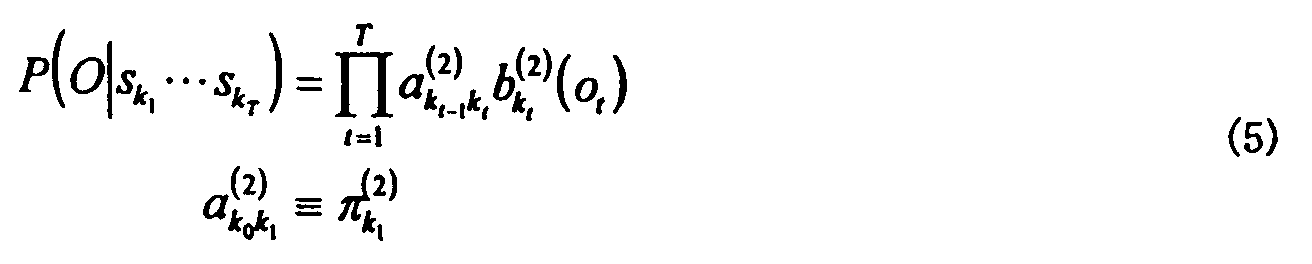
where ajk (2) is the transition probability from internal state j to internal state k, and bk (2)(ot) is the probability of outputting feature vector ot in internal state k. In summary,
The forward probability that feature vector ot is output upon reaching of state n and internal state k at time instant t, is defined as follows.
Likewise, the backward probability that observed feature vector ot+1 is output at time instant (t+1) and that state and internal state k are reached at time point t, can be defined as
In consequence, it is seen that the probability P(O|W) can be obtained through recurrence formula calculation of the forward probability on the TRELIS specified by three dimensions of the time t, state n and internal state k. In the prior art HMM, calculations for O(T·N) lattice points on two-dimensional TRELIS specified by time t and state n were necessary. With the system according to the present invention, the calculation for
- Estimation of the transition probability and output probability in the training can be executed is possible by applying the same re-estimation formulas as in the case of the prior art HMM on the three-dimensional TRELIS.


In the above formulas, µk and Σk are the mean vector and variance matrix when the output probability of feature vectors in internal state k is represented by Gaussian distribution. - Equation (6) representing the likelihood according to the present invention is rewritten as follows:

In comparison of this equation with the semi-continuous HMM, the coefficient λnk,j can be considered to be mixing coefficient in the case of using the k-th output probability bk (2)(O) in state n. - According to the present invention, however, the mixing coefficient depends on which output probability (as specified by the subscript j) is used in the preceding frame (that is, it has a Markovian correlation). If an approximation is made such that there is no such correlation (

- A method of introducing the Markovian correlation to the preceding frame to the mixing coefficient in the mixture distribution HMM, is formulated as two-stage transition mixture distribution HMM (Prior art method 1). In this case, the likelihood is expressed as:

A first difference of this case from the present invention is that the feature vector output probability bnk(O) depends on both the state n and internal state k. In contrast, according to the invention, it depends on the internal state k only. This leads to a great increase of the output probability parameter number in theprior art method 1. - A second difference is that in the
prior art method 1 the parameter number of the mixing coefficient λnk,j is N·K·K. According to the present invention, as is obvious from Equation (16), the mixing coefficient λnk,j is decomposed to the product of the output probability bnk (1) and transition probability ajk (2), and the parameter number is thus reduced to (
Prior art method 1 and 320,000 according to the invention. That is, the parameter number can be reduced to 1/200. According to the present invention, the parameter number is of the same order as in the case of the semi-continuous HMM. - Further, there has been proposed a heuristic method introducing frame correlation to the semi-continuous HMM mixing coefficient by using bigram probability of the code (VQ code) obtained through the vector quantization (VQ) (Prior art method 2). In this method, a new mixing coefficient λ̂nk,j which is calculated by transformation as defined by the following Equation is used:

where λnk is the mixing coefficient of the k-th output probability (internal state k) in the state n of the semi-continuous HMM, and ajk is the bigram probability of VQ codes in the training data (i.e., bigram probability that VQ code j is followed by VQ code k as the next one), is used at the time of the recognition. - In this method, the vector quantization (VQ) process and re-calculation of the mixing coefficient with the above equation are necessary at the time of the recognition. In the present invention, no such extra calculation is necessary. Further, because the semi-continuous HMM and bigram probability of VQ codes, the two being different in nature, are combined, the above equation is not the optimum calculation formula based on statistical theory but is merely based on heuristic one.
- What has been described above is shown in Fig. 2 (Prior art method 1), Fig. 3 (Prior art method 2) and Fig. 4 (present invention). Comparison of these Figures will clarify the difference of the parameter number (necessary memory area) and calculation procedure.
- According to the present invention, as is seen from Equation (7), forward probability recurrence formula calculation is made on the three-dimensional TRELIS specified by time t, state n and internal state k. In the prior art HMM, calculation for O(T·N) lattice points on the two-dimensional TRELIS specified by time t and state n was necessary. In the system according to the present invention, calculation for

- Forward probability, in which summation of the internal states k is taken on the two-dimensional TRELIS specified by time t and state n, is defined as:

Also, internal state k̂t(n) which gives the maximum probability on the two-dimensional TRELIS specified by time t and state n is defined as:
Under the above definitions, approximation given by the following equation
is introduced. - This approximation corresponds to the assumption that the forward probability is sufficiently low in the other internal states than the one k̂t(n) corresponding to the maximum probability. Using this approximation, the following equation of probability recurrence on the two-dimensional TRELIS can be obtained.

Thus, the following calculating algorithm of sub-optimal recurrence on the two-dimensional TRELIS can be obtained.
In time (frame) synchronous recurrence formula calculation, it is necessary to store only the forward probability α̂t(n) and the optimum internal state k̂t(n), and thus both the operation and storage amounts can be reduced to be comparable with those in the case of the semi-continuous HMM. - Fig. 5 is a block diagram showing a word speech recognizer according to the present invention. Speech signal obtained by a
microphone 10 is sampled, digitized and then converted to feature vectors through Fast Fourier transform or the like in an analyzer. The output of theanalyser 20 being fed to amicroprocessor 30 connected to a HMM-1 and a HMM-2parameter memory work memory 60. - In the HMM-1
parameter memory 40 are stored, as first HMM parameters of individual words w, transition probability

parameter memory 50 are stored second HMM parameters common to all the words, i.e., parameters of distribution functions representing transition probability
work memory 60 is a working area for tentatively storing the output probability and forward probability when calculating the likelihood value of each word to be recognized with a reference pattern model. It is possible that the HMM-1 and HMM-2parameter memories work memory 60 be defined as distinct memory areas in the microprocessor main memory. - The recognizing process is executed in accordance with a program in the
microprocessor 30. Specifically, whenever input signal feature vector ot is supplied, themicroprocessor 30 executes a routine as shown by the flow chart in Fig. 6. In a step shown asblock 101 in the flow chart, output probability bk (2)(ot) of outputting the feature vector ot in the internal state k is calculated on the basis of the output probability distribution parameters stored in the HMM-2parameter memory 50 and stored as variable B in the work memory 70. Further, array variables A (w,t,n,k) in thework memory 60 for calculating the forward probability are cleared. In a step shown asblock 102, contribution to forward probability when the feature vector ot is output through transition from state m and internal state j to state n and internal state k, is calculated from the parameters stored in the HMM-1 and HMM-2parameter memories work memory 60 and added to the array variables A (w,t,n,k). - When the above routine is ended, the time instant of the input signal is incremented by unit time to be ready for the input of the next feature vector ot for the same routine. When the routine for the last feature vector oT is over with the end of the input signal, the following process is executed in the
microprocessor 30. The forward probability A (w,T,n,k) for each word w stored in the work memory 70 gives word output probability (likelihood value) of outputting input signal by the reference pattern model for each word. These values are compared successively to obtain the maximum value, and the corresponding word w=ŵ is output as recognition result. - In the embodiment, it is enough to store in the
work memory 60 the array variables A (w,t,n,k) at instant t only those for times t and
(t-1), not for all the times. This means that the size of the array variable storage area is
- According to the embodiment, the size of the storage area can be further reduced. Fig. 7 shows a flow chart in the embodiment. Array variables that are necessary for the calculation are kmax(t,n) and A (w,t,n). In either case, it is necessary at instant t to preserve only array variables for times t and (t-1). Thus, the necessary storage area size is

- As has been described in the foregoing, according to the invention it is possible to solve the problem of the discontinuities at the HMM state transition boundaries so as to obtain highly accurate modeling of signals and realize a low cost and high performance speech recognizer with a greatly reduced parameter number compared to
Prior art method 1 and also without vector quantization or heuristic re-calculation of coefficients as involved inPrior art method 2. - Changes in construction will occur to those skilled in the art and various apparently different modifications and embodiments may be made without departing from the scope of the present invention. The matter set forth in the foregoing description and accompanying drawings is offered by way of illustration only. It is therefore intended that the foregoing description be regarded as illustrative rather than limiting.
Claims (5)
- A speech recognizer for recognizing input speech by analyzing the input speech at a predetermined time interval, extracting feature vectors and calculating likelihood value of a reference pattern model of each category to be recognized, comprising:
first probability calculation means for calculating a probability that a first hidden Markov model having internal state number as output symbol for each of categories to be recognized outputs an internal state number;
second probability calculation means for calculating a probability that a second hidden Markov model having transition probabilities of internal state number and feature vector output probability distribution for each of the respective internal state numbers outputs a feature vector; and likelihood value calculation means for calculating likelihood value of a reference pattern model of the category to be recognized by using outputs of the first and second probability calculation means. - The speech recognizer as set forth in claim 1, wherein the likelihood value calculation means executes the likelihood calculation process by using only internal state number providing the maximum likelihood value at each time instant on an input speech feature vector time series time axis and in each state of the first hidden Markov model of the category to be recognized.
- A speech recognizer comprising:
a first HMM parameter memory for storing as first HMM parameters of individual words w, transition probability

a second HMM parameter memory for storing as second HMM parameters common to all the words, parameters of distribution functions representing transition probability
work memory as an working area for tentatively storing the output probability and forward probability when calculating the likelihood value of each word to be recognized with a reference pattern model; and
recognition processing means including:
first calculation means for calculating the output probability bk (2)(ot) of outputting the feature vector ot in the internal state k on the basis of the output probability distribution parameters stored in the second HMM parameter memory and storing it as variable B in the work memory;
clearing means for clearing array variables A (w,t,n,k) in the work memory for calculating the forward probability;
second calculation means for calculating contribution to the forward probability when the feature vector ot is output through transition from state m and internal state j to state n and internal state k, from the parameters stored in the first and second HMM parameter memories and work memory and adding it to the array variables A (w,t,n,k); and
comparing the forward probability A (w,T,n,k) for each word w stored in the work memory successively to obtain the maximum value, and recognition result of the corresponding word having the maximum value. - The speech recognizer as set forth in claim 3, wherein the work memory stores the arrangement variables A (w,t,n,k) only for times t and (t-1).
- The speech recognizer as set forth in claim 3, wherein the first and second HMM parameter memories and work memory are defined as distinct memory areas in a main memory.
Applications Claiming Priority (3)
| Application Number | Priority Date | Filing Date | Title |
|---|---|---|---|
| JP6129985A JP2654539B2 (en) | 1994-06-13 | 1994-06-13 | Voice recognition device |
| JP129985/94 | 1994-06-13 | ||
| JP12998594 | 1994-06-13 |
Publications (3)
| Publication Number | Publication Date |
|---|---|
| EP0688012A2 true EP0688012A2 (en) | 1995-12-20 |
| EP0688012A3 EP0688012A3 (en) | 1996-02-07 |
| EP0688012B1 EP0688012B1 (en) | 2000-01-19 |
Family
ID=15023311
Family Applications (1)
| Application Number | Title | Priority Date | Filing Date |
|---|---|---|---|
| EP95109134A Expired - Lifetime EP0688012B1 (en) | 1994-06-13 | 1995-06-13 | A speech recognizer |
Country Status (5)
| Country | Link |
|---|---|
| US (1) | US5737488A (en) |
| EP (1) | EP0688012B1 (en) |
| JP (1) | JP2654539B2 (en) |
| CA (1) | CA2151330C (en) |
| DE (1) | DE69514573T2 (en) |
Cited By (2)
| Publication number | Priority date | Publication date | Assignee | Title |
|---|---|---|---|---|
| US6837790B1 (en) | 2000-07-26 | 2005-01-04 | Igt | Gaming device with moving screen simulation |
| US7263799B2 (en) | 2003-06-17 | 2007-09-04 | E. Van Zanten Holding B.V. | Plant base |
Families Citing this family (8)
| Publication number | Priority date | Publication date | Assignee | Title |
|---|---|---|---|---|
| EP1078355B1 (en) * | 1998-05-11 | 2002-10-02 | Siemens Aktiengesellschaft | Method and array for introducing temporal correlation in hidden markov models for speech recognition |
| US6594392B2 (en) * | 1999-05-17 | 2003-07-15 | Intel Corporation | Pattern recognition based on piecewise linear probability density function |
| US6611825B1 (en) * | 1999-06-09 | 2003-08-26 | The Boeing Company | Method and system for text mining using multidimensional subspaces |
| US6701305B1 (en) | 1999-06-09 | 2004-03-02 | The Boeing Company | Methods, apparatus and computer program products for information retrieval and document classification utilizing a multidimensional subspace |
| KR100464428B1 (en) * | 2002-08-12 | 2005-01-03 | 삼성전자주식회사 | Apparatus for recognizing a voice |
| TWI454955B (en) * | 2006-12-29 | 2014-10-01 | Nuance Communications Inc | An image-based instant message system and method for providing emotions expression |
| JP5243375B2 (en) * | 2009-09-09 | 2013-07-24 | 日本光電工業株式会社 | Biological signal processing device and medical device control method |
| US8515734B2 (en) * | 2010-02-08 | 2013-08-20 | Adacel Systems, Inc. | Integrated language model, related systems and methods |
Family Cites Families (3)
| Publication number | Priority date | Publication date | Assignee | Title |
|---|---|---|---|---|
| US5268990A (en) * | 1991-01-31 | 1993-12-07 | Sri International | Method for recognizing speech using linguistically-motivated hidden Markov models |
| US5241619A (en) * | 1991-06-25 | 1993-08-31 | Bolt Beranek And Newman Inc. | Word dependent N-best search method |
| US5199077A (en) * | 1991-09-19 | 1993-03-30 | Xerox Corporation | Wordspotting for voice editing and indexing |
-
1994
- 1994-06-13 JP JP6129985A patent/JP2654539B2/en not_active Expired - Fee Related
-
1995
- 1995-06-07 US US08/483,321 patent/US5737488A/en not_active Expired - Fee Related
- 1995-06-08 CA CA002151330A patent/CA2151330C/en not_active Expired - Fee Related
- 1995-06-13 DE DE69514573T patent/DE69514573T2/en not_active Expired - Fee Related
- 1995-06-13 EP EP95109134A patent/EP0688012B1/en not_active Expired - Lifetime
Cited By (3)
| Publication number | Priority date | Publication date | Assignee | Title |
|---|---|---|---|---|
| US6837790B1 (en) | 2000-07-26 | 2005-01-04 | Igt | Gaming device with moving screen simulation |
| US7156740B2 (en) | 2000-07-26 | 2007-01-02 | Igt | Gaming device with moving screen simulation |
| US7263799B2 (en) | 2003-06-17 | 2007-09-04 | E. Van Zanten Holding B.V. | Plant base |
Also Published As
| Publication number | Publication date |
|---|---|
| JP2654539B2 (en) | 1997-09-17 |
| DE69514573D1 (en) | 2000-02-24 |
| US5737488A (en) | 1998-04-07 |
| JPH07334187A (en) | 1995-12-22 |
| CA2151330C (en) | 2000-08-15 |
| DE69514573T2 (en) | 2000-07-06 |
| EP0688012A3 (en) | 1996-02-07 |
| EP0688012B1 (en) | 2000-01-19 |
| CA2151330A1 (en) | 1995-12-14 |
Similar Documents
| Publication | Publication Date | Title |
|---|---|---|
| US6041299A (en) | Apparatus for calculating a posterior probability of phoneme symbol, and speech recognition apparatus | |
| US5473728A (en) | Training of homoscedastic hidden Markov models for automatic speech recognition | |
| EP0303022B1 (en) | Rapidly training a speech recognizer to a subsequent speaker given training data of a reference speaker | |
| US6064958A (en) | Pattern recognition scheme using probabilistic models based on mixtures distribution of discrete distribution | |
| US6278970B1 (en) | Speech transformation using log energy and orthogonal matrix | |
| US5050215A (en) | Speech recognition method | |
| EP0831461B1 (en) | Scheme for model adaptation in pattern recognition based on taylor expansion | |
| US4827521A (en) | Training of markov models used in a speech recognition system | |
| EP0387791B1 (en) | Method and apparatus for time series signal recognition with signal variation proof learning | |
| EP0755046B1 (en) | Speech recogniser using a hierarchically structured dictionary | |
| EP0805434A2 (en) | Method and system for speech recognition using continuous density hidden Markov models | |
| EP0706171A1 (en) | Speech recognition method and apparatus | |
| EP0617827B1 (en) | Composite expert | |
| EP0335739A2 (en) | Pattern recognition system | |
| US5956676A (en) | Pattern adapting apparatus using minimum description length criterion in pattern recognition processing and speech recognition system | |
| EP0688012B1 (en) | A speech recognizer | |
| US6934681B1 (en) | Speaker's voice recognition system, method and recording medium using two dimensional frequency expansion coefficients | |
| EP0606913A2 (en) | Method and system for recognizing pattern | |
| US6275799B1 (en) | Reference pattern learning system | |
| EP1074018B1 (en) | Speech recognition system and method | |
| Takahashi et al. | Discrete mixture HMM | |
| US6782362B1 (en) | Speech recognition method and apparatus utilizing segment models | |
| JP2982689B2 (en) | Standard pattern creation method using information criterion | |
| JP3035239B2 (en) | Speaker normalization device, speaker adaptation device, and speech recognition device | |
| Juang et al. | Mixture autoregressive hidden Markov models for speaker independent isolated word recognition |
Legal Events
| Date | Code | Title | Description |
|---|---|---|---|
| PUAI | Public reference made under article 153(3) epc to a published international application that has entered the european phase |
Free format text: ORIGINAL CODE: 0009012 |
|
| AK | Designated contracting states |
Kind code of ref document: A2 Designated state(s): DE FR GB |
|
| PUAL | Search report despatched |
Free format text: ORIGINAL CODE: 0009013 |
|
| AK | Designated contracting states |
Kind code of ref document: A3 Designated state(s): DE FR GB |
|
| 17P | Request for examination filed |
Effective date: 19960607 |
|
| GRAG | Despatch of communication of intention to grant |
Free format text: ORIGINAL CODE: EPIDOS AGRA |
|
| GRAG | Despatch of communication of intention to grant |
Free format text: ORIGINAL CODE: EPIDOS AGRA |
|
| GRAH | Despatch of communication of intention to grant a patent |
Free format text: ORIGINAL CODE: EPIDOS IGRA |
|
| 17Q | First examination report despatched |
Effective date: 19990604 |
|
| GRAH | Despatch of communication of intention to grant a patent |
Free format text: ORIGINAL CODE: EPIDOS IGRA |
|
| GRAA | (expected) grant |
Free format text: ORIGINAL CODE: 0009210 |
|
| RIC1 | Information provided on ipc code assigned before grant |
Free format text: 7G 10L 15/14 A |
|
| AK | Designated contracting states |
Kind code of ref document: B1 Designated state(s): DE FR GB |
|
| REF | Corresponds to: |
Ref document number: 69514573 Country of ref document: DE Date of ref document: 20000224 |
|
| ET | Fr: translation filed | ||
| PLBE | No opposition filed within time limit |
Free format text: ORIGINAL CODE: 0009261 |
|
| STAA | Information on the status of an ep patent application or granted ep patent |
Free format text: STATUS: NO OPPOSITION FILED WITHIN TIME LIMIT |
|
| 26N | No opposition filed | ||
| REG | Reference to a national code |
Ref country code: GB Ref legal event code: IF02 |
|
| PGFP | Annual fee paid to national office [announced via postgrant information from national office to epo] |
Ref country code: DE Payment date: 20080619 Year of fee payment: 14 |
|
| PGFP | Annual fee paid to national office [announced via postgrant information from national office to epo] |
Ref country code: FR Payment date: 20080617 Year of fee payment: 14 |
|
| PGFP | Annual fee paid to national office [announced via postgrant information from national office to epo] |
Ref country code: GB Payment date: 20080618 Year of fee payment: 14 |
|
| GBPC | Gb: european patent ceased through non-payment of renewal fee |
Effective date: 20090613 |
|
| REG | Reference to a national code |
Ref country code: FR Ref legal event code: ST Effective date: 20100226 |
|
| PG25 | Lapsed in a contracting state [announced via postgrant information from national office to epo] |
Ref country code: FR Free format text: LAPSE BECAUSE OF NON-PAYMENT OF DUE FEES Effective date: 20090630 |
|
| PG25 | Lapsed in a contracting state [announced via postgrant information from national office to epo] |
Ref country code: GB Free format text: LAPSE BECAUSE OF NON-PAYMENT OF DUE FEES Effective date: 20090613 |
|
| PG25 | Lapsed in a contracting state [announced via postgrant information from national office to epo] |
Ref country code: DE Free format text: LAPSE BECAUSE OF NON-PAYMENT OF DUE FEES Effective date: 20100101 |