EP0688110A2 - Procédé et dispositif d'égalisation adaptative à décision double pour canaux à évanouissement multivoie - Google Patents
Procédé et dispositif d'égalisation adaptative à décision double pour canaux à évanouissement multivoie Download PDFInfo
- Publication number
- EP0688110A2 EP0688110A2 EP95480049A EP95480049A EP0688110A2 EP 0688110 A2 EP0688110 A2 EP 0688110A2 EP 95480049 A EP95480049 A EP 95480049A EP 95480049 A EP95480049 A EP 95480049A EP 0688110 A2 EP0688110 A2 EP 0688110A2
- Authority
- EP
- European Patent Office
- Prior art keywords
- decision
- filter
- feed forward
- symbol
- coefficient
- Prior art date
- Legal status (The legal status is an assumption and is not a legal conclusion. Google has not performed a legal analysis and makes no representation as to the accuracy of the status listed.)
- Withdrawn
Links
Images





Classifications
-
- H—ELECTRICITY
- H04—ELECTRIC COMMUNICATION TECHNIQUE
- H04L—TRANSMISSION OF DIGITAL INFORMATION, e.g. TELEGRAPHIC COMMUNICATION
- H04L1/00—Arrangements for detecting or preventing errors in the information received
- H04L1/004—Arrangements for detecting or preventing errors in the information received by using forward error control
- H04L1/0045—Arrangements at the receiver end
- H04L1/0054—Maximum-likelihood or sequential decoding, e.g. Viterbi, Fano, ZJ algorithms
-
- H—ELECTRICITY
- H04—ELECTRIC COMMUNICATION TECHNIQUE
- H04L—TRANSMISSION OF DIGITAL INFORMATION, e.g. TELEGRAPHIC COMMUNICATION
- H04L25/00—Baseband systems
- H04L25/02—Details ; arrangements for supplying electrical power along data transmission lines
- H04L25/03—Shaping networks in transmitter or receiver, e.g. adaptive shaping networks
- H04L25/03006—Arrangements for removing intersymbol interference
- H04L25/03012—Arrangements for removing intersymbol interference operating in the time domain
- H04L25/03019—Arrangements for removing intersymbol interference operating in the time domain adaptive, i.e. capable of adjustment during data reception
- H04L25/03057—Arrangements for removing intersymbol interference operating in the time domain adaptive, i.e. capable of adjustment during data reception with a recursive structure
-
- H—ELECTRICITY
- H04—ELECTRIC COMMUNICATION TECHNIQUE
- H04L—TRANSMISSION OF DIGITAL INFORMATION, e.g. TELEGRAPHIC COMMUNICATION
- H04L25/00—Baseband systems
- H04L25/02—Details ; arrangements for supplying electrical power along data transmission lines
- H04L25/03—Shaping networks in transmitter or receiver, e.g. adaptive shaping networks
- H04L25/03006—Arrangements for removing intersymbol interference
- H04L25/03012—Arrangements for removing intersymbol interference operating in the time domain
- H04L25/03019—Arrangements for removing intersymbol interference operating in the time domain adaptive, i.e. capable of adjustment during data reception
- H04L25/03057—Arrangements for removing intersymbol interference operating in the time domain adaptive, i.e. capable of adjustment during data reception with a recursive structure
- H04L25/0307—Arrangements for removing intersymbol interference operating in the time domain adaptive, i.e. capable of adjustment during data reception with a recursive structure using blind adaptation
-
- H—ELECTRICITY
- H04—ELECTRIC COMMUNICATION TECHNIQUE
- H04L—TRANSMISSION OF DIGITAL INFORMATION, e.g. TELEGRAPHIC COMMUNICATION
- H04L25/00—Baseband systems
- H04L25/02—Details ; arrangements for supplying electrical power along data transmission lines
- H04L25/03—Shaping networks in transmitter or receiver, e.g. adaptive shaping networks
- H04L25/03006—Arrangements for removing intersymbol interference
- H04L25/03178—Arrangements involving sequence estimation techniques
- H04L25/03248—Arrangements for operating in conjunction with other apparatus
- H04L25/03254—Operation with other circuitry for removing intersymbol interference
- H04L25/03267—Operation with other circuitry for removing intersymbol interference with decision feedback equalisers
Definitions
- the present invention relates to a device and method for performing adaptive equalization in a communications system.
- the present invention provides for blind or referenced trained adaptive equalization for use in digital communication systems.
- ISI inter-symbol interference
- DSP programmable digital signal processors
- Both types of equalizers typically utilize an adaptive filter.
- the adaptive filter often referred to as transversal filter or moving average filter, is made with a chain of delay elements, at the output of each of which is placed a variable gain amplifier (tap gain).
- the variable tap gains are usually referred to as adjustable coefficients.
- the outputs of the variable tap gain amps are then added to provide a signal sample which gives an indication of the transmitted symbol. This signal sample is then sent to a decision element or symbol detector to obtain a decided symbol. Assuming no errors, the decided symbol should be equal to the symbol fed into the transmission channel by the transmitter.
- equalizers can reduce the inter-symbol interference according to a given criterion.
- Some types of equalizers referred to as adaptive, provide for automatic coefficient adjustment. In these equalizers, starting from arbitrary initial coefficients often quite far from the optimum, the coefficients can be modified iteratively until an optimal configuration is reached.
- MSE mean square error
- the mean square error is a quadratic function of the tap gains for referenced trained adaptive filters. The mean square error is minimized by estimating its gradient with respect to the filter coefficients. The filter coefficients are modified in the direction opposite to the estimated gradient.
- blind equalization techniques are capable of converging in a configuration of limited distortion without the necessity of using a predetermined reference symbol sequence (see Y. Sato, "A method of self-recovering equalization for multi-level amplitude-modulation systems", IEEE Transaction on Communication, Vol. COM-23, N.
- these blind techniques typically use new non-convex cost functions different than the mean square error used for the self-learning equalizer.
- these cost functions characterize the inter-symbol interference sufficiently well while their stochastic minimization can be performed by using locally generated control signals with no knowledge of the transmitted data.
- these methods of adaptive blind equalization are not fully satisfactory because they do not converge smoothly, and particularly because under steady state operating conditions they maintain a very high residual variance of the error signal. In other words, they do not reach the point of minimal inter-symbol interference but oscillate continually around the minimum. This leads to operation with unacceptable results.
- Blind equalization techniques are attractive not only because they provide for uninterrupted data transmission (because there is no need to send a training sequence when incorrect decisions are made or the transmission channel characteristics change) but, also because they are quite easy to implement in practice.
- Most of the existing blind equalization techniques can be categorized as decision-directed-type techniques which use a nonlinear estimator at the output of the equalizer to generate a decision-directed estimated error. This error is then utilized to adjust the coefficients in a feed forward filter.
- the decision directed type equalizer uses a feed forward filter to compensate for the non-ideal channel.
- a feed forward filter is not very effective in equalizing channels containing spectral nulls.
- the equalizer places a large gain in the vicinity of the spectral null and as a consequence significantly enhances the additive noise present in the received signal. Consequently, decision directed blind equalizers are not effective for equalizing channels containing spectral nulls.
- Spectral nulls in the transmission channel are encountered in practice wherever there is multipath propagation.
- Mobil radio channels as discussed above, are generally characterized as fading multipath channels with time dispersion (multipath spreads). The ability of the equalizer to compensate for spectral nulls is particularly important where multi-path propagation is present.
- a decision directed equalizer does not efficiently compensate for postcursor ISI.
- Postcursor ISI is the effect of previously detected symbols on the present symbol. Because detected symbols are not used as feedback, the effect of ISI from previously detected symbols is not effectively removed from the present estimate.
- the decision directed equalization with a feedforward filter attempts to invert the transmission channel without directly using previously detected symbols.
- Decision feedback equalization techniques use feedback to provide for better compensation for spectral nulls and attempt to eliminate postcursor ISI.
- Decision feedback equalization permits the removal of ISI by using decision feedback to cancel from the present symbol the interference from symbols which have already been detected.
- the basic idea of decision feedback equalization is that if the value of symbols already detected are known then the ISI contributed by these symbols in the present symbol can be determined and canceled exactly by subtracting the previously detected symbol values with appropriate weighing.
- a typical decision feedback equalizer combines the output of a feed forward filter and feedback filter, and provides the combined outputs to a decision element. The output of the decision element is then utilized by the feedback filter.
- the output of a feedback filter can be thought of as representing the postcursor ISI imposed by previously detected symbols on the present symbol.
- the adjustment of the feed forward filter and feedback filter are typically based on the current value of the filter coefficients and an objective function.
- the objective function typically uses an error signal which can be defined as the difference between the symbol sequence input to the decision element and the output symbol sequence of the decision element. Because the error signal is based upon the output sequence and the output sequence is used as input to the feedback filter, decision feedback equalizers are susceptible to decision error propagation. Decision error propagation can cause the equalizer to "blow up", diverge or oscillate.
- the problem of decision error propagation can be explained as follows, if the decision element incorrectly decides (or detects or assigns) a symbol this incorrect symbol is provided to the feedback filter as input. It should be noted that this incorrect decision will then be utilized by the feedback filter to compensate for postcursor ISI for a number of present symbols (the exact number will depend upon the number of delay elements in the feedback filter).
- the incorrect determination by the decision element not only impacts the symbols provided to and propagated in the feedback filter but, also impacts the error signal which is utilized by the feedback filter to adjust its coefficients.
- the incorrect adjustment of the coefficients along with the incorrect symbols used by the feedback filter causes an incorrect cancellation to be made from the present symbol (i.e., the postcursor ISI from previously detected symbols is incorrectly determined).
- the object of the invention is to overcome the above mentioned drawbacks.
- An equalization device for the equalization of electrical signals codified into symbols and transmitted on a transmission channel has a first feed forward filter with a received symbol sequence as input, the first feed forward filter having a series of delay means for delaying said received symbol sequence to provide one or more delayed symbol sequences, a means for multiplying each of the symbol sequences by an adjustable coefficient associated with the symbol sequence, a summation means for adding the multiplied symbol sequences to obtain signal samples; a first decision means for assigning a decided symbol to each signal sample from said first feed forward filter using a first decision process; a second feed forward filter with the received symbol sequence as input, the second feed forward filter having a series of delay means for delaying said received symbol sequence to provide one or more delayed symbol sequences, a means for multiplying each of the symbol sequences by an adjustable coefficient associated with the symbol sequence; a feedback filter with decided symbols from the first decision means as input, the feedback filter having a series of delay means for de
- An equalization method for the equalization of electrical signals codified into symbols and transmitted on a transmission channel having the steps of filtering a received symbol sequence with a first feed forward filter having adjustable coefficients; assigning one or more symbols to said filtered symbol sequence by a first decision element; filtering said received symbol sequence with a second feed forward filter having adjustable coefficients; filtering said assigned symbols from said first decision element by a feedback filter having adjustable coefficients; combining said filtered symbol sequence from said second feed forward filter with the filtered symbol sequence from said feedback filter; assigning one or more symbols to said combined symbol sequence by a second decision element and outputting said assigned symbols from said second decision element as the equalized symbol sequence; and updating the adjustable coefficients associated with the First feed forward filter, the Second feed forward filter and the feedback filter.
- the present invention is an adaptive equalization method and device which provides for the equalization of symbol sequences sent through fading multipath channels with time dispersion.
- a trainer system to supply an estimate of the received symbol sequence to a trainee system equalization of the received symbol sequences is accomplished without the need for training sequences and with the ability of compensating for spectral nulls without substantial increasing the noise in the system.
- the trainer system is configured as a decision directed equalizer with a feed forward filter having the received symbol sequence as input and connected to a decision element that outputs decided symbols.
- the trainee system is similar to decision feed back equalization in that it has a feed forward filter, a feedback filter and a decision element but, differs in that the input to the feed back filter is provided by the trainer system.
- the feed forward filter of the trainee system takes received symbol sequence as input.
- the output of the feed forward filter and the feedback filter of the trainee system is provided to the decision element which outputs the equalized symbols sequences.
- FIG. 1(a) depicts a typical feed forward transversal filter.
- FIG. 1(b) depicts a typical feed back transversal filter.
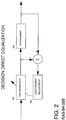
- FIG. 2 depicts decision direct equalization
- FIG. 3 depicts decision feedback equalization
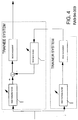
- FIG. 4 shows one embodiment of the present invention.
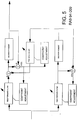
- FIG. 5 shows one embodiment of the present invention highlighting the error signals.
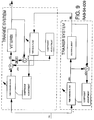
- FIG. 6 shows one embodiment of the present invention highlighting the trainee and trainer system elements.
- FIG. 7 shows a discrete-time equivalent communication model.
- FIG. 8(a) shows the scatter diagram of the distorted received signal before equalization.
- FIG. 8(b) depicts the scatter diagram of the equalized signal using the feed-forward only blind equalization.
- FIG. 8(c) shows the scatter diagram of the equalized signal using the present invention.
- FIG. 8(d) shows the learning curves in terms of the mean square error (MSE).
- FIG. 9 shows one embodiment of the present invention using Viterbi decoding.
- channels which link a transmitter and a receiver.
- These channels include telephone lines used in voice and modem applications, coaxial cables, fiber cables, under water channels used in acoustic applications, read/write channels used in magnetic storage devices, and atmospheric or space channels used in radar, satellite, radio, and other wireless communication systems. Although their physical media and propagation characteristics vary greatly, these channels are an important consideration in any communication system.
- a communication system consists of a transmitter for sending symbols into a channel and a receiver for receiving the transmitted symbols from the channel. This can be modeled as shown in FIG 7.
- the equalization method and device of the present invention can be considered as part of the receiver and offers advantages to all communications systems.
- Fig 4 provides an overview of the present invention.
- the present invention as depicted in FIG 4 can be thought of as two systems: a trainer system and a trainee system.
- both the trainer and trainee system receive their input signals from the same source.
- the input signal is electrically coded symbols from antennae or the front end of a receiver.
- the input signals can be thought of as electrical signals which are codified into symbols.
- the trainer system consists of a decision directed equalizer having a feed forward filter and a decision element.
- the output signal of the trainer system is provided as input to the feedback filter of the trainee system.
- the trainee system looks similar to a decision feedback equalizer having a feed forward filter and feedback filter with the important exception that the input signals for the feedback filter are provided from the output of the trainer system instead of the output of the decision element of the trainee system.
- the output of the decision element in the trainee system which is the output of the present invention (i.e., the equalized symbol sequence), is not directly utilized by the trainee system.
- the output of the decision element of the trainee system may be utilized in determining one or more of the objective functions which are used to adapt the coefficients of the adaptive filters. This feature of the present invention eliminates decision error propagation.
- the adaptive filter is typically a finite duration impulse response filter with adjustable coefficients. Adjustments of the adjustable coefficients is usually performed adaptively during the transmission of information by using an objective function and a coefficient adjustment process. This objective function is usually minimized or optimized by the coefficient adjustment process.
- the coefficient adjustment process or adaptation algorithm adjusts the adjustable coefficients of the adaptive filter to effect the objective function.
- the objective function is an error signal and the coefficient adjustment process attempts to minimize the error signal.
- An error signal may use the difference between the signal input to the decision element and the signal output by the decision element.
- FIG 1 (a) shows one embodiment for a feed forward filter (FFF) where the input is a received symbol sequence which is sent through a series of delay elements.
- the received input sequence and each of the delayed input sequences are provided to their own variable gain amplifiers (tap gain).
- the variable tap gains are usually referred to as adjustable coefficients.
- the received input sequence and each of the delayed input sequences are multiplied by their respective adjustable coefficients.
- the outputs of the variable tap gain amps are then added to provide a signal sample which gives an indication of the transmitted symbol.
- the signal sample output of the FFF can be thought of as the estimate of the transmitted symbol with a certain delay.
- the signal sample output of the FFF is referred to as the present symbol or current symbol.
- the addition may be carried out by a summer, combiner or adder. This signal sample can then be sent to a decision element or symbol detector to obtain a decided symbol.
- the present invention utilizes two FFFs one in the trainer system and one in the trainee system.
- FIG 1(b) shows one embodiment for a feedback filter (FBF) where the input is a symbol sequence which is sent through a series of delay elements.
- the delayed sequences are each provided with their own variable gain amplifiers (tap gain).
- the variable tap gains are usually referred to as adjustable coefficients.
- Each of the delayed input sequences are multiplied by their respective adjustable coefficients.
- the output of a FBF can be thought of as representing the estimated postcursor ISI due to previously assigned symbols. By canceling the ISI from the signal sample provided by the FFF the respective ISI is removed.
- the outputs of the variable tap gain amps of the FBF are then added with the output from a FFF to provide a signal sample which gives an indication of the transmitted symbol with the ISI cancelled.
- the feedback filter may use the same summer or combiner or adder as the FFF or a separate summer or combiner or adder.
- the signal sample with the ISI removed can then be sent to a decision element or symbol detector to obtain a assigned or decided symbol.
- the present invention utilizes a single FBF in the trainee system.
- FFF and FBF are very similar in design and structure.
- the main difference between the two types of adaptive filters is where they are placed in the equalizer and the fact that the feed back filter typically delays all the signal sequences while the feed forward filter provides a coefficient for the input symbol sequence without any delay.
- the filters can have any number of tap gains and delay elements. The exact number of delay elements and associated tap gain amplifiers to use is a design decision dependent on one or more of the following factors: the modulation scheme, expected number of multipath signals, expected strength of multipath signals, the time dispersion, the frequency dispersion, ambient noise and data rate.
- FIG 2 shows an overview of the decision direct equalization (linear equalization) using an adaptive filter.
- the basic idea of the DDE consists of minimizing or optimizing an objective function based upon the decision element.
- the objective function typically uses an error signal.
- the error signal can be the difference between the symbol sequence input to the decision element and the symbol sequence assigned or generated by the decision element, as is shown in FIG 2.
- a typical objective function is the mean square error (MSE) which is the expected value of the square of the error signal.
- An input sequence is provided to the feed forward filter 201, such as is shown in FIG 1(a), where it is passed through a series of delay elements.
- the input symbol sequence and the delayed symbol sequences are each multiplied by a coefficient associated with each of the tap gain amplifiers which perform the multiplication.
- the multiplied symbols are then added or combined or summed in a adding or summing or combining element in the FFF 201.
- the combined symbol sequence is then provided to a decision element 203.
- the decision element 203 can use a decision process to determine which symbol the combined symbol is to be assigned from the symbol set.
- the assigned symbol (or decided symbol) is then provided as the equalized output of the DDE.
- a coefficient adjustment element 205 is used to update the coefficients of the FFF 201.
- the coefficient adjustment element 205 uses a coefficient adjustment process to update the coefficients based on the current value of the coefficients, the input symbol sequence and an error signal (if an error signal is used by the objective function) or the gradient of the objective function.
- the coefficient adjustment element determines and updates the coefficients.
- DDE does not efficiently compensate for postcursor ISI. This is primarily because assigned symbols are not directly used as feedback, thus the effect of ISI from previously assigned symbols is not effectively removed from the present estimate. DDE attempts to invert the transmission channel without directly using previously detected symbols.
- DFE permits the removal of postcursor ISI by using feedback. DFE attempts to cancel the interference from symbols which have already been assigned (or detected) from the present symbol. The basic idea of the DFE is that if the value of symbols already assigned are known then the ISI contributed by these symbols can be determined and canceled exactly by subtracting past symbol values with appropriate weighing from the present symbol.
- FIG 3 shows one embodiment of a DFE. DFE (also referred to as nonlinear equalization) uses a feed forward filter and a feed back filter. The input sequence is provided to the FFF, as is shown in FIG 3, where it is passed through a series of delay elements. The input symbol sequence and the delayed symbol sequences are each multiplied by a coefficient associated with each of the tap gain amplifiers which perform the multiplication.
- the multiplied symbols are then added or combined or summed in an adding or summing or combining element.
- This element may also combine multiplied symbols obtained from the FBF 305.
- this element 303 is shown as separate for the FFF and FBF in FIG 3, but it may be made part of the FFF 301 or the FBF 305 (as depicted in FIG 1(a) and FIG 1(b) respectively) and/or used for both.
- the combining element 303 combines the sequence from the FFF 301 and subtracts the sequence provided from the FBF 305.
- the combined symbol sequence is then provided to a decision element 307.
- the output of a FBF 305 can be thought of as representing the postcursor ISI imposed by previous symbols on the present received symbol.
- the input symbol sequence to the FBF 305 is the output sequence from the decision element 307 (i.e., previously assigned or detected symbols).
- the FBF 305 weighs the sequence of assigned symbols to estimate the ISI in the received sequence from previously assigned symbols.
- the previously assigned symbols are passed through a series of delay elements.
- the delayed assigned symbols are then each multiplied by a coefficient associated with each of the tap gain amplifiers which perform the multiplication.
- the multiplied symbols from the FBF 305 are then added or combined or summed in a summing element 303 where they can be combined with the multiplied symbol sequences from the FFF 301.
- the FBF 305 can determine the cancellation sequence or the estimated ISI (i.e., the output of the FBF 305 can be added or subtracted form the output of the FFF 301) . If the FBF 305 determines the cancellation sequence then the output of the FBF 305 is added to the output of the FFF 301, if an estimate of the ISI is provided then the output of the FBF 305 is subtracted from the output of the FFF 301. Either addition or subtraction can be used, the FBF coefficients will converge to the correct sign accordingly. By compensating the received signal sequence with the output sequence of the FBF 305, the ISI is removed and the decision element 307 can use a sequence with little or no ISI.
- the combined signals from the FFF 301 and the FBF 305 are then provided to a decision element 307.
- the decision element 307 determines, according to a decision process, which symbol of the symbol set the combined symbol should be assigned.
- the assigned symbol is then provided as the equalized symbol output of the DFE.
- the assigned symbol is also provided as input to the FBF 305 as described above for use in processing subsequent symbols.
- a coefficient adjustment elements 311 and 309 are used to update the coefficients in the FFF 301 and FBF 305, respectively.
- Each coefficient adjustment element uses a coefficient adjustment process to determine coefficients or updates to the coefficients. As with the DDE, the coefficient updates may be based on the current value of the coefficients, the input symbol sequence and an error signal (if an error signal is used by the objective function) or the gradient of the objective function. The coefficient adjustment element determines and updates the coefficients. The same or different objective functions may be used for both the FBF 305 and the FFF 301.
- the coefficients for each filter are then updated according to the coefficient adjustment process.
- the coefficient adjustment process is typically the same for both the FFF and FBF but may differ. Note that in this embodiment although the coefficient adjustment process is the same the number of coefficients (i.e., the number of tap gain amplifiers) will typically be different and the coefficient values themselves will also be different. Various different coefficient adjustment processes are identified below.
- DFE DFE
- decision error propagation stems from the DFE assuming that the decision element has correctly assigned previous symbols.
- the incorrectly assigned symbol is provided to the FBF.
- the FBF uses the incorrectly assigned symbol in computing the postcursor ISI in the present symbol.
- the FBF uses the incorrectly assigned symbol in determining the postcursor ISI for subsequently received symbols until the incorrectly assigned symbol has propagated through all the delay elements of the FBF.
- the next few received symbols are effected as the incorrectly assigned symbol propagates through the delay elements of the FBF.
- the use of the incorrectly assigned symbol in turn may create subsequent incorrect decisions because the output of the FFF is compensated for using incorrect estimate of the postcursor ISI.
- This problem is further compounded because the error signal, used by the objective function and the coefficient adjustment process to update the FBF coefficients, is also based upon the incorrectly assigned symbols.
- the incorrect adjustment of the coefficients along with the incorrect symbols used by the feedback filter cause an incorrect cancellation to be made from the present symbol (i.e., the postcursor ISI from previously assigned symbol is incorrectly determined).
- the sequence provided to the decision element is thus incorrect and the decision element is more likely to make another incorrect assignment which is provided to the FBF so that the FBF is now using two incorrectly assigned symbols.
- the cycle repeats and performance of the equalizer worsens as the decision error propagates through the equalizer resulting in the equalizer not minimizing the ISI.
- the coefficient adjustment process determines what adjustments are needed in the coefficients of an adaptive filter. Many adaptation techniques have been developed. Some of these are identified below. Some adaptation algorithms require that a known sequence of symbols be sent by the transmitter in order to initially adjust the weights. Equalization schemes that do not require an initial known sequence of symbols or reference sequence are referred to as blind equalization schemes. All coefficient adjustment processes make use of an objective function. A typical objective function is the Mean Square Error (MSE) which uses the expected value of the square of an error signal.
- MSE Mean Square Error
- the coefficient adjustment process attempts to modify the coefficients of the adaptive filter such that the measure of the objective function is minimized or optimized. The coefficient adjustment process attempts to change the coefficients so as to move closer to the minimum or optimum point on the objective function surface. In order to update the coefficients the coefficient adjustment process typically determines and utilizes the gradient of the objective function with respect to the coefficients. The following is a list of several adaptation schemes that can be used for updating filter coefficients:
- the present invention is not limited to any particular adaptation technique, algorithm or scheme.
- the adaptation techniques identified above are some of the more common ones.
- the present invention may use one or more coefficient adaptation processes in a particular embodiment of the invention.
- One adaptation process may be used for each adaptive filter in the present invention.
- the adaptive filters may use the same adaptation process as another adaptive filter or a different process.
- Each adaptive filter may have a different adaptive process or all filters may use the same process or two filters may use the same process.
- the particular adaptation process selected will depend upon the requirements of the communication system. Such factors as rate at which the transmission channel characteristics change, computational complexity of a given scheme, and the capabilities of particular hardware selected for implementation will determine which particular scheme to use.
- the decision element or detection element or assignment element determines or detects which particular symbol in a symbol set, the outputted symbol is to be assigned.
- Various different decision processes can be used with the present invention.
- the decision element may be a simple slicer or can use a more sophisticated decision process.
- the slicer may use a threshold logic function or a sigmoidal function. Other functions may be utilized with the present invention as well. The following is a list of possible decision processes/algorithms:
- FIG 9 shows one embodiment of the present invention using a Viterbi decoder in the decision element.
- Viterbi decoding is particularly well-suited when trellis code modulation is used in the transmitter. It should be noted that there are many ways to implement the present invention with viterbi decoding - the embodiment in FIG 9 illustrating just one embodiment of many.
- the particular decision element selected will depend upon the particular communication system parameters, desired error rate, data rate and other factors.
- the present invention applies to a blind equalization technique, i.e., it does not require transmission of a known training or reference sequence, it may be used with training sequences.
- the present invention is not limited to any particular decision element or decision process.
- the decision processes identified above are some of the more common ones.
- the present invention may use one or more decision processes in a particular embodiment of the invention.
- the decision elements of the present invention may use the same decision process or different decision processes.
- the particular decision processes selected will depend upon the requirements of the communication system. Such factors as rate at which the transmission channel characteristics change, computational complexity of a given scheme, and the capabilities of particular hardware selected for implementation will determine which particular scheme to use.
- FIG 6 shows an overview of one embodiment of the present invention.
- the present invention is a hybrid equalization system using a Decision Directed Equalization (DDE) section called a trainer system and a modified Decision Feedback Equalization (DFE) section called a trainee system.
- DDE Decision Directed Equalization
- DFE Decision Feedback Equalization
- FIG 6 the output of the trainer system 675, r f , is used as input to the FeedBack Filter (FBF) 605 of the trainee system 695.
- BMF FeedBack Filter
- the output of the decision element is used as input to the FBF.
- the present invention uses two equalization systems: a trainee system and a trainer system.
- the trainer system is designed to continuously train the trainee system without the need for training sequences.
- the present invention in the embodiment depicted in FIG 6 is composed of feed forward filters (FFFs), elements 601 and 603, and FBF 605. Each filter section can be updated using different or the same coefficient adjustment processes.
- FFFs feed forward filters
- the trainer system 675 does not utilize feedback filter.
- the major components of the trainer system are as follows: a feed forward filter 603, a decision element 613 and a coefficient adjustment element 625.
- the output of the trainer system is provided to the feedback filter of the trainee system (rf(k)).
- the coefficient adjustment element 625 requires that an objective function be provided (e.g, MSE).
- the trainee system 695 consists of a modified Decision Feedback Equalizer (DFE).
- DFE Decision Feedback Equalizer
- the major components of the Trainee system 695 are as follows: feed forward filter 601, decision element 611, a feedback filter 605 and a coefficient adjustment element 621.
- the input to the feed forward filter 603 is the received signal sequence, r(k).
- the input to the feed-forward filter is also the received signal sequence r(k) and the input to the feedback filter 605 is the assigned symbols, rf(k), from the trainer system 675.
- the output of a FBF 605 can be thought of as representing the postcursor ISI imposed by previous symbols on the present received symbol. Note that the input symbol sequence to the FBF 605 is the output sequence, rf(k), from the decision element 613 (i.e., previously assigned or detected symbols from the trainer system 675).
- the FBF 605 weighs the sequence of assigned symbols to estimate the ISI in the received sequence from previously assigned symbols.
- the FBF 605 the previously assigned symbols, rf(k), are passed through a series of delay elements. The delayed assigned symbols are then each multiplied by a coefficient associated with each of the tap gain amplifiers which perform the multiplication. The multiplied symbols from the FBF 605 are then combined with the multiplied symbol sequences from the FFF 601. As with DFE, the FBF 605 can determine the cancellation sequence or the estimated ISI (i.e., the output of the FBF 605 can be added or subtracted from the output of the FFF 601) . Thus, either addition or subtraction can be used, and the FBF coefficients will converge to the correct sign accordingly.
- LMS Least Mean Square
- the difference between the output sequence of the decision element and the input sequence to the decision element is commonly referred to as an error signal.
- the error signal is commonly used by an objective function.
- the error signal for the trainee system can be given as follows: and for the trainer system the error signal may be given as follows:
- the same error signal, e1(k) is used in updating the feed-forward and the feedback filters.
- the error signal can best be distinguished by establishing an analogy with the classical Least Mean Squares (LMS) coefficient adjustment process using the MSE as the objective function.
- LMS Least Mean Squares
- the complex LMS coefficient adjustment process has the following update rule for the three equalizer filters where w1 represents the coefficients associated with FFF 601, w2 represents the coefficients associated with FFF 603, and wf represents the coefficients associated with FBF 605.
- Each of the coefficients for each of the respective filters is updated as follows: where (*) denotes conjugation operation and ⁇ 1, ⁇ 2 and ⁇ f are suitably selected constants. Note that one constant may be used for all three filters. a is an adapation constant or adapation rate that can be thought of as the size of the steps taken down the error curve. Other variations of this method can be used with the present invention.
- the present invention has been described for transmission of symbols/signals in which the sampling time and the delay introduced by each of the delay elements of the adaptive filters are equal to the symbol transmission time, however the present invention is perfectly applicable to so called fractionary equalization systems (e.g., fractionally spaced equalization) without any significant changes.
- fractionary equalization systems e.g., fractionally spaced equalization
- the feed forward filters w1 and w2 are implemented fractionally.
- the FBF, wf is not affected.
- the present invention has been described without the need for the transmitter to transmit a known symbol sequence (i.e., a reference or training sequence). However, the present invention may be used with training sequences. If training symbol sequences are used then the FBF of the trainee system is provided with the known training sequence as input. The objective function for each of the adaptive filters would then utilize the known training sequence rather than the outputs of the respective decision elements while the filters are in training mode.
- DSP Digital Signal Processor
- MSP MWAVE Signal Processor
- the performance improvement obtained by the present invention was simulated and compared with that of a feed forward only blind equalizer.
- a Quadrature Amplitude Modulation (QAM) communications system was used to transmit symbols from a QPSK symbol alphabet in the presence of multipath propagation and additive white Gaussian noise.
- the multipath transmission medium contains a line-of-sight (LOS) path and two other multipaths which were one and three symbol intervals delayed.
- the relative signal powers of the multipaths compared to the LOS path are 0.4 and 0.2.
- the feed forward section of the blind equalizer consisted of 8 taps.
- the feedback filter had 4 taps which was adequate to compensate for the ISI introduced by the multipaths which have a maximum of 3 symbol duration delay.
- Fig. 8(a) shows the scatter diagram of the distorted received signal before equalization.
- Fig. 8(b) depicts the scatter diagram of the equalized signal using the feed forward only blind equalization (FOBE).
- Fig. 8(c) shows the scatter diagram of the equalized signal using the present invention.
- the present invention yields a sharper signal constellation than the FOBE.
- the learning curves for each are represented in Fig. 8(d) in terms of the mean square error (MSE).
- MSE mean square error
- the present invention provides for several significant advantages over prior art systems.
- the first advantage is that the present invention eliminates the need for the transmitter to provide a training sequence. This saves communication overhead and the need to retrain when channel conditions change. Due to the blind nature of the present invention and the trainer system, continuous self training is performed and therefore no external training is required.
- a second advantage of the present invention is that it provides compensation for spectral nulls in the transmission channel without substantially increasing the level of noise in the system. This is accomplished by the feedback nature of the present invention.
- the trainee system avoids placing large gains in the received signal sequence to compensate for spectral nulls.
- the present invention provides a remedy to the inherent problem of noise amplification for the equalization of channels containing spectral nulls.
- a third advantage of the present invention is that it eliminates the problem of decision error propagation. Because the input to the FBF of the trainee system is the output of the trainer system , the decision error propagation loop of prior art systems is broken. The output of the trainee system is not feedback through the FBF. Therefore errors in the decision element are not propagated back through the equalizer. Also, the DDE of the trainer system operates and is adjusted independently of the output of the trainee system. Thus, the present invention provides a remedy to the decision error propagation problem that has plagued other prior art equalization techniques.
- a forth advantage of the present invention is that it adapts to rapidly changing communications channel conditions.
- the present invention provides a very attractive solution for mobile communications applications where the challenging problem concerning reliable transmission of signals through rapidly changing multipath fading channels with deep spectral nulls had not been resolved.
- a fifth advantage is that the parallel nature of the trainer and trainee systems permits efficient parallel processor implementations. With the emergence of Digital Signal Processing and parallel computing in general, comes the need to divide a solution into separate smaller problems that do not require a lot of interaction. The present invention with the independence of the trainer and the trainee systems lends itself to parallel processing implementations.
Landscapes
- Engineering & Computer Science (AREA)
- Computer Networks & Wireless Communication (AREA)
- Signal Processing (AREA)
- Power Engineering (AREA)
- Artificial Intelligence (AREA)
- Cable Transmission Systems, Equalization Of Radio And Reduction Of Echo (AREA)
- Filters That Use Time-Delay Elements (AREA)
- Digital Transmission Methods That Use Modulated Carrier Waves (AREA)
Applications Claiming Priority (2)
| Application Number | Priority Date | Filing Date | Title |
|---|---|---|---|
| US08/259,850 US5539774A (en) | 1994-06-15 | 1994-06-15 | Dual decision equalization method and device |
| US259850 | 1994-06-15 |
Publications (2)
| Publication Number | Publication Date |
|---|---|
| EP0688110A2 true EP0688110A2 (fr) | 1995-12-20 |
| EP0688110A3 EP0688110A3 (fr) | 2000-12-20 |
Family
ID=22986684
Family Applications (1)
| Application Number | Title | Priority Date | Filing Date |
|---|---|---|---|
| EP95480049A Withdrawn EP0688110A3 (fr) | 1994-06-15 | 1995-04-27 | Procédé et dispositif d'égalisation adaptative à décision double pour canaux à évanouissement multivoie |
Country Status (3)
| Country | Link |
|---|---|
| US (2) | US5539774A (fr) |
| EP (1) | EP0688110A3 (fr) |
| JP (1) | JP3155438B2 (fr) |
Cited By (9)
| Publication number | Priority date | Publication date | Assignee | Title |
|---|---|---|---|---|
| WO1998042089A3 (fr) * | 1997-03-14 | 1998-10-29 | At & T Corp | Egalisation spatio-temporelle pour systemes amrt is-136 a evanouissement dispersif rapide et brouillage dans un meme canal |
| EP0792051A3 (fr) * | 1996-02-23 | 1999-07-07 | Ascom Tech Ag | Procédé de démodulation cohérente d'un signal reçu |
| EP0880253A3 (fr) * | 1997-05-23 | 2001-05-16 | Lucent Technologies Inc. | Adaptation aveugle d'un égaliseur à décision récursive |
| EP1156634A1 (fr) * | 2000-05-15 | 2001-11-21 | Lucent Technologies Inc. | Estimateur de séquence et égaliseur |
| KR100540292B1 (ko) * | 1996-06-04 | 2006-03-22 | 톰슨 콘슈머 일렉트로닉스, 인코포레이티드 | 디지털비디오신호처리시스템내의다중-모드등화기 |
| WO2008005807A3 (fr) * | 2006-07-05 | 2008-03-06 | Zoran Corp | Double égaliseur pour rejet multivoies |
| DE102007053091A1 (de) * | 2007-11-07 | 2009-05-14 | Rohde & Schwarz Gmbh & Co. Kg | Verfahren und Vorrichtung zur Decodierung von faltungscodierten Signalen |
| CN101808057B (zh) * | 2009-02-16 | 2015-07-08 | 华为技术有限公司 | 一种盲均衡的方法、装置和译码器 |
| WO2016130360A1 (fr) * | 2015-02-09 | 2016-08-18 | Xilinx, Inc. | Circuits et procédés de filtrage de brouillage inter-symboles pour application serdes |
Families Citing this family (108)
| Publication number | Priority date | Publication date | Assignee | Title |
|---|---|---|---|---|
| US5602602A (en) * | 1994-02-10 | 1997-02-11 | Philips Electronics North America Corporation | Method and apparatus for combating co-channel NTSC interference for digital TV transmission having a simplified rejection filter |
| US5754591A (en) * | 1994-08-03 | 1998-05-19 | Broadcom Corporation | System for, and method of, processing quadrature amplitude modulated signals |
| US5572262A (en) * | 1994-12-29 | 1996-11-05 | Philips Electronics North America Corporation | Receiver based methods and devices for combating co-channel NTSC interference in digital transmission |
| US5907555A (en) * | 1995-10-18 | 1999-05-25 | Telefonaktiebolaget Lm Ericsson | Method for compensating for time dispersion in a communication system |
| JP2830806B2 (ja) * | 1995-11-29 | 1998-12-02 | 日本電気株式会社 | データ再生検出装置 |
| US5694424A (en) * | 1996-03-15 | 1997-12-02 | Ariyavisitakul; Sirikiat | Pre-cancelling postcursors in decision feedback equalization |
| JPH09284353A (ja) * | 1996-04-18 | 1997-10-31 | Matsushita Commun Ind Co Ltd | 受信機 |
| US6437932B1 (en) * | 1996-05-16 | 2002-08-20 | Lsi Logic Corporation | Decision based time-varying equalizers |
| US6952444B1 (en) * | 1996-07-19 | 2005-10-04 | Texas Instruments Incorporated | Blind DFE and phase correction |
| US6034993A (en) * | 1996-11-15 | 2000-03-07 | 3Com Corporation | Method and apparatus for adaptively equalizing a signal received from a remote transmitter |
| US6067295A (en) * | 1997-01-13 | 2000-05-23 | Lucent Technologies, Inc. | Method and apparatus for reducing error in recovering information bits in a wireless system |
| US6061193A (en) * | 1997-01-21 | 2000-05-09 | Seagate Technology, Inc. | Method and apparatus for detection in digital magnetic recording |
| US6584147B1 (en) * | 1997-05-23 | 2003-06-24 | Imec | High speed modem for a communication network |
| US6011813A (en) * | 1997-06-23 | 2000-01-04 | Philips Electronics North America Corporation | Blind equalization method and apparatus having reduced complexity |
| US6009120A (en) * | 1997-06-26 | 1999-12-28 | Rockwell Science Center, Inc. | Multi-dimensional combined equalizer and decoder |
| US5995543A (en) * | 1997-06-30 | 1999-11-30 | Stmicroelectronics N.V. | Constrained fixed delay tree search receiver for a MTR=2 encoded communication channel |
| US6212661B1 (en) | 1997-08-11 | 2001-04-03 | Seagate Technology, Inc. | Static viterbi detector for channels utilizing a code having time varying constraints |
| US6285709B1 (en) * | 1997-10-31 | 2001-09-04 | 3 Com Corporation | Error filtering in a hybrid equalizer system |
| US6493162B1 (en) | 1997-12-05 | 2002-12-10 | Seagate Technology Llc | Frame synchronization for viterbi detector |
| US6141783A (en) * | 1998-04-10 | 2000-10-31 | International Business Machines Corporation | Error propagation limiting encoder/decoder for multilevel decision feedback equalization |
| US6314134B1 (en) * | 1998-04-24 | 2001-11-06 | Lucent Technologies Inc. | Blind equalization algorithm with joint use of the constant modulus algorithm and the multimodulus algorithm |
| US6680971B1 (en) * | 1998-05-18 | 2004-01-20 | Sarnoff Corporation | Passband equalizer for a vestigial sideband signal receiver |
| KR100442818B1 (ko) * | 1998-10-14 | 2004-09-18 | 삼성전자주식회사 | 순차적 갱신 적응형 등화기 및 그 방법 |
| US6775334B1 (en) * | 1998-11-03 | 2004-08-10 | Broadcom Corporation | Equalization and decision-directed loops with trellis demodulation in high definition TV |
| JP4147647B2 (ja) * | 1998-11-09 | 2008-09-10 | ソニー株式会社 | データ処理装置およびデータ処理方法、並びに記録媒体 |
| JP4517409B2 (ja) * | 1998-11-09 | 2010-08-04 | ソニー株式会社 | データ処理装置およびデータ処理方法 |
| US6477200B1 (en) * | 1998-11-09 | 2002-11-05 | Broadcom Corporation | Multi-pair gigabit ethernet transceiver |
| US6535554B1 (en) * | 1998-11-17 | 2003-03-18 | Harris Corporation | PCS signal separation in a one dimensional channel |
| JP2001060896A (ja) * | 1999-08-23 | 2001-03-06 | Nec Corp | 自動等化器 |
| JP2001102970A (ja) * | 1999-09-29 | 2001-04-13 | Matsushita Electric Ind Co Ltd | 通信端末装置及び無線通信方法 |
| US7269212B1 (en) | 2000-09-05 | 2007-09-11 | Rambus Inc. | Low-latency equalization in multi-level, multi-line communication systems |
| US7161513B2 (en) * | 1999-10-19 | 2007-01-09 | Rambus Inc. | Apparatus and method for improving resolution of a current mode driver |
| US6396329B1 (en) | 1999-10-19 | 2002-05-28 | Rambus, Inc | Method and apparatus for receiving high speed signals with low latency |
| US7124221B1 (en) | 1999-10-19 | 2006-10-17 | Rambus Inc. | Low latency multi-level communication interface |
| US6650700B1 (en) * | 1999-10-22 | 2003-11-18 | Zenith Electronics Corporation | Dual path ghost eliminating equalizer with optimum noise enhancement |
| US7428265B1 (en) * | 1999-11-12 | 2008-09-23 | Cornell Research Foundation | Systems and methods for optimal symbol spacing to minimize intersymbol interference in a receiver |
| US6754294B1 (en) | 1999-11-12 | 2004-06-22 | Cornell Research Foundation, Inc. | Dual equalizer for use in an receiver and method of operation |
| WO2001048991A1 (fr) | 1999-12-21 | 2001-07-05 | Nokia Networks Oy | Correcteur de phase avec une fonction cout prenant en compte l'energie de bruit |
| US6590933B1 (en) * | 1999-12-27 | 2003-07-08 | Tioga Technologies Ltd. | Adaptive decision-feedback equalizer with error-predictor for improved convergence |
| KR100320214B1 (ko) * | 2000-02-12 | 2002-01-10 | 구자홍 | 채널 등화기 |
| US6718087B2 (en) * | 2000-03-22 | 2004-04-06 | University Of Maryland Baltimore County | System and method for reducing differential mode dispersion effects in multimode optical fiber transmissions |
| US6731682B1 (en) * | 2000-04-07 | 2004-05-04 | Zenith Electronics Corporation | Multipath ghost eliminating equalizer with optimum noise enhancement |
| US6934328B1 (en) * | 2000-08-15 | 2005-08-23 | Virata Corporation | Relaxed, more optimum training for modems and the like |
| KR100382487B1 (ko) * | 2000-11-02 | 2003-05-09 | 엘지전자 주식회사 | 이득 및 위상 왜곡 보상 기능을 가지는 이동통신 송신시스템 |
| US7000175B2 (en) * | 2000-11-03 | 2006-02-14 | Agere Systems Inc. | Method and apparatus for pipelined joint equalization and decoding for gigabit communications |
| US7031405B1 (en) * | 2000-11-15 | 2006-04-18 | Ati Research, Inc. | Carrier phase estimation based on single-axis constant modulus cost criterion and Bussgang criteria |
| US7173551B2 (en) | 2000-12-21 | 2007-02-06 | Quellan, Inc. | Increasing data throughput in optical fiber transmission systems |
| DE10101950C1 (de) * | 2001-01-17 | 2003-01-23 | Infineon Technologies Ag | Entscheidungsrückgekoppelte Entzerrervorrichtung |
| US7149256B2 (en) | 2001-03-29 | 2006-12-12 | Quellan, Inc. | Multilevel pulse position modulation for efficient fiber optic communication |
| US7307569B2 (en) | 2001-03-29 | 2007-12-11 | Quellan, Inc. | Increasing data throughput in optical fiber transmission systems |
| US6856649B2 (en) * | 2001-03-30 | 2005-02-15 | Koninklijke Philips Electronics N.V. | Initialization scheme for a hybrid frequency-time domain equalizer |
| WO2002082694A1 (fr) | 2001-04-04 | 2002-10-17 | Quellan, Inc. | Procede et systeme permettant de decoder des signaux multiniveau |
| US6734920B2 (en) * | 2001-04-23 | 2004-05-11 | Koninklijke Philips Electronics N.V. | System and method for reducing error propagation in a decision feedback equalizer of ATSC VSB receiver |
| US6628707B2 (en) * | 2001-05-04 | 2003-09-30 | Radiant Networks Plc | Adaptive equalizer system for short burst modems and link hopping radio networks |
| DE10136698A1 (de) * | 2001-07-27 | 2003-02-13 | Infineon Technologies Ag | Vorrichtung zum Entzerren eines Empfangssignals |
| US20030063664A1 (en) * | 2001-10-02 | 2003-04-03 | Bodenschatz John S. | Adaptive thresholding for adaptive equalization |
| US7206342B1 (en) * | 2001-12-07 | 2007-04-17 | Applied Micro Circuits Corp. | Modified gain non-causal channel equalization using feed-forward and feedback compensation |
| US6961197B1 (en) | 2001-12-28 | 2005-11-01 | Marvell International Ltd. | Correcting errors in disk drive read back signals by iterating with the Reed-Solomon decoder |
| US7751138B1 (en) * | 2001-12-28 | 2010-07-06 | Marvell International Ltd. | Correcting errors in disk drive read back signals by iterating with the Reed-Solomon decoder |
| US7212580B2 (en) | 2002-02-15 | 2007-05-01 | Quellan, Inc. | Multi-level signal clock recovery technique |
| US7031383B2 (en) * | 2002-04-05 | 2006-04-18 | Scintera Networks, Inc. | Compensation circuit for reducing intersymbol interference products caused by signal transmission via dispersive media |
| US7130366B2 (en) * | 2002-04-05 | 2006-10-31 | Scintera Networks, Inc. | Compensation circuit and method for reducing intersymbol interference products caused by signal transmission via dispersive media |
| WO2003088478A1 (fr) * | 2002-04-05 | 2003-10-23 | Scintera Networks, Inc. | Circuit de compensation et procede pour reduire les produits de brouillage intersymbole provoques par la transmission de signaux dans des milieux dispersifs |
| KR100467317B1 (ko) * | 2002-05-22 | 2005-01-24 | 한국전자통신연구원 | 스케일러블 적응등화 장치 |
| US7107303B2 (en) * | 2002-05-23 | 2006-09-12 | Analog Devices, Inc. | Sparse echo canceller |
| KR100518029B1 (ko) * | 2002-06-11 | 2005-10-04 | 한국전자통신연구원 | 블라인드 판정궤환등화 장치 및 그 방법 |
| US8861667B1 (en) | 2002-07-12 | 2014-10-14 | Rambus Inc. | Clock data recovery circuit with equalizer clock calibration |
| US7292629B2 (en) | 2002-07-12 | 2007-11-06 | Rambus Inc. | Selectable-tap equalizer |
| US7362800B1 (en) | 2002-07-12 | 2008-04-22 | Rambus Inc. | Auto-configured equalizer |
| AU2003256569A1 (en) * | 2002-07-15 | 2004-02-02 | Quellan, Inc. | Adaptive noise filtering and equalization |
| US7046726B2 (en) * | 2002-07-18 | 2006-05-16 | Qualcomm, Inc. | Method and apparatus for hybrid decision feedback equalization |
| US7194674B2 (en) * | 2002-07-29 | 2007-03-20 | Sharp Kabushiki Kaisha | Adaptive waveform equalization for viterbi-decodable signal and signal quality evaluation of viterbi-decodable signal |
| AU2003287628A1 (en) | 2002-11-12 | 2004-06-03 | Quellan, Inc. | High-speed analog-to-digital conversion with improved robustness to timing uncertainty |
| KR100462738B1 (ko) * | 2003-01-20 | 2004-12-23 | 삼성전자주식회사 | 광기록/재생장치용 등화장치 및 그의 등화방법 |
| US20040190661A1 (en) * | 2003-03-26 | 2004-09-30 | Quellan, Inc. | Method and system for equalizing communication signals |
| US7586982B2 (en) * | 2003-05-06 | 2009-09-08 | Nokia Corporation | Kalman filter based method and apparatus for linear equalization of CDMA downlink channels |
| US7408981B2 (en) * | 2003-05-20 | 2008-08-05 | Rambus Inc. | Methods and circuits for performing margining tests in the presence of a decision feedback equalizer |
| US7590175B2 (en) | 2003-05-20 | 2009-09-15 | Rambus Inc. | DFE margin test methods and circuits that decouple sample and feedback timing |
| US7627029B2 (en) | 2003-05-20 | 2009-12-01 | Rambus Inc. | Margin test methods and circuits |
| US7804760B2 (en) | 2003-08-07 | 2010-09-28 | Quellan, Inc. | Method and system for signal emulation |
| KR101109847B1 (ko) | 2003-08-07 | 2012-04-06 | ?란 인코포레이티드 | 혼선 제거 방법 및 시스템 |
| JP4246562B2 (ja) * | 2003-08-19 | 2009-04-02 | パイオニア株式会社 | マルチパスひずみ除去フィルタ |
| ATE488068T1 (de) | 2003-11-17 | 2010-11-15 | Quellan Inc | Verfahren und system zur löschung von antennenstörungen |
| US7616700B2 (en) | 2003-12-22 | 2009-11-10 | Quellan, Inc. | Method and system for slicing a communication signal |
| KR100615597B1 (ko) * | 2004-05-27 | 2006-08-25 | 삼성전자주식회사 | 데이터 입력회로 및 방법 |
| US7177352B1 (en) | 2004-05-28 | 2007-02-13 | Pmc-Sierra, Inc. | Pre-cursor inter-symbol interference cancellation |
| US7522883B2 (en) | 2004-12-14 | 2009-04-21 | Quellan, Inc. | Method and system for reducing signal interference |
| US7725079B2 (en) | 2004-12-14 | 2010-05-25 | Quellan, Inc. | Method and system for automatic control in an interference cancellation device |
| WO2006101159A1 (fr) * | 2005-03-24 | 2006-09-28 | Evolvable Systems Research Institute, Inc. | Dispositif de traitement de signaux et procédé de traitement de signaux |
| US7421022B2 (en) * | 2005-04-27 | 2008-09-02 | Inphi Corporation | Method for robust and stable convergence of blind LMS based adaptation of coefficients for a continuous time FFE-DFE |
| WO2007053831A2 (fr) * | 2005-10-31 | 2007-05-10 | University Of Florida Research Foundation, Inc. | Filtre de corrélation et d'entropie optimal non linéaire |
| WO2007072306A2 (fr) * | 2005-12-19 | 2007-06-28 | Nxp B.V. | Recepteur presentant une egalisation au niveau puce |
| WO2007095112A2 (fr) * | 2006-02-14 | 2007-08-23 | Baker Hughes Incorporated | Égalisation à décision rétroactive en télémétrie par impulsions dans la boue |
| JP5078991B2 (ja) | 2006-04-26 | 2012-11-21 | ケラン エルエルシー | 通信チャネルからの放射性放出を削減する方法とシステム |
| CN100437640C (zh) * | 2006-08-01 | 2008-11-26 | 北京航空航天大学 | 基于自适应判决反馈均衡技术的盲图像复原方法 |
| US20080095225A1 (en) * | 2006-10-18 | 2008-04-24 | Mediatek Inc. | System, Multi-Stage Equalizer and Equalization Method |
| US8175141B2 (en) * | 2007-08-20 | 2012-05-08 | Computer Access Technology Corporation | Method and apparatus for calibrating equalizers without knowledge of the data pattern being received |
| US7974336B2 (en) * | 2008-04-23 | 2011-07-05 | Mediatek Inc. | Equalization system and method thereof |
| WO2010030513A1 (fr) * | 2008-09-12 | 2010-03-18 | The Government Of The United States Of America, As Represented By The Secretary Of The Navy | Egaliseur basé sur une corrélation itérative pour des communications acoustiques sous–marines sur des canaux qui varient dans le temps |
| US8428113B1 (en) | 2009-01-23 | 2013-04-23 | Pmc-Sierra, Inc. | Equalizer for heavily clipped or compressed communications signals |
| US8644369B1 (en) | 2009-12-01 | 2014-02-04 | Pmc-Sierra, Inc. | Equalizer adaptation for heavily compressed or clipped communications signals |
| US10263663B2 (en) * | 2015-12-17 | 2019-04-16 | Intel Corporation | M-ary pulse amplitude modulation digital equalizer |
| US10985951B2 (en) | 2019-03-15 | 2021-04-20 | The Research Foundation for the State University | Integrating Volterra series model and deep neural networks to equalize nonlinear power amplifiers |
| EP4082161A4 (fr) * | 2019-12-26 | 2023-09-13 | INTEL Corporation | Traitement d'égalisation et d'estimation dans des dispositifs sans fil |
| EP4027149B1 (fr) * | 2021-01-11 | 2024-07-31 | Rohde & Schwarz GmbH & Co. KG | Structure de filtre parallèle, oscilloscope et procédé de traitement d'un signal |
| EP4272320A1 (fr) * | 2021-04-26 | 2023-11-08 | Huawei Technologies Co., Ltd. | Appareil et procédé d'annulation d'interférence rf dans une liaison de communication de données filaire |
| US11451417B1 (en) * | 2021-07-20 | 2022-09-20 | Credo Technology Group Ltd | Power-efficient nonlinear equalizers and methods |
| US11770276B1 (en) * | 2022-10-07 | 2023-09-26 | Huawei Technologies Co., Ltd. | Systems and methods for compensating polarization dependent loss (PDL) in dual polarized communication network |
Family Cites Families (26)
| Publication number | Priority date | Publication date | Assignee | Title |
|---|---|---|---|---|
| US4141072A (en) * | 1976-12-28 | 1979-02-20 | Xerox Corporation | Frequency domain automatic equalizer using minimum mean square error correction criteria |
| US4384355A (en) * | 1979-10-15 | 1983-05-17 | Bell Telephone Laboratories, Incorporated | Control of coefficient drift for fractionally spaced equalizers |
| IT1154430B (it) * | 1982-01-15 | 1987-01-21 | Cselt Centro Studi Lab Telecom | Equalizzatore per tramissione di segnali numerici |
| US4475211A (en) * | 1982-09-13 | 1984-10-02 | Communications Satellite Corporation | Digitally controlled transversal equalizer |
| IT1159389B (it) * | 1983-04-19 | 1987-02-25 | Cselt Centro Studi Lab Telecom | Equalizzatore adattativo per segnali numerici |
| IT1188626B (it) * | 1986-03-25 | 1988-01-20 | Gte Telecom Spa | Metodo e dispositivo di equalizzazione adattiva cieca |
| US4759036A (en) * | 1987-03-02 | 1988-07-19 | American Telephone And Telegraph Company | Decision-directed control circuit |
| GB2219469A (en) * | 1988-06-02 | 1989-12-06 | Philips Electronic Associated | A decision feedback equaliser and a method of operating a decision feedback equaliser |
| US4989170A (en) * | 1988-06-09 | 1991-01-29 | National Semiconductor Corporation | Hybrid stochastic gradient for convergence of adaptive filter |
| DE3852395T2 (de) * | 1988-10-17 | 1995-05-24 | Ibm | Adaptiver Entzerrer für Aufzeichnungssysteme unter Verwendung von Partial-Response-Signalisierung. |
| US5031195A (en) * | 1989-06-05 | 1991-07-09 | International Business Machines Corporation | Fully adaptive modem receiver using whitening matched filtering |
| JPH03154435A (ja) * | 1989-11-13 | 1991-07-02 | Toshiba Corp | 判定帰還形等化方式 |
| DK0448758T3 (da) * | 1990-03-28 | 1995-08-14 | Sel Alcatel Ag | Fremgangsmåde til bestemmelse af FIR filterkoefficienter i modforvrængere |
| FR2666947A1 (fr) * | 1990-09-18 | 1992-03-20 | Trt Telecom Radio Electr | Dispositif d'egalisation de spectre. |
| EP0483435A1 (fr) * | 1990-10-31 | 1992-05-06 | International Business Machines Corporation | Système et méthode d'égalisation pour égaliser une ligne de télécommunication en bande de base |
| JP2551231B2 (ja) * | 1990-11-16 | 1996-11-06 | 日本電気株式会社 | 判定帰還形等化器 |
| JP3172198B2 (ja) * | 1991-03-01 | 2001-06-04 | 株式会社東芝 | 等化方式 |
| CA2076099A1 (fr) * | 1991-09-03 | 1993-03-04 | Howard Leroy Lester | Alignement automatique d'emissions diffusees en simultaneite |
| EP0543328B1 (fr) * | 1991-11-18 | 1999-03-17 | Nec Corporation | Egaliseur automatique permettant d'annuler efficacement l'interférence intersymbole et l'interférence de polarisation croisée lors d'une transmission à double polarisation sur canal unique |
| US5517527A (en) * | 1992-12-11 | 1996-05-14 | Industrial Technology Research Institute | Adaptive equalizer for ISDN U-interface transceiver |
| KR970009687B1 (ko) * | 1993-06-02 | 1997-06-17 | 삼성전자 주식회사 | 디지탈통신을 위한 적응 등화시스템 |
| US5513215A (en) * | 1993-09-20 | 1996-04-30 | Glenayre Electronics, Inc. | High speed simulcast data system using adaptive compensation |
| US5481565A (en) * | 1993-10-18 | 1996-01-02 | At&T Corp. | Method and apparatus for channel equalization |
| JPH07169055A (ja) * | 1993-12-15 | 1995-07-04 | Hitachi Ltd | 光ディスク装置及び光ディスク |
| US5414733A (en) * | 1993-12-20 | 1995-05-09 | Adtran | Decision feedback equalizer employing fixed ratio postcursor taps for minimizing noise and intersymbol interference in signals conveyed over high speed data service loop |
| US5513216A (en) * | 1994-10-13 | 1996-04-30 | At&T Corp. | Hybrid equalizer arrangement for use in data communications equipment |
-
1994
- 1994-06-15 US US08/259,850 patent/US5539774A/en not_active Expired - Fee Related
-
1995
- 1995-03-22 JP JP06240795A patent/JP3155438B2/ja not_active Expired - Fee Related
- 1995-04-27 EP EP95480049A patent/EP0688110A3/fr not_active Withdrawn
-
1996
- 1996-04-18 US US08/633,253 patent/US5692011A/en not_active Expired - Fee Related
Non-Patent Citations (4)
| Title |
|---|
| KOHNO R ET AL: "COMBINATION OF CANCELLING INTERSYMBOL INTERFERENCE AND DECODING OF ERROR-CORRECTING CODE" PROCEEDINGS OF THE INSTITUTION OF ELECTRICAL ENGINEERS,GB,INSTITUTION OF ELECTRICAL ENGINEERS. STEVENAGE, vol. 133, no. 3, PART F, 1 June 1986 (1986-06-01), pages 224-231, XP000760523 * |
| PROAKIS J G: "ADAPTIVE EQUALIZATION FOR TDMA DIGITAL MOBILE RADIO" IEEE TRANSACTIONS ON VEHICULAR TECHNOLOGY,US,IEEE INC. NEW YORK, vol. 40, no. 2, 1 May 1991 (1991-05-01), pages 333-341, XP000234897 ISSN: 0018-9545 * |
| TAMBURELLI G: "THE PARALLEL DECISION FEEDBACK AND FEEDFORWARD EQUALIZER" IEEE TRANSACTIONS ON COMMUNICATIONS,US,IEEE INC. NEW YORK, vol. COM-31, no. 2, February 1983 (1983-02), pages 224-231, XP000758663 ISSN: 0090-6778 * |
| WESOLOWSKI K: "ON THE PERFORMANCE AND CONVERGENCE OF THE ADAPTIVE CANCELLER OF INTERSYMBOL INTERFERENCE IN DATA TRANSMISSION" IEEE TRANSACTIONS ON COMMUNICATIONS,US,IEEE INC. NEW YORK, vol. COM-33, no. 5, May 1985 (1985-05), pages 425-432, XP000758541 ISSN: 0090-6778 * |
Cited By (15)
| Publication number | Priority date | Publication date | Assignee | Title |
|---|---|---|---|---|
| EP0792051A3 (fr) * | 1996-02-23 | 1999-07-07 | Ascom Tech Ag | Procédé de démodulation cohérente d'un signal reçu |
| KR100540292B1 (ko) * | 1996-06-04 | 2006-03-22 | 톰슨 콘슈머 일렉트로닉스, 인코포레이티드 | 디지털비디오신호처리시스템내의다중-모드등화기 |
| WO1998042089A3 (fr) * | 1997-03-14 | 1998-10-29 | At & T Corp | Egalisation spatio-temporelle pour systemes amrt is-136 a evanouissement dispersif rapide et brouillage dans un meme canal |
| EP0880253A3 (fr) * | 1997-05-23 | 2001-05-16 | Lucent Technologies Inc. | Adaptation aveugle d'un égaliseur à décision récursive |
| EP1156634A1 (fr) * | 2000-05-15 | 2001-11-21 | Lucent Technologies Inc. | Estimateur de séquence et égaliseur |
| US8121185B2 (en) | 2006-07-05 | 2012-02-21 | Csr Technology Inc. | Double equalizer for multi-path rejection |
| WO2008005807A3 (fr) * | 2006-07-05 | 2008-03-06 | Zoran Corp | Double égaliseur pour rejet multivoies |
| US7646806B2 (en) | 2006-07-05 | 2010-01-12 | Zoran Corporation | Double equalizer for multi-path rejection |
| DE102007053091A1 (de) * | 2007-11-07 | 2009-05-14 | Rohde & Schwarz Gmbh & Co. Kg | Verfahren und Vorrichtung zur Decodierung von faltungscodierten Signalen |
| US8509358B2 (en) | 2007-11-07 | 2013-08-13 | Rohde & Schwarz Gmbh & Co. Kg | Viterbi equalization with detection of the nearest constellation points for stage reduction |
| CN101808057B (zh) * | 2009-02-16 | 2015-07-08 | 华为技术有限公司 | 一种盲均衡的方法、装置和译码器 |
| WO2016130360A1 (fr) * | 2015-02-09 | 2016-08-18 | Xilinx, Inc. | Circuits et procédés de filtrage de brouillage inter-symboles pour application serdes |
| CN107251498A (zh) * | 2015-02-09 | 2017-10-13 | 赛灵思公司 | 用于serdes应用的滤除码间干扰的电路和方法 |
| JP2018511207A (ja) * | 2015-02-09 | 2018-04-19 | ザイリンクス インコーポレイテッドXilinx Incorporated | Serdesアプリケーション用に符号間干渉をフィルタリングするための回路および方法 |
| CN107251498B (zh) * | 2015-02-09 | 2018-10-30 | 赛灵思公司 | 用于serdes应用的滤除码间干扰的电路和方法 |
Also Published As
| Publication number | Publication date |
|---|---|
| EP0688110A3 (fr) | 2000-12-20 |
| US5692011A (en) | 1997-11-25 |
| JPH088795A (ja) | 1996-01-12 |
| US5539774A (en) | 1996-07-23 |
| JP3155438B2 (ja) | 2001-04-09 |
Similar Documents
| Publication | Publication Date | Title |
|---|---|---|
| US5539774A (en) | Dual decision equalization method and device | |
| EP0880253B1 (fr) | Adaptation aveugle d'un égaliseur à décision récursive | |
| Qureshi | Adaptive equalization | |
| US5353307A (en) | Automatic simulcast alignment | |
| US7006564B2 (en) | Adaptive equalizer | |
| US6775322B1 (en) | Equalizer with adaptive pre-filter | |
| USRE42558E1 (en) | Joint adaptive optimization of soft decision device and feedback equalizer | |
| US6751255B1 (en) | Decision feedback analyzer with filter compensation | |
| US7764732B2 (en) | Adaptive error slicer and residual intersymbol interference estimator | |
| US20020150155A1 (en) | Convergence speed, lowering the excess noise and power consumption of equalizers | |
| US4468786A (en) | Nonlinear equalizer for correcting intersymbol interference in a digital data transmission system | |
| US6151358A (en) | Method and apparatus, and computer program for producing filter coefficients for equalizers | |
| US8379711B2 (en) | Methods and apparatus for decision-feedback equalization with oversampled phase detector | |
| US7016406B1 (en) | Adaptation structure and methods for analog continuous time equalizers | |
| US6987803B2 (en) | Data communication system with adaptive precoding | |
| US6011813A (en) | Blind equalization method and apparatus having reduced complexity | |
| EP0453814B1 (fr) | Système adaptatif d'estimation de réponses impulsionnelles de canal au moyen d'estimation de séquence ayant un maximum de vraisemblance | |
| US7187873B2 (en) | Compensation of polarization mode dispersion in single mode fiber for maximum-likelihood sequence estimation | |
| US5524124A (en) | Multiple-filter equalizer for structured digitally modulated signals | |
| KR100202944B1 (ko) | 에러 궤환을 이용한 결정 궤환 등화기 | |
| US10129053B2 (en) | Steepest descent FFE computation and tracking | |
| US5995544A (en) | Adaptive equalization for PRIV transmission systems | |
| US20060245486A1 (en) | Method for robust and stable convergence of blind LMS based adaptation of coefficients for a continuous time FFE-DFE | |
| US6940924B1 (en) | Signal detection based on channel estimation | |
| Randhawa et al. | A survey of equalization techniques for an effective equalizer design in MIMO-OFDM systems |
Legal Events
| Date | Code | Title | Description |
|---|---|---|---|
| PUAI | Public reference made under article 153(3) epc to a published international application that has entered the european phase |
Free format text: ORIGINAL CODE: 0009012 |
|
| AK | Designated contracting states |
Kind code of ref document: A2 Designated state(s): DE FR GB |
|
| 17P | Request for examination filed |
Effective date: 19960424 |
|
| PUAL | Search report despatched |
Free format text: ORIGINAL CODE: 0009013 |
|
| AK | Designated contracting states |
Kind code of ref document: A3 Designated state(s): DE FR GB |
|
| 17Q | First examination report despatched |
Effective date: 20030509 |
|
| STAA | Information on the status of an ep patent application or granted ep patent |
Free format text: STATUS: THE APPLICATION IS DEEMED TO BE WITHDRAWN |
|
| 18D | Application deemed to be withdrawn |
Effective date: 20040727 |