EP0688801B1 - Verfahren zur Herstellung von Cycloolefincopolymeren - Google Patents
Verfahren zur Herstellung von Cycloolefincopolymeren Download PDFInfo
- Publication number
- EP0688801B1 EP0688801B1 EP95109013A EP95109013A EP0688801B1 EP 0688801 B1 EP0688801 B1 EP 0688801B1 EP 95109013 A EP95109013 A EP 95109013A EP 95109013 A EP95109013 A EP 95109013A EP 0688801 B1 EP0688801 B1 EP 0688801B1
- Authority
- EP
- European Patent Office
- Prior art keywords
- zirconium dichloride
- metallocene
- bis
- indenyl
- polymerization
- Prior art date
- Legal status (The legal status is an assumption and is not a legal conclusion. Google has not performed a legal analysis and makes no representation as to the accuracy of the status listed.)
- Expired - Lifetime
Links
- 0 CN(C1)*C1(*)O Chemical compound CN(C1)*C1(*)O 0.000 description 1
Classifications
-
- C—CHEMISTRY; METALLURGY
- C08—ORGANIC MACROMOLECULAR COMPOUNDS; THEIR PREPARATION OR CHEMICAL WORKING-UP; COMPOSITIONS BASED THEREON
- C08F—MACROMOLECULAR COMPOUNDS OBTAINED BY REACTIONS ONLY INVOLVING CARBON-TO-CARBON UNSATURATED BONDS
- C08F232/00—Copolymers of cyclic compounds containing no unsaturated aliphatic radicals in a side chain, and having one or more carbon-to-carbon double bonds in a carbocyclic ring system
-
- C—CHEMISTRY; METALLURGY
- C08—ORGANIC MACROMOLECULAR COMPOUNDS; THEIR PREPARATION OR CHEMICAL WORKING-UP; COMPOSITIONS BASED THEREON
- C08F—MACROMOLECULAR COMPOUNDS OBTAINED BY REACTIONS ONLY INVOLVING CARBON-TO-CARBON UNSATURATED BONDS
- C08F32/00—Homopolymers and copolymers of cyclic compounds having no unsaturated aliphatic radicals in a side chain, and having one or more carbon-to-carbon double bonds in a carbocyclic ring system
- C08F32/02—Homopolymers and copolymers of cyclic compounds having no unsaturated aliphatic radicals in a side chain, and having one or more carbon-to-carbon double bonds in a carbocyclic ring system having no condensed rings
- C08F32/04—Homopolymers and copolymers of cyclic compounds having no unsaturated aliphatic radicals in a side chain, and having one or more carbon-to-carbon double bonds in a carbocyclic ring system having no condensed rings having one carbon-to-carbon double bond
-
- C—CHEMISTRY; METALLURGY
- C08—ORGANIC MACROMOLECULAR COMPOUNDS; THEIR PREPARATION OR CHEMICAL WORKING-UP; COMPOSITIONS BASED THEREON
- C08F—MACROMOLECULAR COMPOUNDS OBTAINED BY REACTIONS ONLY INVOLVING CARBON-TO-CARBON UNSATURATED BONDS
- C08F210/00—Copolymers of unsaturated aliphatic hydrocarbons having only one carbon-to-carbon double bond
- C08F210/02—Ethene
-
- C—CHEMISTRY; METALLURGY
- C08—ORGANIC MACROMOLECULAR COMPOUNDS; THEIR PREPARATION OR CHEMICAL WORKING-UP; COMPOSITIONS BASED THEREON
- C08F—MACROMOLECULAR COMPOUNDS OBTAINED BY REACTIONS ONLY INVOLVING CARBON-TO-CARBON UNSATURATED BONDS
- C08F4/00—Polymerisation catalysts
- C08F4/42—Metals; Metal hydrides; Metallo-organic compounds; Use thereof as catalyst precursors
- C08F4/44—Metals; Metal hydrides; Metallo-organic compounds; Use thereof as catalyst precursors selected from light metals, zinc, cadmium, mercury, copper, silver, gold, boron, gallium, indium, thallium, rare earths or actinides
- C08F4/60—Metals; Metal hydrides; Metallo-organic compounds; Use thereof as catalyst precursors selected from light metals, zinc, cadmium, mercury, copper, silver, gold, boron, gallium, indium, thallium, rare earths or actinides together with refractory metals, iron group metals, platinum group metals, manganese, rhenium technetium or compounds thereof
- C08F4/62—Refractory metals or compounds thereof
- C08F4/64—Titanium, zirconium, hafnium or compounds thereof
- C08F4/659—Component covered by group C08F4/64 containing a transition metal-carbon bond
- C08F4/65912—Component covered by group C08F4/64 containing a transition metal-carbon bond in combination with an organoaluminium compound
-
- C—CHEMISTRY; METALLURGY
- C08—ORGANIC MACROMOLECULAR COMPOUNDS; THEIR PREPARATION OR CHEMICAL WORKING-UP; COMPOSITIONS BASED THEREON
- C08F—MACROMOLECULAR COMPOUNDS OBTAINED BY REACTIONS ONLY INVOLVING CARBON-TO-CARBON UNSATURATED BONDS
- C08F4/00—Polymerisation catalysts
- C08F4/42—Metals; Metal hydrides; Metallo-organic compounds; Use thereof as catalyst precursors
- C08F4/44—Metals; Metal hydrides; Metallo-organic compounds; Use thereof as catalyst precursors selected from light metals, zinc, cadmium, mercury, copper, silver, gold, boron, gallium, indium, thallium, rare earths or actinides
- C08F4/60—Metals; Metal hydrides; Metallo-organic compounds; Use thereof as catalyst precursors selected from light metals, zinc, cadmium, mercury, copper, silver, gold, boron, gallium, indium, thallium, rare earths or actinides together with refractory metals, iron group metals, platinum group metals, manganese, rhenium technetium or compounds thereof
- C08F4/62—Refractory metals or compounds thereof
- C08F4/64—Titanium, zirconium, hafnium or compounds thereof
- C08F4/659—Component covered by group C08F4/64 containing a transition metal-carbon bond
- C08F4/6592—Component covered by group C08F4/64 containing a transition metal-carbon bond containing at least one cyclopentadienyl ring, condensed or not, e.g. an indenyl or a fluorenyl ring
- C08F4/65922—Component covered by group C08F4/64 containing a transition metal-carbon bond containing at least one cyclopentadienyl ring, condensed or not, e.g. an indenyl or a fluorenyl ring containing at least two cyclopentadienyl rings, fused or not
- C08F4/65927—Component covered by group C08F4/64 containing a transition metal-carbon bond containing at least one cyclopentadienyl ring, condensed or not, e.g. an indenyl or a fluorenyl ring containing at least two cyclopentadienyl rings, fused or not two cyclopentadienyl rings being mutually bridged
-
- Y—GENERAL TAGGING OF NEW TECHNOLOGICAL DEVELOPMENTS; GENERAL TAGGING OF CROSS-SECTIONAL TECHNOLOGIES SPANNING OVER SEVERAL SECTIONS OF THE IPC; TECHNICAL SUBJECTS COVERED BY FORMER USPC CROSS-REFERENCE ART COLLECTIONS [XRACs] AND DIGESTS
- Y10—TECHNICAL SUBJECTS COVERED BY FORMER USPC
- Y10S—TECHNICAL SUBJECTS COVERED BY FORMER USPC CROSS-REFERENCE ART COLLECTIONS [XRACs] AND DIGESTS
- Y10S526/00—Synthetic resins or natural rubbers -- part of the class 520 series
- Y10S526/943—Polymerization with metallocene catalysts
Definitions
- the present invention relates to a process for the production of transparent cycloolefin copolymers (COC) with high tear strengths and high viscosity numbers.
- COC transparent cycloolefin copolymers
- melt viscosity of the polymer Depending on the application, different requirements are placed on the melt viscosity of the polymer. Lower melt viscosities are required for injection molding applications than for extrusion applications.
- the melt viscosity of the cycloolefin copolymers increases with the average molecular weight for a given comonomer composition and processing temperature. A measure of the average molecular weight is, for example, the viscosity number. In general, it is desirable to be able to control the viscosity number in as wide a range as possible. According to the prior art, the viscosity number of cycloolefin copolymers is mainly controlled by metering hydrogen and, if technically feasible, by varying the reaction temperature.
- Hydrogen control can either be used to lower the viscosity number or the polymerization temperature can be increased. In contrast, the viscosity number can only be increased by lowering the temperature. The temperature drop are However, there are technical limits, since the constant temperature is no longer guaranteed at low reaction temperatures. This is due to the fact that the efficiency of the cooling increases with the temperature difference between the polymerization and the cooling temperature. Since it is preferred to cool with river water for economic reasons, a polymerization process that takes place below approx. 35 ° C. can therefore no longer be cooled economically. In addition, the activity of the catalyst and thus the reaction rate is reduced too far at low polymerization temperatures.
- a prerequisite for a wide accessible viscosity number range is therefore that the process delivers cycloolefin copolymers with a high viscosity number from the outset, which can then be reduced if necessary by suitable measures.
- the present invention was therefore based on the object of finding a process which enables the preparation of cycloolefin copolymers with high tear strengths and high viscosity numbers and enables high space-time yields.
- a monocyclic olefin of the formula VIII where n is a number from 2 to 10 is used.
- cyclopentene which may be substituted, is preferred.
- an acyclic 1-olefin of the formula IX is preferably used, wherein R 16 , R 17 , R 18 and R 19 are identical or different and represent a hydrogen atom or a C 1 -C 20 hydrocarbon radical, preferably a C 6 -C 10 aryl radical and a C 1 -C 8 alkyl radical. Ethylene and propylene are preferred.
- copolymers of polycyclic olefins are produced with ethylene.
- Particularly preferred polycyclic olefins are norbornene and tetracyclododecene, which may be substituted by (C 1 -C 6 ) alkyl. They are preferably copolymerized with ethylene; ethylene / norbornene copolymers are of particular importance.
- the polycyclic olefin is used in an amount of 0.1 to 99.9 mol%, preferably 40-75 mol% and the acyclic olefin in an amount of 0.1 to 99.9 mol%, preferably 20-60 mol -%, each based on the total amount of monomers used.
- the concentration of the acyclic olefin results from its solubility in the reaction medium at a given pressure and temperature.
- Mixtures of two or more olefins of the respective type are also to be understood as polycyclic olefins, monocyclic olefins and acyclic olefins. This means that in addition to polycyclic bicopolymers, ter- and multicopolymers can also be produced by the process according to the invention.
- the catalyst to be used for the process according to the invention contains at least one cocatalyst and at least one metallocene of the formula I.
- R 1 and R 2 are preferably equal to R 1 and R 2 represent a halogen atom, such as fluorine, chlorine, bromine or iodine, especially chlorine.
- R 3 and R 4 are identical and preferably substituted cyclopentadienyl such as tetramethylcyclopentadienyl, indenyl or substituted indenyl such as isopropylindenyl, phenylindenyl or benzoindenyl.
- R 5 and R 6 are preferably the same.
- metallocenes used in the process according to the invention are the racemates of: Isopropylene-bis (cyclopentadienyl) zirconium dichloride, methylphenylmethylene-bis (cyclopentadienyl) zirconium dichloride, diphenylmethylene-bis (cyclopentadienyl) zirconium dichloride, isopropylene-bis (2,3,4, 5-tetramethylcyclopentadienyl), zirconium dichloride 5-tetramethylcyclopentadienyl) zirconium dichloride, diphenylmethylene bis (2,3,4,5-tetramethylcyclopentadienyl) zirconium dichloride, isopropylene bis (1-indenyl) zirconium dichloride, methylphenylmethylene bis (1 -indenyl) zirconium dichloride, zirconium dichloride, Isopropylene bis (1- (4-phenylinden
- metallocenes are: Isopropylene bis (isopropylene bis (1-indenyl) zirconium dichloride and diphenylmethylene bis (1-indenyl) zirconium dichloride.
- the cocatalyst is preferably an aluminoxane, in particular of the formula X for the linear type and / or the formula Xl for the cyclic type, where in the formulas X and XI R 20 are identical or different and is a C 1 -C 6 -alkyl group, phenyl or benzyl and n is an integer from 0 to 50.
- the C 1 -C 6 alkyl group is preferably methyl, ethyl or isobutyl, butyl or neopentyl, particularly preferably methyl.
- n is an integer from 0 to 50, preferably 5 to 40.
- the aluminoxane can be prepared in various ways by known methods.
- One of the methods is, for example, that an aluminum hydrocarbon compound and / or a hydridoaluminum hydrocarbon compound is reacted with water (gaseous, solid, liquid or bound - for example as water of crystallization) in an inert solvent (such as toluene).
- an inert solvent such as toluene
- AlR 3 + AlR 3 ' two different aluminum trialkyls (AlR 3 + AlR 3 ') are reacted with water according to the desired composition (S. Pasynkiewics, Polyhedron 9 (1990) 429, EP-A 302 424).
- aluminoxane it is also possible to apply the aluminoxane to a support and then to use it as a suspension in a supported form.
- carrier processes are known (EP 567 952), for example silica gel can act as a carrier.
- the transition metal compound is preactivated in solution.
- the metallocene is preferably dissolved in a solution of the aluminoxane in an inert hydrocarbon.
- An aliphatic or aromatic hydrocarbon is suitable as the inert hydrocarbon; toluene is preferably used.
- the concentration of the aluminoxane in the solution is in the range from about 1% by weight to the saturation limit, preferably from 5 to 30% by weight, based in each case on the total solution.
- the metallocene can be used in the same concentration, but it is preferably used in an amount of 10 -4 mol per mol of aluminoxane.
- the preactivation time is 1 minute to 60 hours, preferably 5 to 60 minutes. One works at a temperature of -78 ° C to 100 ° C, preferably 0 to 70 ° C.
- the catalyst components can also be used in a prepolymerization or applied to a support.
- the (or one of the) olefin (s) used in the polymerization is preferably used.
- Suitable carriers are, for example, silica gels, aluminum oxides, solid aluminoxane or other inorganic carrier materials.
- a suitable carrier material is also a polyolefin powder in finely divided form.
- a further possible embodiment of the process according to the invention consists in using a salt-like compound of the formula R x NH 4 -x BR ' 4 or of the formula R 3 PHBR' 4 as a cocatalyst instead of or in addition to an aluminoxane.
- X 1, 2 or 3
- R alkyl or aryl, the same or different
- R aryl, which may also be fluorinated or partially fluorinated can.
- the catalyst consists of the reaction product of a metallocene with one of the compounds mentioned (EP-A 277 004).
- solvent is added to the reaction mixture, then it is common inert solvents such as e.g. aliphatic or cycloaliphatic hydrocarbons, gasoline or hydrogenated diesel oil fractions or toluene.
- the metallocenes are used in the form of their racemates.
- the metallocene compound is usually used in a concentration, based on the transition metal, of 10 -3 to 10 -8 , preferably 10 -4 to 10 -7 mol, transition metal per dm 3 reactor volume.
- the aluminoxane is usually used in a concentration of 10 -4 to 10 -1 , preferably 10 -4 to 10 -2 mol per dm 3 reactor volume, based on the aluminum content. In principle, however, higher concentrations are also possible.
- the polymerization is carried out in the liquid cycloolefin itself or in a cycloolefin solution.
- the polymerization temperature is preferably from -78 to 150 ° C. and the pressure from 0.01 to 64, in particular from 1 to 64 bar.
- the molar ratios of the polycyclic olefin to the open-chain olefin used can be varied within a wide range. Molar ratios of 3: 1 to 100: 1 cycloolefin to open-chain olefin are preferably used.
- the choice of the polymerization temperature, the concentration of the catalyst components and the molar ratio used or the pressure of the gaseous, open-chain olefin allow the rate of comonomer incorporation to be controlled almost as desired. Incorporation rates between 20 and 80 mol% of the cyclic components are preferred, and incorporation rates between 40 and 60 mol% of the cyclic components are particularly preferred.
- the polymerization can also be carried out in several stages, block copolymers also being able to be formed (EP-A-560 090).
- the average molecular weight of the polymer formed can further be controlled in a known manner by metering in hydrogen, varying the concentration of the catalyst components or varying the temperature.
- the polydispersity M w / M n of the cycloolefin copolymers is preferably between 1.9 and 3.5.
- the process according to the invention can be used to produce amorphous cycloolefin copolymers which have a high viscosity number.
- a wide range of viscosity numbers is accessible via hydrogen regulation or a variation of the polymerization temperature.
- the cycloolefin copolymers prepared according to the invention have high tear strengths and can be obtained with a high space-time yield.
- ethylene-containing cycloolefin copolymers prepared according to the invention do not contain any crystalline ethylene sequences (DSC according to DIN 53765) and are highly transparent.
- the copolymers are transparent, hard and thermoplastically processable.
- the tensile stress at break (according to DIN 53457) is preferably in the range from 50 to 100 MPa, particularly preferably between 60 and 80 MPa.
- the viscosity numbers (according to DIN 53728, at 135 0 C in decalin) are preferably in the range of 100 to 250 cm 3 / g in particular from 150 - 250 cm 3 / g. No decomposition reactions or viscosity degradation are found either at extrusion or injection molding at temperatures of 300 ° C.
- the materials produced according to the invention are particularly suitable for the production of moldings such as extrusion parts (for example foils, hoses, tubes, rods and fibers) or injection molded articles of any shape and size.
- An important property of the materials according to the invention is their transparency.
- the refractive index of the reaction products described in the following examples determined with an Abbe refractometer and mixed light, is in the range between 1.520 and 1.555.
- the Products according to the invention find various applications as glass substitutes, such as, for example, lenses, prisms, carrier plates and foils for optical data storage, for video disks, for compact disks, as cover or focusing disks for solar cells, as cover and diffusing disks for power optics, as optical waveguides in the form of Fibers or foils.
- glass substitutes such as, for example, lenses, prisms, carrier plates and foils for optical data storage, for video disks, for compact disks, as cover or focusing disks for solar cells, as cover and diffusing disks for power optics, as optical waveguides in the form of Fibers or foils.
- the materials according to the invention can be used as a structural material in various technical areas (EP 0 566 988).
- the polymers according to the invention can also be used for the production of polymer alloys.
- the alloys can be made in the melt or in solution.
- the alloys each have a combination of properties of the components that is favorable for certain applications.
- the following polymers can be used for alloys with the polymers according to the invention:
- Tg glass transition temperatures
- Fp melting points
- VZ specified viscosity numbers
- the yield of polymer per unit of time and per mmol of metallocene was used as a measure of the catalyst activity (A *).
- the molar mass of the methylaluminoxane (MAO) used is 1000 g / mol and is to be regarded as the average molecular weight of isolated MAO.
- Activity Polymer [g] Time unit [h] x amount of metallocene [mmol]
- the mixture was polymerized for one hour at 70 ° C. while stirring at about 750 rpm, the ethylene pressure being kept constant at 18 bar.
- the reactor was first let down and then the reaction solution was drained into a vessel.
- the polymer was precipitated in 3500 ml of acetone and filtered after stirring for 5 minutes.
- the filter cake was repeatedly with 10 percent.
- Hydrochloric acid and acetone washed alternately. Finally, it was washed neutral with water and filtered after adding 2000 ml of acetone.
- the powder thus purified was dried at 80 ° C. and a pressure of 0.2 bar for 15 hours.
- Example 2 was carried out analogously to Example 1, but polymerization was carried out at 90 ° C. and 0.2 mg rac-isopropylenebis (1-indenyl) zirconium dichloride was used. 89.0 g of colorless powder were obtained; this corresponds to an activity of 25 700 g polymer / hour x mmol metallocene. A viscosity number of 148 cm 3 / g and a glass transition temperature of 144 ° C. were measured on the polymer. No melting point could be detected by thermal analysis.
- Example 3 was carried out analogously to Example 1, but polymerization was carried out at 12 bar ethylene pressure and 1.5 mg of rac-isopropylene-bis (1-indenyl) zirconium dichloride were used. 79.4 g of colorless powder were obtained; this corresponds to an activity of 22900 g polymer / hour x mmol metallocene. A viscosity number of 171 cm 3 / g and a glass transition temperature of 160 ° C. were measured on the polymer. No melting point could be detected by thermal analysis.
- Example 1 In Example 1 was repeated with 5.0 mg rac-dimethylsilylbis (1-indenyl) zirconium dichloride. After drying, 54.0 g of colorless powder was obtained; this corresponds to an activity of 4840 g polymer / hour x mmol metallocene. A viscosity number of 173 cm 3 / g and was measured on the polymer. A glass point at 137 ° C and a melting point at 124 ° C were detected by thermal analysis.
Landscapes
- Chemical & Material Sciences (AREA)
- Health & Medical Sciences (AREA)
- Chemical Kinetics & Catalysis (AREA)
- Medicinal Chemistry (AREA)
- Polymers & Plastics (AREA)
- Organic Chemistry (AREA)
- Transition And Organic Metals Composition Catalysts For Addition Polymerization (AREA)
- Addition Polymer Or Copolymer, Post-Treatments, Or Chemical Modifications (AREA)
Description
- Die vorliegende Erfindung betrifft ein Verfahren zur Herstellung von transparenten Cycloolefin-Copolymeren (COC) mit hohen Reißfestigkeiten und hohen Viskositätszahlen.
- Verfahren mittels Metallocen-Katalysatorsystemen cyclische Olefine mit alpha-Olefinen zu copolymerisieren sind bekannt (EP 283 164, EP 447 072, EP 407 870). Die Polymerisation der Cycloolefine verläuft dabei unter Erhalt der Cyclen und kann in Lösungsmitteln oder in Masse durchgeführt werden. Als Lösungsmittel können z.B. Kohlenwasserstoffe dienen. Die Cycloolefin-Copolymere besitzen eine hohe thermische Formbeständigkeit und ein Einsatz der Polymere als thermoplastische Formmassen ist möglich.
- Je nach Anwendung werden unterschiedliche Anforderungen an die Schmelzviskosität des Polymers gestellt. Für Spritzgußanwendungen werden niedrigere Schmelzviskositäten benötigt als für Extrusionsanwendungen. Die Schmelzviskosität der Cycloolefin-Copolymere steigt bei gegebener Comonomerzusammensetzung und Verarbeitungstemperatur mit dem mittleren Molekulargewicht an. Ein Maß für das mittlere Molekulargewicht ist z.B. die Viskositätszahl. Ganz generell ist es wünschenswert die Viskositätszahl in einem möglichst weiten Bereich kontrollieren zu können. Nach dem Stand der Technik wird die Viskositätszahl von Cycloolefin-Copolymeren hauptsächlich durch Wasserstoff-Dosierung und, soweit technisch realisierbar, durch Variation der Reaktionstemperatur gesteuert. Zur Senkung der Viskositätszahl kann entweder eine Wasserstoffregelung dienen oder die Polymerisationstemperatur erhöht werden. Dagegen kann die Erhöhung der Viskositätszahl nur durch Temperaturerniedrigung realisiert werden. Der Temperaturerniedrigung sind jedoch technische Grenzen gesetzt, da bei niedrigen Reaktionstemperaturen die zeitliche Temperaturkonstanz nicht mehr gewährleistet ist. Dies ist darauf zurückzuführen, daß die Effizienz der Kühlung mit der Temperaturdifferenz zwischen Polymerisations- und Kühltemperatur ansteigt. Da aus wirtschaftlichen Gründen bevorzugt mit Flußwasser gekühlt wird, ist ein Polymerisationsprozeß, der unter ca. 35°C abläuft somit nicht mehr wirtschaftlich zu kühlen. Außerdem wird bei niedrigen Polymerisationstemperaturen die Aktivität des Katalysators und damit die Reaktionsgeschwindigkeit zu weit herabgesetzt. Voraussetzung für einen weiten zugänglichen Viskositätszahl-Bereich ist also, daß das Verfahren von vorneherein Cycloolefin-Copolymere mit einer hohen Viskositätszahl liefert, die dann gegebenenfalls durch geeignete Maßnahmen erniedrigt werden kann. Darüber hinaus ist es wünschenswert, hohe Reißfestigkeiten und Raum-Zeit-Ausbeuten zu erzielen.
- Der vorliegenden Erfindung lag daher die Aufgabe zugrunde, ein Verfahren zu finden, welches die Herstellung von Cycloolefin-Copolymeren mit hohen Reißfestigkeiten und hohen Viskositätszahlen ermöglicht und hohe Raum-Zeit-Ausbeuten ermöglicht.
- Es wurde gefunden, daß durch Verwendung spezieller Metallocene die gestellte Aufgabe gelöst werden kann.
- Die vorliegende Erfindung betrifft somit ein Verfahren zur Herstellung eines Cycloolefincopolymers durch Polymerisation mindestens eines Cycloolefins und mindestens eines acyclischen Olefins in Gegenwart eines Katalysators, welcher mindestens einen Cokatalysator und mindestens ein Metallocen der Formel (I) enthält,

- M Zirkonium bedeutet
- R1 und R2 gleich oder verschieden sind und ein Halogenatom bedeuten,
- R3 und R4 gleich sind und ein Cyclopentadienyl oder subtituiertes Cyclopentadienyl, Indenyl oder substituiertes Indenyl bedeuten,
- und R5 und R6 gleich oder verschieden sind und eine Methylgruppe, oder Phenylgruppe bedeuten, wobei das Metallocen der Formel (I) als Racemat vorliegt.
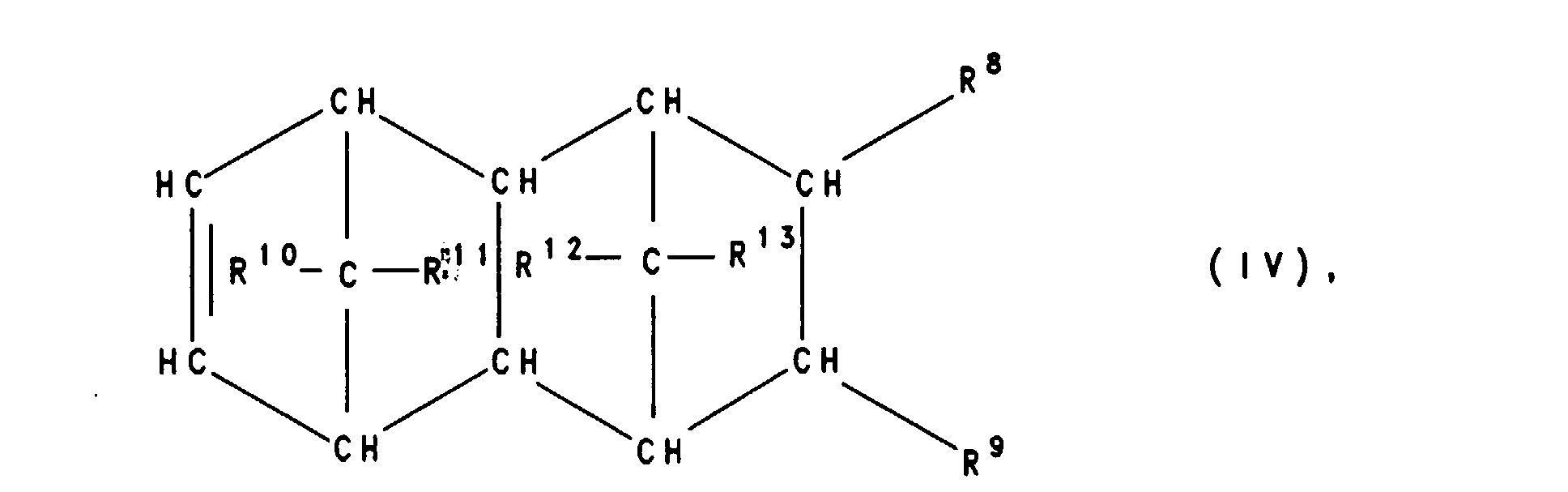
- Bevorzugt eingesetzt werden in dem erfindungsgemäßen Verfahren eingesetzt, 0,1 bis 99,9 Gew.-%, bezogen auf die Gesamtmenge der Monomeren, mindestens eines polycyclischen Olefins der Formeln I, II, III, IV, V, VI oder VII




0 bis 99,9 Gew.-%, bezogen auf die Gesamtmenge der Monomeren, eines monocyclischen Olefins der Formel VIII
0,1 bis 99,9 Gew.-%, bezogen auf die Gesamtmenge der Monomeren, mindestens eines acyclischen Olefins der Formel IX
- Im erfindungsgemäßen Verfahren wird vorzugsweise ein Cycloolefin der Formeln II oder IV, worin R8, R9, R10, R11, R12, R13, R14 und R15 gleich oder verschieden sind und ein Wasserstoffatom oder einen C1-C20-Kohlenwasserstoffrest, bevorzugt einen C6-C10-Arylrest oder einen C1-C8-Alkylrest, bedeuten, wobei gleiche Reste in den verschiedenen Formeln eine unterschiedliche Bedeutung haben können, eingesetzt.
- Gegebenenfalls wird auch ein monocyclisches Olefin der Formel VIII

- Außerdem wird bevorzugt ein acyclisches 1-Olefin der Formel IX verwendet,

- Insbesondere werden Copolymere von polycyclischen Olefinen, vorzugsweise der Formeln II und IV, mit Ethylen hergestellt.
- Besonders bevorzugte polycyclische Olefine sind Norbornen und Tetracyclododecen, wobei diese durch (C1-C6)-Alkyl substituiert sein können. Sie werden vorzugsweise mit Ethylen copolymerisiert; besondere Bedeutung besitzen Ethylen/Norbornen-Copolymere.
- Das polycyclische Olefin wird in einer Menge von 0,1 bis 99,9 Mol-%, bevorzugt 40 - 75 Mol-% und das acyclische Olefin in einer Menge von 0,1 bis 99,9 Mol-%, bevorzugt 20 - 60 Mol-%, jeweils bezogen auf die Gesamtmenge der Monomeren, eingesetzt.
- Die Konzentration des acyclischen Olefins ergibt sich aus dessen Löslichkeit in dem Reaktionsmedium bei gegebenem Druck und gegebener Temperatur.
- Als polycyclische Olefine, monocyclische Olefine und acyclische Olefine sind auch Gemische zweier oder mehrerer Olefine des jeweiligen Typs zu verstehen. Das heißt, es können neben polycyclischen Bicopolymeren auch Ter- und Multicopolymere nach dem erfindungsgemäßen Verfahren hergestellt werden.
- Der für das erfindungsgemäße Verfahren zu verwendende Katalysator enthält mindestens einen Cokatalysator und mindestens ein Metallocen der Formel I

- In Formel I sind R1 und R2 bevorzugt gleich R1 und R2 bedeuten ein Halogenatom, wie Fluor, Chlor, Brom oder Jod, insbesondere Chlor.
- R3 und R4 sind gleich und bevorzugt substituiertes Cyclopentadienyl wie Tetramethylcyclopentadienyl, Indenyl oder substituiertes Indenyl wie Isopropylindenyl, Phenylindenyl oder Benzoindenyl.
- R5 und R6 sind bevorzugt gleich.
- Beispiele für in dem erfindungsgemäßen Verfahren eingesetzte Metallocene sind die Racemate von:
Isopropylen-bis(cyclopentadienyl)zirkoniumdichlorid, Methylphenylmethylen-bis(cyclopentadienyl)zirkoniumdichlorid, Diphenylmethylen-bis(cyclopentadienyl)zirkoniumdichlorid, Isopropylen-bis(2,3,4, 5-tetramethylcyclopentadienyl)zirkoniumdichlorid, Methylphenylmethylen-bis(2,3,4,5-tetramethylcyclopentadienyl)zirkoniumdichlorid, Diphenylmethylen-bis(2,3,4,5-tetramethylcyclopentadienyl)zirkoniumdichlorid, Isopropylen-bis(1-indenyl)zirkoniumdichlorid, Methylphenylmethylen-bis(1 -indenyl)zirkoniumdichlorid, Diphenylmethylen-bis(1-indenyl)zirkoniumdichlorid, Isopropylen-bis(1-(4-phenylindenyl))zirkoniumdichlorid, Methylphenylmethylen-bis(1-(4-phenylindenyl))zirkoniumdichlorid, Diphenylmethylen-bis(1-(4-phenylindenyl))zirkoniumdichlorid, Isopropylen-bis(1-(4-isopropylindenyl))zirkoniumdichlorid, Methylphenylmethylen-bis(1-(4-isopropylindenyl))zirkoniumdichlorid, Diphenylmethylen-bis(1-(4-isopropylindenyl))zirkoniumdichlorid, Isopropylen-bis(1-(4,5-benzoindenyl)zirkoniumdichlorid, Methylphenylmethylen-bis(1-(4,5-benzoindenyl))zirkoniumdichlorid, und Diphenylmethylen-bis(1-(4,5-benzoindenyl))zirkoniumdichlorid. - Besonders bevorzugte Metallocene sind:
Isopropylen-bis(Isopropylen-bis(1-indenyl)zirkoniumdichlorid und Diphenylmethylen-bis(1-indenyl)zirkoniumdichlorid. - Der Cokatalysator ist bevorzugt ein Aluminoxan, insbesondere der Formel X


- Das Aluminoxan kann auf verschiedene Arten nach bekannten Verfahren hergestellt werden. Eine der Methoden ist beispielsweise, daß eine Aluminiumkohlenwasserstoffverbindung und/oder eine Hydridoaluminiumkohlenwasserstoffverbindung mit Wasser (gasförmig, fest, flüssig oder gebunden - beispielsweise als Kristallwasser) in einem inerten Lösungsmittel (wie z.B. Toluol) umgesetzt wird. Zur Herstellung eines Aluminoxans mit verschiedenen Alkylgruppen R20 werden entsprechend der gewünschten Zusammensetzung zwei verschiedene Aluminiumtrialkyle (AlR3 + AlR3') mit Wasser umgesetzt (S. Pasynkiewics, Polyhedron 9 (1990) 429, EP-A 302 424).
- Die genaue räumliche Struktur der Aluminoxane ist nicht bekannt.
- Unabhängig von der Art der Herstellung ist allen Aluminoxanlösungen ein wechselnder Gehalt an nicht umgesetzter Aluminiumausgangsverbindung gemeinsam, die in freier Form oder als Addukt vorliegt.
- Es ist auch möglich, das Aluminoxan auf einen Träger aufzubringen und es dann als Suspension in geträgerter Form einzusetzen. Es sind mehrere Trägerungsverfahren bekannt (EP 567 952), z.B. kann Kieselgel als Träger fungieren.
- Es ist möglich, das Metallocen vor dem Einsatz in der Polymerisationsreaktion mit einem Cokatalysator, insbesondere einem Aluminoxan zu aktivieren. Dadurch wird die Polmerisationsaktivität deutlich erhöht.
- Die Voraktivierung der Übergangsmetallverbindung wird in Lösung vorgenommen. Bevorzugt wird dabei das Metallocen in einer Lösung des Aluminoxans in einem inerten Kohlenwasserstoff aufgelöst. Als inerter Kohlenwasserstoff eignet sich ein aliphatischer oder aromatischer Kohlenwasserstoff; bevorzugt wird Toluol verwendet.
- Die Konzentration des Aluminoxans in der Lösung liegt im Bereich von ca. 1 Gew.-% bis zur Sättigungsgrenze, vorzugsweise von 5 bis 30 Gew.-%, jeweils bezogen auf die Gesamtlösung. Das Metallocen kann in der gleichen Konzentration eingesetzt werden, vorzugsweise wird es jedoch in einer Menge von 10-4 mol pro mol Aluminoxan eingesetzt. Die Voraktivierungszeit beträgt 1 Minute bis 60 Stunden, vorzugsweise 5 bis 60 Minuten. Man arbeitet bei einer Temperatur von -78°C bis 100°C, vorzugsweise 0 bis 70°C.
- Die Katalysatorkomponenten können auch in einer Vorpolymerisation eingesetzt werden oder auf einen Träger aufgebracht werden. Zur Vorpolymerisation wird bevorzugt das (oder eines der) in der Polymerisation eingesetzte(n) Olefin(e) verwendet.
- Geeignete Träger sind beispielsweise Silikagele, Aluminiumoxide, festes Aluminoxan oder andere anorganische Trägermaterialien. Ein geeignetes Trägermaterial ist auch ein Polyolefinpulver in feinverteilter Form.
- Eine weitere mögliche Ausgestaltung des erfindungsgemäßen Verfahrens besteht darin, daß man anstelle oder neben eines Aluminoxans eine salzartige Verbindung der Formel RxNH4-xBR'4 oder der Formel R3PHBR'4 als Cokatalysator verwendet. Dabei sind x = 1, 2 oder 3, R = Alkyl oder Aryl, gleich oder verschieden, und R = Aryl, das auch fluoriert oder teilfluoriert sein kann. In diesem Fall besteht der Katalysator aus dem Reaktionsprodukt eines Metallocens mit einer der genannten Verbindungen (EP-A 277 004).
- Falls dem Reaktionsgemisch Lösemittel zugesetzt wird, dann handelt es sich um gebräuchliche inerte Lösemittel wie z.B. aliphatische oder cycloaliphatische Kohlenwasserstoffe, Benzin- bzw. hydrierte Dieselölfraktionen oder Toluol.
- Die Metallocene werden in Form ihrer Racemate eingesetzt. Die Metallocenverbindung wird üblicherweise in einer Konzentration, bezogen auf das Übergangsmetall, von 10-3 bis 10-8, vorzugsweise 10-4 bis 10-7 mol Übergangsmetall pro dm3 Reaktorvolumen angewendet. Das Aluminoxan wird üblicherweise in einer Konzentration von 10-4 bis 10-1, vorzugsweise 10-4 bis 10-2 mol pro dm3 Reaktorvolumen verwendet, bezogen auf den Gehalt an Aluminium. Prinzipiell sind aber auch höhere Konzentrationen möglich.
- Die Polymerisation wird im flüssigen Cycloolefin selbst oder in Cycloolefin-Lösung durchgeführt. Bevorzugt liegt die Polymerisationstemperatur bei -78 bis 150°C und der Druck bei 0,01 bis 64, insbesondere bei 1 bis 64 bar.
- Bei der Herstellung von Copolymerisaten kann die Variation der Molverhältnisse des polycyclischen Olefins zum eingesetzten offenkettigen Olefin in einem weiten Bereich erfolgen. Bevorzugt werden molare Verhältnisse von 3:1 bis 100:1 Cycloolefin zu offenkettigem Olefin eingesetzt. Durch die Wahl der Polymerisationstemperatur, durch die Konzentration der Katalysatorkomponenten und das eingesetzte Molverhältnis bzw. den Druck des gasförmigen, offenkettigen Olefins läßt sich die Einbaurate an Comonomer beinahe beliebig steuern. Bevorzugt werden Einbauraten zwischen 20 und 80 Mol-% der cyclischen Komponenten und besonders bevorzugt werden Einbauraten zwischen 40 und 60 Mol-% der cyclischen Komponenten.
- Die Polymerisation kann auch mehrstufig erfolgen, wobei auch Blockcopolymere entstehen können (EP-A-560 090).
- Die mittlere Molmasse des gebildeten Polymeren läßt sich weiter durch Wasserstoff-Dosierung, Variation der Konzentration der Katalysatorkomponenten oder Variation der Temperatur in bekannter Weise steuern. Die Polydispersität Mw/Mn der Cycloolefin-Copolymeren liegt bevorzugt zwischen 1,9 und 3,5.
- Mit dem erfindungsgemäßen Verfahren lassen sich amorphe Cycloolefincopolymere herstellen, die eine hohe Viskositätszahl aufweisen. Außerdem ist über eine Wasserstoffregelung oder eine Variation der Polymerisationstemperatur ein breiter Bereich an Viskositätszahlen zugänglich. Die erfindungsgemäß hergestellten Cycloolefincopolymere weisen hohe Reißfestigkeiten auf und können mit hoher Raum-Zeit-Ausbeute erhalten werden. Außerdem enthalten erfindungsgemäß hergestellte ethylenhaltige Cycloolefincopolymere keine kristallinen Ethylensequenzen (DSC gemäß DIN 53765) und weisen eine hohe Transparenz auf. Die Copolymeren sind transparent, hart und thermoplastisch verarbeitbar. Die Reißspannungen (gemäß DIN 53457) liegen bevorzugt im Bereich von 50 bis 100 MPa, besonders bevorzugt zwischen 60 und 80 MPa. Die Viskositätszahlen (gemäß DIN 53728, bei 1350C in Dekalin) liegen bevorzugt im Bereich von 100 bis 250 cm3/g insbesondere 150 - 250 cm3/g. Sowohl beim Extrudieren als auch beim Spritzgießen werden bei Temperaturen von 300°C keine Zersetzungsreaktionen oder Viskositätsabbau gefunden.
- Die erfindungsgemäß hergestellten Materialien eignen sich besonders zur Herstellung von Formkörpern wie Extrusionsteilen (z.B. Folien, Schläuche, Rohre, Stangen und Fasern) oder Spritzgußartikeln beliebiger Form und Größe. Eine wichtige Eigenschaft der erfindungsgemäßen Materialien ist ihre Transparenz. Dadurch kommt besonders den optischen Anwendungen der extrudierten oder spritzgegossenen Teile aus diesen Materialien eine große Bedeutung zu. Der mit einem Abbe-Refraktometer und Mischlicht bestimmte Brechungsindex der in den nachfolgenden Beispielen beschriebenen Reaktionsprodukte liegt im Bereich zwischen 1,520 und 1,555. Nachdem der Brechungsindex sehr nahe an dem von Kronglas (n = 1,51) liegt, können die erfindungsgemäßen Produkte als Glasersatz verschiedene Anwendungen finden wie beispielsweise Linsen, Prismen, Trägerplatten und -folien für optische Datenspeicher, für Videoplatten, für Compact Disks, als Deck- oder Fokussierscheiben für Solarzellen, als Deck- und Streuscheiben für Leistungsoptiken, als Lichtwellenleiter in der Form von Fasern oder Folien.
- In schlagzähmodifizierter Form sind die erfindungsgemäßen Materialien als Strukturwerkstoff in verschiedenen technischen Bereichen einsetzbar (EP 0 566 988).
- Die erfindungsgemäßen Polymeren sind auch für die Herstellung von Polymerlegierungen einsetzbar. Die Legierungen können in der Schmelze oder in Lösung hergestellt werden. Die Legierungen weisen jeweils eine für bestimmte Anwendungen günstige Eigenschaftskombination der Komponenten auf. Für Legierungen mit den erfindungsgemäßen Polymeren sind folgende Polymere einsetzbar:
- Polyethylen, Polypropylen, (Ethylen-Propylen)-Copolymere, Polybutylen, Poly-(4-methyl-1-penten), Polyisopren, Polyisobutylen, Naturkautschuk, Poly(methylmethacrylat), weitere Polymethacrylate, Polyacrylate, (Acrylatmethacrylat)-Copolymere, methacrylat)-Copolymere, Bisphenol-A-Polycarbonat, Polystyrol, weitere Polycarbonate, aromatische Polyestercarbonate, Polyethylenterephthalat, Polybutylenterephthalat, amorphe Polyarylate, Nylon-6, Nylon-66, weitere Polyamide, Polyaramide, Polyetherketone, Polyoxymethylen, Polyoxyethylen, Polyurethane, Polysulfone, Polyethersulfone, Polyvinylidenfluorid.
- Die in den Beispielen und der Tabelle angegebenen Glastemperaturen (Tg) und Schmelzpunkte (Fp) wurden mittels Differential Scanning Calorimetry (DSC gemäß DIN 53765) bei einer Aufheizrate von 20°C/min bestimmt. Die angegebenen Viskositätszahlen (VZ) wurden gemäß DIN 53 728 bei 135°C in Dekalin ermittelt.
- Als Maß für die Katalysatoraktivität (A*) wurde die Ausbeute an Polymer pro Zeiteinheit und pro mmol Metallocen herangezogen.
Die Molmasse des verwendeten Methylaluminoxans (MAO) beträgt 1000 g/mol und ist als durchschnittliches Molekulargewicnt von isoliertem MAO zu betrachten.
- In einen mehrmals mit Stickstoff gespülten 1500 ml Reaktor wurden 600 ml einer 85 gewichtsproz. Lösung von Norbornen in Toluol gefüllt und auf 70°C aufgeheizt. Durch mehrfaches Aufdrücken von Ethylen (18 bar Überdruck) wurde die Lösung mit Ethylen gesättigt. In den entspannten Reaktor wurden im Ethylengegenstrom 7 ml toluolische Methylaluminoxanlösung gegeben und anschließend 15 min gerührt. In die so vorbereitete Reaktionslösung wurden 1,5 mg rac-Isopropylenbis(1-indenyl)zirkoniumdichlorid gegeben, welches in 5 ml toluolischer Aluminoxanlösung 15 min lang bei Raumtempertur voraktiviert worden war. Danach wurde sofort möglichst schnell ein Ethylendruck von 18 bar eingestellt.
Unter Rühren bei ca. 750 UpM wurde eine Stunde bei 70°C polymerisiert, wobei der Ethylendruck konstant bei 18 bar gehalten wurde.
Zur Beendigung der Reaktion wurde zuerst der Reaktor entspannt und anschließend die Reaktionslösung in ein Gefäß abgelassen. Das Polymer wurde in 3500 ml Aceton gefällt und nach 5 min Rühren filtriert. Der Filterkuchen wurde mehrfach mit 10proz. Salzsäure und Aceton im Wechsel gewaschen. Abschließend wurde mit Wasser neutral gewaschen und nach Zugabe von 2000 ml Aceton filtriert. Das so gereinigte Pulver wurde bei 80°C und einem Druck von 0,2 bar 15 Stunden getrocknet.
Nach dem Trocknen wurde 65,5 g farbloses Pulver erhalten; das enstpricht einer Aktivität von 18 900 g Polymer/Stunde x mmol Metallocen. An dem Polymer wurde eine Viskositätszahl von 182 cm3/g und eine Glastemperatur von 134°C gemessen. Durch thermische Analyse konnte kein Schmelzpunkt nachgewiesen werden. - Beispiel 2 wurde analog Beispiel 1 durchgeführt, jedoch wurde bei 90°C polymerisiert und 0,2 mg rac-Isopropylenbis(1-indenyl)zirkoniumdichlorid eingesetzt.
Es wurde 89,0 g farbloses Pulver erhalten; das enstpricht einer Aktivität von 25 700 g Polymer/Stunde x mmol Metallocen. An dem Polymer wurde eine Viskositätszahl von 148 cm3/g und eine Glastemperatur von 144°C gemessen. Durch thermische Analyse konnte kein Schmelzpunkt nachgewiesen werden. - Beispiel 3 wurde analog Beispiel 1 durchgeführt, jedoch wurde bei 12 bar Ethylenüberdruck polymerisiert und 1,5 mg rac-lsopropylenbis(1-indenyl)zirkoniumdichlorid eingesetzt.
Es wurde 79,4 g farbloses Pulver erhalten; das enstpricht einer Aktivität von 22900 g Polymer/Stunde x mmol Metallocen. An dem Polymer wurde eine Viskositätszahl von 171 cm3/g und eine Glastemperatur von 160°C gemessen. Durch thermische Analyse konnte kein Schmelzpunkt nachgewiesen werden.Tabelle: Eigenschaften der COC aus den Beispielen 1,2 und 3; Zugversuch (DIN 53457, Instron 4320) Polymer aus Beispiel 1 Polymer aus Beispiel 2 Polymer aus Beispiel 3 Reißspannung [MPa] 67,9 67,3 71,7 Reißdehnung [%] 3,62 3,59 3,62 VZ [cm3/g] 182 148 171 Tg[°C] 134 144 160 - Vergleichsbeispiel 1:
- In Beispiel 1 wurde mit 5,0 mg rac-Dimethylsilylbis(1-indenyl)zirkoniumdichlorid wiederholt.
Nach dem Trocknen wurde 54,0 g farbloses Pulver erhalten; das enstpricht einer Aktivität von 4840 g Polymer/Stunde x mmol Metallocen. An dem Polymer wurde eine Viskositätszahl von 173 cm3/g und gemessen. Durch thermische Analyse konnte ein Glaspunkt bei 137°C und ein Schmelzpunkt bei 124°C nachgewiesen werden.
Claims (4)
- Verfahren zur Herstellung eines Cycloolefincopolymers durch Polymerisation mindestens eines Cycloolefins und mindestens eines acyclischen Olefins in Gegenwart eines Katalysators, welcher mindestens einen Cokatalysator und mindestens ein Metallocen der Formel (I) enthält,
 M Zirkonum bedeutet,R1 und R2 gleich oder verschieden sind und ein Halogenatom bedeuten,R3 und R4 gleich sind und ein Cyclopentadienyl oder substituiertes Cyclopentadienyl, Indenyl oder substituiertes Indenyl bedeuten undR5 und R6 gleich oder verschieden sind und eine Methylgruppe oder Phenylgruppe bedeuten, wobeidas Metallocen mit der Formel (I) als Racemat vorliegt.
 - Verfahren nach Anspruch 1, wobei R1 und R2 ein Chloratom bedeuten, R5 und R6 gleich sind und eine Methylgruppe oder Phenylgruppe bedeuten.
- Verfahren nach Anspruch 1 oder 2, worin der Cokatalysator ein Aluminoxan ist.
- Verfahren nach einem oder mehreren der Ansprüche 1 bis 3, worin mindestens ein polycyclisches Olefin und mindestens ein acyclisches Olefin polymerisiert werden.
Applications Claiming Priority (2)
| Application Number | Priority Date | Filing Date | Title |
|---|---|---|---|
| DE4422157A DE4422157A1 (de) | 1994-06-24 | 1994-06-24 | Verfahren zur Herstellung von Cycloolefincopolymeren |
| DE4422157 | 1994-06-24 |
Publications (2)
| Publication Number | Publication Date |
|---|---|
| EP0688801A1 EP0688801A1 (de) | 1995-12-27 |
| EP0688801B1 true EP0688801B1 (de) | 1997-12-29 |
Family
ID=6521429
Family Applications (1)
| Application Number | Title | Priority Date | Filing Date |
|---|---|---|---|
| EP95109013A Expired - Lifetime EP0688801B1 (de) | 1994-06-24 | 1995-06-12 | Verfahren zur Herstellung von Cycloolefincopolymeren |
Country Status (7)
| Country | Link |
|---|---|
| US (1) | US5698645A (de) |
| EP (1) | EP0688801B1 (de) |
| JP (1) | JP3703525B2 (de) |
| KR (1) | KR100386759B1 (de) |
| CN (1) | CN1116324C (de) |
| CA (1) | CA2152552C (de) |
| DE (2) | DE4422157A1 (de) |
Cited By (1)
| Publication number | Priority date | Publication date | Assignee | Title |
|---|---|---|---|---|
| US8063163B2 (en) | 2005-11-24 | 2011-11-22 | Polypastics Co., Ltd. | Cycloolefin copolymer |
Families Citing this family (35)
| Publication number | Priority date | Publication date | Assignee | Title |
|---|---|---|---|---|
| US6964798B2 (en) | 1993-11-16 | 2005-11-15 | Baxter International Inc. | Multi-layered polymer based thin film structure for medical grade products |
| DE19546500A1 (de) * | 1995-12-13 | 1997-06-19 | Hoechst Ag | Verfahren zur Herstellung eines Cycloolefincopolymeren |
| DE19633641A1 (de) * | 1996-08-21 | 1998-02-26 | Hoechst Ag | Elastomere Cycloolefincopolymere |
| DE19652774A1 (de) * | 1996-12-19 | 1998-06-25 | Hoechst Ag | Folien |
| ES2203965T3 (es) * | 1997-03-29 | 2004-04-16 | Basell Polyolefine Gmbh | Metalocenos y catalizadores para la polimerizacion de olefinas. |
| US5889128A (en) | 1997-04-11 | 1999-03-30 | Massachusetts Institute Of Technology | Living olefin polymerization processes |
| US6297322B1 (en) | 1999-09-09 | 2001-10-02 | Baxter International Inc. | Cycloolefin blends and method for solvent bonding polyolefins |
| US6590033B2 (en) | 1999-09-09 | 2003-07-08 | Baxter International Inc. | Cycloolefin blends and method for solvent bonding polyolefins |
| US6613187B1 (en) | 1999-09-09 | 2003-09-02 | Baxter International Inc | Solvent bonding method for polyolefin materials |
| US6632318B1 (en) | 1999-09-09 | 2003-10-14 | Baxter International Inc. | Method for solvent bonding polyolefins |
| US6497676B1 (en) | 2000-02-10 | 2002-12-24 | Baxter International | Method and apparatus for monitoring and controlling peritoneal dialysis therapy |
| US6538087B2 (en) | 2000-07-28 | 2003-03-25 | Promerus, Llc | Polymeric compositions for forming optical waveguides; optical waveguides formed therefrom; and methods for making same |
| US6372848B1 (en) | 2000-10-10 | 2002-04-16 | Baxter International Inc. | Blend of ethylene and α-olefin copolymers obtained using a metallocene catalyst for fabricating medical films and tubings |
| US20030125662A1 (en) | 2002-01-03 | 2003-07-03 | Tuan Bui | Method and apparatus for providing medical treatment therapy based on calculated demand |
| US7238164B2 (en) | 2002-07-19 | 2007-07-03 | Baxter International Inc. | Systems, methods and apparatuses for pumping cassette-based therapies |
| US20060255049A1 (en) * | 2002-08-09 | 2006-11-16 | Fort James Corporation | Stretch blow-molded stackable tumbler |
| US7101654B2 (en) * | 2004-01-14 | 2006-09-05 | Promerus Llc | Norbornene-type monomers and polymers containing pendent lactone or sultone groups |
| KR20070015178A (ko) | 2004-04-27 | 2007-02-01 | 백스터 인터내셔널 인코포레이티드 | 교반-탱크 반응기 시스템 |
| US20090050196A1 (en) * | 2005-03-18 | 2009-02-26 | Mitsui Chemicals, Inc. | Resin Composition for Solar Cell Package |
| DE102007006825A1 (de) | 2007-02-07 | 2008-08-14 | Evonik Röhm Gmbh | Kunststoffformkörper mir anisotroper Lichtstreuung |
| US8558964B2 (en) | 2007-02-15 | 2013-10-15 | Baxter International Inc. | Dialysis system having display with electromagnetic compliance (“EMC”) seal |
| US7731689B2 (en) | 2007-02-15 | 2010-06-08 | Baxter International Inc. | Dialysis system having inductive heating |
| US8361023B2 (en) | 2007-02-15 | 2013-01-29 | Baxter International Inc. | Dialysis system with efficient battery back-up |
| US8870812B2 (en) | 2007-02-15 | 2014-10-28 | Baxter International Inc. | Dialysis system having video display with ambient light adjustment |
| US7998115B2 (en) | 2007-02-15 | 2011-08-16 | Baxter International Inc. | Dialysis system having optical flowrate detection |
| US8092628B2 (en) | 2008-10-31 | 2012-01-10 | Brewer Science Inc. | Cyclic olefin compositions for temporary wafer bonding |
| US8771927B2 (en) * | 2009-04-15 | 2014-07-08 | Brewer Science Inc. | Acid-etch resistant, protective coatings |
| DE102010030074A1 (de) | 2010-06-15 | 2011-12-15 | Evonik Degussa Gmbh | Kunststoff-Photovoltaik-Modul und Verfahren zu seiner Herstellung |
| JP6176015B2 (ja) | 2012-11-01 | 2017-08-09 | 日本ポリプロ株式会社 | メタロセン錯体およびオレフィンの重合方法 |
| JP5710035B2 (ja) * | 2013-02-27 | 2015-04-30 | 日本ポリエチレン株式会社 | メタロセン化合物およびオレフィン重合体の製造方法 |
| US11179516B2 (en) | 2017-06-22 | 2021-11-23 | Baxter International Inc. | Systems and methods for incorporating patient pressure into medical fluid delivery |
| CN109593160A (zh) * | 2017-09-30 | 2019-04-09 | 中国石化扬子石油化工有限公司 | 一种环烯烃共聚物的制备方法 |
| CN109627366A (zh) * | 2017-10-09 | 2019-04-16 | 中国石化扬子石油化工有限公司 | 一种茂金属催化剂及在环烯烃共聚物制备中的应用 |
| MX2022014747A (es) | 2020-05-29 | 2023-01-11 | Univation Tech Llc | Polietileno bimodal de un solo reactor con modulo mejorado para aplicaciones de tambor de moldeo por soplado por extrusion. |
| CN112745431B (zh) * | 2020-12-23 | 2023-04-21 | 广东华锦达新材科技有限公司 | 一种环烯烃共聚物及其制备方法 |
Family Cites Families (7)
| Publication number | Priority date | Publication date | Assignee | Title |
|---|---|---|---|---|
| US5003019A (en) * | 1987-03-02 | 1991-03-26 | Mitsui Petrochemical Industries, Ltd. | Cyclo-olefinic random copolymer, olefinic random copolymer, and process for producing cyclo-olefinic random copolymers |
| DE3922546A1 (de) * | 1989-07-08 | 1991-01-17 | Hoechst Ag | Verfahren zur herstellung von cycloolefinpolymeren |
| ATE212042T1 (de) * | 1990-03-06 | 2002-02-15 | Mitsui Chemicals Inc | Statistische cycloolefincopolymere und verfahren zu ihrer herstellung |
| US5371158A (en) * | 1990-07-05 | 1994-12-06 | Hoechst Aktiengesellschaft | Bulk polymerization using specific metallocene catalysts for the preparation of cycloolefin polymers |
| TW227005B (de) * | 1990-11-14 | 1994-07-21 | Hoechst Ag | |
| DE59209568D1 (de) * | 1991-02-27 | 1999-01-07 | Ticona Gmbh | Verfahren zur Herstellung von Cycloolefin(co)polymeren mit enger Molekulargewichtsverteilung |
| EP0503422B1 (de) * | 1991-03-09 | 1998-06-03 | TARGOR GmbH | Verfahren zur Herstellung chemisch einheitlicher Cycloolefincopolymere |
-
1994
- 1994-06-24 DE DE4422157A patent/DE4422157A1/de not_active Withdrawn
-
1995
- 1995-06-12 DE DE59501145T patent/DE59501145D1/de not_active Expired - Lifetime
- 1995-06-12 EP EP95109013A patent/EP0688801B1/de not_active Expired - Lifetime
- 1995-06-23 CA CA002152552A patent/CA2152552C/en not_active Expired - Fee Related
- 1995-06-23 CN CN95107662A patent/CN1116324C/zh not_active Expired - Fee Related
- 1995-06-24 KR KR1019950017248A patent/KR100386759B1/ko not_active Expired - Fee Related
- 1995-06-26 JP JP15908495A patent/JP3703525B2/ja not_active Expired - Fee Related
-
1997
- 1997-02-07 US US08/796,312 patent/US5698645A/en not_active Expired - Lifetime
Cited By (1)
| Publication number | Priority date | Publication date | Assignee | Title |
|---|---|---|---|---|
| US8063163B2 (en) | 2005-11-24 | 2011-11-22 | Polypastics Co., Ltd. | Cycloolefin copolymer |
Also Published As
| Publication number | Publication date |
|---|---|
| JPH0812712A (ja) | 1996-01-16 |
| KR960000935A (ko) | 1996-01-25 |
| JP3703525B2 (ja) | 2005-10-05 |
| CN1116324C (zh) | 2003-07-30 |
| US5698645A (en) | 1997-12-16 |
| CN1120551A (zh) | 1996-04-17 |
| EP0688801A1 (de) | 1995-12-27 |
| CA2152552A1 (en) | 1995-12-25 |
| CA2152552C (en) | 2008-03-18 |
| KR100386759B1 (ko) | 2003-08-09 |
| DE4422157A1 (de) | 1996-01-04 |
| DE59501145D1 (de) | 1998-02-05 |
Similar Documents
| Publication | Publication Date | Title |
|---|---|---|
| EP0610851B1 (de) | Verfahren zur Herstellung von Cycloolefincopolymeren | |
| EP0688801A1 (de) | Verfahren zur Herstellung von Cycloolefincopolymeren | |
| EP0610843B1 (de) | Verfahren zur Herstellung von Cycloolefinpolymeren | |
| EP0407870B1 (de) | Verfahren zur Herstellung von Cycloolefinpolymeren | |
| EP0501370B1 (de) | Verfahren zur Herstellung von Cycloolefin(co)polymeren mit enger Molekulargewichtsverteilung | |
| EP0729977B1 (de) | Metallocen und Katalysator | |
| EP0946618B1 (de) | Cycloolefincopolymere, ihre verwendung und daraus hergestellte formkörper | |
| EP0779306B1 (de) | Verfahren zur Herstellung eines Cycloolefincopolymeren | |
| EP0516018B1 (de) | Verfahren zur Herstellung von Polyolefinen mit breiter Molmassenverteilung | |
| EP0485893B1 (de) | Massepolymerisation mit speziellen Metallocenkatalysatoren zur Herstellung von Cycloolefinpolymeren | |
| EP0659758B1 (de) | Metallocene und ihre Verwendung als Katalysatoren | |
| EP0645401B1 (de) | Verfahren zur Herstellung von Polyolefinen | |
| EP0516019B1 (de) | Verfahren zur Herstellung von syndiotaktischen Polyolefinen mit breiter Molmassenverteilung | |
| EP0683797A1 (de) | Cycloolefincopolymere mit niedriger schmelzeviskosität und niedriger optischer dämpfung | |
| EP0946616B1 (de) | Verfahren zur herstellung eines cycloolefincopolymers | |
| EP0560090B1 (de) | Cycloolefinblockcopolymere und Verfahren zu ihrer Herstellung | |
| EP0749988A2 (de) | Verfahren zur Herstellung von Cycloolefincopolymeren | |
| EP0610850A1 (de) | Verfahren zur Herstellung von Cycloolefinpolymeren | |
| DE4344631A1 (de) | Verfahren zur Herstellung von Cycloolefincopolymeren |
Legal Events
| Date | Code | Title | Description |
|---|---|---|---|
| PUAI | Public reference made under article 153(3) epc to a published international application that has entered the european phase |
Free format text: ORIGINAL CODE: 0009012 |
|
| AK | Designated contracting states |
Kind code of ref document: A1 Designated state(s): DE FR GB IT NL |
|
| 17P | Request for examination filed |
Effective date: 19960627 |
|
| 17Q | First examination report despatched |
Effective date: 19960812 |
|
| GRAG | Despatch of communication of intention to grant |
Free format text: ORIGINAL CODE: EPIDOS AGRA |
|
| GRAG | Despatch of communication of intention to grant |
Free format text: ORIGINAL CODE: EPIDOS AGRA |
|
| GRAH | Despatch of communication of intention to grant a patent |
Free format text: ORIGINAL CODE: EPIDOS IGRA |
|
| GRAH | Despatch of communication of intention to grant a patent |
Free format text: ORIGINAL CODE: EPIDOS IGRA |
|
| GRAA | (expected) grant |
Free format text: ORIGINAL CODE: 0009210 |
|
| AK | Designated contracting states |
Kind code of ref document: B1 Designated state(s): DE FR GB IT NL |
|
| REF | Corresponds to: |
Ref document number: 59501145 Country of ref document: DE Date of ref document: 19980205 |
|
| ITF | It: translation for a ep patent filed | ||
| RAP2 | Party data changed (patent owner data changed or rights of a patent transferred) |
Owner name: MITSUI PETROCHEMICAL INDUSTRIES, LTD. Owner name: TICONA GMBH |
|
| GBT | Gb: translation of ep patent filed (gb section 77(6)(a)/1977) |
Effective date: 19980304 |
|
| ET | Fr: translation filed | ||
| NLT2 | Nl: modifications (of names), taken from the european patent patent bulletin |
Owner name: TICONA GMBH EN MITSUI PETROCHEMICAL INDUSTRIES, LT |
|
| RAP2 | Party data changed (patent owner data changed or rights of a patent transferred) |
Owner name: MITSUI PETROCHEMICAL INDUSTRIES, LTD. Owner name: TICONA GMBH |
|
| PLBE | No opposition filed within time limit |
Free format text: ORIGINAL CODE: 0009261 |
|
| STAA | Information on the status of an ep patent application or granted ep patent |
Free format text: STATUS: NO OPPOSITION FILED WITHIN TIME LIMIT |
|
| 26N | No opposition filed | ||
| NLT2 | Nl: modifications (of names), taken from the european patent patent bulletin |
Owner name: TICONA GMBH EN MITSUI PETROCHEMICAL INDUSTRIES, LT |
|
| REG | Reference to a national code |
Ref country code: GB Ref legal event code: IF02 |
|
| NLS | Nl: assignments of ep-patents |
Owner name: TICONA GMBH Effective date: 20050825 Owner name: MITSUI PETROCHEMICAL INDUSTRIES, LTD. Effective date: 20050825 |
|
| REG | Reference to a national code |
Ref country code: GB Ref legal event code: 732E |
|
| PGFP | Annual fee paid to national office [announced via postgrant information from national office to epo] |
Ref country code: NL Payment date: 20120626 Year of fee payment: 18 Ref country code: DE Payment date: 20120622 Year of fee payment: 18 |
|
| PGFP | Annual fee paid to national office [announced via postgrant information from national office to epo] |
Ref country code: FR Payment date: 20120705 Year of fee payment: 18 Ref country code: GB Payment date: 20120622 Year of fee payment: 18 |
|
| PGFP | Annual fee paid to national office [announced via postgrant information from national office to epo] |
Ref country code: IT Payment date: 20120628 Year of fee payment: 18 |
|
| REG | Reference to a national code |
Ref country code: NL Ref legal event code: V1 Effective date: 20140101 |
|
| GBPC | Gb: european patent ceased through non-payment of renewal fee |
Effective date: 20130612 |
|
| REG | Reference to a national code |
Ref country code: DE Ref legal event code: R119 Ref document number: 59501145 Country of ref document: DE Effective date: 20140101 |
|
| REG | Reference to a national code |
Ref country code: FR Ref legal event code: ST Effective date: 20140228 |
|
| PG25 | Lapsed in a contracting state [announced via postgrant information from national office to epo] |
Ref country code: GB Free format text: LAPSE BECAUSE OF NON-PAYMENT OF DUE FEES Effective date: 20130612 Ref country code: DE Free format text: LAPSE BECAUSE OF NON-PAYMENT OF DUE FEES Effective date: 20140101 Ref country code: NL Free format text: LAPSE BECAUSE OF NON-PAYMENT OF DUE FEES Effective date: 20140101 |
|
| PG25 | Lapsed in a contracting state [announced via postgrant information from national office to epo] |
Ref country code: FR Free format text: LAPSE BECAUSE OF NON-PAYMENT OF DUE FEES Effective date: 20130701 Ref country code: IT Free format text: LAPSE BECAUSE OF NON-PAYMENT OF DUE FEES Effective date: 20130612 |