EP0689316A2 - Procédé et dispositif pour identifier des usagers et vérifier des paquets de données dans un réseau de communications sans fil - Google Patents
Procédé et dispositif pour identifier des usagers et vérifier des paquets de données dans un réseau de communications sans fil Download PDFInfo
- Publication number
- EP0689316A2 EP0689316A2 EP95304083A EP95304083A EP0689316A2 EP 0689316 A2 EP0689316 A2 EP 0689316A2 EP 95304083 A EP95304083 A EP 95304083A EP 95304083 A EP95304083 A EP 95304083A EP 0689316 A2 EP0689316 A2 EP 0689316A2
- Authority
- EP
- European Patent Office
- Prior art keywords
- data
- message
- unit
- hashing
- data packet
- Prior art date
- Legal status (The legal status is an assumption and is not a legal conclusion. Google has not performed a legal analysis and makes no representation as to the accuracy of the status listed.)
- Withdrawn
Links
- 238000000034 method Methods 0.000 title claims abstract description 20
- 238000004891 communication Methods 0.000 title claims description 21
- 238000013524 data verification Methods 0.000 title description 2
- 238000013479 data entry Methods 0.000 claims description 5
- 230000005540 biological transmission Effects 0.000 description 6
- 238000013478 data encryption standard Methods 0.000 description 5
- 238000012545 processing Methods 0.000 description 5
- 238000012546 transfer Methods 0.000 description 5
- 238000013459 approach Methods 0.000 description 4
- 230000010365 information processing Effects 0.000 description 4
- 230000001413 cellular effect Effects 0.000 description 3
- RWSOTUBLDIXVET-UHFFFAOYSA-N Dihydrogen sulfide Chemical compound S RWSOTUBLDIXVET-UHFFFAOYSA-N 0.000 description 2
- 241001417511 Ardis Species 0.000 description 1
- 238000010367 cloning Methods 0.000 description 1
- 238000012790 confirmation Methods 0.000 description 1
- 238000004519 manufacturing process Methods 0.000 description 1
- 238000012795 verification Methods 0.000 description 1
Images

Classifications
-
- H—ELECTRICITY
- H04—ELECTRIC COMMUNICATION TECHNIQUE
- H04L—TRANSMISSION OF DIGITAL INFORMATION, e.g. TELEGRAPHIC COMMUNICATION
- H04L9/00—Cryptographic mechanisms or cryptographic arrangements for secret or secure communications; Network security protocols
- H04L9/32—Cryptographic mechanisms or cryptographic arrangements for secret or secure communications; Network security protocols including means for verifying the identity or authority of a user of the system or for message authentication, e.g. authorization, entity authentication, data integrity or data verification, non-repudiation, key authentication or verification of credentials
- H04L9/3236—Cryptographic mechanisms or cryptographic arrangements for secret or secure communications; Network security protocols including means for verifying the identity or authority of a user of the system or for message authentication, e.g. authorization, entity authentication, data integrity or data verification, non-repudiation, key authentication or verification of credentials using cryptographic hash functions
-
- H—ELECTRICITY
- H04—ELECTRIC COMMUNICATION TECHNIQUE
- H04L—TRANSMISSION OF DIGITAL INFORMATION, e.g. TELEGRAPHIC COMMUNICATION
- H04L9/00—Cryptographic mechanisms or cryptographic arrangements for secret or secure communications; Network security protocols
- H04L9/32—Cryptographic mechanisms or cryptographic arrangements for secret or secure communications; Network security protocols including means for verifying the identity or authority of a user of the system or for message authentication, e.g. authorization, entity authentication, data integrity or data verification, non-repudiation, key authentication or verification of credentials
- H04L9/3247—Cryptographic mechanisms or cryptographic arrangements for secret or secure communications; Network security protocols including means for verifying the identity or authority of a user of the system or for message authentication, e.g. authorization, entity authentication, data integrity or data verification, non-repudiation, key authentication or verification of credentials involving digital signatures
-
- H—ELECTRICITY
- H04—ELECTRIC COMMUNICATION TECHNIQUE
- H04L—TRANSMISSION OF DIGITAL INFORMATION, e.g. TELEGRAPHIC COMMUNICATION
- H04L9/00—Cryptographic mechanisms or cryptographic arrangements for secret or secure communications; Network security protocols
- H04L9/40—Network security protocols
-
- H—ELECTRICITY
- H04—ELECTRIC COMMUNICATION TECHNIQUE
- H04L—TRANSMISSION OF DIGITAL INFORMATION, e.g. TELEGRAPHIC COMMUNICATION
- H04L2209/00—Additional information or applications relating to cryptographic mechanisms or cryptographic arrangements for secret or secure communication H04L9/00
- H04L2209/80—Wireless
Definitions
- the present invention relates generally to communication systems that transmit information via a wireless network. More particularly, the present invention relates to user-identification and the verification of data integrity in wireless communication systems.
- Wireless communication systems pose unique security concerns compared to the security risks associated with wired or tethered systems.
- Communication over wireless networks is more vulnerable to attack by unauthorized persons using the system in any of a number of ways.
- Transmission of data in the clear means that the data can be monitored or intercepted easily by anyone possessing an appropriate receiver. Similarly, transmission of a user's identification in the clear opens the user to traffic analysis.
- wireless systems are vulnerable to misuse of resources associated with the system, such as the cloning of wireless communication devices by persons who are not subscribers to the network's services.
- the cloned devices can be programmed to include identification information associated with a legitimate subscriber or the subscriber's device. Such techniques allow the non-subscriber to qualify for service in a fraudulent manner, which may result in unrecoverable costs to the service provider.
- the present invention discloses a system for transmitting information over a wireless communication system with improved security.
- This system preferably comprises a wireless transmitting unit for transmitting a message via a wireless network, where the message comprises a first segment including identification information, a second segment including a data packet, and a third segment including a digital signature.
- the digital signature is obtained by applying a hashing algorithm and an encryption algorithm to the data packet, where the encryption algorithm uses an encryption key corresponding to the identification information.
- the system further comprises a wireless network and a wireless receiving unit.
- the wireless receiving unit may comprise circuitry for receiving the message and a memory unit for storing the encryption key corresponding to the identification information.
- the wireless receiving unit also has a hashing unit for hashing the data packet according to the hashing algorithm to form hashed data and an encryption unit for forming encrypted hashed data by applying the encryption algorithm to the hashed data using the encryption key.
- the wireless receiving unit may include a comparing unit for comparing the encrypted hashed data to the digital signature and a processor for controlling the flow of data between other units in the wireless receiving unit.
- FIG. 1 illustrates an exemplary wireless communication system according to the present invention.
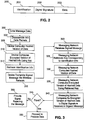
- FIG. 2 shows a signed message having three segments in accordance with the present invention.
- FIG. 3 is a flow chart showing the steps for identifying and authenticating the originator of a transmission and verifying the integrity of the transmission according to the method of the present invention.
- FIG. 1 illustrates an exemplary wireless communication system 1 according to the present invention.
- the wireless system 1 includes a messaging network 100 which serves as a platform for end-user services such as exchanging messages or mediating transactions between subscribers. Each such subscriber will typically have a wireless device such as wireless device 150. As a result, the messaging network 100 will typically communicate with a large number of wireless devices even though FIG. 1 shows a single such device 150 for simplicity of presentation.
- a system component, such as the wireless device 150, which transmits information via a wireless communication network generally may be referred to as a wireless transmitting unit.
- the messaging network 100 may be connected, for example, by an Ethernet format connection to the wireless interface 130, which serves as an interface between the messaging network 100 and a wireless network 140.
- a system component, such as the messaging network 100, which receives information via a wireless network may generally be referred to as a wireless receiving unit.
- the wireless network 140 may suitably be a public packet radio network such as the RAM Mobile Data Network, the ARDIS Network, or any Cellular Digital Packet Data (CDPD) network.
- CDPD Cellular Digital Packet Data
- the transfer of information between the wireless interface 130 and the wireless network 140 occurs in either a connectionless or connection-oriented manner.
- the transfer of information between the wireless network 140 and the wireless device 150 takes place in a connectionless manner according to a protocol specified by the particular wireless network 140.
- a connectionless transfer of information may be distinguished from a session-oriented approach in which a "handshake" routine typically takes place between the network and a user of or subscriber to the network.
- the handshake routine typically requires that the user be authenticated as legitimate at the beginning of a session, for example, by using a personal password that identifies the user.
- the user then sends messages, for example, to the network, after which the session is terminated.
- individual messages are not verified or authenticated.
- connectionless approach does not require that communication between the user and network be initialized and terminated at some later time. Rather, the connectionless approach allows individual packets of information or data, which are self-contained, to be sent to the network without prior negotiation and without prior confirmation of the user with the exception of a possible subscription agreement permitting the subscriber to use the network.
- the wireless device 150 may be a personal digital assistant (PDA) or personal communicator, or a device for use in a cellular telephone system, such as a digital cellular telephone. It is to be understood, however, that any device that is capable of transmitting and receiving appropriate signals over a wireless network may be used. In the discussion that follows, it will be assumed that the device 150 is a PDA having an data entry unit 160, such as a keyboard, keypad, stylus, or any other suitable means for entering data.
- PDA personal digital assistant
- the device 150 is a PDA having an data entry unit 160, such as a keyboard, keypad, stylus, or any other suitable means for entering data.
- each wireless device intended for use in the system 1, such as the wireless device 150 is assigned a unique identifier or identification information.
- the identification information is stored in the device 150, for example, as an electronic serial number (ESN) 171 incorporated into the device 150 at the time of manufacture.
- ESN 171 may be stored in a memory unit 170.
- the identification information may be a user name, an account identification, an account name, or a service identification stored in the memory unit 170.
- each subscriber to the messaging network's services is provided with a unique private encryption key, K, for use as explained below.
- the encryption key, K is one that can be used with a secure encryption scheme.
- the key, K may be, for example, a 56-bit Data Encryption Standard (DES) key for use in a cryptosystem such as the one described in "Data Encryption Standards," Federal Information Processing Standard, Publication No. 46, National Bureau of Standards, January 1977.
- DES Data Encryption Standard
- the private key, K is entered into the device 150, preferably in a manner not subject to tampering, and is stored for further use in a file 172 in the memory unit 170.
- the private key may be periodically updated to further increase its security.
- the private key, K is intended for the private use of the subscriber alone and should not be disclosed to other individuals.
- the messaging network 100 and the wireless device 150 each follow a message-oriented protocol, which resides on the messaging network 100 and the wireless device 150 in a receiver 105 and a transmitter 155, respectively.
- Both the receiver 105 and the transmitter 155 may suitably be, for example, a radio transceiver connected to a modem.
- each message transmitted by the wireless device 150 preferably contains three segments.
- a first segment 201 includes the identification information that is retrieved from the memory unit 170 by the device 150, for example the electronic serial number 171.
- a second segment 203 includes a data packet that the subscriber wishes to send.
- a third segment 202 includes a digital signature as further explained below.
- a message, such as the message 200, containing the three segments 201, 202 and 203, may be referred to as a signed message.
- FIG. 3 is a flow chart showing the steps of sending a message according to the method of the present invention.
- the subscriber wishes to send a message via the wireless network 140 using the wireless device 150, the subscriber enters the message data into the device 150 as shown in step 300 of FIG. 3.
- the message data may be entered into the device 150 by using the data entry unit 160 associated with the device 150.
- the subscriber could enter the data into the device 150 by using a keypad.
- a processor 162 such as a central processing unit, connected to the data entry unit 160 and to the transmitter 155, disassembles the data into smaller data packets, as shown in step 302.
- a processor 162 typically be a plurality of packets of data which, when reassembled, constitute the entire message that the user entered into the data entry unit 160.
- These data packets may be temporarily stored in the memory unit 170 for further processing. It should be understood, however, that the complete message data may be sent as one data packet.
- the processor 162 retrieves the key, K, from the file 172 and proceeds to generate and transmit a signed message for each packet of data as explained in greater detail below.
- the processor 162 also controls the flow of information to and from other components in the wireless device 150.
- the device 150 computes a hashed version of a first data packet by applying a pre-defined hashing algorithm to the first data packet to form hashed information.
- the hashing algorithm is executed by a hashing unit 161 connected to the processor 162.
- the hashing unit 161 may suitably be an electronic circuit which implements the pre-defined hashing algorithm.
- the hashing unit 161 may be a processor, such as a general purpose processor programmed with appropriate software, which implements the hashing algorithm.
- Such hashing algorithms and implementations thereof are well-known in the art and are described, for example, in "Secure Hash Standard," Federal Information Processing Standard, Publication No. 180/XAB, National Bureau of Standards, May 11, 1993. The subject matter of this publication and the subject matter of all other publications referred to herein are incorporated by reference.
- the device 150 computes an encrypted version of the hashed information according to a primary encryption algorithm using the private key, K, to form encrypted hashed information.
- the encrypted version of the hashed information is computed by a primary encryption unit 163 connected to the processor 160.
- the primary encryption unit 163 may be an electronic circuit which implements the primary encryption algorithm.
- a commercially available AT&T T7000 Data Encryption Processor is also suitable for use as the primary encryption unit 163.
- the primary encryption algorithm may be a DES encryption algorithm or some other suitable secure encryption algorithm that may be used with the private key, K.
- the encryption unit 163 is connected to the processor 160, for example, by control lines 164 which provide control signals to the encryption unit 163. Control signals indicate, for example, whether data or the key, K, is to be entered into the encryption unit 163.
- data lines 165 are used to transfer the plain and encrypted data between the encryption unit 163 and the processor 160.
- the encryption unit 163 may be a processor, such as a general purpose processor programmed with appropriate software, which encrypts the hashed data according to the primary encryption algorithm.
- a processor such as a general purpose processor programmed with appropriate software, which encrypts the hashed data according to the primary encryption algorithm.
- Hardware and software implementations of encryption algorithms are well-known in the art and are described more fully, for example, in "DES Modes of Operation,” Federal Information Processing Standard, Publication No. 81, National Bureau of Standards, December 2, 1980, and "Guidelines For Implementing and Using The NBS Data Encryption Standard,” Federal Information Processing Standards, Publication No. 74, National Bureau of Standards, April 1, 1981.
- the encrypted version of the hashed information computed in step 310 is the digital signature referred to above.
- the digital signature therefore, is obtained by applying the pre-defined hashing algorithm and the primary encryption algorithm to the first data packet, where the primary encryption algorithm uses the private encryption key, K.
- the processor 162 retrieves the identification information stored as the ESN 171 as shown in step 312. This identification information is included in the segment 201 of the signed message 200, and the first data packet is included in the segment 203.
- the transmitter 155 transmits a signed message via the wireless network 140.
- the preferred order for transmitting the three segments 201-203 is to place the segment 201 containing the identification information, which preferably is of fixed length, at the front of the signed message 200.
- the segment 203 containing the data packet which may be of variable length, is placed at the end of the message 200. If, however, the segment 203 is also of fixed length, then it is desirable to transmit it before the segment 202 containing the digital signature. Transmitting segments of fixed length at the front of the signed message makes it easier for the messaging unit 100 to determine where one segment ends and another segment begins. Also, placing the segment 201 at the front of the signed message permits processing at the messaging network 100 to take place without unnecessary delay because the identification information in the segment 201 is needed to begin processing the received message at the messaging network 100. It is to be understood, however, that the segments 201-203 may be transmitted in any order in accordance with the present invention.
- the data packet which is contained in the third segment 203 is also transmitted in an encrypted form.
- the first data packet is encrypted using an encryption key, K2, that differs from the private key, K.
- K2 that differs from the private key, K.
- a secondary encryption unit 166 connected to the processor 160, may be used.
- the secondary encryption unit 166 may be similar to the primary encryption unit 163 and connected to the processor 162 in a similar manner.
- the key, K2 may be stored in a file 173 in the memory unit 170.
- One purpose of the encryption performed by the secondary encryption unit 166 is to prevent unauthorized persons from intercepting the signed message and reading the contents of the data packet.
- the signed message is transmitted via the wireless network 140, it is received by the wireless interface 130 and transmitted to the messaging network 100, which receives the signed message in the receiver 105 as shown in step 320.
- the received signed message may be temporarily stored in a file 121 in a memory unit 119 that is connected to the receiver 105.
- the memory unit 119 also has a look-up table 120 which stores the encryption key corresponding to each subscriber.
- the look-up table allows the encryption key corresponding to a particular subscriber to be retrieved based upon the identification information received in the segment 201 of the signed message.
- a processor 112 such as a central processing unit, is connected to the memory unit 119 and controls the flow of data to and from other units in the messaging network 100. In step 325, the processor 112 retrieves the encryption key that corresponds to the identification information contained in the segment 201 of the signed message.
- the key retrieved by the messaging network 100 in the step 325 is the same as the key, K, used by the subscriber to transmit the signed message.
- the messaging network 100 computes a hashed version of the data packet received in the third segment 203 according to the same pre-defined hashing algorithm that was used by the device 150 in the step 305 to form hashed data.
- Execution of the hashing algorithm in the step 330 may be performed by a hashing unit 111 connected to the processor 112.
- the hashing unit 111 may suitably be an electronic circuit which implements the pre-defined hashing algorithm.
- the hashing unit 161 may be a processor, such as a general purpose processor programmed with appropriate software, which implements the hashing algorithm.
- step 335 the messaging network 100 computes an encrypted version of the hashed data, to form encrypted hashed data.
- the encryption key retrieved in step 325 and an encryption algorithm are used to encrypt the hashed data.
- the encryption implemented in step 335 depends upon the key that is retrieved from the database 119, which in turn depends upon the identification information that was received in the first segment 201 of the signed message 200. If the subscriber and the device 150 are legitimate, then the encryption algorithm used in the step 310 and the primary encryption algorithm used in the step 335 are the same.
- An encryption unit 113 which is connected to the processor 112, executes the encryption algorithm in step 335 using the key retrieved from the memory unit 119 according to known techniques in either hardware or software.
- the encryption unit 113 may be an electronic circuit which implements the primary encryption algorithm.
- a commercially available AT&T T7000 Data Encryption Processor is also suitable for use as the encryption unit 113.
- the encryption unit 113 is connected to the processor 112, for example, by control lines 114 which provide control signals to the encryption unit 113. Control signals indicate, for example, whether data or the retrieved key is to be entered into the encryption device 163.
- data lines 115 are used to transfer the plain and encrypted data between the encryption unit 113 and the processor 112.
- the encryption unit 113 may be a processor, such as a general purpose processor programmed with appropriate software, which encrypts the hashed data according to the primary encryption algorithm.
- step 340 the messaging network 100 compares the encrypted hashed data computed by it in step 335 to the digital signature contained in the second segment 202 of the received signed message 200.
- a comparing unit 116 which may be an electronic comparing circuit and which is also connected to the processor 112, may be used to perform step 340. In an alternative embodiment, the comparing unit 116 may be a general purpose processor programmed to compare the encrypted hashed data to the digital signature.
- step 345 the next step depends upon the results of the comparison performed in the step 340. If the encrypted hashed data computed by the messaging network 100 is the same as the received digital signature, then the subscriber and device 150 are authenticated as legitimate, and the integrity of the received data packet is deemed to have been preserved during transmission.
- the messaging network 100 proceeds to process the data received in the segment 203. For example, if the established protocol requires that the data packet contained in the third segment 203 be sent in an encrypted form as explained above according to the preferred embodiment, then the messaging network 100 decrypts the data using a decryption unit 118, connected to the processor 112.
- the decryption unit 118 executes in hardware or software a decryption algorithm which retrieves the original data that was encrypted by encryption unit 166.
- the decryption unit 118 may be an electronic circuit or a processor, such as a general purpose processor programmed with appropriate software, which executes the decryption algorithm.
- Such decryption algorithms and decryption devices are well-known in the art.
- a commercially available AT&T T7000 Data Encryption Processor is also suitable for use as the decryption unit 118.
- step 355 the messaging network 100 provides a signal indicating that the data packet 200 is rejected.
- Signed messages incorporating the other data packets that were formed by the processor 160 from the original message data entered into the device 150, are also transmitted by the device 150 and processed by the network 100 according to the same method described in detail above.
- the network 100 would then reassemble the data packets to reconstruct the complete message originally entered into the device 150 by the user.
- the messaging network 100 would process the complete message by sending the data to its ultimate destination if, for example, the message is an e-mail message, or by acting upon it if, for example, the data is a control message to the messaging network 100.
- One advantage of the present invention is that it helps prevent fraudulent use of messaging or other services employing wireless networks.
- the present invention described above provides a means for identifying the entity transmitting data over a wireless network. Furthermore, the present invention helps ensure that only authorized subscribers use the messaging network and that only legitimate devices are used to transmit messages to the messaging network.
- Another feature of the present invention is that it verifies the integrity of the received data. By verifying the integrity of the received data, the present invention makes it more difficult for a party to deny having transmitted the data that was actually received. Thus, for example, when parties transact business via a wireless network, the present invention makes it more difficult for one of the parties to repudiate the transaction by claiming that the information received was not the same as the information sent.
- the present invention has been described in the context of a wireless communication system 1 in which a signed message is transmitted by the wireless device 150 to the messaging network 100, the roles of the device 150 and the network 100 may be reversed.
- the messaging network may serve as the wireless transmitting unit which sends a signed message
- the wireless device may serve as the wireless receiving unit which receives and verifies the signed message.
- other devices or system components which communicate via a wireless network may be configured for use in accordance with the present invention. The present invention is, therefore, limited only by the appended claims.
Landscapes
- Engineering & Computer Science (AREA)
- Computer Security & Cryptography (AREA)
- Computer Networks & Wireless Communication (AREA)
- Signal Processing (AREA)
- Mobile Radio Communication Systems (AREA)
- Data Exchanges In Wide-Area Networks (AREA)
Applications Claiming Priority (2)
| Application Number | Priority Date | Filing Date | Title |
|---|---|---|---|
| US26370694A | 1994-06-22 | 1994-06-22 | |
| US263706 | 1994-06-22 |
Publications (1)
| Publication Number | Publication Date |
|---|---|
| EP0689316A2 true EP0689316A2 (fr) | 1995-12-27 |
Family
ID=23002919
Family Applications (1)
| Application Number | Title | Priority Date | Filing Date |
|---|---|---|---|
| EP95304083A Withdrawn EP0689316A2 (fr) | 1994-06-22 | 1995-06-14 | Procédé et dispositif pour identifier des usagers et vérifier des paquets de données dans un réseau de communications sans fil |
Country Status (3)
| Country | Link |
|---|---|
| EP (1) | EP0689316A2 (fr) |
| JP (1) | JPH0832575A (fr) |
| CA (1) | CA2149067A1 (fr) |
Cited By (51)
| Publication number | Priority date | Publication date | Assignee | Title |
|---|---|---|---|---|
| EP0750423A3 (fr) * | 1995-06-23 | 1997-07-23 | Irdeto Bv | Méthode et dispositif pour le contrÔle du fonctionnement d'un décodeur de signaux dans un système de radiodifussion |
| WO1997033403A1 (fr) * | 1996-03-04 | 1997-09-12 | Nokia Telecommunications Oy | Securite amelioree d'un systeme de transmission par paquets dans un systeme de communication mobile |
| GB2313989A (en) * | 1996-06-06 | 1997-12-10 | Nokia Mobile Phones Ltd | Encrypted packets have frame synchronisation. |
| WO1999022486A1 (fr) * | 1997-10-28 | 1999-05-06 | Brokat Infosystems Ag | Procede pour la signature numerique d'un message |
| WO2000002343A1 (fr) * | 1998-07-01 | 2000-01-13 | Fastcom Technology S.A. | Methode d'authentification et de verification de l'integrite de donnees numeriques |
| WO2000039958A1 (fr) * | 1998-12-16 | 2000-07-06 | Sonera Smarttrust Oy | Procede et systeme de mise en oeuvre d'une signature numerique |
| WO2000049766A1 (fr) * | 1999-02-16 | 2000-08-24 | Sonera Smarttrust Oy | Procede prevoyant la disposition d'une securite des donnees |
| WO2000074316A1 (fr) * | 1999-05-31 | 2000-12-07 | Sony Corporation | Procede de constitution d'un systeme de reseau radio et d'un dispositif de radiotransmission |
| WO2001011820A1 (fr) * | 1999-08-04 | 2001-02-15 | Nagravision Sa | Methode et dispositif pour garantir l'integrite et l'authenticite d'un ensemble de donnees |
| DE19747603C2 (de) * | 1997-10-28 | 2001-07-05 | Brokat Informationssysteme Gmb | Verfahren zum digitalen Signieren einer Nachricht |
| EP1081913A3 (fr) * | 1999-08-30 | 2001-10-24 | Philips Corporate Intellectual Property GmbH | Réseau utilisant une compression d'identités |
| US6385317B1 (en) | 1996-04-03 | 2002-05-07 | Irdeto Access Bv | Method for providing a secure communication between two devices and application of this method |
| US6393128B1 (en) | 1998-09-01 | 2002-05-21 | Mindport B. V. | System for broadcasting data signals in a secure manner |
| WO2002087150A1 (fr) * | 2001-04-25 | 2002-10-31 | Telefonaktiebolaget L M Ericsson (Publ) | Methode de non-repudiation dans laquelle des signatures cryptographiques sont utilisees dans des petits dispositifs |
| GB2379297A (en) * | 2001-09-03 | 2003-03-05 | Intercede Ltd | Server with file verification |
| FR2835130A1 (fr) * | 2002-01-24 | 2003-07-25 | Gemplus Card Int | Procede de generation et de verification de signatures electroniques |
| WO2003088697A1 (fr) * | 2002-04-17 | 2003-10-23 | Deutsche Telekom Ag | Procede et dispositif de communication pour la signature electronique d'un message dans un telephone radio mobile |
| EP0942567A3 (fr) * | 1998-02-12 | 2004-01-28 | Rohde & Schwarz SIT GmbH | Interface assurant la protection cryptographique de données |
| KR100416713B1 (ko) * | 2001-07-09 | 2004-01-31 | 엘지전자 주식회사 | 네트워크 시스템의 암호화 키 집합 검증 장치 및 방법 |
| US6725371B1 (en) * | 1999-06-30 | 2004-04-20 | Intel Corporation | Secure packet processor |
| US6731927B1 (en) | 2000-07-14 | 2004-05-04 | Context Connect, Inc. | System and method for context association |
| US6766024B1 (en) | 1998-09-01 | 2004-07-20 | Mindport B.V. | Data communication system |
| AU779830B2 (en) * | 2000-07-26 | 2005-02-10 | Google Technology Holdings LLC | Encryption processing for streaming media |
| EP1577730A1 (fr) * | 2004-03-17 | 2005-09-21 | Sap Ag | Procédé, système et logiciel pour la vérification de certaines conditions dans des documents électroniques |
| GB2415574A (en) * | 2004-06-21 | 2005-12-28 | Vodafone Plc | Authenticating messages in a telecommunication system |
| US7110984B1 (en) * | 1998-08-13 | 2006-09-19 | International Business Machines Corporation | Updating usage conditions in lieu of download digital rights management protected content |
| KR100792287B1 (ko) | 2006-07-27 | 2008-01-07 | 삼성전자주식회사 | 자체 생성한 암호화키를 이용한 보안방법 및 이를 적용한보안장치 |
| US7340048B2 (en) | 2000-07-14 | 2008-03-04 | Context Connect Llc | System and method for directory services and e-commerce across multi-provider networks |
| US7363278B2 (en) * | 2001-04-05 | 2008-04-22 | Audible Magic Corporation | Copyright detection and protection system and method |
| US7386727B1 (en) | 1998-10-24 | 2008-06-10 | Encorus Holdings Limited | Method for digital signing of a message |
| US7562012B1 (en) | 2000-11-03 | 2009-07-14 | Audible Magic Corporation | Method and apparatus for creating a unique audio signature |
| US7564970B2 (en) | 2004-08-12 | 2009-07-21 | Cmla, Llc | Exponential data transform to enhance security |
| US7577250B2 (en) | 2004-08-12 | 2009-08-18 | Cmla, Llc | Key derivation functions to enhance security |
| CN1848725B (zh) * | 2005-04-04 | 2010-12-08 | 捷讯研究有限公司 | 保护第一设备和第二设备之间通信链接的方法和相应设备 |
| US7877438B2 (en) | 2001-07-20 | 2011-01-25 | Audible Magic Corporation | Method and apparatus for identifying new media content |
| US7917645B2 (en) | 2000-02-17 | 2011-03-29 | Audible Magic Corporation | Method and apparatus for identifying media content presented on a media playing device |
| US8006314B2 (en) | 2007-07-27 | 2011-08-23 | Audible Magic Corporation | System for identifying content of digital data |
| US8077861B2 (en) | 2004-08-12 | 2011-12-13 | Cmla, Llc | Permutation data transform to enhance security |
| US8082150B2 (en) | 2001-07-10 | 2011-12-20 | Audible Magic Corporation | Method and apparatus for identifying an unknown work |
| US8130746B2 (en) | 2004-07-28 | 2012-03-06 | Audible Magic Corporation | System for distributing decoy content in a peer to peer network |
| US8199651B1 (en) | 2009-03-16 | 2012-06-12 | Audible Magic Corporation | Method and system for modifying communication flows at a port level |
| US8332633B2 (en) | 2000-07-26 | 2012-12-11 | General Instrument Corporation | Encryption processing for streaming media |
| US8332326B2 (en) | 2003-02-01 | 2012-12-11 | Audible Magic Corporation | Method and apparatus to identify a work received by a processing system |
| KR101229128B1 (ko) * | 2009-12-18 | 2013-02-01 | 주식회사 케이티 | 검증키를 이용한 다양한 해쉬 비밀번호 관리 방법 |
| US8972481B2 (en) | 2001-07-20 | 2015-03-03 | Audible Magic, Inc. | Playlist generation method and apparatus |
| US9081778B2 (en) | 2012-09-25 | 2015-07-14 | Audible Magic Corporation | Using digital fingerprints to associate data with a work |
| US9673992B2 (en) | 2007-03-02 | 2017-06-06 | Thomson Licensing Dtv | Method for operating a network as well as a local network and network component |
| CN107451483A (zh) * | 2017-07-28 | 2017-12-08 | 佛山市南方数据科学研究院 | 一种数据平台的安全加密方法 |
| US20210058257A1 (en) * | 2019-08-20 | 2021-02-25 | Rune Labs, Inc. | Security and identity verification for neuromodulation therapy implant device programming |
| US11817209B2 (en) | 2019-08-20 | 2023-11-14 | Rune Labs, Inc. | Neuromodulation therapy development environment |
| US12048846B2 (en) | 2019-08-20 | 2024-07-30 | Rune Labs, Inc. | Neuromodulation therapy simulator |
Families Citing this family (1)
| Publication number | Priority date | Publication date | Assignee | Title |
|---|---|---|---|---|
| US5754659A (en) * | 1995-12-22 | 1998-05-19 | General Instrument Corporation Of Delaware | Generation of cryptographic signatures using hash keys |
-
1995
- 1995-05-10 CA CA002149067A patent/CA2149067A1/fr not_active Abandoned
- 1995-06-14 EP EP95304083A patent/EP0689316A2/fr not_active Withdrawn
- 1995-06-21 JP JP7176875A patent/JPH0832575A/ja active Pending
Non-Patent Citations (1)
| Title |
|---|
| None |
Cited By (96)
| Publication number | Priority date | Publication date | Assignee | Title |
|---|---|---|---|---|
| US6021197A (en) * | 1995-06-23 | 2000-02-01 | Irdeto B.V. | Method and apparatus for controlling the operation of a signal decoder in a broadcasting system |
| EP0750423A3 (fr) * | 1995-06-23 | 1997-07-23 | Irdeto Bv | Méthode et dispositif pour le contrÔle du fonctionnement d'un décodeur de signaux dans un système de radiodifussion |
| WO1997033403A1 (fr) * | 1996-03-04 | 1997-09-12 | Nokia Telecommunications Oy | Securite amelioree d'un systeme de transmission par paquets dans un systeme de communication mobile |
| US6118775A (en) * | 1996-03-04 | 2000-09-12 | Nokia Telecommunications Oy | Security of packet-mode transmission in a mobile communication system |
| AU717901B2 (en) * | 1996-03-04 | 2000-04-06 | Nokia Technologies Oy | Improving security of packet-mode transmission in a mobile communication system |
| US7171553B2 (en) | 1996-04-03 | 2007-01-30 | Irdeto Access B.V. | Method for providing a secure communication between two devices and application of this method |
| US6385317B1 (en) | 1996-04-03 | 2002-05-07 | Irdeto Access Bv | Method for providing a secure communication between two devices and application of this method |
| WO1997047111A1 (fr) * | 1996-06-06 | 1997-12-11 | Nokia Mobile Phones Limited | Procede de chiffrement pour transfert de donnees |
| NL1006252C2 (nl) * | 1996-06-06 | 2002-01-16 | Nokia Mobile Phones Ltd | Werkwijze voor het versleutelen van gegevensoverdracht. |
| US5987137A (en) * | 1996-06-06 | 1999-11-16 | Nokia Mobile Phones, Ltd. | Method for the encryption of data transfer |
| ES2143371A1 (es) * | 1996-06-06 | 2000-05-01 | Nokia Mobile Phones Ltd | Metodo para codificacion de una transferencia de datos y el correspondiente sistema de transmision de datos. |
| DE19723659B4 (de) * | 1996-06-06 | 2009-04-02 | Nokia Corporation | Datenkommunikationssystem und Verfahren zur Chiffrierung zu übertragender Daten |
| FR2750272A1 (fr) * | 1996-06-06 | 1997-12-26 | Nokia Mobile Phones Ltd | Procede pour le chiffrement du transfert de donnees, et systeme de communication de donnees l'employant |
| GB2313989B (en) * | 1996-06-06 | 2001-03-21 | Nokia Mobile Phones Ltd | Data encryption |
| GB2313989A (en) * | 1996-06-06 | 1997-12-10 | Nokia Mobile Phones Ltd | Encrypted packets have frame synchronisation. |
| WO1999022486A1 (fr) * | 1997-10-28 | 1999-05-06 | Brokat Infosystems Ag | Procede pour la signature numerique d'un message |
| US7774609B2 (en) | 1997-10-28 | 2010-08-10 | First Data Mobile Holdings Limited | Process for digital signing of a message |
| DE19747603C2 (de) * | 1997-10-28 | 2001-07-05 | Brokat Informationssysteme Gmb | Verfahren zum digitalen Signieren einer Nachricht |
| EP0942567A3 (fr) * | 1998-02-12 | 2004-01-28 | Rohde & Schwarz SIT GmbH | Interface assurant la protection cryptographique de données |
| WO2000002343A1 (fr) * | 1998-07-01 | 2000-01-13 | Fastcom Technology S.A. | Methode d'authentification et de verification de l'integrite de donnees numeriques |
| US7110984B1 (en) * | 1998-08-13 | 2006-09-19 | International Business Machines Corporation | Updating usage conditions in lieu of download digital rights management protected content |
| US7487128B2 (en) * | 1998-08-13 | 2009-02-03 | International Business Machines Corporation | Updating usage conditions in lieu of download digital rights management protected content |
| US6393128B1 (en) | 1998-09-01 | 2002-05-21 | Mindport B. V. | System for broadcasting data signals in a secure manner |
| US6766024B1 (en) | 1998-09-01 | 2004-07-20 | Mindport B.V. | Data communication system |
| US7386727B1 (en) | 1998-10-24 | 2008-06-10 | Encorus Holdings Limited | Method for digital signing of a message |
| WO2000039958A1 (fr) * | 1998-12-16 | 2000-07-06 | Sonera Smarttrust Oy | Procede et systeme de mise en oeuvre d'une signature numerique |
| WO2000049766A1 (fr) * | 1999-02-16 | 2000-08-24 | Sonera Smarttrust Oy | Procede prevoyant la disposition d'une securite des donnees |
| WO2000074316A1 (fr) * | 1999-05-31 | 2000-12-07 | Sony Corporation | Procede de constitution d'un systeme de reseau radio et d'un dispositif de radiotransmission |
| KR100813580B1 (ko) * | 1999-05-31 | 2008-03-17 | 소니 가부시끼 가이샤 | 무선네트워크 시스템의 구축방법 및 무선전송장치 |
| US6725371B1 (en) * | 1999-06-30 | 2004-04-20 | Intel Corporation | Secure packet processor |
| WO2001011820A1 (fr) * | 1999-08-04 | 2001-02-15 | Nagravision Sa | Methode et dispositif pour garantir l'integrite et l'authenticite d'un ensemble de donnees |
| AU769218B2 (en) * | 1999-08-04 | 2004-01-22 | Nagravision S.A. | Method and device for guaranteeing the integrity and authenticity of a set of data |
| CZ301928B6 (cs) * | 1999-08-04 | 2010-08-04 | Nagravision S. A. | Zpusob a zarízení pro zajištení integrity a pravosti souboru dat |
| US6961429B1 (en) | 1999-08-04 | 2005-11-01 | Nagravision S.A. | Method and device for guaranteeing the integrity and authenticity of a set of data |
| EP1081913A3 (fr) * | 1999-08-30 | 2001-10-24 | Philips Corporate Intellectual Property GmbH | Réseau utilisant une compression d'identités |
| US7917645B2 (en) | 2000-02-17 | 2011-03-29 | Audible Magic Corporation | Method and apparatus for identifying media content presented on a media playing device |
| US10194187B2 (en) | 2000-02-17 | 2019-01-29 | Audible Magic Corporation | Method and apparatus for identifying media content presented on a media playing device |
| US9049468B2 (en) | 2000-02-17 | 2015-06-02 | Audible Magic Corporation | Method and apparatus for identifying media content presented on a media playing device |
| US7340048B2 (en) | 2000-07-14 | 2008-03-04 | Context Connect Llc | System and method for directory services and e-commerce across multi-provider networks |
| US6731927B1 (en) | 2000-07-14 | 2004-05-04 | Context Connect, Inc. | System and method for context association |
| US8332633B2 (en) | 2000-07-26 | 2012-12-11 | General Instrument Corporation | Encryption processing for streaming media |
| AU779830B2 (en) * | 2000-07-26 | 2005-02-10 | Google Technology Holdings LLC | Encryption processing for streaming media |
| US7562012B1 (en) | 2000-11-03 | 2009-07-14 | Audible Magic Corporation | Method and apparatus for creating a unique audio signature |
| US8086445B2 (en) | 2000-11-03 | 2011-12-27 | Audible Magic Corporation | Method and apparatus for creating a unique audio signature |
| US8484691B2 (en) | 2001-04-05 | 2013-07-09 | Audible Magic Corporation | Copyright detection and protection system and method |
| US7565327B2 (en) | 2001-04-05 | 2009-07-21 | Audible Magic Corporation | Copyright detection and protection system and method |
| US7363278B2 (en) * | 2001-04-05 | 2008-04-22 | Audible Magic Corporation | Copyright detection and protection system and method |
| US7797249B2 (en) | 2001-04-05 | 2010-09-14 | Audible Magic Corporation | Copyright detection and protection system and method |
| US7711652B2 (en) | 2001-04-05 | 2010-05-04 | Audible Magic Corporation | Copyright detection and protection system and method |
| US8645279B2 (en) | 2001-04-05 | 2014-02-04 | Audible Magic Corporation | Copyright detection and protection system and method |
| US7707088B2 (en) | 2001-04-05 | 2010-04-27 | Audible Magic Corporation | Copyright detection and protection system and method |
| US8775317B2 (en) | 2001-04-05 | 2014-07-08 | Audible Magic Corporation | Copyright detection and protection system and method |
| US9589141B2 (en) | 2001-04-05 | 2017-03-07 | Audible Magic Corporation | Copyright detection and protection system and method |
| GB2390277A (en) * | 2001-04-25 | 2003-12-31 | Ericsson Telefon Ab L M | Method for non repudiation using cryptograhpic signatures in small devices |
| WO2002087150A1 (fr) * | 2001-04-25 | 2002-10-31 | Telefonaktiebolaget L M Ericsson (Publ) | Methode de non-repudiation dans laquelle des signatures cryptographiques sont utilisees dans des petits dispositifs |
| GB2390277B (en) * | 2001-04-25 | 2004-06-09 | Ericsson Telefon Ab L M | Method for non repudiation using cryptograhpic signatures in small devices |
| KR100416713B1 (ko) * | 2001-07-09 | 2004-01-31 | 엘지전자 주식회사 | 네트워크 시스템의 암호화 키 집합 검증 장치 및 방법 |
| US8082150B2 (en) | 2001-07-10 | 2011-12-20 | Audible Magic Corporation | Method and apparatus for identifying an unknown work |
| US8972481B2 (en) | 2001-07-20 | 2015-03-03 | Audible Magic, Inc. | Playlist generation method and apparatus |
| US10025841B2 (en) | 2001-07-20 | 2018-07-17 | Audible Magic, Inc. | Play list generation method and apparatus |
| US7877438B2 (en) | 2001-07-20 | 2011-01-25 | Audible Magic Corporation | Method and apparatus for identifying new media content |
| GB2379297B (en) * | 2001-09-03 | 2005-02-23 | Intercede Ltd | Server with file verification |
| GB2379297A (en) * | 2001-09-03 | 2003-03-05 | Intercede Ltd | Server with file verification |
| FR2835130A1 (fr) * | 2002-01-24 | 2003-07-25 | Gemplus Card Int | Procede de generation et de verification de signatures electroniques |
| WO2003063413A1 (fr) * | 2002-01-24 | 2003-07-31 | Gemplus | Procede de generation et de verification de signatures electroniques |
| WO2003088697A1 (fr) * | 2002-04-17 | 2003-10-23 | Deutsche Telekom Ag | Procede et dispositif de communication pour la signature electronique d'un message dans un telephone radio mobile |
| US8332326B2 (en) | 2003-02-01 | 2012-12-11 | Audible Magic Corporation | Method and apparatus to identify a work received by a processing system |
| EP1577730A1 (fr) * | 2004-03-17 | 2005-09-21 | Sap Ag | Procédé, système et logiciel pour la vérification de certaines conditions dans des documents électroniques |
| WO2005091105A1 (fr) * | 2004-03-17 | 2005-09-29 | Sap Ag | Procede, systeme et application logicielle permettant de verifier certaines conditions pour des documents electroniques |
| US7519817B2 (en) | 2004-03-17 | 2009-04-14 | Sap Ag | Methods, systems and software applications for verifying certain requirements on electronic documents |
| GB2415574A (en) * | 2004-06-21 | 2005-12-28 | Vodafone Plc | Authenticating messages in a telecommunication system |
| GB2415574B (en) * | 2004-06-21 | 2009-02-25 | Vodafone Plc | Authenticating messages in a telecommunications system |
| US8130746B2 (en) | 2004-07-28 | 2012-03-06 | Audible Magic Corporation | System for distributing decoy content in a peer to peer network |
| US7564970B2 (en) | 2004-08-12 | 2009-07-21 | Cmla, Llc | Exponential data transform to enhance security |
| US8737608B2 (en) | 2004-08-12 | 2014-05-27 | Cmla, Llc | Exponential data transform to enhance security |
| US8077861B2 (en) | 2004-08-12 | 2011-12-13 | Cmla, Llc | Permutation data transform to enhance security |
| US7577250B2 (en) | 2004-08-12 | 2009-08-18 | Cmla, Llc | Key derivation functions to enhance security |
| US8155310B2 (en) | 2004-08-12 | 2012-04-10 | Cmla, Llc | Key derivation functions to enhance security |
| CN1848725B (zh) * | 2005-04-04 | 2010-12-08 | 捷讯研究有限公司 | 保护第一设备和第二设备之间通信链接的方法和相应设备 |
| KR100792287B1 (ko) | 2006-07-27 | 2008-01-07 | 삼성전자주식회사 | 자체 생성한 암호화키를 이용한 보안방법 및 이를 적용한보안장치 |
| US9673992B2 (en) | 2007-03-02 | 2017-06-06 | Thomson Licensing Dtv | Method for operating a network as well as a local network and network component |
| US9785757B2 (en) | 2007-07-27 | 2017-10-10 | Audible Magic Corporation | System for identifying content of digital data |
| US9268921B2 (en) | 2007-07-27 | 2016-02-23 | Audible Magic Corporation | System for identifying content of digital data |
| US8006314B2 (en) | 2007-07-27 | 2011-08-23 | Audible Magic Corporation | System for identifying content of digital data |
| US8112818B2 (en) | 2007-07-27 | 2012-02-07 | Audible Magic Corporation | System for identifying content of digital data |
| US8732858B2 (en) | 2007-07-27 | 2014-05-20 | Audible Magic Corporation | System for identifying content of digital data |
| US10181015B2 (en) | 2007-07-27 | 2019-01-15 | Audible Magic Corporation | System for identifying content of digital data |
| US8199651B1 (en) | 2009-03-16 | 2012-06-12 | Audible Magic Corporation | Method and system for modifying communication flows at a port level |
| KR101229128B1 (ko) * | 2009-12-18 | 2013-02-01 | 주식회사 케이티 | 검증키를 이용한 다양한 해쉬 비밀번호 관리 방법 |
| US9608824B2 (en) | 2012-09-25 | 2017-03-28 | Audible Magic Corporation | Using digital fingerprints to associate data with a work |
| US9081778B2 (en) | 2012-09-25 | 2015-07-14 | Audible Magic Corporation | Using digital fingerprints to associate data with a work |
| US10698952B2 (en) | 2012-09-25 | 2020-06-30 | Audible Magic Corporation | Using digital fingerprints to associate data with a work |
| CN107451483A (zh) * | 2017-07-28 | 2017-12-08 | 佛山市南方数据科学研究院 | 一种数据平台的安全加密方法 |
| US20210058257A1 (en) * | 2019-08-20 | 2021-02-25 | Rune Labs, Inc. | Security and identity verification for neuromodulation therapy implant device programming |
| US11817209B2 (en) | 2019-08-20 | 2023-11-14 | Rune Labs, Inc. | Neuromodulation therapy development environment |
| US12048846B2 (en) | 2019-08-20 | 2024-07-30 | Rune Labs, Inc. | Neuromodulation therapy simulator |
Also Published As
| Publication number | Publication date |
|---|---|
| JPH0832575A (ja) | 1996-02-02 |
| CA2149067A1 (fr) | 1995-12-23 |
Similar Documents
| Publication | Publication Date | Title |
|---|---|---|
| EP0689316A2 (fr) | Procédé et dispositif pour identifier des usagers et vérifier des paquets de données dans un réseau de communications sans fil | |
| EP1025675B1 (fr) | Securite de commutations de donnees | |
| EP1512307B1 (fr) | Procede et systeme d'authentification de l'utilisateur par stimulation/reponse | |
| CN100539747C (zh) | 认证及检验sms通信的方法 | |
| US7076657B2 (en) | Use of short message service (SMS) for secure transactions | |
| US8214649B2 (en) | System and method for secure communications between at least one user device and a network entity | |
| JP4504192B2 (ja) | 加入モジュールへのセキュアアクセス方法 | |
| US8583809B2 (en) | Destroying a secure session maintained by a server on behalf of a connection owner | |
| US8683194B2 (en) | Method and devices for secure communications in a telecommunications network | |
| EP1101331A1 (fr) | Appareil destine a securiser les informations d'utilisateurs dans un systeme de telecommunications mobiles connecte a l'internet et son procede | |
| US20100005300A1 (en) | Method in a peer for authenticating the peer to an authenticator, corresponding device, and computer program product therefore | |
| Rongyu et al. | A PK-SIM card based end-to-end security framework for SMS | |
| JPH11504789A (ja) | 移動通信システムにおけるパケットモード送信の保安性の改良 | |
| US6742115B2 (en) | Method for negotiating weakened keys in encryption systems | |
| CN110690956A (zh) | 双向认证方法及系统、服务器和终端 | |
| JP4941918B2 (ja) | 電子認証システム | |
| CN1695362B (zh) | 对预订模块的保密访问 | |
| US20040255121A1 (en) | Method and communication terminal device for secure establishment of a communication connection | |
| Bocan et al. | Mitigating denial of service threats in GSM networks | |
| US20050066057A1 (en) | Method and arrangement in a communications network | |
| WO2000059244A1 (fr) | Procede et systeme de transmission d'informations | |
| Bocan et al. | Security and denial of service threats in GSM networks | |
| KR100463751B1 (ko) | 무선통신을 위한 패킷데이터 생성 방법과, 이를 이용한무선통신 방법 및 그 장치 | |
| US20050216740A1 (en) | Method and apparatus for reducing the use of signalling plane in certificate provisioning procedures | |
| Saluja | Review of Short Messaging Service Security |
Legal Events
| Date | Code | Title | Description |
|---|---|---|---|
| PUAI | Public reference made under article 153(3) epc to a published international application that has entered the european phase |
Free format text: ORIGINAL CODE: 0009012 |
|
| AK | Designated contracting states |
Kind code of ref document: A2 Designated state(s): DE FR GB IT |
|
| STAA | Information on the status of an ep patent application or granted ep patent |
Free format text: STATUS: THE APPLICATION HAS BEEN WITHDRAWN |
|
| 18W | Application withdrawn |
Withdrawal date: 19971127 |