EP0689359A2 - Bewegungsadaptive Bewegungskompensationskodierungsmethode und -vorrichtung - Google Patents
Bewegungsadaptive Bewegungskompensationskodierungsmethode und -vorrichtung Download PDFInfo
- Publication number
- EP0689359A2 EP0689359A2 EP19950304120 EP95304120A EP0689359A2 EP 0689359 A2 EP0689359 A2 EP 0689359A2 EP 19950304120 EP19950304120 EP 19950304120 EP 95304120 A EP95304120 A EP 95304120A EP 0689359 A2 EP0689359 A2 EP 0689359A2
- Authority
- EP
- European Patent Office
- Prior art keywords
- motion
- pixel values
- image
- current image
- memory
- Prior art date
- Legal status (The legal status is an assumption and is not a legal conclusion. Google has not performed a legal analysis and makes no representation as to the accuracy of the status listed.)
- Granted
Links
Images


Classifications
-
- H—ELECTRICITY
- H04—ELECTRIC COMMUNICATION TECHNIQUE
- H04N—PICTORIAL COMMUNICATION, e.g. TELEVISION
- H04N19/00—Methods or arrangements for coding, decoding, compressing or decompressing digital video signals
- H04N19/50—Methods or arrangements for coding, decoding, compressing or decompressing digital video signals using predictive coding
- H04N19/503—Methods or arrangements for coding, decoding, compressing or decompressing digital video signals using predictive coding involving temporal prediction
- H04N19/51—Motion estimation or motion compensation
- H04N19/513—Processing of motion vectors
-
- H—ELECTRICITY
- H04—ELECTRIC COMMUNICATION TECHNIQUE
- H04N—PICTORIAL COMMUNICATION, e.g. TELEVISION
- H04N19/00—Methods or arrangements for coding, decoding, compressing or decompressing digital video signals
- H04N19/50—Methods or arrangements for coding, decoding, compressing or decompressing digital video signals using predictive coding
- H04N19/503—Methods or arrangements for coding, decoding, compressing or decompressing digital video signals using predictive coding involving temporal prediction
- H04N19/51—Motion estimation or motion compensation
- H04N19/527—Global motion vector estimation
-
- H—ELECTRICITY
- H04—ELECTRIC COMMUNICATION TECHNIQUE
- H04N—PICTORIAL COMMUNICATION, e.g. TELEVISION
- H04N19/00—Methods or arrangements for coding, decoding, compressing or decompressing digital video signals
- H04N19/10—Methods or arrangements for coding, decoding, compressing or decompressing digital video signals using adaptive coding
- H04N19/102—Methods or arrangements for coding, decoding, compressing or decompressing digital video signals using adaptive coding characterised by the element, parameter or selection affected or controlled by the adaptive coding
- H04N19/103—Selection of coding mode or of prediction mode
- H04N19/105—Selection of the reference unit for prediction within a chosen coding or prediction mode, e.g. adaptive choice of position and number of pixels used for prediction
-
- H—ELECTRICITY
- H04—ELECTRIC COMMUNICATION TECHNIQUE
- H04N—PICTORIAL COMMUNICATION, e.g. TELEVISION
- H04N19/00—Methods or arrangements for coding, decoding, compressing or decompressing digital video signals
- H04N19/10—Methods or arrangements for coding, decoding, compressing or decompressing digital video signals using adaptive coding
- H04N19/102—Methods or arrangements for coding, decoding, compressing or decompressing digital video signals using adaptive coding characterised by the element, parameter or selection affected or controlled by the adaptive coding
- H04N19/115—Selection of the code volume for a coding unit prior to coding
-
- H—ELECTRICITY
- H04—ELECTRIC COMMUNICATION TECHNIQUE
- H04N—PICTORIAL COMMUNICATION, e.g. TELEVISION
- H04N19/00—Methods or arrangements for coding, decoding, compressing or decompressing digital video signals
- H04N19/10—Methods or arrangements for coding, decoding, compressing or decompressing digital video signals using adaptive coding
- H04N19/102—Methods or arrangements for coding, decoding, compressing or decompressing digital video signals using adaptive coding characterised by the element, parameter or selection affected or controlled by the adaptive coding
- H04N19/124—Quantisation
-
- H—ELECTRICITY
- H04—ELECTRIC COMMUNICATION TECHNIQUE
- H04N—PICTORIAL COMMUNICATION, e.g. TELEVISION
- H04N19/00—Methods or arrangements for coding, decoding, compressing or decompressing digital video signals
- H04N19/10—Methods or arrangements for coding, decoding, compressing or decompressing digital video signals using adaptive coding
- H04N19/134—Methods or arrangements for coding, decoding, compressing or decompressing digital video signals using adaptive coding characterised by the element, parameter or criterion affecting or controlling the adaptive coding
- H04N19/136—Incoming video signal characteristics or properties
- H04N19/137—Motion inside a coding unit, e.g. average field, frame or block difference
- H04N19/139—Analysis of motion vectors, e.g. their magnitude, direction, variance or reliability
-
- H—ELECTRICITY
- H04—ELECTRIC COMMUNICATION TECHNIQUE
- H04N—PICTORIAL COMMUNICATION, e.g. TELEVISION
- H04N19/00—Methods or arrangements for coding, decoding, compressing or decompressing digital video signals
- H04N19/10—Methods or arrangements for coding, decoding, compressing or decompressing digital video signals using adaptive coding
- H04N19/169—Methods or arrangements for coding, decoding, compressing or decompressing digital video signals using adaptive coding characterised by the coding unit, i.e. the structural portion or semantic portion of the video signal being the object or the subject of the adaptive coding
- H04N19/17—Methods or arrangements for coding, decoding, compressing or decompressing digital video signals using adaptive coding characterised by the coding unit, i.e. the structural portion or semantic portion of the video signal being the object or the subject of the adaptive coding the unit being an image region, e.g. an object
- H04N19/172—Methods or arrangements for coding, decoding, compressing or decompressing digital video signals using adaptive coding characterised by the coding unit, i.e. the structural portion or semantic portion of the video signal being the object or the subject of the adaptive coding the unit being an image region, e.g. an object the region being a picture, frame or field
-
- H—ELECTRICITY
- H04—ELECTRIC COMMUNICATION TECHNIQUE
- H04N—PICTORIAL COMMUNICATION, e.g. TELEVISION
- H04N19/00—Methods or arrangements for coding, decoding, compressing or decompressing digital video signals
- H04N19/10—Methods or arrangements for coding, decoding, compressing or decompressing digital video signals using adaptive coding
- H04N19/169—Methods or arrangements for coding, decoding, compressing or decompressing digital video signals using adaptive coding characterised by the coding unit, i.e. the structural portion or semantic portion of the video signal being the object or the subject of the adaptive coding
- H04N19/17—Methods or arrangements for coding, decoding, compressing or decompressing digital video signals using adaptive coding characterised by the coding unit, i.e. the structural portion or semantic portion of the video signal being the object or the subject of the adaptive coding the unit being an image region, e.g. an object
- H04N19/176—Methods or arrangements for coding, decoding, compressing or decompressing digital video signals using adaptive coding characterised by the coding unit, i.e. the structural portion or semantic portion of the video signal being the object or the subject of the adaptive coding the unit being an image region, e.g. an object the region being a block, e.g. a macroblock
-
- H—ELECTRICITY
- H04—ELECTRIC COMMUNICATION TECHNIQUE
- H04N—PICTORIAL COMMUNICATION, e.g. TELEVISION
- H04N19/00—Methods or arrangements for coding, decoding, compressing or decompressing digital video signals
- H04N19/10—Methods or arrangements for coding, decoding, compressing or decompressing digital video signals using adaptive coding
- H04N19/169—Methods or arrangements for coding, decoding, compressing or decompressing digital video signals using adaptive coding characterised by the coding unit, i.e. the structural portion or semantic portion of the video signal being the object or the subject of the adaptive coding
- H04N19/182—Methods or arrangements for coding, decoding, compressing or decompressing digital video signals using adaptive coding characterised by the coding unit, i.e. the structural portion or semantic portion of the video signal being the object or the subject of the adaptive coding the unit being a pixel
-
- H—ELECTRICITY
- H04—ELECTRIC COMMUNICATION TECHNIQUE
- H04N—PICTORIAL COMMUNICATION, e.g. TELEVISION
- H04N19/00—Methods or arrangements for coding, decoding, compressing or decompressing digital video signals
- H04N19/50—Methods or arrangements for coding, decoding, compressing or decompressing digital video signals using predictive coding
- H04N19/503—Methods or arrangements for coding, decoding, compressing or decompressing digital video signals using predictive coding involving temporal prediction
- H04N19/51—Motion estimation or motion compensation
-
- H—ELECTRICITY
- H04—ELECTRIC COMMUNICATION TECHNIQUE
- H04N—PICTORIAL COMMUNICATION, e.g. TELEVISION
- H04N19/00—Methods or arrangements for coding, decoding, compressing or decompressing digital video signals
- H04N19/60—Methods or arrangements for coding, decoding, compressing or decompressing digital video signals using transform coding
- H04N19/61—Methods or arrangements for coding, decoding, compressing or decompressing digital video signals using transform coding in combination with predictive coding
-
- H—ELECTRICITY
- H04—ELECTRIC COMMUNICATION TECHNIQUE
- H04N—PICTORIAL COMMUNICATION, e.g. TELEVISION
- H04N19/00—Methods or arrangements for coding, decoding, compressing or decompressing digital video signals
- H04N19/10—Methods or arrangements for coding, decoding, compressing or decompressing digital video signals using adaptive coding
- H04N19/134—Methods or arrangements for coding, decoding, compressing or decompressing digital video signals using adaptive coding characterised by the element, parameter or criterion affecting or controlling the adaptive coding
- H04N19/146—Data rate or code amount at the encoder output
-
- H—ELECTRICITY
- H04—ELECTRIC COMMUNICATION TECHNIQUE
- H04N—PICTORIAL COMMUNICATION, e.g. TELEVISION
- H04N19/00—Methods or arrangements for coding, decoding, compressing or decompressing digital video signals
- H04N19/10—Methods or arrangements for coding, decoding, compressing or decompressing digital video signals using adaptive coding
- H04N19/134—Methods or arrangements for coding, decoding, compressing or decompressing digital video signals using adaptive coding characterised by the element, parameter or criterion affecting or controlling the adaptive coding
- H04N19/146—Data rate or code amount at the encoder output
- H04N19/152—Data rate or code amount at the encoder output by measuring the fullness of the transmission buffer
Definitions
- the present invention relates to a motion compensation encoding method which is adaptive to an amount of motion and the apparatus thereof, and more particularly, though not exclusively, to a motion compensation encoding method for use in a differential pulse encoded video signal capable of adaptively performing a motion compensation encoding operation even when an amount of motion between images is beyond a predetermined amount of motion.
- a video signal is usually encoded into digital data and then processed to improve a quality of the picture.
- an amount of data becomes considerably large.
- a conventional video encoding system utilizes a transformation encoding method, a differential pulse code modulation (DPCM) method, a vector quantization method and a variable length coding (VLC) method, thereby removing redundancy data included in a digital video signal to reduce an amount of the total data.
- DPCM differential pulse code modulation
- VLC variable length coding
- One frame digital video signal is reconstructed as M x N pixels. Pixel values of the reconstructed video blocks are stored in memory 10. The pixel values stored in memory 10 are applied to a motion estimator 18, a subtracter 31 and a ratio controller 20. Motion estimator 18 uses pixel values of a current image supplied from memory 10 and pixel values of a reference image stored in a frame memory 17, to estimate an amount of motion with respect to the respective video blocks of the current image. Motion estimation is performed on the basis of correlation between frames. Motion estimator 18 finds a reference video block having image information nearly identical to that of a current video block used for comparison in a search area which becomes a part of the reference image, to then generate a motion vector MV representing a spatial position difference between the current video block and the reference video block.
- a motion compensator 19 reads pixel values of the reference video block which is designated by motion vector MV produced by motion estimator 18, from frame memory 17. The read pixel values are output to subtracter 31. Subtracter 31 subtracts a corresponding pixel value applied from motion compensator 19 from a pixel value supplied from memory 10 for a differential pulse code modulation and outputs a differential pixel value obtained by substraction to a transformer 11. A transformer 11 transforms spatial region pixel values supplied from subtracter 31 into frequency region transform coefficient values.
- Transformer 11 uses one among a discrete cosine transform (DCT) method, a Walsh-Hadamard transform (WHT) method, a discrete Fourier transform (DFT) method or a discrete sine transform (DST) method, to perform a transform operation in units of a video block having M x N pixels.
- the transform coefficient values output from transformer 11 are quantized by a quantizer 12 to then be supplied to a variable-length coder 13 and an inverse quantizer 15.
- Quantizer 12 and inverse quantizer 15 quantizes and inverse-quantizes respectively the input data according to a quantization control signal Qss applied from ratio controller 20.
- Variable-length coder 13 variable-length-codes the input data.
- a buffer 14 temporarily stores the data output from variable-length coder 13 prior to being transmitted, and outputs a buffer fullness representing a storage state of buffer 14 to ratio controller 20.
- Ratio controller 20 generates a control signal Qss for quantization on the basis of the pixel values supplied from memory 10 and the buffer fullness applied from buffer 14.
- an inverse transformer 16 performs an inverse transform of the transform coefficient values applied from inverse quantizer 15 with respect to the transform by transformer 11, to generate spatial region pixel values.
- An adder 32 adds pixel values applied from motion compensator 19 and pixel values applied from inverse transformer 16, to then output the result to frame memory 17.
- Frame memory 17 stores the pixel values applied from adder 32.
- the quantization control signal generated by ratio controller 20, motion vector MV generated by motion estimator 18 and output data Vc of buffer 14 are supplied to a video decoder shown in Figure 2.
- Switches 33 and 34 are used for reducing the difference between an image prior to being encoded by differential pulse code modulation in the motion picture encoder shown in Figure 1 and an image after decoding in the decoder shown in Figure 2.
- variable-length decoder 21 variable-length-decodes data Vc output from buffer 14.
- An inverse quantizer 22 and in inverse transformer 23 perform the same function as those of inverse quantizer 15 and inverse transformer 16 of Figure 1, respectively.
- Motion compensator 24 reads pixel values from frame memory 25 corresponding to motion vector MV to supply the read pixel values to an adder 26.
- Adder 26 adds the output data of motion compensator 24 to the output data of inverse transformer 23, to output the result to a display and frame memory 25.
- a switch 27 is used for the same purpose as those of above switches 33 and 34.
- the motion image encoder shown in Figure 1 uses a search area composed of the number of pixels smaller than one frame to find a reference video block having the same image information as that of a current video block, a reference video block having the same image information as that of the current video block does not exist in a given search area, in case of a fast moving picture or a whole faning picture such as sports.
- the Figure 1 motion image encoder does not perform a non-intracoding operation which obtains a difference value between image frames by using differential pulse code modulation with respect to the current video block, but performs an intracoding operation. Accordingly, an amount of bits of the encoded data becomes large. Such a problem lowers a total quality of picture and heightens a probability of occurrence of an overflow in buffer 14, in a system by a predetermined data standard which uses a proper combination of an intracoding and a non-intracoding.
- a motion compensation encoding apparatus for use in an image encoder for performing differential pulse code modulation by using pixel values of a current image and motion-compensated pixel values
- the motion compensation encoder comprising: a first memory for storing pixel values of a reference image; a second memory for storing pixel values with respect to a plurality of images, and repetitively outputting the stored pixel values of each image one-frame by one-frame at least twice; global motion estimation means for generating a global motion vector representing spatial position difference between the reference image according to the pixel values stored in the first memory and the current image according to the pixel values stored in the second memory, motion-compensating the reference image on the basis of the generated global motion vector and storing the pixel values of the motion-compensated reference image; local motion estimation means for generating a local motion vector according to comparison of the pixel values between a current video block which is formed by the pixel values supplied from the second memory, and which has a size smaller than the current
- said global motion estimator generates said local motion vector on the basis of a mean absolute error value according to pixel difference values between a plurality of a respectively moved current image obtained by movement within the motion estimation range and the reference image.
- said global motion estimator generates said local motion vector on the basis of a mean square error value according to pixel difference values between a plurality of a respectively moved current image obtained by movement within the motion estimation range and the reference image.
- a motion compensation encoding apparatus for use in an image encoder for performing differential pulse code modulation by using pixel values of a current image and motion-compensated pixel values
- the motion compensation encoder comprising: a first memory for storing pixel values of a reference image; a second memory for storing pixel values with respect to a plurality of images, outputting the stored pixel values of each image one-frame by one-frame, and outputting again the pixel values of each image output one-frame by one-frame once or twice more on the basis of a first control signal; motion discrimination means, coupled to receive the firstly output one-frame pixel values among the duplicate pixel values of the same image output from the second memory, for discriminating whether an amount of motion of the current image according to the pixel values supplied from the second memory with respect to the reference image according to the pixel values stored in the first memory, is beyond a predetermined amount of motion, and generating first and second control signals according to the discrimination result; global motion estimation means
- said second memory outputs the pixel values of the current image one-frame by one-frame twice if the first control signal represents that the current image motion amount is beyond the predetermined motion amount, while said second memory outputs the pixel values of the current image of only one frame if the first control signal represents that the former is not beyond the latter.
- said motion discriminator generates the first control signal according to a result whether the first reference video block having the same image information as that of the current video block exists in the first search area corresponding to the current video block.
- said motion discriminator discriminates whether the first reference video block having the same image information with respect to a plurality of the current video block exists in the current image.
- said global motion estimator generates said first local motion vector on the basis of a mean absolute error value according to pixel difference values between a plurality of a respectively moved current image obtained by movement within the motion estimation range and the reference image.
- said global motion estimator generates said first local motion vector on the basis of a mean square error value according to pixel difference values between a plurality of a respectively moved current image obtained by movement within the motion estimation range and the reference image.
- said local motion estimator generates said first local motion vector if the motion-compensated reference image is not stored in said global motion estimator, while the former generates said second local motion vector if the motion-compensated reference image is stored in said latter.
- a motion compensation encoding method for use in an image encoder for performing differential pulse code modulation by using pixel values of a current image and motion-compensated pixel values, the motion compensation encoding method comprising the steps of:
- said method further comprises the steps of:
- said step c) comprises the sub-steps of:
- said sub-step c2) further comprises the sub-step of discriminating whether the first reference video block having the same image information with respect to a plurality of the current video blocks exists in the current image.
- said step d) further comprises the sub-step of d1) generating the global motion vector on the basis of a mean absolute error value according to pixel difference values between a plurality of a respectively moved current image obtained by movement of the current image within the predetermined motion estimation range and the reference image.
- sub-step d1) comprises the sub-step of da1) calculating the mean absolute error value of the pixel difference values between one current image by movement using the following equation and the reference image, in which Y cur (m, n) represents the (m, n) th pixel value in the current image, and Y ref (m, n) represents the (m, n) th pixel value in the reference image, characters W and H represent the number of horizontal and vertical pixels, respectively, and expressions x_rang and y_rang represent a movement range of the current image with respect to the reference image in the horizontal and vertical directions, respectively.
- step d) further comprises the sub-step of d2) generating the global motion vector on the basis of a mean square error value according to pixel difference values between a plurality of a respectively moved current image obtained by movement of the current image within the predetermined motion estimation range and the reference image.
- said sub-step d2) comprises the sub-step of da2) calculating the mean square error value of the pixel difference values between one current image by movement using the following equation and the reference image, in which Y cur (m, n) represents the (m, n) th pixel value in the current image, and Y ref (m, n) represents the (m, n) th pixel value in the reference image, characters W and H represent the number of horizontal and vertical pixels, respectively, and expressions x_rang and y_rang represent a movement range of the current image with respect to the reference image in the horizontal and vertical directions, respectively.
- Figure 1 is a block diagram showing a conventional image encoding system.
- Figure 2 is a block diagram showing a conventional image decoding system.
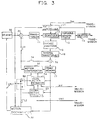
- Figure 3 is a block diagram showing a motion compensating encoding apparatus according to a preferred embodiment of the present invention.
- Figures 4A and 4B show a motion compensation encoding method which is adaptive to an amount of motion according to the present invention.
- Figure 3 shows a motion compensation encoder according to a preferred embodiment of the present invention.
- the like elements to Figure 1 use the like reference numerals thereto and the detailed description thereof will be omitted.
- a memory 56 stores pixel values of a plurality of images.
- Memory 56 outputs the pixel values of a previous image among the stored pixel values to a ratio controller 20 and a subtracter 31, and outputs the pixel values of a current image to motion discriminator 51.
- Subtracter 31 subtracts the corresponding pixel values supplied from motion compensator 55 from the respective pixel values of the previous image supplied from memory 31 and outputs a difference value to a transformer 11.
- motion estimator 51 receives the pixel values of the reference image stored in a frame memory 17 if the pixel values of the current image is supplied from memory 56 and discriminates an amount of motion of the current image with respect to the reference image. To discriminate the amount of motion of the current image with respect to the reference image, motion discriminator 51 discriminates whether a first reference video block having the same image information as that of a current video block which becomes a part of the current image exists in a first search area with respect to one or more current video blocks. Motion discriminator 51 generates a first control signal CTL1 representing whether motion estimation of the current image is possible using the pixel values of the reference image on the basis of the detection result.
- Motion discriminator 51 generates a second control signal CTL2 on the basis of the above discrimination result. If first control signal CTL1 represents that the motion estimation of the current image is possible using the pixel values of the reference image, memory 56 supplies the pixel values of the current image to a switch 52. Memory 56 supplies the pixel values of the current image again to a subtracter 31 after all the pixel values of the current image are supplied to switch 52. Switch 52 supplies the pixel values of the current image supplied via an input end C from memory 56 to a local motion estimator 54 via a first output end A, according to the applied second control signal CTL2. Local motion estimator 54 discriminates whether the pixel values of the compensated reference image are stored in global motion estimator 53.
- local motion estimator 54 uses the pixel values of the reference image stored in frame memory 17 and the pixel values of the current image applied via switch 52, and generates a first local motion vector LMV1 with respect to a current video block.
- first local motion vector LMV1 is determined on the basis of the current video block within the current image and the first search area within the reference image.
- the first search area has a smaller number of pixels than that of the reference image, and has a position on an image corresponding to the current video block.
- the current video block is represented as a hatched rectangular shape
- the first reference video block having the same image information as that of the current video block is represented as a hatched rectangular shape.
- Local motion estimator 54 compares a corresponding block having the same number of pixels as that of the current video block and which is located on the left-upper end in the first search area and all blocks which are obtained by moving the corresponding block one-pixel by one-pixel to the right direction and/or to the down direction with the current video block.
- a method used for comparison is a well-known mean absolute error (MAE) method or mean square error (MSE) method. If the first reference video block having the least difference value from the current video block is determined by comparison of the pixel values of the MAE or MSE, local motion estimator 54 generates a first local motion vector LMV1 representing spatial position difference between the first reference video block and the current video block. First local motion vector LMV1 is produced with respect to the respective current video blocks and the produced first motion vector LMV1 is supplied to motion compensator 55.
- MSE mean square error
- Motion compensator 55 discriminates that the pixel values of the compensated reference image are not stored in global motion estimator 53, if first motion vector LMV1 is applied from motion estimator 54. Based on such discrimination, motion compensator 55 generates the motion-compensated pixel values according to the pixel values of the reference image stored in frame memory 17 and the first local motion vector LMV1 generated in motion estimator 54. Subtracter 31 subtracts the corresponding pixel values supplied from motion compensator 55 from the respective pixel values of the current image supplied from memory 56 and outputs the difference value obtained by subtraction to transformer 11. The pixel values output from motion compensator 55 are also supplied to an adder 32, by which is added to the data output from inverse transformer 16. The pixel values obtained by adder 32 are stored in frame memory 17 and used as the pixel values of the reference image for motion-compensating the following image.
- first control signal CTL1 generated in motion discriminator 51 represents that motion estimation of the current image is not possible using the pixel values of the reference image
- memory 56 repetitively supplies the pixel values of the current image one-frame by one-frame twice to switch 52.
- the pixel values of the current image are also supplied to subtracter 31.
- Switch 52 supplies the pixel values of firstly input one-frame current image among the pixel values of the two-frame current image supplied via input end C from memory 56 according to the applied second control signal CTL2, via a second output end B to local motion estimator 54. Then, switch 52 supplies the pixel values of the secondly applied current image via first output end A to local motion estimator 54.
- Local motion estimator 54 does not generate a local motion vector during the time when the pixel values of the current image are not supplied via switch 52. Subtracter 31 does not operate as well since the pixel values of the current image from memory 56 and the motion-compensated pixel values from motion compensator 55 are not supplied thereto.
- Global motion estimator 53 generates a global motion vector GMV representing spatial position difference of the current image with respect to the reference image by using all the pixel values of the current image applied from second output end B of switch 52 and all the pixel values of the reference image stored in frame memory 17.
- Global motion estimator 53 uses one among the following equations (1) according to the MAE method or following equation (2) according to the MSE method, to generate global motion vector GMV.
- the relationship between the reference image and the compensated reference image is conceptually shown in Figure 4B.
- global motion vector GMV represents the spatial position difference of the current image with respect to the reference image.
- Y cur (m, n) represents the (m, n) th pixel value in the current image
- Y ref (m, n) represents the (m, n) th pixel value in the reference image.
- Characters W and H represent the number of horizontal and vertical pixels, respectively.
- Expression x_rang and y_rang represent a movement range of the current image with respect to the reference image in the horizontal and vertical directions, respectively. That is, the current image can have a position with respect to the reference image within the range from -x_rang to x_range-1 of the reference image in the horizontal direction. This is also same as that in the vertical direction.
- global motion estimator 53 receives and stores the pixel values of the compensated reference image having a reference position moved from frame memory 17, by moving a position of the reference image by global motion vector GMV.
- all pixel values are established into any one of the same values.
- Such a value can be set to a specific value of "0" or "255" in case of a pixel value representing 256 gradation.
- the pixel values of the current image supplied from memory 56 are supplied via switch 52 to local motion estimator 54.
- Local motion estimator 54 determines whether the pixel values of the compensated reference image are stored in global motion estimator 53, if the pixel values of the current image are applied via first output end A of switch 52. If global motion estimator 53 stores the pixel values of the compensated reference image according to the discrimination result, local motion estimator 54 uses the pixel values of the compensated reference image stored in global motion estimator 53 and the pixel values of the current image applied via switch 52, to generate a second local motion vector LMV2 with respect to the current video block.
- Local motion estimator 54 compares the pixel values of the current video block with the pixel values in a second search area of the compensated reference frame, and determines a second reference video block in the second search area having the same image information as that of the current video block.
- the second search area has a position which is moved by a value of global motion vector GMV from the first search area as shown in Figure 4B, and has a position corresponding to the current video block used for comparison within the compensated reference image as well.
- Local motion estimator 54 generates second local motion vector LMV2 representing spatial position difference between the current video block and the second reference video block, if the second reference video block is determined.
- the generated second local motion vector LMV2 is supplied to motion compensator 55.
- Motion compensator 55 uses the pixel values of the compensated reference image stored in global motion estimator 53 and the second local motion vector LMV2 to obtain the motion-compensated pixel values with respect to the current video block if the second local motion vector LMV2 is applied thereto, and then outputs the obtained pixel values to subtracter 31 and adder 32.
- Subtracter 31 subtracts the motion-compensated pixel values supplied from motion compensator 55 from the pixel values of the current image supplied from memory 56. Thereafter, since operation of the Figure 3 apparatus is the same as the motion compensation operation using the first local motion vector LMVl, the detailed description thereof will be omitted.
- the global motion vector GMV and local motion vector LMV1 or LMV2 generated in the Figure 3 apparatus are transmitted to a decoder (not shown) for decoding the motion-compensated encoded image.
- the apparatus of Figure 3 operates on the basis of the control signals according to the discrimination of motion discriminator 51. It is, however, possible to provide other variations which are obtained by removing motion discriminator 51 and switch 52.
- the modified embodiment will be briefly described below referring to Figure 3.
- global motion estimator 53 If memory 56 outputs the pixel values of the current image, global motion estimator 53 generates a global motion vector of the current image with respect to the reference image in the same manner as that described referring to Figure 3. Global motion estimator 53 uses the generated global motion vector, motion-compensates the reference image, and stores the pixel values of the motion-compensated reference image.
- Motion estimator 54 generates a local motion vector on the basis of the motion-compensated reference image stored in global motion estimator 53 and the pixel values of the current image applied from memory 56. Motion compensator 54 uses the local motion vector and the pixel values stored in global motion estimator 53, to generate the motion-compensated pixel values. Thus, motion compensator 54 can generate the motion-compensated pixel values properly as well when an amount of motion of the current image with respect to the reference image is beyond a predetermined motion amount.
- the motion compensation encoder adaptive to an amount of motion can determine a motion vector with respect to the respective video blocks in the current image, even when motion vectors with respect to the respective video blocks in the current image cannot determine using the search area determined in the reference image.
- a problem of increasing an amount of the transmission data occurring in the conventional motion compensation encoding system which performs an intracoding operation because of no determination of the motion vector with respect to an image having a large amount of motion can be solved.
Landscapes
- Engineering & Computer Science (AREA)
- Multimedia (AREA)
- Signal Processing (AREA)
- Compression Or Coding Systems Of Tv Signals (AREA)
- Compression, Expansion, Code Conversion, And Decoders (AREA)
Applications Claiming Priority (2)
| Application Number | Priority Date | Filing Date | Title |
|---|---|---|---|
| KR9413488 | 1994-06-15 | ||
| KR1019940013488A KR0148154B1 (ko) | 1994-06-15 | 1994-06-15 | 움직임크기에 따른 동영상데이타의 부호화방법 및 장치 |
Publications (3)
| Publication Number | Publication Date |
|---|---|
| EP0689359A2 true EP0689359A2 (de) | 1995-12-27 |
| EP0689359A3 EP0689359A3 (de) | 1997-05-02 |
| EP0689359B1 EP0689359B1 (de) | 2000-09-13 |
Family
ID=19385333
Family Applications (1)
| Application Number | Title | Priority Date | Filing Date |
|---|---|---|---|
| EP19950304120 Expired - Lifetime EP0689359B1 (de) | 1994-06-15 | 1995-06-14 | Bewegungsadaptive Bewegungskompensationskodierungsmethode und -vorrichtung |
Country Status (6)
| Country | Link |
|---|---|
| US (1) | US5657087A (de) |
| EP (1) | EP0689359B1 (de) |
| JP (1) | JP2801559B2 (de) |
| KR (1) | KR0148154B1 (de) |
| CN (1) | CN1084110C (de) |
| DE (1) | DE69518801T2 (de) |
Cited By (11)
| Publication number | Priority date | Publication date | Assignee | Title |
|---|---|---|---|---|
| EP0896300A3 (de) * | 1997-08-07 | 1999-09-08 | Matsushita Electric Industrial Co., Ltd. | Vorrichtung und Verfahren zur Detektion eines Bewegungsvektors |
| EP0797357A3 (de) * | 1996-03-18 | 1999-11-24 | Hitachi, Ltd. | Verfahren zur Kodierung und Dekodierung von Bildern |
| GB2366113A (en) * | 2000-06-28 | 2002-02-27 | Samsung Electronics Co Ltd | Correcting a digital image for camera shake |
| US6785331B1 (en) * | 1997-02-14 | 2004-08-31 | Nippon Telegraph And Telephone Corporation | Predictive encoding and decoding methods of video data |
| WO2008002491A3 (en) * | 2006-06-27 | 2010-04-29 | Marvell World Trade Ltd. | Systems and methods for a motion compensated picture rate converter |
| US20120087413A1 (en) * | 2005-03-31 | 2012-04-12 | Panasonic Corporation | Video decoding device, video decoding method, video decoding program, and video decoding integrated circuit |
| US8290040B2 (en) | 2002-11-26 | 2012-10-16 | British Telecommunications Public Limited Company | Method and system for estimating global motion in video sequences |
| US8494051B2 (en) | 2002-11-26 | 2013-07-23 | British Telecommunications Plc | Method and system for estimating global motion in video sequences |
| CN104680504A (zh) * | 2013-11-26 | 2015-06-03 | 杭州海康威视数字技术股份有限公司 | 场景变化检测方法及其装置 |
| US9154789B2 (en) | 1997-06-25 | 2015-10-06 | Nippon Telegraph And Telephone Corporation | Motion vector predictive encoding and decoding method using prediction of motion vector of target block based on representative motion vector |
| CN115442522A (zh) * | 2022-08-10 | 2022-12-06 | 深圳市贝嘉技术有限公司 | 基于显微镜的成像调整方法、装置、设备及存储介质 |
Families Citing this family (53)
| Publication number | Priority date | Publication date | Assignee | Title |
|---|---|---|---|---|
| KR100211916B1 (ko) * | 1995-10-26 | 1999-08-02 | 김영환 | 물체 모양정보 부호화에서의 부호화타입과 모드의 결정방법 |
| JP3774954B2 (ja) * | 1996-10-30 | 2006-05-17 | 株式会社日立製作所 | 動画像の符号化方法 |
| JPH10210473A (ja) * | 1997-01-16 | 1998-08-07 | Toshiba Corp | 動きベクトル検出装置 |
| CN1217852A (zh) | 1997-02-13 | 1999-05-26 | 三菱电机株式会社 | 动态图象预测方式 |
| DE69838281T2 (de) * | 1997-06-25 | 2008-05-15 | Nippon Telegraph And Telephone Corp. | Bewegungsprädiktives bildkodierungsverfahren sowie speichermedium zur speicherung des entsprechenden programms |
| JP2001507908A (ja) * | 1997-11-07 | 2001-06-12 | コーニンクレッカ フィリップス エレクトロニクス エヌ ヴィ | 画像シーケンスの符号化 |
| US6353683B1 (en) | 1997-12-10 | 2002-03-05 | Matsushita Electric Industrial Co., Ltd. | Method and apparatus of image processing, and data storage media |
| EP1119975B1 (de) | 1998-10-13 | 2003-04-23 | STMicroelectronics Asia Pacific Pte Ltd. | VERFAHREN ZUR BESTIMMUNG VON BEWEGUNGSVEKTORFELDERN MIT LOKALER BEWEGUNGSSCHäTZUNG |
| JP4280353B2 (ja) * | 1999-03-19 | 2009-06-17 | キヤノン株式会社 | 符号化装置、画像処理装置、符号化方法、及び記録媒体 |
| JP3753578B2 (ja) * | 1999-12-07 | 2006-03-08 | Necエレクトロニクス株式会社 | 動きベクトル探索装置および方法 |
| US6609035B1 (en) * | 2000-04-25 | 2003-08-19 | Emhart Glass S.A. | Adaptive motion controller |
| DE60238109D1 (de) * | 2001-02-19 | 2010-12-09 | Honda Motor Co Ltd | Automatisches Zielerkennen mittels Vorlagenvergleich |
| JP2003143609A (ja) * | 2001-08-21 | 2003-05-16 | Canon Inc | 画像処理装置、画像処理方法、記録媒体及びプログラム |
| US7050500B2 (en) * | 2001-08-23 | 2006-05-23 | Sharp Laboratories Of America, Inc. | Method and apparatus for motion vector coding with global motion parameters |
| DE60228101D1 (de) * | 2001-09-12 | 2008-09-18 | Nxp Bv | Bewegungsschätzung und/oder kompensation |
| JP2003274410A (ja) * | 2002-03-13 | 2003-09-26 | Hitachi Ltd | 監視映像の符号化装置及び復号装置並びに符号化方法 |
| ES2745059T3 (es) | 2002-04-19 | 2020-02-27 | Panasonic Ip Corp America | Método de cálculo de vectores de movimiento |
| JP4120301B2 (ja) * | 2002-04-25 | 2008-07-16 | ソニー株式会社 | 画像処理装置およびその方法 |
| JP2004048390A (ja) * | 2002-07-11 | 2004-02-12 | Matsushita Electric Ind Co Ltd | 動画像符号化装置及び方法 |
| US7421129B2 (en) * | 2002-09-04 | 2008-09-02 | Microsoft Corporation | Image compression and synthesis for video effects |
| US7408989B2 (en) * | 2003-01-16 | 2008-08-05 | Vix5 Systems Inc | Method of video encoding using windows and system thereof |
| US7558320B2 (en) * | 2003-06-13 | 2009-07-07 | Microsoft Corporation | Quality control in frame interpolation with motion analysis |
| US7408986B2 (en) * | 2003-06-13 | 2008-08-05 | Microsoft Corporation | Increasing motion smoothness using frame interpolation with motion analysis |
| US7453940B2 (en) * | 2003-07-15 | 2008-11-18 | Lsi Corporation | High quality, low memory bandwidth motion estimation processor |
| US7580584B2 (en) * | 2003-07-18 | 2009-08-25 | Microsoft Corporation | Adaptive multiple quantization |
| US7602851B2 (en) * | 2003-07-18 | 2009-10-13 | Microsoft Corporation | Intelligent differential quantization of video coding |
| US7738554B2 (en) | 2003-07-18 | 2010-06-15 | Microsoft Corporation | DC coefficient signaling at small quantization step sizes |
| US8218624B2 (en) * | 2003-07-18 | 2012-07-10 | Microsoft Corporation | Fractional quantization step sizes for high bit rates |
| US10554985B2 (en) | 2003-07-18 | 2020-02-04 | Microsoft Technology Licensing, Llc | DC coefficient signaling at small quantization step sizes |
| US7801383B2 (en) | 2004-05-15 | 2010-09-21 | Microsoft Corporation | Embedded scalar quantizers with arbitrary dead-zone ratios |
| US7751632B2 (en) * | 2005-02-15 | 2010-07-06 | Panasonic Corporation | Intelligent, dynamic, long-term digital surveilance media storage system |
| US8422546B2 (en) | 2005-05-25 | 2013-04-16 | Microsoft Corporation | Adaptive video encoding using a perceptual model |
| US8503536B2 (en) | 2006-04-07 | 2013-08-06 | Microsoft Corporation | Quantization adjustments for DC shift artifacts |
| US8059721B2 (en) | 2006-04-07 | 2011-11-15 | Microsoft Corporation | Estimating sample-domain distortion in the transform domain with rounding compensation |
| US7974340B2 (en) | 2006-04-07 | 2011-07-05 | Microsoft Corporation | Adaptive B-picture quantization control |
| US8130828B2 (en) | 2006-04-07 | 2012-03-06 | Microsoft Corporation | Adjusting quantization to preserve non-zero AC coefficients |
| US7995649B2 (en) | 2006-04-07 | 2011-08-09 | Microsoft Corporation | Quantization adjustment based on texture level |
| US8711925B2 (en) | 2006-05-05 | 2014-04-29 | Microsoft Corporation | Flexible quantization |
| KR100772194B1 (ko) * | 2006-07-26 | 2007-11-01 | 한국전자통신연구원 | 피사체의 움직임 여부에 기초하여 영상의 선택적 출력이가능한 네트워크 기반 지능형 이동 로봇 및 그 방법 |
| US8238424B2 (en) | 2007-02-09 | 2012-08-07 | Microsoft Corporation | Complexity-based adaptive preprocessing for multiple-pass video compression |
| US8498335B2 (en) | 2007-03-26 | 2013-07-30 | Microsoft Corporation | Adaptive deadzone size adjustment in quantization |
| US8243797B2 (en) | 2007-03-30 | 2012-08-14 | Microsoft Corporation | Regions of interest for quality adjustments |
| US8442337B2 (en) | 2007-04-18 | 2013-05-14 | Microsoft Corporation | Encoding adjustments for animation content |
| US8331438B2 (en) | 2007-06-05 | 2012-12-11 | Microsoft Corporation | Adaptive selection of picture-level quantization parameters for predicted video pictures |
| JP2009081622A (ja) * | 2007-09-26 | 2009-04-16 | Oki Semiconductor Co Ltd | 動画像圧縮符号化装置 |
| US8189933B2 (en) | 2008-03-31 | 2012-05-29 | Microsoft Corporation | Classifying and controlling encoding quality for textured, dark smooth and smooth video content |
| JP4506875B2 (ja) * | 2008-05-19 | 2010-07-21 | ソニー株式会社 | 画像処理装置および画像処理方法 |
| US8897359B2 (en) | 2008-06-03 | 2014-11-25 | Microsoft Corporation | Adaptive quantization for enhancement layer video coding |
| JP2013074571A (ja) * | 2011-09-29 | 2013-04-22 | Sony Corp | 画像処理装置および方法、プログラム、並びに記録媒体 |
| KR20140006190A (ko) * | 2012-06-27 | 2014-01-16 | 삼성전자주식회사 | 광학측정장치 및 그 제어방법 |
| CN104301703A (zh) * | 2013-07-16 | 2015-01-21 | 联咏科技股份有限公司 | 匹配搜寻方法与匹配搜寻系统 |
| US20150146784A1 (en) * | 2013-11-26 | 2015-05-28 | Vixs Systems Inc. | Motion compensation with moving window |
| US10681374B2 (en) * | 2017-11-16 | 2020-06-09 | Google Llc | Diversified motion using multiple global motion models |
Family Cites Families (4)
| Publication number | Priority date | Publication date | Assignee | Title |
|---|---|---|---|---|
| DE68922610T2 (de) * | 1989-09-25 | 1996-02-22 | Rai Radiotelevisione Italiana | Umfassendes System zur Codierung und Übertragung von Videosignalen mit Bewegungsvektoren. |
| GB9019538D0 (en) * | 1990-09-07 | 1990-10-24 | Philips Electronic Associated | Tracking a moving object |
| SE469412B (sv) * | 1992-04-13 | 1993-06-28 | Dv Sweden Ab | Saett att adaptivt estimera icke oenskade globala bildinstabiliteter i bildsekvenser i digitala videosignaler |
| US5473379A (en) * | 1993-11-04 | 1995-12-05 | At&T Corp. | Method and apparatus for improving motion compensation in digital video coding |
-
1994
- 1994-06-15 KR KR1019940013488A patent/KR0148154B1/ko not_active Expired - Fee Related
-
1995
- 1995-06-14 EP EP19950304120 patent/EP0689359B1/de not_active Expired - Lifetime
- 1995-06-14 DE DE69518801T patent/DE69518801T2/de not_active Expired - Fee Related
- 1995-06-14 JP JP14766295A patent/JP2801559B2/ja not_active Expired - Fee Related
- 1995-06-15 US US08/490,704 patent/US5657087A/en not_active Expired - Fee Related
- 1995-06-15 CN CN95108443A patent/CN1084110C/zh not_active Expired - Fee Related
Non-Patent Citations (1)
| Title |
|---|
| None |
Cited By (22)
| Publication number | Priority date | Publication date | Assignee | Title |
|---|---|---|---|---|
| EP0797357A3 (de) * | 1996-03-18 | 1999-11-24 | Hitachi, Ltd. | Verfahren zur Kodierung und Dekodierung von Bildern |
| EP1646242A3 (de) * | 1996-03-18 | 2010-10-27 | Hitachi, Ltd. | Vorrichtung zur Bilddecodierung |
| US6785331B1 (en) * | 1997-02-14 | 2004-08-31 | Nippon Telegraph And Telephone Corporation | Predictive encoding and decoding methods of video data |
| US9154789B2 (en) | 1997-06-25 | 2015-10-06 | Nippon Telegraph And Telephone Corporation | Motion vector predictive encoding and decoding method using prediction of motion vector of target block based on representative motion vector |
| EP0896300A3 (de) * | 1997-08-07 | 1999-09-08 | Matsushita Electric Industrial Co., Ltd. | Vorrichtung und Verfahren zur Detektion eines Bewegungsvektors |
| US6289050B1 (en) | 1997-08-07 | 2001-09-11 | Matsushita Electric Industrial Co., Ltd. | Device and method for motion vector detection |
| GB2366113A (en) * | 2000-06-28 | 2002-02-27 | Samsung Electronics Co Ltd | Correcting a digital image for camera shake |
| GB2366113B (en) * | 2000-06-28 | 2002-12-04 | Samsung Electronics Co Ltd | Decoder having digital image stabilization function and digital image stabiliz ation method |
| US7010045B2 (en) | 2000-06-28 | 2006-03-07 | Samsung Electronics Co., Ltd. | Decoder having digital image stabilization function and digital image stabilization method |
| US8290040B2 (en) | 2002-11-26 | 2012-10-16 | British Telecommunications Public Limited Company | Method and system for estimating global motion in video sequences |
| US8494051B2 (en) | 2002-11-26 | 2013-07-23 | British Telecommunications Plc | Method and system for estimating global motion in video sequences |
| US20120087413A1 (en) * | 2005-03-31 | 2012-04-12 | Panasonic Corporation | Video decoding device, video decoding method, video decoding program, and video decoding integrated circuit |
| US8654847B2 (en) * | 2005-03-31 | 2014-02-18 | Panasonic Corporation | Video decoding device, video decoding method, video decoding program, and video decoding integrated circuit |
| US8873631B2 (en) | 2005-03-31 | 2014-10-28 | Panasonic Corporation | Video decoding device, video decoding method, video decoding program, and video decoding integrated circuit |
| US9516336B2 (en) | 2005-03-31 | 2016-12-06 | Panasonic Intellectual Property Management Co., Ltd. | Video decoding device, video decoding method, video decoding program, and video decoding integrated circuit |
| US9800889B2 (en) | 2005-03-31 | 2017-10-24 | Panasonic Intellectual Property Management Co., Ltd. | Video decoding device, video decoding method, video decoding program, and video decoding integrated circuit |
| US8340185B2 (en) | 2006-06-27 | 2012-12-25 | Marvell World Trade Ltd. | Systems and methods for a motion compensated picture rate converter |
| WO2008002491A3 (en) * | 2006-06-27 | 2010-04-29 | Marvell World Trade Ltd. | Systems and methods for a motion compensated picture rate converter |
| CN104680504A (zh) * | 2013-11-26 | 2015-06-03 | 杭州海康威视数字技术股份有限公司 | 场景变化检测方法及其装置 |
| CN104680504B (zh) * | 2013-11-26 | 2018-06-08 | 杭州海康威视数字技术股份有限公司 | 场景变化检测方法及其装置 |
| CN115442522A (zh) * | 2022-08-10 | 2022-12-06 | 深圳市贝嘉技术有限公司 | 基于显微镜的成像调整方法、装置、设备及存储介质 |
| CN115442522B (zh) * | 2022-08-10 | 2023-11-21 | 深圳市贝嘉技术有限公司 | 基于显微镜的成像调整方法、装置、设备及存储介质 |
Also Published As
| Publication number | Publication date |
|---|---|
| CN1115953A (zh) | 1996-01-31 |
| JPH0870460A (ja) | 1996-03-12 |
| EP0689359B1 (de) | 2000-09-13 |
| US5657087A (en) | 1997-08-12 |
| CN1084110C (zh) | 2002-05-01 |
| DE69518801D1 (de) | 2000-10-19 |
| KR0148154B1 (ko) | 1998-09-15 |
| KR960003404A (ko) | 1996-01-26 |
| JP2801559B2 (ja) | 1998-09-21 |
| DE69518801T2 (de) | 2001-01-11 |
| EP0689359A3 (de) | 1997-05-02 |
Similar Documents
| Publication | Publication Date | Title |
|---|---|---|
| EP0689359A2 (de) | Bewegungsadaptive Bewegungskompensationskodierungsmethode und -vorrichtung | |
| KR0178231B1 (ko) | 계층적인 움직임 추정 기법을 이용하는 움직임 벡터 검출 방법 및 장치 | |
| CA2024135C (en) | Conditional motion compensated interpolation of digital motion video | |
| EP1096800B1 (de) | Bildkodierungsgerät und Bilddekodierungsgerät | |
| EP0595599B1 (de) | Bilddatenkomprimierungs/Dekomprimierungssystem | |
| KR100415494B1 (ko) | 화상인코딩방법및장치,기록장치,비디오신호인코딩장치,처리장치및방법,비디오데이터처리장치및방법 | |
| KR920020958A (ko) | 움직임 보상예측 부호화방법및 장치 | |
| EP0512854B1 (de) | Kodierung von Videosignalen | |
| US5103307A (en) | Interframe predictive coding/decoding system for varying interval between independent frames | |
| US6795498B1 (en) | Decoding apparatus, decoding method, encoding apparatus, encoding method, image processing system, and image processing method | |
| JP4284265B2 (ja) | 動画像符号化装置、動画像符号化方法、動画像復号化装置および動画像復号化方法 | |
| Adolph et al. | 1.15 Mbit/s coding of video signals including global motion compensation | |
| US5508745A (en) | Apparatus for controlling a quantization level to be modified by a motion vector | |
| US5394190A (en) | Video signal encoding apparatus | |
| EP0570127B1 (de) | Bewegungsabschätzer zur Bestimmung von kodierten Bewegungsvektoren mit variabler Länge | |
| US7023916B1 (en) | Method and device for estimating motion in a digitized image with pixels | |
| JP3362463B2 (ja) | フレーム補間装置 | |
| KR19980051713A (ko) | 전송되는 비디오 신호의 에러 은폐 방법 및 장치 | |
| JPH07336695A (ja) | 動画像の符号化及び復号化方法 | |
| JP3235453B2 (ja) | 画像符号化装置 | |
| JP3063380B2 (ja) | 高能率符号化装置 | |
| JP3784086B2 (ja) | 映像信号符号化・復号化装置及び符号化・復号化方法 | |
| JP2921755B2 (ja) | インタレース画像信号の予測符号化装置 | |
| JPH10145793A (ja) | 画像符号化装置とその方法、および、画像復号化装置とその方法 | |
| JPH04288790A (ja) | インタレース画像信号の予測符号化方法 |
Legal Events
| Date | Code | Title | Description |
|---|---|---|---|
| PUAI | Public reference made under article 153(3) epc to a published international application that has entered the european phase |
Free format text: ORIGINAL CODE: 0009012 |
|
| 17P | Request for examination filed |
Effective date: 19950626 |
|
| AK | Designated contracting states |
Kind code of ref document: A2 Designated state(s): DE FR GB |
|
| PUAL | Search report despatched |
Free format text: ORIGINAL CODE: 0009013 |
|
| AK | Designated contracting states |
Kind code of ref document: A3 Designated state(s): DE FR GB |
|
| 17Q | First examination report despatched |
Effective date: 19990420 |
|
| GRAG | Despatch of communication of intention to grant |
Free format text: ORIGINAL CODE: EPIDOS AGRA |
|
| GRAG | Despatch of communication of intention to grant |
Free format text: ORIGINAL CODE: EPIDOS AGRA |
|
| GRAH | Despatch of communication of intention to grant a patent |
Free format text: ORIGINAL CODE: EPIDOS IGRA |
|
| GRAH | Despatch of communication of intention to grant a patent |
Free format text: ORIGINAL CODE: EPIDOS IGRA |
|
| GRAA | (expected) grant |
Free format text: ORIGINAL CODE: 0009210 |
|
| AK | Designated contracting states |
Kind code of ref document: B1 Designated state(s): DE FR GB |
|
| REF | Corresponds to: |
Ref document number: 69518801 Country of ref document: DE Date of ref document: 20001019 |
|
| ET | Fr: translation filed | ||
| PLBE | No opposition filed within time limit |
Free format text: ORIGINAL CODE: 0009261 |
|
| STAA | Information on the status of an ep patent application or granted ep patent |
Free format text: STATUS: NO OPPOSITION FILED WITHIN TIME LIMIT |
|
| 26N | No opposition filed | ||
| REG | Reference to a national code |
Ref country code: GB Ref legal event code: IF02 |
|
| PGFP | Annual fee paid to national office [announced via postgrant information from national office to epo] |
Ref country code: DE Payment date: 20080619 Year of fee payment: 14 |
|
| PGFP | Annual fee paid to national office [announced via postgrant information from national office to epo] |
Ref country code: FR Payment date: 20080617 Year of fee payment: 14 |
|
| PGFP | Annual fee paid to national office [announced via postgrant information from national office to epo] |
Ref country code: GB Payment date: 20080618 Year of fee payment: 14 |
|
| GBPC | Gb: european patent ceased through non-payment of renewal fee |
Effective date: 20090614 |
|
| REG | Reference to a national code |
Ref country code: FR Ref legal event code: ST Effective date: 20100226 |
|
| PG25 | Lapsed in a contracting state [announced via postgrant information from national office to epo] |
Ref country code: FR Free format text: LAPSE BECAUSE OF NON-PAYMENT OF DUE FEES Effective date: 20090630 |
|
| PG25 | Lapsed in a contracting state [announced via postgrant information from national office to epo] |
Ref country code: GB Free format text: LAPSE BECAUSE OF NON-PAYMENT OF DUE FEES Effective date: 20090614 |
|
| PG25 | Lapsed in a contracting state [announced via postgrant information from national office to epo] |
Ref country code: DE Free format text: LAPSE BECAUSE OF NON-PAYMENT OF DUE FEES Effective date: 20100101 |