EP0689622B1 - Zusammengesetzte faser aus vermischten glasfasern und polytetrafluoroethylen und verfahren zu ihrer herstellung - Google Patents
Zusammengesetzte faser aus vermischten glasfasern und polytetrafluoroethylen und verfahren zu ihrer herstellung Download PDFInfo
- Publication number
- EP0689622B1 EP0689622B1 EP93911632A EP93911632A EP0689622B1 EP 0689622 B1 EP0689622 B1 EP 0689622B1 EP 93911632 A EP93911632 A EP 93911632A EP 93911632 A EP93911632 A EP 93911632A EP 0689622 B1 EP0689622 B1 EP 0689622B1
- Authority
- EP
- European Patent Office
- Prior art keywords
- filaments
- fiberglass
- ptfe
- fabric
- fiber
- Prior art date
- Legal status (The legal status is an assumption and is not a legal conclusion. Google has not performed a legal analysis and makes no representation as to the accuracy of the status listed.)
- Expired - Lifetime
Links
Images



Classifications
-
- B—PERFORMING OPERATIONS; TRANSPORTING
- B01—PHYSICAL OR CHEMICAL PROCESSES OR APPARATUS IN GENERAL
- B01D—SEPARATION
- B01D46/00—Filters or filtering processes specially modified for separating dispersed particles from gases or vapours
- B01D46/02—Particle separators, e.g. dust precipitators, having hollow filters made of flexible material
- B01D46/04—Cleaning filters
-
- B—PERFORMING OPERATIONS; TRANSPORTING
- B01—PHYSICAL OR CHEMICAL PROCESSES OR APPARATUS IN GENERAL
- B01D—SEPARATION
- B01D39/00—Filtering material for liquid or gaseous fluids
- B01D39/08—Filter cloth, i.e. woven, knitted or interlaced material
- B01D39/083—Filter cloth, i.e. woven, knitted or interlaced material of organic material
-
- B—PERFORMING OPERATIONS; TRANSPORTING
- B01—PHYSICAL OR CHEMICAL PROCESSES OR APPARATUS IN GENERAL
- B01D—SEPARATION
- B01D39/00—Filtering material for liquid or gaseous fluids
- B01D39/08—Filter cloth, i.e. woven, knitted or interlaced material
- B01D39/086—Filter cloth, i.e. woven, knitted or interlaced material of inorganic material
-
- B—PERFORMING OPERATIONS; TRANSPORTING
- B01—PHYSICAL OR CHEMICAL PROCESSES OR APPARATUS IN GENERAL
- B01D—SEPARATION
- B01D39/00—Filtering material for liquid or gaseous fluids
- B01D39/14—Other self-supporting filtering material ; Other filtering material
- B01D39/16—Other self-supporting filtering material ; Other filtering material of organic material, e.g. synthetic fibres
- B01D39/1692—Other shaped material, e.g. perforated or porous sheets
-
- B—PERFORMING OPERATIONS; TRANSPORTING
- B01—PHYSICAL OR CHEMICAL PROCESSES OR APPARATUS IN GENERAL
- B01D—SEPARATION
- B01D46/00—Filters or filtering processes specially modified for separating dispersed particles from gases or vapours
- B01D46/0001—Making filtering elements
-
- B—PERFORMING OPERATIONS; TRANSPORTING
- B01—PHYSICAL OR CHEMICAL PROCESSES OR APPARATUS IN GENERAL
- B01D—SEPARATION
- B01D46/00—Filters or filtering processes specially modified for separating dispersed particles from gases or vapours
- B01D46/66—Regeneration of the filtering material or filter elements inside the filter
- B01D46/70—Regeneration of the filtering material or filter elements inside the filter by acting counter-currently on the filtering surface, e.g. by flushing on the non-cake side of the filter
- B01D46/71—Regeneration of the filtering material or filter elements inside the filter by acting counter-currently on the filtering surface, e.g. by flushing on the non-cake side of the filter with pressurised gas, e.g. pulsed air
-
- B—PERFORMING OPERATIONS; TRANSPORTING
- B01—PHYSICAL OR CHEMICAL PROCESSES OR APPARATUS IN GENERAL
- B01D—SEPARATION
- B01D46/00—Filters or filtering processes specially modified for separating dispersed particles from gases or vapours
- B01D46/66—Regeneration of the filtering material or filter elements inside the filter
- B01D46/74—Regeneration of the filtering material or filter elements inside the filter by forces created by movement of the filter element
- B01D46/76—Regeneration of the filtering material or filter elements inside the filter by forces created by movement of the filter element involving vibrations
-
- D—TEXTILES; PAPER
- D02—YARNS; MECHANICAL FINISHING OF YARNS OR ROPES; WARPING OR BEAMING
- D02G—CRIMPING OR CURLING FIBRES, FILAMENTS, THREADS, OR YARNS; YARNS OR THREADS
- D02G3/00—Yarns or threads, e.g. fancy yarns; Processes or apparatus for the production thereof, not otherwise provided for
- D02G3/02—Yarns or threads characterised by the material or by the materials from which they are made
- D02G3/16—Yarns or threads made from mineral substances
- D02G3/18—Yarns or threads made from mineral substances from glass or the like
- D02G3/182—Yarns or threads made from mineral substances from glass or the like the glass being present only in part of the structure
-
- D—TEXTILES; PAPER
- D02—YARNS; MECHANICAL FINISHING OF YARNS OR ROPES; WARPING OR BEAMING
- D02J—FINISHING OR DRESSING OF FILAMENTS, YARNS, THREADS, CORDS, ROPES OR THE LIKE
- D02J1/00—Modifying the structure or properties resulting from a particular structure; Modifying, retaining, or restoring the physical form or cross-sectional shape, e.g. by use of dies or squeeze rollers
- D02J1/08—Interlacing constituent filaments without breakage thereof, e.g. by use of turbulent air streams
-
- B—PERFORMING OPERATIONS; TRANSPORTING
- B01—PHYSICAL OR CHEMICAL PROCESSES OR APPARATUS IN GENERAL
- B01D—SEPARATION
- B01D2239/00—Aspects relating to filtering material for liquid or gaseous fluids
- B01D2239/02—Types of fibres, filaments or particles, self-supporting or supported materials
- B01D2239/0241—Types of fibres, filaments or particles, self-supporting or supported materials comprising electrically conductive fibres or particles
-
- B—PERFORMING OPERATIONS; TRANSPORTING
- B01—PHYSICAL OR CHEMICAL PROCESSES OR APPARATUS IN GENERAL
- B01D—SEPARATION
- B01D2239/00—Aspects relating to filtering material for liquid or gaseous fluids
- B01D2239/04—Additives and treatments of the filtering material
-
- B—PERFORMING OPERATIONS; TRANSPORTING
- B01—PHYSICAL OR CHEMICAL PROCESSES OR APPARATUS IN GENERAL
- B01D—SEPARATION
- B01D2239/00—Aspects relating to filtering material for liquid or gaseous fluids
- B01D2239/04—Additives and treatments of the filtering material
- B01D2239/0471—Surface coating material
-
- B—PERFORMING OPERATIONS; TRANSPORTING
- B01—PHYSICAL OR CHEMICAL PROCESSES OR APPARATUS IN GENERAL
- B01D—SEPARATION
- B01D2239/00—Aspects relating to filtering material for liquid or gaseous fluids
- B01D2239/04—Additives and treatments of the filtering material
- B01D2239/0471—Surface coating material
- B01D2239/0478—Surface coating material on a layer of the filter
-
- B—PERFORMING OPERATIONS; TRANSPORTING
- B01—PHYSICAL OR CHEMICAL PROCESSES OR APPARATUS IN GENERAL
- B01D—SEPARATION
- B01D2239/00—Aspects relating to filtering material for liquid or gaseous fluids
- B01D2239/06—Filter cloth, e.g. knitted, woven non-woven; self-supported material
- B01D2239/0604—Arrangement of the fibres in the filtering material
- B01D2239/064—The fibres being mixed
-
- Y—GENERAL TAGGING OF NEW TECHNOLOGICAL DEVELOPMENTS; GENERAL TAGGING OF CROSS-SECTIONAL TECHNOLOGIES SPANNING OVER SEVERAL SECTIONS OF THE IPC; TECHNICAL SUBJECTS COVERED BY FORMER USPC CROSS-REFERENCE ART COLLECTIONS [XRACs] AND DIGESTS
- Y10—TECHNICAL SUBJECTS COVERED BY FORMER USPC
- Y10S—TECHNICAL SUBJECTS COVERED BY FORMER USPC CROSS-REFERENCE ART COLLECTIONS [XRACs] AND DIGESTS
- Y10S57/00—Textiles: spinning, twisting, and twining
- Y10S57/908—Jet interlaced or intermingled
-
- Y—GENERAL TAGGING OF NEW TECHNOLOGICAL DEVELOPMENTS; GENERAL TAGGING OF CROSS-SECTIONAL TECHNOLOGIES SPANNING OVER SEVERAL SECTIONS OF THE IPC; TECHNICAL SUBJECTS COVERED BY FORMER USPC CROSS-REFERENCE ART COLLECTIONS [XRACs] AND DIGESTS
- Y10—TECHNICAL SUBJECTS COVERED BY FORMER USPC
- Y10T—TECHNICAL SUBJECTS COVERED BY FORMER US CLASSIFICATION
- Y10T428/00—Stock material or miscellaneous articles
- Y10T428/249921—Web or sheet containing structurally defined element or component
-
- Y—GENERAL TAGGING OF NEW TECHNOLOGICAL DEVELOPMENTS; GENERAL TAGGING OF CROSS-SECTIONAL TECHNOLOGIES SPANNING OVER SEVERAL SECTIONS OF THE IPC; TECHNICAL SUBJECTS COVERED BY FORMER USPC CROSS-REFERENCE ART COLLECTIONS [XRACs] AND DIGESTS
- Y10—TECHNICAL SUBJECTS COVERED BY FORMER USPC
- Y10T—TECHNICAL SUBJECTS COVERED BY FORMER US CLASSIFICATION
- Y10T428/00—Stock material or miscellaneous articles
- Y10T428/29—Coated or structually defined flake, particle, cell, strand, strand portion, rod, filament, macroscopic fiber or mass thereof
- Y10T428/2913—Rod, strand, filament or fiber
- Y10T428/2922—Nonlinear [e.g., crimped, coiled, etc.]
- Y10T428/2924—Composite
-
- Y—GENERAL TAGGING OF NEW TECHNOLOGICAL DEVELOPMENTS; GENERAL TAGGING OF CROSS-SECTIONAL TECHNOLOGIES SPANNING OVER SEVERAL SECTIONS OF THE IPC; TECHNICAL SUBJECTS COVERED BY FORMER USPC CROSS-REFERENCE ART COLLECTIONS [XRACs] AND DIGESTS
- Y10—TECHNICAL SUBJECTS COVERED BY FORMER USPC
- Y10T—TECHNICAL SUBJECTS COVERED BY FORMER US CLASSIFICATION
- Y10T428/00—Stock material or miscellaneous articles
- Y10T428/29—Coated or structually defined flake, particle, cell, strand, strand portion, rod, filament, macroscopic fiber or mass thereof
- Y10T428/2913—Rod, strand, filament or fiber
- Y10T428/2933—Coated or with bond, impregnation or core
- Y10T428/294—Coated or with bond, impregnation or core including metal or compound thereof [excluding glass, ceramic and asbestos]
- Y10T428/2956—Glass or silicic fiber or filament with metal coating
-
- Y—GENERAL TAGGING OF NEW TECHNOLOGICAL DEVELOPMENTS; GENERAL TAGGING OF CROSS-SECTIONAL TECHNOLOGIES SPANNING OVER SEVERAL SECTIONS OF THE IPC; TECHNICAL SUBJECTS COVERED BY FORMER USPC CROSS-REFERENCE ART COLLECTIONS [XRACs] AND DIGESTS
- Y10—TECHNICAL SUBJECTS COVERED BY FORMER USPC
- Y10T—TECHNICAL SUBJECTS COVERED BY FORMER US CLASSIFICATION
- Y10T428/00—Stock material or miscellaneous articles
- Y10T428/31504—Composite [nonstructural laminate]
- Y10T428/3154—Of fluorinated addition polymer from unsaturated monomers
-
- Y—GENERAL TAGGING OF NEW TECHNOLOGICAL DEVELOPMENTS; GENERAL TAGGING OF CROSS-SECTIONAL TECHNOLOGIES SPANNING OVER SEVERAL SECTIONS OF THE IPC; TECHNICAL SUBJECTS COVERED BY FORMER USPC CROSS-REFERENCE ART COLLECTIONS [XRACs] AND DIGESTS
- Y10—TECHNICAL SUBJECTS COVERED BY FORMER USPC
- Y10T—TECHNICAL SUBJECTS COVERED BY FORMER US CLASSIFICATION
- Y10T428/00—Stock material or miscellaneous articles
- Y10T428/31504—Composite [nonstructural laminate]
- Y10T428/3154—Of fluorinated addition polymer from unsaturated monomers
- Y10T428/31544—Addition polymer is perhalogenated
-
- Y—GENERAL TAGGING OF NEW TECHNOLOGICAL DEVELOPMENTS; GENERAL TAGGING OF CROSS-SECTIONAL TECHNOLOGIES SPANNING OVER SEVERAL SECTIONS OF THE IPC; TECHNICAL SUBJECTS COVERED BY FORMER USPC CROSS-REFERENCE ART COLLECTIONS [XRACs] AND DIGESTS
- Y10—TECHNICAL SUBJECTS COVERED BY FORMER USPC
- Y10T—TECHNICAL SUBJECTS COVERED BY FORMER US CLASSIFICATION
- Y10T442/00—Fabric [woven, knitted, or nonwoven textile or cloth, etc.]
- Y10T442/30—Woven fabric [i.e., woven strand or strip material]
- Y10T442/3065—Including strand which is of specific structural definition
- Y10T442/313—Strand material formed of individual filaments having different chemical compositions
- Y10T442/3138—Including inorganic filament
Definitions
- the present invention relates to improved composite fibers and fabrics and methods for producing them. More particularly, the present invention relates to an improved composite textile of fiberglass and polytetrafluoroethylene (PTFE).
- PTFE polytetrafluoroethylene
- Fiberglass textiles are widely employed today in numerous applications. This is due to the many favorable properties of fiberglass, including relatively low cost, excellent mechanical strength, dimensional stability, good insulative properties, and excellent resistance to temperature and humidity.
- fiberglass are as an architectural fabric, in the electronics industry (e.g. as a printed circuit board), as a filtration media, and as a structural composite.
- fiberglass Due mostly to its relatively low cost, fiberglass presently dominates the high temperature filtration market (typically defined as those filters operating within 300 to 500°F). In this regard, fiberglass often costs 33 to 95 % less than some competitive synthetic textile fibers (e.g. polytetraethylene, aramids, polyphenylene sulfide, polyimides and copolyimides).
- some competitive synthetic textile fibers e.g. polytetraethylene, aramids, polyphenylene sulfide, polyimides and copolyimides.
- fiberglass performs adequately in these applications, it suffers from numerous deficiencies. Perhaps the greatest problem with fiberglass is that it is quite fragile--being easily damaged when flexed or abraded. As a result, fiberglass fabric is incapable of performing in many applications. For instance, where a filter must be vigorously flexed to free filtrate and clean the filter media (e.g. in a "shaker"-type bag house filter or a pulse-jet bag house filter), a fiberglass fabric will quickly fail. Even under less demanding regenerative procedures (e.g. reverse air cleaned bags), where far less bag flex is encountered, fiberglass has relatively limited operational life.
- Another common problem with fiberglass is that it is difficult to handle and work.
- the fiberglass is not carefully handled during a weaving process, the low abrasion resistance of the fiberglass often leads to friction damage to the glass fibrils.
- abrasion caused by weaving equipment can result in surface imperfections (e.g. glass pills) which can cause problems in later processing. Further, even a single fold in the glass material during processing can lead to fatigue and later failure.
- synthetic fibers are the fibers of choice where long filter life is needed and/or extreme operative conditions are expected.
- the costs of synthetic fibers restrict their accepted uses.
- certain synthetic fibers while having many exceptional characteristics, are also limited in certain respects.
- PTFE tends to have stability (creep) problems in reverse air bag houses, with tension on the bag elongating it to a point at which proper cleaning and flexure does not occur.
- Copolyimides and aramids hydrolyze in the presence of moisture and high temperatures. Polyphenylene sulfide oxidizes and embrittles when exposed to oxygen and high temperature.
- European Patent Application 0,358,222 to E. I. duPont de Nemours and Co. is directed to the use of "straight" fiberglass strands with "loopy” PTFE strands entangled therein as a portion of a process to produce a high temperature felt material. While this structure may function adequately in a non-woven felt, such a fiber has insufficient strength and durability to be used alone or in a woven fabric that must endure repeated folds and similar wear.
- the present invention is an improved composite fiber of polytetrafluoroethylene (PTFE) and fiberglass and a method for producing it.
- PTFE polytetrafluoroethylene
- the present invention is an improved composite fiber of polytetrafluoroethylene (PTFE) and fiberglass and a method for producing it.
- the composite fiber is created by combining an expanded PTFE tow yarn and a fiberglass yarn in an air-jet texturing apparatus.
- the filaments of expanded PTFE become intertwined around the filaments of fiberglass so as to form an single strand of strong, flexible composite material.
- the material can be readily formed into a fabric with a wide range of possible uses, including as a filter media, as an architectural fabric, as a structural fabric (such as when combined with an epoxy resin), etc.
- the fiber and fabric of the present invention has numerous advantages over previously available fiberglass materials.
- the fiber is sufficiently resistant to flex and abrasion that it can be easily handled and worked without compromising its structural integrity.
- the combination of fiberglass and expanded PTFE imparts a number of improved properties to the composite which have previously eluded some synthetic fabrics, including greater temperature and moisture resistance, greater stability and resistance to creep, and reduced cost.
- the present invention is an improved textile which is a composite of fiberglass filaments and polytetrafluoroethylene (PTFE) filaments.
- PTFE polytetrafluoroethylene
- the fibers 10a, 10b of the present invention comprise filaments of fiberglass 12a, 12b and filaments of PTFE 14a, 14b.
- the filaments 12, 14 are commingled together to form a cohesive composite thread.
- fiber is applied herein, it is intended to encompass any strand of composite material made in accordance with the present invention, regardless of application. This is intended to include, without limitation, applications where the fiber is employed as a single thread, as multiple threads braided or otherwise combined together, as a non-woven fabric or membrane material, and as a woven fabric or membrane material.
- Figure 1 shows a fiber 10a wherein clusters 16 of fiberglass filaments 12a tend to remain oriented together, with the PTFE filaments 14a essentially encapsulating the clusters 16.
- the fiber 10b of Figure 2 has a far more homogenous mix of fiberglass filaments 12b and PTFE filaments 14b, with the fiberglass filaments 12b oriented randomly or fairly evenly throughout the PTFE.
- the fibers of the present invention have demonstrated exceptional flex and abrasion resistance. Additionally, these fibers have a lower coefficient of friction and natural lubricity when they rub against each other. They also have unique bulky characteristics, providing variability in the texture of the yarn, including its density and morphology.
- the filaments of PTFE are spread apart into an open lattice and the filaments of fiberglass are then inserted and enclosed within the lattice.
- the fiberglass filaments are bulked, fragmented, and "texturized" into the PTFE lattice.
- textured yarns are those which have been given notably greater apparent volume than a correlational yarn of similar fiber (filament) count and linear density. This is normally accomplished by distorting the shape and/or orientation of the fibers and then setting the fiber (usually through some application of heat) in the distorted orientation. Common procedures in this regard are twisting, heating, crimping, and air jetting.
- Air jet apparatus achieves bulk in a yarn by feeding the fibers over high pressure jets of air at a rate faster than they are drawn off. This drives some of the fibers into random loops and provides a substantial amount of bulk.
- the amount of disarray of the fibers is a function of many parameters, including the amount of tension on the yarn, the speed of the yarn is driven through the apparatus, and the amount of air pressure applied.
- Improvements in the basic air jet apparatus has allowed it to be employed to combine two or more types of material into a yarn. Essentially, this process involves: (1) feeding a first material through a series of rollers and the air jet to open up its structure; and (2) simultaneously "overfeeding" a second material to cause it to be drawn into and interlaced within the first material. Again, by adjusting operating parameters (e.g. the relative speed of yarn feed, air jet pressure, relative roller speed, temperature, etc.), a wide variety of yarn textures and types can be produced. Among the products which are created with such an apparatus are single end yarns, multiple end yarns, core and effect yarns, novelty yarns (e.g. with different color mixes), and blended yarns (e.g. filament yarns with staple yarns blended in). One such apparatus is commercially available as a "Model ATM" from HIRSCHBURGER-ELTEX U.S., INC., of Greer, South Carolina 29650.
- the present invention can be readily constructed by employing such air jet apparatus.
- the fiberglass filaments become entrapped within the structure of the PTFE (or visa versa) and form a composite.
- a composite can be readily created as is shown in Figures 1 and 2.
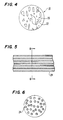
- the tow yarn 18 when created in this manner, can be easily separated to reveal a lattice structure of long randomly interconnected filaments 20 of expanded PTFE. As is shown in Figure 4, in un-exploded orientation, these filaments 20 are positioned within the PTFE tow yarn defining open spaces 22 between them.
- fiberglass filaments 24 are generally arranged in essentially a parallel or spiral arrangement. When subjected to an air-jet texturing apparatus, some of these filaments normally become fragmented into shorter strands.
- the fiberglass and PTFE can be mixed in various proportions to impart different properties to the composite thread.
- the composite fiber should contain 10 to 75% by weight of PTFE and 25 to 90% by weight of fiberglass. These proportions are a function of the mechanical properties required for a given application, with relatively more PTFE included to provide greater flex fatigue and abrasion resistance. For most applications, proportions of 25 to 50% by weight of PTFE and 50 to 75% by weight fiberglass are preferred.
- fillers may be desirable to include one or more fillers to provide additional or enhanced properties for the composite fiber.
- Appropriate fillers include conductive fillers, such as graphite, carbon black or metal oxide, to produce an electrically conductive fiber; metal oxide or organic pigments to create colors for aesthetic or other reasons; and/or thermoplastic thermoset resins to create structural composites.
- conductive fillers such as graphite, carbon black or metal oxide
- metal oxide or organic pigments to create colors for aesthetic or other reasons
- thermoplastic thermoset resins to create structural composites.
- Such fillers can be coated onto the composite fiber and/or incorporated into the PTFE fiber itself, such as through procedures similar to those disclosed in United States Patent 4,985,296 issued January 15, 1991, to Mortimer, Jr.
- the fibers created in accordance with the present invention can be readily used to create fabrics with a wide assortment of uses. This can be accomplished through any conventional procedures to create a woven, non-woven, braided or ribbon material.
- the fabric is woven on conventional weaving looms to produce a woven fabric.
- the resulting fabric can be scoured with a surfactant and water solution or heat cleaned using a high temperature bake cycle to remove any residual sizing. Additional chemical finishes can then be applied to the composite fabric to impart chemical resistance or other desired properties.
- One of the more promising applications of the present invention in this regard is to create woven fabrics for use as filter media.
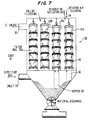
- FIG. 7 Shown in Figure 7 is a representation of a reverse air filter bag house 26.
- Such industrial filter units employ an inlet 28 for dirty flue gases, an outlet 30 for clean flue gases, and one or more filter bags 32a, 32b, 32c, 32d in communication between the inlet and the outlet to trap particulate matter.
- a reverse air inlet 34 is provided for imparting a pressure onto the outside of the filter bags 32.
- a conventional shaker filter bag house 42 has an inlet 44 for dirty flue gases, one or more outlets 46 for clean flue gases, and one or more filter bags 48a, 48b, 48c in communication between the inlet 44 and the outlet 46 for trapping particulate matter 50. Similar in scrubbing operation to the reverse air bag house, during operation the insides of the shaker bag filters 48 become encrusted with secondary cake as shown.
- each of the filter bags 48 is attached to a rocker arm 52 actuated by rotating shaft 54 or similar device which "shake" the bags to free particulate.
- the shaking procedure is illustrated in Figure 9. When the bags are distorted in this manner, particulate 50 will fall into a hopper 56 where it can be removed.
- bags 48a, 48b, 48c of the present invention can easily withstand such treatment without failure or loss of effectiveness.
- the fabric of the present invention lends itself to many further improvements in filter environments.
- a composite fabric of the present invention can be combined with other filter coatings (e.g. an expanded PTFE filter membrane) to provide improved filtration characteristics.
- filter coatings e.g. an expanded PTFE filter membrane
- the strong yet flexible nature of the fiber of the present invention is believed to be able to create a superior filter in this regard.
- conductive filled PTFE tow yarns it is possible to dissipate static charges created by tribo-electrically dissimilar materials rubbing against each other (e.g. dust rubbing against the filter bag surface).
- a variety of other improved filter properties are believed possible through use of the present invention.
- flexible release belts can be improved by weaving a textile using the fiber of the invention. By coating such belts with TEFLON B dispersion or similar material, an improved release belt surface can be provided for cooking or sealing operations.
- the fiber and fabric of the present invention has numerous other possible applications. For instance, it can be employed as an improved sewing thread, belting, architectural fabric, in printed circuit boards, as a structural composite, in roofing material, as insulation material, etc.
- a 1200 denier expanded PTFE monofilament slit film fiber was towed in a correlational manner using a pinwheel.
- the two yarns in equal proportions (50:50) were twisted together at 2.8 turns per inch in the S direction.
- the twisted yarn was then run through a HIRSCHBURGER-ELTEX Air Texturing machine, Model ATM, to intimately blend or commingle the fibers. Once commingled, it was impossible to separate the component yarns without destroying them.
- the yarn now had a "fuzzy" appearance.
- the following table is a physical property comparison of the commingled yarn to a conventional fiberglass yarn.
- Fill Yarn Type Conventional Yarn Composite Yarn Description ECDE 75 1/3 Tex ECDE 75 2/0 + PTFE Denier 2400 2400 Break Strength, kg 2.20 (4.84 lbs) 6.67 (14.7 lbs) M.I.T. Flex Cycles to Failure 8 1408 Yarn Abrasion Cycles to Failure 0 188
- the "M.I.T. Flex Cycles” test comprises an apparatus which double folds the fiber over a straightedge in either direction over a 270° range until failure occurs.
- the "Yarn Abrasion Cycles” test comprises fixing two similar yarns in brackets and then rubbing the yarn on itself until failure occurs. A cycle is one complete stroke which includes forward and return movements. The conventional fiberglass yarn tested was incapable of completing one cycle.
- the above fiber was woven on a conventional weaving loom to produce a 746 g/m 2 (22 oz./yd 2 ) greige fabric.
- the greige fabric had the following properties: thread count of 18.9 x 15.7 threads per cm (48 x 40 threads per inch); thickness of 0.086 cm (0.034 inches); and break strength (W x F) of 102 x 58 kg/cm (570 x 323 lbs f /inch) grab.
- the greige fabric was scoured with a hot water and surfactant solution to remove starches and weaving aids. It was then coated with TEFLON B dispersion and cured in a convection oven. The fabric was baked at 260°C (500°F) overnight to heat set the fabric and bake off any residual surfactants from the coating process.
- this fiber For use of this fiber as a filtration fiber, the demands of filtration application require improved flex fatigue resistance in the filling direction only. As such, the fibers of the present invention need only be applied in that direction.
- the composite fabric was tested for filtration efficiency and found to have significantly better capture efficiency than conventional fiberglass fabrics.
- the composite fabric was also successfully laminated with a microporous PTFE membrane. This fabric is expected to provide'superior performance during field testing.
Landscapes
- Chemical & Material Sciences (AREA)
- Chemical Kinetics & Catalysis (AREA)
- Engineering & Computer Science (AREA)
- Textile Engineering (AREA)
- Fluid Mechanics (AREA)
- Physics & Mathematics (AREA)
- Inorganic Chemistry (AREA)
- Mechanical Engineering (AREA)
- Filtering Materials (AREA)
- Woven Fabrics (AREA)
- Treatments For Attaching Organic Compounds To Fibrous Goods (AREA)
- Reinforced Plastic Materials (AREA)
- Yarns And Mechanical Finishing Of Yarns Or Ropes (AREA)
- Multicomponent Fibers (AREA)
Claims (18)
- Mischfaser (10) aus mehreren Filamenten aus Polytetrafluorethylen (PTFE) (14) und mehreren Glasfaserfilamenten (12), von denen die Filamente aus PTFE (14) und Glasfaser (12) eine einzelne Litze aus miteinander verbundenen Filamenten (12, 14) bilden, dadurch gekennzeichnet, daß die Filamente aus PTFE (14) Filamente aus expandiertem PTFE sind und die Filamente aus Glasfaser (12) fragmentierte Filamente aus Glasfaser sind, wobei die Litze aus miteinander verbundenen Filamenten (12, 14) die fragmentierten Glasfaserfilamente (12) in den Filamenten aus expandiertem PTFE (14) texturiert hat.
- Mischfaser nach Anspruch 1, bei der die mehreren Filamente aus expandiertem PTFE Towgarn (18) aus expandiertem PTFE mit den darin texturierten fragmentierten Glasfaserfilamenten (12) aufweisen.
- Mischfaser nach Anspruch 1, bei der die Faser flexibel ist und wiederholten Doppelfaltungen ohne Schaden widersteht.
- Mischfaser nach Anspruch 1, bei der die Faser 10 bis 75 Gew.-% PTFE-Filamente (14) aufweist.
- Mischfaser nach Anspruch 4, bei der die Faser 25 bis 90 Gew.-% Glasfaserfilamente (12) aufweist.
- Mischfaser nach Anspruch 5, bei der die Faser außerdem einen Füllstoff enthält.
- Stoff aus einem Gewebe aus mehreren Mischfasern (10) nach Anspruch 1.
- Stoff nach Anspruch 7, der ausreichend flexibel ist, um ohne zu zerreißen wiederholten Doppelfaltungen zu widerstehen.
- Stoff nach Anspruch 8, in Form eines Filters.
- Stoff nach Anspruch 9, wobei der Filter einen Beutelfilter (32) aufweist.
- Verfahren zum Herstellen einer Mischfaser (10), umfassend:Bereitstellen von Glasfaserfilamenten (12);Bereitstellen von Filamenten aus Polytetrafluorethylen (PTFE) (14);Zusammenfügen der Filamente aus Glasfaser (12) und PTFE (14), um eine einzelne Litze der Mischfaser (10) zu bilden;dadurch gekennzeichnet, daß die PTFE-Filamente (14) Filamente aus expandiertem PTFE und die Glasfaserfilamente (12) fragmentierte Glasfaserfilamente sind, und die einzelne Litze aus Mischfaser (10) die fragmentierten Glasfaserfilamente (12) in den Filamenten aus expandiertem PTFE (14) texturiert aufweist.
- Verfahren nach Anspruch 11, bei dem die PTFE-Filamente (14) in Form einen Towgarns (18) aus expandiertem PTFE bereitgestellt werden.
- Verfahren nach Anspruch 12, bei dem das Mischen der Filamente aus Glasfasern (12) und PTFE (14) aufweist:Luftstrahl-Texturieren der Filamente (12, 14) derart, daß die Filamente aus PTFE (14) separiert und die Glasfaserfilamente (12) fragmentiert werden;wobei Fragmente von Glasfaserfilamenten (12) in den PTFE-Filamenten (14) verstreut werden.
- Verfahren nach Anspruch 13, weiterhin umfassend das Bereitstellen von Glasfaserfilamenten (12) in einem relativen Anteil von 10 bis 75 Gew.-% der Faser (10).
- Verfahren nach Anspruch 14, umfassend das Bereitstellen von PTFE-Filamenten (14) in der Form eines Towgarns (18), welches 25 bis 90 Gew.-% der Faser (10) aufweist.
- Verfahren nach Anspruch 13, umfassend das Weben mehrerer Mischfasern (10) zu einem Stoff.
- Verfahren nach Anspruch 16, umfassend das Anbringen einer Membran aus expandiertem PTFE an dem Stoff.
- Verfahren nach Anspruch 17, umfassend das Bilden des Stoffs und der befestigten Membrane aus expandiertem PTFE zu einem Filter (32).
Applications Claiming Priority (3)
| Application Number | Priority Date | Filing Date | Title |
|---|---|---|---|
| US3367893A | 1993-03-16 | 1993-03-16 | |
| US33678 | 1993-03-16 | ||
| PCT/US1993/003477 WO1994021846A1 (en) | 1993-03-16 | 1993-04-13 | Composite fiber of commingled fiberglass and polytetrafluoroethylene and method of producing same |
Publications (2)
| Publication Number | Publication Date |
|---|---|
| EP0689622A1 EP0689622A1 (de) | 1996-01-03 |
| EP0689622B1 true EP0689622B1 (de) | 1997-07-09 |
Family
ID=21871800
Family Applications (1)
| Application Number | Title | Priority Date | Filing Date |
|---|---|---|---|
| EP93911632A Expired - Lifetime EP0689622B1 (de) | 1993-03-16 | 1993-04-13 | Zusammengesetzte faser aus vermischten glasfasern und polytetrafluoroethylen und verfahren zu ihrer herstellung |
Country Status (7)
| Country | Link |
|---|---|
| US (3) | US5456983A (de) |
| EP (1) | EP0689622B1 (de) |
| JP (1) | JPH08508316A (de) |
| AU (1) | AU674003B2 (de) |
| CA (1) | CA2155325C (de) |
| DE (1) | DE69312094T2 (de) |
| WO (1) | WO1994021846A1 (de) |
Families Citing this family (39)
| Publication number | Priority date | Publication date | Assignee | Title |
|---|---|---|---|---|
| EP0689622B1 (de) * | 1993-03-16 | 1997-07-09 | W.L. Gore & Associates, Inc. | Zusammengesetzte faser aus vermischten glasfasern und polytetrafluoroethylen und verfahren zu ihrer herstellung |
| BR9400435A (pt) * | 1994-02-04 | 1995-10-17 | Manegro Comercio Ltda | Fita composta para fabricação de gaxetas trançadas gaxeta trançada e processo de formação da referida fita composta |
| DE69531625T2 (de) * | 1994-10-04 | 2004-06-24 | Daikin Industries, Ltd. | Polytetrafluorethylenfaser, baumwollartiges diese faser enthaltendes material und verfahren zu deren herstellung |
| US6317292B1 (en) | 1994-10-18 | 2001-11-13 | Iomega Corporation | PTFE fiber based liner for flexible high density magnetic media |
| FR2729088B1 (fr) * | 1995-01-05 | 1997-03-28 | Genevet Sa | Manches filtrantes pour filtres a manches |
| TW357200B (en) * | 1995-09-13 | 1999-05-01 | Owens Corning Fiberglas Tech | Unidirectional fabric and method and apparatuses for forming the same |
| US5876537A (en) * | 1997-01-23 | 1999-03-02 | Mcdermott Technology, Inc. | Method of making a continuous ceramic fiber composite hot gas filter |
| US6008146A (en) * | 1997-09-02 | 1999-12-28 | Gore Enterprise Holdings, Inc. | Filter material and cartridge filters made therefrom |
| US6132866A (en) * | 1998-01-28 | 2000-10-17 | E. I. Du Pont De Nemours And Company | Yarn blend for friction applications |
| US6341483B1 (en) | 1999-05-13 | 2002-01-29 | Supreme Elastic Corporation | Multi-component yarn and making the same |
| US6349531B1 (en) | 1999-05-13 | 2002-02-26 | Supreme Elastic Corporation | Multipart component for a cut resistant composite yarn and method of making |
| US6293410B1 (en) | 1999-06-29 | 2001-09-25 | Mahle-Parr Filter Systems, Inc. | No-cure fuel filter and method for making same |
| DE10014678C2 (de) * | 2000-03-17 | 2002-02-07 | Siemens Ag | Filterbeutel |
| US6381940B1 (en) | 2000-04-19 | 2002-05-07 | Supreme Elastic Corporation | Multi-component yarn and method of making the same |
| US6734122B1 (en) | 2001-11-16 | 2004-05-11 | Bgf Industries, Inc. | Fabric for high-temperature gaseous filtration applications |
| US20030208998A1 (en) * | 2002-05-10 | 2003-11-13 | U.F. Strainrite Corporation | Filter bag and method of manufacture thereof |
| US20040128961A1 (en) * | 2002-05-10 | 2004-07-08 | U.F. Strainrite Corporation | Filter bag and method of manufacture thereof |
| US6758743B1 (en) | 2002-05-13 | 2004-07-06 | Lockheed Martin Corporation | Venting system for use with composite structures |
| US7442352B2 (en) * | 2003-06-20 | 2008-10-28 | Gore Enterprise Holdings, Inc. | Flue gas purification process using a sorbent polymer composite material |
| US7296394B2 (en) * | 2005-02-11 | 2007-11-20 | Gore Enterprise Holdings, Inc. | Fluoropolymer fiber composite bundle |
| US9334587B2 (en) * | 2005-02-11 | 2016-05-10 | W. L. Gore & Associates, Inc. | Fluoropolymer fiber composite bundle |
| US20060182962A1 (en) * | 2005-02-11 | 2006-08-17 | Bucher Richard A | Fluoropolymer fiber composite bundle |
| US7409815B2 (en) * | 2005-09-02 | 2008-08-12 | Gore Enterprise Holdings, Inc. | Wire rope incorporating fluoropolymer fiber |
| WO2007066826A1 (ja) * | 2005-12-09 | 2007-06-14 | Sumitomo Chemical Company, Limited | 油水分離フィルター及び油水分離装置 |
| RU2501216C2 (ru) * | 2008-10-14 | 2013-12-20 | Уай. Джи Кей КО., ЛТД. | Рыболовная леска, содержащая объединенную композитную нить, включающую короткое волокно |
| US8578853B2 (en) * | 2008-12-24 | 2013-11-12 | Printing Research, Inc. | Anti-marking jackets comprised of attachment structure and methods of using in offset printing |
| US8281716B2 (en) * | 2008-12-24 | 2012-10-09 | Printing Research, Inc. | Anti-marking jackets comprised of fluoropolymer and methods of using in offset printing |
| CN101879390B (zh) * | 2010-06-09 | 2012-10-17 | 宋朋泽 | 耐高温复合玻纤滤料及其制备方法 |
| US8424453B2 (en) | 2010-09-01 | 2013-04-23 | Printing Research, Inc. | Apparatus and method for adjusting anti-marking jackets |
| US8677899B2 (en) | 2011-01-31 | 2014-03-25 | Printing Research, Inc. | Reversible anti-marking jackets and methods of using |
| BR112013027872B1 (pt) * | 2011-04-29 | 2021-08-10 | American Biltrite (Canada) Ltd | Material para pavimentação, produto para pavimentação curado de composição para pavimentação e método para produção de produto para pavimentação |
| WO2013040180A1 (en) * | 2011-09-13 | 2013-03-21 | Owens Corning Intellectual Capital, Llc | Granule coated waterproof roofing membrane |
| US8790432B2 (en) * | 2012-04-27 | 2014-07-29 | W. L. Gore & Associates, Inc. | Seam-sealed filters and methods of making thereof |
| US9346258B2 (en) | 2012-05-02 | 2016-05-24 | Printing Research, Inc. | Method for cleaning anti-marking jackets |
| WO2014159821A1 (en) | 2013-03-13 | 2014-10-02 | Federal-Mogul Powertrain, Inc. | Self-wrappable eptfe textile sleeve and method of construction thereof |
| WO2019086977A1 (en) | 2017-11-03 | 2019-05-09 | American Biltrite (Canada) Ltd. | Resilient surface coverings and methods of making and using thereof |
| US11434176B2 (en) | 2017-12-11 | 2022-09-06 | Rolls-Royce High Temperature Composites Inc. | Fugitive fiber commingling to provide loft in ceramic fiber tows |
| CN111389095A (zh) * | 2020-04-06 | 2020-07-10 | 台州市皓天产业用布股份有限公司 | 高硅氧聚四氟乙烯覆膜滤布 |
| CN115897011B (zh) * | 2022-08-27 | 2024-06-25 | 安徽省绩溪华林环保科技股份有限公司 | 一种聚四氟乙烯纤维与玻璃纤维混纺滤料 |
Family Cites Families (15)
| Publication number | Priority date | Publication date | Assignee | Title |
|---|---|---|---|---|
| US3073005A (en) * | 1957-12-30 | 1963-01-15 | Owens Corning Fiberglass Corp | Composite fibers |
| US3438841A (en) * | 1965-03-03 | 1969-04-15 | Marlo Co Inc | Packing material |
| CA962021A (en) * | 1970-05-21 | 1975-02-04 | Robert W. Gore | Porous products and process therefor |
| US3815468A (en) * | 1972-01-20 | 1974-06-11 | Textron Inc | Braided fabric bearing liner |
| US4026863A (en) * | 1976-06-07 | 1977-05-31 | Asahi Glass Co., Ltd. | Fluorocarbon polymer composite containing a treated filler |
| US4362069A (en) * | 1979-04-02 | 1982-12-07 | Markel Corporation | High efficiency, abrasion resistant product and process |
| FR2473124A1 (fr) * | 1980-01-04 | 1981-07-10 | Marteau D Autry Eric | Dispositif de prelevement et de distribution de volumes reglables de liquides, a affichage numerique |
| US4361619A (en) * | 1981-05-20 | 1982-11-30 | E. I. Du Pont De Nemours And Company | Filter of poly(tetrafluoroethylene) and glass fibers |
| US4612237A (en) * | 1985-12-13 | 1986-09-16 | E. I. Du Pont De Nemours And Company | Hydraulically entangled PTFE/glass filter felt |
| US5188892A (en) * | 1986-10-31 | 1993-02-23 | E. I. Du Pont De Nemours And Company | Spun textile yarns |
| US5206085A (en) * | 1987-08-13 | 1993-04-27 | Across Co., Ltd. | Preformed yarn useful for forming composite articles and process for producing same |
| US4975321A (en) * | 1988-06-20 | 1990-12-04 | E. I. Du Pont De Nemours And Company | Structural composites of fluoropolymers reinforced with continuous filament fibers |
| US4840838A (en) * | 1988-09-08 | 1989-06-20 | E. I. Du Pont De Nemours And Company | High temperature filter felt |
| US4985296A (en) * | 1989-03-16 | 1991-01-15 | W. L. Gore & Associates, Inc. | Polytetrafluoroethylene film |
| EP0689622B1 (de) * | 1993-03-16 | 1997-07-09 | W.L. Gore & Associates, Inc. | Zusammengesetzte faser aus vermischten glasfasern und polytetrafluoroethylen und verfahren zu ihrer herstellung |
-
1993
- 1993-04-13 EP EP93911632A patent/EP0689622B1/de not_active Expired - Lifetime
- 1993-04-13 CA CA002155325A patent/CA2155325C/en not_active Expired - Lifetime
- 1993-04-13 WO PCT/US1993/003477 patent/WO1994021846A1/en not_active Ceased
- 1993-04-13 AU AU40490/93A patent/AU674003B2/en not_active Expired
- 1993-04-13 DE DE69312094T patent/DE69312094T2/de not_active Expired - Lifetime
- 1993-04-13 JP JP6520988A patent/JPH08508316A/ja active Pending
-
1994
- 1994-09-16 US US08/307,540 patent/US5456983A/en not_active Expired - Lifetime
- 1994-09-16 US US08/307,539 patent/US5549966A/en not_active Expired - Lifetime
-
1996
- 1996-04-03 US US08/627,194 patent/US5667611A/en not_active Expired - Lifetime
Also Published As
| Publication number | Publication date |
|---|---|
| DE69312094D1 (de) | 1997-08-14 |
| AU674003B2 (en) | 1996-12-05 |
| US5667611A (en) | 1997-09-16 |
| DE69312094T2 (de) | 1997-10-30 |
| WO1994021846A1 (en) | 1994-09-29 |
| JPH08508316A (ja) | 1996-09-03 |
| AU4049093A (en) | 1994-10-11 |
| CA2155325A1 (en) | 1994-09-29 |
| EP0689622A1 (de) | 1996-01-03 |
| CA2155325C (en) | 1999-07-13 |
| US5549966A (en) | 1996-08-27 |
| US5456983A (en) | 1995-10-10 |
Similar Documents
| Publication | Publication Date | Title |
|---|---|---|
| CA2155325C (en) | Composite fiber of commingled fiberglass and polytetrafluoroethylene and method of producing same | |
| US6008146A (en) | Filter material and cartridge filters made therefrom | |
| CA2156614C (en) | Crimped carbonaceous fibers | |
| SE448638B (sv) | Kombigarn och derav framstelld vatpressfilt | |
| KR100523312B1 (ko) | 이중 유리 섬유의 카딩성 블렌드, 이로부터 제조된 응집성 웹, 이로부터 제조된 펠트, 이중 유리 섬유 함유 펠트의 형성 방법 | |
| WO2007140302A2 (en) | Hot gas filtration fabrics with silica and flame resistant fibers | |
| JPS588147A (ja) | 弾性カバ−ドヤ−ン | |
| RU99101125A (ru) | Эластичное изделие, устойчивое к проникновению | |
| KR100493342B1 (ko) | 에어백용 특수 직물 | |
| EP1302229B2 (de) | Filtertaschen | |
| US3078543A (en) | Loop pile fabric | |
| JPH03130436A (ja) | セーム皮調ワイピングクロスおよびその製造方法 | |
| JP2874283B2 (ja) | スパンライク織物の製造方法 | |
| JP2741377B2 (ja) | 柔軟性の改善された織物 | |
| CA1173313A (en) | Yarn and fabric formed therefrom | |
| JP2008007869A (ja) | 制電作業着 | |
| JP3409886B2 (ja) | 羽毛袋体 | |
| JPS5938049A (ja) | 芳香族ポリアミド繊維積層シ−ト | |
| JPH0333808B2 (de) | ||
| JPH0313341B2 (de) | ||
| JPH0753210B2 (ja) | バグフィルター用のガラスクロス | |
| JPS6032753B2 (ja) | 防水帆布およびその製造方法 | |
| CN1018004B (zh) | 具有较好的消除电荷能力和吸水性能的编织物 | |
| KR19990017167A (ko) | 촉감과 방오성이 우수한 폴리에스테르/나일론 마이크로 직물의 제조방법 | |
| JPS6229068B2 (de) |
Legal Events
| Date | Code | Title | Description |
|---|---|---|---|
| PUAI | Public reference made under article 153(3) epc to a published international application that has entered the european phase |
Free format text: ORIGINAL CODE: 0009012 |
|
| 17P | Request for examination filed |
Effective date: 19950830 |
|
| AK | Designated contracting states |
Kind code of ref document: A1 Designated state(s): DE FR GB IT SE |
|
| 17Q | First examination report despatched |
Effective date: 19960502 |
|
| GRAG | Despatch of communication of intention to grant |
Free format text: ORIGINAL CODE: EPIDOS AGRA |
|
| GRAH | Despatch of communication of intention to grant a patent |
Free format text: ORIGINAL CODE: EPIDOS IGRA |
|
| GRAH | Despatch of communication of intention to grant a patent |
Free format text: ORIGINAL CODE: EPIDOS IGRA |
|
| GRAA | (expected) grant |
Free format text: ORIGINAL CODE: 0009210 |
|
| AK | Designated contracting states |
Kind code of ref document: B1 Designated state(s): DE FR GB IT SE |
|
| REF | Corresponds to: |
Ref document number: 69312094 Country of ref document: DE Date of ref document: 19970814 |
|
| ET | Fr: translation filed | ||
| PLBE | No opposition filed within time limit |
Free format text: ORIGINAL CODE: 0009261 |
|
| STAA | Information on the status of an ep patent application or granted ep patent |
Free format text: STATUS: NO OPPOSITION FILED WITHIN TIME LIMIT |
|
| 26N | No opposition filed | ||
| REG | Reference to a national code |
Ref country code: GB Ref legal event code: IF02 |
|
| PGFP | Annual fee paid to national office [announced via postgrant information from national office to epo] |
Ref country code: DE Payment date: 20120427 Year of fee payment: 20 |
|
| PGFP | Annual fee paid to national office [announced via postgrant information from national office to epo] |
Ref country code: SE Payment date: 20120427 Year of fee payment: 20 Ref country code: GB Payment date: 20120425 Year of fee payment: 20 Ref country code: FR Payment date: 20120503 Year of fee payment: 20 |
|
| PGFP | Annual fee paid to national office [announced via postgrant information from national office to epo] |
Ref country code: IT Payment date: 20120424 Year of fee payment: 20 |
|
| REG | Reference to a national code |
Ref country code: DE Ref legal event code: R071 Ref document number: 69312094 Country of ref document: DE |
|
| REG | Reference to a national code |
Ref country code: GB Ref legal event code: PE20 Expiry date: 20130412 |
|
| PG25 | Lapsed in a contracting state [announced via postgrant information from national office to epo] |
Ref country code: GB Free format text: LAPSE BECAUSE OF EXPIRATION OF PROTECTION Effective date: 20130412 Ref country code: DE Free format text: LAPSE BECAUSE OF EXPIRATION OF PROTECTION Effective date: 20130416 |