EP0689704B1 - Verfahren und vorrichtung zur fernbedienung - Google Patents
Verfahren und vorrichtung zur fernbedienung Download PDFInfo
- Publication number
- EP0689704B1 EP0689704B1 EP94910392A EP94910392A EP0689704B1 EP 0689704 B1 EP0689704 B1 EP 0689704B1 EP 94910392 A EP94910392 A EP 94910392A EP 94910392 A EP94910392 A EP 94910392A EP 0689704 B1 EP0689704 B1 EP 0689704B1
- Authority
- EP
- European Patent Office
- Prior art keywords
- remote control
- control signals
- microprocessor
- bit
- tlrc
- Prior art date
- Legal status (The legal status is an assumption and is not a legal conclusion. Google has not performed a legal analysis and makes no representation as to the accuracy of the status listed.)
- Expired - Lifetime
Links
- 238000000034 method Methods 0.000 title claims description 16
- 230000000630 rising effect Effects 0.000 claims 2
- 230000003213 activating effect Effects 0.000 claims 1
- 230000001172 regenerating effect Effects 0.000 claims 1
- 238000010586 diagram Methods 0.000 description 6
- 230000005540 biological transmission Effects 0.000 description 5
- 230000036962 time dependent Effects 0.000 description 2
- 230000002457 bidirectional effect Effects 0.000 description 1
- 238000001514 detection method Methods 0.000 description 1
- 230000000694 effects Effects 0.000 description 1
- 230000005923 long-lasting effect Effects 0.000 description 1
- 239000011159 matrix material Substances 0.000 description 1
- 230000003287 optical effect Effects 0.000 description 1
- 230000008929 regeneration Effects 0.000 description 1
- 238000011069 regeneration method Methods 0.000 description 1
- 230000000717 retained effect Effects 0.000 description 1
Images



Classifications
-
- G—PHYSICS
- G08—SIGNALLING
- G08C—TRANSMISSION SYSTEMS FOR MEASURED VALUES, CONTROL OR SIMILAR SIGNALS
- G08C19/00—Electric signal transmission systems
- G08C19/16—Electric signal transmission systems in which transmission is by pulses
- G08C19/28—Electric signal transmission systems in which transmission is by pulses using pulse code
Definitions
- the present invention relates to a method and a Device for learning remote control signals for electronic devices, in particular consumer electronics according to the preamble of Claim 1 or according to the preamble of Claim 9.
- a remote control transmitter is generally known. He sends in Signal wired or wireless, for example infrared light, Microwaves, ultrasonic waves or the like, more specific Frequencies and codes using a transmitter over a transmission path to a receiving device that the sent Recognizes signal codes and then certain, in the Executes commands contained in signal codes.
- a disadvantage of the known learning remote control transmitters is the fact that data formats, the so-called toggle bits contained in their data word, not correctly recognized by them and also not perceived different carrier frequency ranges will.
- such "learning" remote control transmitters work usually in the range of approximately 30 kHz to approximately 40 kHz, so that data formats with a carrier frequency in the range from for example 390 kHz to approx. 500 kHz not determined and cannot be reproduced correctly in broadcast mode.
- Toggle bits are usually at the beginning of a data word transferred and either take the logic state "1" or "0". Their condition remains until the corresponding one Data word is no longer sent.
- toggle bits the task of multiple, identical and long-lasting key presses to be able to distinguish perfectly from one another.
- Conventional "learning" remote controls would do the same Data word that after a short interruption by a button is sent again, but this time with the toggle bit state "0" (if it was previously "1"), no longer recognize as the same command.
- Infrared remote control transmitter can therefore in particular then fail if the original remote control transmitter, its infrared format from the learner remote control transmitter should be recognized and saved in the data word Togglebit contains. Error detections and / or operating errors are thus mapped out. Frequent complaints in this regard are known from publications e.g. in video 5/92, Page 42 and stereoplay no. 3/91, page 72.
- EP-A-0 380 371 is a "learning" remote control known in which a received remote control signal in one Memory can be entered.
- the "learning" remote control has the ability to receive the remote control signal to analyze and then in the appropriate form reproduce.
- This "learning" remote control also the ability to toggle bits in the received Detect remote control signals.
- everyone will received remote control signal to be learned corresponding bit pattern assigned, which is also stored becomes. After the repeated transmission of what is to be learned Remote control signal are both stored bit patterns compared with each other. This will position a Toggle bits detected.
- the present invention is based on the object, too recognize and reproduce such transmission formats can have at least one toggle bit in their data word contain. It is advantageously irrelevant whether one or more toggle bits are contained in the data word and on the position of toggle bits in the data word.
- the invention solves the problem in that at later times at least one other remote control signal for the same Remote command from the first remote control transmitter transmitted and received by the second remote control transmitter and is stored, the value of the further remote control signal is compared with the value of the first remote control signal and based on the comparison, the remote control command assigned remote control signal is formed.
- an inventive device for learning and sending remote control signals realized be that with the help of a first memory initially at least two containing the same command, different remote control signals are saved with With the help of a comparator the values of the previously saved Remote control signals for time differences be examined with the help of a second memory (RAM) Results from the comparison are stored there with the help of an encoder at a later date Values of the original remote control signals are formed.
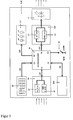
- Figure 1 shows a block diagram of an arrangement of a toggle bit learning Remote control with a "fast" microprocessor.
- Figure 2 shows a block diagram of an arrangement of a toggle bit learning Remote control with two carrier frequency oscillators.
- Figure 3 shows a block diagram of an arrangement of a toggle bit learning Remote control with two infrared receivers and two carrier frequency oscillators.
- FIG. 4 shows a pulse diagram of an infrared data word.
- the original infrared format is forwarded from an infrared receiver IR to a first input E1 of a control device, which can be a microprocessor MP, for processing.
- a switch SW which has one pole at reference potential and the other at a second input E2 of the microprocessor MP, switches the operating mode "LEARN" or "SEND" on.
- a keyboard matrix KB is connected to a third input E3 of the microprocessor MP via a first line bus LB1.
- An external memory RAM is connected to a bidirectional line bus I 2 C with an input or output IO of the microprocessor MP.
- a first output A1 of the microprocessor MP supplies its data words to an infrared transmitter IS, which amplifies the data words and emits them as infrared light.
- a display device AZ of optical and / or acoustic type is controlled by a second output A2 of the microprocessor MP via a second line bus LB2.
- TLRC toggle bit Learning Remote Control
- TLRC toggle bit Learning Remote Control
- the microprocessor MP controls the display device AZ, the advantageously light-emitting Diodes or an LCD display can contain.
- the Display device AZ shows the user whether the TLRC is on Ready to receive the first data word of the original remote control stands. The user now selects a button the keypad KB of the TLRC, so that it commands the Original remote control can take over.
- the microprocessor prompts by means of the display device AZ MP prompts the user to repeat the same process. After the second reading of the data word, the in two tables read within the microprocessor MP and stored two data words by comparison Examine toggle bits.
- FIG. 4 shows a typical example of a pulse diagram of an infrared remote control transmitter.
- the pulse diagram at points A0, A1 and D6 has time-dependent bit states of a logical "1" of, for example, a length of 5.06 milliseconds.
- Logical bit states of a "0" are transmitted with a duration of 2.53 milliseconds, for example.
- the time-dependent bit states are compared at the same table position.
- both times in the present example differ by less than 150 microseconds, both times are regarded as identical and an internal table pointer is increased by one digit. If the time difference is greater than 150 microseconds, there are different logical states at this position in the data words read. This is considered a toggle bit position. The position is stored in an information byte and a bit is set in the same byte, which indicates that it is a data format with at least one toggle bit. This is important for the examination of the table for further toggle bits and the transmission mode. After comparing a table position, the internal table pointer of the microprocessor MP is incremented and the next table position is examined.
- the information obtained from this is stored in an information byte and the differing times are stored in the internal RAM of the microprocessor MP.
- the tolerance time of 150 microseconds in the present example is a factor of 3 greater than the maximum inaccuracy measured when the same times are sent repeatedly from one and the same original remote control transmitter.
- a second toggle bit By incrementing the table pointer, it is checked in the further comparison whether a second toggle bit is present.
- a maximum of only two toggle bits are permitted and these must follow one another directly. If it is an approved position, the current bit position must be 1 (one) larger than the position stored in the information byte. If this is not the case, there is an error, for example due to a reading error.
- the receiver software of the remotely controllable device simply changes a single toggle bit to recognize the same, repeated keystroke. Therefore only the position of the first detected toggle bit is saved. The different times are stored in the internal RAM of the microprocessor MP in reserved memory locations. This is necessary because the data word must be regenerated before sending.
- FIG. 1 An embodiment shown in Figure 1 as a control device contain fast microprocessor MP, which the incoming Frequencies up to 500 kHz, which corresponds to a period of 2 microseconds, can measure and reproduce safely.
- the arrangement in FIG. 1 provides only a single broadband infrared receiver IR with an infrared receiving diode, which forwards carrier frequencies between 30 kHz and 500 kHz to its output.
- the high-speed microprocessor MP connected downstream of the infrared receiver IR can measure the frequencies directly and store their values or convert them into two decision criteria. One decision is on the lower, the other on the upper carrier frequency range. This means that, for example, a bit is set to "1" in the information byte when it is detected, and this frequency-designating bit is set to "0" in the information byte when it is detected.
- the microprocessor MP stores all the information relevant for regeneration of the data word, such as the measured sequence of times, toggle bit times and information bytes, via the I 2 C bus in the external memory RAM .
- the user sets the switch SW to the "SEND" position and actuates a key on the keypad KB of the togglebit-learning remote control transmitter TLRC corresponding to the command to be executed.
- the microprocessor MP then reads the information from the external memory RAM via I 2 C-Bus, regenerates the original data word in all essential details, as well as the modulation of the carrier frequency, and essentially sends it in its original condition via the infrared transmitter IS Receiving device.
- a second exemplary embodiment in FIG. 2 contains two carrier frequency oscillators. It differs from the first exemplary embodiment shown in FIG. 1 in that between the output A1 of the microprocessor MP and the input of the infrared transmitter IS there is now an oscillator stage OSC with two parallel oscillators LO and HO, which can be selected through the output A1 of the microprocessor MP can be controlled via a third line bus LB3. As described for the first exemplary embodiment, this arrangement contains only a single broadband infrared receiver IR with an infrared receiving diode, and a microprocessor MP, which, however, does not contain an internal carrier frequency oscillator here.
- the microprocessor MP can be more cost-effective to design the microprocessor MP as a slow microprocessor and to connect this to a double oscillator stage OSC, which consists on the one hand of an oscillator with a low frequency LO (approx. 36 kHz) and on the other hand of an oscillator with a high frequency HO (400 kHz) exists.
- OSC double oscillator stage
- the microprocessor MP either activates one or the other oscillator. Everything else remains as described above for the first embodiment, which is why the reference numerals used there have been retained.
- the infrared commands are first read in with the aid of a first infrared receiver LF with a lower pass band for frequencies from 30 kHz to 40 kHz (eg type IS1U60 from Sharp).
- the carrier frequency range can be determined together with the second infrared receiver HF, which responds to frequencies in the range from 390 kHz to 500 kHz (eg type TFMT 4040 from Telefunken).
- a switch is made from the first infrared receiver LF to the second infrared receiver HF during the reading process of the data words.
- the negative edges of the data words which are received via the second IR receiver HF and are keyed at a carrier frequency in the range from 390 kHz to 455 kHz, trigger interrupts.
- the interrupts are counted in an interrupt routine within the microprocessor MP. If the carrier frequency is in the lower range, that is to say between 30 kHz and 40 kHz, no signal is passed through, due to the pass band of the IR receiver HF. However, if the user specifies an insufficient distance between the TLRC remote control learning toggle bit and the original remote control or if the lighting conditions are unfavorable, there is a possibility that a few interrupts will be counted despite the lower carrier frequency range.
- the total information of the data words as well as the information about the toggle bit, the different times of the toggle bit states, number, position, carrier frequency range as well as other data relevant to the program are stored in the external memory RAM using the I 2 C bus read, and stored there until called. If the data are to be sent, switch SW must be set from "LEARN” to "SEND” so that the microprocessor MP can read the data from the external memory RAM.
- the data from the external memory RAM are processed in the microprocessor on the basis of the information from the information byte to form the complete data word.
- the state of the toggle bit (s) is also changed or incremented by 1 each time a key on this key is assigned to the data field KB.
- the microprocessor activates either the 36 kHz carrier frequency oscillator LO or the 400 kHz carrier frequency oscillator HO so that the data word corresponding to the original can be sent to the receiving device via the infrared transmitter IS.
Landscapes
- Physics & Mathematics (AREA)
- General Physics & Mathematics (AREA)
- Selective Calling Equipment (AREA)
Description
Die in den einzelnen Stufen enthaltenen Elemente können jedoch auch getrennt ausgeführt werden.
Hierin wird das Original-Infrarot Format von einem Infrarot-Empfänger IR an einen ersten Eingang E1 eines Steuergeräts, das ein Mikroprozessor MP sein kann, zur Verarbeitung weitergeleitet. Ein Schalter SW, der mit einem Pol auf Bezugspotential liegt und mit seinem anderen auf einem zweiten Eingang E2 des Mikroprozessors MP, schaltet die Betriebsart "LEARN" oder "SEND" ein. über einen ersten Leitungsbus LB1 liegt eine Tastaturmatrix KB an einem dritten Eingang E3 des Mikroprozessors MP. Ein externer Speicher RAM ist mit einem bidirektionalen Leitungsbus I2C mit einem Ein- bzw. Ausgang IO des Mikroprozessors MP verbunden. Ein erster Ausgang A1 des Mikroprozessors MP liefert seine Datenworte an einen Infrarot-Sender IS, der die Datenworte verstärkt und als Infrarotlicht ausstrahlt. Eine Anzeigevorrichtung AZ optischer und/oder akustischer Art wird von einem zweiten Ausgang A2 des Mikroprozessors MP über einen zweiten Leitungsbus LB2 angesteuert.
Die Figur 4 zeigt ein typisches Beispiel eines Impulsdiagramms eines Infrarot-Fernbedienungsgebers. Wie daraus ersichtlich ist, weist das Impulsdiagramm an den Stellen A0, A1 sowie D6 zeitabhängige Bitzustände einer logischen "1" von beispielsweise der Länge 5,06 Millisekunden auf. Logische Bitzustände einer "0" werden mit einer Zeitdauer von beispielsweise 2,53 Millisekunden übertragen.
Es findet ein Vergleich der zeitabhängigen Bitzustände an der gleichen Tabellenposition statt. Unterscheiden sich im vorliegenden Beispiel die Zeiten um weniger als 150 Mikrosekunden, so werden beide Zeiten als identisch angesehen und ein interner Tabellenzeiger wird um eine Stelle erhöht. Ist die Zeitdifferenz größer als 150 Mikrosekunden, so liegen an dieser Position in den eingelesenen Datenworten unterschiedliche logische Zustände vor. Dies wird als Togglebit-Position gewertet. Die Position wird in einem Informationsbyte abgelegt und ein Bit im selben Byte gesetzt, welches anzeigt, daß es sich um ein Datenformat mit mindestens einem Togglebit handelt. Dies ist für die Untersuchung der Tabelle auf weitere Togglebits und den Sendebetrieb von Bedeutung.
Nach dem Vergleich einer Tabellenposition wird der interne Tabellenzeiger des Mikroprozessors MP inkrementiert und die nächste Tabellenposition untersucht. Sind die Unterschiede jeder einzelne Tabellenposition der beiden Datenworte ermittelt, werden die daraus gewonnenen Informationen in einem Informationsbyte abgelegt und die sich unterscheidenden Zeiten im internen RAM des Mikroprozessors MP abgespeichert. Die Toleranzzeit ist mit 150 Mikrosekunden im vorliegenden Beispiel um den Faktor 3 größer, als die maximal gemessene Ungenauigkeit bei wiederholtem Senden der gleichen Zeiten von ein und demselben Original-Fernbedienungsgeber.
Die sich unterscheidenden Zeiten werden im internen RAM des Mikroprozessors MP in reservierten Speicherstellen abgelegt. Dies ist deshalb notwendig, da das Datenwort vor dem Senden wieder regeneriert werden muß.
Bei Abruf des zu regenerierenden Datenwortes legt der Benutzer den Schalter SW in die Position "SEND" und betätigt eine dem auszuführenden Befehl entsprechende Taste auf dem Tastenfeld KB des togglebit-lernenden Fernbedinungsgebers TLRC. Der Mikroprozessor MP liest daraufhin via I2C-Bus die Informationen aus dem externen Speicher RAM aus, regeneriert in allen wesentlichen Details das ursprüngliche Datenwort, wie auch die Modulation der Trägerfrequenz und sendet es im wesentlichen in seiner Originalbeschaffenheit über die Infrarot-Sendestufe IS zum Empfangsgerät aus.
Es unterscheidet sich von dem in Figur 1 dargestellten ersten Ausführungsbeispiel insofern, daß zwischen dem Ausgang A1 des Mikroprozessors MP und dem Eingang des Infrarotsenders IS nunmehr eine Oszillatorstufe OSC mit zwei parallel liegenden Oszillatoren LO und HO liegt, die wahlweise durch den Ausgang A1 des Mikroprozessors MP über einen dritten Leitungsbus LB3 angesteuert werden können.
Diese Anordnung enthält, ebenso wie zum ersten Ausführungsbeispiel beschrieben, nur einen einzigen breitbandigen Infrarot-empfänger IR mit einer Infrarot-Empfangsdiode, sowie einen Mikroprozessor MP, der hier jedoch keinen internen Trägerfrequenz-Oszillator enthält. Statt dessen kann es kostengünstiger sein, den Mikroprozessor MP als einen langsamen Mikroprozessor auszubilden und diesem eine Doppel-Oszillatorstufe OSC nachzuschalten, die einerseits aus einem Oszillator mit einer tiefen Frequenz LO (ca. 36 kHz) und andererseits aus einem Oszillator mit einer hohen Frequenz HO (400 kHz) besteht. Abhängig von der Trägerfrequenz, die dem Original-Datenformat ursprünglich aufmoduliert war, aktiviert der Mikroprozessor MP entweder den einen oder den anderen Oszillator. Alles andere bleibt so, wie oben bereits zum ersten Ausführungsbeispiel beschrieben, weswegen auch die dort verwendeten Bezugszeichen beibehalten wurden.
Zusammen mit dem zweiten Infrarot-Empfänger HF, der auf Frequenzen im Bereich von 390 kHz bis 500 kHz reagiert (z.B. Typ TFMT 4040 von Telefunken), läßt sich der Trägerfrequenzbereich ermitteln.
Hierzu wird während des Einlesvorgangs der Datenworte vom ersten Infrarot-Empfänger LF auf den zweiten Infrarot-Empfänger HF umgeschaltet. Während eines Zeitfensters (z.B. 261ms) lösen die negativen Flanken der Datenworte, die über den zweiten IR-Empfänger HF empfangen und mit einer Trägerfrequenz im Bereich von 390 kHz bis 455 kHz getastet werden, Interrupts aus. In einer Interrupt-Routine innerhalb des Mikroprozessors MP werden die Interrupts gezählt. Liegt die Trägerfrequenz im unteren Bereich, also zwischen 30 kHz und 40 kHz, wird, bedingt durch den Durchlaßbereich des IR-Empfängers HF, kein Signal durchgelassen. Legt jedoch der Benutzer einen zu geringen Abstand zwischen der togglebit-lernenden Fernbedienung TLRC und der Originalfernbedienung fest oder liegen ungünstige Lichtverhältnisse vor, besteht die Möglichkeit, daß trotz des unteren Trägerfrequenzbereichs einige wenige Interrupts gezählt werden. Dies ist aber nicht weiter von Bedeutung, da beispielsweise bei einer Anzahl von mehr als 6 Interrupts auf "oberen" Trägerfrequenzbereich erkannt werden kann. Bekannte Datenformate im oberen Trägerfrequenzbereich (z.B. Formate von NEC, Philips, Ferguson, SABA, Telefunken und Nordmende) lösen entsprechend ihrer Bitanzahl Interrupts aus.
Claims (9)
- Verfahren zum Lernen von Fernbedienungssignalen eines ersten Fernbedienungsgebers, der zunächst erste Fernbedienungssignale eines Datenwortes für einen vorgegebenen Fernbedienungsbefehl aussendet, die von einem zweiten Fernbedienungsgeber (TLRC), der zum Empfang und zum Aussenden von Fernbedienungssignalen ausgebildet ist, empfangen werden, wobei der Wert der ersten Fernbedienungssignale des ersten Fernbedienungsgebers im zweiten Fernbedienungsgeber (TLRC) abgespeichert wird, und zweite oder weitere Fernbedienungssignale, die sich nur durch mindestens ein Toggle-Bit von den ersten Fernbedienungssignalen unterscheiden, erkannt werden, dadurch gekennzeichnet, daß die ersten und zweiten oder weiteren Fernbedienungssignale nach Empfang als Zeiten in einander zugeordneten Tabellen eines Mikroprozessors (MP) oder eines Speichers (RAM) des zweiten Fernbedienungsgebers (TLRC) abgelegt werden und diese Werte auf zeitliche Unterschiede hin untersucht werden, wobei verglichen wird, ob die Differenz der gemessenen Zeiten zwischen den ansteigenden Flanken größer als eine vorgegebene Zeit ist und daß, wenn dies der Fall ist, erkannt wird, daß an der entsprechenden Position in dem empfangenen Datenwort unterschiedliche logische Zustände vorliegen und diese Position als Toggle-Bit-Position gewertet wird.
- Verfahren nach Anspruch 1, wobei der Vergleich der gemessenen Zeiten nach der Erkennung des ersten Toggle-Bits fortgeführt wird und sofern an einer weiteren Position erneut eine Zeitdifferenz festgestellt wird, die größer als die vorgegebene Zeit ist, geprüft wird, ob es sich um ein Toggle-Bit handelt, wobei auf ein weiteres Toggle-Bit erkannt wird, wenn die große Zeitdifferenz für ein Bit der Datenworte festgestellt wird, das zu dem ersten erkannten Toggle-Bit direkt benachbart ist und daß anderenfalls auf einen Fehler erkannt wird.
- Verfahren nach Anspruch 1 oder 2, wobei die durch Vergleich der gemessenen Zeiten gewonnenen Informationen über die Toggle-Bit-Positionen in einem Informations-Byte abgelegt werden.
- Verfahren nach Anspruch 3, wobei das Informations-Byte im Mikroprozessor (MP) oder im Speicher (RAM) des zweiten Fernbedienungsgebers (TLRC) abgespeichert wird und ein Teil des Informations-Bytes, insbesondere ein einzelnes Bit, zur Kennzeichnung des Trägerfrequenzbereichs verwendet wird, der den ursprünglichen Fernbedienungssignalen aufmoduliert war.
- Verfahren nach Anspruch 4, wobei das oder die im Informations-Byte gespeicherten frequenzkennzeichnenden Bit(s) dazu verwendet werden, um einen Oszillator (LO, HO) zu aktivieren, der den zu regenerierenden Fernbedienungssignalen eine Trägerfrequenz aufmoduliert, die im wesentlichen derjenigen entspricht, die den Ursprungs-Fernbedienungssignalen aufmoduliert war.
- Verfahren nach Anspruch 4 oder 5, wobei eine von mehreren möglichen Trägerfrequenzen in Abhängigkeit von dem oder den im Speicher (RAM) abgespeicherten Informations-Bit(s) den zu sendenden Fernbedienungssignalen aufmoduliert wird.
- Verfahren nach Anspruch 5 oder 6, wobei bei dem zweiten Fernbedienungsgeber (TLRC) eine erste Trägerfrequenz im Bereich von 36 kHz und/oder das eine zweite Trägerfrequenz im Bereich von 400 kHz den zu sendenden Fernbedienungssignalen aufmoduliert wird.
- Verfahren nach einem der vorhergehenden Ansprüche, wobei bei dem zweiten Fernbedienungsgeber (TLRC) auf einen zweiten Infrarot-Empfänger (HF) umgeschaltet wird, und während eines Zeitfensters die negativen Flanken der Datenworte über den zweiten Infrarot-Empfänger (HF) Interrupts an dem Mikroprozessor (MP) auslösen, die von dem Mikroprozessor (MP) zur Bestimmung der Trägerfrequenz ausgewertet werden, wobei die daraus gewonnene Information als ein Bit im Informations-Byte und die Gesamtinformation des Informations-Bytes im Mikroprozessor (MP) oder im externen Speicher (RAM) zur späteren Regenerierung des Datenwortes abgelegt wird.
- Vorrichtung zum Lernen von Fernbedienungssignalen eines ersten Fernbedienungsgebers, der zunächst erste Fernbedienungssignale eines Datenwortes für einen vorgegebenen Fernbedienungsbefehl aussendet, mit einem zweiten Fernbedienungsgeber (TLRC), der zum Empfang und zum Aussenden von Fernbedienungssignalen ausgebildet ist, der die ersten Fernbedienungssignale empfängt und den empfangenen ersten Fernbedienungssignalen entsprechende Werte abspeichert und Mittel enthält, die zweite oder weitere Fernbedienungssignale, die sich nur durch mindestens ein Toggle-Bit unterscheiden, erkennen können, dadurch gekennzeichnet, daß Mittel vorgesehen sind, die die ersten und zweiten oder weiteren Fernbedienungssignale nach Empfang als Zeiten in einander zugeordneten Tabellen eines Mikroprozessors (MP) oder Speichers (RAM) ablegen und auf zeitliche Unterschiede hin untersuchen, wobei in einem Vergleicher unterschieden wird, ob die Differenz der gemessenen Zeiten zwischen zwei ansteigenden Flanken der Fernbedienungssignale größer als eine vorgegebene Zeit ist und daß weitere Mittel vorhanden sind, die erkennen, daß in dem empfangenen Datenwort an der entsprechenden Position unterschiedliche logische Zustände vorliegen und diese Positionen als Toggle-Bit-Positionen werten, wenn die Differenz die vorgegebene Zeit überschreitet.
Applications Claiming Priority (3)
| Application Number | Priority Date | Filing Date | Title |
|---|---|---|---|
| DE4308441 | 1993-03-17 | ||
| DE4308441A DE4308441A1 (de) | 1993-03-17 | 1993-03-17 | Verfahren und Vorrichtung zur Fernbedienung |
| PCT/EP1994/000697 WO1994022119A1 (de) | 1993-03-17 | 1994-03-08 | Verfahren und vorrichtung zur fernbedienung |
Publications (2)
| Publication Number | Publication Date |
|---|---|
| EP0689704A1 EP0689704A1 (de) | 1996-01-03 |
| EP0689704B1 true EP0689704B1 (de) | 1998-01-21 |
Family
ID=6483008
Family Applications (1)
| Application Number | Title | Priority Date | Filing Date |
|---|---|---|---|
| EP94910392A Expired - Lifetime EP0689704B1 (de) | 1993-03-17 | 1994-03-08 | Verfahren und vorrichtung zur fernbedienung |
Country Status (7)
| Country | Link |
|---|---|
| US (1) | US5670958A (de) |
| EP (1) | EP0689704B1 (de) |
| JP (1) | JP3704148B2 (de) |
| KR (1) | KR100294144B1 (de) |
| CN (1) | CN1047015C (de) |
| DE (2) | DE4308441A1 (de) |
| WO (1) | WO1994022119A1 (de) |
Families Citing this family (19)
| Publication number | Priority date | Publication date | Assignee | Title |
|---|---|---|---|---|
| GB2305276A (en) * | 1995-09-15 | 1997-04-02 | Thomson Multimedia Sa | Learning remote control IR codes |
| ITVE20000054A1 (it) * | 2000-12-29 | 2002-06-29 | Teleco Automation Srl | Dispositivo di telecomando multiutenza |
| US20020191252A1 (en) * | 2001-05-10 | 2002-12-19 | Pugel Michel Anthony | Economical extension of the operating distance of an RF remote link accommodating IR remote controls having differing IR carrier frequencies |
| US6895252B2 (en) | 2001-05-10 | 2005-05-17 | Thomson Licensing Sa | Economical extension of the operating distance of an RF remote link accommodating information signals having differing carrier frequencies |
| JP2004336723A (ja) * | 2003-04-17 | 2004-11-25 | Sharp Corp | 端末装置、センタ装置、通信システム、端末装置の制御方法、センタ装置の制御方法、端末装置制御プログラム、センタ装置制御プログラム、および該プログラムを記録した記録媒体 |
| DE102004045689A1 (de) * | 2004-09-21 | 2006-03-30 | Hans Seitz | Fernbedienung |
| EP1672647B1 (de) * | 2004-12-15 | 2011-04-27 | STMicroelectronics Srl | Ein nichtflüchtiger Speicher mit Unterstützung von hochparallelem Test auf Waferebene |
| JP4324803B2 (ja) * | 2005-07-14 | 2009-09-02 | ソニー株式会社 | 遠隔操作の送信機 |
| US8384513B2 (en) * | 2006-01-03 | 2013-02-26 | Johnson Controls Technology Company | Transmitter and method for transmitting an RF control signal |
| FR2896367B1 (fr) * | 2006-01-17 | 2008-04-11 | Canon Europa Nv Naamlooze Venn | Procede de synchronisation de la valeur du champ alterne d'un signal de commande infrarouge, produit programme d'ordinateur, moyen de stockage et noeud recepteur correspondants |
| TW200835303A (en) * | 2006-09-07 | 2008-08-16 | Avocent Huntsville Corp | Point-to-multipoint high definition multimedia transmitter and receiver |
| US8533764B2 (en) * | 2007-10-19 | 2013-09-10 | Lawrence Lo | System and method for regulating bandwidth in a multicast video transmission system |
| CN101452643B (zh) * | 2007-11-30 | 2010-12-08 | 无锡华润矽科微电子有限公司 | 一种学习型红外遥控器 |
| CN101867380B (zh) * | 2010-02-10 | 2013-02-27 | 成都九洲迪飞科技有限责任公司 | 手持式发射机 |
| CN105575082A (zh) * | 2014-10-14 | 2016-05-11 | 庆富造船股份有限公司 | 学习式遥控系统 |
| CN104392600A (zh) * | 2014-11-26 | 2015-03-04 | 福建求实智能股份有限公司 | 一种采集不同红外频率进行存储的方法 |
| CN106982323B (zh) * | 2017-02-16 | 2019-12-27 | 小绿草股份有限公司 | 自拍系统及方法 |
| CN107539747A (zh) * | 2017-08-01 | 2018-01-05 | 龙口矿业集团有限公司 | 新型遥控皮带输送机 |
| CN111292522B (zh) * | 2020-02-13 | 2021-06-18 | 青岛海信宽带多媒体技术有限公司 | 机顶盒红外接收自动测试系统及方法 |
Family Cites Families (5)
| Publication number | Priority date | Publication date | Assignee | Title |
|---|---|---|---|---|
| US4623887A (en) * | 1984-05-15 | 1986-11-18 | General Electric Company | Reconfigurable remote control |
| JPH01218296A (ja) * | 1988-02-26 | 1989-08-31 | Nec Home Electron Ltd | 学習機能付きリモコン受信器 |
| US4866434A (en) * | 1988-12-22 | 1989-09-12 | Thomson Consumer Electronics, Inc. | Multi-brand universal remote control |
| MY104831A (en) * | 1989-01-27 | 1994-06-30 | Sharp Kk | Memory remote control device. |
| US5142398A (en) * | 1989-07-11 | 1992-08-25 | Tandy Corporation | Timer system for learning and replaying of infrared signals |
-
1993
- 1993-03-17 DE DE4308441A patent/DE4308441A1/de not_active Withdrawn
-
1994
- 1994-03-08 DE DE59405116T patent/DE59405116D1/de not_active Expired - Lifetime
- 1994-03-08 CN CN94191459A patent/CN1047015C/zh not_active Expired - Fee Related
- 1994-03-08 WO PCT/EP1994/000697 patent/WO1994022119A1/de not_active Ceased
- 1994-03-08 KR KR1019950704003A patent/KR100294144B1/ko not_active Expired - Fee Related
- 1994-03-08 EP EP94910392A patent/EP0689704B1/de not_active Expired - Lifetime
- 1994-03-08 JP JP52059394A patent/JP3704148B2/ja not_active Expired - Fee Related
-
1995
- 1995-11-28 US US08/495,640 patent/US5670958A/en not_active Expired - Lifetime
Also Published As
| Publication number | Publication date |
|---|---|
| WO1994022119A1 (de) | 1994-09-29 |
| CN1047015C (zh) | 1999-12-01 |
| EP0689704A1 (de) | 1996-01-03 |
| KR960701420A (ko) | 1996-02-24 |
| JP3704148B2 (ja) | 2005-10-05 |
| DE59405116D1 (de) | 1998-02-26 |
| US5670958A (en) | 1997-09-23 |
| KR100294144B1 (ko) | 2001-09-17 |
| JPH08511914A (ja) | 1996-12-10 |
| CN1119474A (zh) | 1996-03-27 |
| DE4308441A1 (de) | 1994-09-22 |
Similar Documents
| Publication | Publication Date | Title |
|---|---|---|
| EP0689704B1 (de) | Verfahren und vorrichtung zur fernbedienung | |
| DE69408354T2 (de) | Fernsteueranordnung | |
| DE69838938T2 (de) | Verfahren und Gerät zum Speichern von kodierten Datensignalen | |
| EP0106273B1 (de) | Sicherheitseinrichtung | |
| DE3889272T2 (de) | Verfahren und Gerät zur Ermittlung des Empfangskanals eines Empfängers. | |
| DE69934276T2 (de) | Fernbedienung-Lerngerät und Verfahren mit Signalhülle-Mustererkennung | |
| DE19752453B4 (de) | Positionserfassungsgerät und Positionszeigereinrichtung und Verfahren zum Erfassen von zwei oder mehr Positionszeigereinrichtungen | |
| DE69218016T2 (de) | Verfahren zum Verarbeiten von Steueraufträgen | |
| DE3313493C2 (de) | ||
| DE3106427A1 (de) | Fernbedienungssender | |
| DE69621541T2 (de) | Übertragungs-/Empfangssystem für Steuerungs-/Überwachungssignale | |
| DE68920458T2 (de) | Universeller Fernsteuerungs-Sender mit vereinfachter Apparatidentifizierung. | |
| DE4131647A1 (de) | Selbstpruefung und wechselseitige pruefung von mehrfunktions-fernbedienungssendern | |
| DE3840493C1 (de) | ||
| DE2737467C2 (de) | Fernsteueranordnung | |
| EP0519089B1 (de) | Einlesen von Betriebsparametern in einen funktionsbereiten Näherungsschalter | |
| DE3545293C2 (de) | ||
| DE4025302C2 (de) | ||
| DE2746532C2 (de) | Computergesteuertes nachrichtentechnisches Gerät | |
| DE3604236C1 (de) | Universell programmierbare Tastatur | |
| DE2801209C3 (de) | Datenerfassungssystem | |
| WO2001089966A1 (de) | Programmierbare sensoreinheit | |
| DE2749559A1 (de) | Fernsteuereinrichtung | |
| EP1594024B1 (de) | Analysierung des Lastverhaltens einer Ausgangsschaltung | |
| EP1876770A2 (de) | Verfahren zum Identifizieren von Hörgeräten im Rahmen einer drahtlosen Programmierung |
Legal Events
| Date | Code | Title | Description |
|---|---|---|---|
| PUAI | Public reference made under article 153(3) epc to a published international application that has entered the european phase |
Free format text: ORIGINAL CODE: 0009012 |
|
| 17P | Request for examination filed |
Effective date: 19950902 |
|
| AK | Designated contracting states |
Kind code of ref document: A1 Designated state(s): DE ES FR GB IT |
|
| 17Q | First examination report despatched |
Effective date: 19960227 |
|
| GRAG | Despatch of communication of intention to grant |
Free format text: ORIGINAL CODE: EPIDOS AGRA |
|
| GRAG | Despatch of communication of intention to grant |
Free format text: ORIGINAL CODE: EPIDOS AGRA |
|
| GRAG | Despatch of communication of intention to grant |
Free format text: ORIGINAL CODE: EPIDOS AGRA |
|
| GRAH | Despatch of communication of intention to grant a patent |
Free format text: ORIGINAL CODE: EPIDOS IGRA |
|
| GRAH | Despatch of communication of intention to grant a patent |
Free format text: ORIGINAL CODE: EPIDOS IGRA |
|
| GRAA | (expected) grant |
Free format text: ORIGINAL CODE: 0009210 |
|
| AK | Designated contracting states |
Kind code of ref document: B1 Designated state(s): DE ES FR GB IT |
|
| PG25 | Lapsed in a contracting state [announced via postgrant information from national office to epo] |
Ref country code: ES Free format text: THE PATENT HAS BEEN ANNULLED BY A DECISION OF A NATIONAL AUTHORITY Effective date: 19980121 |
|
| ITF | It: translation for a ep patent filed | ||
| GBT | Gb: translation of ep patent filed (gb section 77(6)(a)/1977) |
Effective date: 19980123 |
|
| REF | Corresponds to: |
Ref document number: 59405116 Country of ref document: DE Date of ref document: 19980226 |
|
| ET | Fr: translation filed | ||
| PLBE | No opposition filed within time limit |
Free format text: ORIGINAL CODE: 0009261 |
|
| STAA | Information on the status of an ep patent application or granted ep patent |
Free format text: STATUS: NO OPPOSITION FILED WITHIN TIME LIMIT |
|
| 26N | No opposition filed | ||
| REG | Reference to a national code |
Ref country code: GB Ref legal event code: 746 Effective date: 20010806 |
|
| REG | Reference to a national code |
Ref country code: FR Ref legal event code: D6 |
|
| REG | Reference to a national code |
Ref country code: GB Ref legal event code: IF02 |
|
| PGFP | Annual fee paid to national office [announced via postgrant information from national office to epo] |
Ref country code: IT Payment date: 20100316 Year of fee payment: 17 Ref country code: FR Payment date: 20100408 Year of fee payment: 17 |
|
| PGFP | Annual fee paid to national office [announced via postgrant information from national office to epo] |
Ref country code: GB Payment date: 20100302 Year of fee payment: 17 |
|
| PGFP | Annual fee paid to national office [announced via postgrant information from national office to epo] |
Ref country code: DE Payment date: 20100322 Year of fee payment: 17 |
|
| GBPC | Gb: european patent ceased through non-payment of renewal fee |
Effective date: 20110308 |
|
| REG | Reference to a national code |
Ref country code: FR Ref legal event code: ST Effective date: 20111130 |
|
| PG25 | Lapsed in a contracting state [announced via postgrant information from national office to epo] |
Ref country code: FR Free format text: LAPSE BECAUSE OF NON-PAYMENT OF DUE FEES Effective date: 20110331 Ref country code: DE Free format text: LAPSE BECAUSE OF NON-PAYMENT OF DUE FEES Effective date: 20111001 |
|
| REG | Reference to a national code |
Ref country code: DE Ref legal event code: R119 Ref document number: 59405116 Country of ref document: DE Effective date: 20111001 |
|
| PG25 | Lapsed in a contracting state [announced via postgrant information from national office to epo] |
Ref country code: GB Free format text: LAPSE BECAUSE OF NON-PAYMENT OF DUE FEES Effective date: 20110308 Ref country code: IT Free format text: LAPSE BECAUSE OF NON-PAYMENT OF DUE FEES Effective date: 20110308 |