EP0690306A1 - Méthode et dispositif à utiliser dans les essais de liaisons spécifiques - Google Patents
Méthode et dispositif à utiliser dans les essais de liaisons spécifiques Download PDFInfo
- Publication number
- EP0690306A1 EP0690306A1 EP95110031A EP95110031A EP0690306A1 EP 0690306 A1 EP0690306 A1 EP 0690306A1 EP 95110031 A EP95110031 A EP 95110031A EP 95110031 A EP95110031 A EP 95110031A EP 0690306 A1 EP0690306 A1 EP 0690306A1
- Authority
- EP
- European Patent Office
- Prior art keywords
- substance
- signal
- specific binding
- detection means
- assayed
- Prior art date
- Legal status (The legal status is an assumption and is not a legal conclusion. Google has not performed a legal analysis and makes no representation as to the accuracy of the status listed.)
- Ceased
Links
- 230000009870 specific binding Effects 0.000 title claims abstract description 219
- 238000000159 protein binding assay Methods 0.000 title claims abstract description 93
- 238000000034 method Methods 0.000 title claims abstract description 92
- 239000000126 substance Substances 0.000 claims abstract description 674
- 238000001514 detection method Methods 0.000 claims abstract description 289
- 239000007788 liquid Substances 0.000 claims abstract description 124
- 238000003556 assay Methods 0.000 claims abstract description 119
- 238000009739 binding Methods 0.000 claims abstract description 68
- 238000009826 distribution Methods 0.000 claims abstract description 67
- 230000004044 response Effects 0.000 claims abstract description 60
- 238000012545 processing Methods 0.000 claims abstract description 13
- 238000009792 diffusion process Methods 0.000 claims description 25
- 230000027455 binding Effects 0.000 claims description 8
- 230000015572 biosynthetic process Effects 0.000 claims description 8
- 238000012546 transfer Methods 0.000 claims description 7
- 238000005259 measurement Methods 0.000 abstract description 65
- 238000012360 testing method Methods 0.000 abstract description 53
- 230000000694 effects Effects 0.000 abstract description 41
- 239000003153 chemical reaction reagent Substances 0.000 abstract description 14
- 230000002779 inactivation Effects 0.000 abstract description 11
- 230000007717 exclusion Effects 0.000 abstract description 3
- 239000000376 reactant Substances 0.000 abstract 1
- 239000000523 sample Substances 0.000 description 200
- 102000011022 Chorionic Gonadotropin Human genes 0.000 description 141
- 108010062540 Chorionic Gonadotropin Proteins 0.000 description 141
- 229940084986 human chorionic gonadotropin Drugs 0.000 description 141
- 238000006243 chemical reaction Methods 0.000 description 75
- 229940088598 enzyme Drugs 0.000 description 65
- 238000005470 impregnation Methods 0.000 description 65
- 102000004190 Enzymes Human genes 0.000 description 64
- 108090000790 Enzymes Proteins 0.000 description 64
- 239000000243 solution Substances 0.000 description 61
- 210000004369 blood Anatomy 0.000 description 58
- 239000008280 blood Substances 0.000 description 58
- MHAJPDPJQMAIIY-UHFFFAOYSA-N Hydrogen peroxide Chemical compound OO MHAJPDPJQMAIIY-UHFFFAOYSA-N 0.000 description 48
- FAPWRFPIFSIZLT-UHFFFAOYSA-M Sodium chloride Chemical compound [Na+].[Cl-] FAPWRFPIFSIZLT-UHFFFAOYSA-M 0.000 description 41
- XSQUKJJJFZCRTK-UHFFFAOYSA-N Urea Chemical compound NC(N)=O XSQUKJJJFZCRTK-UHFFFAOYSA-N 0.000 description 38
- 238000004080 punching Methods 0.000 description 35
- 238000010521 absorption reaction Methods 0.000 description 33
- 239000012528 membrane Substances 0.000 description 31
- 230000001419 dependent effect Effects 0.000 description 28
- 230000006870 function Effects 0.000 description 26
- 230000014509 gene expression Effects 0.000 description 25
- 238000002360 preparation method Methods 0.000 description 25
- 210000002966 serum Anatomy 0.000 description 24
- 210000002381 plasma Anatomy 0.000 description 23
- IJGRMHOSHXDMSA-UHFFFAOYSA-N Atomic nitrogen Chemical compound N#N IJGRMHOSHXDMSA-UHFFFAOYSA-N 0.000 description 22
- 108010001336 Horseradish Peroxidase Proteins 0.000 description 22
- 230000007274 generation of a signal involved in cell-cell signaling Effects 0.000 description 22
- 239000000356 contaminant Substances 0.000 description 21
- 239000000203 mixture Substances 0.000 description 21
- 238000007789 sealing Methods 0.000 description 21
- 239000003365 glass fiber Substances 0.000 description 20
- 239000011780 sodium chloride Substances 0.000 description 20
- 239000000758 substrate Substances 0.000 description 20
- XLYOFNOQVPJJNP-UHFFFAOYSA-N water Substances O XLYOFNOQVPJJNP-UHFFFAOYSA-N 0.000 description 20
- 239000004202 carbamide Substances 0.000 description 19
- 230000027756 respiratory electron transport chain Effects 0.000 description 15
- 229920001213 Polysorbate 20 Polymers 0.000 description 14
- 239000000427 antigen Substances 0.000 description 14
- 102000036639 antigens Human genes 0.000 description 14
- 108091007433 antigens Proteins 0.000 description 14
- 239000008363 phosphate buffer Substances 0.000 description 14
- 239000000256 polyoxyethylene sorbitan monolaurate Substances 0.000 description 14
- 235000010486 polyoxyethylene sorbitan monolaurate Nutrition 0.000 description 14
- 150000001875 compounds Chemical class 0.000 description 13
- 238000004020 luminiscence type Methods 0.000 description 13
- NIXOWILDQLNWCW-UHFFFAOYSA-N acrylic acid group Chemical group C(C=C)(=O)O NIXOWILDQLNWCW-UHFFFAOYSA-N 0.000 description 12
- 238000004891 communication Methods 0.000 description 12
- 238000009795 derivation Methods 0.000 description 12
- 230000009467 reduction Effects 0.000 description 12
- 238000006722 reduction reaction Methods 0.000 description 12
- 239000007853 buffer solution Substances 0.000 description 11
- 238000003018 immunoassay Methods 0.000 description 11
- 230000003647 oxidation Effects 0.000 description 11
- 238000007254 oxidation reaction Methods 0.000 description 11
- 239000011148 porous material Substances 0.000 description 11
- 238000005406 washing Methods 0.000 description 11
- 102000003992 Peroxidases Human genes 0.000 description 10
- 230000002860 competitive effect Effects 0.000 description 10
- 239000000499 gel Substances 0.000 description 10
- 239000000463 material Substances 0.000 description 10
- 108040007629 peroxidase activity proteins Proteins 0.000 description 10
- 239000000020 Nitrocellulose Substances 0.000 description 9
- FJWGYAHXMCUOOM-QHOUIDNNSA-N [(2s,3r,4s,5r,6r)-2-[(2r,3r,4s,5r,6s)-4,5-dinitrooxy-2-(nitrooxymethyl)-6-[(2r,3r,4s,5r,6s)-4,5,6-trinitrooxy-2-(nitrooxymethyl)oxan-3-yl]oxyoxan-3-yl]oxy-3,5-dinitrooxy-6-(nitrooxymethyl)oxan-4-yl] nitrate Chemical compound O([C@@H]1O[C@@H]([C@H]([C@H](O[N+]([O-])=O)[C@H]1O[N+]([O-])=O)O[C@H]1[C@@H]([C@@H](O[N+]([O-])=O)[C@H](O[N+]([O-])=O)[C@@H](CO[N+]([O-])=O)O1)O[N+]([O-])=O)CO[N+](=O)[O-])[C@@H]1[C@@H](CO[N+]([O-])=O)O[C@@H](O[N+]([O-])=O)[C@H](O[N+]([O-])=O)[C@H]1O[N+]([O-])=O FJWGYAHXMCUOOM-QHOUIDNNSA-N 0.000 description 9
- 239000000872 buffer Substances 0.000 description 9
- 230000003100 immobilizing effect Effects 0.000 description 9
- 229920001220 nitrocellulos Polymers 0.000 description 9
- 238000000926 separation method Methods 0.000 description 9
- 239000004094 surface-active agent Substances 0.000 description 9
- 241000283973 Oryctolagus cuniculus Species 0.000 description 8
- BQCADISMDOOEFD-UHFFFAOYSA-N Silver Chemical compound [Ag] BQCADISMDOOEFD-UHFFFAOYSA-N 0.000 description 8
- 229910021607 Silver chloride Inorganic materials 0.000 description 8
- GSEJCLTVZPLZKY-UHFFFAOYSA-N Triethanolamine Chemical compound OCCN(CCO)CCO GSEJCLTVZPLZKY-UHFFFAOYSA-N 0.000 description 8
- 229920002678 cellulose Polymers 0.000 description 8
- 238000004040 coloring Methods 0.000 description 8
- 238000010276 construction Methods 0.000 description 8
- 238000006911 enzymatic reaction Methods 0.000 description 8
- 238000002156 mixing Methods 0.000 description 8
- 229910052757 nitrogen Inorganic materials 0.000 description 8
- HKZLPVFGJNLROG-UHFFFAOYSA-M silver monochloride Chemical compound [Cl-].[Ag+] HKZLPVFGJNLROG-UHFFFAOYSA-M 0.000 description 8
- 238000002835 absorbance Methods 0.000 description 7
- 238000012937 correction Methods 0.000 description 7
- 238000002372 labelling Methods 0.000 description 7
- 229910052709 silver Inorganic materials 0.000 description 7
- 239000004332 silver Substances 0.000 description 7
- 238000011144 upstream manufacturing Methods 0.000 description 7
- VOXZDWNPVJITMN-ZBRFXRBCSA-N 17β-estradiol Chemical compound OC1=CC=C2[C@H]3CC[C@](C)([C@H](CC4)O)[C@@H]4[C@@H]3CCC2=C1 VOXZDWNPVJITMN-ZBRFXRBCSA-N 0.000 description 6
- 108091003079 Bovine Serum Albumin Proteins 0.000 description 6
- 239000000654 additive Substances 0.000 description 6
- 230000000996 additive effect Effects 0.000 description 6
- 239000012298 atmosphere Substances 0.000 description 6
- 229940098773 bovine serum albumin Drugs 0.000 description 6
- 229910052799 carbon Inorganic materials 0.000 description 6
- 230000008859 change Effects 0.000 description 6
- 229910001873 dinitrogen Inorganic materials 0.000 description 6
- 239000012153 distilled water Substances 0.000 description 6
- 229960005309 estradiol Drugs 0.000 description 6
- 229930182833 estradiol Natural products 0.000 description 6
- 150000007523 nucleic acids Chemical group 0.000 description 6
- 239000000047 product Substances 0.000 description 6
- 239000011541 reaction mixture Substances 0.000 description 6
- XHKCLRBLZWNKLD-UHFFFAOYSA-N 2-[4-[bis(2-hydroxyethyl)amino]-n-(2-hydroxyethyl)anilino]ethanol;dihydrochloride Chemical compound Cl.Cl.OCCN(CCO)C1=CC=C(N(CCO)CCO)C=C1 XHKCLRBLZWNKLD-UHFFFAOYSA-N 0.000 description 5
- 229920002799 BoPET Polymers 0.000 description 5
- OKTJSMMVPCPJKN-UHFFFAOYSA-N Carbon Chemical compound [C] OKTJSMMVPCPJKN-UHFFFAOYSA-N 0.000 description 5
- RTZKZFJDLAIYFH-UHFFFAOYSA-N Diethyl ether Chemical compound CCOCC RTZKZFJDLAIYFH-UHFFFAOYSA-N 0.000 description 5
- 239000007864 aqueous solution Substances 0.000 description 5
- 238000011161 development Methods 0.000 description 5
- 230000018109 developmental process Effects 0.000 description 5
- 238000002474 experimental method Methods 0.000 description 5
- 239000011521 glass Substances 0.000 description 5
- 238000007689 inspection Methods 0.000 description 5
- 230000007246 mechanism Effects 0.000 description 5
- 239000002243 precursor Substances 0.000 description 5
- 235000018102 proteins Nutrition 0.000 description 5
- 102000004169 proteins and genes Human genes 0.000 description 5
- 108090000623 proteins and genes Proteins 0.000 description 5
- PLIKAWJENQZMHA-UHFFFAOYSA-N 4-aminophenol Chemical compound NC1=CC=C(O)C=C1 PLIKAWJENQZMHA-UHFFFAOYSA-N 0.000 description 4
- CIWBSHSKHKDKBQ-JLAZNSOCSA-N Ascorbic acid Chemical compound OC[C@H](O)[C@H]1OC(=O)C(O)=C1O CIWBSHSKHKDKBQ-JLAZNSOCSA-N 0.000 description 4
- IGXWBGJHJZYPQS-SSDOTTSWSA-N D-Luciferin Chemical compound OC(=O)[C@H]1CSC(C=2SC3=CC=C(O)C=C3N=2)=N1 IGXWBGJHJZYPQS-SSDOTTSWSA-N 0.000 description 4
- KCXVZYZYPLLWCC-UHFFFAOYSA-N EDTA Chemical compound OC(=O)CN(CC(O)=O)CCN(CC(O)=O)CC(O)=O KCXVZYZYPLLWCC-UHFFFAOYSA-N 0.000 description 4
- QIGBRXMKCJKVMJ-UHFFFAOYSA-N Hydroquinone Chemical compound OC1=CC=C(O)C=C1 QIGBRXMKCJKVMJ-UHFFFAOYSA-N 0.000 description 4
- 108060001084 Luciferase Proteins 0.000 description 4
- 239000005089 Luciferase Substances 0.000 description 4
- 229930006000 Sucrose Natural products 0.000 description 4
- CZMRCDWAGMRECN-UGDNZRGBSA-N Sucrose Chemical compound O[C@H]1[C@H](O)[C@@H](CO)O[C@@]1(CO)O[C@@H]1[C@H](O)[C@@H](O)[C@H](O)[C@@H](CO)O1 CZMRCDWAGMRECN-UGDNZRGBSA-N 0.000 description 4
- QVGXLLKOCUKJST-UHFFFAOYSA-N atomic oxygen Chemical compound [O] QVGXLLKOCUKJST-UHFFFAOYSA-N 0.000 description 4
- 239000003795 chemical substances by application Substances 0.000 description 4
- 235000013681 dietary sucrose Nutrition 0.000 description 4
- 238000005534 hematocrit Methods 0.000 description 4
- 150000002431 hydrogen Chemical class 0.000 description 4
- 239000001257 hydrogen Substances 0.000 description 4
- 229910052739 hydrogen Inorganic materials 0.000 description 4
- 238000012417 linear regression Methods 0.000 description 4
- 239000011159 matrix material Substances 0.000 description 4
- 108020004707 nucleic acids Proteins 0.000 description 4
- 102000039446 nucleic acids Human genes 0.000 description 4
- 230000033116 oxidation-reduction process Effects 0.000 description 4
- 239000001301 oxygen Substances 0.000 description 4
- 229910052760 oxygen Inorganic materials 0.000 description 4
- 239000002245 particle Substances 0.000 description 4
- 230000035945 sensitivity Effects 0.000 description 4
- VUFNRPJNRFOTGK-UHFFFAOYSA-M sodium;1-[4-[(2,5-dioxopyrrol-1-yl)methyl]cyclohexanecarbonyl]oxy-2,5-dioxopyrrolidine-3-sulfonate Chemical compound [Na+].O=C1C(S(=O)(=O)[O-])CC(=O)N1OC(=O)C1CCC(CN2C(C=CC2=O)=O)CC1 VUFNRPJNRFOTGK-UHFFFAOYSA-M 0.000 description 4
- 239000007787 solid Substances 0.000 description 4
- 230000002269 spontaneous effect Effects 0.000 description 4
- 229960004793 sucrose Drugs 0.000 description 4
- 229920003043 Cellulose fiber Polymers 0.000 description 3
- CYCGRDQQIOGCKX-UHFFFAOYSA-N Dehydro-luciferin Natural products OC(=O)C1=CSC(C=2SC3=CC(O)=CC=C3N=2)=N1 CYCGRDQQIOGCKX-UHFFFAOYSA-N 0.000 description 3
- 229920002307 Dextran Polymers 0.000 description 3
- LFQSCWFLJHTTHZ-UHFFFAOYSA-N Ethanol Chemical compound CCO LFQSCWFLJHTTHZ-UHFFFAOYSA-N 0.000 description 3
- BJGNCJDXODQBOB-UHFFFAOYSA-N Fivefly Luciferin Natural products OC(=O)C1CSC(C=2SC3=CC(O)=CC=C3N=2)=N1 BJGNCJDXODQBOB-UHFFFAOYSA-N 0.000 description 3
- WQZGKKKJIJFFOK-GASJEMHNSA-N Glucose Natural products OC[C@H]1OC(O)[C@H](O)[C@@H](O)[C@@H]1O WQZGKKKJIJFFOK-GASJEMHNSA-N 0.000 description 3
- 239000004366 Glucose oxidase Substances 0.000 description 3
- 108010015776 Glucose oxidase Proteins 0.000 description 3
- DDWFXDSYGUXRAY-UHFFFAOYSA-N Luciferin Natural products CCc1c(C)c(CC2NC(=O)C(=C2C=C)C)[nH]c1Cc3[nH]c4C(=C5/NC(CC(=O)O)C(C)C5CC(=O)O)CC(=O)c4c3C DDWFXDSYGUXRAY-UHFFFAOYSA-N 0.000 description 3
- 229910019142 PO4 Inorganic materials 0.000 description 3
- HEMHJVSKTPXQMS-UHFFFAOYSA-M Sodium hydroxide Chemical compound [OH-].[Na+] HEMHJVSKTPXQMS-UHFFFAOYSA-M 0.000 description 3
- LEHOTFFKMJEONL-UHFFFAOYSA-N Uric Acid Chemical compound N1C(=O)NC(=O)C2=C1NC(=O)N2 LEHOTFFKMJEONL-UHFFFAOYSA-N 0.000 description 3
- -1 aliphatic aldehyde Chemical class 0.000 description 3
- 238000004458 analytical method Methods 0.000 description 3
- 210000000601 blood cell Anatomy 0.000 description 3
- 239000001913 cellulose Substances 0.000 description 3
- 229920002301 cellulose acetate Polymers 0.000 description 3
- 239000005515 coenzyme Substances 0.000 description 3
- 239000004035 construction material Substances 0.000 description 3
- 239000008367 deionised water Substances 0.000 description 3
- 229910021641 deionized water Inorganic materials 0.000 description 3
- 229940079593 drug Drugs 0.000 description 3
- 239000003814 drug Substances 0.000 description 3
- 238000001035 drying Methods 0.000 description 3
- 238000003411 electrode reaction Methods 0.000 description 3
- 230000007613 environmental effect Effects 0.000 description 3
- 150000002148 esters Chemical class 0.000 description 3
- 239000010419 fine particle Substances 0.000 description 3
- 239000012530 fluid Substances 0.000 description 3
- 108010074605 gamma-Globulins Proteins 0.000 description 3
- 239000008103 glucose Substances 0.000 description 3
- 229940116332 glucose oxidase Drugs 0.000 description 3
- 235000019420 glucose oxidase Nutrition 0.000 description 3
- 150000004676 glycans Chemical class 0.000 description 3
- 239000000852 hydrogen donor Substances 0.000 description 3
- 230000008105 immune reaction Effects 0.000 description 3
- 239000012133 immunoprecipitate Substances 0.000 description 3
- 150000002500 ions Chemical class 0.000 description 3
- 244000005700 microbiome Species 0.000 description 3
- 229940126619 mouse monoclonal antibody Drugs 0.000 description 3
- 229930027945 nicotinamide-adenine dinucleotide Natural products 0.000 description 3
- BOPGDPNILDQYTO-NNYOXOHSSA-N nicotinamide-adenine dinucleotide Chemical compound C1=CCC(C(=O)N)=CN1[C@H]1[C@H](O)[C@H](O)[C@@H](COP(O)(=O)OP(O)(=O)OC[C@@H]2[C@H]([C@@H](O)[C@@H](O2)N2C3=NC=NC(N)=C3N=C2)O)O1 BOPGDPNILDQYTO-NNYOXOHSSA-N 0.000 description 3
- 230000036961 partial effect Effects 0.000 description 3
- 239000010452 phosphate Substances 0.000 description 3
- 229920000728 polyester Polymers 0.000 description 3
- 229920000139 polyethylene terephthalate Polymers 0.000 description 3
- 239000005020 polyethylene terephthalate Substances 0.000 description 3
- 229920001282 polysaccharide Polymers 0.000 description 3
- 239000005017 polysaccharide Substances 0.000 description 3
- 238000007639 printing Methods 0.000 description 3
- 108090000765 processed proteins & peptides Proteins 0.000 description 3
- 230000035484 reaction time Effects 0.000 description 3
- 230000002829 reductive effect Effects 0.000 description 3
- 238000007650 screen-printing Methods 0.000 description 3
- 239000008279 sol Substances 0.000 description 3
- RYHBNJHYFVUHQT-UHFFFAOYSA-N 1,4-Dioxane Chemical compound C1COCCO1 RYHBNJHYFVUHQT-UHFFFAOYSA-N 0.000 description 2
- CBCKQZAAMUWICA-UHFFFAOYSA-N 1,4-phenylenediamine Chemical compound NC1=CC=C(N)C=C1 CBCKQZAAMUWICA-UHFFFAOYSA-N 0.000 description 2
- JRBJSXQPQWSCCF-UHFFFAOYSA-N 3,3'-Dimethoxybenzidine Chemical compound C1=C(N)C(OC)=CC(C=2C=C(OC)C(N)=CC=2)=C1 JRBJSXQPQWSCCF-UHFFFAOYSA-N 0.000 description 2
- HBMCQTHGYMTCOF-UHFFFAOYSA-N 4-hydroxyphenyl acetate Chemical compound CC(=O)OC1=CC=C(O)C=C1 HBMCQTHGYMTCOF-UHFFFAOYSA-N 0.000 description 2
- 229920001817 Agar Polymers 0.000 description 2
- 241000894006 Bacteria Species 0.000 description 2
- 241000283690 Bos taurus Species 0.000 description 2
- 108010022366 Carcinoembryonic Antigen Proteins 0.000 description 2
- 102100025475 Carcinoembryonic antigen-related cell adhesion molecule 5 Human genes 0.000 description 2
- 102000016938 Catalase Human genes 0.000 description 2
- 108010053835 Catalase Proteins 0.000 description 2
- 239000001856 Ethyl cellulose Substances 0.000 description 2
- ZZSNKZQZMQGXPY-UHFFFAOYSA-N Ethyl cellulose Chemical compound CCOCC1OC(OC)C(OCC)C(OCC)C1OC1C(O)C(O)C(OC)C(CO)O1 ZZSNKZQZMQGXPY-UHFFFAOYSA-N 0.000 description 2
- SXRSQZLOMIGNAQ-UHFFFAOYSA-N Glutaraldehyde Chemical compound O=CCCCC=O SXRSQZLOMIGNAQ-UHFFFAOYSA-N 0.000 description 2
- 102000001554 Hemoglobins Human genes 0.000 description 2
- 108010054147 Hemoglobins Proteins 0.000 description 2
- 239000004354 Hydroxyethyl cellulose Substances 0.000 description 2
- 229920000663 Hydroxyethyl cellulose Polymers 0.000 description 2
- 102000004856 Lectins Human genes 0.000 description 2
- 108090001090 Lectins Proteins 0.000 description 2
- 102000009151 Luteinizing Hormone Human genes 0.000 description 2
- 108010073521 Luteinizing Hormone Proteins 0.000 description 2
- BZORFPDSXLZWJF-UHFFFAOYSA-N N,N-dimethyl-1,4-phenylenediamine Chemical compound CN(C)C1=CC=C(N)C=C1 BZORFPDSXLZWJF-UHFFFAOYSA-N 0.000 description 2
- BAWFJGJZGIEFAR-NNYOXOHSSA-O NAD(+) Chemical compound NC(=O)C1=CC=C[N+]([C@H]2[C@@H]([C@H](O)[C@@H](COP(O)(=O)OP(O)(=O)OC[C@@H]3[C@H]([C@@H](O)[C@@H](O3)N3C4=NC=NC(N)=C4N=C3)O)O2)O)=C1 BAWFJGJZGIEFAR-NNYOXOHSSA-O 0.000 description 2
- 102000004576 Placental Lactogen Human genes 0.000 description 2
- 108010003044 Placental Lactogen Proteins 0.000 description 2
- 239000000381 Placental Lactogen Substances 0.000 description 2
- 229920005654 Sephadex Polymers 0.000 description 2
- 239000012507 Sephadex™ Substances 0.000 description 2
- TVWHNULVHGKJHS-UHFFFAOYSA-N Uric acid Natural products N1C(=O)NC(=O)C2NC(=O)NC21 TVWHNULVHGKJHS-UHFFFAOYSA-N 0.000 description 2
- BZHJMEDXRYGGRV-UHFFFAOYSA-N Vinyl chloride Chemical compound ClC=C BZHJMEDXRYGGRV-UHFFFAOYSA-N 0.000 description 2
- 230000009471 action Effects 0.000 description 2
- 239000008272 agar Substances 0.000 description 2
- 235000010419 agar Nutrition 0.000 description 2
- 235000010323 ascorbic acid Nutrition 0.000 description 2
- 229960005070 ascorbic acid Drugs 0.000 description 2
- 239000011668 ascorbic acid Substances 0.000 description 2
- 230000000903 blocking effect Effects 0.000 description 2
- 238000012875 competitive assay Methods 0.000 description 2
- 230000000295 complement effect Effects 0.000 description 2
- 239000012141 concentrate Substances 0.000 description 2
- YPHMISFOHDHNIV-FSZOTQKASA-N cycloheximide Chemical compound C1[C@@H](C)C[C@H](C)C(=O)[C@@H]1[C@H](O)CC1CC(=O)NC(=O)C1 YPHMISFOHDHNIV-FSZOTQKASA-N 0.000 description 2
- UFULAYFCSOUIOV-UHFFFAOYSA-N cysteamine Chemical compound NCCS UFULAYFCSOUIOV-UHFFFAOYSA-N 0.000 description 2
- 238000007865 diluting Methods 0.000 description 2
- 239000012636 effector Substances 0.000 description 2
- 238000001962 electrophoresis Methods 0.000 description 2
- 235000019325 ethyl cellulose Nutrition 0.000 description 2
- 229920001249 ethyl cellulose Polymers 0.000 description 2
- KTWOOEGAPBSYNW-UHFFFAOYSA-N ferrocene Chemical compound [Fe+2].C=1C=C[CH-]C=1.C=1C=C[CH-]C=1 KTWOOEGAPBSYNW-UHFFFAOYSA-N 0.000 description 2
- 239000010408 film Substances 0.000 description 2
- 238000001641 gel filtration chromatography Methods 0.000 description 2
- 235000019447 hydroxyethyl cellulose Nutrition 0.000 description 2
- 238000001114 immunoprecipitation Methods 0.000 description 2
- 230000006872 improvement Effects 0.000 description 2
- 239000003112 inhibitor Substances 0.000 description 2
- 238000002347 injection Methods 0.000 description 2
- 239000007924 injection Substances 0.000 description 2
- 239000002523 lectin Substances 0.000 description 2
- 239000011344 liquid material Substances 0.000 description 2
- 229940040129 luteinizing hormone Drugs 0.000 description 2
- 238000004519 manufacturing process Methods 0.000 description 2
- 230000001404 mediated effect Effects 0.000 description 2
- 229960003151 mercaptamine Drugs 0.000 description 2
- 229910021645 metal ion Inorganic materials 0.000 description 2
- 229920000609 methyl cellulose Polymers 0.000 description 2
- 239000001923 methylcellulose Substances 0.000 description 2
- 235000010981 methylcellulose Nutrition 0.000 description 2
- 239000004745 nonwoven fabric Substances 0.000 description 2
- IWDCLRJOBJJRNH-UHFFFAOYSA-N p-cresol Chemical compound CC1=CC=C(O)C=C1 IWDCLRJOBJJRNH-UHFFFAOYSA-N 0.000 description 2
- NBIIXXVUZAFLBC-UHFFFAOYSA-K phosphate Chemical compound [O-]P([O-])([O-])=O NBIIXXVUZAFLBC-UHFFFAOYSA-K 0.000 description 2
- 239000008055 phosphate buffer solution Substances 0.000 description 2
- BASFCYQUMIYNBI-UHFFFAOYSA-N platinum Chemical compound [Pt] BASFCYQUMIYNBI-UHFFFAOYSA-N 0.000 description 2
- 229920002401 polyacrylamide Polymers 0.000 description 2
- 229920000642 polymer Polymers 0.000 description 2
- 108091033319 polynucleotide Proteins 0.000 description 2
- 102000040430 polynucleotide Human genes 0.000 description 2
- 239000002157 polynucleotide Substances 0.000 description 2
- 229920002451 polyvinyl alcohol Polymers 0.000 description 2
- 238000003672 processing method Methods 0.000 description 2
- 230000002035 prolonged effect Effects 0.000 description 2
- 150000003839 salts Chemical class 0.000 description 2
- 239000012488 sample solution Substances 0.000 description 2
- 238000003756 stirring Methods 0.000 description 2
- UHUFTBALEZWWIH-UHFFFAOYSA-N tetradecanal Chemical compound CCCCCCCCCCCCCC=O UHUFTBALEZWWIH-UHFFFAOYSA-N 0.000 description 2
- ATGUDZODTABURZ-UHFFFAOYSA-N thiolan-2-ylideneazanium;chloride Chemical compound Cl.N=C1CCCS1 ATGUDZODTABURZ-UHFFFAOYSA-N 0.000 description 2
- 229940116269 uric acid Drugs 0.000 description 2
- 230000000007 visual effect Effects 0.000 description 2
- PROQIPRRNZUXQM-UHFFFAOYSA-N (16alpha,17betaOH)-Estra-1,3,5(10)-triene-3,16,17-triol Natural products OC1=CC=C2C3CCC(C)(C(C(O)C4)O)C4C3CCC2=C1 PROQIPRRNZUXQM-UHFFFAOYSA-N 0.000 description 1
- WYTZZXDRDKSJID-UHFFFAOYSA-N (3-aminopropyl)triethoxysilane Chemical compound CCO[Si](OCC)(OCC)CCCN WYTZZXDRDKSJID-UHFFFAOYSA-N 0.000 description 1
- ZHTDDOWJIRXOMA-YVEZLPLXSA-N (8r,9s,13s,14s,17s)-3,17-dihydroxy-13-methyl-8,9,11,12,14,15,16,17-octahydro-7h-cyclopenta[a]phenanthren-6-one Chemical compound OC1=CC=C2[C@H]3CC[C@](C)([C@H](CC4)O)[C@@H]4[C@@H]3CC(=O)C2=C1 ZHTDDOWJIRXOMA-YVEZLPLXSA-N 0.000 description 1
- GEYOCULIXLDCMW-UHFFFAOYSA-N 1,2-phenylenediamine Chemical compound NC1=CC=CC=C1N GEYOCULIXLDCMW-UHFFFAOYSA-N 0.000 description 1
- WELKBINNNXKQQS-UHFFFAOYSA-N 1,4-benzoquinone imine Chemical compound N=C1C=CC(=O)C=C1 WELKBINNNXKQQS-UHFFFAOYSA-N 0.000 description 1
- IXPNQXFRVYWDDI-UHFFFAOYSA-N 1-methyl-2,4-dioxo-1,3-diazinane-5-carboximidamide Chemical compound CN1CC(C(N)=N)C(=O)NC1=O IXPNQXFRVYWDDI-UHFFFAOYSA-N 0.000 description 1
- OXLOOFYYJICYFH-UHFFFAOYSA-N 1-n,1-n,4-n,4-n-tetraethylbenzene-1,4-diamine Chemical compound CCN(CC)C1=CC=C(N(CC)CC)C=C1 OXLOOFYYJICYFH-UHFFFAOYSA-N 0.000 description 1
- CJAOGUFAAWZWNI-UHFFFAOYSA-N 1-n,1-n,4-n,4-n-tetramethylbenzene-1,4-diamine Chemical compound CN(C)C1=CC=C(N(C)C)C=C1 CJAOGUFAAWZWNI-UHFFFAOYSA-N 0.000 description 1
- QOXGGCVXTAOYLP-UHFFFAOYSA-N 2-[4-[bis(2-hydroxyethyl)amino]-n-(2-hydroxyethyl)anilino]ethanol Chemical compound OCCN(CCO)C1=CC=C(N(CCO)CCO)C=C1 QOXGGCVXTAOYLP-UHFFFAOYSA-N 0.000 description 1
- IDQJPXPEIIEMQI-UHFFFAOYSA-N 2-[4-[bis(carboxymethyl)amino]-n-(carboxymethyl)anilino]acetic acid Chemical compound OC(=O)CN(CC(O)=O)C1=CC=C(N(CC(O)=O)CC(O)=O)C=C1 IDQJPXPEIIEMQI-UHFFFAOYSA-N 0.000 description 1
- YOETUEMZNOLGDB-UHFFFAOYSA-N 2-methylpropyl carbonochloridate Chemical compound CC(C)COC(Cl)=O YOETUEMZNOLGDB-UHFFFAOYSA-N 0.000 description 1
- UAIUNKRWKOVEES-UHFFFAOYSA-N 3,3',5,5'-tetramethylbenzidine Chemical compound CC1=C(N)C(C)=CC(C=2C=C(C)C(N)=C(C)C=2)=C1 UAIUNKRWKOVEES-UHFFFAOYSA-N 0.000 description 1
- NUIURNJTPRWVAP-UHFFFAOYSA-N 3,3'-Dimethylbenzidine Chemical compound C1=C(N)C(C)=CC(C=2C=C(C)C(N)=CC=2)=C1 NUIURNJTPRWVAP-UHFFFAOYSA-N 0.000 description 1
- HSTOKWSFWGCZMH-UHFFFAOYSA-N 3,3'-diaminobenzidine Chemical compound C1=C(N)C(N)=CC=C1C1=CC=C(N)C(N)=C1 HSTOKWSFWGCZMH-UHFFFAOYSA-N 0.000 description 1
- NEGFNJRAUMCZMY-UHFFFAOYSA-N 3-(dimethylamino)benzoic acid Chemical compound CN(C)C1=CC=CC(C(O)=O)=C1 NEGFNJRAUMCZMY-UHFFFAOYSA-N 0.000 description 1
- JATMCHQTUFBIDC-UHFFFAOYSA-N 3-[4-[bis(2,3-dihydroxypropyl)amino]-n-(2,3-dihydroxypropyl)anilino]propane-1,2-diol Chemical compound OCC(O)CN(CC(O)CO)C1=CC=C(N(CC(O)CO)CC(O)CO)C=C1 JATMCHQTUFBIDC-UHFFFAOYSA-N 0.000 description 1
- 244000215068 Acacia senegal Species 0.000 description 1
- 229920000178 Acrylic resin Polymers 0.000 description 1
- 239000004925 Acrylic resin Substances 0.000 description 1
- 229920000936 Agarose Polymers 0.000 description 1
- 102000002260 Alkaline Phosphatase Human genes 0.000 description 1
- 108020004774 Alkaline Phosphatase Proteins 0.000 description 1
- 102100023635 Alpha-fetoprotein Human genes 0.000 description 1
- 229920002134 Carboxymethyl cellulose Polymers 0.000 description 1
- 108010076119 Caseins Proteins 0.000 description 1
- 102000008186 Collagen Human genes 0.000 description 1
- 108010035532 Collagen Proteins 0.000 description 1
- IMROMDMJAWUWLK-UHFFFAOYSA-N Ethenol Chemical compound OC=C IMROMDMJAWUWLK-UHFFFAOYSA-N 0.000 description 1
- 108010014531 FMN Reductase Proteins 0.000 description 1
- 102000008857 Ferritin Human genes 0.000 description 1
- 108050000784 Ferritin Proteins 0.000 description 1
- 238000008416 Ferritin Methods 0.000 description 1
- 108090000331 Firefly luciferases Proteins 0.000 description 1
- 241000233866 Fungi Species 0.000 description 1
- 108010010803 Gelatin Proteins 0.000 description 1
- 229930186217 Glycolipid Natural products 0.000 description 1
- 108090000288 Glycoproteins Proteins 0.000 description 1
- 102000003886 Glycoproteins Human genes 0.000 description 1
- 229920000084 Gum arabic Polymers 0.000 description 1
- DGAQECJNVWCQMB-PUAWFVPOSA-M Ilexoside XXIX Chemical compound C[C@@H]1CC[C@@]2(CC[C@@]3(C(=CC[C@H]4[C@]3(CC[C@@H]5[C@@]4(CC[C@@H](C5(C)C)OS(=O)(=O)[O-])C)C)[C@@H]2[C@]1(C)O)C)C(=O)O[C@H]6[C@@H]([C@H]([C@@H]([C@H](O6)CO)O)O)O.[Na+] DGAQECJNVWCQMB-PUAWFVPOSA-M 0.000 description 1
- GUBGYTABKSRVRQ-QKKXKWKRSA-N Lactose Natural products OC[C@H]1O[C@@H](O[C@H]2[C@H](O)[C@@H](O)C(O)O[C@@H]2CO)[C@H](O)[C@@H](O)[C@H]1O GUBGYTABKSRVRQ-QKKXKWKRSA-N 0.000 description 1
- 229920000057 Mannan Polymers 0.000 description 1
- 206010028980 Neoplasm Diseases 0.000 description 1
- 206010029719 Nonspecific reaction Diseases 0.000 description 1
- 108020004711 Nucleic Acid Probes Proteins 0.000 description 1
- 108091028043 Nucleic acid sequence Proteins 0.000 description 1
- 239000004677 Nylon Substances 0.000 description 1
- 108091034117 Oligonucleotide Proteins 0.000 description 1
- 239000004642 Polyimide Substances 0.000 description 1
- 239000004793 Polystyrene Substances 0.000 description 1
- 239000004372 Polyvinyl alcohol Substances 0.000 description 1
- 108020004511 Recombinant DNA Proteins 0.000 description 1
- 239000012327 Ruthenium complex Substances 0.000 description 1
- 229920002472 Starch Polymers 0.000 description 1
- 108010092464 Urate Oxidase Proteins 0.000 description 1
- 241000700605 Viruses Species 0.000 description 1
- 235000010489 acacia gum Nutrition 0.000 description 1
- 239000000205 acacia gum Substances 0.000 description 1
- 230000002378 acidificating effect Effects 0.000 description 1
- 239000003522 acrylic cement Substances 0.000 description 1
- 230000002730 additional effect Effects 0.000 description 1
- 239000000853 adhesive Substances 0.000 description 1
- 230000001070 adhesive effect Effects 0.000 description 1
- 230000004520 agglutination Effects 0.000 description 1
- 230000002776 aggregation Effects 0.000 description 1
- 238000004220 aggregation Methods 0.000 description 1
- 239000013566 allergen Substances 0.000 description 1
- 108010026331 alpha-Fetoproteins Proteins 0.000 description 1
- 102000005840 alpha-Galactosidase Human genes 0.000 description 1
- 108010030291 alpha-Galactosidase Proteins 0.000 description 1
- 230000004075 alteration Effects 0.000 description 1
- 230000036436 anti-hiv Effects 0.000 description 1
- 230000001775 anti-pathogenic effect Effects 0.000 description 1
- OHDRQQURAXLVGJ-HLVWOLMTSA-N azane;(2e)-3-ethyl-2-[(e)-(3-ethyl-6-sulfo-1,3-benzothiazol-2-ylidene)hydrazinylidene]-1,3-benzothiazole-6-sulfonic acid Chemical compound [NH4+].[NH4+].S/1C2=CC(S([O-])(=O)=O)=CC=C2N(CC)C\1=N/N=C1/SC2=CC(S([O-])(=O)=O)=CC=C2N1CC OHDRQQURAXLVGJ-HLVWOLMTSA-N 0.000 description 1
- OHDRQQURAXLVGJ-UHFFFAOYSA-N azane;3-ethyl-2-[(3-ethyl-6-sulfo-1,3-benzothiazol-2-ylidene)hydrazinylidene]-1,3-benzothiazole-6-sulfonic acid Chemical compound [NH4+].[NH4+].S1C2=CC(S([O-])(=O)=O)=CC=C2N(CC)C1=NN=C1SC2=CC(S([O-])(=O)=O)=CC=C2N1CC OHDRQQURAXLVGJ-UHFFFAOYSA-N 0.000 description 1
- 230000008901 benefit Effects 0.000 description 1
- 102000015736 beta 2-Microglobulin Human genes 0.000 description 1
- 108010081355 beta 2-Microglobulin Proteins 0.000 description 1
- 238000012742 biochemical analysis Methods 0.000 description 1
- 230000002715 bioenergetic effect Effects 0.000 description 1
- 239000006227 byproduct Substances 0.000 description 1
- 238000004364 calculation method Methods 0.000 description 1
- 239000005018 casein Substances 0.000 description 1
- BECPQYXYKAMYBN-UHFFFAOYSA-N casein, tech. Chemical compound NCCCCC(C(O)=O)N=C(O)C(CC(O)=O)N=C(O)C(CCC(O)=N)N=C(O)C(CC(C)C)N=C(O)C(CCC(O)=O)N=C(O)C(CC(O)=O)N=C(O)C(CCC(O)=O)N=C(O)C(C(C)O)N=C(O)C(CCC(O)=N)N=C(O)C(CCC(O)=N)N=C(O)C(CCC(O)=N)N=C(O)C(CCC(O)=O)N=C(O)C(CCC(O)=O)N=C(O)C(COP(O)(O)=O)N=C(O)C(CCC(O)=N)N=C(O)C(N)CC1=CC=CC=C1 BECPQYXYKAMYBN-UHFFFAOYSA-N 0.000 description 1
- 235000021240 caseins Nutrition 0.000 description 1
- 210000004027 cell Anatomy 0.000 description 1
- 238000005119 centrifugation Methods 0.000 description 1
- 239000000919 ceramic Substances 0.000 description 1
- 210000001175 cerebrospinal fluid Anatomy 0.000 description 1
- 230000005465 channeling Effects 0.000 description 1
- GTKRFUAGOKINCA-UHFFFAOYSA-M chlorosilver;silver Chemical compound [Ag].[Ag]Cl GTKRFUAGOKINCA-UHFFFAOYSA-M 0.000 description 1
- 238000004587 chromatography analysis Methods 0.000 description 1
- 229920001436 collagen Polymers 0.000 description 1
- 230000001351 cycling effect Effects 0.000 description 1
- 238000000354 decomposition reaction Methods 0.000 description 1
- 238000013461 design Methods 0.000 description 1
- 238000000502 dialysis Methods 0.000 description 1
- 201000010099 disease Diseases 0.000 description 1
- 208000037265 diseases, disorders, signs and symptoms Diseases 0.000 description 1
- 239000006185 dispersion Substances 0.000 description 1
- 238000004090 dissolution Methods 0.000 description 1
- 230000005611 electricity Effects 0.000 description 1
- 238000005868 electrolysis reaction Methods 0.000 description 1
- 239000002532 enzyme inhibitor Substances 0.000 description 1
- 229960001348 estriol Drugs 0.000 description 1
- PROQIPRRNZUXQM-ZXXIGWHRSA-N estriol Chemical compound OC1=CC=C2[C@H]3CC[C@](C)([C@H]([C@H](O)C4)O)[C@@H]4[C@@H]3CCC2=C1 PROQIPRRNZUXQM-ZXXIGWHRSA-N 0.000 description 1
- 239000000284 extract Substances 0.000 description 1
- 238000000605 extraction Methods 0.000 description 1
- FVTCRASFADXXNN-SCRDCRAPSA-N flavin mononucleotide Chemical compound OP(=O)(O)OC[C@@H](O)[C@@H](O)[C@@H](O)CN1C=2C=C(C)C(C)=CC=2N=C2C1=NC(=O)NC2=O FVTCRASFADXXNN-SCRDCRAPSA-N 0.000 description 1
- 244000053095 fungal pathogen Species 0.000 description 1
- 102000037865 fusion proteins Human genes 0.000 description 1
- 108020001507 fusion proteins Proteins 0.000 description 1
- 229920000159 gelatin Polymers 0.000 description 1
- 239000008273 gelatin Substances 0.000 description 1
- 235000019322 gelatine Nutrition 0.000 description 1
- 235000011852 gelatine desserts Nutrition 0.000 description 1
- PCHJSUWPFVWCPO-UHFFFAOYSA-N gold Chemical compound [Au] PCHJSUWPFVWCPO-UHFFFAOYSA-N 0.000 description 1
- 229910052737 gold Inorganic materials 0.000 description 1
- 239000010931 gold Substances 0.000 description 1
- 239000011544 gradient gel Substances 0.000 description 1
- 230000005484 gravity Effects 0.000 description 1
- 238000009499 grossing Methods 0.000 description 1
- 230000002949 hemolytic effect Effects 0.000 description 1
- 229940088597 hormone Drugs 0.000 description 1
- 239000005556 hormone Substances 0.000 description 1
- 238000009396 hybridization Methods 0.000 description 1
- GPRLSGONYQIRFK-UHFFFAOYSA-N hydron Chemical compound [H+] GPRLSGONYQIRFK-UHFFFAOYSA-N 0.000 description 1
- 238000003317 immunochromatography Methods 0.000 description 1
- 239000011810 insulating material Substances 0.000 description 1
- 230000002452 interceptive effect Effects 0.000 description 1
- JORABGDXCIBAFL-UHFFFAOYSA-M iodonitrotetrazolium chloride Chemical compound [Cl-].C1=CC([N+](=O)[O-])=CC=C1N1[N+](C=2C=CC(I)=CC=2)=NC(C=2C=CC=CC=2)=N1 JORABGDXCIBAFL-UHFFFAOYSA-M 0.000 description 1
- 230000002427 irreversible effect Effects 0.000 description 1
- 238000002955 isolation Methods 0.000 description 1
- 239000008101 lactose Substances 0.000 description 1
- 150000002605 large molecules Chemical class 0.000 description 1
- 239000004816 latex Substances 0.000 description 1
- 229920000126 latex Polymers 0.000 description 1
- 238000012886 linear function Methods 0.000 description 1
- HWYHZTIRURJOHG-UHFFFAOYSA-N luminol Chemical compound O=C1NNC(=O)C2=C1C(N)=CC=C2 HWYHZTIRURJOHG-UHFFFAOYSA-N 0.000 description 1
- 238000007620 mathematical function Methods 0.000 description 1
- KBOPZPXVLCULAV-UHFFFAOYSA-N mesalamine Chemical compound NC1=CC=C(O)C(C(O)=O)=C1 KBOPZPXVLCULAV-UHFFFAOYSA-N 0.000 description 1
- 229960004963 mesalazine Drugs 0.000 description 1
- 230000002503 metabolic effect Effects 0.000 description 1
- 229910052751 metal Inorganic materials 0.000 description 1
- 239000002184 metal Substances 0.000 description 1
- 238000002493 microarray Methods 0.000 description 1
- 230000004048 modification Effects 0.000 description 1
- 238000012986 modification Methods 0.000 description 1
- 210000003097 mucus Anatomy 0.000 description 1
- 230000003533 narcotic effect Effects 0.000 description 1
- 210000002445 nipple Anatomy 0.000 description 1
- 239000002853 nucleic acid probe Substances 0.000 description 1
- 229920001778 nylon Polymers 0.000 description 1
- 229920001542 oligosaccharide Polymers 0.000 description 1
- 150000002482 oligosaccharides Chemical class 0.000 description 1
- 230000003287 optical effect Effects 0.000 description 1
- 230000000149 penetrating effect Effects 0.000 description 1
- 230000002093 peripheral effect Effects 0.000 description 1
- NMHMNPHRMNGLLB-UHFFFAOYSA-M phloretate Chemical compound OC1=CC=C(CCC([O-])=O)C=C1 NMHMNPHRMNGLLB-UHFFFAOYSA-M 0.000 description 1
- 239000000049 pigment Substances 0.000 description 1
- 229910052697 platinum Inorganic materials 0.000 description 1
- 229920001495 poly(sodium acrylate) polymer Polymers 0.000 description 1
- 229920001721 polyimide Polymers 0.000 description 1
- 229920001184 polypeptide Polymers 0.000 description 1
- 229920000128 polypyrrole Polymers 0.000 description 1
- 229920002223 polystyrene Polymers 0.000 description 1
- 229920000123 polythiophene Polymers 0.000 description 1
- 229920000915 polyvinyl chloride Polymers 0.000 description 1
- 239000004800 polyvinyl chloride Substances 0.000 description 1
- 150000004033 porphyrin derivatives Chemical class 0.000 description 1
- 238000001556 precipitation Methods 0.000 description 1
- 230000008569 process Effects 0.000 description 1
- 102000004196 processed proteins & peptides Human genes 0.000 description 1
- 239000003223 protective agent Substances 0.000 description 1
- 150000004053 quinones Chemical class 0.000 description 1
- 238000006479 redox reaction Methods 0.000 description 1
- 230000008929 regeneration Effects 0.000 description 1
- 238000011069 regeneration method Methods 0.000 description 1
- 238000009877 rendering Methods 0.000 description 1
- 230000002441 reversible effect Effects 0.000 description 1
- 210000003296 saliva Anatomy 0.000 description 1
- 229920006395 saturated elastomer Polymers 0.000 description 1
- 230000003248 secreting effect Effects 0.000 description 1
- 238000002791 soaking Methods 0.000 description 1
- 229910052708 sodium Inorganic materials 0.000 description 1
- 239000011734 sodium Substances 0.000 description 1
- 235000010413 sodium alginate Nutrition 0.000 description 1
- 239000000661 sodium alginate Substances 0.000 description 1
- 229940005550 sodium alginate Drugs 0.000 description 1
- NNMHYFLPFNGQFZ-UHFFFAOYSA-M sodium polyacrylate Chemical compound [Na+].[O-]C(=O)C=C NNMHYFLPFNGQFZ-UHFFFAOYSA-M 0.000 description 1
- IWIUXJGIDSGWDN-UQKRIMTDSA-M sodium;(2s)-2-(dodecanoylamino)pentanedioate;hydron Chemical compound [Na+].CCCCCCCCCCCC(=O)N[C@H](C([O-])=O)CCC(O)=O IWIUXJGIDSGWDN-UQKRIMTDSA-M 0.000 description 1
- 239000011343 solid material Substances 0.000 description 1
- 238000001179 sorption measurement Methods 0.000 description 1
- 238000004544 sputter deposition Methods 0.000 description 1
- 239000003381 stabilizer Substances 0.000 description 1
- 230000000087 stabilizing effect Effects 0.000 description 1
- 239000008107 starch Substances 0.000 description 1
- 235000019698 starch Nutrition 0.000 description 1
- 239000003270 steroid hormone Substances 0.000 description 1
- 235000000346 sugar Nutrition 0.000 description 1
- 229910052717 sulfur Inorganic materials 0.000 description 1
- 239000006228 supernatant Substances 0.000 description 1
- 210000001138 tear Anatomy 0.000 description 1
- 239000010409 thin film Substances 0.000 description 1
- 210000001519 tissue Anatomy 0.000 description 1
- IMFACGCPASFAPR-UHFFFAOYSA-N tributylamine Chemical compound CCCCN(CCCC)CCCC IMFACGCPASFAPR-UHFFFAOYSA-N 0.000 description 1
- 210000002700 urine Anatomy 0.000 description 1
- 239000011345 viscous material Substances 0.000 description 1
- 238000013389 whole blood assay Methods 0.000 description 1
- 239000002759 woven fabric Substances 0.000 description 1
Images













Classifications
-
- G—PHYSICS
- G01—MEASURING; TESTING
- G01N—INVESTIGATING OR ANALYSING MATERIALS BY DETERMINING THEIR CHEMICAL OR PHYSICAL PROPERTIES
- G01N33/00—Investigating or analysing materials by specific methods not covered by groups G01N1/00 - G01N31/00
- G01N33/48—Biological material, e.g. blood, urine; Haemocytometers
- G01N33/50—Chemical analysis of biological material, e.g. blood, urine; Testing involving biospecific ligand binding methods; Immunological testing
- G01N33/53—Immunoassay; Biospecific binding assay; Materials therefor
-
- G—PHYSICS
- G01—MEASURING; TESTING
- G01N—INVESTIGATING OR ANALYSING MATERIALS BY DETERMINING THEIR CHEMICAL OR PHYSICAL PROPERTIES
- G01N33/00—Investigating or analysing materials by specific methods not covered by groups G01N1/00 - G01N31/00
- G01N33/48—Biological material, e.g. blood, urine; Haemocytometers
- G01N33/50—Chemical analysis of biological material, e.g. blood, urine; Testing involving biospecific ligand binding methods; Immunological testing
- G01N33/53—Immunoassay; Biospecific binding assay; Materials therefor
- G01N33/543—Immunoassay; Biospecific binding assay; Materials therefor with an insoluble carrier for immobilising immunochemicals
-
- G—PHYSICS
- G01—MEASURING; TESTING
- G01N—INVESTIGATING OR ANALYSING MATERIALS BY DETERMINING THEIR CHEMICAL OR PHYSICAL PROPERTIES
- G01N33/00—Investigating or analysing materials by specific methods not covered by groups G01N1/00 - G01N31/00
- G01N33/48—Biological material, e.g. blood, urine; Haemocytometers
- G01N33/50—Chemical analysis of biological material, e.g. blood, urine; Testing involving biospecific ligand binding methods; Immunological testing
- G01N33/53—Immunoassay; Biospecific binding assay; Materials therefor
- G01N33/543—Immunoassay; Biospecific binding assay; Materials therefor with an insoluble carrier for immobilising immunochemicals
- G01N33/54366—Apparatus specially adapted for solid-phase testing
- G01N33/54386—Analytical elements
- G01N33/54387—Immunochromatographic test strips
- G01N33/54391—Immunochromatographic test strips based on vertical flow
-
- Y—GENERAL TAGGING OF NEW TECHNOLOGICAL DEVELOPMENTS; GENERAL TAGGING OF CROSS-SECTIONAL TECHNOLOGIES SPANNING OVER SEVERAL SECTIONS OF THE IPC; TECHNICAL SUBJECTS COVERED BY FORMER USPC CROSS-REFERENCE ART COLLECTIONS [XRACs] AND DIGESTS
- Y10—TECHNICAL SUBJECTS COVERED BY FORMER USPC
- Y10S—TECHNICAL SUBJECTS COVERED BY FORMER USPC CROSS-REFERENCE ART COLLECTIONS [XRACs] AND DIGESTS
- Y10S435/00—Chemistry: molecular biology and microbiology
- Y10S435/817—Enzyme or microbe electrode
-
- Y—GENERAL TAGGING OF NEW TECHNOLOGICAL DEVELOPMENTS; GENERAL TAGGING OF CROSS-SECTIONAL TECHNOLOGIES SPANNING OVER SEVERAL SECTIONS OF THE IPC; TECHNICAL SUBJECTS COVERED BY FORMER USPC CROSS-REFERENCE ART COLLECTIONS [XRACs] AND DIGESTS
- Y10—TECHNICAL SUBJECTS COVERED BY FORMER USPC
- Y10S—TECHNICAL SUBJECTS COVERED BY FORMER USPC CROSS-REFERENCE ART COLLECTIONS [XRACs] AND DIGESTS
- Y10S436/00—Chemistry: analytical and immunological testing
- Y10S436/805—Optical property
-
- Y—GENERAL TAGGING OF NEW TECHNOLOGICAL DEVELOPMENTS; GENERAL TAGGING OF CROSS-SECTIONAL TECHNOLOGIES SPANNING OVER SEVERAL SECTIONS OF THE IPC; TECHNICAL SUBJECTS COVERED BY FORMER USPC CROSS-REFERENCE ART COLLECTIONS [XRACs] AND DIGESTS
- Y10—TECHNICAL SUBJECTS COVERED BY FORMER USPC
- Y10S—TECHNICAL SUBJECTS COVERED BY FORMER USPC CROSS-REFERENCE ART COLLECTIONS [XRACs] AND DIGESTS
- Y10S436/00—Chemistry: analytical and immunological testing
- Y10S436/806—Electrical property or magnetic property
Definitions
- This invention relates to a specific binding assay method by which substances to be assayed in test samples can be measured simply, quickly and accurately without undergoing influences of non-specific reactions and contaminants, making use of a specific binding reaction of a substance to be assayed with another substance (specific binding substance) which binds specifically to the substance to be assayed, and to a specific binding assay device suitable for the practice of the method.
- this invention relates to a specific binding assay method, as well as a device suitable for the practice of the method, in which (1) a specific binding reaction-related substance which binds to a specific binding substance in competition with a substance to be assayed or binds specifically to the substance to be assayed and can generate a signal substance directly or indirectly is used as a label (signal substance generator), (2) a distance distribution of the signal substance generator correlative to a detection means is formed in response to the concentration of the substance to be assayed, in a channel where the specific binding substance is immobilized, making use of at least one specific binding reaction of the substance to be assayed with the specific binding substance, (3) the signal substance generated by the signal substance generator is detected at the detection means and then (4) the substance to be assayed is measured making use of a property in which the signal strength observed at the detection means is modulated in response to the distance between the signal substance generator and the detection means (that is, diffusion length of the signal substance), wherein a plurality of the signal substance
- these methods are divided into a heterogeneous method which requires a step, so-called B/F (bound/free) separation, for the isolation of unreacted substances after specific binding reactions and a homogeneous method that does not require the B/F separation step.
- B/F bound/free
- the heterogeneous method is useful for the measurement of samples with relatively high sensitivity and can be regarded as a general purpose method, because it can detect degree of the specific binding reaction without receiving interference of unreacted substances and samples by carrying out the B/F separation.
- This method requires complex handling for the separation of unreacted substances and, in some cases, requires special tools or instruments such as a washing apparatus. Because of this, it is still necessary to improve this method in terms of its simplicity and quickness.
- the homogeneous method in which its detection reaction is carried out in the presence of a sample has another disadvantage in that it is apt to cause errors due to sample interference and measuring conditions.
- measured values are generally corrected using authentic samples in the specific binding assays. That is, the amount of a substance to be assayed in an unknown sample is determined by a method in which the unknown sample is analyzed together with an authentic sample whose content of the substance to be assayed is already known, and the thus obtained signal strength of the unknown sample is compared with that of the authentic sample.
- a relational curve between the signal strength and the concentration of a substance to be assayed (standard curve) is prepared from an authentic sample which is serially diluted into known concentrations over the measurable range of each assay method, and the signal strength of each unknown sample is converted to the concentration of the substance to be assayed based on the standard curve.
- standard curve a relational curve between the signal strength and the concentration of a substance to be assayed
- MEDIA medium diffusion-controlled immunoassay
- a distance distribution of a signal substance generator correlative to a detection means is formed in response to the concentration of a substance to be assayed in a liquid sample, making use of a specific binding reaction of the substance to be assayed in the liquid sample, and the distribution is detected at the detection means as a mass transfer of a signal substance generated by the signal substance generator, namely as a signal strength which is rate-determined by the diffusion length [cf.
- JP-A-5-264552 (the term "JP-A” as used herein means an "unexamined published Japanese patent application”) and European Patent 0,525,723 A2]. According to this method, substances to be assayed in test samples can be measured easily and quickly with a high sensitivity without requiring a step for the removal of unreacted substances.
- this assay method sometimes causes measuring errors of the substance to be assayed in a test sample, because interference of the sample, measuring conditions such as reaction temperature and the like or changes in the reagents used in the assay system exert an influence upon the signal strength to be detected at the detection means in some cases.
- a primary object of the present invention which has been accomplished with the aim of overcoming the aforementioned problems involved in the prior art, is to provide a simple and general purpose specific binding assay method which is based on a principle of the specific binding assay but does not require a step for the separation of unreacted substances (washing step) and can perform highly accurate and quick measurement effected by the exclusion of various factors that decrease reliability of the measured values, such factors including non-specific influence of test samples upon the measurement, assay conditions such as reaction temperature and the like and changes in the activity of reagents used in the assay caused for example by their inactivation. It also provides a specific binding assay device suitable for the practice of the specific binding assay method.
- a method for specific binding assay in which a substance to be assayed in a liquid sample is measured based on its specific binding reaction, which comprises allowing a liquid sample and a specific binding reaction-related signal substance generator that generates a signal substance to flow through a predetermined channel in a predetermined direction, generating a specific binding reaction of the substance to be assayed, forming a distribution of the signal substance generator in the channel in response to the concentration of the substance to be assayed in the liquid sample making use of the specific binding reaction, allowing the signal substance generator distributed in the channel to generate the signal substance, detecting the generated signal substance by a plurality of detection means arranged at different positions in the flow direction, and then arithmetically processing the plural detection results to minimize influence of other factors than the concentration of the substance to be assayed upon the assay result.
- a specific binding assay device useful for the practice of the assay method of the first aspect of the present invention, which comprises (1) a liquid sample-introducing means, (2) a liquid sample-flowing channel connected thereto and (3) a plurality of detection means arranged at different positions in the liquid flow direction by which a distribution of a signal substance generator, formed in the channel in response to the concentration of a substance to be assayed in a liquid sample by a specific binding reaction of the substance to be assayed with a specific binding substance capable of binding specifically thereto, is detected as a signal strength which is rate-limited by diffusion mass transfer to detection means of a signal substance generated from the signal substance generator.
- the detection means are preferably electro-chemical detective systems, preferably, the plural detection means in the inventive specific binding assay device are electrochemical electrodes.
- the plural detection means in the inventive specific binding assay device are arranged at a distance of 10 ⁇ m or more in the flow direction.
- Fig. 1 is a conceptual graph showing a principle of the specific binding assay method of the present invention.
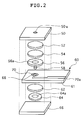
- Fig. 2 is a graph showing a schematic exploded perspective view of the specific binding assay device of the present invention.
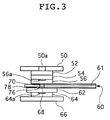
- Fig. 3 is a graph showing a schematic sectional drawing of the assembled specific binding assay device shown in Fig. 2.
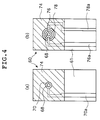
- Fig. 4 is a graph showing upside (a) and down side (b) of the electrode portion of the specific binding assay device shown in Fig. 2.
- Fig. 5 is a graph showing (a) the down side of an electrode portion having two electrodes to be used in the specific binding assay device shown in Fig. 2 and (b) the downside of an electrode portion having two electrodes on one strip-type channel (matrix) to be used in another type device of the present specific binding assay.
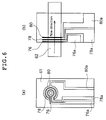
- Fig. 6 is a graph showing (a) still another example of the down side of an electrode portion having three electrodes to be used in the specific binding assay device shown in Fig. 2 and (b) the downside of an electrode portion having three electrodes on one strip-type channel (matrix) to be used in another type device of the present specific binding assay.
- Fig. 7 is a graph showing a relationship between hCG concentrations and current values measured by a plurality of detection means.
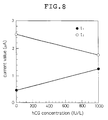
- Fig. 8 is a graph showing a relationship between hCG concentrations and current values measured by a plurality of detection means.
- Fig. 9 is a graph showing a relationship between hCG concentrations and current values measured by a plurality of detection means.
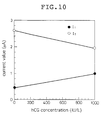
- Fig. 10 is a graph showing a relationship between hCG concentrations and current values measured by a plurality of detection means.
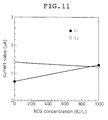
- Fig. 11 is a graph showing a relationship between hCG concentrations and current values measured by a plurality of detection means.
- Fig. 12 is a graph showing a relationship between hCG concentrations and current values measured by a plurality of detection means.
- Fig. 13 is a graph showing a relationship between hCG concentrations and current values.
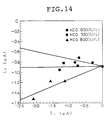
- Fig. 14 is a graph showing a relationship between current values measured at detection means 1 and 2.
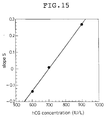
- Fig. 15 is a graph showing a relationship between hCG concentrations and slopes.
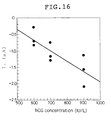
- Fig. 16 is a graph showing a relationship between hCG concentrations and measured current values by the detection means 1.
- Fig. 17 is a graph showing a relationship between hCG concentrations and current values.
- Fig. 18 is a graph showing a relationship between hCG concentrations and parameter P.
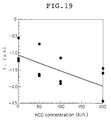
- Fig. 19 is a graph showing a relationship between hCG concentrations and current values measured by the detection means 1.
- Fig. 20 is a graph showing a relationship between hCG concentrations and current values measured by the detection means 2.
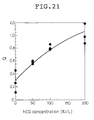
- Fig. 21 is a graph showing a relationship between hCG concentrations and parameter Q.
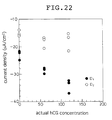
- Fig. 22 is a graph showing a relationship between hCG concentrations and current densities.
- Fig. 23 is a graph showing a relationship between hCG concentrations and parameter Q.
- Fig. 24 is a graph showing a relationship between hCG concentrations measured by the specific binding assay (device) of the present invention and those measured by enzyme immunoassay using microtiterplate.
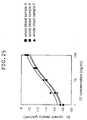
- Fig. 25 is a graph showing a relationship between E2 concentrations and current densities (D1).
- Fig. 26 is a graph showing a relationship between E2 concentrations and current densities (D1+D2).
- Fig. 27 is a schematic view showing a system of detecting signals of this invention.
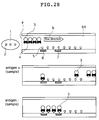
- Fig. 28 is a schematic view showing the relation between whether antigens are present or not in a sample and the distribution of the labeling enzymes (signal substance generators) in a channel by competitive type MEDIA method of the invention.
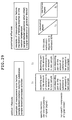
- Fig. 29 is a schematic view showing the influences which measuring error factors affect to the signal intensities I1, I2 measured at two detection means.
- each character means as follows:1, liquid sample; 2, antigen; 3, enzyme; 4, enzyme labeled antibody; 5, immobilized antigen; 6, detection means 1; 7, detection means 2; 10, signal substance generator; 12, signal substance; 14, substance related to the generation of signal substance; 50, upper cover; 50a, sample-introducing means; 52, filter; 54, first impregnation portion; 56, second impregnation portion; 56a and 64a, sealing means; 58, communication means; 60, electrode portion; 61, electrode base plate; 62, channel (matrix); 64, absorption means; 66, base cover; 68, through hole; 70, counter/reference electrode; 70a, counter/reference electrode; 74, insulating layer; 76, first working electrode (detection means 1); 76a, first working electrode terminal; 78, second working electrode (detection means 2); 78a, second working electrode terminal; 80, third working electrode (detection means 3); 80a, third working electrode terminal; a, sample-introducing means;
- substance to be assayed means a substance which is measured by the method or the device of the present invention.
- Such substances include those which are antibodies or functionally capable of acting as antigen molecules, such as proteins, polypeptides, glycoproteins, polysaccharides, complex glycolipids and the like; or nucleic acids, effector molecules, receptor molecules, enzymes, inhibitors and the like.
- such substances include: tumor markers such as ⁇ -fetoprotein, carcinoembryonic antigen (CEA), CA 125, CA 19-9 and the like; various proteins such as ⁇ 2 microglobulin ( ⁇ 2 m), ferritin and the like; various hormones such as estradiol (E2), estriol (E3), human chorionic gonadotropin (hCG), luteinizing hormone (LH), human placental lactogen (hPL) and the like; various virus-related antigens or antibody molecules such as HBs antigen, anti-HBs antibody, HBe antigen, anti-HBe antibody, anti-HBc antibody, anti-HCV antibody, anti-HIV antibody and the like; various allergens and their corresponding IgE antibody molecules; narcotic drugs, medical drugs and metabolic products thereof; and nucleic acids having virus-and disease-related polynucleotide sequences.
- tumor markers such as ⁇ -fetoprotein, carcinoembryonic antigen (CEA), CA 125,
- analogue of a substance to be assayed means a substance which shows similar behavior to the substance to be assayed in a binding reaction with a specific binding substance which will be described later.
- the substance to be assayed means a substance structurally analogous to the substances to be assayed, which includes various types of structural analogues of the substances to be assayed.
- it is used as a composing element of a signal substance generator which will be described later, mainly when a specific binding reaction is effected by a competitive method.
- the substance to be assayed is a low molecular weight steroid hormone, drug compound or the like
- its structural analogue is the same substance to be assayed or a modified compound thereof.
- the substance to be assayed is a protein, a nucleic acid or a polysaccharide
- its structural analogue means a partial peptide, a partial oligonucleotide, a partial oligosaccharide or the like.
- the substance to be assayed is an antibody or the like
- its analogues include those which can bind to a specific antigen as a specific binding substance in competition with the substance to be assayed, namely various functional analogues of antibodies, receptors, lectins and the like substances to be assayed.
- liquid sample means a liquid material which contains or probably contains a substance to be assayed.
- Illustrative examples of the liquid sample include urine, sera, blood plasma, total blood, saliva, tear fluid, cerebrospinal fluid, secretory fluids from nipples and the like.
- solid, gel or sol substances such as mucus, body tissues, cells and the like suspended or dissolved in liquid materials such as buffers, extracts, solutions and the like.
- specific binding substance means a substance which has a specific affinity for a certain substance such as a substance to be assayed, that is, a substance which is capable of undergoing a specific binding reaction with a specific substance.
- Examples of combinations of the specific substance with its corresponding specific binding substance include: antigens with corresponding antibody molecules, a nucleic acid sequence with its complementary sequence, effector molecules with receptor molecules, enzymes with inhibitors, enzymes with cofactors, enzymes with substrates, sugar chain-containing compounds with lectins, an antibody molecule with another antibody molecule specific for the former antibody, receptor molecules with corresponding antibody molecules and the like combinations.
- the combination of, for example, antigen-antibody shows the both types of combinations, namely, specific substance - specific binding substance and specific binding substance - specific substance (reverse type).
- specific binding substances include a specific binding substance which has been chemically modified to such a degree that its specific binding activity still remains intact and a complex body of a specific binding substance bound to other component.
- specific binding substances include a chemically biotin-modified antibody molecule or polynucleotide, an avidin-covalent antibody molecule and the like. Also included are antibody-enzyme, antibody-receptor and the like fusion proteins prepared by recombinant DNA techniques.
- a substance which has a portion that acts as a specific binding substance may also be used as a specific binding substance, such as the following signal substance generator.
- signal substance generator means a substance which takes part in the specific binding reaction, such as a substance which binds to a specific binding substance in competition with a substance to be assayed or a substance that specifically binds to the substance to be assayed, and can generate a signal substance directly or indirectly.
- the signal substance generator forms its distribution in a channel, depending on the amount of the substance to be assayed.
- the signal substance generator is a labeled specific binding substance consisting of a portion which acts as a specific binding substance and another portion that contributes to the formation of a signal substance which will be described later.
- the portion which acts as a specific binding substance has a structure as a specific binding substance for a substance to be assayed, or has a structure of the substance to be assayed or its analogue, and the other portion that contributes to the formation of a signal substance is composed of various types of enzymes or the like which are conventionally used as labeling agents in immunological reactions and the like.
- the signal substance generator is a substance which, on the one hand, takes part in the specific binding reaction of a substance to be assayed with a corresponding specific binding substance, thereby changing its distribution in a channel in response to the amount of the substance to be assayed, and, on the other hand, contributes to the formation of a signal substance.
- signal substance means a substance which is formed by the signal substance generator-contributing reaction and which generates a certain signal by itself or causes other substance to generate a signal at the detecting means described below.
- substance related to the generation of a signal substance may include the aforementioned signal substance generator when the term is interpreted literally. According to the present invention, however, it means a substance other than the signal substance generator, such as a precursor of a signal substance or a substance which contributes to the conversion of the precursor into its corresponding signal substance. Examples of such a type of substance include an electron mediator or a substance which generates the electron mediator, an enzyme substrate, an enzyme cofactor, a hydrogen donor and the like which will be described later.
- substance related to the generation of a signal means a substance which contributes to the generation of a signal, excluding the signal substance, when the signal substance does not generate a signal directly but causes other substance to generate a signal, or when the signal substance generates a signal in conjunction with other substance.
- signals include electron transfer which is measurable by electrochemical means, fluorescence which is measurable using a fluorophotometer, luminescence which is measurable using an luminometer and coloring which is measurable by visual judgment or using a reflect-meter.
- the electrochemical means is most preferable, because it can measure signals even in total blood and the like samples which contain blood cell components, hemoglobin and the like.
- the specific binding substance, the signal substance generator, the substance related to the generation of a signal substance and the substance related to the generation of a signal may be included in the assay device in advance or introduced into the assay device prior to, at the same time of or after the introduction of a liquid sample.
- these substances When these substances are included in the assay device in advance, they may be distributed evenly in the assay device or arranged on specified positions in the assay device so that they are dissolved when a liquid sample or a developing solution other than the sample is introduced.
- channel means a passage of the flow of a liquid sample introduced through a sample-introducing means, where a substance to be assayed and a signal substance generator are developed to generate the specific binding reaction.
- the liquid sample introduced through the sample-introducing means is introduced into the channel by an external pressure such as of a pump, an external force such as gravity, or, a spontaneous permeation.
- it is an area in which a specific binding substance is immobilized on the channel-constituting capillary or a porous member and where a specific binding reaction occurs to form a distribution along the flow direction of a liquid sample when the liquid sample and a signal substance generator flow in a predetermined direction.
- a substance to be assayed and a signal substance generator perform specific binding to a specific binding substance in a competitive manner, or the substance to be assayed binds to the specific binding substance and then the signal substance generator specifically binds to the substance to be assayed in a sandwich or the like manner, so that the specific binding reaction occurs having a distribution along the flow direction of the liquid sample and a distribution of the signal substance generator is formed in response to the concentration of the substance to be assayed in the liquid sample.
- the channel where the specific binding reaction and the like occur having a distribution along the flow direction of a liquid sample is not limited to the case in which a specific binding substance is immobilized, but may be an area where changes in the molecular weight, particle size and the like caused by the specific binding reaction are used as a distribution.
- detection means means an area where a signal generated by the signal substance is detected and a degree of signal modulation is measured by visual judgment or using an appropriate external measuring instrument depending on the signal properties.
- a plurality of the detection means are arranged at different positions along the liquid sample flowing direction in the channel, in order to enable accurate assay by minimizing influences of other factors than the concentration of the substance to be assayed, such as contaminants, viscosity and the like sample properties, reaction (development) temperature and the like environmental conditions and enzyme activity reduction, substrate decomposition and the like changes in the reagents used in the assay system.
- absorption means means a part which comprises a water-absorbable material and where, when required, the aforementioned substance related to the generation of a signal substance and the like are maintained. This means also contributes to the absorption and keeping of the introduced liquid test sample.
- the specific binding assay of the present invention is carried out using a device which comprises a sample-introducing means "a” from which a liquid sample is introduced, a liquid sample-flowing channel “b” connected thereto and a plurality (2 in the drawing) of detection means arranged at different positions in the liquid sample flow direction (direction of an arrow "x" in Fig. 1), namely a first detection means c1 and a second detection means c2 (both means will altogether be referred to as “c” hereinafter).
- a liquid sample containing unknown amount of a substance to be assayed is introduced from the sample-introducing means "a" into the device, a distribution of a signal substance generator 10 is formed in a channel "b" in response to the amount of the substance to be assayed in the liquid sample making use of at least one specific binding reaction of the substance to be assayed with a specific binding substance, followed, if necessary, by additional reaction with a substance 14 which is related to the generation of a signal substance, thereby effecting generation of the signal substance 12 by the signal substance generator 10 which is distributed in the channel "b", and then a signal generated by the signal substance 12 is measured at a detection means "c" when the signal substance reaches the detection means after its diffusion through the channel.
- the signal to be measured at the detection means "c" is rate-determined by the diffusion mass transfer of the signal substance 12 continuously generated from a number of the signal substance generator 10 distributed in the channel "b".
- the signal is dependent on a distance x1 or x2 between the signal substance generator 10 as the source of the signal substance 12 and the detection means c1 or c2, a distance in which the signal substance 12 must be transferred by diffusion in the channel.
- distribution of the signal substance generator 10 is dependent on the amount of the substance to be assayed in the liquid sample.
- diffusion distance distribution of the signal substance 12 between the signal substance generator 10 and the detection means "c” varies depending on the amount of the substance to be assayed.
- a difference in the distribution of the signal substance generator 10 can be detected as a difference in the signal generated by the signal substance 12 which reached the detection means "c".
- the specific binding assay method and the specific binding assay device of the present invention are characterized in that the amount of a substance to be assayed in a liquid sample is measured based on the signals which are generated by the signal substance 12 and detected at a plurality of the detection means "c".
- the term "specific binding reaction” means a reaction of a substance to be assayed with a specific binding substance (including the signal substance generator 10) which has a specific affinity for the substance to be assayed or a reaction of the specific binding substance with the signal substance generator 10.
- the present invention has rendered possible highly accurate and quick assay by minimizing influences on the assay results caused by various factors other than the concentration of the substance to be measured, such factors including assay conditions such as reaction (development) temperature and the like, contaminants in liquid samples and changes in the activity of reagents used in the assay caused for example by their inactivation, which has been effected on the basis of the basic concepts that:
- the present inventors have found the above basic concepts and proposed specific binding assay method and device making use thereof (cf. JP-A-5-264552 and European Patent 0,525,723 A2).
- This assay method is called MEDIA (mediator diffusion-controlled immunoassay).
- substances to be assayed in test samples can be measured quickly with a high sensitivity without requiring a step for the removal of unreacted substances.
- the present inventors have examined this relationship by experiments and experiences and found arithmetic expressions which can minimize influences of various factors other than the concentration of substances to be assayed (amount of substances in test samples) upon the signals, for example, contaminants, environmental conditions such as reaction (development) temperature and inactivation of reagents used in the assay caused such as decrease in the enzyme activity.
- the present invention has been accomplished based on a finding that more accurate specific binding assay can be made when results of the measurement of signals are arithmetically processed using this arithmetic expression.
- the present invention has been accomplished on the basis of the following technical ideas.
- the signals measured at a plurality of the detection means arranged at different positions in the flow direction are derived from the same signal substance generator, but become different functions against the concentration of a substance to be assayed in a liquid sample.
- the reason for this is that the distance distribution between the signal substance generator and each detection means varies depending on each detection means, because positions of the detection means differ from one another in the flow direction of the liquid sample, namely in the direction of the formation of the signal substance generator distribution. This means that the specific signal strength component which is dependent on the amount of the substance to be assayed substantially varies at each detection means.
- the signal measured at each detection means is originated from completely the same signal generation mechanism in which the generated signal is measured when a specified signal substance reaches the detection means by means of diffusion, so that the signal also undergoes influences of contaminants in the liquid sample, environmental conditions such as reaction (development) temperature and inactivation of reagents used in the assay caused such as decrease in the enzyme activity in the same manner.
- the signal measured at each detection means is a mixture consisting of the specific signal strength component which is dependent on the amount of the substance to be assayed and non-specific signal strength components.
- the non-specific signal strength components are mixtures of the additive components which influence additively to the specific signal strength and proportional components which influence proportionally to the specific signal strength, as shown in Fig. 27.
- the present inventors have examined relationships between signals measured at plural detection means, which seemingly have different tendencies in the response to the amount of the substance to be assayed in the liquid sample, and between these signals and the amount of the substance to be assayed, and found arithmetic expressions (relational expressions) which can reduce influences of various factors other than the concentration of substances to be assayed from the data measured at a plurality of detection means arranged at different positions in the flow direction of the liquid sample.
- the accurate specific binding assay method which can minimize influences of samples, assay environment, periodical changes in the assay device and the like was realized by calculating the amount of the substance to be assayed from a plurality of detection results using this relational expression.
- the specific binding assay method (device) of the present invention provides a novel, so-called standardless assay technique by which the amount of a substance to be assayed can be calculated by merely measuring an unknown sample.
- a technical idea is completely different from the prior art signal correction method in which a specific binding reaction with a standard substance or a standard signal generation reaction is carried out separately or simultaneously in the same device, and the signal of an unknown substance to be assayed is judged using the standard signal.
- Positional gaps among a plurality of detection means in the flow direction are not particularly limited, but, according to an examination conducted by the present inventors, it is preferable to arrange plural detection means with a geometric distance of 10 ⁇ m or more, more preferably 100 ⁇ m or more, in the liquid flow direction of the channel "b" in the case of the present invention in which a specific binding reaction is employed.
- Such an arrangement renders possible the detection of significantly different signals at a plurality of the detection means, which are rate-determined by the mass transfer (diffusion) of the signal substance 12 in response to the formed distribution of the signal substance generator 10 by the specific binding reaction, and the realization of accurate assay by preparing an arithmetic expression which can minimize influences of other factors than the concentration of the substance to be assayed upon the assay results.
- the influences to the non-specific signal strength including additive factors and proportional factors can be detected and deleted by using proper relation formulae derived from the detected data.
- distribution of the signal substance generator 10 in the channel "b" is changed by the specific binding reaction in response to the amount of a substance to be assayed in a liquid sample, and the distribution changes are measured at a plurality of the detection means arranged at different positions in the flow direction of the liquid sample.
- the specific binding reaction of the method of the present invention in which a binding substance specific for a substance to be assayed is used, the following describes some immunological reactions (specific binding reactions) in the channel "b" in the case of a substance to be assayed which is a component of an immunological reaction system.
- a first example is a competitive method which is carried out by immobilizing the same substance to be assayed or an analogous substance thereof.
- the same substance to be assayed or an analogous substance thereof is immobilized on the channel "b", and a combined body of an anti-substance to be assayed antibody as a specific binding substance and a label (for example, an enzyme which takes part in the generation reaction of the signal substance 12) is used as the signal substance generator 10.
- a label for example, an enzyme which takes part in the generation reaction of the signal substance 12
- a substance to be assayed in a liquid sample and the same but immobilized substance to be assayed (or an analogue thereof) are allowed to react with the antibody moiety (specific binding substance) of the signal substance generator 10 in a competitive manner, by mixing the liquid sample with the signal substance generator 10 in advance and introducing the mixture into the channel "b” or by mixing the liquid sample with the signal substance generator 10 at an impregnation portion containing the signal substance generator 10, located on an upstream area of the channel "b", and allowing the mixture to flow into the channel "b".
- distribution of the signal substance generator 10 shifts to more downstream side in the channel "b" when the amount of the substance to be assayed is large.
- This method can be used suitably for either of low molecular weight substances to be assayed such as haptens and high molecular weight substances to be assayed.
- the substance to be assayed is a hapten
- the same hapten as the substance to be assayed or other hapten with which a specific binding substance can undergo a cross reaction may be immobilized on the channel "b" in such a manner that the specific binding substance can be bonded thereto.
- the substance to be assayed is a high molecular weight substance such as a protein
- the protein itself or a peptide sequence of an epitope to which the specific binding substance can be bonded may be immobilized on the channel "b".
- a second example is a sandwich method which is useful when the substance to be assayed is a high molecular weight compound that can bind simultaneously to a plurality of antibody molecules.
- an antibody specific for an epitope A as a first specific binding substance of a substance to be assayed is immobilized on the channel "b" and a combined body of a label with an antibody specific for an epitope B which is a second specific binding substance of the substance to be assayed is used as the signal substance generator 10, and the reaction with the substance to be assayed is effected by mixing the liquid sample with the signal substance generator 10 in advance and introducing the mixture into the channel "b” or by mixing the liquid sample with the signal substance generator 10 at an impregnation portion containing the signal substance generator 10, located on an upstream area of the channel "b", and allowing the mixture to flow into the channel "b".
- the substance to be assayed in the liquid sample is allowed to react in a sandwich type fashion.
- distribution of the signal substance generator 10 shifts to more upstream side in the channel "b" when the amount of the substance to be assayed is large.
- an antigen to be used as a specific binding substance is immobilized on the channel "b", and a combined body of an anti-(antibody) antibody with a label is used as the signal substance generator 10 and allowed to react with the substance to be assayed.
- a third example is a competitive method which is carried out by immobilizing a binding substance specific for a substance to be assayed.
- an anti-substance to be assayed antibody to be used as a specific binding substance is immobilized on the channel "b" and a combined body of a label with the same substance to be assayed or an analogue thereof, which competes with the substance to be assayed for the immobilized specific binding substance, is used as the signal substance generator 10, and the substance to be assayed in a liquid sample and the signal substance generator 10 are allowed to react with the immobilized specific binding substance in a competitive manner, by mixing the liquid sample with the signal substance generator 10 in advance and introducing the mixture into the channel "b” or by mixing the liquid sample with the signal substance generator 10 at an impregnation portion containing the signal substance generator 10, located on an upstream area of the channel "b", and allowing the mixture to flow into the channel "b".
- distribution of the signal substance generator 10 shifts to more downstream side in the channel "b" when the amount of the substance to be assayed is large.
- the substance to be assayed is an antibody
- an antigen or an epitope moiety to be used as a specific binding substance is immobilized on the channel "b"
- a combined body of a label with another antibody which competes with the antibody to be assayed for the immobilized specific binding substance is used as the signal substance generator 10.
- the substance to be assayed is a microorganism (a pathogenic fungus or the like for example) and the signal substance generator 10 is a labeled specific binding substance obtained by binding a labeling agent to an anti-microorganism antibody (anti-pathogenic fungus antibody or the like)
- travel speed or reaching point of a combined body of the substance to be assayed and the signal substance generator 10 in the channel "b" is considerably different from that of the free-state signal substance generator 10, because the size of the substance to be assayed (microorganism) is fairly large in comparison with the signal substance generator 10.
- the substance to be assayed is not bound to the channel "b" but its distribution in the channel "b” is localized, and the signal substance generator 10 which is capable of undergoing a specific binding reaction with the substance to be assayed is distributed in the channel "b" in response to the amount of the substance to be assayed.
- the measurement may be effected making use of the formation (so-called gel immunoprecipitation reaction) of a spontaneous precipitation complex (immunoprecipitate) of a free labeled antibody and a free substance to be assayed.
- the amount of the formed immunoprecipitate changes in response to the amount of the substance to be assayed and the formed immunoprecipitate is trapped in an upper area of the channel "b" which comprises a porous material and/or a gel carrier, but the free-state labeled antibody which did not take part in the immunoprecipitation reaction can travel downward in the channel "b".
- distribution of the signal substance generator 10 changes in response to the amount of the substance to be assayed in a test sample.
- Table 1 shows six typical examples of the signal generation in the assay method of the present invention.
- the upper row shows reaction steps using the aforementioned terminology of this invention, and the lower row explains illustrative examples thereof.
- the type 1 is an example in which an electrode is used as the detection means "c" and electron transfer is used as the signal. The following describes this type of signal generation with reference to Fig. 1.
- a substance 14 related to the generation of a signal substance p-aminophenyl- ⁇ -D-galactoside
- a signal substance generator ⁇ -galactosidase-labeled specific binding substance 10 in a channel "b”
- the substance 14 related to the generation of a signal substance is converted into a signal substance (p-aminophenol) 12.
- the signal substance 12 reaches an detection means c1 or c2 (electrode, set at an electric potential of +400 mV (vs.
- the signal substance 12 is converted into p-benzoquinone monoimine by oxidation and, at the same time, generates oxidation current (electron transfer) as a signal at each detection means "c". Thereafter, values related to the electron transfer signal are measured as the quantity of electricity or current values.
- the type 2 is an example in which an electrode is used as the detection means "c", electron transfer is used as the signal and an electron mediator is used for the transfer of electron.
- electron mediator means, in accordance with the present invention, a generic name of oxidation-reduction compounds which mediate between an enzyme reaction and an electrode reaction, thereby rendering possible electron transfer between the two reactions.
- Such compounds include a substance which does not form substantially irreversible by-products both in the two reactions and is capable of undergoing cycling between the two reactions.
- a substance 14 related to the generation of a signal substance a combination of glucose and ferricinium ion as an oxidation type electron mediator
- a signal substance generator glucose oxidase-labeled specific binding substance
- the ferricinium ion is converted into ferrocene which is a reduction type electron mediator to be used as the signal substance 12.
- an detection means c1 or c2 electrode, set at an electric potential of +400 mV (vs.
- the signal substance 12 is oxidized and reversed into the oxidized state ferricinium ion as the oxidation type electron mediator and, at the same time, generates oxidation current (electron transfer) as a signal at each detection means "c".
- diffusion transfer of the electron itself between electron mediators by electron hopping or the like and measurement of the resulting signal (electron transfer) generated at the detection means "c" may also be applicable.
- Illustrative examples of the reduction type electron mediator which becomes the substance 14 related to the generation of a signal substance include hydroquinone, p-phenylenediamine (PPD), N,N-dimethyl-p-phenylenediamine (DMPD), N,N,N',N'-tetramethyl-p-phenylenediamine (TMPD), N,N,N',N'-tetraethyl-p-phenylenediamine (TEPD), N,N,N',N'-tetrakiscarboxymethyl-p-phenylenediamine (TCPD), N,N,N',N'-tetrakis-(2-hydroxyethyl)-p-phenylenediamine (THEPD), N,N,N',N'-tetrakis-(2,3-dihydroxypropyl)-p-phenylenediamine (TDHPD) and the like, of which TDHPD, TCPD and THEPD are particularly preferred.
- the type 4 is an example in which an enzyme electrode is used as the detection means "c" and electron transfer is used as the signal.
- an electron mediator and/or an electrically conductive high molecular compound (polypyrrole, polythiophene or the like) as composing elements in the enzyme electrode portion, in order to improve performance of the enzyme electrode.
- Reaction of a signal substance with a detection means "c" (enzyme electrode) and resulting direct or indirect generation of a signal (electron transfer) are not affected by these composing elements.
- Preferred examples of the signal substance include a substrate, a cofactor, a coenzyme and the like which correspond to the enzyme electrode.
- the signal generation-related substance may be located on the detection means "c" and/or in an area close to the detection means "c".
- a substance 14 related to the generation of a signal substance a combination of glucose and dissolved oxygen
- a signal substance generator glucose oxidase-labeled specific binding substance
- a signal substance (hydrogen peroxide) 12 is formed.
- the signal substance 12 reaches an detection means c1 or c2 (peroxidase electrode, set at an electric potential of -150 mV (vs. Ag/AgCl)
- the signal substance 12 receives electron from the electrode, mediated or not mediated by an electron mediator, and reacts with a substance 15 related to the generation of a signal (hydrogen ion). In this way, the signal substance 12 is reduced and, at the same time, a signal (electron transfer) is generated at the detection means "c" (peroxidase electrode).
- the type 5 is an example in which the detection means "c" is a part where an enzyme (peroxidase) is substantially immobilized and luminescence is used as the signal. Also in this example, a signal substance 12 itself does not generates the signal so that a substance related to the generation of signal is used.
- an enzyme peroxidase
- the signal substance 12 When the signal substance 12 reaches an detection means c1 or c2 (peroxidase-immobilized part) it changes a substance related to the generation of a signal (luminol) 15 to generate a signal (luminescence).
- an detection means c1 or c2 peroxidase-immobilized part
- the type 6 is an example in which the detection means "c" is a part where an enzyme (peroxidase) is substantially immobilized and coloration is used as the signal.
- a signal substance 12 itself also does not generates the signal so that a substance related to the generation of signal is used.
- a substance 14 related to the generation of a signal substance a combination of urate and dissolved oxygen
- a signal substance generator uricase-labeled specific binding substance 10 in a channel "b”
- a signal substance (hydrogen peroxide) 12 is formed.
- the signal substance 12 reaches an detection means c1 or c2 (peroxidase-immobilized part) it changes a substance related to the generation of a signal (orthodianisidine) to generate a signal (coloration).
- each detection means "c" Thereafter, coloration after or until a predetermined time elapse is measured at each detection means "c" by detecting absorbance or reflected light of the color or visually observing the color.
- Table 2 shows an example of the combination of an enzyme (a label, a composing element of the signal substance generator in Table 1), which is suitable for use in the generation of a signal substance, with its substrate (a substance related to the generation of the signal substance in Table 1).
- an oxidation-reduction substance known as an electron mediator is used as a substrate of Table 2 instead of O2.
- the reaction shown in Table 1 is effected in which the signal substance 12 (an electron mediator in the reduction state) is generated, electrons are released from the signal substance 12 to an electrode charged with an electric potential corresponding to the electron mediator in the same manner as the case of the type 1, and the electron mediator itself returns to its oxidation state.
- electron mediators which include metal ions, metal complexes, ruthenium complex compounds, ferrocene compounds, quinone compounds, viologen compounds, porphyrin derivatives and the like. Also included are compounds which take part in enzyme reactions as hydrogen donors.
- electron mediators are shown in Table 3, though chemically modified products of these examples or other suitable electron mediators can also be used.
- electron mediators are not limited to those which change from the oxidation state to the reduction state by the action of the signal substance generator 10, but those having the function to change from the reduction state to the oxidation state may also be used.
- a hydrogen donor shown in Table 2 namely a reduction type mediator, is used.
- Such a mediator can effect the reaction shown in Table 1 in which the signal substance 12 (an electron mediator in the oxidation state) is generated, the signal substance 12 accept electrons from electrode at an electrode charged with an electric potential corresponding to the electron mediator in the same manner as the case of the type 1, and the electron mediator itself returns to its reduction state.
- the type 4 in Table 1 shows an example in which an enzyme electrode is used as the detection means "c".
- types of the enzyme used in the enzyme electrode are limited depending on the types of the signal substance 12 generated by the first stage reaction.
- an enzyme electrode to which a peroxidase such as horseradish peroxidase or the like has been immobilized may be used as the detection means "c" (cf. J.E. Frew et al., J. Electoanal. Chem ., vol.201, pp.1 - 10, 1986; R.M. Paddock and E.F. Bowden, J. Electoanal. Chem ., vol.260, pp.487 - 494, 1989; and Ulla Wollenberger et al. Analytical Letters , vol.23, pp.1795 - 1808, 1990).
- an electron mediator may be used as a substance related to the generation of a signal in some cases as shown in Table 1. In that case, the electron mediator generates an electron transfer as a signal at the detection means via an enzyme reaction and an electrode reaction.
- Chemically modified electrodes are known as analogous means of the enzyme electrode, which are disclosed for instance by R.W. Murray (Chemically Modified Electrode, Electroanalytical Chemistry , vol.13, pp.191 - 368, Marcel Dekker, Inc., New York, 1084), by K. Nakamura, M. Aizawa and O. Miyawaki ( Electroenzymology Coenzyme Regeneration , Springer-Verlag, Berlin, 1988) and by V.J. Razumas, J.J. Jasaitis and J.J. Kulys, Bioelectrochemistry and Bioenergetics , vol.12, pp.297 - 322, 1984).
- a typical combination of the substances related to the second stage reaction may be peroxidase with 4-hydroxyphenyl acetate or 3-(4-hydroxyphenyl) propionate.
- the signal when the signal is luminescence, the following combinations may be used. That is, when the signal substance 12 is ATP, a typical combination of the substances related to the second stage reaction may be firefly luciferase with luciferin and Mg2+. When the signal substance 12 is NADH, the combination of the substances related to the second stage reaction may be NAD(P)H:FMN oxidoreductase and a luciferase of luminescent bacterium origin with FMN and a saturated long chain aliphatic aldehyde such as tetradecanal.
- each of the detection means c1 and c2 may be constructed by immobilizing at least one of the substances which take part in the second stage reaction, but preferably an enzyme from a reaction efficiency point of view.
- luciferin is formed as the signal substance 12 when a luciferin derivative such as D-luciferin-o-phosphate is used as the substance related to the generation of the signal substance 12 and alkaline phosphatase is used as a labeling agent which constitutes the signal substance generator 10, and luminescence (signal) is generated when luciferin is treated with luciferase in the presence of ATP and Mg2+.
- a luciferin derivative such as D-luciferin-o-phosphate
- alkaline phosphatase alkaline phosphatase
- each of the detection means c1 and c2 may be constructed by immobilizing at least one of ATP, Mg2+ and luciferase, but preferably luciferase from a reaction efficiency point of view.
- a typical combination of the substances related to the second stage reaction may be peroxidase with a coloring substance precursor such as 5-aminosalicylic acid, o-dianisidine, 2,2'-azino-di-(3-ethylbenzothiazoline-6-sulfonate) diammonium salt (ABTS), 3-methyl-2-benzothiazolinehydrazone (MBTH) and 3-(dimethylamino)benzoic acid (DMAB), or o-tolidine, 3,3'-diaminobenzidine ((DAB), 1,2-phenylenediamine, 3,3',5,5'-tetramethylbenzidine or the like.
- a coloring substance precursor such as 5-aminosalicylic acid, o-dianisidine, 2,2'-azino-di-(3-ethylbenzothiazoline-6-sulfonate) diammonium salt (ABTS), 3-methyl-2-benzothiazolinehydrazone (MBTH) and 3-(dimethyl
- the combination of the substances related to the second stage reaction may be diaphorase with a coloring substance precursor such as iodonitrotetrazolium violet.
- each of the detection means c1 and c2 may be constructed by immobilizing at least one of the substances which take part in the second stage reaction, but preferably an enzyme from a reaction efficiency point of view.
- the assay device for use in the specific binding assay of the present invention basically comprises a sample-introducing means "a", a channel "b" and a plurality of detection means "c".
- a substance related to the generation of a signal substance and/or a substance related to the generation of a signal may be located at an appropriate liquid sample-flowing part of the assay device.
- the sample-introducing means "a” is an entrance connected to the channel “b” for use in the introduction of liquid samples and the like into the channel “b” from its predetermined site.
- sample-introducing means "a” is generally used as a liquid sample-introducing entrance connected to the channel "b", it may be used also as a space where a liquid sample necessary for the assay is temporarily stored. As occasion demands, the sample-introducing means "a” may be equipped with a filter capable of removing contaminants and the like.
- an impregnation portion may be arranged between the sample-introducing means "a” and the channel "b", which is impregnated with various substances required for the reaction, such as the signal substance generator 10, the substance 14 related to the signal substance generation, a substance related to the signal generation, a specific binding substance and the like.
- the channel “b” is a portion connected to the downstream side of the sample-introducing means "a", where an introduced liquid sample is allowed to flow and a distribution of the signal substance generator 10 is formed in response to the amount (concentration) of a substance to be assayed in the liquid sample.
- the liquid sample it is desirable to allow the liquid sample to flow spontaneously on the channel "b" without applying an external force such as of a pump, in order to simplify the assay operation. Because of this, it is desirable to construct the channel “b” with a capillary or narrow gaps or a porous member. Construction of the channel “b” with a capillary or porous member will provide additional effects such as increase in the efficiency of the specific binding reaction and formation of clear distribution of the signal substance generator.
- an absorption means may be connected to the downstream side of the channel "b", in order to enhance spontaneous flow of the liquid sample and to increase volume of the liquid sample passing through the channel "b".
- the channel "b" is prepared from for example a porous carrier or a gel carrier.
- a gel carrier it is preferable to use a material which becomes the state of gel or sol when contacted with a test sample.
- a porous carrier is preferably in any case.
- a porous carrier may be impregnated with a water soluble high molecular compound and then dried to use as the channel "b".
- a material in which a solid substance is kept in the porous carrier or the like may also be used as the channel "b".
- porous carrier examples include: porous membranes made of cellulose acetate, cellulose nitrate, nylon and the like; filter papers made of glass fibers, cellulose fibers and the like; and porous ceramics and the like.
- gel carrier examples include agar, agarose, dextran, polyacrylamide and the like.
- Illustrative examples of the aforementioned water soluble high molecular compound include starch and derivatives thereof, mannan, galactan, agar, sodium alginate, gum arabic, dextran, gelatin, casein, collagen, methyl cellulose (MC), ethyl cellulose (EC), hydroxyethyl cellulose (HEC), carboxymethyl cellulose (CMC), polyvinyl alcohol (poval), sodium polyacrylate and the like.
- Illustrative examples of the solid substance described above include porous particles such as of dextran and the like, latexes made of polystyrene and the like, and fine particles such as of glass and the like or modified products thereof produced by adding active groups for binding use.
- the channel "b" is a site where a specific binding reaction is carried out as described in the foregoing, constitution of this part exerts a great influence on the detection results.
- the channel "b” in such a manner that it can show appropriate properties in response to the kind of substances to be assayed, the type of specific binding reactions (for example, competitive type and sandwich type) and the like conditions. That is, distribution conditions of a signal substance generator and diffusion velocities of a signal substance and the like are optionally controlled by selecting appropriate construction material of the channel "b” and adjusting its size (thickness), pore size and viscosity (consistency) when changed to the state of gel.
- properties of the channel "b" can be controlled minutely when it is constructed from a plurality of structures and materials, such as a laminated body or the like.
- difference in the distribution of a signal substance generator after a specific binding reaction in response to the amount of a substance to be assayed can be detected more clearly when a construction material having a small pore size is used in the vicinity of the detection means c1 and c2 and another construction material having a large pore size is used in its sample-introducing means "a" side.
- Such an effect may be realized by the use of a polyacrylamide gradient gel or a laminated porous membranes having different pore sizes.
- a specific binding substance for a substance to be assayed When a specific binding substance for a substance to be assayed is included or immobilized in the channel "b", it may be included or immobilized uniformly in the entire area of the channel, or localized in a part of the channel "b". Alternatively, a density gradient may be effected by including or immobilizing the specific binding substance in a large amount in the upstream area of the channel and in a small amount in its downstream area.
- Immobilization of a specific binding substance for a substance to be assayed in the channel "b” may be attained by immobilizing it in a porous carrier or a gel carrier through covalent bonding or adsorption.
- immobilization of the specific binding substance may be applied to all of the channel-composing elements or to a part of them.
- Length of the channel "b" in the sample flow direction of the assay device of the present invention may be generally in the range of from about 10 ⁇ m to several tens in mm, because necessary amount of a liquid test sample can be minimized by reducing the channel length, but changes in the distribution of a signal substance generator in response to the amount of a substance to be assayed in the test sample become unclear when the channel length is too small.
- the detection means "c" is a portion by which a signal generated by a signal substance gotten thereto can be measured as its degree of modulation with the naked eye or using an external instrument appropriately selected depending on the type of each signal, which is arranged in the direction of the liquid sample flow in plural numbers at different positions where they can receive the signal substance 12 from the channel "b".
- At least one of the plural detection means “c” may be arranged at a position where the signal modulation generated from the positional distribution of the signal generator 10 in the channel “b" is large. In general, such a position is the most downstream or upstream side in the channel "b".
- the other detection means may be arranged also at a position where the signal modulation generated from the positional distribution of the signal generator 10 in the channel "b" is large or at a position where it can hardly receive the signal modulation generated from the positional distribution of the signal generator 10 in the channel "b".
- the inventive assay method making use of a plurality of detection means cannot be effected when the plural detection means are completely the same with each other with regard to the changes in the positional distribution of the signal substance generator in the channel "b" so that a difference in the signal modulation cannot be observed between these detection means.
- a plurality of the detection means are arranged at different positions in the liquid flow direction of the channel "b". Since changes in the distribution of the signal substance generator in the channel "b" in response to the amount of a substance to be assayed occur basically in the flow direction of the liquid sample, signal modulations detected at a plurality of detection means do not become equal when they are arranged at different positions in the liquid flow direction in the channel "b".
- Detection methods at the detection means are not particularly limited, and various known methods can be applied depending on each signal generated by a signal substance (or a signal generated by the detection means via a signal substance). Particularly preferred are electrochemical measuring methods.
- the detection means when the signal is electrochemical, various types of working and reference electrodes can be used as the detection means, such as a platinum electrode, a gold electrode, a carbon electrode and the like, of which a carbon print electrode is particularly preferred from a production point of view.
- a liquid-impermeable plate such as a PET film, a vinyl chloride plate, a glass plate or the like or a liquid-permeable sheet such as a filter paper or the like may be used as an electrode base.
- a microarray electrode may be constructed.
- An Ag/AgCl electrode or the like may be used as a reference electrode of the above electrode, which can be produced making use of printing techniques and the like.
- Specificity and sensitivity of the electrode reaction can be improved when an enzyme electrode is used as the detection means "c".
- a signal substance functions as a substrate or a cofactor of the enzyme electrode, and a signal is detected when electron transfer is effected on the electrode.
- Various types of the enzyme electrode are known in the fields of biochemical analysis and analytical chemistry.
- the detection means "c" is actually an luminescence generation part where a substance which takes part in at least one signal generation necessary for the luminescence reaction is substantially immobilized, a fluorescence generation part where a substance which takes part in at least one signal generation necessary for the fluorescence reaction is substantially immobilized or a color generation part where a substance which takes part in at least one signal generation necessary for the coloring reaction is substantially immobilized.
- the detection means “c” When the detection means “c” is a site where fluorescence, luminescence, coloring or the like is detected, the detection means “c” may be prepared by immobilizing the aforementioned signal generation-related substance in an area of the aforementioned channel "b" or of a portion of an absorption means which will be described later, or on a base when the base is arranged in the downstream side of the detection means "c". In that instance, the immobilization may be effected by various means, for example, by binding an enzyme of interest using glutaraldehyde to the surface of a glass base which has been treated with 3-aminopropyltriethoxysilane
- the assay device of the present invention may have a support (or base) and a cover.
- Fig. 2 shows an exploded perspective view of an example of the specific binding assay device of the present invention in which the measurement is carried out based on an electrochemical signal
- Fig. 3 shows its sectional view when assembled.
- the assay device shown in Fig. 2 is composed of an upper cover 50, a filter 52, a first impregnation portion 54, a second impregnation portion 56, a communication means 58, an electrode portion 60 having a plurality of detection means, a channel (matrix) 62, an absorption means 64 and a lower base 66 in that downward order, and these members are assembled by superposing them upon one another in such order as shown in Fig. 3.
- a sample-introducing means is composed of the upper cover 50 (its sample-introducing hole 50a), the filter 52, the first impregnation portion 54, the second impregnation portion 56 and the communication means 58.
- the filter 52, the first impregnation portion 54, the second impregnation portion 56 and the communication means 58 are arranged as occasion demands or as a preferred mode in response to the specific binding substance to be used in the assay or the construction of the device, so that the present invention is not restricted by these members.
- the sample-introducing means may be formed by using only the sample-introducing hole 50a through which a liquid sample is introduced directly into a channel 62 or by combining it with other optionally selected members depending on each purpose.
- the upper cover 50 is formed from various materials as described in the foregoing, and its central portion has the sample-introducing hole 50a for use in the injection of a liquid sample.
- the filter 52 is generally ode of woven fabric, non-woven fabric or the like and, in case of need, the filter 52 may be used for the purpose of removing solid materials (interfering materials) which are contained in test samples and unnecessary for the assay and of effecting uniform introduction of the test sample.
- Each of the first impregnation portion 54 and the second impregnation portion 56 is optionally arranged depending on the type of the liquid sample, the substance to be assayed, the specific binding reaction to be applied and the like, and prepared by impregnating a piece of glass fiber filter paper, cellulose fiber filter paper, non-woven fabric or the like with various substances and then drying the impregnated piece.
- impregnating substances examples include a signal substance generator, a substance related to the generation of a signal substance, a substance related to the generation of a signal, an electron mediator and its stabilizing or protecting agent, a salt component for use in the adjustment of ionic strength and/or pH, a buffer solution, a liquid sample flow-smoothing agent such as a surface active agent or the like.
- a signal substance generator and the like are eluted and mixed with the liquid sample or the reaction starts.
- first impregnation portion 54 and the second impregnation portion 56 may be made into a single impregnation portion.
- first impregnation portion 54 and the second impregnation portion 56 renders possible prolongation of the flowing time of test samples to obtain sufficient reaction time.
- a water-impermeable sealing means 56a is formed on the central portion of the upper surface of the second impregnation portion 56 as a preferred mode.
- the sealing means 56a By the use of the sealing means 56a, the sample flow originally vertical in direction can be changed to the horizontal direction, which renders possible prolongation of the flowing time of test samples to obtain sufficient reaction time and simultaneous improvement of the reaction efficiency through the mixing effect, hence resulting in the realization of more accurate measurement.
- Materials and methods for the formation of the sealing means 56a are not particularly limited, and it may be formed by adhering a water-impermeable material selected from various sources such as vinyl chloride, cellulose acetate, polyester and the like to the central portion of the second impregnation portion 56 using an adhesive such as an acrylic adhesive or the like.
- the first impregnation portion 54, the second impregnation portion 56 and the like are not essential elements of the assay device (assay method) of the present invention, and when these members are not used (when they are not impregnated with a signal substance generator and the like), the signal substance generator and the like essential substances may be introduced into the reaction system for example by mixing them in advance with a liquid sample or injecting them from the sample-introducing hole 50a before or after injection of the liquid sample.
- the communication means 58 is used to introduce the liquid sample and the like which passed through the second impregnation portion 56 into the channel 62 via a through hole 68 of an electrode portion 60, which is formed from glass fiber filter paper, cellulose fiber filter paper or the like.
- the communication means 58 is arranged by inserting it into the through hole 68 of the electrode portion 60 which will be described later. This means may not be required when thickness of an electrode substrate 61 is not large.
- the electrode portion 60 is composed of a plurality of detection means "c" which are essential elements of the present invention.
- the electrode portion 60 is arranged by forming a reference electrode on the upside of the insulating substrate 61 made of PET (polyethylene terephthalate) or the like, and a working electrode to be used as a detection means on its backside, and an electric signal generated in response to a signal substance generator distribution formed in the channel 62 is detected by the working electrode.
- a circular counter electrode (reference electrode) 70 and its terminal 70a are formed, as well as an insulating layer 74 shown by a shaded portion excluding the counter electrode 70.
- a circular first working electrode 76 and its terminal 76a are formed similar to the case of the upside, in addition to a roughly circular second working electrode 78 having the same center with and a larger size than those of the first working electrode 76, as well as its terminal 78a.
- an insulating layer 74 shown by a shaded portion excluding the first working electrode 76, the second working electrode 78 and a gap between them. That is, the first working electrode 76 in the illustrated example corresponds to the first detection means c1 of Fig. 1, and the second working electrode 78 to the second detection means c2.
- a through hole 68 is formed in the insulating substrate 61 penetrating the inside of the counter electrode 70 and the first working electrode 76.
- a liquid sample is introduced into the channel 62 which will be described later, through the through hole 68 or, as occasion demands, through a communication means 58 inserted into the through hole 68.
- the liquid sample in the channel 62 flows radially in outside directions from the center of the through hole 68, namely the first working electrode 76.
- the first working electrode 76 and the second working electrode 78 are arranged at different positions in the liquid sample flowing direction, by making the electrodes (detection means) into circular forms having the same center but different sizes so that the liquid sample flows from the center.
- the first working electrode 76 and the second working electrode 78 may preferably have a gap of 10 ⁇ m or more as described in the foregoing.
- the first working electrode 76 and the second working electrode 78 to be used as the detection means are formed from the aforementioned various materials.
- the counter electrode 70 is formed as a silver electrode, a silver/silver chloride electrode or the like.
- the substrate 28 is formed from various known insulating materials such as PET, polyvinyl chloride, polyimide, polyester and the like.
- the insulating layer 36 is formed from various known insulating ink materials such as acrylic resins, polyesters and the like.
- Each of the working electrodes, the counter electrode (reference electrode) and the insulating layer in the illustrated device can be formed by known film forming techniques such as screen printing, doctor knife and the like thick film forming techniques or sputtering, CVD and the like thin film forming techniques.
- the first working electrode 76, the second working electrode 78 and the like are not particularly limited to the illustrated circular shape and can be made into various shapes such as those shown in Fig. 5, provided that they are arranged at different positions (preferably with a certain distance) in the flow direction of a liquid sample.
- the plural detection means are not limited to two, and three, or even more, working electrodes may be formed as shown in Fig. 6.
- the working electrodes may also be arranged at different positions in a linear of one direction as shown in Figs. 5(b) and 6(b).
- the channel 62 functions as the channel "b" of the specific binding assay device of the present invention, where, for example, a substance to be assayed and an antibody capable of binding specifically to a signal substance generator are fixed by immobilization, and a distribution of the signal substance generator is formed in response to the amount of the substance to be assayed in a liquid sample via a specific binding reaction of the substance to be assayed and the like. Positional distributions of the signal substance generator from the first working electrode 76 and the second working electrode 78 are measured as current values via the signal substance.
- the channel 62 is formed in the same manner as the case of the aforementioned channel "b", for example by a method in which antibody, antigen, nucleic acid or the like molecules for use in the specific binding reaction are fixed to a porous membrane by immobilization and then dried.
- Excess amount of a liquid sample passed through the channel 62 is absorbed by an absorption means 64.
- the absorption means 64 absorbs excess amount of a liquid sample passed through the channel 62 as described above and is formed from for example a cellulose filter paper such as a chromatography filter paper or the like or a polymer having high water absorbing capacity.
- the absorption means 64 may be impregnated in advance with a substance related to the generation of a signal substance and/or a signal.
- a water impermeable sealing means 64a is formed on the central portion of the upper surface of the absorption means 64 as a preferred mode of the present invention.
- the use of the sealing means 64a renders possible alteration of the sample flow originally vertical in direction to the horizontal direction, so that the flowing time of test samples can be prolonged to improve the reaction efficiency and more accurate measurement can be made due to the clear distribution of signal substance generator (labeled body) in the channel.
- both specific signal intensity components and non-specific signal intensity components can be detected at the respective detection means 76 and 78.
- the detection means 76 is positioned within the width of the sealing means 64a and the other detection means 78 is positioned far from the width of the sealing means 64a, the detected signal at the detection means 78 has less specific signal intensity components. If the detection means 78 is positioned far enough from the sealing means 64a, specific signal intensity components are hardly detected at the detection means 78.
- the sealing means 64a can be formed in the same manner as the case of the aforementioned sealing means 56a.
- the illustrated example of the assay device can be prepared by superposing these members one upon another in the order shown in Figs. 2 and 3 on a lower base cover 66, and fixing these laminated members between the upper cover 50 and the lower base cover 66 using screws, bolts and nuts and the like.
- a liquid sample is injected through the sample introducing hole 50a formed in the upper cover 50 as described in the foregoing.
- the liquid sample injected through the sample introducing hole 50a passes through the filter 52 where contaminants and the like are removed, flows into the first impregnation portion 54 and then into the second impregnation portion 56.
- dried and fixed signal substance generator and the like are eluted and mixed with the test sample or the specific binding reaction of the substance to be assayed starts.
- the sealing means 56a is formed on the upper surface of the second impregnation portion 56, so that the flow direction of a liquid sample changes from vertical to horizontal to ensure sufficient reaction time as described in the foregoing.
- the liquid sample passed through the second impregnation portion 56 then passes through the through hole 68 of the electrode portion 60 via the communication means 58 and flows into the channel 62.
- the signal substance generator When the liquid sample flows into the channel 62, distribution of the signal substance generator is formed in response to the specific binding reaction of the substance to be assayed in the liquid sample, the signal substance generated by the action of the signal substance generator reaches the first working electrode 76 or the second working electrode 78 by diffusion, and distribution of the signal substance generator in the radial direction of each working electrode in the channel 62 is detected as an electrochemical signal in response to the reaction.
- the output from the first working electrode 76 or the second working electrode 78 (not only an electric signal but also other output from various detection means) is measured by adding a predetermined amount of the liquid sample to the sample introducing means and reading the output after a predetermined lapse of time or continuously until a predetermined lapse of time.
- Measurement of signals at a plurality of detection means may be carried out either simultaneously or separately. When measurement of signals at a plurality of detection means is carried out separately, each detection means may be measured repeatedly in turn.
- the data may be read for example as an output strength (for example, current value) after a predetermined lapse of time, as an average of output strength values within a predetermined period, as a time until the output reaches a predetermined strength, as an integrated value of continuous output (for example, charge quantity), or as a time until the charge reaches a predetermined value.
- an output strength for example, current value
- an average of output strength values within a predetermined period as a time until the output reaches a predetermined strength
- an integrated value of continuous output for example, charge quantity
- the following formula (2) can be obtained from the formulae (1)-1 and (1)-2.
- the amount C cannot be obtained when signals detected by two detection means are the same, namely when the formula (1) is as follows.
- I 1 f(C, Z)
- a distribution of a signal substance generator is formed in the channel in response to the amount of a substance to be assayed, by at least one specific binding reaction with the substance to be assayed in a liquid sample, to measure a signal which is rate-determined by the diffusion of a signal substance that travels by diffusion from the signal substance generator to the detection means to generate the signal.
- the signal strengths of two detection means become different functions against the amount C of the substance to be assayed when a plurality of detection means are arranged at different positions in the liquid flow direction.
- the term "different positions in the liquid flow direction" means that detection means are respectively positioned upstream and downstream of the liquid flow direction.
- the plural detection means have a positional overlap in the liquid flow direction when the electrode size is large or depending on the shape of the electrode.
- Even such a case of plural detection means can be regarded as those which are arranged at different positions in the liquid flow direction, because a difference in the signal strength can be expected when geometric centers of electrodes or their edges are different from each other.
- geometric centers of electrodes or their edges are arranged having a distance of 10 ⁇ m or more.
- the use of a plurality of detection means renders possible minimization of various non-specific influences which do not substantially take part in the distribution of a signal substance generator in the channel formed by a specific binding reaction with a substance to be assayed.
- the specific binding assay method and device of the present invention can minimize their non-specific influential portions which do not substantially take part in the distribution of the signal substance generator in the channel formed by the specific binding reaction with the substance to be assayed.
- Z was defined in the above description of mathematical formulae as the amount of contaminants in a test sample which exert influence upon the signal strength of the detection means, the same explanation can generally be made when Z is the non-specific factor of the above described item I due to contaminants in and properties of test samples, the assay environment factor of the item II or the reagent component inactivation factor of the item III.
- a signal substance (electron mediator, etc.) is generated by a signal substance generator (labeling enzyme, etc.), and the generated signal substance is detected as a signal (electric current, etc.) by use of suitable detection means (electrode, etc.).
- suitable detection means electrode, etc.
- the intensity of signal detected is dependent largely on the distance of diffusion, or substantially on the distribution of distances to the detection means, or, the distribution of numerous molecules of signal substance generator in the channel (namely, the positional distribution of signal substance generator).
- a distribution of signal substance generators is formed in a flow of a liquid sample by use of specific binding reactions in accordance with the concentration of substance to be assayed, and the aforementioned signal detection is conducted by two detection means 6 and 7 located at different positions along the flow direction in the channel b.
- the detection means are measuring the signal depending on the distribution of signal substance generators formed corresponding to the concentration of specific substances to be assayed, different signal intensities are measured due to difference in the distribution of distances between the signal substance generators and detection means coming from relative positions different to the distribution of the signal substance generator.
- signal intensities of two detection means show different response curves with regard to the concentration of the substance to be assayed in the liquid sample. Respective response curve can be approximated by a mathematical function having some of coefficients.
- the signals at two detection means are affected identically by the non-specific measuring error factor Z in the liquid sample.
- the effect of the measuring error factors on signal intensities can be classified into an additive influence and a proportional influence as mentioned in Fig. 29, however, both influences exist in both signals as a mixture. Therefore, the calibration widely used in this field for calibrating additive influence by subtracting control or reference value from the measured value, which is called as the blank calibration method, is not enough to give a result of accuracy.
- the detection means for the control or reference since detection means for the control or reference must be settled at equivalent positions of those for the measuring, and further must be so arranged as to indicate no response to the concentration of the substance to be assayed, the method is restrictive and the mechanism of assay device is complicated.
- the detection means settled at any position of the flow direction respond to the concentration of the substance to be assayed (signal from specific binding reaction of the test sample) even though the response degree is very small in some cases. Then, the detection means of the invention does not respond independently to the noise signal (error factors from non-specific influence of the test sample) but respond both the signal and the noise signal.
- present method can provide a precise calibration method. Further, in the present assay method, it is possible to minimize the effect of the non-specific measuring error factor Z containing simultaneously additive and proportional influences from consideration of its affecting evenly on a plurality of detection means.
- the present assay method it is possible to derive a relation formula for obtaining the concentration of substance to be assayed under minimized effects of measuring error factors, based on the response relationship between signal intensities in a plural detection means and concentration of substance to be assayed as well as on the relationship between signal intensities in a plurality of detection means and the non-specific measuring error factor Z.
- Several methods are available for the derivation, and the undermentioned ones are preferred due to the simplicity and high precision.
- forecast a measuring error factor foreseeable for the objective assay elect a parameter (the function of signal intensities at plural detection means) and a formula thereof to minimize the effect of the error factor, and optimize the parameter by conducting assay in the presence of the measuring error factors foreseeable.
- the additive influence can be eliminated through differences between signal intensities of a plurality of detection means, and the proportional influence is eliminated through calculating ratios, and the parameters P, G and R shown afterward are exemplified accordingly. Any formula is usable if the parameter enables to minimize the effect of measuring error factors.
- Method-2 Estimating an approximate equation for response curve, and using the formula relating the measuring error factors as the coefficients of the equation:
- the effect of the measuring error factor Z on coefficients of an approximate equation for concentrations of substance to be assayed in a plurality of detection means is approximated by functional relations, and a final formula for obtaining concentrations of substance to be assayed is derived from the approximate equation and the functional relations.
- the effect of the measuring error factor Z on coefficients of an approximate equation may be expressed as a functional relation more precisely by conducting assays under conditions of foreseeable measuring error factor Z to enable more accurate assay.
- the present invention has rendered possible provision of a simple and easy specific binding assay method and a specific binding assay device suitable for the practice of the assay method, which does not require a separation step (washing step) of unreacted substances, is excellent in general purpose performance and can be used for quick measurement and also can minimize measurement errors caused by the non-specific influence of the specific binding assay without requiring additional assay handling.
- the function f of the aforementioned formula (1) is defined by the substance to be assayed, specific binding substance, signal substance generator, signal substance, type of the specific binding reaction, type of the signal substance generation, arrangement of detection means, assay device constitution and the like.
- the function f varies depending on these factors, it is difficult in general to make the function itself into a mathematical formula.
- the parameter can be used as a function of I1 and I2 and is determined by various factors such as substance to be assayed, specific binding substance, signal substance generator, signal substance, type of the specific binding reaction, type of the signal substance generation, arrangement of detection means, assay device constitution and the like.
- parameter P u(I 1 , I 2 )
- C v(P)
- the parameter can be applied to any functional formula, provided that it is a functional formula of I1 and I2 which can minimize influence of Z.
- each of these parameters P and Q can minimize the influence of Z when heparinized plasma is used as a test sample. Also, Inventive Examples 3, 4 and 5 illustratively show that this method is useful when Z is any one of the non-specific influence of contaminant in a test sample, the reaction temperature and the change in the activity of a signal substance generator.
- the function of parameters is not limited to the case of P and Q, and a combined function of P and Q can also minimize the influence of Z.
- a, b, c, d, e and f is a constant, can be illustrated, and any function capable of reducing the influence of Z can be used as a parameter.
- There are many other useful arithmetic processing methods which can minimize influence of other factors than the concentration of a substance to be assayed upon assay results, using a plurality of detection results detected at a plurality of detection means arranged at different positions in the flow direction of a liquid sample. Since these arithmetic processing methods are different from one another in terms of the degree of minimization, a function most effective for the minimization may be used as the parameter.
- degree of the minimization of influence of various factors, excluding concentration of a substance to be assayed, upon assay results can be improved by introducing a function which is more accurate than the aforementioned parameter R and the relation formula derived from R, like the case of a relation formula S which will be described later.
- the thus obtained parameter and/or relation formula is incorporated in advance into the arithmetic processing mechanism of a measuring apparatus, or input it as a parameter in the measuring apparatus at the time of measurement and the amount of a substance to be assayed is processed and displayed after the measurement.
- Setting of these constant portions in the measuring apparatus can be effected by generally used input means which include for example setting using a hardware switch such as a ring switch, a dip switch or the like, input using an input apparatus such as a keyboard, a mouse, a pen or the like, reading of magnetic information using a magnetic tape, a magnetic card or the like, reading of electric information such as electric property value, IC memory or the like of a sensor portion and optical reading using a bar code or the like.
- a hardware switch such as a ring switch, a dip switch or the like
- input apparatus such as a keyboard, a mouse, a pen or the like
- reading of magnetic information using a magnetic tape, a magnetic card or the like reading of electric information such as electric property value, IC memory or the like of a sensor portion and optical reading using a bar code or the like.
- this device lot-dependent constant determination method by the use of a serum sample for determining the lot-dependent constants can be standardized easily and handled simply, in comparison with a constant determination method in which a whole blood sample is used for determining the lot-dependent constants, and therefore is suitable for the device lot management at the time of the assay device production.
- a hapten namely estradiol
- a competitive method is used as the specific binding reaction, so that a signal intensity I1 at the first detection means against the concentration C of the substance to be assayed in a test sample fits to an S-shaped curve such as a logistic curve (formula 4).
- an S-shaped curve such as a logistic curve (formula 4).
- b1 and c1 in the formula (4) are constants, but a1 and d1 are functions of Z which vary depending on each whole blood sample.
- a signal intensity I2 at the second detection means against the concentration C of the substance to be assayed in a test sample also fits to a logistic curve (formula 5).
- b2 and c2 in the formula (5) are constants, but a2 and d2 are functions of Z which vary depending on each whole blood sample.
- the sum of the signal intensities (I1+I2) or the difference of the signal intensities (I1-I2) also may fit S-shaped curve such as logistic curve. Therefore, when one of the I1 and I2 is replaced with (I1+I2) or (I1-I2) in the formulae (4), (5), (6) and (7), the relation formula C described above can also be derived in the same procedure. In Inventive Example 7, the relation formula is obtained by using I1 and I1+I2.
- the aforementioned dependency of coefficients a1, d1, a2 and d2 on whole blood samples means that a1, d1, a2 and d2 are changed by Z such as aforementioned contaminants in the sample, sample properties, assay environment, changes in sample component activities and the like.
- the coefficients a1, d1, a2 and d2 respectively correspond to the positions of the lower and upper asymptotic lines of the S-shaped response curve of the first detection means and the lower and upper asymptotic lines of the S-shaped response curve of the second detection means.
- a1 can be regarded as a signal strength of the first detection means when concentration of a substance to be assayed in a test sample is sufficiently low
- d1 can be regarded as a signal strength of the first detection means when concentration of a substance to be assayed is sufficiently high
- a2 as a signal strength of the second detection means when concentration of a substance to be assayed is sufficiently low
- d2 as a signal strength of the second detection means when concentration of a substance to be assayed is sufficiently high.
- these functional relationships can be explained as follows.
- Measurement of a plurality of whole blood samples means simply that a functional relationship which reflects the appearance of the influence of Z with a certain regularity in each coefficient is determined by measuring a plurality of test samples having different Z values.
- testing samples to be used in the derivation of such relation formula specific for the assay device lot are not limited to whole blood samples, and other samples having different Z values whose similarity to the behavior of whole blood samples are already known can also be used.
- Such samples for testing use can be obtained for example by adding Z elements to standard serum or standard plasma samples.
- Z elements to be added include contaminants, activities analogous to those of signal substance generators, factors which change sample properties and substances which inhibit signal substance generators or signal substances.
- Illustrative examples of preferred Z elements include enzymes such as peroxidase, catalase and the like, blood pigment components or hemolytic components such as hemoglobin and the like, oxidation-reduction compounds such as ascorbic acid, uric acid and the like, pH-fluctuating elements such as acidic or basic components, ionic strength-fluctuating elements such as salts and the like, cofactors such as metal ions, coenzymes and the like, enzyme inhibitors and viscous substances such as polysaccharides and the like.
- Examples of preferred Z elements which can be added to effect fluctuation of hematocrit values include latex particles, fine polymer particles and blood cell analogues such as fixed blood cells and the like, as well as a testing sample to which an electron mediator and/or enzyme-labeled substance is added in order to fluctuate concentration of the electron mediator or enzyme-labeled substance which is apt to receive influence of hematocrit values.
- the Z elements are not necessarily such added substances, and the testing may be carried out by changing the reaction temperature as an assay environment-fluctuating factor or after changing activities of reagent components contained in the assay device by treating them under a high temperature or high moisture condition.
- the testing means are not particularly limited to these examples, and any other means can be used provided that the relation formula can be determined thereby.
- the description in Inventive Example 7 or in the above is based on a case in which the signal strength of the second detection means also responds depending on the concentration of a substance to be assayed. Since the first and second detection means are arranged at different positions in the liquid flow direction, responses of signal strengths of respective detection means to the concentration of a substance to be assayed do not become the same, so that the internal parameter relational formula can be derived.
- the first and second detection means can be arranged in such a manner that responses of signal strengths of respective detection means to the concentration of a substance to be assayed become completely different from each other.
- An example of such an arrangement is a case in which, in the electrode portion 60 shown in Fig.
- Electrode portion 60 shown in Fig. 4 were prepared by subjecting the front and back sides of a transparent PET film having a thickness of 0.25 mm to screen printing using a conductive carbon ink (400-CT, manufactured by Asahi Kaken), a conductive silver paste (LS411N, manufactured by Asahi Kaken) and a resist (XB-101G, manufactured by Fujikura Kasei).
- a conductive carbon ink 400-CT, manufactured by Asahi Kaken
- LS411N conductive silver paste
- XB-101G manufactured by Fujikura Kasei
- the front side of the PET film to be used as the insulating base 61 was subjected to screen printing using the carbon ink to form the counter electrode (reference electrode) 70 and the terminal 70a, followed by the formation of the insulating layer 74 using the insulating resist.
- the counter electrode 70 was further subjected to finish coat printing using the silver paste.
- the first working electrode 76, its terminal 76a, the second working electrode 78 and its terminal 78a were formed on the back side of the PET film to be used as the insulating substrate 61 in the same manner using the carbon ink, followed by the formation of the insulating layer 74 (that is, silver paste printing was not applied).
- the PET film was cut into a size of 50 mm in length and 20 mm in width, and the through hole 68 was formed by punching the central portion of the counter electrode 70 and the first working electrode 76. In this way, a total of 7 types of the electrode portion 60 shown in Fig. 4 were prepared, each having different sizes of the first working electrode 76, the second working electrode 78, the through hole 68 and the like.
- Data of each working electrode on the back side of the electrode portion 60 are shown in the following.
- data of counter (reference) electrodes from electrode portions 60a to 60f are omitted, because they are formed on the front side of the electrode portion 60 at the same position of the first working electrode 76, having completely the same size and shape. Since the counter electrode (reference electrode) of the electrode portion 60g has a different size, data of this counter (reference) electrode on the front side of the electrode portion 60 are also shown together with data of its working electrode on the back side.
- Through hole 68 inner diameter of the first working electrode 76), 3 mm; outer diameter of the first working electrode 76, 5 mm (that is, the first working electrode 76 has a width of 1 mm); gap between the first working electrode 76 and the second working electrode 78, 0.5 mm; and outer diameter of the second working electrode 78, 8 mm (that is, the second working electrode 78 has a width of 1 mm)
- Through hole 68 inner diameter of the first working electrode 76), 3 mm; outer diameter of the first working electrode 76, 6 mm (that is, the first working electrode 76 has a width of 1.5 mm); gap between the first working electrode 76 and the second working electrode 78, 1 mm; and outer diameter of the second working electrode 78, 11 mm (that is, the second working electrode 78 has a width of 1.5 mm)
- Through hole 68 inner diameter of the first working electrode 76), 3 mm; outer diameter of the first working electrode 76, 6 mm (that is, the first working electrode 76 has a width of 1.5 mm); gap between the first working electrode 76 and the second working electrode 78, 1.5 mm; and outer diameter of the second working electrode 78, 12 mm (that is, the second working electrode 78 has a width of 1.5 mm)
- Through hole 68 inner diameter of the first working electrode 76), 3 mm; outer diameter of the first working electrode 76, 5 mm (that is, the first working electrode 76 has a width of 1 mm); gap between the first working electrode 76 and the second working electrode 78, 2 mm; and outer diameter of the second working electrode 78, 11 mm (that is, the second working electrode 78 has a width of 1 mm)
- Through hole 68 inner diameter of the first working electrode 76), 2 mm; outer diameter of the first working electrode 76, 5 mm (that is, the first working electrode 76 has a width of 1.5 mm); gap between the first working electrode 76 and the second working electrode 78, 1 mm; and outer diameter of the second working electrode 78, 10 mm (that is, the second working electrode 78 has a width of 1.5 mm)
- Through hole 68 inner diameter of the first working electrode 76), 2 mm; outer diameter of the first working electrode 76, 5 mm (that is, the first working electrode 76 has a width of 1.5 mm); gap between the first working electrode 76 and the second working electrode 78, 1.5 mm; and outer diameter of the second working electrode 78, 11 mm (that is, the second working electrode 78 has a width of 1.5 mm)
- Through hole 68 inner diameter of the first working electrode 76), 2 mm; outer diameter of the first working electrode 76, 4 mm (that is, the first working electrode 76 has a width of 1 mm); gap between the first working electrode 76 and the second working electrode 78, 0.5 mm; outer diameter of the second working electrode 78, 6 mm (that is, the second working electrode 78 has a width of 0.5 mm); inner diameter of the counter electrode (reference electrode) on the front side, 2.5 mm; and outer diameter of the counter electrode (reference electrode), 6 mm
- the aforementioned silver paste electrode was used as such or after forming a silver chloride layer on the surface by carrying out 10 minutes of electrolysis in 0.1 M sodium chloride aqueous solution (+1.0 V vs silver/silver chloride electrode).
- Mouse monoclonal antibody HM81 (prepared by Mochida Pharmaceutical) which recognizes the ⁇ chain of hCG was dissolved in a buffer solution consisting of 100 mM sodium chloride, 1 mM EDTA and 60 mM triethanolamine (pH 8.0, to be referred to as "TEA buffer” hereinafter) to a final concentration of 7.7 mg/ml, and the resulting solution was dialyzed thoroughly against the TEA buffer which has been purged with nitrogen.
- TEA buffer triethanolamine
- HRPO horseradish peroxidase
- HRPO-HM81 The thus concentrated conjugate preparation (to be referred to as "HRPO-HM81" hereinafter) was checked for its molecular weight by a Phast system electrophoresis (manufactured by Pharmacia) and its antibody and enzyme contents based on its absorbance and enzyme activity and used as a signal substance generator in measuring experiments.
- a solution was prepared by diluting the horseradish peroxidase-labeled anti-hCG ⁇ antibody prepared in the above step ⁇ 1 ⁇ with 0.1 M phosphate buffer (pH 6.0) containing 0.1 M NaCl further supplemented with 0.01% Amisoft LS-11 (manufactured by Ajinomoto), 5% normal rabbit serum (NRS) and 10% saccharose.
- 0.1 M phosphate buffer pH 6.0
- Amisoft LS-11 manufactured by Ajinomoto
- NRS normal rabbit serum
- saccharose a 140 ⁇ l portion of the thus prepared solution was spotted on a circular filter paper of 12 mm in diameter obtained by punching a glass fiber filter paper (GA100, manufactured by Advantech Toyo), and the resulting filter paper was freeze-dried to obtain the first impregnation portion 54 (signal substance generator-impregnated portion).
- a 5.0 mM THEPD solution was prepared by dissolving it in 0.1 M phosphate buffer (pH 6.0) containing 0.01% Tween 20 and 0.1 M NaCl. Next, a 140 ⁇ l portion of the thus prepared solution was spotted on a circular filter paper of 12 mm in diameter obtained by punching a glass fiber filter paper (GA100, manufactured by Advantech Toyo), and the resulting filter paper was freeze-dried to obtain the second impregnation portion 56 (electron mediator-impregnated portion).
- Hydrogen peroxide and urea (both manufactured by Wako Pure Chemical Industries) were dissolved in distilled water to prepare a 3.0 M hydrogen peroxide-3.0 M urea solution. Next, a 120 ⁇ l portion of the thus prepared solution was spotted on a circular filter paper of 12 mm in diameter obtained by punching a chromatograph filter paper (17 Chr, manufactured by Whatman), and the resulting filter paper was freeze-dried to obtain the absorption means 64 (dried body impregnated with hydrogen peroxide and urea).
- This absorption means serves also as a holding portion of an enzyme substrate (hydrogen peroxide) which is a substance related to the generation of a signal substance.
- channel 62 an antibody-immobilized membrane, namely an anti-hCG ⁇ antibody-immobilized porous cellulose ester mixture membrane
- PBS phosphate buffer containing 0.45% sodium chloride
- a total of 200 pieces of a cellulose acetate/cellulose nitrate mixture ester porous membrane catalog No. SCWP01300, manufactured by Nippon Millipore, in a circular form of 13 mm in diameter having a pore size of 8.0 ⁇ m, were added to the above solution and heated at 60°C for 2 hours with gentle stirring.
- the supernatant fluid was removed, and the still remaining liquid was removed by suction.
- the resulting pieces were washed by thoroughly stirring them in a sufficient volume of PBS and then removing the buffer solution.
- the washing step with PBS was repeated two more times, and the pieces were further washed 7 times with distilled water.
- the resulting pieces were gently stirred in 200 ml of 1.0% glutaraldehyde aqueous solution to carry out 3 hours of reaction at 25°C. After the reaction, the thus treated porous membrane pieces were washed 10 times with distilled water and then dried by placing them one by one on a glass plate.
- Mouse monoclonal antibody HM21 (manufactured by Mochida Pharmaceutical) which recognizes the ⁇ chain of hCG was dissolved in a 0.05 M sodium bicarbonate-0.05 M sodium chloride aqueous solution to a final concentration of 1.0 mg/ml. A 25 ⁇ l portion of the thus prepared antibody solution was spotted on the central portion of each of the above porous membrane pieces (13 mm ⁇ ) dried on a glass plate. After 1 hour of reaction at room temperature, 200 ml of a 0.2% bovine serum albumin (BSA)/PBS solution was added to the porous membrane to carry out 2 days of blocking reaction at 4°C with shaking.
- BSA bovine serum albumin
- the thus treated pieces were washed three times with a 0.1% Tween 20/PBS solution and then 7 times with PBS.
- the channel 62 anti-hCG ⁇ antibody-immobilized porous cellulose ester mixture membrane
- the absorption means 64 (dried body impregnated with hydrogen peroxide and urea) was superposed on the acrylic base cover 66. A seal of 6 mm in diameter obtained by punching a mending tape (manufactured by Sumitomo 3M) was adhered on the center of the absorption means.
- the channel 62 anti-hCG ⁇ antibody-immobilized porous cellulose ester mixture membrane was superposed on the water absorption means 64 having the sealing means 64a, by adjusting their centers at the same position.
- a circular filter paper having a diameter of 2 or 3 mm was prepared by punching from a glass fiber filter paper (GA55, manufactured by Advantech Toyo), inserted into the through hole of the electrode and used as the communication means 58.
- the second impregnation portion 56 (electron mediator-impregnated portion) was superposed in such a manner that its center coincided with the center of the through hole of the electrode.
- a seal of 6 mm in diameter obtained by punching a mending tape On this was superposed the first impregnation portion 54 (signal substance generator-impregnated portion).
- respective terminals of the first working electrode 76 (detection means 1), the second working electrode 78 (detection means 2) and the counter electrode 70 of each of the specific binding assay devices thus constructed were connected with Potentiostat HA-150 (manufactured by Hokuto Denko).
- the potentiostat was further connected with XY Recorder and Function Generator HB-104 (manufactured by Hokuto Denko) for use in the setting of electrode potentials, and the recorder was connected to a computer via a GPIB line to carry out measurement and data processing.
- Authentic hCG sample was dissolved in a 0.1 M phosphate buffer solution (pH 6.0) containing 0.1% bovine serum albumin and 0.1 M NaCl, in order to prepare a sample solution containing 0 IU/L or 1,000 IU/L of hCG.
- Results of the measurement by a specific binding assay device constructed using the electrode portion 60a are shown in Fig. 7, and those using the electrode portion 60b are shown in Fig. 8, 60c in Fig. 9, 60d in Fig. 10, 60e in Fig. 11 and 60f in Fig. 12. All of these data are current values measured 4 minutes after the introduction of respective liquid samples, and the current values measured at the first and second working electrodes 76 and 78 are shown by I1 and I2, respectively.
- the current value changes in response to the concentration of hCG in every device in which the electrode portion 60 having a plurality of working electrodes (detection means) is used, independent of the size of the first working electrode 76 and the second working electrode 78.
- a glass fiber filter paper (GA100, manufactured by Advantech Toyo) was soaked in a 0.2% aqueous solution of Tween 20 (manufactured by Wako Pure Chemical Industries) and allowed to stand overnight at room temperature. Thereafter, the filter paper was washed 10 times with distilled water and then dried in an oven (80°C) to prepare the surfactant (Tween 20)-treated glass fiber filter paper.
- a solution was prepared by diluting the horseradish peroxidase-labeled anti-hCG ⁇ antibody prepared in the step ⁇ 1 ⁇ of Inventive Example 1 with 0.1 M phosphate buffer (pH 6.0) containing 0.1 M NaCl further supplemented with 5% normal rabbit serum (NRS) and 10% saccharose.
- a 140 ⁇ l portion of the thus prepared solution was spotted on a circular filter paper of 12 mm in diameter obtained by punching the Tween 20-treated glass fiber filter paper prepared in the above step ⁇ 1 ⁇ , and the resulting filter paper was freeze-dried to obtain the first impregnation portion 54 (signal substance generator-impregnated portion).
- a 5.0 mM THEPD solution was prepared by dissolving it in 0.1 M phosphate buffer (pH 6.0) containing 0.1 M NaCl.
- a 140 ⁇ l portion of the thus prepared solution was spotted on a circular filter paper of 12 mm in diameter obtained by punching the Tween 20-treated glass fiber filter paper prepared in the above step ⁇ 1 ⁇ , and the resulting filter paper was freeze-dried to obtain the second impregnation portion 56 (electron mediator-impregnated portion).
- Hydrogen peroxide and urea (both manufactured by Wako Pure Chemical Industries) were dissolved in distilled water to prepare a 1.0 M hydrogen peroxide-1.0 M urea solution. Next, a 120 ⁇ l portion of the thus prepared solution was spotted on a circular filter paper of 12 mm in diameter obtained by punching a chromatograph filter paper (17 Chr, manufactured by Whatman), and the resulting filter paper was freeze-dried to obtain the absorption means 64 (dried body impregnated with hydrogen peroxide and urea).
- channel 62 an antibody-immobilized membrane, namely an anti-hCG antibody-immobilized porous nitrocellulose membrane
- a rabbit polyclonal antibody SE030 (prepared by Mochida Pharmaceutical) which recognizes hCG was immobilized on porous nitrocellulose membrane (manufactured by Advantec Toyo) having a 5 ⁇ m diameter pore size to obtain the channel 62.
- the absorption means 64 (dried body impregnated with hydrogen peroxide and urea) was superposed on the acrylic base cover 66. A seal of 6 mm in diameter obtained by punching a mending tape (manufactured by Sumitomo 3M) was adhered on the center of the absorption means.
- the channel 62 anti-hCG antibody (SE030)-immobilized porous nitrocellulose membrane
- SE030 anti-hCG antibody
- a circular filter paper having a diameter of 3 mm was prepared by punching from a glass fiber filter paper (GA55, manufactured by Advantech Toyo), inserted into the through hole of the electrode and used as the communication means 58.
- the second impregnation portion 56 (electron mediator-impregnated portion) was superposed in such a manner that its center coincided with the center of the through hole of the electrode.
- a seal of 6 mm in diameter obtained by punching a mending tape On this was superposed the first impregnation portion 54 (signal substance generator-impregnated portion).
- the counter electrode 70 of the electrode portion 60a of each of the thus constructed specific binding assay devices as a counter/reference electrode, its terminal 70a was connected to the counter electrode (reference electrode) terminal of ⁇ -PGS10 Potentiostat/Galvanostat (manufactured by Teknologue) for 2 channel simultaneous measurement use, and the respective terminals 76a and 78a of the first working electrode 76 (detection means 1) and the second working electrode 78 (detection means 2) were connected with the channel 1 and channel 2 working electrode terminals of the instrument.
- the instrument was further connected to a computer via a GPIB line to carry out measurement and data processing.
- Authentic hCG sample was added to 3 samples (A), (B) and (C) of heparinized healthy male plasma, in order to prepare heparinized plasma samples respectively containing 600 IU/L, 700 IU/L and 900 IU/L of hCG.
- each working electrode was set to -150 mV against the counter/reference electrode, and current values were recorded.
- Fig. 13 shows average values of currents measured at the first and second working electrodes 76 and 78 (I1 and I2, respectively) for 6 to 8 minutes after introduction of each of the hCG solutions having different concentrations prepared using 3 heparinized plasma samples (A), (B) and (C).
- the intercept was almost independent of the hCG concentration (approximately -8.8 x 10 ⁇ 1), while the slope was dependent on the hCG concentration.
- Concentration of hCG in each test sample was calculated in the case of a single working electrode system, namely when the hCG concentration was determined by measuring distribution of the specific binding reaction in the anti-hCG antibody-immobilized porous nitrocellulose membrane by only one of the detection means.
- hCG concentration was determined only by I1
- a linear relation of I1 to the hCG concentration was found as shown in Fig. 16.
- a linear expression was obtained by linear regression, and a relation formula (the following formula 4) for use in the enumeration of hCG concentration from the current value I1 of the single detection means was derived using the linear expression.
- the horseradish peroxidase-labeled anti-hCG ⁇ antibody prepared in the step ⁇ 1 ⁇ of Inventive Example 1 and THEPD (final concentration, 5 mM) were dissolved in 0.1 M phosphate buffer (pH 6.0) containing 5% normal rabbit serum (NRS), 10% saccharose and 0.1 M NaCl.
- a 140 ⁇ l portion of the thus prepared solution was spotted on a circular filter paper of 12 mm in diameter obtained by punching the Tween 20-treated glass fiber filter paper prepared in the step ⁇ 1 ⁇ of Inventive Example 2, and the resulting filter paper was freeze-dried to obtain the first impregnation portion 54 (signal substance generator- and electron mediator-impregnated portion).
- a 100 ⁇ l portion of the 1.0 M hydrogen peroxide-1.0 M urea solution prepared in the step ⁇ 4 ⁇ of Inventive Example 2 was spotted on a circular filter paper of 12 mm in diameter obtained by punching a chromatograph filter paper (17 Chr, manufactured by Whatman), and the resulting filter paper was freeze-dried to obtain a dried body impregnated with hydrogen peroxide and urea.
- the absorption means 64 (dried body impregnated with hydrogen peroxide and urea) was superposed on the acrylic base cover 66. A seal of 6 mm in diameter obtained by punching a mending tape (manufactured by Sumitomo 3M) was adhered on the center of the absorption means.
- the channel 62 anti-hCG antibody (SE030)-immobilized porous nitrocellulose membrane
- Inventive Example 2 was superposed on the water absorption filter paper having the sealing means 64a, by adjusting their centers at the same position.
- a circular filter paper having a diameter of 3 mm was prepared by punching from a glass fiber filter paper (GA55, manufactured by Advantech Toyo), inserted into the through hole of the electrode and used as the communication means 58.
- the surfactant (Tween 20)-treated glass fiber filter paper prepared in the step ⁇ 1 ⁇ of inventive Example 2 was used as the second impregnation portion 56 and superposed in such a manner that its center coincided with the center of the through hole of the electrode.
- a seal of 6 mm in diameter obtained by punching a mending tape On this was superposed the first impregnation portion 54 (signal substance generator-and electron mediator-impregnated portion).
- a circular member of 12 mm in diameter prepared by punching surfactant-treated ELTAS (catalog No. A05070, manufactured by Asahi Chemical Industry) to be used as the filter portion 52.
- the counter electrode 70 of the electrode portion 60a of each of the thus constructed specific binding assay devices was connected as a counter/reference electrode to the reference electrode terminal and counter electrode (reference electrode) terminal of ⁇ -PGS10 Potentiostat/Galvanostat (manufactured by Teknologue) for 2 channel simultaneous measurement use, and the respective terminals 76a and 78a of the first working electrode 76 (detection means 1) and the second working electrode 78 (detection means 2) were connected with the channel 1 and channel 2 working electrode terminals of the instrument.
- the instrument was further connected to a computer via a GPIB line to carry out measurement and data processing.
- authentic hCG sample was added to 3 samples (A), (B) and (C) of heparinized healthy male plasma, in order to prepare heparinized plasma samples respectively containing 50 IU/L, 100 IU/L and 200 IU/L of hCG.
- each working electrode was set to -150 mV against the counter/reference electrode, and current values were recorded.
- Fig. 17 shows average values of currents measured at the first and second working electrodes 76 and 78 (I1 and I2) for 8 to 10 minutes after introduction of each of the hCG solutions having different concentrations prepared using 3 heparinized plasma samples (A), (B) and (C).
- a relational formula between the parameter P and the hCG concentration C was obtained from the correlation of P to each hCG concentration C in each test sample (formula 5).
- P 5.99 x 10- 6 C 2 - 3.52 x 10 -3 C - 7.59 x 10 -2
- a relation formula (formula 6) for use in the enumeration of the hCG concentration (C) was derived from the formula 5.
- C Concentration (C) of hCG in each test sample was calculated in the case of a single working electrode system, namely when the hCG concentration was determined by measuring distribution of the specific binding reaction in the channel 62 (in the anti-hCG antibody-immobilized porous nitrocellulose membrane) by only I1 or I2.
- Relation formulae (formulae 7 and 8) were obtained for use in the enumeration of hCG concentration (C) from a correlation of I1 to the hCG concentration (Fig. 19) when hCG is determined by only I1 or from a correlation of I2 to the hCG concentration (Fig. 20) when hCG is determined by only I2.
- Average values D1 and D2 of the current density were calculated from the average values of currents measured at the first and second working electrodes 76 and 78 (I1 and I2) for 8 to 10 minutes in the aforementioned assay of each of the hCG solutions having different concentrations prepared using 3 heparinized plasma samples (A), (B) and (C).
- a value obtained by subtracting a background (-1.5 ⁇ A/cm2) from the D1 value at each hCG concentration was divided by another value obtained by subtracting a background (-0.2 ⁇ A/cm2) from the D2 value, and a constant 1.3 was subtracted from the divided value to obtain a parameter Q.
- a relationship between the parameter Q and the hCG concentration is shown in Fig. 21.
- Concentration (C) of hCG in each test sample was calculated in the case of a single detection means, namely when the hCG concentration was determined based on only D1 or D2.
- Relation formulae (formulae 10 and 11) were obtained for use in the enumeration of hCG concentration (C) from a correlation of D1 to the hCG concentration when determined by only D1 or from a correlation of D2 to the hCG concentration when determined by only D2.
- Table 9 Determined hCG concentration in 200 hCG IU/L sample Labeled antibody Assay by plural detection means (IU/L) Assay by single detection means (IU/L) (A) 210 30 (B) 240 40 (C) 170 not determinable Determined hCG concentration in 400 hCG IU/L sample Labeled antibody Assay by plural detection means (IU/L) Assay by single detection means (IU/L) (A) 370 280 (B) 370 310 (C) 420 180
- the specific binding assay device of Inventive Example 3 was constructed, and hCG content in a heparinized plasma sample (hCG 400 IU/L) was measured at 25°C and 40°C in Constant Temperature Testing Chambers model IV21 (manufactured by Yamato Kagaku).
- the horseradish peroxidase-labeled anti-hCG ⁇ antibody prepared in the step ⁇ 1 ⁇ of Inventive Example 1 and THEPD (final concentration, 2 mM) were dissolved in 0.1 M phosphate buffer (pH 6.0) containing 5% normal rabbit serum (NRS), 10% saccharose and 0.1 M NaCl.
- a 140 ⁇ l portion of the thus prepared solution was spotted on a circular filter paper of 12 mm in diameter obtained by punching the Tween 20-treated glass fiber filter paper prepared in the step ⁇ 1 ⁇ of Inventive Example 2, and the resulting filter paper was freeze-dried to obtain the first impregnation portion 54 (signal substance generator- and electron mediator-impregnated portion).
- a 140 ⁇ l portion of 0.1 M phosphate buffer (pH 6.0) containing 0.1 M NaCl was spotted on a circular filter paper of 12 mm in diameter obtained by punching the Tween 20-treated glass fiber filter paper prepared in the step ⁇ 1 ⁇ of Inventive Example 2, and the resulting filter paper was freeze-dried to obtain a dried body impregnated with the buffer component.
- channel 62 antibody-immobilized membrane, namely an anti-hCG antibody-immobilized porous cellulose ester mixture membrane
- a rabbit polyclonal antibody SE030 (prepared by Mochida Pharmaceutical) which recognizes hCG was dissolved in PBS containing ethanol (final concentration, 20%) to prepare an antibody solution of 6.4 mg/ml.
- PBS containing ethanol final concentration, 20%
- an antibody solution of 6.4 mg/ml On a Petri dish, a 30 ⁇ l portion of the solution was spotted on the center of a circular porous membrane of 16 mm in diameter obtained by punching a cellulose mixture ester porous membrane having a pore size of 8.0 ⁇ m (catalog No. SCWP0190R, manufactured by Nippon Millipore). After 2 hours of drying in a desiccator at room temperature, the circular membrane was further punched into a diameter of 13 mm to obtain the channel 62 (anti-hCG antibody (SE030)-immobilized porous cellulose ester mixture membrane).
- the absorption means 64 (dried body impregnated with hydrogen peroxide and urea) prepared in Inventive Example 3 was superposed on the acrylic lower substrate 66. A seal of 8 mm in diameter obtained by punching a mending tape (manufactured by Sumitomo 3M) was adhered on the center of the absorption means.
- the channel 62 anti-hCG antibody (SE030)-immobilized porous nitrocellulose membrane
- a circular filter paper having a diameter of 3 mm was prepared by punching from a glass fiber filter paper (GA55, manufactured by Advantec Toyo), inserted into the through hole of the electrode and used as the communication means 58.
- the second impregnation portion 56 (buffer solution component-impregnated portion) was superposed in such a manner that its center coincided with the center of the through hole of the electrode.
- a seal of 6 mm in diameter obtained by punching a mending tape.
- the first impregnation portion 54 signal substance generator- and electron mediator-impregnated portion.
- a circular member of 12 mm in diameter prepared by punching surfactant-treated ELTAS (catalog No. A05070, manufactured by Asahi Chemical Industry) to be used as the filter portion 52.
- the counter electrode 70 of the electrode portion 60a of each of the thus constructed specific binding assay devices was connected as a counter/reference electrode to the counter electrode (reference electrode) terminal of a current measuring circuit, and the respective terminals 76a and 78a of the first working electrode 76 (detection means 1) and the second working electrode 78 (detection means 2) were connected with the channel 1 and channel 2 working electrode terminals of the circuit.
- the circuit was further connected to a computer via a data gathering board AT-MIO-16X (manufactured by National Instruments) to carry out data processing.
- heparinized healthy male whole blood samples (A), (B), (C) and (D) were collected using a Venoject II vacuum blood collection tube (manufactured by Terumo Corp.), and authentic hCG was added in an amount of 50 IU/L or 100 IU/L to the sample (A), 25 IU/L, 50 IU/L or 75 IU/L to the samples (B) and (C) and 50 IU/L to the sample (D).
- each working electrode was set to -150 mV against the counter/reference electrode, and current values were recorded.
- the added amount does not reflect its actual concentration because of the dissolution of hCG in plasma component, so that it is necessary to carry out correction of the concentration by hematocrit value.
- hCG contained in the plasma was determined by an enzyme immunoassay using microtiter plate in the following manner to be used as the hCG actual concentration.
- a rabbit polyclonal antibody SE030 which recognizes hCG was dissolved in PBS in an amount of 10 ⁇ g/ml, and a 50 ⁇ l portion of the solution was added to NUNC-IMMUNO PLATE (manufactured by NUNC) and incubated at 56°C for 30 minutes. After washing with deionized water, 100 ⁇ l of 0.5% BSA solution in PBS was added to the plate and incubated at room temperature for 1.5 hours to effect blocking.
- TMB Soluble Reagent manufactured by Scy Tck
- TMB Stop Buffer manufactured by Scy Tck
- Average current density values were calculated from the average current values I1 and I2 measured for 10 to 12 minutes at the first and second working electrodes 76 and 78 after application of each of the hCG solutions having different concentrations prepared using the heparinized whole blood sample (A).
- a relationship between the hCG actual concentration and the current density is shown in Fig. 22.
- a value obtained by subtracting a background (-23 ⁇ A/cm2) from the D1 value at each hCG actual concentration was divided by the D2 value to obtain a parameter Q.
- a relationship between the hCG actual concentration and the parameter Q is shown in Fig. 23.
- each of the Q values of the heparinized whole blood hCG samples (B), (C) and (D) was substituted for Q in the formula 12 to calculate the hCG concentration and find its correlation to the whole blood hCG actual concentration measured by the enzyme immunoassay of the aforementioned step ⁇ 6 ⁇ .
- Mouse monoclonal antibody F815 (prepared by Mochida Pharmaceutical) which recognizes E2 was dissolved in a buffer solution consisting of 100 mM sodium chloride, 1 mM EDTA and 60 mM triethanolamine (pH 8.0, to be referred to as "TEA buffer” hereinafter) to a final concentration of 5.3 mg/ml, and the resulting solution was dialyzed thoroughly against the TEA buffer which has been purged with nitrogen.
- TEA buffer triethanolamine
- HRPO horseradish peroxidase
- Toyobo 100 mM phosphate buffer (pH 6.0) containing 100 mM sodium chloride (to be referred to as "PB” hereinafter) to a concentration of 20 mg/ml was gently stirred and mixed with 3.1 ml of 50 mM sulfo-SMCC (manufactured by Pierce Chemical Company).
- reaction mixture was passed through a Sephadex G-25 (manufactured by Pharmacia) column (2.5 ⁇ x 14.5 cm) which has been equilibrated in advance with nitrogen gas-pureged PB, thereby removing unreacted sulfo-SMCC, and then concentrated using CENTRIPREP-10 (manufactured by Amicon) to obtain maleimidated HRPO.
- Sephadex G-25 manufactured by Pharmacia
- CENTRIPREP-10 manufactured by Amicon
- Each of the thus eluted fractions were checked for its absorbances at 280 nm and 403 nm, in order to collect and concentrate fractions containing the F815/HRPO linked product but not containing free enzyme molecules.
- HRPO-F815 antibody The thus concentrated preparation (to be referred to as "HRPO-F815 antibody” hereinafter) was checked for its molecular weight by a Phast system electrophoresis (manufactured by Pharmacia) and its antibody and enzyme contents based on its absorbance and enzyme activity and used as a signal substance generator in measuring experiments.
- E2-6CMO E2-6CMO
- dioxane 0.66 ml of dioxane
- the solution was mixed with 4.62 ⁇ l of tri-n-butylamine (manufactured by Wako Pure Chemical Industries) and 4.62 ⁇ l of isobutyl chloroformate (manufactured by Nakalai Tesque) and stirred at 10°C for 30 minutes.
- This solution was added to 30.32 ml of a solution of bovine ⁇ -globulin (manufactured by Sigma) which has been adjusted in advance to a concentration of 5 mg/ml with 50% dioxane aqueous solution. Thereafter, the reaction solution was stirred at 10°C for 4 hours while controlling its pH value at 8.0 to 8.5 with 0.1 N sodium hydroxide.
- horseradish peroxidase-labeled anti-E2-antibody (HRPO-F815 antibody) obtained in the above step ⁇ 1 ⁇ and THEPD final concentration, 2 mM
- HRPO-F815 antibody horseradish peroxidase-labeled anti-E2-antibody
- THEPD final concentration, 2 mM
- 0.01 M phosphate buffer (pH 7.4) containing 5% normal rabbit serum (NRS), 10% lactose and 0.1 M NaCl 0.01 M phosphate buffer (pH 7.4) containing 5% normal rabbit serum (NRS), 10% lactose and 0.1 M NaCl.
- the E2-6CMO- ⁇ G prepared in the above step ⁇ 2 ⁇ was dissolved in PBS to a concentration of 2.0 mg/ml.
- a total of 1,000 circular porous membrane pieces, each having a diameter of 11 mm, were obtained by punching a sheet of a cellulose mixture ester porous membrane (manufactured by Nippon Millipore) having a pore size of 8.0 ⁇ m, soaked in 100 ml of the thus prepared solution and shaken at 25°C for 30 minutes.
- a 30 ⁇ l portion of a 2.0 M hydrogen peroxide-4.0 M urea solution prepared in the same manner as described in the step ⁇ 4 ⁇ of inventive Example 2 was spotted on a circular filter paper of 10 mm in diameter obtained by punching a chromatograph filter paper (31 ET, manufactured by Whatman), and the resulting filter paper was freeze-dried to obtain a dried body impregnated with hydrogen peroxide and urea.
- the absorption means 64 (dried body impregnated with hydrogen peroxide and urea) was superposed on the acrylic base cover 66. A seal of 8 mm in diameter obtained by punching a mending tape (manufactured by Sumitomo 3M) was adhered on the center of the absorption means 64.
- the channel 62 (hapten-immobilized membrane) was superposed on the water absorption filter paper portion having the sealing means 64a, by adjusting their centers at the same position.
- the second impregnation portion 56 (buffer solution component-impregnated portion) was superposed in such a manner that its center coincided with the center of the through hole of the electrode.
- a seal of 8 mm in diameter obtained by punching a mending tape On this was superposed the first impregnation portion 54 (signal substance generator- and electron mediator-impregnated portion).
- the counter electrode 70 of the electrode portion 60g of each of the thus constructed specific binding assay devices was connected as a counter/reference electrode to the counter electrode (reference electrode) terminal of a current measuring circuit, and the respective terminals 76a and 78a of the first working electrode 76 (detection means 1) and the second working electrode 78 (detection means 2) were connected with the channel 1 and channel 2 working electrode terminals of the circuit.
- the circuit was further connected to a computer via a data gathering board AT-MIO-16X (manufactured by National Instruments) to carry out data processing.
- heparinized healthy male whole blood sample (A) collected using a Venoject II vacuum blood collection tube (manufactured by Terumo Corp.) was added authentic E2 in an amount of 1 ng/ml, 3 ng/ml, 10 ng/ml, 30 ng/ml or 100 ng/ml to be used in the assay.
- Other assay samples were also prepared by adding varied amounts of E2 to whole blood samples (B) and (C) collected in the same manner. A 150 ⁇ l portion of each of the thus prepared E2-containing heparinized whole blood samples was introduced into the specific binding assay device through the sample-introducing hole of the acrylic upper cover.
- each working electrode was set to -150 mV against the counter/reference electrode, and periodical current values were recorded.
- E2 concentration in plasma separated from each whole blood samples were determined using a commercially available E2 measuring kit Enzymun-Test Estradiol (manufactured by Boehringer-Mannheim Corp.). And these E2 concentration were considered as the E2 actual concentrations in the whole blood samples.
- Average current density values were calculated from the average current values I1 and I2 measured for 8 to 10 minutes at the first and second working electrodes 76 and 78 after application of each of the E2 solutions having different concentrations prepared using the heparinized whole blood samples (A), (B) and (C).
- one approximate equation for response curve was estimated between the E2 actual concentration and D1 (Fig. 25).
- Another approximate equation for response curve was estimated between the E2 actual concentration and D1+D2 instead of D2 only (Fig. 26).
- a steroid-free serum sample A for determining the lot-dependent constants corresponding to the whole blood with low non-specific factor
- a steroid-free serum sample containing 5 x 10 ⁇ 10 M of the aforementioned horseradish peroxidase-labeled anti-E2 antibody and 1 x 10 ⁇ 4 M of THEPD serum sample B for determining the lot-dependent constants
- a steroid-free serum sample containing 5 x 10 ⁇ 11 M of the horseradish peroxidase-labeled anti-E2 antibody and 1 x 10 ⁇ 4 M of THEPD serum sample C for determining the lot-dependent constants) (corresponding to the whole blood with middle non-specific factor) was added authentic E2 in an amount of 1 ng/ml, 3 ng/ml, 10 ng/ml, 30 ng/ml or 100 ng/ml.
- each working electrode was set to -150 mV against the counter/reference electrode, and periodical current values were recorded.
- Average current density values were calculated from the average current values I1 and I2 measured for 5.5 to 7.5 minutes corresponding to 8 to 10 minutes in whole blood sample at the first and second working electrodes 76 and 78 after application of each of the E2 solutions having different concentrations prepared using the serum samples for determining the lot-dependent constants (A), (B) and (C).
- Enumeration of E2 concentration in whole blood samples can be accomplished by using the relation formula derived from the serum samples for determining the lot-dependent constants.
- a specific binding assay method which does not require a step for the separation of unreacted substances (washing step), is excellent in general purpose applicability and can perform highly accurate and quick measurement effected by the exclusion of various factors that decrease reliability of the measured values, such factors including influence of contaminants, non-specific influence of test samples upon the measurement, assay conditions such as reaction temperature and the like and changes in the activity of reagents used in the assay caused for example by their inactivation, as well as a specific binding assay device suitable for the practice of the specific binding assay method.
Landscapes
- Health & Medical Sciences (AREA)
- Immunology (AREA)
- Life Sciences & Earth Sciences (AREA)
- Engineering & Computer Science (AREA)
- Molecular Biology (AREA)
- Biomedical Technology (AREA)
- Chemical & Material Sciences (AREA)
- Hematology (AREA)
- Urology & Nephrology (AREA)
- Biotechnology (AREA)
- Microbiology (AREA)
- Cell Biology (AREA)
- Food Science & Technology (AREA)
- Medicinal Chemistry (AREA)
- Physics & Mathematics (AREA)
- Analytical Chemistry (AREA)
- Biochemistry (AREA)
- General Health & Medical Sciences (AREA)
- General Physics & Mathematics (AREA)
- Pathology (AREA)
- Measuring Or Testing Involving Enzymes Or Micro-Organisms (AREA)
Applications Claiming Priority (2)
| Application Number | Priority Date | Filing Date | Title |
|---|---|---|---|
| JP146865/94 | 1994-06-28 | ||
| JP14686594 | 1994-06-28 |
Publications (1)
| Publication Number | Publication Date |
|---|---|
| EP0690306A1 true EP0690306A1 (fr) | 1996-01-03 |
Family
ID=15417321
Family Applications (1)
| Application Number | Title | Priority Date | Filing Date |
|---|---|---|---|
| EP95110031A Ceased EP0690306A1 (fr) | 1994-06-28 | 1995-06-27 | Méthode et dispositif à utiliser dans les essais de liaisons spécifiques |
Country Status (3)
| Country | Link |
|---|---|
| US (1) | US5723345A (fr) |
| EP (1) | EP0690306A1 (fr) |
| CA (1) | CA2152756A1 (fr) |
Cited By (9)
| Publication number | Priority date | Publication date | Assignee | Title |
|---|---|---|---|---|
| WO1998032018A1 (fr) * | 1997-01-15 | 1998-07-23 | Carbury Herne Limited | Dispositif de dosage biochimique et immunochimique |
| US5858645A (en) * | 1995-12-28 | 1999-01-12 | Mochida Pharmaceutical Co., Ltd. | Assay utilizing hydrogen peroxide adduct |
| WO1999039190A1 (fr) * | 1998-02-02 | 1999-08-05 | Signature Bioscience Inc. | Procede et appareil de detection d'evenements de liaison moleculaire |
| EP0995994A3 (fr) * | 1998-10-23 | 2000-05-17 | Roche Diagnostics GmbH | Couches fonctionnelles à haute précision, méthode pour leur préparation et bandes d'essai contenants ces couches fonctionelles |
| US6376258B2 (en) | 1998-02-02 | 2002-04-23 | Signature Bioscience, Inc. | Resonant bio-assay device and test system for detecting molecular binding events |
| US6395480B1 (en) | 1999-02-01 | 2002-05-28 | Signature Bioscience, Inc. | Computer program and database structure for detecting molecular binding events |
| US7396689B2 (en) | 2005-02-04 | 2008-07-08 | Decision Biomarkers Incorporated | Method of adjusting the working range of a multi-analyte assay |
| EP2131197A1 (fr) * | 2008-06-05 | 2009-12-09 | F.Hoffmann-La Roche Ag | Procédé de détermination d'une analyse dans un échantillon de liquide et dispositif d'analyse |
| EP2786142A4 (fr) * | 2011-11-30 | 2015-07-22 | Diagnostear Ltd | Diagnostic de l'oeil sec |
Families Citing this family (56)
| Publication number | Priority date | Publication date | Assignee | Title |
|---|---|---|---|---|
| US6652808B1 (en) * | 1991-11-07 | 2003-11-25 | Nanotronics, Inc. | Methods for the electronic assembly and fabrication of devices |
| US6569382B1 (en) * | 1991-11-07 | 2003-05-27 | Nanogen, Inc. | Methods apparatus for the electronic, homogeneous assembly and fabrication of devices |
| US6165335A (en) | 1996-04-25 | 2000-12-26 | Pence And Mcgill University | Biosensor device and method |
| USD407825S (en) | 1996-10-17 | 1999-04-06 | Universal Healthwatch, Inc. | Octagonal diagnostic test device |
| US6706473B1 (en) | 1996-12-06 | 2004-03-16 | Nanogen, Inc. | Systems and devices for photoelectrophoretic transport and hybridization of oligonucleotides |
| AU6157898A (en) | 1997-02-06 | 1998-08-26 | E. Heller & Company | Small volume (in vitro) analyte sensor |
| EP0972082A4 (fr) * | 1997-04-04 | 2007-04-25 | Caliper Life Sciences Inc | Analyseurs biochimiques fonctionnant en boucle fermee |
| US6391622B1 (en) * | 1997-04-04 | 2002-05-21 | Caliper Technologies Corp. | Closed-loop biochemical analyzers |
| US6235471B1 (en) | 1997-04-04 | 2001-05-22 | Caliper Technologies Corp. | Closed-loop biochemical analyzers |
| US7494816B2 (en) | 1997-12-22 | 2009-02-24 | Roche Diagnostic Operations, Inc. | System and method for determining a temperature during analyte measurement |
| JP3389106B2 (ja) | 1998-06-11 | 2003-03-24 | 松下電器産業株式会社 | 電気化学分析素子 |
| US6338790B1 (en) | 1998-10-08 | 2002-01-15 | Therasense, Inc. | Small volume in vitro analyte sensor with diffusible or non-leachable redox mediator |
| US6300141B1 (en) * | 1999-03-02 | 2001-10-09 | Helix Biopharma Corporation | Card-based biosensor device |
| AU2898500A (en) | 1999-03-02 | 2000-09-21 | Helix Biopharma Corporation | Biosensor device and method |
| US6654625B1 (en) * | 1999-06-18 | 2003-11-25 | Therasense, Inc. | Mass transport limited in vivo analyte sensor |
| US20040185462A1 (en) * | 1999-08-06 | 2004-09-23 | Tum Gene, Inc. | Method of and detecting apparatus and detecting chip for single base substitution SNP and point mutation of genes |
| US7276146B2 (en) * | 2001-11-16 | 2007-10-02 | Roche Diagnostics Operations, Inc. | Electrodes, methods, apparatuses comprising micro-electrode arrays |
| US6562210B1 (en) * | 1999-12-30 | 2003-05-13 | Roche Diagnostics Corporation | Cell for electrochemical anaylsis of a sample |
| WO2001053799A1 (fr) * | 2000-01-24 | 2001-07-26 | Nanogen, Inc. | Systemes et dispositifs de transport par electrophorese et d'hybridation d'oligonucleotides |
| GB0027487D0 (en) * | 2000-11-10 | 2000-12-27 | Univ Cranfield | Home hygiene indicator |
| US6770434B2 (en) * | 2000-12-29 | 2004-08-03 | The Provost, Fellows And Scholars Of The College Of The Holy & Undivided Trinity Of Queen Elizabeth Near Dublin | Biological assay method |
| DE60236429D1 (en) * | 2001-05-30 | 2010-07-01 | I Sens Inc | Biosensor |
| US20030116447A1 (en) | 2001-11-16 | 2003-06-26 | Surridge Nigel A. | Electrodes, methods, apparatuses comprising micro-electrode arrays |
| CA2419213C (fr) * | 2002-03-07 | 2011-06-21 | Bayer Healthcare Llc | Capteur electrique ameliore |
| EP1511999A1 (fr) * | 2002-06-10 | 2005-03-09 | Unilever Plc | Biocapteur electrochimique |
| US20030036085A1 (en) * | 2002-08-19 | 2003-02-20 | Salinaro Richard F | Membranes |
| US9017544B2 (en) | 2002-10-04 | 2015-04-28 | Roche Diagnostics Operations, Inc. | Determining blood glucose in a small volume sample receiving cavity and in a short time period |
| AU2003900285A0 (en) * | 2003-01-20 | 2003-02-06 | Universal Biosensors Pty Limited | Electrochemical detection method |
| US7300802B2 (en) * | 2003-04-25 | 2007-11-27 | Biodigit Laboratories Corp. | Membrane strip biosensor system for point-of-care testing |
| US7723099B2 (en) * | 2003-09-10 | 2010-05-25 | Abbott Point Of Care Inc. | Immunoassay device with immuno-reference electrode |
| CA2553632A1 (fr) | 2004-02-06 | 2005-08-25 | Bayer Healthcare Llc | Especes oxydables servant de reference interne a des biocapteurs, et procede d'utilisation |
| US7828954B2 (en) * | 2004-09-21 | 2010-11-09 | Gamida For Life B.V. | Electrode based patterning of thin film self-assembled nanoparticles |
| US7387890B2 (en) * | 2004-12-16 | 2008-06-17 | Chembio Diagnostic Systems, Inc. | Immunoassay devices and use thereof |
| WO2006098804A2 (fr) * | 2005-03-11 | 2006-09-21 | Chembio Diagnostic Systems, Inc. | Dispositif de dosage immunologique a double trajet |
| US7189522B2 (en) | 2005-03-11 | 2007-03-13 | Chembio Diagnostic Systems, Inc. | Dual path immunoassay device |
| US20090061524A1 (en) * | 2005-04-15 | 2009-03-05 | Judith Rishpon | Enzyme-Channeling Based Electrochemical Biosensors |
| CN101258406A (zh) * | 2005-07-14 | 2008-09-03 | 松下电器产业株式会社 | 分析装置及分析方法 |
| KR101321296B1 (ko) | 2005-07-20 | 2013-10-28 | 바이엘 헬스케어 엘엘씨 | 게이트형 전류 측정법 온도 결정 방법 |
| KR101477947B1 (ko) | 2005-09-30 | 2014-12-30 | 바이엘 헬스케어 엘엘씨 | 게이트형 전압 전류 측정 이온화제 및 헤마토크리트 결정 방법 |
| WO2007061981A2 (fr) * | 2005-11-21 | 2007-05-31 | Lumera Corporation | Detecteur a resonance de plasmon en surface avec mecanisme de balayage d’angle entraine par actionneur |
| US7463358B2 (en) * | 2005-12-06 | 2008-12-09 | Lumera Corporation | Highly stable surface plasmon resonance plates, microarrays, and methods |
| US7547557B2 (en) * | 2006-06-13 | 2009-06-16 | Quantum Design, Inc. | Directed-flow assay device |
| US7993512B2 (en) * | 2006-07-11 | 2011-08-09 | Bayer Healthcare, Llc | Electrochemical test sensor |
| US20090060786A1 (en) * | 2007-08-29 | 2009-03-05 | Gibum Kim | Microfluidic apparatus for wide area microarrays |
| CN101896273B (zh) | 2007-11-29 | 2014-10-01 | 国际商业机器公司 | 用于检测样本中的被分析物的设备和方法 |
| WO2009076271A2 (fr) * | 2007-12-10 | 2009-06-18 | Bayer Healthcare Llc | Sonde d'essai électrochimique résistant à l'usure et procédé pour sa fabrication |
| WO2009076302A1 (fr) | 2007-12-10 | 2009-06-18 | Bayer Healthcare Llc | Marqueurs de contrôle pour la détection automatique d'une solution de contrôle et procédés d'utilisation |
| US8004669B1 (en) | 2007-12-18 | 2011-08-23 | Plexera Llc | SPR apparatus with a high performance fluid delivery system |
| US20100022916A1 (en) | 2008-07-24 | 2010-01-28 | Javanbakhsh Esfandiari | Method and Apparatus for Collecting and Preparing Biological Samples for Testing |
| ES2549609T3 (es) | 2009-11-16 | 2015-10-29 | Silicon Biodevices, Inc. | Dispositivo de filtración para ensayos |
| GB201005191D0 (en) * | 2010-03-26 | 2010-05-12 | Cambridge Entpr Ltd | Immunoassays,methods for carrying out immunoassays,immunoassay kits and method for manufacturing immunoassay kits |
| US8956859B1 (en) | 2010-08-13 | 2015-02-17 | Aviex Technologies Llc | Compositions and methods for determining successful immunization by one or more vaccines |
| US8603835B2 (en) | 2011-02-10 | 2013-12-10 | Chembio Diagnostic Systems, Inc. | Reduced step dual path immunoassay device and method |
| EP2691540B1 (fr) | 2011-03-31 | 2016-01-20 | GnuBIO, Inc. | Gestion de variation dans des mesures d'intensité spectroscopique par utilisation de composant de référence |
| CA2944488C (fr) | 2014-04-02 | 2023-03-21 | Chembio Diagnostic Systems, Inc. | Immunoessai utilisant un conjugue de piegeage |
| US20160116466A1 (en) | 2014-10-27 | 2016-04-28 | Chembio Diagnostic Systems, Inc. | Rapid Screening Assay for Qualitative Detection of Multiple Febrile Illnesses |
Citations (3)
| Publication number | Priority date | Publication date | Assignee | Title |
|---|---|---|---|---|
| EP0310824A2 (fr) * | 1987-09-11 | 1989-04-12 | New Oji Paper Co., Ltd. | Procédé et appareil pour la détermination de deux substances différentes dans un échantillon à l'aide d'électrodes enzymatiques |
| WO1991016630A1 (fr) * | 1990-04-12 | 1991-10-31 | Optical Systems Development Partners | Dispositif et methode d'electroimmunodosage |
| EP0525723A2 (fr) | 1991-07-29 | 1993-02-03 | Mochida Pharmaceutical Co., Ltd. | Procédé et dispositif à utiliser dans les essais de liaisons spécifiques |
Family Cites Families (3)
| Publication number | Priority date | Publication date | Assignee | Title |
|---|---|---|---|---|
| AU6753390A (en) * | 1989-10-02 | 1991-04-28 | University Of Michigan, The | Bioanalytical detection system |
| GB2244135B (en) * | 1990-05-04 | 1994-07-13 | Gen Electric Co Plc | Sensor devices |
| US5491095A (en) * | 1993-05-26 | 1996-02-13 | Westinghouse Electric Corp. | System and method for aggulutination detection |
-
1995
- 1995-06-27 US US08/495,028 patent/US5723345A/en not_active Expired - Fee Related
- 1995-06-27 CA CA002152756A patent/CA2152756A1/fr not_active Abandoned
- 1995-06-27 EP EP95110031A patent/EP0690306A1/fr not_active Ceased
Patent Citations (4)
| Publication number | Priority date | Publication date | Assignee | Title |
|---|---|---|---|---|
| EP0310824A2 (fr) * | 1987-09-11 | 1989-04-12 | New Oji Paper Co., Ltd. | Procédé et appareil pour la détermination de deux substances différentes dans un échantillon à l'aide d'électrodes enzymatiques |
| WO1991016630A1 (fr) * | 1990-04-12 | 1991-10-31 | Optical Systems Development Partners | Dispositif et methode d'electroimmunodosage |
| EP0525723A2 (fr) | 1991-07-29 | 1993-02-03 | Mochida Pharmaceutical Co., Ltd. | Procédé et dispositif à utiliser dans les essais de liaisons spécifiques |
| JPH05264552A (ja) | 1991-07-29 | 1993-10-12 | Mochida Pharmaceut Co Ltd | 特異結合分析方法および装置 |
Non-Patent Citations (8)
| Title |
|---|
| J.E. FREW ET AL.,, J. ELECTOANAL. CHEM., vol. 201, 1986, pages 1 - 10 |
| K. MIKI ET AL.,, ANALYTICAL SCIENCES, vol. 5, 1989, pages 269 - 274 |
| K. NAKAMURA, M. AIZAWA AND O. MIYAWAKI: "Electroenzymology Coenzyme Regeneration", 1988, SPRINGER-VERLAG, BERLIN |
| PATENT ABSTRACTS OF JAPAN * |
| R.M. PADDOCK AND E.F. BOWDEN, J. ELECTOANAL. CHEM., vol. 260, 1989, pages 487 - 494 |
| R.W. MURRAY: "Chemically Modified Electrode, Electroanalytical Chemistry", vol. 13, MARCEL DEKKER, INC.,, NEW YORK |
| ULLA WOLLENBERGER ET AL.,, ANALYTICAL LETTERS, vol. 23, 1990, pages 1795 - 1808 |
| V.J. RAZUMAS, J.J. JASAITIS AND J.J. KULYS, BIOELECTROCHEMISTRY AND BIOENERGETICS, vol. 12, 1984, pages 297 - 322 |
Cited By (17)
| Publication number | Priority date | Publication date | Assignee | Title |
|---|---|---|---|---|
| US5858645A (en) * | 1995-12-28 | 1999-01-12 | Mochida Pharmaceutical Co., Ltd. | Assay utilizing hydrogen peroxide adduct |
| US6573108B1 (en) | 1997-01-15 | 2003-06-03 | Diamatrix Limited | Biochemical and immunochemical assay device |
| WO1998032018A1 (fr) * | 1997-01-15 | 1998-07-23 | Carbury Herne Limited | Dispositif de dosage biochimique et immunochimique |
| US7303923B2 (en) | 1997-01-15 | 2007-12-04 | Diamatrix Limited | Biochemical and immunochemical assay device |
| EP1443327A3 (fr) * | 1997-01-15 | 2004-12-01 | Diamatrix Limited | Dispositif d'essai biochimique et immunochimique |
| WO1999039190A1 (fr) * | 1998-02-02 | 1999-08-05 | Signature Bioscience Inc. | Procede et appareil de detection d'evenements de liaison moleculaire |
| GB2342176A (en) * | 1998-02-02 | 2000-04-05 | Signature Bioscience Inc | Method and apparatus for detecting molecular binding events |
| GB2342176B (en) * | 1998-02-02 | 2001-05-02 | Signature Bioscience Inc | Method and apparatus for detecting molecular binding events |
| US6368795B1 (en) | 1998-02-02 | 2002-04-09 | Signature Bioscience, Inc. | Bio-assay device and test system for detecting molecular binding events |
| US6376258B2 (en) | 1998-02-02 | 2002-04-23 | Signature Bioscience, Inc. | Resonant bio-assay device and test system for detecting molecular binding events |
| EP0995994A3 (fr) * | 1998-10-23 | 2000-05-17 | Roche Diagnostics GmbH | Couches fonctionnelles à haute précision, méthode pour leur préparation et bandes d'essai contenants ces couches fonctionelles |
| US6455001B1 (en) | 1998-10-23 | 2002-09-24 | Roche Diagnostics Gmbh | Functional layers of high precision, process for their production and test strips containing these functional layers |
| US6395480B1 (en) | 1999-02-01 | 2002-05-28 | Signature Bioscience, Inc. | Computer program and database structure for detecting molecular binding events |
| US7396689B2 (en) | 2005-02-04 | 2008-07-08 | Decision Biomarkers Incorporated | Method of adjusting the working range of a multi-analyte assay |
| EP2131197A1 (fr) * | 2008-06-05 | 2009-12-09 | F.Hoffmann-La Roche Ag | Procédé de détermination d'une analyse dans un échantillon de liquide et dispositif d'analyse |
| CN101598663B (zh) * | 2008-06-05 | 2012-06-27 | 霍夫曼-拉罗奇有限公司 | 确定液体样品中的分析物的方法及分析装置 |
| EP2786142A4 (fr) * | 2011-11-30 | 2015-07-22 | Diagnostear Ltd | Diagnostic de l'oeil sec |
Also Published As
| Publication number | Publication date |
|---|---|
| US5723345A (en) | 1998-03-03 |
| CA2152756A1 (fr) | 1995-12-29 |
Similar Documents
| Publication | Publication Date | Title |
|---|---|---|
| US5723345A (en) | Method and device for specific binding assay | |
| EP0525723B1 (fr) | Procédé et dispositif à utiliser dans les essais de liaisons spécifiques | |
| US5149629A (en) | Coulometric assay system | |
| EP1618383B1 (fr) | Systeme de biocapteur avec des bandelettes de membrane permettant d'effectuer des tests sur le lieu des soins | |
| US5830680A (en) | Unitary sandwhich enzyme immunoassay cassette device and method of use | |
| US4963245A (en) | Unitary multiple electrode sensor | |
| US4956275A (en) | Migratory detection immunoassay | |
| US5066372A (en) | Unitary multiple electrode sensor | |
| JP3329449B2 (ja) | 電気伝導度メンブレンストリップバイオセンサー | |
| US5427912A (en) | Electrochemical enzymatic complementation immunoassay | |
| Meyerhoff et al. | Novel nonseparation sandwich-type electrochemical enzyme immunoassay system for detecting marker proteins in undiluted blood | |
| EP0171150A2 (fr) | Méthode et dispositif pour essais utilisant des réactifs de qualité contrôlée facultativement | |
| EP0859230A1 (fr) | Détection d'analytes par électrochemie | |
| US20040106190A1 (en) | Flow-through assay devices | |
| EP0121385A1 (fr) | Techniques biologiques de mesure conductométrique | |
| PL216216B1 (pl) | Urządzenie jednorazowego użytku, przeznaczone do wykrywania antygenu docelowego w płynnej próbce i sposób wyznaczania ilości antygenu docelowego w płynnej próbce | |
| EP0207152B1 (fr) | Analyse de diffusion dans une phase solide | |
| US5434054A (en) | Devices for determining hydrolase activity through its hydrolytic release of an immobilized indicator enzyme | |
| JPH0875748A (ja) | 特異結合分析方法および装置 | |
| Medyantseva et al. | Immunosensors in biology and medicine: analytical capabilities, problems, and prospects | |
| JPS61500152A (ja) | 流動体迅速定量分析用装置 | |
| Kawde et al. | Moving enzyme-linked immunosorbent assay to the point-of-care dry-reagent strip biosensors | |
| Brown et al. | Potentiometric enzyme channelling immunosensor for proteins | |
| US5858645A (en) | Assay utilizing hydrogen peroxide adduct | |
| JP2572812B2 (ja) | ペースト状試料中の分析物を測定するためのテストキット |
Legal Events
| Date | Code | Title | Description |
|---|---|---|---|
| PUAI | Public reference made under article 153(3) epc to a published international application that has entered the european phase |
Free format text: ORIGINAL CODE: 0009012 |
|
| AK | Designated contracting states |
Kind code of ref document: A1 Designated state(s): AT BE CH DE DK ES FR GB GR IE IT LI LU MC NL PT SE |
|
| 17P | Request for examination filed |
Effective date: 19960402 |
|
| 17Q | First examination report despatched |
Effective date: 19990120 |
|
| GRAG | Despatch of communication of intention to grant |
Free format text: ORIGINAL CODE: EPIDOS AGRA |
|
| STAA | Information on the status of an ep patent application or granted ep patent |
Free format text: STATUS: THE APPLICATION HAS BEEN REFUSED |
|
| 18R | Application refused |
Effective date: 20021108 |