EP0692134B1 - Traitement de la parole - Google Patents
Traitement de la parole Download PDFInfo
- Publication number
- EP0692134B1 EP0692134B1 EP94911271A EP94911271A EP0692134B1 EP 0692134 B1 EP0692134 B1 EP 0692134B1 EP 94911271 A EP94911271 A EP 94911271A EP 94911271 A EP94911271 A EP 94911271A EP 0692134 B1 EP0692134 B1 EP 0692134B1
- Authority
- EP
- European Patent Office
- Prior art keywords
- path
- nodes
- node
- vocabulary
- speech
- Prior art date
- Legal status (The legal status is an assumption and is not a legal conclusion. Google has not performed a legal analysis and makes no representation as to the accuracy of the status listed.)
- Expired - Lifetime
Links
Images


Definitions
- the present invention relates to speech processing and in particular to a system for processing alternative parses of connected speech.
- Speech processing includes speaker recognition, in which the identity of a speaker is detected or verified, and speech recognition, wherein a system may be used by anyone without requiring recogniser training, and so-called speaker dependent recognition, in which the users allowed to operate a system are restricted and a training phase is necessary to derive information from each allowed user.
- recognition processing to input speech data, typically in digital form, to a so-called front-end processor, which derives from the stream of input speech data a more compact, perceptually significant set of data referred to as a front-end feature set or vector.
- speech is typically input via a microphone, sampled, digitised, segmented into frames of length 10-20ms (e.g.
- a stored representation of the word or phrase known as a template or model, comprises a reference feature matrix of that word as previously derived from, in the case of speaker independent recognition, multiple speakers.
- the input feature vector is matched with the model and a measure of similarity between the two is produced.
- Speech recognition (whether human or machine) is susceptible to error and may result in the misrecognition of words. If a word or phrase is incorrectly recognised, the speech recogniser may then offer another attempt at recognition, which may or may not be correct.
- each word is a separate 'path' in a transition network representing the words to be recognised and the independent word paths join only at the final point in the network. Ordering all the paths exiting the network in terms of their similarity to the stored templates or the like will give the best and alternative matches.
- any tokens that are present at the input of a node are passed into the node and the current frame of speech matched within the word models associated with those nodes. New tokens then appear at the output of the nodes (having "travelled" through the model associated with the node). Only the best scoring token is then passed onto the inputs of the following nodes.
- an external device such as a pause detector
- a single token will be present at the final node. From this token the entire path through the network can be extracted by tracing back along the path by means of the previous path information contained within the token to provide the best match to the input speech.
- a speech recognition apparatus comprises means for deriving a recognition feature vector from an input speech signal for each predetermined time frame; means for modelling expected input speech comprising a plurality of vocabulary nodes each of which has an associated word representation model and links between said vocabulary nodes; processing means for comparing the recognition feature vectors with the modelled input speech and for generating a path link for each node and time frame, said path links indicating the most likely prior sequence of vocabulary nodes for each vocabulary node and time frame, each path link comprising a field for storing an accumulated recognition score and a field for storing a reference to the most likely previous path link in the sequence; and means for indicating recognition of the input speech signal in dependence upon the comparison; characterised in that the processing means (351) is capable of processing more than one path link for at least one vocabulary node, other than the final node, in a single time frame.
- Such an arrangement means that more than one incoming path link can be processed by a node in a single time frame and hence that more than one recognition result may be obtained.
- the modelling means preferably comprises a transition network containing a plurality of noise nodes and vocabulary nodes which are associated with word represenation models.
- the processing means is capable of producing path links for each node comprising fields for storing a pointer to the previous path link, an accumulated score for a path, a pointer to a previous node and a time index for segmentation information.
- the vocabulary nodes which may have more than one path link processed in a single time frame have more than one identical associated word representation model.
- the provision that at least one of the vocabulary nodes other than the final node of the network has more than one associated word representation model allows the processor to process multiple paths for the same time frame and so allows more than one path link to be propagated across each inter-node link at each input frame.
- the invention creates multiple layers of a transition network along which several alternative paths may be propagated. The best scoring path may be used by the first model of a node, the next best by the second and so on until either parallel models or incoming paths run out.
- network includes directed acyclic graphs (DAGs) and trees.
- DAG directed acyclic graphs
- a DAG is a network with no cycles and a tree is a network in which the only meeting of paths occurs conceptually right at the end of the network.
- word here denotes a basic recognition unit, which may be a word but equally well may be a diphone, phoneme, allophone, etc.
- Recognition is the process of matching an unknown utterance with a predefined transition network, the network having been designed to be compatible with what a user is likely to say.
- the apparatus may include means for tracing the path link back through the network.
- the apparatus may also include means for assigning a signature to at least some of the nodes having associated word representation models and means for comparing the signature of each path, to determine the path with the best match to the input speech and that with the second best alternative match.
- This arrangement allows for an alternative which is necessarily different in character to the best match and does not differ merely in segmentation or noise matches.
- the word representation models may be Hidden Markov Models (HMMs) as described generally in British Telecom Technology Journal, April 1988, Vol, 6, no. 2, page 105: Cox, "Hidden Markov Models for automatic speech recognition: theory and application", templates, Dynamic Time Warping models or any other suitable word representation model.
- HMMs Hidden Markov Models
- the processing which occurs within a model is irrelevant as far as this invention is concerned.
- a decision point as used herein relates to a point in the network which has more than one incoming path.
- Partial paths may be examined at certain decision points in the network, certain constraints being imposed at these decision points so that only paths conforming to the constraints are propagated, as described in the applicants' International patent application filed on 31st March 1994 entitled “Connected Speech Recognition", No WO/23425, published 13th October 1994..
- Each decision point is associated with a set of valid signatures and any path links with signatures that are not in the set are discarded.
- the accumulated signature may be used to identify the complete path, resulting in extra efficiency of operation as the path links need not be traversed to determine the path identity, and the partial path information of the token may not be generated at all. In this case the signature field must be large enough to identify all paths uniquely.
- the signal processing of path signatures is preferably carried out in a single operation to increase processing speed.
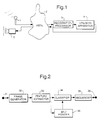
- a telecommunications system including speech recognition generally comprises a microphone 1, typically forming part of a telephone handset, a telecommunications network (typically a public switched telecommunications network (PSTN)) 2, a recognition processor 3, connected to receive a voice signal from the network 2, and a utilising apparatus 4 connected to the recognition processor 3 and arranged to receive therefrom a voice recognition signal, indicating recognition or otherwise of a particular word or phrase, and to take action in response thereto.
- the utilising apparatus 4 may be a remotely operated banking terminal for effecting banking transactions.
- the utilising apparatus 4 will generate an auditory response to the speaker, transmitted via the network 2 to a loudspeaker 5 typically forming a part of the subscriber handset.
- a speaker speaks into the microphone 1 and an analog speech signal is transmitted from the microphone 1 into the network 2 to the recognition processor 3, where the speech signal is analysed and a signal indicating identification or otherwise of a particular word or phrase is generated and transmitted to the utilising apparatus 4, which then takes appropriate action in the event of recognition of the speech.
- the recognition processor needs to acquire data concerning the speech against which to verify the speech signal, and this data acquisition may be performed by the recognition processor in a second mode of operation in which the recognition processor 3 is not connected to the utilising apparatus 4, but receives a speech signal from the microphone 1 to form the recognition data for that word or phrase.
- this data acquisition may be performed by the recognition processor in a second mode of operation in which the recognition processor 3 is not connected to the utilising apparatus 4, but receives a speech signal from the microphone 1 to form the recognition data for that word or phrase.
- other methods of acquiring the speech recognition data are also possible.
- the recognition processor 3 is unaware of the route taken by the signal from the microphone 1 to and through the network 2; any one of a large variety of types and qualities of receiver handset. Likewise, within the network 2, any one of a large variety of transmission paths may be taken, including radio links, analog and digital paths and so on. Accordingly, the speech signal Y reaching the recognition processor 3 corresponds to the speech signal S received at the microphone 1, convolved with the transfer characteristics of the microphone 1, link to network 2, channel through the network 2, and link to the recognition processor 3, which may be lumped and designated by a single transfer characteristic H.
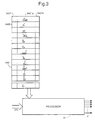
- the recognition processor 3 comprises an input 31 for receiving speech in digital form (either from a digital network or from an analog to digital converter), a frame processor 32 for partioning the succession of digital samples into a succession of frames of contiguous samples; a feature extractor 33 for generating from a frame of samples a corresponding feature vector; a classifier 34 receiving the succession of feature vectors and operating on each with a plurality of model states, to generate recognition results; a sequencer 35 which is arranged to receive the classification results form the classifier 34 and to determine the predetermined utterance to which the sequence of classifier output indicates the greatest similarity; and an output port 38 at which a recognition signal is supplied indicating the speech utterance which has been recognised.
- the frame generator 32 is arranged to receive speech samples at a rate of, for example, 8,000 samples per second, and to form frames comprising 256 contiguous samples, at a frame rate of 1 frame every 16ms.
- each frame is windowed (i.e. the samples towards the edge of the frame are multiplied by predetermined weighting constants) using, for example, a Hamming window to reduce spurious artifacts, generated by the frames edges.
- the frames are overlapping (for example by 50%) so as to ameliorate the effects of the windowing.
- the feature extractor 33 receives frames from the frame generator 32 and generates, in each case, a set or vector of features.
- the features may, for example, comprise cepstral coefficients (for example, LPC cepstral coefficients or mel frequency cepstral coefficients as described in "On the Evaluation of Speech Recognisers and Databases using a Reference System", Chollet & Gagnoulet, 1982 proc. IEEE p2026), or differential values of such coefficients comprising, for each coefficient, the differences between the coefficient and the corresponding coefficient value in the preceding vector, as described in "On the use of Instantaneous and Transitional Spectral Information in Speaker Recognition", Soong & Rosenberg, 1988 IEEE Trans. on Acoustics, Speech and Signal Processing Vol 36 No. 6 p871. Equally, a mixture of several types of feature coefficient may be used.
- the feature extractor 33 outputs a frame number, incremented for each successive frame.
- the output of the feature extractor 33 is also passed to an end pointer 36, the output of which is connected to the classifier 34.
- the end pointer 36 detects the end of speech and various types are well known in this field.
- the frame generator 32 and feature extractor 33 are, in this embodiment, provided by a single suitably programmed digital signal processor (DSP) device (such as the Motorola DSP 56000, or the Texas Instruments TMS C 320) or similar device.
- DSP digital signal processor
- the classifier 34 comprises a classifying processor 341 and a state memory 342.
- the state memory 342 comprises a state field 3421, 3422, ...., for each of the plurality of speech states.
- each allophone to be recognised by the recognition processor comprises 3 states, and accordingly 3 state fields are provided in the state memory 342 for each allophone.
- the classification processor 34 is arranged to read each state field within the memory 342 in turn, and calculate for each, using the current input feature coefficient set, the probability that the input feature set or vector corresponds to the corresponding state.
- the output of the classification processor is a plurality of state probabilities P, one for each state in the state memory 342, indicating the likelihood that the input feature vector corresponds to each state.
- the classifying processor 341 may be a suitably programmed digital signal processing (DSP) device, may in particular be the same digital signal processing device as the feature extractor 33.
- DSP digital signal processing
- the sequencer 35 in this embodiment comprises a state sequence memory 352, a parsing processor 351, and a sequencer output buffer 354.
- the state sequence memory 352 comprises a plurality of state sequence fields 3521, 3522, ...., each corresponding to a word or phase sequence to be recognised consisting of a string of allophones.
- Each state sequence in the state sequence memory 352 comprises, as illustrated in Figure 5, a number of states P 1 , P 2 , ... P N (where N is a multiple of 3) and, for each state, two probabilities; a repeat probability (P i1 ) and a transition probability to the following state (P i2 ).
- the states of the sequence are a plurality of groups of three states each relating to a single allophone.
- the observed sequence of states associated with a series of frames may therefore comprise several repetitions of each state P i in each state sequence model 3521 etc; for example: Frame Number 1 2 3 4 5 6 7 8 9 . . . Z Z+1 State P1 P1 P1 P2 P2 P2 P2 P2 P2 . . . Pn Pn
- the parsing processor 351 is arranged to read, at each frame, the state probabilities output by the classifier processor 341, and the previous stored state probabilities in the state probability memory 353, and to calculate the most likely path of states to date over time, and to compare this with each of the state sequences stored in the state sequence memory 352.
- the calculation employs the well known HMM, as discussed in the above referenced Cox paper.
- the HMM processing performed by the parsing processor 351 uses the well . known Viterbi algorithm.
- the parsing processor 351 may, for example, be a microprocessor such as the Intel (TM) i-486 (TM) microprocessor or the Motorola (TM) 68000 microprocessor, or may alternatively be a DSP device (for example, the same DSP device as is employed for any of the preceding processors).
- a probability score is output by the parser processor 351 at each frame of input speech.
- the state sequences may comprise the names in a telephone directory.
- a label signal a indicating the most probable state sequence is output from the parsing processor 351 to the output port 38, to indicate that the corresponding name, word or phrase has been recognised.
- the parsing processor 351 comprises a network which is specifically configured to recognise certain phrases or words for example a string of digits.
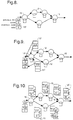
- Figure 6 shows a simple network for recognising a string of words, in this case either a string of four words or a string of three.
- Each node 12 of the network is associated with a word representation model 13, for example a HMM, which is stored in a model list.
- a word representation model 13 for example a HMM
- Several nodes can be associated with each model and each node includes a pointer to its associated model (as can be seen in Figures 6 and 7a).
- the final node 14 is associated with two models so allowing this node to process two paths. If n parses are required, the final node 14 of the network is associated with n identical word models.
- a path link 15 contains information relating to a pointer to the previous path link, an accumulated score, a pointer to the node previously exited and a time index.
- an empty path link 15' is inserted into the first node 16 as shown in Figure 8.
- the first node now contains a path link and is therefore active whereas the remaining nodes are inactive.
- any active nodes accumulate a score in their path link.
- the first model can match, say, a minimum of seven frames of speech
- a path link 15'' is output from the first node with the score for matching the seven frames to the model and pointers to the entry path link and the node just matched.
- the path link is fed to all of the following nodes 12, as shown in Figure 9. Now the first three nodes are active. The input frame of speech is then matched in the models associated with the active nodes and new path links outputted.
- path links from each 'branch' of the network may be presented to this node 18. If, at any given time frame, there is a single path link (i.e. only one of the parallel paths has been completed) that path link is taken to be the best (and only) match and is processed by the final node 18. However, if there are two path links presented to the final node 18, both are processed by that node, since the final node 18 is able to process more than one path.
- the output path links are continuously updated at each frame of speech. When the utterance is completed there will be two path links 15''' at the output of the network, as shown in Figure 10 (from which the pointers to previous path links and nodes have been excluded for the sake of clarity).
- the full path can be found by following the pointers to the previous path links and the nodes on the recognised path (and hence the input speech deemed to be recognised) can be identified by looking at the pointers to the nodes exited.
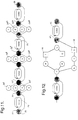
- Figure 11 represents a second embodiment of a network configured to recognise strings of three digits.
- the grey nodes 22 are null nodes in the network; the white nodes are active nodes which may be divided into vocabulary nodes 24 with associated word representation models (not shown), for matching incoming speech and noise nodes 25 which represent arbitrary noise.
- the output of the network will comprise path links relating to the three top scoring paths of the system.
- the three paths can be found by following, for each path, the pointers to the previous path links.
- the nodes on the paths (and hence the input speech deemed to be recognised) can be identified by looking at the pointers to the exited nodes.
- the path links may be augmented with signatures which represent the significant nodes of the network.
- These significant nodes may, for example, include all vocabulary nodes 24.
- each vocabulary node 24 is assigned a signature, for example the nodes representing the digit 1 are assigned a signature '1', the nodes 24" representing the digit 2 are assigned a signature '2' and so on.
- a single empty path link is passed into a network entry node 26. Since this is a null node, the path link is passed to the next node, a noise node 25. The input frame is matched in the noise model (not shown) of this node and an updated path link produced at the output. This path link is then passed to the next active nodes i.e.the first vocabulary nodes 24 having an associated model (not shown). Each vocabulary node 24 processes the frame of speech in its associated word model and produces an updated path link. The signature field of the path link is also updated. At the end of each time frame, the updated path links are sorted to retain the three (n) top scoring paths which have different signature fields. A list ordered by score is maintained with the added constraint that accumulated signatures are unique: if a second path link with the same signature enters, the better of the two is retained. The list contains only the top "n" different paths, the rest being ignored.
- n path links are propagated through the next null node 22' to the following noise node 25 and vocabulary nodes 24", each of which are associated with three identical word representation models. After this, model processing takes place, resulting in the updating of the lists of path links and the extending of the paths into further nodes 24"', 25. It should be clear that the signature fields of the path links are not updated after processing by the null nodes 22 or the noise nodes 25 since these nodes do not have assigned signatures.
- the path links are propagated along paths which pass through the remaining active nodes to produce, at an output node 28, up to three paths links indicating the relative scores and signatures, for example 1 2 1, of the paths taken through the network.
- the path links are continuously updated until the end of speech is detected (for example by an external device such as a pause detector or, until a time out is reached). At this point, the pointers or the accumulated signatures of the path links at the output node 28 are examined to determine the recognition results.
- the system can distinguish between the 'PHI' and 'PAU' paths at the 'L' node because the signatures of the path links created at the previous nodes are different.
- the following node 47 will be able to distinguish between all three independent paths since the signatures of the square nodes 44 are different.
- Only the 'L' node and the final noise node 48 need to be associated with more than one identical word model, so that these models are capable of having more than one path for a single time frame.
- each network illustrating the speech to be recognised requires analysis to determine which nodes are to be assigned signatures.
- the network is configured to be compatible with what a user is likely to say.
- Savings in memory size and processing speed may be achieved by limiting the signatures that a node will propagate. For instance, say the only valid input speech to a recogniser having the network of Figure 6 is the four following numbers only: 111, 112, 121, 211. Certain nodes within the network are associated with a set of valid signatures and a path will only be propagated by such a 'constrained' node if a path link having one of these signatures is presented. To achieve this, the signature fields of the path links entering a constrained node, eg third null node 22', are examined. If the signature field contains a signature other than 1 or 2, the path link is discarded and the path is not propagated any further.
- the next constrained node is the null node 22" after the next vocabulary nodes.
- This null node is constrained to only propagate path links having a signature 11, 12 or 21.
- the null node 22"' after the next vocabulary nodes is constrained to only propagate path links having the signature 111, 112, 121 or 211.
- Such an arrangement significantly reduces the necessary processing and allows for a saving in the memory capacity of the apparatus. Only some of the nodes at decision points in the network need to be so constrained. In practice, a 32 bit signature has proved to be suitable for sequences of up to 9 digits. A 64 bit signature appears suitable for a 12 character alphanumeric string.
- recognition processing apparatus suitable to be coupled to a telecommunications exchange has been described.
- the invention may be embodied on simple apparatus connected to a conventional subscriber station (mobile or fixed) connected to the telephone network; in this case, analog to digital conversion means may be provided for digitising the incoming analog telephone signal.
Landscapes
- Telephonic Communication Services (AREA)
Claims (19)
- Dispositif de reconnaissance de la parole comprenant :caractérisé en ce que le moyen de traitement (351) est capable de traiter plus d'une liaison de trajet pour au moins un noeud de vocabulaire, autre que le noeud final, dans une seule trame temporelle.un moyen destiné à obtenir un vecteur de caractéristiques de reconnaissance à partir d'un signal vocal en entrée pour chaque trame temporelle prédéterminée,un moyen destiné à modéliser la parole en entrée prévue, comprenant un certain nombre de noeuds de vocabulaire, chacun des noeuds de vocabulaire comprenant un modèle de représentation de mots associé et le modèle comportant des liaisons entre lesdits noeuds de vocabulaire,un moyen de traitement destiné à comparer les vecteurs de caractéristiques de reconnaissance à la parole en entrée modélisée et à générer une liaison de trajet pour chaque noeud et une trame temporelle, lesdites liaisons de trajets indiquant la séquence antérieure la plus probable des noeuds de vocabulaire pour chaque noeud de vocabulaire et chaque trame temporelle, chaque liaison de trajet comprenant un champ destiné à mémoriser une évaluation accumulée de la reconnaissance et un champ destiné à mémoriser une référence sur la liaison de trajet précédente la plus probable dans la séquence, etun moyen destiné à indiquer la reconnaissance du signal vocal en entrée suivant la comparaison,
- Dispositif de reconnaissance de la parole selon la revendication 1, caractérisé en ce que le au moins un noeud des noeuds de vocabulaire est associé à plus d'un modèle identique de représentation de mots.
- Dispositif de reconnaissance de la parole selon la revendication 2, caractérisé en ce que les modèles de représentation de mots sont des Modèles de Markov Cachés.
- Dispositif de reconnaissance de la parole selon l'une quelconque des revendications 1, 2 ou 3, caractérisé en ce que tous les noeuds de vocabulaire se voient affecter des signatures.
- Dispositif de reconnaissance de la parole selon l'une quelconque des revendications 1, 2 ou 3, caractérisé en ce que seuls les noeuds de vocabulaire apparaissant avant un point de décision se voient affecter des signatures.
- Dispositif de reconnaissance de la parole selon soit la revendication 4, soit la revendication 5, caractérisé en ce que les liaisons de trajets comprennent une signature accumulée.
- Dispositif de reconnaissance de la parole selon l'une quelconque des revendications 4, 5 ou 6, caractérisé en ce qu'au moins certains des noeuds sont contraints à ne propager que des liaisons de trajets présentant certaines signatures prédéterminées.
- Dispositif de reconnaissance de la parole selon l'une quelconque des revendications 4 à 7, caractérisé en ce que le moyen d'indication de reconnaissance comprend un moyen destiné à comparer l'évaluation et la signature des liaisons de trajets afin de déterminer le trajet présentant la meilleure mise en correspondance avec la parole reliée en entrée et ceux présentant les mises en correspondance auxiliaires les meilleures suivantes.
- Procédé de reconnaissance de la parole comprenant :l'obtention d'un vecteur de caractéristiques de reconnaissance à partir d'un signal vocal en entrée pour chaque trame temporelle prédéterminée,la modélisation de la parole en entrée prévue,la comparaison des données de caractéristiques avec la parole en entrée modélisée en générant un réseau contenant un certain nombre de noeuds de vocabulaire associés à des modèles de représentation de mots, et la génération d'une liaison de trajet pour chaque noeud et trame temporelle, la liaison de trajet indiquant la séquence antérieure la plus probable de noeuds de vocabulaire pour chaque noeud de vocabulaire et chaque trame temporelle, chaque liaison de trajet comprenant un champ destiné à mémoriser une évaluation de reconnaissance accumulée et un champ destiné à mémoriser une référence vers la liaison de trajet précédente la plus probable dans la séquence,l'indication de la reconnaissance de la parole suivant la comparaison, caractérisé en ce que plus d'une liaison de trajet est traitée dans une seule trame temporelle pour au moins un noeud de vocabulaire autre que le noeud final.
- Procédé selon la revendication 9, caractérisé en ce que le au moins un noeud parmi les noeuds de vocabulaire est associé à plus d'un modèle identique de représentation de mots.
- Procédé selon la revendication 10, caractérisé en ce que le au moins un noeud parmi les noeuds de vocabulaire est associé à un nombre de modèles de représentation de mots identiques égal au nombre des résultats de reconnaissance désirés.
- Procédé selon soit la revendication 10, soit la revendication 11, caractérisé en ce que les évaluations des liaisons de trajets sont comparées au niveau de chaque point de décision du réseau, seules les n liaisons de trajets présentant la meilleure évaluation étant propagées vers le ou les noeuds suivants.
- Procédé selon l'une quelconque des revendications 10, 11 ou 12, caractérisé par l'affectation de signatures à tous les noeuds de vocabulaire.
- Procédé selon l'une quelconque des revendications 10, 11 ou 12, caractérisé par le fait de n'affecter des signatures qu'à des noeuds de vocabulaire apparaissant avant un point de décision dans le réseau.
- Procédé selon soit la revendication 13, soit la revendication 14, lorsqu'elle dépend de la revendication 12, caractérisé en ce que les signatures des liaisons de trajets sont également comparées, seules les liaisons de trajets présentant des signatures différentes étant propagées vers le ou les noeuds suivants.
- Procédé selon l'une quelconque des revendications 13, 14 ou 15, caractérisé par le fait de contraindre au moins certains des noeuds à ne transmettre que des liaisons de trajets présentant certaines signatures prédéterminées dans leur champ de signature.
- Procédé selon l'une quelconque des revendications 9 à 16, caractérisé en ce que le signal vocal en entrée estimé être reconnu est déterminé en remontant les liaisons de trajets au travers du réseau.
- Procédé selon l'une quelconque des revendications 13 à 16, caractérisé en ce que le signal vocal en entrée estimé être reconnu est déterminé par la signature accumulée de chaque liaison de trajet.
- Procédé selon l'une quelconque des revendications 10 à 18, caractérisé en ce que la liaison de trajet présentant la meilleure évaluation est traitée par le premier modèle de représentation de mots d'un noeud de vocabulaire, la seconde meilleure par le second et ainsi de suite jusqu'à l'épuisement, soit des modèles parallèles, soit des liaisons de trajet entrantes.
Priority Applications (1)
| Application Number | Priority Date | Filing Date | Title |
|---|---|---|---|
| EP94911271A EP0692134B1 (fr) | 1993-03-31 | 1994-03-31 | Traitement de la parole |
Applications Claiming Priority (6)
| Application Number | Priority Date | Filing Date | Title |
|---|---|---|---|
| EP93302538 | 1993-03-31 | ||
| EP93302538 | 1993-03-31 | ||
| EP93304993 | 1993-06-25 | ||
| EP93304993 | 1993-06-25 | ||
| EP94911271A EP0692134B1 (fr) | 1993-03-31 | 1994-03-31 | Traitement de la parole |
| PCT/GB1994/000704 WO1994023424A1 (fr) | 1993-03-31 | 1994-03-31 | Traitement de la parole |
Publications (2)
| Publication Number | Publication Date |
|---|---|
| EP0692134A1 EP0692134A1 (fr) | 1996-01-17 |
| EP0692134B1 true EP0692134B1 (fr) | 1999-02-24 |
Family
ID=27235398
Family Applications (1)
| Application Number | Title | Priority Date | Filing Date |
|---|---|---|---|
| EP94911271A Expired - Lifetime EP0692134B1 (fr) | 1993-03-31 | 1994-03-31 | Traitement de la parole |
Country Status (1)
| Country | Link |
|---|---|
| EP (1) | EP0692134B1 (fr) |
-
1994
- 1994-03-31 EP EP94911271A patent/EP0692134B1/fr not_active Expired - Lifetime
Also Published As
| Publication number | Publication date |
|---|---|
| EP0692134A1 (fr) | 1996-01-17 |
Similar Documents
| Publication | Publication Date | Title |
|---|---|---|
| CA2158064C (fr) | Traitement de la parole | |
| EP0695453B1 (fr) | Reconnaissance de chaines de mots | |
| Soong et al. | A Tree. Trellis based fast search for finding the n best sentence hypotheses in continuous speech recognition | |
| EP0314908B1 (fr) | Détermination automatique d'étiquettes et de représentations de mots par des modèles de Markov dans un système pour la reconnaissance de la parole | |
| US5072452A (en) | Automatic determination of labels and Markov word models in a speech recognition system | |
| EP0387602B1 (fr) | Procédé et dispositif pour la détermination automatique des règles phonologiques pour un système de reconnaissance de la parole continue | |
| US5729656A (en) | Reduction of search space in speech recognition using phone boundaries and phone ranking | |
| EP0769184B1 (fr) | Procedes et appareils de reconnaissance de la parole a base de la modelisation de nouveaux mots | |
| US6922668B1 (en) | Speaker recognition | |
| KR19990014292A (ko) | 신뢰성 있는 바지-인과 음성검출의 조기종료에 유용한 연속 상태의 음성 인식에서의 단어 카운팅 방법과 절차 | |
| US6230128B1 (en) | Path link passing speech recognition with vocabulary node being capable of simultaneously processing plural path links | |
| JPH05265483A (ja) | 複数の出力を与える音声認識法 | |
| US4783809A (en) | Automatic speech recognizer for real time operation | |
| JP4199927B2 (ja) | 発声言語における少なくとも1つのキーワードを計算器により認識する方法および認識装置 | |
| EP0692134A1 (fr) | Traitement de la parole | |
| HK1014390B (en) | Speech processing | |
| CA2013263C (fr) | Methode de rejet pour la reconnaissance des paroles | |
| Forgie et al. | An overview of the Lincoln Laboratory speech recognition system | |
| JPH02272498A (ja) | 音声認識方法 | |
| Rose et al. | A user-configurable system for voice label recognition | |
| Okada et al. | Word spotting system based on stochastic models of phonemic segments | |
| JPS6346499A (ja) | 大語▲い▼単語音声認識方式 | |
| Baker | Automatic recognition of speech using optimal search | |
| JPH06266396A (ja) | 単語予備選択方式 |
Legal Events
| Date | Code | Title | Description |
|---|---|---|---|
| PUAI | Public reference made under article 153(3) epc to a published international application that has entered the european phase |
Free format text: ORIGINAL CODE: 0009012 |
|
| 17P | Request for examination filed |
Effective date: 19950911 |
|
| AK | Designated contracting states |
Kind code of ref document: A1 Designated state(s): BE CH DE DK ES FR GB IT LI NL SE |
|
| 17Q | First examination report despatched |
Effective date: 19960624 |
|
| GRAG | Despatch of communication of intention to grant |
Free format text: ORIGINAL CODE: EPIDOS AGRA |
|
| GRAG | Despatch of communication of intention to grant |
Free format text: ORIGINAL CODE: EPIDOS AGRA |
|
| GRAH | Despatch of communication of intention to grant a patent |
Free format text: ORIGINAL CODE: EPIDOS IGRA |
|
| GRAH | Despatch of communication of intention to grant a patent |
Free format text: ORIGINAL CODE: EPIDOS IGRA |
|
| GRAA | (expected) grant |
Free format text: ORIGINAL CODE: 0009210 |
|
| AK | Designated contracting states |
Kind code of ref document: B1 Designated state(s): BE CH DE DK ES FR GB IT LI NL SE |
|
| PG25 | Lapsed in a contracting state [announced via postgrant information from national office to epo] |
Ref country code: NL Free format text: LAPSE BECAUSE OF FAILURE TO SUBMIT A TRANSLATION OF THE DESCRIPTION OR TO PAY THE FEE WITHIN THE PRESCRIBED TIME-LIMIT Effective date: 19990224 Ref country code: IT Free format text: LAPSE BECAUSE OF FAILURE TO SUBMIT A TRANSLATION OF THE DESCRIPTION OR TO PAY THE FEE WITHIN THE PRESCRIBED TIME-LIMIT;WARNING: LAPSES OF ITALIAN PATENTS WITH EFFECTIVE DATE BEFORE 2007 MAY HAVE OCCURRED AT ANY TIME BEFORE 2007. THE CORRECT EFFECTIVE DATE MAY BE DIFFERENT FROM THE ONE RECORDED. Effective date: 19990224 Ref country code: ES Free format text: THE PATENT HAS BEEN ANNULLED BY A DECISION OF A NATIONAL AUTHORITY Effective date: 19990224 |
|
| REG | Reference to a national code |
Ref country code: CH Ref legal event code: NV Representative=s name: JACOBACCI & PERANI S.A. Ref country code: CH Ref legal event code: EP |
|
| REF | Corresponds to: |
Ref document number: 69416670 Country of ref document: DE Date of ref document: 19990401 |
|
| PG25 | Lapsed in a contracting state [announced via postgrant information from national office to epo] |
Ref country code: DK Free format text: LAPSE BECAUSE OF FAILURE TO SUBMIT A TRANSLATION OF THE DESCRIPTION OR TO PAY THE FEE WITHIN THE PRESCRIBED TIME-LIMIT Effective date: 19990524 |
|
| ET | Fr: translation filed | ||
| NLV1 | Nl: lapsed or annulled due to failure to fulfill the requirements of art. 29p and 29m of the patents act | ||
| PLBE | No opposition filed within time limit |
Free format text: ORIGINAL CODE: 0009261 |
|
| STAA | Information on the status of an ep patent application or granted ep patent |
Free format text: STATUS: NO OPPOSITION FILED WITHIN TIME LIMIT |
|
| 26N | No opposition filed | ||
| REG | Reference to a national code |
Ref country code: GB Ref legal event code: IF02 |
|
| REG | Reference to a national code |
Ref country code: GB Ref legal event code: 732E |
|
| REG | Reference to a national code |
Ref country code: GB Ref legal event code: 732E |
|
| REG | Reference to a national code |
Ref country code: FR Ref legal event code: TP Ref country code: FR Ref legal event code: CD Ref country code: FR Ref legal event code: CA |
|
| REG | Reference to a national code |
Ref country code: CH Ref legal event code: PCAR Free format text: ISLER & PEDRAZZINI AG;POSTFACH 1772;8027 ZUERICH (CH) |
|
| BECA | Be: change of holder's address |
Owner name: CISCO RAVENSCOURT LLC170 WEST TASMAN DRIVE, SAN JO Effective date: 20080331 |
|
| BECN | Be: change of holder's name |
Owner name: CISCO RAVENSCOURT LLC Effective date: 20080331 |
|
| PGFP | Annual fee paid to national office [announced via postgrant information from national office to epo] |
Ref country code: CH Payment date: 20130325 Year of fee payment: 20 Ref country code: DE Payment date: 20130327 Year of fee payment: 20 Ref country code: GB Payment date: 20130327 Year of fee payment: 20 Ref country code: SE Payment date: 20130327 Year of fee payment: 20 Ref country code: FR Payment date: 20130405 Year of fee payment: 20 |
|
| PGFP | Annual fee paid to national office [announced via postgrant information from national office to epo] |
Ref country code: BE Payment date: 20130327 Year of fee payment: 20 |
|
| BE20 | Be: patent expired |
Owner name: CISCO RAVENSCOURT LLC Effective date: 20140331 |
|
| REG | Reference to a national code |
Ref country code: DE Ref legal event code: R071 Ref document number: 69416670 Country of ref document: DE |
|
| REG | Reference to a national code |
Ref country code: CH Ref legal event code: PL |
|
| REG | Reference to a national code |
Ref country code: GB Ref legal event code: PE20 Expiry date: 20140330 |
|
| PG25 | Lapsed in a contracting state [announced via postgrant information from national office to epo] |
Ref country code: GB Free format text: LAPSE BECAUSE OF EXPIRATION OF PROTECTION Effective date: 20140330 |
|
| REG | Reference to a national code |
Ref country code: SE Ref legal event code: EUG |
|
| PG25 | Lapsed in a contracting state [announced via postgrant information from national office to epo] |
Ref country code: DE Free format text: LAPSE BECAUSE OF EXPIRATION OF PROTECTION Effective date: 20140401 |