EP0692262A2 - Formbarer Polyurethanstützverband - Google Patents
Formbarer Polyurethanstützverband Download PDFInfo
- Publication number
- EP0692262A2 EP0692262A2 EP95304490A EP95304490A EP0692262A2 EP 0692262 A2 EP0692262 A2 EP 0692262A2 EP 95304490 A EP95304490 A EP 95304490A EP 95304490 A EP95304490 A EP 95304490A EP 0692262 A2 EP0692262 A2 EP 0692262A2
- Authority
- EP
- European Patent Office
- Prior art keywords
- substrate
- silicone
- fiber
- casting tape
- fabric
- Prior art date
- Legal status (The legal status is an assumption and is not a legal conclusion. Google has not performed a legal analysis and makes no representation as to the accuracy of the status listed.)
- Withdrawn
Links
Images

Classifications
-
- A—HUMAN NECESSITIES
- A61—MEDICAL OR VETERINARY SCIENCE; HYGIENE
- A61L—METHODS OR APPARATUS FOR STERILISING MATERIALS OR OBJECTS IN GENERAL; DISINFECTION, STERILISATION OR DEODORISATION OF AIR; CHEMICAL ASPECTS OF BANDAGES, DRESSINGS, ABSORBENT PADS OR SURGICAL ARTICLES; MATERIALS FOR BANDAGES, DRESSINGS, ABSORBENT PADS OR SURGICAL ARTICLES
- A61L15/00—Chemical aspects of, or use of materials for, bandages, dressings or absorbent pads
- A61L15/07—Stiffening bandages
- A61L15/14—Use of materials characterised by their function or physical properties
-
- A—HUMAN NECESSITIES
- A61—MEDICAL OR VETERINARY SCIENCE; HYGIENE
- A61F—FILTERS IMPLANTABLE INTO BLOOD VESSELS; PROSTHESES; DEVICES PROVIDING PATENCY TO, OR PREVENTING COLLAPSING OF, TUBULAR STRUCTURES OF THE BODY, e.g. STENTS; ORTHOPAEDIC, NURSING OR CONTRACEPTIVE DEVICES; FOMENTATION; TREATMENT OR PROTECTION OF EYES OR EARS; BANDAGES, DRESSINGS OR ABSORBENT PADS; FIRST-AID KITS
- A61F13/00—Bandages or dressings; Absorbent pads
- A61F13/04—Plaster of Paris bandages; Other stiffening bandages
-
- A—HUMAN NECESSITIES
- A61—MEDICAL OR VETERINARY SCIENCE; HYGIENE
- A61L—METHODS OR APPARATUS FOR STERILISING MATERIALS OR OBJECTS IN GENERAL; DISINFECTION, STERILISATION OR DEODORISATION OF AIR; CHEMICAL ASPECTS OF BANDAGES, DRESSINGS, ABSORBENT PADS OR SURGICAL ARTICLES; MATERIALS FOR BANDAGES, DRESSINGS, ABSORBENT PADS OR SURGICAL ARTICLES
- A61L15/00—Chemical aspects of, or use of materials for, bandages, dressings or absorbent pads
- A61L15/07—Stiffening bandages
- A61L15/08—Stiffening bandages containing inorganic materials, e.g. plaster of Paris
-
- A—HUMAN NECESSITIES
- A61—MEDICAL OR VETERINARY SCIENCE; HYGIENE
- A61L—METHODS OR APPARATUS FOR STERILISING MATERIALS OR OBJECTS IN GENERAL; DISINFECTION, STERILISATION OR DEODORISATION OF AIR; CHEMICAL ASPECTS OF BANDAGES, DRESSINGS, ABSORBENT PADS OR SURGICAL ARTICLES; MATERIALS FOR BANDAGES, DRESSINGS, ABSORBENT PADS OR SURGICAL ARTICLES
- A61L15/00—Chemical aspects of, or use of materials for, bandages, dressings or absorbent pads
- A61L15/07—Stiffening bandages
- A61L15/12—Stiffening bandages containing macromolecular materials
Definitions
- the present invention relates to an improved conformable orthopaedic casting tape.
- the casting tapes of the present invention provide substantial extensibility and elasticity in both their longitudinal and cross direction which results in improved conformability, and thus allows better application of the casting tapes to the patient and the resulting cast better fits or conforms to the patient's limb.
- Plaster of Paris casts have been in use to immobilize body members or limbs for some time.
- the plaster of Paris bandages have been supplemented and, to some extent, superseded by synthetic cast tapes or bandages which employ polymeric materials on a substrate.
- the preferred polymeric materials are water-cured or water-reactive polyurethane compositions.
- the polyurethane materials have largely supplanted other polymeric synthetic casting materials. These polyurethane casting materials are of the type which are disclosed in U.S. Patent 4,376,438 and U.S. Patent 4,411,262.
- the fibrous substrate used in the synthetic casting materials is usually a polyester or fiberglass. Although knitted substrates are most common, woven substrates have also been used.
- the fiberglass materials offer advantages in terms of strength of the finished cast and various constructions of fiberglass fabrics have been used for the substrates for the synthetic casting tapes.
- the patents mentioned above disclose the use of different fiberglass materials as the substrate for casting tapes.
- U.S. Patents 3,686,725, 3,787,272 and 3,882,857 disclose specific fiberglass materials, or the treatment of fiberglass yarns, to produce fiberglass substrates which are particularly suitable for use in orthopaedic casts.
- U.S. Patent 4,323,061 discloses a cast substrate made from a combination of glass fibers and a second fiber such as cotton, flax, rayon, wool, acrylic resin, nylon, Teflon or polyester.
- the purpose of the second fiber in the substrate is to hold the curable resin on the substrate.
- U.S. Patent 3,332,416 discloses a plaster of Paris cast bandage with a woven substrate made with a combination of elastic and inelastic fibers.
- U.S. Patent 4,668,563 discloses a polyurethane casting tape made from a high modulus fiber such as fiberglass, polyaramide or polyethlene combined with an elastomeric highly extensible fiber made from natural or synthetic rubber or spandex (polyurethane).
- U.S. Patent 5,256,134 discloses a polyurethane casting tape containing an elastic yarn such as natural or synthetic rubber or polyurethane and an inelastic yarn formed from polypropylene, polyester, polyamide, polyethylene or cotton viscose.
- a disadvantage of the conformable casting tapes mentioned above is that the elastic fibers employed had serious limitations.
- the water reactive polyurethane prepolymer may eventually swell the spandex (polyurethane) filaments causing the filaments to lose their extensibility. This limits the shelf life of conformable casting tapes made with spandex elastic filaments.
- Natural and synthetic rubber filaments are usually compounded with chemicals which may cause the polyurethane prepolymer to gel prematurely. This may be avoided by treating the rubber filaments with an extraction process or by treating the rubber filaments with an acid. Both of these processes are environmentally detrimental and add cost to the substrate and casting tape.
- the present invention provides a highly conformable polyurethane casting tape made with a substrate containing inelastic and elastic yarns which does not have the instability problems or manufacturing problems of previous highly conformable casting tapes.
- the casting tapes of the present invention use an elastic yarn made from a silicone elastomer.
- the silicone elastomeric yarns are chemically inert to polyurethane resins and do not require acid treatment as do natural rubber yarns.
- the conformable fabric substrate containing the silicone elastomer yarns may be knitted or woven fabric. Knitted fabrics are preferred.
- the silicone elastomers used in the yarns of the present invention are high molecular weight linear divinyl polydimethylsiloxanes polymers. These polymers can be efficiently cured using cross-linking agents in the presence of a platinum catalyst or ultraviolet light. Silicone materials that have been found to be useful in the practice of the present invention are available from Wacker Silicones Corporation under the designations Elastosil R401/40, R401/50, R401/60, R401/70, R401/80, R420/30, R420/40, R420/50, R420/60 and R420/70. Mixtures of these materials may also be used. These silicone materials may be cross linked with silicone hydrides in the presence of a platinum catalyst or with sulfur hydrides under U.V.
- the silicone elastomers may also contain a reinforcing filler such as amorphous fumed silica. Fibers made from the ElastosilTM silicone materials are commercially available from Patter Products.
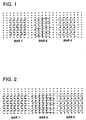
- Fig. 1 and 2 are three bar Raschel knit patterns of the type which can be used in the substrate of the present invention in which bar 1 performs a simple chain stitch and bars 2 and 3 perform lapping motions to lay in yarn.
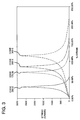
- Fig. 3 are extensibility recovery curves of the conformable substrate of the present invention and curves of a commercially available prior art conformable casting tape substrate.
- Fig.4 is a graph comparing the extensibility characteristic of the present casting tape with the casting tapes in the prior art.
- the substrate of the casting tape of the present invention is constructed i.e. woven or knitted, with a combination of continuous filament high tenacity yarns such as fiberglass yarns or lower tenacity yarns such as polyester yarn or combination of fiberglass and polyester yarns and silicone elastomeric yarns.
- Fiberglass cast substrates are generally characterized as made from filaments which are sized, formed into yarn, and woven or knitted into the desired structure.
- the cast substrate fabrics of the present invention are knitted or woven fabrics which combine an inelastic fiber such as fiberglass, polyaramide, polypropylene or polyester with a highly elastic silicone fiber.
- the elastomeric fiber is the silicone fiber described above.
- the knitted substrates are preferably knitted on a Raschel Warp Knitting Machine having 6 to 28 needles per inch.
- extensible and extensibility used herein refer to the capability of a material, e.g. fiber or fabric, to stretch without breaking.
- elastic refers to the capability of a material, e.g. fiber or fabric, to recover its size and shape after deformation or stretching.
- the elastic fiber is present in a woven or knit fabric in the warp or wale yarns, i.e., machine direction, but normally not in the fill yarns. About 0.25 to 35% of the fibers based on the total volume of fibers in the fabric are extensible.
- the fabric should have a stretch in the longitudinal direction of at least 40% and up to 200% under a static load of 1.5 lb/inch.
- the fabric knitted or woven with elastic yarns has considerable extensibility in the length direction and it is this lengthwise extensibility that provides greater conformability of the resulting casting tape.
- the extensibility of the fabric of the present invention is at least 40%, and may be as high as 200%, as determined under a static load of 680 grams per inch of width.
- the preferred range of extensibility is between 40 and 120%.
- the elastic fiber is also in the warp yarns, and the fabric should have a stretch in the length direction of up to 200% percent.
- Knitted fiberglass fabrics previously employed as substrates in casting tapes had some stretchability or extensibility but would not immediately return or recover to their original length after stretching.
- the present substrate will return substantially to its original length because of the elastomeric fibers in the substrate. The force returning the substrate to its original length causes the substrate to conform to the patient's body.
- the elastic fiber component of the substrate can be wrapped or unwrapped yarns.
- the elastic fiber may be wrapped with cotton, nylon or polyester fiber.
- the elastic filament may be an extruded filament or it may be a cut thread or filament, i.e. the thread or filament may be cut from a sheet of elastic material.
- the particular wrapping fiber, if any, is not significant to the present invention.
- the substrate contains between 65 and 99.75% by volume, of fiberglass or other yarn and between 0.25 and 35% by volume of the elastic yarn.
- the substrate preferably contains between 1 and 6% by volume of the elastic yarn.
- the stretch characteristics of the fabrics can be controlled by the selection of the type of yarn, the number of elastic filaments and the size or gauge of the filaments as well as the tension of the elastic yarns during knitting and the knitting pattern of the fabric.
- the elastic yarn provides significant stretch or elasticity of the fabric in the length direction.
- a typical prior art fiberglass cast substrate has stretch in the length direction of from about 5 to 35%.
- the cast substrates of the present invention have a stretch greater than 40% and up to 200% and a preferred stretch of between 60 and 100%.
- the substrates will also have some stretch in the cross direction which is the result of the knit pattern structure rather than the presence of the elastic yarns.
- the cross direction stretch is between about 30 and 80%.
- the fabric of the present invention has relatively low power. Power is the force necessary to stretch a fabric a given percentage. It is expressed as force per unit width, e.g. grams/inch width for a specific elongation.
- the power should be low to prevent constriction of the patient's limb after the tape is applied to the patient and before the prepolymer cures. After the prepolymer is cured, the power of the fabric is not a consideration as the cured polymer will prevent any further constriction.
- the power of the fabric of the present invention is preferably between 40 and 175 grams per inch width to stretch the fabric 30%. The power of any particular knit fabric construction may be adjusted by changing the thickness or gauge of the elastic yarn.
- the power may also be adjusted by changing the number of elastic yarns in the fabric or changing the knit construction and by changing the tension of the elastic yarns during knitting.
- the silicone elastic thread employed have been found to be compatible with the water curable polyurethane prepolymer employed in the casting tape.
- the elastomer yarns used in the prior art cast substrates were natural rubber or polyurethane, (spandex).
- the spandex elastic yarns have a tendency to lose their desirable properties when in contact with polyurethane cast prepolymer for extended periods of time, i.e. during product storage.
- the rubber yarns were treated with acid prior to use to prevent premature hardening of the prepolymer.
- the use of the silicone elastomers of the present invention avoids these problems.
- the silicone elastomers are chemically stable in polyurethane resin, and do not require any wrapping to prevent a direct contact of silicone elastomers with urethane resin.
- Spandex for example, has the repeated polyurethane units in a polymer backbone which tend to be miscible in polyurethane resins. This problem can be partially overcome by wrapping the elastomeric yarns with nylon, polyester, or cotton. However, this is not a permanent solution in a conformable polyurethane based casting tapes as the polyurethane resin penetrates the layer of the cover of spandex and eventually attacks the polymer backbone and physical properties may be affected.
- the silicone base materials that can be converted to silicone elastic yarns in the present disclosure contain as a major component a silicone of the composition, where x is an integer from 30 to 10,000 preferrably between 4,000 to 5,000 and y is an integer from 0 to 5,000 preferrably between 50 to 200.
- the molecular weight of the preferred silicone is between 400,000 and 600,000.
- the base materials containing the above major chemical component can be crosslinked in many ways. It can be crosslinked with silicone hydride in the presence of a platinum catalyst, or by a free radical mechanisms in the presence of a peroxide catalyst, or by ultraviolet light,
- the base silicone materials may be properly compounded prior to the extrusion.
- the base materials are compounded with silicone hydride and a small amount of platinum salt as a catalyst.
- the composite material is then extruded in the form of continuous fine silicone yarns at ambient temperature, which then undergo heat accelerated crosslinking over the hot air vulcanizer. During this process, the fine silicone strands join side by side together to form a ribbon.
- the ribbon is further cured on the heated belt conveyer. Heat curing can be accomplished between 300°F to 900°F, preferably between 400°F and 600°F.
- Platinum initiated crosslinking does not generate by-products, provides low shrinkage, needs no post-curing, and requires a very low level of catalyst.
- the extruded silicone yarn has a diameter between 5 mil and 15 mil, more preferably between 8 mil and 13 mil for our application to casting tapes.
- the elongation at break is between 300% to 1500%, more preferably between 600% and 800% for our objective.
- the base silicone materials can also be crosslinked in the presence of peroxide initiators such as 2,4-dichlorobenzoyl peroxide and dicumyl peroxide. In this case, no crosslinking agent is required.
- peroxide initiators such as 2,4-dichlorobenzoyl peroxide and dicumyl peroxide. In this case, no crosslinking agent is required.
- silicone elastomers in the polyurethane resin is tested without difficulty. Since the elastomers in the conformable casting tapes are in a stretched form, compatibility of the silicone yarns in polyurethane resin is also evaluated in stretched state and tested in the following manner: silicone yarns are prestretched by 50% and 100%, respectively, and immersed in polyurethane resin in propylene tubes maintained at ambient temperature, 50°C, 70°C, and 90°C, respectively. Samples at 50°C are kept for 3 months, those at 70°C for 24 days, and those at 90°C for 3 days, which all correspond to about 2 years at 20°C.
- the silicon elastomers do not require chemical and/or solvent treatments prior to its knitting with inelastomeric yarns. At the same time, the silicone elastomers do not have to be washed with water, which may cause premature jelling of the products if it is not thoroughly dried.
- ElastosilTM yarns made from brand silicone provide a significant stretch or elasticity of the fabric in the length direction equivalent to conformable casting substrates in the prior art to conformable substrates in the present invention have a stretch greater than 40% and up to 200%.
- a preferred stretch of the substrates in the present invention is between 40% and 120% in the length direction.
- the knit substrates also have some stretch in the cross direction, but this is due to the knit pattern structure, and it is between 30% and 80%.
- the substrates are generally knitted using 3 bars in the knitting machine, one of them is for the elastic yarn. It is also possible to make a highly conformable cast substrates by using a two bar fabrics, but such fabrics do not provide an optimum cast strength.
- the elastic yarn is in bar 2, or bar 3 in 3-bar knit or in bars 2,3 and or 4 in a 4-bar Raschel knit construction, the tension in the elastic yarn becomes important.
- the tension in the elastic yarn should be high enough so that gathering or contraction of the fabric occurs to some extent when the fabric is released from the knitting machine. When the fabric is stretched, the gathers are pulled out and further extensibility of the fabric is limited by the non elastic fiber in the chain stitch.
- the preferred fabric is a 3 bar knit with the elastic silicone yarn in bar 3.
- Fig. 1 is a three bar pattern with the elastic silicone thread on the bar 3 and other inelastic yarns on bars 1 and 2.
- Fig. 2 is a three bar pattern similar to Fig. 1. However, the fabric in Fig. 2 would be heavier as the fill yarns traverse across three needles in Fig. 2 and two needles in Fig. 1. This increases the length of the fill yarn employed and results in greater weight of the fabric.
- the patterns of Figs. 1 and 2 could be modified by employing a zig-zag pattern on bar 3.
- the particular knit pattern is not critical as long as the fabric has the desired power, lengthwise extensibility and volume of fiberglass or other inelastic fiber in the fabric to produce the desired cast strength.
- the elastic yarns are preferably laid in a straight pattern to give uniform longitudinal extensibility.
- the conformability of the present casting tape compared to the conformability of a commercially available polyurethane based fiberglass casting tapes is shown in Fig. 4.
- the length stretch is determined by suspending a weight of 80 grams per inch of material width from a 10 inch length of tape and measuring the percent of stretch. The same procedure is repeated to determine the percent stretch in the width direction with the material hung from a side rather than its end.
- Fig. 3 illustrates the extensibility recovery characteristics of four inch wide fiberglass substrates (Example 2 and Example 1) of the present invention and other commercially available casting substrates having natural rubber threads.
- the curves in Fig. 3 were generated on Instron Model 1122. The substrate were strained by a force of 1.5 pounds (680 grams) per inch width and then allowed to recover. The downward sloping portion of the curve is the recovery and could be illustrated as returning to the zero point.
- the curves shown in Fig. 3 are the curves as plotted by the test machine in which the chart paper moves in one direction. The curves show the greater stretch of the substrate fabric of the present invention and the return properties of the fabric. The fabric of the present invention returns faster and also returns to its original length.
- lines A, B and C show the extensibility of all fiberglass cast bandages.
- Line D is a fiberglass natural rubber thread cast bandage of the type shown in U.S. Patent 4,668,563.
- the lines E and F show the extensibilities of conformable bandages of the present invention made with silicone elastomers.
- Line E shows the conformable bandages with a longitudinal extensibility of 48% and line F in the substrate of Example 1 shows a longitudinal extensibility of 74%.
- the stretch of the substrate fabric is determined by securing one end of a sample of fabric, affixing a weight to the other end of the sample.
- the weight affixed is 80 grams per inch width and the percent stretch is the percent increase in length of the sample of the fabric.
- Extensibility is a measure of the maximum stretch or extension of the fabric. It is determined in the same manner as stretchability but with a weight of 1.5 pound (680 grams) per inch width of fabric. It should also be noted that the extensibility of the uncoated substrate is more than that of the coated substrate.
- the extensibility of the casting tapes may vary depending upon how the substrates are knitted.
- the stretch of the silicone elastomer can be controlled by the tension between the take away rolls and the input nip rolls of the knitting machine.
- the number of courses per inch of the substrate change the degree of extensibility of the substrate and the casting tapes. Because of the excellent elasticity of the silicone elastomer, any adjustments for the stretch to provide a given extensibility is accomplished with ease.
- Line G in Fig. 4 shows the range of extensibility possible in a casting tape using a silicone elastomer in the elastic yarn.
- Examples 1-4 show particular substrates that are useful in the present invention.
- a conformable fiberglass substrate (Code-302-3) was knitted on 28 gauge Raschel knitting machine using a 3-bar configuration as in Figure 1. Bars 1 and 2 contained DE 100 1/0 fiberglass yarns and bar 3 contained 79 gauge Elastosil yarn. The silicone yarn made from ElastosilTM Silicone Elastomer was available from Patter Products under the designation of 1093-1850. Bars 1,2, and 3 had 60, 57, and 40 ends, respectively.
- the conformable substrate showed the Stretch (80g/in.) of 77.5% and the Extensibility (1.5lb/in.) of 116.3%.
- the construction of substrate (Code-302-3) had 60 ends in the first bar, 57 ends in the second bar, and 40 ends in the third bar.
- the chain link numbers were: Bar 1 - 2,0,0,2; Bar 2 - 0,0,8,8;
- Another conformable fiberglass substrate (Code-292-3) was knitted in the same way as Example 1 using 74 gauge silicone yarn.
- the substrate had an average of 50% Stretchability (80g/in.) and about 86.3% of Extensibility (1.5lb/in.).
- the designation of this silicone yarn from Patter Products was 1093-E0098.
- a conformable substrate (Code-310-3) with Stretchability of about 53% and Extensibility of 80% was also constructed with fiberglass yarn and an silicone yarn. Knitting configuration was similar to Example 1, and chain link numbers were: Bar 1 - 2,0,0,2; Bar 2 - 0,0,8,8; Bar 3 - 0,0,2,2
- a conformable polyester substrate (Code-064-4) was knitted on an 18 gauge Raschel knitting machine using a 3-bar configuration as shown in Figure 1.
- Bars 1 and 2 contained 1/150/34 texturized polyester and 1/500/100 high tenacity polyester, respectively.
- Bar 3 contained 88 gauge Falter Products elastic yarn.
- Bars 1, 2 and 3 had 43,41 and 43 ends, respectively.
- the substrate showed an average of 76% stretchability.
- the extensibility was 86%.
- the knitting configuration was: Bar 1 - 2,0,0,2 Bar 2 - 0,0,6,6 Bar 3 - 2,2,0,0
- Elastosil Ribbons made from Elastosil silicone, one lot with 40 Durometer hardness and one lot with 50 Durometer hardness were prestretched as in Example 5 and immersed in a urethane prepolymer at 90°C for 3 days. After 3 days, the samples were cooled to ambient temperature, the resin was completely and carefully wiped from the samples in a Dry Box under nitrogen, and the lengths were remeasured. The observed stress relaxation was consistent and was about 3% per inch. The samples were compared with a control sample under the photomicroscope and there was no chemical attack on the fiber by the urethane resin.
- Example 6 The study described in Example 6 was repeated at 70°C for 24 days and 50°C for 3 months. All results were consistent as above, and it demonstrated that the yarns made from Elastosil silicone elastomer were highly compatible in polyurethane resin.
- a conformable fiberglass substrate knitted with silicone Elastosil yarns as described in Example 1 (Code-302-3) was coated with polyurethane prepolymer with approximately 45% of add-on, and aged at 70°C for 25 days.
- the bandages maintained its original extensibility of about 74%.
- the conformable substrate (Code-310-3) was also coated with about 45% of polyurethane resin, and the bandage was tested as Example 8. It maintained original extensibility of about 48%.
- Crush strengths of samples of the casting tape was determined as follows: A cast cylinder is made by wetting a cast tape bandage to be tested and wrapping five layers of the casting tape about a two and one half inch diameter test dowel. Hard pressure is asserted on the layers for 10 seconds to laminate them to one another. The cast cylinder is removed from the test dowel and placed in the jaws of a Chatillion Universal Compressor (Test strand Model USTM) which is set to close at a deformation speed of twelve inches per minute. The jaws are set to touch the test cylinder and individual cylinders are crushed to a deformation of 1 centimeter at 15 minutes, 1 hour and 24 hours after the tape is wetted. The force necessary to deform the cast is the reported cast strength.
- the crush strength of the conformable bandages containing silicone elastomers are comparable to that of bandages containing the natural rubber.
- a woven substrate was constructed with 81 ends of 2/150/33 heat treated polyester yarns and 40 ends of a silicone elastomeric yarns in the warp and 38 fill yarns of 1/500/96 heat treated polyester in a plain 1/1 weaving pattern.
- the extensibility of the substrate was 172.5%.
- the substrate was coated with a typical polyurethane cast resin at an add on level of 60% by weight. the finished tape had an extensibility of 102%.
- the 24 hour crush strength determined as in Example 10 was 98.7 pounds and the cylinder weight was 59.8 grams.
Landscapes
- Health & Medical Sciences (AREA)
- General Health & Medical Sciences (AREA)
- Animal Behavior & Ethology (AREA)
- Chemical & Material Sciences (AREA)
- Veterinary Medicine (AREA)
- Public Health (AREA)
- Life Sciences & Earth Sciences (AREA)
- Engineering & Computer Science (AREA)
- Epidemiology (AREA)
- Materials Engineering (AREA)
- Biomedical Technology (AREA)
- Inorganic Chemistry (AREA)
- Heart & Thoracic Surgery (AREA)
- Vascular Medicine (AREA)
- Materials For Medical Uses (AREA)
- Knitting Of Fabric (AREA)
Applications Claiming Priority (2)
| Application Number | Priority Date | Filing Date | Title |
|---|---|---|---|
| US08/266,280 US5505692A (en) | 1994-06-27 | 1994-06-27 | Conformable polyurethane casting tape |
| US266280 | 1994-06-27 |
Publications (2)
| Publication Number | Publication Date |
|---|---|
| EP0692262A2 true EP0692262A2 (de) | 1996-01-17 |
| EP0692262A3 EP0692262A3 (de) | 1996-08-21 |
Family
ID=23013922
Family Applications (1)
| Application Number | Title | Priority Date | Filing Date |
|---|---|---|---|
| EP95304490A Withdrawn EP0692262A3 (de) | 1994-06-27 | 1995-06-26 | Formbarer Polyurethanstützverband |
Country Status (5)
| Country | Link |
|---|---|
| US (1) | US5505692A (de) |
| EP (1) | EP0692262A3 (de) |
| JP (1) | JPH0852173A (de) |
| CN (1) | CN1124659A (de) |
| CA (1) | CA2152724A1 (de) |
Cited By (2)
| Publication number | Priority date | Publication date | Assignee | Title |
|---|---|---|---|---|
| WO1997049362A1 (en) * | 1996-06-27 | 1997-12-31 | Kang Sung Ki | Orthopedic fixation tape |
| US7549866B2 (en) | 2005-12-15 | 2009-06-23 | Kimberly-Clark Worldwide, Inc. | Mannequin with more skin-like properties |
Families Citing this family (12)
| Publication number | Priority date | Publication date | Assignee | Title |
|---|---|---|---|---|
| US5725487A (en) * | 1995-06-07 | 1998-03-10 | Johnson & Johnson Professional, Inc. | Orthopedic casting tape |
| US5823978A (en) * | 1996-04-24 | 1998-10-20 | Clinitex Medical Corporation | Low modulus synthetic fiber casting system |
| US5997492A (en) * | 1997-12-19 | 1999-12-07 | 3M Innovative Properties Company | Orthopedic casting articles containing backings having water soluble binders |
| DE10022524A1 (de) * | 2000-05-09 | 2001-11-15 | Beiersdorf Ag | Bandage für das Sprunggelenk |
| GB0216427D0 (en) * | 2002-07-16 | 2002-08-21 | Advanced Biotechnologies Inter | Wound dressing |
| US11690746B2 (en) | 2004-04-02 | 2023-07-04 | Applied Biokinetics Llc | Pre-cut adhesive supports for anatomical support, pain reduction, or therapeutic treatment |
| US20060073328A1 (en) * | 2004-09-21 | 2006-04-06 | Andover Coated Products, Inc. | Strapping system with non-elastic cohesive tape |
| JP5358934B2 (ja) * | 2007-12-06 | 2013-12-04 | 信越化学工業株式会社 | シリコーンゴムの製造方法 |
| US20110137223A1 (en) * | 2009-12-03 | 2011-06-09 | Daniel M Tyson | Sports bandage and improved flexible medical devices |
| WO2012011550A1 (ja) * | 2010-07-23 | 2012-01-26 | 興和株式会社 | サポーター |
| EP3328325B1 (de) | 2015-07-27 | 2022-11-23 | Ossur Iceland EHF | Gestricktes interface |
| JP6860785B2 (ja) * | 2017-03-03 | 2021-04-21 | テイ・エス テック株式会社 | 乗物用シート |
Citations (7)
| Publication number | Priority date | Publication date | Assignee | Title |
|---|---|---|---|---|
| US3332416A (en) | 1963-04-08 | 1967-07-25 | Johnson & Johnson | Cast forming elements and method of making the same |
| US3686725A (en) | 1969-12-29 | 1972-08-29 | Carolina Narrow Fabric Co | Method of forming glass fabric suitable for casts, bandages, and the like |
| US3787272A (en) | 1969-12-29 | 1974-01-22 | Carolina Narrow Fab Co | Glass fabric suitable for casts, bandages, and the like |
| US3882857A (en) | 1969-12-29 | 1975-05-13 | Carolina Narrow Fabric Co | Orthopedic cast having protective sleeve |
| US4323061A (en) | 1978-10-04 | 1982-04-06 | Tokyo Eizai Laboratory Co., Ltd. | Stiff supporting bandage |
| US4668563A (en) | 1986-06-12 | 1987-05-26 | Johnson & Johnson Products, Inc. | Conformable fiberglass casting tape |
| US5256134A (en) | 1988-09-09 | 1993-10-26 | Smith & Nephew Plc | Conformable bandage |
Family Cites Families (5)
| Publication number | Priority date | Publication date | Assignee | Title |
|---|---|---|---|---|
| US3127363A (en) * | 1955-08-05 | 1964-03-31 | Process for the manufacture of elasto- | |
| US3763858A (en) * | 1971-02-24 | 1973-10-09 | Johnson & Johnson | Composite material having cementitious properties |
| US3930090A (en) * | 1972-11-24 | 1975-12-30 | Johnson & Johnson | Non-slip waistband product |
| US4238522A (en) * | 1979-03-27 | 1980-12-09 | Potts James E | Orthopedic devices, materials and methods |
| FR2591198B1 (fr) * | 1985-12-06 | 1988-08-05 | Rhone Poulenc Spec Chim | Fil en elastomere silicone pour emballage de produits alimentaires a cuire. |
-
1994
- 1994-06-27 US US08/266,280 patent/US5505692A/en not_active Expired - Fee Related
-
1995
- 1995-06-26 JP JP7180580A patent/JPH0852173A/ja active Pending
- 1995-06-26 EP EP95304490A patent/EP0692262A3/de not_active Withdrawn
- 1995-06-27 CN CN95109117A patent/CN1124659A/zh active Pending
- 1995-06-27 CA CA002152724A patent/CA2152724A1/en not_active Abandoned
Patent Citations (7)
| Publication number | Priority date | Publication date | Assignee | Title |
|---|---|---|---|---|
| US3332416A (en) | 1963-04-08 | 1967-07-25 | Johnson & Johnson | Cast forming elements and method of making the same |
| US3686725A (en) | 1969-12-29 | 1972-08-29 | Carolina Narrow Fabric Co | Method of forming glass fabric suitable for casts, bandages, and the like |
| US3787272A (en) | 1969-12-29 | 1974-01-22 | Carolina Narrow Fab Co | Glass fabric suitable for casts, bandages, and the like |
| US3882857A (en) | 1969-12-29 | 1975-05-13 | Carolina Narrow Fabric Co | Orthopedic cast having protective sleeve |
| US4323061A (en) | 1978-10-04 | 1982-04-06 | Tokyo Eizai Laboratory Co., Ltd. | Stiff supporting bandage |
| US4668563A (en) | 1986-06-12 | 1987-05-26 | Johnson & Johnson Products, Inc. | Conformable fiberglass casting tape |
| US5256134A (en) | 1988-09-09 | 1993-10-26 | Smith & Nephew Plc | Conformable bandage |
Non-Patent Citations (1)
| Title |
|---|
| PROCEEDINGS OF THE 10TH ANNUAL MEETING OF THE SOCIETY FOR BIOMATERIALS, 27 April 1984 (1984-04-27), pages 243 |
Cited By (2)
| Publication number | Priority date | Publication date | Assignee | Title |
|---|---|---|---|---|
| WO1997049362A1 (en) * | 1996-06-27 | 1997-12-31 | Kang Sung Ki | Orthopedic fixation tape |
| US7549866B2 (en) | 2005-12-15 | 2009-06-23 | Kimberly-Clark Worldwide, Inc. | Mannequin with more skin-like properties |
Also Published As
| Publication number | Publication date |
|---|---|
| JPH0852173A (ja) | 1996-02-27 |
| CN1124659A (zh) | 1996-06-19 |
| CA2152724A1 (en) | 1995-12-28 |
| US5505692A (en) | 1996-04-09 |
| EP0692262A3 (de) | 1996-08-21 |
Similar Documents
| Publication | Publication Date | Title |
|---|---|---|
| EP0249312B1 (de) | Formbarer Glasfaserverband | |
| KR100291356B1 (ko) | 정형 외과용으로 유용한 직물성 지지 재료 | |
| US4984566A (en) | Orthopedic casting tape | |
| CA2168070C (en) | Conformable orthopedic casting tape | |
| US5505692A (en) | Conformable polyurethane casting tape | |
| EP0680300B1 (de) | Mikrokreppen von stoffen für orthopädische stützbänder | |
| CA1334640C (en) | Conformable bandage | |
| EP0460040B1 (de) | Gestrickte oder gewirkte elastische bandage | |
| US5014403A (en) | Method of making a stretchable orthopaedic fiberglass casting tape | |
| US5658650A (en) | Compacted fabrics for orthopedic casting tapes | |
| US5931798A (en) | Orthopedic casting tape having alternating thick and thin portions | |
| US5725487A (en) | Orthopedic casting tape | |
| WO1999065433A1 (en) | Orthopaedic casting tape and a method for preparing thereof | |
| KR100297803B1 (ko) | 정형외과용 캐스팅 테이프 및 이의 제조방법 | |
| AU744267B2 (en) | Fabric backing for orthopedic support materials | |
| AU718627B2 (en) | Fabric backing or orthopedic support materials |
Legal Events
| Date | Code | Title | Description |
|---|---|---|---|
| PUAI | Public reference made under article 153(3) epc to a published international application that has entered the european phase |
Free format text: ORIGINAL CODE: 0009012 |
|
| AK | Designated contracting states |
Kind code of ref document: A2 Designated state(s): DE FR GB IT NL |
|
| PUAL | Search report despatched |
Free format text: ORIGINAL CODE: 0009013 |
|
| AK | Designated contracting states |
Kind code of ref document: A3 Designated state(s): DE FR GB IT NL |
|
| 17P | Request for examination filed |
Effective date: 19970128 |
|
| STAA | Information on the status of an ep patent application or granted ep patent |
Free format text: STATUS: THE APPLICATION IS DEEMED TO BE WITHDRAWN |
|
| 18D | Application deemed to be withdrawn |
Effective date: 19990105 |