EP0692425A1 - Verfahren und System zur Positionshaltung zwischen im Orbit befindlichen Raumflugkörpern durch Änderung ihrer ballistischen Koeffizienten - Google Patents
Verfahren und System zur Positionshaltung zwischen im Orbit befindlichen Raumflugkörpern durch Änderung ihrer ballistischen Koeffizienten Download PDFInfo
- Publication number
- EP0692425A1 EP0692425A1 EP95110366A EP95110366A EP0692425A1 EP 0692425 A1 EP0692425 A1 EP 0692425A1 EP 95110366 A EP95110366 A EP 95110366A EP 95110366 A EP95110366 A EP 95110366A EP 0692425 A1 EP0692425 A1 EP 0692425A1
- Authority
- EP
- European Patent Office
- Prior art keywords
- spacecraft
- surface area
- satellite
- facing
- altering
- Prior art date
- Legal status (The legal status is an assumption and is not a legal conclusion. Google has not performed a legal analysis and makes no representation as to the accuracy of the status listed.)
- Withdrawn
Links
Images


Classifications
-
- B—PERFORMING OPERATIONS; TRANSPORTING
- B64—AIRCRAFT; AVIATION; COSMONAUTICS
- B64G—COSMONAUTICS; VEHICLES OR EQUIPMENT THEREFOR
- B64G1/00—Cosmonautic vehicles
- B64G1/22—Parts of, or equipment specially adapted for fitting in or to, cosmonautic vehicles
- B64G1/40—Arrangements or adaptations of propulsion systems
- B64G1/407—Solar sailing
-
- B—PERFORMING OPERATIONS; TRANSPORTING
- B64—AIRCRAFT; AVIATION; COSMONAUTICS
- B64G—COSMONAUTICS; VEHICLES OR EQUIPMENT THEREFOR
- B64G1/00—Cosmonautic vehicles
- B64G1/10—Artificial satellites; Systems of such satellites; Interplanetary vehicles
- B64G1/1085—Swarms and constellations
-
- B—PERFORMING OPERATIONS; TRANSPORTING
- B64—AIRCRAFT; AVIATION; COSMONAUTICS
- B64G—COSMONAUTICS; VEHICLES OR EQUIPMENT THEREFOR
- B64G1/00—Cosmonautic vehicles
- B64G1/22—Parts of, or equipment specially adapted for fitting in or to, cosmonautic vehicles
- B64G1/24—Guiding or controlling apparatus, e.g. for attitude control
- B64G1/242—Orbits and trajectories
-
- B—PERFORMING OPERATIONS; TRANSPORTING
- B64—AIRCRAFT; AVIATION; COSMONAUTICS
- B64G—COSMONAUTICS; VEHICLES OR EQUIPMENT THEREFOR
- B64G1/00—Cosmonautic vehicles
- B64G1/10—Artificial satellites; Systems of such satellites; Interplanetary vehicles
- B64G1/1007—Communications satellites
-
- B—PERFORMING OPERATIONS; TRANSPORTING
- B64—AIRCRAFT; AVIATION; COSMONAUTICS
- B64G—COSMONAUTICS; VEHICLES OR EQUIPMENT THEREFOR
- B64G1/00—Cosmonautic vehicles
- B64G1/22—Parts of, or equipment specially adapted for fitting in or to, cosmonautic vehicles
- B64G1/222—Parts of, or equipment specially adapted for fitting in or to, cosmonautic vehicles for deploying structures between a stowed and deployed state
- B64G1/2221—Parts of, or equipment specially adapted for fitting in or to, cosmonautic vehicles for deploying structures between a stowed and deployed state characterised by the manner of deployment
- B64G1/2222—Folding
-
- B—PERFORMING OPERATIONS; TRANSPORTING
- B64—AIRCRAFT; AVIATION; COSMONAUTICS
- B64G—COSMONAUTICS; VEHICLES OR EQUIPMENT THEREFOR
- B64G1/00—Cosmonautic vehicles
- B64G1/22—Parts of, or equipment specially adapted for fitting in or to, cosmonautic vehicles
- B64G1/24—Guiding or controlling apparatus, e.g. for attitude control
- B64G1/244—Spacecraft control systems
Definitions
- This invention relates to orbiting spacecraft and more particularly to a system and method for formationkeeping between two or more orbiting spacecraft by modulating their respective ballistic coefficients during at least a portion of their respective orbits while they are at sufficiently low altitude to experience atmospheric drag.
- Satellites in low altitude orbits are useful for a variety of applications. Many such applications require the use of a network, or constellation, of two or more cooperating satellites in a co-planar orbit.
- constellation a network of sixteen or more satellites in low Earth orbit, has been deployed for use as an ultra-precise radio location system for determining the distance between two locations separated by large distances on the surface of the Earth to an accuracy of a few centimeters.
- constellations of satellites in low Earth orbits can be used to implement systems for communication between two points on the surface of the Earth.
- the perturbative forces on an orbiting spacecraft vary due to a number of factors, including the oblateness of the Earth (which results in gravitational forces not being uniform throughout the orbit), variations in atmospheric density and temperature (which affect drag) and the magnitude of solar activity (which results in fluxuations in solar pressure). Because the forces due to these factors are not uniform over an entire orbit and because the mass and profile of each satellite can vary over time and from one satellite to another, atmospheric drag and the other perturbations affect the inter-satellite spacing of orbiting constellations over time. Fortunately, techniques known in the art can be used to predict the magnitude and variation of these perturbative forces so that orbital maintenance can be performed.
- each satellite in the constellation must compensate for the perturbative forces it experiences.
- the compensating maneuvers performed by the satellites in the formation are known in the art as “formationkeeping” or “formationflying.”
- formationkeeping When only a single satellite is involved, compensating maneuvers to maintain constant satellite-to-station distances are called “stationkeeping.”
- the studies do not provide a fully generalized technique for maintaining a formation of two or more satellites orbiting as a constellation.
- control of differential drag between two satellites was used to maintain a relative distance between a slave satellite and a master (i.e., a reference) satellite involving relatively short line-of-sight distances.
- Matthews and Leszkiewicz describe a technique for maintaining the distance between orbiting platforms and a reference satellite (i.e., the Space Station).
- the principal object of this invention is to provide an improved system and method for formationkeeping in a constellation of orbiting satellites. More specifically, it is an object of this invention to provide a system and method for maintaining the desired spacing (whether fixed or periodic) of a constellation of two or more satellites by using satellite orientation or the orientation of a portion thereof as a means for altering the surface area of the satellite and thereby altering the atmospheric drag force and/or the solar radiation pressure exerted on that satellite.
- the formationkeeping system and method includes one or more networks of co-planar constellations of spaced orbiting satellites, wherein each satellite in the network can alter its surface area facing the direction of perturbative forces acting on the satellite.
- a control system (which may be ground based or located on-board the satellite) is provided which measures the position and velocity of each satellite, computes the position and velocity differences between the satellites and compares these differences to a position and velocity threshold level. If the actual position and velocity differences exceed acceptable tolerances, the control system corrects for the positional error by altering the windward surface area of the satellite and hence its ballistic coefficient. As a result, relative satellite position and velocity are controlled by the change in magnitude of the atmospheric drag forces exerted on the satellite.
- control system can alter the surface area in the direction of solar radiation pressure to control the position and velocity of the satellites by the change in magnitude of the solar forces exerted on the satellite.
- control by variation of drag force and solar radiation pressure could be used.
- the atmospheric drag or solar radiation surface area of each satellite in the constellation can be modified by altering either the solar panel position or the yaw axis of the satellite or both.
- the solar panel on each satellite can be rotated about an axis perpendicular to the direction of satellite motion thereby varying the windward surface area of the satellite.
- solar panel adjustments can be made while the satellite is in the eclipse portion of its orbit without adverse effects on the satellite's power supply.
- the yaw angle (as well as the pitch or roll, depending upon the application) of each satellite can be varied, which also has the effect of changing the surface area of the satellite in the direction of motion.
- the methods of the present invention can be used for any constellation of satellites, preferably in co-planar orbit, at any inclination or altitude where atmospheric drag and/or solar radiation pressure is a significant cause of relative motion between the satellites.
- the method of the present invention can be used in conjunction with either a ground-based or an autonomous formationkeeping system. These methods can also be used for stationkeeping a single satellite in a desired position relative to an orbiting space station.
- the method and system of the present invention has a number of advantages over prior systems.
- the method of controlling satellite motion by modulating atmospheric drag or solar radiation forces exerted on the individual satellites produces relatively small corrective forces, thus preventing the creation of secondary errors which were common in the propulsive formationkeeping techniques used in prior systems.
- a method and system for achieving an initial orbit of one or more satellites or for establishing the initial formation of a network of deployed satellites.
- the system alters satellite surface area in the direction of motion (i.e., the ballistic coefficient) to increase or decrease drag forces exerted on the satellite in order to achieve the precise velocity profiles required by initial orbit maneuvers.
- the control system alters the spacecraft surface area in the direction of the solar radiation pressure to increase or decrease solar forces exerted on the satellite in order to control the velocity profile of the satellite.
- both drag and solar pressure are varied by modulating the respective surface areas of the satellite to control the velocity profile of the spacecraft.
- the planar separation between many coplanar constellations of satellites can be maintained by using ballistic coefficient control.
- the ballistic coefficients of all the satellites in a constellation orbiting in the same plane are adjusted relative to those orbiting in an adjacent plane.
- the rate of precession of one orbit is altered relative to the adjacent orbit so that the angular spacing between the orbits can be controlled.
- FIG. 1 shows a co-planar and co-orbital network or constellation 10 of satellites 12 in low altitude orbit around the Earth 14.
- Each satellite 12 or a portion thereof is capable of independent changes in orientation with respect to orbital motion.
- accurate spacing between satellites in low Earth orbit is critical for many applications.
- the present invention includes a control means for monitoring the spacing between satellites 12 and maintaining the inter-satellite distances within a desired tolerance. To correct for any positional errors found, the control system signals the affected satellites to change their orientation by altering the amount of surface area facing the direction of satellite motion or the direction of solar pressure as described more fully below.
- the system of this invention modulates the drag and solar forces F exerted on satellites 12 in response to the inter-satellite positional error and thereby controls the inter-satellite spacing.
- the surface area adjustments are made by changing the orientation of the solar panels 20 of the satellite or by changing the orientation of the satellite itself or both.
- the orientation of solar panels 20 on the satellite to affect its ballistic coefficient can be carried out during the portion of the orbit where the sun is in eclipse so as to not affect the solar energy available to the satellite.
- the invention is illustrated for use with satellite constellations in low Earth orbit, the invention is also suitable for use with constellations in any orbit where perturbations due to atmospheric drag and/or solar radiation pressure are significant.
- the methods of the present invention can be used to maintain constant satellite-to-station distances, where the station is in orbit along with the satellite, as well as inter-satellite distances as shown in the illustrated embodiment.
- Orbiting satellites can be subjected to significant perturbative forces F due to atmospheric drag or solar radiation pressure.
- drag force F is tangential to the satellite orbit and opposite in direction to constellation motion V.
- F S is the solar constant (1358 W/M)
- C is the speed of light (3 X 10⁸ M/S)
- a S is the surface area of the satellite 12 facing in the direction of the solar force
- q is the reflectance factor
- i is the angle of incidence to the sun
- M is the satellite mass.
- changes in the ballistic coefficient of each satellite 12 in constellation 10 are produced by varying the surface area A of each satellite that faces the direction of motion.
- equations (1) through (3) by changing the orientation of satellite 12 (or a portion thereof) such that its area A is increased, the satellite's ballistic coefficient B is decreased, thus increasing the drag force on the satellite.
- the drag surface area A is decreased, the ballistic coefficient of the satellite is increased and hence the atmospheric drag force F decreases.
- equation (4) by varying the amount of surface area A S facing the direction of force due to solar pressure, the acceleration of the satellite due to these forces can be increased or decreased.
- the satellite surface area adjustments produce corrective forces that modify the in-track spacing of the satellites. Unlike prior propellant-based systems, these corrective forces are, on average, comparable in size to perturbative forces and, therefore, are less likely to cause undesirable secondary effects.
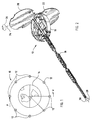
- FIG. 2 illustrates the methods by which the cross-sectional area of satellite 12 is manipulated in conformance with the present invention.
- Satellite 12 includes a body or disk 18, a nadir-pointing antenna system 16 and a pair of solar panels 20 and 22 extending perpendicularly from the disk 18 for providing power to the satellite.
- Solar panels 20 and 22 are mounted on hinges (not shown) so that the panels can be folded for convenient stowage.
- solar panels 20 and 22 are mounted for rotation about an axis 24 in the direction shown in FIG. 2 by arrow 26. The rotation of solar panels 20 and 22 about axis 24 can be used, for example, to vary the surface area of satellite 12 in the plane perpendicular to the direction of motion and for maximizing the amount of solar radiation absorbed by panels 20 and 22.
- Satellite 12 is constructed for movement about a yaw axis 28 in the direction of motion shown by arrow 30 in FIG. 2.
- the yaw movement of satellite 12 about axis 28 is substantially perpendicular to the rotational movement of solar panels 20 and 22 about axis 24, thereby providing a second axis of movement. Additionally, this second axis of movement provides a second means for increasing or decreasing the surface area of satellite 12 in the direction of motion or in the direction of solar pressure.
- the yaw movement of satellite 12 is achieved by a conventional attitude control system.
- the details of the general construction of satellite 12 is disclosed in a copending application, assigned to the assignee of the present invention, for a "Satellite Having a Stackable Configuration", Serial No. 08/191831 filed on February 4, 1994, the disclosure of which is hereby incorporated by reference into the present application.
- the surface area of satellite 12 can be varied by rotating solar panels 20 and 22 about axis 24.
- disk 18 of satellite 12 lies in the plane of the orbit of constellation 10 (i.e., at a yaw angle of 0°)
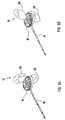
- rotating solar panels 20 and 22 toward 90° about axis 24 increases the satellite surface area thereby increasing the atmospheric drag forces F.
- FIG. 3b An illustration of satellite 12 with its solar panels 20 and 22 in the flared position is shown in FIG. 3b.
- satellite surface area, and hence atmospheric drag F can be minimized by "feathering" solar panels 20 and 22 substantially as shown in FIG. 3a.
- the surface area of satellite 12 can also be varied by rotation about yaw axis 28. As best illustrated in FIG. 2, when satellite 12 rotates about axis 28, the surface area A due to the profile of satellite disk 18 gradually increases, reaching a maximum when the yaw angle is 90°. It should be noted that in the preferred embodiment, radiation patterns emitted by antenna system 16 are substantially symmetrical about axis 28 so that yaw rotation to alter the satellite cross-sectional surface area does not affect radio transmissions. It should also be observed that the influence of solar panels 20 and 22 on drag force F diminishes as the yaw angle of satellite 12 increases.
- solar panels 20 and 22 as a means of controlling drag and solar pressure forces is somewhat constrained by the power requirements of satellite 12. While satellite 12 is exposed to the sun, it is desirable that the orientation of the satellite and the solar panels 20 and 22 be maintained to maximize the amount of solar radiation incident to the solar panels. However, the orientation of satellite 12 and solar panels 20 and 22 is virtually unconstrained for most of the period that the satellite is not exposed to the sun (i.e., when the satellite 12 is in the eclipse portion of its orbit). During this time, modulation of atmospheric drag forces can be accomplished at least partially through variation of the position of solar panels 20 and 22, the orientation of disk 18, or a combination of these.
- FIG. 5 is a schematic block diagram of the formationkeeping control system of the present invention. It is to be noted that although the control system will be described as using variations in atmospheric drag surface area (and hence in the ballistic coefficient of the satellite) to change satellite position and velocity, the control system can also use variations in surface area in the direction of solar radiation pressure to alter satellite motion where the magnitude of the solar pressure is significant.
- the control system receives the actual position of each satellite 12 in constellation 10.
- each satellite 12 is equipped with a position and velocity measuring device.
- a NAVSTARTM Global Positioning System (GPS) receiver can be used for this purpose.
- the GPS comprises a constellation of reference satellites that emit a reference signal.
- the GPS receivers 40 on board satellite 12 calculate accurate absolute position and velocity information from the reference signal. This information is then transmitted via telemetry subsystems 42 and 44 to the ground-based control system 60 on the Earth's surface.
- the operation of the control system 60 is described with reference to a ground-based system, the methods of the present invention could also be used with satellite-to-satellite crosslinks to allow for autonomous control.
- the control system 60 computes the differences in position and velocity of each satellite 12 in constellation 10.
- the current position differences i.e., phase angle as shown in block 48
- velocity i.e., phase angle rate
- the control system 60 initiates corrective action by computing new position commands at block 50 and transmitting the commands to the affected satellites through command subsystem 52 and the telemetry subsystem 42 of the spacecraft. These commands are passed to the spacecraft's attitude control system 54, which makes the required adjustments.
- the control system When the separation between any two satellites exceeds acceptable limits, at block 50 the control system generates commands so that the satellites with the greatest velocity will decrease their surface area by feathering their solar panels (hence, increasing their ballistic coefficient). The remaining (i.e., slower) satellites will increase their surface area by flaring their solar panels (hence, decreasing their ballistic coefficient). Consequently, energy is removed from the orbit of the slower satellites which causes the orbit to decay slightly. These satellites will then have a shorter orbit period and, therefore, the mean velocity of the satellites increases. Conversely, decreasing the surface area of the faster satellites decreases the rate of orbit decay and, therefore, the velocity of these satellites tends to remain constant. The process continues until all satellites attain the desired spacing and same mean velocity.
- Control system 60 also employs a predictive algorithm to compensate for the large lag times inherent in the control of satellite motion through changes in its ballistic coefficient.
- the predictor uses a model of the space environment along with measurements of actual satellite motion to initiate control before the separation between the satellites reaches its critical threshold value.
- the velocity measurements of all the satellites in the constellation are used to compute the rates of separation between all the satellites and, based on these separation rates, to estimate when the respective satellites will reach the separation threshold.
- the control system estimates the duration of the ballistic coefficient control process (i.e., "the control duration window") based on current orbit parameters and the expected magnitude of the perturbative forces.
- the control system initiates a change in the satellite surface area (if necessary) before the satellites reach the separation threshold.
- the controlled satellites are commanded to change their position so as to maximize or minimize, their ballistic coefficients (and hence to minimize or maximize, respectively, the drag force F that each satellite experiences).
- the control system can employ other algorithms that vary the ballistic coefficient as a function of the positional error magnitude, e.g., proportional or integral control or a combination thereof.
- the ballistic coefficient can be increased or decreased by feathering or flaring solar panels 20 and 22, respectively, about axis 24 or by increasing or decreasing the yaw angle of satellite 12, respectively, about axis 28 or by a combination of both maneuvers.
- FIG. 4 shows the control band of a two-satellite constellation using an on/off control method.
- the satellite position oscillates about the optimum by a small amount due to periodic gravitational effects on the orbits of the two satellites.
- the control system is stable because the variation in atmospheric drag force produced by the control maneuvers is relatively small.
- Modulation of satellite ballistic coefficients in accordance with this invention produces a 15% variation in long-term average drag force F on each satellite. This is only several times larger than the perturbations which cause the satellite to drift apart. As a result, minimal secondary errors are introduced by the control system.
- Propulsive formationkeeping systems produce forces on the order of hundreds of times these orbit perturbations, which can cause undesirable secondary effects.
- the present invention also provides a method for "formationfinding," or final orbit trimming, to initiate the orbit of a deployed satellite.
- the satellite 12 In targeting to achieve a particular orbit, the satellite 12 must undergo several precise maneuvers to eliminate the effect of the forces imposed on the satellite during separation from the launch vehicle. The satellites are detached from the launch vehicle so that their initial velocities cause the satellites to separate and move towards their final spacing. Next, initial orbit maneuvers are performed to synchronize the orbits. Where, as in prior systems, the maneuvers are performed by thrusters, orbit insertion can be incomplete because even the smallest available thrusters cannot provide energy in precise amounts. In addition, uncertainties regarding satellite position and velocity contribute to orbit insertion errors. As a result, after the insertion maneuvers are completed, the satellites may still drift apart at some small rate.
- FIG. 4 illustrates the initial separation profile of a two-satellite constellation. After separation from the launch vehicle, several thruster maneuvers are used to achieve an initial separation rate as represented by the initial slope in phase angle shown in FIG. 4. The separation rate is then reduced to achieve final orbit trimming by altering the satellite's atmospheric drag surface area or solar radiation surface area or both.
- ballistic coefficient control was employed during eclipse periods for approximately 110 days after the last thruster maneuver.
- control of atmospheric drag and solar radiation forces can be used to maintain planar separations between several adjacent constellations.
- the atmospheric drag or solar radiation pressure surface areas of each satellite in the constellation are varied through solar panel rotation or satellite yaw angle adjustments or both.
- the constellations can achieve proper right ascension separations between themselves.
- the semi-major axes of two constellations can be controlled relative to each other. Because the rate of precession of an orbit depends in part upon its semi-major axis, surface area control of all of the satellites in one orbit plane can vary the angular spacing between that orbit and an adjacent orbit plane.
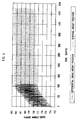
- FIG. 6 is a graph which plots the planar separation between two adjacent orbits of satellites that are being controlled in conformance with the present invention. As shown in FIG. 6 through control of the atmospheric drag forces exerted on the individual satellites in adjacent orbits, planar separation drift (represented by the dashed line trace of FIG. 6) can be eliminated so that the adjacent orbits are maintained at a constant separation (represented by the solid line trace of FIG. 6).
Landscapes
- Engineering & Computer Science (AREA)
- Remote Sensing (AREA)
- Aviation & Aerospace Engineering (AREA)
- Combustion & Propulsion (AREA)
- Chemical & Material Sciences (AREA)
- Physics & Mathematics (AREA)
- Radar, Positioning & Navigation (AREA)
- Astronomy & Astrophysics (AREA)
- General Physics & Mathematics (AREA)
- Life Sciences & Earth Sciences (AREA)
- Sustainable Development (AREA)
- Sustainable Energy (AREA)
- Control Of Position, Course, Altitude, Or Attitude Of Moving Bodies (AREA)
Applications Claiming Priority (2)
| Application Number | Priority Date | Filing Date | Title |
|---|---|---|---|
| US27521094A | 1994-07-14 | 1994-07-14 | |
| US275210 | 1994-07-14 |
Publications (1)
| Publication Number | Publication Date |
|---|---|
| EP0692425A1 true EP0692425A1 (de) | 1996-01-17 |
Family
ID=23051321
Family Applications (1)
| Application Number | Title | Priority Date | Filing Date |
|---|---|---|---|
| EP95110366A Withdrawn EP0692425A1 (de) | 1994-07-14 | 1995-07-03 | Verfahren und System zur Positionshaltung zwischen im Orbit befindlichen Raumflugkörpern durch Änderung ihrer ballistischen Koeffizienten |
Country Status (2)
| Country | Link |
|---|---|
| US (1) | US5806801A (de) |
| EP (1) | EP0692425A1 (de) |
Cited By (3)
| Publication number | Priority date | Publication date | Assignee | Title |
|---|---|---|---|---|
| US6016999A (en) * | 1997-07-05 | 2000-01-25 | Matra Marconi Space Uk Limited | Spacecraft platforms |
| WO2017212478A1 (en) * | 2016-06-06 | 2017-12-14 | Israel Aerospace Industries Ltd. | Miniaturized satellite with a body integrated antenna |
| CN113448346A (zh) * | 2020-03-27 | 2021-09-28 | 中国人民解放军63729部队 | 一种基于遥测信息的弹道择优方法 |
Families Citing this family (17)
| Publication number | Priority date | Publication date | Assignee | Title |
|---|---|---|---|---|
| US6050525A (en) * | 1997-04-29 | 2000-04-18 | Lockheed Martin Corporation | Asymmetric open rosette constellations |
| US6491257B1 (en) * | 1999-10-13 | 2002-12-10 | Motorola, Inc. | Technique for satellite constellation growth |
| US6877691B2 (en) * | 2002-03-12 | 2005-04-12 | Bae Systems Information And Electronic Systems Integration Inc. | High altitude stripping for threat discrimination |
| US6830222B1 (en) | 2002-03-21 | 2004-12-14 | Global Aerospace Corporation | Balloon device for lowering space object orbits |
| DE602004021954D1 (de) * | 2004-12-31 | 2009-08-20 | Thales Sa | Satellit mit Mitteln gegen den Sonnendruck |
| US7874520B2 (en) * | 2006-03-21 | 2011-01-25 | Lockheed Martin Corporation | Satellite with deployable, articulatable thermal radiators |
| ES2397646T3 (es) * | 2006-03-23 | 2013-03-08 | Thales | Sistema de control de despliegue de ingenios espaciales que deben volar en formación , por determinación simultánea y de gran precisión de sus posiciones |
| US8437892B1 (en) * | 2010-01-20 | 2013-05-07 | The United States Of America, As Represented By The Secretary Of The Navy | Method and system for establishment and maintenance of a global formation of directionally-fixed spacecraft without the use of expendable mass |
| US8768622B2 (en) * | 2012-09-14 | 2014-07-01 | The United States Of America, As Represented By The Secretary Of The Navy | System and method for maneuver plan for satellites flying in proximity using apocentral coordinate system |
| JP5632513B2 (ja) * | 2013-07-24 | 2014-11-26 | 三菱スペース・ソフトウエア株式会社 | 観測装置 |
| US9889950B2 (en) | 2015-02-20 | 2018-02-13 | Space Systems/Loral, Llc | Spacecraft with aerodynamic control |
| WO2016200451A2 (en) * | 2015-03-11 | 2016-12-15 | The Aerospace Corporation | Satellite laser communications relay node |
| US9919813B2 (en) * | 2015-04-15 | 2018-03-20 | The United States Of America, As Represented By The Secretary Of The Navy | Control system and method for a plane change for satellite operations |
| CN112357122B (zh) * | 2019-01-17 | 2022-02-01 | 长沙天仪空间科技研究院有限公司 | 一种带有充气天线的卫星 |
| CA3214943A1 (en) * | 2021-05-03 | 2023-01-12 | Kerri Cahoy | Localizing, waking-up, and estimating direction of femto-satellites |
| CN114933028B (zh) * | 2022-07-21 | 2022-11-11 | 北京航天驭星科技有限公司 | 双星轨控策略控制方法、装置、电子设备及存储介质 |
| CN120735989B (zh) * | 2025-09-08 | 2025-11-21 | 中国科学院空间应用工程与技术中心 | 一种远距离逆行轨道航天器的轨道维持机动方法及系统 |
Citations (4)
| Publication number | Priority date | Publication date | Assignee | Title |
|---|---|---|---|---|
| US3588000A (en) * | 1968-07-29 | 1971-06-28 | Westinghouse Electric Corp | Orbit position control of planar reflector satellites |
| WO1992009479A2 (fr) * | 1990-11-30 | 1992-06-11 | Aerospatiale Societe Nationale Industrielle | Procede de controle d'attitude en tangage d'un satellite grace a la pression de radiation solaire et satellite adapte a sa mise en ×uvre |
| DE4243395A1 (en) * | 1991-12-21 | 1993-06-24 | Deutsche Forsch Luft Raumfahrt | Coordinated position maintenance of geostationary satellite cluster - measuring satellites optically relative to master within group for accurate control |
| US5267167A (en) | 1991-05-10 | 1993-11-30 | Ball Corporation | Method and system for formationfinding and formationkeeping in a constellation of satellites |
Family Cites Families (5)
| Publication number | Priority date | Publication date | Assignee | Title |
|---|---|---|---|---|
| DE2604005A1 (de) * | 1976-02-03 | 1977-08-11 | Messerschmitt Boelkow Blohm | Einrichtung zur beeinflussung der position und lage eines satelliten |
| US4759517A (en) * | 1982-06-25 | 1988-07-26 | General Electric Company | Station-keeping using solar sailing |
| GB8927867D0 (en) * | 1989-12-08 | 1990-02-14 | Cambridge Consultants | Solar spacecraft |
| US5124925A (en) * | 1990-01-16 | 1992-06-23 | Space Systems/Loral, Inc. | Method for controlling east/west motion of a geostationary satellite |
| FR2679515B1 (fr) * | 1991-07-26 | 1996-01-26 | Onera (Off Nat Aerospatiale) | Voilure solaire. |
-
1995
- 1995-07-03 EP EP95110366A patent/EP0692425A1/de not_active Withdrawn
-
1996
- 1996-08-05 US US08/692,401 patent/US5806801A/en not_active Expired - Lifetime
Patent Citations (4)
| Publication number | Priority date | Publication date | Assignee | Title |
|---|---|---|---|---|
| US3588000A (en) * | 1968-07-29 | 1971-06-28 | Westinghouse Electric Corp | Orbit position control of planar reflector satellites |
| WO1992009479A2 (fr) * | 1990-11-30 | 1992-06-11 | Aerospatiale Societe Nationale Industrielle | Procede de controle d'attitude en tangage d'un satellite grace a la pression de radiation solaire et satellite adapte a sa mise en ×uvre |
| US5267167A (en) | 1991-05-10 | 1993-11-30 | Ball Corporation | Method and system for formationfinding and formationkeeping in a constellation of satellites |
| DE4243395A1 (en) * | 1991-12-21 | 1993-06-24 | Deutsche Forsch Luft Raumfahrt | Coordinated position maintenance of geostationary satellite cluster - measuring satellites optically relative to master within group for accurate control |
Non-Patent Citations (4)
| Title |
|---|
| "AIAA 26th Aerospace Sciences Meeting", January 1988, article MATTHEWS M., LESZKIEWICZ S.J.: "Efficient Spacecraft Formationkeeping with consideration of ballistic coefficient control" |
| CAROLINA LEE LEONARD: "Formationkeeping of Spacecraft via Differential Drag", July 1986, MASSACHUSETTS INSTITUTE OF TECHNOLOGY |
| LEONARD ET AL.: "ORBITAL FORMATIONKEEPING WITH DIFFERENTIAL DRAG", JOURNAL OF GUIDANCE, CONTROL AND DYNAMICS, vol. 12, no. 1, pages 108 - 113, XP000028008 * |
| MATHEWS ET AL.: "EFFICIENT SPACECRAFT FORMATIONKEEPING WITH CONSIDERATION OF BALLISTIC COEFFICIENT CONTROL", AIAA 26TH AEROSPACE SCIENCES MEETING, 11 January 1988 (1988-01-11) - 14 January 1988 (1988-01-14), RENO, NEVADA (USA), pages 1 - 11, XP002041746 * |
Cited By (3)
| Publication number | Priority date | Publication date | Assignee | Title |
|---|---|---|---|---|
| US6016999A (en) * | 1997-07-05 | 2000-01-25 | Matra Marconi Space Uk Limited | Spacecraft platforms |
| WO2017212478A1 (en) * | 2016-06-06 | 2017-12-14 | Israel Aerospace Industries Ltd. | Miniaturized satellite with a body integrated antenna |
| CN113448346A (zh) * | 2020-03-27 | 2021-09-28 | 中国人民解放军63729部队 | 一种基于遥测信息的弹道择优方法 |
Also Published As
| Publication number | Publication date |
|---|---|
| US5806801A (en) | 1998-09-15 |
Similar Documents
| Publication | Publication Date | Title |
|---|---|---|
| US5806801A (en) | Method and system for formationkeeping between orbiting spacecraft by varying their ballistic coefficients | |
| US5100084A (en) | Method and apparatus for inclined orbit attitude control for momentum bias spacecraft | |
| EP0496879B1 (de) | Vorrichtung zum halten eines satelliten auf seiner umlaufbahn | |
| EP0322349B1 (de) | System zur Bestimmung und Steuerung der Lage eines Satelliten mit einem in Richtung steuerbaren Sensorsbündel | |
| US5267167A (en) | Method and system for formationfinding and formationkeeping in a constellation of satellites | |
| US5806804A (en) | Adaptive harmonic disturbance compensation system | |
| EP0578176B1 (de) | Verfahren und Vorrichtung zur Momentausgleichung eines Satelliten | |
| EP0743249B1 (de) | Universelles Lageregelungssystem für Raumfahrzeug | |
| US10046869B2 (en) | Inertial sensing augmentation for navigation of spacecraft | |
| JP2847302B2 (ja) | 静止衛星のための自律軌道コントロール方法およびシステム | |
| EP0568209A1 (de) | Lageregelung und Momentenausgleich für Raumfahrzeuge mittels kardanisch befestigten und kontinuierlich gedrosselten Triebwerken | |
| US7874519B2 (en) | Spacecraft three-axis attitude acquisition from sun direction measurement | |
| EP0785132A1 (de) | Dynamische Momenten-Vorsteuerung für die Gierregelung im Weltraum | |
| EP0780299A1 (de) | Momentenentladung mittels kardanisch befestigten Triebwerken | |
| JPH05238498A (ja) | 太陽センサを使用して人工衛星の太陽翼を制御する方法および装置 | |
| US6288670B1 (en) | Combined roll-yaw spacecraft steering method for low earth orbit target trajectory compensation | |
| CN113189619A (zh) | 一种低轨星座相位保持参数估计方法 | |
| US6439507B1 (en) | Closed-loop spacecraft orbit control | |
| Wertz et al. | Autonomous constellation maintenance | |
| Markley et al. | Attitude control system conceptual design for geostationary operational environmental satellite spacecraft series | |
| CN112357115B (zh) | 一种卫星轨道纠正方法 | |
| US5996942A (en) | Autonomous solar torque management | |
| US5411227A (en) | Satellite thruster uncertainty estimation in transition mode | |
| EP1092626B1 (de) | Ausgleich eines Thermalschocks auf einem Solarflügel bei Anwendung seines Stellantriebes | |
| EP0544241A1 (de) | Methode und Vorrichtung zur dynamischen Prekompensation von Rückwirkungen der Schrittbewegung eines Solarpaneels auf einen Satelliten |
Legal Events
| Date | Code | Title | Description |
|---|---|---|---|
| PUAI | Public reference made under article 153(3) epc to a published international application that has entered the european phase |
Free format text: ORIGINAL CODE: 0009012 |
|
| AK | Designated contracting states |
Kind code of ref document: A1 Designated state(s): DE FR GB |
|
| 17P | Request for examination filed |
Effective date: 19960715 |
|
| 17Q | First examination report despatched |
Effective date: 19980407 |
|
| STAA | Information on the status of an ep patent application or granted ep patent |
Free format text: STATUS: THE APPLICATION IS DEEMED TO BE WITHDRAWN |
|
| 18D | Application deemed to be withdrawn |
Effective date: 20000815 |