EP0692479B1 - 1,2,3-Oxathiazin-4(3F)-on-2,2-dioxide, ein Verfahren zu ihrer Herstellung und ihre Verwendung als elektrophile Fluorierungsmittel - Google Patents
1,2,3-Oxathiazin-4(3F)-on-2,2-dioxide, ein Verfahren zu ihrer Herstellung und ihre Verwendung als elektrophile Fluorierungsmittel Download PDFInfo
- Publication number
- EP0692479B1 EP0692479B1 EP95110210A EP95110210A EP0692479B1 EP 0692479 B1 EP0692479 B1 EP 0692479B1 EP 95110210 A EP95110210 A EP 95110210A EP 95110210 A EP95110210 A EP 95110210A EP 0692479 B1 EP0692479 B1 EP 0692479B1
- Authority
- EP
- European Patent Office
- Prior art keywords
- compound
- compounds
- formula
- hydrogen
- fluorination
- Prior art date
- Legal status (The legal status is an assumption and is not a legal conclusion. Google has not performed a legal analysis and makes no representation as to the accuracy of the status listed.)
- Expired - Lifetime
Links
- 238000003682 fluorination reaction Methods 0.000 title claims description 13
- 238000000034 method Methods 0.000 title claims description 10
- 238000002360 preparation method Methods 0.000 title claims description 7
- 150000001875 compounds Chemical class 0.000 claims description 26
- WEVYAHXRMPXWCK-UHFFFAOYSA-N Acetonitrile Chemical compound CC#N WEVYAHXRMPXWCK-UHFFFAOYSA-N 0.000 claims description 14
- 239000000203 mixture Substances 0.000 claims description 12
- 229910052731 fluorine Inorganic materials 0.000 claims description 11
- 239000011737 fluorine Substances 0.000 claims description 11
- PUZPDOWCWNUUKD-UHFFFAOYSA-M sodium fluoride Chemical compound [F-].[Na+] PUZPDOWCWNUUKD-UHFFFAOYSA-M 0.000 claims description 11
- 239000012025 fluorinating agent Substances 0.000 claims description 10
- 239000001257 hydrogen Substances 0.000 claims description 9
- 229910052739 hydrogen Inorganic materials 0.000 claims description 9
- 125000004435 hydrogen atom Chemical group [H]* 0.000 claims description 9
- IJGRMHOSHXDMSA-UHFFFAOYSA-N Atomic nitrogen Chemical compound N#N IJGRMHOSHXDMSA-UHFFFAOYSA-N 0.000 claims description 8
- YMWUJEATGCHHMB-UHFFFAOYSA-N Dichloromethane Chemical compound ClCCl YMWUJEATGCHHMB-UHFFFAOYSA-N 0.000 claims description 6
- 235000013024 sodium fluoride Nutrition 0.000 claims description 6
- 239000011775 sodium fluoride Substances 0.000 claims description 6
- 239000002904 solvent Substances 0.000 claims description 6
- XKRFYHLGVUSROY-UHFFFAOYSA-N Argon Chemical compound [Ar] XKRFYHLGVUSROY-UHFFFAOYSA-N 0.000 claims description 4
- HEDRZPFGACZZDS-UHFFFAOYSA-N Chloroform Chemical compound ClC(Cl)Cl HEDRZPFGACZZDS-UHFFFAOYSA-N 0.000 claims description 4
- 229910001515 alkali metal fluoride Inorganic materials 0.000 claims description 4
- 239000011261 inert gas Substances 0.000 claims description 4
- 229910052757 nitrogen Inorganic materials 0.000 claims description 4
- NROKBHXJSPEDAR-UHFFFAOYSA-M potassium fluoride Chemical compound [F-].[K+] NROKBHXJSPEDAR-UHFFFAOYSA-M 0.000 claims description 4
- 239000011734 sodium Chemical group 0.000 claims description 4
- VZGDMQKNWNREIO-UHFFFAOYSA-N tetrachloromethane Chemical compound ClC(Cl)(Cl)Cl VZGDMQKNWNREIO-UHFFFAOYSA-N 0.000 claims description 4
- CYRMSUTZVYGINF-UHFFFAOYSA-N trichlorofluoromethane Chemical compound FC(Cl)(Cl)Cl CYRMSUTZVYGINF-UHFFFAOYSA-N 0.000 claims description 4
- DGAQECJNVWCQMB-PUAWFVPOSA-M Ilexoside XXIX Chemical group C[C@@H]1CC[C@@]2(CC[C@@]3(C(=CC[C@H]4[C@]3(CC[C@@H]5[C@@]4(CC[C@@H](C5(C)C)OS(=O)(=O)[O-])C)C)[C@@H]2[C@]1(C)O)C)C(=O)O[C@H]6[C@@H]([C@H]([C@@H]([C@H](O6)CO)O)O)O.[Na+] DGAQECJNVWCQMB-PUAWFVPOSA-M 0.000 claims description 3
- 125000004178 (C1-C4) alkyl group Chemical group 0.000 claims description 2
- BOSAWIQFTJIYIS-UHFFFAOYSA-N 1,1,1-trichloro-2,2,2-trifluoroethane Chemical compound FC(F)(F)C(Cl)(Cl)Cl BOSAWIQFTJIYIS-UHFFFAOYSA-N 0.000 claims description 2
- ZLMJMSJWJFRBEC-UHFFFAOYSA-N Potassium Chemical group [K] ZLMJMSJWJFRBEC-UHFFFAOYSA-N 0.000 claims description 2
- 229910052783 alkali metal Chemical group 0.000 claims description 2
- 150000001340 alkali metals Chemical group 0.000 claims description 2
- 229910052786 argon Inorganic materials 0.000 claims description 2
- 150000008282 halocarbons Chemical class 0.000 claims description 2
- 239000001307 helium Substances 0.000 claims description 2
- 229910052734 helium Inorganic materials 0.000 claims description 2
- SWQJXJOGLNCZEY-UHFFFAOYSA-N helium atom Chemical compound [He] SWQJXJOGLNCZEY-UHFFFAOYSA-N 0.000 claims description 2
- 239000012442 inert solvent Substances 0.000 claims description 2
- 229910052743 krypton Inorganic materials 0.000 claims description 2
- DNNSSWSSYDEUBZ-UHFFFAOYSA-N krypton atom Chemical compound [Kr] DNNSSWSSYDEUBZ-UHFFFAOYSA-N 0.000 claims description 2
- 125000002496 methyl group Chemical group [H]C([H])([H])* 0.000 claims description 2
- 229910052754 neon Inorganic materials 0.000 claims description 2
- GKAOGPIIYCISHV-UHFFFAOYSA-N neon atom Chemical compound [Ne] GKAOGPIIYCISHV-UHFFFAOYSA-N 0.000 claims description 2
- 150000002825 nitriles Chemical class 0.000 claims description 2
- 229910052756 noble gas Inorganic materials 0.000 claims description 2
- 229910052700 potassium Chemical group 0.000 claims description 2
- 239000011591 potassium Chemical group 0.000 claims description 2
- 235000003270 potassium fluoride Nutrition 0.000 claims description 2
- 239000011698 potassium fluoride Substances 0.000 claims description 2
- 229910052708 sodium Inorganic materials 0.000 claims description 2
- PXGOKWXKJXAPGV-UHFFFAOYSA-N Fluorine Chemical compound FF PXGOKWXKJXAPGV-UHFFFAOYSA-N 0.000 claims 2
- 229910052799 carbon Inorganic materials 0.000 claims 1
- RTZKZFJDLAIYFH-UHFFFAOYSA-N Diethyl ether Chemical compound CCOCC RTZKZFJDLAIYFH-UHFFFAOYSA-N 0.000 description 10
- 239000003921 oil Substances 0.000 description 10
- YCKRFDGAMUMZLT-UHFFFAOYSA-N Fluorine atom Chemical compound [F] YCKRFDGAMUMZLT-UHFFFAOYSA-N 0.000 description 9
- 238000005481 NMR spectroscopy Methods 0.000 description 4
- 238000006243 chemical reaction Methods 0.000 description 4
- 239000003153 chemical reaction reagent Substances 0.000 description 4
- XLYOFNOQVPJJNP-UHFFFAOYSA-N water Substances O XLYOFNOQVPJJNP-UHFFFAOYSA-N 0.000 description 4
- 239000000706 filtrate Substances 0.000 description 3
- FVAUCKIRQBBSSJ-UHFFFAOYSA-M sodium iodide Chemical compound [Na+].[I-] FVAUCKIRQBBSSJ-UHFFFAOYSA-M 0.000 description 3
- 238000003860 storage Methods 0.000 description 3
- 238000004293 19F NMR spectroscopy Methods 0.000 description 2
- 238000005160 1H NMR spectroscopy Methods 0.000 description 2
- GYMMWOANEVEPLC-UHFFFAOYSA-N 2-fluoro-1,1-dioxo-1,2-benzothiazol-3-one Chemical compound C1=CC=C2S(=O)(=O)N(F)C(=O)C2=C1 GYMMWOANEVEPLC-UHFFFAOYSA-N 0.000 description 2
- HEDRZPFGACZZDS-MICDWDOJSA-N Trichloro(2H)methane Chemical compound [2H]C(Cl)(Cl)Cl HEDRZPFGACZZDS-MICDWDOJSA-N 0.000 description 2
- YGCFIWIQZPHFLU-UHFFFAOYSA-N acesulfame Chemical compound CC1=CC(=O)NS(=O)(=O)O1 YGCFIWIQZPHFLU-UHFFFAOYSA-N 0.000 description 2
- 230000015572 biosynthetic process Effects 0.000 description 2
- ISLBSUZRYCRXSH-UHFFFAOYSA-M cesium fluoro sulfate Chemical compound [Cs+].[O-]S(=O)(=O)OF ISLBSUZRYCRXSH-UHFFFAOYSA-M 0.000 description 2
- CSJLBAMHHLJAAS-UHFFFAOYSA-N diethylaminosulfur trifluoride Chemical compound CCN(CC)S(F)(F)F CSJLBAMHHLJAAS-UHFFFAOYSA-N 0.000 description 2
- 239000000463 material Substances 0.000 description 2
- 239000000047 product Substances 0.000 description 2
- 239000011541 reaction mixture Substances 0.000 description 2
- CVHZOJJKTDOEJC-UHFFFAOYSA-N saccharin Chemical compound C1=CC=C2C(=O)NS(=O)(=O)C2=C1 CVHZOJJKTDOEJC-UHFFFAOYSA-N 0.000 description 2
- 229940081974 saccharin Drugs 0.000 description 2
- 235000019204 saccharin Nutrition 0.000 description 2
- 239000000901 saccharin and its Na,K and Ca salt Substances 0.000 description 2
- 238000007086 side reaction Methods 0.000 description 2
- 238000006467 substitution reaction Methods 0.000 description 2
- 239000000725 suspension Substances 0.000 description 2
- 238000003786 synthesis reaction Methods 0.000 description 2
- VCEAGMYKGZNUFL-UHFFFAOYSA-N 1,2,2,3,3,4,4,5,5,6,6-undecafluoropiperidine Chemical compound FN1C(F)(F)C(F)(F)C(F)(F)C(F)(F)C1(F)F VCEAGMYKGZNUFL-UHFFFAOYSA-N 0.000 description 1
- UWDCUCCPBLHLTI-UHFFFAOYSA-N 1-fluoropyridin-1-ium Chemical class F[N+]1=CC=CC=C1 UWDCUCCPBLHLTI-UHFFFAOYSA-N 0.000 description 1
- ZCYVEMRRCGMTRW-UHFFFAOYSA-N 7553-56-2 Chemical compound [I] ZCYVEMRRCGMTRW-UHFFFAOYSA-N 0.000 description 1
- 0 C/C(/OS(=O)=O)=C(/*)\C(N*)=O Chemical compound C/C(/OS(=O)=O)=C(/*)\C(N*)=O 0.000 description 1
- SMFNIURNBQXLJX-UHFFFAOYSA-N FNS(=O)=O Chemical compound FNS(=O)=O SMFNIURNBQXLJX-UHFFFAOYSA-N 0.000 description 1
- UFHFLCQGNIYNRP-UHFFFAOYSA-N Hydrogen Chemical compound [H][H] UFHFLCQGNIYNRP-UHFFFAOYSA-N 0.000 description 1
- XWZWPMWCBVWHFS-UHFFFAOYSA-N [Na].CC=1C(NS(OC1C)(=O)=O)=O Chemical compound [Na].CC=1C(NS(OC1C)(=O)=O)=O XWZWPMWCBVWHFS-UHFFFAOYSA-N 0.000 description 1
- 229960005164 acesulfame Drugs 0.000 description 1
- MJGKXSYZACBTDZ-UHFFFAOYSA-N diethyl 2-fluoro-2-phenylpropanedioate Chemical compound CCOC(=O)C(F)(C(=O)OCC)C1=CC=CC=C1 MJGKXSYZACBTDZ-UHFFFAOYSA-N 0.000 description 1
- FGYDHYCFHBSNPE-UHFFFAOYSA-N diethyl phenylmalonate Chemical compound CCOC(=O)C(C(=O)OCC)C1=CC=CC=C1 FGYDHYCFHBSNPE-UHFFFAOYSA-N 0.000 description 1
- 238000001035 drying Methods 0.000 description 1
- 230000008030 elimination Effects 0.000 description 1
- 238000003379 elimination reaction Methods 0.000 description 1
- JHZPNBKZPAWCJD-UHFFFAOYSA-N ethyl 2-oxocyclopentane-1-carboxylate Chemical compound CCOC(=O)C1CCCC1=O JHZPNBKZPAWCJD-UHFFFAOYSA-N 0.000 description 1
- 238000004880 explosion Methods 0.000 description 1
- 150000002222 fluorine compounds Chemical class 0.000 description 1
- 125000001153 fluoro group Chemical group F* 0.000 description 1
- 125000000623 heterocyclic group Chemical group 0.000 description 1
- 238000004128 high performance liquid chromatography Methods 0.000 description 1
- 150000002431 hydrogen Chemical group 0.000 description 1
- 125000002887 hydroxy group Chemical group [H]O* 0.000 description 1
- 239000004615 ingredient Substances 0.000 description 1
- 229910052740 iodine Inorganic materials 0.000 description 1
- 239000011630 iodine Substances 0.000 description 1
- 238000011031 large-scale manufacturing process Methods 0.000 description 1
- 150000002835 noble gases Chemical class 0.000 description 1
- 230000000269 nucleophilic effect Effects 0.000 description 1
- 239000003960 organic solvent Substances 0.000 description 1
- XHFXMNZYIKFCPN-UHFFFAOYSA-N perchloryl fluoride Chemical compound FCl(=O)(=O)=O XHFXMNZYIKFCPN-UHFFFAOYSA-N 0.000 description 1
- 150000003242 quaternary ammonium salts Chemical class 0.000 description 1
- 238000007142 ring opening reaction Methods 0.000 description 1
- 150000003839 salts Chemical class 0.000 description 1
- 235000009518 sodium iodide Nutrition 0.000 description 1
- 239000011877 solvent mixture Substances 0.000 description 1
- 239000007858 starting material Substances 0.000 description 1
- 239000000126 substance Substances 0.000 description 1
- 229940124530 sulfonamide Drugs 0.000 description 1
- 125000000999 tert-butyl group Chemical group [H]C([H])([H])C(*)(C([H])([H])[H])C([H])([H])[H] 0.000 description 1
- -1 tetrafluoroborate Chemical compound 0.000 description 1
- 238000004448 titration Methods 0.000 description 1
- 231100000331 toxic Toxicity 0.000 description 1
- 230000002588 toxic effect Effects 0.000 description 1
- IMNIMPAHZVJRPE-UHFFFAOYSA-N triethylene diamine Substances C1CN2CCN1CC2 IMNIMPAHZVJRPE-UHFFFAOYSA-N 0.000 description 1
Classifications
-
- C—CHEMISTRY; METALLURGY
- C07—ORGANIC CHEMISTRY
- C07B—GENERAL METHODS OF ORGANIC CHEMISTRY; APPARATUS THEREFOR
- C07B39/00—Halogenation
-
- C—CHEMISTRY; METALLURGY
- C07—ORGANIC CHEMISTRY
- C07C—ACYCLIC OR CARBOCYCLIC COMPOUNDS
- C07C67/00—Preparation of carboxylic acid esters
- C07C67/30—Preparation of carboxylic acid esters by modifying the acid moiety of the ester, such modification not being an introduction of an ester group
- C07C67/307—Preparation of carboxylic acid esters by modifying the acid moiety of the ester, such modification not being an introduction of an ester group by introduction of halogen; by substitution of halogen atoms by other halogen atoms
-
- C—CHEMISTRY; METALLURGY
- C07—ORGANIC CHEMISTRY
- C07D—HETEROCYCLIC COMPOUNDS
- C07D291/00—Heterocyclic compounds containing rings having nitrogen, oxygen and sulfur atoms as the only ring hetero atoms
- C07D291/02—Heterocyclic compounds containing rings having nitrogen, oxygen and sulfur atoms as the only ring hetero atoms not condensed with other rings
- C07D291/06—Six-membered rings
Definitions
- the invention relates to 1,2,3-oxathiazin-4 (3F) -on-2,2-dioxide, a process for their preparation and their use as electrophilic fluorinating agents.
- N-fluorosulfonamide (C) (US Pat. 4,479,901, 4,828,764, DE 36 23 184 A); Camphor-N-Fluor-Sultam (D) (Tetrahedron Lett. 1988, 29, 6087); N-fluorquinicludinium salts (E) (J. Chem. Soc. Perkin Trans I, 1988, 2805); N-fluoropyridinium salts (F) (J. Am. Chem. Soc. 1990, 112, 8563); N-fluoro-N-perfluoromethyl sulfonamides (G) (U.S. Pat. 4,828,764, U.S. Pat. 5,227,493) and N-fluoro-N-chloromethyl-triethylenediamine bis (tetrafluoroborate) (F-Teda (H)) (U.S. Pat. 5,086,178 ).
- the compound (B) is not stable in storage.
- the compounds (C), (F) and (H) are commercially available.
- the commercially available N-flurosulfonamides have the disadvantage, however, that due to the hydrogen atom at the ⁇ position of the N-alkyl radical, HF elimination can very easily occur as a side reaction.
- N-alkyl radicals that have no hydrogen atoms in the ⁇ -position, for. B. a t-butyl group, the yield in the preparation of the NF compound is very low.
- the invention further relates to a process for the preparation of the compounds of the formula (I). It is characterized in that compounds of the formula (II) in which R is as defined above and X is hydrogen or an alkali metal are reacted with elemental fluorine at low temperatures in the presence of an inert solvent and, if appropriate, an alkali metal fluoride.
- Sodium or potassium fluoride in particular sodium fluoride, have proven useful as alkali metal fluorides.
- the fluorinating agent fluorine is advantageously used in a mixture with inert gas such as nitrogen, SF 6 , CF 4 or noble gases such as helium, neon, argon, krypton.
- inert gas such as nitrogen, SF 6 , CF 4 or noble gases such as helium, neon, argon, krypton.
- the preferred inert gas is nitrogen.
- Fluorine / inert gas mixtures which contain up to 30% by volume of fluorine can be used for the fluorination.
- N 2 / F 2 mixture which contains between 1 and 15% by volume, in particular 2 and 10% by volume, preferably 3 to 6% by volume, of F 2 contains.
- Z. B. halogenated hydrocarbons such as dichloromethane, chloroform, carbon tetrachloride, fluorotrichloromethane, trifluorotrichloroethane, tetrafluorodichloroethane or nitriles, especially acetonitrile.
- the temperature at which the reaction is carried out can be varied within a wide range and is in particular in the range from + 10 to -80 ° C.
- the choice of temperature depends in individual cases on the choice of reaction conditions, such as fluorine concentration, composition of the solvent mixture, etc.
- the fluorination is advantageously carried out at temperatures from -80 to -20 ° C., in particular -60 to -30 ° C., preferably -50 to -35 ° C.
- the invention further relates to the use of the compounds of formula (I) for the fluorination of compounds which have open or hidden carbanion character, such as. B. 1,3-dicarbonyl compounds. These compounds can be converted into the fluorine compounds in very high yields.
- the compounds of formula (I) are able to produce iodine if they are treated with sodium iodide solution.
- the concentration of the compounds can therefore be determined by titration.
Landscapes
- Chemical & Material Sciences (AREA)
- Organic Chemistry (AREA)
- Organic Low-Molecular-Weight Compounds And Preparation Thereof (AREA)
- Low-Molecular Organic Synthesis Reactions Using Catalysts (AREA)
Description
- Die Erfindung betrifft 1,2,3-Oxathiazin-4(3F)-on-2,2-dioxide, ein Verfahren zu ihrer Herstellung und ihre Verwendung als elektrophile Fluorierungsmittel.
- Viele neue Agro- und Pharmawirkstoffe enthalten F-Atome an strategischen Positionen. Ein Grund hierfür ist die Tatsache, daß der Ersatz von Wasserstoff durch Fluor (isosterische Substitution) oder von Hydroxylgruppen durch Fluor (isopolare Substitution) sehr oft zu einer Verbesserung der Wirksamkeit führt. Die selektive Einführung von Fluor in organische Moleküle ist deshalb eine sehr wichtige Aufgabe in der modernen Chemie geworden. Obwohl durch die Einführung von Diethylamino-Schwefeltrifluorid und anderer Reagenzien dieser Verbindungsklasse ein Durchbruch auf dem Gebiet der nukleophilen Fluorierung erreicht wurde, besteht weiterer Bedarf an sicheren, milden und effizienten elektrophilen Fluorierungsmitteln. Die meisten solcher elektrophilen Reagenzien, wie z. B. Perchlorylfluorid, Trifluormethylhypofluorid, CsSO4F usw. sind toxische und sehr aggressive Chemikalien, mit denen nicht selten Explosionen beobachtet wurden. Darüberhinaus ist die Lagerstabilität solcher Materialien sehr begrenzt. "F⊕"-Reagenzien auf der Basis von N-F haltigen Verbindungen wurden sehr intensiv untersucht, da einige dieser Materialien sich als gut isolierbar, lagerstabile und effiziente Fluorierungsmitteln bewährt haben. Erste Versuche in dieser Richtung wurden mit Perfluor-N-Fluorpiperidin (A) (J. Chem. Soc. Perkin Trans. I 1988, 2805) durchgeführt. Aufgrund der aufwendigen Synthese (Ausbeute max. 13 %) und der Nebenreaktion während der Fluorierung ist diese Verbindung für praktische Zwecke jedoch nicht von Interesse. Andere bekannte N-F Fluorierungsmittel sind N-Fluorpyridin-2-(1H)one (B) (J. Org. Chem. 1983, 43, 761), N-Fluorsulfonamide (C) (U.S. Pat. 4,479,901, 4,828,764, DE 36 23 184 A); Camphor-N-Fluor-Sultam (D) (Tetrahedron Lett. 1988, 29, 6087); N-Fluorquinicludinium Salze (E) (J. Chem. Soc. Perkin Trans I, 1988, 2805); N-Fluorpyridinium Salze (F) (J. Am. Chem. Soc. 1990, 112, 8563); N-Fluor-N-Perfluormethyl Sulfonamides (G) (U.S. Pat. 4,828,764, U.S. Pat. 5,227,493) und N-Fluor-N-chlormethyl-triethylendiamin-bis(tetrafluorborat) (F-Teda (H)) (U.S. Pat. 5,086,178).

- Die Verbindung (B) ist nicht lagerstabil. Das Reagenz (G), das die stärkste bekannte NF-Verbindung darstellt, erfordert eine sehr aufwendige Synthese für seine Herstellung. Die Verbindungen (C), (F) und (H) sind kommerziell erhältlich. Die käuflichen N-Flurosulfonamide haben allerdings den Nachteil, daß aufgrund des Wasserstoffatoms an der α-Stelle des N-Alkylrests eine HF-Eliminierung sehr leicht als Nebenreaktion auftreten kann. Mit N-Alkylresten, die keine Wasserstoffatome in der α-Stelle besitzen, z. B. einer t-Butylgruppe, ist die Ausbeute bei der Herstellung der NF-Verbindung sehr gering. Obwohl die geladenen Systeme (H), (F), sehr effiziente Fluorierungsmittel sind, ist ein entscheidender Nachteil dieser Systeme ihre begrenzte Löslichkeit in den gängigen organischen Lösungsmitteln. F-Teda (H) hat zusätzlich den Nachteil, daß bei diesem quaternären Ammoniumsalz oft eine Hofmann-Eliminierung stattfindet. Dies ist besonders problematisch bei der Fluorierung von starken Carbanionen.
- In Tetrahedron Vol. 47, No. 35, 1991 Seiten 7447 bis 7458 ist die Verwendung von Cäsiumfluroxysulfat als elektrophiles Fluorierungsmittel für die Herstellung von N-Fluorverbindungen beschrieben. So wird durch Umsetzung von Saccharin mit Cäsiumfluoroxysulfat N-Fluorsaccharin erhalten, dem die Autoren Bedeutung als elektrophiles Fluorierungsmittel bemessen. Eine Herstellung von N-Fluorsaccharin in größerem Maßstab durch Fluorierung von Sacharin mit elementaren Fluor schlug jedoch fehl, bei dieser Reaktion trat Ringöffnung des Heterocyclus auf.
- Es bestand daher ein großer Bedarf nach einem elektrophilen Fluorierungsmittel, das die beschriebenen Nachteile nicht aufweist, aus gut zugänglichen Edukten einfach herzustellen ist und hohe Lagerstabilität besitzt.
- Diese Aufgabe wird gelöst durch Verbindungen der allgemeinen Formel (I)
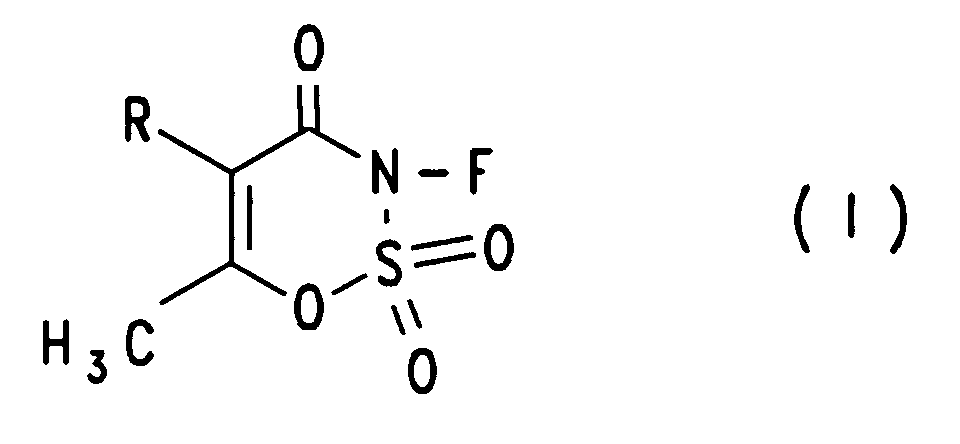
- Von Interesse sind die Verbindungen der Formel (I) worin R gleich Wasserstoff oder Methyl ist.
- Abhängig vom Lösungsmittel ist es auch möglich, daß die Verbindungen der Formel (I) im tautomeren Gleichgewicht mit den Verbindungen der Formel (I') stehen:

- Die Erfindung betrifft ferner ein Verfahren zur Herstellung der Verbindungen der Formel (I). Es ist dadurch gekennzeichnet, daß man Verbindungen der Formel (II), worin R die oben erwähnte Bedeutung besitzt, und X für Wasserstoff oder ein Alkalimetall steht, in Gegenwart eines inerten Lösungsmittels und gegebenenfalls eines Alkalimetallfluorids bei tiefen Temperaturen mit elementarem Fluor umsetzt.

- Die Verbindungen (II) sind großtechnische Produkte (R = H) oder auf literaturbekannte Weise herzustellen.
- Gute Ergebnisse werden z. B. erhalten, wenn X für Wasserstoff, Natrium oder Kalium steht.
- Als Alkalimetallfluoride haben sich Natrium- oder Kaliumfluorid, insbesondere Natriumfluorid bewährt.
- Das Fluorierungsmittel Fluor wird vorteilhaft im Gemisch mit Inertgas wie Stickstoff, SF6, CF4 oder Edelgasen wie Helium, Neon, Argon, Krypton eingesetzt. Bevorzugtes Inertgas ist Stickstoff. Für die Fluorierung können Fluor/Inertgas-Gemische eingesetzt werden, die bis zu 30 Vol.-% Fluor enthalten.
- Es hat sich in vielen Fällen bewährt, die Fluorierung mit einem N2/F2-Gemisch vorzunehmen, das zwischen 1 und 15 Vol.-%, insbesondere 2 und 10 Vol.-%, bevorzugt 3 bis 6 Vol.-% F2 enthält.
- Als Lösungsmittel sind z. B. Halogenkohlenwasserstoffe wie Dichlormethan, Chloroform, Tetrachlorkohlenstoff, Fluortrichlormethan, Trifluor-Trichloräthan, Tetrafluor-Dichloräthan oder Nitrile, insbesondere Acetonitril geeignet.
- Die Temperatur bei der die Umsetzung durchgeführt wird, kann in weiten Bereichen variiert werden und liegt insbesondere im Bereich von + 10 bis -80°C. Die Wahl der Temperatur hängt im Einzelfall von der Wahl der Reaktionsbedingungen wie Fluorkonzentration, Zusammensetzung des Lösungsmittelgemisches etc. ab.
Die Fluorierung wird vorteilhaft bei Temperaturen von -80 bis -20°C, insbesondere -60 bis -30°C, bevorzugt -50 bis -35°C durchgeführt. - Die Erfindung betrifft weiterhin die Verwendung der Verbindungen der Formel (I) zur Fluorierung von Verbindungen die offenen oder versteckten Carbanion-Charakter besitzen, wie z. B. 1,3-Dicarbonylverbindungen. Diese Verbindungen können in sehr hohen Ausbeuten zu den Fluorverbindungen umgesetzt werden.
- Die Verbindungen der Formel (I) sind in der Lage Iod zu erzeugen, wenn man sie mit Natriumiodidlösung behandelt. Die Konzentration der Verbindungen kann deshalb mittels Titration festgestellt werden.
- In der vollständig trockenen (ausgeflammten) unter N2 stehenden Fluorierungsapparatur werden 1,08 g (5,4 mmol) 5,6-Dimethyl-1,2,3-oxathiazin-4(3H)-on-2,2-dioxid Natriumsalz in 120 ml mit CaH2 getrocknetem Acetonitril (Chromasolv R für HPLC) suspendiert, mit 0,22 g NaF (5,4 mmol) versetzt un bei -40°C mit einer 5 % (v/v) F2 in N2-Mischung fluoriert. Anschließend wird 0,5 h bei -40°C und 1 h bei Raumtemperatur mit N2 gespült. Das Gemisch wird filtriert und das Filtrat an der Ölpumpe schnell abdestilliert. Das gelbe Öl wird in getrocknetem Ether aufgenommen, klar filtriert und am Rotationsverdampfer eingeengt. Nach dem Trocknen an der Ölpumpe erhält man 0,55 g Produkt (hellgelbes Öl).
- 1H-NMR (300-MHz, CDCl3): δ(ppm) 2.02 (Quintett, CH3-C-CO); 2,30 (Quartett, CH3-C-O). 19F-NMR (94,2 MHz, CH3CN): δ(ppm, Standard CFCl3) - 78 (b,NF).
- Fluorierung wie oben beschrieben von einer Mischung aus 1,38 g Acesulfam (6-Methyl-1,2,3-oxathiazin-4(3H)-on-2,2-dioxid) und 1,78 g NaF in 120 ml Acetonitril gab 0,92 g eines gelben Öls.
- 1H-NMR (100 MHz, CDCld3): δ (ppm) 2,18 (d, CH3-); 5,81 (m, 1H). 19F-NMR (94,2 MHz, CH3CN): δ (ppm, Standard CFCl3): -78,8 (b,NF).
- Folgende Beispiele sollen die Verwendung der oben beschriebenen Öle illustrieren:
- Eine Lösung von 207 mg (1,3 mmol) Cyclopentanon-2-carbonsäureethylester in 60 ml getrocknetem THF wurde zu einer Suspension von 42 mg NaH (80 % in Öl / 10 ml THF) bei 0°C unter Ar zugegeben. Die Mischung wurde 0,5 h bei 0°C und 1 h bei Raumtemperatur gerührt bevor das Öl von Beispiel 2 (0,5 g) zugegeben wurde. Die Reaktionsmischung wurde 4 h bei Raumtemperatur gerührt. Das Lösungsmittel wurde am Rotationsverdampfer abgezogen. Der Rückstand wurde in Ether aufgenommen, klar filtriert und das Filtrat mit Wasser, gesät. NaHCO3 Lösung und Wasser ausgeschüttet. Die Etherphase wurde dann mit Na2SO4 getrocknet, abfiltriert und das Lösungsmittel unter Vakuum entfernt. Ausbeute 152 mg (67 % d.Th.).
- Eine Lösung von 284 mg (1,2 mmol) 2-Phenylmalonsäurediethylester in 50 ml getrocknetem THF wurde zu einer Suspension von 36 mg NaH (80 % in Öl / 10 ml THF) bei 0°C unter Ar zugegeben. Die Mischung wurde 0,5 h bei 0°C und 1 h bei Raumtemperatur gerührt bevor das Öl von Beispiel 1 (0,3 g) zugegeben wurde. Die Reaktionsmischung wurde 4 h bei Raumtemperatur gerührt. Das Lösungsmittel wurde am Rotationsverdampfer abgezogen. Der Rückstand wurde in Ether aufgenommen, klar filtriert und das Filtrat mit Wasser, gesät. NaHCO3 Lösung und Wasser ausgeschüttelt. Die Etherphase wurde dann mit Na2SO4 getrocknet, abfiltriert und das Lösungsmittel unter Vakuum entfernt. Ausbeute 250 mg (82 % d.Th.).
Claims (11)
- Verbindungen der allgemeinen Formel (I)

- Verbindungen der allgemeinen Formel (I), worin R Wasserstoff oder Methyl bedeuten.
- Verfahren zur Herstellung der Verbindung nach Anspruch 1 oder 2, dadurch gekennzeichnet, daß man Verbindungen der allgemeinen Formel (II)

- Verfahren nach Anspruch 3, dadurch gekennzeichnet, daß X für Wasserstoff, Natrium oder Kalium steht.
- Verfahren nach Anspruch 3 oder 4, dadurch gekennzeichnet, daß als Alkalimetallfluorid Natrium- oder Kaliumfluorid, insbesondere Natriumfluorid eingesetzt wird.
- Verfahren nach mindestens einem der Ansprüche 3 bis 5, dadurch gekennzeichnet, daß das Fluorierungsmittel Fluor im Gemisch mit Inertgasen wie Stickstoff, SF6, CF4 oder Edelgasen wie Helium, Neon, Argon, Krypton, insbesondere Stickstoff eingesetzt wird.
- Verfahren nach mindestens einem der Ansprüche 3 bis 6, dadurch gekennzeichnet, daß die Fluorierung mit einem N2/F2-Gemisch durchgeführt wird, das zwischen 1 und 15 Vol.-%, insbesondere 2 und 10 Vol.- %, bevorzugt 3 bis 6 Vol.-% F2 enthält.
- Verfahren nach mindestens einem der Ansprüche 3 bis 7, dadurch gekennzeichnet, daß als Lösungsmittel Halogenkohlenwasserstoffe, insbesondere Dichlormethan, Chloroform, Tetrachlorkohlenstoff, Fluortrichlormethan, Trifluor-Trichloräthan, Tetrafluor-Dichloräthan oder Nitrile, insbesondere Acetonitril verwendet werden.
- Verfahren nach mindestens einem der Ansprüche 3 bis 8, dadurch gekennzeichnet, daß die Fluorierung bei Temperaturen von -80 bis + 10°C, insbesondere -80 bis -20°C, bevorzugt -60 bis -30°C, besonders bevorzugt -50 bis -35°C durchgeführt wird.
- Verwendung von Verbindungen der Formel (I) zur Fluorierung von Verbindungen die offenen oder versteckten Carbanioncharakter besitzen.
- Verwendung nach Anspruch 10, dadurch gekennzeichnet, daß als Verbindungen mit Carbanioncharakter 1,3-Dicarbonylverbindungen eingesetzt werden.
Applications Claiming Priority (2)
| Application Number | Priority Date | Filing Date | Title |
|---|---|---|---|
| DE4425407 | 1994-07-13 | ||
| DE4425407A DE4425407A1 (de) | 1994-07-13 | 1994-07-13 | 1,2,3-Oxathiazin-4(3F)-on-2.2-dioxide, ein Verfahren zu ihrer Herstellung und ihre Verwendung als elektrophile Fluorierungsmittel |
Publications (2)
| Publication Number | Publication Date |
|---|---|
| EP0692479A1 EP0692479A1 (de) | 1996-01-17 |
| EP0692479B1 true EP0692479B1 (de) | 1997-11-19 |
Family
ID=6523501
Family Applications (1)
| Application Number | Title | Priority Date | Filing Date |
|---|---|---|---|
| EP95110210A Expired - Lifetime EP0692479B1 (de) | 1994-07-13 | 1995-06-30 | 1,2,3-Oxathiazin-4(3F)-on-2,2-dioxide, ein Verfahren zu ihrer Herstellung und ihre Verwendung als elektrophile Fluorierungsmittel |
Country Status (5)
| Country | Link |
|---|---|
| US (1) | US5614626A (de) |
| EP (1) | EP0692479B1 (de) |
| JP (1) | JPH0899967A (de) |
| CA (1) | CA2153759A1 (de) |
| DE (2) | DE4425407A1 (de) |
Families Citing this family (3)
| Publication number | Priority date | Publication date | Assignee | Title |
|---|---|---|---|---|
| DE19644342C1 (de) * | 1996-10-25 | 1998-02-05 | Erwin Giegerich | Barre für maschenbildende Teile und Fassung für Maschenbildungselemente |
| US20030166648A1 (en) * | 2002-11-01 | 2003-09-04 | Macdonald Timothy L | Felbamate derived compounds |
| EP4335841A4 (de) * | 2021-05-28 | 2024-07-24 | Anhui Jinhe Industrial Co., Ltd. | Verfahren zur herstellung von acesulfam-kalium |
Family Cites Families (6)
| Publication number | Priority date | Publication date | Assignee | Title |
|---|---|---|---|---|
| US4479901A (en) | 1983-08-15 | 1984-10-30 | E. I. Du Pont De Nemours And Company | Fluorination of carbanions with N-fluoro-N-alkylsulfonamides |
| US4828764A (en) | 1985-07-24 | 1989-05-09 | Research Corporation | N-Fluoro-N-Perfluoromethyl sulfonamides |
| JPS6226264A (ja) * | 1985-07-24 | 1987-02-04 | リサ−チ・コ−ポレイシヨン | N−フルオロ−n−ペルフルオロメチルスルホンアミド類 |
| DE3623184A1 (de) | 1986-07-10 | 1988-01-14 | Kali Chemie Ag | Verfahren zur herstellung von n-fluorsulfonamiden |
| US5227493A (en) | 1990-08-31 | 1993-07-13 | Air Products And Chemicals, Inc. | Fluorinated sulfonamide derivatives |
| US5086178A (en) | 1990-09-20 | 1992-02-04 | Air Products And Chemicals, Inc. | Fluorinated diazabicycloalkane derivatives |
-
1994
- 1994-07-13 DE DE4425407A patent/DE4425407A1/de not_active Withdrawn
-
1995
- 1995-06-30 EP EP95110210A patent/EP0692479B1/de not_active Expired - Lifetime
- 1995-06-30 DE DE59501002T patent/DE59501002D1/de not_active Expired - Fee Related
- 1995-07-10 JP JP7173693A patent/JPH0899967A/ja not_active Withdrawn
- 1995-07-11 US US08/500,166 patent/US5614626A/en not_active Expired - Fee Related
- 1995-07-12 CA CA002153759A patent/CA2153759A1/en not_active Abandoned
Also Published As
| Publication number | Publication date |
|---|---|
| US5614626A (en) | 1997-03-25 |
| CA2153759A1 (en) | 1996-01-14 |
| EP0692479A1 (de) | 1996-01-17 |
| DE59501002D1 (de) | 1998-01-02 |
| JPH0899967A (ja) | 1996-04-16 |
| DE4425407A1 (de) | 1996-01-18 |
Similar Documents
| Publication | Publication Date | Title |
|---|---|---|
| EP0260560B1 (de) | Verfahren zur Herstellung von 2-Chlor-5-chlormethylthiazol | |
| WO2000032549A1 (de) | Verfahren zur herstellung von säurefluoriden aus säurechloriden | |
| EP1266904B1 (de) | Verbessertes Verfahren zur Herstellung kernfluorierter Aromaten | |
| DE69612899T2 (de) | Reagenz und Verfahren zum Anbringen einer substituierten Difluoromethylgruppe an einer Verbindung mit mindenstens einer elektrophilen Funktion | |
| EP0001993A1 (de) | Fluorhaltige Alkyl-sulfato-betaine und Verfahren zu deren Herstellung | |
| DE2838701C2 (de) | Verfahren zur Herstellung organischer Carbonate | |
| EP0692479B1 (de) | 1,2,3-Oxathiazin-4(3F)-on-2,2-dioxide, ein Verfahren zu ihrer Herstellung und ihre Verwendung als elektrophile Fluorierungsmittel | |
| EP0168344B1 (de) | Verfahren zur Herstellung von alpha,alpha-Difluoralkyl-phenyläther-Derivaten | |
| DE2028843A1 (de) | Benzoylhalogenalkansulfonanilide | |
| DE10258671A1 (de) | Ionische Flüssigkeiten mit [N(CF3)2]-Anionen | |
| DE69309090T2 (de) | Ein verbessertes Verfahren zur Herstellung von N-Fluorsulfonimiden. | |
| EP0680956A1 (de) | Benz-1,2,3-oxathiazin-4(3F)-on-2,2-dioxide, ein Verfahren zu ihrer Herstellung und ihre Verwendung als elektrophile Fluorierungsmittel | |
| DE1292664B (de) | 1, 2, 3, 5, 6-Pentathiacycloheptan, Verfahren zu dessen Herstellung und Verwendung | |
| DE2603508C2 (de) | Verfahren zur Herstellung von " Isothiocyanaten | |
| EP0107163B1 (de) | Dihalogenvinylphenyl-phosphorsäureester, Verfahren zu ihrer Herstellung und ihre Verwendung als Schädlingsbekämpfungsmittel | |
| DE69803186T2 (de) | Katalysierte fluorierung von carbonylverbindungen | |
| DE69837852T2 (de) | Derivate von o-(perfluor)dibenzofuranium-salzen, zwischenprodukte zu ihrer herstellung, verfahren zur herstellung der zwischenprodukte, perfluoralkylierungsmittel und perfluoralkylierungsverfahren | |
| DE19732030B4 (de) | Verfahren zur Herstellung von Chlormethansulfonylchlorid | |
| DE4133247A1 (de) | Verfahren zur herstellung von 1.1.1.2-tetrafluorethan | |
| WO1996034854A1 (de) | β-AZIDOETHANSULFONYLAZID, VERFAHREN ZU SEINER HERSTELLUNG UND SEINE VERWENDUNG | |
| DE2534601A1 (de) | Verfahren zur herstellung von camptothecin-aehnlichen verbindungen | |
| AT228802B (de) | Verfahren zur Herstellung des neuen O, O-Dimethyl-O-(3-methyl-4-nitro-phenyl)-thionophosphorsäureesters | |
| DE2441441A1 (de) | Thiophenderivate und verfahren zu ihrer herstellung | |
| WO1996032373A1 (de) | VERFAHREN ZUR HERSTELLUNG VON WEITGEHEND ISOMERENREINEN α-BISOXIMEN | |
| DE2101359C3 (de) | Verfahren zur Herstellung von 4-Mercaptophenolen |
Legal Events
| Date | Code | Title | Description |
|---|---|---|---|
| PUAI | Public reference made under article 153(3) epc to a published international application that has entered the european phase |
Free format text: ORIGINAL CODE: 0009012 |
|
| AK | Designated contracting states |
Kind code of ref document: A1 Designated state(s): CH DE FR GB IT LI NL |
|
| 17P | Request for examination filed |
Effective date: 19960717 |
|
| 17Q | First examination report despatched |
Effective date: 19960812 |
|
| GRAG | Despatch of communication of intention to grant |
Free format text: ORIGINAL CODE: EPIDOS AGRA |
|
| GRAH | Despatch of communication of intention to grant a patent |
Free format text: ORIGINAL CODE: EPIDOS IGRA |
|
| GRAH | Despatch of communication of intention to grant a patent |
Free format text: ORIGINAL CODE: EPIDOS IGRA |
|
| GRAA | (expected) grant |
Free format text: ORIGINAL CODE: 0009210 |
|
| AK | Designated contracting states |
Kind code of ref document: B1 Designated state(s): CH DE FR GB IT LI NL |
|
| REG | Reference to a national code |
Ref country code: CH Ref legal event code: EP |
|
| REF | Corresponds to: |
Ref document number: 59501002 Country of ref document: DE Date of ref document: 19980102 |
|
| ITF | It: translation for a ep patent filed | ||
| GBT | Gb: translation of ep patent filed (gb section 77(6)(a)/1977) |
Effective date: 19980120 |
|
| ET | Fr: translation filed | ||
| PLBE | No opposition filed within time limit |
Free format text: ORIGINAL CODE: 0009261 |
|
| STAA | Information on the status of an ep patent application or granted ep patent |
Free format text: STATUS: NO OPPOSITION FILED WITHIN TIME LIMIT |
|
| 26N | No opposition filed | ||
| PGFP | Annual fee paid to national office [announced via postgrant information from national office to epo] |
Ref country code: GB Payment date: 20010515 Year of fee payment: 7 |
|
| PGFP | Annual fee paid to national office [announced via postgrant information from national office to epo] |
Ref country code: CH Payment date: 20010517 Year of fee payment: 7 |
|
| PGFP | Annual fee paid to national office [announced via postgrant information from national office to epo] |
Ref country code: FR Payment date: 20010531 Year of fee payment: 7 |
|
| PGFP | Annual fee paid to national office [announced via postgrant information from national office to epo] |
Ref country code: DE Payment date: 20010611 Year of fee payment: 7 |
|
| PGFP | Annual fee paid to national office [announced via postgrant information from national office to epo] |
Ref country code: NL Payment date: 20010618 Year of fee payment: 7 |
|
| REG | Reference to a national code |
Ref country code: GB Ref legal event code: IF02 |
|
| PG25 | Lapsed in a contracting state [announced via postgrant information from national office to epo] |
Ref country code: LI Free format text: LAPSE BECAUSE OF NON-PAYMENT OF DUE FEES Effective date: 20020630 Ref country code: GB Free format text: LAPSE BECAUSE OF NON-PAYMENT OF DUE FEES Effective date: 20020630 Ref country code: CH Free format text: LAPSE BECAUSE OF NON-PAYMENT OF DUE FEES Effective date: 20020630 |
|
| PG25 | Lapsed in a contracting state [announced via postgrant information from national office to epo] |
Ref country code: NL Free format text: LAPSE BECAUSE OF NON-PAYMENT OF DUE FEES Effective date: 20030101 Ref country code: DE Free format text: LAPSE BECAUSE OF NON-PAYMENT OF DUE FEES Effective date: 20030101 |
|
| REG | Reference to a national code |
Ref country code: CH Ref legal event code: PL |
|
| GBPC | Gb: european patent ceased through non-payment of renewal fee |
Effective date: 20020630 |
|
| PG25 | Lapsed in a contracting state [announced via postgrant information from national office to epo] |
Ref country code: FR Free format text: LAPSE BECAUSE OF NON-PAYMENT OF DUE FEES Effective date: 20030228 |
|
| NLV4 | Nl: lapsed or anulled due to non-payment of the annual fee |
Effective date: 20030101 |
|
| REG | Reference to a national code |
Ref country code: FR Ref legal event code: ST |
|
| PG25 | Lapsed in a contracting state [announced via postgrant information from national office to epo] |
Ref country code: IT Free format text: LAPSE BECAUSE OF NON-PAYMENT OF DUE FEES;WARNING: LAPSES OF ITALIAN PATENTS WITH EFFECTIVE DATE BEFORE 2007 MAY HAVE OCCURRED AT ANY TIME BEFORE 2007. THE CORRECT EFFECTIVE DATE MAY BE DIFFERENT FROM THE ONE RECORDED. Effective date: 20050630 |