EP0692503A1 - Cycloolefinpolymere - Google Patents
Cycloolefinpolymere Download PDFInfo
- Publication number
- EP0692503A1 EP0692503A1 EP95110211A EP95110211A EP0692503A1 EP 0692503 A1 EP0692503 A1 EP 0692503A1 EP 95110211 A EP95110211 A EP 95110211A EP 95110211 A EP95110211 A EP 95110211A EP 0692503 A1 EP0692503 A1 EP 0692503A1
- Authority
- EP
- European Patent Office
- Prior art keywords
- cycloolefin
- polymer
- solution
- polymers
- cycloolefin polymer
- Prior art date
- Legal status (The legal status is an assumption and is not a legal conclusion. Google has not performed a legal analysis and makes no representation as to the accuracy of the status listed.)
- Withdrawn
Links
- 229920000089 Cyclic olefin copolymer Polymers 0.000 title claims abstract description 85
- -1 acyclic olefin Chemical class 0.000 claims abstract description 79
- NNBZCPXTIHJBJL-UHFFFAOYSA-N decalin Chemical compound C1CCCC2CCCCC21 NNBZCPXTIHJBJL-UHFFFAOYSA-N 0.000 claims abstract description 37
- 229920001400 block copolymer Polymers 0.000 claims abstract description 19
- PXXNTAGJWPJAGM-UHFFFAOYSA-N vertaline Natural products C1C2C=3C=C(OC)C(OC)=CC=3OC(C=C3)=CC=C3CCC(=O)OC1CC1N2CCCC1 PXXNTAGJWPJAGM-UHFFFAOYSA-N 0.000 claims abstract description 18
- JRZJOMJEPLMPRA-UHFFFAOYSA-N olefin Natural products CCCCCCCC=C JRZJOMJEPLMPRA-UHFFFAOYSA-N 0.000 claims abstract description 14
- 239000003054 catalyst Substances 0.000 claims abstract description 12
- 239000000178 monomer Substances 0.000 claims abstract description 12
- 150000001925 cycloalkenes Chemical group 0.000 claims abstract description 11
- 150000001336 alkenes Chemical class 0.000 claims abstract description 10
- 238000000034 method Methods 0.000 claims abstract description 9
- 230000008569 process Effects 0.000 claims abstract description 6
- 229920000578 graft copolymer Polymers 0.000 claims abstract description 5
- 229910052723 transition metal Inorganic materials 0.000 claims abstract description 3
- 150000003624 transition metals Chemical class 0.000 claims abstract description 3
- 125000004432 carbon atom Chemical group C* 0.000 claims description 16
- 125000000524 functional group Chemical group 0.000 claims description 11
- 229920001577 copolymer Polymers 0.000 claims description 9
- 238000002360 preparation method Methods 0.000 claims description 3
- 229920000642 polymer Polymers 0.000 abstract description 45
- 229910052794 bromium Inorganic materials 0.000 description 18
- CSCPPACGZOOCGX-UHFFFAOYSA-N Acetone Chemical compound CC(C)=O CSCPPACGZOOCGX-UHFFFAOYSA-N 0.000 description 16
- WKBOTKDWSSQWDR-UHFFFAOYSA-N Bromine atom Chemical compound [Br] WKBOTKDWSSQWDR-UHFFFAOYSA-N 0.000 description 16
- GDTBXPJZTBHREO-UHFFFAOYSA-N bromine Substances BrBr GDTBXPJZTBHREO-UHFFFAOYSA-N 0.000 description 16
- YXFVVABEGXRONW-UHFFFAOYSA-N Toluene Chemical compound CC1=CC=CC=C1 YXFVVABEGXRONW-UHFFFAOYSA-N 0.000 description 15
- WYURNTSHIVDZCO-UHFFFAOYSA-N Tetrahydrofuran Chemical compound C1CCOC1 WYURNTSHIVDZCO-UHFFFAOYSA-N 0.000 description 14
- 238000006243 chemical reaction Methods 0.000 description 13
- KWKAKUADMBZCLK-UHFFFAOYSA-N 1-octene Chemical compound CCCCCCC=C KWKAKUADMBZCLK-UHFFFAOYSA-N 0.000 description 12
- VLKZOEOYAKHREP-UHFFFAOYSA-N n-Hexane Chemical compound CCCCCC VLKZOEOYAKHREP-UHFFFAOYSA-N 0.000 description 12
- PPBRXRYQALVLMV-UHFFFAOYSA-N Styrene Chemical compound C=CC1=CC=CC=C1 PPBRXRYQALVLMV-UHFFFAOYSA-N 0.000 description 10
- VPGLGRNSAYHXPY-UHFFFAOYSA-L zirconium(2+);dichloride Chemical compound Cl[Zr]Cl VPGLGRNSAYHXPY-UHFFFAOYSA-L 0.000 description 10
- 239000000203 mixture Substances 0.000 description 9
- 238000006116 polymerization reaction Methods 0.000 description 9
- 239000000843 powder Substances 0.000 description 9
- XKRFYHLGVUSROY-UHFFFAOYSA-N Argon Chemical compound [Ar] XKRFYHLGVUSROY-UHFFFAOYSA-N 0.000 description 8
- VGGSQFUCUMXWEO-UHFFFAOYSA-N Ethene Chemical compound C=C VGGSQFUCUMXWEO-UHFFFAOYSA-N 0.000 description 8
- 239000005977 Ethylene Substances 0.000 description 8
- KFZMGEQAYNKOFK-UHFFFAOYSA-N Isopropanol Chemical compound CC(C)O KFZMGEQAYNKOFK-UHFFFAOYSA-N 0.000 description 8
- 150000001450 anions Chemical class 0.000 description 8
- 239000004215 Carbon black (E152) Substances 0.000 description 7
- 239000004793 Polystyrene Substances 0.000 description 7
- 229910052736 halogen Inorganic materials 0.000 description 7
- 150000002367 halogens Chemical class 0.000 description 7
- 229930195733 hydrocarbon Natural products 0.000 description 7
- 238000004519 manufacturing process Methods 0.000 description 7
- 229920002223 polystyrene Polymers 0.000 description 7
- RRHGJUQNOFWUDK-UHFFFAOYSA-N Isoprene Chemical compound CC(=C)C=C RRHGJUQNOFWUDK-UHFFFAOYSA-N 0.000 description 6
- OKKJLVBELUTLKV-UHFFFAOYSA-N Methanol Chemical compound OC OKKJLVBELUTLKV-UHFFFAOYSA-N 0.000 description 6
- 238000002474 experimental method Methods 0.000 description 6
- 125000002887 hydroxy group Chemical group [H]O* 0.000 description 6
- 239000003999 initiator Substances 0.000 description 6
- 230000000717 retained effect Effects 0.000 description 6
- 125000001931 aliphatic group Chemical group 0.000 description 5
- 125000003118 aryl group Chemical group 0.000 description 5
- 230000000052 comparative effect Effects 0.000 description 5
- 238000010168 coupling process Methods 0.000 description 5
- 150000003254 radicals Chemical class 0.000 description 5
- ZGEGCLOFRBLKSE-UHFFFAOYSA-N 1-Heptene Chemical compound CCCCCC=C ZGEGCLOFRBLKSE-UHFFFAOYSA-N 0.000 description 4
- KAKZBPTYRLMSJV-UHFFFAOYSA-N Butadiene Chemical compound C=CC=C KAKZBPTYRLMSJV-UHFFFAOYSA-N 0.000 description 4
- LFQSCWFLJHTTHZ-UHFFFAOYSA-N Ethanol Chemical compound CCO LFQSCWFLJHTTHZ-UHFFFAOYSA-N 0.000 description 4
- MZRVEZGGRBJDDB-UHFFFAOYSA-N N-Butyllithium Chemical compound [Li]CCCC MZRVEZGGRBJDDB-UHFFFAOYSA-N 0.000 description 4
- 239000005062 Polybutadiene Substances 0.000 description 4
- 229910052786 argon Inorganic materials 0.000 description 4
- 230000008878 coupling Effects 0.000 description 4
- 238000005859 coupling reaction Methods 0.000 description 4
- 238000005227 gel permeation chromatography Methods 0.000 description 4
- 239000011521 glass Substances 0.000 description 4
- CPOFMOWDMVWCLF-UHFFFAOYSA-N methyl(oxo)alumane Chemical compound C[Al]=O CPOFMOWDMVWCLF-UHFFFAOYSA-N 0.000 description 4
- TVMXDCGIABBOFY-UHFFFAOYSA-N n-Octanol Natural products CCCCCCCC TVMXDCGIABBOFY-UHFFFAOYSA-N 0.000 description 4
- JFNLZVQOOSMTJK-KNVOCYPGSA-N norbornene Chemical compound C1[C@@H]2CC[C@H]1C=C2 JFNLZVQOOSMTJK-KNVOCYPGSA-N 0.000 description 4
- 229920002857 polybutadiene Polymers 0.000 description 4
- 229920001195 polyisoprene Polymers 0.000 description 4
- 125000002924 primary amino group Chemical group [H]N([H])* 0.000 description 4
- 125000004805 propylene group Chemical group [H]C([H])([H])C([H])([*:1])C([H])([H])[*:2] 0.000 description 4
- 238000003756 stirring Methods 0.000 description 4
- VXNZUUAINFGPBY-UHFFFAOYSA-N 1-Butene Chemical compound CCC=C VXNZUUAINFGPBY-UHFFFAOYSA-N 0.000 description 3
- LIKMAJRDDDTEIG-UHFFFAOYSA-N 1-hexene Chemical compound CCCCC=C LIKMAJRDDDTEIG-UHFFFAOYSA-N 0.000 description 3
- HEMHJVSKTPXQMS-UHFFFAOYSA-M Sodium hydroxide Chemical compound [OH-].[Na+] HEMHJVSKTPXQMS-UHFFFAOYSA-M 0.000 description 3
- 238000010539 anionic addition polymerization reaction Methods 0.000 description 3
- 150000001244 carboxylic acid anhydrides Chemical class 0.000 description 3
- 239000003995 emulsifying agent Substances 0.000 description 3
- 230000009477 glass transition Effects 0.000 description 3
- 125000004435 hydrogen atom Chemical group [H]* 0.000 description 3
- 239000000463 material Substances 0.000 description 3
- 230000004048 modification Effects 0.000 description 3
- 238000012986 modification Methods 0.000 description 3
- 125000001181 organosilyl group Chemical group [SiH3]* 0.000 description 3
- YWAKXRMUMFPDSH-UHFFFAOYSA-N pentene Chemical compound CCCC=C YWAKXRMUMFPDSH-UHFFFAOYSA-N 0.000 description 3
- 239000002904 solvent Substances 0.000 description 3
- 150000003623 transition metal compounds Chemical class 0.000 description 3
- XLYOFNOQVPJJNP-UHFFFAOYSA-N water Substances O XLYOFNOQVPJJNP-UHFFFAOYSA-N 0.000 description 3
- 239000004711 α-olefin Substances 0.000 description 3
- RFFLAFLAYFXFSW-UHFFFAOYSA-N 1,2-dichlorobenzene Chemical compound ClC1=CC=CC=C1Cl RFFLAFLAYFXFSW-UHFFFAOYSA-N 0.000 description 2
- 238000005160 1H NMR spectroscopy Methods 0.000 description 2
- WSSSPWUEQFSQQG-UHFFFAOYSA-N 4-methyl-1-pentene Chemical compound CC(C)CC=C WSSSPWUEQFSQQG-UHFFFAOYSA-N 0.000 description 2
- 239000004593 Epoxy Chemical group 0.000 description 2
- BAPJBEWLBFYGME-UHFFFAOYSA-N Methyl acrylate Chemical compound COC(=O)C=C BAPJBEWLBFYGME-UHFFFAOYSA-N 0.000 description 2
- 238000005481 NMR spectroscopy Methods 0.000 description 2
- YZCKVEUIGOORGS-IGMARMGPSA-N Protium Chemical compound [1H] YZCKVEUIGOORGS-IGMARMGPSA-N 0.000 description 2
- 229910006069 SO3H Inorganic materials 0.000 description 2
- 229910000831 Steel Inorganic materials 0.000 description 2
- UCIKZESDXASJNG-UHFFFAOYSA-L [Cl-].[Cl-].C1=CC=C2C([Zr+2])C=CC2=C1 Chemical compound [Cl-].[Cl-].C1=CC=C2C([Zr+2])C=CC2=C1 UCIKZESDXASJNG-UHFFFAOYSA-L 0.000 description 2
- 230000001070 adhesive effect Effects 0.000 description 2
- 125000003545 alkoxy group Chemical group 0.000 description 2
- 238000004458 analytical method Methods 0.000 description 2
- 150000008064 anhydrides Chemical group 0.000 description 2
- 150000005840 aryl radicals Chemical class 0.000 description 2
- 125000004104 aryloxy group Chemical group 0.000 description 2
- 230000031709 bromination Effects 0.000 description 2
- 238000005893 bromination reaction Methods 0.000 description 2
- 125000003178 carboxy group Chemical group [H]OC(*)=O 0.000 description 2
- 229910052801 chlorine Inorganic materials 0.000 description 2
- 238000001816 cooling Methods 0.000 description 2
- 238000007334 copolymerization reaction Methods 0.000 description 2
- 125000004122 cyclic group Chemical group 0.000 description 2
- HGCIXCUEYOPUTN-UHFFFAOYSA-N cyclohexene Chemical compound C1CCC=CC1 HGCIXCUEYOPUTN-UHFFFAOYSA-N 0.000 description 2
- KBLWLMPSVYBVDK-UHFFFAOYSA-N cyclohexyl prop-2-enoate Chemical class C=CC(=O)OC1CCCCC1 KBLWLMPSVYBVDK-UHFFFAOYSA-N 0.000 description 2
- ZSWFCLXCOIISFI-UHFFFAOYSA-N cyclopentadiene Chemical compound C1C=CC=C1 ZSWFCLXCOIISFI-UHFFFAOYSA-N 0.000 description 2
- LPIQUOYDBNQMRZ-UHFFFAOYSA-N cyclopentene Chemical compound C1CC=CC1 LPIQUOYDBNQMRZ-UHFFFAOYSA-N 0.000 description 2
- 230000008034 disappearance Effects 0.000 description 2
- 238000000921 elemental analysis Methods 0.000 description 2
- 150000002148 esters Chemical class 0.000 description 2
- 230000007717 exclusion Effects 0.000 description 2
- 229910052731 fluorine Inorganic materials 0.000 description 2
- 238000007306 functionalization reaction Methods 0.000 description 2
- 238000010438 heat treatment Methods 0.000 description 2
- 239000001257 hydrogen Substances 0.000 description 2
- 229910052739 hydrogen Inorganic materials 0.000 description 2
- 239000012968 metallocene catalyst Substances 0.000 description 2
- QLOKAVKWGPPUCM-UHFFFAOYSA-N oxovanadium;dihydrochloride Chemical compound Cl.Cl.[V]=O QLOKAVKWGPPUCM-UHFFFAOYSA-N 0.000 description 2
- 239000001301 oxygen Substances 0.000 description 2
- 229910052760 oxygen Inorganic materials 0.000 description 2
- 230000037048 polymerization activity Effects 0.000 description 2
- QQONPFPTGQHPMA-UHFFFAOYSA-N propylene Natural products CC=C QQONPFPTGQHPMA-UHFFFAOYSA-N 0.000 description 2
- 238000000425 proton nuclear magnetic resonance spectrum Methods 0.000 description 2
- 239000010959 steel Substances 0.000 description 2
- 125000005504 styryl group Chemical group 0.000 description 2
- 125000000020 sulfo group Chemical group O=S(=O)([*])O[H] 0.000 description 2
- 238000003786 synthesis reaction Methods 0.000 description 2
- VZGDMQKNWNREIO-UHFFFAOYSA-N tetrachloromethane Chemical compound ClC(Cl)(Cl)Cl VZGDMQKNWNREIO-UHFFFAOYSA-N 0.000 description 2
- XBFJAVXCNXDMBH-UHFFFAOYSA-N tetracyclo[6.2.1.1(3,6).0(2,7)]dodec-4-ene Chemical compound C1C(C23)C=CC1C3C1CC2CC1 XBFJAVXCNXDMBH-UHFFFAOYSA-N 0.000 description 2
- YLQBMQCUIZJEEH-UHFFFAOYSA-N tetrahydrofuran Natural products C=1C=COC=1 YLQBMQCUIZJEEH-UHFFFAOYSA-N 0.000 description 2
- 229920001169 thermoplastic Polymers 0.000 description 2
- 239000004416 thermosoftening plastic Substances 0.000 description 2
- 239000004034 viscosity adjusting agent Substances 0.000 description 2
- PRFBWRVABJJZDD-UHFFFAOYSA-N 1,2,3,4,4a,5,6,7,8,8a-decahydronaphthalene argon Chemical compound C1CCCC2CCCCC12.[Ar] PRFBWRVABJJZDD-UHFFFAOYSA-N 0.000 description 1
- SDRZFSPCVYEJTP-UHFFFAOYSA-N 1-ethenylcyclohexene Chemical compound C=CC1=CCCCC1 SDRZFSPCVYEJTP-UHFFFAOYSA-N 0.000 description 1
- IGGDKDTUCAWDAN-UHFFFAOYSA-N 1-vinylnaphthalene Chemical compound C1=CC=C2C(C=C)=CC=CC2=C1 IGGDKDTUCAWDAN-UHFFFAOYSA-N 0.000 description 1
- HECLRDQVFMWTQS-RGOKHQFPSA-N 1755-01-7 Chemical compound C1[C@H]2[C@@H]3CC=C[C@@H]3[C@@H]1C=C2 HECLRDQVFMWTQS-RGOKHQFPSA-N 0.000 description 1
- NGNBDVOYPDDBFK-UHFFFAOYSA-N 2-[2,4-di(pentan-2-yl)phenoxy]acetyl chloride Chemical compound CCCC(C)C1=CC=C(OCC(Cl)=O)C(C(C)CCC)=C1 NGNBDVOYPDDBFK-UHFFFAOYSA-N 0.000 description 1
- BTOVVHWKPVSLBI-UHFFFAOYSA-N 2-methylprop-1-enylbenzene Chemical compound CC(C)=CC1=CC=CC=C1 BTOVVHWKPVSLBI-UHFFFAOYSA-N 0.000 description 1
- VJJZJBUCDWKPLC-UHFFFAOYSA-N 3-methoxyapigenin Chemical compound O1C2=CC(O)=CC(O)=C2C(=O)C(OC)=C1C1=CC=C(O)C=C1 VJJZJBUCDWKPLC-UHFFFAOYSA-N 0.000 description 1
- JLBJTVDPSNHSKJ-UHFFFAOYSA-N 4-Methylstyrene Chemical compound CC1=CC=C(C=C)C=C1 JLBJTVDPSNHSKJ-UHFFFAOYSA-N 0.000 description 1
- DGZXVEAMYQEFHB-UHFFFAOYSA-N 4-ethenylbenzoyl chloride Chemical compound ClC(=O)C1=CC=C(C=C)C=C1 DGZXVEAMYQEFHB-UHFFFAOYSA-N 0.000 description 1
- INYHZQLKOKTDAI-UHFFFAOYSA-N 5-ethenylbicyclo[2.2.1]hept-2-ene Chemical compound C1C2C(C=C)CC1C=C2 INYHZQLKOKTDAI-UHFFFAOYSA-N 0.000 description 1
- NIXOWILDQLNWCW-UHFFFAOYSA-M Acrylate Chemical compound [O-]C(=O)C=C NIXOWILDQLNWCW-UHFFFAOYSA-M 0.000 description 1
- 125000005915 C6-C14 aryl group Chemical group 0.000 description 1
- CTBFXDVGDCMIQR-UHFFFAOYSA-L C[SiH](C)[Zr](Cl)(Cl)(C1C=CC=C1)C1C=Cc2ccccc12 Chemical compound C[SiH](C)[Zr](Cl)(Cl)(C1C=CC=C1)C1C=Cc2ccccc12 CTBFXDVGDCMIQR-UHFFFAOYSA-L 0.000 description 1
- MPJLHVOQWLKMRN-UHFFFAOYSA-L C[SiH](C)[Zr](Cl)(Cl)(C1C=CC=C1)C1c2ccccc2-c2ccccc12 Chemical compound C[SiH](C)[Zr](Cl)(Cl)(C1C=CC=C1)C1c2ccccc2-c2ccccc12 MPJLHVOQWLKMRN-UHFFFAOYSA-L 0.000 description 1
- OKTJSMMVPCPJKN-UHFFFAOYSA-N Carbon Chemical compound [C] OKTJSMMVPCPJKN-UHFFFAOYSA-N 0.000 description 1
- SVHPGKHHBXQFLQ-UHFFFAOYSA-L Cl[Zr](Cl)(C1C=CC=C1)(C1c2ccccc2-c2ccccc12)=C(c1ccccc1)c1ccccc1 Chemical compound Cl[Zr](Cl)(C1C=CC=C1)(C1c2ccccc2-c2ccccc12)=C(c1ccccc1)c1ccccc1 SVHPGKHHBXQFLQ-UHFFFAOYSA-L 0.000 description 1
- JIGUQPWFLRLWPJ-UHFFFAOYSA-N Ethyl acrylate Chemical compound CCOC(=O)C=C JIGUQPWFLRLWPJ-UHFFFAOYSA-N 0.000 description 1
- MHAJPDPJQMAIIY-UHFFFAOYSA-N Hydrogen peroxide Chemical compound OO MHAJPDPJQMAIIY-UHFFFAOYSA-N 0.000 description 1
- VQTUBCCKSQIDNK-UHFFFAOYSA-N Isobutene Chemical group CC(C)=C VQTUBCCKSQIDNK-UHFFFAOYSA-N 0.000 description 1
- CERQOIWHTDAKMF-UHFFFAOYSA-M Methacrylate Chemical compound CC(=C)C([O-])=O CERQOIWHTDAKMF-UHFFFAOYSA-M 0.000 description 1
- VVQNEPGJFQJSBK-UHFFFAOYSA-N Methyl methacrylate Chemical compound COC(=O)C(C)=C VVQNEPGJFQJSBK-UHFFFAOYSA-N 0.000 description 1
- 239000004698 Polyethylene Substances 0.000 description 1
- 239000004743 Polypropylene Substances 0.000 description 1
- LBKBUQUIRJQWLH-UHFFFAOYSA-L [Cl-].[Cl-].C1(=CC=CC=C1)CC=[Zr+2](C1C=CC=C1)C1C2=CC=CC=C2C=2C=CC=CC1=2 Chemical compound [Cl-].[Cl-].C1(=CC=CC=C1)CC=[Zr+2](C1C=CC=C1)C1C2=CC=CC=C2C=2C=CC=CC1=2 LBKBUQUIRJQWLH-UHFFFAOYSA-L 0.000 description 1
- YCIQPHTUFUTPAN-UHFFFAOYSA-L [Cl-].[Cl-].C1=CC2=CC=CC=C2C1[Hf+2](C1C2=CC=CC=C2C=C1)[SiH2]CC1=CC=CC=C1 Chemical compound [Cl-].[Cl-].C1=CC2=CC=CC=C2C1[Hf+2](C1C2=CC=CC=C2C=C1)[SiH2]CC1=CC=CC=C1 YCIQPHTUFUTPAN-UHFFFAOYSA-L 0.000 description 1
- BWUKAWLFMALYIV-UHFFFAOYSA-L [Cl-].[Cl-].C1=CC2=CC=CC=C2C1[Hf+2](C1C2=CC=CC=C2C=C1)[SiH](C=1C=CC=CC=1)C1=CC=CC=C1 Chemical compound [Cl-].[Cl-].C1=CC2=CC=CC=C2C1[Hf+2](C1C2=CC=CC=C2C=C1)[SiH](C=1C=CC=CC=1)C1=CC=CC=C1 BWUKAWLFMALYIV-UHFFFAOYSA-L 0.000 description 1
- XVMVAJPMNDQYLF-UHFFFAOYSA-L [Cl-].[Cl-].C1=CC2=CC=CC=C2C1[Zr+2](C1C2=CC=CC=C2C=C1)[SiH2]C=CC1=CC=CC=C1 Chemical compound [Cl-].[Cl-].C1=CC2=CC=CC=C2C1[Zr+2](C1C2=CC=CC=C2C=C1)[SiH2]C=CC1=CC=CC=C1 XVMVAJPMNDQYLF-UHFFFAOYSA-L 0.000 description 1
- IIYQHRJOJALMSW-UHFFFAOYSA-L [Cl-].[Cl-].C1=CC2=CC=CC=C2C1[Zr+2](C1C2=CC=CC=C2C=C1)[SiH2]CC1=CC=CC=C1 Chemical compound [Cl-].[Cl-].C1=CC2=CC=CC=C2C1[Zr+2](C1C2=CC=CC=C2C=C1)[SiH2]CC1=CC=CC=C1 IIYQHRJOJALMSW-UHFFFAOYSA-L 0.000 description 1
- DHOIFLAXQKMNNF-UHFFFAOYSA-L [Cl-].[Cl-].C1=CC2=CC=CC=C2C1[Zr+2](C1C2=CC=CC=C2C=C1)[SiH](C=1C=CC=CC=1)C1=CC=CC=C1 Chemical compound [Cl-].[Cl-].C1=CC2=CC=CC=C2C1[Zr+2](C1C2=CC=CC=C2C=C1)[SiH](C=1C=CC=CC=1)C1=CC=CC=C1 DHOIFLAXQKMNNF-UHFFFAOYSA-L 0.000 description 1
- DPXFROCZZRXAGW-UHFFFAOYSA-L [Cl-].[Cl-].C1=CC2=CC=CC=C2C1[Zr+2]([GeH](C)C)C1C2=CC=CC=C2C=C1 Chemical compound [Cl-].[Cl-].C1=CC2=CC=CC=C2C1[Zr+2]([GeH](C)C)C1C2=CC=CC=C2C=C1 DPXFROCZZRXAGW-UHFFFAOYSA-L 0.000 description 1
- FJMJPZLXUXRLLD-UHFFFAOYSA-L [Cl-].[Cl-].C1=CC2=CC=CC=C2C1[Zr+2]([SiH](C)C)C1C2=CC=CC=C2C=C1 Chemical compound [Cl-].[Cl-].C1=CC2=CC=CC=C2C1[Zr+2]([SiH](C)C)C1C2=CC=CC=C2C=C1 FJMJPZLXUXRLLD-UHFFFAOYSA-L 0.000 description 1
- DIDTVPPGXZOJGG-UHFFFAOYSA-L [Cl-].[Cl-].C1C[SiH](C1)[Zr++](C1C=Cc2ccccc12)C1C=Cc2ccccc12 Chemical compound [Cl-].[Cl-].C1C[SiH](C1)[Zr++](C1C=Cc2ccccc12)C1C=Cc2ccccc12 DIDTVPPGXZOJGG-UHFFFAOYSA-L 0.000 description 1
- OKPFRHMGNFRBIW-UHFFFAOYSA-L [SiH](c1ccccc1)c1ccccc1.Cl[Zr](Cl)(C1C=CC=C1)C1c2ccccc2-c2ccccc12 Chemical compound [SiH](c1ccccc1)c1ccccc1.Cl[Zr](Cl)(C1C=CC=C1)C1c2ccccc2-c2ccccc12 OKPFRHMGNFRBIW-UHFFFAOYSA-L 0.000 description 1
- 238000010521 absorption reaction Methods 0.000 description 1
- 239000002253 acid Substances 0.000 description 1
- 239000000654 additive Substances 0.000 description 1
- 230000002411 adverse Effects 0.000 description 1
- 125000000217 alkyl group Chemical group 0.000 description 1
- XYLMUPLGERFSHI-UHFFFAOYSA-N alpha-Methylstyrene Chemical compound CC(=C)C1=CC=CC=C1 XYLMUPLGERFSHI-UHFFFAOYSA-N 0.000 description 1
- 150000001408 amides Chemical class 0.000 description 1
- 229920006125 amorphous polymer Polymers 0.000 description 1
- 125000000129 anionic group Chemical group 0.000 description 1
- 230000015572 biosynthetic process Effects 0.000 description 1
- 238000009835 boiling Methods 0.000 description 1
- 125000001246 bromo group Chemical group Br* 0.000 description 1
- IAQRGUVFOMOMEM-UHFFFAOYSA-N butene Natural products CC=CC IAQRGUVFOMOMEM-UHFFFAOYSA-N 0.000 description 1
- CQEYYJKEWSMYFG-UHFFFAOYSA-N butyl acrylate Chemical class CCCCOC(=O)C=C CQEYYJKEWSMYFG-UHFFFAOYSA-N 0.000 description 1
- 229910052799 carbon Inorganic materials 0.000 description 1
- 150000007942 carboxylates Chemical group 0.000 description 1
- 150000001732 carboxylic acid derivatives Chemical class 0.000 description 1
- 150000001875 compounds Chemical class 0.000 description 1
- 238000009833 condensation Methods 0.000 description 1
- 230000005494 condensation Effects 0.000 description 1
- 238000011109 contamination Methods 0.000 description 1
- 125000004093 cyano group Chemical group *C#N 0.000 description 1
- 238000011161 development Methods 0.000 description 1
- IVTQDRJBWSBJQM-UHFFFAOYSA-L dichlorozirconium;indene Chemical compound C1=CC2=CC=CC=C2C1[Zr](Cl)(Cl)C1C2=CC=CC=C2C=C1 IVTQDRJBWSBJQM-UHFFFAOYSA-L 0.000 description 1
- 150000001993 dienes Chemical class 0.000 description 1
- 239000002270 dispersing agent Substances 0.000 description 1
- 238000009826 distribution Methods 0.000 description 1
- 150000002118 epoxides Chemical class 0.000 description 1
- LDLDYFCCDKENPD-UHFFFAOYSA-N ethenylcyclohexane Chemical compound C=CC1CCCCC1 LDLDYFCCDKENPD-UHFFFAOYSA-N 0.000 description 1
- 229920001038 ethylene copolymer Polymers 0.000 description 1
- 239000000706 filtrate Substances 0.000 description 1
- 238000001914 filtration Methods 0.000 description 1
- 239000000446 fuel Substances 0.000 description 1
- 150000004820 halides Chemical class 0.000 description 1
- 125000003106 haloaryl group Chemical group 0.000 description 1
- LNMQRPPRQDGUDR-UHFFFAOYSA-N hexyl prop-2-enoate Chemical class CCCCCCOC(=O)C=C LNMQRPPRQDGUDR-UHFFFAOYSA-N 0.000 description 1
- 229920001519 homopolymer Polymers 0.000 description 1
- 238000006197 hydroboration reaction Methods 0.000 description 1
- 230000003301 hydrolyzing effect Effects 0.000 description 1
- 229910052500 inorganic mineral Inorganic materials 0.000 description 1
- 150000002576 ketones Chemical class 0.000 description 1
- 239000007788 liquid Substances 0.000 description 1
- 239000011159 matrix material Substances 0.000 description 1
- 238000002844 melting Methods 0.000 description 1
- 230000008018 melting Effects 0.000 description 1
- VHRYZQNGTZXDNX-UHFFFAOYSA-N methacryloyl chloride Chemical compound CC(=C)C(Cl)=O VHRYZQNGTZXDNX-UHFFFAOYSA-N 0.000 description 1
- 125000000956 methoxy group Chemical group [H]C([H])([H])O* 0.000 description 1
- JKJJSJJGBZXUQV-UHFFFAOYSA-N methyl 2-methylidenebutanoate Chemical compound CCC(=C)C(=O)OC JKJJSJJGBZXUQV-UHFFFAOYSA-N 0.000 description 1
- 239000011707 mineral Substances 0.000 description 1
- 239000002480 mineral oil Substances 0.000 description 1
- 150000007522 mineralic acids Chemical class 0.000 description 1
- 239000003607 modifier Substances 0.000 description 1
- 239000010705 motor oil Substances 0.000 description 1
- 229920006030 multiblock copolymer Polymers 0.000 description 1
- 229920006113 non-polar polymer Polymers 0.000 description 1
- 238000010534 nucleophilic substitution reaction Methods 0.000 description 1
- 239000003921 oil Substances 0.000 description 1
- 230000003287 optical effect Effects 0.000 description 1
- 230000003647 oxidation Effects 0.000 description 1
- 238000007254 oxidation reaction Methods 0.000 description 1
- 125000004430 oxygen atom Chemical group O* 0.000 description 1
- 238000010422 painting Methods 0.000 description 1
- RGSFGYAAUTVSQA-UHFFFAOYSA-N pentamethylene Natural products C1CCCC1 RGSFGYAAUTVSQA-UHFFFAOYSA-N 0.000 description 1
- ULDDEWDFUNBUCM-UHFFFAOYSA-N pentyl prop-2-enoate Chemical class CCCCCOC(=O)C=C ULDDEWDFUNBUCM-UHFFFAOYSA-N 0.000 description 1
- PNJWIWWMYCMZRO-UHFFFAOYSA-N pent‐4‐en‐2‐one Natural products CC(=O)CC=C PNJWIWWMYCMZRO-UHFFFAOYSA-N 0.000 description 1
- 150000004965 peroxy acids Chemical class 0.000 description 1
- 239000003208 petroleum Substances 0.000 description 1
- 229920000058 polyacrylate Polymers 0.000 description 1
- 229920000573 polyethylene Polymers 0.000 description 1
- 229920002959 polymer blend Polymers 0.000 description 1
- 230000000379 polymerizing effect Effects 0.000 description 1
- 229920000193 polymethacrylate Polymers 0.000 description 1
- 229920000098 polyolefin Polymers 0.000 description 1
- 229920001155 polypropylene Polymers 0.000 description 1
- 229920001296 polysiloxane Polymers 0.000 description 1
- 239000002244 precipitate Substances 0.000 description 1
- 238000001556 precipitation Methods 0.000 description 1
- 238000003825 pressing Methods 0.000 description 1
- PNXMTCDJUBJHQJ-UHFFFAOYSA-N propyl prop-2-enoate Chemical class CCCOC(=O)C=C PNXMTCDJUBJHQJ-UHFFFAOYSA-N 0.000 description 1
- 230000001105 regulatory effect Effects 0.000 description 1
- 230000004044 response Effects 0.000 description 1
- 229920006395 saturated elastomer Polymers 0.000 description 1
- 239000007787 solid Substances 0.000 description 1
- 229920003048 styrene butadiene rubber Polymers 0.000 description 1
- 239000000126 substance Substances 0.000 description 1
- 238000006467 substitution reaction Methods 0.000 description 1
- 150000003460 sulfonic acids Chemical class 0.000 description 1
- 238000012360 testing method Methods 0.000 description 1
- 229920002725 thermoplastic elastomer Polymers 0.000 description 1
- 150000007970 thio esters Chemical class 0.000 description 1
- XJDNKRIXUMDJCW-UHFFFAOYSA-J titanium tetrachloride Chemical compound Cl[Ti](Cl)(Cl)Cl XJDNKRIXUMDJCW-UHFFFAOYSA-J 0.000 description 1
- 125000000391 vinyl group Chemical group [H]C([*])=C([H])[H] 0.000 description 1
- 229920002554 vinyl polymer Polymers 0.000 description 1
- 239000001993 wax Substances 0.000 description 1
Classifications
-
- C—CHEMISTRY; METALLURGY
- C08—ORGANIC MACROMOLECULAR COMPOUNDS; THEIR PREPARATION OR CHEMICAL WORKING-UP; COMPOSITIONS BASED THEREON
- C08F—MACROMOLECULAR COMPOUNDS OBTAINED BY REACTIONS ONLY INVOLVING CARBON-TO-CARBON UNSATURATED BONDS
- C08F293/00—Macromolecular compounds obtained by polymerisation on to a macromolecule having groups capable of inducing the formation of new polymer chains bound exclusively at one or both ends of the starting macromolecule
-
- C—CHEMISTRY; METALLURGY
- C08—ORGANIC MACROMOLECULAR COMPOUNDS; THEIR PREPARATION OR CHEMICAL WORKING-UP; COMPOSITIONS BASED THEREON
- C08F—MACROMOLECULAR COMPOUNDS OBTAINED BY REACTIONS ONLY INVOLVING CARBON-TO-CARBON UNSATURATED BONDS
- C08F232/00—Copolymers of cyclic compounds containing no unsaturated aliphatic radicals in a side chain, and having one or more carbon-to-carbon double bonds in a carbocyclic ring system
-
- C—CHEMISTRY; METALLURGY
- C08—ORGANIC MACROMOLECULAR COMPOUNDS; THEIR PREPARATION OR CHEMICAL WORKING-UP; COMPOSITIONS BASED THEREON
- C08F—MACROMOLECULAR COMPOUNDS OBTAINED BY REACTIONS ONLY INVOLVING CARBON-TO-CARBON UNSATURATED BONDS
- C08F290/00—Macromolecular compounds obtained by polymerising monomers on to polymers modified by introduction of aliphatic unsaturated end or side groups
- C08F290/02—Macromolecular compounds obtained by polymerising monomers on to polymers modified by introduction of aliphatic unsaturated end or side groups on to polymers modified by introduction of unsaturated end groups
- C08F290/04—Polymers provided for in subclasses C08C or C08F
-
- Y—GENERAL TAGGING OF NEW TECHNOLOGICAL DEVELOPMENTS; GENERAL TAGGING OF CROSS-SECTIONAL TECHNOLOGIES SPANNING OVER SEVERAL SECTIONS OF THE IPC; TECHNICAL SUBJECTS COVERED BY FORMER USPC CROSS-REFERENCE ART COLLECTIONS [XRACs] AND DIGESTS
- Y10—TECHNICAL SUBJECTS COVERED BY FORMER USPC
- Y10S—TECHNICAL SUBJECTS COVERED BY FORMER USPC CROSS-REFERENCE ART COLLECTIONS [XRACs] AND DIGESTS
- Y10S526/00—Synthetic resins or natural rubbers -- part of the class 520 series
- Y10S526/943—Polymerization with metallocene catalysts
Definitions
- the invention relates to cycloolefin polymers (COP) with terminal olefinically unsaturated groups and a solution viscosity (VZ, eta) ⁇ 0.25 dl / g (in accordance with DIN 53728 in decalin at 135 ° C.) and functionalized cycloolefin polymers and block copolymers derived therefrom and to processes for the production of these polymers.
- COP cycloolefin polymers
- VZ, eta solution viscosity
- Thermoplastic cycloolefin polymers are described in the literature (EP 203 799, EP 283 164, DE 2421838, EP 156 464, EP 407 870). They are characterized by a number of technologically important properties such as low water absorption, high heat resistance, high moduli of elasticity and hydrolytic resistance. However, they are difficult to mix with other substances, in particular polymers, and have poor adhesive properties. They are also difficult to functionalize.
- EP 441 548-A describes the preparation of copolymers with terminal olefinically unsaturated end groups by copolymerization of ethylene and alpha-olefins having up to 18 carbon atoms with Ziegler / Natta catalysts.
- WO 911488, DE 4030399 and WO 9324539 describe the production of homopolymers and copolymers with olefinically unsaturated end groups by polymerizing ethylene and alpha-olefins using metallocene catalysts. Pure polypropylene oligomers with different end groups are described in DE 4030399.
- the polymers known to date with terminal, olefinically unsaturated groups are mostly oils or waxes with low melting points, which can be used in functionalized form as dispersants in fuels and motor oils, as viscosity index modifiers or as emulsifiers.
- the object was therefore to find a polymer which avoids the disadvantages of the prior art.
- the present invention thus relates to a cycloolefin polymer with a solution viscosity ⁇ 0.25 dl / g, containing polymerized units of at least one cycloolefin and optionally polymerized units of one or more acyclic olefins, characterized in that the cycloolefin polymer has an olefinically unsaturated group at one or both ends has at least 3 carbon atoms (carbon atoms).
- the cycloolefin polymer according to the invention preferably has an olefinically unsaturated end group at one end.
- the cycloolefin polymer contains polymerized units of at least one polycyclic olefin and preferably also polymerized units of at least one acyclic olefin.
- the terminal olefinically unsaturated group with at least 3 carbon atoms preferably has the formula I.
- R1, R2, R3 are the same or different and are a hydrogen atom, a hydrocarbon radical or a halogenated hydrocarbon radical, for example C1-C16-alkyl, C1-C16-aryl, C1-C16-alkenyl, C1-C16-haloalkyl or C1- C16 haloaryl.
- two of R1, R2 and R3 may be linked to form a ring.
- the C1-C16 alkyl radical or C1-C16 haloalkyl radical can be linear, branched or cyclic.
- the C1-C16 aryl radical can be substituted or unsubstituted. Linear C1-C8 alkyl radicals are particularly preferred.
- the olefinically unsaturated group with at least 3 carbon atoms is particularly preferably derived from propylene, 1-butene, 1-pentene, 1-hexene, 1-heptene or 1-octene.
- Cycloolefin polymers containing 0.1-100% by weight, preferably 0.1-99% by weight, based on the total mass of the cycloolefin polymer, of polymerized units of at least one polycyclic olefin of the formula I, II, III, IV, V are preferred , VI or VII , wherein R4, R5, R6, R7, R8, R9, R10 and R11 are the same or different and a hydrogen atom or a C1-C30 hydrocarbon radical, for example a linear or branched C1-C8 alkyl radical, C6-C18 aryl radical, C7 -C20-alkylenearyl radical or a cyclic or acyclic C2-C20 alkenyl radical, or two or more radicals R4 to R11 are cyclically linked, the same radicals in the different formulas having different meanings, 0 to 45% by weight, based on the total mass of the cycloolefin polymer, of polymerized units of at least
- the cycloolefin polymers preferably contain polymerized units of at least one polycyclic olefin, in particular of the formula II or IV, and an acyclic olefin of the formula IX, which preferably has 2-20 C atoms, in particular ethylene.
- Cycloolefin polymers are preferred which contain polymerized units of polycyclic olefins with a norbornene basic structure, particularly preferably norbornene or tetracyclododecene. Cycloolefin polymers are also preferred which contain polymerized units of acyclic olefins, such as alpha-olefins, particularly preferably ethylene. Norbornene / ethylene and tetracyclododecene / ethylene copolymers with an olefinically unsaturated are particularly preferred End group with at least 3 carbon atoms.
- the proportion of polymerized units of acyclic olefins of the formula IX is 0 to 99% by weight, preferably 5-80% by weight, particularly preferably 10-60% by weight, based on the total mass of the cycloolefin polymer.
- the cycloolefin polymers according to the invention with terminal olefinically unsaturated groups have glass transition temperatures between -20 ° C. and 400 ° C., preferably between 50 ° C. and 200 ° C.
- the viscosity number (decalin, 135 ° C, DIN 53728) is between 0.1 and 25 ml / g, preferably between 10 and 25 ml / g.
- the cycloolefin polymers according to the invention are amorphous polyolefins with high transparency and high heat resistance and narrow molecular weight distributions. They can be used for optical components such as lenses, panes, covers, glasses. They are also suitable as educts for the production of COP with terminal polar functional groups without the functionalizations causing gelling.
- the present invention also relates to a process for the preparation of a cycloolefin polymer with a solution viscosity ⁇ 0.25 dl / g, in the presence of a transition metal catalyst, characterized in that at least one cycloolefin and optionally one or more acyclic olefins are reacted with less than 25 mol%. , based on the total amount of monomers, one of the acyclic olefin (s) and the cycloolefin (s) different olefins with at least 3 carbon atoms.
- cycloolefin polymers with olefinically unsaturated end groups can be synthesized and that by choosing the concentration ratio of the olefin allow the molecular weights of the cycloolefin polymers to be adjusted in a targeted manner with at least 3 carbon atoms to the cycloolefin monomers.
- regulators Due to the molecular weight regulating effect, the olefins with at least 3 carbon atoms are referred to below as regulators.
- regulators are linear or branched C3-C18 olefins such as propylene, butene, isobutylene, pentene, hexene, heptene, octene, 4-methylpentene, butadiene, isoprene, or cyclic olefins such as cyclopentene, cyclohexene, vinylcyclohexane, vinylnorbornene, vinylcyclohexene, cyclopentadiene , Dicyclopentadiene, styrene or ⁇ -methylstyrene.
- olefins such as propylene, butene, isobutylene, pentene, hexene, heptene, octene, 4-methylpentene, butadiene, isoprene, or cyclic olefins such as cyclopentene, cyclohexene, vinylcyclohexane,
- the regulator is placed in the monomer mixture before the polymerization is started.
- the regulators are introduced into the monomer mixture in the desired concentration.
- the concentration can be adjusted by adjusting the partial pressure at the respective temperature.
- the concentration of the liquid olefins can be adjusted simply by adding the appropriate amount.
- the concentrations of the regulators are between 0.001 mol and 1.5 mol, preferably between 0.01 and 1 mol, based on one liter of the monomer solution.
- the polymerization can be continued as described for cycloolefin polymers in EP 203 799, EP 283 164, DE 2421838, EP 156 464 or EP 407 870, to which reference is hereby expressly made.
- the polymerization can be carried out continuously or batchwise.
- the regulator used in the polymerization can be continuously replenished during the polymerization.
- the polymerization activities of the metallocene catalysts used are generally not adversely affected by the addition of the regulators. An increase in polymerization activities can even be observed for low concentrations. This behavior is of particular interest for the economical production of cycloolefin polymers with olefinically unsaturated terminal groups.
- the process according to the invention works at temperatures from -78 to 150 ° C. and a pressure of 0.01 to 64 bar, in the presence of one or more catalysts which contain at least one cocatalyst and at least one transition metal compound.
- catalysts which contain at least one cocatalyst and at least one transition metal compound.
- Such catalyst systems are e.g. described in EP 203 799, EP 283 164, P 43 04 309.7, P 43 04 308.9 or DE 2421838, to which reference is hereby expressly made.
- Metallocene-aluminoxane catalyst systems are preferred.
- transition metal compounds used are: rac-dimethylsilyl-bis- (1-indenyl) zirconium dichloride, rac-dimethylgermyl-bis- (1-indenyl) zirconium dichloride, rac-phenylmethylsilyl-bis- (1-indenyl) zirconium dichloride, rac-phenylvinylsilyl-bis- (1-indenyl) zirconium dichloride, 1-silacyclobutyl-bis (1-indenyl) zirconium dichloride, rac-diphenylsilyl-bis- (1-indenyl) hafnium dichloride, rac-phenylmethylsilyl-bis- (1-indenyl) hafnium dichloride, rac-diphenylsilyl-bis- (1-indenyl) zirconium dichloride, rac-ethylene-1,2-bis (1-indenyl) zirconium dichloride, Dimethyl
- Another aspect of the invention are functionalized cycloolefin polymers with a solution viscosity ⁇ 0.25 dl / g, containing polymerized units of at least one cycloolefin and optionally polymerized units of one or more acyclic olefins, characterized in that the cycloolefin polymer has one of olefinically unsaturated at one or both ends End groups carries various terminal functional groups.
- the terminal functional group preferably has the formula X wherein R16 and R17 may be the same or different and a hydrogen radical, an aliphatic or aromatic C1-C30 hydrocarbon radical, a carboxylic acid anhydride, a silyl or siloxane radical, an oxygen radical J, Br, CN, Cl, F, OH, OR ', OCOR ', COOH, COR, COOR', NH2, NHR ', NR'2, SOH, SO2H, SO3H, SOR', SO2R 'or SO3R', where R 'is an aliphatic or aromatic C1-C20 hydrocarbon radical, and Y a group means wherein R18, R19 and R20 may be the same or different and are a hydrogen radical, an aliphatic or aromatic C1-C30 hydrocarbon radical, a carboxylic acid anhydride, a silyl or siloxane radical, an oxygen radical J, Br, CN, Cl, F, OH, OR '',
- radicals R16, R17, R18, R19 and R20 are hydroxy, alkoxy, aryloxy, amino, halogen, imino, thio, ester, thioester, carboxylic acid, ketone, amide, carboxylic anhydride -, carboxylate and epoxy end groups.
- Cycloolefin polymers with terminal functional groups different from olefinically unsaturated end groups, which are accessible by a polymer-analogous reaction of the cycloolefin polymers according to the invention and which have olefinically unsaturated groups with at least 3 C atoms at one or both ends, are preferred.
- a large number of further compounds are possible via reactions of the OH-terminated cycloolefin polymers, e.g. Esters of carbon, mineral, and sulfonic acids and silyl esters.
- the addition of the hydrogen halides or halogens can be carried out at room temperature or lower temperatures with the greatest possible exclusion of light. In this way, bromine can be added at 10 ° C and decalin as a solvent.
- the reaction proceeds quantitatively, as can be seen from the disappearance of the olefinic protons in 1 H-NMR.
- the cycloolefin polymers according to the invention with terminal functional groups different from olefinically unsaturated end groups have glass transition temperatures between -20 ° C. and 400 ° C., preferably between 50 ° C. and 200 ° C.
- the viscosity number (decalin, 135 ° C, DIN 53728) is between 0.1 and 25 ml / g, preferably between 10 and 25 ml / g.
- COP with terminal functional groups can be used as additives in polymers.
- the surface properties of nonpolar polymers can be modified by COP with terminal functional groups and so on eg improve printability and adhesive properties.
- COP with terminal functional groups can be used as polymeric emulsifiers to improve phase adhesion in polymer blends.
- the phase adhesion can be further optimized by a reaction of the functional group with a component of the blend.
- the COPs with terminal functional groups can be used as viscosity modifiers or flow improvers for petroleum, mineral oils and similar systems.
- block copolymers containing blocks from the functionalized cycloolefin polymers according to the invention.
- the block copolymers can be di, tri, multi or star block copolymers as well as graft copolymers.
- Cycloolefin polymer block copolymers in the sense of the invention contain at least one block of the functionalized cycloolefin polymers according to the invention and at least one block of a polymer or copolymer different from COP.
- These polymers or copolymers other than COP can be amorphous or partially crystalline polymers. Amorphous polymers or copolymers with glass steps in the range from -100 to 150 ° C. are preferred.
- polystyrene examples include polystyrene, polysiloxanes, polyoxytetramethylene, polybutadiene, polyisoprene, polyacrylates, polymethacrylates, poly (styrene-co-butadiene), poly (styrene-co-isoprene).
- the diblock, triblock and branched multiblock copolymers can be prepared by suitable coupling methods from cycloolefin polymers with functionalized terminal groups other than olefinically unsaturated end groups.
- the molecular weights of the polymer blocks other than COP are in the range from 104-106, preferably 104-105 g / mol.
- the absolute molecular weights M w of the cycloolefin polymer blocks are in the range from 2000 to 10000, preferably from 5000 to 10000 g / mol.
- the polydispersity M w / M n of the block copolymers is in the range from 1-10, preferably in the range of 1-5 and particularly preferably in the range of 1-3.
- the cycloolefin polymer block copolymers according to the invention can e.g. produce by coupling with anionically polymerized polymers and copolymers.
- the reaction of cycloolefin polymers which have substitutable halogens at the chain end with anions results in the substitution of the halogen by the anion.
- This reaction can be used to couple halogenated cycloolefin polymer with the polymerization-active anions, such as those that occur in anionic polymerization.
- block copolymers can be produced from cycloolefin polymers and monomers which are accessible to anionic polymerization.
- anionically polymerizable monomers are vinyl aromatics such as styrene, alpha-methylstrole, methylstyrene, dimethylstyrene, vinylnaphthalene, conjugated dienes such as isoprene, butadiene and acrylate and methacrylate monomers such as, for.
- vinyl aromatics such as styrene, alpha-methylstrole, methylstyrene, dimethylstyrene, vinylnaphthalene, conjugated dienes such as isoprene, butadiene and acrylate and methacrylate monomers
- methyl methacrylate methyl ethyl acrylate, methyl propyl acrylate, methyl acrylate, ethyl acrylate, propyl acrylates, butyl acrylates, pentyl acrylates, hexyl acrylates and higher homologues, cyclohexyl acrylates and substituted cyclohexyl
- Another aspect of the production of block copolymers containing blocks of cycloolefin polymers and polymers which can be prepared anionically is the reaction of cycloolefin polymer with terminal bromine residues and the anions of, for example, polybutadiene, polyisoprene or polystyrene.
- the cycloolefin polymer with terminal double bonds is in a solvent which is relatively inert under the reaction conditions towards bromine and anions, e.g. B. carbon tetrachloride or decalin, and slowly at temperatures of -30 to 50 ° C with a solution of bromine, in the solvent used for the reaction, so that only part of the amount of bromine required for complete bromination is added.
- Cycloolefin polymers with terminal hydroxyl, amino or anhydride groups can be used with polymers such.
- B. terminal acid, acid chloride, dialkylsilyl halides, dialkylsilylamino, or amino end groups contain to combine block copolymers.
- Graft copolymers are accessible via a copolymerization of cycloolefin polymers with a suitable functionalization and one or more suitable monomers. So you can implement cycloolefin polymers with methacrylyol or styryl end groups with free-radically polymerizable monomers to graft copolymers.
- the methacryloyl or styryl end groups can be obtained by reacting cycloolefin polymers with e.g. B. terminal hydroxyl or amino end groups and methacryloyl chloride and 4-vinylbenzoyl chloride or 4-vinylbenzyl chloride in the cycloolefin polymer.
- the range of properties of the block copolymers depends on the proportions and properties of the polymers and copolymers combined with the cycloolefin copolymers. It can range from thermoplastic elastomers to brittle thermoplastics. Combining a cycloolefin polymer as a matrix with a low glass temperature (Tg) polymer such as polybutadiene results in an impact resistant polymer. The admixture of such a block copolymer to unmodified cycloolefin polymers also increases the impact.
- Tg glass temperature
- block copolymers are to improve the phase adhesion and miscibility of cycloolefin polymers and other polymers.
- the surface of these polymers can be modified by adding block copolymers with, for example, polar blocks to cycloolefin polymers to improve the adhesion to other materials. This is very important for printing, painting or metallizing.
- block copolymers are emulsifiers, viscosity modifiers and flow aids.
- a 1.5 dm3 reactor was filled with 1 liter of gasoline fraction (boiling range: 90-110 ° C) and 20 ml of toluene methylaluminoxane solution (10.1% by weight methylaluminoxane with a molecular weight of 1300 g / mol after cryoscopic determination) and at 70 ° C stirred for approx. 30 min to remove any contamination. After draining the solution, the reactor was charged with 470 cc of an 85 weight percent solution of norbornene in toluene and 30 cc of 1-octene.
- the glass transition temperatures were determined at a heating rate of 20 ° C / min from the 2nd heating curve and were 172 ° C.
- the content of unsaturated double bonds is determined by means of nuclear magnetic resonance spectroscopy.
- the ratio of the intensities of olefinic protons to aliphatic protons was 0.089%.
- the molecular weight of the polymer was determined by gel permeation chromatography at 135 ° C. in ortho-dichlorobenzene. Polyethylene fractions were used as standards. The following values were found for the polymer: M n : 4800 g / mol, M w : 10400 g / mol, M w / M n : 2.2.
- Example 2 The procedure was analogous to Example 1. Different amounts of 1-octene were used. Table 1 summarizes the test parameters. The analytical data of the polymers are described in Table 2. Table 1 E.g. catalyst Qty print 1-octene Monomeric Response time yield mg bar ml ml Min.
- Catalyst 1 isopropylene (1-cyclopentadienyl) (1-indenyl) zirconium dichloride
- Catalyst 2 isopropylene bis (1-indenyl) zirconium dichloride
- Catalyst 3 4- ( ⁇ 5-cyclopentadienyl) 4,7,7-trimethyl- ( ⁇ 5-4,5,6,7-tetrahydroindenyl) zirconium dichloride E.g.
- Approx. 210 ml of the cold solution 2 are added to the solution 1, which has also been cooled to 0-10 ° C., via a steel cannula flushed with argon. The cooling is removed and the solution is stirred at room temperature for a further 60 minutes. The excess polystyryl anions are then broken off with isopropanol and the solution is poured into acetone, the polymer is isolated and dried. 3.35 g of a white powder are obtained (polymer 1). The precipitation bath is poured into 4 dm3 of methanol, the polymer is isolated and dried. 17.5 g of a white powder are obtained (polymer 2).
- polystyrene solution is broken off with isopropanol, the polymer is precipitated in methanol and dried. 7.8 g of a white powder are obtained (polymer 3).
- the polymers are characterized by DSC and GPC (THF, 35 ° C, polystyrene standards): Polymer 1: T g : 102 ° C, 166 ° C M n : 35,600, M w : 45,100 Polymer 2: T g : 100 ° C M n : 20,700, M w : 24,600 Polymer 3: T g : 101 ° C M n : 16,100, M w : 23,700
- Approx. 210 ml of the cold solution 2 are added to the solution 1, which has also been cooled to 0-10 ° C., via a steel cannula flushed with argon. The cooling is removed and the solution is stirred at room temperature for a further 60 minutes. The excess anions are then broken off with isopropanol and the solution is stirred into ethanol. The precipitate is decanted off, taken up in 300 ml of THF and mixed with 450 ml of acetone. After filtration, 8.6 g of a white powder are obtained (polymer 1). The remaining filtrate is concentrated on a rotary evaporator (polymer 2).
- Polymers 1 and 2 are examined using GPC (THF, 35 ° C, polystyrene standards) and DSC. The following was obtained: Polymer 1: T g : 110 ° C; M n : 6,400 g / mol; M w : 10,000 g / mol Polymer 2: T g : -57 ° C; M n : 6,600 g / mol; M w : 15,800 g / mol
Landscapes
- Chemical & Material Sciences (AREA)
- Health & Medical Sciences (AREA)
- Chemical Kinetics & Catalysis (AREA)
- Medicinal Chemistry (AREA)
- Polymers & Plastics (AREA)
- Organic Chemistry (AREA)
- Addition Polymer Or Copolymer, Post-Treatments, Or Chemical Modifications (AREA)
Abstract
Die vorliegende Erfindung betrifft ein Cycloolefinpolymer mit einer Lösungsviskosität < 0,25 dl/g, enthaltend polymerisierte Einheiten mindestens eines Cycloolefins und gegebenenfalls polymerisierte Einheiten eines oder mehrerer acyclischer Olefine, dadurch gekennzeichnet, daß das Cycloolefinpolymer an einem oder beiden Enden eine olefinisch ungesättigte Gruppe mit mindestens 3 C-Atomen aufweist.
Description
- Die Erfindung bezieht sich auf Cycloolefinpolymere (COP) mit endständigen olefinisch ungesättigten Gruppen und einer Lösungsviskosität (VZ, eta) < 0,25 dl/g (gemäß DIN 53728 in Dekalin bei 135°C) sowie davon abgeleitete funktionalisierte Cycloolefinpolymere und Blockcopolymere und auf Verfahren zur Herstellung dieser Polymere.
- Thermoplastische Cycloolefinpolymere sind in der Literatur beschrieben (EP 203 799, EP 283 164, DE 2421838, EP 156 464, EP 407 870). Sie zeichnen sich durch eine Reihe technologisch wichtiger Eigenschaften wie niedrige Wasseraufnahme, hohe Wärmeformbeständigkeit, hohe Elastizitätsmoduln und hydrolytische Beständigkeit aus. Allerdings sind sie schlecht mit anderen Stoffen, insbesondere Polymeren, mischbar und weisen schlechte Hafteigenschaften auf. Außerdem sind sie schwer funktionalisierbar.
- In EP 441 548-A wird die Herstellung von Copolymeren mit endständigen olefinisch ungesättigten Endgruppen durch Copolymerisation von Ethylen und alpha-Olefinen mit bis zu 18 C-Atomen mit Ziegler/Natta-Katalysatoren beschrieben. WO 911488, DE 4030399 und WO 9324539 beschreiben die Herstellung von Homo- und Copolymeren mit olefinisch ungesättigten Endgruppen durch Polymerisation von Ethylen und alpha-Olefinen unter Verwendung von Metallocen-Katalysatoren. Reine Polypropylenoligomere mit verschiedenen Endgruppen werden in der DE 4030399 beschrieben. Bei den bislang bekannten Polymeren mit endständigen, olefinisch ungesättigten Gruppen handelt sich meist um Öle oder Wachse mit niedrigen Schmelzpunkten, die in funktionalisierter Form als Dispergierhilfsmittel in Kraftstoffen und Motorölen, als Viskositätsindexmodifikatoren oder als Emulgatoren eingesetzt werden können.
- Es bestand somit die Aufgabe ein Polymer zu finden, welches die Nachteile des Standes der Technik vermeidet.
- Die vorliegende Erfindung betrifft somit ein Cycloolefinpolymer mit einer Lösungsviskosität < 0,25 dl/g, enthaltend polymerisierte Einheiten mindestens eines Cycloolefins und gegebenenfalls polymerisierte Einheiten eines oder mehrerer acyclischer Olefine, dadurch gekennzeichnet, daß das Cycloolefinpolymer an einem oder beiden Enden eine olefinisch ungesättigte Gruppe mit mindestens 3 Kohlenstoffatomen (C-Atomen) aufweist.
- Bevorzugt weist das erfindungsgemäße Cycloolefinpolymer an einem Ende eine olefinisch ungesättigte Endgruppe auf. Das Cycloolefinpolymer enthält polymerisierte Einheiten mindestens eines polycyclischen Olefins und bevorzugt auch polymerisierte Einheiten mindestens eines acyclischen Olefins.
- Die endständige olefinisch ungesättigte Gruppe mit mindestens 3 C-Atomen hat bevorzugt die Formel I
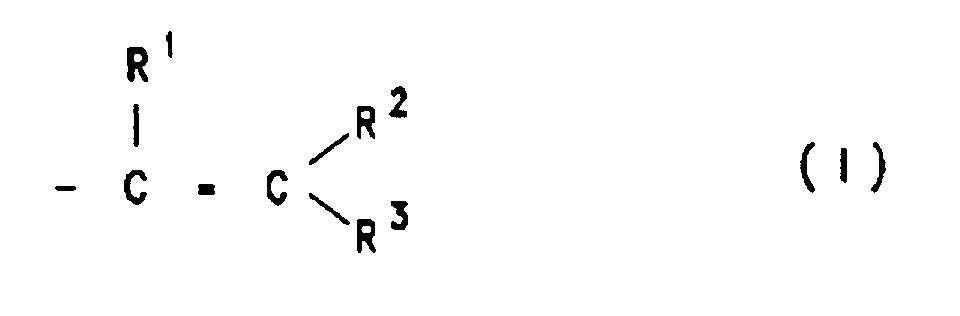
, worin R¹, R², R³ gleich oder verschieden sind und ein Wasserstoffatom, ein Kohlenwasserstoffrest oder ein halogenierter Kohlenwasserstoffrest sind, z.B. C₁-C₁₆-Alkyl, C₁-C₁₆-Aryl, C₁-C₁₆-Alkenyl, C₁-C₁₆-Halogenalkyl oder C₁-C₁₆-Halogenaryl. Außerdem können zwei der Reste R¹, R² und R³ zu einem Ring verbunden sein. Der C₁-C₁₆-Alkylrest oder C₁-C₁₆-Halogenalkylrest kann linear, verzweigt oder cyclisch sein. Der C₁-C₁₆- Arylrest kann substituiert oder unsubstituiert sein. Besonders bevorzugt sind lineare C₁-C₈-Alkylreste. - Besonders bevorzugt leitet sich die olefinisch ungesättigte Gruppe mit mindestens 3 C-Atomen von Propylen, 1-Buten, 1-Penten, 1-Hexen, 1-Hepten oder 1-Octen ab.
- Bevorzugt sind Cycloolefinpolymere, enthaltend 0,1-100 Gew.-%, bevorzugt 0,1-99 Gew.-%, bezogen auf die Gesamtmasse des Cycloolefinpolymers, polymerisierte Einheiten mindestens eines polycyclischen Olefins der Formel I, II, III, IV, V, VI oder VII


, worin R⁴, R⁵, R⁶, R⁷, R⁸, R⁹, R¹⁰ und R¹¹ gleich oder verschieden sind und ein Wasserstoffatom oder einen C₁-C₃₀-Kohlenwasserstoffrest, z.B. einen linearen oder verzweigten C₁-C₈-Alkylrest, C₆-C₁₈-Arylrest, C₇-C₂₀-Alkylenarylrest oder einen cyclischen oder acyclischen C₂-C₂₀-Alkenylrest bedeuten, oder zwei oder mehrere Reste R⁴ bis R¹¹ cyclisch verbunden sind, wobei gleiche Reste in den verschiedenen Formeln eine unterschiedliche Bedeutung haben können, 0 bis 45 Gew.-%, bezogen auf die Gesamtmasse des Cycloolefinpolymers, polymerisierte Einheiten mindestens eines monocyclischen Olefins der Formel VIII
worin n eine Zahl von 2 bis 10 ist,
0 bis 99 Gew.-%, bezogen auf die Gesamtmasse des Cycloolefinpolymers, polymerisierte Einheiten eines acyclischen Olefins der Formel IX
worin R¹², R¹³, R¹⁴, R¹⁵ gleich oder verschieden sind und ein Wasserstoffatom oder C₁-C₁₀-Kohlenwasserstoffrest, z.B. einen C₁-C₈-Alkylrest oder C₆-C₁₄-Arylrest bedeuten,
und eine olefinisch ungesättigte Endgruppe mit mindestens 3 C-Atomen. - Bevorzugt enthalten die Cycloolefinpolymere polymerisierte Einheiten mindestens eines polycyclischen Olefins, insbesondere der Formel II oder IV, und eines acyclischen Olefins der Formel IX, welches bevorzugt 2-20 C-Atome aufweist, insbesondere Ethylen.
- Bevorzugt sind Cycloolefinpolymere, die polymerisierte Einheiten polycyclischer Olefine mit Norbornengrundstruktur, besonders bevorzugt Norbornen oder Tetracyclododecen, enthalten. Bevorzugt sind auch Cycloolefinpolymere, die polymerisierte Einheiten acyclischer Olefine, wie alpha-Olefine, besonders bevorzugt Ethylen, enthalten. Besonders bevorzugt sind Norbornen/Ethylen- und Tetracyclododecen/Ethylen-Copolymere mit einer olefinisch ungesättigten Endgruppe mit mindestens 3 C-Atomen.
- Der Anteil polymerisierter Einheiten acyclischer Olefine der Formel IX beträgt 0 bis 99 Gew.-%, bevorzugt 5-80 Gew.-%, besonders bevorzugt 10-60 Gew.-%, bezogen auf die Gesamtmasse des Cycloolefinpolymers.
- Die erfindungsgemäßen Cycloolefinpolymere mit endständigen olefinisch ungesättigten Gruppen weisen Glastemperaturen zwischen -20°C und 400°C, bevorzugt zwischen 50°C und 200°C auf. Die Viskositätszahl (Dekalin, 135°C, DIN 53728) liegt zwischen 0,1 und 25 ml/g, bevorzugt zwischen 10 und 25 ml/g.
- Die erfindungsgemäßen Cycloolefinpolymere sind amorphe Polyolefine mit hoher Transparenz und hohen Wärmeformbeständigkeiten und engen Molekulargewichtsverteilungen. Sie können für optische Bauteile wie Linsen, Scheiben, Abdeckungen, Gläser eingesetzt werden. Weiterhin eignen sie sich als Edukte für die Herstellung von COP mit endständigen polaren funktionellen Gruppen, ohne daß es bei den Funktionalisierungen zur Vergelung kommt.
- Die vorliegende Erfindung betrifft außerdem ein Verfahren zur Herstellung eines Cycloolefinpolymers mit einer Lösungsviskosität < 0,25 dl/g, in Gegenwart eines Übergangsmetallkatalysators, dadurch gekennzeichnet, daß mindestens ein Cycloolefin und gegebenenfalls eines oder mehrere acyclische Olefine umgesetzt werden mit weniger als 25 Mol-%, bezogen auf die Gesamtmenge an Monomeren, eines von dem/den acyclischen Olefin(en) und dem/den Cycloolefin(en) verschiedenen Olefins mit mindestens 3 C-Atomen.
- Es wurde gefunden, daß sich durch Zusatz von Olefinen mit mindestens 3 C-Atomen während der Polymerisation von Cycloolefinpolymeren mit Übergangsmetallverbindungen in Gegenwart eines Cokatalysators, Cycloolefinpolymere mit olefinisch ungesättigten Endgruppen synthetisieren lassen und daß sich durch die Wahl des Konzentrationsverhältnisses des Olefins mit mindestens 3 C-Atomen zu den Cycloolefin-Monomeren die Molekulargewichte der Cycloolefinpolymere gezielt einstellen lassen.
- Aufgrund der molekulargewichtsregelnden Wirkung sollen die Olefine mit mindestens 3 C-Atomen im Folgenden als Regler bezeichnet werden.
- Als Regler eignen sich lineare oder verzweigte C₃-C₁₈-Olefine wie Propylen, Buten, Isobutylen, Penten, Hexen, Hepten, Octen, 4-Methylpenten, Butadien, Isopren, oder cyclische Olefine wie Cyclopenten, Cyclohexen, Vinylcyclohexan, Vinylnorbornen, Vinylcyclohexen, Cyclopentadien, Dicyclopentadien, Styrol oder α-Methylstyrol.
- Zur Herstellung der Cycloolefinpolymere im Sinne der Erfindung wird der Regler in der Monomermischung vorgelegt bevor die Polymerisation gestartet wird. Die Regler werden in der gewünschten Konzentration in das Monomergemisch eingebracht. Bei den gasförmigen Olefinen kann die Konzentration durch Einstellen des Partialdrucks bei der jeweiligen Temperatur eingestellt werden. Die Konzentration der flüssigen Olefine läßt sich einfach durch Zugabe der entsprechenden Menge einstellen. Die Konzentrationen der Regler liegen zwischen 0.001 mol und 1,5 mol, bevorzugt zwischen 0.01 und 1 mol, bezogen auf einen Liter der Monomerlösung. Nach Zugabe des polymerisationsaktiven Katalysators kann die Polymerisation weitergeführt werden, wie sie für Cycloolefinpolymere in EP 203 799, EP 283 164, DE 2421838, EP 156 464 oder EP 407 870 beschrieben ist, auf die hiermit ausdrücklich Bezug genommen wird. Die Polymerisation kann kontinuierlich oder diskontinuierlich durchgeführt werden.
- Der bei der Polymerisation verbrauchte Regler kann während der Polymerisation kontinuierlich nachdosiert werden. Die Polymerisationsaktivitäten der eingesetzten Metallocenkatalysatoren werden durch die Zugabe der Regler in der Regel nicht beeinträchtigt. Für geringe Konzentrationen kann sogar eine Steigerung der Polymerisationsaktiviäten beobachtet werden. Dieses Verhalten ist besonders für die wirtschaftliche Herstellung der Cycloolefinpolymere mit olefinisch ungesättigten endständigen Gruppen von Interesse.
- Das erfindungsgemäße Verfahren arbeitet bei Temperaturen von -78 bis 150°C und einem Druck von 0,01 bis 64 bar, in Gegenwart eines oder mehrerer Katalysatoren, welche mindestens einen Cokatalysator und mindestens eine Übergangsmetallverbindung enthalten. Solche Katalysatorensysteme sind z.B. beschrieben in EP 203 799, EP 283 164, P 43 04 309.7, P 43 04 308.9 oder DE 2421838, auf die hiermit ausdrücklich Bezug genommen wird. Bevorzugt sind Metallocen-Aluminoxan Katalysatorsysteme.
- Beispiele für eingesetzte Übergangsmetallverbindungen sind:
rac-Dimethylsilyl-bis-(1-indenyl)-zirkondichlorid,
rac-Dimethylgermyl-bis-(1-indenyl)-zirkondichlorid,
rac-Phenylmethylsilyl-bis-(1-indenyl)-zirkondichlorid,
rac-Phenylvinylsilyl-bis-(1-indenyl)-zirkondichlorid,
1-Silacyclobutyl-bis(1-indenyl)-zirkondichlorid,
rac-Diphenylsilyl-bis-(1-indenyl)-hafniumdichlorid,
rac-Phenylmethylsilyl-bis-(1-indenyl)-hafniumdichlorid,
rac-Diphenylsilyl-bis-(1-indenyl)-zirkondichlorid,
rac-Ethylen-1,2-bis-(1-indenyl)-zirkondichlorid,
Dimethylsilyl-(9-fluorenyl)-(cyclopentadienyl)-zirkondichlorid,
Diphenylsilyl-(9-fluorenyl)-(cyclopentadienyl)-zirkondichlorid,
Bis(1-indenyl)-zirkondichlorid,
Diphenylmethylenen-(9-fluorenyl)-cyclopentadienylzirkondichlorid,
Isopropylen-(9-fluorenyl)-cyclopentadienyl-zirkondichlorid,
Phenylmethylmethylen-(9-fluorenyl)-cyclopentadienyl-zirkondichlorid,
Isopropylen-(9-fluorenyl)-(1-(3-isopropyl)cyclopentadienyl)-zirkondichlorid,
Isopropylen-(9-fluorenyl)(1-(3-methyl)cyclopentadienyl)-zirkondichlorid,
Diphenylmethylen-(9-fluorenyl)(1-(3-methyl)cyclopentadienyl)-zirkondichlorid,
Methylphenylmethylen-(9-fluorenyl)(1-(3-methyl)cyclopentadienyl)-zirkondichlorid,
Dimethylsilyl-(9-fluorenyl)(1-(3-methyl)-cyclopentadienyl)-zirkondichlorid,
Diphenylsilyl-(9-fluorenyl)(1-(3-methyl)cyclopentadienyl)-zirkondichlorid,
Diphenylmethylen-(9-fluorenyl)(1-(3-tert.-butyl)cyclopentadienyl)-zirkondichlorid,
Isopropylen-(9-fluorenyl)(1-(3-tert.-butyl)cyclopentadienyl)-zirkondichlorid,
Isopropylen-(cyclopentadienyl)-(1-indenyl)-zirkondichlorid,
Diphenylcarbonyl-(cyclopenadienyl)-(1-indenyl)-zirkondichlorid,
Dimethylsilyl-(cyclopentadienyl)-(1-indenyl)-zirkondichlorid,
Isopropylen-(methylcyclopentadienyl)-(1-indenyl)-zirkondichlorid,
Isopropylen-bis(1-indenyl)-zirkondichlorid,
4-(η⁵-cyclopentadienyl)4,7,7-trimethyl-(η⁵-4,5,6,7-tetrahydroindenyl)zirkondichlorid
und analoge Hafnocene,
Titantetrachlorid, VOCl₃, VOCl₂(OCH₃), VOCl₂(OC₂H₅) und VOCl(OC₂H₅)₂. - Ein weiterer Aspekt der Erfindung sind funktionalisierte Cycloolefinpolymere mit einer Lösungsviskosität < 0,25 dl/g, enthaltend polymerisierte Einheiten mindestens eines Cycloolefins und gegebenenfalls polymerisierte Einheiten eines oder mehrerer acyclischer Olefine, dadurch gekennzeichnet, daß das Cycloolefinpolymer an einem oder beiden Enden eine von olefinisch ungesättigten Endgruppen verschiedene endständige funktionelle Gruppen trägt.
- Die endständige funktionelle Gruppe hat bevorzugt die Formel X

worin R¹⁶ und R¹⁷ gleich oder verschieden sein können und einen Wasserstoffrest, einen aliphatischen oder aromatischen C₁-C₃₀-Kohlenwasserstoffrest, ein Carbonsäureanhydrid, einen Silyl- oder Siloxanrest, einen Sauerstoffrest J, Br, CN, Cl, F, OH, OR', OCOR', COOH, COR, COOR', NH₂, NHR', NR'₂, SOH, SO₂H, SO₃H, SOR',SO₂R' oder SO₃R' bedeutet, wobei R' ein aliphatischer oder aromatischer C₁-C₂₀-Kohlenwasserstoffrest ist,
und Y eine Gruppe
bedeutet,
worin R¹⁸, R¹⁹ und R²⁰ gleich oder verschieden sein können und einen Wasserstoffrest, einen aliphatischen oder aromatischen C₁-C₃₀-Kohlenwasserstoffrest, ein Carbonsäureanhydrid, einen Silyl- oder Siloxanrest, einen Sauerstoffrest J, Br, CN, Cl, F, OH, OR'', OCOR'', COOH, COOR'', NH₂, NHR'', NR''₂, SOH, SO₂H, SO₃H, SOR'',SO₂R'' oder SO₃R'' bedeutet, wobei R'' ein aliphatischer oder aromatischer C₁-C₂₀-Kohlenwasserstoffrest ist, oder die beiden Reste R¹⁶ und R¹⁸ durch ein Sauerstoffatom ersetzt sind, so daß ein Epoxid vorliegt. Es können auch zwei oder mehr der Reste R¹⁶-R²⁰ cyclisch miteinander verbunden sein. - Besonders bevorzugte Reste R¹⁶, R¹⁷, R¹⁸, R¹⁹ und R²⁰ sind Hydroxy-, Alkoxy-, Aryloxy-, Amino-, Halogen-, Imino-, Thio-, Ester-, Thioester-, Carbonsäure-, Keton-, Amid-, Carbonsäureanhydrid-, Carboxylat- sowie Epoxidendgruppen.
- Bevorzugt sind Cycloolefinpolymere mit solchen, von olefinisch ungesättigten Endgruppen verschiedenen endständigen funktionellen Gruppen, die durch eine polymeranaloge Umsetzung der erfindungsgemäßen Cycloolefinpolymere zugänglich sind, welche an einem oder beiden Enden olefinisch ungesättigte Gruppen mit mindestens 3 C-Atomen aufweisen.
- Der Stand der Entwicklung in der organischen Synthese bietet hierzu eine Vielzahl von Reaktionen (Advanced Organic Chemistry, Jerry March, Verlag John Wiley & Sons, New York 1985, Seiten 657-779 oder Organikum, VEB Deutscher Verlag der Wissenschaften, Berlin 1986, auf die beide hiermit ausdrücklich Bezug genommen wird). Im Folgenden sind beispielhaft einige Umsetzungen beschrieben:
- Durch Addition von Halogenwasserstoffen und Halogenen sind Cycloolefinpolymere mit terminalen Halogenen zugänglich. Durch Anlagerung von Wasser ist die direkte Einführung von Hydroxyguppen möglich. Hydroxygruppen lassen sich auch durch eine Hydroborierung/Oxidation an das Kettenende des Cycloolefinpolymer bringen. Durch eine nukleophile Substitution der Halogene lassen sich Hydroxy, Alkoxy, Aryloxy, Amino, Imino, Thio, Cyano oder Alkyl-und Arylgruppen einführen. Cycloolefinpolymere mit Epoxidendgruppen sind durch Umsetzungen mit z.B. Persäuren möglich. Über eine Enmaleinierung lassen sich Anhydridgruppen einführen. Über Umsetzungen der OH-terminierten Cycloolefinpolymere sind eine Vielzahl weiterer Verbindungen möglich, wie z.B. Ester von Carbon-, Mineral-, und Sulfonsäuren und Silylester. Die Anlagerung der Halogenwasserstoffe oder Halogene kann schon bei Raumtemperatur oder tieferen Temperaturen unter weitesgehendem Ausschluß von Licht durchgeführt werden. So gelingt die Anlagerung von Brom bei 10°C und Dekalin als Lösungsmittel. Die Reaktion verläuft quantitativ, wie aus dem Verschwinden der olefinischen Protonen im ¹H-NMR zu erkennen ist.
- Die erfindungsgemäßen Cycloolefinpolymere mit von olefinisch ungesättigten Endgruppen verschiedenen endständigen funktionalisierten Gruppen weisen Glastemperaturen zwischen -20°C und 400°C, bevorzugt zwischen 50°C und 200°C auf. Die Viskositätszahl (Dekalin, 135°C, DIN 53728) liegt zwischen 0,1 und 25 ml/g, bevorzugt zwischen 10 und 25 ml/g.
- COP mit endständigen funktionellen Gruppen können als Additive in Polymeren eingesetzt werden. Durch COP mit endständigen funktionellen Gruppen lassen sich die Oberflächeneigenschaften von unpolaren Polymeren modifizieren und so z.B. die Bedruckbarkeit und Hafteigenschaften verbessern. COP mit endständigen funktionellen Gruppen können als polymere Emulgatoren zur Verbesserung der Phasenhaftung in Polymerblends eingesetzt werden. Durch eine Reaktion der funktionellen Gruppe mit einer Komponente des Blends kann die Phasenhaftung weiter optimiert werden. In einer anderen Anwendung lassen sich die COP mit endständigen funktionellen Gruppen als Viskositätsmodifikatoren oder Fließverbesserer von Erdölen, Mineralölen und ähnlichen Systemen einsetzen.
- Ein weiterer Aspekt der Erfindung sind Blockcopolymere enthaltend Blöcke aus den erfindungsgemäßen funktionalisierten Cycloolefinpolymeren. Die Blockcopolymere können Di-, Tri-, Multi- oder Sternblockcopolymere wie auch Graftcopolymere sein.
- Cycloolefinpolymer-Blockcopolymere im Sinne der Erfindung enthalten mindestens einen Block der erfindungsgemäßen funktionalisierten Cycloolefinpolymere und mindestens einen Block eines von COP verschiedenen Polymeren oder Copolymeren. Bei diesen von COP verschiedenen Polymeren oder Copolymeren kann es sich um amorphe oder teilkristalline Polymere handeln. Bevorzugt sind amorphe Polymere oder Copolymere mit Glasstufen im Bereich von -100 bis 150°C. Beispiele für solche Polymere sind Polystyrol, Polysiloxane, Polyoxytetramethylen, Polybutadien, Polyisopren, Polyacrylate, Polymethacrylate, Poly(styrol-co-butadien), Poly(styrol-co-isopren).
- Die Diblock-, Triblock- und verzweigte Multiblockcopolymere lassen sich durch geeignete Kupplungsmethoden aus Cycloolefinpolymeren, mit von olefinisch ungesättigten Endgruppen verschiedenen endständigen funktionalisierten Gruppen, herstellen. Die Molekulargewichte der von COP verschiedenen Polymerblöcke liegen im Bereich von 10⁴-10⁶, bevorzugt 10⁴-10⁵ g/mol. Die absoluten Molekulargewichte Mw der Cycloolefinpolymerblöcke liegen im Bereich von 2000 bis 10000, bevorzugt von 5000 bis 10000 g/mol. Die Polydispersität Mw/Mn der Blockcopolymere liegt im Bereich von 1-10, bevorzugt im Bereich von 1-5 und besonders bevorzugt im Bereich von 1-3.
- Die erfindungsgemäßen Cycloolefinpolymer-Blockcopolymere lassen sich z.B. herstellen durch Kuppelung mit anionisch polymerisierten Polymeren und Copolymeren. Die Umsetzung von Cycloolefinpolymeren, die substituierbare Halogene am Kettenende besitzen, mit Anionen resultiert in einer Substitution des Halogens durch das Anion. Diese Reaktion läßt sich zur Kupplung von halogeniertem Cycloolefinpolymer mit den polymeriationsaktiven Anionen, wie sie bei der anionischen Polymerisation auftreten, ausnutzen. Auf diese Weise lassen sich Blockcopolymere aus Cycloolefinpolymeren und Monomeren herstellen, die einer anionischen Polymerisation zugänglich sind. Beispiele für anionisch polymerisierbare Monomere sind Vinylaromaten wie Styrol, alpha-Methylstrole, Methylstyrole, Dimethylstyrol, Vinylnaphthalin, konjugierte Diene wie Isopren, Butadien und Acrylat und Methacrylatmonomere wie z. B. Methylmethacrylat, Methylethylacrylat, Methylpropylacrylat, Methylacrylat, Ethylacrylat, Propylacrylate, Butylacrylate, Pentylacrylate, Hexylacrylate und höhere Homologe, Cyclohexylacrylate und subtituierte Cyclohexylacrylate.
- Ein weiterer Aspekt der Herstellung von Blockcoplymeren, enthaltend Blöcke aus Cycloolefinpolymeren und anionisch herstellbaren Polymeren, ist die Umsetzung von Cycloolefinpolymer mit endständigen Bromresten und den Anionen von z.B. Polybutadien, Polyisopren oder Polystyrol. Das Cycloolefinpolymer mit terminalen Doppelbindungen wird in einem, unter den Reaktionsbedingungen gegenüber Brom und Anionen relativ inerten Lösungsmittel, z. B. Tetrachlorkohlenstoff oder Dekalin, gelöst und bei Temperaturen von -30 bis 50°C langsam mit einer Lösung von Brom, in dem zur Umsetzung verwendeten Lösungsmittel, so umgesetzt, daß immer nur ein Teil der zur vollständigen Bromierung nötigen Menge Brom zugesetzt wird. Diese Verfahrensweise wird fortgeführt bis die Eigenfarbe der Bromlösung auch in der Reaktionslösung über einen längeren Zeitraum (5-60 Minuten) erhalten bleibt. Die Herstellung von Polybutadien, Polyisopren oder Polystyrol durch anionische Polymerisation geschieht nach bekannten Methoden wie sie z. B. in Advances in Polymer Science 56, Springer Verlag Berlin (1984) beschreiben sind. Die Polymerlösung, die noch die anionischen Kettenenden enthält wird nach Beendigung der Bromierung bei Temperaturen von -30 bis 20°C der Cycloolefinpolymer-Lösung zugesetzt. Anschließend läßt man auf Raumtemperatur erwärmen und läßt die Lösung noch bei Temperaturen von 20 bis 100°C einige Zeit weiterrühren. Ein weiterer Aspekt der Herstellung von Cycloolefinpolymer Blockcopolymeren ist die Kupplung über Kondensationsverfahren. Cycloolefinpolymere mit endständigen Hydroxy, Amino, oder Anhydridgruppen lassen sich mit Polymeren die z. B. terminale Säure, Säurechlorid, Dialkylsilylhalogen, Dialkylsilylamino, oder Aminoendgruppen enthalten zu Blockcopolymeren verbinden.
- Graftcopolymere sind über eine Copolymerisation von Cycloolefinpolymeren mit einer geeigneten Funktionalisierung und einem oder mehreren geeigneten Monomeren zugänglich. So kann man Cycloolefinpolymere mit Methacrylyol- oder Styrylendgruppen mit radikalisch polymerisierbaren Monomeren zu Graftcopolymeren umsetzen. Die Methacryloyl oder Styrylendgruppen lassen sich durch Umsetzen von Cycloolefinpolymeren mit z. B. terminalen Hydroxy- oder Aminoendgruppen und Methacryloylchlorid und 4-Vinylbenzoylchlorid oder 4-Vinylbenzylchlorid in das Cycloolefinpolymer einführen.
- Das Eigenschaftsspektrum der Blockcopolymere ist abhängig von den Anteilen und Eigenschaften der mit den Cycloolefincopolymeren kombinierten Polymeren und Copolymeren. Es kann von thermoplastischen Elastomeren bis zu spröden Thermoplasten reichen. Die Kombination eines Cycloolefinpolymeren als Matrix mit einem Polymer mit niedriger Glastemperatur (Tg) wie Polybutadien führt zu einem schlagzähen Polymer. Die Zumischung eines solchen Blockcopolymeren zu unmodifizierten Cycloolefinpolymeren erhöht ebenfalls die Schlagartigkeit.
- Weitere Anwendungen solcher Blockcopolymere sind die Verbesserung der Phasenhaftung und Mischbarkeit von Cycloolefinpolymeren und anderen Polymeren. Durch Zumischen von Blockcopolymeren mit z.B. polaren Blöcken zu Cycloolefinpolymeren läßt sich die Oberfläche dieser Polymere modifizieren und damit die Haftung zu anderen Materialien verbessern. Dies ist sehr wichtig für das Bedrucken, Lackieren oder Metallisieren. Weitere Anwendungen solcher Blockcopolymere sind Emulgatoren, Viskositätsmodifikatoren und Fließhilfsmittel.
- Ein 1,5-dm³-Reaktor wurde mit 1 Liter Benzinfraktion (Siedebereich: 90-110°C) und 20 ml toluolische Methylaluminoxanlösung (10,1 Gew.-% Methylaluminoxan der Molmasse 1300 g/mol nach kryoskopischer Bestimmung) befüllt und bei 70°C ca. 30 min gerührt, um eventuell vorhandene Verunreinigungen zu entfernen. Nach Ablassen der Lösung wurde der Reaktor mit 470 cm³ einer 85 gewichtsprozentigen Lösung von Norbornen in Toluol und mit 30 cm³ 1-Octen beschickt. Durch mehrfaches Aufdrücken von Ethylen (6 bar G) wurde die Lösung mit Ethylen gesättigt und anschließend 10 cm³ der toluolischen Methylaluminoxanlösung in den Reaktor gegeben und 5 Minuten bei 70°C gerührt. Eine Lösung von 4,72 mg Isopropylen-(1-cyclopentadienyl) (1-indenyl) zirkondichlorid in 10 cm³ toluolischer Methylaluminoxanlösung wurde nach 15 minütiger Voraktivierung zugegeben.
Unter Rühren (750 UPM) wurde 30 Minuten bei 70°C polymerisiert, wobei der Ethylendruck durch Nachdosieren bei 6 bar G gehalten wurde. Die homogene Reaktionslösung wurde in ein Gefäß abgelassen und mit ca 1 ml Wasser versetzt. Anschließend wird die Lösung mit einem Filterhilfsmittel versetzt und über eine Drucknutsche filtriert. Diese Lösung wird schnell in 5 dm³ Aceton eingegossen, 10 min gerührt und filtriert. Der erhaltene Feststoff wurde mit Aceton gewaschen. Das erneut filtrierte Polymer wurde bei 80°C und einem Druck von 0,2 bar 15 Stunden getrocknet.
Es wurden 26,4 g eines farblosen Polymers erhalten. Die Bestimmung der Viskositätszahl wurde gemäß DIN 53728 in Dekalin vorgenommen. Die Lösung wurde in einem Kappillarviskosimeter bei 135°C vermessen. Die Viskositätszahl betrug 20,8 dl/g. Die Glastemperaturen wurden mit einem DSC7 der Firma Perkin Elmer bestimmt. Die Glastemperaturen wurde bei einer Heizrate von 20°C /min aus der 2. Heizkurve ermittelt und betrug 172°C. Der Gehalt an ungesättigten Doppelbindungen mittels Kernresonanspektroskopie ermittelt. Das Verhältnis der Intensitäten von olefinischen Protonen zu aliphatischen Protonen betrug 0.089 %. Das Molekulargewicht des Polymeren wurde mittels Gelpermerationschromatographie bei 135°C in ortho-Dichlorbenzol ermittelt. Als Standards wurden Polyethylenfraktionen verwendet. Für das Polymer wurden folgende Werte gefunden: Mn: 4800 g/mol, Mw: 10400 g/mol, Mw/Mn:2,2. - Die Durchführung geschah analog zu Beispiel 1. Es wurden verschiedene Mengen 1-Octen eingesetzt. Tabelle 1 faßt die Versuchsparameter zusammen.Die analytischen Daten der Polymere sind in Tabelle 2 beschrieben.
Tabelle 1 Bsp. Katalysator Kat.-Menge Druck 1-Octen Monomerl. Reaktionsz. Ausbeute mg Bar ml ml Min. g 2 1 5,29 6 60 440 30 45,2 3 1 4,93 6 100 400 30 44,5 4 2 0.96 12 100 400 60 22,2 5 3 10 6 120 2880 60 750 Katalysator 1: Isopropylen-(1-cyclopentadienyl) (1-indenyl) zirkondichlorid
Katalysator 2: Isopropylen-bis(1-indenyl) zirkondichlorid
Katalysator 3: 4-(η⁵-cyclopentadienyl)4,7,7-trimethyl-(η⁵-4,5,6,7-tetrahydroindenyl)zirkondichloridTabelle 2 Bsp. Viskositätszahl Mw Mn Mw/Mn Olefinische Prot. Tg dl/g g/mol g/mol % °C 2 14,1 5400 2600 2,08 0,17 147 3 12,1 3800 2100 1,81 0,25 127 4 16,0 11000 5900 1,86 0,17 107 5 10,1 8400 4400 1,90 0,10 209 - Der in Beispiel 1 beschriebene Versuch wurde unter den gleichen Bedingungen wiederholt. Als Abänderung wurde in diesem Versuch kein Octen bei der Polymerisation des Cycloolefinpolymers zugesetzt.
Es wurden 40.9 g eines weißen Pulvers erhalten. Die Analyse des Materials ergab: VZ = 62,7 dl/g, Tg = 184°C , Mw = 48400 g/mol, Mn = 15500 g/mol, Mw/Mn = 3,13. Das ¹H-NMR-Spektrum des Polymers zeigt keine olefinischen Protonen. - Der in Beispiel 4 beschriebene Versuch wurde unter den gleichen Bedingungen wiederholt. Als Abänderung wurde in diesem Versuch kein Octen bei der Polymerisation von Cycloolefinpolymer zugesetzt.
Es wurden 18,9 g eines weißen Pulvers erhalten. Die Analyse des Materials ergab: VZ = 172,2 dl/g,, Tg = 153°C, Mw = 165000g/mol, Mn =47000g/mol,Mw/Mn = 3,5. Das ¹H-NMR-Spektrum des Polymers zeigt keine olefinischen Protonen. - Der in Beispiel 5 beschriebene Versuch wurde unter den gleichen Bedingungen wiederholt. Als Abänderung wurde in diesem Versuch kein Octen bei der Polymerisation von Cycloolefinpolymer zugesetzt.
Daten: 147 g, VZ = 25,2 dl/g, Tg = 223°C, Mw = 24.000 g/mol, Mn = 11300g/mol, keine olefinischen Protonen. - 10 g des Cycloolefinpolymer aus Beispiel 3 werden in 100 ml trockenem Dekalin gelöst und auf 0 bis 10°C abgekühlt.
Anschließend wird eine Lösung aus 1 ml Brom und 20 ml Dekalin langsam und unter weitesgehendem Ausschluß von Licht in die Cycloolefinpolymer- Lösung getropft bis die Lösung die Eigenfarbe des Broms über 15 Minuten beibehält. Der Verbrauch an Bromlösung beträgt 1 ml. Das Polymere wird in Aceton gefällt, abflitriert, mehrmals mit Aceton gewaschen und getrocknet. Es werden 10,2 g eines weißen Pulvers erhalten. Die Elementaranalyse ergibt einen Bromgehalt von 2,9%. Im ¹H-NMR werden keine olefinischen Protonen detektiert. - 10 g des Cycloolefinpolymer aus Vergleichsbeispiel 1 wurden wie unter Beispiel 6 beschrieben mit Bromlösung versetzt. Der Verbrauch an Bromlösung beträgt weniger als 0,1ml. Es werden 9,9 g eines weißen Pulvers erhalten. Die Elementaranalyse ergibt einen Bromgehalt von < 0.1%.
- 10 g des unter Beispiel 3 beschriebenen Cycloolefinpolymer werden in einer Mischung aus 100 ml trockenem Tetrahydrofuran und 100 ml trockenem Toluol gelöst und auf 10°C abgekühlt. Anschließend werden 10 ml einer 1 molaren Lösung eines BH₃/THF-Komplexes in Tetrahydrofuran zugetropft. Nach beendeter Zugabe wird die Lösung auf 60°C erwärmt und 4 Stunden gerührt. Die Lösung wird auf 10°C abgekühlt und mit einer Lösung aus 20 ml 6 molarer Natriumhydroxidlösung, 2 ml Ethanol und 10 ml 30%-iger Wasserstoffperoxidlösung versetzt. Anschließend wird die Mischung noch weitere 2 Stunden bei Raumtemperatur gerührt. Das Polymer wird in Aceton gefällt, mit Aceton gewaschen und getrocknet. Es werden 9,8 g eines weißen Pulvers erhalten. Das ¹H-NMR zeigt das Verschwinden der olefinischen Protonen und das Auftauchen von Protonen bei 3,8 ppm.
- 3,0 g des Cycloolefinpolymer aus Beispiel 1 werden unter Überlagerung mit Argon in 40 ml trockenem Dekalin in einem ausgeheizten 500 ml Vierhalskolben gelöst. Unter Rühren und weitestgehendem Ausschluß von Licht wird bei 0-10°C zu dieser Lösung langsam eine Lösung aus 0,5 ml Brom und 5 ml Hexan getropft, bis die bräunliche Eigenfarbe des Broms ca 30 Minuten erhalten bleibt.
- Gleichzeitig werden in einem anderen ausgeheizten und mit Argon gespülten 500-ml Vierhalskolben 250 ml trockenes Dekalin bei einer Temperatur von 50-60°C mit einer Initiatorlösung aus 2,8 ml einer 1,6 molaren Lösung von n-Butyllithium in Hexan, 35 ml Dekalin und 1,4 ml trocknem, entstabilisiertem Styrol titriert bis die Eigenfarbe des Styrylanions gerade erhalten bleibt. Anschließend wird das Dekalin auf 0-10°C abgekühlt und es werden 30 ml trocknes, entstabilisiertes Styrol hinzugefügt und mit Initiatorlösung titriert bis die rote Eigenfarbe des Styrylanions erhalten bleibt. Dann wird auf 50-60°C erwärmt und es werden 27,2 ml der Initiatorlösung zugegeben. Die Lösung wird noch weitere 30 bis 60 Minuten gerührt und anschließend wieder auf 0-10°C abgekühlt.
- Ca. 210 ml der kalten Lösung 2 werden über eine mit Argon gespülte Stahlkanüle zu der ebenfalls auf 0-10°C abgekühlten Lösung 1 gegeben. Die Kühlung wird entfernt und die Lösung bei Raumtemperatur noch weitere 60 Minuten gerührt. Anschließend werden die überschüssigen Polystyrylanionen mit Isopropanol abgebrochen und die Lösung in Aceton eingegossen, das Polymer isoliert und getrocknet. Es werden 3,35 g einese weißen Pulvers erhalten (Polymer 1). Das Fällungsbad wird in 4 dm³ Methanol gegossen, das Polymer isoliert und getrocknet. Es werden 17,5 g eines weißen Pulvers erhalten (Polymer 2). Die verbleibende Polystrollösung wird mit Isopropanol abgebrochen, das Polymer in Methanol gefällt und getrocknet. Es werden 7,8g eines weißen Pulvers erhalten(Polymer 3).
Die Polymere werden mittels DSC und GPC (THF, 35°C, Polystrolstandards) charakterisiert:Polymer 1: Tg: 102°C, 166°C Mn: 35.600, Mw: 45.100 Polymer 2: Tg: 100°C Mn: 20.700, Mw: 24.600 Polymer 3: Tg: 101°C Mn: 16.100, Mw: 23.700 - 11 g des Cycloolefinpolymer aus Beispiel 3 werden unter Überlagerung mit Argon in 90 ml trockenem Dekalin in einem ausgeheizten 500 ml Vierhalskolben gelöst. Unter Rühren und weitestgehendem Ausschluß von Licht wird zu dieser Lösung langsam eine Lösung aus 1 ml Brom und 10 ml Hexan getropft, bis die bräunliche Eigenfarbe des Broms ca 30 Minuten konstant erhalten bleibt.
- Gleichzeitig werden in einem anderen ausgeheizten und mit Argon gespülten 500-ml Vierhalskolben 250 ml trockenes Dekalin bei einer Temperatur von 50-60°C mit einer Initiatorlösung aus 3,6 ml einer 1,6 molaren Lösung von n-Butyllithium in Hexan, 50 ml Dekalin und 1,8 ml trocknem, entstabilisiertem Styrol titriert bis die Eigenfarbe des Styrylanions gerade erhalten bleibt. Anschließend wird das Dekalin auf 0-10°C abgekühlt und es werden 29 ml trockenes, entstabilisiertes Isopren hinzugefügt und mit Initiatorlösung titriert bis die Eigenfarbe des Anions erhalten bleibt. Anschließend wird auf 15-20°C erwärmt und es werden 40,2 ml der Initiatorlösung zugegeben. Die Lösung wird noch weitere 30 bis 60 Minuten bei 30°C gerührt und wieder auf 0-10°C abgekühlt.
- Ca. 210 ml der kalten Lösung 2 werden über eine mit Argon gespülte Stahlkanüle zu der ebebenfalls auf 0-10°C abgekühlten Lösung 1 gegeben. Die Kühlung wird entfernt und die Lösung bei Raumtemperatur noch weitere 60 Minuten gerührt. Anschließend werden die überschüssigen Anionen mit Isopropanol abgebrochen und die Lösung in Ethanol eingerührt. Der ausgefallene Niederschlag wird abdekantiert, in 300 ml THF aufgenommen und mit 450 ml Aceton versetzt. Es werden nach Filtration 8,6 g eines weißen Pulvers erhalten (Polymer 1). Das verbleibende Filtrat wird am Rotationsverdampfer eingeengt (Polymer 2). Der Rest der Polyisoprenlösung wird mit 0,5 ml Isopropanol abgebrochen. Ein GPC (THF, 35°C, Polystrolstandards) der Lösung ergibt: Mn: 5.500 g/mol, Mw: 12.500 g/mol. Die Lösung wird am Rotationsverdampfer eingeengt und der verbleibende Rückstand mittels DSC untersucht. Es wird eine Tg von -59°C gemessen.
- Die Polymere 1 und 2 werden mittels GPC (THF, 35°C, Polystrolstandards) und DSC untersucht. Dabei wurde erhalten:
Polymer 1: Tg: 110°C; Mn: 6.400 g/mol; Mw: 10.000 g/mol Polymer 2: Tg: -57°C; Mn: 6.600 g/mol; Mw: 15.800 g/mol
Claims (6)
- Cycloolefinpolymer mit einer Lösungsviskosität < 0,25 dl/g, (gemäß DIN 53 728 in Dekalin bei 135°C) enthaltend polymerisierte Einheiten mindestens eines Cycloolefins und gegebenenfalls polymerisierte Einheiten eines oder mehrerer acyclischer Olefine, dadurch gekennzeichnet, daß das Cycloolefinpolymer an einem oder beiden Enden eine olefinisch ungesättigte Gruppe mit mindestens 3 C-Atomen aufweist.
- Cycloolefincopolymer gemäß Anspruch 1, enthaltend polymerisierte Einheiten mindestens eines Cycloolefins und mindestens eines acyclischen Olefins, dadurch gekennzeichnet, daß das Cycloolefinpolymer an einem Ende eine olefinisch ungesättigte Gruppe mit mindestens 3 C-Atomen aufweist.
- Verfahren zur Herstellung eines Cycloolefinpolymers mit einer Lösungsviskosität < 0,25 dl/g, (gemäß DIN 53 728 in Dekalin bei 135°C) in Gegenwart eines Übergangsmetall-katalysators, dadurch gekennzeichnet, daß mindestens ein Cycloolefin und gegebenenfalls eines oder mehrere acyclische Olefine umgesetzt werden mit weniger als 25 Mol-%, bezogen auf die Gesamtmenge an Monomeren, eines von dem/den acyclischen Olefin(en) und dem/den Cycloolefin(en) verschiedenen Olefins mit mindestens 3 C-Atomen.
- Funktionalisiertes Cycloolefinpolymer mit einer Lösungsviskosität < 0,25 dl/g, (gemäß DIN 53 728 in Dekalin bei 135°C) enthaltend polymerisierte Einheiten mindestens eines Cycloolefins und gegebenenfalls polymerisierte Einheiten eines oder mehrerer acyclischer Olefine, dadurch gekennzeichnet, daß das Cycloolefinpolymer an einem oder beiden Enden eine von olefinisch ungesättigten Endgruppen verschiedene endständige funktionelle Gruppen trägt.
- Blockcopolymer, enthaltend Blöcke aus mindestens einem funktionalisierten Cycloolefinpolymeren gemäß Anspruch 4.
- Graftcopolymer, enthaltend Blöcke aus mindestens einem funktionalisierten Cycloolefinpolymeren gemäß Anspruch 4.
Applications Claiming Priority (2)
| Application Number | Priority Date | Filing Date | Title |
|---|---|---|---|
| DE4425408 | 1994-07-13 | ||
| DE4425408A DE4425408A1 (de) | 1994-07-13 | 1994-07-13 | Cycloolefinpolymere |
Publications (1)
| Publication Number | Publication Date |
|---|---|
| EP0692503A1 true EP0692503A1 (de) | 1996-01-17 |
Family
ID=6523502
Family Applications (1)
| Application Number | Title | Priority Date | Filing Date |
|---|---|---|---|
| EP95110211A Withdrawn EP0692503A1 (de) | 1994-07-13 | 1995-06-30 | Cycloolefinpolymere |
Country Status (7)
| Country | Link |
|---|---|
| US (2) | US5610253A (de) |
| EP (1) | EP0692503A1 (de) |
| JP (1) | JPH08100029A (de) |
| KR (1) | KR960004379A (de) |
| CN (1) | CN1121930A (de) |
| CA (1) | CA2153753A1 (de) |
| DE (1) | DE4425408A1 (de) |
Cited By (1)
| Publication number | Priority date | Publication date | Assignee | Title |
|---|---|---|---|---|
| WO1996037528A1 (en) * | 1995-05-25 | 1996-11-28 | The B.F. Goodrich Company | Blends and alloys of polycyclic polymers |
Families Citing this family (83)
| Publication number | Priority date | Publication date | Assignee | Title |
|---|---|---|---|---|
| US6964798B2 (en) | 1993-11-16 | 2005-11-15 | Baxter International Inc. | Multi-layered polymer based thin film structure for medical grade products |
| DE19539093A1 (de) * | 1995-10-20 | 1997-04-24 | Hoechst Ag | Metallisierte Polyolefinfolie |
| EP0930326A4 (de) * | 1996-09-30 | 1999-12-15 | Nippon Zeon Co | Norbornenpolymer und verfahren zur herstellung |
| US5889128A (en) | 1997-04-11 | 1999-03-30 | Massachusetts Institute Of Technology | Living olefin polymerization processes |
| DE19929809A1 (de) * | 1999-06-30 | 2001-01-04 | Ticona Gmbh | Kontinuierliches Verfahren zur Herstellung eines amorphen Polyolefins mit breiter Molmassenverteilung und einheitlicher Glastemperatur |
| US6297322B1 (en) | 1999-09-09 | 2001-10-02 | Baxter International Inc. | Cycloolefin blends and method for solvent bonding polyolefins |
| US6590033B2 (en) | 1999-09-09 | 2003-07-08 | Baxter International Inc. | Cycloolefin blends and method for solvent bonding polyolefins |
| US6613187B1 (en) | 1999-09-09 | 2003-09-02 | Baxter International Inc | Solvent bonding method for polyolefin materials |
| US6255396B1 (en) | 1999-09-09 | 2001-07-03 | Baxter International Inc. | Cycloolefin blends and method for solvent bonding polyolefins |
| US6632318B1 (en) | 1999-09-09 | 2003-10-14 | Baxter International Inc. | Method for solvent bonding polyolefins |
| JP2001217553A (ja) * | 2000-02-03 | 2001-08-10 | Nippon Zeon Co Ltd | 多層回路基板の製造方法 |
| US6497676B1 (en) | 2000-02-10 | 2002-12-24 | Baxter International | Method and apparatus for monitoring and controlling peritoneal dialysis therapy |
| DE10009646A1 (de) * | 2000-03-01 | 2001-09-13 | Ticona Gmbh | Neues Polymergemisch |
| KR100341965B1 (ko) * | 2000-03-28 | 2002-06-26 | 손진익 | 고분자 중합체로된 시멘트 유동화제 |
| US6287742B1 (en) | 2000-05-16 | 2001-09-11 | Matsci Solutions, Inc. | Toner compositions and method of producing toner for developing latent electrostatic images |
| FR2811083B1 (fr) * | 2000-06-30 | 2002-11-22 | Inst Curie | Milieu liquide non-thermosensible pour l'analyse d'especes au sein d'un canal |
| US8975328B2 (en) * | 2000-06-30 | 2015-03-10 | Institute Curie | Non-thermosensitive medium for analyzing species in a channel and for minimizing adsorption and/or electroosomosic phenomena |
| FR2810905B1 (fr) * | 2000-06-30 | 2003-05-16 | Inst Curie | Additif pour minimiser les phenomenes d'adsorption et/ou d'electroosmose |
| US6372848B1 (en) | 2000-10-10 | 2002-04-16 | Baxter International Inc. | Blend of ethylene and α-olefin copolymers obtained using a metallocene catalyst for fabricating medical films and tubings |
| US20020139088A1 (en) | 2001-03-08 | 2002-10-03 | Archie Woodworth | Polymeric syringe body and stopper |
| US20020172615A1 (en) * | 2001-03-08 | 2002-11-21 | Archie Woodworth | Apparatus for and method of manufacturing a prefilled sterile container |
| US6461783B1 (en) | 2001-05-18 | 2002-10-08 | Dpi Solutions, Inc. | Micro-serrated color toner particles and method of making same |
| US6544705B2 (en) | 2001-05-18 | 2003-04-08 | Dpi Solutions, Inc. | Micro-serrated, dyed color toner particles and method of making same |
| US6531255B2 (en) | 2001-05-18 | 2003-03-11 | Dpi Solutions, Inc. | Micro-serrated particles for use in color toner and method of making same |
| US20030077466A1 (en) * | 2001-10-19 | 2003-04-24 | Smith Sidney T. | Multilayered polymer structure |
| US20030125662A1 (en) | 2002-01-03 | 2003-07-03 | Tuan Bui | Method and apparatus for providing medical treatment therapy based on calculated demand |
| US6821267B2 (en) | 2002-03-07 | 2004-11-23 | Baxter International | Luer tip cap having reduced removal force |
| US7238164B2 (en) | 2002-07-19 | 2007-07-03 | Baxter International Inc. | Systems, methods and apparatuses for pumping cassette-based therapies |
| US7514517B2 (en) | 2004-03-17 | 2009-04-07 | Dow Global Technologies Inc. | Anti-blocking compositions comprising interpolymers of ethylene/α-olefins |
| US7897689B2 (en) * | 2004-03-17 | 2011-03-01 | Dow Global Technologies Inc. | Functionalized ethylene/α-olefin interpolymer compositions |
| US7662881B2 (en) | 2004-03-17 | 2010-02-16 | Dow Global Technologies Inc. | Viscosity index improver for lubricant compositions |
| US7863379B2 (en) * | 2004-03-17 | 2011-01-04 | Dow Global Technologies Inc. | Impact modification of thermoplastics with ethylene/alpha-olefin interpolymers |
| US7795321B2 (en) | 2004-03-17 | 2010-09-14 | Dow Global Technologies Inc. | Rheology modification of interpolymers of ethylene/α-olefins and articles made therefrom |
| US7622529B2 (en) | 2004-03-17 | 2009-11-24 | Dow Global Technologies Inc. | Polymer blends from interpolymers of ethylene/alpha-olefin with improved compatibility |
| AR053693A1 (es) | 2004-03-17 | 2007-05-16 | Dow Global Technologies Inc | Composiciones de interpolimero de etileno/alfa-olefina multibloque adecuado para peliculas |
| US7579408B2 (en) * | 2004-03-17 | 2009-08-25 | Dow Global Technologies Inc. | Thermoplastic vulcanizate comprising interpolymers of ethylene/α-olefins |
| US7803728B2 (en) | 2004-03-17 | 2010-09-28 | Dow Global Technologies Inc. | Fibers made from copolymers of ethylene/α-olefins |
| US7608668B2 (en) * | 2004-03-17 | 2009-10-27 | Dow Global Technologies Inc. | Ethylene/α-olefins block interpolymers |
| BRPI0508148B1 (pt) | 2004-03-17 | 2015-09-01 | Dow Global Technologies Inc. | Interpolímero de etileno em multibloco, derivado reticulado e composição |
| US7666918B2 (en) | 2004-03-17 | 2010-02-23 | Dow Global Technologies, Inc. | Foams made from interpolymers of ethylene/α-olefins |
| US7671131B2 (en) | 2004-03-17 | 2010-03-02 | Dow Global Technologies Inc. | Interpolymers of ethylene/α-olefins blends and profiles and gaskets made therefrom |
| US7504347B2 (en) | 2004-03-17 | 2009-03-17 | Dow Global Technologies Inc. | Fibers made from copolymers of propylene/α-olefins |
| US7741397B2 (en) | 2004-03-17 | 2010-06-22 | Dow Global Technologies, Inc. | Filled polymer compositions made from interpolymers of ethylene/α-olefins and uses thereof |
| BRPI0508173B1 (pt) * | 2004-03-17 | 2016-03-15 | Dow Global Technologies Inc | copolímeros em multibloco, polímero, copolímero, um derivado funcional, mistura homogênea de polímero, processo para a preparação de um copolímero em multibloco contendo propileno e processo para preparar um copolímero em multibloco contendo 4-metil-1-penteno |
| US7714071B2 (en) * | 2004-03-17 | 2010-05-11 | Dow Global Technologies Inc. | Polymer blends from interpolymers of ethylene/α-olefins and flexible molded articles made therefrom |
| US7355089B2 (en) * | 2004-03-17 | 2008-04-08 | Dow Global Technologies Inc. | Compositions of ethylene/α-olefin multi-block interpolymer for elastic films and laminates |
| US8273838B2 (en) * | 2004-03-17 | 2012-09-25 | Dow Global Technologies Llc | Propylene/α-olefins block interpolymers |
| US7524911B2 (en) | 2004-03-17 | 2009-04-28 | Dow Global Technologies Inc. | Adhesive and marking compositions made from interpolymers of ethylene/α-olefins |
| US7687442B2 (en) | 2004-03-17 | 2010-03-30 | Dow Global Technologies Inc. | Low molecular weight ethylene/α-olefin interpolymer as base lubricant oils |
| US7622179B2 (en) * | 2004-03-17 | 2009-11-24 | Dow Global Technologies Inc. | Three dimensional random looped structures made from interpolymers of ethylene/α-olefins and uses thereof |
| US7557147B2 (en) | 2004-03-17 | 2009-07-07 | Dow Global Technologies Inc. | Soft foams made from interpolymers of ethylene/alpha-olefins |
| US7582716B2 (en) * | 2004-03-17 | 2009-09-01 | Dow Global Technologies Inc. | Compositions of ethylene/α-olefin multi-block interpolymer for blown films with high hot tack |
| US7671106B2 (en) * | 2004-03-17 | 2010-03-02 | Dow Global Technologies Inc. | Cap liners, closures and gaskets from multi-block polymers |
| KR20070015178A (ko) | 2004-04-27 | 2007-02-01 | 백스터 인터내셔널 인코포레이티드 | 교반-탱크 반응기 시스템 |
| AU2006237514B2 (en) * | 2005-03-17 | 2011-10-27 | Dow Global Technologies Llc | Cap liners, closures and gaskets from multi-block polymers |
| US7786216B2 (en) | 2005-03-17 | 2010-08-31 | Dow Global Technologies Inc. | Oil based blends of interpolymers of ethylene/α-olefins |
| US7737215B2 (en) * | 2005-03-17 | 2010-06-15 | Dow Global Technologies Inc. | Compositions of ethylene/α-olefin multi-block interpolymer for elastic films and laminates |
| US8084537B2 (en) * | 2005-03-17 | 2011-12-27 | Dow Global Technologies Llc | Polymer blends from interpolymers of ethylene/α-olefin with improved compatibility |
| KR101425227B1 (ko) * | 2005-03-17 | 2014-07-31 | 다우 글로벌 테크놀로지스 엘엘씨 | 탄성 필름 및 라미네이트용의 에틸렌/α―올레핀 멀티블록혼성중합체 조성물 |
| WO2006102150A2 (en) * | 2005-03-17 | 2006-09-28 | Dow Global Technologies Inc. | Adhesive and marking compositions made from interpolymers of ethylene/alpha-olefins |
| US7910658B2 (en) * | 2005-03-17 | 2011-03-22 | Dow Global Technologies Llc | Compositions of ethylene/α-olefin multi-block interpolymer for elastic films and laminates |
| US7906587B2 (en) * | 2005-09-16 | 2011-03-15 | Dow Global Technologies Llc | Polymer blends from interpolymer of ethylene/α olefin with improved compatibility |
| US7695812B2 (en) * | 2005-09-16 | 2010-04-13 | Dow Global Technologies, Inc. | Fibers made from copolymers of ethylene/α-olefins |
| WO2007051115A2 (en) * | 2005-10-26 | 2007-05-03 | Dow Global Technologies Inc. | Multi-layer, elastic articles |
| CN101326203A (zh) * | 2005-12-09 | 2008-12-17 | 陶氏环球技术公司 | 乙烯/α-烯烃组合物中控制分子量分布的方法 |
| US8153243B2 (en) | 2005-12-09 | 2012-04-10 | Dow Global Technologies Llc | Interpolymers suitable for multilayer films |
| ATE448286T1 (de) * | 2006-10-05 | 2009-11-15 | Chisso Corp | Flüssigkristallzusammensetzung und flüssigkristallanzeigevorrichtung |
| US7998115B2 (en) | 2007-02-15 | 2011-08-16 | Baxter International Inc. | Dialysis system having optical flowrate detection |
| US7731689B2 (en) | 2007-02-15 | 2010-06-08 | Baxter International Inc. | Dialysis system having inductive heating |
| US8361023B2 (en) | 2007-02-15 | 2013-01-29 | Baxter International Inc. | Dialysis system with efficient battery back-up |
| US8870812B2 (en) | 2007-02-15 | 2014-10-28 | Baxter International Inc. | Dialysis system having video display with ambient light adjustment |
| US8558964B2 (en) | 2007-02-15 | 2013-10-15 | Baxter International Inc. | Dialysis system having display with electromagnetic compliance (“EMC”) seal |
| US8519057B2 (en) * | 2007-06-01 | 2013-08-27 | Exxonmobil Chemical Patents Inc. | Impact modification and functionalization of copolymers of olefins and dienes |
| ES2543735T3 (es) * | 2007-10-22 | 2015-08-21 | Becton Dickinson And Company | Artículos médicos revestidos con organopolisiloxano que contienen una disolución de proteína y un tensioactivo no iónico |
| EP2052857A1 (de) * | 2007-10-22 | 2009-04-29 | Dow Global Technologies Inc. | Mehrschichtige Folien |
| US20110186537A1 (en) * | 2008-09-22 | 2011-08-04 | Becton, Dickinson And Company | Systems, Apparatus and Methods for Coating the Interior of a Container Using a Photolysis and/or Thermal Chemical Vapor Deposition Process |
| US8802603B2 (en) | 2010-06-17 | 2014-08-12 | Becton, Dickinson And Company | Medical components having coated surfaces exhibiting low friction and low reactivity |
| WO2016051962A1 (ja) * | 2014-10-02 | 2016-04-07 | テルモ株式会社 | タンパク質溶液製剤を収容するための医療用容器 |
| ES2797298T3 (es) | 2016-02-10 | 2020-12-01 | Becton Dickinson France | Procedimiento para evaluar la estabilidad de una formulación a base de proteína |
| US11179516B2 (en) | 2017-06-22 | 2021-11-23 | Baxter International Inc. | Systems and methods for incorporating patient pressure into medical fluid delivery |
| WO2021111781A1 (ja) * | 2019-12-06 | 2021-06-10 | ポリプラスチックス株式会社 | 環状オレフィン重合体、溶液、フィルム、及び金属樹脂積層体 |
| MX2022014747A (es) | 2020-05-29 | 2023-01-11 | Univation Tech Llc | Polietileno bimodal de un solo reactor con modulo mejorado para aplicaciones de tambor de moldeo por soplado por extrusion. |
| US20250073123A1 (en) | 2023-08-30 | 2025-03-06 | Becton, Dickinson And Company | Medical Device Comprising Self-Lubricating Rubber Component |
Citations (11)
| Publication number | Priority date | Publication date | Assignee | Title |
|---|---|---|---|---|
| GB957105A (en) * | 1961-03-22 | 1964-05-06 | Montedison Spa | Elastomeric copolymers and process for preparing them |
| DE2421838A1 (de) | 1973-07-10 | 1975-01-30 | Leuna Werke Veb | Verfahren zur selektiven vinylanalogen polymerisation von norbornen |
| EP0156464A1 (de) | 1984-02-03 | 1985-10-02 | Mitsui Petrochemical Industries, Ltd. | Statistische Copolymere |
| EP0203799A1 (de) | 1985-05-24 | 1986-12-03 | Mitsui Petrochemical Industries, Ltd. | Statistisches Copolymer und Verfahren zu dessen Herstellung |
| EP0283164A2 (de) | 1987-03-02 | 1988-09-21 | Mitsui Petrochemical Industries, Ltd. | Zyklisch-olefinische statische Copolymere, olefinische statische Copolymere und Verfahren zur Herstellung von zyklisch-olefinischen statischen Copolymeren |
| EP0407870A2 (de) | 1989-07-08 | 1991-01-16 | Hoechst Aktiengesellschaft | Verfahren zur Herstellung von Cycloolefinpolymeren |
| EP0441548A1 (de) | 1988-08-01 | 1991-08-14 | Exxon Chemical Patents Inc. | Ethylen-alpha-Olefinpolymer-substituierte Mono- und Dicarbonsäuredispergierzusätze |
| DE4030399A1 (de) | 1990-09-26 | 1992-04-02 | Basf Ag | Makromolekuele des propylens mit einem funktionellen kettenende |
| WO1993024539A1 (en) | 1992-05-26 | 1993-12-09 | Amoco Corporation | Reactive, low molecular weight, viscous poly(1-olefins) and copoly(1-olefins) and their method of manufacture |
| DE4304309A1 (de) | 1993-02-12 | 1994-08-18 | Hoechst Ag | Biegsame Cycloolefincopolymer-Folie |
| DE4304308A1 (de) | 1993-02-12 | 1994-08-18 | Hoechst Ag | Steife Cycloolefincopolymer-Folie |
Family Cites Families (4)
| Publication number | Priority date | Publication date | Assignee | Title |
|---|---|---|---|---|
| US3884888A (en) * | 1969-06-02 | 1975-05-20 | Du Pont | Functionally substituted terpolymers and tetrapolymers of {60 -olefins and process for manufacturing functional substituted copolymers |
| US5179171A (en) * | 1985-05-24 | 1993-01-12 | Mitsui Petrochemical Industries, Ltd. | Random copolymer, and process for production thereof |
| US5229022A (en) * | 1988-08-01 | 1993-07-20 | Exxon Chemical Patents Inc. | Ethylene alpha-olefin polymer substituted mono- and dicarboxylic acid dispersant additives (PT-920) |
| US4969741A (en) * | 1989-07-21 | 1990-11-13 | Massachusetts Institute Of Technology | Measurement of solid particle concentration in presence of a second particle type |
-
1994
- 1994-07-13 DE DE4425408A patent/DE4425408A1/de not_active Withdrawn
-
1995
- 1995-06-30 EP EP95110211A patent/EP0692503A1/de not_active Withdrawn
- 1995-07-11 CN CN95109985A patent/CN1121930A/zh active Pending
- 1995-07-11 US US08/501,263 patent/US5610253A/en not_active Expired - Fee Related
- 1995-07-12 CA CA002153753A patent/CA2153753A1/en not_active Abandoned
- 1995-07-13 JP JP7200381A patent/JPH08100029A/ja active Pending
- 1995-07-13 KR KR1019950020548A patent/KR960004379A/ko not_active Withdrawn
-
1997
- 1997-09-16 US US08/931,482 patent/US5866662A/en not_active Expired - Fee Related
Patent Citations (11)
| Publication number | Priority date | Publication date | Assignee | Title |
|---|---|---|---|---|
| GB957105A (en) * | 1961-03-22 | 1964-05-06 | Montedison Spa | Elastomeric copolymers and process for preparing them |
| DE2421838A1 (de) | 1973-07-10 | 1975-01-30 | Leuna Werke Veb | Verfahren zur selektiven vinylanalogen polymerisation von norbornen |
| EP0156464A1 (de) | 1984-02-03 | 1985-10-02 | Mitsui Petrochemical Industries, Ltd. | Statistische Copolymere |
| EP0203799A1 (de) | 1985-05-24 | 1986-12-03 | Mitsui Petrochemical Industries, Ltd. | Statistisches Copolymer und Verfahren zu dessen Herstellung |
| EP0283164A2 (de) | 1987-03-02 | 1988-09-21 | Mitsui Petrochemical Industries, Ltd. | Zyklisch-olefinische statische Copolymere, olefinische statische Copolymere und Verfahren zur Herstellung von zyklisch-olefinischen statischen Copolymeren |
| EP0441548A1 (de) | 1988-08-01 | 1991-08-14 | Exxon Chemical Patents Inc. | Ethylen-alpha-Olefinpolymer-substituierte Mono- und Dicarbonsäuredispergierzusätze |
| EP0407870A2 (de) | 1989-07-08 | 1991-01-16 | Hoechst Aktiengesellschaft | Verfahren zur Herstellung von Cycloolefinpolymeren |
| DE4030399A1 (de) | 1990-09-26 | 1992-04-02 | Basf Ag | Makromolekuele des propylens mit einem funktionellen kettenende |
| WO1993024539A1 (en) | 1992-05-26 | 1993-12-09 | Amoco Corporation | Reactive, low molecular weight, viscous poly(1-olefins) and copoly(1-olefins) and their method of manufacture |
| DE4304309A1 (de) | 1993-02-12 | 1994-08-18 | Hoechst Ag | Biegsame Cycloolefincopolymer-Folie |
| DE4304308A1 (de) | 1993-02-12 | 1994-08-18 | Hoechst Ag | Steife Cycloolefincopolymer-Folie |
Non-Patent Citations (1)
| Title |
|---|
| ADVANCES IN POLYMER SCIENCE, vol. 56, 1984, SPRINGER VERLAG BERLIN |
Cited By (1)
| Publication number | Priority date | Publication date | Assignee | Title |
|---|---|---|---|---|
| WO1996037528A1 (en) * | 1995-05-25 | 1996-11-28 | The B.F. Goodrich Company | Blends and alloys of polycyclic polymers |
Also Published As
| Publication number | Publication date |
|---|---|
| JPH08100029A (ja) | 1996-04-16 |
| DE4425408A1 (de) | 1996-01-18 |
| CA2153753A1 (en) | 1996-01-14 |
| CN1121930A (zh) | 1996-05-08 |
| US5866662A (en) | 1999-02-02 |
| KR960004379A (ko) | 1996-02-23 |
| US5610253A (en) | 1997-03-11 |
Similar Documents
| Publication | Publication Date | Title |
|---|---|---|
| DE4425408A1 (de) | Cycloolefinpolymere | |
| DE69034005T2 (de) | Additionspolymerisationskatalysator, Verfahren zur Herstellung davon, Vorläufer dafür und Verfahren zur Verwendung | |
| EP0692502A1 (de) | Cycloolefinpolymere | |
| DE3853843T2 (de) | Zyklisch-olefinische statische Copolymere, olefinische statische Copolymere und Verfahren zur Herstellung von zyklisch-olefinischen statischen Copolymeren. | |
| DE69922548T2 (de) | Verbrückte metallocene zur olefincopolymerisation | |
| DE69721465T2 (de) | Metallocene, deren Herstellung und deren Verwendung in der Herstellung von Alpha-Olefine | |
| DE3834622A1 (de) | Formmasse auf der basis von propylenpolymerisaten und ihre verwendung zur herstellung von folien | |
| DE69705186T2 (de) | Katalysatorsysteme für die (Co)Polymerisation von Alpha-Olefinen | |
| DE69112420T2 (de) | Makromolekulare monomere aus lebenden polymeren. | |
| DE68916508T2 (de) | Verfahren zur Produktion von Olefinpolymeren. | |
| DE69515697T2 (de) | Blockcopolymere und verfahren zur herstellung | |
| EP0864593A1 (de) | Kammpolymere via Metallocenkatalyse | |
| DE60226310T2 (de) | Verfahren zur herstellung von cycloolefinadditionspolymerisat | |
| DE69701306T2 (de) | Organometallische Katalysatoren für die Polymerisation und die Copolymerisation von Alpha-Olefinen | |
| EP0601456A1 (de) | Glasfaserverstärktes Cycloolefinpolymer-Material und Verfahren zu seiner Herstellung | |
| DE69617434T2 (de) | Polymerisation crystalliner copolymere aus olefinen und zyklischen olefinen | |
| DE69227424T2 (de) | Endständig modifiziertes polyolefin | |
| EP0283948B1 (de) | Mit Säureendgruppen modifizierte Polymerisate, deren Herstellung und Verwendung | |
| EP0303177B1 (de) | Polymerisate mit funktionellen Gruppen | |
| WO1998046650A1 (de) | Katalysatorzubereitungen für die herstellung von olefin(co)polymeren | |
| DE10140135A1 (de) | Vanadium-Imidoaryl-Komplexe für die Olefinpolymerisation | |
| WO1992016585A1 (de) | Legierungen aus cycloolefinpolymeren und flüssigkristallinen polyestern | |
| EP0643729B1 (de) | Katalysatorsysteme zur polymerisation von c2- bis c10-alk-1-enen | |
| DE1923851A1 (de) | Alkenabkoemmlinge und Verfahren zu ihrer Herstellung | |
| DE2143803C3 (de) | Verfahren zur Herstellung von Polymerisaten und Mischpolymerisaten unter Verwendung von polycyclischen Polyenen |
Legal Events
| Date | Code | Title | Description |
|---|---|---|---|
| PUAI | Public reference made under article 153(3) epc to a published international application that has entered the european phase |
Free format text: ORIGINAL CODE: 0009012 |
|
| AK | Designated contracting states |
Kind code of ref document: A1 Designated state(s): DE FR GB IT |
|
| 17P | Request for examination filed |
Effective date: 19960717 |
|
| 17Q | First examination report despatched |
Effective date: 19960113 |
|
| RAP1 | Party data changed (applicant data changed or rights of an application transferred) |
Owner name: TICONA GMBH |
|
| RAP1 | Party data changed (applicant data changed or rights of an application transferred) |
Owner name: TICONA GMBH |
|
| RBV | Designated contracting states (corrected) |
Designated state(s): DE FR GB IT |
|
| STAA | Information on the status of an ep patent application or granted ep patent |
Free format text: STATUS: THE APPLICATION HAS BEEN WITHDRAWN |
|
| 18W | Application withdrawn |
Withdrawal date: 20000117 |