EP0692536A2 - Protein, das Interferon-Gamma Herstellung induziert und monoklonaler Antikörper dagegen - Google Patents
Protein, das Interferon-Gamma Herstellung induziert und monoklonaler Antikörper dagegen Download PDFInfo
- Publication number
- EP0692536A2 EP0692536A2 EP95304906A EP95304906A EP0692536A2 EP 0692536 A2 EP0692536 A2 EP 0692536A2 EP 95304906 A EP95304906 A EP 95304906A EP 95304906 A EP95304906 A EP 95304906A EP 0692536 A2 EP0692536 A2 EP 0692536A2
- Authority
- EP
- European Patent Office
- Prior art keywords
- protein
- monoclonal antibody
- seq
- amino acid
- dna
- Prior art date
- Legal status (The legal status is an assumption and is not a legal conclusion. Google has not performed a legal analysis and makes no representation as to the accuracy of the status listed.)
- Granted
Links
Images


Classifications
-
- C—CHEMISTRY; METALLURGY
- C07—ORGANIC CHEMISTRY
- C07K—PEPTIDES
- C07K16/00—Immunoglobulins [IG], e.g. monoclonal or polyclonal antibodies
- C07K16/18—Immunoglobulins [IG], e.g. monoclonal or polyclonal antibodies against material from animals or humans
- C07K16/24—Immunoglobulins [IG], e.g. monoclonal or polyclonal antibodies against material from animals or humans against cytokines, lymphokines or interferons
- C07K16/244—Interleukins [IL]
-
- C—CHEMISTRY; METALLURGY
- C07—ORGANIC CHEMISTRY
- C07K—PEPTIDES
- C07K14/00—Peptides having more than 20 amino acids; Gastrins; Somatostatins; Melanotropins; Derivatives thereof
- C07K14/435—Peptides having more than 20 amino acids; Gastrins; Somatostatins; Melanotropins; Derivatives thereof from animals; from humans
- C07K14/52—Cytokines; Lymphokines; Interferons
-
- C—CHEMISTRY; METALLURGY
- C07—ORGANIC CHEMISTRY
- C07K—PEPTIDES
- C07K16/00—Immunoglobulins [IG], e.g. monoclonal or polyclonal antibodies
- C07K16/18—Immunoglobulins [IG], e.g. monoclonal or polyclonal antibodies against material from animals or humans
- C07K16/24—Immunoglobulins [IG], e.g. monoclonal or polyclonal antibodies against material from animals or humans against cytokines, lymphokines or interferons
-
- G—PHYSICS
- G01—MEASURING; TESTING
- G01N—INVESTIGATING OR ANALYSING MATERIALS BY DETERMINING THEIR CHEMICAL OR PHYSICAL PROPERTIES
- G01N33/00—Investigating or analysing materials by specific methods not covered by groups G01N1/00 - G01N31/00
- G01N33/48—Biological material, e.g. blood, urine; Haemocytometers
- G01N33/50—Chemical analysis of biological material, e.g. blood, urine; Testing involving biospecific ligand binding methods; Immunological testing
- G01N33/68—Chemical analysis of biological material, e.g. blood, urine; Testing involving biospecific ligand binding methods; Immunological testing involving proteins, peptides or amino acids
- G01N33/6863—Cytokines, i.e. immune system proteins modifying a biological response such as cell growth proliferation or differentiation, e.g. TNF, CNF, GM-CSF, lymphotoxin, MIF or their receptors
-
- G—PHYSICS
- G01—MEASURING; TESTING
- G01N—INVESTIGATING OR ANALYSING MATERIALS BY DETERMINING THEIR CHEMICAL OR PHYSICAL PROPERTIES
- G01N33/00—Investigating or analysing materials by specific methods not covered by groups G01N1/00 - G01N31/00
- G01N33/48—Biological material, e.g. blood, urine; Haemocytometers
- G01N33/50—Chemical analysis of biological material, e.g. blood, urine; Testing involving biospecific ligand binding methods; Immunological testing
- G01N33/68—Chemical analysis of biological material, e.g. blood, urine; Testing involving biospecific ligand binding methods; Immunological testing involving proteins, peptides or amino acids
- G01N33/6863—Cytokines, i.e. immune system proteins modifying a biological response such as cell growth proliferation or differentiation, e.g. TNF, CNF, GM-CSF, lymphotoxin, MIF or their receptors
- G01N33/6866—Interferon
-
- G—PHYSICS
- G01—MEASURING; TESTING
- G01N—INVESTIGATING OR ANALYSING MATERIALS BY DETERMINING THEIR CHEMICAL OR PHYSICAL PROPERTIES
- G01N33/00—Investigating or analysing materials by specific methods not covered by groups G01N1/00 - G01N31/00
- G01N33/48—Biological material, e.g. blood, urine; Haemocytometers
- G01N33/50—Chemical analysis of biological material, e.g. blood, urine; Testing involving biospecific ligand binding methods; Immunological testing
- G01N33/68—Chemical analysis of biological material, e.g. blood, urine; Testing involving biospecific ligand binding methods; Immunological testing involving proteins, peptides or amino acids
- G01N33/6863—Cytokines, i.e. immune system proteins modifying a biological response such as cell growth proliferation or differentiation, e.g. TNF, CNF, GM-CSF, lymphotoxin, MIF or their receptors
- G01N33/6869—Interleukin
-
- G—PHYSICS
- G01—MEASURING; TESTING
- G01N—INVESTIGATING OR ANALYSING MATERIALS BY DETERMINING THEIR CHEMICAL OR PHYSICAL PROPERTIES
- G01N33/00—Investigating or analysing materials by specific methods not covered by groups G01N1/00 - G01N31/00
- G01N33/48—Biological material, e.g. blood, urine; Haemocytometers
- G01N33/50—Chemical analysis of biological material, e.g. blood, urine; Testing involving biospecific ligand binding methods; Immunological testing
- G01N33/68—Chemical analysis of biological material, e.g. blood, urine; Testing involving biospecific ligand binding methods; Immunological testing involving proteins, peptides or amino acids
- G01N33/6872—Intracellular protein regulatory factors and their receptors, e.g. including ion channels
-
- A—HUMAN NECESSITIES
- A61—MEDICAL OR VETERINARY SCIENCE; HYGIENE
- A61K—PREPARATIONS FOR MEDICAL, DENTAL OR TOILETRY PURPOSES
- A61K39/00—Medicinal preparations containing antigens or antibodies
- A61K2039/505—Medicinal preparations containing antigens or antibodies comprising antibodies
-
- C—CHEMISTRY; METALLURGY
- C07—ORGANIC CHEMISTRY
- C07K—PEPTIDES
- C07K2317/00—Immunoglobulins specific features
- C07K2317/70—Immunoglobulins specific features characterized by effect upon binding to a cell or to an antigen
- C07K2317/76—Antagonist effect on antigen, e.g. neutralization or inhibition of binding
Definitions
- the present invention relates to a protein which induces the interferon- ⁇ (hereinafter abbreviated as "IFN- ⁇ ”) production by immunocompetent cells, and a monoclonal antibody specific to the protein.
- IFN- ⁇ interferon- ⁇
- IFN- ⁇ is a protein which has antiviral-, antioncotic- and immunoregulatory-activities and which is produced by immunocompetent cells stimulated with antigens and/or mitogens. Because of these biological activities, IFN- ⁇ is expected to be used as an antitumor agent since the discovery, and energetically studied on clinical trials as a therapeutic agent for malignant tumors in general including brain tumors. IFN- ⁇ preparations now commercially available are roughly classified into 2 groups, i.e. natural IFN- ⁇ s produced by immunocompetent cells and recombinant IFN- ⁇ s produced by transformants prepared by introducing DNAs which encode the natural IFN- ⁇ s into microorganisms of the species Escherichia coli . In such clinical trials, either of these IFN- ⁇ s is administered to patients as an "exogenous IFN- ⁇ ".
- the natural IFN- ⁇ is usually produced by culturing established immunocompetent cells in nutrient culture media supplemented with IFN- ⁇ inducers to form IFN- ⁇ , and purifying the IFN- ⁇ . It is known that the type of IFN- ⁇ inducers greatly influence on the production yield and the facility of IFN- ⁇ purification, as well as the safeness of the final products. Generally, mitogens such as concanavalin A (Con A), Lens culinaris, Phytolacca americana, endotoxin and lipopolysaccharide are used.
- Con A concanavalin A
- Lens culinaris Phytolacca americana
- endotoxin and lipopolysaccharide
- mitogens have problems of their molecular and quality varying dependently on their origins and purification methods, as well as the difficulty of obtaining a desired amount of preparations with a constant IFN- ⁇ inducibility.
- most of these mitogens induce unfavorable side effects when administered to living bodies, and some of them may cause toxicity, so that it is substantially difficult to induce the IFN- ⁇ production by the direct administration to living bodies.
- the present inventors have found in mouse liver a novel substance which induces the IFN- ⁇ production. They isolated the substance using two or more conventional purification methods including column chromatography mainly, studied the property and feature and revealing that the reality is a protein having the following physicochemical properties:
- the present protein has an activity of inducing the IFN- ⁇ production by immunocompetent cells, and is expected to be used in a variety of uses as an anti-virus agent, antioncotic agent, antiseptic, immunoregulatory agent or a platelet-increasing agent.
- an anti-virus agent antioncotic agent
- antiseptic antiseptic
- immunoregulatory agent a platelet-increasing agent.
- the material most suitable for the purification and assay is a monoclonal antibody, but such a monoclonal antibody specific to the protein is not established.
- the present invention aims to provide a novel protein which induces the IFN- ⁇ production by immunocompetent cells.
- the present invention provides a protein having the following physicochemical properties:
- the present invention further provides a DNA which encodes the protein.
- the present invention further provides a replicable recombinant DNA which contains the DNA and a self-replicable vector.
- the present invention further provides a transformant obtainable by introducing the replicable recombinant DNA into an appropriate host.
- the present invention further provides a process for preparing the protein comprising culturing the transformant in a nutrient culture medium, and collecting the formed protein from the resultant culture.
- the present invention further provides a monoclonal antibody which is specific to a protein having the following physicochemical properties:
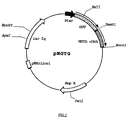
- MGTG-1 cDNA means cDNA which encodes the present protein; "KGFM5 cDNA”, cDNA which encodes the present protein; "Ptac”, tac promoter; “GST”, glutathione S transferase gene; “AmpR”, ampicillin resistant gene; "ori”, replication initiation site of Escherichia coli ; and “rrnBT1T2", terminator of ribosome RNA operon.
- the DNA according to the present invention expresses the production of the present protein by introducing the DNA into an appropriate self-replicable vector to form a recombinant DNA, and introducing the recombinant DNA into a host capable of proliferating without difficulty but inherently incapable of producing the protein.
- the present monoclonal antibody specifically reacts with a protein having specific physicochemical properties.
- the present hybridoma forms the monoclonal antibody when cultured in vivo and in vitro .
- the present purification method yields the present protein with a relatively-high purity from a mixture containing it along with impurities.
- the present protein can be prepared by culturing in nutrient culture media transformants with DNAs encoding the protein, and collecting the formed protein from the resultant cultures.
- the transformants usable in the present invention can be obtained by introducing into appropriate hosts DNAs having the base sequence in SEQ ID NO:4, homologous base sequences to it, and complementary ones to these base sequences. One or more bases in those base sequences can be replaced with other bases by means of the degeneracy of genetic code without alternating the amino acid sequence of the present protein.
- one or more bases in base sequences, which encode the present protein or its variants can be replaced with other bases.
- pKK223-2, pGEX-2T, pRL- ⁇ , pBTrp2 DNA, pUB110 and YEp13 are suitably used when the present DNA is expressed in procaryotes such as yeasts and other microorganisms of the species Escherichia coli and Bacillus subtilis
- Ti plasmid, Ri plasmid and pBI121 are suitably used for the expression in animal- and plant-cells.
- DNA fragments and vector fragments are, if necessary, first annealed, then treated with a DNA ligase in vivo or in vitro .
- the recombinant DNAs thus obtained can be readily introduced into appropriate hosts, and this enables the limitless replication of the DNAs by culturing the transformants.
- the recombinant DNAs usable in the present invention can be introduced into appropriate hosts such as yeasts and other microorganisms of the species Escherichia coli and Bacillus subtilis :
- microorganisms of the species Escherichia coli are used as a host, they are cultured in the presence of recombinant DNAs and calcium ions, and the competent cell method and the protoplast method are used when microorganisms of the species Bacillus subtilis are used as a host.
- the competent cell method and the protoplast method are used when microorganisms of the species Bacillus subtilis are used as a host.
- To clone the objective transformants they are selected by the colony hybridization method or by culturing all the transformants in nutrient culture media, and selecting ones which produce proteins capable of inducing immunocompetent cells to produce IFN- ⁇ .
- the resultant purified solutions containing the present protein can be concentrated and/or lyophilized into liquids or solids to meet to final uses.
- the present protein is allowed to coexist in nutrient culture media to induce the IFN- ⁇ production by immunocompetent cells, or directly administered to mammals for the treatment and/or prevention of IFN- ⁇ susceptive diseases.
- immunocompetent cells or directly administered to mammals for the treatment and/or prevention of IFN- ⁇ susceptive diseases.
- leukocytes separated from peripheral blood of mammals, or established immunocompetent cells such as HBL-38 cells, MO cells, Jurkat cells, EL-4 cells and L12-R4 cells are suspended in nutrient culture media containing the present protein to induce the IFN- ⁇ production.
- such nutrient culture media can be supplemented with T-cell stimulants such as mitogen, interleukin 2, and anti-CD 3 antibody, and the cells are cultured at 30-40°C and at a pH of about 5-8 for about 1-100 hours while the media were replacing with fresh ones.
- the IFN- ⁇ inducing agents according to the present invention are directly administered to mammals:
- the agents are orally administered to mammals after formulated into appropriate forms, or injected to the mammals intradermally, subcutaneously, muscularly, intravenously and peritoneally.
- the mammals, which can be administered with the present protein are not restricted to human, and include other animals such as mouse, rat, hamster, rabbit, dog, cat, caw, horse, coat, sheep, pig and monkey.
- the present protein Since the present protein has a strong IFN- ⁇ inducibility and an extremely-low toxicity, it readily induces the IFN- ⁇ production with only a small amount without causing serious side effects even when administered to in a relatively-large amount.
- the present protein induces the desired amount of IFN- ⁇ production smoothly without strictly controlling the administration, so that it can be used as an IFN- ⁇ production inducing agent.
- the present protein has a feature of strongly activating the cytotoxicity of killer cells, and, when used in combination with interleukin 2 and/or tumor necrosis factor (TNF), it exerts a strong effect on the therapeutic effect and/or the reduction of side effects in the treatment of adoptive immunotherapy for malignant tumors including solid carcinomas such as lung cancer, renal cancer, and breast cancer.
- TNF tumor necrosis factor
- the monoclonal antibody according to the present invention includes those in general, which are specific to the proteins having the above physicochemical properties independently of their sources, origins and classes.
- proteins are those which have the amino acid sequence in SEQ ID NO:3 and its homologous ones.
- homologous amino acid sequences include those wherein one or more amino acids are replaced with other amino acids without substantially alternating the physicochemical properties of the protein, as well as those which one or more amino acids are added to the N- and C-terminals in SEQ ID NO:3, and those which are defective in one or more amino acids in the N- and C-terminals in SEQ ID NO:3.
- the present monoclonal antibody can be obtained by using the protein or its antigenic fragments as an antigen.
- the monoclonal antibody can be obtained by hybridizing antibody-producing cells, collected from mammals which had been immunized with those antigens, with cells that infinitely proliferate, cloning hybridomas capable of producing the present monoclonal antibody, and culturing the clones in nutrient culture media in vitro .
- the immunization methods usable in the present invention include conventional ones: For example, those which comprise injecting the antigens with or without adjuvants into mammals intravenously, subcutaneously or intraperitoneally, and feeding the mammals for a prescribed period of time.
- the mammals usable in the present invention are not specifically restricted to as long as they produce the objective antigen-producing cells independently of their kind, size and sex.
- rodents such as rat, mouse and hamster are generally used, the most suitable mammal is chosen therefrom in view of the adaptivity to the following mammalian cells which infinitely proliferate.
- the total dose of antigens is generally about 5-500 ⁇ g/mouse and administered to in 2-5 shots at an interval of about 1-2 weeks.
- the spleens of the mammals are extracted and dispersed in nutrient culture media to obtain a spleen cell suspension as an antigen-producing cell.
- the resultant cells and mammalian cells capable of infinitely proliferating are hybridized to obtain hybridized cells containing the objective hybridomas.
- the mammalian cells capable of infinitely proliferating generally include cell lines from mouse bone marrow such as P3-NS1-Ag4-1 cells (ATCC TIB18), P3-X63-Ag8 cells (ATCC TIB9) and SP2/O-Ag14 cells (ATCC CRL1581), and their variants.
- the methods to fuse cells include conventional methods wherein electric pulses and fusion accelerators such as polyethylene glycol and sendai virus (HVJ) are used.
- the media for cell fusion used in the present invention are those in generally used in this field such as MEM medium, RPMI 1640 medium and Iscove's modified Dulbecco's medium, and it is desirable to exclude serums such as calf serum from the media.
- the resultant fused cells are transferred to selection media such as HAT medium, incubated at about 30-40°C for about 3 days to 3 weeks to die cells other than the objective hybridomas.
- the hybridomas are cultured in usual manner, and the antibody secreted in the culture is tested for reactivity with the present protein.
- Conventional assays for detecting antigens such as enzyme immunoassay, radioimmunoassay and bioassay are used in this experiment. For example, these assays are described in detail in " Tan-kuron Kotai Jikken Manual (Monoclonal Antibody Experimental Manual)", edited by Sakuji TOYAMA and Tamie ANDO, pp.105-152 (1991).
- Hybridomas capable of producing antibodies specific to the present protein are speedily cloned by the limiting dilution to obtain the present hybridoma.
- the monoclonal antibody according to the present invention can be obtained by culturing the present hydridoma in vivo or in vitro .
- the culture methods usable in the present invention include conventional ones used for culturing mammalian cells.
- the monoclonal antibody is collected from the resultant culture, while in the case of in vivo culture wherein the hybridoma is transplanted in warm-blooded animals and cultured in the bodies, the monoclonal antibody is collected from the animals's ascites or blood.
- the later described hybridoma M-1 is characteristic of a relatively-high productivity of the monoclonal antibody and a readily proliferation in vivo and in vitro .
- the monoclonal antibody according to the present invention is extremely useful in the purification of the present protein on immunoaffinity chromatography.
- a purification method comprises a step of contacting the present monoclonal antibody with a mixture containing the present protein and impurities, and a step of desorbing the adsorbed protein from the monoclonal antibody. These steps are usually carried out in an aqueous medium.
- the present monoclonal antibody is generally used under the conditions of coupling to aqueous carriers in a gel form which are packed in cylindrical columns, followed by feeding to the columns with mouse liver cell extracts, cultures of transformants, or their partially purified products to substantially adsorb the protein on the monoclonal antibody.
- the adsorbed protein is readily desorbed by changing the pH around the monoclonal antibody, for example, in the case of using a monoclonal antibody belonging to IgG class, the present protein is eluted therefrom at an acid pH, usually, a pH of 2-3, while in the case of using a monoclonal antibody belonging to IgM class, it is eluted at an alkaline pH, usually, a pH of 10-11.
- the present purification method can purify the present protein with the minimum labor cost and time.
- the present protein has an activity of inducing the IFN- ⁇ production by immunocompetent cells, so that the resultant purified protein can be used as an inducer for the IFN- ⁇ production by cell culturing methods, and can be arbitrarily used as a therapeutic and/or prophylactic agent for viral diseases such as AIDS and condyloma, malignant tumors such as renal cancer, granuloma, mycosis fungoides and cerebral tumor.
- the protein according to the present invention has an activity of increasing the cytotoxicity of killer cells, it can be used in combination with interleukin 2 and/or tumor necrosis factor to exert a remarkable efficacy on the therapeutic effect in the treatment of malignant tumors including solid carcinomas such as lung cancer, renal cancer and breast cancer, and it also decreases the side effects.
- the monoclonal antibody according to the present invention is widely useful in the field where the detection of the present protein is required.
- the present monoclonal antibody is used in combination with labeled immunoassays such as radioimmunoassay, enzyme immunoassay and fluorescent immunoassay, the present protein in test samples is quickly and accurately quantified or qualified.
- the present monoclonal antibody is labeled with radioactive substances, enzymes and/or fluorescent substances prior to use. Since the present monoclonal antibody specifically binds to the present protein to cause an immunoreaction, a trace amount of the present protein in test samples can be detected by measuring the level of the immunoreaction based on these labeled substances as a marker.
- labeled immunoassays As compared with bioassays, labeled immunoassays have features that it can assay many samples at the same time in a relatively short time, low labor-cost, and high accuracy. Therefore, the present detection method is extremely useful for controlling the steps in the preparation of the present protein and in the quality control of the final products.
- the present invention does not describe in detail the method for labeling monoclonal antibodies and the labeled assays because the present invention in itself does not relate to them, examples of such are described by P. Tijssen in " Practice and Theory of Enzyme Immunoassays ", pp.196-347 (1989).
- Fractions containing the present protein eluted at 0.8 M ammonium sulfate were collected and pooled into an about 4.8 L solution which was then concentrated with a membrane filter, dialyzed against 20 mM phosphate buffer (pH 6.5) at 4°C for 18 hours, and fed to a column packed with about 250 ml of "DEAE-SEPHAROSE", a product of Pharmacia LKB, Uppsala, Sweden. The column was washed with a fresh preparation of the same buffer and fed at an SV 1.2 with a linear gradient of sodium chloride ranging from 0 M to 0.2 M in 20 mM phosphate buffer (pH 6.5) to elute the present protein at a concentration of about 0.13 M sodium chloride.
- the newly formed precipitate was successively treated similarly as above with 70 v/v aqueous trifluoroacetate containing 0.001 v/v Tween 20 and with 50 v/v % aqueous acetonitrile to obtain a supernatant.
- the resultant supernatant and the above supernatant already obtained in the above were pooled and concentrated up to 250 ⁇ l, and the concentrate was centrifugally filtered.
- the peptide fragments A and B were analyzed on "MODEL 473 A", a protein sequencer commercialized by Perkin-Elmer Corp., Instrument Div., Norwalk, USA, and revealing that they have the amino acid sequences in SEQ ID NOs:1 and 2.
- the resultant mixture was mixed with 2 ⁇ l of mRNA in Experiment 3-3, volumed up to 19 ⁇ l with sterilized distilled-water, mixed with one ⁇ l of a solution containing 20 units of reverse transcriptase, and incubated at 42°C for 40 min to obtain a reaction mixture containing the first strand cDNA.
- the spleen cells and SP2/0-Ag14 cells (ATCC CRL 1581) derived from mouse myeloma were suspended in serum-free RPMI 1640 (pH 7.2) to give cell densities of 3x10⁴ cells/ml and 1x10⁴ cells/ml, respectively, and the cells suspension was centrifuged to collect the resultant precipitate.
Landscapes
- Life Sciences & Earth Sciences (AREA)
- Health & Medical Sciences (AREA)
- Chemical & Material Sciences (AREA)
- Molecular Biology (AREA)
- Immunology (AREA)
- Engineering & Computer Science (AREA)
- Urology & Nephrology (AREA)
- Cell Biology (AREA)
- Hematology (AREA)
- Biomedical Technology (AREA)
- Proteomics, Peptides & Aminoacids (AREA)
- General Health & Medical Sciences (AREA)
- Biochemistry (AREA)
- Medicinal Chemistry (AREA)
- Organic Chemistry (AREA)
- Physics & Mathematics (AREA)
- General Physics & Mathematics (AREA)
- Pathology (AREA)
- Biotechnology (AREA)
- Analytical Chemistry (AREA)
- Microbiology (AREA)
- Food Science & Technology (AREA)
- Biophysics (AREA)
- Genetics & Genomics (AREA)
- Toxicology (AREA)
- Gastroenterology & Hepatology (AREA)
- Zoology (AREA)
- Preparation Of Compounds By Using Micro-Organisms (AREA)
- Peptides Or Proteins (AREA)
Applications Claiming Priority (6)
| Application Number | Priority Date | Filing Date | Title |
|---|---|---|---|
| JP18416294 | 1994-07-14 | ||
| JP06184162A JP3109018B2 (ja) | 1994-07-14 | 1994-07-14 | インターフェロン−γの産生を誘導する蛋白質 |
| JP184162/94 | 1994-07-14 | ||
| JP4505795 | 1995-02-10 | ||
| JP07045057A JP3122963B2 (ja) | 1995-02-10 | 1995-02-10 | モノクローナル抗体 |
| JP45057/95 | 1995-02-10 |
Publications (3)
| Publication Number | Publication Date |
|---|---|
| EP0692536A2 true EP0692536A2 (de) | 1996-01-17 |
| EP0692536A3 EP0692536A3 (de) | 1997-03-26 |
| EP0692536B1 EP0692536B1 (de) | 2000-11-22 |
Family
ID=26385017
Family Applications (1)
| Application Number | Title | Priority Date | Filing Date |
|---|---|---|---|
| EP95304906A Expired - Lifetime EP0692536B1 (de) | 1994-07-14 | 1995-07-13 | Protein, das Interferon-Gamma Herstellung induziert und monoklonaler Antikörper dagegen |
Country Status (3)
| Country | Link |
|---|---|
| US (6) | US5912324A (de) |
| EP (1) | EP0692536B1 (de) |
| DE (1) | DE69519454T2 (de) |
Cited By (19)
| Publication number | Priority date | Publication date | Assignee | Title |
|---|---|---|---|---|
| EP0767178A1 (de) * | 1995-09-26 | 1997-04-09 | Kabushiki Kaisha Hayashibara Seibutsu Kagaku Kenkyujo | Protein, das die Interferon gamma-Herstellung durch immunkompetente Zellen anregt |
| WO1998010072A1 (en) * | 1996-09-09 | 1998-03-12 | Cornell Research Foundation, Inc. | INTERFERON-η INDUCING FACTOR IN NEUROENDOCRINE CELLS |
| US5879942A (en) * | 1996-07-19 | 1999-03-09 | Kabushiki Kaisha Hayashibara Seibutsu Kagaku Kenkyujo | Processing enzyme for polypeptide |
| US5891663A (en) * | 1996-07-25 | 1999-04-06 | Kabushiki Kaisha Hayashibara Seibutsu Kagaku Kenkyujo | Process for preparing polypeptide |
| EP0962531A3 (de) * | 1994-11-15 | 1999-12-15 | Kabushiki Kaisha Hayashibara Seibutsu Kagaku Kenkyujo | Isoliertes Polypeptidfragment, das die Interferon-gamma Produktion induziert, und für das Polypeptid kodierende DNA |
| US6060283A (en) * | 1996-06-27 | 2000-05-09 | Kabushiki Kaisha Hayashibara Seibutsu Kagaku Kenkyujo | Genomic DNA encoding human interleukin-18 (IL-18, interferon-γ inducing factor) |
| US6087116A (en) * | 1997-03-12 | 2000-07-11 | Kabushiki Kaisha Hayashibara Seibutsu Kagaku Kenkyujo | Interleukin-18 (IL-18) receptor polypeptides and their uses |
| US6214584B1 (en) | 1994-11-15 | 2001-04-10 | Kabushiki Kaisha Hayashibara Seibutsu Kagaku Kenkyujo | Human Interferon-γinducing factor |
| WO2001098455A2 (en) | 2000-06-15 | 2001-12-27 | Smithkline Beecham Corporation | Method for preparing a physiologically active il-18 polypeptide |
| US6600022B1 (en) | 1996-12-26 | 2003-07-29 | Kabushiki Kaisha Hayashibara Seibutsu Kagaku Kenkyujo | Monoclonal antibody for human IL-18 receptor |
| US6790442B1 (en) | 1996-06-27 | 2004-09-14 | Kabushiki Kaisha Hayashibara Seibutsu Kagaku Kenkyujo | Genomic DNA encoding a polypeptide capable of inducing the production of interferon-γ |
| US7135458B1 (en) | 1995-11-15 | 2006-11-14 | Kabushiki Kaisha Hayashibara Seibutsu Kagaku Kenkyujo | Interferon-γ inducing polypeptide, pharmaceutical composition thereof, monoclonal antibody thereto, and methods of use |
| WO2007134539A1 (en) * | 2006-05-23 | 2007-11-29 | Institute Of Biophysics Chinese Academy Of Sciences | Antibody to autoantigen and/or species high conservation antigen and its preparing method |
| US7311902B2 (en) | 2003-04-15 | 2007-12-25 | Smithkline Beecham Corporation | Conjugates comprising human IL-18 and substitution mutants thereof |
| EP2161032A2 (de) | 2004-08-20 | 2010-03-10 | GlaxoSmithKline LLC | Verfahren zur Wundheilung durch Verabreichen von menschlichem IL-18 |
| WO2010075460A1 (en) | 2008-12-23 | 2010-07-01 | Abbott Laboratories | Alkylated interleukin-18 and related compositions, kits, and methods of making and using same |
| EP2338514A1 (de) | 2007-03-23 | 2011-06-29 | Glaxosmithkline LLC | IL-18 und Pazopanib kombinierte Krebsbehandlung |
| US8133978B2 (en) | 2006-05-25 | 2012-03-13 | Glaxo Group Limited | Humanised anti-interleukin-18 antibody |
| US11219672B2 (en) | 2014-08-07 | 2022-01-11 | Haruki Okamura | Therapeutic agent for cancer which comprises combination of IL-18 and molecule-targeting antibody |
Families Citing this family (18)
| Publication number | Priority date | Publication date | Assignee | Title |
|---|---|---|---|---|
| DE69519454T2 (de) * | 1994-07-14 | 2001-05-03 | Kabushiki Kaisha Hayashibara Seibutsu Kagaku Kenkyujo, Okayama | Protein, das Interferon-Gamma Herstellung induziert und monoklonaler Antikörper dagegen |
| JP2952750B2 (ja) * | 1995-02-23 | 1999-09-27 | 株式会社林原生物化学研究所 | モノクローナル抗体 |
| JP4024366B2 (ja) * | 1996-11-29 | 2007-12-19 | 株式会社林原生物化学研究所 | ポリペプチド |
| JP3955352B2 (ja) * | 1997-02-25 | 2007-08-08 | 株式会社林原生物化学研究所 | 破骨細胞形成阻害剤 |
| US6432678B1 (en) | 1999-06-21 | 2002-08-13 | Smithkline Beecham Corporation | Macaca cynomolgus IL 18 |
| SK12942002A3 (sk) * | 2000-02-10 | 2003-05-02 | Abbott Laboratories | Protilátky viažuce ľudský interleukín-18, spôsoby ich výroby a použitia |
| US6818444B2 (en) | 2000-08-04 | 2004-11-16 | Heska Corporation | Canine and feline proteins, nucleic acid molecules and uses thereof |
| WO2002032374A2 (en) * | 2000-10-18 | 2002-04-25 | Immunex Corporation | Methods for treating il-18 mediated disorders |
| US20030044398A1 (en) * | 2001-03-20 | 2003-03-06 | Robl James M. | Methods for producing antibodies in mammals |
| TR201809678T4 (tr) | 2001-06-26 | 2018-07-23 | Amgen Fremont Inc | Opgl ye karşi antikorlar. |
| AU2002316384A1 (en) * | 2001-06-26 | 2003-03-03 | Photomed Technologies, Inc. | Multiple wavelength illuminator |
| US7253260B2 (en) * | 2002-04-17 | 2007-08-07 | Smithkline Beecham Corporation | Human IL-18 crystal structure |
| US20050121254A1 (en) * | 2002-05-29 | 2005-06-09 | Marcus Hofmann | Device for establishing noise in a motor vehicle |
| US20050153880A1 (en) * | 2002-06-27 | 2005-07-14 | Yukio Goto | Methods of treating or preventing ibd with il-18 |
| WO2004060911A2 (en) * | 2002-12-30 | 2004-07-22 | Amgen Inc. | Combination therapy with co-stimulatory factors |
| US20050100965A1 (en) | 2003-11-12 | 2005-05-12 | Tariq Ghayur | IL-18 binding proteins |
| US7968684B2 (en) * | 2003-11-12 | 2011-06-28 | Abbott Laboratories | IL-18 binding proteins |
| US7141382B1 (en) | 2004-10-12 | 2006-11-28 | Parikh Chirag R | Methods for detection of IL-18 as an early marker for diagnosis of acute renal failure and predictor of mortality |
Family Cites Families (5)
| Publication number | Priority date | Publication date | Assignee | Title |
|---|---|---|---|---|
| US5134076A (en) * | 1988-09-27 | 1992-07-28 | The Regents Of The University Of California | Monoclonal antibodies specific for protease nexin-1 and puriciation of protease nexin-1 using monoclonal antibodies |
| US5457038A (en) * | 1988-11-10 | 1995-10-10 | Genetics Institute, Inc. | Natural killer stimulatory factor |
| JP3230531B2 (ja) * | 1991-08-08 | 2001-11-19 | 光信 佐藤 | IFN―γ誘導活性物質 |
| DE69519454T2 (de) * | 1994-07-14 | 2001-05-03 | Kabushiki Kaisha Hayashibara Seibutsu Kagaku Kenkyujo, Okayama | Protein, das Interferon-Gamma Herstellung induziert und monoklonaler Antikörper dagegen |
| JP4024366B2 (ja) * | 1996-11-29 | 2007-12-19 | 株式会社林原生物化学研究所 | ポリペプチド |
-
1995
- 1995-07-13 DE DE69519454T patent/DE69519454T2/de not_active Expired - Lifetime
- 1995-07-13 EP EP95304906A patent/EP0692536B1/de not_active Expired - Lifetime
- 1995-07-14 US US08/502,535 patent/US5912324A/en not_active Expired - Lifetime
-
1997
- 1997-08-11 US US08/908,005 patent/US5914253A/en not_active Expired - Lifetime
-
1999
- 1999-02-19 US US09/253,523 patent/US6274709B1/en not_active Expired - Lifetime
- 1999-02-19 US US09/251,911 patent/US6277598B1/en not_active Expired - Lifetime
- 1999-08-12 US US09/373,230 patent/US7758853B2/en not_active Expired - Fee Related
-
2014
- 2014-07-31 US US14/448,002 patent/US20140336364A1/en not_active Abandoned
Non-Patent Citations (5)
| Title |
|---|
| J. SUMBROOK ET AL.: "Molecular Cloning: A Laboratory Manual", 1989, COLD SPRING HARBOR LABORATORY PRESS, NEW YORK, USA |
| M. MURAMATSU: "Rabo-Manual for Genetic Technology", 1988, MARUZEN CO., LTD., TOKYO, JAPAN |
| P. TIJSSEN: "Practice and Theory of Enzyme Immunoassays", 1989, pages: 196 - 347 |
| S. TOYAMA, T. ANDO: "Tan-kuron Kotai Jikken Manual = Monoclonal Antibody Experimental Manual", 1991, pages: 105 - 152 |
| U.K. LAEMMLI, NATURE, vol. 227, 1970, pages 680 - 685 |
Cited By (28)
| Publication number | Priority date | Publication date | Assignee | Title |
|---|---|---|---|---|
| US6214584B1 (en) | 1994-11-15 | 2001-04-10 | Kabushiki Kaisha Hayashibara Seibutsu Kagaku Kenkyujo | Human Interferon-γinducing factor |
| EP0962531A3 (de) * | 1994-11-15 | 1999-12-15 | Kabushiki Kaisha Hayashibara Seibutsu Kagaku Kenkyujo | Isoliertes Polypeptidfragment, das die Interferon-gamma Produktion induziert, und für das Polypeptid kodierende DNA |
| EP0767178A1 (de) * | 1995-09-26 | 1997-04-09 | Kabushiki Kaisha Hayashibara Seibutsu Kagaku Kenkyujo | Protein, das die Interferon gamma-Herstellung durch immunkompetente Zellen anregt |
| US6441138B2 (en) | 1995-09-26 | 2002-08-27 | Kabushiki Kaisha Hayashibara Seibutsu Kagaku Kenkyujo | Protein which induces interferon-γ production by immunocompetent cell |
| US6403079B1 (en) | 1995-09-26 | 2002-06-11 | Kabushiki Kaisha Hayashibara Seibutsu Kagaku Kenkyujo | Process for producing a pharmaceutical composition containing a protein which induces interferon-γ production by an immunocompetent cell |
| US6242255B1 (en) | 1995-09-26 | 2001-06-05 | Kabushiki Kaisha Hayashibara Seibutsu Kegaku Kenkyujo | Protein which induces interferon-gamma production by immunocompetent cell |
| US7135458B1 (en) | 1995-11-15 | 2006-11-14 | Kabushiki Kaisha Hayashibara Seibutsu Kagaku Kenkyujo | Interferon-γ inducing polypeptide, pharmaceutical composition thereof, monoclonal antibody thereto, and methods of use |
| US6790442B1 (en) | 1996-06-27 | 2004-09-14 | Kabushiki Kaisha Hayashibara Seibutsu Kagaku Kenkyujo | Genomic DNA encoding a polypeptide capable of inducing the production of interferon-γ |
| US6060283A (en) * | 1996-06-27 | 2000-05-09 | Kabushiki Kaisha Hayashibara Seibutsu Kagaku Kenkyujo | Genomic DNA encoding human interleukin-18 (IL-18, interferon-γ inducing factor) |
| US5879942A (en) * | 1996-07-19 | 1999-03-09 | Kabushiki Kaisha Hayashibara Seibutsu Kagaku Kenkyujo | Processing enzyme for polypeptide |
| US5891663A (en) * | 1996-07-25 | 1999-04-06 | Kabushiki Kaisha Hayashibara Seibutsu Kagaku Kenkyujo | Process for preparing polypeptide |
| WO1998010072A1 (en) * | 1996-09-09 | 1998-03-12 | Cornell Research Foundation, Inc. | INTERFERON-η INDUCING FACTOR IN NEUROENDOCRINE CELLS |
| US6600022B1 (en) | 1996-12-26 | 2003-07-29 | Kabushiki Kaisha Hayashibara Seibutsu Kagaku Kenkyujo | Monoclonal antibody for human IL-18 receptor |
| US7141393B2 (en) | 1996-12-26 | 2006-11-28 | Kabushiki Kaisha Hayashibara Seibutsu Kagaku Kenkyujo | Interleukin-18-receptor proteins |
| US6087116A (en) * | 1997-03-12 | 2000-07-11 | Kabushiki Kaisha Hayashibara Seibutsu Kagaku Kenkyujo | Interleukin-18 (IL-18) receptor polypeptides and their uses |
| US6559298B1 (en) | 1997-03-12 | 2003-05-06 | Kabushiki Kaisha Hayashibara Seibutsu Kagaku Kenkyujo | Polypeptides that bind interleukin-18 (IL-18) |
| WO2001098455A2 (en) | 2000-06-15 | 2001-12-27 | Smithkline Beecham Corporation | Method for preparing a physiologically active il-18 polypeptide |
| US7311902B2 (en) | 2003-04-15 | 2007-12-25 | Smithkline Beecham Corporation | Conjugates comprising human IL-18 and substitution mutants thereof |
| EP2161032A2 (de) | 2004-08-20 | 2010-03-10 | GlaxoSmithKline LLC | Verfahren zur Wundheilung durch Verabreichen von menschlichem IL-18 |
| WO2007134539A1 (en) * | 2006-05-23 | 2007-11-29 | Institute Of Biophysics Chinese Academy Of Sciences | Antibody to autoantigen and/or species high conservation antigen and its preparing method |
| CN1850863B (zh) * | 2006-05-23 | 2012-07-04 | 中国科学院生物物理研究所 | 针对自身抗原和/或种属间高度保守抗原的抗体及其制备方法 |
| US8133978B2 (en) | 2006-05-25 | 2012-03-13 | Glaxo Group Limited | Humanised anti-interleukin-18 antibody |
| US8637018B2 (en) | 2006-05-25 | 2014-01-28 | Glaxo Group Limited | Humanized anti-IL-18 antibodies |
| US9499617B2 (en) | 2006-05-25 | 2016-11-22 | Glaxo Group Limited | Humanized anti-IL-18 antibodies |
| US10703814B2 (en) | 2006-05-25 | 2020-07-07 | Glaxo Group Limited | Method of treatment with humanized anti-IL-18 antibodies |
| EP2338514A1 (de) | 2007-03-23 | 2011-06-29 | Glaxosmithkline LLC | IL-18 und Pazopanib kombinierte Krebsbehandlung |
| WO2010075460A1 (en) | 2008-12-23 | 2010-07-01 | Abbott Laboratories | Alkylated interleukin-18 and related compositions, kits, and methods of making and using same |
| US11219672B2 (en) | 2014-08-07 | 2022-01-11 | Haruki Okamura | Therapeutic agent for cancer which comprises combination of IL-18 and molecule-targeting antibody |
Also Published As
| Publication number | Publication date |
|---|---|
| EP0692536A3 (de) | 1997-03-26 |
| EP0692536B1 (de) | 2000-11-22 |
| US5912324A (en) | 1999-06-15 |
| US20140336364A1 (en) | 2014-11-13 |
| DE69519454D1 (de) | 2000-12-28 |
| US20030099607A1 (en) | 2003-05-29 |
| DE69519454T2 (de) | 2001-05-03 |
| US6277598B1 (en) | 2001-08-21 |
| US6274709B1 (en) | 2001-08-14 |
| US7758853B2 (en) | 2010-07-20 |
| US5914253A (en) | 1999-06-22 |
Similar Documents
| Publication | Publication Date | Title |
|---|---|---|
| US7758853B2 (en) | IFN-γ production inducing protein (IGIF, IL-18) | |
| EP0962531B1 (de) | Isoliertes Polypeptidfragment, das die Interferon-gamma Produktion induziert, und für das Polypeptid kodierende DNA | |
| US6268486B1 (en) | Process for purifying a polypeptide | |
| EP0186833B1 (de) | Monoklonaler Antikörper gegen ein Cytotoxin, denselben erzeugendes Hybridoma und Verfahren für die Herstellung des gereinigten Cytotoxin | |
| EP0398327B2 (de) | Tumor-Nekrosefaktor-Bindungsprotein II, seine Reinigung und spezifische Antikörper | |
| US5681933A (en) | Antibodies to IL-1β | |
| US6600022B1 (en) | Monoclonal antibody for human IL-18 receptor | |
| US6214584B1 (en) | Human Interferon-γinducing factor | |
| US7015308B1 (en) | Hedgehog protein | |
| JP2559035B2 (ja) | 細胞生長調節因子 | |
| US7355014B2 (en) | Interferon-γ inducing polypeptide, pharmaceutical composition thereof, monoclonal antibody thereto, and methods of use | |
| EP1101772A1 (de) | Antikörper spezifisch für den Interleukin-18 Vorläufer | |
| JP3122963B2 (ja) | モノクローナル抗体 | |
| WO1991012334A1 (en) | Inhibitor of cytokine activity and applications thereof | |
| KR100490447B1 (ko) | 인터페론-γ의생산을유도하는폴리펩피드,이폴리펩티드에특이적인모노클로날항체및감수성질환체 | |
| Hirose et al. | Macrophage migration inhibitory factor (MIF) produced by a human T cell hybridoma clone | |
| JP3381032B2 (ja) | モノクローナル抗体 | |
| FI98373C (fi) | Uusi diagnostisesti käyttökelpoinen polypeptidi, onkostatiini M | |
| US20030059838A1 (en) | Hedgehog protein |
Legal Events
| Date | Code | Title | Description |
|---|---|---|---|
| PUAI | Public reference made under article 153(3) epc to a published international application that has entered the european phase |
Free format text: ORIGINAL CODE: 0009012 |
|
| AK | Designated contracting states |
Kind code of ref document: A2 Designated state(s): DE FR GB |
|
| PUAL | Search report despatched |
Free format text: ORIGINAL CODE: 0009013 |
|
| AK | Designated contracting states |
Kind code of ref document: A3 Designated state(s): DE FR GB |
|
| 17P | Request for examination filed |
Effective date: 19970407 |
|
| 17Q | First examination report despatched |
Effective date: 19971007 |
|
| GRAG | Despatch of communication of intention to grant |
Free format text: ORIGINAL CODE: EPIDOS AGRA |
|
| GRAG | Despatch of communication of intention to grant |
Free format text: ORIGINAL CODE: EPIDOS AGRA |
|
| GRAG | Despatch of communication of intention to grant |
Free format text: ORIGINAL CODE: EPIDOS AGRA |
|
| GRAG | Despatch of communication of intention to grant |
Free format text: ORIGINAL CODE: EPIDOS AGRA |
|
| GRAH | Despatch of communication of intention to grant a patent |
Free format text: ORIGINAL CODE: EPIDOS IGRA |
|
| GRAH | Despatch of communication of intention to grant a patent |
Free format text: ORIGINAL CODE: EPIDOS IGRA |
|
| GRAA | (expected) grant |
Free format text: ORIGINAL CODE: 0009210 |
|
| AK | Designated contracting states |
Kind code of ref document: B1 Designated state(s): DE FR GB |
|
| REF | Corresponds to: |
Ref document number: 69519454 Country of ref document: DE Date of ref document: 20001228 |
|
| ET | Fr: translation filed | ||
| PLBE | No opposition filed within time limit |
Free format text: ORIGINAL CODE: 0009261 |
|
| STAA | Information on the status of an ep patent application or granted ep patent |
Free format text: STATUS: NO OPPOSITION FILED WITHIN TIME LIMIT |
|
| 26N | No opposition filed | ||
| REG | Reference to a national code |
Ref country code: GB Ref legal event code: IF02 |
|
| PGFP | Annual fee paid to national office [announced via postgrant information from national office to epo] |
Ref country code: GB Payment date: 20140605 Year of fee payment: 20 |
|
| PGFP | Annual fee paid to national office [announced via postgrant information from national office to epo] |
Ref country code: DE Payment date: 20140709 Year of fee payment: 20 |
|
| PGFP | Annual fee paid to national office [announced via postgrant information from national office to epo] |
Ref country code: FR Payment date: 20140708 Year of fee payment: 20 |
|
| REG | Reference to a national code |
Ref country code: DE Ref legal event code: R071 Ref document number: 69519454 Country of ref document: DE |
|
| REG | Reference to a national code |
Ref country code: GB Ref legal event code: PE20 Expiry date: 20150712 |
|
| PG25 | Lapsed in a contracting state [announced via postgrant information from national office to epo] |
Ref country code: GB Free format text: LAPSE BECAUSE OF EXPIRATION OF PROTECTION Effective date: 20150712 |