EP0692914A2 - Verfahren zum Einfügen eines zusätzlichen variablen Datenstromes in einen Primärdatenstrom von ebenfalls variabler Datenrate - Google Patents
Verfahren zum Einfügen eines zusätzlichen variablen Datenstromes in einen Primärdatenstrom von ebenfalls variabler Datenrate Download PDFInfo
- Publication number
- EP0692914A2 EP0692914A2 EP95304706A EP95304706A EP0692914A2 EP 0692914 A2 EP0692914 A2 EP 0692914A2 EP 95304706 A EP95304706 A EP 95304706A EP 95304706 A EP95304706 A EP 95304706A EP 0692914 A2 EP0692914 A2 EP 0692914A2
- Authority
- EP
- European Patent Office
- Prior art keywords
- buffer
- distortion
- level
- signal
- video signal
- Prior art date
- Legal status (The legal status is an assumption and is not a legal conclusion. Google has not performed a legal analysis and makes no representation as to the accuracy of the status listed.)
- Withdrawn
Links
- 238000000034 method Methods 0.000 title claims abstract description 13
- 206010021403 Illusion Diseases 0.000 claims abstract description 16
- 230000005540 biological transmission Effects 0.000 claims abstract description 14
- 238000013139 quantization Methods 0.000 claims description 10
- 238000010586 diagram Methods 0.000 description 5
- 230000033001 locomotion Effects 0.000 description 4
- 238000005259 measurement Methods 0.000 description 3
- 230000003044 adaptive effect Effects 0.000 description 2
- 230000006870 function Effects 0.000 description 2
- WABPQHHGFIMREM-YPZZEJLDSA-N lead-205 Chemical compound [205Pb] WABPQHHGFIMREM-YPZZEJLDSA-N 0.000 description 2
- 239000013598 vector Substances 0.000 description 2
- 230000009471 action Effects 0.000 description 1
- 230000008859 change Effects 0.000 description 1
- 239000002131 composite material Substances 0.000 description 1
- 230000001419 dependent effect Effects 0.000 description 1
- 230000000694 effects Effects 0.000 description 1
- 230000008713 feedback mechanism Effects 0.000 description 1
- 239000000835 fiber Substances 0.000 description 1
- WABPQHHGFIMREM-UHFFFAOYSA-N lead(0) Chemical compound [Pb] WABPQHHGFIMREM-UHFFFAOYSA-N 0.000 description 1
- 230000008569 process Effects 0.000 description 1
Images
Classifications
-
- H—ELECTRICITY
- H04—ELECTRIC COMMUNICATION TECHNIQUE
- H04N—PICTORIAL COMMUNICATION, e.g. TELEVISION
- H04N21/00—Selective content distribution, e.g. interactive television or video on demand [VOD]
- H04N21/40—Client devices specifically adapted for the reception of or interaction with content, e.g. set-top-box [STB]; Operations thereof
- H04N21/43—Processing of content or additional data, e.g. demultiplexing additional data from a digital video stream; Elementary client operations, e.g. monitoring of home network or synchronising decoder's clock; Client middleware
- H04N21/434—Disassembling of a multiplex stream, e.g. demultiplexing audio and video streams, extraction of additional data from a video stream; Remultiplexing of multiplex streams; Extraction or processing of SI; Disassembling of packetised elementary stream
- H04N21/4348—Demultiplexing of additional data and video streams
-
- H—ELECTRICITY
- H04—ELECTRIC COMMUNICATION TECHNIQUE
- H04N—PICTORIAL COMMUNICATION, e.g. TELEVISION
- H04N21/00—Selective content distribution, e.g. interactive television or video on demand [VOD]
- H04N21/20—Servers specifically adapted for the distribution of content, e.g. VOD servers; Operations thereof
- H04N21/23—Processing of content or additional data; Elementary server operations; Server middleware
- H04N21/236—Assembling of a multiplex stream, e.g. transport stream, by combining a video stream with other content or additional data, e.g. inserting a URL [Uniform Resource Locator] into a video stream, multiplexing software data into a video stream; Remultiplexing of multiplex streams; Insertion of stuffing bits into the multiplex stream, e.g. to obtain a constant bit-rate; Assembling of a packetised elementary stream
-
- H—ELECTRICITY
- H04—ELECTRIC COMMUNICATION TECHNIQUE
- H04N—PICTORIAL COMMUNICATION, e.g. TELEVISION
- H04N19/00—Methods or arrangements for coding, decoding, compressing or decompressing digital video signals
- H04N19/10—Methods or arrangements for coding, decoding, compressing or decompressing digital video signals using adaptive coding
- H04N19/102—Methods or arrangements for coding, decoding, compressing or decompressing digital video signals using adaptive coding characterised by the element, parameter or selection affected or controlled by the adaptive coding
-
- H—ELECTRICITY
- H04—ELECTRIC COMMUNICATION TECHNIQUE
- H04N—PICTORIAL COMMUNICATION, e.g. TELEVISION
- H04N19/00—Methods or arrangements for coding, decoding, compressing or decompressing digital video signals
- H04N19/10—Methods or arrangements for coding, decoding, compressing or decompressing digital video signals using adaptive coding
- H04N19/134—Methods or arrangements for coding, decoding, compressing or decompressing digital video signals using adaptive coding characterised by the element, parameter or criterion affecting or controlling the adaptive coding
- H04N19/146—Data rate or code amount at the encoder output
- H04N19/147—Data rate or code amount at the encoder output according to rate distortion criteria
-
- H—ELECTRICITY
- H04—ELECTRIC COMMUNICATION TECHNIQUE
- H04N—PICTORIAL COMMUNICATION, e.g. TELEVISION
- H04N19/00—Methods or arrangements for coding, decoding, compressing or decompressing digital video signals
- H04N19/10—Methods or arrangements for coding, decoding, compressing or decompressing digital video signals using adaptive coding
- H04N19/134—Methods or arrangements for coding, decoding, compressing or decompressing digital video signals using adaptive coding characterised by the element, parameter or criterion affecting or controlling the adaptive coding
- H04N19/146—Data rate or code amount at the encoder output
- H04N19/152—Data rate or code amount at the encoder output by measuring the fullness of the transmission buffer
-
- H—ELECTRICITY
- H04—ELECTRIC COMMUNICATION TECHNIQUE
- H04N—PICTORIAL COMMUNICATION, e.g. TELEVISION
- H04N19/00—Methods or arrangements for coding, decoding, compressing or decompressing digital video signals
- H04N19/10—Methods or arrangements for coding, decoding, compressing or decompressing digital video signals using adaptive coding
- H04N19/169—Methods or arrangements for coding, decoding, compressing or decompressing digital video signals using adaptive coding characterised by the coding unit, i.e. the structural portion or semantic portion of the video signal being the object or the subject of the adaptive coding
- H04N19/184—Methods or arrangements for coding, decoding, compressing or decompressing digital video signals using adaptive coding characterised by the coding unit, i.e. the structural portion or semantic portion of the video signal being the object or the subject of the adaptive coding the unit being bits, e.g. of the compressed video stream
-
- H—ELECTRICITY
- H04—ELECTRIC COMMUNICATION TECHNIQUE
- H04N—PICTORIAL COMMUNICATION, e.g. TELEVISION
- H04N19/00—Methods or arrangements for coding, decoding, compressing or decompressing digital video signals
- H04N19/46—Embedding additional information in the video signal during the compression process
-
- H—ELECTRICITY
- H04—ELECTRIC COMMUNICATION TECHNIQUE
- H04N—PICTORIAL COMMUNICATION, e.g. TELEVISION
- H04N19/00—Methods or arrangements for coding, decoding, compressing or decompressing digital video signals
- H04N19/60—Methods or arrangements for coding, decoding, compressing or decompressing digital video signals using transform coding
- H04N19/61—Methods or arrangements for coding, decoding, compressing or decompressing digital video signals using transform coding in combination with predictive coding
-
- H—ELECTRICITY
- H04—ELECTRIC COMMUNICATION TECHNIQUE
- H04N—PICTORIAL COMMUNICATION, e.g. TELEVISION
- H04N21/00—Selective content distribution, e.g. interactive television or video on demand [VOD]
- H04N21/20—Servers specifically adapted for the distribution of content, e.g. VOD servers; Operations thereof
- H04N21/23—Processing of content or additional data; Elementary server operations; Server middleware
- H04N21/236—Assembling of a multiplex stream, e.g. transport stream, by combining a video stream with other content or additional data, e.g. inserting a URL [Uniform Resource Locator] into a video stream, multiplexing software data into a video stream; Remultiplexing of multiplex streams; Insertion of stuffing bits into the multiplex stream, e.g. to obtain a constant bit-rate; Assembling of a packetised elementary stream
- H04N21/23614—Multiplexing of additional data and video streams
-
- H—ELECTRICITY
- H04—ELECTRIC COMMUNICATION TECHNIQUE
- H04N—PICTORIAL COMMUNICATION, e.g. TELEVISION
- H04N21/00—Selective content distribution, e.g. interactive television or video on demand [VOD]
- H04N21/60—Network structure or processes for video distribution between server and client or between remote clients; Control signalling between clients, server and network components; Transmission of management data between server and client, e.g. sending from server to client commands for recording incoming content stream; Communication details between server and client
- H04N21/63—Control signaling related to video distribution between client, server and network components; Network processes for video distribution between server and clients or between remote clients, e.g. transmitting basic layer and enhancement layers over different transmission paths, setting up a peer-to-peer communication via Internet between remote STB's; Communication protocols; Addressing
-
- H—ELECTRICITY
- H04—ELECTRIC COMMUNICATION TECHNIQUE
- H04N—PICTORIAL COMMUNICATION, e.g. TELEVISION
- H04N19/00—Methods or arrangements for coding, decoding, compressing or decompressing digital video signals
- H04N19/10—Methods or arrangements for coding, decoding, compressing or decompressing digital video signals using adaptive coding
- H04N19/134—Methods or arrangements for coding, decoding, compressing or decompressing digital video signals using adaptive coding characterised by the element, parameter or criterion affecting or controlling the adaptive coding
- H04N19/146—Data rate or code amount at the encoder output
Definitions
- the present invention relates to the transmission of primary and auxiliary digital data streams over a broadcast channel.
- Systems such as HDTV systems, use encoding techniques to extract redundancies from video signals which are transmitted as video frames from a transmitter to a receiver.
- the amount of information contained in the encoded video signals tends to be variable, resulting in a bursty signal. For example, scenes involving a lot of action, such as basketball footage, contain less frame-to-frame redundant information, and therefore tend to produce a larger amount of encoded information or data, than the amount of encoded data required to transmit subsequent frames of a still picture, which contain primarily redundant information.
- an HDTV encoder For transmission using a limited-bit-rate channel, an HDTV encoder must produce a constrained constant bit rate.
- a buffer is associated with the HDTV transmitter which accumulates the bursty video signals and controls the rate at which the bitstream is transmitted. If there is a break in the transmission of the bitstream generated by the HDTV transmitter such that the buffer becomes empty, partial or total loss of picture results.
- video data are received from a data source and compressed by a video encoder.
- the video encoder determines the level, i.e. coarseness of quantization of the video data stream.
- the video data are then transmitted to a buffer.
- the buffer controls the output rate of the video data stream.
- the fullness of the buffer is controlled by distortion control via a feedback mechanism.
- the distortion control controls the level of distortion, i.e., the coarseness or fineness of the video data, for each video frame which, in turn, effects the level of, i.e., makes more coarse, the quantization of the encoded video data.
- the distortion control causes the encoder to increase the level of quantization of the video data stream, thereby reducing buffer fullness.
- the distortion control causes the encoder to reduce the level of quantization of the video data stream, thereby increasing buffer fullness. In the event of buffer underflow, i.e., so many more bits leave the buffer than enter the buffer that the buffer empties.
- the buffer as a practical matter rarely empties even when a highly redundant image, such as a still image, is being sent. The reason is that even a still image contains noise which gives rise to some frame-to-frame differences which cause the encoder to increase the level of quantization.
- the buffer tends to more frequently realize an underflow condition.
- Auxiliary data representative of data services such as electronic publications, can be transmitted during the underflow condition. While having a floor on the distortion level tends to increase the level of quantization of the video data stream compared to what a prior art system would do resulting in reduced picture quality over that which the prior art could achieve, the floor is established at such a level that the picture quality is acceptable to the human eye.
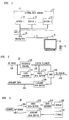
- FIG. 1 illustrates a schematic diagram of an HDTV system implemented in accordance with the present invention.
- FIG. 2 illustrates a block diagram of the HDTV transmitter of the HDTV system of FIG. 1.
- FIG. 3 illustrates a block diagram of the HDTV receiver of the HDTV system of FIG. 1.
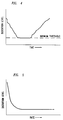
- FIG. 4 illustrates a graph depicting a measurement of the distortion level over time t.
- FIG. 5 illustrates a graph depicting the relationship between the level of distortion and bit rate.
- FIG. 1 A general overview of a video system, illustratively a high definition television (HDTV) system 10, incorporating the principles of the present invention is illustrated in FIG. 1.
- the details of an HDTV video system are described in such U.S. Patents as 5,144,423 entitled “HDTV Encoder with Forward Estimation and Constant Rate Motion Vectors” issued September 1, 1992 to Knauer et al.; 5,136,377 entitled “Adaptive Non-linear Quantizer”, issued August 4, 1992 to Johnston et al.; 5,134,475 entitled “Adaptive Leak HDTV Encoder", issued July 28, 1992 to Johnston et al.; and 5,134,477 entitled “HDTV Receiver” issued July 28, 1992 to Knauer et al.
- a viewer sends instructions to a central data server 12 to identify one or more data services that are desired to be received.
- the instructions are transmitted from the viewer's remote location to the central server 12 by means of a cable or fiber optic network 14.
- the instructions might be transmitted as infra-red signals via a remote control unit 16 to a set-top box 18 associated with receiver 30 which transmits the appropriate signals over the network 14.
- the viewer could transmit his instructions to central server 12 over a standard telephone network (not shown).
- a separate data service converter box (not shown) may be used in place of the set-top box 18 to transmit the instructions over network 14.
- the central server 12 processes the incoming requests from the viewers and retrieves the data desired by the viewers from a respective one of servers 24.
- the data services can be any type of video or audio information such as, but not limited to, electronic newspapers, magazines, catalogs, movies transmitted to a storage device, or other types of services which are not required to be transmitted in real time.
- the data is transmitted to the set-top box 18.
- the set-top box 18 includes storage means, such as memory, for storing the data. Once a significant portion of the data has been transmitted to the set-top box 18, the service can be viewed by the viewer.
- Set-top box also receives video signals over network 14 from a central HDTV transmitter 20.
- HDTV video signals and the data signals are multiplexed together in such a manner that the HDTV video signals are transmitted in real time and the data service signals are transmitted to the set-top box at a slower rate.
- the HDTV signals are the primary signals broadcast to the set-top box 18 and the data signals are treated as auxiliary signals as will be described in detail hereinafter.
- FIG. 2 is a more detailed block diagram of the HDTV transmitter 20 shown in FIG. 1.
- a high-definition (HD) video signal on lead 205 is encoded by an HDTV encoder 210.
- an HDTV encoder--indeed most video encoders--provides a variable-bit-rate output depending on the nature of the video signal being encoded. For example, a video signal which is changing by a relatively small amount from frame to frame can be encoded with fewer bits than when the frame to frame differences are relatively great, as when there is a lot of motion in the image.
- a sharp scene change also causes the encoder output bit rate to increase for a time.
- small scene changes require fewer bits than drastic scene changes, noise present in the video signals causes the image to become distorted. As a result, the number of bits required to encode the scene changes is significant.
- the system also includes distortion control 230 which receives as its inputs the incoming video signal from lead 205 as well as a "buffer fullness" signal on lead 235 provided by buffer 215.
- the function and structure of distortion control 230 are well known in the art.
- the distortion control 230 determines the degree of coarseness to which a video signal is encoded-its distortion level-taking into consideration factors, such as, but not limited to, discrete cosine transform (DCT) coefficients, motion vectors and the level of quantization.
- DCT discrete cosine transform
- the coded video signal must contain enough information so that the coded image maintains the integrity of the original image. However, that measurement of integrity is subject to the constraint that the coded image will be viewed by a human observer who will not be aware of small distortions in the coded image. As long as the human observer can not detect distortions resulting from the coding of the image, the distortion level is considered to be within an acceptable range.
- the distortion level is dependent on a perceptual distortion metric.
- the perceptual distortion metric provides a measurement by which the degree of fineness to which the video signals are encoded may be determined so that the distortion present in the coded image appears, to a human observer, to be uniformly distributed.
- the perceptual distortion metric is set at such a level that a floor is established for the distortion level.
- the relationship between the distortion level and the bit rate of the encoded video signal is illustrated in FIG. 5.
- the distortion level and the bit rate have a generally inverse relationship. When the distortion level is high, the rate is low. When the distortion level is low, the rate is high.
- the maximum amount of encoding i.e., the degree of fineness to which the video signal is encoded, can be limited. As shown in FIG. 4, over time the distortion level tends to decrease.
- the degree of fineness of the encoding associated with the distortion level is maintained until the video image changes or there is an increase in scene complexity, at which point the distortion level is allowed to increase in order to accommodate the resulting increase in the coded bit rate.
- the distortion floor which corresponds to predetermined, non-zero level of perceptual distortion in the video signal, is set at such a level that the buffer will regularly achieve an underflow condition.
- auxiliary data from auxiliary data buffer 245 are transmitted and transmission of the video signals is suspended.
- transmission of auxiliary data is suspended and transmission of the video signals is resumed.
- auxiliary data By creating artificial underflow conditions in this way, the amount of auxiliary data which may be transmitted is increased over the prior art.
- the full data rate capability of the channel may not be taken up by the number of bits being supplied to, and ultimately read out of, video data buffer 215.
- the system thus has the ability during such periods to accommodate the transmission of auxiliary data that would not otherwise be able to be accommodated.
- the system receives an auxiliary data bit stream on lead 240.
- the bits of this data stream are buffered in auxiliary data buffer 245 whose output feeds into multiplexer 225.
- the system may provide a minimum constant bit-rate capability to establish a minimum bit-rate of auxiliary data by dedicating a portion of the video channel exclusively to the transmission of auxiliary data. That is, bits from auxiliary data buffer 245 are continuously read therefrom at at least a predetermined minimum rate and multiplexed with the HDTV-encoded signal for presentation to channel 220.
- multiplexer 225 increases the rate at which it takes auxiliary data bits from buffer 245. Later, as video data buffer 215 begins to fill, the rate of auxiliary data taken from data buffer 245 is decreased--ultimately to the aforementioned minimum constant bit rate.
- FIG. 3 further illustrates a more detailed block diagram of the HDTV receiver 30.
- the composite video/auxiliary data signal is demultiplexed by demultiplexer 305.
- the received HDTV video signal is applied to video data buffer 310, then to HDTV decoder 315, and ultimately to a display 320 while the received auxiliary data is applied to auxiliary data buffer 325 and then to a storage device 330.
- That storage device 330 might be the display 320 on which the HDTV signal is displayed or could be a virtual set-top box which can transmit the data to any kind of end-use device.
- the broadcast industry has indicated that digital data services will be a valuable part of HDTV.
- this arrangement provides a useful way of delivering such services.
- the ability to transmit auxiliary data along with the HDTV signal provides the capability of delivering such services as electronic newspapers and magazines, electronic catalogues, paging services, stock quotes and program guides, as well as additional audio and/or video channels.
Landscapes
- Engineering & Computer Science (AREA)
- Multimedia (AREA)
- Signal Processing (AREA)
- Compression Or Coding Systems Of Tv Signals (AREA)
- Television Systems (AREA)
Applications Claiming Priority (2)
| Application Number | Priority Date | Filing Date | Title |
|---|---|---|---|
| US276069 | 1994-07-15 | ||
| US08/276,069 US5734432A (en) | 1994-07-15 | 1994-07-15 | Method of incorporating a variable rate auxiliary data stream with a variable rate primary data stream |
Publications (2)
| Publication Number | Publication Date |
|---|---|
| EP0692914A2 true EP0692914A2 (de) | 1996-01-17 |
| EP0692914A3 EP0692914A3 (de) | 1999-04-21 |
Family
ID=23055024
Family Applications (1)
| Application Number | Title | Priority Date | Filing Date |
|---|---|---|---|
| EP95304706A Withdrawn EP0692914A3 (de) | 1994-07-15 | 1995-07-05 | Verfahren zum Einfügen eines zusätzlichen variablen Datenstromes in einen Primärdatenstrom von ebenfalls variabler Datenrate |
Country Status (5)
| Country | Link |
|---|---|
| US (1) | US5734432A (de) |
| EP (1) | EP0692914A3 (de) |
| JP (1) | JPH08181952A (de) |
| KR (1) | KR100297863B1 (de) |
| CA (1) | CA2150729C (de) |
Cited By (8)
| Publication number | Priority date | Publication date | Assignee | Title |
|---|---|---|---|---|
| WO1997019560A1 (en) * | 1995-11-21 | 1997-05-29 | Imedia Corporation | Method and apparatus for multiplexing and distributing data with preformatted real-time video |
| GB2309611A (en) * | 1996-01-25 | 1997-07-30 | Ibm | A motion video compression system with buffer empty/fill look-ahead bit allocation |
| EP0798934A1 (de) * | 1996-03-15 | 1997-10-01 | Broderbund Software, Inc. | System um selektiv, beständige Betriebsmitteldaten zur ungebrauchten Bandbreite eines digitalen Kinofilms hinzuzufügen |
| EP0899955A3 (de) * | 1997-08-27 | 2001-01-31 | Matsushita Electric Industrial Co., Ltd. | Vorrichtung zur Erzeugung von Steuerinformation für ein Rundfunksystem |
| WO2000079794A3 (en) * | 1999-06-17 | 2002-02-14 | Bigband Networks Inc | Method for delivery of narrow-cast data over digital broadcast channels |
| US7050093B1 (en) | 1998-06-15 | 2006-05-23 | Industrial Electric Industrial Co., Ltd. | Video camera pivoting apparatus, a pivoting video camera apparatus, and a monitoring system with a pivoting video camera |
| US7151782B1 (en) | 2005-08-09 | 2006-12-19 | Bigband Networks, Inc. | Method and system for providing multiple services to end-users |
| WO2009079320A3 (en) * | 2007-12-18 | 2009-10-08 | Ibiquity Digital Corporation | Method for streaming through a data service over a radio link subsystem |
Families Citing this family (22)
| Publication number | Priority date | Publication date | Assignee | Title |
|---|---|---|---|---|
| BR9708899A (pt) * | 1996-05-01 | 1999-08-03 | Koninkl Philips Electronics Nv | Processos e aparelhos para geração e para recepção e processamento de um sinal de televis o com dados adicionais sinal de televis o com dados adicionais e dispositivo de armazenamento |
| US6360022B1 (en) | 1997-04-04 | 2002-03-19 | Sarnoff Corporation | Method and apparatus for assessing the visibility of differences between two signal sequences |
| US6061719A (en) * | 1997-11-06 | 2000-05-09 | Lucent Technologies Inc. | Synchronized presentation of television programming and web content |
| US6792618B1 (en) | 1998-03-02 | 2004-09-14 | Lucent Technologies Inc. | Viewer customization of displayed programming based on transmitted URLs |
| US6665728B1 (en) * | 1998-12-30 | 2003-12-16 | Intel Corporation | Establishing optimal latency in streaming data applications that use data packets |
| EP1157354B1 (de) * | 1999-02-25 | 2009-12-23 | Sarnoff Corporation | Verfahren und gerät zum bewerten der visibilität von unterschieden zwischen zwei signalsequenzen |
| US6671407B1 (en) * | 1999-10-19 | 2003-12-30 | Microsoft Corporation | System and method for hashing digital images |
| US6831647B1 (en) | 2000-09-28 | 2004-12-14 | Rockwell Automation Technologies, Inc. | Raster engine with bounded video signature analyzer |
| US7215339B1 (en) | 2000-09-28 | 2007-05-08 | Rockwell Automation Technologies, Inc. | Method and apparatus for video underflow detection in a raster engine |
| US7356188B2 (en) * | 2001-04-24 | 2008-04-08 | Microsoft Corporation | Recognizer of text-based work |
| US7020775B2 (en) * | 2001-04-24 | 2006-03-28 | Microsoft Corporation | Derivation and quantization of robust non-local characteristics for blind watermarking |
| US6996273B2 (en) * | 2001-04-24 | 2006-02-07 | Microsoft Corporation | Robust recognizer of perceptually similar content |
| US6973574B2 (en) | 2001-04-24 | 2005-12-06 | Microsoft Corp. | Recognizer of audio-content in digital signals |
| US20030048808A1 (en) | 2001-09-12 | 2003-03-13 | Stahl Thomas Anthony | Method and apparatus for changing received streaming content channels |
| US7831832B2 (en) * | 2004-01-06 | 2010-11-09 | Microsoft Corporation | Digital goods representation based upon matrix invariances |
| US20050165690A1 (en) * | 2004-01-23 | 2005-07-28 | Microsoft Corporation | Watermarking via quantization of rational statistics of regions |
| US7770014B2 (en) * | 2004-04-30 | 2010-08-03 | Microsoft Corporation | Randomized signal transforms and their applications |
| CN1969544A (zh) * | 2004-06-14 | 2007-05-23 | 汤姆逊许可公司 | 视频信号处理器中转换电视频道的系统和方法 |
| US20060159352A1 (en) * | 2005-01-18 | 2006-07-20 | Faisal Ishtiaq | Method and apparatus for encoding a video sequence |
| US8218657B2 (en) * | 2005-09-02 | 2012-07-10 | Netgear, Inc. | System and method for automatic adjustment of streaming video bit rate |
| US20070076869A1 (en) * | 2005-10-03 | 2007-04-05 | Microsoft Corporation | Digital goods representation based upon matrix invariants using non-negative matrix factorizations |
| US8259735B2 (en) * | 2007-08-09 | 2012-09-04 | Imagine Communications Ltd. | Constant bit rate video stream |
Family Cites Families (22)
| Publication number | Priority date | Publication date | Assignee | Title |
|---|---|---|---|---|
| US4237484A (en) * | 1979-08-08 | 1980-12-02 | Bell Telephone Laboratories, Incorporated | Technique for transmitting digital data together with a video signal |
| BE1000258A6 (nl) * | 1987-01-16 | 1988-09-27 | Bell Telephone Mfg | Informatie-overdrachtsysteem. |
| US5043808A (en) * | 1990-03-19 | 1991-08-27 | At&T Bell Laboratories | High definition television arrangement employing motion compensated prediction error signals |
| US5083206A (en) * | 1990-03-19 | 1992-01-21 | At&T Bell Laboratories | High definition television arrangement including noise immunity means |
| US5063444A (en) * | 1990-03-19 | 1991-11-05 | At&T Bell Laboratories | High definition television arrangement with signal selections adapted to the available transmission capacity |
| FR2660139B1 (fr) * | 1990-03-23 | 1995-08-25 | France Etat | Procede de codage et de transmission a au moins deux niveaux de qualite d'images numeriques appartenant a une sequence d'images, et dispositifs correspondants. |
| GB9022326D0 (en) * | 1990-10-15 | 1990-11-28 | British Telecomm | Signal coding |
| US5144423A (en) * | 1990-12-11 | 1992-09-01 | At&T Bell Laboratories | Hdtv encoder with forward estimation and constant rate motion vectors |
| US5134477A (en) * | 1990-12-11 | 1992-07-28 | At&T Bell Laboratories | Hdtv receiver |
| US5136377A (en) * | 1990-12-11 | 1992-08-04 | At&T Bell Laboratories | Adaptive non-linear quantizer |
| US5134475A (en) * | 1990-12-11 | 1992-07-28 | At&T Bell Laboratories | Adaptive leak hdtv encoder |
| US5122875A (en) * | 1991-02-27 | 1992-06-16 | General Electric Company | An HDTV compression system |
| US5111292A (en) * | 1991-02-27 | 1992-05-05 | General Electric Company | Priority selection apparatus as for a video signal processor |
| US5159447A (en) * | 1991-05-23 | 1992-10-27 | At&T Bell Laboratories | Buffer control for variable bit-rate channel |
| US5243419A (en) * | 1991-10-31 | 1993-09-07 | At&T Bell Laboratories | Soft coding for HDTV |
| ES2113362T3 (es) * | 1991-12-24 | 1998-05-01 | Alsthom Cge Alcatel | Metodo de transmision de datos en el que se usa una pluralidad de leyes de codificacion para transmision de una corriente de bits principal y otra auxiliar. |
| US5289276A (en) * | 1992-06-19 | 1994-02-22 | General Electric Company | Method and apparatus for conveying compressed video data over a noisy communication channel |
| US5493339A (en) * | 1993-01-21 | 1996-02-20 | Scientific-Atlanta, Inc. | System and method for transmitting a plurality of digital services including compressed imaging services and associated ancillary data services |
| US5481543A (en) * | 1993-03-16 | 1996-01-02 | Sony Corporation | Rational input buffer arrangements for auxiliary information in video and audio signal processing systems |
| US5511054A (en) * | 1993-03-31 | 1996-04-23 | Sony Corporation | Apparatus and method for multiplexing encoded data signals and recording medium having multiplexed signals recorded thereon |
| US5461619A (en) * | 1993-07-06 | 1995-10-24 | Zenith Electronics Corp. | System for multiplexed transmission of compressed video and auxiliary data |
| US5430485A (en) * | 1993-09-30 | 1995-07-04 | Thomson Consumer Electronics, Inc. | Audio/video synchronization in a digital transmission system |
-
1994
- 1994-07-15 US US08/276,069 patent/US5734432A/en not_active Expired - Lifetime
-
1995
- 1995-06-05 CA CA002150729A patent/CA2150729C/en not_active Expired - Fee Related
- 1995-07-05 EP EP95304706A patent/EP0692914A3/de not_active Withdrawn
- 1995-07-12 KR KR1019950020419A patent/KR100297863B1/ko not_active Expired - Lifetime
- 1995-07-17 JP JP7201801A patent/JPH08181952A/ja active Pending
Non-Patent Citations (1)
| Title |
|---|
| None |
Cited By (14)
| Publication number | Priority date | Publication date | Assignee | Title |
|---|---|---|---|---|
| EP1753249A3 (de) * | 1995-11-21 | 2007-04-18 | Imedia Corporation | Verfahren und Vorrichtung zum statistischen Multiplexen und Verteilen von kodierten Videoprogrammen |
| US5966120A (en) * | 1995-11-21 | 1999-10-12 | Imedia Corporation | Method and apparatus for combining and distributing data with pre-formatted real-time video |
| WO1997019560A1 (en) * | 1995-11-21 | 1997-05-29 | Imedia Corporation | Method and apparatus for multiplexing and distributing data with preformatted real-time video |
| GB2309611A (en) * | 1996-01-25 | 1997-07-30 | Ibm | A motion video compression system with buffer empty/fill look-ahead bit allocation |
| GB2309611B (en) * | 1996-01-25 | 2000-06-14 | Ibm | A motion video compression system with buffer empty/fill look-ahead bit allocation |
| EP0798934A1 (de) * | 1996-03-15 | 1997-10-01 | Broderbund Software, Inc. | System um selektiv, beständige Betriebsmitteldaten zur ungebrauchten Bandbreite eines digitalen Kinofilms hinzuzufügen |
| EP0899955A3 (de) * | 1997-08-27 | 2001-01-31 | Matsushita Electric Industrial Co., Ltd. | Vorrichtung zur Erzeugung von Steuerinformation für ein Rundfunksystem |
| US6505347B1 (en) | 1997-08-27 | 2003-01-07 | Matsushita Electric Industrial Co., Ltd. | Control information generating apparatus for broadcast system |
| US7050093B1 (en) | 1998-06-15 | 2006-05-23 | Industrial Electric Industrial Co., Ltd. | Video camera pivoting apparatus, a pivoting video camera apparatus, and a monitoring system with a pivoting video camera |
| WO2000079794A3 (en) * | 1999-06-17 | 2002-02-14 | Bigband Networks Inc | Method for delivery of narrow-cast data over digital broadcast channels |
| US7451475B1 (en) | 1999-06-17 | 2008-11-11 | Big Band Networks Inc | Method for delivery of narrow-cast data over digital broadcast channels |
| US7151782B1 (en) | 2005-08-09 | 2006-12-19 | Bigband Networks, Inc. | Method and system for providing multiple services to end-users |
| WO2009079320A3 (en) * | 2007-12-18 | 2009-10-08 | Ibiquity Digital Corporation | Method for streaming through a data service over a radio link subsystem |
| US9872066B2 (en) | 2007-12-18 | 2018-01-16 | Ibiquity Digital Corporation | Method for streaming through a data service over a radio link subsystem |
Also Published As
| Publication number | Publication date |
|---|---|
| US5734432A (en) | 1998-03-31 |
| CA2150729C (en) | 1999-07-27 |
| KR100297863B1 (ko) | 2001-10-24 |
| CA2150729A1 (en) | 1996-01-16 |
| EP0692914A3 (de) | 1999-04-21 |
| JPH08181952A (ja) | 1996-07-12 |
| KR960006650A (ko) | 1996-02-23 |
Similar Documents
| Publication | Publication Date | Title |
|---|---|---|
| CA2150729C (en) | Method of incorporating a variable rate auxiliary data stream with a variable rate primary data stream | |
| US6643327B1 (en) | Statistical multiplexer and remultiplexer that accommodates changes in structure of group of pictures | |
| AU650219B2 (en) | Statistical multiplexer for a multichannel image compression system | |
| CA2185704C (en) | Method, rate controller, and system for preventing overflow and underflow of a decoder buffer | |
| US6384862B1 (en) | Imaging system and method for interactive control of image quality | |
| EP0758509B1 (de) | Methode und vorrichtung zur vermeidung von über-/unterlauf eines kodiererzwischenspeichers in einem videokompressionssystem | |
| US6154496A (en) | Video buffer for seamless splicing of MPEG streams | |
| US7394850B1 (en) | Method and apparatus for performing digital-to-digital video insertion | |
| KR20010073001A (ko) | 압축 및 압축되지 않은 디지탈 비디오신호의 통계적다중화를 위한 동적 비트할당방법 및 그 장치 | |
| GB2307151A (en) | Digital coding of video signals | |
| US5710595A (en) | Method and apparatus for controlling quantization and buffering for digital signal compression | |
| US6188729B1 (en) | Method and apparatus for effecting seamless data rate changes in a video compression system | |
| US20010014122A1 (en) | Method and apparatus for video compression and restructuring | |
| GB2341745A (en) | Image encoding | |
| US20020114389A1 (en) | Compressing a digital signal | |
| EP0980186A2 (de) | Verfahren und Vorrichtung zur Verwaltung eines Decoder-Pufferspeichers | |
| CA2388944C (en) | Method and apparatus for performing digital-to-digital video insertion | |
| Drury et al. | Picture quality and multiplex management in digital video broadcasting systems | |
| HK1013758B (en) | Statistical multiplexer for a multichannel image compression system and demultiplexer | |
| HK1016387A (en) | Adaptive video signal compression |
Legal Events
| Date | Code | Title | Description |
|---|---|---|---|
| PUAI | Public reference made under article 153(3) epc to a published international application that has entered the european phase |
Free format text: ORIGINAL CODE: 0009012 |
|
| AK | Designated contracting states |
Kind code of ref document: A2 Designated state(s): DE FR GB IT NL |
|
| PUAL | Search report despatched |
Free format text: ORIGINAL CODE: 0009013 |
|
| AK | Designated contracting states |
Kind code of ref document: A3 Designated state(s): DE FR GB IT NL |
|
| 17P | Request for examination filed |
Effective date: 19991008 |
|
| 17Q | First examination report despatched |
Effective date: 20010418 |
|
| GRAH | Despatch of communication of intention to grant a patent |
Free format text: ORIGINAL CODE: EPIDOS IGRA |
|
| STAA | Information on the status of an ep patent application or granted ep patent |
Free format text: STATUS: THE APPLICATION IS DEEMED TO BE WITHDRAWN |
|
| 18D | Application deemed to be withdrawn |
Effective date: 20030415 |