EP0693277A1 - Procédé d'obstruction des canaux lacrimaux avec une solution ou une dispersion infusable - Google Patents
Procédé d'obstruction des canaux lacrimaux avec une solution ou une dispersion infusable Download PDFInfo
- Publication number
- EP0693277A1 EP0693277A1 EP95109708A EP95109708A EP0693277A1 EP 0693277 A1 EP0693277 A1 EP 0693277A1 EP 95109708 A EP95109708 A EP 95109708A EP 95109708 A EP95109708 A EP 95109708A EP 0693277 A1 EP0693277 A1 EP 0693277A1
- Authority
- EP
- European Patent Office
- Prior art keywords
- solution
- collagen
- lacrimal
- liquid dispersion
- infusible
- Prior art date
- Legal status (The legal status is an assumption and is not a legal conclusion. Google has not performed a legal analysis and makes no representation as to the accuracy of the status listed.)
- Granted
Links
Images
Classifications
-
- A—HUMAN NECESSITIES
- A61—MEDICAL OR VETERINARY SCIENCE; HYGIENE
- A61L—METHODS OR APPARATUS FOR STERILISING MATERIALS OR OBJECTS IN GENERAL; DISINFECTION, STERILISATION OR DEODORISATION OF AIR; CHEMICAL ASPECTS OF BANDAGES, DRESSINGS, ABSORBENT PADS OR SURGICAL ARTICLES; MATERIALS FOR BANDAGES, DRESSINGS, ABSORBENT PADS OR SURGICAL ARTICLES
- A61L31/00—Materials for other surgical articles, e.g. stents, stent-grafts, shunts, surgical drapes, guide wires, materials for adhesion prevention, occluding devices, surgical gloves, tissue fixation devices
- A61L31/14—Materials characterised by their function or physical properties, e.g. injectable or lubricating compositions, shape-memory materials, surface modified materials
- A61L31/145—Hydrogels or hydrocolloids
-
- A—HUMAN NECESSITIES
- A61—MEDICAL OR VETERINARY SCIENCE; HYGIENE
- A61F—FILTERS IMPLANTABLE INTO BLOOD VESSELS; PROSTHESES; DEVICES PROVIDING PATENCY TO, OR PREVENTING COLLAPSING OF, TUBULAR STRUCTURES OF THE BODY, e.g. STENTS; ORTHOPAEDIC, NURSING OR CONTRACEPTIVE DEVICES; FOMENTATION; TREATMENT OR PROTECTION OF EYES OR EARS; BANDAGES, DRESSINGS OR ABSORBENT PADS; FIRST-AID KITS
- A61F9/00—Methods or devices for treatment of the eyes; Devices for putting in contact-lenses; Devices to correct squinting; Apparatus to guide the blind; Protective devices for the eyes, carried on the body or in the hand
- A61F9/007—Methods or devices for eye surgery
- A61F9/00772—Apparatus for restoration of tear ducts
-
- A—HUMAN NECESSITIES
- A61—MEDICAL OR VETERINARY SCIENCE; HYGIENE
- A61L—METHODS OR APPARATUS FOR STERILISING MATERIALS OR OBJECTS IN GENERAL; DISINFECTION, STERILISATION OR DEODORISATION OF AIR; CHEMICAL ASPECTS OF BANDAGES, DRESSINGS, ABSORBENT PADS OR SURGICAL ARTICLES; MATERIALS FOR BANDAGES, DRESSINGS, ABSORBENT PADS OR SURGICAL ARTICLES
- A61L31/00—Materials for other surgical articles, e.g. stents, stent-grafts, shunts, surgical drapes, guide wires, materials for adhesion prevention, occluding devices, surgical gloves, tissue fixation devices
- A61L31/04—Macromolecular materials
- A61L31/041—Mixtures of macromolecular compounds
-
- A—HUMAN NECESSITIES
- A61—MEDICAL OR VETERINARY SCIENCE; HYGIENE
- A61L—METHODS OR APPARATUS FOR STERILISING MATERIALS OR OBJECTS IN GENERAL; DISINFECTION, STERILISATION OR DEODORISATION OF AIR; CHEMICAL ASPECTS OF BANDAGES, DRESSINGS, ABSORBENT PADS OR SURGICAL ARTICLES; MATERIALS FOR BANDAGES, DRESSINGS, ABSORBENT PADS OR SURGICAL ARTICLES
- A61L31/00—Materials for other surgical articles, e.g. stents, stent-grafts, shunts, surgical drapes, guide wires, materials for adhesion prevention, occluding devices, surgical gloves, tissue fixation devices
- A61L31/04—Macromolecular materials
- A61L31/043—Proteins; Polypeptides; Degradation products thereof
-
- A—HUMAN NECESSITIES
- A61—MEDICAL OR VETERINARY SCIENCE; HYGIENE
- A61L—METHODS OR APPARATUS FOR STERILISING MATERIALS OR OBJECTS IN GENERAL; DISINFECTION, STERILISATION OR DEODORISATION OF AIR; CHEMICAL ASPECTS OF BANDAGES, DRESSINGS, ABSORBENT PADS OR SURGICAL ARTICLES; MATERIALS FOR BANDAGES, DRESSINGS, ABSORBENT PADS OR SURGICAL ARTICLES
- A61L31/00—Materials for other surgical articles, e.g. stents, stent-grafts, shunts, surgical drapes, guide wires, materials for adhesion prevention, occluding devices, surgical gloves, tissue fixation devices
- A61L31/04—Macromolecular materials
- A61L31/043—Proteins; Polypeptides; Degradation products thereof
- A61L31/044—Collagen
-
- A—HUMAN NECESSITIES
- A61—MEDICAL OR VETERINARY SCIENCE; HYGIENE
- A61P—SPECIFIC THERAPEUTIC ACTIVITY OF CHEMICAL COMPOUNDS OR MEDICINAL PREPARATIONS
- A61P27/00—Drugs for disorders of the senses
- A61P27/02—Ophthalmic agents
-
- A—HUMAN NECESSITIES
- A61—MEDICAL OR VETERINARY SCIENCE; HYGIENE
- A61L—METHODS OR APPARATUS FOR STERILISING MATERIALS OR OBJECTS IN GENERAL; DISINFECTION, STERILISATION OR DEODORISATION OF AIR; CHEMICAL ASPECTS OF BANDAGES, DRESSINGS, ABSORBENT PADS OR SURGICAL ARTICLES; MATERIALS FOR BANDAGES, DRESSINGS, ABSORBENT PADS OR SURGICAL ARTICLES
- A61L2430/00—Materials or treatment for tissue regeneration
- A61L2430/16—Materials or treatment for tissue regeneration for reconstruction of eye parts, e.g. intraocular lens, cornea
Definitions
- the present invention relates to a method for obstructing the lacrimal canaliculi with an infusible solution or dispersion and resulting infusible fluid obstruent in the lacrimal canaliculi containing an infusible material as the main ingredient for improving of the symptoms of dry eye.
- Tear secretion can be enhanced with various stimulus and mental impression.
- a small amount of tears is normally secreted for preventing the dryness of the eye and washing foreign bodies out of the eye.
- tears are responsible for prevention of keratitis conjunctivitis, and other disease because of its bacterioidal effect. Tears are secreted from the lacrimal glands, collected at the medial canthus, enter the lower and upper lacrimal punctum, pass through the upper and lower canaliculi, lacrimal sac and nasolacrimal duct, and drain into the nasal cavity through the inferior nasal meatus.
- a known method for improving the symptoms of dry eye is inserting a cylindrical plug with a conical end, 1 to 3 mm in length and 0.2 to 0.8 mm in diameter, made of aqueous or nonaqueous material and which is called a punctual plug, into the lacrimal punctum for occlusion so that the outflow of tears is prevented.
- measures such as application of artificial tears is taken in conjunction with inserting a punctual plug (see JP Patent Publication No. Sho 61-15559 or Hei 3-292953).
- Known punctual plugs include aqueous plugs such as copolymers of trimethylene carbonate and glycosides, or glycosides and lactides other than glycosides (JP Publication No.
- aqueous plugs or dissolvable implants
- These aqueous plugs are in solid form when used, but since these aqueous plugs readily dissolve in water, they can be absorbed by the body rather quickly, such as in approximately a two-week period.
- Catgut or gut suture which is a conventional surgical suture, is also known for closing the lacrimal punctum.
- Nonaqueous plugs such as a copolymer of the hydrogels polyvinylpyrrolidone and polymethylmethacrylate, polytetrafluoroethylene (Teflon), silicone and stainless steel are also known. See, for example. U.S. Patent Nos. 3,949,750 and 4,660,546, which are incorporated herein by reference.
- nonaqueous plugs As to conventional nonaqueous plugs, however, one end of the plug always sticks out of the lacrimal punctum, which may touch the corneal and cause damage to it. Further, such nonaqueous plugs always cause the patient to have a foreign body sensation. Moreover, nonaqueous plugs have a disadvantage in that their long-term use may increase the size of the lacrimal punctum because a plug having a little larger diameter than the lacrimal punctum is usually used. When aqueous plugs are used, they do not provide any foreign body sensation because they completely enter the canaliculus. However, it is difficult for aqueous plugs to sustain their efficacy for a long time. Moreover, in the case of any of these plugs, many types of plugs in size increments of 0.1 mm must be prepared according to the see of patients' lacrimal punctum.
- the inventors found that a solution or liquid dispersion containing a gelling or infusible ingredient or ingredients as the main ingredient(s), when infused into the lacrimal punctum occludes the lacrimal punctum for a long period of time, and that in some cases an appropriately prepared solution or liquid dispersion of gelling ingredient(s) can gel at body temperature within the lacrimal punctum, these solutions and dispersion of gelling ingredient(s) serving as a plug for the lacrimal punctum.
- the present invention is directed toward providing an obstruent of the lacrimal canaliculi infused in the lacrimal punctum for improvement of the symptoms of dry eye.
- An object of the present invention is a liquid canalicular obstruent of a solution or a liquid dispersion containing gelling or infusible material(s) as the main ingredient(s) which is infused or introduced through the lacrimal puncta into the lacrimal canaliculi.
- the gelling or infusing material(s) can remain in the gelled or fused condition with the lacrimal canaliculi or puncta, so that the flow of tears therethrough is blocked for a long period of time from more than at least two weeks and up to more than four weeks.
- a preferred gelling or infusible material is collagen having concentrations that can be in the range of 1 mg/ml to 70 mg/ml.
- This canalicular obstruent containing collagen as the main ingredient can be a solution or liquid dispersion having a physiological acceptable salt concentration.
- the canalicular obstruent of the present invention can contain drugs with antibacterial activity.
- the canalicular obstruent of this invention occurs as a solution or liquid dispersion containing the gelling or infusible material(s) as its main ingredient(s), which material can be selected to gel at, for example, human body temperature.
- the use of collagen as the gelling or infusible material has the advantage of good biocompatibility with patients because its main ingredient is collagen.
- the obstruent of the present invention is liquefied (in liquid form) when infused or introduced into the lacrimal puncta, and thus preparations of various plug sizes are not required, unlike the conventional plugs.
- the infusing liquid can occlude the lacrimal canaliculi by itself, and in cases where desired, it can gel or otherwise solidify and occlude the canaliculi at body temperature after infusion. The patient therefore has no foreign body sensation.
- an aqueous atelocollagen solution is known to be used for internal Infusion (Japan Open-laid Application No. 28936/1985).
- this solution has (1) sufficient fluidity for infusion into the body, and when exposed to biological conditions, it is equilibrated and forms collagen fibers, (2) fits to the adjacent tissue, and (3) retains a desired volume for certain time; it is used for filling and raising of tissue defects, such as for skin depressions.
- a solution of this type could Improve the symptoms of dry eye when infused through the lacrimal puncta as shown in this invention.
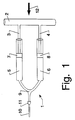
- Figure 1 shows a device for mixing two materials prior to injection into the lacrimal punctum.
- the solution or liquid dispersion of gelling or infusible material(s), the canalicular obstruent of this invention is injectable into either the upper or lower lacrimal punctum or through the respective lacrimal punctum into either the upper or lower canaliculus by using a needle or other means.
- infusible as used in the specification describes a material or ingredient, such as in the form of a solution or dispersion, that can be introduced into a human body cavity, such as the lacrimal canaliculi or punctum, and once contained therein obstrudes or obstructs the body cavity.
- the "infusible" material or ingredient is or becomes an obstacle that blocks or closes up the lacrimal canaliculi or punctum, so that tears cannot pass therethrough.
- gelling as used in this specification describes a material or ingredient that can be in the form of an injectable solution or liquid dispersion and that is not gelled and thus capable of being injected through a needle of appropriate see to fit into the lacrimal punctum; and after injection, the "gelling" material or ingredient forms a gel to obstruct the lacrimal canaliculi or punctum, namely, prevent the passage of tears therethrough.
- collagen When collagen is used in this invention, it can be obtained from the skin, tendon, or other parts of animals, and purified collagen is preferred. Either soluble or insoluble collagen can be used, including acid-soluble collagen, salt-soluble collagen, atelocollagen, alkaline-soluble collagen, chemically-modified collagen (such as succinated, phthalated, acylated and methylated collagens) as soluble collagens, and Achilles tendon collagen, hide collagen, cross-linked collagen as insoluble collagens. The preferred concentration of this solution or liquid dispersion of collagen ranges from 1 mg/ml to 70 mg/ml.
- a neutral solution or liquid dispersion is recommended, although any solution that does not provide eye irritation can be used.
- collagen is used as the gelling material, it is dissolved or dispersed in a physiological acceptable medium, so as to have a pH of from about 6.5 to about 8.0 and an osmolality of from about 230 to about 320 mOsm/KgH2O.
- collagens having the same isoelectric point as the human body such as acid-soluble collagen, salt-soluble collagen, and atelocollagen, occur as a liquid at low temperature under neutral and physiological salt concentration conditions. These collagens, however, gel when heated to near body temperature, enhancing their occluding or blocking effect.
- Additives can be added to the infusible solution or liquid dispersion.
- These additives can include ingredients having high affinity for the body, such as mucopolysaccharides including hyaluronic acid and chondroitin.
- Drugs having antibacterial activity can also be mixed with the infusible solution or liquid dispersion for preventing infection.
- collagen When collagen is used as the infusing ingredient, it is preferred that collagen make up more than 30% by weight of the mixture.
- the eye After infusing the solution or liquid dispersion of the present invention into the lacrimal puncta using a needle for washing of the lacrimal sac or other means, the eye should be closed and kept at rest for a few minutes to obtain an immediate puncta occluding effect.
- a conventional plug may be concurrently used, such as until the infusible solution or dispersion occludes the lacrimal puncta.
- Materials or ingredients other than the collagen discussed above can be used as the infusible material in the form of a solution or liquid dispersion in the same manner as the solution or liquid dispersion of collagen described above.
- the solutions or liquid dispersions containing these other infusible materials should be physiological acceptable mediums along the guidelines for a solution or liquid dispersion of collagen discussed above. It is preferable that these other materials form a gel when injected into the lacrimal punctum.
- Other such infusible materials include gelatin and agarose.
- Gelatin or agarose can be used at a concentration of about 5 to about 300 mg/ml, and such a solution or dispersion thereof can be formulated so as to not gel or fuse at a warm temperature (i.e., about 45° C), but gel or fuse at the body temperature of a human (i.e., about 37° C).
- a solution or liquid dispersion of gelatin or agarose is maintained at a temperature above its gelling point and injected through the lacrimal punctum at this temperature; whereupon after the solution or liquid dispersion is injected and cools down to body temperature, it forms a gel that blocks tear flow.
- the infusible solution or dispersion of the present invention can comprise a mixture of two materials, which themselves may not form a gel, but which form a gel or other obstruent when mixed together.
- a representative of such an infusible mixture is a fibrin sealant.
- a typical fibrin sealant that forms a gel or other obstruent is a mixture prepared by mixing fibrinogen (at a concentration of about 90 mg/ml) and thrombin (at a concentration of about 4 to about 500 IU/ml).
- "IU" represents International Units. An International Unit is an internationally agreed upon standard, as measured by bioassay, to which samples of a substance, such as a drug or hormone, are compared to ascertain their relative potency. The IU for thrombin is well known in the art.
- Two other materials that form a gel when mixed together and can be used in accordance with the present invention are a polysaccharide, such as alginic acid, and a calcium salt solution, such as those containing CaCl2.
- the viscosity or amounts of the polysaccharide and calcium salt are variable based on the molecular weight of the polysaccharide.
- a typical mixture contains polysaccharide in a concentration of about one to about 300 mg/ml and calcium salt in a concentration of about 10 to about 100 mg/ml.
- a device 1 such as shown in Fig. 1 or another device of similar function can be used to mix the materials together, such as just prior to injection.
- the device 1 can include a handle 2 having two arms 3,4 respectively projecting into test tubes or cylindrical-shaped holders 5,6. Each arm 3,4 has a respective plunger 7,8 secured to the end thereof.
- the cylinders or test tubes 5,6 are joined together by a Y-shaped tubular joint 9 that is joined to a needle 10 by a grommet 11.
- the assembly of the handle (2), arms (3,4) and plungers (7,8) can be removed from the test tubes 5,6.
- the assembly of the handle (2), arms (3,4) and plungers (7,8) is then arranged so that the plungers (7,8) respectively hold or confine the two materials in the test tubes (5,6).
- the handle is thereafter pressed in the direction of arrow 12, the two materials are mixed in the Y-shaped tubular joint 9 and the gel, gelling or other obstruent mixture is then ejected from the needle 10 for use, such as for injection into the lacrimal punctum.
- any of these other infusible materials can be used in a mixture with the collagen as described above to form an infusible solution or dispersion in accordance with the present invention.
- a neutral solution of atelocollagen with the physiological salt concentration of Koken Atelocollagen Implant (3% by weight solution of atelocollagen, pH 7.3, 260 mOsm/kgH2O, manufactured by Koken, Co., Ltd, Japan) was injected into the patient's lacrimal puncta using a needle for washing of the lacrimal sac.
- the amount of the solution injected was about 0.1 ml per lacrimal punctum. Following closing the eyes and keeping at rest for about 10 minutes after infusion, the symptoms of dry eye were improved, and this effect persisted for more than 4 weeks.
- the symptoms of dry eye were improved by infusing injectable collagen cross linked with an aqueous polyepoxy compound into the lacrimal puncta following the procedures of Example 1 above.
- the injectable collagen in the form of an aqueous dispersion was obtained by the procedures in Example 1 of U.S. Patent No. 5,314,874, and contained 6% by weight of atelocollagen (60 mg/ml) having an ⁇ -amino group modifying rate of cross linked atelocollagen of 49.2%.
- the results were the same as in Example 1.
- Example 1 The symptoms of dry eye were improved by infusing a 1:1 mixture of atelocollagen and hyaluronic acid into the lacrimal puncta following the procedures of Example 1 above.
- the mixture was prepared by the procedures in Example 1 of U.S. Patent No. 5,137,875, and was an aqueous solution containing atelocollagen and hyaluronic acid each at 1% by weight concentration, and having a pH of 7.3 and an osmolality 260 mOsm/kgH2O.
- the results were the same as in Example 1.
- a solution or liquid dispersion containing gelling or infusible material(s) as the main ingredient(s) is used as a canalicular obstruent.
- This solution or liquid dispersion has advantages in that because it is injected in the form of liquid into the lacrimal canaliculi, unlike the conventional aqueous or nonaqueous plugs that are made of solid material; and after injection, the solution or dispersion forms a gel, a solid substance or is otherwise capable of blocking the flow of tears into the lacrimal canaliculi of the present invention.
- the canalicular obstruent of the present invention is a liquid that occludes itself in the lacrimal canaliculi, and in cases where desired, it is solidified at body temperature and, therefore, has a long-term improvement effect on the symptoms of dry eye without providing any foreign body sensation.
Landscapes
- Health & Medical Sciences (AREA)
- Veterinary Medicine (AREA)
- Life Sciences & Earth Sciences (AREA)
- Animal Behavior & Ethology (AREA)
- General Health & Medical Sciences (AREA)
- Public Health (AREA)
- Surgery (AREA)
- Vascular Medicine (AREA)
- Heart & Thoracic Surgery (AREA)
- Epidemiology (AREA)
- Ophthalmology & Optometry (AREA)
- Chemical & Material Sciences (AREA)
- Engineering & Computer Science (AREA)
- Nuclear Medicine, Radiotherapy & Molecular Imaging (AREA)
- Plastic & Reconstructive Surgery (AREA)
- Dispersion Chemistry (AREA)
- Biomedical Technology (AREA)
- Bioinformatics & Cheminformatics (AREA)
- Chemical Kinetics & Catalysis (AREA)
- General Chemical & Material Sciences (AREA)
- Medicinal Chemistry (AREA)
- Organic Chemistry (AREA)
- Pharmacology & Pharmacy (AREA)
- Medicinal Preparation (AREA)
- Medicines That Contain Protein Lipid Enzymes And Other Medicines (AREA)
- Prostheses (AREA)
- Materials For Medical Uses (AREA)
Applications Claiming Priority (3)
| Application Number | Priority Date | Filing Date | Title |
|---|---|---|---|
| JP143623/94 | 1994-06-24 | ||
| JP14362394 | 1994-06-24 | ||
| JP14362394A JP3486758B2 (ja) | 1994-06-24 | 1994-06-24 | 注入可能な涙小管閉鎖剤 |
Publications (2)
| Publication Number | Publication Date |
|---|---|
| EP0693277A1 true EP0693277A1 (fr) | 1996-01-24 |
| EP0693277B1 EP0693277B1 (fr) | 2001-05-16 |
Family
ID=15343063
Family Applications (1)
| Application Number | Title | Priority Date | Filing Date |
|---|---|---|---|
| EP95109708A Expired - Lifetime EP0693277B1 (fr) | 1994-06-24 | 1995-06-22 | Utilisation d'une solution ou d'une dispersion perfusable pour préparer un médicament pour obstruer des canaux lacrimaux |
Country Status (4)
| Country | Link |
|---|---|
| US (1) | US5840054A (fr) |
| EP (1) | EP0693277B1 (fr) |
| JP (1) | JP3486758B2 (fr) |
| DE (1) | DE69520912T2 (fr) |
Cited By (2)
| Publication number | Priority date | Publication date | Assignee | Title |
|---|---|---|---|---|
| WO2002011783A1 (fr) * | 2000-08-04 | 2002-02-14 | Medennium, Inc. | Obturateur oculaire pour implants d'orifices lacrymaux et intracanaliculaires |
| WO2011104037A3 (fr) * | 2010-02-26 | 2012-04-19 | Kist-Europe Forschungsgesellschaft Mbh | Procédé de fabrication d'une préparation dosable prête à l'application |
Families Citing this family (23)
| Publication number | Priority date | Publication date | Assignee | Title |
|---|---|---|---|---|
| US20050220882A1 (en) * | 2004-03-04 | 2005-10-06 | Wilson Pritchard | Materials for medical implants and occlusive devices |
| US20050197614A1 (en) * | 2004-03-04 | 2005-09-08 | Wilson Pritchard | Occlusive biomedical devices, punctum plugs, and methods of use thereof |
| US20050232972A1 (en) | 2004-04-15 | 2005-10-20 | Steven Odrich | Drug delivery via punctal plug |
| EP1765454B1 (fr) | 2004-07-02 | 2016-04-13 | Mati Therapeutics Inc. | DISPOSITIF DE MISE EN PLACE D'UN MOYEN DE TRAITEMENT POUR l'OEIL |
| US20060020253A1 (en) * | 2004-07-26 | 2006-01-26 | Prescott Anthony D | Implantable device having reservoir with controlled release of medication and method of manufacturing the same |
| US7117870B2 (en) * | 2004-07-26 | 2006-10-10 | Clarity Corporation | Lacrimal insert having reservoir with controlled release of medication and method of manufacturing the same |
| US7223737B1 (en) | 2004-08-13 | 2007-05-29 | Alcon, Inc. | Method of treating dry eye disorders using glycosides |
| WO2007028005A2 (fr) * | 2005-09-01 | 2007-03-08 | Bristol-Myers Squibb Company | Marqueurs biologiques et procedes permettant de determiner la receptivite aux modulateurs du facteur de croissance endotheliale vasculaire 2 (vegfr-2) |
| EP2004172B1 (fr) | 2006-03-31 | 2019-03-13 | Mati Therapeutics Inc. | Structures d'administration de médicaments et compositions utilisées dans le système nasolacrymal |
| WO2007130364A2 (fr) * | 2006-05-01 | 2007-11-15 | Riolan Technologies, Inc. | Compositions, procédés et trousses pour le traitement des yeux secs |
| UY30883A1 (es) | 2007-01-31 | 2008-05-31 | Alcon Res | Tapones punctales y metodos de liberacion de agentes terapeuticos |
| ES2732555T3 (es) | 2007-09-07 | 2019-11-25 | Mati Therapeutics Inc | Implantes lagrimales y métodos relacionados |
| EP2207529B1 (fr) | 2007-09-07 | 2014-12-31 | Mati Therapeutics Inc. | Noyaux de médicament pour une libération soutenue d'agents thérapeutiques |
| US9011361B2 (en) | 2007-09-07 | 2015-04-21 | Mati Therapeutics Inc. | Lacrimal implant detection |
| CA2715489C (fr) * | 2008-02-18 | 2017-09-19 | Qlt Plug Delivery, Inc. | Implants lacrymaux et leur utilisation pour le traitement de troubles de l'oeil |
| WO2009134371A2 (fr) | 2008-04-30 | 2009-11-05 | Qlt Plug Delivery, Inc. | Insert lacrymal composite et procédés apparentés |
| MX2010012022A (es) | 2008-05-09 | 2011-03-15 | Qlt Plug Delivery Inc | Suministro de liberacion sostenida de agentes activos para tratar glaucoma e hipertension ocular. |
| WO2010096822A2 (fr) * | 2009-02-23 | 2010-08-26 | Qlt Plug Delivery, Inc. | Implants lacrymaux et procédés associés |
| US8979821B2 (en) * | 2009-04-14 | 2015-03-17 | Fezza Family Properties, Llc | Lacrimal filler |
| US9974685B2 (en) | 2011-08-29 | 2018-05-22 | Mati Therapeutics | Drug delivery system and methods of treating open angle glaucoma and ocular hypertension |
| ES2727203T3 (es) | 2011-08-29 | 2019-10-14 | Mati Therapeutics Inc | Administración por liberación sostenida de agentes activos para tratar glaucoma e hipertensión ocular |
| CN111065359A (zh) | 2017-06-16 | 2020-04-24 | 埃斯库莱泰克股份有限公司 | 热反应性聚合物及其用途 |
| AU2021453584A1 (en) * | 2021-06-29 | 2024-01-25 | Visant Medical, Inc. | Method and device for irrigation into the lacrimal puncta |
Citations (9)
| Publication number | Priority date | Publication date | Assignee | Title |
|---|---|---|---|---|
| US3949750A (en) | 1974-10-07 | 1976-04-13 | Freeman Jerre M | Punctum plug and method for treating keratoconjunctivitis sicca (dry eye) and other ophthalmic aliments using same |
| JPS6028936A (ja) | 1983-07-27 | 1985-02-14 | Koken:Kk | アテロコラ−ゲン水溶液およびその製造方法 |
| JPS6115559A (ja) | 1984-06-30 | 1986-01-23 | Toshiba Corp | 搬送装置 |
| US4660546A (en) | 1984-11-07 | 1987-04-28 | Robert S. Herrick | Method for treating for deficiency of tears |
| JPH03292953A (ja) | 1990-04-11 | 1991-12-24 | Fr Siderurgie Instr | 涙病理学用細管プラグ |
| US5137875A (en) | 1988-04-19 | 1992-08-11 | Shiseido Co., Ltd. | Hyaluronic acid-containing aqueous solution or aqueous dispersion of collagen |
| JPH04364856A (ja) | 1991-06-11 | 1992-12-17 | Asahi Chem Ind Co Ltd | 涙液せき止め用ロッド |
| WO1994005342A1 (fr) * | 1992-09-02 | 1994-03-17 | Landec Corporation | Occlusion de canaux chez les mammiferes vivants |
| US5314874A (en) | 1991-04-19 | 1994-05-24 | Koken Co., Ltd. | Intracorporeally injectable composition for implanting highly concentrated cross-linked atelocollagen |
Family Cites Families (11)
| Publication number | Priority date | Publication date | Assignee | Title |
|---|---|---|---|---|
| US4242291A (en) * | 1979-05-09 | 1980-12-30 | Battelle Development Corporation | Collagen reconstitution |
| US4424208A (en) * | 1982-01-11 | 1984-01-03 | Collagen Corporation | Collagen implant material and method for augmenting soft tissue |
| EP0089145B1 (fr) * | 1982-03-08 | 1987-06-16 | Collagen Corporation | Matériau pour implant à base de collagène réticulé injectable |
| US4837285A (en) * | 1984-03-27 | 1989-06-06 | Medimatrix | Collagen matrix beads for soft tissue repair |
| US4642117A (en) * | 1985-03-22 | 1987-02-10 | Collagen Corporation | Mechanically sheared collagen implant material and method |
| US4803075A (en) * | 1986-06-25 | 1989-02-07 | Collagen Corporation | Injectable implant composition having improved intrudability |
| JPH0712375B2 (ja) * | 1986-11-17 | 1995-02-15 | 株式会社高研 | 移植組成物及びその製造方法 |
| US4915684A (en) * | 1988-06-21 | 1990-04-10 | Mackeen Donald L | Method and apparatus for modulating the flow of lacrimal fluid through a punctum and associated canaliculus |
| US4959048A (en) * | 1989-01-17 | 1990-09-25 | Helix Medical, Inc. | Lacrimal duct occluder |
| US5163959A (en) * | 1990-03-29 | 1992-11-17 | Herrick Robert S | Method for treating an eye with a canalicular implant having a collapsible flared section |
| US5283063A (en) * | 1992-01-31 | 1994-02-01 | Eagle Vision | Punctum plug method and apparatus |
-
1994
- 1994-06-24 JP JP14362394A patent/JP3486758B2/ja not_active Expired - Lifetime
-
1995
- 1995-06-21 US US08/493,282 patent/US5840054A/en not_active Expired - Lifetime
- 1995-06-22 DE DE69520912T patent/DE69520912T2/de not_active Expired - Lifetime
- 1995-06-22 EP EP95109708A patent/EP0693277B1/fr not_active Expired - Lifetime
Patent Citations (9)
| Publication number | Priority date | Publication date | Assignee | Title |
|---|---|---|---|---|
| US3949750A (en) | 1974-10-07 | 1976-04-13 | Freeman Jerre M | Punctum plug and method for treating keratoconjunctivitis sicca (dry eye) and other ophthalmic aliments using same |
| JPS6028936A (ja) | 1983-07-27 | 1985-02-14 | Koken:Kk | アテロコラ−ゲン水溶液およびその製造方法 |
| JPS6115559A (ja) | 1984-06-30 | 1986-01-23 | Toshiba Corp | 搬送装置 |
| US4660546A (en) | 1984-11-07 | 1987-04-28 | Robert S. Herrick | Method for treating for deficiency of tears |
| US5137875A (en) | 1988-04-19 | 1992-08-11 | Shiseido Co., Ltd. | Hyaluronic acid-containing aqueous solution or aqueous dispersion of collagen |
| JPH03292953A (ja) | 1990-04-11 | 1991-12-24 | Fr Siderurgie Instr | 涙病理学用細管プラグ |
| US5314874A (en) | 1991-04-19 | 1994-05-24 | Koken Co., Ltd. | Intracorporeally injectable composition for implanting highly concentrated cross-linked atelocollagen |
| JPH04364856A (ja) | 1991-06-11 | 1992-12-17 | Asahi Chem Ind Co Ltd | 涙液せき止め用ロッド |
| WO1994005342A1 (fr) * | 1992-09-02 | 1994-03-17 | Landec Corporation | Occlusion de canaux chez les mammiferes vivants |
Non-Patent Citations (1)
| Title |
|---|
| W.S. FOULDS: "INTRACANALICULAR GELATIN IMPLANTS IN THR TREATMENT OF KERATO-CONJUNCTIVITIS SICCA", BRITISH J. OPHTHALMOLOGY, vol. 45, no. 9, September 1961 (1961-09-01), LONDON U.K., pages 625 - 627 * |
Cited By (2)
| Publication number | Priority date | Publication date | Assignee | Title |
|---|---|---|---|---|
| WO2002011783A1 (fr) * | 2000-08-04 | 2002-02-14 | Medennium, Inc. | Obturateur oculaire pour implants d'orifices lacrymaux et intracanaliculaires |
| WO2011104037A3 (fr) * | 2010-02-26 | 2012-04-19 | Kist-Europe Forschungsgesellschaft Mbh | Procédé de fabrication d'une préparation dosable prête à l'application |
Also Published As
| Publication number | Publication date |
|---|---|
| EP0693277B1 (fr) | 2001-05-16 |
| DE69520912T2 (de) | 2001-10-25 |
| DE69520912D1 (de) | 2001-06-21 |
| US5840054A (en) | 1998-11-24 |
| JP3486758B2 (ja) | 2004-01-13 |
| JPH0812592A (ja) | 1996-01-16 |
Similar Documents
| Publication | Publication Date | Title |
|---|---|---|
| US5840054A (en) | Method for obstructing lacrimal canaliculi with infusable solution or dispersion | |
| US5171270A (en) | Canalicular implant having a collapsible flared section and method | |
| US5163959A (en) | Method for treating an eye with a canalicular implant having a collapsible flared section | |
| US6290684B1 (en) | Punctum plug having a collapsible expanded section and distal tip extending substantially perpendicular thereto and method of inserting same | |
| US5723005A (en) | Punctum plug having a collapsible flared section and method | |
| US7404825B2 (en) | Implant capable of forming a differential image in an eye | |
| US6149684A (en) | Punctum plug having a thin elongated lip and a distal starting tip and method of using | |
| US20050277864A1 (en) | Injectable gel implant for glaucoma treatment | |
| US5462739A (en) | Microdelivery device and method for enhanced drug administration to the eye | |
| US11400044B2 (en) | Thermoresponsive polymers and uses thereof | |
| US6428502B1 (en) | Punctal cannula | |
| US5527356A (en) | Retinal plug | |
| EP0181165A2 (fr) | Implant intracanaliculaire pour el traitement de l'oeil par blocage canaliculaire horizontal | |
| EP0988844A2 (fr) | Appareil d'intubation du canal lacrimal | |
| JP2009531298A (ja) | 脈絡膜上薬物送達のための装置および製剤 | |
| RU2398566C2 (ru) | Применение вязкоупругой композиции по новому назначению | |
| JP2011092765A (ja) | 治療薬を含有する眼のインプラント | |
| Maurice | Iontophoresis of fluorescein into the posterior segment of the rabbit eye | |
| WO1999044553A1 (fr) | Obturateur du punctum lacrimale pourvu d'une section en forme de tromblon et susceptible de s'aplatir | |
| CA2124011A1 (fr) | Dispositif de micro-liberation pour l'administration amelioree de medicaments aux yeux | |
| RU2095040C1 (ru) | Устройство для восстановления слезно-носового протока | |
| US20220331157A1 (en) | Thermoresponsive polymers and uses thereof | |
| EP4149400B1 (fr) | Méthodes et compositions permettant de réduire la pression intraoculaire | |
| JPH0920651A (ja) | 注入可能な涙小管閉鎖剤 | |
| Schepens | Vitreous substitutes and vitreous surgery |
Legal Events
| Date | Code | Title | Description |
|---|---|---|---|
| PUAI | Public reference made under article 153(3) epc to a published international application that has entered the european phase |
Free format text: ORIGINAL CODE: 0009012 |
|
| AK | Designated contracting states |
Kind code of ref document: A1 Designated state(s): DE FR GB IT NL |
|
| 17P | Request for examination filed |
Effective date: 19960621 |
|
| 17Q | First examination report despatched |
Effective date: 19990128 |
|
| RTI1 | Title (correction) |
Free format text: USE OF A SOLUTION OR LIQUID DISPERSION FOR THE MANUFACTURE OF A MEDICAMENT FOR OCCLUDING A LACRIMAL CANALICULI |
|
| RTI1 | Title (correction) |
Free format text: USE OF A SOLUTION OR LIQUID DISPERSION FOR THE MANUFACTURE OF A MEDICAMENT FOR OCCLUDING A LACRIMAL CANALICULI |
|
| GRAG | Despatch of communication of intention to grant |
Free format text: ORIGINAL CODE: EPIDOS AGRA |
|
| GRAG | Despatch of communication of intention to grant |
Free format text: ORIGINAL CODE: EPIDOS AGRA |
|
| GRAH | Despatch of communication of intention to grant a patent |
Free format text: ORIGINAL CODE: EPIDOS IGRA |
|
| GRAH | Despatch of communication of intention to grant a patent |
Free format text: ORIGINAL CODE: EPIDOS IGRA |
|
| GRAA | (expected) grant |
Free format text: ORIGINAL CODE: 0009210 |
|
| ITF | It: translation for a ep patent filed | ||
| AK | Designated contracting states |
Kind code of ref document: B1 Designated state(s): DE FR GB IT NL |
|
| REF | Corresponds to: |
Ref document number: 69520912 Country of ref document: DE Date of ref document: 20010621 |
|
| ET | Fr: translation filed | ||
| REG | Reference to a national code |
Ref country code: GB Ref legal event code: IF02 |
|
| PLBE | No opposition filed within time limit |
Free format text: ORIGINAL CODE: 0009261 |
|
| STAA | Information on the status of an ep patent application or granted ep patent |
Free format text: STATUS: NO OPPOSITION FILED WITHIN TIME LIMIT |
|
| 26N | No opposition filed | ||
| PGFP | Annual fee paid to national office [announced via postgrant information from national office to epo] |
Ref country code: FR Payment date: 20100709 Year of fee payment: 16 |
|
| PGFP | Annual fee paid to national office [announced via postgrant information from national office to epo] |
Ref country code: IT Payment date: 20100618 Year of fee payment: 16 |
|
| PGFP | Annual fee paid to national office [announced via postgrant information from national office to epo] |
Ref country code: NL Payment date: 20100603 Year of fee payment: 16 |
|
| PGFP | Annual fee paid to national office [announced via postgrant information from national office to epo] |
Ref country code: GB Payment date: 20100616 Year of fee payment: 16 Ref country code: DE Payment date: 20100616 Year of fee payment: 16 |
|
| REG | Reference to a national code |
Ref country code: NL Ref legal event code: V1 Effective date: 20120101 |
|
| GBPC | Gb: european patent ceased through non-payment of renewal fee |
Effective date: 20110622 |
|
| PG25 | Lapsed in a contracting state [announced via postgrant information from national office to epo] |
Ref country code: IT Free format text: LAPSE BECAUSE OF NON-PAYMENT OF DUE FEES Effective date: 20110622 |
|
| REG | Reference to a national code |
Ref country code: FR Ref legal event code: ST Effective date: 20120229 |
|
| REG | Reference to a national code |
Ref country code: DE Ref legal event code: R119 Ref document number: 69520912 Country of ref document: DE Effective date: 20120103 |
|
| PG25 | Lapsed in a contracting state [announced via postgrant information from national office to epo] |
Ref country code: FR Free format text: LAPSE BECAUSE OF NON-PAYMENT OF DUE FEES Effective date: 20110630 Ref country code: DE Free format text: LAPSE BECAUSE OF NON-PAYMENT OF DUE FEES Effective date: 20120103 |
|
| PG25 | Lapsed in a contracting state [announced via postgrant information from national office to epo] |
Ref country code: NL Free format text: LAPSE BECAUSE OF NON-PAYMENT OF DUE FEES Effective date: 20120101 |
|
| PG25 | Lapsed in a contracting state [announced via postgrant information from national office to epo] |
Ref country code: GB Free format text: LAPSE BECAUSE OF NON-PAYMENT OF DUE FEES Effective date: 20110622 |