EP0694532B1 - Perfluoroalkylsulfid-,-sulfon-, -polysulfon- und -polysulfiddiole - Google Patents
Perfluoroalkylsulfid-,-sulfon-, -polysulfon- und -polysulfiddiole Download PDFInfo
- Publication number
- EP0694532B1 EP0694532B1 EP95810423A EP95810423A EP0694532B1 EP 0694532 B1 EP0694532 B1 EP 0694532B1 EP 95810423 A EP95810423 A EP 95810423A EP 95810423 A EP95810423 A EP 95810423A EP 0694532 B1 EP0694532 B1 EP 0694532B1
- Authority
- EP
- European Patent Office
- Prior art keywords
- carbon atoms
- diisocyanate
- hydrogen
- group
- methyl
- Prior art date
- Legal status (The legal status is an assumption and is not a legal conclusion. Google has not performed a legal analysis and makes no representation as to the accuracy of the status listed.)
- Expired - Lifetime
Links
- -1 Perfluoroalkyl sulfide Chemical compound 0.000 title claims description 43
- 150000002009 diols Chemical class 0.000 title claims description 36
- 150000008117 polysulfides Polymers 0.000 title description 6
- 150000003457 sulfones Chemical class 0.000 title description 6
- 229920001021 polysulfide Polymers 0.000 title description 5
- 239000005077 polysulfide Substances 0.000 title description 5
- 229920002492 poly(sulfone) Polymers 0.000 title description 3
- 125000004432 carbon atom Chemical group C* 0.000 claims description 117
- 239000001257 hydrogen Substances 0.000 claims description 88
- 229910052739 hydrogen Inorganic materials 0.000 claims description 88
- UFHFLCQGNIYNRP-UHFFFAOYSA-N Hydrogen Chemical compound [H][H] UFHFLCQGNIYNRP-UHFFFAOYSA-N 0.000 claims description 55
- XLYOFNOQVPJJNP-UHFFFAOYSA-N water Substances O XLYOFNOQVPJJNP-UHFFFAOYSA-N 0.000 claims description 40
- 229910001868 water Inorganic materials 0.000 claims description 33
- 238000006243 chemical reaction Methods 0.000 claims description 31
- 125000002496 methyl group Chemical group [H]C([H])([H])* 0.000 claims description 31
- 239000000203 mixture Substances 0.000 claims description 31
- LFQSCWFLJHTTHZ-UHFFFAOYSA-N Ethanol Chemical compound CCO LFQSCWFLJHTTHZ-UHFFFAOYSA-N 0.000 claims description 28
- 125000000217 alkyl group Chemical group 0.000 claims description 28
- 125000002947 alkylene group Chemical group 0.000 claims description 28
- 239000004814 polyurethane Substances 0.000 claims description 27
- 229920002635 polyurethane Polymers 0.000 claims description 27
- XXROGKLTLUQVRX-UHFFFAOYSA-N allyl alcohol Chemical compound OCC=C XXROGKLTLUQVRX-UHFFFAOYSA-N 0.000 claims description 26
- 150000001875 compounds Chemical class 0.000 claims description 24
- 125000005442 diisocyanate group Chemical group 0.000 claims description 22
- CSCPPACGZOOCGX-UHFFFAOYSA-N Acetone Chemical compound CC(C)=O CSCPPACGZOOCGX-UHFFFAOYSA-N 0.000 claims description 21
- 150000003254 radicals Chemical class 0.000 claims description 20
- 150000002431 hydrogen Chemical class 0.000 claims description 19
- UFWIBTONFRDIAS-UHFFFAOYSA-N Naphthalene Chemical compound C1=CC=CC2=CC=CC=C21 UFWIBTONFRDIAS-UHFFFAOYSA-N 0.000 claims description 18
- 229920006395 saturated elastomer Polymers 0.000 claims description 18
- 125000002023 trifluoromethyl group Chemical group FC(F)(F)* 0.000 claims description 18
- BDERNNFJNOPAEC-UHFFFAOYSA-N propan-1-ol Chemical compound CCCO BDERNNFJNOPAEC-UHFFFAOYSA-N 0.000 claims description 17
- 238000000034 method Methods 0.000 claims description 16
- XNLICIUVMPYHGG-UHFFFAOYSA-N pentan-2-one Chemical compound CCCC(C)=O XNLICIUVMPYHGG-UHFFFAOYSA-N 0.000 claims description 16
- 125000004178 (C1-C4) alkyl group Chemical group 0.000 claims description 15
- 229910019142 PO4 Inorganic materials 0.000 claims description 14
- 239000002253 acid Substances 0.000 claims description 14
- 125000004435 hydrogen atom Chemical group [H]* 0.000 claims description 14
- 235000021317 phosphate Nutrition 0.000 claims description 14
- 150000002148 esters Chemical class 0.000 claims description 13
- IJGRMHOSHXDMSA-UHFFFAOYSA-N nitrogen Substances N#N IJGRMHOSHXDMSA-UHFFFAOYSA-N 0.000 claims description 13
- 125000005010 perfluoroalkyl group Chemical group 0.000 claims description 13
- ZWEHNKRNPOVVGH-UHFFFAOYSA-N 2-Butanone Chemical compound CCC(C)=O ZWEHNKRNPOVVGH-UHFFFAOYSA-N 0.000 claims description 12
- 125000000732 arylene group Chemical group 0.000 claims description 12
- 229910052731 fluorine Inorganic materials 0.000 claims description 11
- YCKRFDGAMUMZLT-UHFFFAOYSA-N Fluorine atom Chemical compound [F] YCKRFDGAMUMZLT-UHFFFAOYSA-N 0.000 claims description 10
- 239000011737 fluorine Substances 0.000 claims description 10
- 229910052757 nitrogen Inorganic materials 0.000 claims description 10
- 229920000728 polyester Polymers 0.000 claims description 10
- 239000000758 substrate Substances 0.000 claims description 10
- XEKOWRVHYACXOJ-UHFFFAOYSA-N Ethyl acetate Chemical compound CCOC(C)=O XEKOWRVHYACXOJ-UHFFFAOYSA-N 0.000 claims description 9
- 125000003178 carboxy group Chemical group [H]OC(*)=O 0.000 claims description 9
- JMMWKPVZQRWMSS-UHFFFAOYSA-N isopropanol acetate Natural products CC(C)OC(C)=O JMMWKPVZQRWMSS-UHFFFAOYSA-N 0.000 claims description 9
- 229940011051 isopropyl acetate Drugs 0.000 claims description 9
- GWYFCOCPABKNJV-UHFFFAOYSA-N isovaleric acid Chemical compound CC(C)CC(O)=O GWYFCOCPABKNJV-UHFFFAOYSA-N 0.000 claims description 9
- 238000002360 preparation method Methods 0.000 claims description 9
- CEKVYFNTUVJDAG-UHFFFAOYSA-N [2,2-bis(hydroxymethyl)-3-propanoyloxypropyl] propanoate Chemical compound CCC(=O)OCC(CO)(CO)COC(=O)CC CEKVYFNTUVJDAG-UHFFFAOYSA-N 0.000 claims description 8
- SMWVKLFSRAUNLB-UHFFFAOYSA-N [2-(acetyloxymethyl)-3-hydroxy-2-(hydroxymethyl)propyl] acetate Chemical compound CC(=O)OCC(CO)(CO)COC(C)=O SMWVKLFSRAUNLB-UHFFFAOYSA-N 0.000 claims description 8
- 150000003863 ammonium salts Chemical class 0.000 claims description 8
- 150000003467 sulfuric acid derivatives Chemical class 0.000 claims description 8
- OFOBLEOULBTSOW-UHFFFAOYSA-N Malonic acid Chemical compound OC(=O)CC(O)=O OFOBLEOULBTSOW-UHFFFAOYSA-N 0.000 claims description 7
- UCKMPCXJQFINFW-UHFFFAOYSA-N Sulphide Chemical compound [S-2] UCKMPCXJQFINFW-UHFFFAOYSA-N 0.000 claims description 7
- 239000007795 chemical reaction product Substances 0.000 claims description 7
- 239000000539 dimer Substances 0.000 claims description 7
- 239000010452 phosphate Substances 0.000 claims description 7
- 150000003013 phosphoric acid derivatives Chemical class 0.000 claims description 7
- KDYFGRWQOYBRFD-UHFFFAOYSA-N succinic acid Chemical compound OC(=O)CCC(O)=O KDYFGRWQOYBRFD-UHFFFAOYSA-N 0.000 claims description 7
- QGZKDVFQNNGYKY-UHFFFAOYSA-O Ammonium Chemical compound [NH4+] QGZKDVFQNNGYKY-UHFFFAOYSA-O 0.000 claims description 6
- WKBOTKDWSSQWDR-UHFFFAOYSA-N Bromine atom Chemical group [Br] WKBOTKDWSSQWDR-UHFFFAOYSA-N 0.000 claims description 6
- ZAMOUSCENKQFHK-UHFFFAOYSA-N Chlorine atom Chemical group [Cl] ZAMOUSCENKQFHK-UHFFFAOYSA-N 0.000 claims description 6
- KFZMGEQAYNKOFK-UHFFFAOYSA-N Isopropanol Chemical compound CC(C)O KFZMGEQAYNKOFK-UHFFFAOYSA-N 0.000 claims description 6
- NINIDFKCEFEMDL-UHFFFAOYSA-N Sulfur Chemical compound [S] NINIDFKCEFEMDL-UHFFFAOYSA-N 0.000 claims description 6
- WNLRTRBMVRJNCN-UHFFFAOYSA-N adipic acid Chemical compound OC(=O)CCCCC(O)=O WNLRTRBMVRJNCN-UHFFFAOYSA-N 0.000 claims description 6
- 229910052783 alkali metal Inorganic materials 0.000 claims description 6
- GDTBXPJZTBHREO-UHFFFAOYSA-N bromine Chemical group BrBr GDTBXPJZTBHREO-UHFFFAOYSA-N 0.000 claims description 6
- 229910052794 bromium Chemical group 0.000 claims description 6
- 239000000460 chlorine Chemical group 0.000 claims description 6
- 229910052801 chlorine Inorganic materials 0.000 claims description 6
- ZLCCLBKPLLUIJC-UHFFFAOYSA-L disodium tetrasulfane-1,4-diide Chemical compound [Na+].[Na+].[S-]SS[S-] ZLCCLBKPLLUIJC-UHFFFAOYSA-L 0.000 claims description 6
- VZCYOOQTPOCHFL-UPHRSURJSA-N maleic acid Chemical compound OC(=O)\C=C/C(O)=O VZCYOOQTPOCHFL-UPHRSURJSA-N 0.000 claims description 6
- VNWKTOKETHGBQD-UHFFFAOYSA-N methane Chemical compound C VNWKTOKETHGBQD-UHFFFAOYSA-N 0.000 claims description 6
- HFVMEOPYDLEHBR-UHFFFAOYSA-N (2-fluorophenyl)-phenylmethanol Chemical compound C=1C=CC=C(F)C=1C(O)C1=CC=CC=C1 HFVMEOPYDLEHBR-UHFFFAOYSA-N 0.000 claims description 5
- 229940008841 1,6-hexamethylene diisocyanate Drugs 0.000 claims description 5
- 239000005058 Isophorone diisocyanate Substances 0.000 claims description 5
- QAOWNCQODCNURD-UHFFFAOYSA-L Sulfate Chemical compound [O-]S([O-])(=O)=O QAOWNCQODCNURD-UHFFFAOYSA-L 0.000 claims description 5
- KKEYFWRCBNTPAC-UHFFFAOYSA-N Terephthalic acid Chemical compound OC(=O)C1=CC=C(C(O)=O)C=C1 KKEYFWRCBNTPAC-UHFFFAOYSA-N 0.000 claims description 5
- 150000005690 diesters Chemical class 0.000 claims description 5
- VDQVEACBQKUUSU-UHFFFAOYSA-M disodium;sulfanide Chemical compound [Na+].[Na+].[SH-] VDQVEACBQKUUSU-UHFFFAOYSA-M 0.000 claims description 5
- 150000004662 dithiols Chemical class 0.000 claims description 5
- RRAMGCGOFNQTLD-UHFFFAOYSA-N hexamethylene diisocyanate Chemical compound O=C=NCCCCCCN=C=O RRAMGCGOFNQTLD-UHFFFAOYSA-N 0.000 claims description 5
- 229930195733 hydrocarbon Natural products 0.000 claims description 5
- 239000012948 isocyanate Substances 0.000 claims description 5
- 150000002513 isocyanates Chemical class 0.000 claims description 5
- NIMLQBUJDJZYEJ-UHFFFAOYSA-N isophorone diisocyanate Chemical compound CC1(C)CC(N=C=O)CC(C)(CN=C=O)C1 NIMLQBUJDJZYEJ-UHFFFAOYSA-N 0.000 claims description 5
- NBIIXXVUZAFLBC-UHFFFAOYSA-K phosphate Chemical compound [O-]P([O-])([O-])=O NBIIXXVUZAFLBC-UHFFFAOYSA-K 0.000 claims description 5
- HYHCSLBZRBJJCH-UHFFFAOYSA-M sodium hydrosulfide Chemical compound [Na+].[SH-] HYHCSLBZRBJJCH-UHFFFAOYSA-M 0.000 claims description 5
- 229910052979 sodium sulfide Inorganic materials 0.000 claims description 5
- 239000001384 succinic acid Substances 0.000 claims description 5
- 150000003673 urethanes Chemical class 0.000 claims description 5
- UPMLOUAZCHDJJD-UHFFFAOYSA-N 4,4'-Diphenylmethane Diisocyanate Chemical compound C1=CC(N=C=O)=CC=C1CC1=CC=C(N=C=O)C=C1 UPMLOUAZCHDJJD-UHFFFAOYSA-N 0.000 claims description 4
- QTBSBXVTEAMEQO-UHFFFAOYSA-N Acetic acid Chemical compound CC(O)=O QTBSBXVTEAMEQO-UHFFFAOYSA-N 0.000 claims description 4
- 239000004215 Carbon black (E152) Substances 0.000 claims description 4
- CERQOIWHTDAKMF-UHFFFAOYSA-M Methacrylate Chemical compound CC(=C)C([O-])=O CERQOIWHTDAKMF-UHFFFAOYSA-M 0.000 claims description 4
- LRHPLDYGYMQRHN-UHFFFAOYSA-N N-Butanol Chemical compound CCCCO LRHPLDYGYMQRHN-UHFFFAOYSA-N 0.000 claims description 4
- 125000001931 aliphatic group Chemical group 0.000 claims description 4
- 125000003342 alkenyl group Chemical group 0.000 claims description 4
- 125000005529 alkyleneoxy group Chemical group 0.000 claims description 4
- 125000004122 cyclic group Chemical group 0.000 claims description 4
- 125000001033 ether group Chemical group 0.000 claims description 4
- XMBWDFGMSWQBCA-UHFFFAOYSA-N hydrogen iodide Chemical compound I XMBWDFGMSWQBCA-UHFFFAOYSA-N 0.000 claims description 4
- 125000004356 hydroxy functional group Chemical group O* 0.000 claims description 4
- 150000002576 ketones Chemical group 0.000 claims description 4
- 239000011976 maleic acid Substances 0.000 claims description 4
- 239000003960 organic solvent Substances 0.000 claims description 4
- DGTNSSLYPYDJGL-UHFFFAOYSA-N phenyl isocyanate Chemical compound O=C=NC1=CC=CC=C1 DGTNSSLYPYDJGL-UHFFFAOYSA-N 0.000 claims description 4
- XNGIFLGASWRNHJ-UHFFFAOYSA-N phthalic acid Chemical compound OC(=O)C1=CC=CC=C1C(O)=O XNGIFLGASWRNHJ-UHFFFAOYSA-N 0.000 claims description 4
- 125000004434 sulfur atom Chemical group 0.000 claims description 4
- 150000003573 thiols Chemical class 0.000 claims description 4
- DVKJHBMWWAPEIU-UHFFFAOYSA-N toluene 2,4-diisocyanate Chemical compound CC1=CC=C(N=C=O)C=C1N=C=O DVKJHBMWWAPEIU-UHFFFAOYSA-N 0.000 claims description 4
- VZCYOOQTPOCHFL-UHFFFAOYSA-N trans-butenedioic acid Natural products OC(=O)C=CC(O)=O VZCYOOQTPOCHFL-UHFFFAOYSA-N 0.000 claims description 4
- RTTZISZSHSCFRH-UHFFFAOYSA-N 1,3-bis(isocyanatomethyl)benzene Chemical compound O=C=NCC1=CC=CC(CN=C=O)=C1 RTTZISZSHSCFRH-UHFFFAOYSA-N 0.000 claims description 3
- VGHSXKTVMPXHNG-UHFFFAOYSA-N 1,3-diisocyanatobenzene Chemical compound O=C=NC1=CC=CC(N=C=O)=C1 VGHSXKTVMPXHNG-UHFFFAOYSA-N 0.000 claims description 3
- ALQLPWJFHRMHIU-UHFFFAOYSA-N 1,4-diisocyanatobenzene Chemical compound O=C=NC1=CC=C(N=C=O)C=C1 ALQLPWJFHRMHIU-UHFFFAOYSA-N 0.000 claims description 3
- CDMDQYCEEKCBGR-UHFFFAOYSA-N 1,4-diisocyanatocyclohexane Chemical compound O=C=NC1CCC(N=C=O)CC1 CDMDQYCEEKCBGR-UHFFFAOYSA-N 0.000 claims description 3
- SBJCUZQNHOLYMD-UHFFFAOYSA-N 1,5-Naphthalene diisocyanate Chemical compound C1=CC=C2C(N=C=O)=CC=CC2=C1N=C=O SBJCUZQNHOLYMD-UHFFFAOYSA-N 0.000 claims description 3
- DFPJRUKWEPYFJT-UHFFFAOYSA-N 1,5-diisocyanatopentane Chemical compound O=C=NCCCCCN=C=O DFPJRUKWEPYFJT-UHFFFAOYSA-N 0.000 claims description 3
- QGLRLXLDMZCFBP-UHFFFAOYSA-N 1,6-diisocyanato-2,4,4-trimethylhexane Chemical compound O=C=NCC(C)CC(C)(C)CCN=C=O QGLRLXLDMZCFBP-UHFFFAOYSA-N 0.000 claims description 3
- SZBXTBGNJLZMHB-UHFFFAOYSA-N 1-chloro-2,4-diisocyanatobenzene Chemical compound ClC1=CC=C(N=C=O)C=C1N=C=O SZBXTBGNJLZMHB-UHFFFAOYSA-N 0.000 claims description 3
- KDLIYVDINLSKGR-UHFFFAOYSA-N 1-isocyanato-4-(4-isocyanatophenoxy)benzene Chemical compound C1=CC(N=C=O)=CC=C1OC1=CC=C(N=C=O)C=C1 KDLIYVDINLSKGR-UHFFFAOYSA-N 0.000 claims description 3
- QZWKEPYTBWZJJA-UHFFFAOYSA-N 3,3'-Dimethoxybenzidine-4,4'-diisocyanate Chemical compound C1=C(N=C=O)C(OC)=CC(C=2C=C(OC)C(N=C=O)=CC=2)=C1 QZWKEPYTBWZJJA-UHFFFAOYSA-N 0.000 claims description 3
- CPELXLSAUQHCOX-UHFFFAOYSA-M Bromide Chemical compound [Br-] CPELXLSAUQHCOX-UHFFFAOYSA-M 0.000 claims description 3
- DKGAVHZHDRPRBM-UHFFFAOYSA-N Tert-Butanol Chemical compound CC(C)(C)O DKGAVHZHDRPRBM-UHFFFAOYSA-N 0.000 claims description 3
- 239000001361 adipic acid Substances 0.000 claims description 3
- 235000011037 adipic acid Nutrition 0.000 claims description 3
- 125000003118 aryl group Chemical group 0.000 claims description 3
- QVGXLLKOCUKJST-UHFFFAOYSA-N atomic oxygen Chemical compound [O] QVGXLLKOCUKJST-UHFFFAOYSA-N 0.000 claims description 3
- VBIAXKVXACZQFW-OWOJBTEDSA-N bis(2-isocyanatoethyl) (e)-but-2-enedioate Chemical compound O=C=NCCOC(=O)\C=C\C(=O)OCCN=C=O VBIAXKVXACZQFW-OWOJBTEDSA-N 0.000 claims description 3
- DZYFUUQMKQBVBY-UHFFFAOYSA-N bis(2-isocyanatoethyl) carbonate Chemical compound O=C=NCCOC(=O)OCCN=C=O DZYFUUQMKQBVBY-UHFFFAOYSA-N 0.000 claims description 3
- BTANRVKWQNVYAZ-UHFFFAOYSA-N butan-2-ol Chemical compound CCC(C)O BTANRVKWQNVYAZ-UHFFFAOYSA-N 0.000 claims description 3
- KORSJDCBLAPZEQ-UHFFFAOYSA-N dicyclohexylmethane-4,4'-diisocyanate Chemical compound C1CC(N=C=O)CCC1CC1CCC(N=C=O)CC1 KORSJDCBLAPZEQ-UHFFFAOYSA-N 0.000 claims description 3
- 235000014113 dietary fatty acids Nutrition 0.000 claims description 3
- 125000004185 ester group Chemical group 0.000 claims description 3
- 239000000194 fatty acid Substances 0.000 claims description 3
- 229930195729 fatty acid Natural products 0.000 claims description 3
- 150000004665 fatty acids Chemical class 0.000 claims description 3
- 239000007800 oxidant agent Substances 0.000 claims description 3
- 239000001301 oxygen Substances 0.000 claims description 3
- 229910052760 oxygen Inorganic materials 0.000 claims description 3
- KOODSCBKXPPKHE-UHFFFAOYSA-N propanethioic s-acid Chemical compound CCC(S)=O KOODSCBKXPPKHE-UHFFFAOYSA-N 0.000 claims description 3
- SMZOUWXMTYCWNB-UHFFFAOYSA-N 2-(2-methoxy-5-methylphenyl)ethanamine Chemical compound COC1=CC=C(C)C=C1CCN SMZOUWXMTYCWNB-UHFFFAOYSA-N 0.000 claims description 2
- JAHNSTQSQJOJLO-UHFFFAOYSA-N 2-(3-fluorophenyl)-1h-imidazole Chemical compound FC1=CC=CC(C=2NC=CN=2)=C1 JAHNSTQSQJOJLO-UHFFFAOYSA-N 0.000 claims description 2
- QISOBCMNUJQOJU-UHFFFAOYSA-N 4-bromo-1h-pyrazole-5-carboxylic acid Chemical compound OC(=O)C=1NN=CC=1Br QISOBCMNUJQOJU-UHFFFAOYSA-N 0.000 claims description 2
- FJKROLUGYXJWQN-UHFFFAOYSA-N 4-hydroxybenzoic acid Chemical compound OC(=O)C1=CC=C(O)C=C1 FJKROLUGYXJWQN-UHFFFAOYSA-N 0.000 claims description 2
- QPHPUQJVKQXISS-UHFFFAOYSA-N 4-oxo-4-sulfanylbutanoic acid Chemical compound OC(=O)CCC(S)=O QPHPUQJVKQXISS-UHFFFAOYSA-N 0.000 claims description 2
- PXRKCOCTEMYUEG-UHFFFAOYSA-N 5-aminoisoindole-1,3-dione Chemical compound NC1=CC=C2C(=O)NC(=O)C2=C1 PXRKCOCTEMYUEG-UHFFFAOYSA-N 0.000 claims description 2
- JOYRKODLDBILNP-UHFFFAOYSA-N Ethyl urethane Chemical compound CCOC(N)=O JOYRKODLDBILNP-UHFFFAOYSA-N 0.000 claims description 2
- CERQOIWHTDAKMF-UHFFFAOYSA-N Methacrylic acid Chemical compound CC(=C)C(O)=O CERQOIWHTDAKMF-UHFFFAOYSA-N 0.000 claims description 2
- WPYMKLBDIGXBTP-UHFFFAOYSA-N benzoic acid Chemical compound OC(=O)C1=CC=CC=C1 WPYMKLBDIGXBTP-UHFFFAOYSA-N 0.000 claims description 2
- 125000003700 epoxy group Chemical group 0.000 claims description 2
- KOUKXHPPRFNWPP-UHFFFAOYSA-N pyrazine-2,5-dicarboxylic acid;hydrate Chemical compound O.OC(=O)C1=CN=C(C(O)=O)C=N1 KOUKXHPPRFNWPP-UHFFFAOYSA-N 0.000 claims description 2
- 125000006527 (C1-C5) alkyl group Chemical group 0.000 claims 4
- 150000002118 epoxides Chemical class 0.000 claims 2
- 125000003837 (C1-C20) alkyl group Chemical group 0.000 claims 1
- ZCYVEMRRCGMTRW-UHFFFAOYSA-N 7553-56-2 Chemical compound [I] ZCYVEMRRCGMTRW-UHFFFAOYSA-N 0.000 claims 1
- 125000005915 C6-C14 aryl group Chemical group 0.000 claims 1
- 125000003710 aryl alkyl group Chemical group 0.000 claims 1
- 229910052740 iodine Inorganic materials 0.000 claims 1
- 239000011630 iodine Substances 0.000 claims 1
- 239000003921 oil Substances 0.000 description 21
- 238000012360 testing method Methods 0.000 description 21
- 235000019198 oils Nutrition 0.000 description 20
- 239000000123 paper Substances 0.000 description 16
- 239000000243 solution Substances 0.000 description 16
- 239000005871 repellent Substances 0.000 description 13
- 239000000047 product Substances 0.000 description 11
- 230000015572 biosynthetic process Effects 0.000 description 10
- 150000001298 alcohols Chemical class 0.000 description 9
- 239000002904 solvent Substances 0.000 description 9
- 150000002924 oxiranes Chemical class 0.000 description 8
- 239000011734 sodium Substances 0.000 description 8
- 238000003786 synthesis reaction Methods 0.000 description 8
- 239000000543 intermediate Substances 0.000 description 7
- 239000007787 solid Substances 0.000 description 6
- 239000004753 textile Substances 0.000 description 6
- 150000007513 acids Chemical class 0.000 description 5
- 150000004649 carbonic acid derivatives Chemical class 0.000 description 5
- 239000003085 diluting agent Substances 0.000 description 5
- 238000004817 gas chromatography Methods 0.000 description 5
- HEMHJVSKTPXQMS-UHFFFAOYSA-M sodium hydroxide Inorganic materials [OH-].[Na+] HEMHJVSKTPXQMS-UHFFFAOYSA-M 0.000 description 5
- WJIOHMVWGVGWJW-UHFFFAOYSA-N 3-methyl-n-[4-[(3-methylpyrazole-1-carbonyl)amino]butyl]pyrazole-1-carboxamide Chemical compound N1=C(C)C=CN1C(=O)NCCCCNC(=O)N1N=C(C)C=C1 WJIOHMVWGVGWJW-UHFFFAOYSA-N 0.000 description 4
- 229920000742 Cotton Polymers 0.000 description 4
- MHAJPDPJQMAIIY-UHFFFAOYSA-N Hydrogen peroxide Chemical compound OO MHAJPDPJQMAIIY-UHFFFAOYSA-N 0.000 description 4
- 229920002472 Starch Polymers 0.000 description 4
- 239000002585 base Substances 0.000 description 4
- 239000012153 distilled water Substances 0.000 description 4
- 239000000463 material Substances 0.000 description 4
- CRVGTESFCCXCTH-UHFFFAOYSA-N methyl diethanolamine Chemical compound OCCN(C)CCO CRVGTESFCCXCTH-UHFFFAOYSA-N 0.000 description 4
- LNOPIUAQISRISI-UHFFFAOYSA-N n'-hydroxy-2-propan-2-ylsulfonylethanimidamide Chemical compound CC(C)S(=O)(=O)CC(N)=NO LNOPIUAQISRISI-UHFFFAOYSA-N 0.000 description 4
- 239000011541 reaction mixture Substances 0.000 description 4
- 239000008107 starch Substances 0.000 description 4
- 235000019698 starch Nutrition 0.000 description 4
- 238000003756 stirring Methods 0.000 description 4
- LYCAIKOWRPUZTN-UHFFFAOYSA-N Ethylene glycol Chemical compound OCCO LYCAIKOWRPUZTN-UHFFFAOYSA-N 0.000 description 3
- VEXZGXHMUGYJMC-UHFFFAOYSA-N Hydrochloric acid Chemical compound Cl VEXZGXHMUGYJMC-UHFFFAOYSA-N 0.000 description 3
- ZMXDDKWLCZADIW-UHFFFAOYSA-N N,N-Dimethylformamide Chemical compound CN(C)C=O ZMXDDKWLCZADIW-UHFFFAOYSA-N 0.000 description 3
- KWYUFKZDYYNOTN-UHFFFAOYSA-M Potassium hydroxide Chemical compound [OH-].[K+] KWYUFKZDYYNOTN-UHFFFAOYSA-M 0.000 description 3
- YXFVVABEGXRONW-UHFFFAOYSA-N Toluene Chemical compound CC1=CC=CC=C1 YXFVVABEGXRONW-UHFFFAOYSA-N 0.000 description 3
- 239000008346 aqueous phase Substances 0.000 description 3
- 239000007864 aqueous solution Substances 0.000 description 3
- 239000000839 emulsion Substances 0.000 description 3
- 239000004744 fabric Substances 0.000 description 3
- 239000011521 glass Substances 0.000 description 3
- 239000010985 leather Substances 0.000 description 3
- 150000002978 peroxides Chemical class 0.000 description 3
- 150000003014 phosphoric acid esters Chemical class 0.000 description 3
- 230000002940 repellent Effects 0.000 description 3
- 150000003462 sulfoxides Chemical class 0.000 description 3
- 239000002023 wood Substances 0.000 description 3
- 210000002268 wool Anatomy 0.000 description 3
- AVQQQNCBBIEMEU-UHFFFAOYSA-N 1,1,3,3-tetramethylurea Chemical compound CN(C)C(=O)N(C)C AVQQQNCBBIEMEU-UHFFFAOYSA-N 0.000 description 2
- KEQGZUUPPQEDPF-UHFFFAOYSA-N 1,3-dichloro-5,5-dimethylimidazolidine-2,4-dione Chemical compound CC1(C)N(Cl)C(=O)N(Cl)C1=O KEQGZUUPPQEDPF-UHFFFAOYSA-N 0.000 description 2
- AVTLBBWTUPQRAY-UHFFFAOYSA-N 2-(2-cyanobutan-2-yldiazenyl)-2-methylbutanenitrile Chemical compound CCC(C)(C#N)N=NC(C)(CC)C#N AVTLBBWTUPQRAY-UHFFFAOYSA-N 0.000 description 2
- QGZKDVFQNNGYKY-UHFFFAOYSA-N Ammonia Chemical compound N QGZKDVFQNNGYKY-UHFFFAOYSA-N 0.000 description 2
- SECXISVLQFMRJM-UHFFFAOYSA-N N-Methylpyrrolidone Chemical compound CN1CCCC1=O SECXISVLQFMRJM-UHFFFAOYSA-N 0.000 description 2
- 238000005481 NMR spectroscopy Methods 0.000 description 2
- NBIIXXVUZAFLBC-UHFFFAOYSA-N Phosphoric acid Chemical compound OP(O)(O)=O NBIIXXVUZAFLBC-UHFFFAOYSA-N 0.000 description 2
- 229920003171 Poly (ethylene oxide) Polymers 0.000 description 2
- JUJWROOIHBZHMG-UHFFFAOYSA-N Pyridine Chemical compound C1=CC=NC=C1 JUJWROOIHBZHMG-UHFFFAOYSA-N 0.000 description 2
- QAOWNCQODCNURD-UHFFFAOYSA-N Sulfuric acid Chemical compound OS(O)(=O)=O QAOWNCQODCNURD-UHFFFAOYSA-N 0.000 description 2
- HEDRZPFGACZZDS-MICDWDOJSA-N Trichloro(2H)methane Chemical compound [2H]C(Cl)(Cl)Cl HEDRZPFGACZZDS-MICDWDOJSA-N 0.000 description 2
- XSQUKJJJFZCRTK-UHFFFAOYSA-N Urea Chemical compound NC(N)=O XSQUKJJJFZCRTK-UHFFFAOYSA-N 0.000 description 2
- UKLDJPRMSDWDSL-UHFFFAOYSA-L [dibutyl(dodecanoyloxy)stannyl] dodecanoate Chemical compound CCCCCCCCCCCC(=O)O[Sn](CCCC)(CCCC)OC(=O)CCCCCCCCCCC UKLDJPRMSDWDSL-UHFFFAOYSA-L 0.000 description 2
- 230000002378 acidificating effect Effects 0.000 description 2
- NIXOWILDQLNWCW-UHFFFAOYSA-N acrylic acid group Chemical group C(C=C)(=O)O NIXOWILDQLNWCW-UHFFFAOYSA-N 0.000 description 2
- 239000002671 adjuvant Substances 0.000 description 2
- 238000004458 analytical method Methods 0.000 description 2
- 239000012736 aqueous medium Substances 0.000 description 2
- 239000006227 byproduct Substances 0.000 description 2
- 125000002091 cationic group Chemical group 0.000 description 2
- XTHPWXDJESJLNJ-UHFFFAOYSA-N chlorosulfonic acid Substances OS(Cl)(=O)=O XTHPWXDJESJLNJ-UHFFFAOYSA-N 0.000 description 2
- 239000002285 corn oil Substances 0.000 description 2
- 235000005687 corn oil Nutrition 0.000 description 2
- 239000008367 deionised water Substances 0.000 description 2
- 229910021641 deionized water Inorganic materials 0.000 description 2
- 150000004985 diamines Chemical class 0.000 description 2
- 239000012975 dibutyltin dilaurate Substances 0.000 description 2
- 150000001991 dicarboxylic acids Chemical class 0.000 description 2
- 238000010790 dilution Methods 0.000 description 2
- 239000012895 dilution Substances 0.000 description 2
- 238000004821 distillation Methods 0.000 description 2
- 238000001035 drying Methods 0.000 description 2
- 239000012065 filter cake Substances 0.000 description 2
- 235000013305 food Nutrition 0.000 description 2
- 125000000524 functional group Chemical group 0.000 description 2
- 238000002290 gas chromatography-mass spectrometry Methods 0.000 description 2
- 239000004519 grease Substances 0.000 description 2
- 150000003944 halohydrins Chemical class 0.000 description 2
- 238000004519 manufacturing process Methods 0.000 description 2
- 238000002844 melting Methods 0.000 description 2
- 230000008018 melting Effects 0.000 description 2
- 229910052751 metal Inorganic materials 0.000 description 2
- 239000002184 metal Substances 0.000 description 2
- 125000005395 methacrylic acid group Chemical group 0.000 description 2
- 239000012074 organic phase Substances 0.000 description 2
- SUOONJXHCFVNRL-UHFFFAOYSA-N oxadithiirane Chemical group O1SS1 SUOONJXHCFVNRL-UHFFFAOYSA-N 0.000 description 2
- 238000004806 packaging method and process Methods 0.000 description 2
- 230000035515 penetration Effects 0.000 description 2
- 239000012071 phase Substances 0.000 description 2
- 235000011007 phosphoric acid Nutrition 0.000 description 2
- XHXFXVLFKHQFAL-UHFFFAOYSA-N phosphoryl trichloride Chemical compound ClP(Cl)(Cl)=O XHXFXVLFKHQFAL-UHFFFAOYSA-N 0.000 description 2
- 229920000642 polymer Polymers 0.000 description 2
- 230000035484 reaction time Effects 0.000 description 2
- 239000004576 sand Substances 0.000 description 2
- 239000002002 slurry Substances 0.000 description 2
- 239000007921 spray Substances 0.000 description 2
- 238000007655 standard test method Methods 0.000 description 2
- 230000019635 sulfation Effects 0.000 description 2
- 238000005670 sulfation reaction Methods 0.000 description 2
- 239000004094 surface-active agent Substances 0.000 description 2
- 238000010998 test method Methods 0.000 description 2
- 230000009466 transformation Effects 0.000 description 2
- 150000005691 triesters Chemical class 0.000 description 2
- OYHQOLUKZRVURQ-NTGFUMLPSA-N (9Z,12Z)-9,10,12,13-tetratritiooctadeca-9,12-dienoic acid Chemical compound C(CCCCCCC\C(=C(/C\C(=C(/CCCCC)\[3H])\[3H])\[3H])\[3H])(=O)O OYHQOLUKZRVURQ-NTGFUMLPSA-N 0.000 description 1
- RYHBNJHYFVUHQT-UHFFFAOYSA-N 1,4-Dioxane Chemical compound C1COCCO1 RYHBNJHYFVUHQT-UHFFFAOYSA-N 0.000 description 1
- PXGZQGDTEZPERC-UHFFFAOYSA-N 1,4-cyclohexanedicarboxylic acid Chemical compound OC(=O)C1CCC(C(O)=O)CC1 PXGZQGDTEZPERC-UHFFFAOYSA-N 0.000 description 1
- ATOUXIOKEJWULN-UHFFFAOYSA-N 1,6-diisocyanato-2,2,4-trimethylhexane Chemical compound O=C=NCCC(C)CC(C)(C)CN=C=O ATOUXIOKEJWULN-UHFFFAOYSA-N 0.000 description 1
- VLDPXPPHXDGHEW-UHFFFAOYSA-N 1-chloro-2-dichlorophosphoryloxybenzene Chemical compound ClC1=CC=CC=C1OP(Cl)(Cl)=O VLDPXPPHXDGHEW-UHFFFAOYSA-N 0.000 description 1
- 238000005160 1H NMR spectroscopy Methods 0.000 description 1
- CNDCQWGRLNGNNO-UHFFFAOYSA-N 2-(2-sulfanylethoxy)ethanethiol Chemical compound SCCOCCS CNDCQWGRLNGNNO-UHFFFAOYSA-N 0.000 description 1
- WCASXYBKJHWFMY-NSCUHMNNSA-N 2-Buten-1-ol Chemical compound C\C=C\CO WCASXYBKJHWFMY-NSCUHMNNSA-N 0.000 description 1
- DPNXHTDWGGVXID-UHFFFAOYSA-N 2-isocyanatoethyl prop-2-enoate Chemical compound C=CC(=O)OCCN=C=O DPNXHTDWGGVXID-UHFFFAOYSA-N 0.000 description 1
- BYDRTKVGBRTTIT-UHFFFAOYSA-N 2-methylprop-2-en-1-ol Chemical compound CC(=C)CO BYDRTKVGBRTTIT-UHFFFAOYSA-N 0.000 description 1
- ZEYUSQVGRCPBPG-UHFFFAOYSA-N 4,5-dihydroxy-1,3-bis(hydroxymethyl)imidazolidin-2-one Chemical compound OCN1C(O)C(O)N(CO)C1=O ZEYUSQVGRCPBPG-UHFFFAOYSA-N 0.000 description 1
- UITKHKNFVCYWNG-UHFFFAOYSA-N 4-(3,4-dicarboxybenzoyl)phthalic acid Chemical compound C1=C(C(O)=O)C(C(=O)O)=CC=C1C(=O)C1=CC=C(C(O)=O)C(C(O)=O)=C1 UITKHKNFVCYWNG-UHFFFAOYSA-N 0.000 description 1
- VTDMBRAUHKUOON-UHFFFAOYSA-N 4-[(4-carboxyphenyl)methyl]benzoic acid Chemical compound C1=CC(C(=O)O)=CC=C1CC1=CC=C(C(O)=O)C=C1 VTDMBRAUHKUOON-UHFFFAOYSA-N 0.000 description 1
- LSNNMFCWUKXFEE-UHFFFAOYSA-M Bisulfite Chemical compound OS([O-])=O LSNNMFCWUKXFEE-UHFFFAOYSA-M 0.000 description 1
- 229920003043 Cellulose fiber Polymers 0.000 description 1
- VEXZGXHMUGYJMC-UHFFFAOYSA-M Chloride anion Chemical compound [Cl-] VEXZGXHMUGYJMC-UHFFFAOYSA-M 0.000 description 1
- BWGNESOTFCXPMA-UHFFFAOYSA-N Dihydrogen disulfide Chemical compound SS BWGNESOTFCXPMA-UHFFFAOYSA-N 0.000 description 1
- XTHFKEDIFFGKHM-UHFFFAOYSA-N Dimethoxyethane Chemical compound COCCOC XTHFKEDIFFGKHM-UHFFFAOYSA-N 0.000 description 1
- 244000034902 Fevillea cordifolia Species 0.000 description 1
- 235000004863 Fevillea cordifolia Nutrition 0.000 description 1
- 239000005057 Hexamethylene diisocyanate Substances 0.000 description 1
- 238000004566 IR spectroscopy Methods 0.000 description 1
- DGAQECJNVWCQMB-PUAWFVPOSA-M Ilexoside XXIX Chemical compound C[C@@H]1CC[C@@]2(CC[C@@]3(C(=CC[C@H]4[C@]3(CC[C@@H]5[C@@]4(CC[C@@H](C5(C)C)OS(=O)(=O)[O-])C)C)[C@@H]2[C@]1(C)O)C)C(=O)O[C@H]6[C@@H]([C@H]([C@@H]([C@H](O6)CO)O)O)O.[Na+] DGAQECJNVWCQMB-PUAWFVPOSA-M 0.000 description 1
- NISGSNTVMOOSJQ-UHFFFAOYSA-N NC1CCCC1 Chemical compound NC1CCCC1 NISGSNTVMOOSJQ-UHFFFAOYSA-N 0.000 description 1
- 239000004677 Nylon Substances 0.000 description 1
- 229910019213 POCl3 Inorganic materials 0.000 description 1
- 235000004443 Ricinus communis Nutrition 0.000 description 1
- LSNNMFCWUKXFEE-UHFFFAOYSA-N Sulfurous acid Chemical compound OS(O)=O LSNNMFCWUKXFEE-UHFFFAOYSA-N 0.000 description 1
- 239000004809 Teflon Substances 0.000 description 1
- 229920006362 Teflon® Polymers 0.000 description 1
- HCHKCACWOHOZIP-UHFFFAOYSA-N Zinc Chemical compound [Zn] HCHKCACWOHOZIP-UHFFFAOYSA-N 0.000 description 1
- YNINMHWPKMYTQG-UHFFFAOYSA-N [3-hydroxy-2,2-bis(hydroxymethyl)propyl] 2,2-bis(sulfanyl)propanoate Chemical compound CC(S)(S)C(=O)OCC(CO)(CO)CO YNINMHWPKMYTQG-UHFFFAOYSA-N 0.000 description 1
- 238000010521 absorption reaction Methods 0.000 description 1
- GTDPSWPPOUPBNX-UHFFFAOYSA-N ac1mqpva Chemical compound CC12C(=O)OC(=O)C1(C)C1(C)C2(C)C(=O)OC1=O GTDPSWPPOUPBNX-UHFFFAOYSA-N 0.000 description 1
- 238000009825 accumulation Methods 0.000 description 1
- 229960000583 acetic acid Drugs 0.000 description 1
- 150000001242 acetic acid derivatives Chemical class 0.000 description 1
- WETWJCDKMRHUPV-UHFFFAOYSA-N acetyl chloride Chemical compound CC(Cl)=O WETWJCDKMRHUPV-UHFFFAOYSA-N 0.000 description 1
- 239000012346 acetyl chloride Substances 0.000 description 1
- 150000008044 alkali metal hydroxides Chemical class 0.000 description 1
- 125000005907 alkyl ester group Chemical group 0.000 description 1
- 229910000147 aluminium phosphate Inorganic materials 0.000 description 1
- 150000001408 amides Chemical class 0.000 description 1
- 150000001412 amines Chemical class 0.000 description 1
- 229910021529 ammonia Inorganic materials 0.000 description 1
- 239000003945 anionic surfactant Substances 0.000 description 1
- 238000013459 approach Methods 0.000 description 1
- UREZNYTWGJKWBI-UHFFFAOYSA-M benzethonium chloride Chemical compound [Cl-].C1=CC(C(C)(C)CC(C)(C)C)=CC=C1OCCOCC[N+](C)(C)CC1=CC=CC=C1 UREZNYTWGJKWBI-UHFFFAOYSA-M 0.000 description 1
- 229960001950 benzethonium chloride Drugs 0.000 description 1
- WXBLLCUINBKULX-UHFFFAOYSA-N benzoic acid Chemical compound OC(=O)C1=CC=CC=C1.OC(=O)C1=CC=CC=C1 WXBLLCUINBKULX-UHFFFAOYSA-N 0.000 description 1
- 238000009835 boiling Methods 0.000 description 1
- 239000004202 carbamide Substances 0.000 description 1
- 150000001732 carboxylic acid derivatives Chemical class 0.000 description 1
- 239000003054 catalyst Substances 0.000 description 1
- 239000003153 chemical reaction reagent Substances 0.000 description 1
- 150000001805 chlorine compounds Chemical class 0.000 description 1
- AOGYCOYQMAVAFD-UHFFFAOYSA-N chlorocarbonic acid Chemical class OC(Cl)=O AOGYCOYQMAVAFD-UHFFFAOYSA-N 0.000 description 1
- 238000000576 coating method Methods 0.000 description 1
- 238000001816 cooling Methods 0.000 description 1
- 239000013078 crystal Substances 0.000 description 1
- 239000002178 crystalline material Substances 0.000 description 1
- 230000003247 decreasing effect Effects 0.000 description 1
- 230000001627 detrimental effect Effects 0.000 description 1
- MTHSVFCYNBDYFN-UHFFFAOYSA-N diethylene glycol Chemical compound OCCOCCO MTHSVFCYNBDYFN-UHFFFAOYSA-N 0.000 description 1
- 238000006471 dimerization reaction Methods 0.000 description 1
- 229910001873 dinitrogen Inorganic materials 0.000 description 1
- 239000006185 dispersion Substances 0.000 description 1
- 238000009826 distribution Methods 0.000 description 1
- 150000002019 disulfides Chemical class 0.000 description 1
- 238000005108 dry cleaning Methods 0.000 description 1
- 238000004945 emulsification Methods 0.000 description 1
- RLYTZHQLDITXLO-UHFFFAOYSA-N ethene-1,2-dithiol Chemical group SC=CS RLYTZHQLDITXLO-UHFFFAOYSA-N 0.000 description 1
- 150000002170 ethers Chemical class 0.000 description 1
- DNJIEGIFACGWOD-UHFFFAOYSA-N ethyl mercaptane Natural products CCS DNJIEGIFACGWOD-UHFFFAOYSA-N 0.000 description 1
- WCASXYBKJHWFMY-UHFFFAOYSA-N gamma-methylallyl alcohol Natural products CC=CCO WCASXYBKJHWFMY-UHFFFAOYSA-N 0.000 description 1
- 239000007789 gas Substances 0.000 description 1
- 239000012362 glacial acetic acid Substances 0.000 description 1
- 239000011121 hardwood Substances 0.000 description 1
- 238000010438 heat treatment Methods 0.000 description 1
- 150000002430 hydrocarbons Chemical class 0.000 description 1
- 238000011065 in-situ storage Methods 0.000 description 1
- 239000003999 initiator Substances 0.000 description 1
- 230000000977 initiatory effect Effects 0.000 description 1
- PNDPGZBMCMUPRI-UHFFFAOYSA-N iodine Chemical compound II PNDPGZBMCMUPRI-UHFFFAOYSA-N 0.000 description 1
- 125000001261 isocyanato group Chemical group *N=C=O 0.000 description 1
- 150000003951 lactams Chemical class 0.000 description 1
- 238000012544 monitoring process Methods 0.000 description 1
- ABMFBCRYHDZLRD-UHFFFAOYSA-N naphthalene-1,4-dicarboxylic acid Chemical compound C1=CC=C2C(C(=O)O)=CC=C(C(O)=O)C2=C1 ABMFBCRYHDZLRD-UHFFFAOYSA-N 0.000 description 1
- BDJRBEYXGGNYIS-UHFFFAOYSA-N nonanedioic acid Chemical compound OC(=O)CCCCCCCC(O)=O BDJRBEYXGGNYIS-UHFFFAOYSA-N 0.000 description 1
- 229920001778 nylon Polymers 0.000 description 1
- TVMXDCGIABBOFY-UHFFFAOYSA-N octane Chemical compound CCCCCCCC TVMXDCGIABBOFY-UHFFFAOYSA-N 0.000 description 1
- 230000001590 oxidative effect Effects 0.000 description 1
- 239000001254 oxidized starch Substances 0.000 description 1
- 235000013808 oxidized starch Nutrition 0.000 description 1
- HVAMZGADVCBITI-UHFFFAOYSA-M pent-4-enoate Chemical class [O-]C(=O)CCC=C HVAMZGADVCBITI-UHFFFAOYSA-M 0.000 description 1
- 150000003016 phosphoric acids Chemical class 0.000 description 1
- 239000005056 polyisocyanate Substances 0.000 description 1
- 229920001228 polyisocyanate Polymers 0.000 description 1
- 229920000137 polyphosphoric acid Polymers 0.000 description 1
- 239000004810 polytetrafluoroethylene Substances 0.000 description 1
- 229940058401 polytetrafluoroethylene Drugs 0.000 description 1
- 239000000843 powder Substances 0.000 description 1
- 239000002243 precursor Substances 0.000 description 1
- 239000013055 pulp slurry Substances 0.000 description 1
- UMJSCPRVCHMLSP-UHFFFAOYSA-N pyridine Natural products COC1=CC=CN=C1 UMJSCPRVCHMLSP-UHFFFAOYSA-N 0.000 description 1
- 238000010992 reflux Methods 0.000 description 1
- 239000011347 resin Substances 0.000 description 1
- 229920005989 resin Polymers 0.000 description 1
- 230000000717 retained effect Effects 0.000 description 1
- 150000003839 salts Chemical class 0.000 description 1
- 238000004513 sizing Methods 0.000 description 1
- HRZFUMHJMZEROT-UHFFFAOYSA-L sodium disulfite Chemical compound [Na+].[Na+].[O-]S(=O)S([O-])(=O)=O HRZFUMHJMZEROT-UHFFFAOYSA-L 0.000 description 1
- 229940001584 sodium metabisulfite Drugs 0.000 description 1
- 235000010262 sodium metabisulphite Nutrition 0.000 description 1
- 239000011122 softwood Substances 0.000 description 1
- 150000004763 sulfides Chemical class 0.000 description 1
- 229910052717 sulfur Inorganic materials 0.000 description 1
- 239000011593 sulfur Substances 0.000 description 1
- 230000002194 synthesizing effect Effects 0.000 description 1
- 125000001302 tertiary amino group Chemical group 0.000 description 1
- 150000003568 thioethers Chemical class 0.000 description 1
- 238000004448 titration Methods 0.000 description 1
- 238000000844 transformation Methods 0.000 description 1
- SRPWOOOHEPICQU-UHFFFAOYSA-N trimellitic anhydride Chemical compound OC(=O)C1=CC=C2C(=O)OC(=O)C2=C1 SRPWOOOHEPICQU-UHFFFAOYSA-N 0.000 description 1
- 238000005292 vacuum distillation Methods 0.000 description 1
- 238000012800 visualization Methods 0.000 description 1
- 238000005406 washing Methods 0.000 description 1
- 238000005303 weighing Methods 0.000 description 1
- 238000004383 yellowing Methods 0.000 description 1
- 239000011701 zinc Substances 0.000 description 1
- 229910052725 zinc Inorganic materials 0.000 description 1
- ONDPHDOFVYQSGI-UHFFFAOYSA-N zinc nitrate Inorganic materials [Zn+2].[O-][N+]([O-])=O.[O-][N+]([O-])=O ONDPHDOFVYQSGI-UHFFFAOYSA-N 0.000 description 1
- DGVVWUTYPXICAM-UHFFFAOYSA-N β‐Mercaptoethanol Chemical compound OCCS DGVVWUTYPXICAM-UHFFFAOYSA-N 0.000 description 1
Classifications
-
- D—TEXTILES; PAPER
- D21—PAPER-MAKING; PRODUCTION OF CELLULOSE
- D21H—PULP COMPOSITIONS; PREPARATION THEREOF NOT COVERED BY SUBCLASSES D21C OR D21D; IMPREGNATING OR COATING OF PAPER; TREATMENT OF FINISHED PAPER NOT COVERED BY CLASS B31 OR SUBCLASS D21G; PAPER NOT OTHERWISE PROVIDED FOR
- D21H21/00—Non-fibrous material added to the pulp, characterised by its function, form or properties; Paper-impregnating or coating material, characterised by its function, form or properties
- D21H21/14—Non-fibrous material added to the pulp, characterised by its function, form or properties; Paper-impregnating or coating material, characterised by its function, form or properties characterised by function or properties in or on the paper
- D21H21/16—Sizing or water-repelling agents
-
- C—CHEMISTRY; METALLURGY
- C07—ORGANIC CHEMISTRY
- C07C—ACYCLIC OR CARBOCYCLIC COMPOUNDS
- C07C305/00—Esters of sulfuric acids
- C07C305/02—Esters of sulfuric acids having oxygen atoms of sulfate groups bound to acyclic carbon atoms of a carbon skeleton
- C07C305/04—Esters of sulfuric acids having oxygen atoms of sulfate groups bound to acyclic carbon atoms of a carbon skeleton being acyclic and saturated
- C07C305/06—Hydrogenosulfates
-
- C—CHEMISTRY; METALLURGY
- C07—ORGANIC CHEMISTRY
- C07C—ACYCLIC OR CARBOCYCLIC COMPOUNDS
- C07C317/00—Sulfones; Sulfoxides
- C07C317/16—Sulfones; Sulfoxides having sulfone or sulfoxide groups and singly-bound oxygen atoms bound to the same carbon skeleton
- C07C317/18—Sulfones; Sulfoxides having sulfone or sulfoxide groups and singly-bound oxygen atoms bound to the same carbon skeleton with sulfone or sulfoxide groups bound to acyclic carbon atoms of the carbon skeleton
-
- C—CHEMISTRY; METALLURGY
- C07—ORGANIC CHEMISTRY
- C07C—ACYCLIC OR CARBOCYCLIC COMPOUNDS
- C07C323/00—Thiols, sulfides, hydropolysulfides or polysulfides substituted by halogen, oxygen or nitrogen atoms, or by sulfur atoms not being part of thio groups
- C07C323/10—Thiols, sulfides, hydropolysulfides or polysulfides substituted by halogen, oxygen or nitrogen atoms, or by sulfur atoms not being part of thio groups containing thio groups and singly-bound oxygen atoms bound to the same carbon skeleton
- C07C323/11—Thiols, sulfides, hydropolysulfides or polysulfides substituted by halogen, oxygen or nitrogen atoms, or by sulfur atoms not being part of thio groups containing thio groups and singly-bound oxygen atoms bound to the same carbon skeleton having the sulfur atoms of the thio groups bound to acyclic carbon atoms of the carbon skeleton
- C07C323/12—Thiols, sulfides, hydropolysulfides or polysulfides substituted by halogen, oxygen or nitrogen atoms, or by sulfur atoms not being part of thio groups containing thio groups and singly-bound oxygen atoms bound to the same carbon skeleton having the sulfur atoms of the thio groups bound to acyclic carbon atoms of the carbon skeleton the carbon skeleton being acyclic and saturated
-
- C—CHEMISTRY; METALLURGY
- C07—ORGANIC CHEMISTRY
- C07F—ACYCLIC, CARBOCYCLIC OR HETEROCYCLIC COMPOUNDS CONTAINING ELEMENTS OTHER THAN CARBON, HYDROGEN, HALOGEN, OXYGEN, NITROGEN, SULFUR, SELENIUM OR TELLURIUM
- C07F9/00—Compounds containing elements of Groups 5 or 15 of the Periodic Table
- C07F9/02—Phosphorus compounds
- C07F9/06—Phosphorus compounds without P—C bonds
- C07F9/08—Esters of oxyacids of phosphorus
- C07F9/09—Esters of phosphoric acids
- C07F9/091—Esters of phosphoric acids with hydroxyalkyl compounds with further substituents on alkyl
-
- C—CHEMISTRY; METALLURGY
- C08—ORGANIC MACROMOLECULAR COMPOUNDS; THEIR PREPARATION OR CHEMICAL WORKING-UP; COMPOSITIONS BASED THEREON
- C08G—MACROMOLECULAR COMPOUNDS OBTAINED OTHERWISE THAN BY REACTIONS ONLY INVOLVING UNSATURATED CARBON-TO-CARBON BONDS
- C08G18/00—Polymeric products of isocyanates or isothiocyanates
- C08G18/06—Polymeric products of isocyanates or isothiocyanates with compounds having active hydrogen
- C08G18/28—Polymeric products of isocyanates or isothiocyanates with compounds having active hydrogen characterised by the compounds used containing active hydrogen
- C08G18/30—Low-molecular-weight compounds
- C08G18/38—Low-molecular-weight compounds having heteroatoms other than oxygen
- C08G18/3855—Low-molecular-weight compounds having heteroatoms other than oxygen having sulfur
- C08G18/3863—Low-molecular-weight compounds having heteroatoms other than oxygen having sulfur containing groups having sulfur atoms between two carbon atoms, the sulfur atoms being directly linked to carbon atoms or other sulfur atoms
- C08G18/3865—Low-molecular-weight compounds having heteroatoms other than oxygen having sulfur containing groups having sulfur atoms between two carbon atoms, the sulfur atoms being directly linked to carbon atoms or other sulfur atoms containing groups having one sulfur atom between two carbon atoms
- C08G18/3868—Low-molecular-weight compounds having heteroatoms other than oxygen having sulfur containing groups having sulfur atoms between two carbon atoms, the sulfur atoms being directly linked to carbon atoms or other sulfur atoms containing groups having one sulfur atom between two carbon atoms the sulfur atom belonging to a sulfide group
- C08G18/387—Low-molecular-weight compounds having heteroatoms other than oxygen having sulfur containing groups having sulfur atoms between two carbon atoms, the sulfur atoms being directly linked to carbon atoms or other sulfur atoms containing groups having one sulfur atom between two carbon atoms the sulfur atom belonging to a sulfide group in addition to a perfluoroalkyl group
-
- C—CHEMISTRY; METALLURGY
- C08—ORGANIC MACROMOLECULAR COMPOUNDS; THEIR PREPARATION OR CHEMICAL WORKING-UP; COMPOSITIONS BASED THEREON
- C08G—MACROMOLECULAR COMPOUNDS OBTAINED OTHERWISE THAN BY REACTIONS ONLY INVOLVING UNSATURATED CARBON-TO-CARBON BONDS
- C08G63/00—Macromolecular compounds obtained by reactions forming a carboxylic ester link in the main chain of the macromolecule
- C08G63/68—Polyesters containing atoms other than carbon, hydrogen and oxygen
- C08G63/688—Polyesters containing atoms other than carbon, hydrogen and oxygen containing sulfur
- C08G63/6884—Polyesters containing atoms other than carbon, hydrogen and oxygen containing sulfur derived from polycarboxylic acids and polyhydroxy compounds
-
- D—TEXTILES; PAPER
- D06—TREATMENT OF TEXTILES OR THE LIKE; LAUNDERING; FLEXIBLE MATERIALS NOT OTHERWISE PROVIDED FOR
- D06M—TREATMENT, NOT PROVIDED FOR ELSEWHERE IN CLASS D06, OF FIBRES, THREADS, YARNS, FABRICS, FEATHERS OR FIBROUS GOODS MADE FROM SUCH MATERIALS
- D06M13/00—Treating fibres, threads, yarns, fabrics or fibrous goods made from such materials, with non-macromolecular organic compounds; Such treatment combined with mechanical treatment
- D06M13/10—Treating fibres, threads, yarns, fabrics or fibrous goods made from such materials, with non-macromolecular organic compounds; Such treatment combined with mechanical treatment with compounds containing oxygen
- D06M13/224—Esters of carboxylic acids; Esters of carbonic acid
- D06M13/236—Esters of carboxylic acids; Esters of carbonic acid containing halogen atoms
-
- D—TEXTILES; PAPER
- D06—TREATMENT OF TEXTILES OR THE LIKE; LAUNDERING; FLEXIBLE MATERIALS NOT OTHERWISE PROVIDED FOR
- D06M—TREATMENT, NOT PROVIDED FOR ELSEWHERE IN CLASS D06, OF FIBRES, THREADS, YARNS, FABRICS, FEATHERS OR FIBROUS GOODS MADE FROM SUCH MATERIALS
- D06M13/00—Treating fibres, threads, yarns, fabrics or fibrous goods made from such materials, with non-macromolecular organic compounds; Such treatment combined with mechanical treatment
- D06M13/244—Treating fibres, threads, yarns, fabrics or fibrous goods made from such materials, with non-macromolecular organic compounds; Such treatment combined with mechanical treatment with compounds containing sulfur or phosphorus
- D06M13/248—Treating fibres, threads, yarns, fabrics or fibrous goods made from such materials, with non-macromolecular organic compounds; Such treatment combined with mechanical treatment with compounds containing sulfur or phosphorus with compounds containing sulfur
- D06M13/265—Treating fibres, threads, yarns, fabrics or fibrous goods made from such materials, with non-macromolecular organic compounds; Such treatment combined with mechanical treatment with compounds containing sulfur or phosphorus with compounds containing sulfur containing halogen atoms
-
- D—TEXTILES; PAPER
- D06—TREATMENT OF TEXTILES OR THE LIKE; LAUNDERING; FLEXIBLE MATERIALS NOT OTHERWISE PROVIDED FOR
- D06M—TREATMENT, NOT PROVIDED FOR ELSEWHERE IN CLASS D06, OF FIBRES, THREADS, YARNS, FABRICS, FEATHERS OR FIBROUS GOODS MADE FROM SUCH MATERIALS
- D06M13/00—Treating fibres, threads, yarns, fabrics or fibrous goods made from such materials, with non-macromolecular organic compounds; Such treatment combined with mechanical treatment
- D06M13/244—Treating fibres, threads, yarns, fabrics or fibrous goods made from such materials, with non-macromolecular organic compounds; Such treatment combined with mechanical treatment with compounds containing sulfur or phosphorus
- D06M13/282—Treating fibres, threads, yarns, fabrics or fibrous goods made from such materials, with non-macromolecular organic compounds; Such treatment combined with mechanical treatment with compounds containing sulfur or phosphorus with compounds containing phosphorus
- D06M13/292—Mono-, di- or triesters of phosphoric or phosphorous acids; Salts thereof
- D06M13/298—Mono-, di- or triesters of phosphoric or phosphorous acids; Salts thereof containing halogen atoms
-
- D—TEXTILES; PAPER
- D06—TREATMENT OF TEXTILES OR THE LIKE; LAUNDERING; FLEXIBLE MATERIALS NOT OTHERWISE PROVIDED FOR
- D06M—TREATMENT, NOT PROVIDED FOR ELSEWHERE IN CLASS D06, OF FIBRES, THREADS, YARNS, FABRICS, FEATHERS OR FIBROUS GOODS MADE FROM SUCH MATERIALS
- D06M13/00—Treating fibres, threads, yarns, fabrics or fibrous goods made from such materials, with non-macromolecular organic compounds; Such treatment combined with mechanical treatment
- D06M13/322—Treating fibres, threads, yarns, fabrics or fibrous goods made from such materials, with non-macromolecular organic compounds; Such treatment combined with mechanical treatment with compounds containing nitrogen
- D06M13/402—Amides imides, sulfamic acids
- D06M13/425—Carbamic or thiocarbamic acids or derivatives thereof, e.g. urethanes
- D06M13/428—Carbamic or thiocarbamic acids or derivatives thereof, e.g. urethanes containing fluorine atoms
-
- D—TEXTILES; PAPER
- D06—TREATMENT OF TEXTILES OR THE LIKE; LAUNDERING; FLEXIBLE MATERIALS NOT OTHERWISE PROVIDED FOR
- D06M—TREATMENT, NOT PROVIDED FOR ELSEWHERE IN CLASS D06, OF FIBRES, THREADS, YARNS, FABRICS, FEATHERS OR FIBROUS GOODS MADE FROM SUCH MATERIALS
- D06M15/00—Treating fibres, threads, yarns, fabrics, or fibrous goods made from such materials, with macromolecular compounds; Such treatment combined with mechanical treatment
- D06M15/19—Treating fibres, threads, yarns, fabrics, or fibrous goods made from such materials, with macromolecular compounds; Such treatment combined with mechanical treatment with synthetic macromolecular compounds
- D06M15/37—Macromolecular compounds obtained otherwise than by reactions only involving carbon-to-carbon unsaturated bonds
- D06M15/507—Polyesters
- D06M15/513—Polycarbonates
-
- D—TEXTILES; PAPER
- D06—TREATMENT OF TEXTILES OR THE LIKE; LAUNDERING; FLEXIBLE MATERIALS NOT OTHERWISE PROVIDED FOR
- D06M—TREATMENT, NOT PROVIDED FOR ELSEWHERE IN CLASS D06, OF FIBRES, THREADS, YARNS, FABRICS, FEATHERS OR FIBROUS GOODS MADE FROM SUCH MATERIALS
- D06M15/00—Treating fibres, threads, yarns, fabrics, or fibrous goods made from such materials, with macromolecular compounds; Such treatment combined with mechanical treatment
- D06M15/19—Treating fibres, threads, yarns, fabrics, or fibrous goods made from such materials, with macromolecular compounds; Such treatment combined with mechanical treatment with synthetic macromolecular compounds
- D06M15/37—Macromolecular compounds obtained otherwise than by reactions only involving carbon-to-carbon unsaturated bonds
- D06M15/564—Polyureas, polyurethanes or other polymers having ureide or urethane links; Precondensation products forming them
- D06M15/576—Polyureas, polyurethanes or other polymers having ureide or urethane links; Precondensation products forming them containing fluorine
-
- D—TEXTILES; PAPER
- D21—PAPER-MAKING; PRODUCTION OF CELLULOSE
- D21H—PULP COMPOSITIONS; PREPARATION THEREOF NOT COVERED BY SUBCLASSES D21C OR D21D; IMPREGNATING OR COATING OF PAPER; TREATMENT OF FINISHED PAPER NOT COVERED BY CLASS B31 OR SUBCLASS D21G; PAPER NOT OTHERWISE PROVIDED FOR
- D21H17/00—Non-fibrous material added to the pulp, characterised by its constitution; Paper-impregnating material characterised by its constitution
- D21H17/20—Macromolecular organic compounds
- D21H17/33—Synthetic macromolecular compounds
- D21H17/46—Synthetic macromolecular compounds obtained otherwise than by reactions only involving carbon-to-carbon unsaturated bonds
- D21H17/54—Synthetic macromolecular compounds obtained otherwise than by reactions only involving carbon-to-carbon unsaturated bonds obtained by reactions forming in the main chain of the macromolecule a linkage containing nitrogen
- D21H17/57—Polyureas; Polyurethanes
Definitions
- This invention relates to bisperfluoroalkyldiols and their derivatives which impart oil water repellency on materials such as glass, wood, paper, leather, wool, cotton, polyester and other substrates.
- Perfluoroalkyl-substituted polymers possess free surface energies even lower than that of poly-tetrafluoroethylene (Teflon). They have therefore long been used to impart oil- and water repellency to a wide variety of substrates, especially textiles. Phosphate esters of perfluoroalkyl-substituted alcohols are also being used as oil- and water repellent paper sizes, for instance in paper plates and in food packaging products. In these applications it is especially important that the paper sizing compound contain at least two perfluoroalkyl or R F groups. When mono-R F alcohols are used to esterify phosphoric acid, only the diesters are active oil- and water repellents.
- the monoester is too water soluble and, even if retained on the cellulose fiber, reduces water repellency, and the triester is not substantive.
- making phosphate diesters in high yield is very difficult in practice; substantial amounts of mono- and triesters are always produced as by products. It is also impossible to prepare oil- and water-repellent paper sizes in form of sulfuric acid half-esters from mono-R F alcohols, since such esters are very water soluble anionic surfactants and have a detrimental effect on water repellency.
- Mono-R F -substituted alcohols and diols though suitable for the preparation of acrylic and methacrylic oil- and water-repellent R F -polymers, are therefore less suitable for the preparation of oil-repellent phosphate or sulfate ester acidic paper sizes.
- diol For the preparation of oil- and water-repellent polyurethanes it is especially important that the diol contain more than one R F group.
- Common such diols and polyurethanes thereof are described in J. Fluorine Chem. Vol.51, 43-52 (1991) (D1), U.S. Pat. Nos. 3,935,277; 3,968,066; 4,046,944; 4,054,592; 4,098,742; 4,946,992 and 5,200,493.
- di-R F -substituted phosphates and R F -substituted polyurethanes described in the above patents show excellent performance
- the synthesis of the bisperfluoroalkyl-substituted diols involve many steps and costly intermediates such as R F -ethylenethiols and halogenated alcohols and diols.
- Another synthetic route to di-R F -diols is described in J. Fluorine Chemistry, 62 , (1993), p. 161-171. It involves the dimerization of R F I/allyl acetate adducts with zinc. The yields are less than 60% and numerous by-products are formed.
- US-A-3759874 describes a process for the manufacture of mono R F substituted diols, which serve as intermediates in the manufacture of fluorinated polyurethanes, by the reaction of mercaptoethanol with an R F substituted epoxide.
- lower alkyl is meant C 1 - C 5 alkyl.
- the R F group usually represents a homologous mixture of perfluoroalkyl moieties. That is, an R F group indicated as containing a certain number of carbon atoms will also contain a small fraction of perfluoroalkyl groups with fewer carbon atoms and a small fraction of perfluoroalkyl groups with a higher number of carbon atoms. Ordinarily, the perfluoroalkyl group preferably contains a mixture of C 4 F 9 -, C 6 F 13 -, C 8 F 17 -, C 10 F 21 -, C 12 F 25 - and C 14 F 29 - radicals.
- novel diols of this invention where x is 0 are made by reaction of an R F -R 1 -substituted epoxide with Na 2 S or NaHS, resulting in thioether diols, with elemental sulfur, Na 2 S 4 or Na 2 S 5 to form polysulfide diols, or with an organic dithiol to form di-thioether diols of the formula HS-D-SH, wherein D is as definded as in claim 1.
- Sulfoxides and sulfones (x is 1 or 2) can be prepared by oxidizing the corresponding thioethers with, for example, 1 or 2 equivalents of an oxidizing agent, preferably a peroxide, per sulfide linkage.
- the diol-forming reaction is advantageously carried out in the presence of water and an organic diluent or solvent.
- Said organic diluent or solvent should be low boiling enough to be recoverable by distillation, including vacuum distillation, if desired.
- Typical useful diluents and solvents are ketones, such as methyl propyl ketone, methyl ethyl ketone or acetone; esters such as ethyl acetate or isopropyl acetate, and alcohols such as ethanol, n-propanol, isopropanol, n-, sec.- or tert.-butanol or allyl alcohol.
- Typical reaction temperatures are 40 to 80°C and reaction times are 1 to 8 hours.
- R F -epoxides are of the formula R F -R 1 -EP, wherein EP denotes an epoxy group, -CH(-O-)CH 2 , and R F and R 1 are defined as above.
- Said compounds are known per se or can be prepared by known methods. For example some such epoxides are described in U.S. Patents 4,038,195; 4,435,330; 4,490,304 and 4,577,036.
- the halohydrin precursors of the formula R F -CHR v -CR x (hal)-CR y R z OH can be used, wherein R v , R x , R y , and R z are hydrogen or C 1 -C 5 alkyl, and hal is bromide or iodide, preferably iodide.
- R v and R x are hydrogen or methyl
- R y and R z are hydrogen and hal is iodine, with R v and R x also as hydrogen being most preferred.
- the most preferred di-R F -R 1 -diol is heptane-1,7-di-perfluoroalkyl-4-thia-2,6-diol. It can be prepared in one reactor by 1) addition of an R F -iodide to allyl alcohol to form the iodohydrin, followed by 2) reaction of the iodohydrin with a sulfide.
- the epoxide of the formula R F -CH 2 -EP is formed in low concentrations as an intermediate during the second step, but does not accumulate as an isolatable compound and is not present in the reaction product.
- the process of making the preferred diols by reaction of 2 moles of a 2-iodo-3-perfluoroalkyl-1-propanol with one mole of a sulfide is another embodiment of this invention.
- Solvents can be present during this step; for example ketones such as acetone, methyl ethyl ketone or methyl propyl ketone, esters such as isopropyl acetate, alcohols such as ethanol or butanol, ethers such as dioxane or di-(2-hydroxyethyl)-ether, hydrocarbons such as toluene or octane, amides such as dimethylformamide and lactams such as N-methylpyrrolidone.
- ketones such as acetone, methyl ethyl ketone or methyl propyl ketone
- esters such as isopropyl acetate
- alcohols such as ethanol or butanol
- ethers such as dioxane or di-(2-hydroxyethyl)-ether
- hydrocarbons such as toluene or octane
- amides such as dimethylformamide
- lactams such as N-methyl
- the iodohydrin intermediate a 2-iodo-3-perfluoroalkyl-1-propanol
- Na 2 Sx9H 2 O is reacted with Na 2 Sx9H 2 O in the presence of water and an organic diluent or solvent to give a heptane-1,7-di-perfluoroalkyl-4-thia-2,6-diol.
- Typical diluents and solvents are ketones, such as methyl propyl ketone, methyl ethyl ketone or acetone; esters such as ethyl acetate or isopropyl acetate; alcohols such as ethanol, n-propanol, isopropanol, n-, sec.- or tert. butanol or allyl alcohol.
- Typical reaction temperatures are 40 to 80°C and reaction times are 1 to 8 hours.
- the key step is the in-situ preparation of a 3-perfluoroalkyl-1,2-epoxypropane as a transitory, non-isolatable intermediate.
- Evidence of a 3-perfluoroalkyl-1,2-epoxypropane being an intermediate is shown in Example 2.
- a 3-perfluoroalkyl-1,2-epoxypropane is converted to heptane-1,7-di-perfluoroalkyl-4-thia-2,6-diol using Na 2 Sx9H 2 O.
- the same novel diols can also be prepared by the addition of NaHS to a 2-iodo-3-perfluoroalkyl-1-propanol.
- allyl alcohol methallyl alcohol or crotyl alcohol can be used to prepare analogous diols of the formula Ia.
- Disulfides and polysulfides of formula (I) can be prepared from the reaction of Na 2 S plus elemental sulfur or just elemental sulfur with an R F -iodide at elevated temperatures.
- Na 2 S 4 and/or Na 2 S 5 may also be utilized. These reagents will give a mixture of sulfide and polysulfide structures of formula I, ranging from 1 to 4 sulfur atoms in the cross linkage.
- the sulfides and polysulfides of formula I may be oxidized to the corresponding sulfoxides and polysulfoxides or to sulfones and polysulfones.
- This functional group transformation may be accomplished by the addition of one equivalent of an oxidizing agent, preferably a peroxide, per sulfide linkage or two or more equivalents to give, respectively, sulfoxide/polysulfoxide or sulfone/polysulfone structures of formula I.
- Di-thioether diols of formula I can be prepared by reaction of a 2-iodo-3-perfluoroalkyl-1-propanol or an R F -substituted epoxide with a dithiol, for example dimercaptoethylene or pentaerythritol dimercaptopropionate.
- the diols of formula I can be further reacted with isocyanates to form urethanes; diisocyanates to form polyurethanes; with carboxylic, sulfuric or phosphoric acids or derivatives to form carboxylate esters, sulfate esters, phosphate esters, or carbonates, respectively.
- Use of these reaction products and their further derivatives impart oil and water repellency to materials such as glass, wood, paper, leather, textiles such as wool, cotton, polyester and other substrates is another object of this invention.
- Useful esters are mono- and diesters of the formula or wherein
- R 2 is the radical residue of a carboxylic acid of the formula R 2 -COOH.
- Typical examples of R 2 -COOH include acetic, benzoic, hydroxybenzoic, acrylic, methacrylic, thioacetic and thiopropionic acids and the C 1 -C 4 alkyl monoesters of terephthalic, phthalic, citric, maleic, fumaric, itaconic, malonic, succinic and thiosuccinic acids.
- monomaleates and monosuccinates and mono-ortho- and terephthalates of the formula IIa especially those wherein R 1 is -CH 2 - and R x is hydrogen and R 2 -CO- is the radical of a C 1 -C 4 alkyl monoester of therephthalic, phthalic, meleic or succinic acid are especially preferred.
- R 3 is the divalent radical residue of a dicarboxylic acid of the formula HOOC-R 3 -COOH.
- dicarboxylic acids include oxalic, maleic, fumaric, malonic, succinic, glutaric, itaconic, adipic, pimelic, suberic, azelaic, sebacic, brassylic, octadecanedioic, dimer acid, 1,4-cyclohexanedicarboxylic, 4,4'-dicyclohexyl-1,1'-dicarboxylic, phthalic, isophthalic, terephthalic, methylphthalic, chlorophthalic, diphenyl-2,2'-dicarboxylic, diphenyl-4,4'-dicarboxylic, 1,4-naphthalene dicarboxylic, diphenylmethane-2,2'-dicarboxylic, diphenylmethane-3,3'-dicar
- R 3 is substituted by one or two carboxy groups and is derived, for example, from trimellitic anhydride, pyromellitic dianhydride or benzophenone tetracarboxylic acid dianhydride.
- Compounds of the formula IIb wherein R 3 is the divalent radical residue of maleic, succinic or adipic acid are preferred.
- polyesters containing units of the formula which have a molecular weight from about 3,000 to 30,000 and wherein
- esters of the formulae IIb and IIc are those wherein
- carbonates derived from a bischloroformate e.g. ethylene glycol bischloroformate.
- Useful phosphates are of the formula (III) wherein
- Useful sulfates are of the formula wherein one of f and k is zero and the other is 1,
- Useful urethanes are the reaction products of a diol of the formula (I) with an isocyanate of the formula R 4 -NCO, wherein R 4 is the monovalent hydrocarbon radical of phenyl isocyanate, m-isopropenyl-methyl benzyl isocyanato (TMI), 2-isocyanatoethyl acrylate or methacrylate (IEM) or 1,1-dimethyl-2-isocyanatoethyl-m-isopropenylphenyl.
- R 4 is the monovalent hydrocarbon radical of phenyl isocyanate, m-isopropenyl-methyl benzyl isocyanato (TMI), 2-isocyanatoethyl acrylate or methacrylate (IEM) or 1,1-dimethyl-2-isocyanatoethyl-m-isopropenylphenyl.
- Useful polyurethanes consist of or contain repeating units of the general formula wherein
- Preferred polyurethanes are those wherein
- aromatic diisocyanates include toluene diisocyanate (TDI) (all isomers), 4,4'-diphenylmethane diisocyanate (MDI), tolidine diisocyanate, dianisidine diisocyanate, m-xylylene diisocyanate, p-phenylene diisocyanate, m-phenylene diisocyanate, 1-chloro-2,4-phenylene diisocyanate, 3,3'-dimethyl-4,4'-bisphenylene diisocyanate, 4,4'-bis-(2-methylisocyanatophenyl)methane-4,4'-bisphenylene diisocyanate, 4,4'-bis(2-methoxyisocyanatophenyl)methane, 1-nitrophenyl-3,5-diisocyanate, 4,4'-diisocyanatodiphenyl ether, 3,3'-dichloro-4,4'-diisocyan
- Useful aliphatic or cycloaliphatic polyisocyanates include 1,2-ethane diisocyanate, propylene-1,2- and -1,3 diisocyanate, 1,4-tetramethylene diisocyanate, 2-chloropropane-1,3-diisocyanate, pentamethylene diisocyanate, 1,8-octane diisocyanate, 1,10-decane diisocyanate, 1,12-dodecane , 1,16-hexadecane diisocyanate and other aliphatic diisocyanates such as 1,3-cyclohexane diisocyanate and 1,4-cyclohexane diisocyanate.
- diisocyanates are particularly preferred because urethane compositions made therefrom tend to be non-yellowing: 1,6-hexamethylene diisocyanate (HDI), 2,2,4- and 2,4,4-trimethyl 2,4,4-trimethyl-1,6-diisocyanatohexane (TMDI), dimer acid-derived diisocyanate (DDI), obtained from dimerized fatty acids such as linoleic acid, 4,4'-dicyclohexylmethane diisocyanate (hydrogenated MDI), isophorone diisocyanate, 3-isocyanatomethyl-3,5,5-trimethylcyclohexyl diisocyanate, lysine methyl ester diisocyanate (LDIM), bis(2-isocyanatoethyl) fumarate (FDI), bis(2-isocyanatoethyl) carbonate and m-tetramethylxylylene diisocyanate (TMXDI).
- HDI 1,
- the polyurethanes have molecular weights from about 3,000 to 30,000.
- Esters of the formulae IIa-IIc and carbonates may be prepared by reacting diols of formula I with acid chlorides, esters or chloroformates to yield carboxylate esters and carbonates respectively.
- acetyl chloride can be reacted with a diol of formula I to give an acetate derivative. This reaction is preferably carried out in the presence of an organic amine to scavenge HCl.
- Sulfate esters are prepared by the reaction of the inventive diols with chlorosulfonic acid or, preferably, with sulfamic acid in the presence of a base or a basic solvent such as pyridine, N-methylpyrrolidone, urea or tetramethylurea. This reaction is usually carried out at about 100-105° C for 2 to 10 hours.
- a base or a basic solvent such as pyridine, N-methylpyrrolidone, urea or tetramethylurea.
- the reaction of a diol of formula (I) with polyphosphoric acid or POCl 3 will give a phosphate ester of the formula (III). This reaction is typically carried out at about 85°C using glyme as solvent. These phosphates are usually reacted with a base such as ammonia to convert them to the corresponding ammonium salts for water solubility and for application testing.
- a base such as ammonia
- Polyurethanes are prepared from the diols of this invention by the known methods of polyurethane chemistry. These polyurethanes may also contain other building blocks derived from commercially available diols or diamines, especially tertiary amino group-containing diols such as N-methyldiethanolamine, polyethylene oxide diols and 3-aminopropyl-terminated polyethylene oxide (Jeffamine-ED, from TEXACO Corp.), poly-(dimethylsiloxane)-dialkanols and poly-(dimethylsiloxane)-dialkylamino.
- tertiary amino group-containing diols such as N-methyldiethanolamine, polyethylene oxide diols and 3-aminopropyl-terminated polyethylene oxide (Jeffamine-ED, from TEXACO Corp.
- Poly-(dimethylsiloxane)-dialkanols poly-(dimethylsiloxane)-dialkylamin
- this invention relates to a method of treating a substrate to impart oil and water repellency to it, which comprises applying an effective amount of a fluorine-containing composition thereto, wherein at least part of the fluorine in said composition is provided by one or more compounds selected from the group consisting of:
- this invention relates to a substrate containing 0.01 to 10% by weight of a fluorine-containing composition, at least part of said fluorine being provided by one or more compounds derived from an R F -diol of formula (I).
- substrates include glass, wood, paper, leather, textiles such as nylon, wool, cotton, polyester, and other substrates.
- the above reaction products and their further derivatives of the diols of formula I impart oil and water repellency to said substrates. Said substrates and methods of preparing them are further objects of this invention.
- the addition rate of the aqueous allyl alcohol solution is increased to 102 g/h for the following two hours.
- the total amount of water used is 31.5%, based on R F I.
- the formed 2-iodo-3-perfluoroalkyl-1-propanol is obtained as a solution in the excess of aqueous allyl alcohol.
- the excess allyl alcohol is distilled off in vacuo and the product is filtered off, rinsed with deionized water and dried in vacuo at 50° C. It is obtained as a dark-yellow waxy solid in 98% yield; the conversion of R F I is 100%.
- Example 1 Into a 300 ml, three neck round-bottomed flask are placed the 2-iodo-3-perfluoroalkyl-1-propanol of Example 1 (70 g, 0.105 mol), 26 g water, 17 g ethanol and 8.6 g methyl propyl ketone (MPK). The mixture is stirred at 42°C and solid Na 2 Sx9H 2 O (126 g, 0.053 mol) is added over a 30 minute period. After the addition is completed, the reaction mixture is heated to 55° C. The progress of the reaction is monitored by gas chromatography. After one hour the reaction is complete. The MPK is distilled off at 80°C, whereupon the mixture separates into two phases.
- MPK methyl propyl ketone
- Example 3 Heptane-1,7-di-perfluoroalkyl-4-thia-2,6-diol; preparation from a perfluoroalkyl-propylene oxide
- TMDI 2,2,4-trimethyl-1,6-diisocyanatohexane
- DBTL dibutyltin dilaurate
- Example 5 The following example demonstrates the usefulness of a novel polyurethane as an oil and water-repellent textile finish.
- This mixture is homogenized first with a high-shear stirrer (POLYTRON) for 2 minutes, followed by 2-3 passes through a MICROFLUIDIZER at 5000 - 7000 psi.
- POLYTRON high-shear stirrer
- MICROFLUIDIZER 5000 - 7000 psi.
- the emulsion is then stripped free of organic solvent on a rotary evaporator at reduced pressure.
- the polyurethane emulsion is formulated into a pad bath containing 6% by weight of the permanent press resin Permafresh-113B (Sequa Chem. Corp.), 1.2% Catalyst 531 (Zn(NO 3 ) 2 ) and an amount of polyurethane emulsion calculated to result in 0.12% fluorine in the bath.
- This mixture is applied to cotton fabric at 85% wet pick-up.
- the fabric is dried for 10 min. at 110°C and cured for 5 min. at 150°C.
- the test results are shown in the table. They demonstrate excellent performance, even after repeated washing and drycleaning.
- the AATCC Water Spray test rating was determined according to Standard Test method 22-1985 of the American Association of Textile Chemists and Colorists, Volume 61, 1986 (also designated ASTM-D-583-58). Ratings are given from 0 (minimum) to 100 (maximum).
- the AATCC Oil Rating was determined according to Standard Test method 118-1983 of the American Association of Textile Chemists and Colorists. Ratings are given from 0 (minimum) to 8 (maximum). A commonly accepted level of repellency for oil-repellent coatings in the United States is an oil repellency of 4.
- the Bundesmann test simulates the conditions of a fabric being worn during a heavy rain. In this test water absorption is measured in percent pick-up, (underlined numbers in the following table) and appearance (3 samples), rated from 1 (lowest) to 5 (highest rating). TEST RESULTS oil kit spray Bundesmann initial 6 3 x 100 11 ; 5, 5, 5 5 x 60° wash 5 3 x 80 23 ; 2, 1, 1 1 x dryclean 4 100, 90, 90 27 ; 5, 3, 2
- Example 6 This example illustrates the synthesis of di-perfluoroalkyl sulfate esters by reaction of a heptane-1,7-di-perfluoroalkyl-4-thia-2,6-diol with sulfamic acid.
- Example 2 Into a 100 ml round-bottomed flask are placed the heptane-1,7-di-perfluoroalkyl-4-thia-2,6-diol of Example 2 (19.4 g, 0.0150 mol), sulfamic acid (2.62 g, 0.027 mol) and 5.0 g of tetramethylurea. This mixture is stirred under nitrogen for 1.5 hours at 103°C.
- the final degree of sulfation expressed as OH equiv. initial - OH equiv. final , is 0.85.
- the product is dissolved in water and used for application tests.
- Example 7 The following example demonstrates the usefulness of the sulfate ester-acids as oil-repellent paper sizes.
- Samples of the product of Example 6 are diluted to the test application levels with distilled water.
- the solutions are added to a 4% aqueous solution of paper maker's starch (Stayco M, oxidized starch, from Staley Corp.) and then applied to unsized paper by padding (paper dipped through starch solution, and passed through single nip rollers).
- the resulting sheets are dried at ambient conditions for 15 minutes, then 3 minutes at 200°F in an "Emerson Speed Drier" (heated metal plate with canvas cover).
- the oil repellency of the surface is determined by using the TAPPI UM 557 OIL KIT TEST, which consists of determining which of twelve Castor oil-heptane-toluene mixtures having decreasing surface tension causes penetration to occur within 15 seconds: ratings go from 1 (lowest) to 12.
- Grease resistance is determined with the Ralston-Purina RP-2 test for pet food materials; Ralston-Purina Company, Packaging Reference Manual Volume 06 - Test Methods.
- cross-wise creased test papers are placed over a grid sheet imprinted with 100 squares.
- Five grams of sand are placed in the center of the crease.
- a mixture of synthetic oil and a dye for visualization is pipetted onto the sand and the samples are maintained at 60°C for 24 hours. Ratings are determined by the percentage of stained grid segments on at least two samples.
- the resulting slurry is diluted with an additional 500 ml of distilled water and mixed again. This mixture is then poured over a 100 mesh wire screen, with a vacuum applied from below which pulls the water from the pulp mixture to form a sheet on the screen. The wet sheet is removed from the screen and dried between another screen and a hard surface at a pressure of approximately 0.4 lb./in 2 at 110°C for 1 1/2 hours.
- the amount of oil absorbed is determined gravimetrically by weighing the paper before and after the hot oil test, after the surface oil has been removed.
- the Oil-Kit Test is the same as that for the External Size.
- Example 8 Conversion of a sulfur diol to a sulfone.
- a 100 ml single-necked, round-bottomed flask equipped with a stirring bar and cold water condenser is charged with 19.0 g (0.32 mol) glacial acetic acid and 25.0 g (0.025 mol) of the diol of Example 3. With good stirring, the diol is dissolved by heating to 40°C and 2.9 g (0.08 mol, 34%) hydrogen peroxide is added, during which the mixture turns dark amber. After one hour, the reaction mixture is heated to 100°C and an additional 5.7 g (0.17 mol, 34%) hydrogen peroxide are charged.
- the product mixture is evaporated to dryness under reduced pressure at 65°C on a rotary evaporator.
- the resulting cake is stirred in 500 ml of ice cold diluted HCl (pH ⁇ 3), filtered through a Buchner funnel and dried under reduced pressure at 60°C.
- GC analysis of the yellow solid (8,4 g, 95%, m.p. 95-107°C) shows complete conversion of the 2-iodo-3-perfluoroalkyl-1-propanol to product.
- the structure of the product is confirmed by GC/MS.
Landscapes
- Chemical & Material Sciences (AREA)
- Organic Chemistry (AREA)
- Chemical Kinetics & Catalysis (AREA)
- Engineering & Computer Science (AREA)
- Textile Engineering (AREA)
- Health & Medical Sciences (AREA)
- Polymers & Plastics (AREA)
- Medicinal Chemistry (AREA)
- Molecular Biology (AREA)
- General Health & Medical Sciences (AREA)
- Biochemistry (AREA)
- Life Sciences & Earth Sciences (AREA)
- Organic Low-Molecular-Weight Compounds And Preparation Thereof (AREA)
- Polyurethanes Or Polyureas (AREA)
- Detergent Compositions (AREA)
- Polysaccharides And Polysaccharide Derivatives (AREA)
Claims (31)
- Bisperfluoroalkyldiol der Formelworin bedeuten:

- R1
- eine direkte Bindung, ein lineares oder verzweigtes Alkylen mit bis zu 6 Kohlenstoffatomen, Alkylenoxyalkylen mit bis zu 6 Kohlenstoffatomen, Alkylenthioalkylen mit bis zu 6 Kohlenstoffatomen, Alkylenoxy mit bis zu 6 Kohlenstoffatomen, Alkenylenoxyalkylen mit bis zu 6 Kohlenstoffatomen, Alkylenthioalkylenoxyalkylen mit bis zu 9 Kohlenstoffatomen, Carbonamidoalkylen, worin der Alkylenrest bis zu 6 Kohlenstoffatome enthält und der Amido-Stickstoff unsubstituiert oder weiter substituiert ist durch C1-C5-Alkyl; Sulfonamidoalkylen, worin der Alkylenrest bis zu 6 Kohlenstoffatome enthält und der Amido-Stickstoff unsubstituiert oder weiter substituiert ist durch C1-C5-Alkyl; Carbonamidoalkylenthioalkylen, worin der Carbonamidoalkylenrest wie oben definiert ist und der Thioalkylenrest bis zu 6 Kohlenstoffatome enthält, oder Sulfonamidoalkylenthioalkylen, worin der Sulfonamidoalkylenrest wie oben definiert ist und der Thioalkylenrest bis zu 6 Kohlenstoffatome enthält,
- Rx, Ry und Rz
- jeweils unabhängig voneinander Wasserstoff oder eine Alkylgruppe mit 1 bis 5 Kohlenstoffatomen,
- h
- die Zahl 1 oder 2,
- g
- die Zahl 0, 1 oder 2, mit der Maßgabe, daß dann, wenn h = 2, g für die Zahl 0 steht,
- d
- die Zahl 0 oder 1,
- D
- eine Alkylengruppe mit 2 bis 10 Kohlenstoffatomen, eine Dialkylenethergruppe mit 4 bis 10 Kohlenstoffatomen oder Pentaerythritdiacetat oder -dipropionat und
- RF
- einen monovalenten, perfluorierten, linearen, verzweigten oder cyclischen organischen Alkyl- oder Alkenyl-Rest mit 3 bis 20 vollständig fluorierten Kohlenstoffatomen, wobei die RF-Reste jeweils gleich oder verschieden sind,
- Verbindung nach Anspruch 1, worin R1 für eine direkte Bindung, -CH2-, -CH(CH3)-, -CH2CH2-O-CH2-, -CH2CH2-S-CH2-, -CH=CHCH2-O-CH2-, -SO2NR0-CH2- oder -CONH-CH2CH2-O-CH2- steht, worin R0 Wasserstoff oder eine Alkylgruppe mit 1 bis 4 Kohlenstoffatomen bedeutet, Rx für Methyl oder Halogen steht, Ry und Rz für Wasserstoff stehen, h für die Zahl 1 steht, g und d für die Zahl Null stehen und die RF-Gruppe, die gesättigt ist und 6 bis 18 Kohlenstoffatome enthält, vollständig fluoriert ist und mindestens eine endständige Perfluoromethylgruppe enthält.
- Verbindung nach Anspruch 1, worin bedeuten:
- R1
- eine direkte Bindung, -CH2-, -CH(CH3)-, -CH2CH2-O-CH2-, -CH2CH2-S- CH2-, -CH=CHCH2-O-CH2-, -SO2NR0-CH2- oder -CONH-CH2CH2-O-CH2-,
- R0
- Wasserstoff oder eine Alkylgruppe mit 1 bis 4 Kohlenstoffatomen,
- Rx
- Wasserstoff oder Methyl,
- Ry und Rz
- Wasserstoff,
- h
- die Zahl 1, g die Zahl 2 und d die Zahl Null und
- Verbindung nach Anspruch 1, worin bedeuten:
- R1
- eine direkte Bindung, -CH2-, -CH(CH3)-, -CH2CH2-O-CH2-, -CH2CH2-S-CH2-, -CH=CHCH2-O-CH2-, -SO2NR0-CH2- oder -CONH-CH2CH2-O-CH2-
- R0
- Wasserstoff oder eine Alkylgruppe mit 1 bis 4 Kohlenstoffatomen,
- Rx
- Wasserstoff oder Methyl,
- Ry und Rz
- Wasserstoff,
- h und d
- die Zahl 1, g die Zahl Null,
- D
- -CH2CH2-O-CH2CH2- oder Pentaerythritdiacetat oder -dipropionat und die RF-Gruppe, die gesättigt ist und 4 bis 18 Kohlenstoffatome enthält, vollständig fluoriert ist und mindestens eine endständige Perfluoromethylgruppe enthält.
- Verbindung nach Anspruch 1, worin bedeuten:
- R1
- -CH2-,
- Rx, Rz, Ry
- Wasserstoff,
- h
- die Zahl 1,
- g und d
- die Zahl Null und
- RF
- eine vollständig fluorierte, lineare Perfluoroalkylgruppe mit 4 bis 14 Kohlenstoffatomen.
- Verbindung nach Anspruch 1, worin die RF-Gruppe ein Gemisch von C4-F9-, C6F13-, C8-F17-, C10F21-, C12F25- und C14F29-Resten enthält.
- Verfahren zur Herstellung einer Verbindung nach Anspruch 1, in der x = 0, das umfaßt die Umsetzung eines RF-R1-substituierten Epoxids mit Na2S, NaHS, elementarem Schwefel, Na2S4, Na2S5 oder einem organischen Dithiol der Formel HS-D-SH in Gegenwart von Wasser und eines organischen Lösungsmittels, worin D wie in Anspruch 1 definiert ist.
- Verfahren nach Anspruch 7, worin das genannte organische Lösungsmittel ein Keton, Ester oder Alkohol ist.
- Verfahren nach Anspruch 7 oder 8, worin das genannte organische Lösungsmittel ausgewählt wird aus der Gruppe, die besteht aus Methylpropylketon, Methylethylketon, Aceton, Ethylacetat, Isopropylacetat, Ethanol, n-Propanol, Isopropanol, n-, sec- oder tert-Butanol und Allylalkohol.
- Verfahren nach einem der Ansprüche 7 bis 9, worin die genannte Reaktion bei einer Temperatur in dem Bereich von 40 bis 80°C durchgeführt wird.
- Verfahren nach einem der Ansprüche 7 bis 10, worin das genannte RF-R1-substituierte Epoxid ein solches der Formel ist RF-EP; RF-CH2-EP; RF-CH2CH2-S-CH2-EP; RF-CH2CH2-O-CH2-EP, RF-CH=CHCH2-O-CH2-EP, RF-SO2NR0-CH2-EP oder RF-CONH-CH2CH2-O-CH2-EP worin EP für eine Epoxygruppe steht.
- Verfahren zur Herstellung einer Verbindung nach Anspruch 1, in der x = 0 und h = 1, das umfaßt die Umsetzung einer Verbindung der Formel
- Verfahren nach Anspruch 12, worin Rv und Rx für Wasserstoff oder Methyl, Ry und Rz für Wasserstoff und Hal für lod stehen.
- Verfahren zur Herstellung einer Verbindung nach Anspruch 1, in der x = 1 oder 2, das umfaßt die Umsetzung einer Verbindung nach Anspruch 1, in der x = 0, mit 1 oder 2 Äquivalenten eines Oxidationsmittels pro Sulfid-Brückenbindung.
- Mono- oder Diester der Formelnoder
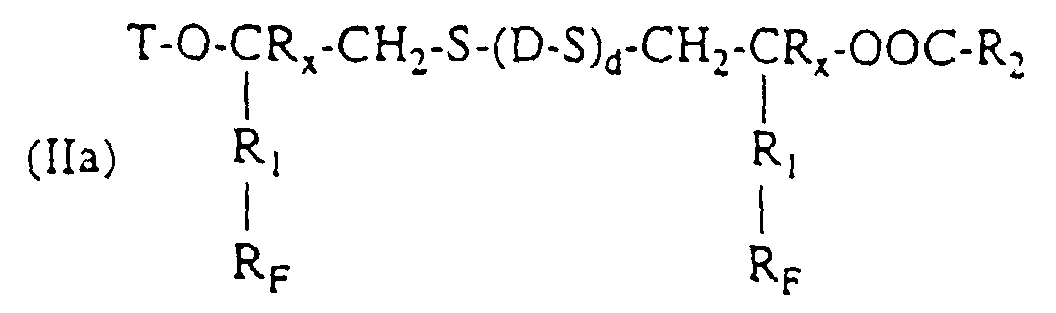 worin bedeuten:
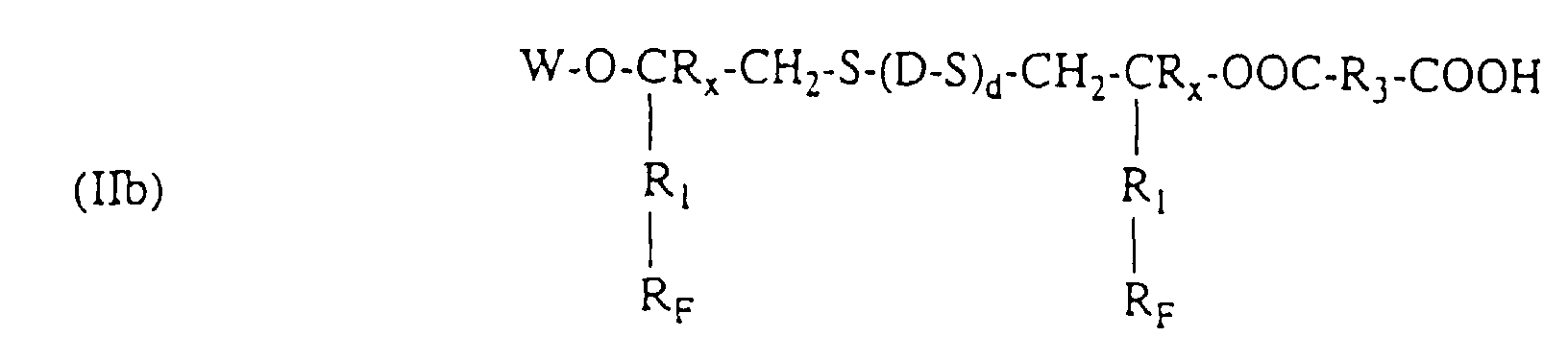
- RF, R1, D und d
- die in Anspruch 1 angegebenen Definitionen,
- Rx
- Wasserstoff oder Methyl,
- T
- Wasserstoff oder R2-CO-, worin
- R2
- für C1-C20-Alkyl, C6-C14-Aryl oder C7-C16-Aralkyl steht, von denen jedes unsubstituiert oder substituiert ist durch eine oder mehr Hydroxy-, Thiol-, Carboxyl- oder C1-C4-Alkylestergruppen und
- W
- Wasserstoff oder HOOC-R3-CO-, worin
- R3
- steht für eine direkte Bindung, ein Alkylen mit 1 bis 16 Kohlenstoffatomen, ein Arylen mit 6 bis 14 Kohlenstoffatomen oder ein Alkarylen mit 7 bis 16 Kohlenstoffatomen, wobei Alkylen, Arylen oder Alkarylen unsubstituiert oder substituiert ist durch C1-C4-Alkyl, Chlor oder Brom.
- Ester der Formel (IIa) nach Anspruch 15, worin bedeuten:
- R1
- eine direkte Bindung, -CH2-, -CH(CH3)-, -CH2CH2-O-CH2-, -CH2CH2-S-CH2-, -CH=CHCH2-O-CH2-, -SO2NR0-CH2- oder -CONH-CH2CH2-O-CH2-
- R0
- Wasserstoff oder eine Alkylgruppe mit 1 bis 4 Kohlenstoffatomen,
- Rx
- Wasserstoff oder Methyl,
- d
- die Zahl Null,
- R2-CO-
- den Rest der Essigsäure, Benzoesäure, Hydroxybenzoesäure, Acrylsäure, Methacrylsäure, Thioessigsäure oder Thiopropionsäure oder eines C1-C4-Alkylmonoesters der Terephthalsäure, Phthalsäure, Citronensäure, Maleinsäure, Fumarsäure, Itaconsäure, Malonsäure, Bernsteinsäure oder Thiobernsteinsäure und
- RF,
- das gesättigt ist und 6 bis 18 Kohlenstoffatome enthält, vollständig fluoriert ist und mindestens eine endständige Perfluoromethylgruppe enthält.
- Ester der Formel IIa nach Anspruch 16, worin bedeuten:
- R1
- -CH2-,
- Rx
- Wasserstoff und
- Polyester, der wiederkehrende Einheiten der Formel enthältder ein Molekulargewicht von etwa 3000 bis 30 000 hat und worin bedeuten:
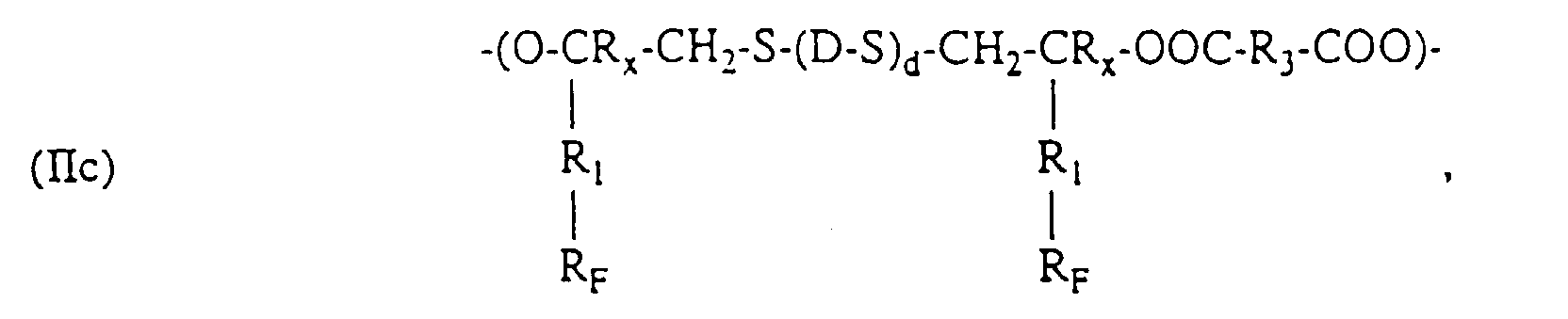
- RF, R1, D und d
- die in Anspruch 1 angegebenen Definitionen,
- Rx
- Wasserstoff oder Methyl und
- R3
- eine direkte Bindung, ein Alkylen mit 1 bis 16 Kohlenstoffatomen, ein Arylen mit 6 bis 14 Kohlenstoffatomen oder ein Alkarylen mit 7 bis 16 Kohlenstoffatomen, wobei Alkylen, Arylen oder Alkarylen unsubstituiert ist oder substituiert ist durch C1-C4-Alkyl, Chlor oder Brom.
- Polyester, der wiederkehrende Einheiten der Formel (llc) enthält, nach Anspruch 18, worin bedeuten:
- R1
- eine direkte Bindung, -CH2-, -CH(CH3)-, -CH2CH2-O-CH2-, -CH2CH2-S-CH2-, -CH=CHCH2-O-CH2-, -SO2NR0-CH2- oder -CONH-CH2CH2-O-CH2-,
- worin R0
- für Wasserstoff oder eine Alkylgruppe mit 1 bis 4 Kohlenstoffatomen steht,
- d
- die Zahl Null, und
- Polyester nach Anspruch 18 oder 19, worin bedeuten:
- R1
- -CH2-,
- Rx
- Wasserstoff, -OOC-R3-COO-, den Diradikalrest der Maleinsäure, Bernsteinsäure oder Adipinsäure und
- RF
- eine vollständig fluorierte lineare Perfluoroalkylgruppe mit 4 bis 14 Kohlenstoffatomen und
- R3
- wie in Anspruch 19 definiert ist.
- Phosphat der Formel (III)worin bedeuten:

- Q
- oder M
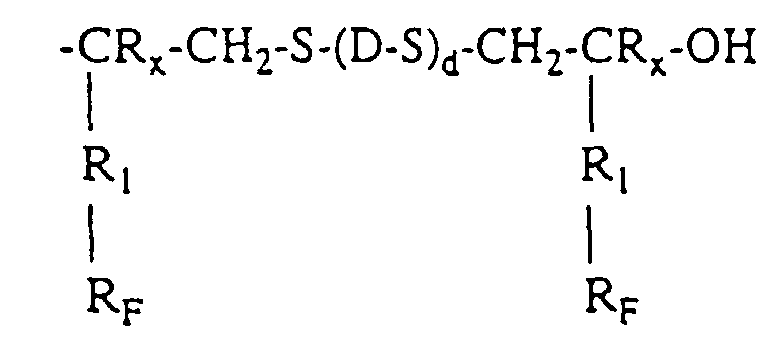
- b
- die Zahl 1 oder Null,
- M und M1
- Wasserstoff, Ammonium, C1-C5-Alkyl- oder C1-C5-Hydroxyalkylsubstituiertes Ammonium oder ein Alkalimetallkation, mit der Maßgabe, daß dann, wenn b = 0, M1 für Wasserstoff steht,
- Rx
- Wasserstoff oder Methyl und
- RF, R1, D, g und d
- wie in Anspruch 1 definiert sind.
- Phosphat der Formel (III) nach Anspruch 21, worin bedeuten:
- R1
- eine direkte Bindung, -CH2-, -CH(CH3)-, -CH2CH2-O-CH2-, -CH2CH2-S-CH2-, -CH=CHCH2-O-CH2-, -SO2NR0-CH2- oder -CONH-CH2CH2-O-CH2-
- R0
- Wasserstoff oder eine Alkylgruppe mit 1 bis 4 Kohlenstoffatomen,
- d
- die Zahl Null,
- Rx
- Wasserstoff oder Methyl und
- Phosphat nach Anspruch 21 oder 22, worin bedeuten:
- R1
- -CH2-,
- Rx
- Wasserstoff und
- RF
- eine vollständig fluorierte, lineare Perfluoroalkylgruppe mit 4 bis 14 Kohlenstoffatomen.
- Sulfat der Formelworin bedeuten:
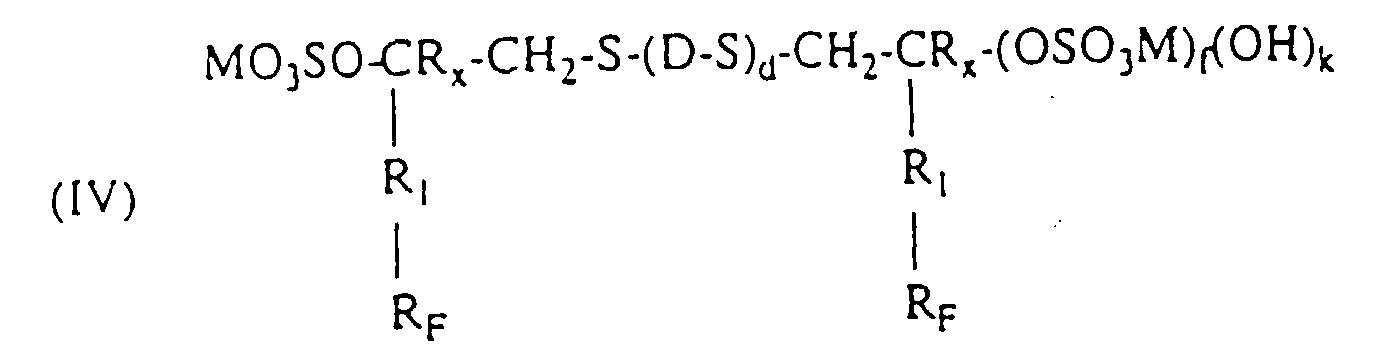
einer der Indices f und k Null und der andere 1,- M
- Wasserstoff, Ammonium, C1-C5-Alkyl- oder C1-C5-Hydroxyalkylsubstituiertes Ammonium oder ein Alkalimetallkation,
- Rx
- Wasserstoff oder Methyl und
- RF, R1, D und d
- die in Anspruch 1 angegebenen Definitionen.
- Sulfat nach Anspruch 24, worin bedeuten:
- R1
- eine direkte Bindung, -CH2-, -CH(CH3)-, -CH2CH2-O-CH2-, -CH2CH2-S-CH2-, -CH=CHCH2-O-CH2-, -SO2NR0-CH2- oder -CONH-CH2CH2-O-CH2-,
- R0
- Wasserstoff oder eine Alkylgruppe mit 1 bis 4 Kohlenstoffatomen,
- k
- die Zahl 1,
- d und f
- die Zahl Null,
- D
- -CH2CH2-O-CH2-CH2- oder Pentaerythritdiacetat oder -dipropionat,
- Rx
- Wasserstoff oder Methyl und
- Sulfat nach Anspruch 25, worin bedeuten:
- R1
- -CH2-,
- Rx
- Wasserstoff,
- d und f
- die Zahl Null und
- RF
- eine vollständig fluorierte lineare Perfluoroalkylgruppe mit 4 bis 14 Kohlenstoffatomen.
- Urethan, bei dem es sich um ein Reaktionsprodukt zwischen einem Diol der Formel (I) und einem Isocyanat der Formel R4-NCO handelt, worin R4 steht für den monovalenten Kohlenwasserstoff-Rest von Phenylisocyanat, m-Isopropenyl-methylbenzylisocyanato, 2-Isocyanatoethylacrylat oder -methacrylat oder 1,1-Dimethyl-2-isocyanatoethyl-m-isopropenylphenyl.
- Polyurethan, das ein Molekulargewicht von etwa 3000 bis 30 000 aufweist und besteht aus oder enthält wiederkehrende Einheiten der Formelworin bedeuten:
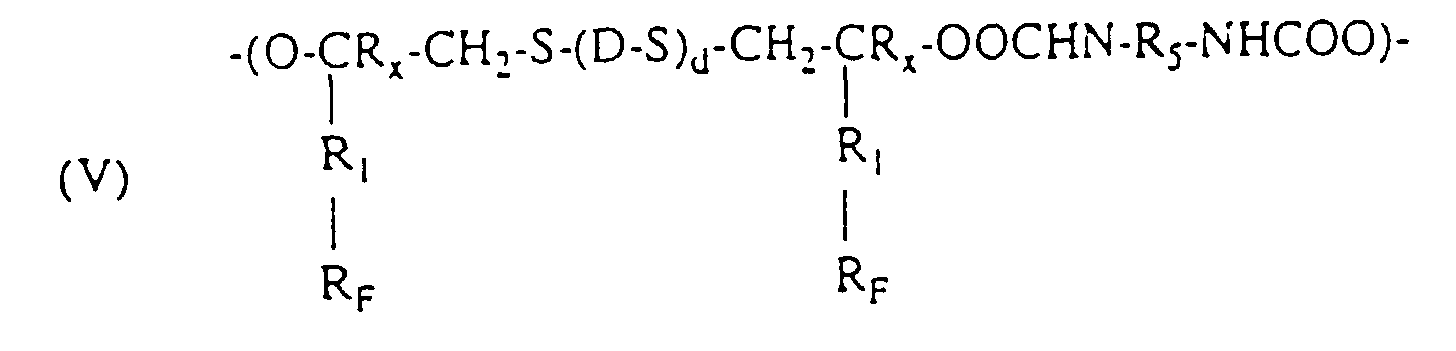
- Rx
- Wasserstoff oder Methyl,
- R5
- einen aromatischen, aliphatischen oder cycloaliphatischen Rest und
- RF, R1, D und d
- wie in Anspruch 1 definiert sind.
- Polyurethan nach Anspruch 28, worin bedeuten:
- R1
- eine direkte Bindung, -CH2-, -CH(CH3)-, -CH2CH2-O-CH2-, -CH2CH2-S-CH2-, -CH=CHCH2-O-CH2-, -SO2NR0-CH2- oder -CONH-CH2CH2-O-CH2-,
- Ro
- Wasserstoff oder eine Alkylgruppe mit 1 bis 4 Kohlenstoffatomen,
- Rx
- Wasserstoff oder Methyl,
- d
- die Zahl Null,
die Gruppe OCN-R5-NCO den Diradikal-Rest eines Diisocyanats, ausgewählt aus der Gruppe, die besteht aus Toluoldiisocyanat, 4,4'-Diphenylmethandiisocyanat, Toluidindiisocyanat, Dianisidindiisocyanat, m-Xylylendiisocyanat, p-Phenylendiisocyanat, m-Phenylendiisocyanat, 1-Chloro-2,4-phenylendiisocyanat, 3,3'-Dimethyl-4,4'-bisphenylendiisocyanat, 4, 4'-Bis(2-methyl isocyanatophenyl)methan-4,4'-bis-phenylendiisocyanat, 4,4'-Bis(2-methoxyisocyanatophenyl)methan, 1-Nitrophenyl-3,5-diisocyanat, 4,4'-Diisocyanatodiphenylether, 3,3'-Dichloro-4,4'-diisocyanatodiphenylether, 3,3'-Dichloro-4,4'-diisocyanatodiphenylmethan, 4,4'-Diisocyanatodibenzyl, 3,3'-Dimethoxy-4,4'-diisocyanatodiphenyl, 2,2'-Dimethyl-4,4'-diisocyanatodiphenyl, 2,2'-Dichloro-5,5'-dimethoxy-4,4'-diisocyanatodiphenyl, 3,3'-Dichloro-4,4'-diisocyanatodiphenyl, 1,2-Naphthalindiisocyanat, 4-Chloro-1,2-napthalindiisocyanat, 4-Methyl-1,2-naphthalindiisocyanat, 1,5-Naphthalindiisocyanat, 1,6-Naphthalindiisocyanat, 1,7-Naphthalindiisocyanat, 1,8-Naphthalindiisocyanat, 4-Chloro-1,8-naphthalindiisocyanat, 2,3-Naphthalindiisocyanat, 2,7-Naphthalindiisocyanat, 1,8-Dinitro-2,7-naphthalindiisocyanat, 1-Methyl-2,4-naphthalindiisocyanat, 1-Methyl-5,7-naphthalindiisocyanat, 6-Methyl-1,3-naphthalindiisocyanat, 7-Methyl-1,3-naphthalindiisocyant, 1,2-Ethandiisocyanat, Propylen-1,2- und -1,3-diisocyanat, 1,4-Tetramethylendiisocyanat, 2-Chloropropan-1,3-diisocyanat, Pentamethylendiisocyanat, 1,8-Octandiisocyanat, 1,10-Decandiisocyanat, 1,12-Dodecandiisocyanat, 1,16-Hexadecandiisocyanat, 1,3-Cyclohexandiisocyanat, 1,4-Cyclohexandiisocyanat, 4,4'-Methylenbis(cyclohexylisocyanat), 1,6-Hexamethylendiisocyanat, 2,2,4- und 2,4,4-Trimethyl-1,6-diisocyanatohexan, von Dimersäure abgeleitetes Diisocyanat, hergestellt aus dimerisierter Linolfettsäure, 4,4'-Dicyclohexylmethandiisocyanat, Isophorondiisocyanat, 3-Isocyanatomethyl-3,5,5-trimethylcyclohexyldiisocyanat, Lysinmethylesterdiisocyanat, Bis(2-Isocyanatoethyl)fumarat, Bis(2-Isocyanatoethyl)carbonat und m-Tetramethylxylylendiisocyanat. - Polyurethan nach Anspruch 29, worin bedeuten:
- R1
- -CH2-,
- Rx
- Wasserstoff,
- d
- die Zahl Null und
- RF,
- das gesättigt ist und 6 bis 18 Kohlenstoffatome enthält, vollständig fluoriert ist und mindestens eine endständige Perfluoromethylgruppe enthält, und
- R5
- den Diradikal-Rest von Isophorondiisocyanat, 2,2,4(2,4,4)-Trimethyl-1,6-diisocyanatohexan, dem von Linoldimersäure abgeleiteten Diisocyanat, 1,6-Hexamethylendiisocyanat oder 3-Isocyanatomethyl-3,5,5-trimethylcyclohexyldiisocyanat.
- Verfahren zum Behandeln eines Substrats, um es öl- und wasserabstoßend zu machen, das umfaßt das Aufbringen einer wirksamen Menge einer Fluor enthaltenden Zusammensetzung auf dasselbe, wobei mindestens ein Teil des Fluors in der genannten Zusammensetzung bereitgestellt wird von einer oder mehreren Verbindungen, die ausgewählt werden aus der Gruppe, die besteht ausa) Mono- oder Diestern der Formelnoder
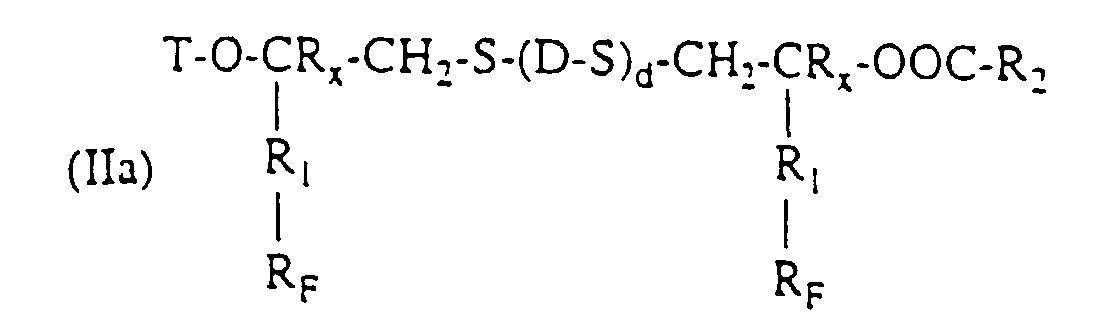 worin bedeuten:

- R1
- eine direkte Bindung, ein lineares oder verzweigtes Alkylen mit bis zu 6 Kohlenstoffatomen, Alkylenoxyalkylen mit bis zu 6 Kohlenstoffatomen, Alkylenthioalkylen mit bis zu 6 Kohlenstoffatomen, Alkylenoxy mit bis zu 6 Kohlenstoffatomen, Alkenylenoxyalkylen mit bis zu 6 Kohlenstoffatomen, Alkylenthioalkylenoxyalkylen mit bis zu 9 Kohlenstoffatomen, Carbonamidoalkylen, worin der Alkylenrest bis zu 6 Kohlenstoffatome enthält und der Amido-Stickstoff unsubstituiert oder weiter substituiert ist durch C1-C5-Alkyl, Sulfonamidoalkylen, worin der Alkylenrest bis zu 6 Kohlenstoffatome enthält und der Amido-Stickstoff unsubstituiert ist oder weiter substituiert ist durch C1-C5-Alkyl; Carbonamidoalkylenthioalkylen, worin der Carbonamidoalkylenrest wie oben definiert ist und der Thioalkylenrest bis zu 6 Kohlenstoffatome enthält, oder Sulfonamidoalkylenthioalkylen, worin der Sulfonamidoalkylenrest wie oben definiert ist und der Thioalkylenrest bis zu 6 Kohlenstoffatome enthält,
- Rx
- Wasserstoff oder Methyl,
- d
- die Zahl 0 oder 1,
- D
- eine Alkylengruppe mit 2 bis 10 Kohlenstoffatomen, eine Dialkylenethergruppe mit 4 bis 10 Kohlenstoffatomen oder Pentaerythritdiacetat oder -dipropionat, und
- RF
- einen monovalenten, perfluorierten, linearen, verzweigten oder cyclischen organischen Alkyl- oder Alkenyl-Rest mit 3 bis 20 vollständig fluorierten Kohlenstoffatomen, wobei dieser Rest durch ein oder mehr divalente Sauerstoff- oder Schwefelatome unterbrochen sein kann, und die RF-Reste jeweils gleich oder verschieden sind,
- T
- Wasserstoff oder R2-CO-,
- R2
- C1-C20-Alkyl, C6-C14-Aryl oder C7-C16-Aralkyl, von denen jedes unsubstituiert oder substituiert ist durch eine oder mehr Hydroxy-, Thiol-, Carboxyl- oder C1-C4-Alkylestergruppen und
- W
- Wasserstoff oder HOOC-R3-CO-,
- R3
- eine direkte Bindung, ein Alkylen mit 1 bis 16 Kohlenstoffatomen, ein Arylen mit 6 bis 14 Kohlenstoffatomen oder ein Alkarylen mit 7 bis 16 Kohlenstoffatomen, wobei Alkylen, Arylen oder Alkarylen unsubstituiert oder substituiert ist durch C1-C4-Alkyl, Chlor oder Brom;
b) Polyestern mit Molekulargewichten von etwa 3000 bis 30 000, die Einheiten der Formel enthaltenworin RF, R1, Rx, R3, D und d wie oben definiert sind;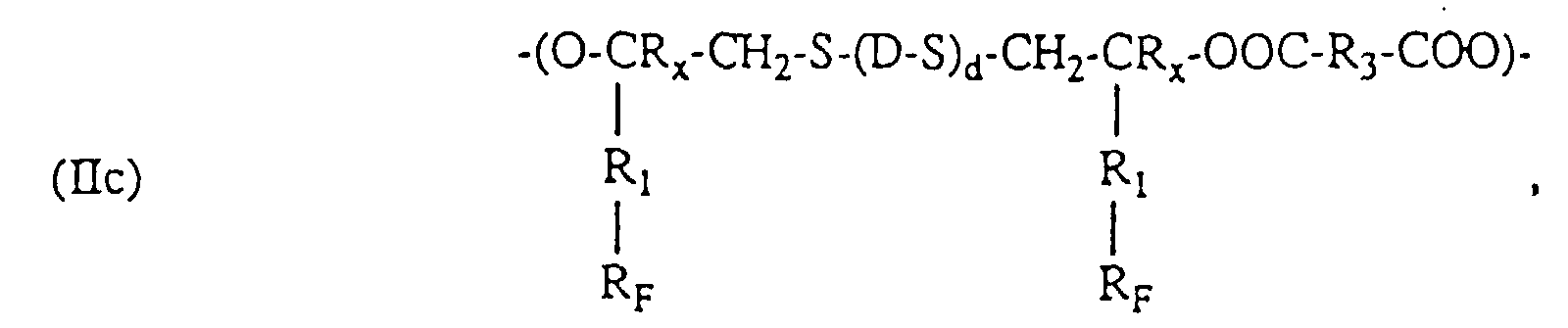 c) Phosphaten der Formel (III)worin bedeuten:

- Q = n Q is
- oder M
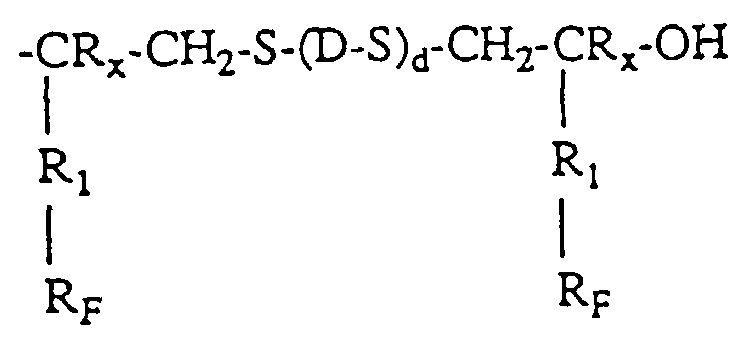
- b
- die Zahl 1 oder Null,
- M und M1
- Wasserstoff, Ammonium, C1-C5-Alkyl- oder C1-C5-Hydroxyalkylsubstituiertes Ammonium oder ein Alkalimetallkation, mit der Maßgabe, daß dann, wenn b = Null, M1 für Wasserstoff steht, und
- RF, R1, Rx, d und D
- wie oben definiert sind;
d) Sulfaten der Formelworin einer der Indices f und k für die Zahl Null und der andere für die Zahl 1 steht, und
M, RF, R1, Rx, d und D wie oben definiert sind;e) Urethanen, die Reaktionsprodukte zwischen einem Diol der Formelworin RF, R1, Rx, D und d wie oben definiert sind,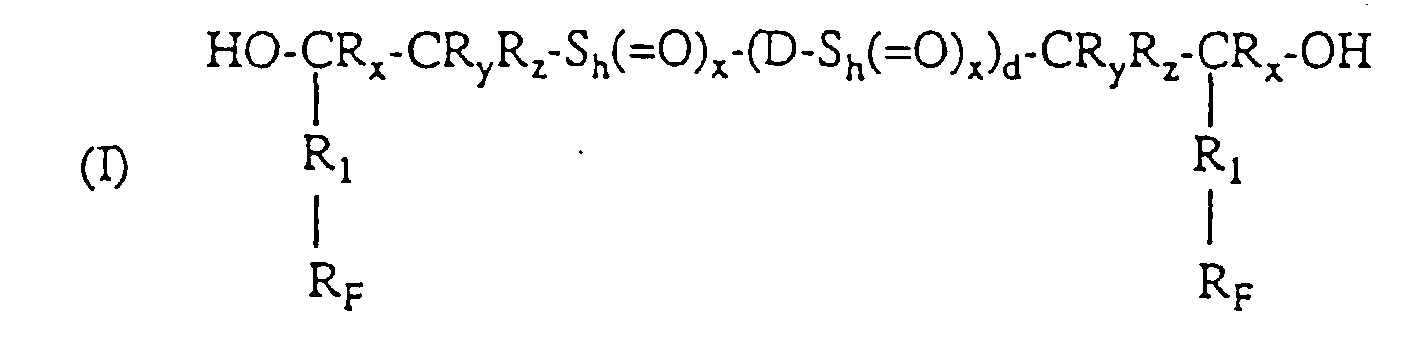
und einem Isocyanat der Formel R4-NCO darstellen,
worin R4 für den monovalenten Kohlenwasserstoff-Rest von Phenylisocyanat, m-Isopropenyl-methylbenzylisocyanato, 2-lsocyanatoethylacrylat oder -methacrylat oder 1,1-Dimethyl-2-isocyanatoethyl-m-isopropenylphenyl steht, undf) Polyurethanen mit Molekulargewichten von etwa 3000 bis 30 000, die bestehen aus oder enthalten wiederkehrende Einheiten der Formelworin RF, R1, Rx, D und d wie oben definiert sind und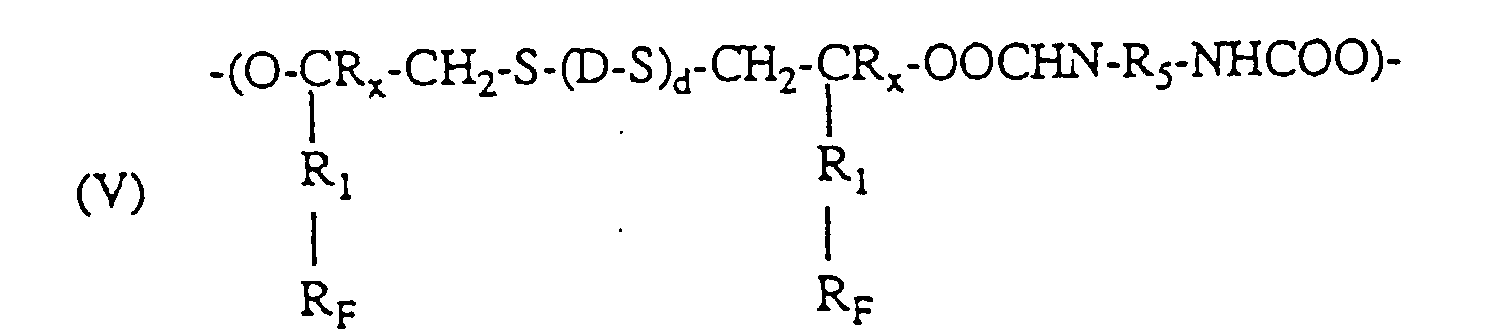
- R5
- für den Diradikalrest eines Diisocyanats der Formel OCN-R5-NCO steht.
Applications Claiming Priority (2)
| Application Number | Priority Date | Filing Date | Title |
|---|---|---|---|
| US27006794A | 1994-07-01 | 1994-07-01 | |
| US270067 | 1994-07-01 |
Publications (2)
| Publication Number | Publication Date |
|---|---|
| EP0694532A1 EP0694532A1 (de) | 1996-01-31 |
| EP0694532B1 true EP0694532B1 (de) | 2000-05-31 |
Family
ID=23029757
Family Applications (1)
| Application Number | Title | Priority Date | Filing Date |
|---|---|---|---|
| EP95810423A Expired - Lifetime EP0694532B1 (de) | 1994-07-01 | 1995-06-22 | Perfluoroalkylsulfid-,-sulfon-, -polysulfon- und -polysulfiddiole |
Country Status (4)
| Country | Link |
|---|---|
| US (2) | US5708119A (de) |
| EP (1) | EP0694532B1 (de) |
| DE (1) | DE69517252T2 (de) |
| ES (1) | ES2147829T3 (de) |
Cited By (1)
| Publication number | Priority date | Publication date | Assignee | Title |
|---|---|---|---|---|
| CN103741459A (zh) * | 2013-12-17 | 2014-04-23 | 江苏金太阳纺织科技有限公司 | 一种涤纶织物拒油整理剂及其制备方法 |
Families Citing this family (21)
| Publication number | Priority date | Publication date | Assignee | Title |
|---|---|---|---|---|
| US5859126A (en) * | 1995-09-18 | 1999-01-12 | E. I. Du Pont De Nemours And Company | Coatings containing fluorinated esters |
| US5670573A (en) * | 1996-08-07 | 1997-09-23 | E. I. Du Pont De Nemours And Company | Coatings containing fluorinated esters |
| US5789513A (en) * | 1997-02-26 | 1998-08-04 | E. I. Du Pont De Nemours And Company | Polyfluorourethane additives for curable coating compositions |
| DE29720200U1 (de) * | 1997-11-14 | 1998-01-02 | Betonwerk Kwade GmbH & Co. KG, 48465 Schüttorf | Betonelement in Gestalt eines Pflastersteins |
| US6479612B1 (en) | 1999-08-10 | 2002-11-12 | E. I. Du Pont De Nemours And Company | Fluorochemical water and oil repellents |
| EP1088867A1 (de) | 1999-09-30 | 2001-04-04 | Ciba Spezialitätenchemie Pfersee GmbH | Zusammensetzungen für die öl- und wasserabweisende Ausrüstung von Fasermaterialien |
| JP2003050068A (ja) * | 2001-05-30 | 2003-02-21 | Permelec Electrode Ltd | 過酸化水素を含有する氷組成物及び生鮮食品の保存方法 |
| US6835860B2 (en) * | 2002-02-01 | 2004-12-28 | Merck & Co., Inc. | Iodohydroxylation of olefins |
| WO2005116099A1 (en) * | 2004-05-25 | 2005-12-08 | Ciba Specialty Chemicals Holding Inc. | Perfluorinated esters, polyester, ethers and carbonates |
| US7326506B2 (en) | 2004-05-28 | 2008-02-05 | Samsung Electronics Co., Ltd. | Bridged charge transport materials having a central sulfur atom linkage |
| US7205431B2 (en) * | 2004-07-26 | 2007-04-17 | Air Products And Chemicals, Inc. | Bis(3-alkoxyalkan-2-ol) sulfides, sulfones, and sulfoxides: new surface active agents |
| US20060188729A1 (en) * | 2005-02-22 | 2006-08-24 | Kai-Volker Schubert | Washable leather with repellency |
| US7160480B2 (en) * | 2005-02-22 | 2007-01-09 | E. I. Du Pont De Nemours And Company | Leather treated with fluorochemicals |
| WO2006110759A1 (en) * | 2005-04-12 | 2006-10-19 | INVISTA TECHNOLOGIES, S.à r.l. | Fabric treated with durable stain repel and stain release finish and method of industrial laundering to maintain durability of finish |
| CN101935449B (zh) * | 2010-07-28 | 2012-09-05 | 丽水市优耐克水性树脂科技有限公司 | 一种水性聚氨酯树脂的制备方法和水性聚氨酯树脂 |
| CN103726308A (zh) * | 2013-12-17 | 2014-04-16 | 江苏金太阳纺织科技有限公司 | 一种羊毛衫拒油整理液及其制备方法 |
| US9120899B1 (en) | 2014-06-02 | 2015-09-01 | International Business Machines Corporation | Preparation of functional polysulfones |
| US9656239B2 (en) | 2014-06-16 | 2017-05-23 | International Business Machines Corporation | Apparatus for controlling metals in liquids |
| US10080806B2 (en) | 2015-08-19 | 2018-09-25 | International Business Machines Corporation | Sulfur-containing polymers from hexahydrotriazine and dithiol precursors as a carrier for active agents |
| JP7292280B2 (ja) * | 2017-12-13 | 2023-06-16 | スリーエム イノベイティブ プロパティズ カンパニー | 全フッ素化1-アルコキシプロペン、組成物、並びにそれらを使用するための方法及び装置 |
| CN113130953B (zh) * | 2021-04-09 | 2022-06-17 | 陕西国防工业职业技术学院 | 一种交联型聚砜阴离子交换膜及其制备方法 |
Family Cites Families (10)
| Publication number | Priority date | Publication date | Assignee | Title |
|---|---|---|---|---|
| US3759874A (en) * | 1971-08-30 | 1973-09-18 | Fmc Corp | Fluorinated polyurethanes as soil release agents |
| US3828098A (en) * | 1972-10-02 | 1974-08-06 | Allied Chem | Sulfur substituted bis(polyfluoroalkoxyalkyl carboxylic acids)and derivatives thereof |
| US3795874A (en) * | 1972-11-03 | 1974-03-05 | Atomic Energy Commission | Apparatus for pumping a high pressure laser system |
| US4098742A (en) * | 1977-01-24 | 1978-07-04 | Ciba-Geigy Corporation | Fluorine and silicone containing polymers |
| US4898981A (en) * | 1988-06-20 | 1990-02-06 | Ciba-Geigy Corporation | Heteroatom containing perfluoroalkyl terminated neopentyl glycols and compositions therefrom |
| US4946992A (en) * | 1988-06-20 | 1990-08-07 | Ciba-Geigy Corporation | Heteroatom containing perfluoroalkyl terminated neopentyl glycols and compositions therefrom |
| US5200493A (en) * | 1989-11-30 | 1993-04-06 | Ciba-Geigy Corporation | Heteroatom containing perfluoralkyl terminated neopentyl mercapto-alcohols and compositions therefrom |
| US5091550A (en) * | 1990-04-20 | 1992-02-25 | Ciba-Geigy Corporation | 5,5-bis (perfluoroalkylheteromethyl)-2-hydroxy-2-oxo-1,3,2-dioxaphosphorinanes, derived acyclic phosphorus acids and salts or esters thereof |
| US5132445A (en) * | 1990-04-20 | 1992-07-21 | Ciba-Geigy Corporation | 5,5-bis (perfluoroalkylheteromethyl)-2-hydroxy-2-oxo-1,3,2-dioxaphosphorinanes, and salts or esters thereof |
| US5120364A (en) * | 1990-10-10 | 1992-06-09 | Ciba-Geigy Corporation | Heteroatom containing perfluoroalkyl terminated neopentyl sulfates and salts thereof |
-
1995
- 1995-06-22 EP EP95810423A patent/EP0694532B1/de not_active Expired - Lifetime
- 1995-06-22 DE DE69517252T patent/DE69517252T2/de not_active Expired - Lifetime
- 1995-06-22 ES ES95810423T patent/ES2147829T3/es not_active Expired - Lifetime
-
1996
- 1996-06-14 US US08/665,125 patent/US5708119A/en not_active Expired - Lifetime
- 1996-07-03 US US08/675,658 patent/US5693747A/en not_active Expired - Lifetime
Cited By (2)
| Publication number | Priority date | Publication date | Assignee | Title |
|---|---|---|---|---|
| CN103741459A (zh) * | 2013-12-17 | 2014-04-23 | 江苏金太阳纺织科技有限公司 | 一种涤纶织物拒油整理剂及其制备方法 |
| CN103741459B (zh) * | 2013-12-17 | 2016-08-31 | 南通市通州区家纺产业发展服务中心 | 一种涤纶织物拒油整理剂及其制备方法 |
Also Published As
| Publication number | Publication date |
|---|---|
| US5708119A (en) | 1998-01-13 |
| DE69517252T2 (de) | 2001-01-25 |
| US5693747A (en) | 1997-12-02 |
| EP0694532A1 (de) | 1996-01-31 |
| DE69517252D1 (de) | 2000-07-06 |
| ES2147829T3 (es) | 2000-10-01 |
Similar Documents
| Publication | Publication Date | Title |
|---|---|---|
| US5708119A (en) | Perfluoroalkyl sulfide, sulfone, polysulfone and polysulfide diols | |
| US5663273A (en) | Polyurethanes derived from oligoperfluoroalkyl alcohols | |
| CA1338174C (en) | Heteroatom containing perfluoroalkyl terminated neopentyl glycols and polymers therefrom | |
| US4054592A (en) | Urethanes containing two perfluoroalkylthio groups | |
| US4946992A (en) | Heteroatom containing perfluoroalkyl terminated neopentyl glycols and compositions therefrom | |
| US5045624A (en) | Heteroatom containing perfluoroalkyl terminated neopentyl glycols and compositions therefrom | |
| US3935277A (en) | New Rf -glycols containing two perfluoroalkylthio groups and useful compositions therefrom | |
| US4001305A (en) | Rf-glycols containing two perfluoroalkylthio groups and useful compositions therefrom | |
| US5057377A (en) | Fluorinated silicon polymers | |
| AU2003239603A1 (en) | Fluorochemical compositions for treatment of a fibrous substrate | |
| US4158672A (en) | Polyfluoroalkylthio alcohols, esters and useful compositions therefrom | |
| EP0472492B1 (de) | Endständige Perfluoralkylgruppen enthaltende Neopentylalkohole und deren Derivate | |
| AU659229B2 (en) | Fluoroaliphatic dimer acid derivatives and use thereof | |
| US3883596A (en) | Fluorine and sulfur-containing compositions | |
| US4097642A (en) | Fabric coated with RF-glycols containing two perfluoroalkylthio groups | |
| CA1066842A (en) | Perfluoroalkylthio groups containing polyurethanes, process for their manufacture and their use | |
| US5145996A (en) | Heteroatom containing perfluoroalkyl terminated neopentyl mercapto-alcohols and compositions therefrom | |
| US5200493A (en) | Heteroatom containing perfluoralkyl terminated neopentyl mercapto-alcohols and compositions therefrom | |
| US3948887A (en) | Fluorine and sulfur-containing compositions | |
| US3976698A (en) | Fluorine and sulfur-containing compositions |
Legal Events
| Date | Code | Title | Description |
|---|---|---|---|
| PUAI | Public reference made under article 153(3) epc to a published international application that has entered the european phase |
Free format text: ORIGINAL CODE: 0009012 |
|
| AK | Designated contracting states |
Kind code of ref document: A1 Designated state(s): BE CH DE ES FR GB IT LI |
|
| 17P | Request for examination filed |
Effective date: 19960725 |
|
| RAP1 | Party data changed (applicant data changed or rights of an application transferred) |
Owner name: CIBA SC HOLDING AG |
|
| RAP3 | Party data changed (applicant data changed or rights of an application transferred) |
Owner name: CIBA SPECIALTY CHEMICALS HOLDING INC. |
|
| 17Q | First examination report despatched |
Effective date: 19970722 |
|
| GRAG | Despatch of communication of intention to grant |
Free format text: ORIGINAL CODE: EPIDOS AGRA |
|
| GRAG | Despatch of communication of intention to grant |
Free format text: ORIGINAL CODE: EPIDOS AGRA |
|
| GRAH | Despatch of communication of intention to grant a patent |
Free format text: ORIGINAL CODE: EPIDOS IGRA |
|
| GRAH | Despatch of communication of intention to grant a patent |
Free format text: ORIGINAL CODE: EPIDOS IGRA |
|
| GRAA | (expected) grant |
Free format text: ORIGINAL CODE: 0009210 |
|
| AK | Designated contracting states |
Kind code of ref document: B1 Designated state(s): BE CH DE ES FR GB IT LI |
|
| REG | Reference to a national code |
Ref country code: CH Ref legal event code: EP |
|
| REF | Corresponds to: |
Ref document number: 69517252 Country of ref document: DE Date of ref document: 20000706 |
|
| ITF | It: translation for a ep patent filed | ||
| ET | Fr: translation filed | ||
| REG | Reference to a national code |
Ref country code: ES Ref legal event code: FG2A Ref document number: 2147829 Country of ref document: ES Kind code of ref document: T3 |
|
| PLBE | No opposition filed within time limit |
Free format text: ORIGINAL CODE: 0009261 |
|
| STAA | Information on the status of an ep patent application or granted ep patent |
Free format text: STATUS: NO OPPOSITION FILED WITHIN TIME LIMIT |
|
| PGFP | Annual fee paid to national office [announced via postgrant information from national office to epo] |
Ref country code: CH Payment date: 20010427 Year of fee payment: 7 |
|
| 26N | No opposition filed | ||
| PGFP | Annual fee paid to national office [announced via postgrant information from national office to epo] |
Ref country code: BE Payment date: 20010816 Year of fee payment: 7 |
|
| REG | Reference to a national code |
Ref country code: GB Ref legal event code: IF02 |
|
| PG25 | Lapsed in a contracting state [announced via postgrant information from national office to epo] |
Ref country code: LI Free format text: LAPSE BECAUSE OF NON-PAYMENT OF DUE FEES Effective date: 20020630 Ref country code: CH Free format text: LAPSE BECAUSE OF NON-PAYMENT OF DUE FEES Effective date: 20020630 Ref country code: BE Free format text: LAPSE BECAUSE OF NON-PAYMENT OF DUE FEES Effective date: 20020630 |
|
| BERE | Be: lapsed |
Owner name: *CIBA SPECIALTY CHEMICALS HOLDING INC. Effective date: 20020630 |
|
| REG | Reference to a national code |
Ref country code: CH Ref legal event code: PL |
|
| PGFP | Annual fee paid to national office [announced via postgrant information from national office to epo] |
Ref country code: FR Payment date: 20110603 Year of fee payment: 17 Ref country code: ES Payment date: 20110621 Year of fee payment: 17 |
|
| PGFP | Annual fee paid to national office [announced via postgrant information from national office to epo] |
Ref country code: GB Payment date: 20110523 Year of fee payment: 17 |
|
| PGFP | Annual fee paid to national office [announced via postgrant information from national office to epo] |
Ref country code: IT Payment date: 20110620 Year of fee payment: 17 |
|
| PGFP | Annual fee paid to national office [announced via postgrant information from national office to epo] |
Ref country code: DE Payment date: 20110630 Year of fee payment: 17 |
|
| GBPC | Gb: european patent ceased through non-payment of renewal fee |
Effective date: 20120622 |
|
| PG25 | Lapsed in a contracting state [announced via postgrant information from national office to epo] |
Ref country code: IT Free format text: LAPSE BECAUSE OF NON-PAYMENT OF DUE FEES Effective date: 20120622 |
|
| REG | Reference to a national code |
Ref country code: FR Ref legal event code: ST Effective date: 20130228 |
|
| REG | Reference to a national code |
Ref country code: DE Ref legal event code: R119 Ref document number: 69517252 Country of ref document: DE Effective date: 20130101 |
|
| PG25 | Lapsed in a contracting state [announced via postgrant information from national office to epo] |
Ref country code: GB Free format text: LAPSE BECAUSE OF NON-PAYMENT OF DUE FEES Effective date: 20120622 Ref country code: DE Free format text: LAPSE BECAUSE OF NON-PAYMENT OF DUE FEES Effective date: 20130101 Ref country code: FR Free format text: LAPSE BECAUSE OF NON-PAYMENT OF DUE FEES Effective date: 20120702 |
|
| REG | Reference to a national code |
Ref country code: ES Ref legal event code: FD2A Effective date: 20131021 |
|
| PG25 | Lapsed in a contracting state [announced via postgrant information from national office to epo] |
Ref country code: ES Free format text: LAPSE BECAUSE OF NON-PAYMENT OF DUE FEES Effective date: 20120623 |