EP0694884A2 - Ein dichte Aufstellung der Abfragegeräte erlaubendes Abfragesystem für Transponder für bewegte Körper - Google Patents
Ein dichte Aufstellung der Abfragegeräte erlaubendes Abfragesystem für Transponder für bewegte Körper Download PDFInfo
- Publication number
- EP0694884A2 EP0694884A2 EP19950111355 EP95111355A EP0694884A2 EP 0694884 A2 EP0694884 A2 EP 0694884A2 EP 19950111355 EP19950111355 EP 19950111355 EP 95111355 A EP95111355 A EP 95111355A EP 0694884 A2 EP0694884 A2 EP 0694884A2
- Authority
- EP
- European Patent Office
- Prior art keywords
- interrogators
- carrier wave
- interrogator
- moving
- transponder
- Prior art date
- Legal status (The legal status is an assumption and is not a legal conclusion. Google has not performed a legal analysis and makes no representation as to the accuracy of the status listed.)
- Withdrawn
Links
Images

Classifications
-
- G—PHYSICS
- G07—CHECKING-DEVICES
- G07B—TICKET-ISSUING APPARATUS; FARE-REGISTERING APPARATUS; FRANKING APPARATUS
- G07B15/00—Arrangements or apparatus for collecting fares, tolls or entrance fees at one or more control points
- G07B15/06—Arrangements for road pricing or congestion charging of vehicles or vehicle users, e.g. automatic toll systems
- G07B15/063—Arrangements for road pricing or congestion charging of vehicles or vehicle users, e.g. automatic toll systems using wireless information transmission between the vehicle and a fixed station
-
- G—PHYSICS
- G06—COMPUTING OR CALCULATING; COUNTING
- G06K—GRAPHICAL DATA READING; PRESENTATION OF DATA; RECORD CARRIERS; HANDLING RECORD CARRIERS
- G06K7/00—Methods or arrangements for sensing record carriers, e.g. for reading patterns
- G06K7/10—Methods or arrangements for sensing record carriers, e.g. for reading patterns by electromagnetic radiation, e.g. optical sensing; by corpuscular radiation
- G06K7/10009—Methods or arrangements for sensing record carriers, e.g. for reading patterns by electromagnetic radiation, e.g. optical sensing; by corpuscular radiation sensing by radiation using wavelengths larger than 0.1 mm, e.g. radio-waves or microwaves
- G06K7/10316—Methods or arrangements for sensing record carriers, e.g. for reading patterns by electromagnetic radiation, e.g. optical sensing; by corpuscular radiation sensing by radiation using wavelengths larger than 0.1 mm, e.g. radio-waves or microwaves using at least one antenna particularly designed for interrogating the wireless record carriers
- G06K7/10356—Methods or arrangements for sensing record carriers, e.g. for reading patterns by electromagnetic radiation, e.g. optical sensing; by corpuscular radiation sensing by radiation using wavelengths larger than 0.1 mm, e.g. radio-waves or microwaves using at least one antenna particularly designed for interrogating the wireless record carriers using a plurality of antennas, e.g. configurations including means to resolve interference between the plurality of antennas
-
- G—PHYSICS
- G08—SIGNALLING
- G08G—TRAFFIC CONTROL SYSTEMS
- G08G1/00—Traffic control systems for road vehicles
- G08G1/01—Detecting movement of traffic to be counted or controlled
- G08G1/017—Detecting movement of traffic to be counted or controlled identifying vehicles
Definitions
- the present invention relates to an interrogator system having a interrogators which communicate with moving-body transponders.
- a part of an interrogator system according to the present invention may be disposed on an automobile, and can be applied in an automatic toll-collection system for vehicles at toll roadways or the like.
- a system which disposes interrogators in each lane of a toll facility of a toll roadway and disposes transponders in vehicles is known as an automatic toll-collection system of, for example, a toll roadway.
- an interrogation signal which has undergone ASK (amplitude-shift keyed) modulation or PSK (phase-shift keyed) modulation of its carrier wave is transmitted by the interrogator, the interrogation signal is received by the transponder, a response signal is transmitted from the transponder to the interrogator in a format for answering the interrogation signal, and toll-collection for each vehicle is performed by a computer which controls the interrogator.
- ASK amplitude-shift keyed
- PSK phase-shift keyed
- the interrogator modulates the carrier wave and inserts an unmodulated carrier wave into an interrogation signal using a time division technique, and the transponder receives this unmodulated carrier wave, performs ASK or PSK modulation on this unmodulated carrier wave, and re-transmits it to the interrogator.
- This method does not require providing an oscillator that generates carrier waves in the transponder, and consequently power consumption is low and this method is preferred for use in a moving body which cannot freely obtain a power source.
- each interrogator employs its own respective oscillator, and so even if carrier waves of identical frequency are generated, it is quite unlikely that their phases or frequencies will exactly coincide; thus, the frequencies do not become completely identical, and a certain amount of disparity occurs between the frequencies due to constructive and destructive interference and beat effects. Thus, although the interrogators are separated by some extent, the two waves will interfere.
- an interrogation signal transmitted from a first interrogator during interval A interferes with an interrogation signal transmitted from a second interrogator during the interval A, and the beat of the two carrier waves is detected when the transponder receives them.
- a response signal transmitted from a first transponder during a time interval B interferes with a response signal transmitted from a second transponder during the time interval B, and in a case of reception by the first and second interrogators, the beat of the carrier waves is detected and generates crosstalk.
- a homodyne wave detection is normally performed by the interrogator during the reception of the signal, and so errors due to the beat are more prone to occur at the time of reception by the interrogator than at the time of reception by the transponder.
- the present invention is devised to solve the above-described problems, and an object thereof is to prevent the occurrence of abnormal communication due to interference of carrier waves of identical frequency.
- a preferred embodiment of the present invention is a system having a plurality of interrogators which perform communication for a plurality of transponders disposed on moving bodies, comprising a first interrogator which repeats an operation of transmitting an interrogation signal with a modulated carrier wave of a predetermined frequency during a time interval A and transmitting an unmodulated carrier wave of a frequency thereof during a subsequent time interval B, as well as modulating at a transponder an unmodulated carrier wave thereof and receiving a signal transmitted as a response signal; a second interrogator disposed in a range in which interference with a carrier wave transmitted by the first interrogator may occur and which repeats an operation of transmitting an interrogation signal with a modulated carrier wave of a predetermined frequency during the time interval A and transmitting an unmodulated carrier wave of a frequency thereof during a subsequent time interval B, as well as modulating at a transponder an unmodulated carrier wave thereof and receiving a signal transmitted as a response signal; a first interrogator which repeats an
- the first interrogator and the second interrogator employ carrier waves of identical frequency. These carrier waves are generated by employing respective phase-lock loop circuits to divide a reference signal generated from a common oscillator by an identical ratio. For this reason, the carrier waves used by the two interrogators are completely synchronized in frequency and phase. Accordingly, the frequency of the carrier wave of the interrogation signal transmitted from the first interrogator during the time interval A and the frequency of the carrier wave of the interrogation signal transmitted from the second interrogator during the time interval B match completely. The frequency of the unmodulated carrier wave transmitted from the first interrogator during the time interval B and the frequency of the unmodulated carrier wave transmitted from the second interrogator during the time interval B also match completely.
- FIG. 1 is a block diagram indicating the structure of the present embodiment.
- a plurality of lanes L1, L2, L3... are formed in a toll facility of a toll roadway, and vehicles installed with respective transponders Y1, Y2, Y3... travel in the lanes.
- Several interrogators X1, X2, X3... are disposed as base stations in the respective lanes L1, L2, L3...
- the interrogators are of identical structure, and so the circuit structure of the interrogator X1 will be described as a representative device.
- the interrogator X1 includes a phase-locked loop circuit (hereinafter termed "PLL") 11, a modulator 12, a demodulator 14, a CPU 13, and an antenna 15.
- PLL phase-locked loop circuit
- the interrogator controller 100 includes a host computer 20 which controls the transmission and receiving operations of each interrogator X1, X2, X3... and an oscillator 10 which transmits a common, standard signal S6 to all of the interrogators X1, X2, X3...
- the reference signal S6 is divided by an established fixed ratio, formed into a carrier wave S7 of a predetermined frequency f1, and provided to the modulator 12 by the PLL 11.
- the CPU 13 outputs binary data for querying the transponder to the modulator 12 during interval A.
- the modulator 12 performs amplitude-shift modulation (ASK) of the carrier wave S7 on the basis of this binary data.
- ASK amplitude-shift modulation
- This modulated signal is transmitted as a radio wave via the antenna 15 as an interrogation signal S1.
- This signal is a dual sideband (DSB) signal.
- the CPU 13 sends a high-level signal to the modulator 12, an unmodulated carrier wave S2 having the frequency f1 is output from the modulator 12, and the signal is transmitted as a radio wave via the antenna 15.
- the transponders Y1, Y2, Y3... are all of identical structure, and so the structure of the transponder Y1 will be described as a representative unit.
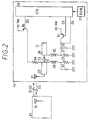
- the structure of the transponder Y1 is shown in FIG. 2.
- the transponder Y1 has an antenna 21 which receives the interrogation signal S1 and the unmodulated carrier wave S2 and transmits a response signal S3.
- the antenna 21 is connected to an anode of a diode 23 via a transmission path 22, the cathode of the diode 23 is connected to a first end of a transmission path 24, and the other end b of the transmission path 24 is open.
- the length of this transmission path 24 is established to be ⁇ /4, where ⁇ is the wavelength of the carrier wave.
- the anode and cathode of the diode 23 are connected to a coil 28 and a resistor 29, and a coil 30 and a resistor 31, respectively.
- the coil 28 and a capacitor 32 and the coil 30 and a capacitor 33 form a low-pass filter, and form an envelope detection--wave circuit together with the diode 23.
- the anode of the diode 23 is connected through a resistor 34 and transistor Tr2 to a power source V DD .
- the transistors Tr1 and Tr2 are off.
- the cathode of the diode 23 is grounded through the resistor 31, and no bias voltage is applied to the diode 23.
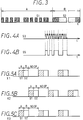
- the interrogation signal S1 indicated in FIG. 3 is received from the antenna 21 in the time interval A, the interrogation signal S1 is made into an envelope detection wave by a envelope detection-wave circuit implemented by the diode 23, coils 28 and 30 and capacitors 32 and 33 (i.e., the carrier wave is interrupted).
- a modulation signal S4 (binary signal) thereof is input to the CPU 26.
- This modulation signal S4 is analyzed by CPU 26, and when it is determined to be an interrogation signal, response signal S3 (see FIG. 4A) which is the modulated version of the unmodulated carrier wave S2 is transmitted from the antenna 21 in interval B shown in FIG. 3.
- This procedure is as follows.
- the CPU 26 reads the individual identification code from the ROM 27, and generates a response signal S5 (shown in FIG. 4B) of binary data containing the identification code.
- On/off control of the transistors Tr1 and Tr2 is performed on the basis of the response signal S5.
- power-source voltage V DD is applied to the cathode of the diode 23, and the diode 23 is reverse-biased through the resistor 29.
- the diode 23 goes into a nonconducting state and the unmodulated carrier wave S2 received by the antenna 21 is reflected by an input lead (first reflection point) a of the diode 23, and is reflected from the antenna 21 as a modulated signal S3.
- the diode 23 goes into a forward-biased state. Accordingly, the unmodulated carrier wave S2 passes through the diode 23, propagates across the transmission path 24, and is reflected at an open end (second reflection point) b of the transmission path 24. This reflected wave passes through the diode 23 in reverse, propagates across the transmission path 22, and is transmitted from the antenna 21.
- the carrier wave is phase-modulated (PSK) by the response signal S5, as shown in FIG. 4A.
- PSK phase-modulated
- the response signal S3 received by the antenna 15 of the interrogator X1 is demodulated into a response signal of binary data by the demodulator 14 and read into the CPU 13, and the CPU 13 sends data to the host computer 20 to indicate that the vehicle on which the transponder Y1 is mounted has passed through the lane L1. Toll collection is managed by the host computer 20.
- the frequencies of the carrier waves of the interrogator X1 and the interrogator X3 are both f1, and the frequency of the carrier wave of the interrogator X2 which is most proximate to the interrogator X1 is a frequency f2 different from f1.
- interrogators X1 and X3 which employ carrier waves of identical frequency transmit interrogation signal S1 and the unmodulated carrier wave S2 at the same time.
- interval A is the transmission interval of the interrogation signal S1
- the time interval B is the transmission interval of the unmodulated carrier wave S2 for both interrogator X1 and interrogator X3.
- Interrogator X2 which uses a carrier wave having a frequency f2, transmits interrogation signal S1 and the unmodulated carrier wave S2 when interrogators X1 and X3 are at rest. Because interrogators X1 and X3 differ with interrogator X2 in their timing of transmitting interrogation signal S1 and unmodulated carrier wave S2, no interference occurs because the frequencies of their carrier waves differ. Moreover, the area in which X1 and X3 interfere is covered by the stronger signal from interrogator X2 which minimizes the effect of crosstalk of signals from those units. Therefore, transponders Y1, Y2, Y3... experience no beat frequency effects.
- the frequencies of the carrier waves of the respective interrogation signals S1 of the interrogator X1 and the interrogator X3 match completely. Accordingly, no beat is detected by the transponders Y1 and Y3, and a received-data error does not occur. Furthermore, the interrogator X1 and the interrogator X3 go into a receiving state during interval B. Accordingly, the interrogator X1 goes into a state of receiving the unmodulated carrier wave S2 output by the interrogator X3, the response signal S3 output by the transponder Y1, and the output signal S3 output by the transponder Y3. The interrogator X3 also goes into a state of receiving the unmodulated carrier wave S2 output by the interrogator X1, the response signal S3 output by the transponder Y3, and the output signal S3 output by the transponder Y1.
Landscapes
- Engineering & Computer Science (AREA)
- Physics & Mathematics (AREA)
- General Physics & Mathematics (AREA)
- Toxicology (AREA)
- Health & Medical Sciences (AREA)
- Computer Networks & Wireless Communication (AREA)
- Electromagnetism (AREA)
- General Health & Medical Sciences (AREA)
- Artificial Intelligence (AREA)
- Computer Vision & Pattern Recognition (AREA)
- Theoretical Computer Science (AREA)
- Business, Economics & Management (AREA)
- Finance (AREA)
- Radar Systems Or Details Thereof (AREA)
- Train Traffic Observation, Control, And Security (AREA)
Applications Claiming Priority (2)
| Application Number | Priority Date | Filing Date | Title |
|---|---|---|---|
| JP19105794A JP3384127B2 (ja) | 1994-07-20 | 1994-07-20 | 移動体応答器に対する質問器システム |
| JP191057/94 | 1994-07-20 |
Publications (2)
| Publication Number | Publication Date |
|---|---|
| EP0694884A2 true EP0694884A2 (de) | 1996-01-31 |
| EP0694884A3 EP0694884A3 (de) | 1999-03-31 |
Family
ID=16268178
Family Applications (1)
| Application Number | Title | Priority Date | Filing Date |
|---|---|---|---|
| EP95111355A Withdrawn EP0694884A3 (de) | 1994-07-20 | 1995-07-19 | Ein dichte Aufstellung der Abfragegeräte erlaubendes Abfragesystem für Transponder für bewegte Körper |
Country Status (3)
| Country | Link |
|---|---|
| EP (1) | EP0694884A3 (de) |
| JP (1) | JP3384127B2 (de) |
| SG (1) | SG38854A1 (de) |
Cited By (9)
| Publication number | Priority date | Publication date | Assignee | Title |
|---|---|---|---|---|
| EP1020044A4 (de) * | 1996-03-21 | 2000-07-19 | Amtech Corp | Spreitzspektrum-frequenzenspringendes lesesystem |
| WO2004015614A1 (en) * | 2002-08-08 | 2004-02-19 | Supersensor (Pty) Ltd | Rf identification system with multiple readers |
| WO2007023274A3 (en) * | 2005-08-23 | 2007-05-31 | Microlise Ltd | Rfid portal arrangements |
| WO2010009002A1 (en) * | 2008-07-16 | 2010-01-21 | Maxim Integrated Products, Inc. | Multi-transceiver rfid reader system with centralized control and frequency source |
| CN102013119A (zh) * | 2010-11-24 | 2011-04-13 | 深圳市金溢科技有限公司 | 电子不停车收费路侧单元的信号下行方法和装置,电子不停车收费方法 |
| EP2378459A3 (de) * | 2005-02-25 | 2012-03-28 | Nidec Sankyo Corporation | Informationsleseeinrichtung |
| CN102693585A (zh) * | 2011-03-25 | 2012-09-26 | 深圳市金溢科技有限公司 | 车载单元 |
| CN102096951B (zh) * | 2009-12-11 | 2014-03-12 | 中兴通讯股份有限公司 | Etc业务信号发送、接收方法以及路侧单元、车载单元 |
| CN104574528A (zh) * | 2013-11-26 | 2015-04-29 | 深圳市金溢科技股份有限公司 | 一种唤醒接收电路及车载单元 |
Families Citing this family (2)
| Publication number | Priority date | Publication date | Assignee | Title |
|---|---|---|---|---|
| US8058994B2 (en) * | 2005-09-09 | 2011-11-15 | Sensormatic Electronics, LLC | EAS system providing synchronized transmission |
| JP2010034743A (ja) * | 2008-07-28 | 2010-02-12 | Mitsubishi Electric Corp | 無線通信システム、無線通信方法、無線通信プログラム及び干渉情報処理装置 |
Citations (1)
| Publication number | Priority date | Publication date | Assignee | Title |
|---|---|---|---|---|
| JPH06191057A (ja) | 1992-12-28 | 1994-07-12 | Canon Inc | インクジェット記録装置 |
Family Cites Families (4)
| Publication number | Priority date | Publication date | Assignee | Title |
|---|---|---|---|---|
| US4121102A (en) * | 1976-07-27 | 1978-10-17 | Kilo Corporation | Object identification system |
| BE1003237A5 (fr) * | 1989-06-02 | 1992-02-04 | Baets Thierry De | Systeme de taxation ou peage automatique pour vehicules routiers. |
| GB9220412D0 (en) * | 1992-09-28 | 1992-11-11 | Texas Instruments Holland | Transponder systems for automatic identification purposes |
| US5701127A (en) * | 1993-02-23 | 1997-12-23 | Texas Instruments Incorporated | Automatic vehicle identification system capable of vehicle lane discrimination |
-
1994
- 1994-07-20 JP JP19105794A patent/JP3384127B2/ja not_active Expired - Lifetime
-
1995
- 1995-07-19 EP EP95111355A patent/EP0694884A3/de not_active Withdrawn
- 1995-07-19 SG SG1995000897A patent/SG38854A1/en unknown
Patent Citations (1)
| Publication number | Priority date | Publication date | Assignee | Title |
|---|---|---|---|---|
| JPH06191057A (ja) | 1992-12-28 | 1994-07-12 | Canon Inc | インクジェット記録装置 |
Cited By (11)
| Publication number | Priority date | Publication date | Assignee | Title |
|---|---|---|---|---|
| EP1020044A4 (de) * | 1996-03-21 | 2000-07-19 | Amtech Corp | Spreitzspektrum-frequenzenspringendes lesesystem |
| WO2004015614A1 (en) * | 2002-08-08 | 2004-02-19 | Supersensor (Pty) Ltd | Rf identification system with multiple readers |
| EP2378459A3 (de) * | 2005-02-25 | 2012-03-28 | Nidec Sankyo Corporation | Informationsleseeinrichtung |
| WO2007023274A3 (en) * | 2005-08-23 | 2007-05-31 | Microlise Ltd | Rfid portal arrangements |
| WO2010009002A1 (en) * | 2008-07-16 | 2010-01-21 | Maxim Integrated Products, Inc. | Multi-transceiver rfid reader system with centralized control and frequency source |
| US8174363B2 (en) | 2008-07-16 | 2012-05-08 | Maxim Integrated Products, Inc. | Multi-transceiver RFID reader system with centralized control and frequency source |
| CN102096951B (zh) * | 2009-12-11 | 2014-03-12 | 中兴通讯股份有限公司 | Etc业务信号发送、接收方法以及路侧单元、车载单元 |
| CN102013119A (zh) * | 2010-11-24 | 2011-04-13 | 深圳市金溢科技有限公司 | 电子不停车收费路侧单元的信号下行方法和装置,电子不停车收费方法 |
| CN102013119B (zh) * | 2010-11-24 | 2012-10-03 | 深圳市金溢科技有限公司 | 电子不停车收费路侧单元的信号下行方法和装置,电子不停车收费方法 |
| CN102693585A (zh) * | 2011-03-25 | 2012-09-26 | 深圳市金溢科技有限公司 | 车载单元 |
| CN104574528A (zh) * | 2013-11-26 | 2015-04-29 | 深圳市金溢科技股份有限公司 | 一种唤醒接收电路及车载单元 |
Also Published As
| Publication number | Publication date |
|---|---|
| JPH0836052A (ja) | 1996-02-06 |
| EP0694884A3 (de) | 1999-03-31 |
| SG38854A1 (en) | 1997-04-17 |
| JP3384127B2 (ja) | 2003-03-10 |
Similar Documents
| Publication | Publication Date | Title |
|---|---|---|
| US5889273A (en) | Wireless communication data storing medium for receiving a plurality of carriers of proximate frequencies and a transmission/receiving method | |
| JP3231919B2 (ja) | 質問機と複数台のトランスポンダ間の通信方法およびデュアルデータリンクトランスポンダシステム | |
| US5873025A (en) | Modulated backscatter wireless communication system having an extended range | |
| US5453747A (en) | Transponder systems for automatic identification purposes | |
| AU607667B2 (en) | Signal discriminating system | |
| US4983976A (en) | Signal transmission system and method | |
| US7026935B2 (en) | Method and apparatus to configure an RFID system to be adaptable to a plurality of environmental conditions | |
| EP0270274A2 (de) | Antwort- und Abfragegerät | |
| GB2224182A (en) | Duplex transponder system | |
| EP1425608A1 (de) | Frequenzsprungsystem für rfid-transponder | |
| AU2002303212A1 (en) | Frequency-hopping rfid system | |
| US6650230B1 (en) | Modulated backscatter wireless communication system having an extended range | |
| JP3384127B2 (ja) | 移動体応答器に対する質問器システム | |
| US5564069A (en) | Communication for a data transmission for a moving vehicle to a stationary beacon | |
| US20050210360A1 (en) | Method for wireless data transmission | |
| EP0853392A3 (de) | Frequenzmultiplexierung von Unterträger von modulierten Rückstrahlsignalen | |
| JPH08167090A (ja) | 移動体識別方法 | |
| EP0552828A1 (de) | Identifizierungssystem mit wenigstens einer Detektionsstation und wenigstens einem Label zur Anwendung im Identifizierungssystem | |
| CN1050670C (zh) | 数据信号双向传输的方法和装置 | |
| JPH09326726A (ja) | 通信装置 | |
| JPH06166374A (ja) | トランスポンダ | |
| JP2865978B2 (ja) | 非接触icカードシステム | |
| JPH07131403A (ja) | データ通信装置 | |
| JPH08327730A (ja) | 移動体識別装置 | |
| JPH0836053A (ja) | 移動体識別装置の応答器 |
Legal Events
| Date | Code | Title | Description |
|---|---|---|---|
| PUAI | Public reference made under article 153(3) epc to a published international application that has entered the european phase |
Free format text: ORIGINAL CODE: 0009012 |
|
| AK | Designated contracting states |
Kind code of ref document: A2 Designated state(s): DE GB IT |
|
| RAP1 | Party data changed (applicant data changed or rights of an application transferred) |
Owner name: DENSO CORPORATION |
|
| PUAL | Search report despatched |
Free format text: ORIGINAL CODE: 0009013 |
|
| AK | Designated contracting states |
Kind code of ref document: A3 Designated state(s): DE GB IT |
|
| RHK1 | Main classification (correction) |
Ipc: G01S 13/82 |
|
| STAA | Information on the status of an ep patent application or granted ep patent |
Free format text: STATUS: THE APPLICATION IS DEEMED TO BE WITHDRAWN |
|
| 18D | Application deemed to be withdrawn |
Effective date: 20000201 |