EP0694975B1 - Structure avec réparation après fabrication et procédé pour des dispositifs d'images à couches minces - Google Patents
Structure avec réparation après fabrication et procédé pour des dispositifs d'images à couches minces Download PDFInfo
- Publication number
- EP0694975B1 EP0694975B1 EP95304925A EP95304925A EP0694975B1 EP 0694975 B1 EP0694975 B1 EP 0694975B1 EP 95304925 A EP95304925 A EP 95304925A EP 95304925 A EP95304925 A EP 95304925A EP 0694975 B1 EP0694975 B1 EP 0694975B1
- Authority
- EP
- European Patent Office
- Prior art keywords
- conductive layer
- upper conductive
- underlying
- layer
- defect
- Prior art date
- Legal status (The legal status is an assumption and is not a legal conclusion. Google has not performed a legal analysis and makes no representation as to the accuracy of the status listed.)
- Expired - Lifetime
Links
- 230000008439 repair process Effects 0.000 title claims description 40
- 238000000034 method Methods 0.000 title claims description 28
- 239000010409 thin film Substances 0.000 title claims description 13
- 238000004519 manufacturing process Methods 0.000 title description 9
- 230000007547 defect Effects 0.000 claims description 41
- 239000000463 material Substances 0.000 claims description 19
- 239000004020 conductor Substances 0.000 claims description 11
- 239000003989 dielectric material Substances 0.000 claims description 10
- 238000002161 passivation Methods 0.000 claims description 6
- 229910001887 tin oxide Inorganic materials 0.000 claims description 6
- AMGQUBHHOARCQH-UHFFFAOYSA-N indium;oxotin Chemical compound [In].[Sn]=O AMGQUBHHOARCQH-UHFFFAOYSA-N 0.000 claims description 5
- 239000004642 Polyimide Substances 0.000 claims description 3
- 229910052581 Si3N4 Inorganic materials 0.000 claims description 3
- VYPSYNLAJGMNEJ-UHFFFAOYSA-N Silicium dioxide Chemical compound O=[Si]=O VYPSYNLAJGMNEJ-UHFFFAOYSA-N 0.000 claims description 3
- YZZNJYQZJKSEER-UHFFFAOYSA-N gallium tin Chemical compound [Ga].[Sn] YZZNJYQZJKSEER-UHFFFAOYSA-N 0.000 claims description 3
- 229920001721 polyimide Polymers 0.000 claims description 3
- HQVNEWCFYHHQES-UHFFFAOYSA-N silicon nitride Chemical compound N12[Si]34N5[Si]62N3[Si]51N64 HQVNEWCFYHHQES-UHFFFAOYSA-N 0.000 claims description 3
- 229910052814 silicon oxide Inorganic materials 0.000 claims description 3
- XOLBLPGZBRYERU-UHFFFAOYSA-N tin dioxide Chemical compound O=[Sn]=O XOLBLPGZBRYERU-UHFFFAOYSA-N 0.000 claims description 3
- 239000012811 non-conductive material Substances 0.000 claims 1
- 238000003384 imaging method Methods 0.000 description 9
- 230000008569 process Effects 0.000 description 7
- 238000000608 laser ablation Methods 0.000 description 6
- 230000005855 radiation Effects 0.000 description 6
- 239000007787 solid Substances 0.000 description 5
- 235000012431 wafers Nutrition 0.000 description 4
- 238000000151 deposition Methods 0.000 description 3
- 230000008021 deposition Effects 0.000 description 3
- 230000002411 adverse Effects 0.000 description 2
- 229910021417 amorphous silicon Inorganic materials 0.000 description 2
- 238000003491 array Methods 0.000 description 2
- 230000015572 biosynthetic process Effects 0.000 description 2
- 239000007772 electrode material Substances 0.000 description 2
- 230000004048 modification Effects 0.000 description 2
- 238000012986 modification Methods 0.000 description 2
- 230000003287 optical effect Effects 0.000 description 2
- ZOKXTWBITQBERF-UHFFFAOYSA-N Molybdenum Chemical compound [Mo] ZOKXTWBITQBERF-UHFFFAOYSA-N 0.000 description 1
- RTAQQCXQSZGOHL-UHFFFAOYSA-N Titanium Chemical compound [Ti] RTAQQCXQSZGOHL-UHFFFAOYSA-N 0.000 description 1
- 238000002679 ablation Methods 0.000 description 1
- 229910052782 aluminium Inorganic materials 0.000 description 1
- XAGFODPZIPBFFR-UHFFFAOYSA-N aluminium Chemical compound [Al] XAGFODPZIPBFFR-UHFFFAOYSA-N 0.000 description 1
- 238000002059 diagnostic imaging Methods 0.000 description 1
- 230000000694 effects Effects 0.000 description 1
- PCHJSUWPFVWCPO-UHFFFAOYSA-N gold Chemical compound [Au] PCHJSUWPFVWCPO-UHFFFAOYSA-N 0.000 description 1
- 239000010931 gold Substances 0.000 description 1
- 229910052737 gold Inorganic materials 0.000 description 1
- 230000007774 longterm Effects 0.000 description 1
- 230000013011 mating Effects 0.000 description 1
- 229910052750 molybdenum Inorganic materials 0.000 description 1
- 239000011733 molybdenum Substances 0.000 description 1
- 230000008520 organization Effects 0.000 description 1
- 238000002294 plasma sputter deposition Methods 0.000 description 1
- 230000009467 reduction Effects 0.000 description 1
- 230000004044 response Effects 0.000 description 1
- 229910052719 titanium Inorganic materials 0.000 description 1
- 239000010936 titanium Substances 0.000 description 1
- 238000005019 vapor deposition process Methods 0.000 description 1
- 238000009834 vaporization Methods 0.000 description 1
- 230000008016 vaporization Effects 0.000 description 1
Images
Classifications
-
- H—ELECTRICITY
- H10—SEMICONDUCTOR DEVICES; ELECTRIC SOLID-STATE DEVICES NOT OTHERWISE PROVIDED FOR
- H10F—INORGANIC SEMICONDUCTOR DEVICES SENSITIVE TO INFRARED RADIATION, LIGHT, ELECTROMAGNETIC RADIATION OF SHORTER WAVELENGTH OR CORPUSCULAR RADIATION
- H10F39/00—Integrated devices, or assemblies of multiple devices, comprising at least one element covered by group H10F30/00, e.g. radiation detectors comprising photodiode arrays
- H10F39/80—Constructional details of image sensors
- H10F39/802—Geometry or disposition of elements in pixels, e.g. address-lines or gate electrodes
-
- H—ELECTRICITY
- H10—SEMICONDUCTOR DEVICES; ELECTRIC SOLID-STATE DEVICES NOT OTHERWISE PROVIDED FOR
- H10F—INORGANIC SEMICONDUCTOR DEVICES SENSITIVE TO INFRARED RADIATION, LIGHT, ELECTROMAGNETIC RADIATION OF SHORTER WAVELENGTH OR CORPUSCULAR RADIATION
- H10F39/00—Integrated devices, or assemblies of multiple devices, comprising at least one element covered by group H10F30/00, e.g. radiation detectors comprising photodiode arrays
- H10F39/10—Integrated devices
- H10F39/12—Image sensors
-
- H—ELECTRICITY
- H10—SEMICONDUCTOR DEVICES; ELECTRIC SOLID-STATE DEVICES NOT OTHERWISE PROVIDED FOR
- H10F—INORGANIC SEMICONDUCTOR DEVICES SENSITIVE TO INFRARED RADIATION, LIGHT, ELECTROMAGNETIC RADIATION OF SHORTER WAVELENGTH OR CORPUSCULAR RADIATION
- H10F39/00—Integrated devices, or assemblies of multiple devices, comprising at least one element covered by group H10F30/00, e.g. radiation detectors comprising photodiode arrays
- H10F39/10—Integrated devices
- H10F39/12—Image sensors
- H10F39/15—Charge-coupled device [CCD] image sensors
Definitions
- This invention relates generally to thin film electronic imager devices and more particularly to a low noise solid state radiation imager having repairable defects between an upper conductive layer disposed and underlying components in the imager array.
- Solid state radiation imagers typically have a scintillator coupled to a photosensor imager array such that incident radiation of the type to be detected is absorbed in the scintillator, resulting in the generation of light, which in turn is detected by the photosensor array.
- the imager array typically comprises a number of components (such as photodiodes and switching transistors) which are coupled to address lines for conducting electrical signals to and from individual components in an imager device.
- a common electrode is disposed over the photosensor array to provide the common contact for each photosensor pixel in the array.
- the electrical signals generated by the photosensors correspond to the number of detected photons passing from the scintillator, and the signals from the respective photosensors are used to reproduce electronically an image corresponding to the photons detected by the array of photosensors.
- a defect in the photosensor array can adversely affect overall performance of the thin film imager device.
- Common defects include electrical shorts between different components in the array, such as between the common electrode and underlying components (e.g., address lines or switching transistors), or between respective underlying components in the array (e.g., between a scan address line and a data address line).
- the components in the array are commonly formed in a series of steps in which layers of conductive, semiconductive, and insulative materials are deposited and these layers are patterned to form the desired components; unwanted conductive paths, or defects, can result from conductive debris left from the fabrication steps.
- JP-A-56131975 describes a method of repairing an electronic imaging device in which a defect region is heated by means of a laser to oxidise the adjoining electrode layer and hence increase the resistance of the device in the defect region.
- Another object of this invention is to provide a repair method and repair structure that increases yield of fabrication.
- a still further object of the present invention to provide an efficacious thin film solid state imager device low-leakage repair structure.
- the present invention provides a thin film electronic imager device, and a method of repairing a defect in such a device, as claimed in the accompanying claims.
- a thin film electronic imager device in accordance with this invention comprises an upper conductive layer disposed in a first level, an underlying component disposed in a second level, a dielectric material layer disposed between the upper conductive layer and the underlying component in an electrically-insulated region, and a repaired site in the electrically insulated region.
- the repair site portions of the upper conductive layer and the dielectric layer have been removed such that the upper conductive layer is electrically isolated from the underlying component.
- the repair site has a bottom level having a surface comprising material of the underlying component and an intermediate step level having a surface comprising the dielectric layer material that extends around the periphery of the repaired area.
- the lateral dimension of the intermediate step level is greater than the lateral dimension of the bottom level such that the width of the intermediate level step surface is typically in the range between about 1 ⁇ m and 3 ⁇ m.
- a passivation layer is disposed over the repair site, the upper conductive layer, and the dielectic layer.
- the upper conductive layer is the common electrode of the imager array and comprises indium tin oxide or the like, and the dielectric material layer comprises polyimide.
- a method of repairing a defect in a thin film electronic imager in accordance with this invention includes the steps of removing a first portion of the upper conductive layer at a repair site; removing a defect region in at least one underlying component so as to excise the defect; and removing a second portion of the upper conductive ctive layer around the periphery of the defect region so as to form an intermediate step at a level in the device below the upper conductive layer.
- the upper conductive layer is thus set back from the sidewall in the region in which the defect was excised, with the width of the intermediate step is between 1 ⁇ m and 3 ⁇ m.
- the steps of removing the portions of the upper conductive layer and removing the defect region typically include ablating the material to be removed with a laser.
- a passivation layer is deposited over the upper conductive layer, the intermediate step in the dielectric layer and the repair site.
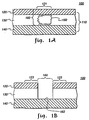
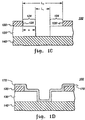
- Figures 1(A) - 1(D) are cross-sectional views illustrating steps in the repair of a defect in an imager device in accordance with this invention.
- a partially-fabricated thin film electronic imager device 100 typically comprises a imaging array 110 (also referred to as a photosensor array), a pertinent portion of which is illustrated in Figure 1.
- Array 110 comprises components (not individually shown) such as photodiodes, address lines, and switching devices (such as thin film transistors) that are arranged to generate an electrical signal in response to incident optical photons that pass from a scintillator (not shown) that is optically coupled to array 110 at a later stage in the fabrication process.
- an upper conductive layer 120 (also referred to as common electrode 120) is disposed over a dielectric material layer 130 that is in turn disposed to electrically insulate upper conductive layer 120 from an underlying component 140.
- Common electrode 120 provides a common contact to a plurality of photodiodes (not shown) or the like and thus is disposed over substantially the entire imaging array, overlying substantially every component in the imaging array.
- Common electrode comprises an electrically conductive material that is also light transmissive so as to allow optical photons to pass from the scintillator to the photosensors; typically the material is a transparent conducting oxide such as indium-tin oxide, gallium-tin oxide, tin oxide, or the like.
- Dielectric layer 130 typically comprises an organic dielectric such as polyimide or the like that is deposited in a spin process to a thickness in the range between 1 ⁇ m and 2 ⁇ m.
- dielectric layer 130 comprises an inorganic dielectric material such as silicon nitride or silicon oxide.
- Dielectric layer 130 extends across array 110 to form a region in which common electrode 120 is electrically insulated from underlying components in the array except at contact points on the photodiode, at which points dielectric layer material is removed so that the conductive material of common electrode 120 is disposed in electrical contact with a surface of the photodiode.
- underlying component 140 illustrates a conductive material in the array, such as address line, a transistor electrode, or the like.
- "underlying” refers to a component that is formed in the fabrication process prior to the deposition of the common electrode 120, and thus is disposed on a different level of the sandwich of materials that are deposited to fabricate the components for the imager device. No restriction on the orientation of the device is to be implied by the terminology relating to levels of the components.
- Underlying component 140 typically comprises a conductive material such as aluminum, gold, titanium, molybdenum or the like, or a heavily doped semiconductive material (such as n+ type doped amorphous silicon).
- component 140 may comprise a layer of semiconductive material, such as the amorphous silicon comprising the photodiode body.
- Figure 1(A) illustrates imager device 100 at a stage in the fabrication process following deposition of the common electrode and prior to the mating of the scintillator to imaging array 110.
- imaging array 110 final checks are made of imaging array 110 to locate electrical defects; arrays that are not repairable to maintain a satisfactory performance must be rejected.
- Electrical defects include electrical short circuits between underlying components in the array, such as between address lines, between address lines and switching transistors, or between the common electrode and underlying components. Open circuit conditions can also occur which require repair and removal of portions of the earlier-deposited components in the array. Each of these repair iterations, however, necessarily incur breaching common electrode 120 to remove a shorted portion of the common electrode or to gain access to defects in underlying components.
- a defect 150 is shown in Figure 1(A) that comprises a piece of conductive material debris that presents a short circuit between common electrode 120 and underlying component 140.
- the illustration of defect 150 is made by way of example and not limitation, and defect 150 is representative of any short circuit condition; further, if defect 150 (or any other type of defect requiring repair) is disposed between other underlying components, the same repair procedures are used to remove the portion of common electrode 120 overlying the defect and produce a low leakage repaired structure.
- the short-circuit defect in imager array 110 is repaired by removing a first portion 121 of common electrode at a repair site (or defect region) 160 on imager array 110.
- a repair site or defect region 160 on imager array 110.
- laser ablation is used to remove common electrode first portion 121.
- an excimer laser operated at low power provides a finely-focused beam that is very effective in ablating the conductive material of common electrode 120 without simultaneously ablating other components in the array or causing such a rapid vaporization of the transparent conducting oxide that results in conductive residue being driven into underlying dielectric layer 130.
- the low power used to remove common electrode first portion 121 is typically in the range between about 50 microJoules ( ⁇ J) and 60 ⁇ J, which is about 15 % of full power in a LCM 308 model excimer laser. Operation of the laser at lower power may necessitate several passes over repair site 160 to completely remove the conductive material of common electrode 120 in the repair area.
- defect 150 and surrounding portions of dielectric layer 130 are then removed.
- Laser ablation is typically used to effect this removal, such as with an excimer laser operated at higher power than that used for removal of the common electrode material (e.g., at power levels in the range between 250 ⁇ J and 350 ⁇ J).
- Laser ablation typically allows fine resolution in removing material from the array (that is, the beam can be focused to an area of about 3 microns square so that the defect can be excised with minimal removal of material surrounding the defect region).
- Laser ablation also typically results in relatively smooth vertical sidewalls in repair site 160.
- the repair region of imager array 110 appears as illustrated in Figure 1(B).
- removal of the defect results in repair site 160 having a bottom surface 162 comprising the conductive material of underlying component 140.
- a second portion 123 of common electrode 120 is removed to form an intermediate step level 124 ( Figure 1(C)) around the periphery of repair site 160.
- the surface of intermediate level step 124 comprises the dielectric material of dielectric layer 130, that is, the conductive material of common electrode 120 is removed to expose the dielectric material.
- the lateral dimension L 1 of bottom.surface 162 is less than the lateral dimension L 2 of the intermediate step level such that the width W of step 124 is greater than 1 ⁇ m, and typically is in the range between about 1 ⁇ m and 3 ⁇ m.
- Laser ablation using the low power levels noted above, is used to remove common electrode second portion 123 to optimize the ablation while reducing the conductive material driven into underlying dielectric layer 130.
- the setback of common electrode sidewalls 125 from dielectric layer sidewalls 164 in repair site 160 serves to reduce possible paths for electrical leakage between common electrode 120 and underlying component 140.
- leakage For many imager arrays (such as those used in medical imaging), it is desirable that leakage be less than 100 pA in order to minimize array noise.
- Data from repaired wafers indicate that for repairs conducted in the conventional manner, that is, without the set-back of the common electrode material around the repair site, only about one-half of the wafers exhibit leakage of 100 pA or less; for wafers repaired in accordance with this invention, about 95% of the wafers exhibit leakage of 100 pA or less. This reduction of leakage is critical in high resolution x-ray imagers used in medical applications, and can constitute the difference between acceptance or rejection of a repaired imaging array 110 for use in a radiation imaging device.
- a passivation layer 170 is formed over the repaired area to enhance the long term low-leakage characteristics of repair site 160.
- Passivation layer 170 comprises a dielectric material such as, silicon nitride, silicon oxide, or the like, which is deposited in a plasma enhanced vapor deposition process to a thickness of about 1500 angstroms.
- the procedure of this invention thus enables a completed imager array 110 to be repaired while maintaining low electrical leakage between common electrode 120 and underlying component 140.
- the procedure of this invention is applicable to any repair procedure requiring breaching common electrode 120 to gain access to underlying components (wherever such components are located in layers of the array), thereby allowing repair of an imaging array after final assembly, resulting in increased yields of devices from the fabrication process.
Landscapes
- Solid State Image Pick-Up Elements (AREA)
- Photo Coupler, Interrupter, Optical-To-Optical Conversion Devices (AREA)
Claims (16)
- Dispositif électronique (100) de formation d'image à couches minces, comprenant :ledit site de réparation comprenant :une couche supérieure conductrice (120) disposée dans un premier niveau et comprenant un matériau de type oxyde conducteur, transparent,un composant conducteur sous-jacent (140) placé dans un deuxième niveau,une couche (130) de matériau diélectrique placée entre ledit composant sous-jacent et ladite couche supérieure conductrice dans une région isolée du point de vue électrique, etun site de réparation (160) dans ladite région isolée du point de vue électrique dudit dispositif où ladite couche supérieure conductrice est isolée du point de vue électrique dudit composant sous-jacent,un niveau inférieur avec une surface (162) qui comprend le matériau du composant conducteur sous-jacent, ledit niveau inférieur ayant une première dimension latérale (L1),un niveau formant marche intermédiaire (124) avec une surface qui comprend le matériau de la couche diélectrique, ledit niveau formant marche intermédiaire ayant une deuxième dimension latérale (L2), ladite deuxième dimension latérale étant supérieure à ladite première dimension latérale de sorte que ladite couche supérieure conductrice est en retrait par rapport à une paroi latérale s'étendant entre la surface du niveau formant marche intermédiaire et la surface du niveau inférieur, etune couche de passivation (170) disposée sur ledit site de réparation (160), ladite couche supérieure conductrice (120) et ladite couche diélectrique (130).
- Dispositif selon la revendication 1, dans lequel ledit niveau formant marche intermédiaire s'étend autour de la périphérie dudit site de réparation.
- Dispositif selon la revendication 2, dans lequel la largeur de la surface dudit niveau formant marche intermédiaire est comprise entre 1 µm et 3 µm.
- Dispositif selon la revendication 1, dans lequel ladite paroi latérale s'étendant entre la surface dudit niveau formant marche intermédiaire et ladite surface du niveau inférieur comprend ledit matériau diélectrique.
- Dispositif selon la revendication 1, dans lequel ladite couche de matériau diélectrique comprend un matériau choisi dans le groupe formé par les polyimides, le nitrure de silicium et l'oxyde de silicium.
- Dispositif selon la revendication 1, dans lequel ladite couche supérieure conductrice comprend un matériau choisi dans le groupe formé par l'oxyde d'indium et d'étain, l'oxyde de gallium et d'étain et l'oxyde d'étain.
- Dispositif selon la revendication 1, dans lequel ledit composant sous-jacent comprend un matériau électro-conducteur.
- Procédé de réparation d'un défaut (150) dans un dispositif électronique (100) de formation d'image à couches minces, entre une couche supérieure conductrice (120) et un composant sous-jacent électro-conducteur (140) placés dans le dispositif de manière à limiter les fuites électriques entre la couche supérieure conductrice et le composant sous-jacent électro-conducteur, le procédé comprenant les étapes consistant à :retirer une première partie (121) de ladite couche supérieure conductrice au niveau d'un site de réparation (160),retirer une région défectueuse (150) au niveau dudit site de réparation dans une couche diélectrique (130) placée sous ladite couche supérieure conductrice afin d'exciser ledit défaut,retirer une deuxième partie (123) de ladite couche supérieure conductrice autour de la périphérie de ladite région défectueuse afin de former une marche intermédiaire (124) dans ladite couche diélectrique entre ladite couche supérieure conductrice et ladite région défectueuse, de sorte que ladite couche supérieure conductrice est en retrait par rapport à une paroi latérale délimitant ladite région défectueuse, si bien que ladite couche supérieure conductrice est isolée du point de vue électrique dudit composant sous-jacent électro-conducteur afin de réduire les fuites électriques entre eux, etdéposer une couche de passivation sur ladite couche supérieure conductrice, ladite marche intermédiaire dans ladite couche diélectrique et ledit site de réparation.
- Procédé selon la revendication 8, dans lequel ladite étape consistant à retirer une première partie de ladite couche supérieure conductrice au niveau dudit site de réparation comprend l'étape consistant à faire une ablation au laser du matériau de la couche supérieure conductrice situé au-dessus de ladite région défectueuse.
- Procédé selon la revendication 9, dans lequel ledit laser est un laser excimer.
- Procédé selon la revendication 10, dans lequel ladite étape consistant à retirer ladite région défectueuse comprend l'étape consistant à réaliser une ablation du matériau dans ledit composant sous-jacent afin de retirer ledit défaut.
- Procédé selon la revendication 11, dans lequel ladite étape consistant à retirer ladite région défectueuse comprend en outre l'étape consistant à retirer un matériau non conducteur disposé dans ladite couche diélectrique entre ladite couche supérieure conductrice et ledit composant sous-jacent électro-conducteur.
- Procédé selon la revendication 12, dans lequel ladite étape consistant à retirer une deuxième partie de ladite couche supérieure conductrice comprend l'étape consistant à faire une ablation au laser de ladite deuxième partie afin de former ladite marche intermédiaire.
- Procédé selon la revendication 12, dans lequel la largeur de ladite marche intermédiaire est comprise entre environ 1 µm et 3 µm.
- Procédé selon la revendication 10, dans lequel ladite couche supérieure conductrice comprend un matériau choisi dans le groupe formé par l'oxyde d'indium et d'étain, l'oxyde de gallium et d'étain et l'oxyde d'étain.
- Procédé selon la revendication 15, dans lequel ladite étape consistant à retirer une première partie de ladite couche supérieure conductrice comprend le fait de faire passer ledit laser sur ladite première partie de multiples fois, avec une puissance d'un niveau inférieur à environ 60 µJ.
Applications Claiming Priority (2)
| Application Number | Priority Date | Filing Date | Title |
|---|---|---|---|
| US08/280,970 US5648296A (en) | 1994-07-27 | 1994-07-27 | Post-fabrication repair method for thin film imager devices |
| US280970 | 1994-07-27 |
Publications (2)
| Publication Number | Publication Date |
|---|---|
| EP0694975A1 EP0694975A1 (fr) | 1996-01-31 |
| EP0694975B1 true EP0694975B1 (fr) | 1998-10-07 |
Family
ID=23075415
Family Applications (1)
| Application Number | Title | Priority Date | Filing Date |
|---|---|---|---|
| EP95304925A Expired - Lifetime EP0694975B1 (fr) | 1994-07-27 | 1995-07-13 | Structure avec réparation après fabrication et procédé pour des dispositifs d'images à couches minces |
Country Status (4)
| Country | Link |
|---|---|
| US (2) | US5648296A (fr) |
| EP (1) | EP0694975B1 (fr) |
| JP (1) | JPH08191142A (fr) |
| DE (1) | DE69505206T2 (fr) |
Families Citing this family (12)
| Publication number | Priority date | Publication date | Assignee | Title |
|---|---|---|---|---|
| US5834321A (en) * | 1995-12-18 | 1998-11-10 | General Electric Company | Low noise address line repair method for thin film imager devices |
| US5976978A (en) * | 1997-12-22 | 1999-11-02 | General Electric Company | Process for repairing data transmission lines of imagers |
| US6696366B1 (en) * | 1998-08-17 | 2004-02-24 | Lam Research Corporation | Technique for etching a low capacitance dielectric layer |
| WO2003039217A1 (fr) * | 2001-11-02 | 2003-05-08 | Atmel Germany Gmbh | Procede pour ouvrir le boitier en plastique d'un module electronique |
| US20040266054A1 (en) * | 2003-06-30 | 2004-12-30 | Brazis Paul W. | OFET channel fabrication |
| US7566346B2 (en) * | 2004-10-29 | 2009-07-28 | X-Spine Systems, Inc. | Prosthetic implant and method |
| US20060154393A1 (en) * | 2005-01-11 | 2006-07-13 | Doan Trung T | Systems and methods for removing operating heat from a light emitting diode |
| US20060151801A1 (en) * | 2005-01-11 | 2006-07-13 | Doan Trung T | Light emitting diode with thermo-electric cooler |
| JP4919146B2 (ja) * | 2005-09-27 | 2012-04-18 | 独立行政法人産業技術総合研究所 | スイッチング素子 |
| JP5120874B2 (ja) * | 2007-06-22 | 2013-01-16 | 株式会社船井電機新応用技術研究所 | スイッチング素子 |
| JP2010185928A (ja) * | 2009-02-10 | 2010-08-26 | Sony Corp | 表示装置の製造方法および表示装置 |
| KR20130046847A (ko) * | 2011-10-28 | 2013-05-08 | 삼성디스플레이 주식회사 | 표시기판 및 표시기판의 수리 방법 |
Family Cites Families (18)
| Publication number | Priority date | Publication date | Assignee | Title |
|---|---|---|---|---|
| JPS56131975A (en) * | 1980-03-19 | 1981-10-15 | Matsushita Electric Ind Co Ltd | Manufacture of solid image photographing plate |
| US4688896A (en) * | 1985-03-04 | 1987-08-25 | General Electric Company | Information conversion device with auxiliary address lines for enhancing manufacturing yield |
| JPS62150847A (ja) * | 1985-12-25 | 1987-07-04 | Hitachi Ltd | 配線接続方法 |
| EP0236936A3 (fr) * | 1986-03-11 | 1989-03-29 | Siemens Aktiengesellschaft | Procédé pour éliminer les courts-circuits pendant la production de composants électriques, de préférence pour des cellules solaires au silicium amorphe |
| US4803536A (en) * | 1986-10-24 | 1989-02-07 | Xerox Corporation | Electrostatic discharge protection network for large area transducer arrays |
| US5141898A (en) * | 1988-02-02 | 1992-08-25 | Analog Devices, Incorporated | Integrated circuit with means for reducing ESD damage |
| JP2708451B2 (ja) * | 1988-03-16 | 1998-02-04 | 株式会社日立製作所 | エネルギビームを用いた加工方法 |
| US5055416A (en) * | 1988-12-07 | 1991-10-08 | Minnesota Mining And Manufacturing Company | Electrolytic etch for preventing electrical shorts in solar cells on polymer surfaces |
| US5019002A (en) * | 1989-07-12 | 1991-05-28 | Honeywell, Inc. | Method of manufacturing flat panel backplanes including electrostatic discharge prevention and displays made thereby |
| US5195010A (en) * | 1990-01-23 | 1993-03-16 | Thomson, S.A. | Electrostatic discharge voltage protection circuit for a solid state instrument |
| FR2663784B1 (fr) * | 1990-06-26 | 1997-01-31 | Commissariat Energie Atomique | Procede de realisation d'un etage d'un circuit integre. |
| US5281541A (en) * | 1990-09-07 | 1994-01-25 | Canon Kabushiki Kaisha | Method for repairing an electrically short-circuited semiconductor device, and process for producing a semiconductor device utilizing said method |
| US5303074A (en) * | 1991-04-29 | 1994-04-12 | General Electric Company | Embedded repair lines for thin film electronic display or imager devices |
| US5313319A (en) * | 1992-06-17 | 1994-05-17 | General Electric Company | Active array static protection devices |
| US5302547A (en) * | 1993-02-08 | 1994-04-12 | General Electric Company | Systems for patterning dielectrics by laser ablation |
| US5518956A (en) * | 1993-09-02 | 1996-05-21 | General Electric Company | Method of isolating vertical shorts in an electronic array using laser ablation |
| US5475246A (en) * | 1993-12-20 | 1995-12-12 | General Electric Company | Repair line structure for thin film electronic devices |
| WO1995017768A1 (fr) * | 1993-12-20 | 1995-06-29 | General Electronic Company | Procede et structure de reparation de ligne d'adresse pour dispositifs de formation d'images a couche mince. |
-
1994
- 1994-07-27 US US08/280,970 patent/US5648296A/en not_active Expired - Fee Related
-
1995
- 1995-07-13 EP EP95304925A patent/EP0694975B1/fr not_active Expired - Lifetime
- 1995-07-13 DE DE69505206T patent/DE69505206T2/de not_active Expired - Fee Related
- 1995-07-20 JP JP18369495A patent/JPH08191142A/ja not_active Withdrawn
-
1997
- 1997-01-21 US US08/786,813 patent/US5736758A/en not_active Expired - Fee Related
Also Published As
| Publication number | Publication date |
|---|---|
| JPH08191142A (ja) | 1996-07-23 |
| US5648296A (en) | 1997-07-15 |
| DE69505206D1 (de) | 1998-11-12 |
| US5736758A (en) | 1998-04-07 |
| DE69505206T2 (de) | 1999-06-17 |
| EP0694975A1 (fr) | 1996-01-31 |
Similar Documents
| Publication | Publication Date | Title |
|---|---|---|
| US6259494B1 (en) | Repairable thin film transistor matrix substrate having overlapping regions between auxiliary capacitance electrodes and drain bus | |
| US6740884B2 (en) | Imaging array and methods for fabricating same | |
| US6982768B2 (en) | Liquid crystal display device | |
| EP0685113B1 (fr) | Procede de reparation d'un ligne conducteur d'un dispositif de formation d'images ou d'un dispositif d'affichage a couche mince et structure fabriquee par ce procede | |
| US5475246A (en) | Repair line structure for thin film electronic devices | |
| EP0694975B1 (fr) | Structure avec réparation après fabrication et procédé pour des dispositifs d'images à couches minces | |
| US5552607A (en) | Imager device with integral address line repair segments | |
| US6724010B1 (en) | Solid state imager having gated photodiodes and method for making same | |
| EP0780720B1 (fr) | Méthode de réparation de lignes métalliques à faible bruit pour dispositifs d'imagerie à couche mince | |
| EP1351310A2 (fr) | Matrice d'imagerie et son procédé de fabrication | |
| US5976978A (en) | Process for repairing data transmission lines of imagers | |
| US5834321A (en) | Low noise address line repair method for thin film imager devices | |
| US6465286B2 (en) | Method of fabricating an imager array | |
| US7323372B2 (en) | Method and process intermediate for electrostatic discharge protection in flat panel imaging detectors | |
| EP1181722A1 (fr) | Structure de ligne de donnees a faible bruit et haut rendement pour imageur | |
| JP2003249635A (ja) | X線撮像装置 |
Legal Events
| Date | Code | Title | Description |
|---|---|---|---|
| PUAI | Public reference made under article 153(3) epc to a published international application that has entered the european phase |
Free format text: ORIGINAL CODE: 0009012 |
|
| AK | Designated contracting states |
Kind code of ref document: A1 Designated state(s): DE FR NL |
|
| 17P | Request for examination filed |
Effective date: 19960731 |
|
| 17Q | First examination report despatched |
Effective date: 19970523 |
|
| GRAG | Despatch of communication of intention to grant |
Free format text: ORIGINAL CODE: EPIDOS AGRA |
|
| GRAG | Despatch of communication of intention to grant |
Free format text: ORIGINAL CODE: EPIDOS AGRA |
|
| GRAH | Despatch of communication of intention to grant a patent |
Free format text: ORIGINAL CODE: EPIDOS IGRA |
|
| GRAH | Despatch of communication of intention to grant a patent |
Free format text: ORIGINAL CODE: EPIDOS IGRA |
|
| GRAA | (expected) grant |
Free format text: ORIGINAL CODE: 0009210 |
|
| AK | Designated contracting states |
Kind code of ref document: B1 Designated state(s): DE FR NL |
|
| REF | Corresponds to: |
Ref document number: 69505206 Country of ref document: DE Date of ref document: 19981112 |
|
| ET | Fr: translation filed | ||
| PLBE | No opposition filed within time limit |
Free format text: ORIGINAL CODE: 0009261 |
|
| STAA | Information on the status of an ep patent application or granted ep patent |
Free format text: STATUS: NO OPPOSITION FILED WITHIN TIME LIMIT |
|
| 26N | No opposition filed | ||
| PGFP | Annual fee paid to national office [announced via postgrant information from national office to epo] |
Ref country code: NL Payment date: 20040616 Year of fee payment: 10 |
|
| PGFP | Annual fee paid to national office [announced via postgrant information from national office to epo] |
Ref country code: FR Payment date: 20040720 Year of fee payment: 10 |
|
| PGFP | Annual fee paid to national office [announced via postgrant information from national office to epo] |
Ref country code: DE Payment date: 20040831 Year of fee payment: 10 |
|
| PG25 | Lapsed in a contracting state [announced via postgrant information from national office to epo] |
Ref country code: NL Free format text: LAPSE BECAUSE OF NON-PAYMENT OF DUE FEES Effective date: 20060201 Ref country code: DE Free format text: LAPSE BECAUSE OF NON-PAYMENT OF DUE FEES Effective date: 20060201 |
|
| PG25 | Lapsed in a contracting state [announced via postgrant information from national office to epo] |
Ref country code: FR Free format text: LAPSE BECAUSE OF NON-PAYMENT OF DUE FEES Effective date: 20060331 |
|
| NLV4 | Nl: lapsed or anulled due to non-payment of the annual fee |
Effective date: 20060201 |
|
| REG | Reference to a national code |
Ref country code: FR Ref legal event code: ST Effective date: 20060331 |