EP0695800A2 - Waschmittel - Google Patents
Waschmittel Download PDFInfo
- Publication number
- EP0695800A2 EP0695800A2 EP95111313A EP95111313A EP0695800A2 EP 0695800 A2 EP0695800 A2 EP 0695800A2 EP 95111313 A EP95111313 A EP 95111313A EP 95111313 A EP95111313 A EP 95111313A EP 0695800 A2 EP0695800 A2 EP 0695800A2
- Authority
- EP
- European Patent Office
- Prior art keywords
- kanemite
- sodium
- weight
- adsorbed
- napc
- Prior art date
- Legal status (The legal status is an assumption and is not a legal conclusion. Google has not performed a legal analysis and makes no representation as to the accuracy of the status listed.)
- Withdrawn
Links
- 238000005406 washing Methods 0.000 title claims abstract description 22
- 239000000203 mixture Substances 0.000 title claims description 19
- VTIIJXUACCWYHX-UHFFFAOYSA-L disodium;carboxylatooxy carbonate Chemical compound [Na+].[Na+].[O-]C(=O)OOC([O-])=O VTIIJXUACCWYHX-UHFFFAOYSA-L 0.000 claims abstract description 17
- 229940045872 sodium percarbonate Drugs 0.000 claims abstract description 17
- MHAJPDPJQMAIIY-UHFFFAOYSA-N Hydrogen peroxide Chemical compound OO MHAJPDPJQMAIIY-UHFFFAOYSA-N 0.000 claims abstract description 12
- CDBYLPFSWZWCQE-UHFFFAOYSA-L Sodium Carbonate Chemical compound [Na+].[Na+].[O-]C([O-])=O CDBYLPFSWZWCQE-UHFFFAOYSA-L 0.000 claims abstract description 12
- XLYOFNOQVPJJNP-UHFFFAOYSA-N water Substances O XLYOFNOQVPJJNP-UHFFFAOYSA-N 0.000 claims abstract description 12
- 229910021527 natrosilite Inorganic materials 0.000 claims abstract description 11
- 239000011734 sodium Substances 0.000 claims abstract description 10
- UIIMBOGNXHQVGW-UHFFFAOYSA-M Sodium bicarbonate Chemical compound [Na+].OC([O-])=O UIIMBOGNXHQVGW-UHFFFAOYSA-M 0.000 claims abstract description 8
- 229910000029 sodium carbonate Inorganic materials 0.000 claims abstract description 6
- 239000004094 surface-active agent Substances 0.000 claims abstract description 6
- 102000004190 Enzymes Human genes 0.000 claims abstract description 5
- 108090000790 Enzymes Proteins 0.000 claims abstract description 5
- 230000003287 optical effect Effects 0.000 claims abstract description 5
- 229910000030 sodium bicarbonate Inorganic materials 0.000 claims abstract description 4
- 235000017557 sodium bicarbonate Nutrition 0.000 claims abstract description 4
- 238000001035 drying Methods 0.000 claims abstract description 3
- 239000003599 detergent Substances 0.000 claims description 22
- 239000004115 Sodium Silicate Substances 0.000 claims description 9
- CURLTUGMZLYLDI-UHFFFAOYSA-N Carbon dioxide Chemical compound O=C=O CURLTUGMZLYLDI-UHFFFAOYSA-N 0.000 claims description 8
- NTHWMYGWWRZVTN-UHFFFAOYSA-N sodium silicate Chemical compound [Na+].[Na+].[O-][Si]([O-])=O NTHWMYGWWRZVTN-UHFFFAOYSA-N 0.000 claims description 8
- 229910052911 sodium silicate Inorganic materials 0.000 claims description 8
- 229910052708 sodium Inorganic materials 0.000 claims description 6
- 229910002092 carbon dioxide Inorganic materials 0.000 claims description 4
- DGAQECJNVWCQMB-PUAWFVPOSA-M Ilexoside XXIX Chemical compound C[C@@H]1CC[C@@]2(CC[C@@]3(C(=CC[C@H]4[C@]3(CC[C@@H]5[C@@]4(CC[C@@H](C5(C)C)OS(=O)(=O)[O-])C)C)[C@@H]2[C@]1(C)O)C)C(=O)O[C@H]6[C@@H]([C@H]([C@@H]([C@H](O6)CO)O)O)O.[Na+] DGAQECJNVWCQMB-PUAWFVPOSA-M 0.000 claims description 3
- 239000001569 carbon dioxide Substances 0.000 claims description 3
- VUZPPFZMUPKLLV-UHFFFAOYSA-N methane;hydrate Chemical compound C.O VUZPPFZMUPKLLV-UHFFFAOYSA-N 0.000 claims description 2
- 238000003756 stirring Methods 0.000 claims description 2
- 239000003795 chemical substances by application Substances 0.000 abstract description 3
- 238000005507 spraying Methods 0.000 abstract description 2
- BPQQTUXANYXVAA-UHFFFAOYSA-N Orthosilicate Chemical compound [O-][Si]([O-])([O-])[O-] BPQQTUXANYXVAA-UHFFFAOYSA-N 0.000 abstract 3
- 238000013019 agitation Methods 0.000 abstract 2
- 235000017550 sodium carbonate Nutrition 0.000 abstract 1
- MWNQXXOSWHCCOZ-UHFFFAOYSA-L sodium;oxido carbonate Chemical compound [Na+].[O-]OC([O-])=O MWNQXXOSWHCCOZ-UHFFFAOYSA-L 0.000 abstract 1
- 229920000742 Cotton Polymers 0.000 description 9
- 239000004744 fabric Substances 0.000 description 9
- 238000012360 testing method Methods 0.000 description 9
- 125000004432 carbon atom Chemical group C* 0.000 description 7
- 150000003839 salts Chemical class 0.000 description 7
- 239000002253 acid Substances 0.000 description 5
- -1 aromatic sulfonates Chemical class 0.000 description 5
- 238000004061 bleaching Methods 0.000 description 5
- 238000009826 distribution Methods 0.000 description 5
- 238000000034 method Methods 0.000 description 5
- 239000002245 particle Substances 0.000 description 5
- 230000000694 effects Effects 0.000 description 4
- 238000003860 storage Methods 0.000 description 4
- QTBSBXVTEAMEQO-UHFFFAOYSA-N Acetic acid Chemical compound CC(O)=O QTBSBXVTEAMEQO-UHFFFAOYSA-N 0.000 description 3
- UHOVQNZJYSORNB-UHFFFAOYSA-N Benzene Chemical compound C1=CC=CC=C1 UHOVQNZJYSORNB-UHFFFAOYSA-N 0.000 description 3
- IAYPIBMASNFSPL-UHFFFAOYSA-N Ethylene oxide Chemical compound C1CO1 IAYPIBMASNFSPL-UHFFFAOYSA-N 0.000 description 3
- YXFVVABEGXRONW-UHFFFAOYSA-N Toluene Chemical compound CC1=CC=CC=C1 YXFVVABEGXRONW-UHFFFAOYSA-N 0.000 description 3
- 150000007513 acids Chemical class 0.000 description 3
- 239000003513 alkali Substances 0.000 description 3
- 239000003945 anionic surfactant Substances 0.000 description 3
- QVGXLLKOCUKJST-UHFFFAOYSA-N atomic oxygen Chemical compound [O] QVGXLLKOCUKJST-UHFFFAOYSA-N 0.000 description 3
- 239000007844 bleaching agent Substances 0.000 description 3
- KRKNYBCHXYNGOX-UHFFFAOYSA-N citric acid Chemical compound OC(=O)CC(O)(C(O)=O)CC(O)=O KRKNYBCHXYNGOX-UHFFFAOYSA-N 0.000 description 3
- 239000007859 condensation product Substances 0.000 description 3
- 235000014113 dietary fatty acids Nutrition 0.000 description 3
- 229940088598 enzyme Drugs 0.000 description 3
- 239000000194 fatty acid Substances 0.000 description 3
- 229930195729 fatty acid Natural products 0.000 description 3
- 150000004665 fatty acids Chemical class 0.000 description 3
- 238000009472 formulation Methods 0.000 description 3
- 229910052760 oxygen Inorganic materials 0.000 description 3
- 239000001301 oxygen Substances 0.000 description 3
- 230000008569 process Effects 0.000 description 3
- ZLMJMSJWJFRBEC-UHFFFAOYSA-N Potassium Chemical compound [K] ZLMJMSJWJFRBEC-UHFFFAOYSA-N 0.000 description 2
- GOOHAUXETOMSMM-UHFFFAOYSA-N Propylene oxide Chemical compound CC1CO1 GOOHAUXETOMSMM-UHFFFAOYSA-N 0.000 description 2
- QAOWNCQODCNURD-UHFFFAOYSA-N Sulfuric acid Chemical class OS(O)(=O)=O QAOWNCQODCNURD-UHFFFAOYSA-N 0.000 description 2
- 239000007795 chemical reaction product Substances 0.000 description 2
- 239000008139 complexing agent Substances 0.000 description 2
- 150000001875 compounds Chemical class 0.000 description 2
- 150000002191 fatty alcohols Chemical class 0.000 description 2
- 238000011065 in-situ storage Methods 0.000 description 2
- 239000004615 ingredient Substances 0.000 description 2
- JVTAAEKCZFNVCJ-UHFFFAOYSA-N lactic acid Chemical compound CC(O)C(O)=O JVTAAEKCZFNVCJ-UHFFFAOYSA-N 0.000 description 2
- 238000002156 mixing Methods 0.000 description 2
- 239000002736 nonionic surfactant Substances 0.000 description 2
- 239000003921 oil Substances 0.000 description 2
- 229920000728 polyester Polymers 0.000 description 2
- 229910052700 potassium Inorganic materials 0.000 description 2
- 239000011591 potassium Substances 0.000 description 2
- 239000000047 product Substances 0.000 description 2
- 239000000344 soap Substances 0.000 description 2
- 239000007787 solid Substances 0.000 description 2
- 239000007921 spray Substances 0.000 description 2
- JIRHAGAOHOYLNO-UHFFFAOYSA-N (3-cyclopentyloxy-4-methoxyphenyl)methanol Chemical compound COC1=CC=C(CO)C=C1OC1CCCC1 JIRHAGAOHOYLNO-UHFFFAOYSA-N 0.000 description 1
- ZPFAVCIQZKRBGF-UHFFFAOYSA-N 1,3,2-dioxathiolane 2,2-dioxide Chemical compound O=S1(=O)OCCO1 ZPFAVCIQZKRBGF-UHFFFAOYSA-N 0.000 description 1
- FJLUATLTXUNBOT-UHFFFAOYSA-N 1-Hexadecylamine Chemical compound CCCCCCCCCCCCCCCCN FJLUATLTXUNBOT-UHFFFAOYSA-N 0.000 description 1
- URDCARMUOSMFFI-UHFFFAOYSA-N 2-[2-[bis(carboxymethyl)amino]ethyl-(2-hydroxyethyl)amino]acetic acid Chemical compound OCCN(CC(O)=O)CCN(CC(O)=O)CC(O)=O URDCARMUOSMFFI-UHFFFAOYSA-N 0.000 description 1
- ZMPRRFPMMJQXPP-UHFFFAOYSA-N 2-sulfobenzoic acid Chemical compound OC(=O)C1=CC=CC=C1S(O)(=O)=O ZMPRRFPMMJQXPP-UHFFFAOYSA-N 0.000 description 1
- LIFHMKCDDVTICL-UHFFFAOYSA-N 6-(chloromethyl)phenanthridine Chemical compound C1=CC=C2C(CCl)=NC3=CC=CC=C3C2=C1 LIFHMKCDDVTICL-UHFFFAOYSA-N 0.000 description 1
- 102000013142 Amylases Human genes 0.000 description 1
- 108010065511 Amylases Proteins 0.000 description 1
- 235000021537 Beetroot Nutrition 0.000 description 1
- BVKZGUZCCUSVTD-UHFFFAOYSA-M Bicarbonate Chemical class OC([O-])=O BVKZGUZCCUSVTD-UHFFFAOYSA-M 0.000 description 1
- 235000011293 Brassica napus Nutrition 0.000 description 1
- 240000008100 Brassica rapa Species 0.000 description 1
- 235000000540 Brassica rapa subsp rapa Nutrition 0.000 description 1
- 229920002134 Carboxymethyl cellulose Polymers 0.000 description 1
- 244000060011 Cocos nucifera Species 0.000 description 1
- 235000013162 Cocos nucifera Nutrition 0.000 description 1
- FEWJPZIEWOKRBE-JCYAYHJZSA-N Dextrotartaric acid Chemical compound OC(=O)[C@H](O)[C@@H](O)C(O)=O FEWJPZIEWOKRBE-JCYAYHJZSA-N 0.000 description 1
- 206010013786 Dry skin Diseases 0.000 description 1
- KCXVZYZYPLLWCC-UHFFFAOYSA-N EDTA Chemical compound OC(=O)CN(CC(O)=O)CCN(CC(O)=O)CC(O)=O KCXVZYZYPLLWCC-UHFFFAOYSA-N 0.000 description 1
- PIICEJLVQHRZGT-UHFFFAOYSA-N Ethylenediamine Chemical compound NCCN PIICEJLVQHRZGT-UHFFFAOYSA-N 0.000 description 1
- DBVJJBKOTRCVKF-UHFFFAOYSA-N Etidronic acid Chemical compound OP(=O)(O)C(O)(C)P(O)(O)=O DBVJJBKOTRCVKF-UHFFFAOYSA-N 0.000 description 1
- 102000004882 Lipase Human genes 0.000 description 1
- 108090001060 Lipase Proteins 0.000 description 1
- 239000004367 Lipase Substances 0.000 description 1
- 239000007832 Na2SO4 Substances 0.000 description 1
- 102000035195 Peptidases Human genes 0.000 description 1
- 108091005804 Peptidases Proteins 0.000 description 1
- 239000004365 Protease Substances 0.000 description 1
- PMZURENOXWZQFD-UHFFFAOYSA-L Sodium Sulfate Chemical compound [Na+].[Na+].[O-]S([O-])(=O)=O PMZURENOXWZQFD-UHFFFAOYSA-L 0.000 description 1
- 229920002472 Starch Polymers 0.000 description 1
- FEWJPZIEWOKRBE-UHFFFAOYSA-N Tartaric acid Natural products [H+].[H+].[O-]C(=O)C(O)C(O)C([O-])=O FEWJPZIEWOKRBE-UHFFFAOYSA-N 0.000 description 1
- 244000269722 Thea sinensis Species 0.000 description 1
- 229910021536 Zeolite Inorganic materials 0.000 description 1
- ZUBJEHHGZYTRPH-KTKRTIGZSA-N [(z)-octadec-9-enyl] hydrogen sulfate Chemical compound CCCCCCCC\C=C/CCCCCCCCOS(O)(=O)=O ZUBJEHHGZYTRPH-KTKRTIGZSA-N 0.000 description 1
- 235000011054 acetic acid Nutrition 0.000 description 1
- 230000009471 action Effects 0.000 description 1
- 125000001931 aliphatic group Chemical group 0.000 description 1
- 150000001447 alkali salts Chemical class 0.000 description 1
- 125000002947 alkylene group Chemical class 0.000 description 1
- 150000003863 ammonium salts Chemical class 0.000 description 1
- 235000019418 amylase Nutrition 0.000 description 1
- 229940025131 amylases Drugs 0.000 description 1
- 125000000129 anionic group Chemical group 0.000 description 1
- 239000007864 aqueous solution Substances 0.000 description 1
- 244000052616 bacterial pathogen Species 0.000 description 1
- 230000008901 benefit Effects 0.000 description 1
- KGBXLFKZBHKPEV-UHFFFAOYSA-N boric acid Chemical class OB(O)O KGBXLFKZBHKPEV-UHFFFAOYSA-N 0.000 description 1
- 239000004327 boric acid Chemical class 0.000 description 1
- 150000004649 carbonic acid derivatives Chemical class 0.000 description 1
- 239000001768 carboxy methyl cellulose Substances 0.000 description 1
- 235000010948 carboxy methyl cellulose Nutrition 0.000 description 1
- 150000001735 carboxylic acids Chemical class 0.000 description 1
- 125000002057 carboxymethyl group Chemical group [H]OC(=O)C([H])([H])[*] 0.000 description 1
- 239000008112 carboxymethyl-cellulose Substances 0.000 description 1
- 235000015165 citric acid Nutrition 0.000 description 1
- 230000000052 comparative effect Effects 0.000 description 1
- 235000021438 curry Nutrition 0.000 description 1
- 239000000645 desinfectant Substances 0.000 description 1
- HNPSIPDUKPIQMN-UHFFFAOYSA-N dioxosilane;oxo(oxoalumanyloxy)alumane Chemical compound O=[Si]=O.O=[Al]O[Al]=O HNPSIPDUKPIQMN-UHFFFAOYSA-N 0.000 description 1
- MOTZDAYCYVMXPC-UHFFFAOYSA-N dodecyl hydrogen sulfate Chemical compound CCCCCCCCCCCCOS(O)(=O)=O MOTZDAYCYVMXPC-UHFFFAOYSA-N 0.000 description 1
- 229940043264 dodecyl sulfate Drugs 0.000 description 1
- 238000004043 dyeing Methods 0.000 description 1
- 238000005516 engineering process Methods 0.000 description 1
- RTZKZFJDLAIYFH-UHFFFAOYSA-N ether Substances CCOCC RTZKZFJDLAIYFH-UHFFFAOYSA-N 0.000 description 1
- 239000003925 fat Substances 0.000 description 1
- 230000002349 favourable effect Effects 0.000 description 1
- 239000006260 foam Substances 0.000 description 1
- 239000003205 fragrance Substances 0.000 description 1
- 229940083124 ganglion-blocking antiadrenergic secondary and tertiary amines Drugs 0.000 description 1
- 239000007789 gas Substances 0.000 description 1
- LPTIRUACFKQDHZ-UHFFFAOYSA-N hexadecyl sulfate;hydron Chemical compound CCCCCCCCCCCCCCCCOS(O)(=O)=O LPTIRUACFKQDHZ-UHFFFAOYSA-N 0.000 description 1
- 229910052739 hydrogen Inorganic materials 0.000 description 1
- 125000001165 hydrophobic group Chemical group 0.000 description 1
- 238000011835 investigation Methods 0.000 description 1
- 239000004310 lactic acid Substances 0.000 description 1
- 235000014655 lactic acid Nutrition 0.000 description 1
- 235000019421 lipase Nutrition 0.000 description 1
- 239000007788 liquid Substances 0.000 description 1
- 238000004519 manufacturing process Methods 0.000 description 1
- 238000005259 measurement Methods 0.000 description 1
- MBKDYNNUVRNNRF-UHFFFAOYSA-N medronic acid Chemical compound OP(O)(=O)CP(O)(O)=O MBKDYNNUVRNNRF-UHFFFAOYSA-N 0.000 description 1
- 229920000609 methyl cellulose Polymers 0.000 description 1
- 239000001923 methylcellulose Substances 0.000 description 1
- 235000010981 methylcellulose Nutrition 0.000 description 1
- 239000008239 natural water Substances 0.000 description 1
- MGFYIUFZLHCRTH-UHFFFAOYSA-N nitrilotriacetic acid Chemical compound OC(=O)CN(CC(O)=O)CC(O)=O MGFYIUFZLHCRTH-UHFFFAOYSA-N 0.000 description 1
- 150000007524 organic acids Chemical class 0.000 description 1
- 235000005985 organic acids Nutrition 0.000 description 1
- 239000007800 oxidant agent Substances 0.000 description 1
- 150000003014 phosphoric acid esters Chemical class 0.000 description 1
- 229920001451 polypropylene glycol Polymers 0.000 description 1
- 159000000001 potassium salts Chemical class 0.000 description 1
- 238000002360 preparation method Methods 0.000 description 1
- KCXFHTAICRTXLI-UHFFFAOYSA-M propane-1-sulfonate Chemical compound CCCS([O-])(=O)=O KCXFHTAICRTXLI-UHFFFAOYSA-M 0.000 description 1
- 150000003856 quaternary ammonium compounds Chemical class 0.000 description 1
- 239000002994 raw material Substances 0.000 description 1
- 230000009467 reduction Effects 0.000 description 1
- 238000011160 research Methods 0.000 description 1
- 239000011347 resin Chemical class 0.000 description 1
- 229920005989 resin Chemical class 0.000 description 1
- 150000004760 silicates Chemical class 0.000 description 1
- 235000019351 sodium silicates Nutrition 0.000 description 1
- 229910052938 sodium sulfate Inorganic materials 0.000 description 1
- 235000011152 sodium sulphate Nutrition 0.000 description 1
- IWMMSZLFZZPTJY-UHFFFAOYSA-M sodium;3-(dodecylamino)propane-1-sulfonate Chemical compound [Na+].CCCCCCCCCCCCNCCCS([O-])(=O)=O IWMMSZLFZZPTJY-UHFFFAOYSA-M 0.000 description 1
- HWCHICTXVOMIIF-UHFFFAOYSA-M sodium;3-(dodecylamino)propanoate Chemical compound [Na+].CCCCCCCCCCCCNCCC([O-])=O HWCHICTXVOMIIF-UHFFFAOYSA-M 0.000 description 1
- 239000003381 stabilizer Substances 0.000 description 1
- 239000008107 starch Substances 0.000 description 1
- 235000019698 starch Nutrition 0.000 description 1
- 239000000126 substance Substances 0.000 description 1
- AGGIJOLULBJGTQ-UHFFFAOYSA-N sulfoacetic acid Chemical compound OC(=O)CS(O)(=O)=O AGGIJOLULBJGTQ-UHFFFAOYSA-N 0.000 description 1
- DIORMHZUUKOISG-UHFFFAOYSA-N sulfoformic acid Chemical class OC(=O)S(O)(=O)=O DIORMHZUUKOISG-UHFFFAOYSA-N 0.000 description 1
- 150000003871 sulfonates Chemical class 0.000 description 1
- 150000003460 sulfonic acids Chemical class 0.000 description 1
- 239000003760 tallow Substances 0.000 description 1
- 239000011975 tartaric acid Substances 0.000 description 1
- 235000002906 tartaric acid Nutrition 0.000 description 1
- 150000003512 tertiary amines Chemical class 0.000 description 1
- 239000001993 wax Substances 0.000 description 1
- 239000010457 zeolite Substances 0.000 description 1
- 239000004711 α-olefin Substances 0.000 description 1
Classifications
-
- C—CHEMISTRY; METALLURGY
- C11—ANIMAL OR VEGETABLE OILS, FATS, FATTY SUBSTANCES OR WAXES; FATTY ACIDS THEREFROM; DETERGENTS; CANDLES
- C11D—DETERGENT COMPOSITIONS; USE OF SINGLE SUBSTANCES AS DETERGENTS; SOAP OR SOAP-MAKING; RESIN SOAPS; RECOVERY OF GLYCEROL
- C11D3/00—Other compounding ingredients of detergent compositions covered in group C11D1/00
- C11D3/39—Organic or inorganic per-compounds
- C11D3/3902—Organic or inorganic per-compounds combined with specific additives
-
- C—CHEMISTRY; METALLURGY
- C11—ANIMAL OR VEGETABLE OILS, FATS, FATTY SUBSTANCES OR WAXES; FATTY ACIDS THEREFROM; DETERGENTS; CANDLES
- C11D—DETERGENT COMPOSITIONS; USE OF SINGLE SUBSTANCES AS DETERGENTS; SOAP OR SOAP-MAKING; RESIN SOAPS; RECOVERY OF GLYCEROL
- C11D3/00—Other compounding ingredients of detergent compositions covered in group C11D1/00
- C11D3/02—Inorganic compounds ; Elemental compounds
- C11D3/12—Water-insoluble compounds
- C11D3/124—Silicon containing, e.g. silica, silex, quartz or glass beads
- C11D3/1246—Silicates, e.g. diatomaceous earth
- C11D3/1253—Layer silicates, e.g. talcum, kaolin, clay, bentonite, smectite, montmorillonite, hectorite or attapulgite
- C11D3/1273—Crystalline layered silicates of type NaMeSixO2x+1YH2O
Definitions
- Modern detergents consist of several substances that fulfill different functions. So builders are used to remove the natural water hardness in the wash liquor, tensides to remove dirt and bleaching systems, which are protected by stabilizers, to oxidatively destroy dirt and germs.
- sodium percarbonate sodium percarbonate
- Sodium percarbonate sodium percarbonate
- Sodium percarbonate can only be used in water-free, at least low-water detergent formulations, which, however, require special production technologies and raw materials.
- Kanemit / NaPC has good storage stability due to the direct contact of the sodium percarbonate with the Kanemit.
- Kanemit / NaPC Because of the optimal distribution of active oxygen on the Kanemitparticles, Kanemit / NaPC has no fire-promoting properties, like an investigation according to the UN regulation "Test for fire-promoting properties" (cf. "Recommendations on the Transport of Dangerous Goods", 8th edition, United Nations , New York, 1993). Therefore Kanemit / NaPC is not to be classified in classes 4.1, 4.2 and 5.1 according to the transport regulations.
- the surprisingly good bleaching effect is probably due to the special particle structure of the Kanemit / NaPC ago.
- the sodium percarbonate formed in situ is adsorbed on the kanemite in very fine distribution, the small particle size of the adsorbed sodium percarbonate resulting in a particularly high bleaching rate and bleaching yield.
- the dispersing effect of the Kanemit in the Kanemit / NaPC system is of crucial importance for the reduction of the mechanical loss in the washing machine, whereby mechanical loss refers to the proportion of poorly soluble or heavy bleach particles that sink to the bottom of the washing machine or in their pump connections remain and therefore do not contribute to the active washing process.
- the detergent according to the invention also shows a surprisingly low tendency towards incrustation.
- the good flowability of the detergent according to the invention is a further advantage, the fine distribution of the sodium percarbonate on the kanemite particles obviously preventing the sodium percarbonate particles from growing together and thus caking during storage.
- the detergent according to the invention can contain anionic surfactants ("Anionics”) and / or nonionic surfactants (“Nonionics”).
- Anionic surfactants are to be understood as meaning the water-soluble salts of higher fatty acids or resin acids, such as sodium or potassium soaps from coconut, palm kernel or turnip oil, and from tallow and mixtures thereof.
- Other suitable anionic surfactants are secondary linear alkane sulfonates and ⁇ -olefin
- Nonionic surfactants are understood to mean those compounds which have an organic, hydrophobic group and a hydrophilic radical, for example the condensation products of alkylphenols or higher fatty alcohols with ethylene oxide (fatty alcohol ethoxylates), the condensation products of polypropylene glycol with ethylene oxide or propylene oxide, the condensation products of Ethylene oxide with the reaction product of ethylenediamine and propylene oxide, as well as long-chain tertiary amine oxides
- surfactants with a zwitterionic (ampholytic) character include the following compounds: Derivatives of aliphatic, secondary and tertiary amines or quaternary ammonium compounds with 8 to 18 carbon atoms and a hydrophilic group in the aliphatic radical, such as sodium 3-dodecylaminopropionate, sodium 3-dodecylaminopropanesulfonate, 3- (N, N-dimethyl-N hexadecy
- Inorganic salts, organic acids and their salts and complexing agents are suitable as auxiliary washing agents.
- Useful inorganic salts include the bicarbonates or carbonates of the alkalis, e.g. Soda.
- Organic washing aids include sulfonic acids, carboxylic acids and sulfocarboxylic acids containing 1 to 7 carbon atoms and their salts.
- benzene, toluene or xylene sulfonic acid, sulfoacetic acid, sulfobenzoic acid, sulfodicarboxylic acids, acetic acid, lactic acid, citric acid and tartaric acid and their salts are to be emphasized.
- the complexing agents include, for example, nitrilotriacetic acid, ethylenediaminetetraacetic acid, N-hydroxyethylethylenediaminetriacetic acid or polyalkylenepolyamine-N-polycarboxylic acids.
- Washing aids also include alkali or ammonium salts of sulfuric acid (e.g. Na2SO4), boric acid, alkylene, hydroxyalkylene or aminoalkylenephosphonic acid, methylenediphosphonic acid, 1-hydroxyethane-1,1-diphosphonic acid and nitrilotrismethylenephosphonic acid.
- sulfuric acid e.g. Na2SO4
- boric acid alkylene, hydroxyalkylene or aminoalkylenephosphonic acid, methylenediphosphonic acid, 1-hydroxyethane-1,1-diphosphonic acid and nitrilotrismethylenephosphonic acid.
- Washing aids that increase the dirt-carrying capacity of washing liquors such as carboxymethyl cellulose, carboxymethyl starch and methyl cellulose, foam regulators, such as mono- and dialkyl phosphoric acid esters with 16 to 20 carbon atoms in the alkyl radical, and optical brighteners, disinfectants and enzymes, such as proteases, amylases, lipases, and also fragrances, can also be components.
- the detergents listed in the following examples were produced by the spray mixing method.
- a free-fall mixer was used, in which the solid powdery ingredients were premixed, while the liquid ingredients were then sprayed onto the dry premix (see “Soaps, Fats, Oils, Waxes", Volume 99, pages 351 to 357, 1973).
- the fabric deposits were determined in the form of the average inorganic fabric ash (average of 5 test fabrics) as a percentage of the residue on ignition at 800 ° C.
- Test fabric Wa I [%] Wa II [%] Wa III [%] WFK cotton 3.8 3.2 2.8 WFK polyester / cotton 2: 1 2.4 2.0 1.6
- the mixture of partially hydrated kanemite (70% by weight) with sodium percarbonate (30% by weight) absorbed in the finest distribution on the surface of the detergent Wa III according to the invention was obtained by the process of DE-OS 42 23 546.
- a sodium silicate consisting essentially of ⁇ -Na2Si205 was added in aqueous solution to saturation with CO2 and then H202 added.
- the amounts of the individual components had previously been calculated to the desired composition described above.
Landscapes
- Chemical & Material Sciences (AREA)
- Inorganic Chemistry (AREA)
- Life Sciences & Earth Sciences (AREA)
- Engineering & Computer Science (AREA)
- Chemical Kinetics & Catalysis (AREA)
- Oil, Petroleum & Natural Gas (AREA)
- Wood Science & Technology (AREA)
- Organic Chemistry (AREA)
- Crystallography & Structural Chemistry (AREA)
- Detergent Compositions (AREA)
Abstract
Description
- Moderne Waschmittel bestehen aus mehreren Stoffen, welche verschiedene Funktionen erfüllen. So dienen Builder zur Entfernung der natürlichen Wasserhärte in der Waschlauge, Tenside zur Entfernung von Schmutz sowie Bleichsysteme, welche durch Stabilisatoren geschützt werden, zur oxidativen Zerstörung von Schmutz und Keimen.
- Als Bleichmittel werden gegenwärtig in größerem Umfang noch Perborate, beispielsweise NaBO₃ . 4H₂O oder NaBO₃ . H₂O, eingesetzt, gegen die jedoch ökologische Bedenken vorgetragen werden. Der Einsatz des als Oxidationsmittel bekannten Natriumcarbonat-Peroxohydrat ("Natriumpercarbonat") als Bleichmittel in Waschmitteln wird durch anwendungstechnische Nachteile erschwert. Natriumpercarbonat kann nämlich nur in wasserfreien, zumindest wasserarmen Waschmittelformulierungen verwendet werden, die jedoch spezielle Produktionstechnologien und Rohstoffe erfordern.
- Aus der DE-OS 42 23 546 ist ein Verfahren zur Herstellung eines Gemisches aus Natriumsilikaten und einem weiteren Salz bekannt, bei welchem man im wesentlichen aus δ-Na₂Si₂O₅ bestehendes Natriumsilikat mit Kohlendioxid umsetzt und dem Umsetzungsprodukt Wasserstoffperoxidlösung zusetzt. Die resultierende Mischung dampft man entweder unter Unterdruck oder durch Versprühen in einen warmen Gasstrom ein und trocknet den festen Rückstand anschließend. Das auf die Weise erhaltene Gemisch besteht im wesentlichen aus teildehydratisiertem Kanemit und Natriumpercarbonat, wobei das in situ gebildete Natriumpercarbonat auf der Oberfläche des teildehydratisierten Kanemits in feinster Verteilung adsorbiert ist; das Gemisch wird in der Folge mit dem Terminus "Kanemit/NaPC" bezeichnet.
- Kanemit/NaPC weist wegen des direkten Kontaktes des Natriumpercarbonates mit dem Kanemit eine gute Lagerstabilität auf.
- Wegen der optimalen Verteilung des Aktivsauerstoffes auf den Kanemitpartikeln hat Kanemit/NaPC keine brandfördernden Eigenschaften, wie eine Untersuchung nach der UN-Vorschrift "Test auf brandfördernde Eigenschaften" (vergl. "Recommendations on the Transport of Dangerous Goods", 8. Ausgabe, United Nations, New York, 1993) zeigt. Deshalb ist Kanemit/NaPC nicht in die Klassen 4.1, 4.2 und 5.1 nach den Transportvorschriften einzustufen.
- Aufgrund dieser günstigen Eigenschaften ist es möglich, Kanemit/NaPC in üblichen Sprühnebelmischsystemen ohne weiteren Aufwand zu einem Waschmittel zu verarbeiten.
- Es ist Aufgabe der vorliegenden Erfindung, ein Waschmittel auf der Basis von Kanemit/NaPC zu formulieren. Dabei besteht das erfindungsgemäße Waschmittel aus
- 10 bis 80 Gewichts%
- teildehydratisiertem Kanemit mit an seiner Oberfläche in feinster Verteilung adsorbiertem Natriumpercarbonat (Kanemit/NaPC),
- 5 bis 40 Gewichts%
- mindestens eines Tensids,
- 0 bis 5 Gewichts%
- Enzyme,
- 0 bis 1 Gewichts%
- optische Aufheller
- Das Waschmittel gemäß der Erfindung kann wahlweise auch noch dadurch weitergebildet sein, daß
- a) der teildehydratisierte Kanemit an seiner Oberfläche bis zu 31 Gewichts% Natriumpercarbonat adsorbiert enthält;
- b) der teildehydratisierte Kanemit mit an seiner Oberfläche adsorbiertem Natriumpercarbonat hergestellt worden ist durch
- aa) mindestens teilweises Umsetzen eines im wesentlichen aus δ-Na₂Si₂O₅ bestehenden Natriumsilikates mit Kohlendioxid und Wasser unter ständigem Umwälzen, wobei sich ein Kanemit/Natriumhydrogencarbonat-Gemisch bildete,
- bb) Inberührungbringen des Kanemit/Natriumhydrogencarbonat-Gemisches und weiteren, im wesentlichen aus δ-Na₂Si₂O₅ bestehenden Natriumsilikates unter ständigem Umwälzem mit zerstäubtem Wasser, wobei sich ein Kanemit/Natriumcarbonat-Gemisch bildete,
- cc) Zusetzen von Wasserstoffperoxid zu dem Kanemit-Natriumcarbonat-Gemisch, wobei 0,015 bis 1,5 Mol Wasserstoffperoxid je Mol eingesetztem, im wesentlichen aus δ-Na₂Si₂O₅ bestehendem Natriumsilikat aufgewendet wurden und
- dd) Trocknen des Produktes bei Temperaturen von 20 bis 150 °C.
- Das erfindungsgemäße Waschmittel zeichnet sich durch gute Waschleistung und Lagerstabilität auf, wobei sich überraschenderweise herausgestellt hat, daß das erfindungsgemäße Waschmittel bei gleichem Aktivsauerstoff-Gehalt in der Waschflotte eine deutlich bessere Bleichwirkung zeigt als ein Waschmittel auf der Grundlage von Natriumpercarbonaten in Kombination mit Schichtsilikaten der Formel NaMSixO2x+1 . yH₂O (mit x = 1,9 bis 4; y = 0 - 20; M = H, Na) und/oder Zeolith. Die überraschend gute Bleichwirkung rührt vermutlich von der besonderen Partikelstruktur des Kanemit/NaPC her. Das in situ gebildete Natriumpercarbonat ist auf dem Kanemit in feinster Verteilung adsorbiert, wobei die geringe Partikelgröße des adsorbierten Natriumpercarbonates eine besonders hohe Bleichgeschwindigkeit und Bleichausbeute mit sich bringt. Die dispergierende Wirkung des Kanemits im Kanemit/NaPC-System ist von entscheidender Bedeutung für die Herabsetzung des mechanischen Verlustes in der Waschmaschine, wobei mit mechanischem Verlust hier der Anteil von schlecht löslichen oder schweren Bleichmittelteilchen bezeichnet wird, die auf den Boden der Waschmaschine absinken oder in ihren Abpumpanschlüssen liegenbleiben und daher zum aktiven Waschprozeß nicht beitragen.
- Das Waschmittel gemäß der Erfindung zeigt außerdem eine überraschend niedrige Inkrustierungsneigung.
- Die gute Fließfähigkeit des Waschmittels gemäß der Erfindung auch nach harten Lagerbedingungen stellt einen weiteren Vorteil dar, wobei offensichtlich die feine Verteilung des Natriumpercarbonates auf den Kanemit-Partikeln ein Verwachsen der Natriumpercarbonat-Partikel und damit eine Verbackung während der Lagerung verhindert.
- Das erfindungsgemäße Waschmittel kann anionische Tenside ("Anionics") und/oder nichtionische Tenside ("Nonionics") enthalten.
- Zu den Tensiden und Waschhilfsstoffen, welche im erfindungsgemäßen Waschmittel enthalten sind, sei noch ausgeführt:
Unter anionischen Tensiden sind die wasserlöslichen Salze höherer Fettsäuren oder Harzsäuren, wie Natrium- oder Kaliumseifen von Kokos-, Palmkern- oder Rüböl sowie von Talg und Gemische davon zu verstehen. Weiterhin zählen dazu höhere alkylsubstituierte, aromatische Sulfonate, wie lineare Alkylbenzolsulfonate mit 9 bis 14 C-Atomen im Alkylrest (LAS), Alkylnaphthalinsulfonate, Alkyltoluolsulfonate, Alkylxylolsulfonate oder Alkylphenolsulfonate; Fettalkoholsulfate (R-CH₂-O-SO₃Na; R = C₁₁₋₁₇) oder Fettalkoholethersulfate, wie Alkalilaurylsulfat oder Alkalihexadecylsulfat, Triethanolaminlaurylsulfat, Natrium- oder Kaliumoleylsulfat, Natrium- oder Kaliumsalze von mit 2 bis 6 Mol Ethylenoxid ethoxyliertem Laurylsulfat. Weitere geeignete anionische Tenside sind sekundäre lineare Alkansulfonate sowie α-Olefinsulfonate mit einer Kettenlänge von 12 - 20 C-Atomen. - Unter nichtionischen Tensiden (Nonionics) sind solche Verbindungen zu verstehen, die eine organische, hydrophobe Gruppe sowie einen hydrophilen Rest aufweisen, z.B. die Kondensationsprodukte von Alkylphenolen oder höheren Fettalkoholen mit Ethylenoxid (Fettalkoholethoxylate), die Kondensationsprodukte von Polypropylenglykol mit Ethylenoxid oder Propylenoxid, die Kondensationsprodukte von Ethylenoxid mit dem Reaktionsprodukt aus Ethylendiamin und Propylenoxid, sowie langkettige tertiäre Aminoxide
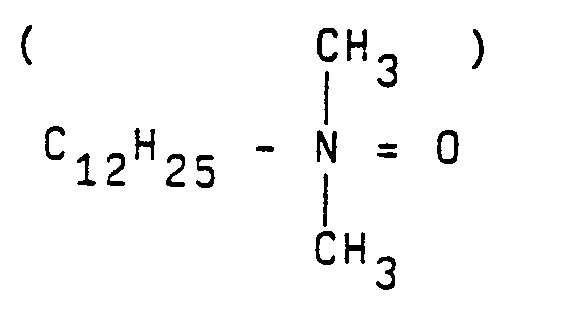
Schließlich umfassen Tenside mit zwitterionischem (ampholytischem) Charakter folgende Verbindungen:
Derivate von aliphatischen, sekundären und tertiären Aminen oder quaternären Ammoniumverbindungen mit 8 bis 18 C-Atomen und einer hydrophilen Gruppe im aliphatischen Rest, wie z.B. Natrium-3-dodecylaminopropionat, Natrium-3-dodecylaminopropansulfonat, 3-(N,N-Dimethyl-N-hexadecyl-ammonium)propan-1-sulfonat oder Fettsäureaminoalkyl-N,N-dimethylacetobetain, wobei die Fettsäure 8 bis 10 C-Atome und der Alkylrest 1-3 C-Atome enthält. - Als Waschhilfsstoffe eignen sich anorganische Salze, organische Säuren und deren Salze sowie Komplexbildner.
- Brauchbare anorganische Salze sind beispielsweise die Bicarbonate oder Carbonate der Alkalien, z.B. Soda. Zu den organischen Waschhilfsstoffen gehören 1 bis 7 C-Atome enthaltende Sulfonsäuren, Carbonsäuren und Sulfocarbonsäuren sowie deren Salze. Hierbei sind vor allem Benzol-, Toluol- oder Xylolsulfonsäure, Sulfoessigsäure, Sulfobenzoesäure, Sulfodicarbonsäuren, Essigsäure, Milchsäure, Zitronensäure und Weinsäure sowie deren Salze hervorzuheben. Zu den Komplexbildnern gehören beispielsweise Nitrilotriessigäsure, Ethylendiamintetraessigsäure, N-Hydroxyethylethylendiamintriessigsäure oder Polyalkylenpolyamin-N-polycarbonsäuren.
- Waschhilfsstoffe umfassen ferner Alkali- oder Ammoniumsalze der Schwefelsäure (z.B. Na₂SO₄), Borsäure, Alkylen-, Hydroxyalkylen- oder Aminoalkylenphosphonsäure, Methylendiphosphonsäure, 1-Hydroxyethan-1,1-diphosphonsäure und Nitrilotrismethylenphosphonsäure.
- Waschhilfsstoffe, die das Schmutztragevermögen von Waschflotten erhöhen, wie Carboxymethylcellulose, Carboxymethylstärke und Methylcellulose, Schaumregulatoren, wie Mono- und Dialkylphosphorsäureester mit 16 bis 20 C-Atomen im Alkylrest sowie optische Aufheller, Desinfizienzien und Enzyme, wie Proteasen, Amylasen, Lipasen, ferner Duftstoffe, können ebenfalls Bestandteile sein.
- Die Herstellung der in den folgenden Beispielen aufgeführten Waschmittel erfolgte nach dem Sprühnebelmischverfahren. Dabei kam ein Freifallmischer zur Anwendung, in welchem die festen pulverförmigen Bestandteile vorgemischt wurden, während die flüssigen Bestandteile anschließend auf die trockene Vormischung aufgedüst wurden (vergl. "Seifen, Fette, Öle, Wachse", Band 99, Seiten 351 bis 357, 1973).
- Die in der Tabelle (vergl. Seite 9) angegebenen Waschmittelformulierungen, in denen Wa I und Wa II Vergleichsformulierungen sind, während Wa III ein Waschmittel gemäß der Erfindung ist, wurden entsprechend den nachstehenden Bedingungen waschtechnisch geprüft:
- Nur Hauptwaschgang (lochkartengesteuerte Haushaltswaschmaschine; Typ Miele TMT)
Aktivsauerstoff: 2,6 g/Waschgang Wasserhärte: 18 °dH Waschtemperatur: 60 °C Testgewebe: Angefärbte bzw. angeschmutzte Baumwolle - Die Schmutzentfernung wurde am gewaschenen Testgewebe durch optische Remissionsmessung bei 460 nm (Gerät: Datacolor 3890) nach der sogenannten Differenzmethode entsprechend folgender Gleichung bestimmt:

% Rd = % Remissionsdifferenz (Maß für Schmutzentfernung)
% Rg = % Remission des gewaschenen Testgewebes
% Ru = % Remission des ungewaschenen Testgewebes bedeuten.Testgewebe Wa I [% Rd] Wa II [% Rd] Wa III [% Rd] Baumwolle mit Immedialschwarzanfärbung 9,8 10,0 10,5 Baumwolle mit Tee-Anschmutzung 15,8 16,5 18,1 Baumwolle mit Curry-Anschmutzung 11,6 13,0 15,2 Baumwolle mit Rote Bete-Anschmutzung 6,9 8,2 10,1 -
Hauptwaschgang: 25 Waschzyklen Wasserhärte: 18 °dH Waschtemperatur: 60 °C Testgewebe: WFK Baumwolle WFK Polyester/Baumwolle 2:1 (WFK = Wäschereiforschung Krefeld, DE) - Die Gewebeablagerungen (Inkrustierungen) wurden in Form der durchschnittlichen anorganischen Gewebeasche (Mittel aus 5 Testgeweben) als prozentualer Glührückstand bei 800 °C bestimmt.
Testgewebe Wa I [%] Wa II [%] Wa III [%] WFK Baumwolle 3,8 3,2 2,8 WFK Polyester/Baumwolle 2:1 2,4 2,0 1,6 
- Das für das erfindungsgemäße Waschmittel Wa III verwendete Gemisch aus teilhydratisiertem Kanemit (70 Gew.-%) mit an seiner Oberfläche in feinster Verteilung absorbiertem Natriumpercarbonat (30 Gew.-%) wurde nach dem Verfahren der DE-OS 42 23 546 erhalten. Hierzu wurde ein im wesentlichen aus δ-Na₂Si₂0₅ bestehendes Natriumsilikat in wäßriger Lösung bis zur Sättigung mit CO₂ versetzt und anschließend H₂0₂ zugesetzt. Die Mengen der einzelnen Komponenten waren zuvor auf die oben beschriebene, gewünschte Zusammensetzung berechnet worden.
- Das erhaltene Produkt wurde anschließend, wie vorstehend auf Seite 6 beschrieben, in das Waschmittel eingearbeitet.
Claims (3)
- Waschmittel, bestehend aus
10 bis 80 Gewichts% teildehydratisiertem Kanemit mit an seiner Oberfläche in feinster Verteilung adsorbiertem Natriumpercarbonat (Kanemit/NaPC),
5 bis 40 Gewichts% mindestens eines Tensids,
0 bis 5 Gewichts% Enzyme,
0 bis 1 Gewichts% optische Aufheller
sowie üblichen Waschhilfsstoffen. - Waschmittel nach Anspruch 1, dadurch gekennzeichnet, daß der teildehydratisierte Kanemit an seiner Oberfläche bis zu 31 Gewichts% Natriumpercarbonat adsorbiert enthält.
- Waschmittel nach Anspruch 1 oder 2, dadurch gekennzeichnet, daß der teildehydratisierte Kanemit mit an seiner Oberfläche adsorbiertem Natriumpercarbonat hergestellt worden ist durchaa) mindestens teilweises Umsetzen eines im wesentlichen aus δ-Na₂Si₂O₅ bestehenden Natriumsilikates mit Kohlendioxid und Wasser unter ständigem Umwälzen, wobei sich ein Kanemit/Natriumhydrogencarbonat-Gemisch bildete,bb) Inberührungbringen des Kanemit/Natriumhydrogancarbonat-Gemisches und weiteren, im wesentlichen aus δ-Na₂Si₂O₅ bestehenden Natriumsilikates unter ständigem Umwälzen mit zerstäubtem Wasser, wobei sich ein Kanemit/Natriumcarbonat-Gemisch bildete,cc) Zusetzen von Wasserstoffperoxid zu dem Kanemit/Natriumcarbonat-Gemisch, wobei 0,015 bis 1,5 Mol Wasserstoffperoxid je Mol eingesetztem, im wesentlichen aus δ-Na₂Si₂O₅ bestehendem Natriumsilikat aufgewendet wurden unddd) Trocknen des Produktes bei Temperaturen von 20 bis 150 °C.
Applications Claiming Priority (4)
| Application Number | Priority Date | Filing Date | Title |
|---|---|---|---|
| DE4427575 | 1994-08-04 | ||
| DE4427575 | 1994-08-04 | ||
| DE19521291 | 1995-06-10 | ||
| DE19521291A DE19521291A1 (de) | 1994-08-04 | 1995-06-10 | Waschmittel |
Publications (2)
| Publication Number | Publication Date |
|---|---|
| EP0695800A2 true EP0695800A2 (de) | 1996-02-07 |
| EP0695800A3 EP0695800A3 (de) | 1997-10-15 |
Family
ID=25938946
Family Applications (1)
| Application Number | Title | Priority Date | Filing Date |
|---|---|---|---|
| EP95111313A Withdrawn EP0695800A3 (de) | 1994-08-04 | 1995-07-19 | Waschmittel |
Country Status (2)
| Country | Link |
|---|---|
| EP (1) | EP0695800A3 (de) |
| JP (1) | JPH08100194A (de) |
Citations (1)
| Publication number | Priority date | Publication date | Assignee | Title |
|---|---|---|---|---|
| DE4223546A1 (de) | 1992-07-17 | 1994-01-20 | Hoechst Ag | Verfahren zur Hertellung eines Gemisches aus Natriumsilikaten und einem weiteren Salz sowie die Verwendung des Gemisches |
Family Cites Families (1)
| Publication number | Priority date | Publication date | Assignee | Title |
|---|---|---|---|---|
| EP0550077A1 (de) * | 1992-01-03 | 1993-07-07 | The Procter & Gamble Company | Körnige Bleichmittelzusammensetzung für Wäsche |
-
1995
- 1995-07-19 EP EP95111313A patent/EP0695800A3/de not_active Withdrawn
- 1995-08-02 JP JP19772395A patent/JPH08100194A/ja not_active Withdrawn
Patent Citations (1)
| Publication number | Priority date | Publication date | Assignee | Title |
|---|---|---|---|---|
| DE4223546A1 (de) | 1992-07-17 | 1994-01-20 | Hoechst Ag | Verfahren zur Hertellung eines Gemisches aus Natriumsilikaten und einem weiteren Salz sowie die Verwendung des Gemisches |
Non-Patent Citations (2)
| Title |
|---|
| "Recommendations on the Transport of Dangerous Goods", 1993, UNITED NATIONS, NEW YORK |
| SEIFEN, FETTE, OELE, WACHSE, vol. 99, 1973, pages 351 - 357 |
Also Published As
| Publication number | Publication date |
|---|---|
| JPH08100194A (ja) | 1996-04-16 |
| EP0695800A3 (de) | 1997-10-15 |
Similar Documents
| Publication | Publication Date | Title |
|---|---|---|
| DE2902236C2 (de) | ||
| AT396114B (de) | Waschmittel | |
| EP0337217A2 (de) | Waschmittel mit lagerstabilisiertem Bleichsystem | |
| DE2514676C2 (de) | Waschmittel | |
| DE2657518A1 (de) | Neue verbindungen und dieselben enthaltende detergensgemische | |
| DE3842007A1 (de) | Fluessiges bis pastoeses, bleichmittelhaltiges waschmittel | |
| DE3625189A1 (de) | Phosphatfreies oder gering phosphathaltiges waschmittel | |
| EP0364739A2 (de) | Waschmittel für niedrige Temperaturen | |
| DE69730703T2 (de) | Waschmittelzusammensetzung fur kleidung | |
| DE3625268A1 (de) | Phosphatfreies oder gering phosphathaltiges waschmittel | |
| DE2900063A1 (de) | Waschmittel mit einem gehalt an schaumdaempfend wirkendem polydimethylsiloxan und verfahren zu dessen herstellung | |
| DE2539110C3 (de) | ||
| EP0337219A2 (de) | Lagerstabilisiertes Waschmittel mit verstärkter Bleichwirkung | |
| DE2825218A1 (de) | Fluessiges wasch- bzw. reinigungsmittel | |
| DE2544019C3 (de) | ||
| EP0377807A1 (de) | Phosphatfreies,flüssiges Waschmittel mit hoher Alkalität | |
| EP0164072B1 (de) | Waschmittel mit verstärkter Waschkraft | |
| DE2916656A1 (de) | Waschmittel fuer textilien | |
| DE3625256A1 (de) | Phosphatfreies oder gering phosphathaltiges waschmittel | |
| DE3644808A1 (de) | Phosphatfreies waschmittel mit verringerter schaumneigung | |
| DE19521291A1 (de) | Waschmittel | |
| EP0622448B1 (de) | Waschmittel | |
| DE4326653A1 (de) | Waschmittel, enthaltend nichtionische Celluloseether | |
| CH601486A5 (en) | Sulphonate detergent | |
| DE2226871A1 (de) | Waschmittel mit einem gehalt an vergrauungsverhuetenden zusaetzen |
Legal Events
| Date | Code | Title | Description |
|---|---|---|---|
| PUAI | Public reference made under article 153(3) epc to a published international application that has entered the european phase |
Free format text: ORIGINAL CODE: 0009012 |
|
| AK | Designated contracting states |
Kind code of ref document: A2 Designated state(s): BE DE FR GB |
|
| PUAL | Search report despatched |
Free format text: ORIGINAL CODE: 0009013 |
|
| AK | Designated contracting states |
Kind code of ref document: A3 Designated state(s): BE DE ES FR GB NL |
|
| RAP1 | Party data changed (applicant data changed or rights of an application transferred) |
Owner name: CLARIANT GMBH |
|
| 17P | Request for examination filed |
Effective date: 19980415 |
|
| RBV | Designated contracting states (corrected) |
Designated state(s): BE DE FR GB |
|
| 17Q | First examination report despatched |
Effective date: 20010620 |
|
| STAA | Information on the status of an ep patent application or granted ep patent |
Free format text: STATUS: THE APPLICATION HAS BEEN WITHDRAWN |
|
| 18W | Application withdrawn |
Withdrawal date: 20010904 |