EP0696229B1 - Procede de fabrication d'un catalyseur et catalyseur realise a l'aide dudit procede - Google Patents
Procede de fabrication d'un catalyseur et catalyseur realise a l'aide dudit procede Download PDFInfo
- Publication number
- EP0696229B1 EP0696229B1 EP94914322A EP94914322A EP0696229B1 EP 0696229 B1 EP0696229 B1 EP 0696229B1 EP 94914322 A EP94914322 A EP 94914322A EP 94914322 A EP94914322 A EP 94914322A EP 0696229 B1 EP0696229 B1 EP 0696229B1
- Authority
- EP
- European Patent Office
- Prior art keywords
- phase
- process according
- dispersed
- ground
- oxidic support
- Prior art date
- Legal status (The legal status is an assumption and is not a legal conclusion. Google has not performed a legal analysis and makes no representation as to the accuracy of the status listed.)
- Expired - Lifetime
Links
- 238000000034 method Methods 0.000 title claims description 41
- 230000008569 process Effects 0.000 title claims description 32
- 239000003054 catalyst Substances 0.000 claims abstract description 36
- 239000000463 material Substances 0.000 claims abstract description 20
- JKQOBWVOAYFWKG-UHFFFAOYSA-N molybdenum trioxide Chemical compound O=[Mo](=O)=O JKQOBWVOAYFWKG-UHFFFAOYSA-N 0.000 claims abstract description 18
- 229910000476 molybdenum oxide Inorganic materials 0.000 claims abstract description 14
- PQQKPALAQIIWST-UHFFFAOYSA-N oxomolybdenum Chemical compound [Mo]=O PQQKPALAQIIWST-UHFFFAOYSA-N 0.000 claims abstract description 14
- 239000000654 additive Substances 0.000 claims abstract description 13
- GNTDGMZSJNCJKK-UHFFFAOYSA-N divanadium pentaoxide Chemical compound O=[V](=O)O[V](=O)=O GNTDGMZSJNCJKK-UHFFFAOYSA-N 0.000 claims abstract description 11
- 229910003077 Ti−O Inorganic materials 0.000 claims abstract description 10
- 239000000203 mixture Substances 0.000 claims abstract description 10
- 150000001875 compounds Chemical class 0.000 claims abstract 5
- 239000007789 gas Substances 0.000 claims description 28
- GWEVSGVZZGPLCZ-UHFFFAOYSA-N Titan oxide Chemical compound O=[Ti]=O GWEVSGVZZGPLCZ-UHFFFAOYSA-N 0.000 claims description 22
- MWUXSHHQAYIFBG-UHFFFAOYSA-N nitrogen oxide Inorganic materials O=[N] MWUXSHHQAYIFBG-UHFFFAOYSA-N 0.000 claims description 21
- 239000002270 dispersing agent Substances 0.000 claims description 18
- 239000002002 slurry Substances 0.000 claims description 18
- 230000003197 catalytic effect Effects 0.000 claims description 17
- XLYOFNOQVPJJNP-UHFFFAOYSA-N water Substances O XLYOFNOQVPJJNP-UHFFFAOYSA-N 0.000 claims description 14
- QGZKDVFQNNGYKY-UHFFFAOYSA-N Ammonia Chemical compound N QGZKDVFQNNGYKY-UHFFFAOYSA-N 0.000 claims description 10
- 239000006185 dispersion Substances 0.000 claims description 10
- OGIDPMRJRNCKJF-UHFFFAOYSA-N titanium oxide Inorganic materials [Ti]=O OGIDPMRJRNCKJF-UHFFFAOYSA-N 0.000 claims description 10
- 238000001816 cooling Methods 0.000 claims description 9
- 230000002378 acidificating effect Effects 0.000 claims description 8
- 230000009467 reduction Effects 0.000 claims description 7
- UGFAIRIUMAVXCW-UHFFFAOYSA-N Carbon monoxide Chemical compound [O+]#[C-] UGFAIRIUMAVXCW-UHFFFAOYSA-N 0.000 claims description 6
- RAHZWNYVWXNFOC-UHFFFAOYSA-N Sulphur dioxide Chemical compound O=S=O RAHZWNYVWXNFOC-UHFFFAOYSA-N 0.000 claims description 6
- 238000010438 heat treatment Methods 0.000 claims description 6
- 229930195733 hydrocarbon Natural products 0.000 claims description 6
- 150000002430 hydrocarbons Chemical class 0.000 claims description 6
- 239000004814 polyurethane Substances 0.000 claims description 6
- 239000011148 porous material Substances 0.000 claims description 6
- 239000002243 precursor Substances 0.000 claims description 6
- AKEJUJNQAAGONA-UHFFFAOYSA-N sulfur trioxide Chemical compound O=S(=O)=O AKEJUJNQAAGONA-UHFFFAOYSA-N 0.000 claims description 6
- 239000000725 suspension Substances 0.000 claims description 6
- 239000002562 thickening agent Substances 0.000 claims description 6
- 229910021529 ammonia Inorganic materials 0.000 claims description 5
- 229910002091 carbon monoxide Inorganic materials 0.000 claims description 5
- 229910052751 metal Inorganic materials 0.000 claims description 5
- 239000002184 metal Substances 0.000 claims description 5
- PNEYBMLMFCGWSK-UHFFFAOYSA-N Alumina Chemical compound [O-2].[O-2].[O-2].[Al+3].[Al+3] PNEYBMLMFCGWSK-UHFFFAOYSA-N 0.000 claims description 4
- 239000002734 clay mineral Substances 0.000 claims description 4
- 239000000945 filler Substances 0.000 claims description 4
- 238000000227 grinding Methods 0.000 claims description 4
- 239000012454 non-polar solvent Substances 0.000 claims description 4
- 239000002798 polar solvent Substances 0.000 claims description 4
- 229920002635 polyurethane Polymers 0.000 claims description 4
- 239000000126 substance Substances 0.000 claims description 4
- VZISNXYSKWKESC-UHFFFAOYSA-N [O].[V].[Mo] Chemical compound [O].[V].[Mo] VZISNXYSKWKESC-UHFFFAOYSA-N 0.000 claims description 3
- 230000000996 additive effect Effects 0.000 claims description 3
- 238000001354 calcination Methods 0.000 claims description 3
- VYPSYNLAJGMNEJ-UHFFFAOYSA-N Silicium dioxide Chemical compound O=[Si]=O VYPSYNLAJGMNEJ-UHFFFAOYSA-N 0.000 claims 1
- 239000000919 ceramic Substances 0.000 claims 1
- 239000001257 hydrogen Substances 0.000 claims 1
- 229910052739 hydrogen Inorganic materials 0.000 claims 1
- 125000004435 hydrogen atom Chemical class [H]* 0.000 claims 1
- 238000002156 mixing Methods 0.000 claims 1
- 229910052814 silicon oxide Inorganic materials 0.000 claims 1
- 239000003381 stabilizer Substances 0.000 claims 1
- 235000010269 sulphur dioxide Nutrition 0.000 claims 1
- 239000004291 sulphur dioxide Substances 0.000 claims 1
- 229910001935 vanadium oxide Inorganic materials 0.000 abstract description 14
- XHCLAFWTIXFWPH-UHFFFAOYSA-N [O-2].[O-2].[O-2].[O-2].[O-2].[V+5].[V+5] Chemical compound [O-2].[O-2].[O-2].[O-2].[O-2].[V+5].[V+5] XHCLAFWTIXFWPH-UHFFFAOYSA-N 0.000 abstract description 13
- 239000012535 impurity Substances 0.000 abstract description 8
- 238000004519 manufacturing process Methods 0.000 abstract description 8
- 238000006243 chemical reaction Methods 0.000 abstract description 7
- 239000012071 phase Substances 0.000 description 73
- 229910010413 TiO 2 Inorganic materials 0.000 description 17
- 239000001301 oxygen Substances 0.000 description 12
- 229910052760 oxygen Inorganic materials 0.000 description 12
- QVGXLLKOCUKJST-UHFFFAOYSA-N atomic oxygen Chemical compound [O] QVGXLLKOCUKJST-UHFFFAOYSA-N 0.000 description 11
- 239000000843 powder Substances 0.000 description 10
- 238000003860 storage Methods 0.000 description 10
- 238000003756 stirring Methods 0.000 description 8
- UFHFLCQGNIYNRP-UHFFFAOYSA-N Hydrogen Chemical compound [H][H] UFHFLCQGNIYNRP-UHFFFAOYSA-N 0.000 description 7
- 238000002844 melting Methods 0.000 description 7
- 230000008018 melting Effects 0.000 description 7
- 239000010936 titanium Substances 0.000 description 7
- 230000007547 defect Effects 0.000 description 6
- 239000004408 titanium dioxide Substances 0.000 description 6
- 239000004215 Carbon black (E152) Substances 0.000 description 4
- KFZMGEQAYNKOFK-UHFFFAOYSA-N Isopropanol Chemical compound CC(C)O KFZMGEQAYNKOFK-UHFFFAOYSA-N 0.000 description 4
- QAOWNCQODCNURD-UHFFFAOYSA-N Sulfuric acid Chemical compound OS(O)(=O)=O QAOWNCQODCNURD-UHFFFAOYSA-N 0.000 description 4
- 230000015572 biosynthetic process Effects 0.000 description 4
- 238000000354 decomposition reaction Methods 0.000 description 4
- 238000011161 development Methods 0.000 description 4
- 238000010586 diagram Methods 0.000 description 4
- 238000001125 extrusion Methods 0.000 description 4
- 239000000155 melt Substances 0.000 description 4
- 238000011084 recovery Methods 0.000 description 4
- 238000005245 sintering Methods 0.000 description 4
- 239000002253 acid Substances 0.000 description 3
- 239000011230 binding agent Substances 0.000 description 3
- 229920002678 cellulose Polymers 0.000 description 3
- 239000001913 cellulose Substances 0.000 description 3
- MTHSVFCYNBDYFN-UHFFFAOYSA-N diethylene glycol Chemical compound OCCOCCO MTHSVFCYNBDYFN-UHFFFAOYSA-N 0.000 description 3
- 230000003647 oxidation Effects 0.000 description 3
- 238000007254 oxidation reaction Methods 0.000 description 3
- 239000002245 particle Substances 0.000 description 3
- 238000005096 rolling process Methods 0.000 description 3
- 238000007086 side reaction Methods 0.000 description 3
- HZAXFHJVJLSVMW-UHFFFAOYSA-N 2-Aminoethan-1-ol Chemical compound NCCO HZAXFHJVJLSVMW-UHFFFAOYSA-N 0.000 description 2
- WWILHZQYNPQALT-UHFFFAOYSA-N 2-methyl-2-morpholin-4-ylpropanal Chemical compound O=CC(C)(C)N1CCOCC1 WWILHZQYNPQALT-UHFFFAOYSA-N 0.000 description 2
- 238000005299 abrasion Methods 0.000 description 2
- BFNBIHQBYMNNAN-UHFFFAOYSA-N ammonium sulfate Chemical compound N.N.OS(O)(=O)=O BFNBIHQBYMNNAN-UHFFFAOYSA-N 0.000 description 2
- 229910052921 ammonium sulfate Inorganic materials 0.000 description 2
- 235000011130 ammonium sulphate Nutrition 0.000 description 2
- 229910052785 arsenic Inorganic materials 0.000 description 2
- RQNWIZPPADIBDY-UHFFFAOYSA-N arsenic atom Chemical compound [As] RQNWIZPPADIBDY-UHFFFAOYSA-N 0.000 description 2
- 238000007664 blowing Methods 0.000 description 2
- 238000004140 cleaning Methods 0.000 description 2
- 230000000694 effects Effects 0.000 description 2
- 230000009969 flowable effect Effects 0.000 description 2
- 229920001519 homopolymer Polymers 0.000 description 2
- 150000004679 hydroxides Chemical class 0.000 description 2
- 238000010309 melting process Methods 0.000 description 2
- DCKVFVYPWDKYDN-UHFFFAOYSA-L oxygen(2-);titanium(4+);sulfate Chemical compound [O-2].[Ti+4].[O-]S([O-])(=O)=O DCKVFVYPWDKYDN-UHFFFAOYSA-L 0.000 description 2
- 239000002244 precipitate Substances 0.000 description 2
- 238000012545 processing Methods 0.000 description 2
- 230000000171 quenching effect Effects 0.000 description 2
- 229910000348 titanium sulfate Inorganic materials 0.000 description 2
- OAYXUHPQHDHDDZ-UHFFFAOYSA-N 2-(2-butoxyethoxy)ethanol Chemical compound CCCCOCCOCCO OAYXUHPQHDHDDZ-UHFFFAOYSA-N 0.000 description 1
- YZBOVSFWWNVKRJ-UHFFFAOYSA-M 2-butoxycarbonylbenzoate Chemical compound CCCCOC(=O)C1=CC=CC=C1C([O-])=O YZBOVSFWWNVKRJ-UHFFFAOYSA-M 0.000 description 1
- POAOYUHQDCAZBD-UHFFFAOYSA-N 2-butoxyethanol Chemical compound CCCCOCCO POAOYUHQDCAZBD-UHFFFAOYSA-N 0.000 description 1
- ZNQVEEAIQZEUHB-UHFFFAOYSA-N 2-ethoxyethanol Chemical compound CCOCCO ZNQVEEAIQZEUHB-UHFFFAOYSA-N 0.000 description 1
- 229910018072 Al 2 O 3 Inorganic materials 0.000 description 1
- VHUUQVKOLVNVRT-UHFFFAOYSA-N Ammonium hydroxide Chemical compound [NH4+].[OH-] VHUUQVKOLVNVRT-UHFFFAOYSA-N 0.000 description 1
- 229910017299 Mo—O Inorganic materials 0.000 description 1
- 229920003171 Poly (ethylene oxide) Polymers 0.000 description 1
- 229920001800 Shellac Polymers 0.000 description 1
- 229910004298 SiO 2 Inorganic materials 0.000 description 1
- QAOWNCQODCNURD-UHFFFAOYSA-L Sulfate Chemical compound [O-]S([O-])(=O)=O QAOWNCQODCNURD-UHFFFAOYSA-L 0.000 description 1
- NIXOWILDQLNWCW-UHFFFAOYSA-N acrylic acid group Chemical group C(C=C)(=O)O NIXOWILDQLNWCW-UHFFFAOYSA-N 0.000 description 1
- 230000009471 action Effects 0.000 description 1
- 239000012072 active phase Substances 0.000 description 1
- 238000005054 agglomeration Methods 0.000 description 1
- 230000002776 aggregation Effects 0.000 description 1
- 235000011114 ammonium hydroxide Nutrition 0.000 description 1
- 239000007864 aqueous solution Substances 0.000 description 1
- 230000008901 benefit Effects 0.000 description 1
- 125000003178 carboxy group Chemical group [H]OC(*)=O 0.000 description 1
- 239000012876 carrier material Substances 0.000 description 1
- 230000015556 catabolic process Effects 0.000 description 1
- 239000004927 clay Substances 0.000 description 1
- 239000000356 contaminant Substances 0.000 description 1
- 229920001577 copolymer Polymers 0.000 description 1
- 238000006731 degradation reaction Methods 0.000 description 1
- GUJOJGAPFQRJSV-UHFFFAOYSA-N dialuminum;dioxosilane;oxygen(2-);hydrate Chemical compound O.[O-2].[O-2].[O-2].[Al+3].[Al+3].O=[Si]=O.O=[Si]=O.O=[Si]=O.O=[Si]=O GUJOJGAPFQRJSV-UHFFFAOYSA-N 0.000 description 1
- 150000002013 dioxins Chemical class 0.000 description 1
- 238000001035 drying Methods 0.000 description 1
- 239000003546 flue gas Substances 0.000 description 1
- 239000003517 fume Substances 0.000 description 1
- 150000002240 furans Chemical class 0.000 description 1
- 239000003365 glass fiber Substances 0.000 description 1
- 239000000314 lubricant Substances 0.000 description 1
- 229910052901 montmorillonite Inorganic materials 0.000 description 1
- 229920002689 polyvinyl acetate Polymers 0.000 description 1
- 239000011118 polyvinyl acetate Substances 0.000 description 1
- 229920005989 resin Polymers 0.000 description 1
- 239000011347 resin Substances 0.000 description 1
- 239000004208 shellac Substances 0.000 description 1
- ZLGIYFNHBLSMPS-ATJNOEHPSA-N shellac Chemical compound OCCCCCC(O)C(O)CCCCCCCC(O)=O.C1C23[C@H](C(O)=O)CCC2[C@](C)(CO)[C@@H]1C(C(O)=O)=C[C@@H]3O ZLGIYFNHBLSMPS-ATJNOEHPSA-N 0.000 description 1
- 229940113147 shellac Drugs 0.000 description 1
- 235000013874 shellac Nutrition 0.000 description 1
- 230000006641 stabilisation Effects 0.000 description 1
- 238000011105 stabilization Methods 0.000 description 1
- 230000000087 stabilizing effect Effects 0.000 description 1
- 150000003467 sulfuric acid derivatives Chemical class 0.000 description 1
- 238000012360 testing method Methods 0.000 description 1
- 229910000349 titanium oxysulfate Inorganic materials 0.000 description 1
- LEONUFNNVUYDNQ-UHFFFAOYSA-N vanadium atom Chemical compound [V] LEONUFNNVUYDNQ-UHFFFAOYSA-N 0.000 description 1
Images


Classifications
-
- B—PERFORMING OPERATIONS; TRANSPORTING
- B01—PHYSICAL OR CHEMICAL PROCESSES OR APPARATUS IN GENERAL
- B01J—CHEMICAL OR PHYSICAL PROCESSES, e.g. CATALYSIS OR COLLOID CHEMISTRY; THEIR RELEVANT APPARATUS
- B01J37/00—Processes, in general, for preparing catalysts; Processes, in general, for activation of catalysts
- B01J37/02—Impregnation, coating or precipitation
- B01J37/0215—Coating
-
- B—PERFORMING OPERATIONS; TRANSPORTING
- B01—PHYSICAL OR CHEMICAL PROCESSES OR APPARATUS IN GENERAL
- B01D—SEPARATION
- B01D53/00—Separation of gases or vapours; Recovering vapours of volatile solvents from gases; Chemical or biological purification of waste gases, e.g. engine exhaust gases, smoke, fumes, flue gases, aerosols
- B01D53/34—Chemical or biological purification of waste gases
- B01D53/74—General processes for purification of waste gases; Apparatus or devices specially adapted therefor
- B01D53/86—Catalytic processes
- B01D53/8621—Removing nitrogen compounds
- B01D53/8625—Nitrogen oxides
- B01D53/8628—Processes characterised by a specific catalyst
-
- B—PERFORMING OPERATIONS; TRANSPORTING
- B01—PHYSICAL OR CHEMICAL PROCESSES OR APPARATUS IN GENERAL
- B01J—CHEMICAL OR PHYSICAL PROCESSES, e.g. CATALYSIS OR COLLOID CHEMISTRY; THEIR RELEVANT APPARATUS
- B01J23/00—Catalysts comprising metals or metal oxides or hydroxides, not provided for in group B01J21/00
- B01J23/002—Mixed oxides other than spinels, e.g. perovskite
-
- B—PERFORMING OPERATIONS; TRANSPORTING
- B01—PHYSICAL OR CHEMICAL PROCESSES OR APPARATUS IN GENERAL
- B01J—CHEMICAL OR PHYSICAL PROCESSES, e.g. CATALYSIS OR COLLOID CHEMISTRY; THEIR RELEVANT APPARATUS
- B01J23/00—Catalysts comprising metals or metal oxides or hydroxides, not provided for in group B01J21/00
- B01J23/16—Catalysts comprising metals or metal oxides or hydroxides, not provided for in group B01J21/00 of arsenic, antimony, bismuth, vanadium, niobium, tantalum, polonium, chromium, molybdenum, tungsten, manganese, technetium or rhenium
- B01J23/24—Chromium, molybdenum or tungsten
- B01J23/28—Molybdenum
-
- B—PERFORMING OPERATIONS; TRANSPORTING
- B01—PHYSICAL OR CHEMICAL PROCESSES OR APPARATUS IN GENERAL
- B01J—CHEMICAL OR PHYSICAL PROCESSES, e.g. CATALYSIS OR COLLOID CHEMISTRY; THEIR RELEVANT APPARATUS
- B01J37/00—Processes, in general, for preparing catalysts; Processes, in general, for activation of catalysts
- B01J37/0009—Use of binding agents; Moulding; Pressing; Powdering; Granulating; Addition of materials ameliorating the mechanical properties of the product catalyst
- B01J37/0027—Powdering
- B01J37/0036—Grinding
-
- B—PERFORMING OPERATIONS; TRANSPORTING
- B01—PHYSICAL OR CHEMICAL PROCESSES OR APPARATUS IN GENERAL
- B01J—CHEMICAL OR PHYSICAL PROCESSES, e.g. CATALYSIS OR COLLOID CHEMISTRY; THEIR RELEVANT APPARATUS
- B01J23/00—Catalysts comprising metals or metal oxides or hydroxides, not provided for in group B01J21/00
- B01J23/16—Catalysts comprising metals or metal oxides or hydroxides, not provided for in group B01J21/00 of arsenic, antimony, bismuth, vanadium, niobium, tantalum, polonium, chromium, molybdenum, tungsten, manganese, technetium or rhenium
- B01J23/20—Vanadium, niobium or tantalum
- B01J23/22—Vanadium
-
- B—PERFORMING OPERATIONS; TRANSPORTING
- B01—PHYSICAL OR CHEMICAL PROCESSES OR APPARATUS IN GENERAL
- B01J—CHEMICAL OR PHYSICAL PROCESSES, e.g. CATALYSIS OR COLLOID CHEMISTRY; THEIR RELEVANT APPARATUS
- B01J2523/00—Constitutive chemical elements of heterogeneous catalysts
Definitions
- the invention relates to a method for producing a catalyst containing a catalytically active molybdenum-vanadium-oxygen phase (Mo-VO phase) and to a catalyst produced by this method.
- This catalyst is particularly suitable for the catalytic conversion of nitrogen oxides (NO x ) contained in exhaust or flue gas and is generally referred to as a DeNO x catalyst.
- European patent application 91 107 237.9 discloses an arsenic-resistant DeNO x catalyst and a process for its production.
- an oxygen-rich Mo-VO phase is formed, which is cooled, ground and then subjected to a reducing treatment. This creates oxygen defects.
- the material obtained in this way is then ground, processed with additives to form a slip, applied to a carrier material, such as expanded metal, and calcined together with the latter.
- the catalyst which is produced by this process, which is disclosed in the above patent application, is distinguished by considerable arsenic resistance and good catalytic activity in the reduction of the nitrogen oxides with ammonia.
- V 2 O 5 precipitates, for example, can catalyze undesirable side reactions.
- V 2 O 5 in addition to the desired catalytic activity in the reduction of nitrogen oxides with NH 3, also has an undesirable catalytic activity in the SO 2 -SO 3 conversion, which leads to the formation of ammonium sulfate and / or ammonium hydrogen sulfate and If the dew point of the sulfates mentioned is not reached, the downstream components are gradually blocked by the ammonium sulfate and / or the ammonium hydrogen sulfate.
- the invention is therefore based on the object of a method specify how a catalyst with a catalytically active Mo-V-O phase can be made in sufficient pure form is obtained, so that expensive post-cleaning of the catalytic substance can be dispensed with. Furthermore, the Invention based on the object of one by this method to specify the catalyst produced.
- this object is achieved in that vanadium oxide V O and molybdenum oxide MoO or their precursors are mixed with one another, the mixture is heated to a temperature above 500 ° C. to produce a Mo-VO phase, the Mo-VO phase is cooled, ground and then subjected to a reducing treatment, vanadium oxide V O and molybdenum oxide MoO or their precursors to one another in a ratio of 0.7: 1% by weight based on V O and MoO or with a higher proportion of MoO are mixed, the milled mixture after the reducing treatment is processed into an acid suspension, dispersed on an oxidic carrier heated to a temperature of 250 to 600 ° C., and then the dispersed material is milled and optionally applied together with other additives on a suitable macroscopic carrier or kneaded to an extrudable mass and extruded and finally calcined.
- the stated object is achieved according to the invention in that a catalytically active Mo-VO phase is provided, the proportion of free V 2 O 5 being below 0.05% by weight. This purity of the catalyst prevents undesirable side reactions from being catalyzed.
- the ground Mo-VO phase can be slurried in a suitable dispersing agent before dispersing and applied in this form to the heated oxidic carrier.
- Water can be used as a dispersing agent. This evaporates together with other impurities, such as MoO 3 when it hits the hot oxidic carrier and allows the Mo-VO phase to be dispersed on the oxidic carrier alone. The evaporated contaminants can be carried away with the exhaust gas.
- the ground Mo-VO phase can be subjected to a reducing treatment in a suitable dispersing agent before the slurry.
- a reducing treatment in a suitable dispersing agent before the slurry.
- This reducing treatment additionally has the effect that any traces of V 2 O 5 that may be present are also reduced.
- the vanadium oxide is no longer able to catalyze the undesired SO 2 -SO 3 conversion.
- the ground Mo-V-O phase when dispersed on an oxidic carrier be subjected to a reducing treatment.
- the reducing Treatment and dispersion on an oxidic Carrier can be summarized in a single operation can. But even with the dispersion of one before subject to reducing treatment acts the reducing treatment continues to be positive, when it prevents this material from re-oxidizing.
- the oxidic carrier in the dispersion not to be heated above 600 ° C. Heating above 600 ° C can partially destroy the Mo-V-O phase and regress lead from vanadium oxide and molybdenum oxide.
- the Mo-V-O phase in development of the invention in a vortex reactor is dispersed on a dusty oxidic carrier.
- the slurried Mo-V-O phase can go directly into a vortex reactor can be entered in which the oxidic Carrier in a hot fluidizing gas, which is a reducing Gas can be whirled up. It can be done in one Generate a pure dispersed Mo-V-O phase, which has partial oxygen defects, while Impurities are carried away with the hot fluidizing gas will.
- the fluidized bed also prevents agglomeration of the dusty particles.
- a honeycomb-shaped catalyst body with high cell density is producible if one or more of the additives Substances polar solvent, non-polar solvent, Ammonia, pore formers, clay minerals, film forming aids and fillers / proppants are used.
- Honeycomb-shaped catalyst body with particularly high cell density can be produced if a non-additive is used ionogenic thickener based on polyurethane used becomes. Such a thickener causes stabilization an extrudable plasticine and improves the flow properties the plasticine.
- the extruded shaped bodies are dried and hardened at 400 to 600 ° C. in an SO 2 and / or SO 3 atmosphere before calcination.
- part of the titanium dioxide contained in the extruded molded body is converted into gypsum-like titanium sulfate, which increases the hardness.
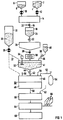
- FIG. 1 shows a storage container 2 for vanadium oxide 4 and next to it a storage container 6 for molybdenum oxide 8.
- Both storage containers 2, 6 are each connected to a mixer 14 via a metering device 10, 12.
- the mixer 14 is connected to a melting device 18 via a discharge line 16.
- a closure slide 20 In the discharge line 16 there is a closure slide 20.
- an outlet valve 22 is provided, through which the melt 24 can be let into a cooling basin 26.
- the cooling basin is connected to a grinder 30 via a further slide valve 28, the grinder unloading its ground material into a stirred basin 32.
- An agitator 34 can be seen in the stirring basin 32.
- a reservoir 31 for TiO 2 33 is connected to the stirring basin 32 via a feed line 37 equipped with a metering device 35.
- a drain line 42 is provided, which leads to a dispersing device 46 via a metering valve 44.
- the dispersing device 46 is combined with a grinding device 48 and installed in a gas-tight housing 50.
- This housing is connected via a separate gas line 52 to a gas container 54 for a reducing gas, in the exemplary embodiment hydrogen gas - it could also be a hydrocarbon, carbon monoxide or the like.
- the housing 50 of the dispersing device also contains an exhaust gas line 56.
- the grinding device 48 is connected via a discharge line 58 to a mixer 60 to which various additives can be mixed in via a further supply line 62.
- a rolling device 64 is connected to the mixer 60 in the supplied macroscopic carrier 66, preferably Made of expanded metal, coated with material from the mixer can be. To this rolling device 64 is followed by a sintering furnace 68.
- a catalyst containing a catalytically active Mo-VO phase is now produced in such a way that via the two metering devices 10, 12, in the exemplary embodiment vanadium oxide 4 and molybdenum oxide 8, in a ratio of 0.7: 1 wt Mixer 14 is metered in and intensively mixed there for several hours.
- the finished, that is to say the sufficiently uniformly mixed, mass is then introduced discontinuously, that is to say in individual batches, into the melting device via the slide valve 20 and the discharge line 16 and melted there at a temperature of about 600 ° C., preferably at 620 ° C. .
- a Mo-VO phase forms at a temperature above 600 ° C, to which the formal V x Mo y O 32 can be assigned, whereby x + y ⁇ 12 and x ⁇ 1 and y ⁇ 1.
- this Mo-VO phase is not free of MoO 3 originally used in excess.
- An excess of molybdenum oxide or its precursor was used to reliably incorporate all vanadium oxide into the Mo-VO phase and to avoid free V 2 O 5 .
- this melt 24 is discharged into a cooling basin 26 at a temperature above 610 ° C. Flakes form in this cooling basin due to the quenching effect.
- a grinder 30 ground down to a grain diameter of less than 180 ⁇ m by means of a grinder 30, and the powder is then conveyed into a stirred tank 32.
- a dispersing agent 40 preferably water, is also added to the stirred tank so that a flowable slurry 41 results.
- a metered amount of an oxidic carrier in the exemplary embodiment TiO 2 powder, is fed to the stirred tank 32 via the feed line 37 and the mass is then mixed intensively by means of the stirrer 34. The slurry thus produced is applied to the dispersing device 46 in a continuous flow.
- a ball mill is used as the dispersing device 46, the balls of which consist of a very hard material.
- the balls are heated to a temperature of 450 ° C. This is done by blowing the balls with the reducing gas which is heated in a heating device (not shown here) and with which the housing 50 of the dispersing device is filled.
- this gas is hydrogen gas. But it can also be carbon monoxide or another hydrocarbon.
- the slurry suggests, that is, the TiO 2 blended Mo-VO phase under the effect of temperature on the hot balls down, wherein the Mo-VO phase on the TiO dispersed 2 powder and the dispersant and any other impurities, such as MoO 3 , evaporate.
- the latter reach the outside via the exhaust line 56 or into a recovery system (not shown).
- the MoO 3 originally mixed in smaller amounts with the Mo-VO phase forms hydroxides with the water vapor which are volatile and escape with the exhaust gas via the exhaust gas line 56.
- the Mo-VO phase deposited on the balls of the ball mill and dispersed on TiO 2 is therefore free of MoO 3 and other impurities.
- the material deposited on the balls of the ball mill is exposed to the reducing attack of the hydrogen gas during the dispersion process. This leads to defects in the oxygen lattice of the Mo-VO phase and thus ultimately to the desired high catalytic activity of the Mo-VO phase generated. Due to the mutual abrasion of the balls of the ball mill 48 with one another and against the wall of the ball mill, the material deposited on the balls and dispersed on TiO 2 is removed from the surface of these balls. The removed material falls down and can be fed intermittently into the downstream mixer 60 via the discharge line 58. In the mixer 60, the removed material is mixed with known additives, such as clay and organic lubricants, to form a kneadable mass.
- known additives such as clay and organic lubricants
- this is rolled onto a macroscopic support, preferably expanded metal sheet 66, in the rolling device 64.
- This expanded metal sheet coated in this way with the catalytically active composition is then calcined in the subsequent sintering furnace 68 to form a usable catalyst.
- Mo-V-Ti-O mixed oxide is formed in addition to the Mo-VO phase dispersed on TiO 2 .
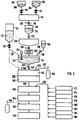
- FIG. 2 shows a variant of the exemplary embodiment in FIG. 1.
- a fluidized bed reactor 72 is used instead of the dispersing and grinding device 46, 48.
- the feed line 37 of the reservoir 31 for TiO 2 powder 33 is connected to the fluidized bed reactor 72.
- a recirculation line 74 with a gas compressor 76 and a heating device 78 for the circulating gas is also connected to the fluidized bed reactor.
- hydrogen gas which can be removed from a gas storage container 75, is used as the cycle gas.
- an intermittently operable recovery system 80 for the substances released during the dispersion is integrated.
- an exhaust line 86 for the Mo-VO phase dispersed on the TiO 2 powder and / or for a ternary Mo-V-Ti-O mixed oxide formed with TiO 2 can be seen. This exhaust line opens into the exhaust line 58 of the system according to FIG. 1.
- the valve 44 of the discharge line for the slurry is opened and the slurry 41 of the Mo-VO phase is dropped onto the fluidized bed of the fluidized bed reactor.
- the Mo-VO phase disperses on the individual TiO 2 particles of the fluidized bed and / or forms a ternary Mo-V-Ti-O phase with TiO 2 .
- the water and other possibly present impurities, such as excess MoO 3 evaporate in a similar form, as was explained with reference to the exemplary embodiment in FIG. 1 for the dispersing device 46 shown there.
- the fluidized bed can then be withdrawn intermittently with the Mo-VO phase dispersed on the TiO 2 powder and / or the Mo-V-Ti-O phase via the discharge line 86, 58.
- the formation of a ternary Mo-V-Ti mixed oxide phase depends on the temperature in the fluidized bed of the fluidized bed reactor 72. With increasing temperature, the proportion of the ternary phase increases at the expense of the proportion of the binary phase.
- the dispersant carried in the circuit, in the exemplary embodiment the water, and the MoO 3 components carried can then condense out and be recovered in the recovery plant, which essentially represents a cold trap.
- the fluidized bed reactor 72 can then be loaded again with TiO 2 powder and a new batch of the slurry can be added.
- the further work steps are then again identical to those which were described using the exemplary embodiment in FIG. 1.
- the end result is a catalyst in which the finest titanium oxide particles are coated with a dispersed, extremely pure molybdenum-vanadium-oxygen layer, the oxygen lattice of which has individual oxygen defects and is therefore highly active.
- a ternary Mo-V-Ti mixed oxide phase with an oxygen lattice i.e. a V y -Mo x -Ti a -O z mixed oxide phase, has arisen.
- the absence of free vanadium oxide and free molybdenum oxide does not catalyze undesirable side reactions, such as the SO 2 SO 3 conversion.
- a storage container 102 for can be seen at the top in FIG Vanadium oxide 104 and next to it a storage container 106 for Molybdenum oxide 108. Both storage containers 102, 106 are each over a metering device 110, 112 connected to a mixer 114.
- the mixer 114 is via an exhaust line 116 connected to a melter 118.
- An outlet valve 122 is provided at the end of the melting device 118, via which a melt 124 into a cooling pool 126 can be left.
- the cooling pool 126 is above one further slide valve 128 connected to a grinder 130, the grinder 130 transfers its regrind into a stirred tank 132 discharges.
- An agitator can be seen in the stirring basin 132 134.
- An inlet line 136 is located at the stirring basin 132 a metering valve 138 for a dispersant 140, in the exemplary embodiment Water, connected.
- a dispersant 140 in the exemplary embodiment Water
- that is Stirring tank 132 over a reservoir 131 for titanium oxide 133 a feed line equipped with a metering device 135 137 connected.
- a drain line 142 is provided which via a metering valve 144 to a dispersing device 146 leads.
- the disperser 146 is with a grinder 148 summarized and in a gas-tight housing 150 installed.
- This housing 150 is via a separate gas line 152 to a gas tank 154 for a reducing Gas, in the exemplary embodiment hydrogen gas - it could also be a hydrocarbon, carbon monoxide or the like - connected.
- the housing 150 of the disperser contains also an exhaust pipe 156.
- the grinder 148 is connected to a mixer 160 via a discharge line 158, on which various via a further feed line 162 Aggregates can be added.
- To the mixer 160 is followed by an extrusion device 164, in which honeycomb-shaped catalysts are extruded, which from the Mixer 160 include material originating.
- a gas-tight heatable closes Container 166, which with a gas supply line 168 a sulfur dioxide and / or sulfur trioxide atmosphere is.
- a sintering furnace closes the container 166 170 at.
- a polar solvent reservoir 172 Reservoir 174 for a non-polar solvent Storage container 176 for ammonia, a storage container 178 for a pore former, a reservoir 180 for clay minerals, a reservoir 182 for a film forming aid Reservoir 184 for filler / proppant and a reservoir 186 connected for a non-ionic thickener.
- a catalyst containing a catalytically active Mo-VO phase and / or a Mo-V-Ti-O phase is now produced in such a way that the two metering devices 110, 112, in the exemplary embodiment vanadium oxide 104 and molybdenum oxide 108, in The ratio of 0.7: 1% by weight in the exemplary embodiment is metered into the mixer 114 and intensively mixed there for several hours.
- the finished, ie the sufficiently uniformly mixed, mass is then introduced discontinuously into the melting device 118 via the slide valve 120 and the discharge line 116 and melted there at a temperature of approximately 600.degree.
- a Mo-VO phase forms at a temperature above 600 ° C., to which the formula V x Mo y O 32 can be assigned, whereby x + y ⁇ 12 and x, y ⁇ 1.
- this Mo-VO phase is generally not free of molybdenum trioxide originally used in excess. An excess of molybdenum oxide or its precursor was used to reliably incorporate all vanadium oxide into the Mo-VO phase and to avoid free vanadium pentoxide V 2 O 5 .
- This melt 124 is discharged discontinuously into the cooling basin 126 after the complete melting. Flakes form in this cooling pool 126 as a result of the quenching effect. These are then ground down to a grain diameter of less than 180 ⁇ m via the grinder 130, and the powder is then conveyed into the stirred tank 132.
- a dispersing agent 140 preferably water or a weak acid, for example highly diluted sulfuric acid, is also added to the stirring basin 132, so that a flowable slurry 141 results.
- an oxidic carrier 133 in the exemplary embodiment titanium oxide powder, is fed to the stirred basin 132 via the feed line 137 and the mass is then mixed intensively by means of the agitator 134.
- a weakly acidic dispersant can be used for this, as described above, but on the other hand non-neutralized titanium oxide from the sulfate process is also used, which contains free sulfuric acid (H 2 SO 4 ) and also titanyl sulfate (TiOSO 4 ), which in aqueous Solution are acidic.
- the slurry 141 thus produced is applied to the dispersing device 146 in a continuous flow.
- a ball mill 148 is used as the dispersing device 146, the balls of which consist of a very hard material.
- the balls are heated to a temperature of 450 ° C. This is done by blowing the balls with the reducing gas heated in a heating device (not shown here), with which the housing 150 of the dispersing device 146 is filled.
- this gas is hydrogen gas.
- carbon monoxide or a hydrocarbon can also be used.
- the slurry 141 is dropped onto the hot balls of the ball mill 148, the slurry 141, ie the Mo-VO phase mixed with titanium oxide, is deposited on the hot balls under the action of temperature, the Mo-VO phase being dispersed on titanium dioxide.
- a ternary V y -Mo x -Ti a -O z mixed oxide phase is also formed.
- the dispersant and any other impurities, such as free molybdenum trioxide MoO 3 evaporate. The latter get out into the open via the exhaust line 156 or into a recovery system (not shown).
- the molybdenum trioxide MoO 3 which is still present in small amounts in the Mo-VO phase is volatile in water vapor under these conditions, ie it forms hydroxides which are volatile with the water vapor and is discharged with the exhaust gas via the exhaust line 156.
- the removed material i.e. the on Titanium dioxide dispersed Mo-V-O phase and the Mo-V-Ti-O phase, mixed with aggregates to a kneadable mass, which are subsequently fed into the extrusion device 164 becomes.
- the one made in extruder 164 Shaped body for example with a hexagonal honeycomb body triangular gas channels (see Figure 4), is then brought into the heatable and gas-tight container 166, in which the molded body is carefully dried and then at a temperature of 450 ° C in a sulfur dioxide and / or Sulfur trioxide atmosphere can be hardened. On this The hardening process is finally followed by a calcining process in the sintering furnace 170 in which the molded body closes a usable catalyst is calcined.
- the slurry 141 by means of the dispersant 140 and / or by means of the oxidic carrier 133 to a pH value is set to less than 7, takes place in the slurry 141 and no decomposition when dispersing slurry 141 the Mo-V-O phase instead, so that subsequently in the mixer 160 can be worked in the alkaline range without the Mo-V-O phase to decompose or free vanadium or molybdenum oxide to create.
- FIG. 4 shows a manufacturing method as explained above manufactured honeycomb catalyst 188, the webs 190 depending on the extrusion tool used have a wall thickness of 0.1 to 0.6 mm, and in which there are a number of 92 cells from 50 to 1200 cells per square inch can be adjusted.
- honeycomb catalysts 188 which for Nitrogen oxide reduction, for the degradation of polyhalogenated hydrocarbons, such as. Dioxins and furans, and for catalytic Oxidation can only be used due to the recipe described above can be produced. How already stated above in the list are the The addition of film-forming aids is necessary because of this Drying cracks in the extruded mass can be avoided.
- the non-ionic thickener based on polyurethane also ensures for stabilizing the plasticine and improving it the flow properties of the plasticine in the mixer 160.
- the homopolymeric dispersant also serves as a binder and ensures together with the cellulose or similar pore formers for the formation of a desired pore structure. Due to the hardening in the container 166, in which the Catalyst body through a partial conversion of the titanium dioxide Supported in titanium sulfate is durability of a honeycomb catalytic converter 188 even with web widths down to given to 0.1 mm.
Landscapes
- Chemical & Material Sciences (AREA)
- Engineering & Computer Science (AREA)
- Materials Engineering (AREA)
- Chemical Kinetics & Catalysis (AREA)
- Organic Chemistry (AREA)
- Environmental & Geological Engineering (AREA)
- Health & Medical Sciences (AREA)
- Biomedical Technology (AREA)
- Analytical Chemistry (AREA)
- General Chemical & Material Sciences (AREA)
- Oil, Petroleum & Natural Gas (AREA)
- Catalysts (AREA)
- Exhaust Gas Treatment By Means Of Catalyst (AREA)
Claims (24)
- Procédé de fabrication d'un pot catalytique contenant une phase molybdène-vanadium-oxygène (phase Mo-V-O) active catalytiquement, qui consiste à mélanger entre eux de l'oxyde de vanadium V2O5 (4, 104) et de l'oxyde de molybdène MoO3 (8, 108) ou leurs précurseurs, à porter le mélange à une température supérieure à 500°C pour produire une phase Mo-V-O, à refroidir la phase Mo-V-O produite et à la soumettre ensuite à un traitement réducteur
caractérisé en ce qu'il consiste à mélanger l'oxyde de vanadium V2O5 (4, 104) et l'oxyde de molybdène MoO3 (8, 108) ou leurs précurseurs entre eux en un rapport de 0,7:1 en pourcentage en poids rapporté au V2O5 et au MoO3 ou avec une proportion plus grande de MoO3, à transformer le mélange broyé après le traitement réducteur en une suspension acide, à la disperser sur un support (33, 133) oxydé porté à une température de 250 à 600°C, et ensuite à broyer la matière dispersée et le cas échéant à la déposer en même temps que d'autres additifs sur un support (66) macroscopique approprié ou à la malaxer en une composition pouvant être extrudée et à l'extruder, et enfin à la calciner. - Procédé selon la revendication 1,
caractérisé en ce qu'il consiste à mélanger la phase Mo-V-O broyée de la suspension acide au support (33, 133) oxydé et ainsi à la disperser sur celui-ci. - Procédé selon la revendication 1 ou 2,
caractérisé en ce qu'il consiste à mettre la phase Mo-V-O broyée avant la dispersion en suspension dans un milieu (40, 140) de dispersion approprié, de préférence l'eau, et à la déposer sous cette forme sur le support (33, 133) oxydé chauffé. - Procédé selon la revendication 1 à 3,
caractérisé en ce qu'il consiste à soumettre la phase Mo-V-O broyée avant la mise en suspension dans un agent (40, 140) de dispersion approprié à un traitement réducteur. - Procédé selon la revendication 1 à 4,
caractérisé en ce qu'il consiste à soumettre la phase Mo-V-O (41, 141) broyée lors de la dispersion sur un support (33, 133) oxydé à un traitement réducteur. - Procédé selon la revendication 4,
caractérisé en ce qu'il consiste à effectuer le traitement réducteur entre 250 et 600°C. - Procédé selon l'une des revendications 1 à 6,
caractérisé en ce qu'il consiste à effectuer le traitement réducteur dans une atmosphère constituée de l'un des gaz que sont l'hydrogène, le monoxyde de carbone, un hydrocarbure ou un composé aromatique ou d'un mélange de ceux-ci. - Procédé selon l'une des revendications 1 à 7,
caractérisé en ce qu'il consiste à disperser la phase Mo-V-O dans un réacteur (72) en lit fluidisé sur un support (33, 133) oxydé sous forme pulvérulente. - Procédé selon l'une des revendications 1 à 7,
caractérisé en ce qu'il consiste à mettre avant la dispersion de la phase Mo-V-O celle-ci en suspension en même temps qu'un support (33, 133) oxydé dans un agent (40, 140) de dispersion. - Procédé selon la revendication 9,
caractérisé en ce qu'il consiste à disperser la suspension (41, 141) sur les boulets chauffés d'un broyeur (48, 148) à boulets. - Procédé selon l'une des revendications 1 à 10,
caractérisé en ce qu'il consiste à broyer le support (3, 133) oxydé en même temps que la phase Mo-V-O qui y est dispersée. - Procédé selon l'une des revendications 1 à 11,
caractérisé en ce qu'il consiste à utiliser de l'oxyde de titane (33, 133) comme support oxydé. - Procédé selon la revendication 12,
caractérisé en ce qu'il consiste, lors de la dispersion sur de l'oxyde de titane (33, 133) à faire réagir au moins une partie de la phase Mo-V-O pour qu'elle devienne une phase Mo-V-Ti-O. - Procédé selon l'une des revendications 1 à 11,
caractérisé en ce qu'il consiste à utiliser de l'oxyde de silicium comme support oxydé. - Procédé selon l'une des revendications 1 à 11,
caractérisé en ce qu'il consiste à utiliser de l'oxyde d'aluminium comme support oxydé. - Procédé selon l'une des revendications 1 à 15,
caractérisé en ce qu'il consiste à utiliser de l'argile comme support oxydé. - Procédé selon l'une des revendications 1 à 16,
caractérisé en ce qu'il consiste à utiliser comme additif au moins l'une des substances que sont un solvant polaire, un solvant non polaire , de l'ammoniac, un agent porogène, un agent filmogène, et une charge et agent de support. - Procédé selon l'une des revendications 1 à 17,
caractérisé en ce qu'il consiste à utiliser comme autre additif un agent épaississant non ionogène à base de polyuréthane. - Procédé selon l'une des revendications 1 à 18,
caractérisé en ce qu'il consiste sécher la composition extrudée et à la durcir avant la calcination dans une atmosphère de dioxyde de soufre et/ou de trioxyde de soufre entre 400 et 600°C. - Pot catalytique ayant une phase Mo-V-O active catalytiquement obtenue par un procédé selon l'une des revendications 1 à 19,
caractérisé en ce que la proportion de V2O5 libre (4) est inférieure à 0,05 % en poids. - Pot catalytique selon la revendication 20,
caractérisé en ce que l'activité catalytique pour la réduction des oxydes d'azote ne subit pas de diminution dans un domaine de température supérieur à 420°C. - Pot catalytique selon la revendication 20 ou 21,
caractérisé par une phase Mo-V-O frittée sur un support (66) macroscopique, de préférence sur un métal déployé, sur une toile métallique ou sur une plaque métallique ou céramique. - Pot catalytique (188) selon la revendication 20 ou 21,
caractérisé par une forme en nid d'abeilles ayant une densité de cellules de 0,7 à 16 cellules par cm2 (5 à 100 cellules par pouce carré) et une largeur des parties pleines de 0,35 à 2 mm. - Pot catalytique (188) selon la revendication 20 ou 21,
caractérisé par une forme en nid d'abeilles ayant une densité de cellules de 7 à 186 cellules par cm2 (50 à 1200 cellules par pouce carré) et par une largeur des parties pleines de 0,1 à 0,6 mm.
Applications Claiming Priority (5)
| Application Number | Priority Date | Filing Date | Title |
|---|---|---|---|
| DE4315062 | 1993-05-06 | ||
| DE19934315062 DE4315062A1 (de) | 1993-05-06 | 1993-05-06 | Verfahren zur Herstellung eines Katalysators und nach diesem Verfahren hergestellter Katalysator |
| DE4341160A DE4341160A1 (de) | 1993-05-06 | 1993-12-02 | Verfahren zur Herstellung eines Katalysators und nach diesem Verfahren hergestellter Katalysator |
| DE4341160 | 1993-12-02 | ||
| PCT/DE1994/000512 WO1994026410A1 (fr) | 1993-05-06 | 1994-05-05 | Procede de fabrication d'un catalyseur et catalyseur realise a l'aide dudit procede |
Publications (2)
| Publication Number | Publication Date |
|---|---|
| EP0696229A1 EP0696229A1 (fr) | 1996-02-14 |
| EP0696229B1 true EP0696229B1 (fr) | 1998-09-02 |
Family
ID=25925660
Family Applications (1)
| Application Number | Title | Priority Date | Filing Date |
|---|---|---|---|
| EP94914322A Expired - Lifetime EP0696229B1 (fr) | 1993-05-06 | 1994-05-05 | Procede de fabrication d'un catalyseur et catalyseur realise a l'aide dudit procede |
Country Status (6)
| Country | Link |
|---|---|
| US (1) | US5866499A (fr) |
| EP (1) | EP0696229B1 (fr) |
| AT (1) | ATE170423T1 (fr) |
| CA (1) | CA2162161A1 (fr) |
| DE (2) | DE4341160A1 (fr) |
| WO (1) | WO1994026410A1 (fr) |
Families Citing this family (5)
| Publication number | Priority date | Publication date | Assignee | Title |
|---|---|---|---|---|
| SK152096A3 (en) * | 1994-05-30 | 1997-06-04 | Siemens Ag | Denox catalyst for reducing the nox concentration in a stream of fluid, and method of manufacturing the catalyst |
| US6638486B2 (en) * | 2000-03-08 | 2003-10-28 | Nippon Shokubai Co., Ltd. | Catalyst for purification of exhaust gases, production process therefor, and process for purification of exhaust gases |
| DE10307724A1 (de) * | 2003-02-05 | 2004-08-19 | Volkswagen Ag | Kraftfahrzeug mit einem Katalysatorsystem |
| CN106621807B (zh) * | 2017-02-15 | 2020-02-04 | 中南大学 | 一种负载镧铈氧化物的二氧化钛纳米管阵列催化还原同时脱硫脱硝的烟气处理方法 |
| CN116493000A (zh) * | 2023-04-14 | 2023-07-28 | 电子科技大学 | 一种原子级相邻的双缺陷位点二氧化钛光催化剂、制备方法及其应用 |
Family Cites Families (5)
| Publication number | Priority date | Publication date | Assignee | Title |
|---|---|---|---|---|
| US3907833A (en) * | 1972-05-15 | 1975-09-23 | Celanese Corp | Process for oxidizing a hydrocarbon to maleic anhydride and acetic acid |
| US4108913A (en) * | 1974-09-23 | 1978-08-22 | The Goodyear Tire & Rubber Company | Dehydrogenation process |
| EP0375391B2 (fr) * | 1988-12-21 | 1997-09-17 | Babcock-Hitachi Kabushiki Kaisha | Méthode de production d'un catalyseur pour éliminer des oxydes d'azote |
| DE4025174A1 (de) * | 1990-08-08 | 1992-02-13 | Siemens Ag | Arsenresistenter mischoxidkatalysator und verfahren zu seiner herstellung |
| US5270277A (en) * | 1990-08-08 | 1993-12-14 | Siemens Aktiengesellschaft | Arsenic-resistant catalyst and method for producing the same |
-
1993
- 1993-12-02 DE DE4341160A patent/DE4341160A1/de not_active Withdrawn
-
1994
- 1994-05-05 WO PCT/DE1994/000512 patent/WO1994026410A1/fr not_active Ceased
- 1994-05-05 DE DE59406839T patent/DE59406839D1/de not_active Expired - Fee Related
- 1994-05-05 AT AT94914322T patent/ATE170423T1/de not_active IP Right Cessation
- 1994-05-05 CA CA002162161A patent/CA2162161A1/fr not_active Abandoned
- 1994-05-05 EP EP94914322A patent/EP0696229B1/fr not_active Expired - Lifetime
-
1995
- 1995-11-06 US US08/554,599 patent/US5866499A/en not_active Expired - Fee Related
Also Published As
| Publication number | Publication date |
|---|---|
| EP0696229A1 (fr) | 1996-02-14 |
| DE59406839D1 (de) | 1998-10-08 |
| CA2162161A1 (fr) | 1994-11-24 |
| ATE170423T1 (de) | 1998-09-15 |
| WO1994026410A1 (fr) | 1994-11-24 |
| DE4341160A1 (de) | 1995-06-08 |
| US5866499A (en) | 1999-02-02 |
Similar Documents
| Publication | Publication Date | Title |
|---|---|---|
| EP0317875B1 (fr) | Catalyseur pour la réduction sélective d'oxydes d'azote par l'ammoniac | |
| EP0762925B1 (fr) | Catalyseur pour la reduction de la concentration en oxydes d'azote dans un fluide en circulation, et son procede de fabrication | |
| DE3433197C2 (de) | Verfahren zur Herstellung eines Katalysators | |
| DE3113326C2 (fr) | ||
| DE60104065T2 (de) | Verfahren zur Herstellung eines Katalysators zur selektiven katalytischen Reduktion von Stickoxiden | |
| DE3220671C2 (fr) | ||
| DE60315530T2 (de) | Verfahren zum Reinigen von Abgasen und hierbei verwendeter Katalysator | |
| EP0385164B1 (fr) | Catalyseur pour la réduction sélective des oxydes d'azote avec de l'ammoniac | |
| DE69917099T2 (de) | Katalysatorträger und Katalysator und Verfahren zur deren Herstellung aus einer Wasser in Öl Emulsion | |
| DE3888816T2 (de) | Verfahren zur Entfernung von Stickstoffoxiden. | |
| DE2535044C2 (de) | Kobalt oder Nickel sowie Molybdän auf Aluminiumoxid als Träger enthaltender Katalysator und seine Verwendung zur Hydroentschwefelung von Kohlenwasserstoffgemischen | |
| DE60014506T2 (de) | Verfahren zur Entfernung von Organohalogenverbindungen | |
| DE69310942T2 (de) | Katalysator zur Entfernung von NOx der anorganische Fasern enthält | |
| WO1989005186A1 (fr) | Catalyseur et son procede de production | |
| DE102011105760A1 (de) | Mischoxidkatalysator, sowie Verfahren zu dessen Herstellung | |
| DE1955260C3 (de) | Verfahren zur Herstellung von abriebsbeständigen, festen, ein Antimonoxyd enthaltenden Katalysatoren | |
| DE3531871A1 (de) | Verfahren zur herstellung eines katalysators fuer die reduktive entfernung eines stickoxids | |
| DE3885512T2 (de) | Verfahren zur Herstellung eines Katalysators zur Denitrierung durch katalytische Reduktion mit Ammoniak. | |
| EP0696229B1 (fr) | Procede de fabrication d'un catalyseur et catalyseur realise a l'aide dudit procede | |
| DE60104067T2 (de) | Verfahren zur Herstellung eines Katalysators zur selektiven katalytischen Reduktion von Stickstoffoxiden | |
| EP1175259B1 (fr) | Corps en dioxyde de titane, et procede de fabrication et d'utilisation dudit corps | |
| DE19624923C1 (de) | Verfahren zur Herstellung eines Katalysators sowie danach hergestellter Katalysator | |
| DE2559009A1 (de) | Fester traegerkatalysator zur katalytischen reduktion von stickstoffoxiden | |
| DE69901100T2 (de) | Verfahren zur herstellung von kugelförmigen teilchen aus oxyden | |
| DE68914070T3 (de) | Verfahren für die Herstellung eines Katalysators zur Entfernung von Stickoxiden. |
Legal Events
| Date | Code | Title | Description |
|---|---|---|---|
| PUAI | Public reference made under article 153(3) epc to a published international application that has entered the european phase |
Free format text: ORIGINAL CODE: 0009012 |
|
| 17P | Request for examination filed |
Effective date: 19950804 |
|
| AK | Designated contracting states |
Kind code of ref document: A1 Designated state(s): AT BE CH DE DK GB IT LI NL SE |
|
| 17Q | First examination report despatched |
Effective date: 19960215 |
|
| GRAG | Despatch of communication of intention to grant |
Free format text: ORIGINAL CODE: EPIDOS AGRA |
|
| GRAG | Despatch of communication of intention to grant |
Free format text: ORIGINAL CODE: EPIDOS AGRA |
|
| GRAH | Despatch of communication of intention to grant a patent |
Free format text: ORIGINAL CODE: EPIDOS IGRA |
|
| GRAH | Despatch of communication of intention to grant a patent |
Free format text: ORIGINAL CODE: EPIDOS IGRA |
|
| GRAA | (expected) grant |
Free format text: ORIGINAL CODE: 0009210 |
|
| AK | Designated contracting states |
Kind code of ref document: B1 Designated state(s): AT BE CH DE DK GB IT LI NL SE |
|
| PG25 | Lapsed in a contracting state [announced via postgrant information from national office to epo] |
Ref country code: NL Free format text: LAPSE BECAUSE OF FAILURE TO SUBMIT A TRANSLATION OF THE DESCRIPTION OR TO PAY THE FEE WITHIN THE PRESCRIBED TIME-LIMIT Effective date: 19980902 Ref country code: IT Free format text: LAPSE BECAUSE OF FAILURE TO SUBMIT A TRANSLATION OF THE DESCRIPTION OR TO PAY THE FEE WITHIN THE PRE;WARNING: LAPSES OF ITALIAN PATENTS WITH EFFECTIVE DATE BEFORE 2007 MAY HAVE OCCURRED AT ANY TIME BEFORE 2007. THE CORRECT EFFECTIVE DATE MAY BE DIFFERENT FROM THE ONE RECORDED.SCRIBED TIME-LIMIT Effective date: 19980902 Ref country code: GB Free format text: LAPSE BECAUSE OF FAILURE TO SUBMIT A TRANSLATION OF THE DESCRIPTION OR TO PAY THE FEE WITHIN THE PRESCRIBED TIME-LIMIT Effective date: 19980902 |
|
| REF | Corresponds to: |
Ref document number: 170423 Country of ref document: AT Date of ref document: 19980915 Kind code of ref document: T |
|
| REG | Reference to a national code |
Ref country code: CH Ref legal event code: EP |
|
| REF | Corresponds to: |
Ref document number: 59406839 Country of ref document: DE Date of ref document: 19981008 |
|
| PG25 | Lapsed in a contracting state [announced via postgrant information from national office to epo] |
Ref country code: SE Free format text: LAPSE BECAUSE OF FAILURE TO SUBMIT A TRANSLATION OF THE DESCRIPTION OR TO PAY THE FEE WITHIN THE PRESCRIBED TIME-LIMIT Effective date: 19981202 Ref country code: DK Free format text: LAPSE BECAUSE OF FAILURE TO SUBMIT A TRANSLATION OF THE DESCRIPTION OR TO PAY THE FEE WITHIN THE PRESCRIBED TIME-LIMIT Effective date: 19981202 |
|
| NLV1 | Nl: lapsed or annulled due to failure to fulfill the requirements of art. 29p and 29m of the patents act | ||
| GBV | Gb: ep patent (uk) treated as always having been void in accordance with gb section 77(7)/1977 [no translation filed] |
Effective date: 19980902 |
|
| PG25 | Lapsed in a contracting state [announced via postgrant information from national office to epo] |
Ref country code: AT Free format text: LAPSE BECAUSE OF NON-PAYMENT OF DUE FEES Effective date: 19990505 |
|
| PG25 | Lapsed in a contracting state [announced via postgrant information from national office to epo] |
Ref country code: LI Free format text: LAPSE BECAUSE OF NON-PAYMENT OF DUE FEES Effective date: 19990531 Ref country code: CH Free format text: LAPSE BECAUSE OF NON-PAYMENT OF DUE FEES Effective date: 19990531 Ref country code: BE Free format text: LAPSE BECAUSE OF NON-PAYMENT OF DUE FEES Effective date: 19990531 |
|
| PLBE | No opposition filed within time limit |
Free format text: ORIGINAL CODE: 0009261 |
|
| STAA | Information on the status of an ep patent application or granted ep patent |
Free format text: STATUS: NO OPPOSITION FILED WITHIN TIME LIMIT |
|
| 26N | No opposition filed | ||
| BERE | Be: lapsed |
Owner name: SIEMENS A.G. Effective date: 19990531 |
|
| REG | Reference to a national code |
Ref country code: CH Ref legal event code: PL |
|
| PG25 | Lapsed in a contracting state [announced via postgrant information from national office to epo] |
Ref country code: DE Free format text: LAPSE BECAUSE OF NON-PAYMENT OF DUE FEES Effective date: 20000301 |