EP0696646A2 - Procédé pour l'élimination de particules en suspension à partir de métal en fusion - Google Patents
Procédé pour l'élimination de particules en suspension à partir de métal en fusion Download PDFInfo
- Publication number
- EP0696646A2 EP0696646A2 EP95112148A EP95112148A EP0696646A2 EP 0696646 A2 EP0696646 A2 EP 0696646A2 EP 95112148 A EP95112148 A EP 95112148A EP 95112148 A EP95112148 A EP 95112148A EP 0696646 A2 EP0696646 A2 EP 0696646A2
- Authority
- EP
- European Patent Office
- Prior art keywords
- molten metal
- particles
- fluoride
- liquid
- settling zone
- Prior art date
- Legal status (The legal status is an assumption and is not a legal conclusion. Google has not performed a legal analysis and makes no representation as to the accuracy of the status listed.)
- Withdrawn
Links
Images


Classifications
-
- C—CHEMISTRY; METALLURGY
- C22—METALLURGY; FERROUS OR NON-FERROUS ALLOYS; TREATMENT OF ALLOYS OR NON-FERROUS METALS
- C22B—PRODUCTION AND REFINING OF METALS; PRETREATMENT OF RAW MATERIALS
- C22B9/00—General processes of refining or remelting of metals; Apparatus for electroslag or arc remelting of metals
- C22B9/02—Refining by liquating, filtering, centrifuging, distilling, or supersonic wave action including acoustic waves
- C22B9/023—By filtering
-
- C—CHEMISTRY; METALLURGY
- C22—METALLURGY; FERROUS OR NON-FERROUS ALLOYS; TREATMENT OF ALLOYS OR NON-FERROUS METALS
- C22B—PRODUCTION AND REFINING OF METALS; PRETREATMENT OF RAW MATERIALS
- C22B21/00—Obtaining aluminium
- C22B21/06—Obtaining aluminium refining
- C22B21/066—Treatment of circulating aluminium, e.g. by filtration
-
- Y—GENERAL TAGGING OF NEW TECHNOLOGICAL DEVELOPMENTS; GENERAL TAGGING OF CROSS-SECTIONAL TECHNOLOGIES SPANNING OVER SEVERAL SECTIONS OF THE IPC; TECHNICAL SUBJECTS COVERED BY FORMER USPC CROSS-REFERENCE ART COLLECTIONS [XRACs] AND DIGESTS
- Y02—TECHNOLOGIES OR APPLICATIONS FOR MITIGATION OR ADAPTATION AGAINST CLIMATE CHANGE
- Y02P—CLIMATE CHANGE MITIGATION TECHNOLOGIES IN THE PRODUCTION OR PROCESSING OF GOODS
- Y02P10/00—Technologies related to metal processing
- Y02P10/20—Recycling
Definitions
- This invention relates to separating and removing suspended particles from molten metal by passing the molten metal containing the suspended particles preferably generally upwardly through a porous media.
- the particles may be either liquid particles or solid inclusions.
- the porous media is constructed and arranged such that the movement of the molten metal therethrough renders the suspended particles gravity separable.
- Molten metal such as aluminum, including alloys containing over 50% aluminum
- Some of these treatments such as in-furnace fluxing or in-line treatment, generate liquid particles, such as molten salts.
- additions of salts are often made to furnaces to reduce melt loss.
- a portion of these molten salts are carried along with the molten metal and, if not removed from the molten metal, can create "oxide patches" on the surface of the solidifying ingot. These oxide patches not only adversely affect ingot quality but also many times have to be scalped off the ingot, which results in a reduction of the recovery of metal in the ingot casting operation. Oxide patches can also cause ingots to crack. In some cases, the oxide patches are so prevalent that the entire ingot must be scrapped and remelted. This, of course, adds cost to the ingot casting operation.
- the liquid particles referred to, such as the molten salts are in the micron size range, typically from less than 1 micron up to 80 or possibly 100 microns in size.
- the molten salts are usually MgCl2, NaCl, CaCl2, KCl, LiCl and mixtures thereof.
- the molten salts can also contain NaF, AlF3 and CaF2 originating from furnace additives or potroom metal.
- Most liquid salts are lighter than the molten metal and would be gravity separable but remain entrained or suspended largely because their small size results in an extremely slow rise velocity. Other than for their small size, the buoyant liquid particles would rise to the surface for removal by skimming or similar operations.
- United States Patent 4,390,364 discloses a removal method comprising moving the molten metal containing suspended particles downwardly through a medium of submerged contacting surfaces such as a packed bed.
- the contacting medium has a high void fraction and a high specific surface area.
- This method results in coalescence or agglomeration of the suspended particles.
- the molten metal is passed generally downwardly through inclined channels or passages. Buoyant particles and agglomerates collect on the underside of the inclined surfaces and typically move upward in a counter-flow relationship with the metal, where the metal moves laterally and downwardly through the inclined passages. These buoyant particles and agglomerates are removed by skimming or similar operations.
- United States Patent 4,790,873 discloses a method of removing particles from molten metal by contacting the molten metal with a medium which retains metal-nonwettable inclusions and then passing the molten metal through a filter of metal-wettable material.
- the metal-wettable material of the filter retains the liquid particles therein.
- the filter containing the liquid particles is subsequently removed and replaced.
- molten metal containing particles suspended therein can be treated by passing the same through porous media so constructed and arranged such that the movement of the molten metal therethrough renders the suspended particles gravity separable.
- the molten metal is passed generally upwardly through the porous media.
- the gravity separable particles rise upwardly so as to be removable from the molten metal.
- the porous media is so constructed and arranged to facilitate coalescence of the suspended particles on the porous media.
- the coalesced particles are carried out of the porous media by sufficient molten metal velocity and by creating coalesced particles having increased buoyancy over the original smaller suspended particles.
- the coalesced particles may be formed from both liquid and solid particles.
- the porous media is made of a porous ceramic material which has preferably 10 to 60 pores per inch and more preferably 20 to 40 pores per inch.
- the porous media can have an upper portion and a lower portion, the lower portion having more pores per inch than the upper portion. In this way, the lower portion can facilitate coalescence of the particles while the upper portion facilitates carrying away of the coalesced particles out of the porous media.
- a filter can be provided downstream of the porous media to further capture remaining liquid and solid particles in the molten metal flowing through the filter.
- An associated apparatus which comprises a molten metal passageway having mounted generally horizontally therein a porous media arranged such that the molten metal passes generally upwardly through the porous media.
- the porous media is so constructed and arranged such that movement of the molten metal therethrough renders the suspended particles gravity separable, whereby the gravity separable particles rise upwardly to the upper surface of the molten metal.
- the molten metal passageway has an inlet portion upstream of the porous media and a settling zone downstream of the inlet portion.
- the settling zone has sufficient length in relation to molten metal velocity and depth of molten metal to allow the gravity separable particles to float to the top surface of the molten metal in the settling zone.
- salt is used herein to mean a compound formed when one or more of the hydrogen atoms of an acid are replaced by one or more cations of the base. Salts may be intentionally added to the molten metal or formed in-situ by the reaction of a fluxing gas, such as chlorine, with elements in the molten metal. Salt which is commonly formed in-situ includes MgCl2 and KCl2. The term salt is also intended to include inorganic carbonates such as K2CO3.
- salts include magnesium chloride, lithium chloride, potassium chloride, sodium chloride, copper chloride, calcium fluoride, magnesium fluoride, lithium fluoride, potassium fluoride, beryllium fluoride, aluminum fluoride, zirconium fluoride, silica fluoride, titanium fluoride, sulfur hexafluoride and combinations thereof.
- halide is used herein to describe compounds of the type MX where X may be fluorine, chlorine, bromine, iodine or astatine, and M may be any other element.
- the method and apparatus of the invention operates in association with the process of casting molten metal, such as aluminum and aluminum alloys, into ingots.
- molten metal such as aluminum and aluminum alloys
- a source of aluminum is provided and melted in a furnace and then transferred to a holding furnace.
- the molten metal is then often subjected to a fluxing and/or filtering treatment.
- the filtering treatment removes entrained solid particles such as aluminum oxide particles.
- the filtering treatment involves flowing the molten metal through a filter means to physically capture solid and liquid particles, typically oxide particles, and impurities before metal is cast.
- the fluxing treatment is used to remove dissolved hydrogen, trapped gas and lower the content of metals such as sodium, calcium, magnesium and lithium and the like.
- the fluxing treatment can form liquid particles, such as molten salts like MgCl2, within the melt.
- a fraction of the molten salt in the melt can remain as a very finely divided suspension and can be difficult to remove or separate from the molten aluminum by flotation or gravity separation. That is, even though the molten salt may have a lower density than the aluminum, some remains entrained therein and can pass through the filtering system with the resulting imperfections in the cast aluminum ingot.
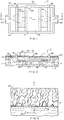
- the improved liquid particle removal system includes a containment vessel 12 constructed or lined with a suitable refractory material in which the molten metal 11 is contained.
- the containment vessel 12 includes two sidewalls 13, 14 ( Figure 1) as well as a floor 15 ( Figure 2).
- a lid (not shown) can be provided to cover the containment vessel 12.
- An inlet baffle 18 establishes an inlet leg 20 for the flow of molten metal (shown by the arrows in Figure 1 and 2).
- a rigid porous ceramic media 24 is mounted generally horizontally in the containment vessel 12 such that the molten metal entering the inlet leg 20 is passed generally upwardly therethrough, as seen best in Figure 2.
- the containment vessel 12 further includes an outlet baffle 28 which establishes an outlet leg 30.
- the inlet baffle 18 and outlet baffle 28 define a settling zone 32 where the gravity separable liquid particles, shown in Figure 2 as coalesced liquid particle globules 34, are collected on the upper surface 35 of the molten metal 11.
- the settling zone 32 includes a floor 36 supported by walls 37 and 38 ( Figure 2) mounted to the floor 15 of the containment vessel 12.
- a porous ceramic filter 40 is mounted generally horizontally in the floor 36 such that the molten metal in the settling zone area 32 passes generally downwardly therethrough.
- liquid particles 50 in operation, liquid particles 50, typically salt particles less than one micron to possibly fifty microns, are entrained in the molten metal 11 flowing in the inlet leg 20 upstream of the rigid porous ceramic media 24.
- the term "liquid particle” also includes slurries of liquid particles and solids, the solids being less than about fifteen volume percent of the liquid particles. More generally, the term liquid particles means particles which are deformable to the shear forces experienced in conventional trough and filter arrangements. The liquid particles are typically lighter than the molten metal, but are not gravity separable and remain entrained or suspended largely because of the very low rise velocity caused by their small size.
- the liquid particles can include molten salts such as MgCl2, NaCl, CaCl2, KCl, LiCl and mixtures thereof.
- the molten salts can also contain fine solids, such as NaF, AlF3 and CaF2 originating from furnace additives or potroom metal.
- the fluorides in addition to being solids, can also be dissolved in the molten salt.
- the liquid particles can be liquid metal phases insoluble in aluminum, such as Pb.
- the molten metal 11 containing the liquid particles 50 passes generally upwardly through the rigid porous ceramic media 24.
- the rigid porous ceramic media 24 renders the livid particles gravity separable with the gravity separable liquid particles subsequently being released from the media 24.
- the liquid particle globules 34 due to their greater buoyancy and the generally upward molten metal flow velocity, float to the top surface 35 of the molten metal 11 in the settling zone 32 as shown in Figure 2.
- the liquid particle globules 34 are typically over 50 or 60 microns and as large as 1,000 microns or larger. From there, floating liquid particle globules 34 can be periodically collected and removed from the containment vessel 12 by skimming or other like operations.
- a small percentage of the liquid particles 62 may remain entrained in the molten metal 11 after it is passed through rigid porous ceramic media 24. This can be caused by the fact that some liquid particles may not be coalesced in the rigid porous ceramic media 24 and because, as will be discussed with respect to Figure 6, as the large coalesced particles are released from the rigid porous ceramic media 24, some smaller diameter droplets of liquid particles can be generated. This happens because in the release process, the film of the liquid particles is ruptured. In order to further remove these liquid particles 62, the molten metal containing these liquid particles optionally can be passed through the porous ceramic filter 40.
- Liquid particles 62 that remain trapped in the porous ceramic filter 40 can be removed when the filter 40 is replaced, which usually occurs after each casting of molten metal (one casting typically ranging from approximately 40,000 to 250,000 pounds of metal).
- the porous ceramic filter 40 can also capture remaining solid particles in the molten metal.
- Filter 40 can be similar to porous media 24. However, preferably, filter 40 has a greater number of pores per inch (see discussion hereinafter for the meaning of pores per inch) than media 24 to capture the smaller liquid particles that remain entrained in the molten metal 11 after the molten metal 11 is passed through media 24. As porous media 24 effects removal of substantially most of the liquid particles in the molten metal 11, filter 40 is usually not loaded by the liquid particles (as will be explained and shown with respect to Figures 4-6) and thus does not create globules of liquid particles that are released therefrom. Filter 40, thus, is used to capture liquid particles which remain entrained in the molten metal 11 after passing generally upwardly through porous media 24.
- the invention contemplates using the rigid porous ceramic media 24, which will render gravity separable substantially most of the liquid particles 50 entrained in the molten metal 11 while omitting the use of porous ceramic filter 40.
- the containment vessel 12 could be configured such that the molten metal will also flow generally upwardly through the porous ceramic filter 40; however, this is not as preferred because this would mean that the settling zone 32 would be shorter (for the same containment vessel length) or the containment vessel size would have to be increased (for the same settling zone length).
- the rigid porous ceramic media 24 can be made of several types of materials such as, for example, ceramic foams, bonded ceramic particulate, porous carbon and glasses.
- the ceramic foam media can be produced by using a polyurethane precursor which is immersed in a ceramic slurry and then fired at a high temperature. During firing, the polymer precursor vaporizes leaving a sintered or fused ceramic media.
- the bonded ceramic particulate media consists of tabular ceramic media held together by a ceramic binder or by bonds formed by sintering without a binder.
- Rigid porous ceramic media is commercially available from various manufacturers such as Hi-Tech Ceramics, Inc. of Alfred, New York, sold under the trade name AlucelTM. These media are generally composed of mixtures of oxides such as alumina, zirconia and silica.
- the alumina filters in particular, can be sintered or phosphate bonded.
- pore size of a porous ceramic media is described by the number of pores per linear inch or PPI.
- the PPI of a specific media is determined, for foam media, from the original pore size of the polyurethane foam used as the template.
- an average PPI can usually be determined and since the pores are nearly spherical in shape, their size can be represented by an effective diameter.
- the pore sizes for the media used in the present invention are preferred to be in the range of about 10 to 60 PPI with 20 to 40 PPI being more highly preferred.
- FIG. 3 to 6 a detailed view of the operation of the rigid porous ceramic media 24 is shown.
- the molten metal 11 containing liquid particles 50 is passed generally upwardly through the media 24 (as indicated by the flow direction arrows), and because the media 24 is wettable by the liquid particles 50, they can wet the media 24 as is shown by the stippled areas 70 an the media 24 in Figure 3. This wetting will continue until most of the media 24 is wetted as shown in Figure 4. Once this occurs, the liquid particles will start to move upwardly as a viscous liquid flow by virtue of the molten metal flow and will eventually gather on the upper surface of the media 24 as shown in Figure 5 by the retained coalesced liquid particles 75.
- coalesced liquid particle globules 34 shown in Figure 6 and in Figures 1 and 2.
- the size of these coalesced liquid particle globules 34 is on the order of about 100 to 10,000 microns, with most being greater than 500 microns. At this size, the coalesced liquid particle globules 34 are gravity separable and they rise through the molten metal 11 in the settling zone 32. It can also be seen from Figure 6 that some smaller liquid particles, such as particles 62 (see also Figure 2), can be released when the larger liquid particle globules 34 are released.
- the ceramic media can consist of an upper portion 90 and a lower portion 92, the upper portion having fewer average PPI (such as 10 to 20 PPI) than the lower portion (such as 30 to 40 PPI).
- the liquid particles are captured more easily on the lower portion 92 for coalescence and subsequently the coalesced particles can pass more easily through the upper portion 90.
- the ceramic media is wettable by the liquid particles sought to be removed.
- One narrow test for determining whether a media is wettable or not involves heating the media to about 600-700°C. and pouring a heated liquid salt on the media. If the liquid salt beads on the media, the media is non-wettable. If the liquid salt does not bead, the media is wettable. In a narrower test, if the heated liquid salt is poured on a heated media and passes through or spreads (but does not bead) the media is also wettable. A more broad test involves measuring wettability as a function of the interfacial tensions (measured in dynes per centimeter) between the ceramic media, the molten salt and the molten aluminum.
- Figure 8 illustrates partially schematically the concept of wettability and non-wettability.
- the molten salt-solid substrate (in this case the ceramic media) interfacial tension is indicated by the variable ⁇ sl
- the molten salt-molten aluminum interfacial tension is indicated by the variable ⁇ sv
- the molten aluminum-solid substrate interfacial tension is indicated by ⁇ lv.
- ⁇ sl is greater than ⁇ sv
- the angle ⁇ which is determined by the Young-Dupre equation will be greater than 90° and the molten salt will be non-wetting toward the substrate.
- the molten salt will have no tendency to spread on the ceramic media surface but instead the molten aluminum will spread over the ceramic media in preference to the molten salt.
- ⁇ sl is less than ⁇ sv
- ⁇ will be less than 90° and the molten salt will be wetting toward the substrate arid the molten salt, as opposed to the molten aluminum, will tend to spread over the ceramic media surface.
- the minimum length of the settling zone 32 ( Figures 1 and 2) is determined to accommodate gravity settling of the liquid particles to the top surface of the molten metal 11 so that the coalesced liquid particle globules 34 can be skimmed or otherwise removed from the top surface of the molten metal.
- the larger the liquid particle globule diameter the faster the rise velocity. Therefore, for larger particles the settling zone 32 (assuming constant width, depth and metal flow velocity) can be shorter in order for the liquid particle globules to rise to the top surface of the molten metal.
- a quantity of 10,000 lb. of aluminum alloy AA5182 was melted in a gas-fired furnace.
- Phosphate-bonded alumina foam media (30 PPI, 12"L x 12"W x 2"D) were used in both the upstream and downstream positions of a unit similar to Figure 1.
- the alumina foam media had 30 PPI.
- the metal in the furnace was heated to approximately 1350°F. At some given time, the plug was removed from the furnace taphole and metal flowed from the furnace into a connecting trough and then into the unit.
- molten salt of composition 70% MgCl2-30% NaCl was semi-continuously poured onto the metal surface and stirred in for dispersal with a graphite stirrer, the additions being made immediately upstream of the unit. Initially, no liquid salt particles were observed on the metal surface in the unit or downstream of the unit. After twenty-eight minutes of operation, large releases of liquid salt particles floated to the metal surface above the upstream media. Regular releases of liquid salt particles occurred throughout the remainder of the test. These liquid salt particles could be skimmed off the metal surface at this point. The test continued for approximately 1 hour at a flow rate of 7,000 lb./hr.
- the procedure to take an inclusion sample was to pull molten aluminum, by a vacuum of approximately 25 in. of mercury, through a porous carbon disk. After approximately 0.5 to 1 kg of aluminum was passed through the porous carbon, the cartridge containing the porous carbon was removed from the metal being supplied and allowed to solidify. The porous carbon disk was then sectioned and examined metallographically. Any solid or liquid inclusion present in the metal were collected on the surface of the porous carbon disk.
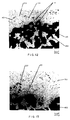
- Figure 10 shows a photomicrograph of an inclusion sample taken upstream of the first media.
- the existence of round holes 101 in the metallic portion 100 of the sample, grey staining of the metal 102, and round rings 103 are the results of salt present in the sample.
- a portion of the carbon 104 from the inclusion sample cartridge can also be seen.
- the grey staining of the sample is the result of atmospheric moisture because of the hygroscopic nature of the salt present in the sample.
- Figure 11 shows a photomicrograph of an inclusion sample taken downstream of the second media.
- the metallic portion 110 is relatively clean with little, if any, salt 111 present.
- the voids 112 in the sample are solidification, shrinkage cavities and, in addition, some constituent phase 113 can also be seen.
- the carbon 114 from the inclusion sample cartridge is also present in Figure 11. No grey staining of the sample occurred, and round voids indicative of salt were not present.
- This metallographic analysis of inclusion samples indicates that the invention effectively removes salt particles from the stream of mol
- FIG 12 is a photomicrograph of an inclusion sample taken upstream of the unit.
- the metallic portion 140 contains evidence of salt due to the condensed droplets of water 141 and the grey staining 142.
- Constituent metallic phase 143 and shrinkage cavities 144 are also present as well as the carbon 145 from the inclusion sample cartridge.
- Figure 15 shows a photomicrograph of an inclusion sample taken downstream of the second media. Once again, there is little or no evidence of the presence of salt in the metallic portion 150.
- Constituent metallic phase 151 and shrinkage cavities 152 as well as the carbon 153 from the inclusion sample is shown.
- FIGS. 10-13 show that the apparatus and the method of the invention are effective for removing molten salts from molten aluminum. While it will be appreciated that the examples have shown removal of molten salts from molten aluminum, the invention is not limited to molten aluminum and can be used with other light molten metals such as magnesium.
- Aluminum alloy AA5083 was melted in a gas-fired furnace. Metal flowing from the furnace was purified in a gas chloridizing system.
- the system includes a gas dispersing unit located in the body of molten metal.
- the dispersing unit is a generally circular rotor or impeller which is rotated, and simultaneously therewith, a fluxing gas is added adjacent or in the region below the rotor.
- the fluxing gas is a chlorine and/or a non-reactive gas selected from the group consisting of argon and nitrogen gases and mixtures thereof.
- the amount of chlorine gas added to the metal was relatively low, in the range of about 0.5 to 10 SCFH (standard cubic feet per hour). This flow rate of fluxing gas is a typical flow rate for use in commercial fluxing of aluminum alloys.
- the metal was filtered with phosphate-bonded alumina foam filter media, with the metal flowing in the standard direction, that is downward through the filter.
- Cleanliness is a measure of the amount of non-metallic inclusions found in the metal such as MgAl2O4, MgO arid Al2O3. It is based on the number of inclusions seen across a leading edge of a porous graphite frit in the sampling cartridge.
- the rating scale ranged from 1 to 5.
- the rating system is set forth as follows: 1. Rating of 1 given to samples in which the metal is absolutely clean with no visible inclusions. 2. Rating of 2 given to samples in which inclusions are seen only occasionally on the porous graphite frit. 3. Rating of 3 given to samples in which inclusions are seen in many but not all pores at the leading edge of the porous graphite frit. 4.
- Example 3 The mean cleanliness level for the material of Example 3 is shown in the following Table. Table Example Number of Samples Average Cleanliness Before Filter After Filter Improvement in Cleanliness 3 5 2.83 2.40 0.43 4 8 3.25 3.25 0.00 5 14 2.79 2.43 0.36 6 8 3.31 2.56 0.75
- Example 3 The procedure of Example 3 was repeated except that the level of chlorine gas added to the metal was increased more than six-fold which is a flow rate that is much higher than the flow rates that are typically used in commercial fluxing of aluminum alloys.
- the mean cleanliness level for the material of Example 3 is shown on the Table.
- Example 3 The procedure of Example 3 was repeated except that the standard flow phosphate-bonded alumina foam filter media was replaced with a liquid particle removal system similar to that shown in Figures 1 and 2. The flow of metal was upward through the first stage and downward through the second stage. The mean cleanliness level for the material of Example 4 is shown on the Table.
- Example 5 The procedure of Example 5 was repeated the level of chlorine gas added to the metal was increased more than six-fold which is a flow rate that is much higher than the flow rates that are typically used in commercial fluxing of aluminum alloys.
- the mean cleanliness level for the material of Example 6 is shown on the Table.
Landscapes
- Engineering & Computer Science (AREA)
- Chemical & Material Sciences (AREA)
- Manufacturing & Machinery (AREA)
- Materials Engineering (AREA)
- Mechanical Engineering (AREA)
- Metallurgy (AREA)
- Organic Chemistry (AREA)
- Physics & Mathematics (AREA)
- Acoustics & Sound (AREA)
- Manufacture And Refinement Of Metals (AREA)
Applications Claiming Priority (2)
| Application Number | Priority Date | Filing Date | Title |
|---|---|---|---|
| US08/287,165 US5427602A (en) | 1994-08-08 | 1994-08-08 | Removal of suspended particles from molten metal |
| US287165 | 1994-08-08 |
Publications (2)
| Publication Number | Publication Date |
|---|---|
| EP0696646A2 true EP0696646A2 (fr) | 1996-02-14 |
| EP0696646A3 EP0696646A3 (fr) | 1996-04-17 |
Family
ID=23101729
Family Applications (1)
| Application Number | Title | Priority Date | Filing Date |
|---|---|---|---|
| EP95112148A Withdrawn EP0696646A3 (fr) | 1994-08-08 | 1995-08-02 | Procédé pour l'élimination de particules en suspension à partir de métal en fusion |
Country Status (7)
| Country | Link |
|---|---|
| US (1) | US5427602A (fr) |
| EP (1) | EP0696646A3 (fr) |
| JP (1) | JPH0867920A (fr) |
| AU (1) | AU2835295A (fr) |
| BR (1) | BR9503580A (fr) |
| CA (1) | CA2155491C (fr) |
| NO (1) | NO311182B1 (fr) |
Cited By (8)
| Publication number | Priority date | Publication date | Assignee | Title |
|---|---|---|---|---|
| US5935295A (en) * | 1997-10-16 | 1999-08-10 | Megy; Joseph A. | Molten aluminum treatment |
| DE10055523C1 (de) * | 2000-11-09 | 2002-04-18 | Vaw Ver Aluminium Werke Ag | Vorrichtung zur Filtration von und Zugabe von Kornfeinungsmittel zu Metallschmelzen |
| WO2007147587A1 (fr) * | 2006-06-22 | 2007-12-27 | Aleris Switzerland Gmbh | Procédé de séparation d'aluminium fondu et d'inclusions solides |
| US7531023B2 (en) | 2004-03-19 | 2009-05-12 | Aleris Switzerland Gmbh | Method for the purification of a molten metal |
| US7537639B2 (en) | 2003-11-19 | 2009-05-26 | Aleris Switzerland Gmbh | Method of cooling molten metal during fractional crystallisation |
| US7648559B2 (en) | 2002-07-05 | 2010-01-19 | Aleris Switzerland Gmbh C/O K+P Treuhangesellschaft | Method for fractional crystallisation of a metal |
| US7892318B2 (en) | 2006-06-28 | 2011-02-22 | Aleris Switzerland Gmbh C/O K+P Treuhandgesellschaft | Crystallisation method for the purification of a molten metal, in particular recycled aluminium |
| US7955414B2 (en) | 2006-07-07 | 2011-06-07 | Aleris Switzerland Gmbh | Method and device for metal purification and separation of purified metal from metal mother liquid such as aluminium |
Families Citing this family (26)
| Publication number | Priority date | Publication date | Assignee | Title |
|---|---|---|---|---|
| CN1076759C (zh) * | 1994-08-01 | 2001-12-26 | 国际钛金属粉末公司 | 制备金属和其它元素的方法 |
| GB9523154D0 (en) * | 1995-11-11 | 1996-01-17 | Enright Philip G | Filtration apparatus and method |
| US6036743A (en) * | 1997-10-27 | 2000-03-14 | Selee Corporation | Method and apparatus for removing liquid salts from liquid metal |
| NO311437B1 (no) * | 1999-03-31 | 2001-11-26 | Norsk Hydro As | Fremgangsmåte og apparat for flussmiddelfri raffinering av magnesium og magnesiumlegeringer |
| US6398844B1 (en) * | 2000-02-07 | 2002-06-04 | Air Products And Chemicals, Inc. | Blanketing molten nonferrous metals and alloys with gases having reduced global warming potential |
| US7621977B2 (en) * | 2001-10-09 | 2009-11-24 | Cristal Us, Inc. | System and method of producing metals and alloys |
| WO2004028655A2 (fr) * | 2002-09-07 | 2004-04-08 | International Titanium Powder, Llc. | Appareil et procede de traitement d'un gateau au moyen d'un filtre |
| EA006616B1 (ru) * | 2002-09-07 | 2006-02-24 | Интернэшнл Тайтейнием Паудер, Ллк | Способ отделения титана от содержащей титан суспензии |
| UA79310C2 (en) * | 2002-09-07 | 2007-06-11 | Int Titanium Powder Llc | Methods for production of alloys or ceramics with the use of armstrong method and device for their realization |
| US20060107790A1 (en) * | 2002-10-07 | 2006-05-25 | International Titanium Powder, Llc | System and method of producing metals and alloys |
| US20070180951A1 (en) * | 2003-09-03 | 2007-08-09 | Armstrong Donn R | Separation system, method and apparatus |
| GB0403466D0 (en) * | 2004-02-17 | 2004-03-24 | Mqp Ltd | Treatment of metal melts |
| DE602005020435D1 (de) * | 2004-02-24 | 2010-05-20 | Alcan Int Ltd | Verfahren zur vorbereitung eines filters für metallschmelze |
| US20070017319A1 (en) * | 2005-07-21 | 2007-01-25 | International Titanium Powder, Llc. | Titanium alloy |
| CA2623544A1 (fr) | 2005-10-06 | 2007-04-19 | International Titanium Powder, Llc | Borure de titane |
| US20080031766A1 (en) * | 2006-06-16 | 2008-02-07 | International Titanium Powder, Llc | Attrited titanium powder |
| US7753989B2 (en) * | 2006-12-22 | 2010-07-13 | Cristal Us, Inc. | Direct passivation of metal powder |
| US9127333B2 (en) * | 2007-04-25 | 2015-09-08 | Lance Jacobsen | Liquid injection of VCL4 into superheated TiCL4 for the production of Ti-V alloy powder |
| KR100917271B1 (ko) * | 2007-10-30 | 2009-09-21 | 대창공업 주식회사 | 금속 용탕 중의 불순물 제거를 위한 다층구조를 가지는필터 |
| CA2668473C (fr) * | 2009-06-08 | 2014-08-19 | Pyrotek, Inc. | Utilisation d'un flux binaire de nacl et de mgcl2 pour la purification de l'aluminium ou des alliages d'aluminium, et methode d'utilisation de ce flux |
| US8479802B1 (en) | 2012-05-17 | 2013-07-09 | Almex USA, Inc. | Apparatus for casting aluminum lithium alloys |
| US8365808B1 (en) | 2012-05-17 | 2013-02-05 | Almex USA, Inc. | Process and apparatus for minimizing the potential for explosions in the direct chill casting of aluminum lithium alloys |
| BR112014028383A2 (pt) | 2013-02-04 | 2018-05-29 | Almex Usa Inc | processo e aparelho para fundição com resfriamento direto. |
| US9936541B2 (en) | 2013-11-23 | 2018-04-03 | Almex USA, Inc. | Alloy melting and holding furnace |
| CN107532849B (zh) | 2015-02-18 | 2019-09-06 | 应达公司 | 用于活性金属和合金的电感应熔炼和保温炉 |
| WO2020081707A2 (fr) * | 2018-10-17 | 2020-04-23 | Kairos Power Llc | Systèmes et procédés pour la préservation chimique dans des systèmes de sels fondus |
Citations (2)
| Publication number | Priority date | Publication date | Assignee | Title |
|---|---|---|---|---|
| US4390364A (en) | 1981-08-03 | 1983-06-28 | Aluminum Company Of America | Removal of fine particles from molten metal |
| US4790873A (en) | 1983-08-16 | 1988-12-13 | Alcan International Limited | Removing inclusions from molten metal |
Family Cites Families (19)
| Publication number | Priority date | Publication date | Assignee | Title |
|---|---|---|---|---|
| US2840463A (en) * | 1954-05-13 | 1958-06-24 | Aluminum Co Of America | Degassing and purifying molten aluminous metal |
| US2863558A (en) * | 1957-04-29 | 1958-12-09 | Aluminum Co Of America | Filtering molten aluminous metal |
| US3025155A (en) * | 1958-11-21 | 1962-03-13 | Aluminum Co Of America | Chloridizing aluminum |
| US3039864A (en) * | 1958-11-21 | 1962-06-19 | Aluminum Co Of America | Treatment of molten light metals |
| US3737305A (en) * | 1970-12-02 | 1973-06-05 | Aluminum Co Of America | Treating molten aluminum |
| US3737304A (en) * | 1970-12-02 | 1973-06-05 | Aluminum Co Of America | Process for treating molten aluminum |
| US3737303A (en) * | 1970-12-02 | 1973-06-05 | Aluminum Co Of America | Refining molten aluminum with chlorine-activated bodies |
| US3893917A (en) * | 1974-01-02 | 1975-07-08 | Alusuisse | Molten metal filter |
| US4032124A (en) * | 1975-03-28 | 1977-06-28 | Swiss Aluminium Ltd. | Apparatus and method for in-line degassing and filtration of molten metal |
| US4024056A (en) * | 1975-07-21 | 1977-05-17 | Swiss Aluminium Ltd. | Filtering of molten metal |
| US3962081A (en) * | 1975-03-28 | 1976-06-08 | Swiss Aluminium Ltd. | Ceramic foam filter |
| US4024212A (en) * | 1975-03-28 | 1977-05-17 | Swiss Aluminium Ltd. | Ceramic foam and method of preparation |
| GB1537549A (en) * | 1975-06-23 | 1978-12-29 | Alusuisse | Methods of preparing ceramic foam materials |
| US4067731A (en) * | 1975-07-18 | 1978-01-10 | Southwire Company | Method of treating molten metal |
| US4384888A (en) * | 1981-08-03 | 1983-05-24 | Aluminum Company Of America | Treating molten aluminum |
| US4769158A (en) * | 1986-12-08 | 1988-09-06 | Aluminum Company Of America | Molten metal filtration system using continuous media filter |
| JPS6462265A (en) * | 1987-09-01 | 1989-03-08 | Hitachi Metals Ltd | Removing method for nonmetallic inclusion in molten metal |
| US5122184A (en) * | 1990-12-28 | 1992-06-16 | Aluminum Company Of America | Molten salt coalescence in molten aluminum |
| US5336295A (en) * | 1993-02-08 | 1994-08-09 | Aluminum Company Of America | Method for separation and removal of suspended liquid particles from molten metal and associated apparatus |
-
1994
- 1994-08-08 US US08/287,165 patent/US5427602A/en not_active Expired - Lifetime
-
1995
- 1995-08-02 EP EP95112148A patent/EP0696646A3/fr not_active Withdrawn
- 1995-08-03 AU AU28352/95A patent/AU2835295A/en not_active Abandoned
- 1995-08-04 CA CA002155491A patent/CA2155491C/fr not_active Expired - Fee Related
- 1995-08-07 NO NO19953090A patent/NO311182B1/no unknown
- 1995-08-08 JP JP7202560A patent/JPH0867920A/ja active Pending
- 1995-08-08 BR BR9503580A patent/BR9503580A/pt not_active IP Right Cessation
Patent Citations (2)
| Publication number | Priority date | Publication date | Assignee | Title |
|---|---|---|---|---|
| US4390364A (en) | 1981-08-03 | 1983-06-28 | Aluminum Company Of America | Removal of fine particles from molten metal |
| US4790873A (en) | 1983-08-16 | 1988-12-13 | Alcan International Limited | Removing inclusions from molten metal |
Cited By (9)
| Publication number | Priority date | Publication date | Assignee | Title |
|---|---|---|---|---|
| US5935295A (en) * | 1997-10-16 | 1999-08-10 | Megy; Joseph A. | Molten aluminum treatment |
| DE10055523C1 (de) * | 2000-11-09 | 2002-04-18 | Vaw Ver Aluminium Werke Ag | Vorrichtung zur Filtration von und Zugabe von Kornfeinungsmittel zu Metallschmelzen |
| US7648559B2 (en) | 2002-07-05 | 2010-01-19 | Aleris Switzerland Gmbh C/O K+P Treuhangesellschaft | Method for fractional crystallisation of a metal |
| US7537639B2 (en) | 2003-11-19 | 2009-05-26 | Aleris Switzerland Gmbh | Method of cooling molten metal during fractional crystallisation |
| US7531023B2 (en) | 2004-03-19 | 2009-05-12 | Aleris Switzerland Gmbh | Method for the purification of a molten metal |
| WO2007147587A1 (fr) * | 2006-06-22 | 2007-12-27 | Aleris Switzerland Gmbh | Procédé de séparation d'aluminium fondu et d'inclusions solides |
| US8313554B2 (en) | 2006-06-22 | 2012-11-20 | Aleris Switzerland Gmbh | Method for the separation of molten aluminium and solid inclusions |
| US7892318B2 (en) | 2006-06-28 | 2011-02-22 | Aleris Switzerland Gmbh C/O K+P Treuhandgesellschaft | Crystallisation method for the purification of a molten metal, in particular recycled aluminium |
| US7955414B2 (en) | 2006-07-07 | 2011-06-07 | Aleris Switzerland Gmbh | Method and device for metal purification and separation of purified metal from metal mother liquid such as aluminium |
Also Published As
| Publication number | Publication date |
|---|---|
| EP0696646A3 (fr) | 1996-04-17 |
| CA2155491C (fr) | 2002-02-05 |
| BR9503580A (pt) | 1996-09-10 |
| NO311182B1 (no) | 2001-10-22 |
| NO953090L (no) | 1996-02-09 |
| US5427602A (en) | 1995-06-27 |
| CA2155491A1 (fr) | 1996-02-09 |
| JPH0867920A (ja) | 1996-03-12 |
| NO953090D0 (no) | 1995-08-07 |
| AU2835295A (en) | 1996-02-22 |
Similar Documents
| Publication | Publication Date | Title |
|---|---|---|
| US5427602A (en) | Removal of suspended particles from molten metal | |
| CA1198289A (fr) | Enlevement de fines particules dans un metal en fusion | |
| US5336295A (en) | Method for separation and removal of suspended liquid particles from molten metal and associated apparatus | |
| US4092153A (en) | Filtering and inline degassing of molten metal | |
| CA1127852A (fr) | Installation et methode d'extraction des metaux alcalins et de terre alcaline en presence dans l'aluminium en fusion | |
| US4154689A (en) | Filtering and inline degassing of molten metal | |
| US4295884A (en) | Process for treating a molten metal or alloy using liquid and solid flux | |
| US5122184A (en) | Molten salt coalescence in molten aluminum | |
| Liu et al. | Assessment of melt cleanliness in A356. 2 aluminium casting alloy using the porous disc filtration apparatus technique: Part II Inclusion analysis | |
| Neff et al. | Melting and melt treatment of aluminum alloys | |
| EP0276576A1 (fr) | Traitement de métal | |
| AU4344399A (en) | Removal of suspended particles from molten metal | |
| AU7216501A (en) | Removal of suspended particles from molten metal | |
| Brant et al. | Fumeless in-line degassing and cleaning of liquid aluminum | |
| NO171044B (no) | Fremgangsmaate for separering ved filtrering av inklusjoner inneholdt i et bad av smeltet metall | |
| RU2090639C1 (ru) | Устройство для рафинирования алюминия и его сплавов | |
| US4533388A (en) | Technique for removing iron-rich components from a copper melt | |
| US20240279772A1 (en) | Magnesium reduction in molten aluminum | |
| WO1983000508A1 (fr) | Traitement de l'aluminium en fusion | |
| Gorner | Removal of dissolved elements in aluminium by filtration | |
| Emley | Cleansing and degassing of light metals | |
| SU1118703A1 (ru) | Способ рафинировани сплавов на основе алюмини | |
| Moldovan et al. | Microstructure evaluation and microporosity formation in AlSi7Mg 0.3 alloys | |
| RU2156815C1 (ru) | Способ переработки отходов и стружки цветных металлов и сплавов | |
| Smith et al. | Selee Corp tackles liquid salts in molten aluminium |
Legal Events
| Date | Code | Title | Description |
|---|---|---|---|
| PUAI | Public reference made under article 153(3) epc to a published international application that has entered the european phase |
Free format text: ORIGINAL CODE: 0009012 |
|
| AK | Designated contracting states |
Kind code of ref document: A2 Designated state(s): CH DE FR GB LI |
|
| PUAL | Search report despatched |
Free format text: ORIGINAL CODE: 0009013 |
|
| AK | Designated contracting states |
Kind code of ref document: A3 Designated state(s): CH DE FR GB LI |
|
| STAA | Information on the status of an ep patent application or granted ep patent |
Free format text: STATUS: THE APPLICATION IS DEEMED TO BE WITHDRAWN |
|
| 18D | Application deemed to be withdrawn |
Effective date: 19961018 |