EP0696872A2 - Antwortorientierte Plannung zur Unterstützung von Video-auf-Anfrage Anwendungen - Google Patents
Antwortorientierte Plannung zur Unterstützung von Video-auf-Anfrage Anwendungen Download PDFInfo
- Publication number
- EP0696872A2 EP0696872A2 EP95110535A EP95110535A EP0696872A2 EP 0696872 A2 EP0696872 A2 EP 0696872A2 EP 95110535 A EP95110535 A EP 95110535A EP 95110535 A EP95110535 A EP 95110535A EP 0696872 A2 EP0696872 A2 EP 0696872A2
- Authority
- EP
- European Patent Office
- Prior art keywords
- requests
- video
- queue
- stream
- scheduler
- Prior art date
- Legal status (The legal status is an assumption and is not a legal conclusion. Google has not performed a legal analysis and makes no representation as to the accuracy of the status listed.)
- Granted
Links
- 238000000034 method Methods 0.000 claims description 12
- 230000005540 biological transmission Effects 0.000 claims 1
- 230000001934 delay Effects 0.000 abstract description 4
- 230000008569 process Effects 0.000 description 6
- 230000000737 periodic effect Effects 0.000 description 3
- 238000013459 approach Methods 0.000 description 2
- 238000004891 communication Methods 0.000 description 2
- 238000010586 diagram Methods 0.000 description 2
- 230000006870 function Effects 0.000 description 2
- 230000002452 interceptive effect Effects 0.000 description 2
- 230000000007 visual effect Effects 0.000 description 2
- 230000002457 bidirectional effect Effects 0.000 description 1
- 230000003139 buffering effect Effects 0.000 description 1
- 230000008859 change Effects 0.000 description 1
- 230000000694 effects Effects 0.000 description 1
- 239000000835 fiber Substances 0.000 description 1
- 239000000945 filler Substances 0.000 description 1
- 238000012986 modification Methods 0.000 description 1
- 230000004048 modification Effects 0.000 description 1
- 238000005457 optimization Methods 0.000 description 1
- 238000011160 research Methods 0.000 description 1
Images


Classifications
-
- H—ELECTRICITY
- H04—ELECTRIC COMMUNICATION TECHNIQUE
- H04N—PICTORIAL COMMUNICATION, e.g. TELEVISION
- H04N7/00—Television systems
- H04N7/16—Analogue secrecy systems; Analogue subscription systems
- H04N7/173—Analogue secrecy systems; Analogue subscription systems with two-way working, e.g. subscriber sending a programme selection signal
- H04N7/17309—Transmission or handling of upstream communications
- H04N7/17327—Transmission or handling of upstream communications with deferred transmission or handling of upstream communications
Definitions
- the present invention relates the scheduling of performance requests in video-on-demand systems.
- VOD Video-On-Demand
- hot videos i.e. movies or other programs
- Batching letting viewers requesting the same video to share a single video stream
- a video request may not get started immediately. While viewers can usually tolerate and accept a small delay (say 3-5 minutes), longer delays will typically cause some viewers to be turned away (i.e. leave the system after making or request or not even make the request at all). The likelihood that viewers will be turned away increases with the length of delay.
- FCFS first-come-first-served
- LQF longest queue length first
- FCFS shortest queue length first
- waiting requests may depart from the queue if the waiting time exceeds the tolerance of the requesting viewers. This loss of viewers (sometimes referred to as reneging) is undesirable.
- the choice of video scheduling policy can have a significant effect on the amount of batching and viewer losses.
- the FCFS policy does not take into account the batching factor while the LQF policy ignores the wait time already incurred by the waiting requests. Periodic showing (when used alone) does not provide the flexibility needed to cope with dynamic load variations.
- a VOD scheduler maintains a queue of pending performance for at least one movie.
- the scheduler delays performance of the video until just prior to expiration of the maximum wait tolerance time of the longest waiting one of the pending performance requests. In the interim, additional streams can join the queue. When the performance occurs all performance requests on the queue are served from a single stream.
- the first concept is the policy of delaying the scheduling of a hot (frequently requested) video for as long as possible within the viewer's tolerance time. This is based on the probability that during the additional delay, some other requests for the same video will arrive. The other requests can then be batched to view a common video showing (performance) along with the original viewer's request. Certainly, delaying the original request too long can result in losing the original requesting viewer.
- the other concept is that if a loss of viewers is inevitable due to the heavy load resulting from a long delay, it is better to lose the cold (less frequently requested) video viewers. This is due to the fact that the revenue from serving a batch of M viewers is M times that of showing a single viewer. In either case, one physical stream capacity is consumed. Hence, the return for a batch showing is much higher.
- the return based scheduler maintains two separate wait queues.
- One is referred to as the H-queue which includes requests waiting for performances of the pre-designated hot videos and any other videos currently with multiple waiting requests.
- the H-queue can be implemented as multiple subqueues one for each hot video.
- the other is referred to as the C-queue which includes other waiting viewers for the cold videos.
- Whether a video is "hot” or "cold" is stored in a database and determined by the system or system operator based on requests received over a previous time period (e.g. the previous day). To maintain fairness, long waiting requests in the C-queue can be moved into the H-queue.)
- the scheduler also maintains a list of completion times for the videos currently being shown.
- the delay tolerance interval i accounts for both the users wait tolerance time and the time it takes to actually commence the requested video. Thus, the delay tolerance interval is actually somewhat shorter than the users delay tolerance time. In other words, when the delay tolerance interval expires, there is enough time remaining (e.g. 1 or 2 seconds) to commence the requested video before the users actual delay tolerance time expires.
- the scheduler is invoked each time any one of the following events occurs: stream completion, the arrival of new requests or the earliest request in H-queue reaching its wait tolerance. Otherwise, the scheduler is in a wait (inactive) state. It works as follows:
- Picking k > 1 can reserve some additional capacity to accommodate hot videos which may not have any viewers at the current moment but may get a number of them subsequently.
- the k value should be a function of the hot videos which are not currently covered in H-queue.
- Step 5 an alternative is to select the video associated with the longest queue.
- Step 7 is to delay the scheduling as long as possible within the viewers wait tolerance. For example, at time t , the scheduler finds that there are N requests for a particular video, V 1, on the H-Queue, where the earliest request arrived at t -30 seconds. The wait tolerance time for requests in this system is 2 minutes (which means that the delay tolerance interval i is perhaps 1 minute, 58 seconds). There is another request (for a different video, V 2) in the C-queue. The next available stream S 2 is scheduled to complete at t + 3 minutes. The scheduler will not schedule the cold video V 1 (from the C-queue), because to do so would cause requests for the hot video V1 to be lost.
- the scheduler enters into a wait state and is reinvoked at t+1 minute, 28 seconds. At that time, the scheduler commences the performance of video V1 on stream S 1. Since i (1 minute, 58 seconds) has expired, the video will be shown at the last moment of the wait tolerance for the earliest requestor. This way, any additional requestors of video V 1 whose requests arrive in the 1 minute, 28 second interval while the scheduler is waiting can be scheduled to view the movie on stream S 1 before it commences.
- Step 7 where multiple requests exceed the delay tolerance interval, an alternative is to schedule the video associated with either the earliest request or the longest queue instead of deferring the scheduled playout.
- FIG. 1 is a block diagram of a video server 100, wherein video data (movies or other moving visual or audio visual performances) is stored in disks 102 and transmitted to the end client stations 103 over the network 104 upon request.
- the video server also includes other disks (not shown) which store working data and the program code for the video server 30 and can also include other storage devices such as video tape players and jukeboxes from which movies can be loaded on the disks 102.
- the program code for the video server includes processes such as the servers main control program, a video scheduling program, a customer usage tracking program, and conventional communications, I/O and buffer management processes.
- the video server 100 includes a processor (cpu) 101 which executes a the processes under control of the main control program and a memory buffer 105 which is used for the temporary storage of portions of videos (thus enabling some users to be served from the memory buffer 105 rather than the disks 102).
- the memory buffer 105 can also be used to handle pause/resume requests by providing a temporary storage for portions of a video which stream from the disk while a viewer is paused.
- the processes can be of a conventional type typically used in VOD systems.
- the video server 100 can be embodied using any processor of sufficient performance for the number of video streams to be supported.
- a small capacity video server could be embodied using a RISC System/6000 TM system while a larger capacity server could be embodied using an ES/9000 TM system (both available form International Business Machines Corporation of Armonk, New York).
- This disk 102 can be of any conventional disk or of disk array.
- the communication network 103 can be, for example, a fiber optic network or a conventional bidirectional cable network.
- the client stations 103 can be embodied as a set-top box.
- the scheduler 106 performs a number of tasks which result in the scheduling of performances for requested videos.
- the scheduler (return based scheduler) 106 upon receiving video requests from the client station 103, enters the requests into the appropriate request queue: H-queue 106a or C-queue 106b. Once a request is scheduled, the completion time is tracked in a completion time list 106c to assist future scheduling.
- the request queue consists of H-queue 106a and C-queue 106b.
- the H-queue includes multiple subqueues, one for each video which is either a hot video, and other videos with a queue length longer than one, or with too long a waiting time.
- the requestor id (R i ) and the arrival time (t i ) are kept in the queue.
- the C-queue which tracks the requests to the cold videos, a single queue is maintained according to the arrival order.
- the requestor id (R i ) the video requested (V i ) and the arrival time (t i ) are kept in the queue.
- the H-queue has 3 hot videos V a , V b and V k with requests queued.
- V a and V b each have two requests queued while V k only has one request queued.
- V k only has one request queued.
- FIG. 3 there is shows an overview of the handling of a given request return based scheduler 106 of FIG. 1.
- step 205 the scheduler 106 is invoked when it detects arrival of a video request.
- step 210 the request is entered into the appropriate request queue (H-queue or C-queue).
- step 215 the available video stream capacity is checked. If there is no currently available stream capacity, in step 220 the scheduler enters exits. Otherwise, if there is available stream capacity, in step 225 the scheduler executes the video stream scheduling task of FIG. 4 to schedule a video for some waiting viewers.
- step 230 the video is multicast to all the requesting viewers.
- step 235 the video completes and the corresponding video stream is released and is available for scheduling any waiting requests.
- step 240 the request queue is checked. If the request queue is empty, in step 245 the scheduler exits. Otherwise, if there are waiting requests, in step 225 the again executes the video stream scheduling task of FIG. 4 to schedule video requests.
- FIG. 3 tracks the handling cycle of an individual request, in fact, many of the steps of FIG. 3 can occur in parallel as the schedular handles different requests. This is best illustrated in FIG. 5A-5C.
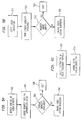
- FIGs. 5A-5C are flow charts of event handling in the return based scheduler.
- Each of the tasks (5A, 5B and 5C) can execute in parallel for different requests, however, the video stream scheduler is a serialization point. That is to say that the video stream scheduler can be invoked by only one task or event at a time and executes to completion once invoked.
- FIG. 5A is a flow chart of video request handling by the return based scheduler.
- step 504 the scheduler determines the appropriate queue for the request (H-queue or C-queue) and enters the request into the correct queue accordingly. If the request is to one of the hot videos or a video currently in the H-queue, it is inserted into the H-queue. Otherwise, the scheduler checks whether the requested video already appears in the C-queue, i.e. the requested video already has a queue on it. If so, the scheduler moves the new request and other waiting requests for that video into the H-queue. Otherwise, if the video has not appeared in the C-queue, the scheduler enters the new request into the C-queue.
- step 506 the scheduler determines if there is any stream capacity available on the server. If there is no capacity available to service the request, the scheduler exits in step 508. At this point the request can not be scheduled until a currently running video completes and its associated stream capacity is freed. If the server has a stream capacity available, the schedular invokes the video stream scheduling task of FIG. 4.
- FIG. 5B is a flow chart of video completion handling by the return based scheduler.
- Completion of a video is detected by the schedular in step 512.
- a video can complete either by finishing the performance through to its scheduled end time or by all of the viewers of the video exiting the video (terminating the performance).
- step 514 the scheduler frees the stream capacity by marking it as being "available” (the use or availability status of each stream capacity is conventionally tracked by the video server by way of a status table).
- step 516 the scheduler checks the request queue to determine if it is empty (i.e. their are no pending requests on either the H-queue or the C-queue). If the request queue is empty, in step 518 the scheduler exits. Otherwise, if the request queue is not empty (there are waiting requests), in step 520 the schedular invokes the video stream scheduling task of FIG. 4.
- FIG. 5C is a flow chart of delay tolerance interval expiration handling by the return based scheduler.
- step 522 When the delay tolerance interval of a video has expired it is detected in step 522. This can be done, for example, by software which regularly checks the waiting time of the H-queue requests against the delay tolerance interval or in conjunction with a device such as an interval timer which is programmed to cause an interrupt when the delay tolerance interval of requests in the H-queue expire.
- step 524 it invokes the video stream scheduling task of FIG. 4.
- the video stream scheduling task is invoked each time any one of the following events occurs: stream completion, the arrival of new requests or the earliest request in the H-queue reaching its wait tolerance. Otherwise, the task is in a wait (inactive) state.
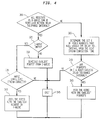
- step 300 the scheduler first determines whether after excluding k streams, all requests on the H-queue can be scheduled within the delay tolerance interval using the currently available streams and streams scheduled to complete in the future. If all H-queue requests can not be scheduled within the delay tolerance interval, in step 305 the scheduler determines the set of video requests that will exceed the delay tolerance interval upon the next scheduled stream completion time. This set of video requests is referred to as set E .
- step 310 the scheduler determines whether any requests in set E have already exceeded the delay tolerance interval. If any requests in set E have already exceeded the wait tolerance interval, in step 315 the video with the earliest request arrival time is scheduled and all pending requests associated with that video are removed from the queue. Then, in step 345 the task exits until another event causes it to be invoked (i.e. the next earliest request in the H-queue reaches the delay tolerance interval, the arrival of a new request or the completion of a video).
- step 345 the task exits until the earliest request in the H-queue reaches the delay tolerance interval or until another event causes it to be invoked (i.e. the arrival of a new request or the completion of a video).
- step 325 the scheduler checks whether the C-queue is empty. If the C-queue is not empty, in step 330 the earliest request from the C-queue is scheduled. Then, in step 345 the task exits and until the earliest request in the H-queue reaches the delay tolerance interval or until another event causes it to be invoked (i.e. the arrival of a new request or the completion of a video).
- step 335 the scheduler checks whether there are ample number of video streams not utilized. If so, in step 340 the video associated with the earliest request in the H-queue is scheduled and in step 345 the task exits until the earliest request in the H-queue reaches the delay tolerance interval or until another event causes it to be invoked.
- a mathematical optimization problem such as dynamic programming (as described for example by F. Hiller and G. Lieberman in Operations Research , Second Edition (1974), Holden-day, pages 248-275) can be formulated to select the next video so as to minimize the number of viewers lost or to maximize the return of the video server.
- the completion time can be made certain by using buffering to support the resuming of paused streams.
- the contents of the stream serving the viewer are placed into a buffer.
- Other viewers being served the video from the same stream continue to view the movie from the original unbuffered stream.
- the paused viewer resumes he is served from the buffer.
- the stream completion time of the original stream remains constant.
- admission control Another issue related to the scheduler is the admission control. Given the scheduler policy, one can provide an admission control process to provide a rough estimate on the wait time to the requesters so each of them can make a decision on whether to wait for the videos at the very beginning. Still the viewers can change their mind and turn away before the showing, especially if it is a long wait and the estimate turns out to be an underestimate.
- a hot video request arrives and there are other waiting requests for that video.
- the hot video request is batched with the other requests on the same video, so its start time is the same as those requests. If there are no other viewers waiting for the requested video, the admission control process needs to determine if the request can be scheduled within the wait tolerance interval. If so, the request is scheduled no latter than the latest possible instance still satisfying the user wait time tolerance constraint. Otherwise, the request is scheduled at the next available stream completion time after all the current H-queue requests are satisfied.
- the estimation can be a bit more difficult, since the scheduler is only using it as a filler to use up available stream capacities.
- the subsequent H-queue requests can cause further delay to the C-queue request than envisioned on arrival time.
- the estimated wait time provided by the admission control can be multiplied by some expansion factor or presented in a less precise way in this case, e.g. say 5-10 minutes instead of 5 minutes.
- the admission control can continue to advise the waiting viewer on the new estimate of the wait time.
Landscapes
- Engineering & Computer Science (AREA)
- Multimedia (AREA)
- Signal Processing (AREA)
- Two-Way Televisions, Distribution Of Moving Picture Or The Like (AREA)
- Television Signal Processing For Recording (AREA)
Applications Claiming Priority (2)
| Application Number | Priority Date | Filing Date | Title |
|---|---|---|---|
| US287434 | 1994-08-08 | ||
| US08/287,434 US5561456A (en) | 1994-08-08 | 1994-08-08 | Return based scheduling to support video-on-demand applications |
Publications (3)
| Publication Number | Publication Date |
|---|---|
| EP0696872A2 true EP0696872A2 (de) | 1996-02-14 |
| EP0696872A3 EP0696872A3 (de) | 1997-01-29 |
| EP0696872B1 EP0696872B1 (de) | 2001-09-19 |
Family
ID=23102889
Family Applications (1)
| Application Number | Title | Priority Date | Filing Date |
|---|---|---|---|
| EP95110535A Expired - Lifetime EP0696872B1 (de) | 1994-08-08 | 1995-07-06 | Antwortorientierte Plannung zur Unterstützung von Video-auf-Anfrage Anwendungen |
Country Status (4)
| Country | Link |
|---|---|
| US (1) | US5561456A (de) |
| EP (1) | EP0696872B1 (de) |
| JP (1) | JP3360971B2 (de) |
| DE (1) | DE69522768T2 (de) |
Cited By (9)
| Publication number | Priority date | Publication date | Assignee | Title |
|---|---|---|---|---|
| EP0759676A3 (de) * | 1995-08-22 | 1997-04-16 | Ibm | Planungsverfahren für Videos in einem Video-auf-Anfrage-System |
| WO1998004975A3 (en) * | 1996-07-30 | 1998-04-16 | Philips Electronics Nv | Bandwidth regulation system for multichannel memory arrays |
| EP0851682A1 (de) * | 1996-12-27 | 1998-07-01 | THOMSON multimedia | Verfahren zur Steuerung eines Nachrichtenflusses in einem interaktiven Netzwerk |
| DE19831516A1 (de) * | 1998-07-14 | 2000-01-20 | Alcatel Sa | Verfahren zum Betrieb eines Servers sowie Server und Steuereinheit |
| EP0737929A3 (de) * | 1995-03-16 | 2000-02-23 | Kabushiki Kaisha Toshiba | Datenstromablaufsteuerungssystem für einen Echtzeitdatenstromsensor |
| US6356947B1 (en) | 1998-02-20 | 2002-03-12 | Alcatel | Data delivery system |
| FR2855706A1 (fr) * | 2003-05-26 | 2004-12-03 | France Telecom | Procede de chargement d'un contenu multimedia distant mettant en oeuvre une temporisation, terminal multimedia et serveur correspondants |
| EP1164512A3 (de) * | 2000-05-30 | 2010-07-28 | Panasonic Corporation | Apparat und Verfahren für die Datenerfassung |
| WO2016099364A1 (en) * | 2014-12-19 | 2016-06-23 | Telefonaktiebolaget Lm Ericsson (Publ) | Managing content streaming requests |
Families Citing this family (45)
| Publication number | Priority date | Publication date | Assignee | Title |
|---|---|---|---|---|
| US5828902A (en) * | 1994-06-10 | 1998-10-27 | Matsushita Electric Ind. | Disc control device having reduced seek time by scheduling disc read requests |
| US7349976B1 (en) | 1994-11-30 | 2008-03-25 | Realnetworks, Inc. | Audio-on-demand communication system |
| US5793980A (en) | 1994-11-30 | 1998-08-11 | Realnetworks, Inc. | Audio-on-demand communication system |
| US5642152A (en) * | 1994-12-06 | 1997-06-24 | Microsoft Corporation | Method and system for scheduling the transfer of data sequences utilizing an anti-clustering scheduling algorithm |
| JP2833507B2 (ja) * | 1995-01-31 | 1998-12-09 | 日本電気株式会社 | サーバ装置のデータアクセス制御方式 |
| US5940738A (en) | 1995-05-26 | 1999-08-17 | Hyundai Electronics America, Inc. | Video pedestal network |
| US5793410A (en) | 1995-05-26 | 1998-08-11 | Hyundai Electronics America | Video pedestal network |
| US5724646A (en) * | 1995-06-15 | 1998-03-03 | International Business Machines Corporation | Fixed video-on-demand |
| JPH0955843A (ja) * | 1995-08-10 | 1997-02-25 | Nec Corp | 画像データ送受信システム |
| US5991811A (en) * | 1995-09-04 | 1999-11-23 | Kabushiki Kaisha Toshiba | Information transmission system utilizing both real-time data transmitted in a normal-in-time direction and in a retrospective-in-time direction |
| EP1457895A3 (de) * | 1995-10-26 | 2005-04-20 | Matsushita Electric Industrial Co., Ltd. | Dateiensystem |
| US5926204A (en) * | 1995-12-29 | 1999-07-20 | At&T Corp | Demand-adaptive system and method for telephone requested cable programming |
| US5631694A (en) * | 1996-02-01 | 1997-05-20 | Ibm Corporation | Maximum factor selection policy for batching VOD requests |
| JPH09284748A (ja) * | 1996-04-19 | 1997-10-31 | Sony Corp | 双方向情報伝送システムおよび双方向情報伝送方法 |
| JP3175620B2 (ja) * | 1996-06-21 | 2001-06-11 | セイコーエプソン株式会社 | 印刷装置 |
| US6263411B1 (en) * | 1996-09-20 | 2001-07-17 | Matsushita Electric Industrial Co., Ltd. | Video server scheduling for simultaneous read-write requests |
| US5935206A (en) * | 1996-12-13 | 1999-08-10 | International Business Machines Corporation | Automatic replication of digital video as needed for video-on-demand |
| JP3810530B2 (ja) * | 1997-09-18 | 2006-08-16 | 富士通株式会社 | ビデオサーバシステム、コンテンツ動的配置装置及びコンテンツ動的配置方法 |
| US6023720A (en) * | 1998-02-09 | 2000-02-08 | Matsushita Electric Industrial Co., Ltd. | Simultaneous processing of read and write requests using optimized storage partitions for read and write request deadlines |
| US6170042B1 (en) * | 1998-02-24 | 2001-01-02 | Seagate Technology Llc | Disc drive data storage system and method for dynamically scheduling queued commands |
| JPH11341471A (ja) | 1998-05-28 | 1999-12-10 | Hitachi Ltd | 映像配信装置および映像配信システム |
| KR100285590B1 (ko) * | 1998-05-29 | 2001-04-02 | 전주범 | 브이오디(vod)서버시스템에서의서비스제어방법 |
| US6378036B2 (en) * | 1999-03-12 | 2002-04-23 | Diva Systems Corporation | Queuing architecture including a plurality of queues and associated method for scheduling disk access requests for video content |
| US6691208B2 (en) * | 1999-03-12 | 2004-02-10 | Diva Systems Corp. | Queuing architecture including a plurality of queues and associated method for controlling admission for disk access requests for video content |
| US7107606B2 (en) * | 2000-08-30 | 2006-09-12 | The Chinese University Of Hong Kong | System and method for highly scalable video on demand |
| JP3646983B2 (ja) * | 2000-10-19 | 2005-05-11 | 株式会社ソニー・コンピュータエンタテインメント | 待ち順番表示方法、待ち順番表示方法のプログラム、待ち順番表示方法のプログラムが記録された記録媒体、及びコンテンツ配信システム |
| US20090031419A1 (en) | 2001-05-24 | 2009-01-29 | Indra Laksono | Multimedia system and server and methods for use therewith |
| US8291457B2 (en) | 2001-05-24 | 2012-10-16 | Vixs Systems, Inc. | Channel selection in a multimedia system |
| WO2003005719A2 (en) * | 2001-05-24 | 2003-01-16 | Vixs Systems Inc. | Method and apparatus for managing resources and multiplexing a plurality of channels in a multimedia system |
| US7617515B1 (en) * | 2001-05-24 | 2009-11-10 | Vixs Systems, Inc. | Method and apparatus for managing resources in a multimedia system |
| US20030005455A1 (en) * | 2001-06-29 | 2003-01-02 | Bowers J. Rob | Aggregation of streaming media to improve network performance |
| US7065764B1 (en) | 2001-07-20 | 2006-06-20 | Netrendered, Inc. | Dynamically allocated cluster system |
| US20050138664A1 (en) * | 2003-12-23 | 2005-06-23 | Raja Neogi | System and method for allocating resources in an adaptive media center processing system |
| CN101601234B (zh) * | 2007-01-11 | 2016-05-04 | 汤姆逊许可公司 | 用于内容通信的系统和方法 |
| US20080196055A1 (en) * | 2007-02-09 | 2008-08-14 | Cable Television Laboratories, Inc. | Restricting access to content |
| US20080310309A1 (en) * | 2007-06-13 | 2008-12-18 | Glenn Darrell Batalden | Sending content from multiple queues to clients |
| US7986705B2 (en) * | 2007-06-13 | 2011-07-26 | International Business Machines Corporation | Determining a transmission order for frames based on bit reversals of sequence numbers |
| US7890651B2 (en) * | 2007-06-13 | 2011-02-15 | International Business Machines Corporation | Sending content from multiple content servers to clients at time reference points |
| US8554941B2 (en) * | 2007-08-30 | 2013-10-08 | At&T Intellectual Property I, Lp | Systems and methods for distributing video on demand |
| US7797391B2 (en) * | 2007-09-19 | 2010-09-14 | The Chinese University Of Hong Kong | Load balancing and admission scheduling in pull-based parallel video servers |
| US9191686B2 (en) | 2011-07-22 | 2015-11-17 | Honeywell International Inc. | System and method of implementing synchronized audio and video streaming |
| US9516078B2 (en) | 2012-10-26 | 2016-12-06 | Cisco Technology, Inc. | System and method for providing intelligent chunk duration |
| US20140281000A1 (en) * | 2013-03-14 | 2014-09-18 | Cisco Technology, Inc. | Scheduler based network virtual player for adaptive bit rate video playback |
| US10613998B2 (en) * | 2018-07-30 | 2020-04-07 | EMC IP Holding Company LLC | Multi-level time decay storage queue |
| US12131066B2 (en) * | 2022-06-21 | 2024-10-29 | Micron Technology, Inc. | Efficient command fetching in a memory sub-system |
Family Cites Families (9)
| Publication number | Priority date | Publication date | Assignee | Title |
|---|---|---|---|---|
| US4949187A (en) * | 1988-12-16 | 1990-08-14 | Cohen Jason M | Video communications system having a remotely controlled central source of video and audio data |
| DE69030886T2 (de) * | 1989-08-23 | 1998-03-05 | Delta Beta Pty. Ltd., Fremantle, W.A. | Optimisierung einer programmübertragung |
| US5421031A (en) * | 1989-08-23 | 1995-05-30 | Delta Beta Pty. Ltd. | Program transmission optimisation |
| US5247347A (en) * | 1991-09-27 | 1993-09-21 | Bell Atlantic Network Services, Inc. | Pstn architecture for video-on-demand services |
| US5508732A (en) * | 1993-03-22 | 1996-04-16 | International Business Machines Corporation | Data server, control server and gateway architecture system and method for broadcasting digital video on demand |
| US5414455A (en) * | 1993-07-07 | 1995-05-09 | Digital Equipment Corporation | Segmented video on demand system |
| US5461415A (en) * | 1994-03-15 | 1995-10-24 | International Business Machines Corporation | Look-ahead scheduling to support video-on-demand applications |
| US5453779A (en) * | 1994-03-15 | 1995-09-26 | International Business Machines Corporation | Scheduling policies with grouping for providing VCR control functions in a video server |
| US5477263A (en) * | 1994-05-26 | 1995-12-19 | Bell Atlantic Network Services, Inc. | Method and apparatus for video on demand with fast forward, reverse and channel pause |
-
1994
- 1994-08-08 US US08/287,434 patent/US5561456A/en not_active Expired - Lifetime
-
1995
- 1995-06-14 JP JP14713895A patent/JP3360971B2/ja not_active Expired - Lifetime
- 1995-07-06 EP EP95110535A patent/EP0696872B1/de not_active Expired - Lifetime
- 1995-07-06 DE DE69522768T patent/DE69522768T2/de not_active Expired - Lifetime
Cited By (16)
| Publication number | Priority date | Publication date | Assignee | Title |
|---|---|---|---|---|
| EP1119197A3 (de) * | 1995-03-16 | 2008-03-12 | Kabushiki Kaisha Toshiba | Datenstromablaufsteuerungssystem für einen Echtzeitdatenstromserver |
| EP0737929A3 (de) * | 1995-03-16 | 2000-02-23 | Kabushiki Kaisha Toshiba | Datenstromablaufsteuerungssystem für einen Echtzeitdatenstromsensor |
| EP0759676A3 (de) * | 1995-08-22 | 1997-04-16 | Ibm | Planungsverfahren für Videos in einem Video-auf-Anfrage-System |
| US5768681A (en) * | 1995-08-22 | 1998-06-16 | International Business Machines Corporation | Channel conservation for anticipated load surge in video servers |
| WO1998004975A3 (en) * | 1996-07-30 | 1998-04-16 | Philips Electronics Nv | Bandwidth regulation system for multichannel memory arrays |
| EP0851682A1 (de) * | 1996-12-27 | 1998-07-01 | THOMSON multimedia | Verfahren zur Steuerung eines Nachrichtenflusses in einem interaktiven Netzwerk |
| FR2758040A1 (fr) * | 1996-12-27 | 1998-07-03 | Thomson Multimedia Sa | Procede de controle du flux de communication dans un reseau interactif |
| US6175378B1 (en) | 1996-12-27 | 2001-01-16 | Thomson Licensing S.A. | Process for controlling the communication flow within an interactive network |
| US6356947B1 (en) | 1998-02-20 | 2002-03-12 | Alcatel | Data delivery system |
| US6434610B1 (en) | 1998-07-14 | 2002-08-13 | Alcatel | Management of memory units of data streaming server to avoid changing their contents by employing a busy list of allocated units for each content and a free list of non-allocated units |
| EP0975167A3 (de) * | 1998-07-14 | 2004-03-31 | Alcatel | Verfahren zum Betrieb eines Servers sowie Server und Steuereinheit |
| DE19831516A1 (de) * | 1998-07-14 | 2000-01-20 | Alcatel Sa | Verfahren zum Betrieb eines Servers sowie Server und Steuereinheit |
| EP1164512A3 (de) * | 2000-05-30 | 2010-07-28 | Panasonic Corporation | Apparat und Verfahren für die Datenerfassung |
| FR2855706A1 (fr) * | 2003-05-26 | 2004-12-03 | France Telecom | Procede de chargement d'un contenu multimedia distant mettant en oeuvre une temporisation, terminal multimedia et serveur correspondants |
| EP1499128A1 (de) * | 2003-05-26 | 2005-01-19 | France Telecom | Method for loading a distant multimedia content with a temporisation, corresponding terminal and server. |
| WO2016099364A1 (en) * | 2014-12-19 | 2016-06-23 | Telefonaktiebolaget Lm Ericsson (Publ) | Managing content streaming requests |
Also Published As
| Publication number | Publication date |
|---|---|
| DE69522768T2 (de) | 2002-07-04 |
| US5561456A (en) | 1996-10-01 |
| JPH0870446A (ja) | 1996-03-12 |
| DE69522768D1 (de) | 2001-10-25 |
| JP3360971B2 (ja) | 2003-01-07 |
| EP0696872A3 (de) | 1997-01-29 |
| EP0696872B1 (de) | 2001-09-19 |
Similar Documents
| Publication | Publication Date | Title |
|---|---|---|
| US5561456A (en) | Return based scheduling to support video-on-demand applications | |
| US5768681A (en) | Channel conservation for anticipated load surge in video servers | |
| US5631694A (en) | Maximum factor selection policy for batching VOD requests | |
| EP0673160B1 (de) | Vorausschauende Planung zur Unterstützung von Video-auf-Anfrage Anwendungen | |
| EP0673159B1 (de) | Gruppierende Planungsweisen zur Erzeugung von VCR-Steuerfunktionen eines Videoservers | |
| Dan et al. | Dynamic batching policies for an on-demand video server | |
| US6041354A (en) | Dynamic hierarchical network resource scheduling for continuous media | |
| US6134596A (en) | Continuous media file server system and method for scheduling network resources to play multiple files having different data transmission rates | |
| US5561637A (en) | Pace control for multicasting in a video server environment | |
| US5544327A (en) | Load balancing in video-on-demand servers by allocating buffer to streams with successively larger buffer requirements until the buffer requirements of a stream can not be satisfied | |
| CA2142380C (en) | Buffer management policy for an on-demand video server | |
| US5815662A (en) | Predictive memory caching for media-on-demand systems | |
| Chen et al. | A scalable video-on-demand service for the provision of VCR-like functions | |
| US20020013864A1 (en) | Queuing architecture including a plurality of queues and assocated method for controlling admission for disk access requests for video content | |
| EP0767585A2 (de) | Video-auf-Anfrage-Systeme | |
| Juhn et al. | Adaptive fast data broadcasting scheme for video-on-demand service | |
| EP1175776B2 (de) | Video-auf-anfrage-systeme | |
| JPH08140081A (ja) | 予約型情報配送方法および装置 | |
| US7784079B1 (en) | Video on demand transaction server | |
| Sengodan et al. | A quasi-static retrieval scheme for interactive VOD servers | |
| Carter et al. | Stream Tapping: a System for Improving E ciency on a Video-on-Demand Server | |
| WO1999014954A1 (en) | Continuous media file server system and method for scheduling disk reads while playing multiple files having different transmission rates |
Legal Events
| Date | Code | Title | Description |
|---|---|---|---|
| PUAI | Public reference made under article 153(3) epc to a published international application that has entered the european phase |
Free format text: ORIGINAL CODE: 0009012 |
|
| AK | Designated contracting states |
Kind code of ref document: A2 Designated state(s): DE FR GB |
|
| 17P | Request for examination filed |
Effective date: 19960626 |
|
| PUAL | Search report despatched |
Free format text: ORIGINAL CODE: 0009013 |
|
| AK | Designated contracting states |
Kind code of ref document: A3 Designated state(s): DE FR GB |
|
| 17Q | First examination report despatched |
Effective date: 19991019 |
|
| GRAG | Despatch of communication of intention to grant |
Free format text: ORIGINAL CODE: EPIDOS AGRA |
|
| GRAG | Despatch of communication of intention to grant |
Free format text: ORIGINAL CODE: EPIDOS AGRA |
|
| GRAH | Despatch of communication of intention to grant a patent |
Free format text: ORIGINAL CODE: EPIDOS IGRA |
|
| GRAH | Despatch of communication of intention to grant a patent |
Free format text: ORIGINAL CODE: EPIDOS IGRA |
|
| GRAA | (expected) grant |
Free format text: ORIGINAL CODE: 0009210 |
|
| AK | Designated contracting states |
Kind code of ref document: B1 Designated state(s): DE FR GB |
|
| REF | Corresponds to: |
Ref document number: 69522768 Country of ref document: DE Date of ref document: 20011025 |
|
| REG | Reference to a national code |
Ref country code: GB Ref legal event code: IF02 |
|
| ET | Fr: translation filed | ||
| PLBE | No opposition filed within time limit |
Free format text: ORIGINAL CODE: 0009261 |
|
| STAA | Information on the status of an ep patent application or granted ep patent |
Free format text: STATUS: NO OPPOSITION FILED WITHIN TIME LIMIT |
|
| 26N | No opposition filed | ||
| REG | Reference to a national code |
Ref country code: GB Ref legal event code: 746 Effective date: 20090619 |
|
| PGFP | Annual fee paid to national office [announced via postgrant information from national office to epo] |
Ref country code: FR Payment date: 20110801 Year of fee payment: 17 |
|
| REG | Reference to a national code |
Ref country code: FR Ref legal event code: ST Effective date: 20130329 |
|
| PG25 | Lapsed in a contracting state [announced via postgrant information from national office to epo] |
Ref country code: FR Free format text: LAPSE BECAUSE OF NON-PAYMENT OF DUE FEES Effective date: 20120731 |
|
| PGFP | Annual fee paid to national office [announced via postgrant information from national office to epo] |
Ref country code: DE Payment date: 20140725 Year of fee payment: 20 |
|
| PGFP | Annual fee paid to national office [announced via postgrant information from national office to epo] |
Ref country code: GB Payment date: 20140729 Year of fee payment: 20 |
|
| REG | Reference to a national code |
Ref country code: DE Ref legal event code: R071 Ref document number: 69522768 Country of ref document: DE |
|
| REG | Reference to a national code |
Ref country code: GB Ref legal event code: PE20 Expiry date: 20150705 |
|
| PG25 | Lapsed in a contracting state [announced via postgrant information from national office to epo] |
Ref country code: GB Free format text: LAPSE BECAUSE OF EXPIRATION OF PROTECTION Effective date: 20150705 |