EP0697295A2 - Printed decorative paper having a three dimensional pattern and a process for the production thereof - Google Patents
Printed decorative paper having a three dimensional pattern and a process for the production thereof Download PDFInfo
- Publication number
- EP0697295A2 EP0697295A2 EP95111188A EP95111188A EP0697295A2 EP 0697295 A2 EP0697295 A2 EP 0697295A2 EP 95111188 A EP95111188 A EP 95111188A EP 95111188 A EP95111188 A EP 95111188A EP 0697295 A2 EP0697295 A2 EP 0697295A2
- Authority
- EP
- European Patent Office
- Prior art keywords
- water
- repellent
- printed
- decorative paper
- resin
- Prior art date
- Legal status (The legal status is an assumption and is not a legal conclusion. Google has not performed a legal analysis and makes no representation as to the accuracy of the status listed.)
- Withdrawn
Links
Images
Classifications
-
- B—PERFORMING OPERATIONS; TRANSPORTING
- B32—LAYERED PRODUCTS
- B32B—LAYERED PRODUCTS, i.e. PRODUCTS BUILT-UP OF STRATA OF FLAT OR NON-FLAT, e.g. CELLULAR OR HONEYCOMB, FORM
- B32B9/00—Layered products comprising a layer of a particular substance not covered by groups B32B11/00 - B32B29/00
-
- B—PERFORMING OPERATIONS; TRANSPORTING
- B41—PRINTING; LINING MACHINES; TYPEWRITERS; STAMPS
- B41M—PRINTING, DUPLICATING, MARKING, OR COPYING PROCESSES; COLOUR PRINTING
- B41M3/00—Printing processes to produce particular kinds of printed work, e.g. patterns
- B41M3/18—Particular kinds of wallpapers
-
- B—PERFORMING OPERATIONS; TRANSPORTING
- B44—DECORATIVE ARTS
- B44C—PRODUCING DECORATIVE EFFECTS; MOSAICS; TARSIA WORK; PAPERHANGING
- B44C5/00—Processes for producing special ornamental bodies
- B44C5/04—Ornamental plaques, e.g. decorative panels, decorative veneers
- B44C5/0469—Ornamental plaques, e.g. decorative panels, decorative veneers comprising a decorative sheet and a core formed by one or more resin impregnated sheets of paper
-
- B—PERFORMING OPERATIONS; TRANSPORTING
- B44—DECORATIVE ARTS
- B44F—SPECIAL DESIGNS OR PICTURES
- B44F9/00—Designs imitating natural patterns
- B44F9/02—Designs imitating natural patterns wood grain effects
-
- Y—GENERAL TAGGING OF NEW TECHNOLOGICAL DEVELOPMENTS; GENERAL TAGGING OF CROSS-SECTIONAL TECHNOLOGIES SPANNING OVER SEVERAL SECTIONS OF THE IPC; TECHNICAL SUBJECTS COVERED BY FORMER USPC CROSS-REFERENCE ART COLLECTIONS [XRACs] AND DIGESTS
- Y10—TECHNICAL SUBJECTS COVERED BY FORMER USPC
- Y10T—TECHNICAL SUBJECTS COVERED BY FORMER US CLASSIFICATION
- Y10T428/00—Stock material or miscellaneous articles
- Y10T428/24—Structurally defined web or sheet [e.g., overall dimension, etc.]
- Y10T428/24752—Laterally noncoextensive components
- Y10T428/2476—Fabric, cloth or textile component
-
- Y—GENERAL TAGGING OF NEW TECHNOLOGICAL DEVELOPMENTS; GENERAL TAGGING OF CROSS-SECTIONAL TECHNOLOGIES SPANNING OVER SEVERAL SECTIONS OF THE IPC; TECHNICAL SUBJECTS COVERED BY FORMER USPC CROSS-REFERENCE ART COLLECTIONS [XRACs] AND DIGESTS
- Y10—TECHNICAL SUBJECTS COVERED BY FORMER USPC
- Y10T—TECHNICAL SUBJECTS COVERED BY FORMER US CLASSIFICATION
- Y10T428/00—Stock material or miscellaneous articles
- Y10T428/24—Structurally defined web or sheet [e.g., overall dimension, etc.]
- Y10T428/24802—Discontinuous or differential coating, impregnation or bond [e.g., artwork, printing, retouched photograph, etc.]
-
- Y—GENERAL TAGGING OF NEW TECHNOLOGICAL DEVELOPMENTS; GENERAL TAGGING OF CROSS-SECTIONAL TECHNOLOGIES SPANNING OVER SEVERAL SECTIONS OF THE IPC; TECHNICAL SUBJECTS COVERED BY FORMER USPC CROSS-REFERENCE ART COLLECTIONS [XRACs] AND DIGESTS
- Y10—TECHNICAL SUBJECTS COVERED BY FORMER USPC
- Y10T—TECHNICAL SUBJECTS COVERED BY FORMER US CLASSIFICATION
- Y10T428/00—Stock material or miscellaneous articles
- Y10T428/24—Structurally defined web or sheet [e.g., overall dimension, etc.]
- Y10T428/24802—Discontinuous or differential coating, impregnation or bond [e.g., artwork, printing, retouched photograph, etc.]
- Y10T428/24851—Intermediate layer is discontinuous or differential
- Y10T428/24868—Translucent outer layer
- Y10T428/24876—Intermediate layer contains particulate material [e.g., pigment, etc.]
-
- Y—GENERAL TAGGING OF NEW TECHNOLOGICAL DEVELOPMENTS; GENERAL TAGGING OF CROSS-SECTIONAL TECHNOLOGIES SPANNING OVER SEVERAL SECTIONS OF THE IPC; TECHNICAL SUBJECTS COVERED BY FORMER USPC CROSS-REFERENCE ART COLLECTIONS [XRACs] AND DIGESTS
- Y10—TECHNICAL SUBJECTS COVERED BY FORMER USPC
- Y10T—TECHNICAL SUBJECTS COVERED BY FORMER US CLASSIFICATION
- Y10T428/00—Stock material or miscellaneous articles
- Y10T428/24—Structurally defined web or sheet [e.g., overall dimension, etc.]
- Y10T428/24802—Discontinuous or differential coating, impregnation or bond [e.g., artwork, printing, retouched photograph, etc.]
- Y10T428/24893—Discontinuous or differential coating, impregnation or bond [e.g., artwork, printing, retouched photograph, etc.] including particulate material
- Y10T428/24901—Discontinuous or differential coating, impregnation or bond [e.g., artwork, printing, retouched photograph, etc.] including particulate material including coloring matter
-
- Y—GENERAL TAGGING OF NEW TECHNOLOGICAL DEVELOPMENTS; GENERAL TAGGING OF CROSS-SECTIONAL TECHNOLOGIES SPANNING OVER SEVERAL SECTIONS OF THE IPC; TECHNICAL SUBJECTS COVERED BY FORMER USPC CROSS-REFERENCE ART COLLECTIONS [XRACs] AND DIGESTS
- Y10—TECHNICAL SUBJECTS COVERED BY FORMER USPC
- Y10T—TECHNICAL SUBJECTS COVERED BY FORMER US CLASSIFICATION
- Y10T428/00—Stock material or miscellaneous articles
- Y10T428/31504—Composite [nonstructural laminate]
-
- Y—GENERAL TAGGING OF NEW TECHNOLOGICAL DEVELOPMENTS; GENERAL TAGGING OF CROSS-SECTIONAL TECHNOLOGIES SPANNING OVER SEVERAL SECTIONS OF THE IPC; TECHNICAL SUBJECTS COVERED BY FORMER USPC CROSS-REFERENCE ART COLLECTIONS [XRACs] AND DIGESTS
- Y10—TECHNICAL SUBJECTS COVERED BY FORMER USPC
- Y10T—TECHNICAL SUBJECTS COVERED BY FORMER US CLASSIFICATION
- Y10T428/00—Stock material or miscellaneous articles
- Y10T428/31504—Composite [nonstructural laminate]
- Y10T428/31855—Of addition polymer from unsaturated monomers
- Y10T428/31909—Next to second addition polymer from unsaturated monomers
-
- Y—GENERAL TAGGING OF NEW TECHNOLOGICAL DEVELOPMENTS; GENERAL TAGGING OF CROSS-SECTIONAL TECHNOLOGIES SPANNING OVER SEVERAL SECTIONS OF THE IPC; TECHNICAL SUBJECTS COVERED BY FORMER USPC CROSS-REFERENCE ART COLLECTIONS [XRACs] AND DIGESTS
- Y10—TECHNICAL SUBJECTS COVERED BY FORMER USPC
- Y10T—TECHNICAL SUBJECTS COVERED BY FORMER US CLASSIFICATION
- Y10T428/00—Stock material or miscellaneous articles
- Y10T428/31504—Composite [nonstructural laminate]
- Y10T428/31942—Of aldehyde or ketone condensation product
- Y10T428/31949—Next to cellulosic
- Y10T428/31964—Paper
-
- Y—GENERAL TAGGING OF NEW TECHNOLOGICAL DEVELOPMENTS; GENERAL TAGGING OF CROSS-SECTIONAL TECHNOLOGIES SPANNING OVER SEVERAL SECTIONS OF THE IPC; TECHNICAL SUBJECTS COVERED BY FORMER USPC CROSS-REFERENCE ART COLLECTIONS [XRACs] AND DIGESTS
- Y10—TECHNICAL SUBJECTS COVERED BY FORMER USPC
- Y10T—TECHNICAL SUBJECTS COVERED BY FORMER US CLASSIFICATION
- Y10T428/00—Stock material or miscellaneous articles
- Y10T428/31504—Composite [nonstructural laminate]
- Y10T428/31971—Of carbohydrate
- Y10T428/31975—Of cellulosic next to another carbohydrate
- Y10T428/31978—Cellulosic next to another cellulosic
-
- Y—GENERAL TAGGING OF NEW TECHNOLOGICAL DEVELOPMENTS; GENERAL TAGGING OF CROSS-SECTIONAL TECHNOLOGIES SPANNING OVER SEVERAL SECTIONS OF THE IPC; TECHNICAL SUBJECTS COVERED BY FORMER USPC CROSS-REFERENCE ART COLLECTIONS [XRACs] AND DIGESTS
- Y10—TECHNICAL SUBJECTS COVERED BY FORMER USPC
- Y10T—TECHNICAL SUBJECTS COVERED BY FORMER US CLASSIFICATION
- Y10T428/00—Stock material or miscellaneous articles
- Y10T428/31504—Composite [nonstructural laminate]
- Y10T428/31971—Of carbohydrate
- Y10T428/31993—Of paper
Definitions
- Printed decorative paper having a grained pattern that imitates the texture of natural, quality wood can be produced by forming a concave pattern of pores in harmony with a printed grain pattern.
- Various processes have been proposed to implement this approach. According to the proposal made in JPB 89/17427, a pattern is printed on the surface of a substrate, a pore pattern is then applied from a curable ink composition containing a repellent and, subsequently, a thermosetting paint is coated on the entire surface of the substrate and heated so that the paint is repelled from the areas where the curable ink composition has been applied, thereby forming concavities.
- the ink and paint compositions used in this conventional method are oil-based and the organic solvents they contain may potentially jeopardize the health of the operating personnel. Additionally, this method requires large-scale exhaust facilities such as solvent recovery equipment and incinerators. What is more, the use of organic solvents is incapable of meeting the global demand for a "clean environment".
- curable ink composition containing a repellent dries so slowly that the printing speed and, hence, the process efficiency cannot be increased beyond a certain limit.
- oil-based ink and paint compositions presents a further problem in that the pore pattern formed of the curable ink composition containing a repellent has an insufficient solvent resistance to avoid the surface of grained decorative paper from being deteriorated by common solvents such as alcohol, petroleum benzine and lacquer thinner.
- the present invention has been accomplished under these circumstances and has as an object providing printed decorative paper having a three dimensional pattern that is environment friendly due to the non-use of organic solvents, that is enhanced in durability as a interior decor material and that can be produced with high efficiency.
- Another object of the invention is to provide a process for producing such printed decorative paper.
- the first object of the invention can he attained by printed decorative paper having a three dimensional pattern that comprises base paper, a printed design layer formed of a water-based ink as an undercoat on a surface of the base paper, an overlying printed design pattern layer formed of a water-based curable ink containing a repellent in harmony with said pattern in the undercoat, and an overlying a water-based curable topcoat applied to the entire surface of the base paper in such a way said topcoat in the areas where said printed design pattern layer is formed is repelled to form concavities.
- the second object of the invention can be attained by a process which comprises forming a printed design layer of a water-based ink as an undercoat on a surface of base paper, overlying said undercoat with a printed design pattern layer formed of a water-based curable ink containing a repellent in harmony with said pattern in the undercoat, applying a water-based curable topcoat to the entire surface of the base paper, and heating the applied coats with the temperature being varied stepwise such that said topcoat in the areas where said printed design pattern layer is formed is repelled to form concavities.
- the applied coats are heated with the temperature being increased in steps.
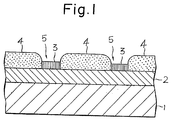
- Fig. 1 is a sectional view of printed decorative paper as produced by the invention.
- Fig. 1 is a sectional view of printed decorative paper as produced by the invention.
- the printed decorative paper comprises base paper 1, a printed design layer 2 formed of water-based ink as an undercoat, a printed pore pattern layer 3 formed of water-based curable ink containing a repellent, a water-based curable topcoat 4, and concavities 5 that are formed as the result of repellency of the topcoat 4 in the areas where the printed pore pattern layer 3 is formed.
- Base paper 1 may be of any materials that are commonly used to form the base paper of decorative paper, including, for example, tissue paper, resin mixed paper and resin impregnated paper that have a basis weight of about 23 - 100 g/m2.
- the printed design layer 2 as an undercoat is formed, typically to imitate the grain of wood, by any known printing technique using water-based ink that employs a vehicle such as an aqueous acrylic resin which is kneaded with a colorant and various other additives, as well as diluent water.
- a vehicle such as an aqueous acrylic resin which is kneaded with a colorant and various other additives, as well as diluent water.
- a water-based sealer layer( water-based undercoat layer ) may be formed on base paper 1, followed by optional overall printing, and the design layer is printed.
- Printed pore pattern layer 3 is formed by any known printing technique using a water-based curable ink containing a repellent such that it is in harmony with the design in the undercoat (imitating the grain of wood).
- the water-based curable ink applied to form the printed pore pattern layer 3 comprises a curing vehicle that is mixed with diluent water, as well as a repellent and various other additives.
- the curable vehicle may be a two-component curable type that has a curing agent added to a base resin selected from among melamine resins, acrylic resins, and urethane resins.
- a two-component curable vehicle that has aziridine added as a curing agent to an aqueous acrylic resin is particularly preferred for use since it features a high reaction rate and provides high physical properties.
- the repellent that may be added to the curable ink include silicone resins, fluorocarbon resins and waxes. These water-based curable inks are satisfactory in various physical properties and durability. Fluorocarbon resins are particularly desirable since they lower the surface tension of ink, thereby providing enhanced repellency.
- the repellent may be preloaded as an aqueous emulsion in an ink composition or, alternatively, it may be added to the ink composition just before use.
- the repellent is preferably contained in an amount of about 5 - 70 wt% of the ink composition.
- the topcoat 4 is applied to the entire surface of the base paper 1 including the printed pore pattern layer 3 and thereafter dried by heating with the temperature being varied stepwise.
- the topcoat 4 is applied to cover the entire surface of the base paper and subsequently heated, the topcoat formed in the areas where the printed pore pattern layer 3 was formed is not only repelled but also pulled by the surrounding areas to form concavities 5 (see Fig. 1); as a result, printed decorative paper is produced that has a concave pore pattern formed in harmony with the pattern imitating the grain of wood.
- Heating is effected with the temperature being varied in steps, desirably from law to high level.
- the specific temperature condition will differ more or less depending upon the kind of the ink and coating solution used; it is generally preferred to vary the temperature stepwise over the range from 20 to 200 °C. A specific heating profile will be found in the example that appears later in this specification.
- the topcoat may be repelled incompletely or a silicone resin or other repellents may bleed out as a white dust, that will impair the aesthetic appearance and, hence, quality, of the final product.
- a pore pattern was gravure printed in harmony with the grain design using a water-based curing ink containing a repellent according to the following recipe.
- a water-based curing topcoat of the formula shown below was gravure coated on the entire surface to give a deposit of 6 g/m2 on a dry basis.
- Acrylic resin 75 parts Curing agent (epoxy compound) 10 parts Release agent (silicon resin) 0.5 parts Diluent (water) 24.5 parts
- the resulting decorative paper was dried by heating as it was passed through a hot oven consisting of 6 zones (with the respective lengths and temperatures set forth below) at a speed of 150 m/min. Zone Length, m Temperature, °C 1 3.0 40 2 3.0 80 3 3.0 90 4 3.0 100 5 4.5 120 6 4.5 140
- the printed decorative paper as the final product has a concave pore pattern in harmony with the grained design.
- the present invention offers the following advantages.
- the printed decorative paper of the invention has sufficient resistance to detergents and thinners customarily used in cleaning operations so that it has enhanced durability for use as a interior decor material.
- the water-based curable ink used to form a pore pattern dries quickly and the topcoat is repelled efficiently so that the production speed can be made faster than in the prior art (e.g. to accomplish printing at 150 m/min or so) and one can produce printed decorative paper of high quality having a concave pore pattern in harmony with a grained design.
Landscapes
- Life Sciences & Earth Sciences (AREA)
- Engineering & Computer Science (AREA)
- Wood Science & Technology (AREA)
- Laminated Bodies (AREA)
- Application Of Or Painting With Fluid Materials (AREA)
- Paper (AREA)
Abstract
Printed decorative paper having a three dimensional pattern comprises base paper 1, a printed design layer 2 formed of a water-based ink as an undercoat on a surface of the base paper, an overlying printed design pattern layer 3 formed of a water-based curable ink containing a repellent in harmony with said pattern in the undercoat, and overlying water-based curable topcoat 4 applied to the entire surface of the base paper in such a way that said topcoat in the areas where said printed design pattern layer 3 is formed is repelled to form concavities 5. This printed decorative paper is environment friendly due to the non-use of organic solvents, is enhanced in durability as a interior decor material and can be produced with high efficiency.
Description
- This invention relates to printed decorative paper having a three dimensional pattern suitable for use as a residential interior material or a furniture surfacing material. More particularly, the invention relates to printed decorative paper having a three dimensional pattern that is environment friendly and which yet has enhanced durability as a interior decor material, as well as a process for producing such paper.
- Printed decorative paper having a grained pattern that imitates the texture of natural, quality wood can be produced by forming a concave pattern of pores in harmony with a printed grain pattern. Various processes have been proposed to implement this approach. According to the proposal made in JPB 89/17427, a pattern is printed on the surface of a substrate, a pore pattern is then applied from a curable ink composition containing a repellent and, subsequently, a thermosetting paint is coated on the entire surface of the substrate and heated so that the paint is repelled from the areas where the curable ink composition has been applied, thereby forming concavities.
- The ink and paint compositions used in this conventional method are oil-based and the organic solvents they contain may potentially jeopardize the health of the operating personnel. Additionally, this method requires large-scale exhaust facilities such as solvent recovery equipment and incinerators. What is more, the use of organic solvents is incapable of meeting the global demand for a "clean environment".
- Another problem with the prior art is that the curable ink composition containing a repellent dries so slowly that the printing speed and, hence, the process efficiency cannot be increased beyond a certain limit.
- The use of oil-based ink and paint compositions presents a further problem in that the pore pattern formed of the curable ink composition containing a repellent has an insufficient solvent resistance to avoid the surface of grained decorative paper from being deteriorated by common solvents such as alcohol, petroleum benzine and lacquer thinner.
- The present invention has been accomplished under these circumstances and has as an object providing printed decorative paper having a three dimensional pattern that is environment friendly due to the non-use of organic solvents, that is enhanced in durability as a interior decor material and that can be produced with high efficiency.
- Another object of the invention is to provide a process for producing such printed decorative paper.
- The first object of the invention can he attained by printed decorative paper having a three dimensional pattern that comprises base paper, a printed design layer formed of a water-based ink as an undercoat on a surface of the base paper, an overlying printed design pattern layer formed of a water-based curable ink containing a repellent in harmony with said pattern in the undercoat, and an overlying a water-based curable topcoat applied to the entire surface of the base paper in such a way said topcoat in the areas where said printed design pattern layer is formed is repelled to form concavities.
- The second object of the invention can be attained by a process which comprises forming a printed design layer of a water-based ink as an undercoat on a surface of base paper, overlying said undercoat with a printed design pattern layer formed of a water-based curable ink containing a repellent in harmony with said pattern in the undercoat, applying a water-based curable topcoat to the entire surface of the base paper, and heating the applied coats with the temperature being varied stepwise such that said topcoat in the areas where said printed design pattern layer is formed is repelled to form concavities.
- In a preferred embodiment, the applied coats are heated with the temperature being increased in steps.
- Fig. 1 is a sectional view of printed decorative paper as produced by the invention.
- Fig. 1 is a sectional view of printed decorative paper as produced by the invention. As shown, the printed decorative paper comprises base paper 1, a printed
design layer 2 formed of water-based ink as an undercoat, a printedpore pattern layer 3 formed of water-based curable ink containing a repellent, a water-basedcurable topcoat 4, andconcavities 5 that are formed as the result of repellency of thetopcoat 4 in the areas where the printedpore pattern layer 3 is formed. - Base paper 1 may be of any materials that are commonly used to form the base paper of decorative paper, including, for example, tissue paper, resin mixed paper and resin impregnated paper that have a basis weight of about 23 - 100 g/m².
- The printed
design layer 2 as an undercoat is formed, typically to imitate the grain of wood, by any known printing technique using water-based ink that employs a vehicle such as an aqueous acrylic resin which is kneaded with a colorant and various other additives, as well as diluent water. In order to hide the color of base paper 1, its surface may be subject to overall printing with a suitable color before the design layer is printed. Alternatively, for the purpose of closing small holes in the surface of base paper 1 and improving its adhesion, a water-based sealer layer( water-based undercoat layer ) may be formed on base paper 1, followed by optional overall printing, and the design layer is printed. - Printed
pore pattern layer 3 is formed by any known printing technique using a water-based curable ink containing a repellent such that it is in harmony with the design in the undercoat (imitating the grain of wood). The water-based curable ink applied to form the printedpore pattern layer 3 comprises a curing vehicle that is mixed with diluent water, as well as a repellent and various other additives. The curable vehicle may be a two-component curable type that has a curing agent added to a base resin selected from among melamine resins, acrylic resins, and urethane resins. A two-component curable vehicle that has aziridine added as a curing agent to an aqueous acrylic resin is particularly preferred for use since it features a high reaction rate and provides high physical properties. Examples of the repellent that may be added to the curable ink include silicone resins, fluorocarbon resins and waxes. These water-based curable inks are satisfactory in various physical properties and durability. Fluorocarbon resins are particularly desirable since they lower the surface tension of ink, thereby providing enhanced repellency. The repellent may be preloaded as an aqueous emulsion in an ink composition or, alternatively, it may be added to the ink composition just before use. The repellent is preferably contained in an amount of about 5 - 70 wt% of the ink composition. - The
topcoat 4 is made from a formulation that has various additives incorporated in a water-based curable topcoat composition that comprises a melamine, acrylic or urethane resin as a base component to which is added a curing agent. In order to assure resistance that complies with the Japanese Agricultural Standards (JAS), a two-component curable vehicle that has aziridine or an epoxy compound added as a curing agent to an aqueous acrylic resin is employed with particular advantage. Thetopcoat 4 amy be applied by any customary coating techniques including roll coating, gravure coating, bar coating, air-knife coating, flow coating and curtain coating. The coating weight is not limited to any particular value but the range from about 4 to 10 g/m² on a dry bases is suitable. - The
topcoat 4 is applied to the entire surface of the base paper 1 including the printedpore pattern layer 3 and thereafter dried by heating with the temperature being varied stepwise. When thetopcoat 4 is applied to cover the entire surface of the base paper and subsequently heated, the topcoat formed in the areas where the printedpore pattern layer 3 was formed is not only repelled but also pulled by the surrounding areas to form concavities 5 (see Fig. 1); as a result, printed decorative paper is produced that has a concave pore pattern formed in harmony with the pattern imitating the grain of wood. Heating is effected with the temperature being varied in steps, desirably from law to high level. The specific temperature condition will differ more or less depending upon the kind of the ink and coating solution used; it is generally preferred to vary the temperature stepwise over the range from 20 to 200 °C. A specific heating profile will be found in the example that appears later in this specification. - If heating is effected in one step at a comparatively high temperature, the topcoat may be repelled incompletely or a silicone resin or other repellents may bleed out as a white dust, that will impair the aesthetic appearance and, hence, quality, of the final product.
- The following example is provided for the purpose of further illustrating the present invention but is in no way to be taken as limiting.
- A surface of tissue paper (basis weight = 30 g/m²) was subjected to overall gravure printing with water-based ink. Then, a design imitating the grain of wood was gravure printed with a similar water-based ink.
- In the next step, a pore pattern was gravure printed in harmony with the grain design using a water-based curing ink containing a repellent according to the following recipe.
-
Pigment 5 parts Acrylic resin 40 parts Curing agent (aziridine) 12 parts Repellent (fluorocarbon resin) 6 parts Diluent (water) 37 parts - Subsequently, a water-based curing topcoat of the formula shown below was gravure coated on the entire surface to give a deposit of 6 g/m² on a dry basis.
-
Acrylic resin 75 parts Curing agent (epoxy compound) 10 parts Release agent (silicon resin) 0.5 parts Diluent (water) 24.5 parts - The resulting decorative paper was dried by heating as it was passed through a hot oven consisting of 6 zones (with the respective lengths and temperatures set forth below) at a speed of 150 m/min.
Zone Length, m Temperature, °C 1 3.0 40 2 3.0 80 3 3.0 90 4 3.0 100 5 4.5 120 6 4.5 140 - As a result of this drying with heat, the topcoat in the areas where the pore pattern was formed was repelled to provide a concave surface having a good aesthetic appeal. The printed decorative paper as the final product has a concave pore pattern in harmony with the grained design.
- The present invention offers the following advantages.
- First, the use of water-based coating solutions and inks eliminates the health and environmental problems associated with the use of organic solvents in the prior art. As a result, the heretofore required large-scale exhaust facilities are obviated and one can produce environment friendly printed decorative paper.
- Secondly, being produced with water-based curing materials, the printed decorative paper of the invention has sufficient resistance to detergents and thinners customarily used in cleaning operations so that it has enhanced durability for use as a interior decor material.
- Thirdly, the water-based curable ink used to form a pore pattern dries quickly and the topcoat is repelled efficiently so that the production speed can be made faster than in the prior art (e.g. to accomplish printing at 150 m/min or so) and one can produce printed decorative paper of high quality having a concave pore pattern in harmony with a grained design.
- Printed decorative paper having a three dimensional pattern comprises base paper 1, a printed
design layer 2 formed of a water-based ink as an undercoat on a surface of the base paper, an overlying printeddesign pattern layer 3 formed of a water-based curable ink containing a repellent in harmony with said pattern in the undercoat, and overlying water-basedcurable topcoat 4 applied to the entire surface of the base paper in such a way that said topcoat in the areas where said printeddesign pattern layer 3 is formed is repelled to formconcavities 5. This printed decorative paper is environment friendly due to the non-use of organic solvents, is enhanced in durability as a interior decor material and can be produced with high efficiency.
Claims (24)
- Printed decorative paper having a three dimensional pattern comprising base paper, a printed design layer formed of a water-based ink as an undercoat on a surface of the base paper, an overlying printed design pattern layer formed of a water-based curable ink containing a repellent in harmony with said pattern in the undercoat, and overlying water-based curable topcoat applied to the entire surface of the base paper in such a way that said topcoat in the areas where said printed design pattern layer is formed is repelled to form concavities.
- Printed decorative paper according to claim 1 wherein said water-based curable ink containing a repellent has water added as a diluent to a curing vehicle and additionally contains a repellent and any necessary additive.
- Printed decorative paper according to claim 2 wherein said curing vehicle is a two-component type having a curing agent added to a melamine resin, an acrylic resin or a urethane resin.
- Printed decorative paper according to claim 3 wherein said curing vehicle is a two-component type using aziridine as a curing agent in an aqueous acrylic resin.
- Printed decorative paper according to claim 1 or 2 wherein said repellent is a silicone resin, a fluorocarbon resin or a wax.
- Printed decorative paper according to claim 5 wherein said repellent is a fluorocarbon resin.
- Printed decorative paper according to claim 1 or 2 wherein said repellent is added in an amount of 5 - 70 wt% of the ink composition.
- Printed decorative paper according to claim 1 wherein said water-based curable topcoat has water added as a diluent to a curing vehicle and additionally contains any necessary additive.
- Printed decorative paper according to claim 8 wherein said curing vehicle is a two-component type having a curing agent added to a melamine resin, an acrylic resin or a urethane resin.
- Printed decorative paper according to claim 9 wherein said curing vehicle is a two-component type using aziridine or an epoxy compound as a curing agent in an aqueous acrylic resin.
- Printed decorative paper according to claim 1 wherein said topcoat is applied to give a deposit of 4 - 10 g/m² on a dry basis.
- A process for producing printed decorative paper having a three dimensional pattern comprising the steps of:
forming a printed design layer of a water-based ink as an undercoat on a surface of base paper;
overlying said undercoat with a printed design pattern layer formed of a water-based curable ink containing a repellent in harmony with said pattern in the undercoat;
applying a water-based curable topcoat to the entire surface of the base paper; and
heating the applied coats with the temperature being varied stepwise such that said topcoat in the areas where said printed design pattern layer is formed is repelled to form concavities. - A process according to claim 12 wherein the heating is effected with the temperature being increased in steps.
- A process according to claim 13 wherein the heating is effected with the temperature being increased from 20 to 200 °C.
- A process according to claim 12 wherein said water-based curable ink containing a repellent has water added as a diluent to a curing vehicle and additionally contains a repellent and any necessary additive.
- A process according to claim 15 wherein said curing vehicle is a two-component type having a curing agent added to a melamine resin, an acrylic resin or a urethane resin.
- A process according to claim 16 wherein said curing vehicle is a two-component type using aziridine as a curing agent in an aqueous acrylic resin.
- A process according to claim 12 or 15 wherein said repellent is a silicone resin, a fluorocarbon resin or a wax.
- A process according to claim 18 wherein said repellent is a fluorocarbon resin.
- A process according to claim 12 or 15 wherein said repellent is added in an amount of 5 - 70 wt% of the ink composition.
- A process according to claim 12 wherein said water-based curable topcoat has water added as a diluent to a curing vehicle and additionally contains any necessary additive.
- A process according to claim 21 wherein said curing vehicle is a two-component type having a curing agent added to a melamine resin, an acrylic resin or a urethane resin.
- A process according to claim 22 wherein said curing vehicle is a two-component type using aziridine or an epoxy compound as a curing agent in an aqueous acrylic resin.
- A process according to claim 12 wherein said topcoat is applied to give a deposit of 4 - 10 g/m² on a dry basis.
Applications Claiming Priority (2)
| Application Number | Priority Date | Filing Date | Title |
|---|---|---|---|
| JP18782794A JP3321596B2 (en) | 1994-07-18 | 1994-07-18 | Three-dimensional patterned decorative paper and method for producing the same |
| JP187827/94 | 1994-07-18 |
Publications (2)
| Publication Number | Publication Date |
|---|---|
| EP0697295A2 true EP0697295A2 (en) | 1996-02-21 |
| EP0697295A3 EP0697295A3 (en) | 1998-03-11 |
Family
ID=16212932
Family Applications (1)
| Application Number | Title | Priority Date | Filing Date |
|---|---|---|---|
| EP95111188A Withdrawn EP0697295A3 (en) | 1994-07-18 | 1995-07-17 | Printed decorative paper having a three dimensional pattern and a process for the production thereof |
Country Status (3)
| Country | Link |
|---|---|
| US (1) | US5665457A (en) |
| EP (1) | EP0697295A3 (en) |
| JP (1) | JP3321596B2 (en) |
Cited By (5)
| Publication number | Priority date | Publication date | Assignee | Title |
|---|---|---|---|---|
| EP1316432A1 (en) * | 2001-11-29 | 2003-06-04 | Georgia-Pacific France | Method of flexographic printing of a sheet of cellulose wadding |
| WO2006005513A1 (en) * | 2004-07-08 | 2006-01-19 | Flint Group Germany Gmbh | Method for production of decorative laminates with synchronised grain structure and suitable printing inks |
| EP1038665A4 (en) * | 1998-07-14 | 2009-01-21 | Dainippon Printing Co Ltd | Decorative material |
| WO2012063157A1 (en) * | 2010-11-09 | 2012-05-18 | Primus Rain, S.L. | A tack free decorative ink composition comprising an aziridine derivative and a polyethylene / paraffin wax mixture, process and use thereof |
| EP3206881A4 (en) * | 2014-10-17 | 2018-07-11 | Sun Chemical Corporation | Decorative printing process |
Families Citing this family (13)
| Publication number | Priority date | Publication date | Assignee | Title |
|---|---|---|---|---|
| US6020397A (en) * | 1997-10-10 | 2000-02-01 | Westvaco Corporation | Two-component ink jet ink system |
| US6546872B1 (en) * | 2000-11-27 | 2003-04-15 | Sonoco Development, Inc. | Profile printing method with additive technology |
| DE10146912A1 (en) * | 2001-09-24 | 2003-04-10 | Giesecke & Devrient Gmbh | Procedure for individualizing security documents and corresponding security document |
| US6701605B2 (en) | 2001-10-09 | 2004-03-09 | Sonoco Development, Inc. | Conductive electrical element and antenna with ink additive technology |
| US7131380B2 (en) * | 2001-11-07 | 2006-11-07 | Sonoco Development, Inc. | EB pattern profile printing |
| KR101189424B1 (en) * | 2003-12-18 | 2012-10-10 | 다이니폰 인사츠 가부시키가이샤 | Decorative material |
| US7807253B2 (en) * | 2005-03-21 | 2010-10-05 | Sealed Air Corporation (Us) | Formed inflatable cellular cushioning article and method of making same |
| KR20130127655A (en) * | 2012-05-15 | 2013-11-25 | 엘지이노텍 주식회사 | Touch window and manufacturing method thereof |
| CN110884281A (en) * | 2018-09-10 | 2020-03-17 | 安徽江南春包装科技有限公司 | Environment-friendly sticking transfer direct-printing stained paper |
| JP7229583B2 (en) * | 2018-10-31 | 2023-02-28 | ラトーレ, イエズス フランシスコ バルベラン | Method for producing three-dimensional structures on the surface of flat plate-shaped material, resulting plate-shaped material and apparatus for producing plate-shaped material by the method |
| CN109663726A (en) * | 2019-01-31 | 2019-04-23 | 佛山希望数码印刷设备有限公司 | A kind of concave-convex hand feeling texture coating method that fidelity is high |
| CN109795237A (en) * | 2019-01-31 | 2019-05-24 | 佛山希望数码印刷设备有限公司 | A kind of wear-resistant texture coating method with concave-convex hand feeling |
| US12134252B2 (en) * | 2022-09-29 | 2024-11-05 | Toppan Inc. | Decorative sheet |
Citations (1)
| Publication number | Priority date | Publication date | Assignee | Title |
|---|---|---|---|---|
| JPS6417427A (en) | 1987-07-13 | 1989-01-20 | Nippon Telegraph & Telephone | Fine pattern transferring device |
Family Cites Families (9)
| Publication number | Priority date | Publication date | Assignee | Title |
|---|---|---|---|---|
| JPS5188615A (en) * | 1975-01-31 | 1976-08-03 | Keshozaino seizoho | |
| US4196033A (en) * | 1977-03-08 | 1980-04-01 | Dai Nippon Insatsu Kabushiki Kaisha | Process for producing decorative sheets |
| DE3314610A1 (en) * | 1983-04-22 | 1984-10-25 | Letron GmbH, 8750 Aschaffenburg | METHOD FOR PRODUCING COLORED MELAMINE RESIN CONTAINER FILMS WITH A THREE-DIMENSIONAL SURFACE STRUCTURE |
| JPS629956A (en) * | 1985-07-08 | 1987-01-17 | 株式会社 千代田グラビヤ印刷社 | Manufacture of solid-pattern decorative sheet |
| US4954556A (en) * | 1987-11-23 | 1990-09-04 | Ppg Industries, Inc. | Water-based ink compositions |
| US5019202A (en) * | 1987-12-15 | 1991-05-28 | Dai Nippon Insatsu Kabushiki Kaisha | Process for producing decorative sheets having embossed pattern |
| JP2856862B2 (en) * | 1990-08-03 | 1999-02-10 | 大日本印刷株式会社 | Paint composition and cosmetic material using the same |
| US5254402A (en) * | 1990-11-30 | 1993-10-19 | Toray Industries, Inc. | Molding laminate |
| US5262222A (en) * | 1990-12-31 | 1993-11-16 | Highland Supply Corporation | Water based ink on a substrate |
-
1994
- 1994-07-18 JP JP18782794A patent/JP3321596B2/en not_active Expired - Lifetime
-
1995
- 1995-07-17 US US08/503,004 patent/US5665457A/en not_active Expired - Lifetime
- 1995-07-17 EP EP95111188A patent/EP0697295A3/en not_active Withdrawn
Patent Citations (1)
| Publication number | Priority date | Publication date | Assignee | Title |
|---|---|---|---|---|
| JPS6417427A (en) | 1987-07-13 | 1989-01-20 | Nippon Telegraph & Telephone | Fine pattern transferring device |
Cited By (7)
| Publication number | Priority date | Publication date | Assignee | Title |
|---|---|---|---|---|
| EP1038665A4 (en) * | 1998-07-14 | 2009-01-21 | Dainippon Printing Co Ltd | Decorative material |
| EP2402157A1 (en) * | 1998-07-14 | 2012-01-04 | Dai Nippon Printing Co., Ltd. | Decorative material |
| EP1316432A1 (en) * | 2001-11-29 | 2003-06-04 | Georgia-Pacific France | Method of flexographic printing of a sheet of cellulose wadding |
| WO2003045701A1 (en) * | 2001-11-29 | 2003-06-05 | Georgia-Pacific France | Method for flexographic printing of a cellulose wadding sheet |
| WO2006005513A1 (en) * | 2004-07-08 | 2006-01-19 | Flint Group Germany Gmbh | Method for production of decorative laminates with synchronised grain structure and suitable printing inks |
| WO2012063157A1 (en) * | 2010-11-09 | 2012-05-18 | Primus Rain, S.L. | A tack free decorative ink composition comprising an aziridine derivative and a polyethylene / paraffin wax mixture, process and use thereof |
| EP3206881A4 (en) * | 2014-10-17 | 2018-07-11 | Sun Chemical Corporation | Decorative printing process |
Also Published As
| Publication number | Publication date |
|---|---|
| EP0697295A3 (en) | 1998-03-11 |
| JP3321596B2 (en) | 2002-09-03 |
| JPH0835199A (en) | 1996-02-06 |
| US5665457A (en) | 1997-09-09 |
Similar Documents
| Publication | Publication Date | Title |
|---|---|---|
| US5665457A (en) | Printed decorative paper having a three dimensional pattern and a process for the production thereof | |
| US6585369B1 (en) | Preparations for ink-jet printing on common household surfaces | |
| US5534352A (en) | Finishing process for textured panels, and structures made thereby | |
| EP2319630A1 (en) | Method for multi-colour permanent varnishing of a product | |
| CN1903532A (en) | Method for producing multiple color ancient-imitation wood floorings | |
| EP3206881B1 (en) | Decorative printing process | |
| DE69423890T2 (en) | METHOD FOR PRODUCING PATTERNS ON ITEMS, IN PARTICULAR ON CERAMIC ITEMS | |
| US6716487B1 (en) | Decorative stickers from inkjet printing and method therefor | |
| KR100584718B1 (en) | Method of depositing color patterns on the surface of thermoplastic synthetic resin molded products | |
| JP3269538B2 (en) | Manufacturing method of three-dimensional patterned decorative paper | |
| JP2007154431A (en) | Decorative building board | |
| US2467228A (en) | Process for obtaining decorative crackle finishes | |
| US7045168B2 (en) | Unique paint effects and methods therefor | |
| DE19612371C1 (en) | Golden mirror coating production on glass plate | |
| US4068031A (en) | Lauan panel with reduced flame spread rating | |
| JPH02191579A (en) | Formation of patterned coating film | |
| KR100683183B1 (en) | Top-coated MDF Lapping and MDF Flat Plate Paper and Manufacturing Method Thereof | |
| US20060080788A1 (en) | Method for the pictorial coloring of wood surfaces and a colored wood substrate | |
| JPH03220270A (en) | Method for forming metallic-patterned coating film and decorative sheet coated with metallic-patterned coating film | |
| KR200294655Y1 (en) | A sublimation heating-transfer color print MDF | |
| US715928A (en) | Imitation leather. | |
| DE102010052057A1 (en) | Method for producing colored decorative surface of e.g. finishing wood frame for picture, involves reducing angle of air jet during distribution of color from inside to outside | |
| KR100484044B1 (en) | Printing method of leather surface | |
| JP2000024587A (en) | Imitation wood like pattern coating method | |
| US147835A (en) | Improvement in preparing transfers for panel-sign painting |
Legal Events
| Date | Code | Title | Description |
|---|---|---|---|
| PUAI | Public reference made under article 153(3) epc to a published international application that has entered the european phase |
Free format text: ORIGINAL CODE: 0009012 |
|
| AK | Designated contracting states |
Kind code of ref document: A2 Designated state(s): BE DE ES FR GB IT |
|
| PUAL | Search report despatched |
Free format text: ORIGINAL CODE: 0009013 |
|
| AK | Designated contracting states |
Kind code of ref document: A3 Designated state(s): BE DE ES FR GB IT |
|
| STAA | Information on the status of an ep patent application or granted ep patent |
Free format text: STATUS: THE APPLICATION IS DEEMED TO BE WITHDRAWN |
|
| 18D | Application deemed to be withdrawn |
Effective date: 19980912 |