EP0697425A1 - Hörterzusammensetzung für Epoxidharze - Google Patents
Hörterzusammensetzung für Epoxidharze Download PDFInfo
- Publication number
- EP0697425A1 EP0697425A1 EP95810502A EP95810502A EP0697425A1 EP 0697425 A1 EP0697425 A1 EP 0697425A1 EP 95810502 A EP95810502 A EP 95810502A EP 95810502 A EP95810502 A EP 95810502A EP 0697425 A1 EP0697425 A1 EP 0697425A1
- Authority
- EP
- European Patent Office
- Prior art keywords
- polyamines
- weight
- percent
- component
- bis
- Prior art date
- Legal status (The legal status is an assumption and is not a legal conclusion. Google has not performed a legal analysis and makes no representation as to the accuracy of the status listed.)
- Granted
Links
- 239000003822 epoxy resin Substances 0.000 title claims abstract description 18
- 229920000647 polyepoxide Polymers 0.000 title claims abstract description 18
- 239000004848 polyfunctional curative Substances 0.000 title claims abstract description 14
- 239000000203 mixture Substances 0.000 title claims description 70
- LNEPOXFFQSENCJ-UHFFFAOYSA-N haloperidol Chemical compound C1CC(O)(C=2C=CC(Cl)=CC=2)CCN1CCCC(=O)C1=CC=C(F)C=C1 LNEPOXFFQSENCJ-UHFFFAOYSA-N 0.000 title claims description 10
- 229920000768 polyamine Polymers 0.000 claims abstract description 40
- ISWSIDIOOBJBQZ-UHFFFAOYSA-N Phenol Chemical compound OC1=CC=CC=C1 ISWSIDIOOBJBQZ-UHFFFAOYSA-N 0.000 claims abstract description 18
- WVDDGKGOMKODPV-UHFFFAOYSA-N Benzyl alcohol Chemical compound OCC1=CC=CC=C1 WVDDGKGOMKODPV-UHFFFAOYSA-N 0.000 claims abstract description 15
- PAYRUJLWNCNPSJ-UHFFFAOYSA-N Aniline Chemical compound NC1=CC=CC=C1 PAYRUJLWNCNPSJ-UHFFFAOYSA-N 0.000 claims abstract description 11
- 125000001931 aliphatic group Chemical group 0.000 claims abstract description 11
- XPFVYQJUAUNWIW-UHFFFAOYSA-N furfuryl alcohol Chemical group OCC1=CC=CO1 XPFVYQJUAUNWIW-UHFFFAOYSA-N 0.000 claims abstract description 9
- RNVCVTLRINQCPJ-UHFFFAOYSA-N o-toluidine Chemical compound CC1=CC=CC=C1N RNVCVTLRINQCPJ-UHFFFAOYSA-N 0.000 claims abstract description 8
- LFQSCWFLJHTTHZ-UHFFFAOYSA-N Ethanol Chemical compound CCO LFQSCWFLJHTTHZ-UHFFFAOYSA-N 0.000 claims abstract description 7
- 235000019445 benzyl alcohol Nutrition 0.000 claims abstract description 5
- 239000001257 hydrogen Substances 0.000 claims abstract description 5
- 229910052739 hydrogen Inorganic materials 0.000 claims abstract description 5
- QZIQHKXOEPYEPM-UHFFFAOYSA-N 2,4-bis[(4-aminocyclohexyl)methyl]aniline Chemical compound C1CC(N)CCC1CC1=CC=C(N)C(CC2CCC(N)CC2)=C1 QZIQHKXOEPYEPM-UHFFFAOYSA-N 0.000 claims abstract description 4
- BNXMTRHBZDTLEW-UHFFFAOYSA-N 2,4-bis[(4-aminocyclohexyl)methyl]cyclohexan-1-amine Chemical compound C1CC(N)CCC1CC1CC(CC2CCC(N)CC2)C(N)CC1 BNXMTRHBZDTLEW-UHFFFAOYSA-N 0.000 claims abstract description 4
- DZIHTWJGPDVSGE-UHFFFAOYSA-N 4-[(4-aminocyclohexyl)methyl]cyclohexan-1-amine Chemical compound C1CC(N)CCC1CC1CCC(N)CC1 DZIHTWJGPDVSGE-UHFFFAOYSA-N 0.000 claims abstract description 4
- UFHFLCQGNIYNRP-UHFFFAOYSA-N Hydrogen Chemical compound [H][H] UFHFLCQGNIYNRP-UHFFFAOYSA-N 0.000 claims abstract description 4
- 125000000217 alkyl group Chemical group 0.000 claims abstract description 4
- 239000003054 catalyst Substances 0.000 claims abstract description 4
- 238000000576 coating method Methods 0.000 claims abstract description 4
- 238000000465 moulding Methods 0.000 claims abstract description 3
- 125000003884 phenylalkyl group Chemical group 0.000 claims abstract description 3
- 150000001298 alcohols Chemical class 0.000 claims description 9
- IGFHQQFPSIBGKE-UHFFFAOYSA-N 4-nonylphenol Chemical compound CCCCCCCCCC1=CC=C(O)C=C1 IGFHQQFPSIBGKE-UHFFFAOYSA-N 0.000 claims description 8
- 239000007859 condensation product Substances 0.000 claims description 7
- 125000001424 substituent group Chemical group 0.000 claims description 7
- 125000003118 aryl group Chemical group 0.000 claims description 6
- 125000004432 carbon atom Chemical group C* 0.000 claims description 6
- 125000002887 hydroxy group Chemical group [H]O* 0.000 claims description 5
- KJWMCPYEODZESQ-UHFFFAOYSA-N 4-Dodecylphenol Chemical compound CCCCCCCCCCCCC1=CC=C(O)C=C1 KJWMCPYEODZESQ-UHFFFAOYSA-N 0.000 claims description 3
- WSFSSNUMVMOOMR-NJFSPNSNSA-N methanone Chemical compound O=[14CH2] WSFSSNUMVMOOMR-NJFSPNSNSA-N 0.000 claims description 3
- 125000002496 methyl group Chemical group [H]C([H])([H])* 0.000 claims description 3
- 125000003277 amino group Chemical group 0.000 claims description 2
- 125000004435 hydrogen atom Chemical group [H]* 0.000 claims description 2
- 238000005984 hydrogenation reaction Methods 0.000 claims description 2
- 238000009833 condensation Methods 0.000 abstract description 3
- 125000002924 primary amino group Chemical group [H]N([H])* 0.000 abstract 1
- -1 hydrogenated trimethylene tetraaniline Chemical compound 0.000 description 17
- QTBSBXVTEAMEQO-UHFFFAOYSA-N Acetic acid Chemical compound CC(O)=O QTBSBXVTEAMEQO-UHFFFAOYSA-N 0.000 description 15
- 235000019441 ethanol Nutrition 0.000 description 13
- 150000002989 phenols Chemical class 0.000 description 8
- BRLQWZUYTZBJKN-UHFFFAOYSA-N Epichlorohydrin Chemical compound ClCC1CO1 BRLQWZUYTZBJKN-UHFFFAOYSA-N 0.000 description 6
- 239000004593 Epoxy Substances 0.000 description 6
- WSFSSNUMVMOOMR-UHFFFAOYSA-N Formaldehyde Chemical compound O=C WSFSSNUMVMOOMR-UHFFFAOYSA-N 0.000 description 5
- 150000001875 compounds Chemical class 0.000 description 5
- RTZKZFJDLAIYFH-UHFFFAOYSA-N ether Substances CCOCC RTZKZFJDLAIYFH-UHFFFAOYSA-N 0.000 description 5
- 239000007788 liquid Substances 0.000 description 5
- 125000001570 methylene group Chemical group [H]C([H])([*:1])[*:2] 0.000 description 5
- 229910052757 nitrogen Inorganic materials 0.000 description 5
- 239000000126 substance Substances 0.000 description 5
- LCFVJGUPQDGYKZ-UHFFFAOYSA-N Bisphenol A diglycidyl ether Chemical compound C=1C=C(OCC2OC2)C=CC=1C(C)(C)C(C=C1)=CC=C1OCC1CO1 LCFVJGUPQDGYKZ-UHFFFAOYSA-N 0.000 description 4
- PEDCQBHIVMGVHV-UHFFFAOYSA-N Glycerine Chemical compound OCC(O)CO PEDCQBHIVMGVHV-UHFFFAOYSA-N 0.000 description 4
- MUBZPKHOEPUJKR-UHFFFAOYSA-N Oxalic acid Chemical compound OC(=O)C(O)=O MUBZPKHOEPUJKR-UHFFFAOYSA-N 0.000 description 4
- 239000002253 acid Substances 0.000 description 4
- 150000007513 acids Chemical class 0.000 description 4
- 150000001412 amines Chemical class 0.000 description 4
- IISBACLAFKSPIT-UHFFFAOYSA-N bisphenol A Chemical compound C=1C=C(O)C=CC=1C(C)(C)C1=CC=C(O)C=C1 IISBACLAFKSPIT-UHFFFAOYSA-N 0.000 description 4
- 239000003795 chemical substances by application Substances 0.000 description 4
- 230000005494 condensation Effects 0.000 description 4
- 125000004367 cycloalkylaryl group Chemical group 0.000 description 4
- MTHSVFCYNBDYFN-UHFFFAOYSA-N diethylene glycol Chemical compound OCCOCCO MTHSVFCYNBDYFN-UHFFFAOYSA-N 0.000 description 4
- GYZLOYUZLJXAJU-UHFFFAOYSA-N diglycidyl ether Chemical compound C1OC1COCC1CO1 GYZLOYUZLJXAJU-UHFFFAOYSA-N 0.000 description 4
- 238000002156 mixing Methods 0.000 description 4
- QWVGKYWNOKOFNN-UHFFFAOYSA-N o-cresol Chemical compound CC1=CC=CC=C1O QWVGKYWNOKOFNN-UHFFFAOYSA-N 0.000 description 4
- YBRVSVVVWCFQMG-UHFFFAOYSA-N 4,4'-diaminodiphenylmethane Chemical compound C1=CC(N)=CC=C1CC1=CC=C(N)C=C1 YBRVSVVVWCFQMG-UHFFFAOYSA-N 0.000 description 3
- VPWNQTHUCYMVMZ-UHFFFAOYSA-N 4,4'-sulfonyldiphenol Chemical compound C1=CC(O)=CC=C1S(=O)(=O)C1=CC=C(O)C=C1 VPWNQTHUCYMVMZ-UHFFFAOYSA-N 0.000 description 3
- QHPQWRBYOIRBIT-UHFFFAOYSA-N 4-tert-butylphenol Chemical compound CC(C)(C)C1=CC=C(O)C=C1 QHPQWRBYOIRBIT-UHFFFAOYSA-N 0.000 description 3
- LYCAIKOWRPUZTN-UHFFFAOYSA-N Ethylene glycol Chemical compound OCCO LYCAIKOWRPUZTN-UHFFFAOYSA-N 0.000 description 3
- QIGBRXMKCJKVMJ-UHFFFAOYSA-N Hydroquinone Chemical compound OC1=CC=C(O)C=C1 QIGBRXMKCJKVMJ-UHFFFAOYSA-N 0.000 description 3
- DNIAPMSPPWPWGF-UHFFFAOYSA-N Propylene glycol Chemical compound CC(O)CO DNIAPMSPPWPWGF-UHFFFAOYSA-N 0.000 description 3
- 229910000831 Steel Inorganic materials 0.000 description 3
- WNLRTRBMVRJNCN-UHFFFAOYSA-N adipic acid Chemical compound OC(=O)CCCCC(O)=O WNLRTRBMVRJNCN-UHFFFAOYSA-N 0.000 description 3
- PXKLMJQFEQBVLD-UHFFFAOYSA-N bisphenol F Chemical compound C1=CC(O)=CC=C1CC1=CC=C(O)C=C1 PXKLMJQFEQBVLD-UHFFFAOYSA-N 0.000 description 3
- WERYXYBDKMZEQL-UHFFFAOYSA-N butane-1,4-diol Chemical compound OCCCCO WERYXYBDKMZEQL-UHFFFAOYSA-N 0.000 description 3
- 150000001735 carboxylic acids Chemical class 0.000 description 3
- 239000011521 glass Substances 0.000 description 3
- 150000002334 glycols Chemical class 0.000 description 3
- QQVIHTHCMHWDBS-UHFFFAOYSA-N isophthalic acid Chemical compound OC(=O)C1=CC=CC(C(O)=O)=C1 QQVIHTHCMHWDBS-UHFFFAOYSA-N 0.000 description 3
- YPFDHNVEDLHUCE-UHFFFAOYSA-N propane-1,3-diol Chemical compound OCCCO YPFDHNVEDLHUCE-UHFFFAOYSA-N 0.000 description 3
- GHMLBKRAJCXXBS-UHFFFAOYSA-N resorcinol Chemical compound OC1=CC=CC(O)=C1 GHMLBKRAJCXXBS-UHFFFAOYSA-N 0.000 description 3
- 239000010959 steel Substances 0.000 description 3
- WMVJWKURWRGJCI-UHFFFAOYSA-N 2,4-bis(2-methylbutan-2-yl)phenol Chemical compound CCC(C)(C)C1=CC=C(O)C(C(C)(C)CC)=C1 WMVJWKURWRGJCI-UHFFFAOYSA-N 0.000 description 2
- FMUYQRFTLHAARI-UHFFFAOYSA-N 2,4-bis(2-phenylpropan-2-yl)phenol Chemical compound C=1C=C(O)C(C(C)(C)C=2C=CC=CC=2)=CC=1C(C)(C)C1=CC=CC=C1 FMUYQRFTLHAARI-UHFFFAOYSA-N 0.000 description 2
- VQQLTEBUMLSLFJ-UHFFFAOYSA-N 2,6-ditert-butyl-4-nonylphenol Chemical compound CCCCCCCCCC1=CC(C(C)(C)C)=C(O)C(C(C)(C)C)=C1 VQQLTEBUMLSLFJ-UHFFFAOYSA-N 0.000 description 2
- VVHFXJOCUKBZFS-UHFFFAOYSA-N 2-(chloromethyl)-2-methyloxirane Chemical compound ClCC1(C)CO1 VVHFXJOCUKBZFS-UHFFFAOYSA-N 0.000 description 2
- SZCFDTYKNQJQKT-UHFFFAOYSA-N 2-(oxiran-2-ylmethoxy)-6-oxabicyclo[3.1.0]hexane Chemical compound C1CC2OC2C1OCC1CO1 SZCFDTYKNQJQKT-UHFFFAOYSA-N 0.000 description 2
- XORJNZNCVGHBDZ-UHFFFAOYSA-N 2-[2-(6-oxabicyclo[3.1.0]hexan-2-yloxy)ethoxy]-6-oxabicyclo[3.1.0]hexane Chemical compound C1CC2OC2C1OCCOC1C2OC2CC1 XORJNZNCVGHBDZ-UHFFFAOYSA-N 0.000 description 2
- CRBJBYGJVIBWIY-UHFFFAOYSA-N 2-isopropylphenol Chemical compound CC(C)C1=CC=CC=C1O CRBJBYGJVIBWIY-UHFFFAOYSA-N 0.000 description 2
- YHZQOKUDQQISEW-UHFFFAOYSA-N 4-Cumylphenol Natural products C1=CC(C(C)C)=CC=C1C1=CC=C(O)C=C1 YHZQOKUDQQISEW-UHFFFAOYSA-N 0.000 description 2
- WXQZLPFNTPKVJM-UHFFFAOYSA-N 4-[(4-hydroxycyclohexyl)methyl]cyclohexan-1-ol Chemical compound C1CC(O)CCC1CC1CCC(O)CC1 WXQZLPFNTPKVJM-UHFFFAOYSA-N 0.000 description 2
- HDPBBNNDDQOWPJ-UHFFFAOYSA-N 4-[1,2,2-tris(4-hydroxyphenyl)ethyl]phenol Chemical compound C1=CC(O)=CC=C1C(C=1C=CC(O)=CC=1)C(C=1C=CC(O)=CC=1)C1=CC=C(O)C=C1 HDPBBNNDDQOWPJ-UHFFFAOYSA-N 0.000 description 2
- CDBAMNGURPMUTG-UHFFFAOYSA-N 4-[2-(4-hydroxycyclohexyl)propan-2-yl]cyclohexan-1-ol Chemical compound C1CC(O)CCC1C(C)(C)C1CCC(O)CC1 CDBAMNGURPMUTG-UHFFFAOYSA-N 0.000 description 2
- WXNZTHHGJRFXKQ-UHFFFAOYSA-N 4-chlorophenol Chemical compound OC1=CC=C(Cl)C=C1 WXNZTHHGJRFXKQ-UHFFFAOYSA-N 0.000 description 2
- YWVFNWVZBAWOOY-UHFFFAOYSA-N 4-methylcyclohexane-1,2-dicarboxylic acid Chemical compound CC1CCC(C(O)=O)C(C(O)=O)C1 YWVFNWVZBAWOOY-UHFFFAOYSA-N 0.000 description 2
- ISAVYTVYFVQUDY-UHFFFAOYSA-N 4-tert-Octylphenol Chemical compound CC(C)(C)CC(C)(C)C1=CC=C(O)C=C1 ISAVYTVYFVQUDY-UHFFFAOYSA-N 0.000 description 2
- YIROYDNZEPTFOL-UHFFFAOYSA-N 5,5-Dimethylhydantoin Chemical compound CC1(C)NC(=O)NC1=O YIROYDNZEPTFOL-UHFFFAOYSA-N 0.000 description 2
- SVLTVRFYVWMEQN-UHFFFAOYSA-N 5-methylcyclohex-3-ene-1,2-dicarboxylic acid Chemical compound CC1CC(C(O)=O)C(C(O)=O)C=C1 SVLTVRFYVWMEQN-UHFFFAOYSA-N 0.000 description 2
- ADAHGVUHKDNLEB-UHFFFAOYSA-N Bis(2,3-epoxycyclopentyl)ether Chemical compound C1CC2OC2C1OC1CCC2OC21 ADAHGVUHKDNLEB-UHFFFAOYSA-N 0.000 description 2
- ALQSHHUCVQOPAS-UHFFFAOYSA-N Pentane-1,5-diol Chemical compound OCCCCCO ALQSHHUCVQOPAS-UHFFFAOYSA-N 0.000 description 2
- ATUOYWHBWRKTHZ-UHFFFAOYSA-N Propane Chemical compound CCC ATUOYWHBWRKTHZ-UHFFFAOYSA-N 0.000 description 2
- KKEYFWRCBNTPAC-UHFFFAOYSA-N Terephthalic acid Chemical compound OC(=O)C1=CC=C(C(O)=O)C=C1 KKEYFWRCBNTPAC-UHFFFAOYSA-N 0.000 description 2
- ZJCCRDAZUWHFQH-UHFFFAOYSA-N Trimethylolpropane Chemical compound CCC(CO)(CO)CO ZJCCRDAZUWHFQH-UHFFFAOYSA-N 0.000 description 2
- FDLQZKYLHJJBHD-UHFFFAOYSA-N [3-(aminomethyl)phenyl]methanamine Chemical compound NCC1=CC=CC(CN)=C1 FDLQZKYLHJJBHD-UHFFFAOYSA-N 0.000 description 2
- YIMQCDZDWXUDCA-UHFFFAOYSA-N [4-(hydroxymethyl)cyclohexyl]methanol Chemical compound OCC1CCC(CO)CC1 YIMQCDZDWXUDCA-UHFFFAOYSA-N 0.000 description 2
- MSILJOYZYPRFDK-UHFFFAOYSA-N [4-[4-(sulfanylmethyl)phenoxy]phenyl]methanethiol Chemical compound C1=CC(CS)=CC=C1OC1=CC=C(CS)C=C1 MSILJOYZYPRFDK-UHFFFAOYSA-N 0.000 description 2
- VCCBEIPGXKNHFW-UHFFFAOYSA-N biphenyl-4,4'-diol Chemical group C1=CC(O)=CC=C1C1=CC=C(O)C=C1 VCCBEIPGXKNHFW-UHFFFAOYSA-N 0.000 description 2
- HQABUPZFAYXKJW-UHFFFAOYSA-N butan-1-amine Chemical compound CCCCN HQABUPZFAYXKJW-UHFFFAOYSA-N 0.000 description 2
- 235000013877 carbamide Nutrition 0.000 description 2
- 125000003178 carboxy group Chemical group [H]OC(*)=O 0.000 description 2
- IFDVQVHZEKPUSC-UHFFFAOYSA-N cyclohex-3-ene-1,2-dicarboxylic acid Chemical compound OC(=O)C1CCC=CC1C(O)=O IFDVQVHZEKPUSC-UHFFFAOYSA-N 0.000 description 2
- QSAWQNUELGIYBC-UHFFFAOYSA-N cyclohexane-1,2-dicarboxylic acid Chemical compound OC(=O)C1CCCCC1C(O)=O QSAWQNUELGIYBC-UHFFFAOYSA-N 0.000 description 2
- 150000002148 esters Chemical class 0.000 description 2
- 235000011187 glycerol Nutrition 0.000 description 2
- 125000005842 heteroatom Chemical group 0.000 description 2
- WJSATVJYSKVUGV-UHFFFAOYSA-N hexane-1,3,5-triol Chemical compound CC(O)CC(O)CCO WJSATVJYSKVUGV-UHFFFAOYSA-N 0.000 description 2
- XXMIOPMDWAUFGU-UHFFFAOYSA-N hexane-1,6-diol Chemical compound OCCCCCCO XXMIOPMDWAUFGU-UHFFFAOYSA-N 0.000 description 2
- ZMVMYBGDGJLCHV-UHFFFAOYSA-N n-methyl-4-[[4-(methylamino)phenyl]methyl]aniline Chemical compound C1=CC(NC)=CC=C1CC1=CC=C(NC)C=C1 ZMVMYBGDGJLCHV-UHFFFAOYSA-N 0.000 description 2
- BDJRBEYXGGNYIS-UHFFFAOYSA-N nonanedioic acid Chemical compound OC(=O)CCCCCCCC(O)=O BDJRBEYXGGNYIS-UHFFFAOYSA-N 0.000 description 2
- QBDSZLJBMIMQRS-UHFFFAOYSA-N p-Cumylphenol Chemical compound C=1C=C(O)C=CC=1C(C)(C)C1=CC=CC=C1 QBDSZLJBMIMQRS-UHFFFAOYSA-N 0.000 description 2
- XNGIFLGASWRNHJ-UHFFFAOYSA-N phthalic acid Chemical compound OC(=O)C1=CC=CC=C1C(O)=O XNGIFLGASWRNHJ-UHFFFAOYSA-N 0.000 description 2
- WLJVNTCWHIRURA-UHFFFAOYSA-N pimelic acid Chemical compound OC(=O)CCCCCC(O)=O WLJVNTCWHIRURA-UHFFFAOYSA-N 0.000 description 2
- 229960001755 resorcinol Drugs 0.000 description 2
- YGSDEFSMJLZEOE-UHFFFAOYSA-N salicylic acid Chemical compound OC(=O)C1=CC=CC=C1O YGSDEFSMJLZEOE-UHFFFAOYSA-N 0.000 description 2
- CXMXRPHRNRROMY-UHFFFAOYSA-N sebacic acid Chemical compound OC(=O)CCCCCCCCC(O)=O CXMXRPHRNRROMY-UHFFFAOYSA-N 0.000 description 2
- 238000003756 stirring Methods 0.000 description 2
- TYFQFVWCELRYAO-UHFFFAOYSA-N suberic acid Chemical compound OC(=O)CCCCCCC(O)=O TYFQFVWCELRYAO-UHFFFAOYSA-N 0.000 description 2
- HFFLGKNGCAIQMO-UHFFFAOYSA-N trichloroacetaldehyde Chemical compound ClC(Cl)(Cl)C=O HFFLGKNGCAIQMO-UHFFFAOYSA-N 0.000 description 2
- 125000004169 (C1-C6) alkyl group Chemical group 0.000 description 1
- VYMPLPIFKRHAAC-UHFFFAOYSA-N 1,2-ethanedithiol Chemical compound SCCS VYMPLPIFKRHAAC-UHFFFAOYSA-N 0.000 description 1
- OUPZKGBUJRBPGC-UHFFFAOYSA-N 1,3,5-tris(oxiran-2-ylmethyl)-1,3,5-triazinane-2,4,6-trione Chemical compound O=C1N(CC2OC2)C(=O)N(CC2OC2)C(=O)N1CC1CO1 OUPZKGBUJRBPGC-UHFFFAOYSA-N 0.000 description 1
- PXGZQGDTEZPERC-UHFFFAOYSA-N 1,4-cyclohexanedicarboxylic acid Chemical compound OC(=O)C1CCC(C(O)=O)CC1 PXGZQGDTEZPERC-UHFFFAOYSA-N 0.000 description 1
- RTBFRGCFXZNCOE-UHFFFAOYSA-N 1-methylsulfonylpiperidin-4-one Chemical compound CS(=O)(=O)N1CCC(=O)CC1 RTBFRGCFXZNCOE-UHFFFAOYSA-N 0.000 description 1
- ICKWICRCANNIBI-UHFFFAOYSA-N 2,4-di-tert-butylphenol Chemical compound CC(C)(C)C1=CC=C(O)C(C(C)(C)C)=C1 ICKWICRCANNIBI-UHFFFAOYSA-N 0.000 description 1
- OPLCSTZDXXUYDU-UHFFFAOYSA-N 2,4-dimethyl-6-tert-butylphenol Chemical compound CC1=CC(C)=C(O)C(C(C)(C)C)=C1 OPLCSTZDXXUYDU-UHFFFAOYSA-N 0.000 description 1
- ZZZRZBIPCKQDQR-UHFFFAOYSA-N 2,4-ditert-butyl-6-methylphenol Chemical compound CC1=CC(C(C)(C)C)=CC(C(C)(C)C)=C1O ZZZRZBIPCKQDQR-UHFFFAOYSA-N 0.000 description 1
- BGRKGHSKCFAPCL-UHFFFAOYSA-N 2-(2-methylbutan-2-yl)phenol Chemical compound CCC(C)(C)C1=CC=CC=C1O BGRKGHSKCFAPCL-UHFFFAOYSA-N 0.000 description 1
- DAXRGSDCXVUHEW-UHFFFAOYSA-N 2-(benzhydrylamino)ethanol Chemical compound C=1C=CC=CC=1C(NCCO)C1=CC=CC=C1 DAXRGSDCXVUHEW-UHFFFAOYSA-N 0.000 description 1
- WAXJSQREIWGYCB-UHFFFAOYSA-N 2-[4-(carboxymethyl)cyclohexyl]acetic acid Chemical compound OC(=O)CC1CCC(CC(O)=O)CC1 WAXJSQREIWGYCB-UHFFFAOYSA-N 0.000 description 1
- OJPDDQSCZGTACX-UHFFFAOYSA-N 2-[n-(2-hydroxyethyl)anilino]ethanol Chemical compound OCCN(CCO)C1=CC=CC=C1 OJPDDQSCZGTACX-UHFFFAOYSA-N 0.000 description 1
- MWGATWIBSKHFMR-UHFFFAOYSA-N 2-anilinoethanol Chemical compound OCCNC1=CC=CC=C1 MWGATWIBSKHFMR-UHFFFAOYSA-N 0.000 description 1
- JKFZLMPBXBMSPD-UHFFFAOYSA-N 2-butan-2-yl-4-tert-butylphenol Chemical compound CCC(C)C1=CC(C(C)(C)C)=CC=C1O JKFZLMPBXBMSPD-UHFFFAOYSA-N 0.000 description 1
- NGFPWHGISWUQOI-UHFFFAOYSA-N 2-sec-butylphenol Chemical compound CCC(C)C1=CC=CC=C1O NGFPWHGISWUQOI-UHFFFAOYSA-N 0.000 description 1
- WJQOZHYUIDYNHM-UHFFFAOYSA-N 2-tert-Butylphenol Chemical compound CC(C)(C)C1=CC=CC=C1O WJQOZHYUIDYNHM-UHFFFAOYSA-N 0.000 description 1
- UYHCLPYFSWPVDZ-UHFFFAOYSA-N 2-tert-butyl-4-(2-phenylpropan-2-yl)phenol Chemical compound C1=C(O)C(C(C)(C)C)=CC(C(C)(C)C=2C=CC=CC=2)=C1 UYHCLPYFSWPVDZ-UHFFFAOYSA-N 0.000 description 1
- IKEHOXWJQXIQAG-UHFFFAOYSA-N 2-tert-butyl-4-methylphenol Chemical compound CC1=CC=C(O)C(C(C)(C)C)=C1 IKEHOXWJQXIQAG-UHFFFAOYSA-N 0.000 description 1
- XOUQAVYLRNOXDO-UHFFFAOYSA-N 2-tert-butyl-5-methylphenol Chemical compound CC1=CC=C(C(C)(C)C)C(O)=C1 XOUQAVYLRNOXDO-UHFFFAOYSA-N 0.000 description 1
- BKZXZGWHTRCFPX-UHFFFAOYSA-N 2-tert-butyl-6-methylphenol Chemical compound CC1=CC=CC(C(C)(C)C)=C1O BKZXZGWHTRCFPX-UHFFFAOYSA-N 0.000 description 1
- VEORPZCZECFIRK-UHFFFAOYSA-N 3,3',5,5'-tetrabromobisphenol A Chemical compound C=1C(Br)=C(O)C(Br)=CC=1C(C)(C)C1=CC(Br)=C(O)C(Br)=C1 VEORPZCZECFIRK-UHFFFAOYSA-N 0.000 description 1
- RXBBSTXUVVVWRC-UHFFFAOYSA-N 3-[3-[4,4-dimethyl-3-(oxiran-2-ylmethyl)-2,5-dioxoimidazolidin-1-yl]-2-(oxiran-2-ylmethoxy)propyl]-5,5-dimethyl-1-(oxiran-2-ylmethyl)imidazolidine-2,4-dione Chemical compound O=C1N(CC(CN2C(C(C)(C)N(CC3OC3)C2=O)=O)OCC2OC2)C(=O)C(C)(C)N1CC1CO1 RXBBSTXUVVVWRC-UHFFFAOYSA-N 0.000 description 1
- NRVOGWCXEOJNFS-UHFFFAOYSA-N 4-[(4-aminocyclohexyl)methyl]aniline Chemical compound C1CC(N)CCC1CC1=CC=C(N)C=C1 NRVOGWCXEOJNFS-UHFFFAOYSA-N 0.000 description 1
- BAYDRSPWXBKSAD-UHFFFAOYSA-N 4-[(4-aminocyclohexyl)methyl]cyclohexan-1-ol Chemical compound C1CC(N)CCC1CC1CCC(O)CC1 BAYDRSPWXBKSAD-UHFFFAOYSA-N 0.000 description 1
- PLIKAWJENQZMHA-UHFFFAOYSA-N 4-aminophenol Chemical class NC1=CC=C(O)C=C1 PLIKAWJENQZMHA-UHFFFAOYSA-N 0.000 description 1
- QIZUBPHXHVWGHD-UHFFFAOYSA-N 4-octadecylphenol Chemical compound CCCCCCCCCCCCCCCCCCC1=CC=C(O)C=C1 QIZUBPHXHVWGHD-UHFFFAOYSA-N 0.000 description 1
- NTDQQZYCCIDJRK-UHFFFAOYSA-N 4-octylphenol Chemical compound CCCCCCCCC1=CC=C(O)C=C1 NTDQQZYCCIDJRK-UHFFFAOYSA-N 0.000 description 1
- ZUTYZAFDFLLILI-UHFFFAOYSA-N 4-sec-Butylphenol Chemical compound CCC(C)C1=CC=C(O)C=C1 ZUTYZAFDFLLILI-UHFFFAOYSA-N 0.000 description 1
- SNKLPZOJLXDZCW-UHFFFAOYSA-N 4-tert-butyl-2-methylphenol Chemical compound CC1=CC(C(C)(C)C)=CC=C1O SNKLPZOJLXDZCW-UHFFFAOYSA-N 0.000 description 1
- OQAPYXJOOYQXDV-UHFFFAOYSA-N 5,5-dimethyl-3-[2-(oxiran-2-ylmethoxy)propyl]-1-(oxiran-2-ylmethyl)imidazolidine-2,4-dione Chemical compound C1OC1COC(C)CN(C(C1(C)C)=O)C(=O)N1CC1CO1 OQAPYXJOOYQXDV-UHFFFAOYSA-N 0.000 description 1
- YXALYBMHAYZKAP-UHFFFAOYSA-N 7-oxabicyclo[4.1.0]heptan-4-ylmethyl 7-oxabicyclo[4.1.0]heptane-4-carboxylate Chemical compound C1CC2OC2CC1C(=O)OCC1CC2OC2CC1 YXALYBMHAYZKAP-UHFFFAOYSA-N 0.000 description 1
- IKHGUXGNUITLKF-UHFFFAOYSA-N Acetaldehyde Chemical compound CC=O IKHGUXGNUITLKF-UHFFFAOYSA-N 0.000 description 1
- 229930185605 Bisphenol Natural products 0.000 description 1
- OKTJSMMVPCPJKN-UHFFFAOYSA-N Carbon Chemical group [C] OKTJSMMVPCPJKN-UHFFFAOYSA-N 0.000 description 1
- FBPFZTCFMRRESA-FSIIMWSLSA-N D-Glucitol Natural products OC[C@H](O)[C@H](O)[C@@H](O)[C@H](O)CO FBPFZTCFMRRESA-FSIIMWSLSA-N 0.000 description 1
- FBPFZTCFMRRESA-JGWLITMVSA-N D-glucitol Chemical compound OC[C@H](O)[C@@H](O)[C@H](O)[C@H](O)CO FBPFZTCFMRRESA-JGWLITMVSA-N 0.000 description 1
- SNRUBQQJIBEYMU-UHFFFAOYSA-N Dodecane Natural products CCCCCCCCCCCC SNRUBQQJIBEYMU-UHFFFAOYSA-N 0.000 description 1
- OYHQOLUKZRVURQ-HZJYTTRNSA-N Linoleic acid Chemical compound CCCCC\C=C/C\C=C/CCCCCCCC(O)=O OYHQOLUKZRVURQ-HZJYTTRNSA-N 0.000 description 1
- CTQNGGLPUBDAKN-UHFFFAOYSA-N O-Xylene Chemical compound CC1=CC=CC=C1C CTQNGGLPUBDAKN-UHFFFAOYSA-N 0.000 description 1
- 239000004146 Propane-1,2-diol Substances 0.000 description 1
- GOOHAUXETOMSMM-UHFFFAOYSA-N Propylene oxide Chemical group CC1CO1 GOOHAUXETOMSMM-UHFFFAOYSA-N 0.000 description 1
- KDYFGRWQOYBRFD-UHFFFAOYSA-N Succinic acid Natural products OC(=O)CCC(O)=O KDYFGRWQOYBRFD-UHFFFAOYSA-N 0.000 description 1
- NINIDFKCEFEMDL-UHFFFAOYSA-N Sulfur Chemical compound [S] NINIDFKCEFEMDL-UHFFFAOYSA-N 0.000 description 1
- FZNCGRZWXLXZSZ-CIQUZCHMSA-N Voglibose Chemical compound OCC(CO)N[C@H]1C[C@](O)(CO)[C@@H](O)[C@H](O)[C@H]1O FZNCGRZWXLXZSZ-CIQUZCHMSA-N 0.000 description 1
- IKHGUXGNUITLKF-XPULMUKRSA-N acetaldehyde Chemical compound [14CH]([14CH3])=O IKHGUXGNUITLKF-XPULMUKRSA-N 0.000 description 1
- 230000002378 acidificating effect Effects 0.000 description 1
- 239000000654 additive Substances 0.000 description 1
- 239000001361 adipic acid Substances 0.000 description 1
- 235000011037 adipic acid Nutrition 0.000 description 1
- 230000001476 alcoholic effect Effects 0.000 description 1
- 150000001299 aldehydes Chemical class 0.000 description 1
- 239000003513 alkali Substances 0.000 description 1
- JFCQEDHGNNZCLN-UHFFFAOYSA-N anhydrous glutaric acid Natural products OC(=O)CCCC(O)=O JFCQEDHGNNZCLN-UHFFFAOYSA-N 0.000 description 1
- QVGXLLKOCUKJST-UHFFFAOYSA-N atomic oxygen Chemical compound [O] QVGXLLKOCUKJST-UHFFFAOYSA-N 0.000 description 1
- 239000002585 base Substances 0.000 description 1
- 230000005587 bubbling Effects 0.000 description 1
- KDYFGRWQOYBRFD-NUQCWPJISA-N butanedioic acid Chemical compound O[14C](=O)CC[14C](O)=O KDYFGRWQOYBRFD-NUQCWPJISA-N 0.000 description 1
- 239000004202 carbamide Substances 0.000 description 1
- 238000006243 chemical reaction Methods 0.000 description 1
- 239000007795 chemical reaction product Substances 0.000 description 1
- 239000003638 chemical reducing agent Substances 0.000 description 1
- 125000001309 chloro group Chemical group Cl* 0.000 description 1
- 239000000470 constituent Substances 0.000 description 1
- 239000011353 cycloaliphatic epoxy resin Substances 0.000 description 1
- 125000000753 cycloalkyl group Chemical group 0.000 description 1
- 238000007033 dehydrochlorination reaction Methods 0.000 description 1
- 150000004662 dithiols Chemical class 0.000 description 1
- 125000003438 dodecyl group Chemical group [H]C([H])([H])C([H])([H])C([H])([H])C([H])([H])C([H])([H])C([H])([H])C([H])([H])C([H])([H])C([H])([H])C([H])([H])C([H])([H])C([H])([H])* 0.000 description 1
- 239000000975 dye Substances 0.000 description 1
- 238000005516 engineering process Methods 0.000 description 1
- 239000000945 filler Substances 0.000 description 1
- 125000000524 functional group Chemical group 0.000 description 1
- HYBBIBNJHNGZAN-UHFFFAOYSA-N furfural Chemical compound O=CC1=CC=CO1 HYBBIBNJHNGZAN-UHFFFAOYSA-N 0.000 description 1
- 238000010438 heat treatment Methods 0.000 description 1
- 125000003187 heptyl group Chemical group [H]C([*])([H])C([H])([H])C([H])([H])C([H])([H])C([H])([H])C([H])([H])C([H])([H])[H] 0.000 description 1
- 125000004051 hexyl group Chemical group [H]C([H])([H])C([H])([H])C([H])([H])C([H])([H])C([H])([H])C([H])([H])* 0.000 description 1
- 150000001469 hydantoins Chemical class 0.000 description 1
- 125000004464 hydroxyphenyl group Chemical group 0.000 description 1
- YAMHXTCMCPHKLN-UHFFFAOYSA-N imidazolidin-2-one Chemical compound O=C1NCCN1 YAMHXTCMCPHKLN-UHFFFAOYSA-N 0.000 description 1
- 125000001449 isopropyl group Chemical group [H]C([H])([H])C([H])(*)C([H])([H])[H] 0.000 description 1
- OYHQOLUKZRVURQ-IXWMQOLASA-N linoleic acid Natural products CCCCC\C=C/C\C=C\CCCCCCCC(O)=O OYHQOLUKZRVURQ-IXWMQOLASA-N 0.000 description 1
- 235000020778 linoleic acid Nutrition 0.000 description 1
- 239000000463 material Substances 0.000 description 1
- 238000000034 method Methods 0.000 description 1
- 125000004108 n-butyl group Chemical group [H]C([H])([H])C([H])([H])C([H])([H])C([H])([H])* 0.000 description 1
- 125000004123 n-propyl group Chemical group [H]C([H])([H])C([H])([H])C([H])([H])* 0.000 description 1
- 125000004433 nitrogen atom Chemical group N* 0.000 description 1
- 125000001400 nonyl group Chemical group [H]C([*])([H])C([H])([H])C([H])([H])C([H])([H])C([H])([H])C([H])([H])C([H])([H])C([H])([H])C([H])([H])[H] 0.000 description 1
- 229920003986 novolac Polymers 0.000 description 1
- 125000002347 octyl group Chemical group [H]C([*])([H])C([H])([H])C([H])([H])C([H])([H])C([H])([H])C([H])([H])C([H])([H])C([H])([H])[H] 0.000 description 1
- 235000006408 oxalic acid Nutrition 0.000 description 1
- 239000001301 oxygen Substances 0.000 description 1
- 229910052760 oxygen Inorganic materials 0.000 description 1
- NRZWYNLTFLDQQX-UHFFFAOYSA-N p-tert-Amylphenol Chemical compound CCC(C)(C)C1=CC=C(O)C=C1 NRZWYNLTFLDQQX-UHFFFAOYSA-N 0.000 description 1
- FJKROLUGYXJWQN-UHFFFAOYSA-N papa-hydroxy-benzoic acid Natural products OC(=O)C1=CC=C(O)C=C1 FJKROLUGYXJWQN-UHFFFAOYSA-N 0.000 description 1
- WXZMFSXDPGVJKK-UHFFFAOYSA-N pentaerythritol Chemical compound OCC(CO)(CO)CO WXZMFSXDPGVJKK-UHFFFAOYSA-N 0.000 description 1
- 125000001997 phenyl group Chemical group [H]C1=C([H])C([H])=C(*)C([H])=C1[H] 0.000 description 1
- WVDDGKGOMKODPV-ZQBYOMGUSA-N phenyl(114C)methanol Chemical compound O[14CH2]C1=CC=CC=C1 WVDDGKGOMKODPV-ZQBYOMGUSA-N 0.000 description 1
- 239000000049 pigment Substances 0.000 description 1
- 239000004014 plasticizer Substances 0.000 description 1
- 229920002755 poly(epichlorohydrin) Polymers 0.000 description 1
- 238000002360 preparation method Methods 0.000 description 1
- 239000000047 product Substances 0.000 description 1
- 239000001294 propane Substances 0.000 description 1
- 229960004063 propylene glycol Drugs 0.000 description 1
- 235000013772 propylene glycol Nutrition 0.000 description 1
- 229960004889 salicylic acid Drugs 0.000 description 1
- 125000002914 sec-butyl group Chemical group [H]C([H])([H])C([H])([H])C([H])(*)C([H])([H])[H] 0.000 description 1
- 239000000600 sorbitol Substances 0.000 description 1
- 125000004079 stearyl group Chemical group [H]C([*])([H])C([H])([H])C([H])([H])C([H])([H])C([H])([H])C([H])([H])C([H])([H])C([H])([H])C([H])([H])C([H])([H])C([H])([H])C([H])([H])C([H])([H])C([H])([H])C([H])([H])C([H])([H])C([H])([H])C([H])([H])[H] 0.000 description 1
- 239000011593 sulfur Substances 0.000 description 1
- 229910052717 sulfur Inorganic materials 0.000 description 1
- 125000000999 tert-butyl group Chemical group [H]C([H])([H])C(*)(C([H])([H])[H])C([H])([H])[H] 0.000 description 1
- UFDHBDMSHIXOKF-UHFFFAOYSA-N tetrahydrophthalic acid Natural products OC(=O)C1=C(C(O)=O)CCCC1 UFDHBDMSHIXOKF-UHFFFAOYSA-N 0.000 description 1
- 230000002110 toxicologic effect Effects 0.000 description 1
- 231100000027 toxicology Toxicity 0.000 description 1
- 125000003258 trimethylene group Chemical group [H]C([H])([*:2])C([H])([H])C([H])([H])[*:1] 0.000 description 1
- 239000008096 xylene Substances 0.000 description 1
Classifications
-
- C—CHEMISTRY; METALLURGY
- C08—ORGANIC MACROMOLECULAR COMPOUNDS; THEIR PREPARATION OR CHEMICAL WORKING-UP; COMPOSITIONS BASED THEREON
- C08G—MACROMOLECULAR COMPOUNDS OBTAINED OTHERWISE THAN BY REACTIONS ONLY INVOLVING UNSATURATED CARBON-TO-CARBON BONDS
- C08G59/00—Polycondensates containing more than one epoxy group per molecule; Macromolecules obtained by polymerising compounds containing more than one epoxy group per molecule using curing agents or catalysts which react with the epoxy groups
- C08G59/18—Macromolecules obtained by polymerising compounds containing more than one epoxy group per molecule using curing agents or catalysts which react with the epoxy groups ; e.g. general methods of curing
- C08G59/40—Macromolecules obtained by polymerising compounds containing more than one epoxy group per molecule using curing agents or catalysts which react with the epoxy groups ; e.g. general methods of curing characterised by the curing agents used
- C08G59/50—Amines
- C08G59/5026—Amines cycloaliphatic
-
- C—CHEMISTRY; METALLURGY
- C08—ORGANIC MACROMOLECULAR COMPOUNDS; THEIR PREPARATION OR CHEMICAL WORKING-UP; COMPOSITIONS BASED THEREON
- C08G—MACROMOLECULAR COMPOUNDS OBTAINED OTHERWISE THAN BY REACTIONS ONLY INVOLVING UNSATURATED CARBON-TO-CARBON BONDS
- C08G59/00—Polycondensates containing more than one epoxy group per molecule; Macromolecules obtained by polymerising compounds containing more than one epoxy group per molecule using curing agents or catalysts which react with the epoxy groups
- C08G59/18—Macromolecules obtained by polymerising compounds containing more than one epoxy group per molecule using curing agents or catalysts which react with the epoxy groups ; e.g. general methods of curing
- C08G59/40—Macromolecules obtained by polymerising compounds containing more than one epoxy group per molecule using curing agents or catalysts which react with the epoxy groups ; e.g. general methods of curing characterised by the curing agents used
- C08G59/50—Amines
- C08G59/56—Amines together with other curing agents
-
- C—CHEMISTRY; METALLURGY
- C08—ORGANIC MACROMOLECULAR COMPOUNDS; THEIR PREPARATION OR CHEMICAL WORKING-UP; COMPOSITIONS BASED THEREON
- C08G—MACROMOLECULAR COMPOUNDS OBTAINED OTHERWISE THAN BY REACTIONS ONLY INVOLVING UNSATURATED CARBON-TO-CARBON BONDS
- C08G59/00—Polycondensates containing more than one epoxy group per molecule; Macromolecules obtained by polymerising compounds containing more than one epoxy group per molecule using curing agents or catalysts which react with the epoxy groups
- C08G59/18—Macromolecules obtained by polymerising compounds containing more than one epoxy group per molecule using curing agents or catalysts which react with the epoxy groups ; e.g. general methods of curing
- C08G59/40—Macromolecules obtained by polymerising compounds containing more than one epoxy group per molecule using curing agents or catalysts which react with the epoxy groups ; e.g. general methods of curing characterised by the curing agents used
- C08G59/50—Amines
- C08G59/5033—Amines aromatic
-
- C—CHEMISTRY; METALLURGY
- C08—ORGANIC MACROMOLECULAR COMPOUNDS; THEIR PREPARATION OR CHEMICAL WORKING-UP; COMPOSITIONS BASED THEREON
- C08G—MACROMOLECULAR COMPOUNDS OBTAINED OTHERWISE THAN BY REACTIONS ONLY INVOLVING UNSATURATED CARBON-TO-CARBON BONDS
- C08G59/00—Polycondensates containing more than one epoxy group per molecule; Macromolecules obtained by polymerising compounds containing more than one epoxy group per molecule using curing agents or catalysts which react with the epoxy groups
- C08G59/18—Macromolecules obtained by polymerising compounds containing more than one epoxy group per molecule using curing agents or catalysts which react with the epoxy groups ; e.g. general methods of curing
- C08G59/40—Macromolecules obtained by polymerising compounds containing more than one epoxy group per molecule using curing agents or catalysts which react with the epoxy groups ; e.g. general methods of curing characterised by the curing agents used
- C08G59/62—Alcohols or phenols
-
- C—CHEMISTRY; METALLURGY
- C09—DYES; PAINTS; POLISHES; NATURAL RESINS; ADHESIVES; COMPOSITIONS NOT OTHERWISE PROVIDED FOR; APPLICATIONS OF MATERIALS NOT OTHERWISE PROVIDED FOR
- C09J—ADHESIVES; NON-MECHANICAL ASPECTS OF ADHESIVE PROCESSES IN GENERAL; ADHESIVE PROCESSES NOT PROVIDED FOR ELSEWHERE; USE OF MATERIALS AS ADHESIVES
- C09J163/00—Adhesives based on epoxy resins; Adhesives based on derivatives of epoxy resins
Definitions
- the present invention relates to a composition based on methylene-linked cycloalkylaryl polyamines, aliphatic, cycloaliphatic or araliphatic alcohols and alkylated or aralkylated phenols, the use of this composition as a hardener, an epoxy resin composition curable therewith and the corresponding hardened material.
- EP-A-0 554 823 gives epoxy resin coatings with a generally good chemical resistance, except for aqueous carboxylic acids such as acetic acid.
- An aliphatic, cycloaliphatic or especially araliphatic alcohol is generally added to the polyamines as a viscosity reducer.
- a substituted phenol can also be admixed as a curing accelerator with these two components of the curing agent.
- a hardener for epoxy resins which contains 41.5% by weight of a mixture of methylene-linked cycloalkylaryl polyamines, 41.5% by weight of benzyl alcohol and 3.5% by weight of bisphenol A.
- the object of the present invention is to provide a liquid epoxy hardener based on methylene-linked cycloalkylaryl polyamines and aliphatic, cycloaliphatic or araliphatic alcohols, which shows better resistance to aqueous carboxylic acids than the corresponding conventional hardener mixtures.
- polyamines of the formula (I) and (II), in which R1 and R2 are hydrogen are in particular bis (4-aminocyclohexyl) methane, 2,4-bis (4-aminocyclohexylmethyl) cyclohexylamine, trimethylene tetracyclohexylamine; 4- (4'-aminobenzyl) cyclohexylamine, 2,4-bis (4-aminocyclohexylmethyl) aniline and partially hydrogenated trimethylene tetraaniline.
- the preparation of such polyamines is known to the person skilled in the art and can, for. B.
- EP-A-0 554 823 by making a condensation product of aniline and / or o-toluidine and formaldehyde, consisting of 85 to 50 percent by weight of corresponding dinuclear condensation products and 15 to 50 percent by weight of corresponding trinuclear and multinuclear condensation products with hydrogen at a pressure of 3.5 to 27.7 MPa (500 to 4000 psig) and a temperature of 150 to 250 ° C in the presence of a hydrogenation catalyst for a period of 1 to 4 hours and optionally remove some or all of the undesired constituents.
- a condensation product of aniline and / or o-toluidine and formaldehyde consisting of 85 to 50 percent by weight of corresponding dinuclear condensation products and 15 to 50 percent by weight of corresponding trinuclear and multinuclear condensation products with hydrogen at a pressure of 3.5 to 27.7 MPa (500 to 4000 psig) and a temperature of 150 to 250 ° C in the presence of a
- a preferred embodiment of the compositions according to the invention essentially consists of component A2), B) and C), component A2) being a polyamine mixture which can be obtained by this process.
- Such polyamine mixtures can also small amounts of monoamines, such as. B. 4-aminocyclohexyl-4-hydroxycyclohexyl methane, and traces of non-hydrogenated condensation product of aniline and / or o-toluidine and formaldehyde and are partially commercially available.
- polyamine mixtures are given in EP-A-0 554 823.
- Polyamine mixtures of are particularly preferred 20 to 40 weight percent 2,4-bis (4-aminocyclohexylmethyl) cyclohexylamine; 40 to 70 weight percent 2,4-bis (4-aminocyclohexylmethyl) aniline; 0 to 10 percent by weight of bis (4-aminocyclohexyl) methane and optionally further four- and / or higher-nucleus polyamines.
- About 10 to 20, in particular about 14% of the total amino groups are particularly preferred aromatic here.
- compositions according to the invention may additionally contain further amines, in particular aliphatic, cycloaliphatic and / or araliphatic polyamines, for. B. in an amount of up to 50 percent by weight based on the total amount of amines.
- the polyamines A1) or A2) are preferably present in the compositions according to the invention in an amount of 30-70 percent by weight.
- Component B) is preferably added to the compositions according to the invention in an amount of 20 to 50 percent by weight, based on the total weight of the polyamines and of components B) and C). It acts in particular as a low viscosity. It is preferably straight-chain or branched aliphatic alcohols with 1 to 10 carbon atoms which are liquid at room temperature or liquid cycloaliphatic or araliphatic alcohols with 5 to 10 carbon atoms. The terms aliphatic, cycloaliphatic and araliphatic should also include the corresponding alcohols which additionally contain one or more heteroatoms, in particular oxygen, sulfur or nitrogen atoms.
- Araliphatic alcohols in particular furfuryl alcohol and / or benzyl alcohol, are particularly preferred as component B).
- Component C) of the compositions according to the invention comprises in particular monophenols, each of which has one, two or three substituents, selected from alkyl groups with 3 to 18 carbon atoms or from phenylalkyl groups.
- suitable alkyl groups are in particular n-propyl, isopropyl, n-butyl, sec-butyl, tert-butyl, n-amyl, sec-amyl, tert-amyl, branched and unbranched hexyl, heptyl, octyl, nonyl , Dodecyl or octadecyl.
- the phenylaryl groups are in particular phenyl (C1-C6) alkyl groups.
- a particularly preferred example of such a phenylaryl group has the formula Phenols with this substituent are often briefly referred to in the art as "cumylphenols". This also applies to the present text, unless otherwise stated.
- Individual substituents are preferably in the ortho or para position, pairs of substituents in the 2,4- or 2,6-position and groups of three in the 2,4,6-position to the phenolic hydroxyl group.
- Monophenols which have an alkyl substituent with 9 to 12 carbon atoms or a substituent of the formula are very particularly preferred have, which is preferably in the para position to the hydroxyl group of the phenol, in particular p-nonylphenol and p-dodecylphenol or mixtures of the two.
- compositions according to the invention contains component A1) or A2) in an amount of 40 to 60 percent by weight, component B) in an amount of 20 to 40 percent by weight and component C) in an amount of 10 to 40 percent by weight on the total weight of components A1), B) and C), these percentages adding up to 100.
- compositions according to the invention are particularly suitable as hardeners for epoxy resins.
- the invention therefore also relates to curable compositions comprising a) at least one epoxy resin and b) contain a composition as described above as a hardener.
- epoxy resins can also be used in which the 1,2-epoxy groups are bonded to different heteroatoms or functional groups; these compounds include, for example, the N, N, O-triglycidyl derivative of 4-aminophenol, the glycidyl ether glycidyl esters of salicylic acid, N-glycidyl-N '- (2-glycidyloxypropyl) -5,5-di-methylhydantoin or 2-glycidyloxy- 1,3-bis (5,5-dimethyl-1-glycidylhydantoin-3-yl) propane.
- these compounds include, for example, the N, N, O-triglycidyl derivative of 4-aminophenol, the glycidyl ether glycidyl esters of salicylic acid, N-glycidyl-N '- (2-glycidyloxypropyl) -5,5-di-methylhydantoin or 2-glycidyl
- the epoxy resin (a) used in the curable mixtures according to the invention is preferably a liquid or viscous polyglycidyl ether or ester, in particular a liquid or viscous bisphenol diglycidyl ether.
- epoxy compounds mentioned above are known and some of them are commercially available. Mixtures of epoxy resins can also be used.
- the amount of curing agent used depends on the chemical nature of the curing agent and on the desired properties of the curable mixture and the cured product. The maximum amount can be easily determined. Usually 0.75 to 1.25 equivalents of hydrogen amine are used per 1 epoxy equivalent.
- the curable compositions according to the invention can be prepared in a customary manner by mixing the components by hand stirring or with the aid of known mixing units, for example using a stirrer, kneader or rollers.
- the compositions have a relatively low viscosity.
- the customary additives such as, for example, fillers, pigments, dyes, leveling agents or plasticizers, can be added to the mixtures according to the invention.
- the hardenable compositions according to the invention can be cured in one or more stages in a manner known per se. Curing is generally carried out at room temperature or below room temperature or by heating the mixtures to temperatures up to 120 ° C., in particular at temperatures between 5 and 50 ° C. The curing is not disturbed by a relatively high relative humidity.
- the moldings and coatings produced from the mixtures according to the invention are notable for high chemical resistance, in particular simultaneously against aqueous carboxylic acids, such as, for example, aqueous acetic acid with an acetic acid content of up to 30% by weight, and highly concentrated alcohols. They form a further subject of the invention.
- Example 1 1.75 g of Ancamine® X2168 (commercially available mixture of polyamines of the formulas (I) and (II)) are heated to 60 ° C. and 0.75 g of benzyl alcohol are added. It is then cooled and 1.0 g of 2,6-bis-tert-butyl-4-nonylphenol is added with stirring. The mixture has a viscosity of 5100 mPa ⁇ s at 25 ° C.
- Examples 2-6 Analogous hardener compositions are prepared with the phenols given in the table below and their viscosity is determined at 25 ° C. example phenol amount viscosity 2nd 4-nonylphenol 1.0 g 9920 mPas 3rd 4-cumylphenol 0.5 g 7840 mPas 4th 2,4-dicumylphenol 0.5 g 10610 mPas 5 2,4-bis-tert-amylphenol 0.5 g 7200 mPas 6 2-tert-butyl-4-cumylphenol 0.5 g 9440 mPas
- Example 7 3.5 g of the hardener from Example 1 are 5.38 g Bisphenol A diglycidyl ether with an epoxy content of 5.25 - 5.40 equivalents / kg and a viscosity of 10000 - 12000 mPa ⁇ s mixed thoroughly. After mixing and a brief thermostatting, the mixture has a mixing viscosity of 6400 mPa ⁇ s. After a further 5 minutes at 25 ° C, the viscosity increases to 7040 mPa ⁇ s. The mixture is applied to a glass plate with a 0.200 mm doctor blade and cured at 20 ° C.
- Example 8 3.5 g of the hardener from Example 1 are 5.41 g Bisphenol A diglycidyl ether with an epoxy content of 5.25 - 5.40 equivalents / kg and a viscosity of 10000 - 12000 mPa ⁇ s mixed thoroughly. The mixture is applied with a brush to sandblasted steel plates. After a few hours at 20 ° C, clear, hard layers develop.
- the Persoz pendulum hardness (measured with a BYK-CHEMIE pendulum hardness tester) is 115 s. After 7 days of hardening at 20 ° C, the Persoz hardness increases to 284 s, after 14 days to 293 s. If curing is carried out at 5 ° C, the pendulum hardness is 97 s after 7 days and 146 s after 14 days. The mixture also cures satisfactorily at 20 ° C. and 100% relative air humidity and at 5 ° C. and 45% relative air humidity, with no or only minimal surface clouding.
- Example 9 1.75 g of Ancamine® X2168 (commercially available mixture of polyamines of the formula (I) and (II)), 0.75 g of benzyl alcohol and 1.4 g of 4-nonylphenol are mixed with 5.41 g of bisphenol-A- Diglycidyl ether with an epoxy content of 5.25 - 5.40 equivalents / kg and a viscosity of 10000 - 12000 mPa ⁇ s thoroughly mixed. The mixture is applied with a brush to sandblasted steel plates. After a few hours at 20 ° C, clear, hard layers develop.
- the Persoz pendulum hardness (measured with a BYK-CHEMIE pendulum hardness tester) is 97 s. After curing for 7 days at 20 ° C the Persoz hardness increases to 246 s. If curing is carried out at 5 ° C, the pendulum hardness is 91 s after 7 days and 133 s after 14 days. This mixture also cures satisfactorily at 20 ° C and 100% relative humidity and at 5 ° C and 45% relative humidity, with no or only minimal surface clouding.
- the chemical resistance is determined after an eight-day hardening at 20 ° C. as follows: Steel plates coated with the mixtures of Examples 8 and 9 are half wetted with the test media in a clamping device and examined daily. The layers withstand the chemicals for the number of days shown in the table below without bubbling or peeling off. Test medium Mixture from example 8th 9 50% CH3COOH / H2O 6 4th 30% CH3COOH / H2O 14 14 10% CH3COOH / H2O > 21 > 21 96% C2H5OH 12th 4th Xylene > 21 12th
Landscapes
- Chemical & Material Sciences (AREA)
- Organic Chemistry (AREA)
- Health & Medical Sciences (AREA)
- Chemical Kinetics & Catalysis (AREA)
- Medicinal Chemistry (AREA)
- Polymers & Plastics (AREA)
- Epoxy Resins (AREA)
- Manufacture Of Macromolecular Shaped Articles (AREA)
- Compositions Of Macromolecular Compounds (AREA)
- Paints Or Removers (AREA)
Abstract
Description
- Die vorliegende Erfindung betrifft eine Zusammensetzung auf Basis methylenverknüpfter Cycloalkylarylpolyamine, aliphatischer, cycloaliphatischer oder araliphatischer Alkohole und alkylierter oder aralkylierter Phenole, die Verwendung dieser Zusammensetzung als Härter, eine damit härtbare Epoxidharzzusammensetzung und das entsprechende gehärtete Material.
- Gemische von Polyaminen, die ein Kohlenstoffgerüst in Form methylenverbrückter Cycloalkyl- und Aromatengruppen (im folgenden auch als methylenverknüpfte Cycloalkylarylpolyamine bezeichnet) aufweisen, finden in neuerer Zeit zunehmend Anwendung zur Härtung von Epoxidharzen, da die früher häufig verwendeten rein aromatischen Polyamine, insbesondere 4,4'-Diaminodiphenylmethan, wegen der damit verbundenen toxikologischen Risiken nur noch unter aussergewöhnlichen Auflagen eingesetzt werden dürfen. Gemische von methylenverknüpften Cycloalkylarylpolyaminen und ihre Anwendung als Epoxidharzhärter sind z. B. in der EP-A-0 554 823 beschrieben und ergeben Epoxidharzbeschichtungen mit einer im allgemeinen guten Chemikalienresistenz, ausgenommen gegenüber wässerigen Carbonsäuren, wie beispielsweise Essigsäure. Den Polyaminen wird im allgemeinen noch ein aliphatischer, cycloaliphatischer oder insbesondere araliphatischer Alkohol als Viskositätsverminderer zugesetzt. Gemäss der EP-A-0 554 823 kann diesen beiden Komponenten des Härters weiterhin ein substituiertes Phenol als Härtungsbeschleuniger zugemischt werden. So ist in dem genannten Dokument beispielsweise ein Härter für Epoxidharze beschrieben, der 41,5 Gewichtsprozent eines Gemisches methylenverknüpfter Cycloalkylarylpolyamine, 41,5 Gewichtsprozent Benzylalkohol und 3,5 Gewichtsprozent Bisphenol A enthält.
- Die Aufgabe der vorliegenden Erfindung ist es, einen flüssigen Epoxidhärter auf Basis methylenverknüpfter Cycloalkylarylpolyamine und aliphatischer, cycloaliphatischer oder araliphatischer Alkohole bereitzustellen, der bessere Resistenz gegen wässerige Carbonsäuren zeigt als die entsprechenden herkömmlichen Härtergemische.
- Die Erfindung hat daher eine Zusammensetzung zu Gegenstand, die im wesentlichen aus den folgenden Komponenten besteht:
- A1) Polyaminen der Formel (I) und/oder (II)


- R₁ und R₂
- unabhängig voneinander ein Wasserstoffatom oder eine Methylgruppe bedeuten,
- x
- eine ganze Zahl von 1 bis 3 und
- y
- eine ganze Zahl von 0 bis 2 darstellen, wobei die Summe von x und y bis zu 4 beträgt und
- z
- eine ganze Zahl von 0 bis 2 bedeutet;
- A2) einem Gemisch von Polyaminen der Formel (I) und/oder (II) mit weiteren Polyaminen;
- B) einem aliphatischen, cycloaliphatischen oder araliphatischen Alkohol oder einem Gemisch entsprechender Alkohole; sowie
- C) einem alkyl- und/oder aralkylsubstituierten Monophenol oder einem Gemisch entsprechender Monophenole,
- Bevorzugt sind Polyamine der Formel (I) und (II), worin R₁ und R₂ Wasserstoff bedeuten. Beispiele für Polyamine der Formel (I) oder (II) sind insbesondere Bis(4-aminocyclohexyl)methan, 2,4-Bis(4-aminocyclohexylmethyl)cyclohexylamin, Trimethylentetracyclohexylamine; 4-(4'-Aminobenzyl)cyclohexylamin, 2,4-Bis(4-aminocyclohexylmethyl)anilin und teilweise hydriertes Trimethylentetraanilin. Die Herstellung derartiger Polyamine ist dem Fachmann bekannt und kann z. B. nach der EP-A-0 554 823 erfolgen, indem man ein Kondensationsprodukt aus Anilin und/oder o-Toluidin und Formaldehyd, bestehend aus 85 bis 50 Gewichtsprozent entsprechender zweikerniger Kondensationsprodukte und 15 bis 50 Gewichtsprozent entsprechender drei- und mehrkerniger Kondensationsprodukte mit Wasserstoff bei einem Druck von 3,5 bis 27,7 MPa (500 bis 4000 psig) und einer Temperatur von 150 bis 250 °C in Gegenwart eines Hydrierungskatalysators während einer Zeit von 1 bis 4 Stunden umsetzt und gegebenenfalls unerwünschte Bestandteile teilweise oder vollständig abtrennt.
- Eine bevorzugte Ausführungsform der erfindungsgemässen Zusammensetzungen besteht im wesentlichen aus der Komponente A2), B) und C), wobei die Komponente A2) ein Polyamingemisch ist, das nach diesem Verfahren erhältlich ist. Derartige Polamingemische können auch geringe Mengen Monoamine, wie z. B. 4-Aminocyclohexyl-4-hydroxycyclohexyl-methan, sowie Spuren von nicht hydriertem Kondensationsprodukt aus Anilin und/oder o-Toluidin und Formaldehyd enthalten und sind teilweise kommerziell erhältlich.
- Verschiedene Beispiele für entsprechende Polyamingemische sind in der EP-A-0 554 823 angeführt. Besonders bevorzugt sind Polyamingemische aus
20 bis 40 Gewichtsprozent 2,4-Bis(4-aminocyclohexylmethyl)cyclohexylamin;
40 bis 70 Gewichtsprozent 2,4-Bis(4-aminocyclohexylmethyl)anilin;
0 bis 10 Gewichtsprozent Bis(4-aminocyclohexyl)methan und gegebenenfalls weiteren vier- und/oder höherkernigen Polyaminen. Besonders bevorzugt sind hierin etwa 10 bis 20, insbesondere etwa 14 % der gesamten Aminogruppen aromatisch. - Die erfindungsgemässen Zusammensetzungen können ausser der Polyaminkomponente A1) oder A2) zusätzlich noch weitere Amine, insbesondere aliphatische, cycloaliphatische und/oder araliphatische Polyamine enthalten, z. B. in einer Menge von bis zu 50 Gewichtsprozent, bezogen auf die Gesamtmenge Amine. Insgesamt sind die Polyamine A1) oder A2) in den erfindungsgemässen Zusammensetzungen bevorzugt in einer Menge von 30 - 70 Gewichtsprozent enthalten.
- Die Komponente B) ist den erfindungsgemässen Zusammensetzungen bevorzugt in einer Menge von 20 bis 50 Gewichtsprozent, bezogen auf das Gesamtgewicht der Polyamine sowie der Komponenten B) und C), zugemischt. Sie wirkt insbesondere als Viskositätserniedriger. Bevorzugt handelt es sich um bei Raumtemperatur flüssige geradkettige oder verzweigte aliphatische Alkohole mit 1 bis 10 Kohlenstoffatomen oder um flüssige cycloaliphatische oder araliphatische Alkohole mit 5 bis 10 Kohlenstoffatomen. Die Begriffe aliphatisch, cycloaliphatisch und araliphatisch sollen hierbei auch die entsprechenden Alkohole umfassen, die zusätzlich eines oder mehrere Heteroatome, insbesondere Sauerstoff-, Schwefel- oder Stickstoffatome enthalten.
- Besonders bevorzugt als Komponente B) sind araliphatische Alkohole, insbesondere Furfurylalkohol und/oder Benzylalkohol.
- Die Komponente C) der erfindungsgemässen Zusammensetzungen umfasst insbesondere Monophenole, die jeweils einen, zwei oder drei Substituenten aufweisen, ausgewählt aus Alkylgruppen mit 3 bis 18 Kohlenstoffatomen oder aus Phenylalkylgruppen. Beispiele für geeignete Alkylgruppen sind insbesondere n-Propyl, iso-Propyl, n-Butyl-, sec-Butyl, tert-Butyl, n-Amyl, sec-Amyl, tert-Amyl, verzweigtes und unverzweigtes Hexyl-, Heptyl, Octyl, Nonyl, Dodecyl oder Octadecyl. Bei den Phenylarylgruppen handelt es sich insbesondere um Phenyl-(C₁-C₆)Alkylgruppen. Ein besonders bevorzugtes Beispiel für eine solche Phenylarylgruppe hat die Formel

Phenole mit diesem Substituenten werden in der Technik oftmals kurz als "Cumylphenole" bezeichnet. Dies gilt auch für den vorliegenden Text, sofern nicht etwas anderes gesagt ist. Einzelne Substituenten sitzen bevorzugt in ortho oder para-Position, Substituentenpaare in 2,4- oder 2,6-Stellung und Dreiergruppen von Substituenten in 2,4,6-Stellung zur phenolischen Hydroxylgruppe. Beispiele für geeignete kommerziell erhältliche Monophenole sind 2-iso-Propylphenol, 2-sec-Butylphenol, 4-sec-Butylphenol, 2-tert-Butylphenol, 4-tert-Butylphenol, 2-tert-Amylphenol, 4-tert-Amylphenol, 4-n-Octylphenol, 4-(1,1,3,3-Tetramethylbutyl)phenol (= 4-tert-Octylphenol), 4-Nonylphenol, 4-Dodecylphenol, 4-Octadecylphenol, 4-Cumylphenol, 2,4-Dicumylphenol, 2-tert-Butyl-para-kresol, 6-tert-Butyl-ortho-kresol, 4-tert-Butyl-ortho-kresol, 6-tert-Butyl-metacresol, 4,6-Di-tert-butylphenol, 2-sec-4-tert-Butylphenol, 2,4-Di-tert-amylphenol, 6-tert-Butyl-2,4-xylenol , 4,6-Di-tert-Butyl-ortho-kresol, 4-sec-2,6-Di-tert-butyl-phenol oder 2,6-Di-tert-butyl-4-nonyl-phenol. Ganz besonders bevorzugt sind Monophenole, die einen Alkylsubstituenten mit 9 bis 12 Kohlenstoffatomen oder einen Substituenten der Formel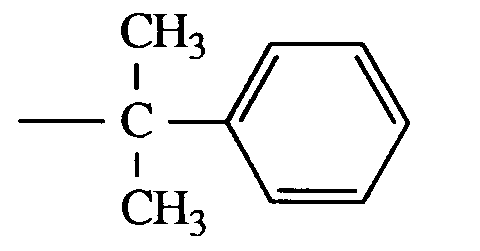
aufweisen, der sich bevorzugt in para-Stellung zu der Hydroxylgruppe des Phenols befindet, insbesondere p-Nonylphenol und p-Dodecylphenol oder Gemische der beiden. - Eine bevorzugte Ausführungsform der erfindungsgemässen Zusammensetzungen enthält die Komponente A1) oder A2) in einer Menge von 40 bis 60 Gewichtsprozent, die Komponente B) in einer Menge von 20 bis 40 Gewichtsprozent und die Komponente C) in einer Menge von 10 bis 40 Gewichtsprozent, bezogen auf das Gesamtgewicht der Komponenten A1), B) und C), wobei sich diese Prozentanteile zu 100 addieren.
- Die erfindungsgemässen Zusammensetzungen eignen sich besonders als Härter für Epoxidharze. Die Erfindung betrifft daher auch härtbare Zusammensetzungen, die a) mindestens ein Epoxidharz und
b) eine Zusammensetzung, wie oben beschrieben, als Härter enthalten. - Als Epoxidharze (a), die in den erfindungsgemässen härtbaren Zusammensetzungen eingesetzt werden können, eignen sich die in der Epoxidharztechnik üblichen Epoxidharze mit mehr als einer 1,2-Epoxidgruppe im Molekül. Beispiele für Epoxidharze sind:
- I) Polyglycidyl- und Poly-(β-methylglycidyl)-ester, erhältlich durch Umsetzung einer Verbindung mit mindestens zwei Carboxylgruppen im Molekül und Epichlorhydrin bzw. β-Methylepichlorhydrin. Die Umsetzung erfolgt zweckmässig in der Gegenwart von Basen.
Als Verbindung mit mindestens zwei Carboxylgruppen im Molekül können aliphatische Polycarbonsäuren verwendet werden. Beispiele für solche Polycarbonsäuren sind Oxalsäure, Bernsteinsäure, Glutarsäure, Adipinsäure, Pimelinsäure, Sebacinsäure, Korksäure, Azelainsäure oder dimerisierte bzw. trimerisierte Linolsäure.
Es können aber auch cycloaliphatische Polycarbonsäuren eingesetzt werden, wie beispielsweise Tetrahydrophthalsäure, 4-Methyltetrahydrophthalsäure, Hexahydrophthalsäure, 4-Methylhexahydrophthalsäure oder Cyclohexan-1,4-dicarbonsäure. Weiterhin können aromatische Polycarbonsäuren Verwendung finden, wie beispielsweise Phthalsäure, Isophthalsäure oder Terephthalsäure. - II) Polyglycidyl-oder Poly-(β-methylglycidyl)-ether, erhältlich durch Umsetzung einer Verbindung mit mindestens zwei freien alkoholischen Hydroxygruppen und/oder phenolischen Hydroxygruppen und Epichlorhydrin oder β-Methylepichlorhydrin unter alkalischen Bedingungen, oder in Anwesenheit eines sauren Katalysators und anschliessende Alkalibehandlung.
Die Glycidylether dieses Typs leiten sich beispielsweise von acyclischen Alkoholen ab, wie von Ethylenglykol, Diethylenglykol und höheren Poly-(oxyethylen)-glykolen, Propan-1,2-diol oder Poly-(oxypropylen)-glykolen, Propan-1,3-diol, Butan-1,4-diol, Poly-(oxytetramethylen)-glykolen, Pentan-1,5-diol, Hexan-1,6-diol, Hexan-2,4,6-triol, Glycerin, 1,1,1-Trimethylolpropan, Pentaerythrit, Sorbit, sowie von Polyepichlorhydrinen.
Sie leiten sich aber auch beispielsweise von cycloaliphatischen Alkoholen, wie 1,4-Cyclohexandimethanol, Bis-(4-hydroxycyclohexyl)-methan oder 2,2-Bis-(4-hydroxycyclohexyl)-propan, ab oder sie besitzen aromatische Kerne, wie N,N-Bis-(2-hydroxyethyl)-anilin oder p,p'-Bis-(2-hydroxyethylamino)-diphenylmethan.
Die Glycidylether können sich auch von einkerningen Phenolen ableiten, wie beispielsweise von Resorcin oder Hydrochinon, oder sie basieren auf mehrkernigen Phenolen, wie beispielsweise Bis-(4-hydroxyphenyl)-methan, 4,4'-Dihydroxybiphenyl, Bis-(4-hydroxyphenyl)-sulfon, 1,1 ,2,2-Tetrakis-(4-hydroxyphenyl)-ethan, 2,2-Bis-(4-hydroxyphenyl)-propan, 2,2-Bis-(3,5-dibrom-4-hydroxyphenyl)-propan sowie von Novolaken, erhältlich durch Kondensation von Aldehyden, wie Formaldehyd, Acetaldehyd, Chloral oder Furfuraldehyd, mit Phenolen, wie Phenol, oder mit Phenolen, die im Kern mit Chloratomen oder C₁-C₉-Alkylgruppen substituiert sind, wie beispielsweise 4-Chlorphenol, 2-Methylphenol, oder 4-tert.-Butylphenol oder durch Kondensation mit Bisphenolen, wie solche der oben genannten Art. - III) Poly-(N-glycidyl)-verbindungen, erhältlich durch Dehydrochlorierung der Reaktionsprodukte von Epichlorhydrin mit Aminen, die mindestens zwei Aminwasserstoffatome enthalten. Bei diesen Aminen handelt es sich zum Beispiel um Anilin, n-Butylamin, Bis-(4-aminophenyl)-methan, m-Xylylendiamin oder Bis-(4-methylaminophenyl)-methan.
Zu den Poly-(N-glycidyl)-verbindungen zählen aber auch Triglycidylisocyanurat, N,N'-Diglycidylderivate von Cycloalkylenharnstoffen, wie Ethylenharnstoff oder 1,3-Propylenharnstoff, und Diglycidylderivate von Hydantoinen, wie von 5,5-Dimethylhydantoin. - IV) Poly-(S-glycidyl)-verbindungen, beispielsweise Di-S-glycidylderivate, die sich von Dithiolen, wie beispielsweise Ethan-1,2-dithiol oder Bis-(4-mercaptomethylphenyl)-ether ableiten.
- V) Cycloaliphatische Epoxidharze, beispielsweise Bis-(2,3-epoxycyclopentyl)-ether, 2,3-Epoxycyclopentylglycidylether, 1,2-Bis-(2,3-epoxycyclopentyloxy)-ethan oder 3,4-Epoxycyclohexylmethyl-3',4'-epoxycyclohexancarboxylat.
- Es lassen sich aber auch Epoxidharze verwenden, bei denen die 1,2-Epoxidgruppen an unterschiedliche Heteroatome bzw. funktionelle Gruppen gebunden sind; zu diesen Verbindungen zählen beispielsweise das N,N,O-Triglycidylderivat des 4-Aminophenols, der Glycidylether-glycidylester der Salicylsäure, N-Glycidyl-N'-(2-glycidyloxypropyl)-5,5-di-methylhydantoin oder 2-Glycidyloxy-1,3-bis-(5,5-dimethyl-1-glycidylhydantoin-3-yl)-propan.
- Bevorzugt verwendet man in den erfindungsgemässen härtbaren Gemischen als Epoxidharz (a) einen flüssigen oder viskosen Polyglycidylether oder -ester, insbesondere einen flüssigen oder viskosen Bisphenoldiglycidylether.
- Die oben genannten Epoxidverbindungen sind bekannt und zum Teil im Handel erhältlich. Es können auch Gemische von Epoxidharzen verwendet werden.
- Die Menge des eingesetzten Härtungsmittels richtet sich nach der chemischen Natur des Härtungsmittels und nach den gewünschten Eigenschaften der härtbaren Mischung und des gehärteten Produktes. Die maximale Menge kann leicht ermittelt werden. Normalerweise werden 0,75 bis 1,25 Äquivalente Aminwasserstoff pro 1 Epoxidäquivalent eingesetzt.
- Die Herstellung der erfindungsgemässen härtbaren Zusammensetzungen kann in üblicher Weise durch Vermischen der Komponenten durch Handrührung oder mit Hilfe bekannter Mischaggregate, beispielsweise mittels Rührer, Kneter oder Walzen, erfolgen. Die Zusammensetzungen weisen nur eine relativ geringe Viskosität auf.
- Je nach Anwendung können den erfindungsgemässen Gemischen die gebräuchlichen Zusätze beigegeben werden, wie beispielsweise Füllstoffe, Pigmente, Farbstoffe, Verlaufmittel oder Plastifizierungsmittel.
- Die Härtung der erfindungsgemässen härtbaren Zusammensetzungen kann in an sich bekannter Weise ein- oder mehrstufig vorgenommen werden. Die Härtung erfolgt im allgemeinen bei Raumtemperatur oder unterhalb der Raumtemperatur oder durch Erhitzen der Gemische auf Temperaturen bis zu 120°C, insbesondere bei Temperaturen zwischen 5 und 50°C. Die Aushärtung wird auch durch eine relativ hohe relative Luftfeuchte nicht gestört.
- Wie eingangs erwähnt, zeichnen sich die aus den erfindungsgemässen Gemischen hergestellten Formkörper und Beschichtungen durch eine hohe Chemikalienresistenz, insbesondere gleichzeitig gegenüber wässerigen Carbonsäuren, wie beispielsweise wässriger Essigsäure mit einem Gehalt an Essigsäure bis zu 30 Gew-%, und hochkonzentrierten Alkoholen aus. Sie bilden einen weiteren Gegenstand der Erfindung.
- Beispiel 1: 1,75 g Ancamine® X2168 (kommerziell erhältliches Gemisch von Polyaminen der Formel (I) und (II)) werden auf 60 °C erwärmt und mit 0,75 g Benzylalkohol versetzt. Dann wird abgekühlt und unter Rühren 1,0 g 2,6-Bis-tert-butyl-4-nonylphenol zugegeben. Das Gemisch weist bei 25°C eine Viskosität von 5100 mPa·s auf.
- Beispiele 2 - 6: Analoge Härterzusammensetzungen werden mit den in der folgenden Tabelle angegebenen Phenolen hergestellt und ihre Viskosität bei 25 °C bestimmt.
Beispiel Phenol Menge Viskosität 2 4-Nonylphenol 1,0 g 9920 mPa·s 3 4-Cumylphenol 0,5 g 7840 mPa·s 4 2,4-Dicumylphenol 0,5 g 10610 mPa·s 5 2,4-Bis-tert-amylphenol 0,5 g 7200 mPa·s 6 2-tert-butyl-4-cumylphenol 0,5 g 9440 mPa·s - Beispiel 7: 3,5 g des Härters aus Beispiel 1 werden mit 5,38 g
Bisphenol-A-diglycidylether mit einem Epoxidgehalt von 5,25 - 5,40 Äquivalenten/kg und einer Viskosität von 10000 - 12000 mPa·s gründlich vermischt. Das Gemisch weist nach dem Vermischen und einer kurzen Thermostatisierung eine Mischviskosität von 6400 mPa·s auf. Nach weiteren 5 Minuten bei 25 °C steigt die Viskosität auf 7040 mPa·s. Das Gemisch wird mit einer 0,200 mm-Rakel auf eine Glasplatte aufgetragen und bei 20 °C ausgehärtet. - Beispiel 8: 3,5 g des Härters aus Beispiel 1 werden mit 5,41 g
Bisphenol-A-diglycidylether mit einem Epoxidgehalt von 5,25 - 5,40 Äquivalenten/kg und einer Viskosität von 10000 - 12000 mPa·s gründlich vermischt. Das Gemisch wird mit einem Pinsel auf sandgestrahlte Stahlplatten aufgetragen. Nach wenigen Stunden bei 20 °C entstehen klare, harte Schichten. - Wird das Gemisch mit einer 0,200 mm-Rakel auf eine Glasplatte aufgetragen und bei 20 °C einen Tag gehärtet, beträgt die Pendelhärte nach Persoz (gemessen mit einem Pendelhärteprüfer der Firma BYK-CHEMIE) 115 s. Nach 7 Tagen Durchhärtung bei 20 °C steigt die Persoz-Härte auf 284 s, nach 14 Tagen auf 293 s. Wird die Aushärtung bei 5 °C durchgeführt beträgt die Pendelhärte nach 7 Tagen 97 s und nach 14 Tagen 146 s. Das Gemisch härtet auch bei 20 °C und 100% relativer Luftfeuchtigkeit sowie bei 5 °C und 45% relativer Luftfeuchtigkeit befriedigend aus, wobei keine oder nur eine minimale Oberflächentrübung auftritt.
- Beispiel 9: 1,75 g Ancamine® X2168 (kommerziell erhältliches Gemisch von Polyaminen der Formel (I) und (II)), 0,75 g Benzylalkohol und 1,4 g 4-Nonylphenol werden mit 5,41 g Bisphenol-A-diglycidylether mit einem Epoxidgehalt von 5,25 - 5,40 Äquivalenten/kg und einer Viskosität von 10000 - 12000 mPa·s gründlich vermischt. Das Gemisch wird mit einem Pinsel auf sandgestrahlte Stahlplatten aufgetragen. Nach wenigen Stunden bei 20 °C entstehen klare, harte Schichten.
- Wird das Gemisch mit einer 0,200 mm-Rakel auf eine Glasplatte aufgetragen und bei 20 °C einen Tag gehärtet, beträgt die Pendelhärte nach Persoz (gemessen mit einem Pendelhärteprüfer der Firma BYK-CHEMIE) 97 s. Nach 7 Tagen Durchhärtung bei 20 °C steigt die Persoz-Härte auf 246 s. Wird die Aushärtung bei 5 °C durchgeführt beträgt die Pendelhärte nach 7 Tagen 91 s und nach 14 Tagen 133 s. Auch dieses Gemisch härtet bei 20 °C und 100% relativer Luftfeuchtigkeit sowie bei 5 °C und 45% relativer Luftfeuchtigkeit befriedigend aus, wobei keine oder nur eine minimale Oberflächentrübung auftritt.
- Die Chemikalienresistenz wird nach einer achttägigen Härtung bei 20 °C wie folgt ermittelt: Mit den Gemischen der Beispiele 8 und 9 beschichtete Stahlplatten werden in einer Einspannvorrichtung zur Hälfte mit den Testmedien benetzt und täglich begutachtet. Die Schichten widerstehen den Chemikalien während der in nachfolgender Tabelle angegebenen Anzahl von Tagen, ohne Blasen zu werfen oder sich abzulösen.
Testmedium Gemisch aus Beispiel 8 9 50% CH₃COOH/H₂O 6 4 30% CH₃COOH/H₂O 14 14 10% CH₃COOH/H₂O >21 >21 96% C₂H₅OH 12 4 Xylol >21 12
wobei die Komponente C) 10 bis 50 Prozent des Gesamtgewichts der genannten Komponenten ausmacht.
Claims (14)
- Zusammensetzung, die im wesentlichen aus den folgenden Komponenten besteht:A1) Polyaminen der Formel (I) und/oder (II)
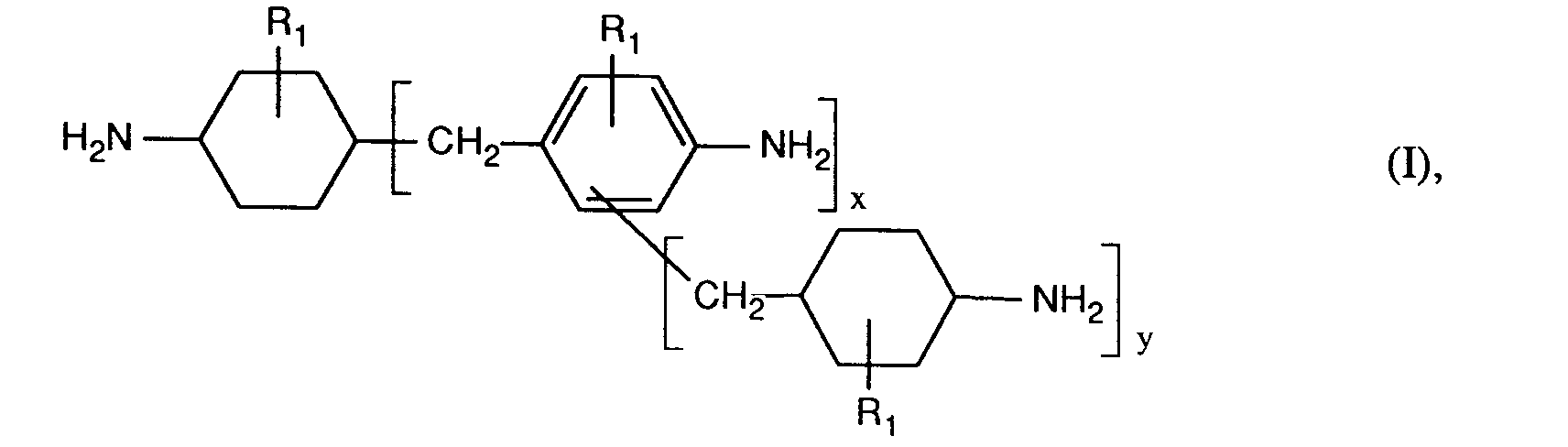
 R₁ und R₂ unabhängig voneinander ein Wasserstoffatom oder eine Methylgruppe bedeuten,x eine ganze Zahl von 1 bis 3 undy eine ganze Zahl von 0 bis 2 darstellen, wobei die Summe von x und y bis zu 4 beträgt undz eine ganze Zahl von 0 bis 2 bedeutet;oderA2) einem Gemisch von Polyaminen der Formel (I) und/oder (II) mit weiteren Polyaminen;B) einem aliphatischen, cycloaliphatischen oder araliphatischen Alkohol oder einem Gemisch entsprechender Alkohole; sowieC) einem alkyl- und/oder aralkylsubstituierten Monophenol oder einem Gemisch entsprechender Monophenole,wobei die Komponente C) 10 bis 50 Prozent des Gesamtgewichts der genannten Komponenten ausmacht.
 - Zusammensetzung nach Anspruch 1, wobei die Komponente A1) oder A2) ein Polyamingemisch ist, das erhältlich ist, indem man ein Kondensationsprodukt aus Anilin und/oder o-Toluidin und Formaldehyd, bestehend aus 85 bis 50 Gewichtsprozent entsprechender zweikerniger Kondensationsprodukte und 15 bis 50 Gewichtsprozent entsprechender drei- und mehrkerniger Kondensationsprodukte mit Wasserstoff bei einem Druck von 3,5 bis 27,7 MPa (500 bis 4000 psig) und einer Temperatur von 150 bis 250 °C in Gegenwart eines Hydrierungskatalysators während einer Zeit von 1 bis 4 Stunden umsetzt und gegebenenfalls unerwünschte Bestandteile teilweise oder vollständig abtrennt.
- Zusammensetzung nach Anspruch 1 oder 2, die als Polyamine ein Gemisch aus 20 bis 40 Gewichtsprozent 2,4-Bis(4-aminocyclohexylmethyl)cyclohexylamin; 40 bis 70 Gewichtsprozent 2,4-Bis(4-aminocyclohexylmethyl)anilin; 0 bis 10 Gewichtsprozent Bis(4-aminocyclohexyl)methan und gegebenenfalls weitere vier- und höherkernige Polyamine enthält, wobei bevorzugt etwa 10 bis 20 % der gesamten Aminogruppen aromatisch sind.
- Zusammensetzung nach Anspruch 1 bis 3, bei der der Polyaminkomponente A1) oder A2) zusätzlich weitere aliphatische, cycloaliphatische und/oder araliphatische Polyamine zugemischt sind.
- Zusammensetzung nach Anspruch 1 bis 4, die die Polyamine A1) oder A2) in einer Menge von 30 - 70 Gewichtsprozent enthält.
- Zusammensetzung nach Anspruch 1 bis 5, die die Komponente B) in einer Menge von 20 bis 50 Gewichtsprozent, bezogen auf das Gesamtgewicht der Polyamine sowie der Komponenten B) und C), enthält.
- Zusammensetzung nach Anspruch 1 bis 3, die die Komponente A1) oder A2) in einer Menge von 40 bis 60 Gewichtsprozent, die Komponente B) in einer Menge von 20 bis 40 Gewichtsprozent und die Komponente C) in einer Menge von 10 bis 40 Gewichtsprozent, bezogen auf das Gesamtgewicht der Komponenten A1), B) und C), enthält, wobei sich diese Prozentanteile zu 100 addieren.
- Zusammensetzung nach Anspruch 1 bis 7, bei der die Komponente B) aus Furfurylalkohol und/oder Benzylalkohol besteht.
- Zusammensetzung nach Anspruch 1 bis 8, bei der die Komponente C) aus einem oder mehreren Monophenolen besteht, die jeweils einen, zwei oder drei Substituenten aufweisen, ausgewählt aus Alkylgruppen mit 3 bis 18 Kohlenstoffatomen oder aus Phenylalkylgruppen.
- Zusammensetzung nach Anspruch 9, bei der die Monophenole einen Alkylsubstituenten mit 9 bis 12 Kohlenstoffatomen oder einen Substituenten der Formel

- Zusammensetzung nach Anspruch 10, die als Monophenol p-Nonylphenol und/oder p-Dodecylphenol enthalten.
- Verwendung einer Zusammensetzung nach Anspruch 1 bis 11 als Härter für Epoxidharze.
- Härtbare Zusammensetzung, diea) mindestens ein Epoxidharz undb) eine Zusammensetzung gemäss Anspruch 1 bis 11 als Härter enthält.
- Die durch Härten der Zusammensetzung gemäss Anspruch 13 erhältlichen Formkörper und Beschichtungen.
Applications Claiming Priority (2)
| Application Number | Priority Date | Filing Date | Title |
|---|---|---|---|
| CH253794 | 1994-08-17 | ||
| CH2537/94 | 1994-08-17 |
Publications (2)
| Publication Number | Publication Date |
|---|---|
| EP0697425A1 true EP0697425A1 (de) | 1996-02-21 |
| EP0697425B1 EP0697425B1 (de) | 1999-03-17 |
Family
ID=4236030
Family Applications (1)
| Application Number | Title | Priority Date | Filing Date |
|---|---|---|---|
| EP95810502A Expired - Lifetime EP0697425B1 (de) | 1994-08-17 | 1995-08-08 | Härterzusammensetzung für Epoxidharze |
Country Status (9)
| Country | Link |
|---|---|
| EP (1) | EP0697425B1 (de) |
| JP (1) | JP3811805B2 (de) |
| KR (1) | KR100347835B1 (de) |
| BR (1) | BR9503671A (de) |
| CA (1) | CA2156095A1 (de) |
| DE (1) | DE59505360D1 (de) |
| ES (1) | ES2130556T3 (de) |
| NO (1) | NO307891B1 (de) |
| TW (1) | TW343991B (de) |
Cited By (1)
| Publication number | Priority date | Publication date | Assignee | Title |
|---|---|---|---|---|
| DE112016002028B4 (de) | 2016-02-12 | 2019-04-25 | Nippon Paint Marine Coatings Co., Ltd. | Korrosionsschutzfarbzusammensetzung, Beschichtungsfilm sowie Schiff und Offshore-Struktur |
Families Citing this family (4)
| Publication number | Priority date | Publication date | Assignee | Title |
|---|---|---|---|---|
| US8026318B2 (en) * | 2008-08-22 | 2011-09-27 | Air Products And Chemicals, Inc. | Mixed polycycloaliphatic amines (MPCA) and MPCA alkylates |
| JP5913762B1 (ja) * | 2016-02-12 | 2016-04-27 | 日本ペイントマリン株式会社 | 防食塗料組成物、塗膜、船舶及び海洋構造物 |
| JP6832122B2 (ja) * | 2016-10-19 | 2021-02-24 | 日本ペイント株式会社 | 二液混合形塗料組成物 |
| JP7618114B1 (ja) * | 2024-06-07 | 2025-01-20 | 日本ペイント株式会社 | 防食塗料組成物 |
Citations (2)
| Publication number | Priority date | Publication date | Assignee | Title |
|---|---|---|---|---|
| EP0554823A1 (de) | 1992-02-07 | 1993-08-11 | Air Products And Chemicals, Inc. | Epoxydharz gehärtet durch eine Mischung von Methylen-überbrückten Poly(cyclohexyl-aromatische)Aminehärtungsmitteln |
| EP0556421A1 (de) * | 1990-08-24 | 1993-08-25 | The Dow Chemical Company | Härtbare Harzzusammensetzungen |
-
1995
- 1995-07-12 TW TW084107204A patent/TW343991B/zh active
- 1995-08-08 DE DE59505360T patent/DE59505360D1/de not_active Expired - Lifetime
- 1995-08-08 EP EP95810502A patent/EP0697425B1/de not_active Expired - Lifetime
- 1995-08-08 ES ES95810502T patent/ES2130556T3/es not_active Expired - Lifetime
- 1995-08-15 CA CA002156095A patent/CA2156095A1/en not_active Abandoned
- 1995-08-16 KR KR1019950025530A patent/KR100347835B1/ko not_active Expired - Fee Related
- 1995-08-16 NO NO953221A patent/NO307891B1/no not_active IP Right Cessation
- 1995-08-16 JP JP23080395A patent/JP3811805B2/ja not_active Expired - Fee Related
- 1995-08-16 BR BR9503671A patent/BR9503671A/pt not_active IP Right Cessation
Patent Citations (2)
| Publication number | Priority date | Publication date | Assignee | Title |
|---|---|---|---|---|
| EP0556421A1 (de) * | 1990-08-24 | 1993-08-25 | The Dow Chemical Company | Härtbare Harzzusammensetzungen |
| EP0554823A1 (de) | 1992-02-07 | 1993-08-11 | Air Products And Chemicals, Inc. | Epoxydharz gehärtet durch eine Mischung von Methylen-überbrückten Poly(cyclohexyl-aromatische)Aminehärtungsmitteln |
Cited By (1)
| Publication number | Priority date | Publication date | Assignee | Title |
|---|---|---|---|---|
| DE112016002028B4 (de) | 2016-02-12 | 2019-04-25 | Nippon Paint Marine Coatings Co., Ltd. | Korrosionsschutzfarbzusammensetzung, Beschichtungsfilm sowie Schiff und Offshore-Struktur |
Also Published As
| Publication number | Publication date |
|---|---|
| ES2130556T3 (es) | 1999-07-01 |
| NO307891B1 (no) | 2000-06-13 |
| NO953221L (no) | 1996-02-19 |
| JPH0867800A (ja) | 1996-03-12 |
| KR100347835B1 (ko) | 2002-11-13 |
| CA2156095A1 (en) | 1996-02-18 |
| EP0697425B1 (de) | 1999-03-17 |
| TW343991B (en) | 1998-11-01 |
| NO953221D0 (no) | 1995-08-16 |
| BR9503671A (pt) | 1996-04-16 |
| DE59505360D1 (de) | 1999-04-22 |
| KR960007638A (ko) | 1996-03-22 |
| JP3811805B2 (ja) | 2006-08-23 |
Similar Documents
| Publication | Publication Date | Title |
|---|---|---|
| EP1114076B1 (de) | Beschleuniger für härtbare systeme | |
| EP3344677B1 (de) | Emissionsarme epoxidharz-zusammensetzung | |
| DE69302289T2 (de) | Epoxydharz gehärtet durch eine Mischung von Methylen-überbrückten Poly(cyclohexyl-aromatische)Aminehärtungsmitteln | |
| EP0272222A2 (de) | Epoxidharze enthaltend Polyester auf Polyalkylenglykolbasis | |
| EP3350245B1 (de) | Amin für emissionsarme epoxidharz-zusammensetzungen | |
| EP0722964A1 (de) | Epoxidgruppenterminierte Polyester enthaltendes Epoxidharzgemisch | |
| EP0146498A2 (de) | Härtbare Gemische, enthaltend ein Epoxidharz, ein Imid und einen Härtungskatalysator | |
| EP0103266B1 (de) | Härtungsmittel für Epoxidharze und Verfahren zum Härten von Epoxidharzen | |
| EP0017623B1 (de) | Dimethylaminoderivate enthaltende härtbare Gemische | |
| DE1032528B (de) | Verfahren zum Beschleunigen der Haertung von Epoxyharzen | |
| DE102011113395B4 (de) | Cyclohexylamine und deren Verwendung, insbesondere in Epoxidharzmischungen | |
| EP0108712A1 (de) | Heisshärtbare Epoxidharzmischungen | |
| EP0697425B1 (de) | Härterzusammensetzung für Epoxidharze | |
| EP0075533A1 (de) | Heisshärtbare Epoxidharzmassen | |
| EP0723982B1 (de) | Härtbares Epoxidharzgemisch | |
| EP0042617B1 (de) | Verfahren zur Herstellung von Formkörpern und Überzügen | |
| EP0654465A1 (de) | Polyaminopolyamide | |
| EP0462053B1 (de) | Pulverförmige frei fliessende Epoxidharzzusammensetzungen | |
| EP0665214B1 (de) | Monocarbonsäureamide von Polyaminen | |
| EP0839865B1 (de) | Härtbare Epoxidharzzusammensetzungen | |
| EP0291454A2 (de) | Ausgewählte Phosphorsäureester als Härter für Epoxidharze | |
| DE2951603C2 (de) | ||
| EP0663384B1 (de) | Salze der Pyromellitsäure, ein Verfahren zu ihrer Herstellung sowie deren Verwendung | |
| DE4141858A1 (de) | Mit mercaptoverbindungen vorverlaengerte bisphenol a-diglycidylether | |
| EP0663415A1 (de) | Verfahren zur Herstellung von matten Epoxidharzbeschichtungen |
Legal Events
| Date | Code | Title | Description |
|---|---|---|---|
| PUAI | Public reference made under article 153(3) epc to a published international application that has entered the european phase |
Free format text: ORIGINAL CODE: 0009012 |
|
| AK | Designated contracting states |
Kind code of ref document: A1 Designated state(s): CH DE ES FR GB IT LI NL SE |
|
| AX | Request for extension of the european patent |
Free format text: LT;LV;SI |
|
| RAX | Requested extension states of the european patent have changed |
Free format text: LT;LV;SI |
|
| 17P | Request for examination filed |
Effective date: 19960808 |
|
| RAP1 | Party data changed (applicant data changed or rights of an application transferred) |
Owner name: CIBA SC HOLDING AG |
|
| RAP3 | Party data changed (applicant data changed or rights of an application transferred) |
Owner name: CIBA SPECIALTY CHEMICALS HOLDING INC. |
|
| 17Q | First examination report despatched |
Effective date: 19970822 |
|
| GRAG | Despatch of communication of intention to grant |
Free format text: ORIGINAL CODE: EPIDOS AGRA |
|
| GRAG | Despatch of communication of intention to grant |
Free format text: ORIGINAL CODE: EPIDOS AGRA |
|
| GRAG | Despatch of communication of intention to grant |
Free format text: ORIGINAL CODE: EPIDOS AGRA |
|
| GRAH | Despatch of communication of intention to grant a patent |
Free format text: ORIGINAL CODE: EPIDOS IGRA |
|
| GRAH | Despatch of communication of intention to grant a patent |
Free format text: ORIGINAL CODE: EPIDOS IGRA |
|
| GRAA | (expected) grant |
Free format text: ORIGINAL CODE: 0009210 |
|
| ITF | It: translation for a ep patent filed | ||
| AK | Designated contracting states |
Kind code of ref document: B1 Designated state(s): CH DE ES FR GB IT LI NL SE |
|
| DAX | Request for extension of the european patent (deleted) | ||
| REG | Reference to a national code |
Ref country code: CH Ref legal event code: EP |
|
| REF | Corresponds to: |
Ref document number: 59505360 Country of ref document: DE Date of ref document: 19990422 |
|
| GBT | Gb: translation of ep patent filed (gb section 77(6)(a)/1977) |
Effective date: 19990406 |
|
| REG | Reference to a national code |
Ref country code: ES Ref legal event code: FG2A Ref document number: 2130556 Country of ref document: ES Kind code of ref document: T3 |
|
| ET | Fr: translation filed | ||
| PLBE | No opposition filed within time limit |
Free format text: ORIGINAL CODE: 0009261 |
|
| STAA | Information on the status of an ep patent application or granted ep patent |
Free format text: STATUS: NO OPPOSITION FILED WITHIN TIME LIMIT |
|
| 26N | No opposition filed | ||
| REG | Reference to a national code |
Ref country code: CH Ref legal event code: PUE Owner name: CIBA SPECIALTY CHEMICALS HOLDING INC. TRANSFER- VA |
|
| REG | Reference to a national code |
Ref country code: GB Ref legal event code: 732E |
|
| NLS | Nl: assignments of ep-patents |
Owner name: VANTICO AG |
|
| REG | Reference to a national code |
Ref country code: GB Ref legal event code: IF02 |
|
| REG | Reference to a national code |
Ref country code: FR Ref legal event code: TP |
|
| PGFP | Annual fee paid to national office [announced via postgrant information from national office to epo] |
Ref country code: NL Payment date: 20030728 Year of fee payment: 9 |
|
| PGFP | Annual fee paid to national office [announced via postgrant information from national office to epo] |
Ref country code: SE Payment date: 20030808 Year of fee payment: 9 |
|
| PG25 | Lapsed in a contracting state [announced via postgrant information from national office to epo] |
Ref country code: SE Free format text: LAPSE BECAUSE OF NON-PAYMENT OF DUE FEES Effective date: 20040809 |
|
| PG25 | Lapsed in a contracting state [announced via postgrant information from national office to epo] |
Ref country code: NL Free format text: LAPSE BECAUSE OF NON-PAYMENT OF DUE FEES Effective date: 20050301 |
|
| EUG | Se: european patent has lapsed | ||
| NLV4 | Nl: lapsed or anulled due to non-payment of the annual fee |
Effective date: 20050301 |
|
| PGFP | Annual fee paid to national office [announced via postgrant information from national office to epo] |
Ref country code: ES Payment date: 20080806 Year of fee payment: 14 Ref country code: CH Payment date: 20080708 Year of fee payment: 14 |
|
| PGFP | Annual fee paid to national office [announced via postgrant information from national office to epo] |
Ref country code: IT Payment date: 20080816 Year of fee payment: 14 Ref country code: FR Payment date: 20080807 Year of fee payment: 14 |
|
| PGFP | Annual fee paid to national office [announced via postgrant information from national office to epo] |
Ref country code: GB Payment date: 20080708 Year of fee payment: 14 |
|
| REG | Reference to a national code |
Ref country code: CH Ref legal event code: PL |
|
| GBPC | Gb: european patent ceased through non-payment of renewal fee |
Effective date: 20090808 |
|
| PG25 | Lapsed in a contracting state [announced via postgrant information from national office to epo] |
Ref country code: LI Free format text: LAPSE BECAUSE OF NON-PAYMENT OF DUE FEES Effective date: 20090831 Ref country code: CH Free format text: LAPSE BECAUSE OF NON-PAYMENT OF DUE FEES Effective date: 20090831 |
|
| REG | Reference to a national code |
Ref country code: FR Ref legal event code: ST Effective date: 20100430 |
|
| PG25 | Lapsed in a contracting state [announced via postgrant information from national office to epo] |
Ref country code: FR Free format text: LAPSE BECAUSE OF NON-PAYMENT OF DUE FEES Effective date: 20090831 |
|
| REG | Reference to a national code |
Ref country code: ES Ref legal event code: FD2A Effective date: 20090810 |
|
| PG25 | Lapsed in a contracting state [announced via postgrant information from national office to epo] |
Ref country code: GB Free format text: LAPSE BECAUSE OF NON-PAYMENT OF DUE FEES Effective date: 20090808 |
|
| PG25 | Lapsed in a contracting state [announced via postgrant information from national office to epo] |
Ref country code: IT Free format text: LAPSE BECAUSE OF NON-PAYMENT OF DUE FEES Effective date: 20090808 |
|
| PG25 | Lapsed in a contracting state [announced via postgrant information from national office to epo] |
Ref country code: ES Free format text: LAPSE BECAUSE OF NON-PAYMENT OF DUE FEES Effective date: 20090809 |
|
| PGFP | Annual fee paid to national office [announced via postgrant information from national office to epo] |
Ref country code: DE Payment date: 20120831 Year of fee payment: 18 |
|
| PG25 | Lapsed in a contracting state [announced via postgrant information from national office to epo] |
Ref country code: DE Free format text: LAPSE BECAUSE OF NON-PAYMENT OF DUE FEES Effective date: 20140301 |
|
| REG | Reference to a national code |
Ref country code: DE Ref legal event code: R119 Ref document number: 59505360 Country of ref document: DE Effective date: 20140301 |