EP0697886B1 - Neuartige peptidantagonisten der glutaminsäure- und nmda-rezeptoren - Google Patents
Neuartige peptidantagonisten der glutaminsäure- und nmda-rezeptoren Download PDFInfo
- Publication number
- EP0697886B1 EP0697886B1 EP94916460A EP94916460A EP0697886B1 EP 0697886 B1 EP0697886 B1 EP 0697886B1 EP 94916460 A EP94916460 A EP 94916460A EP 94916460 A EP94916460 A EP 94916460A EP 0697886 B1 EP0697886 B1 EP 0697886B1
- Authority
- EP
- European Patent Office
- Prior art keywords
- igf
- medicament
- gnrh
- use according
- treatment
- Prior art date
- Legal status (The legal status is an assumption and is not a legal conclusion. Google has not performed a legal analysis and makes no representation as to the accuracy of the status listed.)
- Expired - Lifetime
Links
Images






Classifications
-
- A—HUMAN NECESSITIES
- A61—MEDICAL OR VETERINARY SCIENCE; HYGIENE
- A61K—PREPARATIONS FOR MEDICAL, DENTAL OR TOILETRY PURPOSES
- A61K38/00—Medicinal preparations containing peptides
- A61K38/04—Peptides having up to 20 amino acids in a fully defined sequence; Derivatives thereof
- A61K38/06—Tripeptides
-
- A—HUMAN NECESSITIES
- A61—MEDICAL OR VETERINARY SCIENCE; HYGIENE
- A61K—PREPARATIONS FOR MEDICAL, DENTAL OR TOILETRY PURPOSES
- A61K38/00—Medicinal preparations containing peptides
- A61K38/04—Peptides having up to 20 amino acids in a fully defined sequence; Derivatives thereof
- A61K38/08—Peptides having 5 to 11 amino acids
- A61K38/09—Luteinising hormone-releasing hormone [LHRH], i.e. Gonadotropin-releasing hormone [GnRH]; Related peptides
-
- A—HUMAN NECESSITIES
- A61—MEDICAL OR VETERINARY SCIENCE; HYGIENE
- A61K—PREPARATIONS FOR MEDICAL, DENTAL OR TOILETRY PURPOSES
- A61K38/00—Medicinal preparations containing peptides
- A61K38/16—Peptides having more than 20 amino acids; Gastrins; Somatostatins; Melanotropins; Derivatives thereof
- A61K38/17—Peptides having more than 20 amino acids; Gastrins; Somatostatins; Melanotropins; Derivatives thereof from animals; from humans
- A61K38/22—Hormones
- A61K38/25—Growth hormone-releasing factor [GH-RF], i.e. somatoliberin
-
- A—HUMAN NECESSITIES
- A61—MEDICAL OR VETERINARY SCIENCE; HYGIENE
- A61K—PREPARATIONS FOR MEDICAL, DENTAL OR TOILETRY PURPOSES
- A61K38/00—Medicinal preparations containing peptides
- A61K38/16—Peptides having more than 20 amino acids; Gastrins; Somatostatins; Melanotropins; Derivatives thereof
- A61K38/17—Peptides having more than 20 amino acids; Gastrins; Somatostatins; Melanotropins; Derivatives thereof from animals; from humans
- A61K38/22—Hormones
- A61K38/28—Insulins
-
- A—HUMAN NECESSITIES
- A61—MEDICAL OR VETERINARY SCIENCE; HYGIENE
- A61K—PREPARATIONS FOR MEDICAL, DENTAL OR TOILETRY PURPOSES
- A61K38/00—Medicinal preparations containing peptides
- A61K38/16—Peptides having more than 20 amino acids; Gastrins; Somatostatins; Melanotropins; Derivatives thereof
- A61K38/17—Peptides having more than 20 amino acids; Gastrins; Somatostatins; Melanotropins; Derivatives thereof from animals; from humans
- A61K38/22—Hormones
- A61K38/30—Insulin-like growth factors, i.e. somatomedins, e.g. IGF-1, IGF-2
-
- A—HUMAN NECESSITIES
- A61—MEDICAL OR VETERINARY SCIENCE; HYGIENE
- A61P—SPECIFIC THERAPEUTIC ACTIVITY OF CHEMICAL COMPOUNDS OR MEDICINAL PREPARATIONS
- A61P25/00—Drugs for disorders of the nervous system
-
- A—HUMAN NECESSITIES
- A61—MEDICAL OR VETERINARY SCIENCE; HYGIENE
- A61P—SPECIFIC THERAPEUTIC ACTIVITY OF CHEMICAL COMPOUNDS OR MEDICINAL PREPARATIONS
- A61P3/00—Drugs for disorders of the metabolism
- A61P3/08—Drugs for disorders of the metabolism for glucose homeostasis
-
- A—HUMAN NECESSITIES
- A61—MEDICAL OR VETERINARY SCIENCE; HYGIENE
- A61P—SPECIFIC THERAPEUTIC ACTIVITY OF CHEMICAL COMPOUNDS OR MEDICINAL PREPARATIONS
- A61P43/00—Drugs for specific purposes, not provided for in groups A61P1/00-A61P41/00
-
- A—HUMAN NECESSITIES
- A61—MEDICAL OR VETERINARY SCIENCE; HYGIENE
- A61P—SPECIFIC THERAPEUTIC ACTIVITY OF CHEMICAL COMPOUNDS OR MEDICINAL PREPARATIONS
- A61P9/00—Drugs for disorders of the cardiovascular system
- A61P9/10—Drugs for disorders of the cardiovascular system for treating ischaemic or atherosclerotic diseases, e.g. antianginal drugs, coronary vasodilators, drugs for myocardial infarction, retinopathy, cerebrovascula insufficiency, renal arteriosclerosis
Definitions
- the invention relates to the use of a new type of peptide antagonists at glutamate receptors and a subtype of glutamate receptors (NMDA (N-methyl-D-aspartate)) for the manufacture of a medicament to influence the glutamate receptor- and the NMDA-receptor-controlled cells, such as neurons or glial cells in the central nervous system.
- the medicament comprises glutamic acid-terminating peptides, such as (1-5)GnRH, (1-3)IGF-I, (1-37)GRF and C-peptide of insulin.
- the medicament could be used for the treatment of hypoxic, ischemic and metabolic insults to the central nervous system, such as stroke, hypoglycaemia, traumatic, radiation-induced or inflammatory injuries as well as chronic degenerative states of the brain in adult or paediatric patients.
- NMDA N-methyl-D-aspartate
- IGF-I Insulin-like growth factor-I
- IGF-I Insulin-like growth factor-I
- the mechanism of its paracrine action in the brain is not fully elucidated.
- endocrine effects on the brain possibly resulting from the age-related increase in peripheral serum concentrations of IGF-I (5) are still putative.
- Sara et al have shown the presence of a N-terminal-truncated and bioactive form of IGF-I(6). This led these authors to hypothesize that brain IGF-I could be degraded into (4-70)IGF-I retaining IGF-I bioactivity (7), and (1-3)IGF-I, the N-terminal tripeptide.
- the present invention provides the use of a glutamic acid-terminating peptide, which is a glutamate receptor antagonist, for the manufacture of a medicament to inhibit the effect of glutamate on glutamate-receptor-controlled cells as set out in the claims.
- the present invention provides the use of a glutamic acid-terminating peptide, which is an NMDA receptor antagonist, for the manufacture of a medicament to influence NMDA-receptor-controlled cells as set out in the claims.
- the cells are neurons or glial cells in the central nervous system.
- the medicament may prevent NMDA receptor mediated excitatory effects such as release of neurotransmitter or peptide and toxic effects response resulting in cell injury or cell death following massive calcium influx.
- the invention relates to a method to influence therapeutically the secretion, function and death of glutamate (NMDA)-receptor-controlled cells.
- the medicament comprises glutamic acid-terminating peptides, preferably chosen among (1-5) GnRH, (1-3)IGF-I, (1-37)GFR and C-peptide of insulin.
- the medicament comprises (1-3) IGF-I.
- the medicament has been shown to influence GnRH secretion through NMDA receptor antagonism.
- the medicament could be used for the treatment of disorders involving excessive activation of NMDA receptors such as acute or chronic disorders of the central nervous system, hypoxic, ischemic and metabolic brain disorders including stroke and hypoglycaemia, traumatic, radiation-induced of inflammatory injuries to the brain and chronic degenerative states.
- NMDA receptors e.g. disclosed in Simon RP et al, Sience 1984, 226:850-52, Wielocht, Science 1985, 230:681-83, Mc Donald JW et al, Brain Research Reviews, 1990, 15:41-70, Choi W, Neuron 1988, 1:623-34 .
- the medicament could be administered systemically or locally.
- the medicament should be given in a therapeutic dose.
- Preferred doses could be in the range of 1 ⁇ g - 10 mg/kg and preperably 5-50 ⁇ g/kg when (1-3)IGF-I is given systemically.
- the dose could be 0.1 ⁇ g to 1 mg/kg when (1-3)IGF-I is given locally.
- GnRH a peptide with a N-terminal glutamic acid which results from the degradation of GnRH in the hypothalamus (10). Such a peptide could be involved in the inhibitory autofeedback of GnRH, a regulatory process that we described earlier (11).
- Growth Hormone-Releasing Factor (GRF) is another hypothalamic peptide possibly under the control of NMDA receptors as suggested by the stimulatory effect of NMDA on GH secretion (12).
- Glutamate receptors of the AMPA subtype have been localized in pancreas as well.
- NMDA receptor representing a subclass of glutamate receptors can provide a basis for considering its therapeutic use. Three factors should thereby be taken into consideration:
- the hypothalamic explants of male Wistar rats were studied individually using a static incubation system described earlier (1-3, 9). The total incubation volume of each chamber (0.5 ml) was sampled and renewed every 7.5 min. Using these fractions, the radioimmunoassay of GnRH was performed as described in detail previously (1, 2). The secretion of GnRH was studied either in the absence of any secretagogue or during the 7.5- min exposure to 5.10 -5 M of veratridine, a depolarizing agent opening the Na + channel, or 5.10 -2 M of kainate or N-methyl-D, L-aspartate (NMA) which are agonists of distinct subtypes of glutamate receptors.
- NMA N-methyl-D, L-aspartate
- the GnRH fragments and analogs included (1-5) GnRH (UCB, Brussels, Belgium), (2-10)GnRH (Sigma, St Louis, MO, USA) and (1-9)GnRHa (D-TRP 6 -PRO 9 -N-Ethylamide GnRH) a GnRH agonist kindly provided by Dr J Rivier (The Salk Institute, California, USA).
- the bovine Proinsulin and its subproducts included the C-peptide of insulin and insulin itself (Novo-Nordisk, Copenhagen, Denmark).
- GRF-related peptides included (1-43) rat GRF (Bachem, Bubendorf, Switzerland), (1-37) human GRF (Peninsula, Merseyside, England) and (1-29)human GRF (Kabi Pharmacia, Sweden).
- AP-5 DL-2-amino-5-phosphonovaleric acid, Sigma
- DNQX DNQX-6,7-dinitro-quinoxaline-2,3-dione, Tocris Neuramin, Buckhurst Hill, United Kingdom
- the different peptides or antagonists were used for 15 min, i.e. the 7.5-min fraction before and during exposure to veratridine.
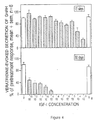
- IGF-I accounts for an inhibitory effect on the secretion of GnRH. This effect is unlikely to be mediated through the classical IGF-I receptors since the secretion of GnRH is not affected by (4-70)IGF-I, a highly bioactive agonist at IGF-I receptors (7). Therefore, it is assumed that, the N-terminal tripeptide, (1-3)IGF-I, could mediate the inhibitory effects of IGF-I on the secretion of GnRH. This hypothesis is supported by the equipotency of the inhibitory effects of IGF-I and (1-3)IGF-I at 25 and 50 days.
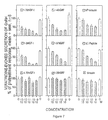
- IGF-I The competitive nature of the antagonism of IGF-I at NMDA receptors is suggested by the relatively low sensitivity to IGF-I at 25 days, a time characterised by a peak activation of the NMDA receptors involved in the secretion of GnRH (3, 9). Also, IGF-I is less active as an inhibitor when the incubation medium is enriched with the agonist NMA. Moreover, IGF-I and its (1-3) subproduct appear to be inhibitors of the GnRH secretion as potent as AP-5, a specific competitive antagonist at NMDA receptors. Finally, glutamate binding to hypothalamic membrane preparation is diplaced by different peptide antagonists.
- IGF-I does not generate any antagonism of NMDA receptors at 15 days of age, a period characterised by a high level of receptors to excitatory amino acids (19, 20).
- the occurrence of IGF-I inhibitory effects between 15 and 25 days is coincident with a reduction in number and activity of those receptors (19,20). It is possible to view the GnRH neurosecretory system and the associated NMDA receptors as a model of the interactions between these receptors and IGF-I in the whole CNS.
- the NMDA receptors are known to play a critical role in neurotoxicity, a process more severe during early postnatal life than in adult animals (21).
- IGF-I can protect against brain hypoxic-ischemic injury (22) whereas (4-70)IGF-I does not result in such an effect (23).
- IGF-I plays a critical role in CNS as a precursor of (1-3)IGF-I, a possible endogenous antagonist at the NMDA receptors.
- NMDA receptor antagonism by glutamic acid-terminating peptides can be extended to peptide systems different from IGF-I, since the subproducts of GnRH, GRF and proinsulin account for similar effects.
- any peptide with a terminal glutamic acid resulting from direct biosynthesis or from degradation of precursor peptides could act as an antagonist of glutamate receptors (NMDA subtype).
- NMDA subtype glutamate receptors
- these peptides are probably involved in a paracrine or autocrine effect at their site of biosynthesis. They can act as inhibitory autoregulators of their secretion when this process depends on activation of NMDA receptors. Such a mechanism can be involved in the autofeedback of GnRH that we described earlier (11).
- the spontaneous pulsatile secretion of GnRH in vitro is transiently suppressed after the in vivo administration of IGF-I.
- (1-3)IGF-I results in an inhibitory effect similar to that of IGF-I.
- IGF-I and (1-3)IGF-I show the same effects as at 50 days though higher concentrations are required.
- IGF-I does not show any effect whereas a potent inhibition of GnRH secretion is observed using (1-3) IGF-I either in vivo or in vitro.
- the glutamate-terminal subproducts of other peptide systems such as (1-5)GnRH, (1-37)GRF and C-peptide of insulin result in inhibitory effects similar to that of (1-3)IGF-I. These effects parallel that of AP-5, a competitive antagonist at NMDA receptors.
- the studied peptides suppress the GnRH secretion induced by NMA but not that induced by kainate and they cause displacement of tritiated glutamate from hypothalamic membrane preparations.
Landscapes
- Health & Medical Sciences (AREA)
- Life Sciences & Earth Sciences (AREA)
- Bioinformatics & Cheminformatics (AREA)
- Engineering & Computer Science (AREA)
- General Health & Medical Sciences (AREA)
- Chemical & Material Sciences (AREA)
- Medicinal Chemistry (AREA)
- Veterinary Medicine (AREA)
- Public Health (AREA)
- Pharmacology & Pharmacy (AREA)
- Animal Behavior & Ethology (AREA)
- Endocrinology (AREA)
- Proteomics, Peptides & Aminoacids (AREA)
- Epidemiology (AREA)
- Immunology (AREA)
- Gastroenterology & Hepatology (AREA)
- Diabetes (AREA)
- Zoology (AREA)
- Nuclear Medicine, Radiotherapy & Molecular Imaging (AREA)
- General Chemical & Material Sciences (AREA)
- Organic Chemistry (AREA)
- Chemical Kinetics & Catalysis (AREA)
- Reproductive Health (AREA)
- Molecular Biology (AREA)
- Hematology (AREA)
- Heart & Thoracic Surgery (AREA)
- Cardiology (AREA)
- Vascular Medicine (AREA)
- Urology & Nephrology (AREA)
- Obesity (AREA)
- Emergency Medicine (AREA)
- Biomedical Technology (AREA)
- Neurology (AREA)
- Neurosurgery (AREA)
- Medicines That Contain Protein Lipid Enzymes And Other Medicines (AREA)
- Peptides Or Proteins (AREA)
Claims (16)
- Verwendung eines Glutaminsäureterminationspeptides, das ein Glutamatrezeptorantagonist ist, zur Herstellung eines Medikaments zur Inhibierung der Wirkung von Glutamat auf glutamatrezeptorkontrollierten Zellen, wobei das Medikament zur Behandlung einer akuten oder chronischen Störung des zentralen Nervensystems, einer hypoxischen, ischämischen oder metabolischen Störung des Gehirns, eines Schlaganfalls, einer Hypoglycämie, einer traumatischen, strahlungsinduzierten oder entzündlichen Verletzung des Gehirns, eines chronisch degenerativen Zustandes oder zur Behandlung eines Kindes während der perinatalen Phase und dem Kindesalter dient.
- Verwendung eines Glutaminsäureterminationspeptides, das ein NMDA-Rezeptorantagonist ist, zur Herstellung eines Medikamentes zur Beeinflussung von NMDA-Rezeptor kontrollierten Zellen, wobei das Medikament zur Behandlung einer akuten oder chronischen Störung des zentralen Nervensystems, einer hypoxischen, ischämischen oder metabolischen Störung des Gehirns, eines Schlaganfalls, einer Hypoglycämie, einer traumatischen, strahlungsinduzierten oder inflammatorischen Verletzung des Gehirns, eines chronischen degenerativen Zustandes oder zur Behandlung von Kindern während der perinatalen Phase und im Kindesalter dient.
- Verwendung nach Anspruch 2, wobei das Medikament zur Prävention von exzitatorischen Wirkungen dient, die durch den NMDA-Rezeptor vermittelt werden.
- Verwendung nach Anspruch 3, wobei die exzitatorischen Wirkungen, die durch den NMDA-Rezeptor vermittelt werden, in einem Freisetzen von Neurotransmittern oder Peptid bestehen, oder in toxischen Wirkungen, die zur Beschädigung oder zum Tod von Zellen führen.
- Verwendung nach mindestens einem der Ansprüche 1 bis 4, wobei die Zellen Neuronen oder Glialzellen im zentralen Nervensystem sind.
- Verwendung nach mindestens einem der Ansprüche 1 bis 5, wobei der Antagonist aus der Gruppe ausgewählt ist, die aus (1-5)GnRH, (1-37)GRF und dem C-Peptid von Insulin besteht.
- Verwendung nach mindestens einem der Ansprüche 1 bis 6, wobei das Medikament zur Beeinflussung der Sekretion von GnRH dient.
- Verwendung nach mindestens einem der Ansprüche 1 bis 5, wobei das Medikament (1-3)IGF-I umfasst.
- Verwendung nach Anspruch 8, wobei das Medikament zur Behandlung von akuten oder chronischen Störungen des zentralen Nervensystems dient.
- Verwendung nach Anspruch 8, wobei das Medikament zur Behandlung von hypoxischen, ischämischen oder metabolischen Gehirnstörungen dient.
- Verwendung nach Anspruch 8, wobei das Medikament zur Behandlung eines Schlaganfalls oder einer Hypoglycämie dient.
- Verwendung nach Anspruch 8, wobei das Medikament zur Behandlung von traumatischen, strahlungsinduzierten oder inflammatorischen Verletzungen des Gehirns dient.
- Verwendung nach Anspruch 8, wobei das Medikament zur Behandlung eines chronischen degenerativen Zustandes dient.
- Verwendung nach mindestens einem der Ansprüche 8 bis 13, wobei das Medikament zur Behandlung eines Kindes währen der perinatalen Phase und im Kindesalter dient.
- Verwendung gemäß mindestens einem der Ansprüche 1 bis 14, wobei das Medikament für die systemische Anwendung formuliert ist.
- Verwendung nach mindestens einem der Ansprüche 1 bis 14, wobei das Medikament zur lokalen Verabreichung in oder an das Gehirn formuliert ist.
Applications Claiming Priority (3)
| Application Number | Priority Date | Filing Date | Title |
|---|---|---|---|
| SE19939301667A SE9301667D0 (sv) | 1993-05-14 | 1993-05-14 | New use |
| SE9301667 | 1993-05-14 | ||
| PCT/SE1994/000454 WO1994026301A1 (en) | 1993-05-14 | 1994-05-16 | New peptide antagonists at glutamate and nmda receptors |
Publications (2)
| Publication Number | Publication Date |
|---|---|
| EP0697886A1 EP0697886A1 (de) | 1996-02-28 |
| EP0697886B1 true EP0697886B1 (de) | 2003-08-20 |
Family
ID=20389945
Family Applications (1)
| Application Number | Title | Priority Date | Filing Date |
|---|---|---|---|
| EP94916460A Expired - Lifetime EP0697886B1 (de) | 1993-05-14 | 1994-05-16 | Neuartige peptidantagonisten der glutaminsäure- und nmda-rezeptoren |
Country Status (12)
| Country | Link |
|---|---|
| US (2) | US5804550A (de) |
| EP (1) | EP0697886B1 (de) |
| JP (1) | JP3819932B2 (de) |
| AT (1) | ATE247481T1 (de) |
| AU (1) | AU685123B2 (de) |
| CA (1) | CA2162924C (de) |
| DE (1) | DE69433058T2 (de) |
| DK (1) | DK0697886T3 (de) |
| ES (1) | ES2204916T3 (de) |
| NZ (1) | NZ266559A (de) |
| SE (1) | SE9301667D0 (de) |
| WO (1) | WO1994026301A1 (de) |
Families Citing this family (28)
| Publication number | Priority date | Publication date | Assignee | Title |
|---|---|---|---|---|
| US6812208B2 (en) | 1993-12-23 | 2004-11-02 | Neuronz Ltd. | Methods to improve neural outcome |
| WO1995017204A1 (en) | 1993-12-23 | 1995-06-29 | Auckland Uniservices Limited | Composition and methods to improve neural outcome |
| GB9611584D0 (en) * | 1996-06-04 | 1996-08-07 | Univ Edinburgh | Neurotransmitters |
| US20070004641A1 (en) * | 2001-05-24 | 2007-01-04 | Neuren Pharmaceuticals Limited | Cognitive enhancement and cognitive therapy using glycyl-L-2-methylprolyl-L-glutamate |
| US7605177B2 (en) | 2001-05-24 | 2009-10-20 | Neuren Pharmaceuticals Limited | Effects of glycyl-2 methyl prolyl glutamate on neurodegeneration |
| US7714020B2 (en) | 2001-05-24 | 2010-05-11 | Neuren Pharmaceuticals Limited | Treatment of non-convulsive seizures in brain injury using G-2-methyl-prolyl glutamate |
| ATE435852T1 (de) | 2001-05-24 | 2009-07-15 | Neuren Pharmaceuticals Ltd | Gpe-analoga und peptidomimetika |
| WO2003086323A2 (en) * | 2002-04-05 | 2003-10-23 | Neuronz Limited | Compositions and methods for immunomodulation |
| WO2004027064A2 (en) * | 2002-09-18 | 2004-04-01 | Centre Hospitalier De L'universite De Montreal (Chum) | Ghrh analogues |
| EP1529533A1 (de) * | 2003-11-06 | 2005-05-11 | Sahltech I Göteborg AB | Behandlung von ischämischen Gehirnschäden mit Wachstumshormon-Sekretionsförderern |
| MX2011003015A (es) | 2008-09-18 | 2011-11-18 | Univ Northwestern | Moduladores del receptor de n-metil-d-aspartato, y usos de los mismos. |
| US8951968B2 (en) | 2009-10-05 | 2015-02-10 | Northwestern University | Methods of treating depression and other related diseases |
| KR101692275B1 (ko) | 2010-02-11 | 2017-01-04 | 노오쓰웨스턴 유니버시티 | 2차 구조 안정화된 nmda 수용체 조절제 및 그의 용도 |
| CN105037492A (zh) | 2010-02-11 | 2015-11-11 | 西北大学 | 二级结构稳定化的nmda受体调节剂及其用途 |
| KR20150110787A (ko) | 2013-01-29 | 2015-10-02 | 노렉스, 인크. | 스피로-락탐 nmda 수용체 조절인자 및 그의 용도 |
| EA032649B1 (ru) | 2013-01-29 | 2019-06-28 | Аптиникс Инк. | Спиролактамные модуляторы nmda-рецептора и их применение |
| SG11201505942YA (en) | 2013-01-29 | 2015-08-28 | Naurex Inc | Spiro-lactam nmda receptor modulators and uses thereof |
| KR20150110586A (ko) | 2013-01-29 | 2015-10-02 | 노렉스, 인크. | 스피로-락탐 nmda 수용체 조절인자 및 그의 용도 |
| SG11201505862TA (en) | 2013-01-29 | 2015-08-28 | Naurex Inc | Spiro-lactam nmda receptor modulators and uses thereof |
| BR112018073663A2 (pt) | 2016-05-19 | 2019-04-30 | Aptinyx Inc. | moduladores de receptores nmda spiro-lactâmicos e seus usos |
| WO2017201285A1 (en) | 2016-05-19 | 2017-11-23 | Aptinyx Inc. | Spiro-lactam nmda receptor modulators and uses thereof |
| EP3490994B8 (de) | 2016-08-01 | 2024-03-13 | Tenacia Biotechnology (Hong Kong) Co., Limited | Spiro-lactam und bis-spiro-lactam nmda rezeptor modulatoren und deren verwendung |
| SG10202101055VA (en) | 2016-08-01 | 2021-03-30 | Aptinyx Inc | Spiro-lactam nmda receptor modulators and uses thereof |
| JP2019527232A (ja) | 2016-08-01 | 2019-09-26 | アプティニックス インコーポレイテッド | スピロ−ラクタムnmda修飾因子及びこれを用いた方法 |
| MX385336B (es) | 2016-08-01 | 2025-03-18 | Aptinyx Inc | Moduladores del receptor nmda espiro-lactam y uso de los mismos. |
| WO2018026782A1 (en) | 2016-08-01 | 2018-02-08 | Aptinyx Inc. | Spiro-lactam nmda receptor modulators and uses thereof |
| CN112204031B (zh) | 2018-01-31 | 2024-05-24 | 元羿生物科技(香港)有限公司 | 螺-内酰胺nmda受体调节剂及其用途 |
| US12012413B2 (en) | 2019-11-11 | 2024-06-18 | Tenacia Biotechnology (Hong Kong) Co., Limited | Methods of treating painful diabetic peripheral neuropathy |
Family Cites Families (4)
| Publication number | Priority date | Publication date | Assignee | Title |
|---|---|---|---|---|
| US5017557A (en) * | 1987-07-24 | 1991-05-21 | Industria Farmaceutica Serono S.P.A. | Treatment of infertility with somatotrophin releasing factor |
| SE8703625D0 (sv) * | 1987-09-18 | 1987-09-18 | Kabivitrum Ab | New medical use |
| US5126324A (en) * | 1990-06-07 | 1992-06-30 | Genentech, Inc. | Method of enhancing growth in patients using combination therapy |
| DE69218948T2 (de) * | 1991-08-01 | 1997-07-31 | Auckland Uniservices Ltd | IGF-I zur Verbesserung der neuronale Lage |
-
1993
- 1993-05-14 SE SE19939301667A patent/SE9301667D0/xx unknown
-
1994
- 1994-05-16 JP JP52470594A patent/JP3819932B2/ja not_active Expired - Fee Related
- 1994-05-16 DK DK94916460T patent/DK0697886T3/da active
- 1994-05-16 NZ NZ266559A patent/NZ266559A/xx unknown
- 1994-05-16 AU AU68108/94A patent/AU685123B2/en not_active Ceased
- 1994-05-16 DE DE69433058T patent/DE69433058T2/de not_active Expired - Fee Related
- 1994-05-16 WO PCT/SE1994/000454 patent/WO1994026301A1/en not_active Ceased
- 1994-05-16 CA CA002162924A patent/CA2162924C/en not_active Expired - Fee Related
- 1994-05-16 EP EP94916460A patent/EP0697886B1/de not_active Expired - Lifetime
- 1994-05-16 ES ES94916460T patent/ES2204916T3/es not_active Expired - Lifetime
- 1994-05-16 AT AT94916460T patent/ATE247481T1/de not_active IP Right Cessation
-
1995
- 1995-11-09 US US08/549,798 patent/US5804550A/en not_active Expired - Fee Related
-
2002
- 2002-02-26 US US10/087,011 patent/US20020115594A1/en not_active Abandoned
Also Published As
| Publication number | Publication date |
|---|---|
| EP0697886A1 (de) | 1996-02-28 |
| AU685123B2 (en) | 1998-01-15 |
| DK0697886T3 (da) | 2003-10-20 |
| US5804550A (en) | 1998-09-08 |
| ATE247481T1 (de) | 2003-09-15 |
| DE69433058T2 (de) | 2004-06-03 |
| SE9301667D0 (sv) | 1993-05-14 |
| JP3819932B2 (ja) | 2006-09-13 |
| WO1994026301A1 (en) | 1994-11-24 |
| CA2162924A1 (en) | 1994-11-24 |
| AU6810894A (en) | 1994-12-12 |
| CA2162924C (en) | 2008-12-30 |
| US20020115594A1 (en) | 2002-08-22 |
| ES2204916T3 (es) | 2004-05-01 |
| NZ266559A (en) | 2000-12-22 |
| DE69433058D1 (de) | 2003-09-25 |
| JPH08510214A (ja) | 1996-10-29 |
Similar Documents
| Publication | Publication Date | Title |
|---|---|---|
| EP0697886B1 (de) | Neuartige peptidantagonisten der glutaminsäure- und nmda-rezeptoren | |
| Arvat et al. | Arginine and growth hormone-releasing hormone restore the blunted growth hormone-releasing activity of hexarelin in elderly subjects | |
| LUMPKIN et al. | Hypothalamic and pituitary sites of action of oxytocin to alter prolactin secretion in the rat | |
| Maccario et al. | Metabolic modulation of the growth hormone-releasing activity of hexarelin in man | |
| MONDSCHEIN et al. | Effects of transforming growth factor-β on the production of immunoreactive insulin-like growth factor I and progesterone and on [3H] thymidine incorporation in porcine granulosa cell cultures | |
| Bourguignon et al. | Acute suppression of gonadotropin-releasing hormone secretion by insulin-like growth factor I and subproducts: an age-dependent endocrine effect | |
| Bourguignon et al. | Gonadotropin releasing hormone inhibitory autofeedback by subproducts antagonist at N-methyl-D-aspartate receptors: a model of autocrine regulation of peptide secretion | |
| Hugues et al. | Interest of growth hormone-releasing hormone administration for improvement of ovarian responsiveness to gonadotropins in poor responder women | |
| Brann et al. | Excitatory amino acid regulation of gonadotropin secretion: modulation by steroid hormones | |
| Van der Meer et al. | Endocrinology: Follicle stimulating hormone (FSH) dynamics of low dose step-up ovulation induction with FSH in patients with polycystic ovary syndrome | |
| Painson et al. | Effects of intracellular glucopenia on pulsatile growth hormone secretion: mediation in part by somatostatin | |
| Veldhuis et al. | Sex-steroid modulation of growth hormone (GH) secretory control: three-peptide ensemble regulation under dual feedback restraint by GH and IGF-I | |
| Ghigo et al. | Interactions of galanin and arginine on growth hormone, prolactin, and insulin secretion in man | |
| Adams et al. | Effect of pancreatic growth hormone releasing factors on GH secretion by human somatotrophic pituitary tumours in cell culture | |
| HRP20040070A2 (en) | Use of lh in controlled ovarian hyperstimulation | |
| PONTIROLI et al. | Effect of Intranasal Growth Hormone-Releasing Hormone and Corticotropin-Releasing Hormone Administration on Growth Hormone and Cortisol Release: Improved Unavailability by Means of Sodium-Gly cocholate | |
| EP0472725B1 (de) | Behandlung polyzystischer ovarkrankheit | |
| LOSA et al. | Growth hormone (GH) and prolactin responses to repetitive administration of GH-releasing hormone in acromegaly | |
| US6489288B1 (en) | Treatment of polycystic ovarian disease | |
| Giustina et al. | Role of galanin in the regulation of somatotrope and gonadotrope function in young ovulatory women | |
| AU639013B2 (en) | Method of treating infertility or sub-fertility in adult men, and the use of preparations in the method | |
| Geisthoevel et al. | Prolactin and gonadotrophin dynamics in response to antagonists of LHRH and dopamine in ovariectornized rhesus monkeys: a dissection of their common secretion | |
| Lidor et al. | Combined somatostatin analog and follicle-stimulating hormone for women with polycystic ovary syndrome resistant to conventional treatment | |
| Ceda et al. | Effects of an acetylcholine precursor on GH secretion in elderly subjects | |
| Arnold et al. | Central control of anterior pituitary function |
Legal Events
| Date | Code | Title | Description |
|---|---|---|---|
| PUAI | Public reference made under article 153(3) epc to a published international application that has entered the european phase |
Free format text: ORIGINAL CODE: 0009012 |
|
| 17P | Request for examination filed |
Effective date: 19951211 |
|
| AK | Designated contracting states |
Kind code of ref document: A1 Designated state(s): AT BE CH DE DK ES FR GB GR IE IT LI LU MC NL PT SE |
|
| RAP1 | Party data changed (applicant data changed or rights of an application transferred) |
Owner name: PHARMACIA & UPJOHN AKTIEBOLAG |
|
| 17Q | First examination report despatched |
Effective date: 19990318 |
|
| RAP1 | Party data changed (applicant data changed or rights of an application transferred) |
Owner name: NEURONZ LIMITED |
|
| RIC1 | Information provided on ipc code assigned before grant |
Free format text: 7A 61K 38/02 A, 7A 61K 38/04 B, 7A 61K 38/09 B, 7A 61K 38/17 B, 7A 61L 25/00 B |
|
| RIC1 | Information provided on ipc code assigned before grant |
Free format text: 7A 61K 38/02 A, 7A 61K 38/04 B, 7A 61K 38/09 B, 7A 61K 38/17 B, 7A 61L 25/00 B |
|
| GRAG | Despatch of communication of intention to grant |
Free format text: ORIGINAL CODE: EPIDOS AGRA |
|
| GRAG | Despatch of communication of intention to grant |
Free format text: ORIGINAL CODE: EPIDOS AGRA |
|
| GRAG | Despatch of communication of intention to grant |
Free format text: ORIGINAL CODE: EPIDOS AGRA |
|
| GRAH | Despatch of communication of intention to grant a patent |
Free format text: ORIGINAL CODE: EPIDOS IGRA |
|
| RAP1 | Party data changed (applicant data changed or rights of an application transferred) |
Owner name: NEURONZ LIMITED |
|
| GRAH | Despatch of communication of intention to grant a patent |
Free format text: ORIGINAL CODE: EPIDOS IGRA |
|
| GRAA | (expected) grant |
Free format text: ORIGINAL CODE: 0009210 |
|
| RIC1 | Information provided on ipc code assigned before grant |
Ipc: 7A 61P 25/00 B Ipc: 7A 61K 38/17 B Ipc: 7A 61K 38/09 B Ipc: 7A 61K 38/04 B Ipc: 7A 61K 38/02 A |
|
| AK | Designated contracting states |
Designated state(s): AT BE CH DE DK ES FR GB GR IE IT LI LU MC NL PT SE |
|
| PG25 | Lapsed in a contracting state [announced via postgrant information from national office to epo] |
Ref country code: NL Free format text: LAPSE BECAUSE OF FAILURE TO SUBMIT A TRANSLATION OF THE DESCRIPTION OR TO PAY THE FEE WITHIN THE PRESCRIBED TIME-LIMIT Effective date: 20030820 Ref country code: LI Free format text: LAPSE BECAUSE OF FAILURE TO SUBMIT A TRANSLATION OF THE DESCRIPTION OR TO PAY THE FEE WITHIN THE PRESCRIBED TIME-LIMIT Effective date: 20030820 Ref country code: CH Free format text: LAPSE BECAUSE OF FAILURE TO SUBMIT A TRANSLATION OF THE DESCRIPTION OR TO PAY THE FEE WITHIN THE PRESCRIBED TIME-LIMIT Effective date: 20030820 Ref country code: BE Free format text: LAPSE BECAUSE OF FAILURE TO SUBMIT A TRANSLATION OF THE DESCRIPTION OR TO PAY THE FEE WITHIN THE PRESCRIBED TIME-LIMIT Effective date: 20030820 Ref country code: AT Free format text: LAPSE BECAUSE OF FAILURE TO SUBMIT A TRANSLATION OF THE DESCRIPTION OR TO PAY THE FEE WITHIN THE PRESCRIBED TIME-LIMIT Effective date: 20030820 |
|
| REG | Reference to a national code |
Ref country code: GB Ref legal event code: FG4D |
|
| REG | Reference to a national code |
Ref country code: CH Ref legal event code: EP |
|
| REG | Reference to a national code |
Ref country code: IE Ref legal event code: FG4D |
|
| REF | Corresponds to: |
Ref document number: 69433058 Country of ref document: DE Date of ref document: 20030925 Kind code of ref document: P |
|
| REG | Reference to a national code |
Ref country code: GR Ref legal event code: EP Ref document number: 20030404391 Country of ref document: GR |
|
| REG | Reference to a national code |
Ref country code: SE Ref legal event code: TRGR |
|
| PG25 | Lapsed in a contracting state [announced via postgrant information from national office to epo] |
Ref country code: PT Free format text: LAPSE BECAUSE OF FAILURE TO SUBMIT A TRANSLATION OF THE DESCRIPTION OR TO PAY THE FEE WITHIN THE PRESCRIBED TIME-LIMIT Effective date: 20040120 |
|
| NLV1 | Nl: lapsed or annulled due to failure to fulfill the requirements of art. 29p and 29m of the patents act | ||
| REG | Reference to a national code |
Ref country code: CH Ref legal event code: PL |
|
| REG | Reference to a national code |
Ref country code: ES Ref legal event code: FG2A Ref document number: 2204916 Country of ref document: ES Kind code of ref document: T3 |
|
| PG25 | Lapsed in a contracting state [announced via postgrant information from national office to epo] |
Ref country code: LU Free format text: LAPSE BECAUSE OF NON-PAYMENT OF DUE FEES Effective date: 20040516 |
|
| PG25 | Lapsed in a contracting state [announced via postgrant information from national office to epo] |
Ref country code: IE Free format text: LAPSE BECAUSE OF NON-PAYMENT OF DUE FEES Effective date: 20040517 |
|
| ET | Fr: translation filed | ||
| PG25 | Lapsed in a contracting state [announced via postgrant information from national office to epo] |
Ref country code: MC Free format text: LAPSE BECAUSE OF NON-PAYMENT OF DUE FEES Effective date: 20040531 |
|
| PLBE | No opposition filed within time limit |
Free format text: ORIGINAL CODE: 0009261 |
|
| STAA | Information on the status of an ep patent application or granted ep patent |
Free format text: STATUS: NO OPPOSITION FILED WITHIN TIME LIMIT |
|
| 26N | No opposition filed |
Effective date: 20040524 |
|
| REG | Reference to a national code |
Ref country code: IE Ref legal event code: MM4A |
|
| REG | Reference to a national code |
Ref country code: GB Ref legal event code: 732E |
|
| REG | Reference to a national code |
Ref country code: FR Ref legal event code: TP |
|
| PGFP | Annual fee paid to national office [announced via postgrant information from national office to epo] |
Ref country code: ES Payment date: 20080526 Year of fee payment: 15 Ref country code: DK Payment date: 20080528 Year of fee payment: 15 |
|
| PGFP | Annual fee paid to national office [announced via postgrant information from national office to epo] |
Ref country code: IT Payment date: 20080529 Year of fee payment: 15 |
|
| PGFP | Annual fee paid to national office [announced via postgrant information from national office to epo] |
Ref country code: SE Payment date: 20080529 Year of fee payment: 15 Ref country code: DE Payment date: 20080630 Year of fee payment: 15 |
|
| PGFP | Annual fee paid to national office [announced via postgrant information from national office to epo] |
Ref country code: GB Payment date: 20080529 Year of fee payment: 15 |
|
| REG | Reference to a national code |
Ref country code: ES Ref legal event code: PC2A |
|
| PGFP | Annual fee paid to national office [announced via postgrant information from national office to epo] |
Ref country code: GR Payment date: 20080530 Year of fee payment: 15 |
|
| REG | Reference to a national code |
Ref country code: DK Ref legal event code: EBP |
|
| GBPC | Gb: european patent ceased through non-payment of renewal fee |
Effective date: 20090516 |
|
| REG | Reference to a national code |
Ref country code: FR Ref legal event code: ST Effective date: 20100129 |
|
| PG25 | Lapsed in a contracting state [announced via postgrant information from national office to epo] |
Ref country code: FR Free format text: LAPSE BECAUSE OF NON-PAYMENT OF DUE FEES Effective date: 20090602 Ref country code: DK Free format text: LAPSE BECAUSE OF NON-PAYMENT OF DUE FEES Effective date: 20090531 |
|
| PGFP | Annual fee paid to national office [announced via postgrant information from national office to epo] |
Ref country code: FR Payment date: 20080519 Year of fee payment: 15 |
|
| PG25 | Lapsed in a contracting state [announced via postgrant information from national office to epo] |
Ref country code: GB Free format text: LAPSE BECAUSE OF NON-PAYMENT OF DUE FEES Effective date: 20090516 |
|
| PG25 | Lapsed in a contracting state [announced via postgrant information from national office to epo] |
Ref country code: GR Free format text: LAPSE BECAUSE OF NON-PAYMENT OF DUE FEES Effective date: 20091202 Ref country code: DE Free format text: LAPSE BECAUSE OF NON-PAYMENT OF DUE FEES Effective date: 20091201 |
|
| REG | Reference to a national code |
Ref country code: ES Ref legal event code: FD2A Effective date: 20090518 |
|
| PG25 | Lapsed in a contracting state [announced via postgrant information from national office to epo] |
Ref country code: ES Free format text: LAPSE BECAUSE OF NON-PAYMENT OF DUE FEES Effective date: 20090518 |
|
| PG25 | Lapsed in a contracting state [announced via postgrant information from national office to epo] |
Ref country code: IT Free format text: LAPSE BECAUSE OF NON-PAYMENT OF DUE FEES Effective date: 20090516 |
|
| PG25 | Lapsed in a contracting state [announced via postgrant information from national office to epo] |
Ref country code: SE Free format text: LAPSE BECAUSE OF NON-PAYMENT OF DUE FEES Effective date: 20090517 |