EP0697941B2 - Procede de recuperation de copeaux et de fibres par desagregation de residus de materiaux derives du bois, de vieux meubles, de residus de production, de dechets et d'autres materiaux contenant des materiaux derives du bois - Google Patents
Procede de recuperation de copeaux et de fibres par desagregation de residus de materiaux derives du bois, de vieux meubles, de residus de production, de dechets et d'autres materiaux contenant des materiaux derives du bois Download PDFInfo
- Publication number
- EP0697941B2 EP0697941B2 EP95913030A EP95913030A EP0697941B2 EP 0697941 B2 EP0697941 B2 EP 0697941B2 EP 95913030 A EP95913030 A EP 95913030A EP 95913030 A EP95913030 A EP 95913030A EP 0697941 B2 EP0697941 B2 EP 0697941B2
- Authority
- EP
- European Patent Office
- Prior art keywords
- wood
- process according
- impregnation
- residues
- based articles
- Prior art date
- Legal status (The legal status is an assumption and is not a legal conclusion. Google has not performed a legal analysis and makes no representation as to the accuracy of the status listed.)
- Expired - Lifetime
Links
Images

Classifications
-
- B—PERFORMING OPERATIONS; TRANSPORTING
- B27—WORKING OR PRESERVING WOOD OR SIMILAR MATERIAL; NAILING OR STAPLING MACHINES IN GENERAL
- B27N—MANUFACTURE BY DRY PROCESSES OF ARTICLES, WITH OR WITHOUT ORGANIC BINDING AGENTS, MADE FROM PARTICLES OR FIBRES CONSISTING OF WOOD OR OTHER LIGNOCELLULOSIC OR LIKE ORGANIC MATERIAL
- B27N1/00—Pretreatment of moulding material
- B27N1/003—Pretreatment of moulding material for reducing formaldehyde gas emission
-
- B—PERFORMING OPERATIONS; TRANSPORTING
- B27—WORKING OR PRESERVING WOOD OR SIMILAR MATERIAL; NAILING OR STAPLING MACHINES IN GENERAL
- B27N—MANUFACTURE BY DRY PROCESSES OF ARTICLES, WITH OR WITHOUT ORGANIC BINDING AGENTS, MADE FROM PARTICLES OR FIBRES CONSISTING OF WOOD OR OTHER LIGNOCELLULOSIC OR LIKE ORGANIC MATERIAL
- B27N3/00—Manufacture of substantially flat articles, e.g. boards, from particles or fibres
- B27N3/007—Manufacture of substantially flat articles, e.g. boards, from particles or fibres and at least partly composed of recycled material
-
- B—PERFORMING OPERATIONS; TRANSPORTING
- B27—WORKING OR PRESERVING WOOD OR SIMILAR MATERIAL; NAILING OR STAPLING MACHINES IN GENERAL
- B27N—MANUFACTURE BY DRY PROCESSES OF ARTICLES, WITH OR WITHOUT ORGANIC BINDING AGENTS, MADE FROM PARTICLES OR FIBRES CONSISTING OF WOOD OR OTHER LIGNOCELLULOSIC OR LIKE ORGANIC MATERIAL
- B27N1/00—Pretreatment of moulding material
Definitions
- the invention relates to a method for the recovery of chips and fibers from with urea-formaldehyde binders or glued with other hydrolyzable or chemically digestible binders. Wood materials and wood-based materials, a soaking or impregnation solution for the wood-based material is added and at which the wood material pieces at elevated temperature be unlocked.
- Such a method is e.g. B. the boiling in an excess of water and the associated dissolution of particle board bound with urea-formaldehyde resin and medium-density MDF wood fiber board.
- This method is energy and cost intensive.
- the energy consumption is v. a. by boiling the excess of water strong increased.
- the chips are boiled out and thereby change their properties unfavorably. especially the Swellability increases due to the removal of wood components, while the technological properties the chips worsen.
- the binder is detached from the chips and can be re-glued no longer have a positive effect. The resulting wastewater problem and the drying effort of the chips or Fibers are significant.
- a method for the recovery of chip material is known from DE 42 24 629 A1.
- the wood-based material waste the effect of steam at high temperatures between 120 and 180 ° C and the temperatures corresponding, exposed to high pressures of 2 to 11 bar.
- the wood materials are processed in a pre-treatment step broken into small fragments and any existing metal parts are separated.
- gluing the Modified urea binders are used in this process.
- the chips become strong in addition to the temperature load mechanically damaged, d. H. shortened. Coatings and other non-chip components can also be passed through it is difficult to separate the strong pre-shredding after steam treatment.
- DE 42 01 201 A1 describes a method for recycling wood-based materials and waste known. According to this process, wood-based material remains after a corresponding mechanical Processing same new, finished semi-finished or finished products.
- the object of the present invention is to provide a method for the recovery of chips and fibers from wood material pieces to indicate that is environmentally friendly and economically feasible.
- high-quality chip and fiber material (secondary chips or secondary fibers) can be recovered. This object is achieved by the method specified in claim 1 or 2.
- the subclaims represent advantageous developments represents.
- wood material pieces are impregnated with an impregnation or soaking solution and pre-swollen until they have absorbed at least 50% of their own weight in impregnation solution.
- the impregnated wood material pieces are heated to 80 ° C to 120 ° C until the composite of chips and fibers are dissolved by the influence of the impregnation solution and the temperature, d. H. the glue joints are destroyed chemically by hydrolysis and mechanically by swelling.
- the quantity of impregnation solution and the impregnation process are so dimensioned or adjusted that on the one hand in a complete solution of the wood-based materials takes place within the specified temperature range, but on the other hand after there is no longer any free catchable liquid in the digestion, so that there is no solution to be disposed of. at the method according to the invention is a combination of chemical, thermal and mechanical Process steps. These enable the wood-based material pieces to be used with comparatively mild digestion parameters unlock and thereby recover chips and fibers in undamaged or even tempered form. This procedure is due to the use of the impregnation solution with which the material is impregnated or soaked without lye or waste water remaining after digestion.
- the secondary chips and secondary fibers are low in financial and technical Effort can be produced and can be done with and without the addition of fresh chips or fresh fibers on conventional production systems to new wood-based materials such as B. chipboard and fiberboard.
- the wood materials produced in this way have comparable or even better properties than wood-based materials made from fresh material. This applies to both the technological properties and the formaldehyde emission.
- the secondary chips and - fibers can be processed with conventional binders. Binder consumption is not increased. He lets himself even reduce by the procedure.
- the method according to claim 2 is carried out in such a way that impregnation solution is added to the wood material pieces is, in such an amount that after the solution has been completely absorbed by the wood-based material pieces, this at least Have absorbed 50% of their own weight in impregnation solution.
- this procedure is a Mixing or stirring the wood-based material pieces advantageously so that the existing solution is evenly distributed through all Wood material pieces is added. This can also be achieved with a rotating container.
- the procedure according to claim 1 provides that the wood material pieces impregnation solution in excess is added, whereby the wood material can be completely covered by the liquid. After the pieces of wood at least 50% of their own weight in liquid, the remaining liquid is drained off. she can be used as an impregnation solution for the digestion of other wood materials.
- the treated, i.e. Wood material pieces impregnated with impregnation solution are removed from the impregnation container and placed in be given a digestion tank.
- the wood-based material pieces are heated to a temperature in the range between 80 and heated to 120 ° C.
- the hydrolysis of the glue compounds takes place under the influence of temperature and the action of the impregnation solution instead of.
- a variant of the method provides that the impregnation process is already in the digestion tank takes place, and that the temperature exposure after the complete absorption of liquid by the wood material pieces or after the excess impregnation solution has been drained off can be done either under pressure (in the pressure-tightly closed digestion tank) or without pressure.
- the amount of Pressure depends on the set temperature.
- the duration of the digestion depends on the impregnation, the composition of the impregnation solution, the temperature and the heating-up time of the digestion container about 1 to 60 minutes. For example due to higher temperatures, a higher proportion of impregnation solution and a high acid content of the impregnation solution the digestion accelerates, while due to lower temperatures, less impregnation solution and a basic setting of the impregnation solution is slowed down.
- the amount of pressure used during heating begins at normal pressure and should be taken into account a digestion that is as gentle as possible should not go above two bar overpressure.
- the impregnation process is to be accelerated, it is advantageous if it is under vacuum (after evacuation of the impregnation container) or at an overpressure above normal pressure.
- a vacuum treatment Applying a vacuum of e.g. 150 mbar (absolute) to the impregnation tank) of the wood-based materials escapes from these the air contained therein. At normal pressure, this prevents the penetration of the impregnation solution and would make unlocking, especially of flat, coated wood-based materials, impossible without negative pressure.
- the cavities filled with air make up approximately 30 to 70% of the volume of wood-based materials. Relief also relieved a quick penetration of the impregnation solution into the wood material.
- Another process sequence provides that the wood material residues together with the impregnation solution in a rotating digestion tank or equipped with a mixer or agitator (the the amount of the impregnation solution added is such that none after the impregnation and the digestion there is more free, drainable impregnation solution or waste liquor that would have to be disposed of) and the digestion container is heated to a temperature between 80 and 120 ° C.
- the mechanical process takes place in this procedure the destruction of the glue compounds by swelling and the chemical decomposition by hydrolysis at the same time instead of. That the wood material pieces are simultaneously influenced by the impregnation solution and the temperature (and Pressure) exposed
- Binder components e.g. B. urea
- Binder components are not or only slightly damaged and can affect one re-gluing has a positive effect or can even be reactivated (reduction of the need for binding agents and the Formaldehyde emission).
- disturbing emissions such as occur at higher temperatures and pressures, avoided.
- the wood-based composite After the digestion, the wood-based composite is completely dissolved.
- the chips and fibers as well as the Coatings, solid wood parts, edge materials, metals and other non-chip and fiber components detached from one another and can be through a screening, a wind sifting, a combination of both, or a new one Separation processes are sorted, in particular the chip and the fiber fraction can be easily separated because the chips or fibers are significantly smaller than, for example, the coatings, which are still the size of the pre-broken Have wooden materials.
- the chips and fibers After digestion, the chips and fibers have a moisture content that that of fresh forest wood corresponds to or even lies below.
- the increased temperature of the chips after digestion has an advantageous effect drying them out.
- the recovered chip material can be separated in the usual way or with fresh chips or fibers dry.
- the recovered chips and fibers can be fresher without adding Produce chips or fibers with unmodified commercial binders chipboard and fiberboard that are the same or even have better properties than the starting material. This applies to both the technological Properties as well as for formaldehyde emission.
- a absorption of 80% of the weight of the wood-based materials in impregnation solution is special for you fast and complete digestion particularly cheap.
- the impregnation solution can be absorbed at normal temperature (Ambient temperature) and normal pressure.
- the recording can, for example, by a vacuum treatment preceding the impregnation and / or a pressure swing treatment and / or a Temperature increase of the impregnation solution and / or heating of the digestion material can be accelerated.
- the size of the wood materials to be broken down is advantageously in the range of an average edge length of at least 10 to 20 cm, which is achieved by a slowly rotating, commercially available primary crusher.
- This size helps to ensure that the chips and fibers are only slightly damaged. Also in the edge area only a few chips and fibers are damaged because the material here is due to the special, slowly rotating roller of the primary crusher mainly breaks in the glue joint.
- the coatings and others are not Chip and fiber components changed only slightly in size so that they easily separated after digestion leave because they are then much larger than the chips or fibers.
- the use of such large pieces of wood material is possible because the material is pretreated by the impregnation treatment so that it is everywhere with impregnation solution is penetrated and so by chemical influence everywhere a chemical-hydrolytic destruction of the binder can be done.
- the use of the impregnation solution opens up numerous possibilities, the digestion and especially the digestion result to control.
- the chips and fibers can even be tempered via the composition of the impregnation solution become, d. H. due to the impregnation and / or the digestion these can be better chemical and have physical properties as fresh chips.
- chipboard and medium-density fibreboard Old furniture has relatively high formaldehyde emissions and contents, it makes sense to add the urea impregnation solution, Ammonia or urea or ammonia-releasing or other formaldehyde-binding, formaldehyde-inhibiting or add formaldehyde-destroying chemicals. This will also the after digestion in the Ab and Reduced or completely avoided formaldehyde concentration released by drying air.
- lye can e.g. B. the formation of acids can be counteracted.
- Acids contained in the wood can be neutralized.
- the chips can e.g. B. can be set slightly basic. This can delay the hardening of added binders, which is of particular interest if there is a longer period between gluing and pressing. Also the spectrum of coatings for the wood-based materials made from secondary chips or fibers are also extended to such materials, that require a basic surface. By adding acids, the acid content of the recovered can be Increase chips and fibers. This allows the addition of hardeners to the binder in the Wood material production can be completely or partially dispensed with or the hardening of the binding agent can simply be done be accelerated.
- the addition of acids also has an advantageous effect if those recovered in this way Chips or fiber materials are produced, to which coatings are applied, which are acid-curing Own adhesive system. In this case the adhesive system and the application could be simplified the coating would be accelerated.
- the digestion process is also an acid addition to the impregnation solution accelerated.
- the addition of oxidizing or reducing agents is also advantageous. On the one hand, this can release something Formaldehyde are destroyed, on the other hand, for. B. by adding peroxides in urea be reactivated to a certain extent.
- Another advantageous embodiment with regard to the composition the impregnation solution is also the addition of binders such.
- paraffins for impregnation solution This affects the formaldehyde reduction or later swelling and water absorption of the secondary chips and fibers have a positive effect, and there may be another Gluing of the recovered chips and fibers after digestion can be completely or partially dispensed with. About that in addition, the chips and fibers do not need to be dried as much for further processing into plates. If the recovered chips are to be processed into fibers for fiber board production, then that is Add lignin softening chemicals such as Methanol, sulfites or ammonia make sense in the later Fiber production to save energy.
- lignin softening chemicals such as Methanol, sulfites or ammonia make sense in the later Fiber production to save energy.
- a standard impregnation solution is approx. 0.5 to 3% urea, and approx. 0.1 to 1% ammonia or approx. 0.5% sodium hydroxide solution (dissolved in water) included. Due to the chemicals contained in the impregnation solution, no wood is broken down (Delignification) can be brought about as in the production of cellulose.
- the digestion can also be carried out by adding chemicals to the digestion container during the digestion be positively influenced. So z. B. be destroyed by gassing ozone released formaldehyde.
- Old furniture, production remnants and scrap which contain chipboard and / or MDF or other wood-based materials, are broken into pieces with an edge length of 10 to 20 cm using a commercially available primary crusher (e.g. primary crusher from Pallmann or Maier).
- primary crusher e.g. primary crusher from Pallmann or Maier
- the chips and fibers as well as the coatings and edge materials are only mechanically damaged to a small extent.
- Metal, plastic and solid wood parts do not have to be separated.
- Chipboard and MDF or other wood materials can be broken down separately or mixed.
- the pre-broken wood material parts are filled into a standing or rotating Aufschiuß- / pressure vessel.
- a bulk density of about 350 to 400 kg / m 3 is achieved .
- the pressure vessel is closed and evacuated so that a negative pressure of 150 to 200 mbar (absolute) is established.
- the length of time until this vacuum is set depends on the technology used.
- the impregnation solution now added can penetrate the wood-based materials in a short time. This penetration time is about 5 to 15 minutes with chipboard and depends on the type of wood material, the negative pressure, the composition of the impregnation solution and its temperature.
- the impregnation solution consists of water, urea and sodium hydroxide solution.
- the wood material pieces are exposed to this solution until they have absorbed at least 50% of their own weight corresponding to a liquor ratio (ratio of wood materials to impregnation solution after the impregnation process has ended) of 1: 0.5. Then normal pressure is restored in the digestion tank and the impregnation solution not taken up is drained from the digestion tank. This can be used for the next digestion.
- the digestion container is then closed again and heated to 110 ° C. for about 20 minutes. The heating takes place in a relatively short time due to the free spaces between the plate pieces. After this treatment, the chips or fibers are again in their original geometric shape.
- the coatings and edge materials, as well as other undesirable components, have been removed and can be separated from the chip or fiber fraction by a subsequent screening or wind sifting or a combination of both.
- the residue can be sorted further, e.g. B. in solid wood, plastic and metal parts. These can be processed further, used thermally to generate electricity or energy, or disposed of in some other way.
- Metals can e.g. B. separated by magnets or metal detectors. Plastics and wooden parts are sorted and separated by NIR spectroscopic or other methods.
- the chips or fibers recovered can be used in the usual way without adding fresh chips or fibers Technology and commercially available, unmodified binders such.
- Example 1 As in Example 1, except that digestion material and impregnation solution are already in the desired liquor ratio a rotating digestion tank or one equipped with a stirrer or mixer. This means, there is a maximum of as much impregnation solution in the digestion container as the digestion material absorb can. The mixing and uniform absorption of the impregnation solution takes place by rotating the digestion container or the agitator or mixer.
- the digestion vessel can from the beginning, d. H. right after closing, to be heated.
- the impregnation solution has a higher temperature than the ambient temperature, preferably 60 to 80 ° C.
- the impregnation solution is formaldehyde-binding, formaldehyde-inhibiting or formaldehyde-destroying chemicals, e.g. Urea ammonia or urea or ammonia-releasing Substances are added.
- impregnating solution bases such.
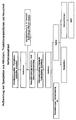
- Fig. 1 is a plant for the digestion of chipboard and wood material residues according to the schematic Invention shown. The process sequence is shown schematically in FIG.
- Wood material remnants are placed on a primary crusher 2 by a wheel loader 1 or a grab excavator or another suitable device.
- the pre-crusher 2 breaks the wood materials into flat pieces with an edge length of on average 10 to 20 cm.
- the pre-broken material is then conveyed into the digestion container 3 via a suitable conveying device 17.
- the digestion container 3 also has the function of an impregnation container. After the digestion container 3 is filled, it is closed airtight. The air contained in the digestion tank 3 and the wood materials is sucked off via a vacuum pump 9 until a vacuum of about 150 to 200 mbar (absolute) has been reached.
- the impregnation solution is now led from the preparation container 4 for impregnation solution via a line 15 into the digestion container 3 until the wood materials are completely covered by the latter.
- Normal pressure is now set again in the digestion tank 3. Overpressure could also be applied to accelerate the penetration of the impregnation solution. Impregnation at normal pressure is also possible.
- the preparation tank 4 for the impregnation solution has an agitator 5 and a supply for chemicals 6 and a feed line for water 7.
- the excess impregnation solution is fed via a line 10 drained from the digestion tank 3 back into the preparation tank 4.
- the digestion container 3 is closed again in a pressure-tight manner and is now heated by means of a heat source 8 via the outer surface or by direct supply of heat by hot air, steam or another gaseous heat transfer medium. For example, a temperature of 110 ° C. is produced for 20 minutes in the digestion tank 3. The heat supply is then stopped and the digestion tank 3 is emptied by a discharge device 16. Instead of a discharge device, the digestion container could also be emptied through an opening in the lower region that extends over the entire width. The digested material is fed into a silo 11 or another suitable storage container. From there it is continuously fed to a screening machine 12.
Landscapes
- Life Sciences & Earth Sciences (AREA)
- Engineering & Computer Science (AREA)
- Manufacturing & Machinery (AREA)
- Wood Science & Technology (AREA)
- Forests & Forestry (AREA)
- Dry Formation Of Fiberboard And The Like (AREA)
- Chemical And Physical Treatments For Wood And The Like (AREA)
- Debarking, Splitting, And Disintegration Of Timber (AREA)
- Processing Of Solid Wastes (AREA)
Claims (24)
- Procédé de récupération de copeaux et de fibres de résidus de matériaux dérivés du bois, de vieux meubles, de résidus de production, de déchets et autres matériaux contenant du bois, collés par des liants urée-formaldéhyde ou d'autres liants hydrolysables ou liants chimiquement solubles, selon lequeldans une première étape on apporte aux pièces à base de bois, une solution d'imprégnation ou d'imbibation,après que les pièces de bois aient absorbé au moins 50 % de leur poids propre en solution d'imprégnation, on évacue le surplus de liquide, eton chauffe les pièces à base de bois ainsi imprégnées, à une température comprise entre 80°C et 120°C, puis le matériau ainsi désagrégé est trié par tamisage et/ou par ventilation.
- Procédé de récupération de copeaux et de fibres de résidus de matériaux dérivés de bois, de vieux meubles, de résidus de production, de déchets et autres matériaux contenant du bois, collés par des liants urée-formaldéhyde ou d'autres liants hydrolysables ou liants chimiquement solubles,
selon lequel on ajoute aux pièces à base de bois une solution d'imprégnation ou d'imbibation en une quantité telle que toute la solution soit reprise par les pièces à base de bois lorsque les pièces ont reçu au moins 50 % de leur poids propre en solution d'imprégnation ou d'imbibation,
et on chauffe les pièces à base de bois, imprégnées, à une température comprise entre 80° C et 120° C et ensuite on trie le matériau ainsi désagrégé par tamisage et/ou par ventilation. - Procédé selon la revendication 1 ou 2,
caractérisé en ce qu'
on imprègne dans une cuve d'imprégnation et on expose les pièces à base de bois imprégnées dans une autre cuve, à savoir la cuve de digestion, à l'action de la température. - Procédé selon la revendication 1 ou 2,
caractérisé en ce que
l'imprégnation et l'action de la température sont effectuées dans la cuve de digestion (3). - Procédé selon la revendication 2,
caractérisé en ce qu'
on effectue simultanément l'imprégnation et l'action de la température. - Procédé selon l'une des revendications précédentes,
caractérisé en ce que
les pièces à base de bois sont plates et ont une longueur d'arête d'au moins 10 à 20 cm. - Procédé selon l'une des revendications 1 à 4 et 6,
caractérisé en ce que
l'imprégnation dure au moins 1 minute. - Procédé selon l'une des revendications 1 à 6,
caractérisé en ce que
l'action de la température dure au moins une minute. - Procédé selon l'une des revendications 1 à 8,
caractérisé en ce que
la cuve d'imprégnation ou de désagrégation (3) est une cuve rotative ou équipée d'un dispositif mélangeur ou d'un agitateur (16) pour mélanger les pièces à base de bois et la solution d'imprégnation. - Procédé selon l'une des revendications 1, 3, 4, 6 à 9,
caractérisé en ce qu'
on ajoute une solution d'imprégnation aux pièces à base de bois pour que l'ensemble des pièces soit recouvert. - Procédé selon la revendication 10,
caractérisé en ce qu'
on effectue le procédé dans une cuve debout. - Procédé selon l'une des revendications précédentes,
caractérisé en ce qu'
on fait régner, dans la cuve de désagrégation (3), une pression allant jusqu'à 2 bars. - Procédé selon l'une des revendications précédentes,
caractérisé en ce que
les pièces à base de bois ont une teneur en solution d'imprégnation de l'ordre de 80 % de leur poids propre et elles sont exposées pendant 20 minutes à une température de 110°C. - Procédé selon l'une des revendications précédentes,
caractérisé en ce que
l'action de la température se fait à la pression normale. - Procédé selon l'une des revendications précédentes,
caractérisé en ce que
l'imprégnation se fait avec une solution d'imprégnation à une pression inférieure à la pression normale ou après un traitement en dépression (mise sous vide) des pièces à base de bois - Procédé selon l'une des revendications précédentes,
caractérisé en ce que
l'imprégnation se fait avec une solution d'imprégnation à une pression supérieure à la pression normale. - Procédé selon l'une des revendications précédentes,
caractérisé en ce que
l'imprégnation se fait avec une solution d'imprégnation en combinant une pression et une dépression. - Procédé selon l'une des revendications précédentes,
caractérisé en ce que
les pièces à base de bois sont chauffées avant d'être imprégnées. - Procédé selon l'une des revendications précédentes,
caractérisé en ce que
la solution d'imprégnation est chauffée au cours et/ou avant l'opération d'imprégnation de préférence à une température allant jusqu'à 80°C. - Procédé selon l'une des revendications précédentes,
caractérisé en ce que
la solution d'imprégnation reçoit des produits chimiques se combinant avec la formaldéhyde, inhibant la formaldéhyde ou détruisant la formaldéhyde comme l'urée, l'ammoniaque ou des produits chimiques dégageant de l'urée ou de l'ammoniaque. - Procédé selon l'une des revendications précédentes,
caractérisé en ce que
la solution d'imprégnation contient des lessives telles que des lessives de sodium, des acides tels que par exemple de l'acide sulfurique, des agents oxydants ou réducteurs, des liants tels que par exemple des résines urée-formaldéhyde, des agents de conservation de liants ou des substances activant les liants, tous ces produits chimiques étant ajoutés avec une concentration globale allant jusqu'à 30 %. - Procédé selon l'une des revendications précédentes,
caractérisé en ce que
pendant la désagrégation on ajoute les produits chimiques dans la cuve de désagrégation (3). - Procédé selon l'une des revendications précédentes,
caractérisé en ce que
pendant la désagrégation on utilise un profil de températures consistant par exemple à passer tout d'abord à des températures élevées puis à des températures basses. - Procédé selon l'une des revendications précédentes,
caractérisé en ce que
les copeaux ou les fibres, récupérés après digestion, sont traités à l'état encore humide, à l'état à peine séché ou à l'état sec, avec des produits chimiques selon les revendications 20 et/ou 21.
Applications Claiming Priority (3)
| Application Number | Priority Date | Filing Date | Title |
|---|---|---|---|
| DE4408788 | 1994-03-15 | ||
| DE4408788 | 1994-03-15 | ||
| PCT/DE1995/000360 WO1995024998A1 (fr) | 1994-03-15 | 1995-03-14 | Procede de recuperation de copeaux et de fibres par desagregation de residus de materiaux derives du bois, de vieux meubles, de residus de production, de dechets et d'autres materiaux contenant des materiaux derives du bois |
Publications (3)
| Publication Number | Publication Date |
|---|---|
| EP0697941A1 EP0697941A1 (fr) | 1996-02-28 |
| EP0697941B1 EP0697941B1 (fr) | 1997-08-27 |
| EP0697941B2 true EP0697941B2 (fr) | 2002-07-17 |
Family
ID=6512857
Family Applications (1)
| Application Number | Title | Priority Date | Filing Date |
|---|---|---|---|
| EP95913030A Expired - Lifetime EP0697941B2 (fr) | 1994-03-15 | 1995-03-14 | Procede de recuperation de copeaux et de fibres par desagregation de residus de materiaux derives du bois, de vieux meubles, de residus de production, de dechets et d'autres materiaux contenant des materiaux derives du bois |
Country Status (11)
| Country | Link |
|---|---|
| US (1) | US5804035A (fr) |
| EP (1) | EP0697941B2 (fr) |
| JP (1) | JP3609414B2 (fr) |
| KR (1) | KR100353308B1 (fr) |
| AT (1) | ATE157298T1 (fr) |
| CA (1) | CA2162894C (fr) |
| DE (2) | DE19509152A1 (fr) |
| DK (1) | DK0697941T4 (fr) |
| ES (1) | ES2107311T5 (fr) |
| GR (1) | GR3025090T3 (fr) |
| WO (1) | WO1995024998A1 (fr) |
Families Citing this family (30)
| Publication number | Priority date | Publication date | Assignee | Title |
|---|---|---|---|---|
| DE19622421A1 (de) * | 1996-06-04 | 1997-12-11 | Fraunhofer Ges Forschung | Verfahren zur Aufbereitung von Altholz |
| DE19619792A1 (de) * | 1996-05-15 | 1997-11-20 | Andreas Mohr | Verfahren zur Wiederverwertung von schutzmittelbehandeltem Altholz |
| AT405038B (de) * | 1996-08-27 | 1999-04-26 | Funder Ind Ges M B H | Verfahren zur aufbereitung von faserplattenabfällen |
| DE19637909A1 (de) * | 1996-09-18 | 1998-03-19 | Infan Ingenieurgesellschaft Fu | Verfahren zur Verwertung von Altholz |
| DE19640503C1 (de) * | 1996-10-01 | 1998-05-20 | Formaplan Holzwerkstoffe Gmbh | Verfahren und Vorrichtung zur Gewinnung von Sekundärspänen und -fasern |
| DE19653067A1 (de) * | 1996-11-25 | 1998-06-04 | Nolte Gmbh & Co Kg Spanplatten | Verfahren zur Wiedergewinnung und Weiterverarbeitung spanförmiger Holzwerkstoffe |
| GB9625068D0 (en) * | 1996-12-02 | 1997-01-22 | Marlit Ltd | Method for production of lignocellulosic composite materials |
| DE19751326C2 (de) * | 1997-11-19 | 2001-01-04 | Pfleiderer Unternehmensverwalt | Verfahren zur Herstellung von Holzwerkstoffen unter Verwertung von Gebraucht-, Rest- und Abfallholzwerkstoffen |
| EP1052021A1 (fr) | 1999-05-06 | 2000-11-15 | von Deym, Carl-Ludwig, Graf | Procédé pour trier/séparer et installation de recyclage de matière plastique |
| GB9913074D0 (en) * | 1999-06-04 | 1999-08-04 | Adhesives Research Insitute Lt | Method for extracting and recycling waste contaminated wood |
| DE19945466B4 (de) * | 1999-09-22 | 2004-09-23 | Pfleiderer Ag | Vorrichtung und Verfahren zum Aufschluss von Holzwerkstoffen |
| GB9928554D0 (en) * | 1999-12-02 | 2000-02-02 | Enigma Nv | Production of high added value products from wastes |
| AUPR245101A0 (en) * | 2001-01-10 | 2001-02-01 | Silverbrook Research Pty Ltd | A method (WSM04) |
| DE10124717A1 (de) | 2001-05-19 | 2002-11-21 | Rolf Hesch | Verfahren und Vorrichtung zur Zerlegung von Altstoffen in wiederverwendbare Bestandteile, insbesondere zum Recycling von Holzwerkstoffen, Altmöbeln, Kfz-Verbundwerkstoffen und ähnlichen Produkten |
| DE10144793A1 (de) * | 2001-09-12 | 2003-03-27 | Fraunhofer Ges Forschung | Verfahren zur Wiedergewinnung von Spänen und Fasern aus Holzwerkstoffreststücken |
| DE10216954B4 (de) * | 2002-04-17 | 2004-10-07 | Fraunhofer-Gesellschaft zur Förderung der angewandten Forschung e.V. | Verfahren zur Wiedergewinnung von Spänen und Fasern aus Holzwerkstoffreststücken und Anlage zur Weiterbehandlung der durch Aufschluss erzielten Späne |
| WO2005007968A1 (fr) * | 2003-07-16 | 2005-01-27 | Fira International Limited | Recyclage de planches a base de lignocellulose |
| JP4592589B2 (ja) * | 2003-09-26 | 2010-12-01 | ヘキソン スペシャルティ ケミカルズ インコーポレーテッド | 徐放性硬化系 |
| US20110060077A1 (en) * | 2009-09-10 | 2011-03-10 | Yeng-Fong Shih | Process for Manufacturing High-Performance Natural Fiber Reinforced Composites |
| ES2925987T3 (es) * | 2019-03-26 | 2022-10-20 | Flooring Technologies Ltd | Producto reciclable de material derivado de la madera, en particular un laminado decorativo reciclable a base de material derivado de la madera |
| IT201900014682A1 (it) | 2019-08-12 | 2021-02-12 | Fantoni Arredamenti Spa | Pannello in fibra di legno e relativo impianto e metodo di realizzazione |
| CN114599491A (zh) * | 2019-10-17 | 2022-06-07 | 科思创(荷兰)有限公司 | 实现面板回收的方法 |
| RU2735099C1 (ru) * | 2019-12-23 | 2020-10-28 | федеральное государственное бюджетное образовательное учреждение высшего образования "Казанский национальный исследовательский технологический университет" (ФГБОУ ВО "КНИТУ") | Способ утилизации железнодорожных древесных шпал |
| BE1028121B1 (nl) | 2020-03-03 | 2021-10-06 | Unilin | Proces voor de productie van spaanplaat of houtvezelplaat |
| AT524158B1 (de) * | 2020-09-09 | 2023-01-15 | Andritz Ag Maschf | Verfahren zur wiederverwendung von fasern aus beschichteten mdf-platten |
| FR3120206A1 (fr) * | 2021-03-01 | 2022-09-02 | Sas Woodoo | Procede de fabrication d’un materiau composite ligno-cellulosique et materiau composite obtenu par ce procede |
| EP4395945A1 (fr) | 2021-08-31 | 2024-07-10 | Unilin, BV | Procédé de production de panneaux de fibres de bois |
| BE1029722B1 (nl) | 2021-08-31 | 2023-03-28 | Flooring Ind Ltd Sarl | Proces voor de productie van houtvezelplaat |
| AT527339A1 (de) | 2023-07-11 | 2025-01-15 | Mondi Ag | Verfahren zur Herstellung von Papier aus Abfallholz sowie daraus hergestelltes Papier |
| DE102023123348B3 (de) * | 2023-08-30 | 2024-12-24 | Institut Für Holztechnologie Dresden Gemeinnützige Gmbh | Verfahren zur Herstellung von Faserstoff aus zerkleinertem Holz und Anordnung zur Umsetzung des Verfahrens zur Herstellung von Faserstoff aus zerkleinertem Holz |
Family Cites Families (3)
| Publication number | Priority date | Publication date | Assignee | Title |
|---|---|---|---|---|
| DE1201045B (de) * | 1962-04-09 | 1965-09-16 | Alf Goeran Sandberg | Verfahren zur Wiedergewinnung von Span-material aus mit ausgehaerteten Bindemitteln durchsetzten Abfaellen, Saegespaenen, Mull usw., zur Herstellung von Spanplatten und aehnlichen geleimten oder gepressten Erzeugnissen |
| DE4222178C2 (de) * | 1992-07-06 | 1994-12-15 | Werzalit Ag & Co | Vorrichtung zur Vorbehandlung von lignozellulosehaltigen Spänen |
| DE4244918C2 (de) * | 1992-07-25 | 1997-05-22 | Pfleiderer Fa G A | Verfahren zum Recycling von Holzwerkstoffen |
-
1995
- 1995-03-14 DE DE19509152A patent/DE19509152A1/de not_active Withdrawn
- 1995-03-14 WO PCT/DE1995/000360 patent/WO1995024998A1/fr not_active Ceased
- 1995-03-14 DE DE59500559T patent/DE59500559D1/de not_active Expired - Lifetime
- 1995-03-14 US US08/553,245 patent/US5804035A/en not_active Expired - Fee Related
- 1995-03-14 DK DK95913030T patent/DK0697941T4/da active
- 1995-03-14 JP JP52378295A patent/JP3609414B2/ja not_active Expired - Fee Related
- 1995-03-14 CA CA002162894A patent/CA2162894C/fr not_active Expired - Fee Related
- 1995-03-14 ES ES95913030T patent/ES2107311T5/es not_active Expired - Lifetime
- 1995-03-14 KR KR1019950705107A patent/KR100353308B1/ko not_active Expired - Fee Related
- 1995-03-14 EP EP95913030A patent/EP0697941B2/fr not_active Expired - Lifetime
- 1995-03-14 AT AT95913030T patent/ATE157298T1/de active
-
1997
- 1997-10-20 GR GR970402731T patent/GR3025090T3/el unknown
Also Published As
| Publication number | Publication date |
|---|---|
| DE19509152A1 (de) | 1995-10-26 |
| EP0697941A1 (fr) | 1996-02-28 |
| ATE157298T1 (de) | 1997-09-15 |
| CA2162894C (fr) | 2003-12-09 |
| JPH08510419A (ja) | 1996-11-05 |
| ES2107311T3 (es) | 1997-11-16 |
| GR3025090T3 (en) | 1998-01-30 |
| DK0697941T3 (da) | 1998-04-20 |
| DK0697941T4 (da) | 2002-11-04 |
| EP0697941B1 (fr) | 1997-08-27 |
| ES2107311T5 (es) | 2003-02-16 |
| KR100353308B1 (ko) | 2002-12-28 |
| WO1995024998A1 (fr) | 1995-09-21 |
| KR960702376A (ko) | 1996-04-27 |
| JP3609414B2 (ja) | 2005-01-12 |
| CA2162894A1 (fr) | 1995-09-21 |
| DE59500559D1 (de) | 1997-10-02 |
| US5804035A (en) | 1998-09-08 |
Similar Documents
| Publication | Publication Date | Title |
|---|---|---|
| EP0697941B2 (fr) | Procede de recuperation de copeaux et de fibres par desagregation de residus de materiaux derives du bois, de vieux meubles, de residus de production, de dechets et d'autres materiaux contenant des materiaux derives du bois | |
| DE60009165T2 (de) | Herstellung von hochwertigen produkten aus abfällen | |
| DE69034003T2 (de) | Wärmehärtbares Harz und Verbundstoff aus Lignozellulosematerial | |
| DE2026093C3 (fr) | ||
| EP0565109B1 (fr) | Procédé pour coller des fragments de bois | |
| DE69711424T2 (de) | Verfahren zur verwendung von lignocellulose-verbundwerkstoffen | |
| DE69904182T2 (de) | Verfahrensvorrichtung und anlage zum zurückgewinnen von holzfasern aus zusammengepresstem faserplatten-abfall | |
| DE69710748T2 (de) | Behandlung von lignocellulosematerialien | |
| EP2974841B1 (fr) | Procede de fabrication d'un panneau de fibres | |
| EP3453504B1 (fr) | Procédé de fabrication de panneaux de lamelles orientées osb à faible émission sur des composés organiques volatils (cov) | |
| EP0381965B1 (fr) | Procédé et dispositif pour fabriquer une matière fibreuse contenant de la ligno-cellulose pour la fabrication de plaques en fibres selon un procédé à sec | |
| EP3059056A1 (fr) | Procédé de fabrication de fibres de bois et panneaux en fibres de bois | |
| EP4122662A1 (fr) | Procédé de fabrication de panneau fibreux à émission réduite de cov | |
| CH642907A5 (de) | Verfahren zur herstellung einer holzspanplatte sowie die hergestellte holzspanplatte. | |
| DE102007054123B4 (de) | Verfahren zur Herstellung von Holzfaserplatten mit verringerter Formaldehydemission, hoher Feuchtebeständigkeit und Hydrolyseresistenz der Verleimung | |
| EP0613906B1 (fr) | Article moulé, en particulier en forme de panneau de fibres | |
| DE831322C (de) | Verfahren zur Herstellung von Faserplatten und Formkoerpern aus Lignocellulose | |
| DE4306439C1 (de) | Formkörper, insbesondere in Form einer Faserplatte, und Verfahren zu seiner Herstellung | |
| DE4305411A1 (de) | Verfahren zum Verkleben von Holzfragmenten und nach dem Verfahren hergestellte Formkörper | |
| DE2744425C2 (de) | Trockenverfahren zur Herstellung von Faserformkörpern aus gegenüber Stammholzmaterial unterschiedlichem pflanzlichem lignocellulosehaltigem Material, sowie Einrichtung zur Durchführung dieses Verfahren | |
| DE10144793A1 (de) | Verfahren zur Wiedergewinnung von Spänen und Fasern aus Holzwerkstoffreststücken | |
| DE4340518C2 (de) | Formkörper auf der Basis von Holz- und/oder Cellulosefasern | |
| DE19653067A1 (de) | Verfahren zur Wiedergewinnung und Weiterverarbeitung spanförmiger Holzwerkstoffe | |
| EP0067426A1 (fr) | Fabrication de planches de construction par utilisation de liant isocyanate-aldéhyde | |
| DE1234381B (de) | Verfahren und Pressbleche fuer die Herstellung von Faserplatten oder Presslingen auslignozelluloschaltigen Materialien |
Legal Events
| Date | Code | Title | Description |
|---|---|---|---|
| PUAI | Public reference made under article 153(3) epc to a published international application that has entered the european phase |
Free format text: ORIGINAL CODE: 0009012 |
|
| 17P | Request for examination filed |
Effective date: 19951129 |
|
| AK | Designated contracting states |
Kind code of ref document: A1 Designated state(s): AT BE CH DE DK ES FR GB GR IE IT LI LU MC NL PT SE |
|
| GRAG | Despatch of communication of intention to grant |
Free format text: ORIGINAL CODE: EPIDOS AGRA |
|
| GRAH | Despatch of communication of intention to grant a patent |
Free format text: ORIGINAL CODE: EPIDOS IGRA |
|
| GRAH | Despatch of communication of intention to grant a patent |
Free format text: ORIGINAL CODE: EPIDOS IGRA |
|
| 17Q | First examination report despatched |
Effective date: 19970204 |
|
| GRAA | (expected) grant |
Free format text: ORIGINAL CODE: 0009210 |
|
| AK | Designated contracting states |
Kind code of ref document: B1 Designated state(s): AT BE CH DE DK ES FR GB GR IE IT LI LU MC NL PT SE |
|
| PG25 | Lapsed in a contracting state [announced via postgrant information from national office to epo] |
Ref country code: IE Free format text: LAPSE BECAUSE OF NON-PAYMENT OF DUE FEES Effective date: 19970827 |
|
| REF | Corresponds to: |
Ref document number: 157298 Country of ref document: AT Date of ref document: 19970915 Kind code of ref document: T |
|
| REG | Reference to a national code |
Ref country code: CH Ref legal event code: NV Representative=s name: SCHMAUDER & WANN PATENTANWALTSBUERO, INHABER KLAUS Ref country code: CH Ref legal event code: EP |
|
| ET | Fr: translation filed | ||
| GBT | Gb: translation of ep patent filed (gb section 77(6)(a)/1977) |
Effective date: 19970901 |
|
| REF | Corresponds to: |
Ref document number: 59500559 Country of ref document: DE Date of ref document: 19971002 |
|
| REG | Reference to a national code |
Ref country code: ES Ref legal event code: FG2A Ref document number: 2107311 Country of ref document: ES Kind code of ref document: T3 |
|
| ITF | It: translation for a ep patent filed | ||
| REG | Reference to a national code |
Ref country code: GR Ref legal event code: FG4A Free format text: 3025090 |
|
| REG | Reference to a national code |
Ref country code: PT Ref legal event code: SC4A Free format text: AVAILABILITY OF NATIONAL TRANSLATION Effective date: 19971110 |
|
| REG | Reference to a national code |
Ref country code: DK Ref legal event code: T3 |
|
| PLBQ | Unpublished change to opponent data |
Free format text: ORIGINAL CODE: EPIDOS OPPO |
|
| PLBI | Opposition filed |
Free format text: ORIGINAL CODE: 0009260 |
|
| PLBF | Reply of patent proprietor to notice(s) of opposition |
Free format text: ORIGINAL CODE: EPIDOS OBSO |
|
| 26 | Opposition filed |
Opponent name: PFLEIDERER UNTERNEHMENSVERWALTUNG GMBH & CO. KG Effective date: 19980513 |
|
| NLR1 | Nl: opposition has been filed with the epo |
Opponent name: PFLEIDERER UNTERNEHMENSVERWALTUNG GMBH & CO. KG |
|
| PLBF | Reply of patent proprietor to notice(s) of opposition |
Free format text: ORIGINAL CODE: EPIDOS OBSO |
|
| PLAW | Interlocutory decision in opposition |
Free format text: ORIGINAL CODE: EPIDOS IDOP |
|
| APAC | Appeal dossier modified |
Free format text: ORIGINAL CODE: EPIDOS NOAPO |
|
| APAE | Appeal reference modified |
Free format text: ORIGINAL CODE: EPIDOS REFNO |
|
| APAE | Appeal reference modified |
Free format text: ORIGINAL CODE: EPIDOS REFNO |
|
| APAC | Appeal dossier modified |
Free format text: ORIGINAL CODE: EPIDOS NOAPO |
|
| APAC | Appeal dossier modified |
Free format text: ORIGINAL CODE: EPIDOS NOAPO |
|
| PLAW | Interlocutory decision in opposition |
Free format text: ORIGINAL CODE: EPIDOS IDOP |
|
| REG | Reference to a national code |
Ref country code: GB Ref legal event code: IF02 |
|
| PUAH | Patent maintained in amended form |
Free format text: ORIGINAL CODE: 0009272 |
|
| STAA | Information on the status of an ep patent application or granted ep patent |
Free format text: STATUS: PATENT MAINTAINED AS AMENDED |
|
| 27A | Patent maintained in amended form |
Effective date: 20020717 |
|
| AK | Designated contracting states |
Kind code of ref document: B2 Designated state(s): AT BE CH DE DK ES FR GB GR IE IT LI LU MC NL PT SE |
|
| REG | Reference to a national code |
Ref country code: CH Ref legal event code: AEN Free format text: AUFRECHTERHALTUNG DES PATENTES IN GEAENDERTER FORM |
|
| NLR2 | Nl: decision of opposition | ||
| GBTA | Gb: translation of amended ep patent filed (gb section 77(6)(b)/1977) | ||
| NLR3 | Nl: receipt of modified translations in the netherlands language after an opposition procedure | ||
| REG | Reference to a national code |
Ref country code: GR Ref legal event code: EP Ref document number: 20020403365 Country of ref document: GR |
|
| ET3 | Fr: translation filed ** decision concerning opposition | ||
| REG | Reference to a national code |
Ref country code: ES Ref legal event code: DC2A Date of ref document: 20021015 Kind code of ref document: T5 |
|
| REG | Reference to a national code |
Ref country code: CH Ref legal event code: PFA Owner name: FRAUNHOFER-GESELLSCHAFT ZUR FOERDERUNG DER ANGEWA Free format text: FRAUNHOFER-GESELLSCHAFT ZUR FOERDERUNG DER ANGEWANDTEN FORSCHUNG E.V.#LEONRODSTRASSE 54#80636 MUENCHEN (DE) -TRANSFER TO- FRAUNHOFER-GESELLSCHAFT ZUR FOERDERUNG DER ANGEWANDTEN FORSCHUNG E.V.#HANSASTRASSE 27 C#80686 MUENCHEN (DE) |
|
| APAH | Appeal reference modified |
Free format text: ORIGINAL CODE: EPIDOSCREFNO |
|
| PLAB | Opposition data, opponent's data or that of the opponent's representative modified |
Free format text: ORIGINAL CODE: 0009299OPPO |
|
| PGFP | Annual fee paid to national office [announced via postgrant information from national office to epo] |
Ref country code: DK Payment date: 20090321 Year of fee payment: 15 |
|
| PGFP | Annual fee paid to national office [announced via postgrant information from national office to epo] |
Ref country code: NL Payment date: 20090324 Year of fee payment: 15 |
|
| PGFP | Annual fee paid to national office [announced via postgrant information from national office to epo] |
Ref country code: GR Payment date: 20090320 Year of fee payment: 15 Ref country code: CH Payment date: 20090325 Year of fee payment: 15 |
|
| PGFP | Annual fee paid to national office [announced via postgrant information from national office to epo] |
Ref country code: SE Payment date: 20090325 Year of fee payment: 15 |
|
| PGFP | Annual fee paid to national office [announced via postgrant information from national office to epo] |
Ref country code: MC Payment date: 20090320 Year of fee payment: 15 |
|
| REG | Reference to a national code |
Ref country code: NL Ref legal event code: V1 Effective date: 20101001 |
|
| PG25 | Lapsed in a contracting state [announced via postgrant information from national office to epo] |
Ref country code: MC Free format text: LAPSE BECAUSE OF NON-PAYMENT OF DUE FEES Effective date: 20100331 |
|
| REG | Reference to a national code |
Ref country code: CH Ref legal event code: PL |
|
| EUG | Se: european patent has lapsed | ||
| REG | Reference to a national code |
Ref country code: DK Ref legal event code: EBP |
|
| PG25 | Lapsed in a contracting state [announced via postgrant information from national office to epo] |
Ref country code: NL Free format text: LAPSE BECAUSE OF NON-PAYMENT OF DUE FEES Effective date: 20101001 |
|
| PG25 | Lapsed in a contracting state [announced via postgrant information from national office to epo] |
Ref country code: LI Free format text: LAPSE BECAUSE OF NON-PAYMENT OF DUE FEES Effective date: 20100331 Ref country code: CH Free format text: LAPSE BECAUSE OF NON-PAYMENT OF DUE FEES Effective date: 20100331 |
|
| PG25 | Lapsed in a contracting state [announced via postgrant information from national office to epo] |
Ref country code: GR Free format text: LAPSE BECAUSE OF NON-PAYMENT OF DUE FEES Effective date: 20101004 |
|
| PG25 | Lapsed in a contracting state [announced via postgrant information from national office to epo] |
Ref country code: DK Free format text: LAPSE BECAUSE OF NON-PAYMENT OF DUE FEES Effective date: 20100331 |
|
| PGFP | Annual fee paid to national office [announced via postgrant information from national office to epo] |
Ref country code: LU Payment date: 20120327 Year of fee payment: 18 Ref country code: FR Payment date: 20120403 Year of fee payment: 18 |
|
| PGFP | Annual fee paid to national office [announced via postgrant information from national office to epo] |
Ref country code: PT Payment date: 20120302 Year of fee payment: 18 |
|
| PGFP | Annual fee paid to national office [announced via postgrant information from national office to epo] |
Ref country code: BE Payment date: 20120323 Year of fee payment: 18 Ref country code: IT Payment date: 20120324 Year of fee payment: 18 Ref country code: GB Payment date: 20120322 Year of fee payment: 18 |
|
| PGFP | Annual fee paid to national office [announced via postgrant information from national office to epo] |
Ref country code: DE Payment date: 20120522 Year of fee payment: 18 |
|
| PG25 | Lapsed in a contracting state [announced via postgrant information from national office to epo] |
Ref country code: SE Free format text: LAPSE BECAUSE OF NON-PAYMENT OF DUE FEES Effective date: 20100315 |
|
| PGFP | Annual fee paid to national office [announced via postgrant information from national office to epo] |
Ref country code: AT Payment date: 20120321 Year of fee payment: 18 |
|
| PGFP | Annual fee paid to national office [announced via postgrant information from national office to epo] |
Ref country code: ES Payment date: 20120326 Year of fee payment: 18 |
|
| REG | Reference to a national code |
Ref country code: PT Ref legal event code: MM4A Free format text: LAPSE DUE TO NON-PAYMENT OF FEES Effective date: 20130916 |
|
| BERE | Be: lapsed |
Owner name: *FRAUNHOFER-GESELLSCHAFT ZUR FORDERUNG DER ANGEWAN Effective date: 20130331 |
|
| PG25 | Lapsed in a contracting state [announced via postgrant information from national office to epo] |
Ref country code: PT Free format text: LAPSE BECAUSE OF NON-PAYMENT OF DUE FEES Effective date: 20130916 |
|
| REG | Reference to a national code |
Ref country code: AT Ref legal event code: MM01 Ref document number: 157298 Country of ref document: AT Kind code of ref document: T Effective date: 20130314 |
|
| GBPC | Gb: european patent ceased through non-payment of renewal fee |
Effective date: 20130314 |
|
| REG | Reference to a national code |
Ref country code: FR Ref legal event code: ST Effective date: 20131129 |
|
| PG25 | Lapsed in a contracting state [announced via postgrant information from national office to epo] |
Ref country code: FR Free format text: LAPSE BECAUSE OF NON-PAYMENT OF DUE FEES Effective date: 20130402 Ref country code: AT Free format text: LAPSE BECAUSE OF NON-PAYMENT OF DUE FEES Effective date: 20130314 Ref country code: DE Free format text: LAPSE BECAUSE OF NON-PAYMENT OF DUE FEES Effective date: 20131001 Ref country code: GB Free format text: LAPSE BECAUSE OF NON-PAYMENT OF DUE FEES Effective date: 20130314 Ref country code: BE Free format text: LAPSE BECAUSE OF NON-PAYMENT OF DUE FEES Effective date: 20130331 |
|
| REG | Reference to a national code |
Ref country code: DE Ref legal event code: R119 Ref document number: 59500559 Country of ref document: DE Effective date: 20131001 |
|
| PG25 | Lapsed in a contracting state [announced via postgrant information from national office to epo] |
Ref country code: IT Free format text: LAPSE BECAUSE OF NON-PAYMENT OF DUE FEES Effective date: 20130314 |
|
| REG | Reference to a national code |
Ref country code: ES Ref legal event code: FD2A Effective date: 20140609 |
|
| PG25 | Lapsed in a contracting state [announced via postgrant information from national office to epo] |
Ref country code: ES Free format text: LAPSE BECAUSE OF NON-PAYMENT OF DUE FEES Effective date: 20130315 |
|
| PG25 | Lapsed in a contracting state [announced via postgrant information from national office to epo] |
Ref country code: LU Free format text: LAPSE BECAUSE OF NON-PAYMENT OF DUE FEES Effective date: 20130314 |