EP0698662A2 - Appareil et méthode pour la production de gomme de xanthane - Google Patents
Appareil et méthode pour la production de gomme de xanthane Download PDFInfo
- Publication number
- EP0698662A2 EP0698662A2 EP95305221A EP95305221A EP0698662A2 EP 0698662 A2 EP0698662 A2 EP 0698662A2 EP 95305221 A EP95305221 A EP 95305221A EP 95305221 A EP95305221 A EP 95305221A EP 0698662 A2 EP0698662 A2 EP 0698662A2
- Authority
- EP
- European Patent Office
- Prior art keywords
- shaft
- pair
- arms
- impeller
- polysaccharide
- Prior art date
- Legal status (The legal status is an assumption and is not a legal conclusion. Google has not performed a legal analysis and makes no representation as to the accuracy of the status listed.)
- Granted
Links
Images






Classifications
-
- C—CHEMISTRY; METALLURGY
- C12—BIOCHEMISTRY; BEER; SPIRITS; WINE; VINEGAR; MICROBIOLOGY; ENZYMOLOGY; MUTATION OR GENETIC ENGINEERING
- C12M—APPARATUS FOR ENZYMOLOGY OR MICROBIOLOGY; APPARATUS FOR CULTURING MICROORGANISMS FOR PRODUCING BIOMASS, FOR GROWING CELLS OR FOR OBTAINING FERMENTATION OR METABOLIC PRODUCTS, i.e. BIOREACTORS OR FERMENTERS
- C12M27/00—Means for mixing, agitating or circulating fluids in the vessel
- C12M27/02—Stirrer or mobile mixing elements
- C12M27/08—Stirrer or mobile mixing elements with different stirrer shapes in one shaft or axis
-
- B—PERFORMING OPERATIONS; TRANSPORTING
- B01—PHYSICAL OR CHEMICAL PROCESSES OR APPARATUS IN GENERAL
- B01F—MIXING, e.g. DISSOLVING, EMULSIFYING OR DISPERSING
- B01F27/00—Mixers with rotary stirring devices in fixed receptacles; Kneaders
- B01F27/05—Stirrers
- B01F27/11—Stirrers characterised by the configuration of the stirrers
- B01F27/111—Centrifugal stirrers, i.e. stirrers with radial outlets; Stirrers of the turbine type, e.g. with means to guide the flow
-
- B—PERFORMING OPERATIONS; TRANSPORTING
- B01—PHYSICAL OR CHEMICAL PROCESSES OR APPARATUS IN GENERAL
- B01F—MIXING, e.g. DISSOLVING, EMULSIFYING OR DISPERSING
- B01F27/00—Mixers with rotary stirring devices in fixed receptacles; Kneaders
- B01F27/05—Stirrers
- B01F27/11—Stirrers characterised by the configuration of the stirrers
- B01F27/112—Stirrers characterised by the configuration of the stirrers with arms, paddles, vanes or blades
- B01F27/1124—Stirrers characterised by the configuration of the stirrers with arms, paddles, vanes or blades rake-shaped or grid-shaped
-
- B—PERFORMING OPERATIONS; TRANSPORTING
- B01—PHYSICAL OR CHEMICAL PROCESSES OR APPARATUS IN GENERAL
- B01F—MIXING, e.g. DISSOLVING, EMULSIFYING OR DISPERSING
- B01F27/00—Mixers with rotary stirring devices in fixed receptacles; Kneaders
- B01F27/05—Stirrers
- B01F27/11—Stirrers characterised by the configuration of the stirrers
- B01F27/113—Propeller-shaped stirrers for producing an axial flow, e.g. shaped like a ship or aircraft propeller
-
- B—PERFORMING OPERATIONS; TRANSPORTING
- B01—PHYSICAL OR CHEMICAL PROCESSES OR APPARATUS IN GENERAL
- B01F—MIXING, e.g. DISSOLVING, EMULSIFYING OR DISPERSING
- B01F27/00—Mixers with rotary stirring devices in fixed receptacles; Kneaders
- B01F27/05—Stirrers
- B01F27/11—Stirrers characterised by the configuration of the stirrers
- B01F27/19—Stirrers with two or more mixing elements mounted in sequence on the same axis
- B01F27/191—Stirrers with two or more mixing elements mounted in sequence on the same axis with similar elements
-
- B—PERFORMING OPERATIONS; TRANSPORTING
- B01—PHYSICAL OR CHEMICAL PROCESSES OR APPARATUS IN GENERAL
- B01F—MIXING, e.g. DISSOLVING, EMULSIFYING OR DISPERSING
- B01F27/00—Mixers with rotary stirring devices in fixed receptacles; Kneaders
- B01F27/05—Stirrers
- B01F27/11—Stirrers characterised by the configuration of the stirrers
- B01F27/19—Stirrers with two or more mixing elements mounted in sequence on the same axis
- B01F27/192—Stirrers with two or more mixing elements mounted in sequence on the same axis with dissimilar elements
-
- B—PERFORMING OPERATIONS; TRANSPORTING
- B01—PHYSICAL OR CHEMICAL PROCESSES OR APPARATUS IN GENERAL
- B01F—MIXING, e.g. DISSOLVING, EMULSIFYING OR DISPERSING
- B01F27/00—Mixers with rotary stirring devices in fixed receptacles; Kneaders
- B01F27/21—Mixers with rotary stirring devices in fixed receptacles; Kneaders characterised by their rotating shafts
- B01F27/2121—Mixers with rotary stirring devices in fixed receptacles; Kneaders characterised by their rotating shafts composed of interconnected parts
-
- C—CHEMISTRY; METALLURGY
- C12—BIOCHEMISTRY; BEER; SPIRITS; WINE; VINEGAR; MICROBIOLOGY; ENZYMOLOGY; MUTATION OR GENETIC ENGINEERING
- C12P—FERMENTATION OR ENZYME-USING PROCESSES TO SYNTHESISE A DESIRED CHEMICAL COMPOUND OR COMPOSITION OR TO SEPARATE OPTICAL ISOMERS FROM A RACEMIC MIXTURE
- C12P19/00—Preparation of compounds containing saccharide radicals
- C12P19/04—Polysaccharides, i.e. compounds containing more than five saccharide radicals attached to each other by glycosidic bonds
- C12P19/06—Xanthan, i.e. Xanthomonas-type heteropolysaccharides
-
- C—CHEMISTRY; METALLURGY
- C12—BIOCHEMISTRY; BEER; SPIRITS; WINE; VINEGAR; MICROBIOLOGY; ENZYMOLOGY; MUTATION OR GENETIC ENGINEERING
- C12P—FERMENTATION OR ENZYME-USING PROCESSES TO SYNTHESISE A DESIRED CHEMICAL COMPOUND OR COMPOSITION OR TO SEPARATE OPTICAL ISOMERS FROM A RACEMIC MIXTURE
- C12P19/00—Preparation of compounds containing saccharide radicals
- C12P19/04—Polysaccharides, i.e. compounds containing more than five saccharide radicals attached to each other by glycosidic bonds
- C12P19/10—Pullulan
Definitions
- This invention relates to apparatus and method for the production of polymers.
- the invention relates to apparatus and a method for the production of polysaccharides from microorganisms using aerobic fermentation methods.
- Polysaccharides produced by microorganisms are generally known as exopolysaccharides and methods for their production, including the parameters for the aerobic fermentation, are known. Typical of these polysaccharides are chitosan, dextran, xanthan gum, gellan gum, welan gum, rhamsan gum, pullulan, curdlan, schizophyllan, scleroglucan, levan, and sphingan. See U. S. Patent No. 5,315,003, and U. S. Patent Application Serial No. 08/377,440. Perhaps the best known of these polysaccharides is xanthan gum. For the purposes of the invention described herein, the description will be provided in terms of the production of xanthan gum and pullulan. However, the invention is equally applicable to other polysaccharides which behave similarly to xanthan gum as described below during their production.
- the product i.e., xanthan gum
- the aqueous culture medium i.e., broth
- the viscosity of the broth increases with the increased formation of xanthan gum.
- good oxygenation of the broth in the fermenter is required to promote growth of the microorganisms. Since this increase in viscosity diminishes the agitating effect and worsens mass transfer within the fermentation chamber, the productivity of xanthan gum is reduced in the later stage of the fermentation. It is desirable to increase the mass transfer as well as the oxygenation as required in the various stages of the process to enhance the productivity and yield of product.
- Xanthan gum can be obtained by subjecting an appropriate microorganism, e.g., Xanthomonas campestris , which is a xanthan gum-producing bacterium of the genus Xanthomonas , to aerobic fermentation in the presence of appropriate nutrients.
- the xanthan gum product is dissolved in the broth, the broth is then mixed with isopropanol or another non-solvent for xanthan to cause its precipitation from the broth and the precipitated gum is recovered.
- Xanthan gum and its method of production are described in U.S. Patent No. 3,659,026, column 4.
- xanthan gum-containing fermented solutions can also be prepared by using, in place of Xanthomonas campestris , other Xanthomonas bacteria known to be productive of xanthan gum, such as, Xanthomonas carotate , Xanthomonas incanae , Xanthomonas begoniae , Xanthomonas papavericola , Xanthomonas translucens , Xanthomonas vasculorum and Xanthomonas hederae .
- other Xanthomonas bacteria known to be productive of xanthan gum, such as, Xanthomonas carotate , Xanthomonas incanae , Xanthomonas begoniae , Xanthomonas papavericola , Xanthomonas translucens , Xanthomonas vasculorum and Xanthom
- turbine-impellers produce only a radial flow of the fermented solution within the fermenter and fail to create a satisfactory mixed state within the fermenter.
- Pullulan is a water-soluble polysaccharide that is produced in a culture solution in the process of cultivating a black yeast called Aureobasidium pullulans , a kind of imperfect microorganism, in an aqueous culture medium combining a carbon source, such as, monosaccharides, starch breakdown products and the like with an appropriate nitrogen source.
- Pullulan has the chemical structure of a linear polymer wherein units of a maltotriose, a glucose trirner having an ⁇ -1,4 bond, are repeatedly bonded to each other with an ⁇ -1,6 bond.
- pullulan products having a molecular weight of approximately 80,000 ⁇ 300,000 having been manufactured and sold in an large scale and have found a wide application in the food and chemical industries because they are excellent in the characteristics, such as water-solubility, adhesiveness, film-making property and the like.
- the chemical fields have also used the pullulan products as the standard substance to determine the molecular weight of water-soluble macromolecules.
- pullulan In pullulan fermentation, the product, i.e., pullulan, is soluble in the aqueous culture medium so that the viscosity of the fermented solution increases with the increased formation of pullulan. Since this increase in viscosity diminishes the agitating effect and worsens mass transfer within the fermentation chamber, the productivity of pullulan is reduced in the later stage of the fermentation. This disposition is particularly significant in the fermentation of pullulan having the molecular weight of more than 2,000,000.
- the macromolecular pullulan-producing microorganisms are all bacteria of the Aureobasidium pullulans species including variants similar to this species.
- Aureobasidium pullulans that has been deposited in the numbers of IFO6353 and IFO4464 at the Fermentation Research Foundation or in the numbers of ATCC9348, ATCC74100, ATCC74101, ATCC74102, ATCC74103, ATCC74104, ATCC74105, and the like, including their variants, can suitably be used in the practice of the present invention.
- ATCC74100, ATCC74101, ATCC74102, ATCC74103, ATCC74104 and ATCC74105 are particularly suitable as the strains capable of producing macromolecular pullulan having the molecular weight of more than 2,000,000 (as described in U. S. Patent No. 5,268,460).
- the culture medium used can contain any ingredients, such as, nitrogen and carbon sources that are usually used in the macromolecular pullulan production and, in the described case, xanthan gum fermentation.
- agitating elements such as, marine propellers, helical propellers and pitched-blade impellers, have also been investigated. It is reported that they can produce a vertical flow owing to their inclined blades (Applied Biochemistry and Biotechnology, Vol.28/29, p.667 et seq., 1991; Biotechnology and Bioengineering, Vol.34, pp. 1393-1397, 1989; Chemical Engineering Progress, 1990). However, it is also reported that the combined use of a turbine impeller and any of these agitating elements is disadvantageous from the viewpoint of power consumption (Process Biochemistry, Vol.27, pp.351-365, 15 1992).
- an agitator component which is a helical impeller comprising:
- an agitator for the production of polysaccharides which comprises:
- an apparatus for the production of a polysaccharide using aerobic fermentation of a microorganism comprising:
- the present invention provides a method for the production of a polysaccharide gum by using the above-described apparatus, the method comprising the steps of subjecting a culture broth containing a microorganism which produces the desired polysaccharide to aerobic fermentation conditions in the presence of appropriate nutrients so as to cause the microorganism to produce the polysaccharide in the above described apparatus while mechanically agitating and aerating the broth by rotation of the inventive agitator.
- An important advantage of the present invention is that the culture broth within the fermenter is agitated by the combined use of a helical impeller and a turbine impeller, thus making it possible to produce xanthan gum by fermentation without causing a reduction in the production rate even in the late stage of the fermentation.
- the radial angle defined between the first and second pair of arms is at least 20 degrees.
- the ratio of the diameter of the helical impeller to the tank diameter of the fermenter is not less than 0.5.
- diameter when used in reference to the helical impeller means the diameter of a circle defined by the outermost ends of the arms of the helical impeller when rotated about the shaft.
- diameter when used in reference to the fermenter assumes that the fermenter is cylindrical in shape.
- the ratio of the diameter of the turbine impeller to the tank diameter of the fermenter is not less than 0.3.
- diameter when used in reference to the turbine impeller, means the diameter of a circle defined by the outermost ends of the arms of the turbine impeller when rotated about the shaft.
- the helical impeller used in the present invention is preferably constructed in such a way that it comprises a pair of cylindrical arms positioned perpendicularly to the agitator shaft and a plurality of rod-like shearing paddles bridging and secured to these arms; the upper and lower arms have an angle of twist so as to define a radial angle of not less than 20 degrees when viewed from above.
- the inventive agitator comprising the helical impeller and the turbine impeller (which are generally coaxial and attached to a common agitator shaft) are positioned within a fermenter having therein the aforesaid aqueous culture medium containing at least a carbohydrate source and a nitrogen source.
- a fermenter having therein the aforesaid aqueous culture medium containing at least a carbohydrate source and a nitrogen source.
- a fermenter chambers which are well known to those skilled in the art and have been conventionally used.
- xanthan gum-producing microorganisms which can suitably be used in the practice of the present invention are bacteria of the genus Xanthomonas .
- xanthan gum can be produced by using, in addition to Xanthomonas campestris as described above, Xanthomonas carotate, Xanthomonas incanae, Xanthomonas begoniae, Xanthomonas papavericola , Xanthomonas translucens , Xanthomonas vasculorum and Xanthomonas hederae .
- Xanthomonas campestris that has been internationally deposited, with accession numbers of ATCC 55298, ATCC 55258, NRRL B-1459 and the like is especially preferred.
- accession numbers of ATCC 55298, ATCC 55258, NRRL B-1459 and the like.
- ATCC 55298, ATCC 55258, NRRL B-1459 and the like is especially preferred.
- the appropriate microorganism will be used. Those skilled in the art are well acquainted with the specific microorganism required for the desired polysaccharide product as well as the conditions and nutrient requirements for the specific organism.
- the culture medium used in the present invention can contain any nitrogen and carbon sources that are usually used in the polysaccharide production and in the described case, xanthan gum fermentation.
- the nitrogen source there may used a water-soluble inorganic nitrogenous component such as ammonium salt, a water-soluble organic nitrogenous component such as polypeptone, a water-insoluble organic nitrogenous component such as soybean powder, or the like.
- the amount of nitrogen source used is in the range of 0.1 to 2.5 g, as nitrogen, per liter.
- the carbon source there may used one or more compounds selected from sugars, such as, glucose, sucrose, xylose, molasses, starch, maltose and dextrin, and polyhydric alcohols, such as, glycerol and sorbitol.
- sugars such as, glucose, sucrose, xylose, molasses, starch, maltose and dextrin
- polyhydric alcohols such as, glycerol and sorbitol.
- the amount of carbon source used is in the range of 5 to 70 g per liter.
- a phosphate inorganic salts.
- the phosphate there may be used one or more compounds selected from monopotassium phosphate, dipotassium phosphate, monosodium phosphate, disodium phosphate and the like.
- the amount of phosphate used is in the range of 1 to 5 g per liter.
- magnesium salt there may be used one or more compounds selected from magnesium phosphate, magnesium sulfate, magnesium nitrate and the like.
- the amount of magnesium salt used is in the range of 0.1 to 1 g per liter.
- minor component(s) there may be used one or more compounds selected from ferrous chloride, ferric chloride, ferrous nitrate, ferric nitrate, ferrous phosphate, ferric phosphate, zinc sulfate, zinc chloride, zinc nitrate and zinc phosphate.
- the amount of minor component(s) used is in the range of 0.02 to 0.08 g per liter.
- the ph of the culture medium should preferably be adjusted to 6-8. If the pH is lower than 6 or higher than 8, the productivity of xanthan gum is reduced.
- the temperature of the culture medium should preferably be adjusted to 25-35°C. If the temperature is lower than 25°C, the fermentation rate is reduced. If the temperature is higher than 35°C, some of the microbial cells are destroyed which causes a reduction in productivity.
- the rate of aeration into the fermenter should preferably be in the range of 0.2 to 1.0 vvm. If the rate of aeration is less than 0.2 vvm, a sufficient amount of oxygen for the growth of microbial cells is not supplied. If the rate of aeration is greater than 1.0 vvm, no further improvement in productivity is produced and it is hence disadvantageous from the viewpoint of cost.
- the amount of preliminary culture solution inoculated into a culture medium for main cultivation is not less than 5% by volume. If the amount is less than 5% by volume, the initial amount of microbial cells present in the culture medium for main cultivation is so small that the growth thereof may be retarded to cause a reduction in the productivity of xanthan gum.
- the agitating speed of the helical impeller and the turbine impeller within the fermenter (which is generally equal to the rotational speed of the agitator shaft) is controlled in such a way that the impellers are rotated at a low speed in the early stage of the fermentation and their agitating speed is increased with the increase in viscosity due to the formation of xanthan gum.
- High-speed agitation in the early stage of the fermentation is disadvantageous from the viewpoint of power consumption for agitation.
- xanthan gum is precipitated by mixing the fermented solution with a hydrophilic organic solvent incapable of dissolving xanthan gum.
- hydrophilic organic solvents include alcohols (such as isopropanol), acetone and the like, as well as aqueous solutions thereof.
- the recovered xanthan gum is dried. This drying is carried out in an air dryer or a vacuum dryer at 40-100°C for 2 hours or more.
- the present invention provides apparatus and method for the production of a polysaccharide which can realize a satisfactorily aerated and mixed state and thereby yield xanthan gum with high productivity even in the high-viscosity period corresponding to the late stage of the cultivation.
- the apparatus and process of the invention is suitable for use with any biopolymer or polysaccharide which exhibits the same properties and variation in properties during the progress of the polymerization. e.g., need for increased aeration in the early stages of the reaction and need for enhanced thermal transfer during the latter stages of the reaction when the viscosity has increased due to the increased concentration of product.
- the high shearing force of the turbine impeller can maintain an appropriate dissolved oxygen level required for the growth of microbial cells in the early stage of the fermentation, whereas the helical impeller can effectively agitate the highly viscous fermented solution after its viscosity has increased owing to the formation of product, e.g., xanthan gum.
- the production of a polysaccharide by fermentation can be carried out without causing a reduction in the formation rate of a polysaccharide even in the late stage of the fermentation.
- high productivity can be achieved at lower power consumption as compared with conventional cases in which a turbine impeller is used alone or in combination with a pitched-blade impeller.
- Fig. 1 illustrates an outline of the apparatus for the production of a polysaccharide in accordance with the present invention.
- the apparatus 1 for the production of a polysaccharide consists of a fermenter 2, an helical impeller unit 3 comprising a first upper helical impeller 3', a second helical impeller 3'' positioned adjacent and immediately below the first helical impeller and a lower turbine impeller 4 spaced apart from and positioned below the helical impeller unit, all of which are secured to a shaft 5 positioned vertically and centrally within fermenter 2. While this preferred embodiment depicts a helical impeller having two impeller units, it is possible to use one such unit, or if desired, three or more, depending on the particular polymerization being carried out and the size of the fermenter and other equipment.
- the aforesaid fermenter 2 has therewithin an aqueous culture medium 6 containing a polysaccharide producing microorganism, at least a carbohydrate source and a nitrogen source.
- the upper helical impeller 3 and the lower turbine impeller 4 are attached to the common agitator shaft 5.
- numeral 7 designates as a motor serving as a means for driving agitator shaft 5 and numeral 8 designates a mechanical scal.
- Figs. 2 and 3 show additional views of the impeller unit 3 of Fig. 1.
- impeller 3' has bottom opposing arms 3'a and 3'b and lower helical impeller 3'' has upper opposing arms 3''c and 3''d.
- the helical impellers 3' and 3'' are interlocked as shown one on top of the other, such that the combination of arms 3'a and 3'b are situated at right angle to arm 3''c and 3''d. This is depicted in Fig. 3 representing a plane view from the top looking down upon the impeller units of Fig. 2.
- impeller units 3'a and 3'b are at a right angle ⁇ 3 to the combination of impeller units 3''c and 3''d.
- the relative positions of units 3'c, 3'd, 3''a, and 3''b are also shown.
- helical impeller 3 consists of a pair of vertically spaced cylindrical arms 9 and 10 extending in opposite directions from agitator shaft 5 and arranged in twisted relationship, and eight shearing paddles bridging these arms 9 and 10.
- Numeral 12 designates a sleeve to which arms 9 and 10 are attached, and helical impeller 3 is fixed to agitator shaft 5 by inserting agitator shaft 5 into the central bore 13 of this sleeve 12.
- the ratio of the impeller diameter to the tank diameter (of the fermenter) is 0.77, and the ratio of the impeller length (L) to the impeller diameter (W) is 0.40.
- the angle of twist ( ⁇ ) between the upper and lower arms is 65.5 degrees.
- Turbine impeller 4 consists of a rotating disc 14 having six turbine blades 15 attached thereto.
- Numeral 16 designates a sleeve to which rotating disc 14 is attached, and turbine impeller 4 is fixed to agitator shaft 5 by inserting agitator shaft 5 into the central bore 17 of this sleeve 16.
- the ratio of the impeller diameter to the tank diameter (of the fermenter) is 0.50.
- the turbine blades 15 may have any suitable shape, e.g., triangular, rectangular, pentagonal, and the like.
- the blades may be positioned at an angle relative to the circumferential point of attachment of disc 14 between 30 to 90 degrees. If the angle is less than about 30 degrees, the shearing force will be too low resulting in insufficient foam dispersion.
- the blades may be angled relative to the plane of the disc of from about 30 to 150 degrees. If the angle is not within this range, the shearing force will be too low resulting in insufficient foam dispersion.
- agitation within fermenter 2 is carried out by rotating helical impeller 3 and turbine impeller 4 through rotation of agitator shaft 5.
- the broth is shorn by the shearing paddles of helical impeller 3, thus causing a reduction in the apparent viscosity of the highly viscous broth.
- the shearing paddles are tilted, good mass transfer within the fermenter can be maintained by producing a vertical flow efficiently within the fermenter.
- the above-described helical impeller 3 can be modified in various ways by altering its dimensions. Moreover, the number of impeller units is not limited to 2, and a single impeller unit or more then two impeller units may be used.
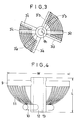
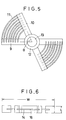
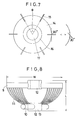
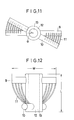
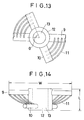
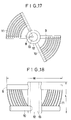
- Figs. 8 to 15 illustrate several modifications thereof, which are used in various testing examples which will be given later.
- Figs. 6 and 7 illustrates the type of helical impeller in which sleeve 12 is divided into upper and lower parts.
- Figs. 16 to 23 are those used in comparative examples.
- Figs. 22 and 23 illustrates a pitched-blade impeller in which the agitating blades 18 have an angle of inclination ( ⁇ 2) of 45 degrees.
- the ratio of the impeller diameter to the tank diameter (of the fermenter) should preferably be not less than 0.5. If the ratio is less than 0.5, a dead region is formed within the fermenter to cause a reduction in fermentation productivity.
- the ratio of the impeller length to the impeller diameter should preferably be not less than 0.2. If the ratio is less than 0.2, the number of impeller units must be increased in order to achieve the same degree of agitation, resulting in a greater amount of power consumption.
- the angle of twist between the upper and lower arms should preferably be not less than 20 degrees and not more than 180 degrees. If the angle of twist is less than 20 degrees, a sufficient vertical flow is not obtained, resulting in a reduction in productivity. If the angle of twist is greater than 180 degrees, it is difficult to maintain the shape of the paddles when the agitation is carried out.
- the helical impeller be provided with four or more shearing paddles. If the number of shearing paddles is less than 4, a sufficient shearing force is not obtained. No particular limitation is placed on the width of the shearing paddles.
- the ratio of the impeller diameter to the tank diameter (of the fermenter) should preferably be not less than 0.3 If the ratio is less than 0.3, the solubility of oxygen injected from a sparger is so low as to cause a reduction in productivity.
- the ratio of the impeller spacing to the impeller diameter should preferably be not greater than 1. If the ratio is greater than 1, the impeller spacing is so wide that a dead region is formed to cause a reduction in fermentation productivity.
- impeller spacing means the distance from the bottom of the upper helical impeller to the top of the lower turbine impeller as shown in Fig. 1 by the letter "D".
- xanthan gum was produced by using the impellers explained in connection with the above-described embodiments. The results thus obtained are shown below. In order to clarify the differences from the prior art, the results of Comparative Examples 1-6 are also shown.
- Xanthomonas campestris was cultivated for 24 hours in a fermenter containing a culture medium having the composition I given below, and then inoculated into a 30-liter fermenter containing a culture medium having the composition II given below. Then, fermentation was carried out by using various impellers having the shapes explained in connection with the above-described embodiments. The parameters of these impellers and their manner of mounting are shown in Table 1.
- xanthan gum was precipitated with the aid of 1.5 parts by weight of an 85% aqueous solution of IPA. The precipitated xanthan gum was recovered, dried at 60°C for 3 hours by means of an air dryer, and then weighed.
- the final viscosity of the fermented solution, residual glucose concentration, xanthan gum concentration and final power consumption, which were observed in each testing example, are shown in Table 2.
- the viscosity was measured at 20°C with a BL Viscometer (manufactured by Tokimec Inc.; rotor No. 4, 30 rpm).
- Example 2 Example 3
- Example 4 Example 5
- Final viscosity of fermented solution (CP) 20000 19000 20000 18000 17500 18000 Residual glucose concentration (g/L) 0 0 0 0 0 0 0 0 Xanthan gum concentration (g/L) 37 35 36 38 35 33
- Final power consumption (kw) 0.9 0.7 0.9 0.7 0.7 0.7 0.7
- Aureobasidium pullulans (ATCC74105) was cultivated for 24 hours in a fermenter containing a culture medium having the composition I given below, and then inoculated into a 30 liter fermenter containing a culture medium having the composition II given below.
- the fermentation was carried out by using various impellers having the shapes illustrated in the figures attached hereto. The parameters of these impellers and their manner of mounting are shown in Table 6.
- the microbial cells were killed by heat treatment at 60°C for 60 minutes while mechanically agitating. Then the cells were removed by a centrifuge. The pullulan solution thus obtained was mixed with 1.5 parts by weight of an 86% aqueous solution of IPA, to recover pullulan from the solution.
- the final viscosity of the fermented solution, residual sucrose concentration, pullulan concentration, pullulan molecular weight and final power consumption, which were observed under the various fermenting conditions, are shown in Table 7.
- the viscosity was measured at 20°C with a BL Viscometer (manufactured by Tokimec Inc., rotor No. 4, 30 rpm).
- the residual sucrose concentration was measured with an Enzyme Electrode Analyzer M-100 (manufactured by Asahi Chemical Industry Co., Ltd.).
- the pullulan molecular weight was obtained by measuring the intrinsic viscosity and calculating the result of the measurement according to the following relational expression developed by Buliga et al. of intrinsic viscosity to molecular weight (Int. J. Biol. Macormol., Vol. 9, 71-76(1987)).
- Example 10 Example 11
- Example 12 Final viscosity of fermented solution (CP) 13000 14000 14000 13000 12500 13000 Residual sucrose concentration (g/L) 0 0 0 0 0 0 0 0
- Molecular weight of pullulan (x 106) 6.5 6.4 6.8 6.3 6.6 6.5
- Fermentation was carried out by using the same culture medium as in the testing examples and various impellers other than the helical impeller.
Landscapes
- Chemical & Material Sciences (AREA)
- Chemical Kinetics & Catalysis (AREA)
- Organic Chemistry (AREA)
- Engineering & Computer Science (AREA)
- Wood Science & Technology (AREA)
- Life Sciences & Earth Sciences (AREA)
- Zoology (AREA)
- Bioinformatics & Cheminformatics (AREA)
- Health & Medical Sciences (AREA)
- Biotechnology (AREA)
- Microbiology (AREA)
- Biochemistry (AREA)
- General Engineering & Computer Science (AREA)
- General Health & Medical Sciences (AREA)
- Genetics & Genomics (AREA)
- General Chemical & Material Sciences (AREA)
- Aviation & Aerospace Engineering (AREA)
- Biomedical Technology (AREA)
- Sustainable Development (AREA)
- Preparation Of Compounds By Using Micro-Organisms (AREA)
- Polysaccharides And Polysaccharide Derivatives (AREA)
- Apparatus Associated With Microorganisms And Enzymes (AREA)
Applications Claiming Priority (6)
| Application Number | Priority Date | Filing Date | Title |
|---|---|---|---|
| JP17303594 | 1994-07-26 | ||
| JP17303594 | 1994-07-26 | ||
| JP173035/94 | 1994-07-26 | ||
| JP31619594 | 1994-12-20 | ||
| JP316195/94 | 1994-12-20 | ||
| JP31619594 | 1994-12-20 |
Publications (3)
| Publication Number | Publication Date |
|---|---|
| EP0698662A2 true EP0698662A2 (fr) | 1996-02-28 |
| EP0698662A3 EP0698662A3 (fr) | 1998-05-27 |
| EP0698662B1 EP0698662B1 (fr) | 2001-06-06 |
Family
ID=26495167
Family Applications (1)
| Application Number | Title | Priority Date | Filing Date |
|---|---|---|---|
| EP95305221A Expired - Lifetime EP0698662B1 (fr) | 1994-07-26 | 1995-07-26 | Appareil et méthode pour la production de gomme de xanthane |
Country Status (3)
| Country | Link |
|---|---|
| US (2) | US5972695A (fr) |
| EP (1) | EP0698662B1 (fr) |
| DE (1) | DE69521175T2 (fr) |
Cited By (7)
| Publication number | Priority date | Publication date | Assignee | Title |
|---|---|---|---|---|
| FR2763867A1 (fr) * | 1997-06-03 | 1998-12-04 | Grande Paroisse Sa | Dispositif pour melanger et dissoudre dans un liquide des granules solides, en particulier pour la production d'engrais phospho-azotes |
| WO2000055295A1 (fr) * | 1999-03-12 | 2000-09-21 | Shinko Pantec Co., Ltd. | Bac de brassage pour stocker une solution de levure, procede pour produire des aliments fermentes comme de la biere dans ce bac de brassage, et pales de brassage situees dans ce bac de brassage |
| CN102229885A (zh) * | 2011-06-17 | 2011-11-02 | 吉武科 | 一种高粘物料发酵搅拌器 |
| EP2656909A1 (fr) * | 2012-04-25 | 2013-10-30 | Thöni Industriebetriebe GmbH | Dispositif d'agitation pour un dispositif de fermentation |
| WO2014046893A1 (fr) * | 2012-09-24 | 2014-03-27 | Abengoa Bioenergy New Technologies, Llc | Cuves de trempage et procédés d'imprégnation d'une biomasse avec du liquide |
| CN112263928A (zh) * | 2020-09-24 | 2021-01-26 | 安徽唯宝印刷科技有限公司 | 一种润版液加工设备 |
| CN112484792A (zh) * | 2020-10-19 | 2021-03-12 | 姚贤卿 | 隔离更换型/喷射型感应式涡街流量计 |
Families Citing this family (13)
| Publication number | Priority date | Publication date | Assignee | Title |
|---|---|---|---|---|
| EP0698662B1 (fr) * | 1994-07-26 | 2001-06-06 | Shin-Etsu Chemical Co., Ltd. | Appareil et méthode pour la production de gomme de xanthane |
| US6709845B1 (en) | 1999-07-02 | 2004-03-23 | Shin-Etsu Bio, Inc. | Production of modified polysaccharide S-7 |
| EP1473357A1 (fr) * | 2003-04-29 | 2004-11-03 | The Procter & Gamble Company | Dispositif de nettoyage pour cuvette de W.C. |
| US7727747B2 (en) * | 2006-11-14 | 2010-06-01 | Bemidji State University Foundation | Solid or semi-solid state fermentation of xanthan on potato or potato waste |
| JP2009072133A (ja) | 2007-09-21 | 2009-04-09 | Hitachi Plant Technologies Ltd | 培養槽装置、細胞培養方法及び物質生産方法 |
| EP2216395A1 (fr) | 2009-02-09 | 2010-08-11 | Lonza Biologics plc. | Bioréacteur pour la culture de cellules de mammifères |
| DE102011085010A1 (de) * | 2011-10-21 | 2013-04-25 | Thomas Kainz | Rührwerk für einen Fermenterbehälter, Fermenterbehälter mit einem derartigen Rührwerk sowie Biogasanlage |
| WO2013151733A1 (fr) | 2012-04-06 | 2013-10-10 | Hyclone Laboratories, Inc. | Système de mélange de fluide avec ligne d'entraînement flexible et roue à aubes pliable |
| US9115214B2 (en) | 2012-09-24 | 2015-08-25 | Abengoa Bioenergy New Technologies, Llc | Methods for controlling pretreatment of biomass |
| DE102012019215B4 (de) | 2012-10-01 | 2014-10-30 | Sartorius Stedim Biotech Gmbh | Rührereinbauhilfe und Verfahren zum Einbau eines Rührorgans in einen Bioreaktor |
| KR20150025684A (ko) * | 2013-08-30 | 2015-03-11 | 주식회사 엘지화학 | 전극 슬러리의 임펠러 믹서 |
| CN113975988B (zh) * | 2015-12-29 | 2024-09-03 | 生命科技股份有限公司 | 具有侧向移位的柔性驱动线的流体混合系统及使用方法 |
| CN111699240A (zh) | 2018-01-17 | 2020-09-22 | 生命技术公司 | 用于细胞培养缩放的系统和方法 |
Citations (6)
| Publication number | Priority date | Publication date | Assignee | Title |
|---|---|---|---|---|
| US4022438A (en) | 1974-05-13 | 1977-05-10 | Mitsubishi Kasei Kogyo Kabushiki Kaisha | Stirring apparatus |
| JPS5860997A (ja) | 1981-09-08 | 1983-04-11 | ケルコ・バイオスペシャルティズ・リミテッド | エマルジヨン発酵によるキサンタンガムの製造 |
| DE3246936A1 (de) | 1982-12-18 | 1984-06-20 | Pfister Gmbh, 8900 Augsburg | Mischer, insbesondere fuer zaehfluessiges oder schuettfaehiges gut |
| JPS61173795A (ja) | 1985-01-28 | 1986-08-05 | Asahi Chem Ind Co Ltd | キサンタンガムの改良製造方法 |
| JPS6356296A (ja) | 1986-06-09 | 1988-03-10 | コ−ポラテイブ ベルニギング ス−カ− ユニ− ユ−. エ−. | 多糖類、とくにキサントンの発酵による生成方法および装置 |
| US5268460A (en) | 1991-10-16 | 1993-12-07 | Shin-Estu Bio, Inc. | High molecular weight pullulan |
Family Cites Families (16)
| Publication number | Priority date | Publication date | Assignee | Title |
|---|---|---|---|---|
| US224117A (en) * | 1880-02-03 | Egg-beater | ||
| US2740696A (en) * | 1951-03-30 | 1956-04-03 | Exxon Research Engineering Co | Polymerization apparatus unit |
| US3382229A (en) * | 1963-04-11 | 1968-05-07 | Exxon Production Research Co | Polysaccharide recovery process |
| GB1096701A (en) * | 1963-11-28 | 1967-12-29 | Cerebos Foods Ltd | Improvements in apparatus for whipping and foaming materials |
| GB1223418A (en) * | 1967-06-19 | 1971-02-24 | British Petroleum Co | Improvements in or relating to a fermenter and to a process in which said fermenter is employed |
| JPS54109939A (en) * | 1978-02-15 | 1979-08-29 | Mitsui Petrochem Ind Ltd | Oxidation reactor for preparing aromatic carboxylic acid |
| JPS55127429A (en) * | 1979-03-26 | 1980-10-02 | Toray Ind Inc | Vertical polycondensation reaction apparatus for polyester |
| US4289854A (en) * | 1980-06-20 | 1981-09-15 | Monsanto Company | Cell culture method and apparatus |
| US4472063A (en) * | 1983-07-05 | 1984-09-18 | Inri-International New Roofing Industries, Inc. | Mixer implement for liquids |
| JP2613892B2 (ja) * | 1986-08-08 | 1997-05-28 | 株式会社日立製作所 | 動物細胞の培養方法及び培養装置 |
| DE3634203A1 (de) * | 1986-10-08 | 1988-04-21 | Boehringer Mannheim Gmbh | Bioreaktor zum kultivieren von biologischem material |
| JPH0777607B2 (ja) * | 1987-05-13 | 1995-08-23 | チッソ株式会社 | 撹拌流動槽 |
| FI86600C (fi) * | 1990-04-04 | 1992-09-25 | Outokumpu Oy | Saett att blanda ihop vaetska, fastaemne och gas samt att ur vaetskan samtidigt avskilja gas eller gas och fastaemne. |
| US5248485A (en) * | 1990-04-04 | 1993-09-28 | Outokumpu Oy | Method for mixing liquid, solids and gas and for simultaneously separating gas or gas and solids from the liquid |
| JPH0771503B2 (ja) * | 1991-05-31 | 1995-08-02 | 信越化学工業株式会社 | 多糖類の発酵生産方法 |
| EP0698662B1 (fr) * | 1994-07-26 | 2001-06-06 | Shin-Etsu Chemical Co., Ltd. | Appareil et méthode pour la production de gomme de xanthane |
-
1995
- 1995-07-26 EP EP95305221A patent/EP0698662B1/fr not_active Expired - Lifetime
- 1995-07-26 DE DE69521175T patent/DE69521175T2/de not_active Expired - Fee Related
-
1997
- 1997-10-14 US US08/950,295 patent/US5972695A/en not_active Expired - Fee Related
-
1998
- 1998-12-07 US US09/206,414 patent/US6110731A/en not_active Expired - Fee Related
Patent Citations (6)
| Publication number | Priority date | Publication date | Assignee | Title |
|---|---|---|---|---|
| US4022438A (en) | 1974-05-13 | 1977-05-10 | Mitsubishi Kasei Kogyo Kabushiki Kaisha | Stirring apparatus |
| JPS5860997A (ja) | 1981-09-08 | 1983-04-11 | ケルコ・バイオスペシャルティズ・リミテッド | エマルジヨン発酵によるキサンタンガムの製造 |
| DE3246936A1 (de) | 1982-12-18 | 1984-06-20 | Pfister Gmbh, 8900 Augsburg | Mischer, insbesondere fuer zaehfluessiges oder schuettfaehiges gut |
| JPS61173795A (ja) | 1985-01-28 | 1986-08-05 | Asahi Chem Ind Co Ltd | キサンタンガムの改良製造方法 |
| JPS6356296A (ja) | 1986-06-09 | 1988-03-10 | コ−ポラテイブ ベルニギング ス−カ− ユニ− ユ−. エ−. | 多糖類、とくにキサントンの発酵による生成方法および装置 |
| US5268460A (en) | 1991-10-16 | 1993-12-07 | Shin-Estu Bio, Inc. | High molecular weight pullulan |
Non-Patent Citations (9)
| Title |
|---|
| APPL. MICROBIOL. BIOTECHNOL., vol. 35, 1991, pages 330 - 333 |
| APPLIED BIOCHEMISTRY AND BIOTECHNOLOGY, vol. 28/29, 1991, pages 667 |
| BIOTECHNOLOGY AND BIOENGINEERING, vol. 34, 1989, pages 1393 - 1397 |
| BIOTECHNOLOGY AND BIOENGINEERING, vol. 39, 1992, pages 85 - 94 |
| BULIGA ET AL., INT. J. BIOL. MACORMOL., vol. 9, 1997, pages 71 - 76 |
| CHEMICAL ENGINEERING PROGRESS, 1990 |
| CHEMICAL ENGINEERING SCIENCE, vol. 35, 1980, pages 2163 - 2175 |
| J. FERMENT, TECHNOL., vol. 66, no. 1, 1988, pages 103 - 109 |
| PROCESS BIOCHEMISTRY, vol. 27, 1992, pages 351 - 365 |
Cited By (10)
| Publication number | Priority date | Publication date | Assignee | Title |
|---|---|---|---|---|
| FR2763867A1 (fr) * | 1997-06-03 | 1998-12-04 | Grande Paroisse Sa | Dispositif pour melanger et dissoudre dans un liquide des granules solides, en particulier pour la production d'engrais phospho-azotes |
| WO1998055213A1 (fr) * | 1997-06-03 | 1998-12-10 | Grande Paroisse S.A. | Dispositif pour melanger et dissoudre dans un liquide des granules solides, en particulier pour la production d'engrais phospho-azotes |
| MD2738C2 (ro) * | 1997-06-03 | 2005-12-31 | Grande Paroisse S.A. | Dispozitiv pentru prepararea reactivului sulfoureic pentru descompunerea fosfatului natural în instalaţia pentru obţinerea îngrăşămintelor nitrofosfatice |
| WO2000055295A1 (fr) * | 1999-03-12 | 2000-09-21 | Shinko Pantec Co., Ltd. | Bac de brassage pour stocker une solution de levure, procede pour produire des aliments fermentes comme de la biere dans ce bac de brassage, et pales de brassage situees dans ce bac de brassage |
| US7368283B1 (en) | 1999-03-12 | 2008-05-06 | Kobelco Eco-Solutions Co. Ltd. | Agitation tank for storing beer yeast slurry |
| CN102229885A (zh) * | 2011-06-17 | 2011-11-02 | 吉武科 | 一种高粘物料发酵搅拌器 |
| EP2656909A1 (fr) * | 2012-04-25 | 2013-10-30 | Thöni Industriebetriebe GmbH | Dispositif d'agitation pour un dispositif de fermentation |
| WO2014046893A1 (fr) * | 2012-09-24 | 2014-03-27 | Abengoa Bioenergy New Technologies, Llc | Cuves de trempage et procédés d'imprégnation d'une biomasse avec du liquide |
| CN112263928A (zh) * | 2020-09-24 | 2021-01-26 | 安徽唯宝印刷科技有限公司 | 一种润版液加工设备 |
| CN112484792A (zh) * | 2020-10-19 | 2021-03-12 | 姚贤卿 | 隔离更换型/喷射型感应式涡街流量计 |
Also Published As
| Publication number | Publication date |
|---|---|
| US5972695A (en) | 1999-10-26 |
| EP0698662B1 (fr) | 2001-06-06 |
| DE69521175D1 (de) | 2001-07-12 |
| US6110731A (en) | 2000-08-29 |
| EP0698662A3 (fr) | 1998-05-27 |
| DE69521175T2 (de) | 2001-11-08 |
Similar Documents
| Publication | Publication Date | Title |
|---|---|---|
| US5972695A (en) | Apparatus and method for the production of xanthan gum | |
| Cadmus et al. | Synthetic media for production of quality xanthan gum in 20 liter fermentors | |
| Margaritis et al. | Mixing, mass transfer, and scale‐up of polysaccharide fermentations | |
| Richard et al. | Rheology, oxygen transfer, and molecular weight characteristics of poly (glutamic acid) fermentation by Bacillus subtilis | |
| Rau et al. | Enhanced glucan formation of filamentous fungi by effective mixing, oxygen limitation and fed-batch processing | |
| JPH06157607A (ja) | 非脆性ゲルとしてのゲランガム | |
| US3391060A (en) | Process for producing a polysaccharide | |
| Sutherland | Microbial biopolymers from agricultural products: production and potential | |
| CN1118240C (zh) | 液态糖类发酵产品在食品中的应用 | |
| US4394447A (en) | Production of high-pyruvate xanthan gum on synthetic medium | |
| AU617727B2 (en) | Process for the production of polysaccharides | |
| EP0039962A1 (fr) | Clarification des produits de fermentation contenant des polysaccharides | |
| CA1164376A (fr) | Methodes d'obtention de biopolymeres de xanthomonas | |
| EP0045569B1 (fr) | Procédé pour augmenter la productivité spécifique du xanthane pendant une fermentation en continu | |
| EP0322393A1 (fr) | Exopolysaccharide du type bêta-1,3-glucane et procédé pour sa préparation | |
| US5679556A (en) | Process for the recovery and purification of xanthan gum | |
| US3433708A (en) | Process for producing a polysaccharide | |
| JP3584344B2 (ja) | 多糖類の製造装置および製造方法 | |
| US5756317A (en) | Production of heteroplysaccharide biopolymers with xanthomonas in oil-in-water emulsion | |
| EP0560800B1 (fr) | Protecteurs pour fermentation microbienne | |
| West et al. | Effect of culture medium pH on bacterial gellan production | |
| EP0690072B1 (fr) | Procédé pour l'obtention et la purification de gomme d'xanthane | |
| JP3062725B2 (ja) | 通気攪拌培養によるバクテリアセルロースの製造方法及び培養装置 | |
| CA1312840C (fr) | Procede de fermentation conduisant a l'obtention d'un polysaccharide du type xanthane et produit ainsi obtenu | |
| KR910008646B1 (ko) | 새로운 다당류계 생물 고분자 물질 및 그 제법 |
Legal Events
| Date | Code | Title | Description |
|---|---|---|---|
| PUAI | Public reference made under article 153(3) epc to a published international application that has entered the european phase |
Free format text: ORIGINAL CODE: 0009012 |
|
| AK | Designated contracting states |
Kind code of ref document: A2 Designated state(s): DE FR GB |
|
| PUAL | Search report despatched |
Free format text: ORIGINAL CODE: 0009013 |
|
| AK | Designated contracting states |
Kind code of ref document: A3 Designated state(s): DE FR GB |
|
| 17P | Request for examination filed |
Effective date: 19980514 |
|
| 17Q | First examination report despatched |
Effective date: 20000504 |
|
| GRAG | Despatch of communication of intention to grant |
Free format text: ORIGINAL CODE: EPIDOS AGRA |
|
| GRAG | Despatch of communication of intention to grant |
Free format text: ORIGINAL CODE: EPIDOS AGRA |
|
| GRAH | Despatch of communication of intention to grant a patent |
Free format text: ORIGINAL CODE: EPIDOS IGRA |
|
| GRAH | Despatch of communication of intention to grant a patent |
Free format text: ORIGINAL CODE: EPIDOS IGRA |
|
| GRAA | (expected) grant |
Free format text: ORIGINAL CODE: 0009210 |
|
| AK | Designated contracting states |
Kind code of ref document: B1 Designated state(s): DE FR GB |
|
| REF | Corresponds to: |
Ref document number: 69521175 Country of ref document: DE Date of ref document: 20010712 |
|
| ET | Fr: translation filed | ||
| REG | Reference to a national code |
Ref country code: GB Ref legal event code: IF02 |
|
| PLBE | No opposition filed within time limit |
Free format text: ORIGINAL CODE: 0009261 |
|
| STAA | Information on the status of an ep patent application or granted ep patent |
Free format text: STATUS: NO OPPOSITION FILED WITHIN TIME LIMIT |
|
| 26N | No opposition filed | ||
| PGFP | Annual fee paid to national office [announced via postgrant information from national office to epo] |
Ref country code: FR Payment date: 20040708 Year of fee payment: 10 |
|
| PGFP | Annual fee paid to national office [announced via postgrant information from national office to epo] |
Ref country code: GB Payment date: 20040721 Year of fee payment: 10 |
|
| PGFP | Annual fee paid to national office [announced via postgrant information from national office to epo] |
Ref country code: DE Payment date: 20040806 Year of fee payment: 10 |
|
| PG25 | Lapsed in a contracting state [announced via postgrant information from national office to epo] |
Ref country code: GB Free format text: LAPSE BECAUSE OF NON-PAYMENT OF DUE FEES Effective date: 20050726 |
|
| PG25 | Lapsed in a contracting state [announced via postgrant information from national office to epo] |
Ref country code: DE Free format text: LAPSE BECAUSE OF NON-PAYMENT OF DUE FEES Effective date: 20060201 |
|
| GBPC | Gb: european patent ceased through non-payment of renewal fee |
Effective date: 20050726 |
|
| PG25 | Lapsed in a contracting state [announced via postgrant information from national office to epo] |
Ref country code: FR Free format text: LAPSE BECAUSE OF NON-PAYMENT OF DUE FEES Effective date: 20060331 |
|
| REG | Reference to a national code |
Ref country code: FR Ref legal event code: ST Effective date: 20060331 |