EP0699015A1 - Speiseschaltung mit Energierückgewinnung zum Betrieb einer elektrolumineszenten Vorrichtung - Google Patents
Speiseschaltung mit Energierückgewinnung zum Betrieb einer elektrolumineszenten Vorrichtung Download PDFInfo
- Publication number
- EP0699015A1 EP0699015A1 EP95305109A EP95305109A EP0699015A1 EP 0699015 A1 EP0699015 A1 EP 0699015A1 EP 95305109 A EP95305109 A EP 95305109A EP 95305109 A EP95305109 A EP 95305109A EP 0699015 A1 EP0699015 A1 EP 0699015A1
- Authority
- EP
- European Patent Office
- Prior art keywords
- energy
- bridge
- inductor
- phase
- discharging
- Prior art date
- Legal status (The legal status is an assumption and is not a legal conclusion. Google has not performed a legal analysis and makes no representation as to the accuracy of the status listed.)
- Granted
Links
- 238000011084 recovery Methods 0.000 title claims abstract description 64
- 238000007599 discharging Methods 0.000 claims abstract description 52
- 239000003990 capacitor Substances 0.000 claims description 45
- 238000005086 pumping Methods 0.000 claims description 18
- 238000000034 method Methods 0.000 claims 4
- 238000004146 energy storage Methods 0.000 abstract description 16
- 230000009471 action Effects 0.000 description 12
- 238000010586 diagram Methods 0.000 description 8
- 230000000694 effects Effects 0.000 description 7
- 230000007704 transition Effects 0.000 description 7
- 230000008901 benefit Effects 0.000 description 4
- 238000001816 cooling Methods 0.000 description 4
- 230000001939 inductive effect Effects 0.000 description 3
- 230000003071 parasitic effect Effects 0.000 description 3
- OAICVXFJPJFONN-UHFFFAOYSA-N Phosphorus Chemical compound [P] OAICVXFJPJFONN-UHFFFAOYSA-N 0.000 description 2
- 230000009286 beneficial effect Effects 0.000 description 2
- 230000009191 jumping Effects 0.000 description 2
- 230000007246 mechanism Effects 0.000 description 2
- 230000003252 repetitive effect Effects 0.000 description 2
- 230000004913 activation Effects 0.000 description 1
- 230000015572 biosynthetic process Effects 0.000 description 1
- 239000000919 ceramic Substances 0.000 description 1
- 230000008859 change Effects 0.000 description 1
- 238000006243 chemical reaction Methods 0.000 description 1
- 239000011248 coating agent Substances 0.000 description 1
- 238000000576 coating method Methods 0.000 description 1
- 238000005516 engineering process Methods 0.000 description 1
- 238000005755 formation reaction Methods 0.000 description 1
- 230000004048 modification Effects 0.000 description 1
- 238000012986 modification Methods 0.000 description 1
- 238000007493 shaping process Methods 0.000 description 1
Images

Classifications
-
- H—ELECTRICITY
- H05—ELECTRIC TECHNIQUES NOT OTHERWISE PROVIDED FOR
- H05B—ELECTRIC HEATING; ELECTRIC LIGHT SOURCES NOT OTHERWISE PROVIDED FOR; CIRCUIT ARRANGEMENTS FOR ELECTRIC LIGHT SOURCES, IN GENERAL
- H05B44/00—Circuit arrangements for operating electroluminescent light sources
-
- Y—GENERAL TAGGING OF NEW TECHNOLOGICAL DEVELOPMENTS; GENERAL TAGGING OF CROSS-SECTIONAL TECHNOLOGIES SPANNING OVER SEVERAL SECTIONS OF THE IPC; TECHNICAL SUBJECTS COVERED BY FORMER USPC CROSS-REFERENCE ART COLLECTIONS [XRACs] AND DIGESTS
- Y02—TECHNOLOGIES OR APPLICATIONS FOR MITIGATION OR ADAPTATION AGAINST CLIMATE CHANGE
- Y02B—CLIMATE CHANGE MITIGATION TECHNOLOGIES RELATED TO BUILDINGS, e.g. HOUSING, HOUSE APPLIANCES OR RELATED END-USER APPLICATIONS
- Y02B20/00—Energy efficient lighting technologies, e.g. halogen lamps or gas discharge lamps
- Y02B20/30—Semiconductor lamps, e.g. solid state lamps [SSL] light emitting diodes [LED] or organic LED [OLED]
Definitions
- This invention relates to a circuit for driving an electroluminescent (“EL”) device, and more particularly to a drive circuit which charges an EL device during one part of a power cycle and recovers EL device discharge energy during another part of the power cycle. The recovered energy then is re-applied to charge the EL device.
- EL electroluminescent
- a typical electroluminescent device is a flat-panel display.
- the panel is formed by an electroluminescent layer sandwiched between a pair of outer conductive layers.
- the electroluminescent layer is formed by a ceramic dielectric having an electroluminescent phosphor coating.
- the outer conductive layers form horizontal and vertical electrodes on opposite sides of the dielectric. Activation of crossing electrodes illuminates the intersected phosphor area to light a pixel on the display.
- a pixel In operation a pixel is activated by repetitive charging and discharging of the panel area defining the pixel.
- the panel in essence is a capacitive device typically modelled as a capacitor having a nonlinear loss element.
- the loss element varies with voltage and switching frequency.
- Conventional electroluminescent devices lacking energy recovery schemes consume large amounts of energy through repetitive charging and discharging and exhibit relatively low power conversion efficiency.
- the panel absorbs energy as capacitance. Then during a discharge phase, the capacitive energy is discharged through a resistive device to be dissipated in the form of heat. During the charging phase, only a very small portion (e.g., less than 5%) of the energy delivered to the panel is expended in the creation of light. Most of the energy is stored in the panel capacitance or dissipated in the charging path resistance as heat. Accordingly there has been a need to improve the efficiency of electroluminescent panels and reduce power consumption.
- Schemes for improving the efficiency include energy saving schemes and energy recovery schemes.
- Energy saving schemes have been directed toward shaping the charging current so as to reduce the energy lost as heat through the charging path resistance.
- This invention is directed toward a drive circuit employing an energy recovery scheme.
- a drive circuit for an EL device defines a power cycle and performs energy recovery.
- a first energy storage device i.e., inductor
- the energy portions incrementally accumulate to create a high energy potential across the EL device. Some of the energy is converted to light by the EL device.
- a second energy storage device i.e., inductor sequentially accepts small energy portions from the EL device to decrementally discharge the EL device.
- a switching scheme is implemented to pump the energy storage devices to sequentially release or accept the small energy portions.
- the size (i.e., inductance and physical size) of the energy storage devices determines the amount of energy to be moved per switching step. By moving small energy portions in many steps, instead of one large energy portion in a single burst, the size of the energy storage devices used is reduced.
- Energy recovery is performed by capturing some of the EL device discharge energy and introducing it back to the EL device during a subsequent charging phase.
- the small energy portions accepted by the second energy storage device are passed to a third energy storage device (i.e., capacitor) which accumulates the portions.
- the third energy storage device introduces the recovered energy back into the EL panel by discharging into the EL device during a subsequent charging phase. This partially charges the EL device.
- additional energy is pumped from the power source via the first energy storage device to the EL device. As previously described, the additional energy is released in the form of small energy portions to incrementally accumulate a high energy potential across the EL device.
- the Drive circuit is formed by a pair of switching bridges and a pair of pumping circuits.
- the pumping circuits include the energy storage devices.
- the bridges are formed as a first and a second bridge across the EL device. Switching action among transistors forming the bridges defines a power cycle. When the first bridge is active, energy flow into the EL device is at one polarity. When the second bridge is active, energy flow into the EL device is at the opposite polarity. When neither bridge is active, the EL device is isolated. Within each bridge, switching transistors are controlled to define either one of a charging phase or a discharging phase. The bridges are controlled to alternate polarity and alternate charging and discharging phases. A repeating power cycle occurs in which a charging phase and discharging phase at one polarity are followed by a charging phase and discharging phase at the opposite polarity.
- an input voltage signal from a power source is received into a first pump stage of the drive circuit.
- the first pump stage includes an inductor for storing energy from the power source and a switching device for pumping the energy from the inductor to the EL device.
- the switching device switches at a high frequency relative to the EL panel charging time constant so that flow of many small portions of energy defines the charging phase.
- the first pump stage is active during charging phases to move a sequence of small energy portions from the power source to the EL device via the inductor.
- the drive circuit includes a second pump stage which receives the discharge from the EL panel during a discharge phase.
- the second pump circuit includes an inductor, a recovery capacitor and a switching device.
- the switching device activates a discharge path for the EL device. While the path is active a small portion of discharge energy flows into the inductor.
- the switching device controls the discharge path so that discharge energy is pumped in small portions from the EL device to the inductor and through the inductor into the recovery capacitor for storage.
- the switching device switches at a high frequency relative to the EL panel discharge timing constant so that flow of many small portions of discharge energy defines the discharging phase.
- the second pump stage is active during the discharge phases to recover portions of discharged energy at the recovery capacitor.
- the recovery capacitor subsequently discharges the recovered energy into the EL device during the next charging phase of the power cycle.
- the EL device receives a relatively large energy portion from the recovery capacitor and multiple small energy portions from the primary power source.
- the energy from the recovery capacitor is recovered energy which need not be drawn off the power source. Thus, power consumption is reduced.
- the switching action in the two pump stages and the two bridges are coordinated to define the power cycle.
- the switch in the first pump stage is active for switching only during charging phases to pump energy into the EL device.
- the switch in the second pump stage is active for switching only during discharge phases to pump energy out of the EL device.
- the transistors in the first bridge are active to define a first polarity and are switched to transition between a charging phase and a discharging phase.
- the transistors in the second bridge are active to define a second polarity and also are switched to transition between a charging phase and a discharging phase.
- One advantage of the energy recovery circuit of this invention is that the switching action used for pumping energy into and out of the EL device allows smaller units of energy to be controlled. Previously discharge energy was recovered in one large burst according to resistive-capacitive-inductive ("RLC") timing constants in resonant tank circuits. According to this invention, however, energy is pumped incrementally based on switching action.
- the switching scheme allows smaller energy storage devices to be used achieve energy recovery than required for conventional resonant tank energy recovery circuits.
- the smaller components in turn enable the energy recovery circuit of this invention to be implemented in very small hand-held portable devices.
- Another advantage of the energy recovery circuit of this invention is a reduced power consumption. Reduced power consumption is particularly beneficial for EL panels used with portable computing devices. As the panel is powered by battery, it operates for a longer time period before the battery needs to be recharged.
- Another advantage of the energy recovery circuit is that less heat is generated in powering an EL device. Thus the need to provide cooling mechanisms is reduced. Reduced cooling requirements means a lighter weight panel may be achieved and that the panel can be used in higher temperature environments.
- Another advantage of the energy recovery circuit is that effective steady state currents in the EL drive circuit are reduced.
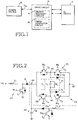
- Fig. 1 shows a block diagram of an electroluminescent (“EL") device 10, power source 12 and drive circuit 14 according to an embodiment of this invention.
- the EL device 10 is an electroluminescent panel, electroluminescent lamp or other electroluminescent lighting device. Such EL devices 10 are capacitive in nature.
- the power source 12 supplies a dc input voltage signal, V in , to the drive circuit 14.
- the drive circuit 14 receives the voltage signal and drives the EL device 10 to alternating high and low potentials at reversing polarity to generate light.
- the drive circuit 14 includes an energy recovery circuit 16 and a timing generator circuit 18.
- the energy recovery circuit 14 receives the input voltage signal, V in , and generates an alternating polarity power input signal to the EL device 10 based upon timing signals provided by the timing generator circuit 18. For each polarity of the power cycle there is a charging phase and discharging phase.
- the EL device 10 is charged to a high potential at one polarity, then discharged to a low potential.
- the polarity then reverses and the device 10 is charged to a high potential at the opposite polarity.
- the device 10 then discharges to a low potential and the polarity again reverses to begin a new power cycle.
- the EL device 10 repeatedly is charging and discharging during operation. During a charging phase, a portion of input energy is absorbed by the device 10, a portion is dissipated as heat and a portion is converted to light. During a discharging phase, the previously absorbed energy is released. The function of the power recovery circuit is to absorb a portion of the released energy for re-use during a subsequent charging phase. The more energy recovered in this way, the more efficient are the EL panel 10 and related drive circuitry 14. By recovering energy for-reuse, the net input from power source 12 is reduced, thereby reducing the power consumption of the EL device 10.
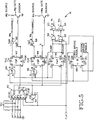
- Fig. 2 shows a schematic diagram of the energy recovery circuit 16 with EL device 10 according to a preferred embodiment of this invention.
- the EL device 10 is represented electrically by its characteristic load capacitance, C L , and load resistance, R L .
- C L characteristic load capacitance
- R L load resistance
- capacitive energy stored in the device 10 (e.g., C L ) is discharged. A portion of this discharged energy is dissipated as heat via the device's load resistance, R L .
- the function of the energy recovery circuit 16, however, is to re-absorb a portion of this discharged capacitive energy, thereby reducing the portion dissipated as heat. Such re-absorbed energy then is re-applied to the device 10 during a subsequent charging phase. As a result, the power drawn from the source 12 to power the EL device 10 is reduced.
- the EL device 10 in effect, becomes more efficient when coupled with the energy recovery circuit 16.
- the energy recovery circuit 16 includes a charging pump stage 20, a recovery pump stage 22, and a bridge stage 24.
- the charging pump stage 20 pumps energy from power source 12 into the EL device 10 during a charging phase.
- the recovery pump stage 22 absorbs load capacitance C L discharge energy during the discharging phase and inputs a portion of that absorbed energy back into the EL device 10 during a subsequent charging phase.
- the bridge stage 24 defines a power cycle controlling the polarity of energy input to the EL device 10 and the charging and discharging phase transitions.
- the charging pump stage 20 includes an inductor L1, diode D1, and switching transistor T1.
- the inductor L1 receives the dc voltage input signal V in from power source 12. Energy then is pumped from the inductor L1 to the EL device 10 by transistor T1. By switching transistor T1 on and off, the inductor L1 is cyclically loaded and released. Diode D1 prevents current from traveling back into the booster stage 20 during discharging phases.
- the recovery pump stage 22 includes an inductor L2, a switching transistor T6, a diode D4, and a recovery capacitor C R .
- the EL device 10 load capacitance C L is discharged. A portion of this discharged energy is dissipated by load resistance R L . A significant portion, however, flows to inductor L2.
- the energy is pumped from inductor L2 to a recovery capacitor, C R , for storage.
- Transistor T6 periodically switches on and off during this discharge phase to pump the energy through the inductor L2 into capacitor C R .
- the recovery capacitor, C R discharges its energy to flow back into the EL device 10.
- the EL device 10 receives energy from both the charging pump stage 20 (e.g., inductor L1) and the recovery pump stage 22 (e.g., capacitor C R ).
- the bridge stage 24 includes a first bridge 26, a second bridge 28 and diodes D2 and D3.
- first bridge 26 When the first bridge 26 is active, second bridge 28 is inactive.
- second bridge 28 when second bridge 28 is active, first bridge 26 is inactive.
- first bridge 26 When first bridge 26 is active, energy flow into the EL device 10 is at one polarity.
- second bridge 28 When second bridge 28 is active, energy flow into EL device 10 is at the opposite polarity.
- neither bridge 26, 28 is active, the EL device is isolated.
- the first bridge 26 is formed by transistors T2 and T3.
- the second bridge 28 is formed by transistors T4 and T5.
- the switching devices T1 - T6 are formed by power FETs having intrinsic body diodes. These body diodes are shown across the source and drain of each transistor in Fig. 2.
- the body diodes of transistors T3 and T5 provide a return path for EL device discharge current while the switching transistors T2-T5 of the first and second bridges 26, 28 are off.
- only the transistors T3 and T5 have body diodes.
- transistors T3 and T5 do not have body diodes, but instead have high efficiency schottky diodes across their respective source and drain contacts.
- Fig. 3 shows the voltage signal, V L , across the EL device 10 over the power cycle.
- the power cycle includes a charging phase 32 and a discharging phase 34 at a first polarity, followed by a charging phase 36 and discharging phase 38 at the opposite polarity.
- Fig. 4 shows a timing diagram of the switching transistor T1-T6 states for the charging and discharging phases 32-38.
- Charging and discharging phases of the EL device are defined by toggling bridge 26 or 28 switching transistors.
- transistors T2 and T3 are on and transistors T4 and T5 are off.
- transistors T2, T3, T4 and T5 are off.
- transistors T2 and T3 are off and transistors T4 and T5 are on.
- transistors T2, T3, T4 and T5 are off.
- transistor T6 When transistor T6 switches on a low potential forward biases the diode D2 or D3 (depending on the polarity) providing a discharge path.
- the load 10 discharges through diode D2 or D3 while transistor T6 is on.
- the body diodes of transistors T3 and T5 provide the return path for the discharge current.
- the load capacitance C L discharges to inductor L2 in small energy portions.
- the charging phase 32 at a first polarity begins at time t0.
- signal M1 becomes active cyclically switching the transistor T1 on and off.
- inductor L1 passes a small portion of the input voltage V in energy from the power source 12 to the load 10 via bridge 26 or 28 to develop a load voltage, V L .
- a portion of the incoming energy is stored in the load capacitance C L . Another portion is converted to light.
- signals M2 and M5 are low and signals M3 and M4 are high during the charging phase 32.
- the first bridge 26 is active.
- Transistor T3 puts node 40 near ground potential and transistor T2 puts node 42 at a high potential.
- the incoming energy is pumped through the first bridge 26 to the EL panel 10 to build the load voltage V L to a high potential at a first polarity (e.g., positive).
- Fig. 3 shows the incremental rise in voltage, V L , across the EL load 10 during phase 32.
- Each step-like increase in voltage, V L corresponds to the energy pumped from inductor L1 during one switching period of signal M1.
- the shape of signal V L during the charging phase 32 is determined by the inductor L1 timing constant, the signal M1 frequency, and the load capacitance C L timing constant.
- the step-like increments in V L are determined by the inductor L1 timing constant and the signal M1 frequency.
- the discharging phase 34 begins at time t1.
- signal M1 is kept low preventing energy from flowing from the charging pump stage 20 to the EL panel 10.
- Signal M2 switches high and signal M3 switches low so that transistors T2-T5 are off isolating the load 10.
- diode D2 is forward biased forcing the panel to discharge toward a lower potential.
- the run-off current enters inductor L2.
- Transistor T6 pumps the current from the inductor L2 through diode D4 charging the recovery capacitor C R .
- Fig. 3 shows the incremental lowering of voltage across the EL device 10 during phase 34 due to the pumping action.
- Fig. 4 shows the switching of transistor T6 triggering the pumping action.
- the shape and step-like decrements in V L are determined by the inductor L1 timing constant, the signal M1 frequency and the load capacitance C L timing constant.
- the next charging phase 36 begins at time t2.
- signal M6 is held low keeping the transistor T6 off so no more energy flows through the inductor L2 into capacitor C R .
- signal M4 is switched low and signal M5 is switched high so that transistors T4 and T5 are on and transistors T2 and T3 are off. This activates the second bridge 28 jumping node 40 to a first potential as capacitor C R discharges.
- Diode D4 keeps the discharge energy from flowing as current back toward inductor L2. The current flows to node 44 and into the EL panel 10. Node 44 increases its voltage potential magnitude as energy is received from both the inductor L1 and the capacitor C R .
- the energy flow from node 44 to nodes 40 and 42 puts node 40 at a high potential and node 42 at a low potential.
- the energy from node 44 flows in the reverse direction to the EL panel 10 compared with the flow during the charging phase 32.
- the EL panel 10 is brought to a high potential, V L , at the opposite polarity (e.g., negative).
- Fig. 3 shows the incremental rise in voltage during phase 36 due to the pumping action.
- Fig. 4 shows the switching of transistor T1 triggering the pumping action.
- the shape and step-like decrements in signal V L are determined by the inductor L1 timing constant, the signal M1 frequency and the load capacitance C L timing constant.
- the next discharging phase 38 begins at time t3.
- signal M1 is kept low preventing energy from flowing from the charging pump stage 20 to the EL panel 10.
- Signal M4 switches high and signal M5 switches low so that transistors T2-T5 are off isolating the load 10.
- diode D3 is forward biased forcing the panel to discharge toward a lower potential.
- the run-off current enters inductor L2.
- Transistor T6 pumps the current from the inductor L2 through diode D4 charging the recovery capacitor C R .
- Fig. 3 shows the incremental lowering of voltage magnitude across the EL device 10 during phase 38 due to the pumping action.
- Fig. 4 shows the switching of transistor T6 triggering the pumping action.
- the shape and step-like decrements in V L are determined by the inductor L1 timing constant, the signal M1 frequency and the load capacitance C L timing constant.
- the next power cycle then begins with a charging phase 32.
- Signal M6 is held low keeping the transistor T6 off so no more energy flows through the inductor L2 into capacitor C R .
- signal M2 is switched low and signal M3 is switched high so that transistors T2 and T3 are on and transistors T4 and T5 are off.
- This activates the first bridge 26 jumping node 42 to a first potential as capacitor C R discharges.
- Diode D4 keeps the discharge energy from flowing as current back toward inductor L2.
- the current flows to node 44 and into the EL panel 10. Node 44 increases its voltage potential magnitude as energy is received from both the inductor L1 and the capacitor C R .
- signal M1 switches transistor T1 on and off to pump energy from the inductor L1 to the EL panel.
- Energy flow from node 44 to nodes 40 and 42 puts node 42 at a high potential and node 40 at a low potential.
- the energy from node 44 flows in the reverse direction to the EL panel 10 compared with the flow during charging phase 36.
- the EL panel 10 thus is brought to a high potential, V L , at the first polarity (e.g., positive).
- the power cycle repeats with energy being pumped to the EL panel 10 during charging phases 32, 36 and non-dissipated energy being recovered from the EL panel 10 during discharge phases 34, 38.
- energy is supplied from the power source 12 via charging pump stage 20 and from the recovery capacitor C R of the recovery pump stage 22.
- Each incremental step in voltage, V L , during charging phases 32, 36 corresponds to the switching period of signal M1.
- each decremental step in voltage, V L during discharging phases 34, 38 corresponds to the switching period of signal M6.
- Fig. 5 shows a schematic diagram of a circuit 18 embodiment for generating the timing signals M1 through M6 of Fig. 4.
- the circuit 18 includes several D flip-flops 42, 44, 46, 48, a counter 50 and several NAND gates 52-64 and inverters 66, 68.
- a clock signal is input to a set of NAND gates 58-64 for generating signals M1 and M6.
- the clock signal also is input to the counter 50 to transition every X number of clock pulses.
- X defines the number of T1 switches during a charging phase 32, 36 or the number of T6 switches during a recovery phase.
- separate counters are used to define the number of T1 switches and T6 switches so that the number of switching periods X in the charging phase may vary with a number Y in a discharging phase.
- Flip-flop 48 is toggled every two counter transitions to enable the first bridge (transistors T2, T3) or the second bridge (transistors T4, T5).
- Flip-flop 46 is toggled every counter transition to switch between a charging phase and a discharging phase.
- Flip-flop 42 is driven by flip-flop 48 when the first bridge is active.
- Flip-flop 44 is driven by flip-flop 48 when the second bridge is active.
- timing generator circuit 18 is depicted with discrete components, in a preferred embodiment, timing circuitry is formed on an integrated circuit. Any of many alternative logic formations are implemented on the IC to achieve the timing pattern of Fig. 4.
- the energy recovery circuit 16 and timing generator circuit 18 are formed on a common integrated circuit designed to minimize parasitic effects.
- parasitic capacitances and inductances attributable to high frequency switching action are greatly minimized by a common IC tuned for a specific switching frequency range. Note that low-profile inductors and capacitors are formed off-chip.
- energy recovery circuit 16 values are selected based on a desired switching frequency range. Different values are preferred for different frequency ranges to best tune out parasitic effects of the transistors T1 to T6.
- inductors L1 and L2 are formed by discrete inductive coils or other inductive structures.
- capacitor C R is formed by a capacitor or other capacitive structure.
- the diodes D1-D4 are formed by diodes or other diode-like structures (e.g., transistor wired as diode).
- the diodes preferably are formed by diode or diode-like structures integral to the IC.
- switches T1-T6 are FET transistors operated as switching devices, although other switching transistors or switching devices also may be used.
- devices T1-T6 are switching structures integral to the IC chip. Such switching structures may be transitive structures or other switching structures.
- the structures implemented for circuit 16 components also may vary depending on the IC technology.
- pumping occurs during the entire charging phase or discharging phase. In alternate embodiments, however, pumping may occur over a portion of the charging or discharging phase. In various embodiments, the number of switching periods in a charging phase may be the same or differ from the number of switching periods during a discharging phase.
- This invention addresses the problem of power inefficiencies in EL devices.
- energy is recovered from the EL device during discharge.
- EL devices are capacitive in nature, such devices are powered by charging the device to a high potential, then discharging the device to a low potential. Only a small portion of such energy input to the device, however, is used to generate light. It is therefore desirable to recover some of the energy during discharge and re-use to charge the EL device during a subsequent charging period.
- the solution of this invention is to provide a switching scheme for pumping energy into and out of the EL device.
- energy is moved in smaller units.
- Conventional resonant tank circuits absorb discharge energy and re-enter the energy into the EL device based upon the timing constants of the capacitive and inductive components of the EL device and resonant tank. Such components are comparatively larger than for the inventive circuit making the resonant tank approach impractical for implementation in small hand-held devices.
- the switching scheme of this approach uses transistors to define a power cycle, trigger charging and discharging phases, and pump energy into and out of the EL device.
- the pump stages include inductors which pump energy in smaller amounts than the EL load capacitance freely discharges.
- One advantageous effect of the energy recovery circuit of this invention is that the switching action used for pumping energy into and out of the EL device allows smaller units of energy to be controlled.
- the switching scheme allows smaller components to achieve energy recovery, as compared to components required by conventional resonant tank energy recovery circuits.
- An effect of the smaller components is that the energy recovery circuit of this invention is easily implemented in very small devices.
- Another advantageous effect of the energy recovery circuit of this invention is a reduced power consumption.
- Reduced power consumption is particularly beneficial for EL panels used with portable computing devices. As the panel is powered by battery, it operates for a longer time period before the battery needs to be recharged.
- Another advantageous effect of the energy recovery circuit is that less heat is generated in powering an EL device.
- Reduced cooling requirements means a lighter weight panel may be achieved and that the panel can be used in higher temperature environments.
- Another advantageous effect of the energy recovery circuit is that effective steady state currents in the EL drive circuit are reduced.
Landscapes
- Physics & Mathematics (AREA)
- Engineering & Computer Science (AREA)
- Microelectronics & Electronic Packaging (AREA)
- Optics & Photonics (AREA)
- Dc-Dc Converters (AREA)
- Electroluminescent Light Sources (AREA)
- Control Of Indicators Other Than Cathode Ray Tubes (AREA)
Applications Claiming Priority (2)
| Application Number | Priority Date | Filing Date | Title |
|---|---|---|---|
| US296194 | 1994-08-24 | ||
| US08/296,194 US5559402A (en) | 1994-08-24 | 1994-08-24 | Power circuit with energy recovery for driving an electroluminescent device |
Publications (2)
| Publication Number | Publication Date |
|---|---|
| EP0699015A1 true EP0699015A1 (de) | 1996-02-28 |
| EP0699015B1 EP0699015B1 (de) | 2000-06-14 |
Family
ID=23141003
Family Applications (1)
| Application Number | Title | Priority Date | Filing Date |
|---|---|---|---|
| EP95305109A Expired - Lifetime EP0699015B1 (de) | 1994-08-24 | 1995-07-21 | Speiseschaltung mit Energierückgewinnung zum Betrieb einer elektrolumineszenten Vorrichtung |
Country Status (4)
| Country | Link |
|---|---|
| US (1) | US5559402A (de) |
| EP (1) | EP0699015B1 (de) |
| JP (1) | JP3524645B2 (de) |
| DE (1) | DE69517477T2 (de) |
Cited By (15)
| Publication number | Priority date | Publication date | Assignee | Title |
|---|---|---|---|---|
| EP0782373A1 (de) * | 1995-12-26 | 1997-07-02 | Pioneer Electronic Corporation | Verfahren und Vorrichtung zum Steuern einer kapazitiven Leuchtquelle |
| WO1998057524A1 (en) * | 1997-06-09 | 1998-12-17 | Telefonaktiebolaget Lm Ericsson | An inverter circuit for illuminating an electroluminescent lamp |
| FR2779884A1 (fr) * | 1998-06-16 | 1999-12-17 | Magneti Marelli France | Dispositif d'alimentation de plaques electroluminescentes, notamment pour l'eclairage de dispositifs d'affichage pour vehicules automobiles |
| EP0899989A3 (de) * | 1997-08-26 | 2000-08-02 | STMicroelectronics, Inc. | Verfahren und Gerät zum Steuern einer Elektrolumineszenzlampe |
| US6157138A (en) * | 1998-12-31 | 2000-12-05 | Telefonaktiebolaget Lm Ericsson | Apparatus for illuminating an electroluminescent lamp that preserves battery power |
| US6376934B1 (en) | 1999-08-18 | 2002-04-23 | Sipex Corporation | Voltage waveform generator |
| WO2002037900A3 (en) * | 2000-11-02 | 2002-08-01 | Koninkl Philips Electronics Nv | Energy-recovering electroluminescent panel supply/driver circuit |
| GB2372646A (en) * | 2001-02-26 | 2002-08-28 | Cambridge Consultants | Power supply circuit for an electroluminescent lamp |
| US6781423B1 (en) | 2003-07-04 | 2004-08-24 | Dialog Semiconductor Gmbh | High-voltage interface and driver control circuit |
| EP1106037A4 (de) * | 1998-07-16 | 2005-01-19 | Durel Corp | Stromversorgung mit einem spannungserhöher zur speisung einer elektrolumineszenslampe mittels einer batterie |
| GB2405270A (en) * | 2003-08-22 | 2005-02-23 | Pelikon Ltd | Control circuit for capacitive load |
| WO2010088954A1 (de) * | 2009-02-04 | 2010-08-12 | Osram Gesellschaft mit beschränkter Haftung | Schaltungsanordnung und verfahren zum betreiben einer elektrolumineszenzfolie |
| EP2469981A1 (de) * | 2010-12-27 | 2012-06-27 | NK Works Co., Ltd. | LED-Treiberschaltung |
| US8698978B2 (en) | 2004-06-11 | 2014-04-15 | Mflex Uk Limited | Electroluminescent displays |
| WO2018075742A1 (en) * | 2016-10-20 | 2018-04-26 | Lawrence Livermore National Security, Llc | Multiple pulse charge transfer for capacitive deionization of a fluid |
Families Citing this family (37)
| Publication number | Priority date | Publication date | Assignee | Title |
|---|---|---|---|---|
| US5302966A (en) * | 1992-06-02 | 1994-04-12 | David Sarnoff Research Center, Inc. | Active matrix electroluminescent display and method of operation |
| JP2755201B2 (ja) * | 1994-09-28 | 1998-05-20 | 日本電気株式会社 | プラズマディスプレイパネルの駆動回路 |
| US5568016A (en) * | 1994-10-18 | 1996-10-22 | Norand Corporation | Power supply for an electroluminescent panel or the like |
| JP2735014B2 (ja) * | 1994-12-07 | 1998-04-02 | 日本電気株式会社 | 表示パネルの駆動回路 |
| JP3241577B2 (ja) * | 1995-11-24 | 2001-12-25 | 日本電気株式会社 | 表示パネル駆動回路 |
| US5789870A (en) * | 1996-05-06 | 1998-08-04 | Durel Corporation | Low noise inverter for EL lamp |
| WO1998039794A2 (en) * | 1997-03-05 | 1998-09-11 | Microdisplay Corporation | Resonant driver apparatus and method |
| JP3667928B2 (ja) * | 1997-03-18 | 2005-07-06 | パイオニア株式会社 | El素子駆動装置及び駆動方法 |
| US5892395A (en) * | 1997-05-02 | 1999-04-06 | Motorola, Inc. | Method and apparatus for efficient signal power amplification |
| KR100277407B1 (ko) * | 1998-06-30 | 2001-01-15 | 전주범 | 플라즈마 디스플레이 패널 텔레비전의 전력 회수방법 및 그 회로 |
| JP3395760B2 (ja) * | 1999-06-01 | 2003-04-14 | セイコーエプソン株式会社 | 電圧生成方法、電気光学装置及び電子機器 |
| KR100566813B1 (ko) * | 2000-02-03 | 2006-04-03 | 엘지.필립스 엘시디 주식회사 | 일렉트로 루미네센스 셀 구동회로 |
| US6448950B1 (en) | 2000-02-16 | 2002-09-10 | Ifire Technology Inc. | Energy efficient resonant switching electroluminescent display driver |
| US6867755B2 (en) * | 2000-04-28 | 2005-03-15 | Yazaki Corporation | Device and method for driving EL device |
| EP1342227A4 (de) * | 2000-11-09 | 2008-04-23 | Lg Electronics Inc | Energiewiedergewinnungs-schaltung mit spannungs-aufwärts-boost und energieeffizientes verfahren damit |
| EP1336326A4 (de) * | 2000-11-22 | 2004-04-14 | Fusion Uv Sys Inc | Ultraviolettlampen-stromversorgung und verfahren zum betrieb mit hoher leistung und verminderter kühlung durch zyklischen betrieb |
| KR100400007B1 (ko) * | 2001-06-22 | 2003-09-29 | 삼성전자주식회사 | 전력 회수율을 개선한 플라즈마 디스플레이 패널 구동장치 및 방법 |
| JP4080775B2 (ja) * | 2001-07-06 | 2008-04-23 | セイコーインスツル株式会社 | El駆動回路、el駆動回路の制御方法及び電子機器 |
| US6819308B2 (en) * | 2001-12-26 | 2004-11-16 | Ifire Technology, Inc. | Energy efficient grey scale driver for electroluminescent displays |
| US20050104535A1 (en) * | 2002-03-19 | 2005-05-19 | Buthker Henricus C.J. | Driver circuit for an electroluminescent lamp |
| KR100454029B1 (ko) * | 2002-06-12 | 2004-10-20 | 삼성에스디아이 주식회사 | 플라즈마 디스플레이 패널용 스위치모드 파워 서플라이의에너지 제어 회로 및 그 제어 방법 |
| CA2391681A1 (en) | 2002-06-26 | 2003-12-26 | Star Headlight & Lantern Co. Of Canada Ltd. | Solid-state warning light with microprocessor controlled excitation circuit |
| JP2005003836A (ja) * | 2003-06-11 | 2005-01-06 | Tohoku Pioneer Corp | 発光表示パネルの駆動装置および駆動方法 |
| DE10356515A1 (de) * | 2003-12-03 | 2005-07-14 | Siemens Ag | Antriebssystem |
| US20060033680A1 (en) * | 2004-08-11 | 2006-02-16 | Lg Electronics Inc. | Plasma display apparatus including an energy recovery circuit |
| JP5011478B2 (ja) * | 2005-08-22 | 2012-08-29 | 株式会社ジャパンディスプレイイースト | 表示装置 |
| TWI277929B (en) * | 2005-10-19 | 2007-04-01 | Chunghwa Picture Tubes Ltd | Method and apparatus for driving plasma display panel to improve characteristic thereof using multi-discharge phenomenon |
| KR101325979B1 (ko) * | 2008-12-24 | 2013-11-07 | 엘지디스플레이 주식회사 | 유기전계 발광 디스플레이장치용 전원공급장치 |
| JP2012033409A (ja) * | 2010-07-30 | 2012-02-16 | Origin Electric Co Ltd | 直流プラズマ用逆極性パルス発生回路及び直流プラズマ電源装置 |
| CN103430314B (zh) * | 2011-03-07 | 2017-03-22 | 皇家飞利浦有限公司 | 电致发光器件 |
| US9357596B2 (en) * | 2011-06-30 | 2016-05-31 | Nokia Technologies Oy | Drivers for loads such as light emitting diodes |
| US20130200815A1 (en) * | 2012-02-06 | 2013-08-08 | David Schie | Energy storage means for last gasp / impedance limited applications |
| GB201309282D0 (en) | 2013-05-23 | 2013-07-10 | Shimadzu Corp | Circuit for generating a voltage waveform |
| US9077284B2 (en) | 2013-06-26 | 2015-07-07 | Werlatone, Inc. | Absorptive RF rectifier circuit |
| US12368189B2 (en) | 2016-02-24 | 2025-07-22 | The Regents Of The University Of Colorado, A Body Corporate | Heterogeneous energy storage system and method of controlling a heterogeneous energy storage system |
| US11146267B1 (en) | 2020-11-30 | 2021-10-12 | Stmicroelectronics S.R.L. | Charge recovery driver for MEMS mirror with reduced number of tank capacitors |
| US11955900B2 (en) * | 2021-06-30 | 2024-04-09 | Abb Schweiz Ag | Soft turn-off for motor controllers |
Citations (4)
| Publication number | Priority date | Publication date | Assignee | Title |
|---|---|---|---|---|
| EP0359245A2 (de) * | 1988-09-14 | 1990-03-21 | Daichi Co., Ltd | Leistungsversorgungsschaltung für EL-Anordnungen |
| EP0420518A2 (de) * | 1989-09-25 | 1991-04-03 | Westinghouse Electric Corporation | Energiesparende Schaltung zur Steuerung von Dünnfilmelektrolumineszenten Elementen |
| EP0487732A1 (de) * | 1990-02-07 | 1992-06-03 | Daichi Co., Ltd | Versorgungsschaltung für eine elektroluminescente lichtquelle |
| EP0508337A2 (de) * | 1991-04-10 | 1992-10-14 | DIEHL GMBH & CO. | Inverterschaltung für eine kapazitive Lichtquelle |
Family Cites Families (5)
| Publication number | Priority date | Publication date | Assignee | Title |
|---|---|---|---|---|
| US4527096A (en) * | 1984-02-08 | 1985-07-02 | Timex Corporation | Drive circuit for capacitive electroluminescent panels |
| JPH07109798B2 (ja) * | 1987-01-06 | 1995-11-22 | シャープ株式会社 | 薄膜el表示装置の駆動回路 |
| US4859911A (en) * | 1987-02-13 | 1989-08-22 | International Business Machines Corporation | Power supply for electroluminescent panel |
| US5227696A (en) * | 1992-04-28 | 1993-07-13 | Westinghouse Electric Corp. | Power saver circuit for TFEL edge emitter device |
| US6459210B1 (en) | 2001-03-01 | 2002-10-01 | Toko, Inc. | Switch mode energy recovery for electro-luminescent lamp panels |
-
1994
- 1994-08-24 US US08/296,194 patent/US5559402A/en not_active Expired - Lifetime
-
1995
- 1995-07-21 DE DE69517477T patent/DE69517477T2/de not_active Expired - Fee Related
- 1995-07-21 EP EP95305109A patent/EP0699015B1/de not_active Expired - Lifetime
- 1995-08-23 JP JP21487195A patent/JP3524645B2/ja not_active Expired - Fee Related
Patent Citations (4)
| Publication number | Priority date | Publication date | Assignee | Title |
|---|---|---|---|---|
| EP0359245A2 (de) * | 1988-09-14 | 1990-03-21 | Daichi Co., Ltd | Leistungsversorgungsschaltung für EL-Anordnungen |
| EP0420518A2 (de) * | 1989-09-25 | 1991-04-03 | Westinghouse Electric Corporation | Energiesparende Schaltung zur Steuerung von Dünnfilmelektrolumineszenten Elementen |
| EP0487732A1 (de) * | 1990-02-07 | 1992-06-03 | Daichi Co., Ltd | Versorgungsschaltung für eine elektroluminescente lichtquelle |
| EP0508337A2 (de) * | 1991-04-10 | 1992-10-14 | DIEHL GMBH & CO. | Inverterschaltung für eine kapazitive Lichtquelle |
Cited By (23)
| Publication number | Priority date | Publication date | Assignee | Title |
|---|---|---|---|---|
| EP0782373A1 (de) * | 1995-12-26 | 1997-07-02 | Pioneer Electronic Corporation | Verfahren und Vorrichtung zum Steuern einer kapazitiven Leuchtquelle |
| WO1998057524A1 (en) * | 1997-06-09 | 1998-12-17 | Telefonaktiebolaget Lm Ericsson | An inverter circuit for illuminating an electroluminescent lamp |
| US6038153A (en) * | 1997-06-09 | 2000-03-14 | Telefonaktiebolaget Lm Ericsson | Inverter circuit for illuminating an electroluminescent lamp |
| EP0899989A3 (de) * | 1997-08-26 | 2000-08-02 | STMicroelectronics, Inc. | Verfahren und Gerät zum Steuern einer Elektrolumineszenzlampe |
| FR2779884A1 (fr) * | 1998-06-16 | 1999-12-17 | Magneti Marelli France | Dispositif d'alimentation de plaques electroluminescentes, notamment pour l'eclairage de dispositifs d'affichage pour vehicules automobiles |
| EP1106037A4 (de) * | 1998-07-16 | 2005-01-19 | Durel Corp | Stromversorgung mit einem spannungserhöher zur speisung einer elektrolumineszenslampe mittels einer batterie |
| US6157138A (en) * | 1998-12-31 | 2000-12-05 | Telefonaktiebolaget Lm Ericsson | Apparatus for illuminating an electroluminescent lamp that preserves battery power |
| US6376934B1 (en) | 1999-08-18 | 2002-04-23 | Sipex Corporation | Voltage waveform generator |
| WO2002037900A3 (en) * | 2000-11-02 | 2002-08-01 | Koninkl Philips Electronics Nv | Energy-recovering electroluminescent panel supply/driver circuit |
| US7102299B2 (en) | 2001-02-26 | 2006-09-05 | Pelikon Limited | Electronic circuits |
| GB2372646A (en) * | 2001-02-26 | 2002-08-28 | Cambridge Consultants | Power supply circuit for an electroluminescent lamp |
| WO2002069675A1 (en) * | 2001-02-26 | 2002-09-06 | Pelikon Ltd | Electronic circuits |
| GB2372646B (en) * | 2001-02-26 | 2005-06-22 | Cambridge Consultants | Electronic circuits |
| EP1494354A1 (de) * | 2003-07-04 | 2005-01-05 | Dialog Semiconductor GmbH | Hochspannungschnittstelle und Steuerschaltung dafür |
| US6781423B1 (en) | 2003-07-04 | 2004-08-24 | Dialog Semiconductor Gmbh | High-voltage interface and driver control circuit |
| GB2405270B (en) * | 2003-08-22 | 2007-04-11 | Pelikon Ltd | Charge recovery for enhanced transistor drive |
| GB2405270A (en) * | 2003-08-22 | 2005-02-23 | Pelikon Ltd | Control circuit for capacitive load |
| US8698978B2 (en) | 2004-06-11 | 2014-04-15 | Mflex Uk Limited | Electroluminescent displays |
| WO2010088954A1 (de) * | 2009-02-04 | 2010-08-12 | Osram Gesellschaft mit beschränkter Haftung | Schaltungsanordnung und verfahren zum betreiben einer elektrolumineszenzfolie |
| EP2469981A1 (de) * | 2010-12-27 | 2012-06-27 | NK Works Co., Ltd. | LED-Treiberschaltung |
| US8810136B2 (en) | 2010-12-27 | 2014-08-19 | Nk Works Co., Ltd. | LED drive circuit |
| WO2018075742A1 (en) * | 2016-10-20 | 2018-04-26 | Lawrence Livermore National Security, Llc | Multiple pulse charge transfer for capacitive deionization of a fluid |
| US10696571B2 (en) | 2016-10-20 | 2020-06-30 | Lawrence Livermore National Security, Llc | Multiple pulse charge transfer for capacitive deionization of a fluid |
Also Published As
| Publication number | Publication date |
|---|---|
| JPH0883683A (ja) | 1996-03-26 |
| US5559402A (en) | 1996-09-24 |
| EP0699015B1 (de) | 2000-06-14 |
| DE69517477D1 (de) | 2000-07-20 |
| JP3524645B2 (ja) | 2004-05-10 |
| DE69517477T2 (de) | 2000-10-26 |
Similar Documents
| Publication | Publication Date | Title |
|---|---|---|
| EP0699015B1 (de) | Speiseschaltung mit Energierückgewinnung zum Betrieb einer elektrolumineszenten Vorrichtung | |
| KR0166432B1 (ko) | 전계발광 소자용 전계발광 소자 점등 장치 및 방법 | |
| US6043610A (en) | Battery operated power supply including a low level boost and a high level boost | |
| US20190280618A1 (en) | Zero-voltage switching hybrid switched-capacitor converter | |
| US6853569B2 (en) | DC to DC converter | |
| US5349269A (en) | Power supply having dual inverters for electroluminescent lamps | |
| US20070052680A1 (en) | Energy recovering circuit with boosting voltage-up and energy efficient method using the same | |
| JP2005505226A (ja) | エネルギー受信回路を有するゲートドライバ装置 | |
| EP0809421A2 (de) | Spannungserhöhungsreglerschaltung | |
| JP2009176749A (ja) | 電子回路 | |
| JP4233873B2 (ja) | 電子回路 | |
| US7151344B2 (en) | Electroluminescent driver circuit | |
| US7009823B2 (en) | Energy recovery circuit and energy recovery method using the same | |
| KR100456141B1 (ko) | 에너지 회수회로 | |
| US7190600B1 (en) | Single output EL driver producing reduced current spikes | |
| JPH06225546A (ja) | 容量性負荷の駆動回路 | |
| US7592718B1 (en) | Boosted switch drive with charge transfer | |
| KR20020036240A (ko) | 승압기능을 가지는 에너지 회수회로 및 그 구동방법 | |
| Liu et al. | Energy recovery sustain circuit for plasma display panel | |
| KR100570965B1 (ko) | 에너지 회수회로 및 그 구동방법 | |
| CN120377659A (zh) | 升降压控制电路及显示装置 | |
| JPH05260730A (ja) | Dc−dcコンバ−タ回路 |
Legal Events
| Date | Code | Title | Description |
|---|---|---|---|
| PUAI | Public reference made under article 153(3) epc to a published international application that has entered the european phase |
Free format text: ORIGINAL CODE: 0009012 |
|
| AK | Designated contracting states |
Kind code of ref document: A1 Designated state(s): DE FR GB |
|
| 17P | Request for examination filed |
Effective date: 19960502 |
|
| 17Q | First examination report despatched |
Effective date: 19980608 |
|
| GRAG | Despatch of communication of intention to grant |
Free format text: ORIGINAL CODE: EPIDOS AGRA |
|
| GRAG | Despatch of communication of intention to grant |
Free format text: ORIGINAL CODE: EPIDOS AGRA |
|
| GRAG | Despatch of communication of intention to grant |
Free format text: ORIGINAL CODE: EPIDOS AGRA |
|
| GRAH | Despatch of communication of intention to grant a patent |
Free format text: ORIGINAL CODE: EPIDOS IGRA |
|
| GRAH | Despatch of communication of intention to grant a patent |
Free format text: ORIGINAL CODE: EPIDOS IGRA |
|
| GRAA | (expected) grant |
Free format text: ORIGINAL CODE: 0009210 |
|
| AK | Designated contracting states |
Kind code of ref document: B1 Designated state(s): DE FR GB |
|
| REF | Corresponds to: |
Ref document number: 69517477 Country of ref document: DE Date of ref document: 20000720 |
|
| ET | Fr: translation filed | ||
| RAP2 | Party data changed (patent owner data changed or rights of a patent transferred) |
Owner name: HEWLETT-PACKARD COMPANY, A DELAWARE CORPORATION |
|
| PLBE | No opposition filed within time limit |
Free format text: ORIGINAL CODE: 0009261 |
|
| STAA | Information on the status of an ep patent application or granted ep patent |
Free format text: STATUS: NO OPPOSITION FILED WITHIN TIME LIMIT |
|
| 26N | No opposition filed | ||
| REG | Reference to a national code |
Ref country code: GB Ref legal event code: IF02 |
|
| REG | Reference to a national code |
Ref country code: GB Ref legal event code: 732E |
|
| REG | Reference to a national code |
Ref country code: FR Ref legal event code: TP |
|
| PGFP | Annual fee paid to national office [announced via postgrant information from national office to epo] |
Ref country code: FR Payment date: 20050718 Year of fee payment: 11 |
|
| REG | Reference to a national code |
Ref country code: FR Ref legal event code: ST Effective date: 20070330 |
|
| PGFP | Annual fee paid to national office [announced via postgrant information from national office to epo] |
Ref country code: DE Payment date: 20070831 Year of fee payment: 13 |
|
| PG25 | Lapsed in a contracting state [announced via postgrant information from national office to epo] |
Ref country code: FR Free format text: LAPSE BECAUSE OF NON-PAYMENT OF DUE FEES Effective date: 20060731 |
|
| PG25 | Lapsed in a contracting state [announced via postgrant information from national office to epo] |
Ref country code: DE Free format text: LAPSE BECAUSE OF NON-PAYMENT OF DUE FEES Effective date: 20090203 |
|
| REG | Reference to a national code |
Ref country code: GB Ref legal event code: 732E Free format text: REGISTERED BETWEEN 20120329 AND 20120404 |
|
| PGFP | Annual fee paid to national office [announced via postgrant information from national office to epo] |
Ref country code: GB Payment date: 20130626 Year of fee payment: 19 |
|
| GBPC | Gb: european patent ceased through non-payment of renewal fee |
Effective date: 20140721 |
|
| PG25 | Lapsed in a contracting state [announced via postgrant information from national office to epo] |
Ref country code: GB Free format text: LAPSE BECAUSE OF NON-PAYMENT OF DUE FEES Effective date: 20140721 |