EP0699065B1 - Polymere florschicht mit deformierten abteilungen, die der florschicht eine wesentlich gesteigerte elastizität verleihen - Google Patents
Polymere florschicht mit deformierten abteilungen, die der florschicht eine wesentlich gesteigerte elastizität verleihen Download PDFInfo
- Publication number
- EP0699065B1 EP0699065B1 EP93918509A EP93918509A EP0699065B1 EP 0699065 B1 EP0699065 B1 EP 0699065B1 EP 93918509 A EP93918509 A EP 93918509A EP 93918509 A EP93918509 A EP 93918509A EP 0699065 B1 EP0699065 B1 EP 0699065B1
- Authority
- EP
- European Patent Office
- Prior art keywords
- web
- base portion
- permanently deformed
- elements
- tension
- Prior art date
- Legal status (The legal status is an assumption and is not a legal conclusion. Google has not performed a legal analysis and makes no representation as to the accuracy of the status listed.)
- Expired - Lifetime
Links
Images




Classifications
-
- A—HUMAN NECESSITIES
- A61—MEDICAL OR VETERINARY SCIENCE; HYGIENE
- A61F—FILTERS IMPLANTABLE INTO BLOOD VESSELS; PROSTHESES; DEVICES PROVIDING PATENCY TO, OR PREVENTING COLLAPSING OF, TUBULAR STRUCTURES OF THE BODY, e.g. STENTS; ORTHOPAEDIC, NURSING OR CONTRACEPTIVE DEVICES; FOMENTATION; TREATMENT OR PROTECTION OF EYES OR EARS; BANDAGES, DRESSINGS OR ABSORBENT PADS; FIRST-AID KITS
- A61F13/00—Bandages or dressings; Absorbent pads
- A61F13/15—Absorbent pads, e.g. sanitary towels, swabs or tampons for external or internal application to the body; Supporting or fastening means therefor; Tampon applicators
- A61F13/51—Absorbent pads, e.g. sanitary towels, swabs or tampons for external or internal application to the body; Supporting or fastening means therefor; Tampon applicators characterised by the outer layers of the pads
- A61F13/511—Topsheet, i.e. the permeable cover or layer facing the skin
- A61F13/512—Topsheet, i.e. the permeable cover or layer facing the skin characterised by its apertures, e.g. perforations
-
- A—HUMAN NECESSITIES
- A61—MEDICAL OR VETERINARY SCIENCE; HYGIENE
- A61F—FILTERS IMPLANTABLE INTO BLOOD VESSELS; PROSTHESES; DEVICES PROVIDING PATENCY TO, OR PREVENTING COLLAPSING OF, TUBULAR STRUCTURES OF THE BODY, e.g. STENTS; ORTHOPAEDIC, NURSING OR CONTRACEPTIVE DEVICES; FOMENTATION; TREATMENT OR PROTECTION OF EYES OR EARS; BANDAGES, DRESSINGS OR ABSORBENT PADS; FIRST-AID KITS
- A61F13/00—Bandages or dressings; Absorbent pads
- A61F13/15—Absorbent pads, e.g. sanitary towels, swabs or tampons for external or internal application to the body; Supporting or fastening means therefor; Tampon applicators
- A61F13/51—Absorbent pads, e.g. sanitary towels, swabs or tampons for external or internal application to the body; Supporting or fastening means therefor; Tampon applicators characterised by the outer layers of the pads
- A61F13/511—Topsheet, i.e. the permeable cover or layer facing the skin
- A61F13/51104—Topsheet, i.e. the permeable cover or layer facing the skin the top sheet having a three-dimensional cross-section, e.g. corrugations, embossments, recesses or projections
-
- B—PERFORMING OPERATIONS; TRANSPORTING
- B29—WORKING OF PLASTICS; WORKING OF SUBSTANCES IN A PLASTIC STATE IN GENERAL
- B29C—SHAPING OR JOINING OF PLASTICS; SHAPING OF MATERIAL IN A PLASTIC STATE, NOT OTHERWISE PROVIDED FOR; AFTER-TREATMENT OF THE SHAPED PRODUCTS, e.g. REPAIRING
- B29C59/00—Surface shaping of articles, e.g. embossing; Apparatus therefor
- B29C59/02—Surface shaping of articles, e.g. embossing; Apparatus therefor by mechanical means, e.g. pressing
- B29C59/04—Surface shaping of articles, e.g. embossing; Apparatus therefor by mechanical means, e.g. pressing using rollers or endless belts
-
- B—PERFORMING OPERATIONS; TRANSPORTING
- B29—WORKING OF PLASTICS; WORKING OF SUBSTANCES IN A PLASTIC STATE IN GENERAL
- B29D—PRODUCING PARTICULAR ARTICLES FROM PLASTICS OR FROM SUBSTANCES IN A PLASTIC STATE
- B29D7/00—Producing flat articles, e.g. films or sheets
- B29D7/01—Films or sheets
-
- B—PERFORMING OPERATIONS; TRANSPORTING
- B31—MAKING ARTICLES OF PAPER, CARDBOARD OR MATERIAL WORKED IN A MANNER ANALOGOUS TO PAPER; WORKING PAPER, CARDBOARD OR MATERIAL WORKED IN A MANNER ANALOGOUS TO PAPER
- B31F—MECHANICAL WORKING OR DEFORMATION OF PAPER, CARDBOARD OR MATERIAL WORKED IN A MANNER ANALOGOUS TO PAPER
- B31F1/00—Mechanical deformation without removing material, e.g. in combination with laminating
- B31F1/07—Embossing, i.e. producing impressions formed by locally deep-drawing, e.g. using rolls provided with complementary profiles
-
- A—HUMAN NECESSITIES
- A61—MEDICAL OR VETERINARY SCIENCE; HYGIENE
- A61F—FILTERS IMPLANTABLE INTO BLOOD VESSELS; PROSTHESES; DEVICES PROVIDING PATENCY TO, OR PREVENTING COLLAPSING OF, TUBULAR STRUCTURES OF THE BODY, e.g. STENTS; ORTHOPAEDIC, NURSING OR CONTRACEPTIVE DEVICES; FOMENTATION; TREATMENT OR PROTECTION OF EYES OR EARS; BANDAGES, DRESSINGS OR ABSORBENT PADS; FIRST-AID KITS
- A61F13/00—Bandages or dressings; Absorbent pads
- A61F13/15—Absorbent pads, e.g. sanitary towels, swabs or tampons for external or internal application to the body; Supporting or fastening means therefor; Tampon applicators
- A61F13/45—Absorbent pads, e.g. sanitary towels, swabs or tampons for external or internal application to the body; Supporting or fastening means therefor; Tampon applicators characterised by the shape
- A61F13/49—Absorbent pads, e.g. sanitary towels, swabs or tampons for external or internal application to the body; Supporting or fastening means therefor; Tampon applicators characterised by the shape specially adapted to be worn around the waist, e.g. diapers, nappies
-
- A—HUMAN NECESSITIES
- A61—MEDICAL OR VETERINARY SCIENCE; HYGIENE
- A61F—FILTERS IMPLANTABLE INTO BLOOD VESSELS; PROSTHESES; DEVICES PROVIDING PATENCY TO, OR PREVENTING COLLAPSING OF, TUBULAR STRUCTURES OF THE BODY, e.g. STENTS; ORTHOPAEDIC, NURSING OR CONTRACEPTIVE DEVICES; FOMENTATION; TREATMENT OR PROTECTION OF EYES OR EARS; BANDAGES, DRESSINGS OR ABSORBENT PADS; FIRST-AID KITS
- A61F13/00—Bandages or dressings; Absorbent pads
- A61F13/15—Absorbent pads, e.g. sanitary towels, swabs or tampons for external or internal application to the body; Supporting or fastening means therefor; Tampon applicators
- A61F13/51—Absorbent pads, e.g. sanitary towels, swabs or tampons for external or internal application to the body; Supporting or fastening means therefor; Tampon applicators characterised by the outer layers of the pads
-
- A—HUMAN NECESSITIES
- A61—MEDICAL OR VETERINARY SCIENCE; HYGIENE
- A61F—FILTERS IMPLANTABLE INTO BLOOD VESSELS; PROSTHESES; DEVICES PROVIDING PATENCY TO, OR PREVENTING COLLAPSING OF, TUBULAR STRUCTURES OF THE BODY, e.g. STENTS; ORTHOPAEDIC, NURSING OR CONTRACEPTIVE DEVICES; FOMENTATION; TREATMENT OR PROTECTION OF EYES OR EARS; BANDAGES, DRESSINGS OR ABSORBENT PADS; FIRST-AID KITS
- A61F13/00—Bandages or dressings; Absorbent pads
- A61F13/15—Absorbent pads, e.g. sanitary towels, swabs or tampons for external or internal application to the body; Supporting or fastening means therefor; Tampon applicators
- A61F13/51—Absorbent pads, e.g. sanitary towels, swabs or tampons for external or internal application to the body; Supporting or fastening means therefor; Tampon applicators characterised by the outer layers of the pads
- A61F13/514—Backsheet, i.e. the impermeable cover or layer furthest from the skin
-
- A—HUMAN NECESSITIES
- A61—MEDICAL OR VETERINARY SCIENCE; HYGIENE
- A61F—FILTERS IMPLANTABLE INTO BLOOD VESSELS; PROSTHESES; DEVICES PROVIDING PATENCY TO, OR PREVENTING COLLAPSING OF, TUBULAR STRUCTURES OF THE BODY, e.g. STENTS; ORTHOPAEDIC, NURSING OR CONTRACEPTIVE DEVICES; FOMENTATION; TREATMENT OR PROTECTION OF EYES OR EARS; BANDAGES, DRESSINGS OR ABSORBENT PADS; FIRST-AID KITS
- A61F13/00—Bandages or dressings; Absorbent pads
- A61F13/15—Absorbent pads, e.g. sanitary towels, swabs or tampons for external or internal application to the body; Supporting or fastening means therefor; Tampon applicators
- A61F13/15577—Apparatus or processes for manufacturing
- A61F2013/15821—Apparatus or processes for manufacturing characterized by the apparatus for manufacturing
- A61F2013/15926—Apparatus or processes for manufacturing characterized by the apparatus for manufacturing for vacuum forming
-
- A—HUMAN NECESSITIES
- A61—MEDICAL OR VETERINARY SCIENCE; HYGIENE
- A61F—FILTERS IMPLANTABLE INTO BLOOD VESSELS; PROSTHESES; DEVICES PROVIDING PATENCY TO, OR PREVENTING COLLAPSING OF, TUBULAR STRUCTURES OF THE BODY, e.g. STENTS; ORTHOPAEDIC, NURSING OR CONTRACEPTIVE DEVICES; FOMENTATION; TREATMENT OR PROTECTION OF EYES OR EARS; BANDAGES, DRESSINGS OR ABSORBENT PADS; FIRST-AID KITS
- A61F13/00—Bandages or dressings; Absorbent pads
- A61F13/15—Absorbent pads, e.g. sanitary towels, swabs or tampons for external or internal application to the body; Supporting or fastening means therefor; Tampon applicators
- A61F13/51—Absorbent pads, e.g. sanitary towels, swabs or tampons for external or internal application to the body; Supporting or fastening means therefor; Tampon applicators characterised by the outer layers of the pads
- A61F13/511—Topsheet, i.e. the permeable cover or layer facing the skin
- A61F13/51121—Topsheet, i.e. the permeable cover or layer facing the skin characterised by the material
- A61F2013/51147—Topsheet, i.e. the permeable cover or layer facing the skin characterised by the material being polymeric films
-
- A—HUMAN NECESSITIES
- A61—MEDICAL OR VETERINARY SCIENCE; HYGIENE
- A61F—FILTERS IMPLANTABLE INTO BLOOD VESSELS; PROSTHESES; DEVICES PROVIDING PATENCY TO, OR PREVENTING COLLAPSING OF, TUBULAR STRUCTURES OF THE BODY, e.g. STENTS; ORTHOPAEDIC, NURSING OR CONTRACEPTIVE DEVICES; FOMENTATION; TREATMENT OR PROTECTION OF EYES OR EARS; BANDAGES, DRESSINGS OR ABSORBENT PADS; FIRST-AID KITS
- A61F13/00—Bandages or dressings; Absorbent pads
- A61F13/15—Absorbent pads, e.g. sanitary towels, swabs or tampons for external or internal application to the body; Supporting or fastening means therefor; Tampon applicators
- A61F13/53—Absorbent pads, e.g. sanitary towels, swabs or tampons for external or internal application to the body; Supporting or fastening means therefor; Tampon applicators characterised by the absorbing medium
- A61F2013/530131—Absorbent pads, e.g. sanitary towels, swabs or tampons for external or internal application to the body; Supporting or fastening means therefor; Tampon applicators characterised by the absorbing medium being made in fibre but being not pulp
-
- B—PERFORMING OPERATIONS; TRANSPORTING
- B31—MAKING ARTICLES OF PAPER, CARDBOARD OR MATERIAL WORKED IN A MANNER ANALOGOUS TO PAPER; WORKING PAPER, CARDBOARD OR MATERIAL WORKED IN A MANNER ANALOGOUS TO PAPER
- B31F—MECHANICAL WORKING OR DEFORMATION OF PAPER, CARDBOARD OR MATERIAL WORKED IN A MANNER ANALOGOUS TO PAPER
- B31F2201/00—Mechanical deformation of paper or cardboard without removing material
- B31F2201/07—Embossing
- B31F2201/0707—Embossing by tools working continuously
- B31F2201/0715—The tools being rollers
- B31F2201/0723—Characteristics of the rollers
-
- B—PERFORMING OPERATIONS; TRANSPORTING
- B31—MAKING ARTICLES OF PAPER, CARDBOARD OR MATERIAL WORKED IN A MANNER ANALOGOUS TO PAPER; WORKING PAPER, CARDBOARD OR MATERIAL WORKED IN A MANNER ANALOGOUS TO PAPER
- B31F—MECHANICAL WORKING OR DEFORMATION OF PAPER, CARDBOARD OR MATERIAL WORKED IN A MANNER ANALOGOUS TO PAPER
- B31F2201/00—Mechanical deformation of paper or cardboard without removing material
- B31F2201/07—Embossing
- B31F2201/0707—Embossing by tools working continuously
- B31F2201/0715—The tools being rollers
- B31F2201/0723—Characteristics of the rollers
- B31F2201/0733—Pattern
-
- B—PERFORMING OPERATIONS; TRANSPORTING
- B31—MAKING ARTICLES OF PAPER, CARDBOARD OR MATERIAL WORKED IN A MANNER ANALOGOUS TO PAPER; WORKING PAPER, CARDBOARD OR MATERIAL WORKED IN A MANNER ANALOGOUS TO PAPER
- B31F—MECHANICAL WORKING OR DEFORMATION OF PAPER, CARDBOARD OR MATERIAL WORKED IN A MANNER ANALOGOUS TO PAPER
- B31F2201/00—Mechanical deformation of paper or cardboard without removing material
- B31F2201/07—Embossing
- B31F2201/0707—Embossing by tools working continuously
- B31F2201/0715—The tools being rollers
- B31F2201/0723—Characteristics of the rollers
- B31F2201/0738—Cross sectional profile of the embossments
-
- B—PERFORMING OPERATIONS; TRANSPORTING
- B31—MAKING ARTICLES OF PAPER, CARDBOARD OR MATERIAL WORKED IN A MANNER ANALOGOUS TO PAPER; WORKING PAPER, CARDBOARD OR MATERIAL WORKED IN A MANNER ANALOGOUS TO PAPER
- B31F—MECHANICAL WORKING OR DEFORMATION OF PAPER, CARDBOARD OR MATERIAL WORKED IN A MANNER ANALOGOUS TO PAPER
- B31F2201/00—Mechanical deformation of paper or cardboard without removing material
- B31F2201/07—Embossing
- B31F2201/0756—Characteristics of the incoming material, e.g. creped, embossed, corrugated
-
- Y—GENERAL TAGGING OF NEW TECHNOLOGICAL DEVELOPMENTS; GENERAL TAGGING OF CROSS-SECTIONAL TECHNOLOGIES SPANNING OVER SEVERAL SECTIONS OF THE IPC; TECHNICAL SUBJECTS COVERED BY FORMER USPC CROSS-REFERENCE ART COLLECTIONS [XRACs] AND DIGESTS
- Y10—TECHNICAL SUBJECTS COVERED BY FORMER USPC
- Y10T—TECHNICAL SUBJECTS COVERED BY FORMER US CLASSIFICATION
- Y10T428/00—Stock material or miscellaneous articles
- Y10T428/24—Structurally defined web or sheet [e.g., overall dimension, etc.]
- Y10T428/24273—Structurally defined web or sheet [e.g., overall dimension, etc.] including aperture
-
- Y—GENERAL TAGGING OF NEW TECHNOLOGICAL DEVELOPMENTS; GENERAL TAGGING OF CROSS-SECTIONAL TECHNOLOGIES SPANNING OVER SEVERAL SECTIONS OF THE IPC; TECHNICAL SUBJECTS COVERED BY FORMER USPC CROSS-REFERENCE ART COLLECTIONS [XRACs] AND DIGESTS
- Y10—TECHNICAL SUBJECTS COVERED BY FORMER USPC
- Y10T—TECHNICAL SUBJECTS COVERED BY FORMER US CLASSIFICATION
- Y10T428/00—Stock material or miscellaneous articles
- Y10T428/24—Structurally defined web or sheet [e.g., overall dimension, etc.]
- Y10T428/24273—Structurally defined web or sheet [e.g., overall dimension, etc.] including aperture
- Y10T428/24322—Composite web or sheet
Definitions
- the present invention relates to resilient, three-dimensional, fluid pervious, polymeric webs comprised of a plurality of beam-like elements connected to one another to form apertures in the web, and more particularly, to such webs wherein a plurality of the beam-like elements have deformed sections providing a substantially increased elasticity to the web.
- a viable prior art solution to the aforementioned problem is an absorbent article having an apertured formed film topsheet.
- Apertured formed film topsheets are pervious to body exudates and yet non-absorbent and have a reduced tendency to allow liquids to pass back through and rewet the wearer's skin.
- the surface of the formed film which is in contact with the body remains dry, thereby reducing body soiling and creating a more comfortable feel for the wearer.
- Apertured formed film topsheets have enjoyed widespread commercial success on absorbent articles due to their clean and dry appearance in use when contrasted to conventional nonwoven fibrous topsheets.
- Another way of improving the comfort and fit of absorbent articles is to make them stretchable such that they provide garment like characteristics. While a stretchable article has improved comfort and fit the materials used to make such articles is cost prohibitive for disposable absorbent articles.
- a stretchable article has improved comfort and fit the materials used to make such articles is cost prohibitive for disposable absorbent articles.
- an elastomeric material is used in order to make the topsheet stretchable.
- the present invention pertains, in a preferred embodiment, to an elastic, three-dimensional, fluid pervious, polymeric web having a first direction and a second direction perpendicular thereto.
- the web has a plurality of beam-like elements which are connected to one another to form apertures in the web.
- the beam-like elements have a base portion in an uppermost plane and a pair of sidewall portions depending from the base portion.
- a plurality of the beam-like elements have permanently deformed sections such that the base portion of the deformed section is below the uppermost plane while the web is in a substantially non-tensioned state.
- the base portion of the permanently deformed section is elevated towards the uppermost plane when the web is subjected to tension in the first direction allowing the web to extend in the first direction and the base portion of the permanently deformed section returns to its non-tensioned position below the uppermost plane when the tension in the web is released.
- the present invention provides an absorbent bandage comprising a wearer-contacting topsheet and an absorbent element for absorbing bodily fluid.
- the topsheet comprises an elastic three-dimensional fluid pervious polymeric web having a first direction and a second direction perpendicular thereto.
- the web has a plurality of beam-like elements connected to one another forming apertures in the web.
- the beam-like elements have a base portion in an uppermost plane and a pair of sidewall portions depending from the base portion and contacting the absorbent element.
- a plurality of the beam-like elements have permanently deformed sections such that the base portion of the permanently deformed section is below the uppermost plane while the web is in a substantially non-tensioned state.
- the base portion of the deformed section is elevated towards the uppermost plane when the web is subjected to tension in the first direction allowing the web to extend in the first direction and the base portion of the permanently deformed section returns to its non-tensioned position below the uppermost plane when the tension in the web is released.
- the term "absorbent article” refers to devices which absorb and contain body exudates, and, more specifically, refers to devices which are placed against or in proximity to the body of the wearer to absorb and contain the various exudates discharged from the body.
- the term "absorbent article” is intended to include diapers, catamenial pads, sanitary napkins, pantiliners, incontinent pads, and the like.
- the term “disposable” is used herein to describe absorbent articles which are not intended to be laundered or otherwise restored or reused as an absorbent article (i.e., they are intended to be discarded after a single use, and, preferably, to be recycled, composted or otherwise disposed of in an environmentally compatible manner).
- a “unitary” absorbent article refers to absorbent articles which are formed of separate parts united together to form a coordinated entity so that they do not require separate manipulative parts like a separate holder and pad.
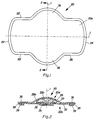
- a preferred embodiment of a unitary disposable absorbent article of the present invention is the catamenial pad, sanitary napkin 20, shown in Figure 1.
- sanitary napkin refers to an absorbent article which is worn by females adjacent to the pudendal region, generally external to the urogenital region, and which is intended to absorb and contain menstrual fluids and other vaginal discharges from the wearer's body (e.g., blood, menses, and urine). Interlabial devices which reside partially within and partially external of the wearer's vestibule are also within the scope of this invention.
- the term “pudendal” refers to the externally visible female genitalia. It should be understood, however, that the present invention is also applicable to other feminine hygiene or catamenial pads such as pantiliners, or other absorbent articles such as incontinence pads, and the like.
- the sanitary napkin 20 has two surfaces, a body-contacting surface or "body surface” 20a and a garment surface 20b.
- the sanitary napkin 20 is shown in Figure 1 as viewed from its body surface 20a.
- the body surface 20a is intended to be worn adjacent to the body of the wearer.
- the garment surface 20b of the sanitary napkin 20 (shown in Figure 2) is on the opposite side and is intended to be placed adjacent to the wearer's undergarments when the sanitary napkin 20 is worn.
- the sanitary napkin 20 has two centerlines, a longitudinal centerline “l” and a transverse centerline “t".
- the terms “transverse” or “lateral” as used herein, are interchangeable, and refer to a line, axis or direction which lies within the plane of the sanitary napkin 20 that is generally perpendicular to the longitudinal direction.
- Figure 1 shows that the sanitary napkin 20 also has two spaced apart longitudinal or side edges 22 and two spaced apart transverse or end edges (or “ends”) 24, which together form the periphery 26 of the sanitary napkin 20.
- the sanitary napkin 20 can be of any thickness, including relatively thick or relatively thin.
- the embodiment of the sanitary napkin 20 shown in Figures 1-2 is intended to be an example of a relatively thin sanitary napkin. It should be understood, however, when viewing these figures the number of layers of material shown cause the sanitary napkin 20 to appear much thicker then it actually is.
- a "thin" sanitary napkin 20 preferably has a caliper of less than about 3 millimeters.
- the thin sanitary napkin 20 shown should also be relatively flexible, so that it is comfortable for the wearer.
- the sanitary napkin 20 is extensible or stretchable.
- extensible or stretchable sanitary napkins are disclosed in PCT Patent Application WO93/01785 claiming priority of July 23, 1992 in the name of Osborn, et al. and PCT Patent Application WO93/017 claiming priority of July 23, 1992 in the name of Osborn, et al.
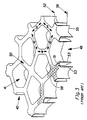
- FIG. 2 is a cross-sectional view of the sanitary napkin 20 taken along section line 2-2 of Figure 1.
- Figure 2 shows the individual components of the sanitary napkin 20.
- the sanitary napkin of the present invention generally comprises at least three primary components. These include a liquid pervious topsheet 28, a liquid impervious backsheet (or “barrier means") 30, and an absorbent core 32.
- the absorbent core 32 is positioned between the topsheet 28 and the backsheet 30.
- the sanitary napkin 20 preferably includes optional side flaps or "wings" 36 that are folded around the crotch portion of the wearer's panties.
- the sanitary napkin 20 shown also has an adhesive fastening means 38 for attaching the sanitary napkin 20 to the undergarment of the wearer. Removable release liners 39 cover the adhesive fastening means 38 to keep the adhesive from sticking to a surface other than the crotch portion of the undergarment prior to use.
- the absorbent core 32 may be any absorbent means which is capable of absorbing or retaining liquids (e.g., menses and/or urine). As shown in Figure 2, the absorbent core 32 has a body surface, a garment surface, side edges, and end edges.
- the absorbent core 32 may be manufactured in a wide variety of sizes and shapes (e.g., rectangular, oval, hourglass, dog bone, asymmetric, etc.) and from a wide variety of liquid-absorbent materials commonly used in sanitary napkins and other absorbent articles such as comminuted wood pulp which is generally referred to as airfelt.
- absorbent materials examples include creped cellulose wadding; chemically stiffened, modified or cross-linked cellulosic fibers; capillary channel fibers; synthetic fibers such as crimped polyester fibers; peat moss; tissue including tissue wraps and tissue laminates; absorbent foams; absorbent sponges; superabsorbent polymers; absorbent gelling materials; or any equivalent material or combinations of materials, or mixtures of these.
- the configuration and construction of the absorbent core may also be varied (e.g., the absorbent core 32 may have varying caliper zones (e.g., profiled so as to be thicker in the center), hydrophilic gradients, superabsorbent gradients, or lower density and lower average basis weight acquisition zones; or may comprise one or more layers or structures).
- the total absorbent capacity of thee absorbent core 32 should, however, be compatible with the design loading and the intended use of the sanitary napkin 20.
- the size and absorbent capacity of the absorbent core 32 may be varied to accommodate different uses such as incontinence pads, pantiliners, regular sanitary napkins, or overnight sanitary napkins.
- the absorbent core 32 may be comprised of certain materials or configurations to provide flexibility if so desired.
- Exemplary absorbent structures for use as the absorbent core 32 of the present invention are described in U.S. Patent 4,950,264 issued to Osborn on August 21, 1990; U.S. Patent 4,610,678 issued to Weisman et al. on September 9, 1986; U.S. Patent 4,834,735 issued to Alemany et al. on May 30, 1989; and European Patent Application No. 0 198 683, The Procter & Gamble Company, published October 22, 1986 in the name of Duenk, et al.
- the backsheet 30 and the topsheet 28 are positioned adjacent the garment surface and the body surface, respectively, of the absorbent core 32 and are preferably joined thereto and to each other by attachment means (not shown) such as those well known in the art.
- the backsheet 30 and/or the topsheet 28 may be secured to the absorbent core 32 or to each other by a uniform continuous layer of adhesive, a patterned layer of adhesive, or an array of separate lines, spirals, or spots of adhesive.
- Adhesives which have been found to be satisfactory are manufactured by H. B. Fuller Company of St. Paul, Minnesota under the designation HL-1258 or H-2031.
- the attachment means will preferably comprise an open pattern network of filaments of adhesive as is disclosed in U.S.
- Patent 4,573,986 issued to Minetola, et al. on March 4, 1986
- An exemplary attachment means of an open pattern network of filaments comprises several lines of adhesive filaments swirled into a spiral pattern such as illustrated by the apparatus and method shown in U.S. Patent 3,911,173 issued to Sprague, Jr. on October 7, 1975; U.S. Patent 4,785,996 issued to Zieker, et al. on November 22, 1978; and U.S. Patent 4,842,666 issued to Werenicz on June 27, 1989.
- the attachment means may comprise heat bonds, pressure bonds, ultrasonic bonds, dynamic mechanical bonds, or any other suitable attachment means or combinations of these attachment means as are known in the art.
- the backsheet 30 is impervious to liquids (e.g., menses and/or urine) and is preferably manufactured from a thin plastic film, although other flexible liquid impervious materials may also be used.
- the term "flexible” refers to materials which are compliant and will readily conform to the general shape and contours of the human body.
- the backsheet 30 prevents the exudates absorbed and contained in the absorbent core 32 from wetting articles which contact the sanitary napkin 20 such as pants, pajamas and undergarments.
- the backsheet 30 may thus comprise a woven or nonwoven material, polymeric films such as thermoplastic films of polyethylene or polypropylene, or composite materials such as a film-coated nonwoven material.
- the backsheet 30 is a polyethylene film having a thickness of from about 0.012 mm (0.5 mil) to about 0.051 mm (2.0 mils).
- Exemplary polyethylene films are manufactured by Clopay Corporation of Cincinnati, Ohio, under the designation P18-0401 and by Ethyl Corporation, Visqueen Division, of Terre Haute, Indiana, under the designation XP-39385.
- the backsheet 30 is preferably embossed and/or matte finished to provide a more clothlike appearance. Further, the backsheet 30 may permit vapors to escape from the absorbent core 32 (i.e., breathable) while still preventing exudates from passing through-the backsheet 30.
- the topsheet 28 is fluid pervious permitting liquids (e.g., menses and/or urine) to readily penetrate through its thickness and when the sanitary napkin 20 is in use, the topsheet 28 is in close proximity to the skin of the user.
- the topsheet 28 is compliant, soft feeling, and non-irritating to the wearer's skin.
- the topsheet 28 has two sides (or faces or surfaces), including a body-facing side 28a and a garment-facing side (or core-facing side) 28b.
- the body-facing side 28a of the topsheet 28 generally forms at least a portion of the body-contacting surface ("body surface") 20a of the sanitary napkin 20.
- FIG 3 is an enlarged, partially segmented, perspective illustration of a prior art three-dimensional, beam-like, fluid pervious plastic web 40 which has been found highly suitable for use as a topsheet 28 for a sanitary napkin 20.
- the prior art web 40 is generally in accordance with the teachings of commonly assigned U.S. Patent 4,342,314 issued to Radel et al. on August 3, 1982 and incorporated herein by reference.
- the fluid pervious plastic web 40 illustrated in Figure 3 exhibits a multiplicity of apertures, e.g., apertures 41, which are formed by a multiplicity of intersecting beam-like elements, e.g., elements 42, 43, 44, 45 and 46 interconnected to one another in the first surface 50 of the web.
- Each beam-like element comprises a base portion, e.g., base portion 51, located in uppermost plane 52.
- Each base portion has a sidewall portion, e.g., sidewall portions 53, attached to each edge thereof.
- the sidewall portions extend generally in the direction of the second surface 55 of the web.
- the intersecting sidewall portions of the beam-like elements are interconnected to one another intermediate the first and second surfaces of the web, and terminate substantially concurrently with one another in the lowermost plane 56 of the second surface 55.
- the base portions 51 of the prior art web 40 include a microscopic pattern of surface aberrations 58, generally in accordance with teachings of commonly assigned U.S. Patent 4,463,045 issued to Ahr et al. on July 31, 1984.
- the microscopic pattern of surface aberrations 58 provide a substantially non-glossy visible surface when the web 40 is struck by incident light rays.
- the interconnected sidewall portions terminate substantially concurrently with one another in the lowermost plane of the second surface 55 to form apertures 48 in the second surface 55 of the web 40.
- the apertures formed by the interconnected sidewall portion allows for free transfer of fluids from the fist surface of the web to the second surface of the web without lateral transmission of fluid between adjacent apertures.
- the prior art web 40 illustrated in Figure 3 is more commonly referred to as a formed film.
- Apertured formed films are often used for topsheets on absorbent articles because they are pervious to body exudates and yet are non-absorbent and have reduced tendency to allow liquids to pass back through and rewet the wearer's skin.
- the surface of the formed film which is in contact with the body remains dry, thereby reducing body soiling and creating a more comfortable feel for the wearer.
- Examples of formed films are described in U.S. Patent 3,929,135 issued to Thompson on December 30, 1975; U.S. Patent 4,324,246 issued to Mullane et al. on April 13, 1982; U.S. Patent 4,463,045 issued to Ahr et al.
- Figure 4 Is an enlarged, partially segmented perspective illustration of a photoetched laminate structure 60 utilized to vacuum form an initially impervious, substantially planar, heated plastic film to produce a prior art, fluid pervious, beam-like web 40 of the type generally illustrated in Figure 3.
- the laminate structure 60 is preferably constructed in accordance with the teaching of commonly assigned U.S. Patent 4,342,314 issued to Radel et al. on August 3, 1982.
- the laminate structure 60 is comprised of individual lamina 61, 62 and 63.
- the aperture patterns in the individual lamina are Identical to one another.
- FIG. 4 A comparison of Figure 4 with the beam-like plastic web 40 shown in Figure 3 reveals the correspondence of aperture 41 in the uppermost plane 52 of plastic web 40 to the uppermost opening 65 in the uppermost plane 66 of the photoetched laminate structure 60. Likewise, aperture 48 in the lowermost plane 56 of plastic web 40 corresponds to the lowermost opening 69 in the lowermost plane 67 of the photoetched laminate structure 60.
- the uppermost surface 64 of photoetched laminate structure 60 located in uppermost plane 66 is provided with a microscopic pattern of protuberances 68.
- This is preferably accomplished by applying a resist coating which corresponds to the desired microscopic pattern of surface aberrations to the top side of a planar photoetched lamina 61, and thereafter initiating a second photoetching process.
- the second photoetching process produces a lamina 61 having a microscopic pattern of protuberances 68 on the uppermost surface 64 of the interconnected beam-like elements defining the pentagonally shaped apertures, e.g., aperture 65.
- Construction of a laminate structure employing such a pattern of protuberances 68 on its uppermost layer is generally disclosed in commonly assigned U.S. Patent 4,463,045 issued to Ahr et al. on July 31, 1984.
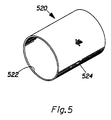
- the outermost surface 524 of the tubular forming member 520 is utilized to form the plastic web brought in contact therewith while the innermost surface 522 of the tubular member generally does not contact the plastic web during the forming operation.
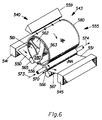
- the tubular member may be employed as the forming surface on debossing/perforating cylinder 555 in a process of the type generally illustrated in Fig. 6 and described in detail In U.S. Patent 4,151,240 issued to Lucas et al. on April 24, 1979.
- a particularly preferred apparatus 540 of the type disclosed in said patent is schematically shown in Fig. 6. It includes constant tension film supply means 541, debossing and perforating means 543, and constant tension film forwarding and winding means 545.
- apparatus 540 comprises means for continuously converting a ribbon of thermoplastic film 550 into a debossed and perforated film 551 by directing hot air jets against one surface of the film while applying vacuum adjacent the opposite surface of the film, and while maintaining sufficient control of the film 550 to substantially obviate wrinkling and/or macroscopically distending the film.
- apparatus 540 comprises means for maintaining constant machine direction tension in the film both upstream and downstream of a zone where the temperature is greater than the thermoplastic temperature of the film, but in which zone there is substantially zero machine direction and cross-machine direction tension tending to macroscopically distend the film.
- the tension is required to control and smooth a running ribbon of thermoplastic film; the zero tension zone results from the film in the zone being at a sufficiently high temperature to enable debossing, and if desired, perforating it through the use of heat and vacuum.
- Figure 6 also shows greatly enlarged scale perforations in film 551 to enable visually perceiving the nature of the difference between the imperforate film 550 and the debossed and perforated film 551 as more fully described hereinafter.
- the debossing and perforating means 543 includes a rotatably mounted debossing perforating cylinder 555 having closed ends 580, a nonrotating triplex vacuum manifold assembly 556 and hot air jet means 559.
- the triplex vacuum manifold assembly 556 comprises three manifolds designated 561, 562, and 563.
- Also shown in Figure 6 is a freely rotatable lead-on idler roll 565, a power rotated lead-off/chill roll 566 and a soft-face (e.g., low density neoprene) roll 567 which is driven with the chill roll.
- thermoplastic ribbon of film running circumferentially about a portion of the debossing-perforating cylinder 555 is sequentially subjected to a first level of vacuum by manifold 561, a second level of vacuum by manifold 562, and a third level of vacuum by manifold 563.
- the vacuum applied to the film by manifold 561 enables maintaining upstream tension in the film
- vacuum applied by manifold 562 enables perforating the film when hot air is directed radially inwardly against the film
- vacuum applied by manifold 563 enables cooling the film to below its thermoplastic temperature and enables establishing downstream tension therein.
- the film contacting surface of the debossing-perforating cylinder 555 may be preheated prior to reaching vacuum manifold 562 by means well known in the art (and therefore not shown) to facilitate better conformance of plastic films comprised of flow-resistant polymers during the debossing operation.
- nip 570 intermediate chill roll 566 and the soft-face roll 567 is only nominally loaded because high pressure would iron-out the three-dimensional debossments which are formed in the film in the aforementioned manner.
- nominal pressure in nip 570 helps the vacuum applied by manifold 563 to isolate downstream tension (i.e., roll winding tension) from the debossing-perforating portion of the debossing-perforating cylinder 555, and enables the nip 570 to peel the debossed and perforated film from the debossing-perforating cylinder 555.
- the first vacuum manifold 561, and the third vacuum manifold 563 located within the debossing-perforating cylinder 555 enable maintaining substantially constant upstream and downstream tension respectively in a running ribbon of film while the intermediate portion of the film adjacent the second vacuum manifold 562 within the debossing-perforating cylinder 555 is subjected to tension vitiating heat and vacuum to effect debossing and perforating of the film.
- cons!ant tension film supply means 541 and the constant tension film forwarding and winding means 545 may, if desired, be substantially identical to and function substantially identically to the corresponding portions of the apparatus shown and described in U.S. Patent 3,674,221 issued to Riemersma on July 4, 1972.
- the debossing and perforating means 543 comprises the rotatably mounted debossing-perforating cylinder 555, means (not shown) for rotating the cylinder 555 at a controlled peripheral velocity, the non-rotating triplex vacuum manifold assembly 556 inside the debossing-perforating cylinder 555, means (not shown) for applying controlled levels of vacuum Inside the three vacuum manifolds 561, 562 and 563 comprising the triplex manifold assembly 556, and hot air jet means 559.
- the debossing-perforating cylinder 555 may be constructed by generally following the teachings of U.S. Patent 4,151,240 issued to Lucas et al. on April 24, 1979 but substituting a tubular laminate forming surface of the present invention for the perforated tubular forming surface disclosed therein.
- photoetched laminate forming structures could be employed with equal facility to directly form a three-dimensional plastic structure.
- a heated fluid plastic material typically a thermoplastic resin
- Such a procedure would involve applying a heated fluid plastic material, typically a thermoplastic resin, directly to the forming surface applying a sufficiently great pneumatic differential pressure to the heated fluid plastic material to cause said material to conform to the image of the perforate laminate forming surface, allowing the fluid material to solidify, and thereafter removing the three-dimensional plastic structure from the forming surface.
- the present technology could, if desired, be incorporated in suitably reinforced film embossing rolls and the like, provided only that the embossing pressures to which the rolls will ultimately be subject are not so great as to destroy the particular three-dimensional pattern exhibited by the laminate embossing surface.
- a resilient back-up roll could, if desired, be utilized in such an embossing operation to avoid damaging the laminate embossing surface.
- laminate forming surfaces of the present invention may find utility in applications other than plastic film forming.
- Another preferred method for converting a ribbon of thermoplastic film into a three-dimensional structure is by applying a high pressure fluid against one surface of the film while jet comprised of water on the like applying a vacuum adjacent the opposite surface of the film.
- Such methods are described in greater detail in U.S. Patents 4,609,518 issued to Curro et al. on September 2, 1986; 4,629,643 issued to Curro et al. on December 16, 1986; 4,637,819 issued to Ouellette et al. on January 20, 1987; 4,695,422 issued to Curro et al. on September 22, 1987; and 4,839,216 issued to Curro et al. on June 13, 1989;
- FIGS 7 and 8 is shown a plan view photograph enlarged approximately 20 times actual size of a preferred embodiment of a three-dimensional, fluid-pervious plastic web 80 of the present invention.
- the webs 80 is particularly well suited for use as a topsheet 28 on a sanitary napkin 20 of the type generally illustrated in Figures 1 and 2.
- Figure 7 is a plan view of the wearer or body contacting surface 80a of the web 80
- Figure 8 is a plan view of the garment facing or pad contacting surface 80b of the web 80.
- the web 80 is comprised of a plurality of beam-like elements 81 interconnected to one another to form apertures 82 in the web.
- beam-like is used to connote a three-dimensional structure which separates adjacent apertures in a three-dimensional formed film.
- a plurality of the beam-like elements 81 have permanently deformed sections 95.
- the permanently deformed sections 95 of the beam-like elements 81 are sections which have been elongated or incrementally stretched substantially In a particular direction, preferably the transverse direction.
- the transverse direction “t” is that direction which is perpendicular to the longitudinal "l” or machine direction, as will be described in detail below.
- the permanently deformed sections 95 of the beam-like elements 81 exhibit a somewhat saddle-shaped configuration.
- the permanently deformed sections 105 of the beam-like elements 101 of the web 100 are deformed to a greater extent than the permanently deformed sections 95 of the beam-like elements 81 of the web 80 of Figures 7 and 8.
- the base portions of the permanently deformed sections of the beam-like elements reside below the uppermost plane of the web while the web is in a substantially non-tensioned or relaxed state.
- the base portion of the permanently deformed sections of the beam-like elements are elevated toward the uppermost plane as depicted in Figure 10.
- the elevation of the permanently deformed section towards the uppermost plane of the web while the web is subjected to tension in the transverse direction allows the web to extend in the transverse direction.
- the permanently deformed sections of the beam-like elements Upon release of the tension the permanently deformed sections of the beam-like elements return or contract to their non-tensioned or relaxed state, as shown in Figure 9, thus providing a substantially increased elasticity to the web in the transverse direction as compared to an identical web not having beam-like elements with permanently deformed sections.
- the permanently deformed sections of the beam-like elements behave as springs.
- the term "spring” means an elastic body or device that recovers its original shape when released after being distorted.
- the permanently deformed sections of the beam-like elements When subjected to tension in the transverse direction, the permanently deformed sections of the beam-like elements are extended or distorted in the direction of applied tension and return to their original shape after removal of the applied tension.
- the permanently deformed sections of the beam-like elements provide a substantially increased elasticity to the web.
- the prior art web of Figure 3 is substantially inelastic. However, by changing or altering its geometry the prior art web can be made to be substantially elastic.
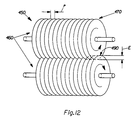
- a three-dimensional, fluid pervious, polyolefin apertured web made according to the aforementioned process is longitudinally passed through rolls 460 of ring-rolling apparatus 450 illustrated in Figure 12 to make the web of the present invention.
- Rolls 460 consist of teeth 470 which are separated by a uniform distance, p, more commonly known as pitch.
- the teeth 470 of each roll 460 are offset by a distance P/2 from each other.
- the distance between the outer circumferences 490 of the rolls 460 can be varied by an intermeshing distance, E, more commonly known as the engagement.
- Ring-rolling of the prior at web 40 incrementally stretches and thereby plastically deforms a plurality of the beam-like elements 81 in the transverse direction.
- the stretching of the beam-like elements occurs incrementally across the width of the web (transverse direction) as the film is constrained at the tips of the teeth 470 and is stretched an amount that is proportional to the pitch and the engagement.
- the engagement depth of the rolls 460 is increased, the incremental stretching and the plastic deformation of the beam-like elements 81 is increased.
- Figures 7 and 8 depict an elastic, three-dimensional, apertured web 80, which has been ring-rolled at an engagement of 1.905 mm (0.075 inches) and at a pitch of 2.54 mm (0.100 inches).
- Figures 9 and 10 depict an elastic three-dimensional apertured web 100, which has been ring-rolled at an engagement of 0.150 inches and at a pitch of 2.54 mm (0.100 inches).
- a particularly preferred three-dimensional, fluid pervious apertured web of the present invention is made from low density polyethylene (LDPE) film available from Tredegar Film Products, of Terre Haute, Indiana, under the designation (X-5654) and is formed by the aforementioned process, more specifically described in U.S. Patents 4,342,314 and 4,463,045.
- the web which is ten inches wide and of variable length is passed in the machine or longitudinal direction through a ring-rolling apparatus operated via a manual hand crank.
- the diameter of each aperture of the web is approximately 0.889 mm (0.035 inch) and the width of each beam-like element is approximately 0.1778 mm (0.007 inch).
- the degree of stretch imparted to the web is experimentally determined by conducting tensile tests on an Instron Model 1125 test stand.
- the samples for testing are cut from the three-dimensionally apertured ring-rolled webs in 7.62 cm (3 inch) by 2.54 cm (1 inch) strips, the 7.62 cm (3 inch) dimension being in the transverse direction of the web.
- These samples are mounted into hydraulic grips on the Instron where the distance between the grips (known as the gage length) is two inches. Each sample is pulled at a rate of 127 mm (5.0 inches] per minute until it breaks.
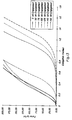
- the data is plotted using Sintech's Test Works software on an IBM 386 personal computer. A graph of the force versus elongation behavior of several samples is shown in Figure 13.
- the low force elastic behavior of the ring-rolled web is quantified by the stretch ratio of a web ring-rolled at a given engagement depth.
- the stretch ratio is defined as the length of the film at its maximum extension divided by the original gage length of the web.
- the maximum extension is determined by the first drawing an isoline at 100 grams on the force-elongation graph and then drawing a tangent to each curve above the 100 gram line. A force of 100 grams was selected because forces greater than 100 grams may cause increased plastic deformation of the beam-like elements of the web. The point at which these two lines intersect is called the maximum extension.
- Figure 14 also includes a plot of the stretch ratio versus engagement depth for a ring-rolled unapertured web of the same composition as the ring-rolled apertured web. This plot was obtained in the same manner as that of the ring-rolled, three-dimensional, apertured web. Stretch ratio versus engagement depth plots of ring-rolled two-dimensionally apertured webs and lightly to highly embossed webs substantially follow the behavior of the ring-rolled unapertured web. This indicates that the low force elastic behavior described herein holds for any variety of three-dimensional, apertured webs which have been ring-rolled and does not hold for unapertured films or for two dimensional apertured films which have been ring-rolled.
- Figures 11A-11D are cross-sectional illustration of various beam-like geometries.
- Figure 11A is a cross-sectional illustration of a preferred beam-like element 81 of the present invention.
- Beam-like element 81 has a base portion 84 located in an uppermost plane 85 of the first or wearer contacting surface 80a.
- base portion is used to connote that portion of the beam-like element 81 which contacts the wearer's skin when the absorbent article is used.
- a pair of sidewall portions 87 depend from the base portion 84 and extend generally in the direction of the second surface 80b, located in lowermost plane 90.
- Figure 11B is cross-sectional illustration of an alternative beam-like element 161 of the present invention.
- the beam-like element 161 comprises a base portion 164 in the uppermost plane 165 of the first or wearer contacting surface 166.
- a pair of sidewall portions 167 depend from the base portion 164 and extend generally in the direction of the second surface 168, located in lowermost plane 170.
- Figure 11C is cross-sectional illustration of an alternative beam-like element 261 of the present invention.
- the beam-like element 261 comprises a base portion 264 in the uppermost plane 265 of the first or wearer contacting surface 266.
- a pair of sidewall portions 267 depend from the base portion 264 and extend generally in the direction of the second surface 268, located in lowermost plane 270.
- Figure 11D is cross-sectional illustration of an alternative beam-like element 361 of the present invention.
- the beam-like element 361 comprises a base portion 364 in the uppermost plane 365 of the first or wearer contacting surface 366.
- a pair of sidewall portions 367 depend from the base portion 364 and extend generally in the direction of the second surface 368 located, in lowermost plane 370.
- the cross-section of the beam-like elements may be either substantially uniform or non-uniform along this length.
- An example of a beam-like element having a substantially uniform cross-section along its length is illustrated in U.S. Patent 4,342,314 issued to Radel et al.
- An example of a beam-like element having a non-uniform cross-section along its length is illustrated in U.S. Patent 3,929,135 issued to Thompson et al.
- the present invention has been described as subjecting an entire web to ring-rolling in one particular direction, the present invention is in no way limited to such application.
- the present invention may also be practiced by subjecting only predetermined discrete portions of the web to ring-rolling. For example, it may be desirable to ring-roll a discrete portion of the web which when used as a topsheet on an absorbent article corresponds to the central portion of the absorbent article.
- the present invention may also be practiced by ring-rolling the web in more than one direction to impart an increased elasticity to the web in more than one direction.
- ring-rolling of prior art web also changes other resultant properties of the web.
- the drape, stretched open-area, and ultimate tensile strength of the ring-rolled web typically increase.
- the gloss and effective stretched basis weight of the ring-rolled web are typically decreased.
- the body surface of the formed film topsheet is hydrophilic so as to help liquid to transfer through the topsheet faster than if the body surface was not hydrophilic so as to diminish the likelihood that menstrual fluid will flow off the topsheet rather than flowing into and being absorbed by the absorbent core.
- surfactant is incorporated into the polymeric materials of the formed film topsheet such as is described in PCT Patent Application WO93/09741 "Absorbent Article Having A Nonwoven and Apertured Film Coversheet" claiming priority of on November 19, 1991 by Aziz, et al.
- the body surface of the topsheet can be made hydrophilic by treating it with a surfactant such as is described in the above referenced U.S. Patent 4,950,254 issued to Osborn.
- the sanitary napkin 20 can be held in place by any support means or attachment means well-known for such purposes.
- the sanitary napkin 20 is placed in the user's undergarment or panty and secured thereto by a fastener such as an adhesive 38, shown in Figure 2.
- the adhesive 38 provides a means for securing the sanitary napkin 20 in the crotch portion of the panty.
- Any adhesive or glue used in the art for such purposes can be used for the adhesive herein, with pressure-sensitive adhesives being preferred.
- Suitable adhesives are Century A-305-IV manufactured by the Century Adhesives Corporation of Columbus, Ohio; and Instant Lock 34-2823 manufactured by the National Starch and Chemical Company of Bridgewater, NJ. Suitable adhesive fasteners are also described in U.S.
- Patent 4,917,697 Before the sanitary napkin is placed in use, the pressure-sensitive adhesive is typically covered with a removable release liner 39 in order to keep the adhesive from drying out or adhering to a surface other than the crotch portion of the panty prior to use.
- Suitable release liners are also described in the above-referenced U.S. Patent 4,917,697. Any commercially available release liners commonly used for such purposes can be utilized herein.
- suitable release liners are BL30MG-A Silox E1/0 and BL30MG-A Silox 4P/0 both of which are manufactured by the Akrosil Corporation of Menasha, WI.
- the sanitary napkin 20 of the present invention is used by removing the release liner 39 and thereafter placing the sanitary napkin in a panty so that the adhesive contacts the panty.
- the adhesive 38 maintains the sanitary napkin 20 in its position within the panty during use.
Landscapes
- Health & Medical Sciences (AREA)
- Engineering & Computer Science (AREA)
- Mechanical Engineering (AREA)
- General Health & Medical Sciences (AREA)
- Veterinary Medicine (AREA)
- Vascular Medicine (AREA)
- Life Sciences & Earth Sciences (AREA)
- Animal Behavior & Ethology (AREA)
- Biomedical Technology (AREA)
- Public Health (AREA)
- Heart & Thoracic Surgery (AREA)
- Epidemiology (AREA)
- Absorbent Articles And Supports Therefor (AREA)
- Laminated Bodies (AREA)
- Materials For Medical Uses (AREA)
- Nonwoven Fabrics (AREA)
- Orthopedics, Nursing, And Contraception (AREA)
- Woven Fabrics (AREA)
- Artificial Filaments (AREA)
Claims (10)
- Eine elastische, dreidimensionale, fluiddurchlässige, polymere Bahn (80) mit einer ersten Richtung (l) und einer dazu senkrecht verlaufenden zweiten Richtung (t), wobei die genannte Bahn eine Vielzahl balkenartiger Elemente (81) umfaßt, die unter Bildung von Öffnungen (82) in der genannten Bahn (80) miteinander verbunden sind, wobei die genannten balkenartigen Elemente (81) einen Basisabschnitt (84) in einer obersten Ebene (85) und ein Paar Seitenwandungsabschnitte (87), die von dem genannten Basisabschnitt (84) herunterhängen, aufweisen, wobei die genannte Bahn dadurch gekennzeichnet ist, daß eine Vielzahl der genannten balkenartigen Elemente (81) permanent verformte Teilstücke (95) aufweist, sodaß der genannte Basisabschnitt des genannten verformten Teilstücks (95) unterhalb der genannten obersten Ebene (85) liegt, während die genannte Bahn (80) sich in einem im wesentlichen nicht-gespannten Zustand befindet, wobei der genannte Basisabschnitt (84) des genannten permanent verformten Teilstücks (95) gegen die genannte oberste Ebene (85) angehoben ist, wenn die genannte Bahn (80) in der ersten Richtung (l) einer Zugspannung unterworfen ist, die es der genannten Bahn (80) gestattet, sich in der ersten Richtung (l) zu dehnen, und der genannte Basisabschnitt (84) des genannten permanent verformten Teilstücks (95) in seine nicht-gespannte Position unterhalb der genannten obersten Ebene (85) zurückkehrt, wenn die Zugspannung in der genannten Bahn (80) freigegeben wird.
- Die elastische, dreidimensionale Bahn (80) nach Anspruch 1, in welcher mindestens ein Abschnitt der genannten balkenartigen Elemente (81) über einen Teil seiner Länge im wesentlichen gerade ist.
- Die elastische, dreidimensionale Bahn (80) nach Anspruch 1 oder Anspruch 2, in welcher die genannten Öffnungen (82) entlang ihrer Länge von nicht-einheitlichem Querschnitt sind.
- Die elastische, dreidimensionale Bahn (80) nach einem der vorhergehenden Ansprüche, in welcher eine Vielzahl der genannten balkenartigen Elemente (81), die permanent verformte Teilstücke (95) aufweisen, nur in diskreten Abschnitten der genannten Bahn (80) angeordnet ist.
- Die elastische, dreidimensionale Bahn (80) nach einem der vorhergehenden Ansprüche, in welcher der genannte Basisabschnitt (84) des genannten permanent verformten Teilstücks (95) gegen die genannte oberste Ebene (85) angehoben ist, wenn die genannte Bahn (80) in der zweiten Richtung (t) einer Zugspannung unterworfen ist, die es der genannten Bahn (80) gestattet, sich in der zweiten Richtung (t) zu dehnen, und der genannte Basisabschnitt (84) des genannten permanent verformten Teilstücks (95) in seine nicht-gespannte Position unterhalb der genannten obersten Ebene (85) zurückkehrt, wenn die Zugspannung in der genannten Bahn (80) freigegeben wird.
- Ein absorbierender Artikel (20), der ein Träger-berührendes Deckblatt (28) und ein absorbierendes Element (32) zum Absorbieren von Körperfluiden umfaßt, wobei das genannte Deckblatt (28) eine elastische, dreidimensionale, fluiddurchlässige polymere Bahn (80) mit einer ersten Richtung (l) und einer dazu senkrecht verlaufenden zweiten Richtung (t) umfaßt, die genannte Bahn (80) eine Vielzahl balkenartiger Elemente (81) umfaßt, die unter Bildung von Öffnungen (82) in der genannten Bahn (80) miteinander verbunden sind, wobei die genannten balkenartigen Elemente (81) einen Basisabschnitt (84) in einer obersten Ebene (85) und ein Paar Seitenwandungsabschnitte (87), die von dem genannten Basisabschnitt (84) herunterhängen und das genannte absorbierende Element (32) berühren, aufweisen, dadurch gekennzeichnet, daß eine Vielzahl der genannten balkenartigen Elemente (81) permanent verformte Teilstücke (95) aufweist, sodaß der genannte Basisabschnitt (84) des genannten permanent verformten Teilstücks (95) unterhalb der genannten obersten Ebene (85) liegt, während sich die genannte Bahn (80) in einem im wesentlichen nicht unter Zugspannung gesetzten Zustand befindet, wobei der genannte Basisabschnitt (84) des genannten permanent verformten Teilstücks (95) gegen die genannte oberste Ebene (85) angehoben ist, wenn die genannte Bahn (80) in der ersten Richtung (l) einer Zugspannung ausgesetzt ist, die es der genannten Bahn (80) gestattet, sich in der ersten Richtung (l) zu dehnen, und der genannte Basisabschnitt (84) des genannten permanent verformten Teilstücks (95) in seine nicht-gespannte Position unterhalb der genannten obersten Ebene (85) zurückkehrt, wenn die Zugspannung in der genannten Bahn (80) freigegeben wird.
- Der absorbierende Artikel (20) nach Anspruch 6, der ein Rückenblatt (30) inkludiert, das gegen den Durchgang von wässerigem Fluid durch es hindurch resistent ist und in übereinanderliegender Beziehung anliegend an die Oberfläche des genannten absorbierenden Elementes (32) gegenüber dem genannten Deckblatt (28) am genannten absorbierenden Artikel (20) befestigt ist.
- Der absorbierende Artikel (20) nach Anspruch 6 oder Anspruch 7, in welchem der genannte absorbierende Artikel (20) eine dehnbare oder streckbare Monatshygiene-Einrichtung umfaßt.
- Der absorbierende Artikel (20) nach einem der Ansprüche 6, 7 oder 8, in welchem eine Vielzahl der genannten balkenartigen Elemente (81), die permanent verformte Teilstücke (95) aufweisen, nur in diskreten Abschnitten der genannten Bahn angeordnet ist.
- Der absorbierende Artikel (20) nach einem der Ansprüche 6, 7, 8 oder 9, in welchem der genannte Basisabschnitt (84) des genannten permanent verformten Teilstücks (95) gegen die genannte oberste Ebene (85) angehoben ist, wenn die genannte Bahn (80) in der zweiten Richtung (t) einer Zugspannung unterworfen ist, die es der genannten Bahn (80) gestattet, sich in der zweiten Richtung (t) zu dehnen, und der genannte Basisabschnitt (84) des genannten permanent verformten Teilstücks (95) in seine nichtgespannte Position unterhalb der genannten obersten Ebene (85) zurückkehrt, wenn die Zugspannung in der genannten Bahn (80) freigegeben wird.
Applications Claiming Priority (3)
| Application Number | Priority Date | Filing Date | Title |
|---|---|---|---|
| US07/936,195 US5366782A (en) | 1992-08-25 | 1992-08-25 | Polymeric web having deformed sections which provide a substantially increased elasticity to the web |
| US936195 | 1992-08-25 | ||
| PCT/US1993/007160 WO1994004112A1 (en) | 1992-08-25 | 1993-08-02 | Polymeric web having deformed sections which provide a substantially increased elasticity to the web |
Publications (2)
| Publication Number | Publication Date |
|---|---|
| EP0699065A1 EP0699065A1 (de) | 1996-03-06 |
| EP0699065B1 true EP0699065B1 (de) | 1998-07-15 |
Family
ID=25468310
Family Applications (1)
| Application Number | Title | Priority Date | Filing Date |
|---|---|---|---|
| EP93918509A Expired - Lifetime EP0699065B1 (de) | 1992-08-25 | 1993-08-02 | Polymere florschicht mit deformierten abteilungen, die der florschicht eine wesentlich gesteigerte elastizität verleihen |
Country Status (22)
| Country | Link |
|---|---|
| US (1) | US5366782A (de) |
| EP (1) | EP0699065B1 (de) |
| JP (1) | JP3519082B2 (de) |
| KR (1) | KR100295527B1 (de) |
| CN (1) | CN1076603C (de) |
| AT (1) | ATE168264T1 (de) |
| AU (1) | AU686109B2 (de) |
| BR (1) | BR9306985A (de) |
| CA (1) | CA2142296C (de) |
| DE (1) | DE69319749T2 (de) |
| EG (1) | EG20076A (de) |
| ES (1) | ES2118246T3 (de) |
| FI (1) | FI950860L (de) |
| MX (1) | MX9305165A (de) |
| MY (1) | MY108757A (de) |
| NO (1) | NO950676L (de) |
| NZ (1) | NZ255165A (de) |
| PH (1) | PH30154A (de) |
| SG (1) | SG55021A1 (de) |
| TR (1) | TR27029A (de) |
| TW (1) | TW302692U (de) |
| WO (1) | WO1994004112A1 (de) |
Cited By (1)
| Publication number | Priority date | Publication date | Assignee | Title |
|---|---|---|---|---|
| CN102065813B (zh) * | 2008-06-17 | 2014-11-26 | 宝洁公司 | 包括活化区的吸收制品 |
Families Citing this family (148)
| Publication number | Priority date | Publication date | Assignee | Title |
|---|---|---|---|---|
| US5585017A (en) * | 1993-09-13 | 1996-12-17 | James; William A. | Defocused laser drilling process for forming a support member of a fabric forming device |
| US5916462A (en) * | 1993-09-13 | 1999-06-29 | James; William A. | Laser drilling processes for forming an apertured film |
| US5817394A (en) | 1993-11-08 | 1998-10-06 | Kimberly-Clark Corporation | Fibrous laminated web and method and apparatus for making the same and absorbent articles incorporating the same |
| US6025050A (en) * | 1994-06-15 | 2000-02-15 | Bba Nonwovens Simpsonville, Inc. | Thermally appertured nonwoven laminates for wipes and coverstock for hygienic articles |
| US5851935A (en) * | 1996-08-29 | 1998-12-22 | Bba Nonwovens Simpsonville, Inc. | Cross-directionally stretchable elastomeric fabric laminated by thermal spot bonding |
| NZ272887A (en) * | 1994-09-16 | 1998-06-26 | Mcneil Ppc Inc | Apertured plastics film comprises a tricot-like or knitted fabric film having sloped side walls extending from wales or ridges and micro-holes |
| US5704101A (en) * | 1995-06-05 | 1998-01-06 | Kimberly-Clark Worldwide, Inc. | Creped and/or apertured webs and process for producing the same |
| US5814390A (en) | 1995-06-30 | 1998-09-29 | Kimberly-Clark Worldwide, Inc. | Creased nonwoven web with stretch and recovery |
| US5681301A (en) * | 1996-01-24 | 1997-10-28 | Johnson & Johnson Worldwide Absorbent Products | Backing web in an absorbent article |
| US6114595A (en) * | 1996-04-11 | 2000-09-05 | The Procter & Gamble Company | Stretchable, extensible composite topsheet for absorbent articles |
| US5628856A (en) * | 1996-04-29 | 1997-05-13 | The Procter & Gamble Company | Method for forming a composite elastic material |
| US5645672A (en) * | 1996-06-24 | 1997-07-08 | The Proctor & Gamble Company | Method for forming a composite elastic material |
| US5733628A (en) * | 1996-10-10 | 1998-03-31 | Tredegar Industries, Inc. | Breathable elastic polymeric film laminates |
| US6465713B1 (en) | 1997-06-30 | 2002-10-15 | Mcneil-Ppc, Inc. | Tampon having an apertured film cover |
| AU2006203504B2 (en) * | 1997-06-30 | 2007-08-02 | Mcneil-Ppc, Inc. | Tampon having an apertured film cover |
| KR100395393B1 (ko) * | 1998-05-29 | 2003-08-21 | 모토로라 인코포레이티드 | 컴퓨터 주변장치의 초기화 및 컴퓨터 주변장치와의 통신을위한 시스템, 장치 및 방법 |
| US5873868A (en) * | 1998-06-05 | 1999-02-23 | The Procter & Gamble Company | Absorbent article having a topsheet that includes selectively openable and closable openings |
| US6262331B1 (en) | 1998-06-05 | 2001-07-17 | The Procter & Gamble Company | Absorbent article having a topsheet that includes selectively openable and closable openings |
| SE512372C2 (sv) * | 1998-07-02 | 2000-03-06 | Sca Hygiene Prod Ab | Vätskegenomsläppligt ytmaterial för absorberande engångsalster, förfarande för dess tillverkning, och ett absorberande engångsalster med ett sådant ytmaterial |
| EP1985639B1 (de) * | 1999-04-09 | 2013-08-14 | Life Technologies AS | Verfahren zur Herstellung monodisperser Polymerteilchen |
| US6613033B1 (en) | 2000-08-15 | 2003-09-02 | Kimberly-Clark Worldwide, Inc. | Pant-like absorbent garments having curved leg cuffs |
| US6652504B1 (en) * | 2000-08-15 | 2003-11-25 | Kimberly-Clark Worldwide, Inc. | Pant-like absorbent garments having curved leak guard flaps |
| JP4840895B2 (ja) * | 2001-02-20 | 2011-12-21 | 株式会社日本吸収体技術研究所 | 液体分配ユニットとそれを備えた吸収体製品 |
| ITMI20020386A1 (it) * | 2002-02-27 | 2003-08-27 | Ledysan S P A | Procedimento per realizzare una pellicola biodegradabile per articoliassorbenti igienici-sanitari e pannolini che la contengono |
| US7855316B2 (en) * | 2002-12-20 | 2010-12-21 | Kimberly-Clark Worldwide, Inc. | Preferentially stretchable laminates with perforated layers |
| EP2177188B1 (de) | 2003-02-12 | 2015-11-04 | The Procter and Gamble Company | Saugfähiger Kern für einen saugfähigen Artikel |
| DE60323810D1 (de) | 2003-02-12 | 2008-11-13 | Procter & Gamble | Bequem Windel |
| US7819852B2 (en) | 2003-06-20 | 2010-10-26 | The Procter & Gamble Company | Sanitary napkin for clean body benefit |
| DE20311313U1 (de) * | 2003-07-23 | 2003-10-02 | RKW AG Rheinische Kunststoffwerke, 67547 Worms | Perforierter Film mit strukturierter Oberfläche |
| US7736351B2 (en) | 2004-02-02 | 2010-06-15 | The Procter & Gamble Company | Simple disposable absorbent article |
| US7318820B2 (en) | 2004-03-12 | 2008-01-15 | The Procter & Gamble Company | Simple disposable absorbent article having breathable side barriers |
| US8684988B2 (en) | 2004-06-29 | 2014-04-01 | The Procter & Gamble Company | Disposable absorbent article having barrier cuff strips |
| US6962578B1 (en) | 2004-06-29 | 2005-11-08 | The Procter & Gamble Company | Disposable absorbent article having backsheet strips |
| US7763004B2 (en) | 2005-05-18 | 2010-07-27 | The Procter & Gamble Company | Disposable absorbent article having layered containment pockets |
| US20060264861A1 (en) | 2005-05-20 | 2006-11-23 | Lavon Gary D | Disposable absorbent article having breathable side flaps |
| US8187239B2 (en) | 2005-05-31 | 2012-05-29 | The Procter & Gamble Company | Side notched folded diaper |
| US7695463B2 (en) | 2005-06-22 | 2010-04-13 | The Procter & Gamble Company | Disposable absorbent article having dual layer barrier cuff strips |
| US7618404B2 (en) | 2005-06-23 | 2009-11-17 | The Procter & Gamble Company | Disposable absorbent article having doubled side flaps and backsheet strips |
| US7931636B2 (en) | 2005-08-04 | 2011-04-26 | The Procter & Gamble Company | Simple disposable absorbent article |
| US8684990B2 (en) | 2005-09-12 | 2014-04-01 | The Procter & Gamble Company | Simple disposable pant-like garment having breathable side barriers |
| US7320684B2 (en) | 2005-09-21 | 2008-01-22 | The Procter & Gamble Company | Disposable absorbent article having deployable belt strips |
| US7737324B2 (en) | 2005-11-23 | 2010-06-15 | The Procter & Gamble Company | Disposable absorbent article having deployable chassis ears |
| CN101460123A (zh) * | 2006-06-07 | 2009-06-17 | 宝洁公司 | 用于吸收制品的可双轴向拉伸的外覆盖件 |
| US8235963B2 (en) | 2006-06-07 | 2012-08-07 | The Procter & Gamble Company | Disposable wearable absorbent articles with anchoring systems |
| US20070287983A1 (en) | 2006-06-07 | 2007-12-13 | Richard Worthington Lodge | Absorbent article having an anchored core assembly |
| US9072633B2 (en) | 2006-06-07 | 2015-07-07 | The Procter & Gamble Company | Biaxially stretchable outer cover for an absorbent article |
| US8257335B2 (en) | 2007-01-31 | 2012-09-04 | The Procter & Gamble Company | Diaper having hip stretch panels |
| US8585672B2 (en) | 2007-02-28 | 2013-11-19 | The Procter & Gamble Company | Disposable absorbent article having deployable belt ears |
| US7857801B2 (en) | 2007-03-23 | 2010-12-28 | The Procter & Gamble Company | Diaper having deployable chassis ears and stretch waistband |
| DE112008000010B4 (de) | 2007-06-18 | 2013-08-22 | The Procter & Gamble Company | Einwegabsorptionsartikel mit im wesentlichen kontinuierlich verteilten, teilchenförmigem polymerem Absorptionsmaterial und Verfahren zu dessen Herstellung |
| WO2008155722A2 (en) | 2007-06-18 | 2008-12-24 | The Procter & Gamble Company | Disposable absorbent article with sealed absorbent core with substantially continuously distributed absorbent particulate polymer material |
| US8858523B2 (en) | 2007-09-07 | 2014-10-14 | The Procter & Gamble Company | Disposable wearable absorbent articles with anchoring subsystems |
| US8668679B2 (en) | 2007-09-07 | 2014-03-11 | The Procter & Gamble Company | Disposable wearable absorbent articles with anchoring subsystems |
| US9056031B2 (en) | 2007-09-07 | 2015-06-16 | The Procter & Gamble Company | Disposable wearable absorbent articles with anchoring subsystems |
| US8597268B2 (en) | 2007-09-07 | 2013-12-03 | The Procter & Gamble Company | Disposable wearable absorbent articles with anchoring subsystems |
| US9060900B2 (en) | 2007-09-07 | 2015-06-23 | The Proctor & Gamble Company | Disposable wearable absorbent articles with anchoring subsystems |
| US8945079B2 (en) | 2007-09-07 | 2015-02-03 | The Procter & Gamble Company | Disposable wearable absorbent articles with anchoring subsystems |
| US8790325B2 (en) | 2007-09-07 | 2014-07-29 | The Procter & Gamble Company | Disposable wearable absorbent articles with anchoring subsystems |
| US20090094943A1 (en) * | 2007-10-10 | 2009-04-16 | The Procter & Gamble Company | Absorbent article package with enhanced grip |
| CA2705564C (en) | 2007-11-19 | 2014-06-10 | The Procter & Gamble Company | Apparatus for activating a web |
| US8445744B2 (en) * | 2008-01-24 | 2013-05-21 | The Procter & Gamble Company | Extrusion bonded laminates for absorbent articles |
| US8168853B2 (en) | 2008-01-24 | 2012-05-01 | The Proctor & Gamble Company | Extrusion bonded laminates for absorbent articles |
| CN102014826A (zh) | 2008-04-29 | 2011-04-13 | 宝洁公司 | 制造具有抗应变芯覆盖件的吸收芯的方法 |
| US9498932B2 (en) | 2008-09-30 | 2016-11-22 | Exxonmobil Chemical Patents Inc. | Multi-layered meltblown composite and methods for making same |
| US10161063B2 (en) | 2008-09-30 | 2018-12-25 | Exxonmobil Chemical Patents Inc. | Polyolefin-based elastic meltblown fabrics |
| US9168718B2 (en) | 2009-04-21 | 2015-10-27 | Exxonmobil Chemical Patents Inc. | Method for producing temperature resistant nonwovens |
| US8664129B2 (en) | 2008-11-14 | 2014-03-04 | Exxonmobil Chemical Patents Inc. | Extensible nonwoven facing layer for elastic multilayer fabrics |
| US8748693B2 (en) | 2009-02-27 | 2014-06-10 | Exxonmobil Chemical Patents Inc. | Multi-layer nonwoven in situ laminates and method of producing the same |
| MX357414B (es) | 2008-09-30 | 2018-07-09 | Exxonmobil Chemical Patents Inc Star | Telas insufladas fundidas elasticas a base de poliolefinas. |
| US8333748B2 (en) | 2009-03-05 | 2012-12-18 | The Procter & Gamble Company | Outer cover for a disposable absorbent article |
| US20100280480A1 (en) * | 2009-05-01 | 2010-11-04 | Gary Dean Lavon | Absorbent Article Comprising Side Sheets |
| WO2010132654A1 (en) * | 2009-05-15 | 2010-11-18 | The Procter & Gamble Company | Disposable absorbent article |
| IN2012DN02445A (de) | 2009-10-02 | 2015-08-21 | Exxonmobil Chem Patents Inc | |
| US8668975B2 (en) | 2009-11-24 | 2014-03-11 | Exxonmobil Chemical Patents Inc. | Fabric with discrete elastic and plastic regions and method for making same |
| EP2329803B1 (de) | 2009-12-02 | 2019-06-19 | The Procter & Gamble Company | Vorrichtungen und verfahren zum transportieren von teilchenförmigem material |
| DK2545215T3 (en) | 2010-03-12 | 2014-11-24 | Exxonmobil Chem Patents Inc | PROCEDURE FOR PREPARING TEMPERATURE RESISTANT NONWOVEN |
| US9226861B2 (en) | 2010-04-09 | 2016-01-05 | Gary Dean Lavon | Converting lines and methods for fabricating both taped and pant diapers comprising substantially identical chassis |
| SG184498A1 (en) | 2010-04-09 | 2012-11-29 | Procter & Gamble | Reconfigurable converting lines and methods for fabricating both taped diapers and pant diapers |
| US11980530B2 (en) | 2010-04-09 | 2024-05-14 | The Procter & Gamble Company | Taped and pant diapers comprising substantially identical chassis |
| US9498386B2 (en) | 2010-09-10 | 2016-11-22 | The Procter & Gamble Company | Method of making disposable absorbent diaper pants |
| US8945326B2 (en) | 2010-09-14 | 2015-02-03 | The Procter & Gamble Company | Method of making prefastened refastenable disposable absorbent articles |
| SG193247A1 (en) | 2011-03-29 | 2013-10-30 | Procter & Gamble | Converting system for fabricating taped diapers and pant diapers |
| EP2511407A1 (de) * | 2011-04-11 | 2012-10-17 | Fiberweb Holdings Limited | Mehrschichtiger Stoff und Herstellungsverfahren dafür |
| US20120271265A1 (en) | 2011-04-20 | 2012-10-25 | Frederick Michael Langdon | Zero-Strain Stretch Laminate with Enhanced Strength, Appearance and Tactile Features, and Absorbent Articles Having Components Formed Therefrom |
| EP2532329B1 (de) | 2011-06-10 | 2018-09-19 | The Procter and Gamble Company | Verfahren und vorrichtung zum herstellen von absorptionsstrukturen mit absorptionsmaterial |
| PL2532332T5 (pl) | 2011-06-10 | 2018-07-31 | The Procter And Gamble Company | Pieluszka jednorazowego użytku o zredukowanym połączeniu pomiędzy wkładem chłonnym a warstwą spodnią |
| PH12013502578A1 (en) | 2011-06-10 | 2014-02-10 | Procter & Gamble | Absorbent core for disposable absorbent articles |
| EP3284449B1 (de) | 2011-06-10 | 2019-10-02 | The Procter & Gamble Company | Einwegwindeln |
| ES2459724T3 (es) | 2011-06-10 | 2014-05-12 | The Procter & Gamble Company | Método y aparato para hacer estructuras absorbentes con material absorbente |
| WO2012170778A1 (en) | 2011-06-10 | 2012-12-13 | The Procter & Gamble Company | Absorbent structure for absorbent articles |
| CN103607989B (zh) | 2011-06-10 | 2017-05-24 | 宝洁公司 | 用于吸收制品的吸收结构 |
| WO2013122939A1 (en) | 2012-02-13 | 2013-08-22 | The Procter & Gamble Company | Disposable pull-on garment |
| JP2015515920A (ja) | 2012-05-15 | 2015-06-04 | ザ プロクター アンド ギャンブルカンパニー | 均一図形を有する吸収性物品 |
| IN2014DN09010A (de) | 2012-05-15 | 2015-05-22 | Procter & Gamble | |
| US9469091B2 (en) | 2012-08-08 | 2016-10-18 | 3M Innovative Properties Company | Method of making extensible web laminates |
| US9944043B2 (en) | 2012-10-02 | 2018-04-17 | 3M Innovative Properties Company | Laminates and methods of making the same |
| US10272655B2 (en) | 2012-10-02 | 2019-04-30 | 3M Innovative Properties Company | Film with alternating stripes and strands and apparatus and method for making the same |
| CN105310832B (zh) | 2012-11-13 | 2020-02-28 | 宝洁公司 | 具有通道和标志的吸收制品 |
| US9216118B2 (en) | 2012-12-10 | 2015-12-22 | The Procter & Gamble Company | Absorbent articles with channels and/or pockets |
| US8979815B2 (en) | 2012-12-10 | 2015-03-17 | The Procter & Gamble Company | Absorbent articles with channels |
| US10639215B2 (en) | 2012-12-10 | 2020-05-05 | The Procter & Gamble Company | Absorbent articles with channels and/or pockets |
| EP2740450B1 (de) | 2012-12-10 | 2025-12-31 | The Procter & Gamble Company | Saugfähiger Artikel mit hohem Anteil an Superabsorptionsmaterial |
| EP2740449B1 (de) | 2012-12-10 | 2019-01-23 | The Procter & Gamble Company | Saugfähiger artikel mit hohem anteil an absorptionsmaterial |
| PL2740452T3 (pl) | 2012-12-10 | 2022-01-31 | The Procter & Gamble Company | Wyrób chłonny o wysokiej zawartości materiału chłonnego |
| US9216116B2 (en) | 2012-12-10 | 2015-12-22 | The Procter & Gamble Company | Absorbent articles with channels |
| US20140248471A1 (en) | 2013-03-01 | 2014-09-04 | 3M Innovative Properties Company | Film with Layered Segments and Apparatus and Method for Making the Same |
| JP2016519581A (ja) | 2013-03-11 | 2016-07-07 | ザ プロクター アンド ギャンブル カンパニー | 多層デュアル積層体を有する吸収性物品 |
| RU2651437C2 (ru) | 2013-03-22 | 2018-04-19 | Дзе Проктер Энд Гэмбл Компани | Одноразовые абсорбирующие изделия |
| US9820894B2 (en) | 2013-03-22 | 2017-11-21 | The Procter & Gamble Company | Disposable absorbent articles |
| US9944764B2 (en) | 2013-05-23 | 2018-04-17 | 3M Innovative Properties Company | Reticulated thermoplastic film and method of making the same |
| US9649824B2 (en) | 2013-05-23 | 2017-05-16 | 3M Innovative Properties Company | Laminates including a reticulated thermoplastic film and method of making the same |
| PL2813201T3 (pl) | 2013-06-14 | 2018-04-30 | The Procter And Gamble Company | Wyrób chłonny i wkład chłonny tworzący kanały w stanie mokrym |
| GB2530214B (en) | 2013-06-20 | 2020-10-07 | Procter & Gamble | Array of disposable absorbent articles for fitting broad range of wearers |
| US9987176B2 (en) | 2013-08-27 | 2018-06-05 | The Procter & Gamble Company | Absorbent articles with channels |
| EP3038578B1 (de) | 2013-08-27 | 2019-08-07 | The Procter and Gamble Company | Absorbierender gegenstand mit kanal |
| US11207220B2 (en) | 2013-09-16 | 2021-12-28 | The Procter & Gamble Company | Absorbent articles with channels and signals |
| RU2636366C2 (ru) | 2013-09-16 | 2017-11-22 | Дзе Проктер Энд Гэмбл Компани | Абсорбирующие изделия с каналами и индицирующими элементами |
| EP3351225B1 (de) | 2013-09-19 | 2021-12-29 | The Procter & Gamble Company | Absorbierende kerne mit materialfreien bereichen |
| ES2606320T3 (es) | 2013-12-19 | 2017-03-23 | The Procter & Gamble Company | Núcleos absorbentes que tienen áreas formadoras de canal y juntas de envoltura en c |
| US9789009B2 (en) | 2013-12-19 | 2017-10-17 | The Procter & Gamble Company | Absorbent articles having channel-forming areas and wetness indicator |
| EP2905001B1 (de) | 2014-02-11 | 2017-01-04 | The Procter and Gamble Company | Verfahren und Vorrichtung zum Herstellen von absorbierenden Strukturen mit Kanälen |
| EP3110617A4 (de) | 2014-02-28 | 2017-11-22 | 3M Innovative Properties Company | Polymergeflecht aus litzen und ersten und zweiten bändern und verfahren zur herstellung davon |
| KR20160127058A (ko) | 2014-02-28 | 2016-11-02 | 쓰리엠 이노베이티브 프로퍼티즈 컴파니 | 리본 및 스트랜드의 중합체 네팅을 포함하는 여과 매체 |
| EP3126434A4 (de) | 2014-04-03 | 2017-11-29 | 3M Innovative Properties Company | Folie mit öffnungen und verfahren zur herstellung davon |
| WO2015157220A1 (en) | 2014-04-08 | 2015-10-15 | The Procter & Gamble Company | Array of disposable absorbent articles for fitting broad range of wearers |
| EP2949301B1 (de) | 2014-05-27 | 2018-04-18 | The Procter and Gamble Company | Saugfähiger Kern mit gebogenen und geraden Absorptionsmaterialbereichen |
| ES2643577T3 (es) | 2014-05-27 | 2017-11-23 | The Procter & Gamble Company | Núcleo absorbente con diseño de material absorbente |
| EP2949300B1 (de) | 2014-05-27 | 2017-08-02 | The Procter and Gamble Company | Saugfähiger Kern mit saugfähiger Materialstruktur |
| EP2949302B1 (de) | 2014-05-27 | 2018-04-18 | The Procter and Gamble Company | Saugfähiger Kern mit gebogenen, kanalbildenden Bereichen |
| CN111544205A (zh) | 2014-10-09 | 2020-08-18 | 宝洁公司 | 包括改进设计的成人一次性吸收制品和所述制品的系列 |
| JP2018508292A (ja) | 2015-03-16 | 2018-03-29 | ザ プロクター アンド ギャンブル カンパニー | 改善されたコアを有する吸収性物品 |
| US10507144B2 (en) | 2015-03-16 | 2019-12-17 | The Procter & Gamble Company | Absorbent articles with improved strength |
| EP3270854B1 (de) | 2015-03-20 | 2021-05-05 | The Procter & Gamble Company | Saugfähige einwegartikel und anordnungen aus besagten artikeln mit visuellen merkmalen |
| US11305034B2 (en) | 2015-04-15 | 2022-04-19 | Nitto Denko Corporation | Stretchable film and product including same |
| EP3294248B1 (de) | 2015-05-12 | 2020-12-30 | The Procter and Gamble Company | Saugfähiger artikel mit verbessertem kern- an-rückseite-klebstoff |
| US10543129B2 (en) | 2015-05-29 | 2020-01-28 | The Procter & Gamble Company | Absorbent articles having channels and wetness indicator |
| US10492962B2 (en) | 2015-09-18 | 2019-12-03 | The Procter & Gamble Company | Absorbent articles comprising substantially identical chassis and substantially identical flaps |
| EP3167859B1 (de) | 2015-11-16 | 2020-05-06 | The Procter and Gamble Company | Absorbierende kerne mit materialfreien bereichen |
| EP3407847A1 (de) | 2016-01-25 | 2018-12-05 | The Procter and Gamble Company | Saugfähige artikel mit abstandshaltern |
| US20170290713A1 (en) | 2016-04-07 | 2017-10-12 | The Procter & Gamble Company | Absorbent articles comprising graphics |
| EP3238676B1 (de) | 2016-04-29 | 2019-01-02 | The Procter and Gamble Company | Saugkern mit profilierter verteilung von absorbierendem material |
| EP3238678B1 (de) | 2016-04-29 | 2019-02-27 | The Procter and Gamble Company | Saugfähiger kern mit transversalen faltlinien |
| EP3451994B1 (de) * | 2016-05-02 | 2023-07-12 | Fitesa Film Products LLC | Geformte filme und vorrichtung zur herstellung davon |
| CN109069314A (zh) | 2016-05-06 | 2018-12-21 | 宝洁公司 | 包括裆区中的弹性部件的吸收制品 |
| US11160352B2 (en) | 2016-06-08 | 2021-11-02 | The Procter & Gamble Company | Precision applicator |
| EP3468409B1 (de) | 2016-06-08 | 2022-10-26 | The Procter & Gamble Company | Verfahren zur herstellung von präzisionsapplikatoren |
| WO2018169865A1 (en) * | 2017-03-13 | 2018-09-20 | Tredegar Film Products Corporation | Activated composite web for absorptive devices |
| DE102019107771A1 (de) * | 2019-03-26 | 2020-10-01 | Reifenhäuser GmbH & Co. KG Maschinenfabrik | Verfahren zur Herstellung eines Vlieslaminates und Vlieslaminat |
Family Cites Families (73)
| Publication number | Priority date | Publication date | Assignee | Title |
|---|---|---|---|---|
| US2158087A (en) * | 1932-07-15 | 1939-05-16 | Paper Service Co | Apparatus for imparting stretchability to webs |
| US2031703A (en) * | 1932-09-01 | 1936-02-25 | Us Rubber Co | Crinkled elastic material |
| US2075189A (en) * | 1935-10-24 | 1937-03-30 | Us Rubber Prod Inc | Crinkled rubber and method of making |
| US2240274A (en) * | 1936-08-07 | 1941-04-29 | Sylvania Ind Corp | Article and process and apparatus for producing the same |
| US2158929A (en) * | 1937-05-14 | 1939-05-16 | Commercial Ingredients Corp | Resilient sheet |
| US2582294A (en) * | 1947-10-31 | 1952-01-15 | Dow Chemical Co | Continuous method for cooling and shaping thermoplastics |
| US2995481A (en) * | 1955-02-15 | 1961-08-08 | Muller Paul Adolf | Crimped flat material for filter plugs |
| US3226280A (en) * | 1955-04-28 | 1965-12-28 | Muller Paul Adolf | Apparatus for producing an endless filter string |
| US3161557A (en) * | 1955-04-28 | 1964-12-15 | Paul A Muller | Apparatus for making an endless filter string for cigarette filter plugs |
| US2946087A (en) * | 1957-07-26 | 1960-07-26 | Continental Diamond Fibre Corp | Apparatus and method for calendering plastic sheet material |
| US2960145A (en) * | 1958-07-14 | 1960-11-15 | Ruegenberg Gottfried | Method of and apparatus for manufacturing longitudinally folded or longitudinally arched, particularly longitudinally corrugated webs of paper, carton, cardboard, plastics or the like |
| US3048895A (en) * | 1959-08-20 | 1962-08-14 | Phillips Petroleum Co | Process for producing biaxially oriented plastic film |
| US3220056A (en) * | 1959-11-27 | 1965-11-30 | Richard R Walton | Treatment of sheet materials |
| NL267226A (de) * | 1960-07-19 | |||
| US3066366A (en) * | 1960-12-08 | 1962-12-04 | American Viscose Corp | Binding device |
| DK97537C (da) * | 1961-06-09 | 1963-12-09 | Ole-Bendt Rasmussen | Fremgangsmåde ved lægdestrækning i kold tilstand af et orienterbart foliemateriale. |
| US3131425A (en) * | 1961-07-28 | 1964-05-05 | Sun Chemical Corp | Embossing, sheeting and winding machine and process |
| US3150576A (en) * | 1961-08-09 | 1964-09-29 | Wood Marc Sa | Process and apparatus for forming transverse corrugations of all forms in a sheet or band of malleable material |
| US3517098A (en) * | 1961-08-11 | 1970-06-23 | Phillips Petroleum Co | Process of film stretching over grooved bar |
| US3211816A (en) * | 1962-01-03 | 1965-10-12 | Fmc Corp | Method and apparatus for shaping and stretching beaded edge films |
| NL294912A (de) * | 1962-07-06 | |||
| US3208100A (en) * | 1962-10-15 | 1965-09-28 | Bevis Ind Inc | Longitudinal web stretching machine |
| US3179024A (en) * | 1963-01-21 | 1965-04-20 | Muller Paul Adolf | Method of and arrangement for producing crimped flat material |
| GB1103114A (en) * | 1963-08-28 | 1968-02-14 | Rasmussen O B | Thermoplastic sheet material, method of producing it, and method of making fibrous articles therefrom |
| GB1069265A (en) * | 1963-10-07 | 1967-05-17 | Rasmussen O B | Method and apparatus for stretching a thermoplastic film in a non-longitudinal direction |
| US3390218A (en) * | 1964-10-06 | 1968-06-25 | Johnson & Johnson | Method of pleating sheet materials |
| US3283378A (en) * | 1964-08-07 | 1966-11-08 | E B & A C Whiting Company | Crimped binding strap and method of making same |
| US3470053A (en) * | 1965-02-19 | 1969-09-30 | Hexcel Corp | Method and apparatus for making corrugated material structure |
| US3488415A (en) * | 1965-07-21 | 1970-01-06 | Smith & Nephew | Production of net-like fabrics from plastic material |
| GB1117527A (en) * | 1965-08-06 | 1968-06-19 | Ici Ltd | Thermoplastic sheet |
| US3507943A (en) * | 1965-10-04 | 1970-04-21 | Kendall & Co | Method for rolling nonwoven fabrics |
| US3416772A (en) * | 1966-06-03 | 1968-12-17 | Phillips Petroleum Co | Method of fibrillation |
| US3666517A (en) * | 1966-11-16 | 1972-05-30 | Celanese Corp | Porous article |
| US3746607A (en) * | 1966-11-17 | 1973-07-17 | Johnson & Johnson | Sheet material |
| GB1176357A (en) * | 1967-04-01 | 1970-01-01 | Barmag Barmer Maschf | Improvements in the Conversion of Films into Separate Oriented Filaments |
| US3462053A (en) * | 1967-11-08 | 1969-08-19 | Dow Chemical Co | Method and apparatus for processing film having beaded portions |
| US3577586A (en) * | 1967-12-20 | 1971-05-04 | Johnson & Johnson | Apparatus for continuously transversely stretching orientable sheet material |
| US3496259A (en) * | 1968-05-03 | 1970-02-17 | Chevron Res | Process for preparing fibrous web |
| US3550826A (en) * | 1968-07-03 | 1970-12-29 | Chevron Res | Method for preparing extremely fine fibrous webs |
| US3574809A (en) * | 1968-12-17 | 1971-04-13 | Fmc Corp | Method for making oriented webs possessing projecting unoriented sections |
| US3616157A (en) * | 1969-08-08 | 1971-10-26 | Johnson & Johnson | Embossed nonwoven wiping and cleaning materials |
| US3676263A (en) * | 1970-03-26 | 1972-07-11 | Ridge Ply Inc | Machine for making stress laminated panel |
| US3679111A (en) * | 1970-06-09 | 1972-07-25 | Monsanto Chemicals | Apparatus for the production of fibrous materials |
| US3724198A (en) * | 1970-07-10 | 1973-04-03 | Hercules Inc | Method for preparing spun yarns |
| US3839514A (en) * | 1970-08-20 | 1974-10-01 | Rowland Dev Corp | Method of embossing thermoplastic sheet using a roll having a surface of varying hardness |
| US3682760A (en) * | 1970-10-08 | 1972-08-08 | Theodore H Fairbanks | Oriented webs and method for making the same |
| CH526276A (de) * | 1971-05-13 | 1972-08-15 | Celfil Co | Verfahren und Einrichtung zur Herstellung von Filtermaterialbahnen für Tabakwarenfilter, insbesondere Zigarettenfilter |
| US4101358A (en) * | 1975-06-26 | 1978-07-18 | Hercules Incorporated | Method of making network structures |
| SE387574B (sv) * | 1973-03-13 | 1976-09-13 | Munters Ab Carl | Sett att i kontinuerlig produktion framstella en bana av tunt termoplastiskt material |
| US3906073A (en) * | 1973-07-05 | 1975-09-16 | Hercules Inc | Methods of making network structures |
| US3966868A (en) * | 1974-12-09 | 1976-06-29 | Hope Henry F | Strip straightening apparatus, product and method |
| US3994299A (en) * | 1975-02-24 | 1976-11-30 | Colgate-Palmolive Company | Absorbent article |
| US3965906A (en) * | 1975-02-24 | 1976-06-29 | Colgate-Palmolive Company | Absorbent article with pattern and method |
| US3969565A (en) * | 1975-03-26 | 1976-07-13 | Norman Forrest | Card clothing method for treating thermoplastic sheet material |
| US4144008A (en) * | 1975-03-31 | 1979-03-13 | Biax-Fiberfilm Corporation | Apparatus for stretching a tubularly-formed sheet of thermoplastic material |
| US4223059A (en) * | 1975-03-31 | 1980-09-16 | Biax Fiberfilm Corporation | Process and product thereof for stretching a non-woven web of an orientable polymeric fiber |
| US4336638A (en) * | 1975-05-23 | 1982-06-29 | Netlon Limited | Apparatus for stretching plastic webs |
| JPS5619087Y2 (de) * | 1976-04-07 | 1981-05-07 | ||
| US4184902A (en) * | 1976-06-16 | 1980-01-22 | Colgate-Palmolive Company | Method of making an absorbent article |
| US4153664A (en) * | 1976-07-30 | 1979-05-08 | Sabee Reinhardt N | Process for pattern drawing of webs |
| US4101625A (en) * | 1977-01-10 | 1978-07-18 | Fmc Corporation | Method for making corrugated molecularly oriented plastic strapping |
| DE2749185C3 (de) * | 1977-11-03 | 1980-07-17 | Erwin Kampf Gmbh & Co Maschinenfabrik, 5276 Wiehl | Vorrichtung zum simultanen biaxialen Recken von Folienbahnen |
| JPS6120590Y2 (de) * | 1978-07-28 | 1986-06-20 | ||
| US4342314A (en) * | 1979-03-05 | 1982-08-03 | The Procter & Gamble Company | Resilient plastic web exhibiting fiber-like properties |
| US4280978A (en) * | 1979-05-23 | 1981-07-28 | Monsanto Company | Process of embossing and perforating thermoplastic film |
| US4374690A (en) * | 1980-12-31 | 1983-02-22 | Mobil Oil Corporation | Multidirectionally oriented films |
| US4463045A (en) | 1981-03-02 | 1984-07-31 | The Procter & Gamble Company | Macroscopically expanded three-dimensional plastic web exhibiting non-glossy visible surface and cloth-like tactile impression |
| US4475971A (en) * | 1981-12-30 | 1984-10-09 | Mobil Oil Corporation | Method for forming strong cross-laminated films |
| US4517714A (en) * | 1982-07-23 | 1985-05-21 | The Procter & Gamble Company | Nonwoven fabric barrier layer |
| JPS60143926A (ja) * | 1983-12-30 | 1985-07-30 | Nippon Petrochem Co Ltd | 凹凸シートの成形装置 |
| US4806300A (en) * | 1985-12-09 | 1989-02-21 | Richard R. Walton | Method for softening a nonwoven web |
| US4977011A (en) * | 1988-09-19 | 1990-12-11 | Weyerhaeuser Company | Disposable elastic structure |
| US5143679A (en) * | 1991-02-28 | 1992-09-01 | The Procter & Gamble Company | Method for sequentially stretching zero strain stretch laminate web to impart elasticity thereto without rupturing the web |
-
1992
- 1992-08-25 US US07/936,195 patent/US5366782A/en not_active Expired - Lifetime
-
1993
- 1993-08-02 JP JP50629694A patent/JP3519082B2/ja not_active Expired - Lifetime
- 1993-08-02 FI FI950860A patent/FI950860L/fi not_active Application Discontinuation
- 1993-08-02 EP EP93918509A patent/EP0699065B1/de not_active Expired - Lifetime
- 1993-08-02 NZ NZ255165A patent/NZ255165A/en not_active IP Right Cessation
- 1993-08-02 AU AU47936/93A patent/AU686109B2/en not_active Expired
- 1993-08-02 KR KR1019950700699A patent/KR100295527B1/ko not_active Expired - Lifetime
- 1993-08-02 AT AT93918509T patent/ATE168264T1/de not_active IP Right Cessation
- 1993-08-02 BR BR9306985A patent/BR9306985A/pt not_active IP Right Cessation
- 1993-08-02 ES ES93918509T patent/ES2118246T3/es not_active Expired - Lifetime
- 1993-08-02 WO PCT/US1993/007160 patent/WO1994004112A1/en not_active Ceased
- 1993-08-02 DE DE69319749T patent/DE69319749T2/de not_active Expired - Lifetime
- 1993-08-02 CA CA002142296A patent/CA2142296C/en not_active Expired - Lifetime
- 1993-08-02 SG SG1996002608A patent/SG55021A1/en unknown
- 1993-08-17 MY MYPI93001634A patent/MY108757A/en unknown
- 1993-08-20 PH PH46727A patent/PH30154A/en unknown
- 1993-08-23 TR TR00763/93A patent/TR27029A/xx unknown
- 1993-08-24 EG EG54093A patent/EG20076A/xx active
- 1993-08-25 CN CN93117224A patent/CN1076603C/zh not_active Expired - Lifetime
- 1993-08-25 MX MX9305165A patent/MX9305165A/es unknown
- 1993-08-31 TW TW084211431U patent/TW302692U/zh unknown
-
1995
- 1995-02-23 NO NO950676A patent/NO950676L/no unknown
Cited By (1)
| Publication number | Priority date | Publication date | Assignee | Title |
|---|---|---|---|---|
| CN102065813B (zh) * | 2008-06-17 | 2014-11-26 | 宝洁公司 | 包括活化区的吸收制品 |
Also Published As
| Publication number | Publication date |
|---|---|
| US5366782A (en) | 1994-11-22 |
| JPH08500544A (ja) | 1996-01-23 |
| NZ255165A (en) | 1997-03-24 |
| ATE168264T1 (de) | 1998-08-15 |
| WO1994004112A1 (en) | 1994-03-03 |
| SG55021A1 (en) | 1998-12-21 |
| DE69319749D1 (de) | 1998-08-20 |
| PH30154A (en) | 1997-01-21 |
| TW302692U (en) | 1997-04-11 |
| CA2142296C (en) | 1999-03-23 |
| AU4793693A (en) | 1994-03-15 |
| NO950676D0 (no) | 1995-02-23 |
| MY108757A (en) | 1996-11-30 |
| ES2118246T3 (es) | 1998-09-16 |
| CA2142296A1 (en) | 1994-03-03 |
| NO950676L (no) | 1995-03-08 |
| KR100295527B1 (ko) | 2001-10-24 |
| EG20076A (en) | 1997-05-31 |
| FI950860A7 (fi) | 1995-02-24 |
| FI950860A0 (fi) | 1995-02-24 |
| EP0699065A1 (de) | 1996-03-06 |
| CN1076603C (zh) | 2001-12-26 |
| DE69319749T2 (de) | 1999-01-14 |
| AU686109B2 (en) | 1998-02-05 |
| MX9305165A (es) | 1994-05-31 |
| CN1087508A (zh) | 1994-06-08 |
| FI950860L (fi) | 1995-02-24 |
| TR27029A (tr) | 1994-10-10 |
| BR9306985A (pt) | 1999-01-12 |
| HK1012947A1 (en) | 1999-08-13 |
| JP3519082B2 (ja) | 2004-04-12 |
Similar Documents
| Publication | Publication Date | Title |
|---|---|---|
| US5366782A (en) | Polymeric web having deformed sections which provide a substantially increased elasticity to the web | |
| US5665452A (en) | Three-dimensional, macroscopically expanded, apertured laminate webs | |
| US5968029A (en) | Web materials exhibiting elastic-like behavior | |
| USH1377H (en) | Absorbent article with multi-functional topsheet | |
| EP0719124B1 (de) | Absorbierender artikel mit mehreren oberschichten | |
| CA2239516C (en) | Absorbent article with angled band structural elastic-like film cuffs | |
| EP0918500B1 (de) | Zweiachsige gewelltes flexibles material für absorbierende artikel | |
| CA2189333C (en) | Sanitary napkin | |
| EP0843541B1 (de) | Damenbinde mit einem flüssigkeitsdurchlässigen randabdeckelement | |
| HK1012947B (en) | Polymeric web having deformed sections which provide a substantially increased elasticity to the web | |
| AU704673B2 (en) | Absorbent article with multi-functional topsheet | |
| AU721700B2 (en) | Three-dimensional macroscopically expanded, apertured laminate webs and method for making | |
| AU732246B2 (en) | Absorbent article having multiple topsheets | |
| HK1011179B (en) | Sanitary napkin having a fluid pervious peripheral masking member | |
| HK1012891B (en) | Fluid pervious web exhibiting a surface energy gradient | |
| HK1012891A1 (en) | Fluid pervious web exhibiting a surface energy gradient |
Legal Events
| Date | Code | Title | Description |
|---|---|---|---|
| PUAI | Public reference made under article 153(3) epc to a published international application that has entered the european phase |
Free format text: ORIGINAL CODE: 0009012 |
|
| 17P | Request for examination filed |
Effective date: 19950203 |
|
| AK | Designated contracting states |
Kind code of ref document: A1 Designated state(s): AT BE CH DE ES FR GB GR IT LI LU NL SE |
|
| 17Q | First examination report despatched |
Effective date: 19970114 |
|
| GRAG | Despatch of communication of intention to grant |
Free format text: ORIGINAL CODE: EPIDOS AGRA |
|
| GRAG | Despatch of communication of intention to grant |
Free format text: ORIGINAL CODE: EPIDOS AGRA |
|
| GRAH | Despatch of communication of intention to grant a patent |
Free format text: ORIGINAL CODE: EPIDOS IGRA |
|
| RBV | Designated contracting states (corrected) |
Designated state(s): AT BE CH DE ES FR GB GR IT LI LU NL SE |
|
| GRAH | Despatch of communication of intention to grant a patent |
Free format text: ORIGINAL CODE: EPIDOS IGRA |
|
| GRAA | (expected) grant |
Free format text: ORIGINAL CODE: 0009210 |
|
| AK | Designated contracting states |
Kind code of ref document: B1 Designated state(s): AT BE CH DE ES FR GB GR IT LI LU NL SE |
|
| REF | Corresponds to: |
Ref document number: 168264 Country of ref document: AT Date of ref document: 19980815 Kind code of ref document: T |
|
| REG | Reference to a national code |
Ref country code: CH Ref legal event code: NV Representative=s name: RITSCHER & SEIFERT PATENTANWAELTE VSP Ref country code: CH Ref legal event code: EP |
|
| REF | Corresponds to: |
Ref document number: 69319749 Country of ref document: DE Date of ref document: 19980820 |
|
| ITF | It: translation for a ep patent filed | ||
| REG | Reference to a national code |
Ref country code: ES Ref legal event code: FG2A Ref document number: 2118246 Country of ref document: ES Kind code of ref document: T3 |
|
| ET | Fr: translation filed | ||
| PLBE | No opposition filed within time limit |
Free format text: ORIGINAL CODE: 0009261 |
|
| STAA | Information on the status of an ep patent application or granted ep patent |
Free format text: STATUS: NO OPPOSITION FILED WITHIN TIME LIMIT |
|
| 26N | No opposition filed | ||
| PGFP | Annual fee paid to national office [announced via postgrant information from national office to epo] |
Ref country code: AT Payment date: 20000703 Year of fee payment: 8 |
|
| PGFP | Annual fee paid to national office [announced via postgrant information from national office to epo] |
Ref country code: LU Payment date: 20000803 Year of fee payment: 8 |
|
| PGFP | Annual fee paid to national office [announced via postgrant information from national office to epo] |
Ref country code: CH Payment date: 20001013 Year of fee payment: 8 |
|
| PG25 | Lapsed in a contracting state [announced via postgrant information from national office to epo] |
Ref country code: LU Free format text: LAPSE BECAUSE OF NON-PAYMENT OF DUE FEES Effective date: 20010802 Ref country code: AT Free format text: LAPSE BECAUSE OF NON-PAYMENT OF DUE FEES Effective date: 20010802 |
|
| PG25 | Lapsed in a contracting state [announced via postgrant information from national office to epo] |
Ref country code: LI Free format text: LAPSE BECAUSE OF NON-PAYMENT OF DUE FEES Effective date: 20010831 Ref country code: CH Free format text: LAPSE BECAUSE OF NON-PAYMENT OF DUE FEES Effective date: 20010831 |
|
| REG | Reference to a national code |
Ref country code: GB Ref legal event code: IF02 |
|
| REG | Reference to a national code |
Ref country code: CH Ref legal event code: PL |
|
| PGFP | Annual fee paid to national office [announced via postgrant information from national office to epo] |
Ref country code: GR Payment date: 20040727 Year of fee payment: 12 |
|
| PG25 | Lapsed in a contracting state [announced via postgrant information from national office to epo] |
Ref country code: GR Free format text: LAPSE BECAUSE OF NON-PAYMENT OF DUE FEES Effective date: 20060302 |
|
| PGFP | Annual fee paid to national office [announced via postgrant information from national office to epo] |
Ref country code: SE Payment date: 20120809 Year of fee payment: 20 Ref country code: GB Payment date: 20120726 Year of fee payment: 20 |
|
| PGFP | Annual fee paid to national office [announced via postgrant information from national office to epo] |
Ref country code: IT Payment date: 20120810 Year of fee payment: 20 Ref country code: ES Payment date: 20120817 Year of fee payment: 20 Ref country code: FR Payment date: 20120809 Year of fee payment: 20 Ref country code: DE Payment date: 20120831 Year of fee payment: 20 |
|
| PGFP | Annual fee paid to national office [announced via postgrant information from national office to epo] |
Ref country code: NL Payment date: 20120813 Year of fee payment: 20 Ref country code: BE Payment date: 20120904 Year of fee payment: 20 |
|
| REG | Reference to a national code |
Ref country code: DE Ref legal event code: R071 Ref document number: 69319749 Country of ref document: DE |
|
| REG | Reference to a national code |
Ref country code: NL Ref legal event code: V4 Effective date: 20130802 |
|
| REG | Reference to a national code |
Ref country code: GB Ref legal event code: PE20 Expiry date: 20130801 |
|
| BE20 | Be: patent expired |
Owner name: THE *PROCTER & GAMBLE CY Effective date: 20130802 |
|
| REG | Reference to a national code |
Ref country code: SE Ref legal event code: EUG |
|
| REG | Reference to a national code |
Ref country code: ES Ref legal event code: FD2A Effective date: 20131018 |
|
| PG25 | Lapsed in a contracting state [announced via postgrant information from national office to epo] |
Ref country code: DE Free format text: LAPSE BECAUSE OF EXPIRATION OF PROTECTION Effective date: 20130803 Ref country code: ES Free format text: LAPSE BECAUSE OF EXPIRATION OF PROTECTION Effective date: 20130803 |
|
| PG25 | Lapsed in a contracting state [announced via postgrant information from national office to epo] |
Ref country code: GB Free format text: LAPSE BECAUSE OF EXPIRATION OF PROTECTION Effective date: 20130801 |