EP0699384A2 - Matériau pour le traitement des excréments d'animaux et procédé pour sa fabrication - Google Patents
Matériau pour le traitement des excréments d'animaux et procédé pour sa fabrication Download PDFInfo
- Publication number
- EP0699384A2 EP0699384A2 EP95113453A EP95113453A EP0699384A2 EP 0699384 A2 EP0699384 A2 EP 0699384A2 EP 95113453 A EP95113453 A EP 95113453A EP 95113453 A EP95113453 A EP 95113453A EP 0699384 A2 EP0699384 A2 EP 0699384A2
- Authority
- EP
- European Patent Office
- Prior art keywords
- small
- excrement treatment
- treatment
- bentonite
- excrement
- Prior art date
- Legal status (The legal status is an assumption and is not a legal conclusion. Google has not performed a legal analysis and makes no representation as to the accuracy of the status listed.)
- Granted
Links
Images

Classifications
-
- A—HUMAN NECESSITIES
- A01—AGRICULTURE; FORESTRY; ANIMAL HUSBANDRY; HUNTING; TRAPPING; FISHING
- A01K—ANIMAL HUSBANDRY; AVICULTURE; APICULTURE; PISCICULTURE; FISHING; REARING OR BREEDING ANIMALS, NOT OTHERWISE PROVIDED FOR; NEW BREEDS OF ANIMALS
- A01K1/00—Housing animals; Equipment therefor
- A01K1/015—Floor coverings, e.g. bedding-down sheets ; Stable floors
- A01K1/0152—Litter
- A01K1/0155—Litter comprising organic material
-
- A—HUMAN NECESSITIES
- A01—AGRICULTURE; FORESTRY; ANIMAL HUSBANDRY; HUNTING; TRAPPING; FISHING
- A01K—ANIMAL HUSBANDRY; AVICULTURE; APICULTURE; PISCICULTURE; FISHING; REARING OR BREEDING ANIMALS, NOT OTHERWISE PROVIDED FOR; NEW BREEDS OF ANIMALS
- A01K1/00—Housing animals; Equipment therefor
- A01K1/015—Floor coverings, e.g. bedding-down sheets ; Stable floors
- A01K1/0152—Litter
-
- A—HUMAN NECESSITIES
- A01—AGRICULTURE; FORESTRY; ANIMAL HUSBANDRY; HUNTING; TRAPPING; FISHING
- A01K—ANIMAL HUSBANDRY; AVICULTURE; APICULTURE; PISCICULTURE; FISHING; REARING OR BREEDING ANIMALS, NOT OTHERWISE PROVIDED FOR; NEW BREEDS OF ANIMALS
- A01K1/00—Housing animals; Equipment therefor
- A01K1/015—Floor coverings, e.g. bedding-down sheets ; Stable floors
- A01K1/0152—Litter
- A01K1/0154—Litter comprising inorganic material
Definitions
- the present invention relates to a material for treating excrements of small animals and to a method of manufacturing the material.
- Cat litter An excrement treatment for small animals, such as pets represented by cats, is generally called “cat litter.”
- Cat litter can be divided roughly into two types: so-called solidifyable cat litter, which is disposable and uses bentonite to absorb excrements to form a mass; and so-called washable cat litter, which uses zeolite, which absorbs excrements but resists forming a mass and which enables absorbed excrements to be washed out with water, allowing the cat litter to be reused after it has dried.
- the conventional solidifyable cat litter is generally in the form of particles or pellets of bentonite or the like.
- the litter particles of the aforementioned conventional solidifyable cat litter absorb excrements, such as urine, they combine together to form a mass, so that the solidifyable cat litter is advantageous in that it is relatively easy to remove the excrements.
- the excrements form a mass that includes a considerable amount of the litter, the amount of the cat litter to be discarded becomes large, which is not economical.
- the excrements easily permeate the absorber, the excrement-absorbed mass becomes elongated, particularly in the vertical plane (depth of the litter), resulting in much non-functional space in the litter container. Therefore there is a problem that the litter tray or toilet for small animals containing the cat litter must be of a relatively large size.
- an object of the present invention is to provide an excrement treatment for small animals that results in a small mass of efficiently absorbed and embraced excrements; that enables a small amount of the cat litter to be discarded; and that permits the cat tray or toilet for small animals to be made compact.
- Another object of the present invention is to provide a method of manufacturing the said excrement treatment.
- Fig. 1 is a perspective-enlarged view of an example of the shape of Sample 2 of an excrement treatment according to the present invention.
- Fig. 2 is a perspective-enlarged view of an example of the shape of a commercially available product A of an example of a conventional excrement treatment.
- Fig. 3 is a perspective-enlarged view of an example of the shape of a commercially available product B of an example of a conventional excrement treatment.
- Fig. 4 is a perspective-enlarged view of an example of the shape of a commercially available product C of an example of a conventional excrement treatment.
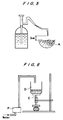
- Fig. 5 is a schematic view of an apparatus for measuring the strength of a mass for the performance test.
- Fig. 6 is a schematic view of an apparatus for measuring the strength of a mass for the performance test.
- the present inventors have studied in various ways. As a result, we have found that, by forming the small pieces of an excrement treatment for small animals not into simple particles or the like but into thin flat plates or waved plates having a specified average aspect ratio, the permeation speed of excrement in the treatment is lowered, the amount of litter to be used can be made small, and the solidifying strength of the formed mass can be improved.
- the present invention has been accomplished based on these findings.
- the present invention provides:
- the excrement treatment for small animals of the present invention is characterized by making small the amount of litter required for absorbing and embracing excrements (urine and droppings) excreted from small animals, such as a cat.
- treating of excrement means absorbing and embracing (incorporating) excrement with litter particles, to make an excrement-absorbed mass. This resultant mass can be easily removed from litter particles that are not polluted with excrement.
- the small pieces of the treatment are formed into the shape of flat plates or waved plates; the thickness of the small pieces of the treatment is 0.1 to 2 mm, and the average aspect ratio (the average value obtained by dividing the diameter of a circle corresponding to the projected area of the main plane of a small piece of the treatment, by the thickness of the small piece of the treatment) is from 3 to 50.
- the particularly preferable dimensions of the small pieces of the treatment are thickness, 0.4 to 1mm, and average aspect ratio, 5 to 20. In this case, if the thickness of the small pieces is over 2 mm, the solidifying bonding strength when urine or the like is absorbed is not satisfactory. Further, if the thickness of the small pieces is over 2.5 mm, solidification and bonding hardly occur.
- the excrement treatment of the present invention made up of small pieces in the shape of thin flat plates or waved plates having a specified thickness and a specified aspect ratio, is placed in a cat tray, the small pieces lie in layers horizontally. Therefore, excrement (urine) does not proceed (penetrate) straight downward through spaces among the small pieces; rather it first flows horizontally between the layers, and then downward; that is, it flows in a zigzag pattern. As a result, the course of the passage becomes considerably long and the excrement and small pieces come in close contact with each other over a satisfactory period of time. Thus, the treatment can satisfactorily absorb the excrement, and a small amount of the treatment can absorb the excrement satisfactorily to form a mass.
- the weight of the solidified mass can be small. Further, since the small pieces are in the shape of thin flat plates or waved plates, when the small pieces are bonded together with the urine, they are secured with the surfaces in contact with each other, and advantageously the solidifying bonding strength between the small pieces of the mass is remarkably high, resulting in a firm mass. In addition, considering the specific gravity, the excrement treatment has low fly loss and is cracked or pulverized less.
- the material of the treatment is made up of mainly bentonite, and most preferably 100% of the material is bentonite; but, as needed, other component such as a sodium compound, a magnesium compound, zeolite, wood powder, paper powder, or the like may be mixed with bentonite, if it can absorb and embrace excrements to form a mass.
- the amount of the bentonite is 20% by weight or more, and more preferably 30% by weight or more.
- the component to be mixed with bentonite is wood powder or paper powder.
- the amount of the wood powder is preferably 1 to 80% by weight, and more preferably 30 to 70% by weight.
- the amount of the paper powder is preferably 1 to 80% by weight, and more preferably 3 to 60% by weight.
- the reason for adding, in addition to bentonite, another component, i.e., wood powder or paper powder, includes the following:
- the excrement treatment of the present invention is molded by a wet-molding process.
- Other procedures of the molding will follow those of the conventional molding process using a usual molding apparatus.
- bentonite, water, and, if necessary, another component, such as wood powder and paper powder are placed and mixed in a mixer.
- the amount of water is 10 to 80 parts by weight, and more preferably 15 to 70 parts by weight, per 100 parts by weight of bentonite, and the amount of paper powder or wood powder is as prescribed above.
- the mixture is spread by using a roll, preferably a three-roll, into a sheet preferably of thickness 0.1 to 2 mm, and more preferably 0.4 to 1 mm.
- the sheet is placed in a dryer, and after drying it, preferably at 90 to 500°C for 0.5 to 1 hour, the sheet is broken into small pieces, and the pieces are sieved through a sifting machine, to obtain an excrement treatment for small animals that is in the form of thin flat plates or waved plates having a prescribed aspect ratio.
- the spaces among the small pieces of the treatment are less and the surface area per unit area of the small pieces of the treatment is large. Therefore, excrements can be absorbed efficiently and the mass embracing the excrements can be made small, and as a result the amount of the litter to be discarded can be made small. Further, since the solidification and bonding of the mass is firm, there is an excellent effect that when the mass is discarded, it hardly crumbles and can be easily handled.
- the treatment can absorbs excrements satisfactorily, and the mass that has absorbed and embraced the excrements becomes small and thin, so that the cat tray or toilet for small animals can be made compact.
- part(s) means weight part(s).
- the average aspect ratio of Sample 1 which ratio was obtained by using the said diameter of the circle corresponding to the projected area of the main plain, was 6.8 (the average aspect ratio by an informal method which was obtained by dividing the length of the major axis by the thickness of a small piece of the sample, was 7).
- a bowl A 1 kg of the sample was placed. Thereinto, 20 ml of 2% table-salt water was poured, from an apparatus shown in Fig. 5 (the nozzle was adjusted so that 20 ml of the table-salt water would flow out in 5 sec, by using a reburette, made by Shibata K.K.). About 30 sec after the pouring, the part of the bentonite that had absorbed the table-salt water was taken out by hand, and after 1 min, water was introduced into a container D, at a rate of about 4 liters per min, from an apparatus shown in Fig. 6.
- the amount of the cat litter of the present invention, used for solidifying 20 ml of 2% table-salt water, are about 1/2 amount of that of the commercially available bentonite product. Therefore, when the excrement treatment of the present invention absorbs and embraces excrements, the size of the mass that has absorbed and embraced the excrements is smaller than that of the conventional case, and the amount of the litter to be discarded is reduced.
- the sample of the present invention is also excellent in the solidity of the mass.
- Example 1 This sample was subjected to the same tests that were conducted in Example 1. The results are shown in Table 1.
- Table 1 Amount of litter required to solidify 20 ml of 2% sodium chloride (g) Permeability (%) Solidity (g) Remarks
- Example 1 (Sample 1) 21.2 46.5 780
- This Invention Example 2 (Sample 2) 20.3 45.8 720 " Commercially Available Product A (bentonite broken particles) 53.3 140 597 Comparative Example Commercially Available Product B (bentonite extruded granules) 43.0 159 560 " Commercially Available Product C (bentonite tumbled granules) 39.8 123 605 " Comparative Example 1 not solidified - - " Comparative Example 2 35.6 82.3 410 "
Landscapes
- Life Sciences & Earth Sciences (AREA)
- Environmental Sciences (AREA)
- Zoology (AREA)
- Animal Husbandry (AREA)
- Biodiversity & Conservation Biology (AREA)
- Chemical & Material Sciences (AREA)
- Inorganic Chemistry (AREA)
- Housing For Livestock And Birds (AREA)
Applications Claiming Priority (3)
| Application Number | Priority Date | Filing Date | Title |
|---|---|---|---|
| JP232525/94 | 1994-09-02 | ||
| JP23252594 | 1994-09-02 | ||
| JP23252594 | 1994-09-02 |
Publications (3)
| Publication Number | Publication Date |
|---|---|
| EP0699384A2 true EP0699384A2 (fr) | 1996-03-06 |
| EP0699384A3 EP0699384A3 (fr) | 1996-06-05 |
| EP0699384B1 EP0699384B1 (fr) | 1999-10-27 |
Family
ID=16940706
Family Applications (1)
| Application Number | Title | Priority Date | Filing Date |
|---|---|---|---|
| EP95113453A Expired - Lifetime EP0699384B1 (fr) | 1994-09-02 | 1995-08-28 | Matériau pour le traitement des excréments d'animaux et procédé pour sa fabrication |
Country Status (3)
| Country | Link |
|---|---|
| US (1) | US5680830A (fr) |
| EP (1) | EP0699384B1 (fr) |
| DE (1) | DE69512977T2 (fr) |
Families Citing this family (13)
| Publication number | Priority date | Publication date | Assignee | Title |
|---|---|---|---|---|
| JP3712319B2 (ja) * | 1997-10-30 | 2005-11-02 | ユニ・チャームペットケア株式会社 | 動物用排泄物処理材及びその製造方法 |
| USD478695S1 (en) | 1999-08-26 | 2003-08-19 | Nestec, Ltd. | Animal Litter |
| US20050005870A1 (en) | 2003-07-11 | 2005-01-13 | The Clorox Company | Composite absorbent particles |
| US20080251027A1 (en) * | 2003-07-11 | 2008-10-16 | Bradley Kirsch | Shaped Absorbent Particles |
| US20050175577A1 (en) * | 2004-02-06 | 2005-08-11 | The Clorox Company | Absorbent composition with improved odor control |
| US20050005869A1 (en) | 2003-07-11 | 2005-01-13 | The Clorox Company | Composite absorbent particles |
| US7549396B2 (en) * | 2006-02-07 | 2009-06-23 | I Did It, Inc. | Breakable active odor control additive for animal litter |
| US7603964B2 (en) | 2005-04-29 | 2009-10-20 | The Clorox Company | Composite particle animal litter and method thereof |
| US20110123474A1 (en) | 2009-11-24 | 2011-05-26 | Jenkins Dennis B | Non-Visible Activated Carbon in Absorbent Materials |
| US9010274B2 (en) | 2011-04-13 | 2015-04-21 | The Clorox Company | Lightweight clumping animal litter and method thereof |
| USD700756S1 (en) * | 2012-10-15 | 2014-03-04 | The Andersons, Inc. | Animal litter puck |
| US11918969B2 (en) | 2019-12-06 | 2024-03-05 | The Clorox Company | Low dusting, small clumping highly absorptive animal litter |
| CN113615583A (zh) * | 2021-08-12 | 2021-11-09 | 田东昊润新材料科技有限公司 | 一种膨润土-木糠猫砂的生产工艺 |
Family Cites Families (13)
| Publication number | Priority date | Publication date | Assignee | Title |
|---|---|---|---|---|
| US3256857A (en) * | 1965-09-24 | 1966-06-21 | Karras Conrad | Product and method for making animal bedding |
| GB1582005A (en) * | 1976-05-04 | 1980-12-31 | Oil Dri Corp Of America | Method for manufacturing granular material comprising calcium sulphate |
| EP0087001B2 (fr) * | 1982-02-19 | 1995-01-11 | Laporte Industries Limited | Procédé pour la fabrication des substances absorbantes |
| NL8304094A (nl) * | 1983-11-29 | 1985-06-17 | Stephanus Stevanus Van Es En A | Werkwijze voor het vervaardigen van kattebak-vulmateriaal. |
| US4625679A (en) * | 1984-08-14 | 1986-12-02 | Hill Robert V | Bedding product for animals and method of making same |
| JPS6167423A (ja) * | 1984-09-10 | 1986-04-07 | 石川 春美 | 動物飼育用の砂代用材 |
| JPS62221444A (ja) * | 1986-03-22 | 1987-09-29 | Suzuki Yasuo | 吸収材料 |
| US5062383A (en) * | 1989-10-25 | 1991-11-05 | Nelson Thomas E | Animal litter containing an improved clay |
| US5229348A (en) * | 1990-03-05 | 1993-07-20 | Bio-Plus, Inc. | Animal litter granules and method of processing peanut hulls in producing cat litter |
| US5279259A (en) * | 1991-08-07 | 1994-01-18 | Floridin Company | Animal litter compositions |
| JP2972945B2 (ja) * | 1992-09-14 | 1999-11-08 | 三洋化成工業株式会社 | ペットの排泄物処理材 |
| DE4243389A1 (de) * | 1992-12-21 | 1994-06-23 | Sued Chemie Ag | Verfahren zur Herstellung von Sorptionsmitteln zur Aufnahme von Flüssigkeiten |
| DE4243390A1 (de) * | 1992-12-21 | 1994-06-23 | Sued Chemie Ag | Verfahren zur Herstellung von Sorptionsmitteln auf Smektitbasis zur Aufnahme von Flüssigkeiten |
-
1995
- 1995-08-28 EP EP95113453A patent/EP0699384B1/fr not_active Expired - Lifetime
- 1995-08-28 DE DE69512977T patent/DE69512977T2/de not_active Expired - Lifetime
- 1995-08-28 US US08/519,929 patent/US5680830A/en not_active Expired - Lifetime
Non-Patent Citations (1)
| Title |
|---|
| None |
Also Published As
| Publication number | Publication date |
|---|---|
| EP0699384A3 (fr) | 1996-06-05 |
| DE69512977D1 (de) | 1999-12-02 |
| DE69512977T2 (de) | 2000-06-29 |
| US5680830A (en) | 1997-10-28 |
| EP0699384B1 (fr) | 1999-10-27 |
Similar Documents
| Publication | Publication Date | Title |
|---|---|---|
| EP0699384B1 (fr) | Matériau pour le traitement des excréments d'animaux et procédé pour sa fabrication | |
| US5183010A (en) | Additive for binding liquid waste | |
| US5450817A (en) | Process for production of sorbents for uptake of liquids | |
| US6206947B1 (en) | Process for making an animal litter comprising gypsum, aluminum sulfate and urea | |
| US5339769A (en) | Process for making an absorbent composition | |
| US9854782B2 (en) | Animal litter sand and animal toilet | |
| KR101462303B1 (ko) | 동물용 화장실 모래 | |
| US9516856B2 (en) | Method for producing animal litter sand | |
| RU99108122A (ru) | Способ получения моющего и чистящего средства в виде оформленных частиц | |
| EP3075240B1 (fr) | Sable de litière pour animal | |
| US5719098A (en) | Sorbent based on smectitic clay minerals reacted with alkaline ion exchanger | |
| JPH0923776A (ja) | ペットの排泄物用処理材及びその製法 | |
| EP2283723B1 (fr) | Procédé de production d'une litière pour animaux de compagnie, de type agglomérante et basse densité, litière ainsi produite | |
| JP2607034B2 (ja) | 液体を吸収するためのスメクタイトに基づく収着剤の製造方法 | |
| CA2145636A1 (fr) | Methode pour l'obtention d'agents de sorption a base de smectites et de substances renfermant de la cellulose avec une faible masse en vrac | |
| DE19843887A1 (de) | Hygienegranulat | |
| WO2001019177A1 (fr) | Procede de production de litiere pour chats en sepiolite, sans poussieres et pouvant etre agglomeree et jetee dans les toilettes | |
| EP0392444A1 (fr) | Litière pour animaux | |
| JPH11246214A5 (fr) | ||
| JP3635135B2 (ja) | 小動物用排泄物処理剤 | |
| EP0436608B1 (fr) | Agent de desodorisation et d'absorption de liquide | |
| JPH08140514A (ja) | ペット排尿処理剤 | |
| JP2847232B2 (ja) | 犬猫の糞尿処理材およびその製造方法 | |
| DE2902109C2 (de) | Verwendung von, gegebenenfalls zerkleinerten, Leichtbauplatten auf der Grundlage von faserverstärkten Calciumsilikatmassen | |
| FI109173B (fi) | Menetelmä kuivike- ja imeytymismateriaalin valmistamiseksi sekä kuivike- ja imeytymismateriaali |
Legal Events
| Date | Code | Title | Description |
|---|---|---|---|
| PUAI | Public reference made under article 153(3) epc to a published international application that has entered the european phase |
Free format text: ORIGINAL CODE: 0009012 |
|
| AK | Designated contracting states |
Kind code of ref document: A2 Designated state(s): DE FR GB |
|
| PUAL | Search report despatched |
Free format text: ORIGINAL CODE: 0009013 |
|
| AK | Designated contracting states |
Kind code of ref document: A3 Designated state(s): DE FR GB |
|
| 17P | Request for examination filed |
Effective date: 19961113 |
|
| GRAG | Despatch of communication of intention to grant |
Free format text: ORIGINAL CODE: EPIDOS AGRA |
|
| 17Q | First examination report despatched |
Effective date: 19981211 |
|
| GRAG | Despatch of communication of intention to grant |
Free format text: ORIGINAL CODE: EPIDOS AGRA |
|
| GRAH | Despatch of communication of intention to grant a patent |
Free format text: ORIGINAL CODE: EPIDOS IGRA |
|
| GRAH | Despatch of communication of intention to grant a patent |
Free format text: ORIGINAL CODE: EPIDOS IGRA |
|
| GRAA | (expected) grant |
Free format text: ORIGINAL CODE: 0009210 |
|
| AK | Designated contracting states |
Kind code of ref document: B1 Designated state(s): DE FR GB |
|
| REF | Corresponds to: |
Ref document number: 69512977 Country of ref document: DE Date of ref document: 19991202 |
|
| ET | Fr: translation filed | ||
| PLBE | No opposition filed within time limit |
Free format text: ORIGINAL CODE: 0009261 |
|
| STAA | Information on the status of an ep patent application or granted ep patent |
Free format text: STATUS: NO OPPOSITION FILED WITHIN TIME LIMIT |
|
| 26N | No opposition filed | ||
| REG | Reference to a national code |
Ref country code: GB Ref legal event code: IF02 |
|
| PGFP | Annual fee paid to national office [announced via postgrant information from national office to epo] |
Ref country code: GB Payment date: 20020809 Year of fee payment: 8 |
|
| PGFP | Annual fee paid to national office [announced via postgrant information from national office to epo] |
Ref country code: DE Payment date: 20020827 Year of fee payment: 8 |
|
| PGFP | Annual fee paid to national office [announced via postgrant information from national office to epo] |
Ref country code: FR Payment date: 20020830 Year of fee payment: 8 |
|
| PG25 | Lapsed in a contracting state [announced via postgrant information from national office to epo] |
Ref country code: GB Free format text: LAPSE BECAUSE OF NON-PAYMENT OF DUE FEES Effective date: 20030828 |
|
| PG25 | Lapsed in a contracting state [announced via postgrant information from national office to epo] |
Ref country code: DE Free format text: LAPSE BECAUSE OF THE APPLICANT RENOUNCES Effective date: 20030923 |
|
| GBPC | Gb: european patent ceased through non-payment of renewal fee | ||
| PG25 | Lapsed in a contracting state [announced via postgrant information from national office to epo] |
Ref country code: FR Free format text: LAPSE BECAUSE OF NON-PAYMENT OF DUE FEES Effective date: 20040430 |
|
| REG | Reference to a national code |
Ref country code: FR Ref legal event code: ST |