EP0699442A1 - Die verwendung eines stammes des pilzes fusarium zur herstellung von substanzen und eine darauf basierende zubereitung mit adaptiven und immunmodulierenden eigenschaften - Google Patents
Die verwendung eines stammes des pilzes fusarium zur herstellung von substanzen und eine darauf basierende zubereitung mit adaptiven und immunmodulierenden eigenschaften Download PDFInfo
- Publication number
- EP0699442A1 EP0699442A1 EP95903058A EP95903058A EP0699442A1 EP 0699442 A1 EP0699442 A1 EP 0699442A1 EP 95903058 A EP95903058 A EP 95903058A EP 95903058 A EP95903058 A EP 95903058A EP 0699442 A1 EP0699442 A1 EP 0699442A1
- Authority
- EP
- European Patent Office
- Prior art keywords
- patients
- milaif
- preparation
- adaptogenic
- organism
- Prior art date
- Legal status (The legal status is an assumption and is not a legal conclusion. Google has not performed a legal analysis and makes no representation as to the accuracy of the status listed.)
- Granted
Links
- 230000002519 immonomodulatory effect Effects 0.000 title claims abstract description 6
- 238000002360 preparation method Methods 0.000 title claims description 42
- 239000000126 substance Substances 0.000 title description 9
- 241000223218 Fusarium Species 0.000 title description 2
- HVYWMOMLDIMFJA-DPAQBDIFSA-N cholesterol Chemical compound C1C=C2C[C@@H](O)CC[C@]2(C)[C@@H]2[C@@H]1[C@@H]1CC[C@H]([C@H](C)CCCC(C)C)[C@@]1(C)CC2 HVYWMOMLDIMFJA-DPAQBDIFSA-N 0.000 claims abstract description 19
- 108090000623 proteins and genes Proteins 0.000 claims abstract description 16
- 102000004169 proteins and genes Human genes 0.000 claims abstract description 16
- 150000002632 lipids Chemical class 0.000 claims abstract description 15
- 229940088594 vitamin Drugs 0.000 claims abstract description 13
- 229930003231 vitamin Natural products 0.000 claims abstract description 13
- 235000013343 vitamin Nutrition 0.000 claims abstract description 13
- 239000011782 vitamin Substances 0.000 claims abstract description 13
- 208000037265 diseases, disorders, signs and symptoms Diseases 0.000 claims abstract description 12
- 241000221779 Fusarium sambucinum Species 0.000 claims abstract description 11
- XLYOFNOQVPJJNP-UHFFFAOYSA-N water Substances O XLYOFNOQVPJJNP-UHFFFAOYSA-N 0.000 claims abstract description 9
- 229910052500 inorganic mineral Inorganic materials 0.000 claims abstract description 8
- 201000002364 leukopenia Diseases 0.000 claims abstract description 8
- 239000011707 mineral Substances 0.000 claims abstract description 8
- 239000013543 active substance Substances 0.000 claims abstract description 7
- 150000001720 carbohydrates Chemical class 0.000 claims abstract description 7
- 235000014633 carbohydrates Nutrition 0.000 claims abstract description 7
- 239000000427 antigen Substances 0.000 claims abstract description 6
- 108091007433 antigens Proteins 0.000 claims abstract description 6
- 102000036639 antigens Human genes 0.000 claims abstract description 6
- 210000001035 gastrointestinal tract Anatomy 0.000 claims abstract description 6
- 210000000265 leukocyte Anatomy 0.000 claims abstract description 6
- 208000031225 myocardial ischemia Diseases 0.000 claims abstract description 6
- 102000039446 nucleic acids Human genes 0.000 claims abstract description 6
- 108020004707 nucleic acids Proteins 0.000 claims abstract description 6
- 150000007523 nucleic acids Chemical class 0.000 claims abstract description 6
- 230000000069 prophylactic effect Effects 0.000 claims abstract description 5
- 238000002560 therapeutic procedure Methods 0.000 claims abstract description 5
- 208000024172 Cardiovascular disease Diseases 0.000 claims abstract description 4
- 239000013570 bacterial allergen Substances 0.000 claims abstract description 4
- 238000009343 monoculture Methods 0.000 claims abstract 2
- 238000011321 prophylaxis Methods 0.000 claims abstract 2
- 239000000203 mixture Substances 0.000 claims description 15
- 238000000034 method Methods 0.000 claims description 14
- 230000008569 process Effects 0.000 claims description 14
- 150000003626 triacylglycerols Chemical class 0.000 claims description 9
- 231100001022 leukopenia Toxicity 0.000 claims description 7
- 230000004060 metabolic process Effects 0.000 claims description 7
- 210000002966 serum Anatomy 0.000 claims description 7
- 235000001674 Agaricus brunnescens Nutrition 0.000 claims description 6
- 201000010099 disease Diseases 0.000 claims description 6
- 230000001363 autoimmune Effects 0.000 claims description 5
- 239000003795 chemical substances by application Substances 0.000 claims description 5
- 235000012000 cholesterol Nutrition 0.000 claims description 5
- 230000005855 radiation Effects 0.000 claims description 5
- 244000005700 microbiome Species 0.000 claims description 4
- 230000000384 rearing effect Effects 0.000 claims description 3
- 230000001225 therapeutic effect Effects 0.000 claims description 3
- 235000013305 food Nutrition 0.000 claims description 2
- 208000017170 Lipid metabolism disease Diseases 0.000 claims 1
- 239000000969 carrier Substances 0.000 claims 1
- 239000008187 granular material Substances 0.000 claims 1
- 239000007788 liquid Substances 0.000 claims 1
- 239000000843 powder Substances 0.000 claims 1
- 239000003826 tablet Substances 0.000 claims 1
- 230000000694 effects Effects 0.000 abstract description 20
- 208000035475 disorder Diseases 0.000 abstract description 6
- 230000037356 lipid metabolism Effects 0.000 abstract description 5
- 206010028980 Neoplasm Diseases 0.000 abstract description 4
- 230000002503 metabolic effect Effects 0.000 abstract description 4
- 238000001959 radiotherapy Methods 0.000 abstract description 4
- 230000006472 autoimmune response Effects 0.000 abstract 1
- 201000011510 cancer Diseases 0.000 abstract 1
- 230000001120 cytoprotective effect Effects 0.000 abstract 1
- UFTFJSFQGQCHQW-UHFFFAOYSA-N triformin Chemical compound O=COCC(OC=O)COC=O UFTFJSFQGQCHQW-UHFFFAOYSA-N 0.000 abstract 1
- 239000002609 medium Substances 0.000 description 15
- 235000018102 proteins Nutrition 0.000 description 14
- 230000009467 reduction Effects 0.000 description 10
- 208000008589 Obesity Diseases 0.000 description 9
- 235000020824 obesity Nutrition 0.000 description 9
- 241000894006 Bacteria Species 0.000 description 8
- ACTIUHUUMQJHFO-UHFFFAOYSA-N Coenzym Q10 Natural products COC1=C(OC)C(=O)C(CC=C(C)CCC=C(C)CCC=C(C)CCC=C(C)CCC=C(C)CCC=C(C)CCC=C(C)CCC=C(C)CCC=C(C)CCC=C(C)C)=C(C)C1=O ACTIUHUUMQJHFO-UHFFFAOYSA-N 0.000 description 8
- 241001465754 Metazoa Species 0.000 description 8
- 210000004369 blood Anatomy 0.000 description 8
- 239000008280 blood Substances 0.000 description 8
- 235000017471 coenzyme Q10 Nutrition 0.000 description 8
- 238000011081 inoculation Methods 0.000 description 8
- 210000004185 liver Anatomy 0.000 description 8
- 235000015097 nutrients Nutrition 0.000 description 8
- 230000007170 pathology Effects 0.000 description 8
- LWIHDJKSTIGBAC-UHFFFAOYSA-K tripotassium phosphate Chemical compound [K+].[K+].[K+].[O-]P([O-])([O-])=O LWIHDJKSTIGBAC-UHFFFAOYSA-K 0.000 description 8
- 241000233866 Fungi Species 0.000 description 7
- WQZGKKKJIJFFOK-GASJEMHNSA-N Glucose Natural products OC[C@H]1OC(O)[C@H](O)[C@@H](O)[C@@H]1O WQZGKKKJIJFFOK-GASJEMHNSA-N 0.000 description 7
- 239000008103 glucose Substances 0.000 description 7
- 230000012010 growth Effects 0.000 description 7
- 238000004519 manufacturing process Methods 0.000 description 7
- GVJHHUAWPYXKBD-UHFFFAOYSA-N (±)-α-Tocopherol Chemical compound OC1=C(C)C(C)=C2OC(CCCC(C)CCCC(C)CCCC(C)C)(C)CCC2=C1C GVJHHUAWPYXKBD-UHFFFAOYSA-N 0.000 description 6
- 210000004027 cell Anatomy 0.000 description 6
- 239000001963 growth medium Substances 0.000 description 6
- 235000010755 mineral Nutrition 0.000 description 6
- 150000003904 phospholipids Chemical class 0.000 description 6
- 238000004659 sterilization and disinfection Methods 0.000 description 6
- LFQSCWFLJHTTHZ-UHFFFAOYSA-N Ethanol Chemical compound CCO LFQSCWFLJHTTHZ-UHFFFAOYSA-N 0.000 description 5
- XEEYBQQBJWHFJM-UHFFFAOYSA-N Iron Chemical compound [Fe] XEEYBQQBJWHFJM-UHFFFAOYSA-N 0.000 description 5
- 206010012601 diabetes mellitus Diseases 0.000 description 5
- 238000000855 fermentation Methods 0.000 description 5
- 230000004151 fermentation Effects 0.000 description 5
- 238000011835 investigation Methods 0.000 description 5
- 239000000463 material Substances 0.000 description 5
- 230000001766 physiological effect Effects 0.000 description 5
- 230000001954 sterilising effect Effects 0.000 description 5
- 238000012360 testing method Methods 0.000 description 5
- 210000001519 tissue Anatomy 0.000 description 5
- PAWQVTBBRAZDMG-UHFFFAOYSA-N 2-(3-bromo-2-fluorophenyl)acetic acid Chemical compound OC(=O)CC1=CC=CC(Br)=C1F PAWQVTBBRAZDMG-UHFFFAOYSA-N 0.000 description 4
- IJGRMHOSHXDMSA-UHFFFAOYSA-N Atomic nitrogen Chemical compound N#N IJGRMHOSHXDMSA-UHFFFAOYSA-N 0.000 description 4
- 208000036649 Dysbacteriosis Diseases 0.000 description 4
- 208000027244 Dysbiosis Diseases 0.000 description 4
- 208000007882 Gastritis Diseases 0.000 description 4
- 206010070834 Sensitisation Diseases 0.000 description 4
- 230000036528 appetite Effects 0.000 description 4
- 235000019789 appetite Nutrition 0.000 description 4
- 230000001580 bacterial effect Effects 0.000 description 4
- WQZGKKKJIJFFOK-VFUOTHLCSA-N beta-D-glucose Chemical compound OC[C@H]1O[C@@H](O)[C@H](O)[C@@H](O)[C@@H]1O WQZGKKKJIJFFOK-VFUOTHLCSA-N 0.000 description 4
- 230000015572 biosynthetic process Effects 0.000 description 4
- 238000011161 development Methods 0.000 description 4
- 230000018109 developmental process Effects 0.000 description 4
- 235000014113 dietary fatty acids Nutrition 0.000 description 4
- 229940079593 drug Drugs 0.000 description 4
- 239000003814 drug Substances 0.000 description 4
- 230000007140 dysbiosis Effects 0.000 description 4
- 235000019197 fats Nutrition 0.000 description 4
- 229930195729 fatty acid Natural products 0.000 description 4
- 239000000194 fatty acid Substances 0.000 description 4
- 150000004665 fatty acids Chemical class 0.000 description 4
- 230000006870 function Effects 0.000 description 4
- 229910000160 potassium phosphate Inorganic materials 0.000 description 4
- 235000011009 potassium phosphates Nutrition 0.000 description 4
- 230000008313 sensitization Effects 0.000 description 4
- 238000001228 spectrum Methods 0.000 description 4
- 210000000952 spleen Anatomy 0.000 description 4
- QTBSBXVTEAMEQO-UHFFFAOYSA-N Acetic acid Chemical compound CC(O)=O QTBSBXVTEAMEQO-UHFFFAOYSA-N 0.000 description 3
- 241000282412 Homo Species 0.000 description 3
- 241000282414 Homo sapiens Species 0.000 description 3
- 208000035150 Hypercholesterolemia Diseases 0.000 description 3
- OAICVXFJPJFONN-UHFFFAOYSA-N Phosphorus Chemical compound [P] OAICVXFJPJFONN-UHFFFAOYSA-N 0.000 description 3
- 241000700159 Rattus Species 0.000 description 3
- 241000194017 Streptococcus Species 0.000 description 3
- 241000282887 Suidae Species 0.000 description 3
- 229930003427 Vitamin E Natural products 0.000 description 3
- 239000002253 acid Substances 0.000 description 3
- 238000004458 analytical method Methods 0.000 description 3
- 230000003078 antioxidant effect Effects 0.000 description 3
- 210000003445 biliary tract Anatomy 0.000 description 3
- 210000000988 bone and bone Anatomy 0.000 description 3
- 238000009395 breeding Methods 0.000 description 3
- 230000001488 breeding effect Effects 0.000 description 3
- 201000001352 cholecystitis Diseases 0.000 description 3
- 201000001883 cholelithiasis Diseases 0.000 description 3
- 230000001684 chronic effect Effects 0.000 description 3
- ACTIUHUUMQJHFO-UPTCCGCDSA-N coenzyme Q10 Chemical compound COC1=C(OC)C(=O)C(C\C=C(/C)CC\C=C(/C)CC\C=C(/C)CC\C=C(/C)CC\C=C(/C)CC\C=C(/C)CC\C=C(/C)CC\C=C(/C)CC\C=C(/C)CCC=C(C)C)=C(C)C1=O ACTIUHUUMQJHFO-UPTCCGCDSA-N 0.000 description 3
- 235000020776 essential amino acid Nutrition 0.000 description 3
- 239000003797 essential amino acid Substances 0.000 description 3
- 235000019441 ethanol Nutrition 0.000 description 3
- 238000002474 experimental method Methods 0.000 description 3
- WIGCFUFOHFEKBI-UHFFFAOYSA-N gamma-tocopherol Natural products CC(C)CCCC(C)CCCC(C)CCCC1CCC2C(C)C(O)C(C)C(C)C2O1 WIGCFUFOHFEKBI-UHFFFAOYSA-N 0.000 description 3
- 238000009630 liquid culture Methods 0.000 description 3
- 235000013379 molasses Nutrition 0.000 description 3
- 238000010606 normalization Methods 0.000 description 3
- 210000000056 organ Anatomy 0.000 description 3
- 229910052698 phosphorus Inorganic materials 0.000 description 3
- 239000011574 phosphorus Substances 0.000 description 3
- 235000004252 protein component Nutrition 0.000 description 3
- 208000024891 symptom Diseases 0.000 description 3
- 238000003786 synthesis reaction Methods 0.000 description 3
- 235000019165 vitamin E Nutrition 0.000 description 3
- 229940046009 vitamin E Drugs 0.000 description 3
- 239000011709 vitamin E Substances 0.000 description 3
- YBJHBAHKTGYVGT-ZKWXMUAHSA-N (+)-Biotin Chemical compound N1C(=O)N[C@@H]2[C@H](CCCCC(=O)O)SC[C@@H]21 YBJHBAHKTGYVGT-ZKWXMUAHSA-N 0.000 description 2
- GHOKWGTUZJEAQD-ZETCQYMHSA-N (D)-(+)-Pantothenic acid Chemical compound OCC(C)(C)[C@@H](O)C(=O)NCCC(O)=O GHOKWGTUZJEAQD-ZETCQYMHSA-N 0.000 description 2
- TZCPCKNHXULUIY-RGULYWFUSA-N 1,2-distearoyl-sn-glycero-3-phosphoserine Chemical compound CCCCCCCCCCCCCCCCCC(=O)OC[C@H](COP(O)(=O)OC[C@H](N)C(O)=O)OC(=O)CCCCCCCCCCCCCCCCC TZCPCKNHXULUIY-RGULYWFUSA-N 0.000 description 2
- 208000035143 Bacterial infection Diseases 0.000 description 2
- OYPRJOBELJOOCE-UHFFFAOYSA-N Calcium Chemical compound [Ca] OYPRJOBELJOOCE-UHFFFAOYSA-N 0.000 description 2
- 241000222120 Candida <Saccharomycetales> Species 0.000 description 2
- 206010057248 Cell death Diseases 0.000 description 2
- 206010008617 Cholecystitis chronic Diseases 0.000 description 2
- RYGMFSIKBFXOCR-UHFFFAOYSA-N Copper Chemical compound [Cu] RYGMFSIKBFXOCR-UHFFFAOYSA-N 0.000 description 2
- WQZGKKKJIJFFOK-QTVWNMPRSA-N D-mannopyranose Chemical compound OC[C@H]1OC(O)[C@@H](O)[C@@H](O)[C@@H]1O WQZGKKKJIJFFOK-QTVWNMPRSA-N 0.000 description 2
- 208000012661 Dyskinesia Diseases 0.000 description 2
- 206010017865 Gastritis erosive Diseases 0.000 description 2
- PEDCQBHIVMGVHV-UHFFFAOYSA-N Glycerine Chemical compound OCC(O)CO PEDCQBHIVMGVHV-UHFFFAOYSA-N 0.000 description 2
- JZNWSCPGTDBMEW-UHFFFAOYSA-N Glycerophosphorylethanolamin Natural products NCCOP(O)(=O)OCC(O)CO JZNWSCPGTDBMEW-UHFFFAOYSA-N 0.000 description 2
- ZWZWYGMENQVNFU-UHFFFAOYSA-N Glycerophosphorylserin Natural products OC(=O)C(N)COP(O)(=O)OCC(O)CO ZWZWYGMENQVNFU-UHFFFAOYSA-N 0.000 description 2
- 229920002527 Glycogen Polymers 0.000 description 2
- 102000001554 Hemoglobins Human genes 0.000 description 2
- 108010054147 Hemoglobins Proteins 0.000 description 2
- 241000414067 Inonotus obliquus Species 0.000 description 2
- GUBGYTABKSRVRQ-QKKXKWKRSA-N Lactose Natural products OC[C@H]1O[C@@H](O[C@H]2[C@H](O)[C@@H](O)C(O)O[C@@H]2CO)[C@H](O)[C@@H](O)[C@H]1O GUBGYTABKSRVRQ-QKKXKWKRSA-N 0.000 description 2
- OYHQOLUKZRVURQ-HZJYTTRNSA-N Linoleic acid Chemical compound CCCCC\C=C/C\C=C/CCCCCCCC(O)=O OYHQOLUKZRVURQ-HZJYTTRNSA-N 0.000 description 2
- PVNIIMVLHYAWGP-UHFFFAOYSA-N Niacin Chemical compound OC(=O)C1=CC=CN=C1 PVNIIMVLHYAWGP-UHFFFAOYSA-N 0.000 description 2
- PXHVJJICTQNCMI-UHFFFAOYSA-N Nickel Chemical compound [Ni] PXHVJJICTQNCMI-UHFFFAOYSA-N 0.000 description 2
- ZLMJMSJWJFRBEC-UHFFFAOYSA-N Potassium Chemical compound [K] ZLMJMSJWJFRBEC-UHFFFAOYSA-N 0.000 description 2
- 241000588769 Proteus <enterobacteria> Species 0.000 description 2
- AUNGANRZJHBGPY-SCRDCRAPSA-N Riboflavin Chemical compound OC[C@@H](O)[C@@H](O)[C@@H](O)CN1C=2C=C(C)C(C)=CC=2N=C2C1=NC(=O)NC2=O AUNGANRZJHBGPY-SCRDCRAPSA-N 0.000 description 2
- 240000004808 Saccharomyces cerevisiae Species 0.000 description 2
- 241000191940 Staphylococcus Species 0.000 description 2
- 229930006000 Sucrose Natural products 0.000 description 2
- CZMRCDWAGMRECN-UGDNZRGBSA-N Sucrose Chemical compound O[C@H]1[C@H](O)[C@@H](CO)O[C@@]1(CO)O[C@@H]1[C@H](O)[C@@H](O)[C@H](O)[C@@H](CO)O1 CZMRCDWAGMRECN-UGDNZRGBSA-N 0.000 description 2
- XSQUKJJJFZCRTK-UHFFFAOYSA-N Urea Chemical compound NC(N)=O XSQUKJJJFZCRTK-UHFFFAOYSA-N 0.000 description 2
- QYSXJUFSXHHAJI-XFEUOLMDSA-N Vitamin D3 Natural products C1(/[C@@H]2CC[C@@H]([C@]2(CCC1)C)[C@H](C)CCCC(C)C)=C/C=C1\C[C@@H](O)CCC1=C QYSXJUFSXHHAJI-XFEUOLMDSA-N 0.000 description 2
- 230000001154 acute effect Effects 0.000 description 2
- 230000032683 aging Effects 0.000 description 2
- WQZGKKKJIJFFOK-PHYPRBDBSA-N alpha-D-galactose Chemical compound OC[C@H]1O[C@H](O)[C@H](O)[C@@H](O)[C@H]1O WQZGKKKJIJFFOK-PHYPRBDBSA-N 0.000 description 2
- 150000001413 amino acids Chemical class 0.000 description 2
- 230000002930 anti-sclerotic effect Effects 0.000 description 2
- 239000003963 antioxidant agent Substances 0.000 description 2
- 235000006708 antioxidants Nutrition 0.000 description 2
- 208000022362 bacterial infectious disease Diseases 0.000 description 2
- 229940036811 bone meal Drugs 0.000 description 2
- 239000002374 bone meal Substances 0.000 description 2
- 239000011575 calcium Substances 0.000 description 2
- 229910052791 calcium Inorganic materials 0.000 description 2
- 230000023852 carbohydrate metabolic process Effects 0.000 description 2
- 235000021256 carbohydrate metabolism Nutrition 0.000 description 2
- 229910052799 carbon Inorganic materials 0.000 description 2
- 210000002421 cell wall Anatomy 0.000 description 2
- 208000023652 chronic gastritis Diseases 0.000 description 2
- 235000020057 cognac Nutrition 0.000 description 2
- 150000001875 compounds Chemical class 0.000 description 2
- 238000010924 continuous production Methods 0.000 description 2
- 229910052802 copper Inorganic materials 0.000 description 2
- 239000010949 copper Substances 0.000 description 2
- RMRCNWBMXRMIRW-BYFNXCQMSA-M cyanocobalamin Chemical compound N#C[Co+]N([C@]1([H])[C@H](CC(N)=O)[C@]\2(CCC(=O)NC[C@H](C)OP(O)(=O)OC3[C@H]([C@H](O[C@@H]3CO)N3C4=CC(C)=C(C)C=C4N=C3)O)C)C/2=C(C)\C([C@H](C/2(C)C)CCC(N)=O)=N\C\2=C\C([C@H]([C@@]/2(CC(N)=O)C)CCC(N)=O)=N\C\2=C(C)/C2=N[C@]1(C)[C@@](C)(CC(N)=O)[C@@H]2CCC(N)=O RMRCNWBMXRMIRW-BYFNXCQMSA-M 0.000 description 2
- 238000001784 detoxification Methods 0.000 description 2
- 238000001035 drying Methods 0.000 description 2
- 210000003608 fece Anatomy 0.000 description 2
- OVBPIULPVIDEAO-LBPRGKRZSA-N folic acid Chemical compound C=1N=C2NC(N)=NC(=O)C2=NC=1CNC1=CC=C(C(=O)N[C@@H](CCC(O)=O)C(O)=O)C=C1 OVBPIULPVIDEAO-LBPRGKRZSA-N 0.000 description 2
- 229930182830 galactose Natural products 0.000 description 2
- 150000004676 glycans Chemical class 0.000 description 2
- 229940096919 glycogen Drugs 0.000 description 2
- 230000036541 health Effects 0.000 description 2
- 210000002216 heart Anatomy 0.000 description 2
- 210000003494 hepatocyte Anatomy 0.000 description 2
- 235000003642 hunger Nutrition 0.000 description 2
- 229910052742 iron Inorganic materials 0.000 description 2
- 210000003734 kidney Anatomy 0.000 description 2
- 239000008101 lactose Substances 0.000 description 2
- 235000020778 linoleic acid Nutrition 0.000 description 2
- OYHQOLUKZRVURQ-IXWMQOLASA-N linoleic acid Natural products CCCCC\C=C/C\C=C\CCCCCCCC(O)=O OYHQOLUKZRVURQ-IXWMQOLASA-N 0.000 description 2
- 230000004807 localization Effects 0.000 description 2
- 238000002796 luminescence method Methods 0.000 description 2
- 239000012528 membrane Substances 0.000 description 2
- 239000002207 metabolite Substances 0.000 description 2
- 230000000813 microbial effect Effects 0.000 description 2
- 235000013336 milk Nutrition 0.000 description 2
- 239000008267 milk Substances 0.000 description 2
- 210000004080 milk Anatomy 0.000 description 2
- 210000003470 mitochondria Anatomy 0.000 description 2
- 210000001616 monocyte Anatomy 0.000 description 2
- 229910052757 nitrogen Inorganic materials 0.000 description 2
- 238000005192 partition Methods 0.000 description 2
- 230000001717 pathogenic effect Effects 0.000 description 2
- WTJKGGKOPKCXLL-RRHRGVEJSA-N phosphatidylcholine Chemical compound CCCCCCCCCCCCCCCC(=O)OC[C@H](COP([O-])(=O)OCC[N+](C)(C)C)OC(=O)CCCCCCCC=CCCCCCCCC WTJKGGKOPKCXLL-RRHRGVEJSA-N 0.000 description 2
- 150000008104 phosphatidylethanolamines Chemical class 0.000 description 2
- 229920001282 polysaccharide Polymers 0.000 description 2
- 239000005017 polysaccharide Substances 0.000 description 2
- 239000011591 potassium Substances 0.000 description 2
- 229910052700 potassium Inorganic materials 0.000 description 2
- 230000003449 preventive effect Effects 0.000 description 2
- 150000003180 prostaglandins Chemical class 0.000 description 2
- 230000001681 protective effect Effects 0.000 description 2
- LXNHXLLTXMVWPM-UHFFFAOYSA-N pyridoxine Chemical compound CC1=NC=C(CO)C(CO)=C1O LXNHXLLTXMVWPM-UHFFFAOYSA-N 0.000 description 2
- NPCOQXAVBJJZBQ-UHFFFAOYSA-N reduced coenzyme Q9 Natural products COC1=C(O)C(C)=C(CC=C(C)CCC=C(C)CCC=C(C)CCC=C(C)CCC=C(C)CCC=C(C)CCC=C(C)CCC=C(C)CCC=C(C)C)C(O)=C1OC NPCOQXAVBJJZBQ-UHFFFAOYSA-N 0.000 description 2
- 230000002829 reductive effect Effects 0.000 description 2
- 230000029058 respiratory gaseous exchange Effects 0.000 description 2
- 210000003296 saliva Anatomy 0.000 description 2
- 230000000392 somatic effect Effects 0.000 description 2
- 230000002269 spontaneous effect Effects 0.000 description 2
- 210000002784 stomach Anatomy 0.000 description 2
- 239000005720 sucrose Substances 0.000 description 2
- VZGDMQKNWNREIO-UHFFFAOYSA-N tetrachloromethane Chemical compound ClC(Cl)(Cl)Cl VZGDMQKNWNREIO-UHFFFAOYSA-N 0.000 description 2
- 229940124597 therapeutic agent Drugs 0.000 description 2
- KYMBYSLLVAOCFI-UHFFFAOYSA-N thiamine Chemical compound CC1=C(CCO)SCN1CC1=CN=C(C)N=C1N KYMBYSLLVAOCFI-UHFFFAOYSA-N 0.000 description 2
- 229960003495 thiamine Drugs 0.000 description 2
- 239000011573 trace mineral Substances 0.000 description 2
- 235000013619 trace mineral Nutrition 0.000 description 2
- 229940035936 ubiquinone Drugs 0.000 description 2
- UUGXJSBPSRROMU-WJNLUYJISA-N ubiquinone-9 Chemical compound COC1=C(OC)C(=O)C(C\C=C(/C)CC\C=C(/C)CC\C=C(/C)CC\C=C(/C)CC\C=C(/C)CC\C=C(/C)CC\C=C(/C)CC\C=C(/C)CCC=C(C)C)=C(C)C1=O UUGXJSBPSRROMU-WJNLUYJISA-N 0.000 description 2
- QYSXJUFSXHHAJI-YRZJJWOYSA-N vitamin D3 Chemical compound C1(/[C@@H]2CC[C@@H]([C@]2(CCC1)C)[C@H](C)CCCC(C)C)=C\C=C1\C[C@@H](O)CCC1=C QYSXJUFSXHHAJI-YRZJJWOYSA-N 0.000 description 2
- 235000005282 vitamin D3 Nutrition 0.000 description 2
- 239000011647 vitamin D3 Substances 0.000 description 2
- 229940021056 vitamin d3 Drugs 0.000 description 2
- 150000003722 vitamin derivatives Chemical class 0.000 description 2
- 230000003313 weakening effect Effects 0.000 description 2
- OYHQOLUKZRVURQ-NTGFUMLPSA-N (9Z,12Z)-9,10,12,13-tetratritiooctadeca-9,12-dienoic acid Chemical compound C(CCCCCCC\C(=C(/C\C(=C(/CCCCC)\[3H])\[3H])\[3H])\[3H])(=O)O OYHQOLUKZRVURQ-NTGFUMLPSA-N 0.000 description 1
- WRIDQFICGBMAFQ-UHFFFAOYSA-N (E)-8-Octadecenoic acid Natural products CCCCCCCCCC=CCCCCCCC(O)=O WRIDQFICGBMAFQ-UHFFFAOYSA-N 0.000 description 1
- OWEGMIWEEQEYGQ-UHFFFAOYSA-N 100676-05-9 Natural products OC1C(O)C(O)C(CO)OC1OCC1C(O)C(O)C(O)C(OC2C(OC(O)C(O)C2O)CO)O1 OWEGMIWEEQEYGQ-UHFFFAOYSA-N 0.000 description 1
- LQJBNNIYVWPHFW-UHFFFAOYSA-N 20:1omega9c fatty acid Natural products CCCCCCCCCCC=CCCCCCCCC(O)=O LQJBNNIYVWPHFW-UHFFFAOYSA-N 0.000 description 1
- HVYWMOMLDIMFJA-UHFFFAOYSA-N 3-cholesterol Natural products C1C=C2CC(O)CCC2(C)C2C1C1CCC(C(C)CCCC(C)C)C1(C)CC2 HVYWMOMLDIMFJA-UHFFFAOYSA-N 0.000 description 1
- UHPMCKVQTMMPCG-UHFFFAOYSA-N 5,8-dihydroxy-2-methoxy-6-methyl-7-(2-oxopropyl)naphthalene-1,4-dione Chemical compound CC1=C(CC(C)=O)C(O)=C2C(=O)C(OC)=CC(=O)C2=C1O UHPMCKVQTMMPCG-UHFFFAOYSA-N 0.000 description 1
- QSBYPNXLFMSGKH-UHFFFAOYSA-N 9-Heptadecensaeure Natural products CCCCCCCC=CCCCCCCCC(O)=O QSBYPNXLFMSGKH-UHFFFAOYSA-N 0.000 description 1
- 229920001817 Agar Polymers 0.000 description 1
- 206010001497 Agitation Diseases 0.000 description 1
- GUBGYTABKSRVRQ-XLOQQCSPSA-N Alpha-Lactose Chemical compound O[C@@H]1[C@@H](O)[C@@H](O)[C@@H](CO)O[C@H]1O[C@@H]1[C@@H](CO)O[C@H](O)[C@H](O)[C@H]1O GUBGYTABKSRVRQ-XLOQQCSPSA-N 0.000 description 1
- 206010003210 Arteriosclerosis Diseases 0.000 description 1
- 201000001320 Atherosclerosis Diseases 0.000 description 1
- 208000035404 Autolysis Diseases 0.000 description 1
- 235000016068 Berberis vulgaris Nutrition 0.000 description 1
- 241000335053 Beta vulgaris Species 0.000 description 1
- 241000219310 Beta vulgaris subsp. vulgaris Species 0.000 description 1
- 235000018185 Betula X alpestris Nutrition 0.000 description 1
- 235000018212 Betula X uliginosa Nutrition 0.000 description 1
- 239000002028 Biomass Substances 0.000 description 1
- OKTJSMMVPCPJKN-UHFFFAOYSA-N Carbon Chemical compound [C] OKTJSMMVPCPJKN-UHFFFAOYSA-N 0.000 description 1
- 206010007269 Carcinogenicity Diseases 0.000 description 1
- 206010008342 Cervix carcinoma Diseases 0.000 description 1
- 208000008964 Chemical and Drug Induced Liver Injury Diseases 0.000 description 1
- GHOKWGTUZJEAQD-UHFFFAOYSA-N Chick antidermatitis factor Natural products OCC(C)(C)C(O)C(=O)NCCC(O)=O GHOKWGTUZJEAQD-UHFFFAOYSA-N 0.000 description 1
- VYZAMTAEIAYCRO-UHFFFAOYSA-N Chromium Chemical compound [Cr] VYZAMTAEIAYCRO-UHFFFAOYSA-N 0.000 description 1
- 208000035473 Communicable disease Diseases 0.000 description 1
- AUNGANRZJHBGPY-UHFFFAOYSA-N D-Lyxoflavin Natural products OCC(O)C(O)C(O)CN1C=2C=C(C)C(C)=CC=2N=C2C1=NC(=O)NC2=O AUNGANRZJHBGPY-UHFFFAOYSA-N 0.000 description 1
- FBPFZTCFMRRESA-KVTDHHQDSA-N D-Mannitol Chemical compound OC[C@@H](O)[C@@H](O)[C@H](O)[C@H](O)CO FBPFZTCFMRRESA-KVTDHHQDSA-N 0.000 description 1
- 208000035762 Disorder of lipid metabolism Diseases 0.000 description 1
- 241000194033 Enterococcus Species 0.000 description 1
- 108090000790 Enzymes Proteins 0.000 description 1
- 102000004190 Enzymes Human genes 0.000 description 1
- 229930091371 Fructose Natural products 0.000 description 1
- 239000005715 Fructose Substances 0.000 description 1
- RFSUNEUAIZKAJO-ARQDHWQXSA-N Fructose Chemical compound OC[C@H]1O[C@](O)(CO)[C@@H](O)[C@@H]1O RFSUNEUAIZKAJO-ARQDHWQXSA-N 0.000 description 1
- 241000287828 Gallus gallus Species 0.000 description 1
- 108010010803 Gelatin Proteins 0.000 description 1
- 208000002705 Glucose Intolerance Diseases 0.000 description 1
- 208000017604 Hodgkin disease Diseases 0.000 description 1
- 206010020751 Hypersensitivity Diseases 0.000 description 1
- 206010020772 Hypertension Diseases 0.000 description 1
- DGAQECJNVWCQMB-PUAWFVPOSA-M Ilexoside XXIX Chemical compound C[C@@H]1CC[C@@]2(CC[C@@]3(C(=CC[C@H]4[C@]3(CC[C@@H]5[C@@]4(CC[C@@H](C5(C)C)OS(=O)(=O)[O-])C)C)[C@@H]2[C@]1(C)O)C)C(=O)O[C@H]6[C@@H]([C@H]([C@@H]([C@H](O6)CO)O)O)O.[Na+] DGAQECJNVWCQMB-PUAWFVPOSA-M 0.000 description 1
- 208000029462 Immunodeficiency disease Diseases 0.000 description 1
- 206010022971 Iron Deficiencies Diseases 0.000 description 1
- 208000008839 Kidney Neoplasms Diseases 0.000 description 1
- LEVWYRKDKASIDU-IMJSIDKUSA-N L-cystine Chemical compound [O-]C(=O)[C@@H]([NH3+])CSSC[C@H]([NH3+])C([O-])=O LEVWYRKDKASIDU-IMJSIDKUSA-N 0.000 description 1
- ROHFNLRQFUQHCH-YFKPBYRVSA-N L-leucine Chemical compound CC(C)C[C@H](N)C(O)=O ROHFNLRQFUQHCH-YFKPBYRVSA-N 0.000 description 1
- FFEARJCKVFRZRR-BYPYZUCNSA-N L-methionine Chemical compound CSCC[C@H](N)C(O)=O FFEARJCKVFRZRR-BYPYZUCNSA-N 0.000 description 1
- COLNVLDHVKWLRT-QMMMGPOBSA-N L-phenylalanine Chemical compound OC(=O)[C@@H](N)CC1=CC=CC=C1 COLNVLDHVKWLRT-QMMMGPOBSA-N 0.000 description 1
- QIVBCDIJIAJPQS-VIFPVBQESA-N L-tryptophane Chemical compound C1=CC=C2C(C[C@H](N)C(O)=O)=CNC2=C1 QIVBCDIJIAJPQS-VIFPVBQESA-N 0.000 description 1
- KZSNJWFQEVHDMF-BYPYZUCNSA-N L-valine Chemical compound CC(C)[C@H](N)C(O)=O KZSNJWFQEVHDMF-BYPYZUCNSA-N 0.000 description 1
- 240000000599 Lentinula edodes Species 0.000 description 1
- 235000001715 Lentinula edodes Nutrition 0.000 description 1
- ROHFNLRQFUQHCH-UHFFFAOYSA-N Leucine Natural products CC(C)CC(N)C(O)=O ROHFNLRQFUQHCH-UHFFFAOYSA-N 0.000 description 1
- WHXSMMKQMYFTQS-UHFFFAOYSA-N Lithium Chemical compound [Li] WHXSMMKQMYFTQS-UHFFFAOYSA-N 0.000 description 1
- 239000004472 Lysine Substances 0.000 description 1
- KDXKERNSBIXSRK-UHFFFAOYSA-N Lysine Natural products NCCCCC(N)C(O)=O KDXKERNSBIXSRK-UHFFFAOYSA-N 0.000 description 1
- FYYHWMGAXLPEAU-UHFFFAOYSA-N Magnesium Chemical compound [Mg] FYYHWMGAXLPEAU-UHFFFAOYSA-N 0.000 description 1
- GUBGYTABKSRVRQ-PICCSMPSSA-N Maltose Natural products O[C@@H]1[C@@H](O)[C@H](O)[C@@H](CO)O[C@@H]1O[C@@H]1[C@@H](CO)OC(O)[C@H](O)[C@H]1O GUBGYTABKSRVRQ-PICCSMPSSA-N 0.000 description 1
- PWHULOQIROXLJO-UHFFFAOYSA-N Manganese Chemical compound [Mn] PWHULOQIROXLJO-UHFFFAOYSA-N 0.000 description 1
- 229930195725 Mannitol Natural products 0.000 description 1
- ZOKXTWBITQBERF-UHFFFAOYSA-N Molybdenum Chemical compound [Mo] ZOKXTWBITQBERF-UHFFFAOYSA-N 0.000 description 1
- 102000008934 Muscle Proteins Human genes 0.000 description 1
- 108010074084 Muscle Proteins Proteins 0.000 description 1
- OVBPIULPVIDEAO-UHFFFAOYSA-N N-Pteroyl-L-glutaminsaeure Natural products C=1N=C2NC(N)=NC(=O)C2=NC=1CNC1=CC=C(C(=O)NC(CCC(O)=O)C(O)=O)C=C1 OVBPIULPVIDEAO-UHFFFAOYSA-N 0.000 description 1
- 206010028813 Nausea Diseases 0.000 description 1
- 206010028851 Necrosis Diseases 0.000 description 1
- 239000005642 Oleic acid Substances 0.000 description 1
- ZQPPMHVWECSIRJ-UHFFFAOYSA-N Oleic acid Natural products CCCCCCCCC=CCCCCCCCC(O)=O ZQPPMHVWECSIRJ-UHFFFAOYSA-N 0.000 description 1
- 239000001888 Peptone Substances 0.000 description 1
- 108010080698 Peptones Proteins 0.000 description 1
- 241001565691 Polyporus sp. Species 0.000 description 1
- MUPFEKGTMRGPLJ-RMMQSMQOSA-N Raffinose Natural products O(C[C@H]1[C@@H](O)[C@H](O)[C@@H](O)[C@@H](O[C@@]2(CO)[C@H](O)[C@@H](O)[C@@H](CO)O2)O1)[C@@H]1[C@H](O)[C@@H](O)[C@@H](O)[C@@H](CO)O1 MUPFEKGTMRGPLJ-RMMQSMQOSA-N 0.000 description 1
- 206010038389 Renal cancer Diseases 0.000 description 1
- 240000000111 Saccharum officinarum Species 0.000 description 1
- 235000007201 Saccharum officinarum Nutrition 0.000 description 1
- 241000191963 Staphylococcus epidermidis Species 0.000 description 1
- 241000191984 Staphylococcus haemolyticus Species 0.000 description 1
- 229920002472 Starch Polymers 0.000 description 1
- 206010041956 Stasis syndrome Diseases 0.000 description 1
- 229930182558 Sterol Natural products 0.000 description 1
- 102000019259 Succinate Dehydrogenase Human genes 0.000 description 1
- 108010012901 Succinate Dehydrogenase Proteins 0.000 description 1
- 235000021536 Sugar beet Nutrition 0.000 description 1
- 206010043275 Teratogenicity Diseases 0.000 description 1
- JZRWCGZRTZMZEH-UHFFFAOYSA-N Thiamine Natural products CC1=C(CCO)SC=[N+]1CC1=CN=C(C)N=C1N JZRWCGZRTZMZEH-UHFFFAOYSA-N 0.000 description 1
- AYFVYJQAPQTCCC-UHFFFAOYSA-N Threonine Natural products CC(O)C(N)C(O)=O AYFVYJQAPQTCCC-UHFFFAOYSA-N 0.000 description 1
- 239000004473 Threonine Substances 0.000 description 1
- QIVBCDIJIAJPQS-UHFFFAOYSA-N Tryptophan Natural products C1=CC=C2C(CC(N)C(O)=O)=CNC2=C1 QIVBCDIJIAJPQS-UHFFFAOYSA-N 0.000 description 1
- MUPFEKGTMRGPLJ-UHFFFAOYSA-N UNPD196149 Natural products OC1C(O)C(CO)OC1(CO)OC1C(O)C(O)C(O)C(COC2C(C(O)C(O)C(CO)O2)O)O1 MUPFEKGTMRGPLJ-UHFFFAOYSA-N 0.000 description 1
- 208000025865 Ulcer Diseases 0.000 description 1
- 208000006105 Uterine Cervical Neoplasms Diseases 0.000 description 1
- KZSNJWFQEVHDMF-UHFFFAOYSA-N Valine Natural products CC(C)C(N)C(O)=O KZSNJWFQEVHDMF-UHFFFAOYSA-N 0.000 description 1
- 229930003451 Vitamin B1 Natural products 0.000 description 1
- TVXBFESIOXBWNM-UHFFFAOYSA-N Xylitol Natural products OCCC(O)C(O)C(O)CCO TVXBFESIOXBWNM-UHFFFAOYSA-N 0.000 description 1
- 240000008042 Zea mays Species 0.000 description 1
- 235000005824 Zea mays ssp. parviglumis Nutrition 0.000 description 1
- 235000002017 Zea mays subsp mays Nutrition 0.000 description 1
- HCHKCACWOHOZIP-UHFFFAOYSA-N Zinc Chemical compound [Zn] HCHKCACWOHOZIP-UHFFFAOYSA-N 0.000 description 1
- ZQBZAOZWBKABNC-UHFFFAOYSA-N [P].[Ca] Chemical compound [P].[Ca] ZQBZAOZWBKABNC-UHFFFAOYSA-N 0.000 description 1
- 238000009825 accumulation Methods 0.000 description 1
- 235000011054 acetic acid Nutrition 0.000 description 1
- 230000002378 acidificating effect Effects 0.000 description 1
- 230000009471 action Effects 0.000 description 1
- 230000004913 activation Effects 0.000 description 1
- 239000012190 activator Substances 0.000 description 1
- 230000007059 acute toxicity Effects 0.000 description 1
- 231100000403 acute toxicity Toxicity 0.000 description 1
- 230000006978 adaptation Effects 0.000 description 1
- 239000008272 agar Substances 0.000 description 1
- 230000000172 allergic effect Effects 0.000 description 1
- XAGFODPZIPBFFR-UHFFFAOYSA-N aluminium Chemical compound [Al] XAGFODPZIPBFFR-UHFFFAOYSA-N 0.000 description 1
- 229910052782 aluminium Inorganic materials 0.000 description 1
- 150000001412 amines Chemical class 0.000 description 1
- 150000003863 ammonium salts Chemical class 0.000 description 1
- 208000007502 anemia Diseases 0.000 description 1
- 230000002418 anti-cytolytic effect Effects 0.000 description 1
- 238000013459 approach Methods 0.000 description 1
- 229910052785 arsenic Inorganic materials 0.000 description 1
- RQNWIZPPADIBDY-UHFFFAOYSA-N arsenic atom Chemical compound [As] RQNWIZPPADIBDY-UHFFFAOYSA-N 0.000 description 1
- 208000037849 arterial hypertension Diseases 0.000 description 1
- 238000010923 batch production Methods 0.000 description 1
- OGBUMNBNEWYMNJ-UHFFFAOYSA-N batilol Chemical class CCCCCCCCCCCCCCCCCCOCC(O)CO OGBUMNBNEWYMNJ-UHFFFAOYSA-N 0.000 description 1
- 230000006399 behavior Effects 0.000 description 1
- 230000009286 beneficial effect Effects 0.000 description 1
- 230000008901 benefit Effects 0.000 description 1
- GUBGYTABKSRVRQ-QUYVBRFLSA-N beta-maltose Chemical compound OC[C@H]1O[C@H](O[C@H]2[C@H](O)[C@@H](O)[C@H](O)O[C@@H]2CO)[C@H](O)[C@@H](O)[C@@H]1O GUBGYTABKSRVRQ-QUYVBRFLSA-N 0.000 description 1
- NJKOMDUNNDKEAI-UHFFFAOYSA-N beta-sitosterol Natural products CCC(CCC(C)C1CCC2(C)C3CC=C4CC(O)CCC4C3CCC12C)C(C)C NJKOMDUNNDKEAI-UHFFFAOYSA-N 0.000 description 1
- 210000000941 bile Anatomy 0.000 description 1
- 230000010234 biliary secretion Effects 0.000 description 1
- 230000033228 biological regulation Effects 0.000 description 1
- 229960002685 biotin Drugs 0.000 description 1
- 235000020958 biotin Nutrition 0.000 description 1
- 239000011616 biotin Substances 0.000 description 1
- 235000019658 bitter taste Nutrition 0.000 description 1
- 208000005634 blind loop syndrome Diseases 0.000 description 1
- 238000004159 blood analysis Methods 0.000 description 1
- 230000023555 blood coagulation Effects 0.000 description 1
- 229910052793 cadmium Inorganic materials 0.000 description 1
- BDOSMKKIYDKNTQ-UHFFFAOYSA-N cadmium atom Chemical compound [Cd] BDOSMKKIYDKNTQ-UHFFFAOYSA-N 0.000 description 1
- 230000003913 calcium metabolism Effects 0.000 description 1
- 230000000711 cancerogenic effect Effects 0.000 description 1
- 239000004202 carbamide Substances 0.000 description 1
- 231100000260 carcinogenicity Toxicity 0.000 description 1
- 230000007670 carcinogenicity Effects 0.000 description 1
- 210000000170 cell membrane Anatomy 0.000 description 1
- 230000007248 cellular mechanism Effects 0.000 description 1
- 201000010881 cervical cancer Diseases 0.000 description 1
- 230000008859 change Effects 0.000 description 1
- 229910052729 chemical element Inorganic materials 0.000 description 1
- 238000006243 chemical reaction Methods 0.000 description 1
- 235000013330 chicken meat Nutrition 0.000 description 1
- 229960001231 choline Drugs 0.000 description 1
- OEYIOHPDSNJKLS-UHFFFAOYSA-N choline Chemical compound C[N+](C)(C)CCO OEYIOHPDSNJKLS-UHFFFAOYSA-N 0.000 description 1
- 230000007665 chronic toxicity Effects 0.000 description 1
- 231100000160 chronic toxicity Toxicity 0.000 description 1
- 239000010941 cobalt Substances 0.000 description 1
- 229910017052 cobalt Inorganic materials 0.000 description 1
- GUTLYIVDDKVIGB-UHFFFAOYSA-N cobalt atom Chemical compound [Co] GUTLYIVDDKVIGB-UHFFFAOYSA-N 0.000 description 1
- GVPFVAHMJGGAJG-UHFFFAOYSA-L cobalt dichloride Chemical compound [Cl-].[Cl-].[Co+2] GVPFVAHMJGGAJG-UHFFFAOYSA-L 0.000 description 1
- KTVIXTQDYHMGHF-UHFFFAOYSA-L cobalt(2+) sulfate Chemical compound [Co+2].[O-]S([O-])(=O)=O KTVIXTQDYHMGHF-UHFFFAOYSA-L 0.000 description 1
- 206010009887 colitis Diseases 0.000 description 1
- 230000000052 comparative effect Effects 0.000 description 1
- 238000011443 conventional therapy Methods 0.000 description 1
- 235000005822 corn Nutrition 0.000 description 1
- 238000012937 correction Methods 0.000 description 1
- 238000012258 culturing Methods 0.000 description 1
- 229960002104 cyanocobalamin Drugs 0.000 description 1
- 235000000639 cyanocobalamin Nutrition 0.000 description 1
- 239000011666 cyanocobalamin Substances 0.000 description 1
- 229960003067 cystine Drugs 0.000 description 1
- 230000009089 cytolysis Effects 0.000 description 1
- 230000006378 damage Effects 0.000 description 1
- 230000007850 degeneration Effects 0.000 description 1
- 230000008021 deposition Effects 0.000 description 1
- 235000005911 diet Nutrition 0.000 description 1
- 230000037213 diet Effects 0.000 description 1
- 235000001916 dieting Nutrition 0.000 description 1
- 230000037228 dieting effect Effects 0.000 description 1
- 230000029087 digestion Effects 0.000 description 1
- 230000001079 digestive effect Effects 0.000 description 1
- 206010013864 duodenitis Diseases 0.000 description 1
- ZKQRGSXITBHHPC-VVQHAZRASA-N ergosta-5,7-dien-3beta-ol Chemical compound C1[C@@H](O)CC[C@]2(C)[C@@H](CC[C@@]3([C@@H]([C@H](C)CC[C@H](C)C(C)C)CC[C@H]33)C)C3=CC=C21 ZKQRGSXITBHHPC-VVQHAZRASA-N 0.000 description 1
- 235000004626 essential fatty acids Nutrition 0.000 description 1
- 230000005284 excitation Effects 0.000 description 1
- 230000029142 excretion Effects 0.000 description 1
- 235000021149 fatty food Nutrition 0.000 description 1
- 229960000304 folic acid Drugs 0.000 description 1
- 235000019152 folic acid Nutrition 0.000 description 1
- 239000011724 folic acid Substances 0.000 description 1
- 235000011389 fruit/vegetable juice Nutrition 0.000 description 1
- 239000008273 gelatin Substances 0.000 description 1
- 229920000159 gelatin Polymers 0.000 description 1
- 235000019322 gelatine Nutrition 0.000 description 1
- 235000011852 gelatine desserts Nutrition 0.000 description 1
- 238000012812 general test Methods 0.000 description 1
- 239000011521 glass Substances 0.000 description 1
- 230000002641 glycemic effect Effects 0.000 description 1
- 125000005456 glyceride group Chemical group 0.000 description 1
- 235000011187 glycerol Nutrition 0.000 description 1
- 244000144993 groups of animals Species 0.000 description 1
- 244000005709 gut microbiome Species 0.000 description 1
- 230000002949 hemolytic effect Effects 0.000 description 1
- 230000003054 hormonal effect Effects 0.000 description 1
- 230000008105 immune reaction Effects 0.000 description 1
- 230000028993 immune response Effects 0.000 description 1
- 230000007813 immunodeficiency Effects 0.000 description 1
- 230000003308 immunostimulating effect Effects 0.000 description 1
- 238000009776 industrial production Methods 0.000 description 1
- 208000015181 infectious disease Diseases 0.000 description 1
- 230000002401 inhibitory effect Effects 0.000 description 1
- 208000014674 injury Diseases 0.000 description 1
- 230000000968 intestinal effect Effects 0.000 description 1
- 210000000936 intestine Anatomy 0.000 description 1
- 238000005342 ion exchange Methods 0.000 description 1
- 238000002955 isolation Methods 0.000 description 1
- QXJSBBXBKPUZAA-UHFFFAOYSA-N isooleic acid Natural products CCCCCCCC=CCCCCCCCCC(O)=O QXJSBBXBKPUZAA-UHFFFAOYSA-N 0.000 description 1
- 201000010982 kidney cancer Diseases 0.000 description 1
- 210000002429 large intestine Anatomy 0.000 description 1
- 239000008141 laxative Substances 0.000 description 1
- 229940125722 laxative agent Drugs 0.000 description 1
- 235000020130 leben Nutrition 0.000 description 1
- 231100000518 lethal Toxicity 0.000 description 1
- 230000001665 lethal effect Effects 0.000 description 1
- 206010024378 leukocytosis Diseases 0.000 description 1
- 230000003859 lipid peroxidation Effects 0.000 description 1
- AGBQKNBQESQNJD-UHFFFAOYSA-M lipoate Chemical compound [O-]C(=O)CCCCC1CCSS1 AGBQKNBQESQNJD-UHFFFAOYSA-M 0.000 description 1
- 235000019136 lipoic acid Nutrition 0.000 description 1
- 229910052744 lithium Inorganic materials 0.000 description 1
- 208000019423 liver disease Diseases 0.000 description 1
- 230000003908 liver function Effects 0.000 description 1
- 210000005228 liver tissue Anatomy 0.000 description 1
- 210000004072 lung Anatomy 0.000 description 1
- 239000011777 magnesium Substances 0.000 description 1
- 229910052749 magnesium Inorganic materials 0.000 description 1
- 229910052748 manganese Inorganic materials 0.000 description 1
- 239000011572 manganese Substances 0.000 description 1
- WPBNNNQJVZRUHP-UHFFFAOYSA-L manganese(2+);methyl n-[[2-(methoxycarbonylcarbamothioylamino)phenyl]carbamothioyl]carbamate;n-[2-(sulfidocarbothioylamino)ethyl]carbamodithioate Chemical compound [Mn+2].[S-]C(=S)NCCNC([S-])=S.COC(=O)NC(=S)NC1=CC=CC=C1NC(=S)NC(=O)OC WPBNNNQJVZRUHP-UHFFFAOYSA-L 0.000 description 1
- 239000000594 mannitol Substances 0.000 description 1
- 235000010355 mannitol Nutrition 0.000 description 1
- 230000007246 mechanism Effects 0.000 description 1
- QSHDDOUJBYECFT-UHFFFAOYSA-N mercury Chemical compound [Hg] QSHDDOUJBYECFT-UHFFFAOYSA-N 0.000 description 1
- 229910052753 mercury Inorganic materials 0.000 description 1
- HEBKCHPVOIAQTA-UHFFFAOYSA-N meso ribitol Natural products OCC(O)C(O)C(O)CO HEBKCHPVOIAQTA-UHFFFAOYSA-N 0.000 description 1
- 229930182817 methionine Natural products 0.000 description 1
- 244000005706 microflora Species 0.000 description 1
- 229910052750 molybdenum Inorganic materials 0.000 description 1
- 239000011733 molybdenum Substances 0.000 description 1
- 230000036651 mood Effects 0.000 description 1
- 230000000877 morphologic effect Effects 0.000 description 1
- 210000000214 mouth Anatomy 0.000 description 1
- 230000035772 mutation Effects 0.000 description 1
- 230000008693 nausea Effects 0.000 description 1
- 230000017074 necrotic cell death Effects 0.000 description 1
- 210000000653 nervous system Anatomy 0.000 description 1
- 229910052759 nickel Inorganic materials 0.000 description 1
- 229960003512 nicotinic acid Drugs 0.000 description 1
- 235000001968 nicotinic acid Nutrition 0.000 description 1
- 239000011664 nicotinic acid Substances 0.000 description 1
- 150000002823 nitrates Chemical class 0.000 description 1
- 235000016709 nutrition Nutrition 0.000 description 1
- 230000035764 nutrition Effects 0.000 description 1
- ZQPPMHVWECSIRJ-KTKRTIGZSA-N oleic acid Chemical compound CCCCCCCC\C=C/CCCCCCCC(O)=O ZQPPMHVWECSIRJ-KTKRTIGZSA-N 0.000 description 1
- 230000000771 oncological effect Effects 0.000 description 1
- 210000003463 organelle Anatomy 0.000 description 1
- 230000008520 organization Effects 0.000 description 1
- 210000004798 organs belonging to the digestive system Anatomy 0.000 description 1
- 230000003647 oxidation Effects 0.000 description 1
- 238000007254 oxidation reaction Methods 0.000 description 1
- 229940094443 oxytocics prostaglandins Drugs 0.000 description 1
- 229940055726 pantothenic acid Drugs 0.000 description 1
- 235000019161 pantothenic acid Nutrition 0.000 description 1
- 239000011713 pantothenic acid Substances 0.000 description 1
- 230000007918 pathogenicity Effects 0.000 description 1
- 230000037361 pathway Effects 0.000 description 1
- 235000019319 peptone Nutrition 0.000 description 1
- 230000035699 permeability Effects 0.000 description 1
- 238000005502 peroxidation Methods 0.000 description 1
- 230000000144 pharmacologic effect Effects 0.000 description 1
- COLNVLDHVKWLRT-UHFFFAOYSA-N phenylalanine Natural products OC(=O)C(N)CC1=CC=CC=C1 COLNVLDHVKWLRT-UHFFFAOYSA-N 0.000 description 1
- 230000008659 phytopathology Effects 0.000 description 1
- 230000008092 positive effect Effects 0.000 description 1
- 201000009104 prediabetes syndrome Diseases 0.000 description 1
- 235000008160 pyridoxine Nutrition 0.000 description 1
- 239000011677 pyridoxine Substances 0.000 description 1
- MUPFEKGTMRGPLJ-ZQSKZDJDSA-N raffinose Chemical compound O[C@H]1[C@H](O)[C@@H](CO)O[C@@]1(CO)O[C@@H]1[C@H](O)[C@@H](O)[C@H](O)[C@@H](CO[C@@H]2[C@@H]([C@@H](O)[C@@H](O)[C@@H](CO)O2)O)O1 MUPFEKGTMRGPLJ-ZQSKZDJDSA-N 0.000 description 1
- 239000002994 raw material Substances 0.000 description 1
- 238000007634 remodeling Methods 0.000 description 1
- 235000019192 riboflavin Nutrition 0.000 description 1
- 229960002477 riboflavin Drugs 0.000 description 1
- 239000002151 riboflavin Substances 0.000 description 1
- 229910052701 rubidium Inorganic materials 0.000 description 1
- IGLNJRXAVVLDKE-UHFFFAOYSA-N rubidium atom Chemical compound [Rb] IGLNJRXAVVLDKE-UHFFFAOYSA-N 0.000 description 1
- 201000000306 sarcoidosis Diseases 0.000 description 1
- 230000028043 self proteolysis Effects 0.000 description 1
- 244000005714 skin microbiome Species 0.000 description 1
- 230000007958 sleep Effects 0.000 description 1
- 210000000813 small intestine Anatomy 0.000 description 1
- 239000011734 sodium Substances 0.000 description 1
- 229910052708 sodium Inorganic materials 0.000 description 1
- 239000007787 solid Substances 0.000 description 1
- 239000008107 starch Substances 0.000 description 1
- 235000019698 starch Nutrition 0.000 description 1
- 210000000130 stem cell Anatomy 0.000 description 1
- 150000003432 sterols Chemical class 0.000 description 1
- 235000003702 sterols Nutrition 0.000 description 1
- 238000003860 storage Methods 0.000 description 1
- 238000005728 strengthening Methods 0.000 description 1
- 229910052712 strontium Inorganic materials 0.000 description 1
- CIOAGBVUUVVLOB-UHFFFAOYSA-N strontium atom Chemical compound [Sr] CIOAGBVUUVVLOB-UHFFFAOYSA-N 0.000 description 1
- 230000001629 suppression Effects 0.000 description 1
- 208000011580 syndromic disease Diseases 0.000 description 1
- 239000008399 tap water Substances 0.000 description 1
- 235000020679 tap water Nutrition 0.000 description 1
- 231100000211 teratogenicity Toxicity 0.000 description 1
- 235000019157 thiamine Nutrition 0.000 description 1
- 239000011721 thiamine Substances 0.000 description 1
- 230000008719 thickening Effects 0.000 description 1
- 229960002663 thioctic acid Drugs 0.000 description 1
- 231100000331 toxic Toxicity 0.000 description 1
- 230000002588 toxic effect Effects 0.000 description 1
- 239000003053 toxin Substances 0.000 description 1
- 231100000765 toxin Toxicity 0.000 description 1
- 108700012359 toxins Proteins 0.000 description 1
- 235000021139 traditional diet Nutrition 0.000 description 1
- 230000009466 transformation Effects 0.000 description 1
- 238000000844 transformation Methods 0.000 description 1
- 238000002054 transplantation Methods 0.000 description 1
- 150000003669 ubiquinones Chemical class 0.000 description 1
- 235000021122 unsaturated fatty acids Nutrition 0.000 description 1
- 150000004670 unsaturated fatty acids Chemical class 0.000 description 1
- 238000005353 urine analysis Methods 0.000 description 1
- 239000004474 valine Substances 0.000 description 1
- 238000009423 ventilation Methods 0.000 description 1
- 210000001835 viscera Anatomy 0.000 description 1
- 235000019156 vitamin B Nutrition 0.000 description 1
- 239000011720 vitamin B Substances 0.000 description 1
- 235000010374 vitamin B1 Nutrition 0.000 description 1
- 239000011691 vitamin B1 Substances 0.000 description 1
- 229940011671 vitamin b6 Drugs 0.000 description 1
- 208000030401 vitamin deficiency disease Diseases 0.000 description 1
- 239000002699 waste material Substances 0.000 description 1
- 238000005303 weighing Methods 0.000 description 1
- 239000000811 xylitol Substances 0.000 description 1
- 235000010447 xylitol Nutrition 0.000 description 1
- HEBKCHPVOIAQTA-SCDXWVJYSA-N xylitol Chemical compound OC[C@H](O)[C@@H](O)[C@H](O)CO HEBKCHPVOIAQTA-SCDXWVJYSA-N 0.000 description 1
- 229960002675 xylitol Drugs 0.000 description 1
- 229910052725 zinc Inorganic materials 0.000 description 1
- 239000011701 zinc Substances 0.000 description 1
Classifications
-
- A—HUMAN NECESSITIES
- A61—MEDICAL OR VETERINARY SCIENCE; HYGIENE
- A61K—PREPARATIONS FOR MEDICAL, DENTAL OR TOILETRY PURPOSES
- A61K36/00—Medicinal preparations of undetermined constitution containing material from algae, lichens, fungi or plants, or derivatives thereof, e.g. traditional herbal medicines
- A61K36/06—Fungi, e.g. yeasts
-
- A—HUMAN NECESSITIES
- A61—MEDICAL OR VETERINARY SCIENCE; HYGIENE
- A61P—SPECIFIC THERAPEUTIC ACTIVITY OF CHEMICAL COMPOUNDS OR MEDICINAL PREPARATIONS
- A61P3/00—Drugs for disorders of the metabolism
- A61P3/06—Antihyperlipidemics
-
- A—HUMAN NECESSITIES
- A61—MEDICAL OR VETERINARY SCIENCE; HYGIENE
- A61P—SPECIFIC THERAPEUTIC ACTIVITY OF CHEMICAL COMPOUNDS OR MEDICINAL PREPARATIONS
- A61P35/00—Antineoplastic agents
- A61P35/02—Antineoplastic agents specific for leukemia
-
- A—HUMAN NECESSITIES
- A61—MEDICAL OR VETERINARY SCIENCE; HYGIENE
- A61P—SPECIFIC THERAPEUTIC ACTIVITY OF CHEMICAL COMPOUNDS OR MEDICINAL PREPARATIONS
- A61P37/00—Drugs for immunological or allergic disorders
-
- A—HUMAN NECESSITIES
- A61—MEDICAL OR VETERINARY SCIENCE; HYGIENE
- A61P—SPECIFIC THERAPEUTIC ACTIVITY OF CHEMICAL COMPOUNDS OR MEDICINAL PREPARATIONS
- A61P43/00—Drugs for specific purposes, not provided for in groups A61P1/00-A61P41/00
-
- A—HUMAN NECESSITIES
- A61—MEDICAL OR VETERINARY SCIENCE; HYGIENE
- A61P—SPECIFIC THERAPEUTIC ACTIVITY OF CHEMICAL COMPOUNDS OR MEDICINAL PREPARATIONS
- A61P9/00—Drugs for disorders of the cardiovascular system
-
- A—HUMAN NECESSITIES
- A61—MEDICAL OR VETERINARY SCIENCE; HYGIENE
- A61P—SPECIFIC THERAPEUTIC ACTIVITY OF CHEMICAL COMPOUNDS OR MEDICINAL PREPARATIONS
- A61P9/00—Drugs for disorders of the cardiovascular system
- A61P9/08—Vasodilators for multiple indications
-
- A—HUMAN NECESSITIES
- A61—MEDICAL OR VETERINARY SCIENCE; HYGIENE
- A61P—SPECIFIC THERAPEUTIC ACTIVITY OF CHEMICAL COMPOUNDS OR MEDICINAL PREPARATIONS
- A61P9/00—Drugs for disorders of the cardiovascular system
- A61P9/10—Drugs for disorders of the cardiovascular system for treating ischaemic or atherosclerotic diseases, e.g. antianginal drugs, coronary vasodilators, drugs for myocardial infarction, retinopathy, cerebrovascula insufficiency, renal arteriosclerosis
Definitions
- the present invention relates to mycology and medicine, in particular the use of certain fungi for the production of physiologically active substances and preparations based thereon for use in the healthcare sector.
- Bephungin is an extract of deposits that form on the birch under the influence of this fungus.
- the preparation is a semi-viscous, flowing mass that contains 30% dry substances to which 1% cobalt chloride or 1.5% cobalt sulphate has been added. It is used as a symptomatic agent that improves the condition of patients with chronic gastritis and dyskinesias of the gastrointestinal tract with dominance of the atony (MD Maschkowsky, Arzneiffen, Verlag "Medizina", Moscow, 1984, B. 2, p. 162 ).
- mushrooms LENTINUS EDODES, GAHODERMA LUCIDUM, PLEUROTIS OSTREATUS have an anti-sclerotic effect and normalize the cholesterol level in the organism (Li Chwa Rei, Wassiljew LW, Orechow LN, Tertow WW, Tutjan WA, anti-sclerotic properties of higher mushrooms, questions of higher mushrooms Nutrition No. 1, 1989, pages 16-20).
- the fungi mentioned have a slow growth rate: the mycelium grows for 5 to 7 days, and the fruiting body over 70 days, and has a narrow spectrum of physiological effects.
- FUSARIUM mushrooms have a higher growth rate using modern biotechnologies.
- the strain of the fungus FUSARIUM SAMBUCINUM FUCKEL VAR is previously known.
- OSSICOLUM (BERK. ET. CURT.)
- Bulai WSB-917 which is a producer of protein with a food or feed purpose (Union collection of industrial microorganisms from the institute WNIIgenetika, collection number WKPM F-169).
- This strain used to be called POLYPORUS SP. WSB-917 (Microbiol. Sciences, 1986, v.3, No. 6, p. 168-171).
- the strain F. SAMBUCINUM FUCKEL VAR. OSSICOLUM (BERK. ET CURT) BULAI WSB-917 was isolated from the F. SAMBUCINUM PS-64 strain (Union collection of industrial microorganisms from the Institute WNIIgenetika, collection number ZMPM-F-165) at the stage of active growth in the process of continuous growth of mycelium .
- the F. SAMBUCINUM WSB-917, F-169 has the following cultural and physiological characteristics: on wort agar it forms white felt colonies, which turn rosy with aging, but does not form fruiting bodies, the buckles are not found. It has two types of spore carrying - conidia and chlamidospores, crescent-shaped conidia with 2 to 5 partitions. When cultivated in the liquid culture medium, it forms the multicellular thread-like mycelium with the partition walls of the askomycete type with the woronin bodies.
- the thickness of the hyphae is 2.5 to 3.5, the mycelium cells are homogeneous, without lipid inclusions or other inclusions, the ends of the hyphae (of the mycelium) are evenly rounded. During aging, numerous fat inclusions appear in the cells.
- the strain is an aerobic, grows in the temperature range from 22 to 28 ° C and in the pH interval from 4.5 to 7.0, the optimal pH value is 5.8. It does not liquefy the gelatin. It assimilates glucose, sucrose, lactose, maltose, galactose, raffinose and starch, ethanol, glycerin, acetic acid, mannitol, xylitol.
- the productivity in the semi-continuous process is 1.4 to 1.6 kg / m3 / hour.
- the stem cell which is obtained under the conditions of deep cultivation on the nutrient medium, which contains in% by weight: molasses - 4, ammonium nitrate - 0.3, acid potassium phosphate - 0.2, the rest of tap water.
- the pH of the medium before sterilization is 6.0-6.2, the temperature 26 to 28 ° C.
- the mixture was subjected to autolysis and the autolysate was added in an amount of 0.25 to 1.0% to the nutrient medium for the growth of the yeast TORULOPSIS CANDIDA, (USSR copyright certificate No. 1 034 401 from March 18, 1982, C 12 No. 1/16), which led to an increase in the protein content in the biomass of yeast and to an increase in its concentration in the breeding medium from 31.1-32 g to 34-44 ASW in 1.
- strain F. SAMBUCINUM WSB-917 is the production of physiologically active substances with a prophylactic and therapeutic effect.
- the invention relates to the use of the strain F. SAMBUCINUM WSB-917 for the production of a preparation which has a wide range of physiological effects in the organism and has no contraindication to the use.
- a preparation which has a wide spectrum of curative-preventive effects through the various physiologically active substances contained in it: essential amino acids, immunomodulating polysaccharides, essential fatty acids, biological amines, ubiquinones, vitamins and trace elements which are used in the natural conditions stand to each other.
- the preparation has a normalizing effect on the disturbed metabolic processes in the organism, which lead to cardiovascular diseases, obesity, diabetes, immunodeficiency and vitamin deficiency diseases.
- the preparation does not cause allergic reactions, combines with the traditional therapeutic agents by increasing their effect on the organism and reducing the unfavorable side effects, especially when performing radiation therapy for oncologically ill patients.
- the chemical composition of the preparation MILAIF in% by weight is as follows: general protein from 60 to 63 real protein from 42 to 46 carbohydrates from 10 to 13 Lipids from 4 to 8 Nucleic acids from 3 to 6 Minerals from 6 to 8 Vitamins from 2.6 to 3.1 water rest
- a component of the protein components of MILAIF are all essential amino acids (% of the general protein): lysine - 9.2; Isoleuzin - 3.4; Leucine - 4.5; Phenylalanine + thyrosine - 4.5; Cystine + methionine - 2.3; Threonine - 3.7; Tryptophan - 0.8; Valine - 3.6, the proportion of which is 35 to 45% of the total of amino acids.
- MILAIF approaches muscle proteins, which also contain 45% essential amino acids.
- the protein substances and their derivatives play a major role in the metabolic processes of digestion, breathing, excretion, exercise. And so-called "essential" amino acids have to be supplied to the human organism in a finished form because they are not synthesized in the organism.
- the carbohydrate content of MILAIF which is 10-13% based on the dry substance, consists of 1-3- ⁇ -D-glycans, which show an immunomodulatory activity (Kaschkin MA, NG Elinow, "Immunomodulatory activity of polysaccharides from fungi", magazine “Mycology and Phytopathology", Volume 19, Edition 4, 1985, pages 1-3).
- the monomeric composition of these glycans consists of glucose, galactose, mannose and fructose in a ratio of 1.0: 1.38: 1.79: 0.5 each.
- lipid fraction from MILAIF which is 4-8% based on dry matter, are physiologically active substances of different types of compounds: Contain phospholipids, sterols, glycerides, fatty acids. The details of their quantitative content are shown in Table 1.
- Phospholipids are the main elements in the structure of the cell wall and cell organelles. Their functional importance is based on the regulation of the permeability of cell walls. They support the work of the cell mechanism: ion exchange, respiration, biological oxidation, influence the activity of enzymes in mitochondria. Due to the lack of phospholipids, the fat metabolism is disturbed, which can lead to acute liver degeneration.
- the fatty acid fraction from MILAIF contains physiologically active fatty acids, which are essential.
- the proportion of linoleic acid which is a preliminary stage of the prostaglandin regulators of the hormonal activity of animals and humans, accounts for more than 50% of the total of fatty acids.
- 22,23-Dihydroergosterin which is a vitamin of group D (D4), has a high physiological effectiveness. It shows the activity of cholecalciferol (Vitamin D3) is similar and contributes to the correct phosphorus calcium metabolism, especially in the growing organisms, and to the timely deposition of the substances in the growing bones (MD Maschkowsky, Arzneistoff, Verlag "Medizina", Moscow, 1984, page 34).
- Ubinon and Ubiquinon Q10 are universal, irreplaceable components in the function of the biological membranes and in the metabolism of the cells as a whole, including the hepatocytes in the organism of animals and humans. Their high hepathoprotector activity is a result of inhibiting the molecular pathogenetic membrane mechanisms associated with the enhancement of lipid peroxidation.
- ubinone and ubiquinone Q # 10 have an antioxidant activity in liver tissue in the case of toxic damage to the same.
- Ubinon and Ubiquinon Q # 10 prevent cytolysis and necrosis of hepatocytes and normalize the excretory and detoxifying liver functions that are changed in toxic hepatitis (LW Winogradow, EA Obolnikowa et al. "Ubiquinone - perspective hepatoprotectors with a metabolic action type". The First Russian National Congress " Man and Medicine ", April 1992, Moscow, Thesis 408).
- the mineral composition of MILAIF is shown in Table 2.
- Table 2 Mineral composition of MILAIF Element, concentration Air-dry preparation Humidity, % 5.95 Ash,% 10.87 Sodium, mg / g 1.74 Calcium, mg / g 17.37 Magnesium, mg / g 2.92 Phosphorus, mg / g 15.0 Iron, mkg / 64.0 Zinc, mkg / g 18.0 Copper, mkg / g 10.0 Manganese, mkg / g 39.0 Strontium, mkg / g 4.76 Cobalt, mkg / g 2.0 Nickel, mkg / g 4.0 Chrome, mkg / g 3.0 Lithium, mkg / g below 0.004 Rubidium, mkg / g 3.16 Molybdenum, mkg / g 0.1 Aluminum,
- MILAIF contains a considerable amount of physiologically active elements.
- Calcium participates in the organism in the formation of the bone tissue, in the activation of the ferments of the blood coagulation, in the reduction of the excitability of individual areas of the nervous system, in the weakening of the action of toxins, in the increase of the resistance against infection, in the excitation of the bioelectric potentials on the surface of the cell membranes.
- Potassium ensures the normalization of internal cell pressure and is an activator of many ferments.
- Phosphorus and its compounds serve as part of the bone tissue and teeth, and participate in the energy processes.
- Copper participates in the iron transformations into the forms that are accessible for the synthesis of hemoglobin.
- Iron forms a component of hemoglobin, the iron deficiency leads to a serious illness - anemia.
- MILAIF Water soluble vitamins contained in MILAIF are shown in Table 3.
- the MILAIF preparation contains vitamins, mainly those from group B, the total amount of which is 2.6 to 3.1%.
- Table 3 Vitamin content in the MILAIF preparation Vitamins mg% amount from to B1 (thiamine) 11 13 B2 (riboflavin) 56 64 B3 (pantothenic acid) 38 49 B4 (choline) 2300 2800 B6 (pyridoxine) 9 10th Folic acid 1 2nd PP (nicotinic acid) 206 231 Biotin 2nd 3rd B12 (cyanocobalamin) 8th 9
- group B vitamins The physiological effects of group B vitamins are currently well studied. It is known that they play an important role in protein, fat and carbohydrate metabolism, increase the resistance of the organism to infectious diseases thanks to the immunostimulating effect, participate in the synthesis of prostaglandins, ferments and coferments, an effective preventive effect have.
- MILAIF these vitamins have a natural origin and are present in the form of a natural complex, which is a considerable advantage compared to the synthetic analogs of the same and the artificially created compositions (methiovit, vitamin B1).
- the task of the medical-biological examinations of MILAIF was to provide information that guarantees the safety of its use for curative and preventive purposes.
- the first group received the usual feed and bone meal as a protein component (30%).
- the second group just like the first, received the usual feed and, as a protein component (30%), the MILAIF protein.
- Table 4 shows the results of these tests.
- Table 4 Characteristic values of lipid metabolism in the blood serum of pigs that have received MILAIF Characteristic value, mg / l 1st group (bone meal) 2nd group (MILAIF) cholesterol 1525 ⁇ 53 1302 ⁇ 109 Phospholipids 1390 ⁇ 95.2 1305 ⁇ 70.1 Triglycerides 1238 ⁇ 84 940 ⁇ 112
- the data obtained indicate that MILAIF has a beneficial effect on lipid metabolism by causing a significant reduction in the levels of cholesterol and triglycerides.
- ischemic heart disease hypercholesterolemia and hypertensia
- the tolerance of the preparation was good in all patients. In 75% of those monitored, there was a significant reduction in hunger and note the drop in appetite. The process of losing body mass was much more comfortable. The loss of body mass in men was 11.9 ⁇ 1 kg and in women - 9.2 ⁇ 2.1 kg.
- MILAIF MILAIF was included in the therapy course over 21 days. The tolerance of the preparation was good in all patients (without exception). A decrease in appetite was found in 75% of the patients.
- MILAIF has the characteristic of marked normalization of the index numbers of cholesterol and triglycerides in the blood serum in the patients with cardiovascular diseases, which run against the background of disorders of the lipid metabolism, and thereby reduces the risk of developing ischemic heart disease.
- the examinations were carried out in 15 oncological patients aged between 31 and 65 with different localizations of the tumors (cervical cancer of the 2nd and 3rd stage, kidney cancer of the 3rd stage, lymphogranulomatosis). 15 people of the same age and with the same localizations of tumors served as controls. All patients were given single doses of 2 to 4 g. and with a total dose of 40 to 60 g. treated. All patients who received MILAIF had a reduction in leukopenia compared to the control group (by 1600 ⁇ 370, P ⁇ 0.05).
- the percentage of monocytes was high, but also somewhat lower than in the control case: in 10 out of 15 people, the monocytes only exceeded the norm by 3 to 5%, while in the other cases, too, significant monocytic leukocytosis (18 - 26%) increased was noted.
- MILAIF is an adaptation agent and protects the organism from the effects of such a damaging factor as repeated radiation.
- MILAIF The influence of MILAIF has also been investigated in patients with spontaneous leukopenia (5 people) and leukopenia as a result of radiation therapy (11 people).
- the main group children were given MILAIF daily for 20 to 25 days.
- control group was treated as standard in the infirmary.
- Prescribing MILAIF to the main group children over 20-25 days contributed to a significant decrease in the amount of autoimmune antibodies circulating in the blood and tissues of the spleen, kidney, liver, stomach and intestine.
- MILAIF MILAIF in cases of digestive tract disease that are accompanied by the autoimmune process and the weakening of the protective powers of the organism.
- the disorders of the intestinal microflora were caused by a significant reduction in the ability of bifidus bacteria to reproduce, by the colibacillus with a weakened fermentative activity, the colibacilli in a lactose-negative form, and by the change in the normal relationships between the different representatives of the intestinal flora as a result of the phenomenon a large amount of the Staphylococcus albus and Streptococcus coccoforms.
- Sensitization to bacterial allergens was investigated using the immunochemistry luminescence method.
- the accumulation of bacterial antibodies in the blood and saliva was determined in relation to the antigens from Streptococcus, Staphylococcus, Colibacterium, Proteus, Enterococcus, Pyozyaneus bacteria.
- Sensitization to coli bacteria, Staphylococcus and Proteus was most common in both the children of the main group and the control group.
- Table 9 shows the data obtained in the study of the immune responses to the bacterial antigens in the children of the main group and the control group.
- MILAIF MILAIF
- MILAIF in patients suffering from chronic cholecystoangiocholites, gastrites, gastroduodenites, colites, often with symptoms of dysbacteriosis that developed against the background of the peroxidation syndrome, contributed to reducing the extent of autoimmune reactions, mainly on antigens of the gastrointestinal tract, and hyposensitization at the same time on some bacterial allergens.
- the strain of the fungus F. SAMBUCINUM WSB-917 is used for the industrial production of the preparation MILAIF.
- the preparation can also be used for the transplantation of organs and tissues.
- sugar beet and sugar cane molasses can be used as a carbon source for the growth of the mycelium: sugar beet and sugar cane molasses, raw sugar, sucrose, glucose, technological waste products from alcohol and cognac production (alcohol and cognac stills), milk serum, juices from root crops and green mass.
- Ammonium nitrate and acidic potassium phosphate are used as sources of nitrogen, potassium and phosphorus.
- the sterilization of the nutrient medium is carried out with the aid of a continuous sterilization system at a temperature of 125 ⁇ 2 ° C, the residence time in the sterilization zone is 3 minutes.
- the inoculation mycelium for the working fermentation apparatus is first grown in the test glasses on a solid culture medium, then in the flask on the vibrating device on a liquid culture medium and then in the inoculator under the following technological conditions: temperature 25 ⁇ 2 ° C PH value 5.5 - 6.2 free ventilation 1 m3 / m3 / min.
- the inoculation material is ready when the concentration of dry mycelium in the growth medium reaches 9-12 g / l. 5 to 10 vol .-% of such a medium serve as inoculation material, which is brought into the working fermentation apparatus in compliance with the rules of aseptic.
- Mycelium is cultivated in the working apparatus under the same conditions as in the inoculator, on the nutrient medium with the same composition. It is possible to do a batch process by taking off Product and replenishment of nutrient medium (semi-continuously) as well as to carry out a continuous process of breeding.
- the mushroom mycelium was grown under the conditions of semi-continuous cultivation in the fermentation apparatus with a volume of 200 l, using the following nutrient medium in% by weight: Beet molasses 4 (2 with regard to reducing substances), Ammonium nitrate 0.3, Acid potassium phosphate 0.2, water until 100 PH value 5.5 - 5.8.
- the inoculation material was introduced in an amount of 5% by volume, the temperature of the cultivation was 24 ⁇ 1 ° C, the duration of one cycle of the cultivation - 14 hours.
- the ASB content was 20 g in 1 l of the medium.
- the productivity of the process is 1.4 kg / m3 / h.
- the preparation produced in this way had the following composition in% by mass: General protein (N x 6.25) 60 carbohydrates 13 Lipids 8th Nucleic acids 3rd Minerals 8th Vitamins 2.6 water 5.4
- the mycelium was grown under the conditions of semi-continuous cultivation in the fermentation apparatus with a volume of 30 l on a nutrient medium which has the following composition in% by weight: Raw sugar 2nd Ammonium nitrate 0.3 Acid potassium phosphate 0.2 Corn steep liquor 0.05 water until 100 PH value 5.7 - 6.0
- the inoculation material was introduced in an amount of 8 vol .-%, the temperature of the cultivation - 25 ⁇ 1 ° C.
- the duration of one cycle was 13 hours.
- the rearing medium was drained in a volume of 92%, a new culture medium was introduced and the breeding process was continued; after 13 hours the operation was repeated.
- the concentration of ASB was 20.1 g in l. Process productivity 1.5 kg / m3 / h
- the preparation produced in this way had the following composition in% by mass: General protein (N x 6.25) 63 carbohydrates 10th Lipids 4th Nucleic acids 6 Minerals 6 Vitamins 3.1 water 7.9
- the cultivation of the mycelium was carried out in the same way as in Example 2, except that the inoculation material was introduced in an amount of 10% by volume.
- the temperature of the cultivation was 26 ⁇ 1 ° C, pH of the medium 6.0 - 6.2.
- the cultivation time was 12.5 hours and the storage of ASB - 20.2 g in l.
- the productivity of the process was 1.6 kg / m3 / hour.
- the preparation had the following composition in mass%: General protein (N x 6.25) 61.5 carbohydrates 11.5 Lipids 6 Nucleic acids 4.5 Minerals 7 Vitamins 2.8 water 6.7
Landscapes
- Health & Medical Sciences (AREA)
- Life Sciences & Earth Sciences (AREA)
- Engineering & Computer Science (AREA)
- Chemical & Material Sciences (AREA)
- Veterinary Medicine (AREA)
- Public Health (AREA)
- Medicinal Chemistry (AREA)
- General Health & Medical Sciences (AREA)
- Animal Behavior & Ethology (AREA)
- Pharmacology & Pharmacy (AREA)
- Bioinformatics & Cheminformatics (AREA)
- Nuclear Medicine, Radiotherapy & Molecular Imaging (AREA)
- General Chemical & Material Sciences (AREA)
- Chemical Kinetics & Catalysis (AREA)
- Organic Chemistry (AREA)
- Mycology (AREA)
- Natural Medicines & Medicinal Plants (AREA)
- Cardiology (AREA)
- Heart & Thoracic Surgery (AREA)
- Alternative & Traditional Medicine (AREA)
- Epidemiology (AREA)
- Hematology (AREA)
- Biotechnology (AREA)
- Botany (AREA)
- Medical Informatics (AREA)
- Microbiology (AREA)
- Oncology (AREA)
- Immunology (AREA)
- Diabetes (AREA)
- Obesity (AREA)
- Urology & Nephrology (AREA)
- Vascular Medicine (AREA)
- Medicines Containing Material From Animals Or Micro-Organisms (AREA)
- Pharmaceuticals Containing Other Organic And Inorganic Compounds (AREA)
Abstract
Description
- Die vorliegende Erfindung betrifft die Mykologie und Medizin, insbesondere die Verwendung von bestimmten Pilzen zur Herstellung von physiologisch wirksamen Stoffen und Präparaten auf deren Basis für die Verwendung im Gesundheitswesen.
- Den Fachleuten sind der Stamm des höheren Pilzes INONOTUS OBLIQUUS und das Präparat Bephungin, das auf deren Basis entwickelt worden war, bekannt.
- Bephungin stellt einen Extrakt von Ablagerungen dar, die sich auf der Birke unter Einwirkung dieses Pilzes bilden. Das Präparat stellt eine halbdickflüssige fließende Masse dar, die 30% trockener Substanzen enthält, denen 1% Cobaltchlorids oder 1,5% Cobaltsulphat zugefügt sind. Es wird als symptomatisches Mittel verwendet, das das Befinden der Kranken mit chronischer Gastritis und Dyskinesien des Magen-Darm-Kanals mit Dominieren der Atonie verbessert (M.D. Maschkowsky, Arzneimittel, Verlag "Medizina", Moskau, 1984, B. 2, S. 162).
- Aber die Ressourcen des Rohstoffes INONOTUS OBLIQUUS für die Herstellung von Bephungin sind überaus beschränkt, ebenso wie auch das Spektrum der physiologischen Einwirkung des Präparates.
- Es ist genauso bekannt, daß die Pilze LENTINUS EDODES, GAHODERMA LUCIDUM, PLEUROTIS OSTREATUS eine antisklerotische Wirkung besitzen und den Cholesterinspiegel im Organismus normalisieren (Li Chwa Rei, Wassiljew L. W., Orechow L. N., Tertow W. W., Tutjan W. A., Antisklerotische Eigenschaffen von höheren Pilzen, Fragen der Ernährung Nr. 1, 1989, Seiten 16-20). Die erwähnten Pilze haben aber eine niedrige Wachstumsgeschwindigkeit: das Myzel wächst 5 bis 7 Tage, und der Fruchtkörper über 70 Tage, und besitzen ein schmales Spektrum der physiologischen Wirkung.
- Eine höhere Wachstumsgeschwindigkeit unter Ausnutzung von modernen Biotechnologien besitzen die Pilze der Art FUSARIUM.
- Vorbekannt ist der Stamm des Pilzes FUSARIUM SAMBUCINUM FUCKEL VAR. OSSICOLUM (BERK. ET. CURT.) Bulai WSB-917, der ein Produzent vom Eiweiß mit der Nahrungs- oder Futterzweckbestimmung ist (Allunionskollektion von Industriemikroorganismen des Instituts WNIIgenetika, Kollektionsnummer WKPM F-169). Früher hatte dieser Stamm die Bezeichnung POLYPORUS SP. WSB-917 (Microbiol. Sciences, 1986, v.3, Nr. 6, P. 168-171).
- Der Stamm F. SAMBUCINUM FUCKEL VAR. OSSICOLUM (BERK. ET CURT) BULAI WSB-917 wurde auf der Stufe des aktiven Wachsens im Prozeß der ununterbrochen ablaufenden Züchtung des Myzeliums vom Stamm F. SAMBUCINUM PS-64 (Allunionskollektion von Industriemikroorganismen des Instituts WNIIgenetika, Kollektionsnummer ZMPM-F-165) isoliert.
- Der F. SAMBUCINUM WSB-917, F-169 weist die nachfolgenden kulturellen und physiologischen Merkmale auf:
auf Würzeagar bildet er weiße Filzkolonien, die sich bei der Alterung rosig färben, bildet aber keine Fruchtkörper, die Schnallen sind nicht festgestellt.
Er hat zwei Arten vom Sporentragen - Konidien und Chlamidosporen, sichelförmige Konidien mit 2 bis 5 Trennwänden.
Bei der Züchtung im flüssigen Nährboden bildet er das vielzellige fadenartige Myzelium mit den Trennwänden vom Askomyzetentyp mit den Woroninkörperchen.
In der Stufe des aktiven Wachsens beträgt die Dicke der Hyphen 2,5 bis 3,5, die Myzeliumzellen sind homogen, ohne Lipideinschlüsse oder andere Einschlüsse, die Enden der Hyphen (des Myzeliums) sind gleichmäßig abgerundet. Bei der Alterung erscheinen in den Zellen zahlreiche Fetteinschlüsse. - Der Stamm ist ein Aerobier, wächst im Temperaturbereich von 22 bis 28°C und im pH-Intervall von 4,5 bis 7,0, der optimale pH-Wert ist 5,8. Er verflüssigt die Gelatine nicht. Er assimiliert Glucose, Saccharose, Lactose, Maltose, Galaktose, Raffinose sowie Stärke, Ethanol, Glyzerin, Essigsäure, Mannit, Xylit.
- Verhalten zur Stickstoffquelle: er assimiliert Ammoniumsalze, Nitrate, Harnstoff, Pepton.
- Unter den Bedingungen der Tiefenzüchtung wächst er gut auf dem Milchserum (4-6 % Lactose), wobei die Ausbeute an ASB 20-25 g pro Liter des Nährbodens beträgt.
- Die Produktivität beträgt beim semikontinuierlichem Prozeß 1,4 bis 1,6 kg/m³/Stunde.
- Das Stammyzellium, das unter den Bedingungen der Tiefenzüchtung auf dem Nährboden erhalten wird, welcher in Gew.% enthält: Melasse - 4, Ammoniumnitrat - 0,3, saures Kaliumphosphat - 0,2, Rest Leitungswasser. Der pH-Wert des Mediums vor der Sterilisation beträgt 6,0-6,2, die Temperatur 26 bis 28°C. Nach einer Züchtung von 16 Stunden, unterwart man die Mischung einer Autolyse, und fügte das Autolysat in einer Menge von 0,25 bis 1,0 % dem Nährboden für das Wachsen der Hefe TORULOPSIS CANDIDA zu,(UdSSR-Urheberschein Nr. 1 034 401 vom 18.03.1982, C 12 Nr. 1/16), was zur Vergrößerung des Eiweißgehaltes in der Biomasse der Hefe sowie zur Erhöhung von deren Konzentration in dem Aufzuchtmedium von 31,1-32 g bis 34-44 ASW in 1 führte.
- Die neue Verwendung des Stammes F. SAMBUCINUM WSB-917 ist die Herstllung von physiologisch wirksamen Stoffen mit prophylaktischer und therapeutischer Wirkung.
- Der Erfindung betrifft die Verwendung des Stammes F. SAMBUCINUM WSB-917 zur Herstellung von einem Präparat, das ein weites Spektrum der physiologischen Wirkung im Organismus aufweist und keine Kontraindikation für die Verwendung hat.
- Auf der Basis des obigen Stammes wurde ein Präparat erhalten, das ein weites Spektrum der heilend-vorbeugenden Wirkung durch die in diesem enthaltenden verschiedenen physiologisch wirksamen Stoffe: essentielle Aminosäuren, immunomodulierende Polysaccharide, essentielle Fettsäuren, biologische Amine, Ubichinone, Vitamine und Spurenelemente, die in den natürlichen Verhältnissen zueinander stehen, aufweist. Das Präparat übt eine normalisierende Wirkung auf die gestörten Stoffwechselprozesse im Organismus aus, die zu den kardiovaskulären Krankheiten, Fettleibigkeit, Diabetes, Immunodefizitzuständen und Vitaminmangelkrankheiten führen. Das Präparat ruft keine allergischen Reaktionen hervor, verbindet sich mit den traditionellen therapeutischen Mitteln, indem es ihre Wirkung auf den Organismus verstärkt und die ungünstigen Nebeneffekte, insbesondere bei der Durchführung der Strahlentherapie der onkologisch Kranken, vermindert.
- Es sind untersucht: die chemische Zusammensetzung des Präparates und die möglichen Nebenwirkungen - Pathogenität, akute und chronische Toxizität, Teratogenität in fünf Generationen von Tieren, Carzinogenität, Cocartinogenität. Die Untersuchungen sind in Übereinstimmung mit den Forderungen der Weltorganisation des Gesundheitswesens (WHO) für die Prüfung der Stoffe des Mikrobiellen Ursprungs durchgeführt. Infolge der Durchführung dieser Serie von Experimenten ist das Präparat von den Behörden des Gesundheitswesens für die Anwendung genehmigt.
- Das Präparat hat eine Warenbezeichnung "Milaif" erhalten.
- Die chemische Zusammensetzung des Präparates MILAIF in Gew.-% ist die folgende:
allgemeines Eiweiß von 60 bis 63 wirkliches Eiweiß von 42 bis 46 Kohlenhydrate von 10 bis 13 Lipide von 4 bis 8 Nukleinsäuren von 3 bis 6 Mineralstoffe von 6 bis 8 Vitamine von 2,6 bis 3,1 Wasser Rest - Einen Bestandteil der Eiweißkomponenten von MILAIF bilden alle essentiellen Aminosäuren (% zum allgemeinen Eiweiß): Lysin - 9,2; Isoleuzin - 3,4; Leuzin - 4,5; Phenylalanin + Thyrosin - 4,5; Cystin + Methionin - 2,3; Threonin - 3,7; Tryptophan - 0,8; Valin - 3,6, deren Anteil 35 bis 45 % von der Summe der Aminosäuren beträgt. Im Hinblick auf diesen Kennwert kommt MILAIF an die Muskeleiweiße heran, welche genauso 45 % essentieller Aminosäuren enthalten. Wie bekannt ist, spielen die Eiweißstoffe und die Derivate derselben eine große Rolle in den Stoffwechselprozessen der Verdauung, Atmung, Ausscheidung, Bewegung. Und sogenannte "essentielle" Aminosäuren müssen in den menschlichen Organismus in fertiger Form zugeführt werden, weil diese im Organismus nicht synthetisiert werden.
- Der Kohlenhydratanteil von MILAIF, der 10-13 % bezogen auf die Trockensubstanz beträgt, besteht aus 1-3-β-D-Glykanen, die eine immunomodulierende Wirksamkeit zeigen (Kaschkin M.A., N.G. Elinow, "Immunomodulierende Wirksamkeit von Polysacchariden aus Pilzen", Zeitschrift "Mykologie und Phytopathologie", Band 19, Ausgabe 4, 1985, Seiten 1-3).
- Die monomere Zusammensetzung dieser Glykane besteht aus Glucose, Galaktose, Mannose und Fruktose in einem Verhältnis von jeweils 1,0 : 1,38 :1,79 : 0,5.
- In der Lipidfraktion von MILAIF; welche 4-8 % bezogen auf die Trockensubstanz, beträgt, sind physiologisch wirksame Stoffe verschiedenen Typs der Verbindungen: Phospholipide, Sterine, Glyzeride, Fettsäuren enthalten. Die Angaben über deren mengenmäßigen Gehalt sind in der Tabelle 1 dargestellt.
- Die im MILAIF enthaltenen, physioligisch wirksamen Phospholipide (Phosphatidylserin, Phosphatidylethanolamin und Phosphatidyl-cholin) beteiligen sich an den verschiedenen Stoffwechselprozessen und dem Energieaustausch.
- Phospholipide sind die hauptsächlichen Elemente in der Struktur der Zellwand und der Zellorganellen. Ihre funktionelle Bedeutung beruht auf der Regulierung der Durchlässigkeit von Zellwänden. Sie unterstützen die Arbeit des Zellmechanismus: Ionenaustausch, Atmung, biologische Oxydation, beeinflussen die Aktivität von Enzymen in Mitochondrien. Wegen des Mangels an Phospholipiden erfolgt die Störung des Fettstoffwechsels, was zur akuter Leberdegeneration führen kann.
- In der Fettsäurenfraktion von MILAIF sind physiologisch wirksame Fettsäuren enthalten, die zu den essentiellen gehören. Über 50 % von der Summe der Fettsäuren entfällt auf den Anteil der Linolsäure, die eine Vorstufe der Prostaglandin-Regulatoren der Hormontätigkeit von Tieren und Menschen darstellt.
- Dank ihrer bekannten pharmakologischen Eigenschaften regenerieren Phospholipide und ungesättigte Fettsäuren die beschädigten Mitochondrien, aktivieren gestörte Fermentsysteme, verstärken die Detoxikationsfunktion der Leber, analog zu dem bekannten Präparat ESSENTIALE (M. D. Maschkowsky, Arzneimittel, Verlag "Medizina", Moskau, 1984, Band 2, Seite 46).
- Eine hohe physiologische Wirksamkeit besitzt 22,23-Dihydroergosterin, das ein Vitamin der Gruppe D (D₄) ist. Es zeigt die Aktivität, die dem Cholecalciferol (Vitamin D₃) ähnlich ist und trägt zu dem richtigen Phosphorcalciumstoffwechsel, insbesondere bei den wachsenden Organismen, und zur rechtzeitigen Ablagerung der Stoffe in den wachsenden Knochen bei (M. D. Maschkowsky, Arzneimittel, Verlag "Medizina", Moskau, 1984, Seite 34).
Tabelle 1 Gehalt an physiologisch aktiven Komponenten in der Lipidfraktion von MILAIF (mg/100g Präparat) Physiologisch aktive Stoffe Mengenmäßiger Gehalt von bis Phosphatidylserin 0,12 0,28 Phosphatidylethanolamin 0,23 0,53 Phosphatidylcholin 0,79 0,85 22,23-Dihydroergosterin 4,0 5,0 Monoglyzeride 46 92 Triglyzeride 1136 2272 Oleinsäure C18:1 0,8 1,6 Linolsäure C18:2 2,8 5,6 Linolsäure C18:3 0,03 0,09 Ubichinon Q 9 0,034 0,075 Ubichinon Q 10 0,054 0,125 Ubichinon Q₉ (Ubinon) ist ein Metabolit vom Organismus der Tiere und Ubichinon Q₁₀ - ein Metabolit des Menschen. - Die vergleichenden Untersuchungen von Ubinon und Ubichinon Q₁₀ mit dem Vitamin E (dem aktiven antioxydativen Mittel) haben gezeigt, daß die antioxydante und anticytolytische Aktivität von Ubinon und Ubichinon Q₁₀ um das 5-fache höher war als beim Vitamin E. Ubinon und Ubichinon Q₁₀ wirken um das 5-fache aktiver im Vergleich zu dem Vitamin E und um das 1,5-fache aktiver im Vergleich zu der Liponsäure, normalisieren die Detoxikationsfunktion und die exkretorische Funktion der Leber bei der Beschädigung derselben mit Tetrachlorkohlenstoff.
- Ubinon und Ubichinon Q₁₀ sind universelle unersetzliche Komponenten in der Funktion der biologischen Membranen und beim Metabolismus der Zellen im ganzen, darunter auch der Hepatozyten im Organismus von Tieren und Menschen. Ihre hohe Hepathoprotektoraktivität ist eine Folge vom Inhibieren der molekularen pathogenetischen Membranen-Mechanismen, die mit der Verstärkung der Peroxidoxydation von Lipiden zusammenhängen.
- Aufgrund der bekannten experimentellen Angaben wurde festgestellt, daß Ubinon und Ubichinon Q#10 eine antioxydante Aktivität im Lebergewebe bei der toxischen Beschädigung desselben aufweisen. Ubinon und Ubichinon Q#10 verhüten Zytolyse und Nekrose von Hepatozyten und normalisieren die exkretorischen und detoxizierenden Leberfunktionen, die beim toxischen Hepatitis geändert sind (L. W. Winogradow, E. A. Obolnikowa u.a. "Ubichinone - perspektive Hepatoprotektoren mit einem metabolischen Wirkungstyp". Der Erste Russische Nationale Kongreß "Mensch und Arznei", April 1992, Moskau, Thesis 408).
- Infolge der Analyse der Zusammensetzung der Lipidkomponente vom Präparat MILAIF kann man auf seine hohe physiologische Aktivität im Organismus schließen. Die mineralische Zusammensetzung von MILAIF ist in der Tabelle 2 angeführt.
Tabelle 2 Mineralische Zusammensetzung von MILAIF Element, Konzentration Lufttrockenes Präparat Feuchtigkeit, % 5,95 Asche, % 10,87 Natrium, mg/g 1,74 Calcium, mg/g 17,37 Magnesium, mg/g 2,92 Phosphor, mg/g 15,0 Eisen, mkg/ 64,0 Zink, mkg/g 18,0 Kupfer, mkg/g 10,0 Mangan, mkg/g 39,0 Strontium, mkg/g 4,76 Cobalt, mkg/g 2,0 Nickel, mkg/g 4,0 Chrom, mkg/g 3,0 Lithium, mkg/g unter 0,004 Rubidium, mkg/g 3,16 Molybdän, mkg/g 0,1 Aluminium, mkg/g 7,1 Blei, mkg/g 0,2 Cadmium, mkg/g 0,2 Arsen, mkg/g 0,1 Quecksilber, mkg/g unter 0,01 - Aus den in Tabelle 2 angeführten Angaben folgt, daß in MILAIF eine beträchtliche Menge von physiologisch wirksamen Elementen enthalten ist.
- Calcium beteiligt sich im Organismus an der Bildung des Knochengewebes, an der Aktivierung der Fermente der Blutgerinnung, an der Herabsetzung der Erregbarkeit von einzelnen Bereichen des Nervensystems, an der Abschwächung der Wirkung von Toxinen, an der Erhöhung der Beständigkeit gegen Infektion, an der Erregung der bioelektrischen Potentiale auf der Oberfläche der Zellmembranen.
- Kalium stellt die Normalisierung des Innenzelldruckes sicher und ist ein Aktivator vieler Fermente.
- Phosphor und seine Verbindungen dienen als Bestandteil des Knochengewebes und der Zähne, beteiligen sich an den Energieprozessen.
- Kupfer nimmt an den Eisenumwandlungen in die Formen teil, welche für die Synthese vom Hämoglobin zugänglich sind.
- Mangan beeinflußt die Synthese von Glykogen, nimmt an der Normalisierung des Kohlenhydratstoffwechsels teil.
- Eisen bildet einen Bestandteil vom Hämoglobin, der Eisenmangel führt zu einer schweren Krankheit - Anämie.
- Ein weites Spektrum der chemischen Elemente, die einen Bestandteil von MILAIF bilden, und moderne Vorstellungen über deren Rolle im Organismus des Menschen weisen somit die physiologische Wirksamkeit dieses Präparates nach. Wasserlösliche Vitamine, die in MILAIF enthalten sind, sind in der Tabelle 3 dargestellt.
- Im Präparat MILAIF sind Vitamine, hauptsächlich die der Gruppe B, enthalten, deren Menge summarisch 2,6 bis 3,1 % beträgt.
Tabelle 3 Vitamingehalt im Präparat MILAIF Vitamine, mg % Menge von bis B₁ (Thiamin) 11 13 B₂ (Riboflavin) 56 64 B₃ (Pantothensäure) 38 49 B₄ (Cholin) 2300 2800 B₆ (Pyridoxin) 9 10 Folsäure 1 2 PP (Nikotinsäure) 206 231 Biotin 2 3 B₁₂ (Cyanocobalamin) 8 9 - Die physiologische Wirkung der Vitamine der Gruppe B ist zur Zeit gut studiert. Es ist bekannt, daß sie eine wichtige Rolle im Eiweiß-, Fett- und Kohlenhydratstoffwechsel spielen, die Resistenz des Organismus gegen Infektionskrankheiten dank der immunostimulierenden Wirkung erhöhen, an der Synthese der Prostaglandinen, Fermente und Cofermente teilnehmen, eine effektive vorbeugende Wirkung besitzen. In MILAIF haben diese Vitamine einen natürlichen Ursprung und sind in Form eines Naturkomplexes anwesend, was ein beträchtlicher Vorteil im Vergleich zu den synthetischen Analoga derselben und den künstlich geschaffenen Kompositionen (Methiovit, Vitamin B₁) ist.
- Die Aufgabe der medizinisch-biologischen Untersuchungen von MILAIF bestand in der Erstellung von Angaben, die die Sicherheit seiner Verwendung bei heilenden und vorbeugenden Zwecken garantieren.
- Nach den Untersuchungen, die an drei Tierarten (Ratten, Hühner, Schweine) durchgeführt wurden, wurde gezeigt, daß beim peroralen Eintritt in den Organismus MILAIF:
- keine negative Einwirkung unter den Bedingungen des akuten (30 Tage), subchronischen (60 Tage) und chronischen (1 Jahr) Experimentes bei seinem 10-, 25-, 50- und 100%igen Ersatz des Proteins vom Vivariumsfutterstoff besitzt; keine carcinogene Wirkung aufweist und keinen modifzierenden Einfluß auf die Entwicklung von spontanen und induzierten Geschwülsten ausübt;
keine dominanten Letalmutationen in den Geschlechtszellen der Tiere hervorruft;
keine teratogenetische Wirkung und Embriotrophiewirkung in fünf Generationen von Tieren zeigt;
keine allergische Wirkung zeigt;
keinen Einfluß auf das Gewicht von Herz, Leber, Nieren, Milz ausübt;
den morphologischen Blutindex von Tieren nicht beeinflußt, die innerhalb der physiologischen Norm bleiben. - Im Prozeß der Untersuchung von MILAIF wurde die Erhöhung der Aktivität der Suczinatdehydrogenase und die Vergrößerung des Glykogengehaltes in der Leber von Ratten festgestellt, in deren Diät der Bedarf an Protein vollkommen durch MILAIF befriedigt wurde. Es wurde auch die Herabsetzung der Fettmenge in der Leber bei den Ratten festgestellt, die Protein nur mit MILAIF erhalten haben.
- Ähnliche Ergebnisse wurden mit Schweinen erhalten, deren Fütterung nach den festgelegten physiologischen Normen erfolgte.
- Untersucht wurden drei Tiergruppen:
Die erste Gruppe erhielt den üblichen Futterstoff und als Eiweißkomponente (30%) Knochenmehl. - Die zweite Gruppe erhielt ebenso wie die erste den gewöhnlichen Futterstoff und als Eiweißkomponente (30%) den MILAIF-Eiweißstoff.
- In der Tabelle 4 sind die Ergebnisse dieser Untersuchungen angeführt.
Tabelle 4 Kennwerte des Lipidstoffwechsels im Blutserum von Schweinen, die MILAIF erhalten haben Kennwert, mg/l 1. Gruppe (Knochenmehl) 2. Gruppe (MILAIF) Cholesterin 1525 ± 53 1302 ± 109 Phospholipide 1390 ± 95,2 1305 ± 70,1 Triglyzeride 1238 ± 84 940 ± 112 Allgemeine Lipide 4440 ± 134 3770 ± 135 β-Lipoproteide 1200 ± 28 925 ± 70 - Die erhaltenen Angaben zeugen davon, daß MILAIF einen günstigen Einfluß auf den Lipidstoffwechsel ausübt, indem er eine beträchtliche Verminderung des Gehaltes an Cholesterin und Triglyzeriden hervorruft.
- Es ist bekannt, daß die alimentäre Fettsucht unentbehrlich zur Entwicklung der Pathologie führt, die verschiedene Systeme des Organismus verletzt.
- Im Zusammenhang damit erhielten die Kranken von drei gebildeten Gruppen MILAIF:
- 1. Kranke, die an Fettsucht in Kombination mit den Erkrankungen des metabolitischen Profils (Hypercholesterinämie, arterielle Hypertension, Zuckerkrankheit mit Verletzung der Glucosetoleranz) leiden - 45 Personen.
- 2. Kranke, die an Fettsucht in Kombination mit der Pathologie des Gallenabscheidungssystems (chronische Cholecystitis, Cholelithiasis, Dyskinäsie der ableitenden Gallenwege) leiden - 18 Personen.
- 3. Kranke, die an Fettsucht in Kombination mit der Pathologie des Magen-Darm-Kanals (Ulkuskrankheit, erosive Gastritis und Bulbitis, Duodenits) leiden - 12 Personen.
- Überwacht wurden 45 Kranke, bei denen sich die Fettsucht mit Hypercholesterinämie vereinigte (1. Gruppe - Männer 20 Personen, 2. Gruppe - Frauen 25 Personen).
- Die Untersuchung der herkömmlichen Indexzahlen des Lipidstoffwechsels, welche einschließen: Gehalt im Blutserum an allgemeinem Cholesterin (OChS), an Lipoproteiden mit einer hohen Dichte (LPWP), Triglyzeriden (TG), an Koeffizient der Atherogenität (KA), erfaßte bei den Kranken gesetzmäßige Verschiebungen dieser Kennwerte (Tabelle 5). Ein besonderes Interesse stellt die Analyse der Kennwerte dar, die das Risiko der Entwicklung der ischämischen Herzkrankheit (IBS) kennzeichnen, weil in der zu untersuchenden Gruppe die überwältigende Anzahl von Patienten (33 Personen) jünger als 40 Jahre war.
- Der Wert der Indexzahl LPWP/OChS sowohl in der ganzen Gruppe als auch in den einzelnen Gruppen von Männern und Frauen wies darauf hin, daß die Patienten sich im Bereich eines hohen Risikos der Entwicklung dieser Pathologie befanden: 17,6-18,7 % bei der Norm von 20-25 %. Der Coeffizient der Atherogenität überschritt signifikant die normalen Werte (4,5 ± 0,4 im Vergleich zu der Norm von 3,0).
- Bei 50 % der zu überwachenden Kranken sind zwei Risikofaktoren für die Entwicklung der ischämischen Herzkrankheit (Hypercholesterinämie und Hypertensie) festgestellt. Nach der durchgeführten Kur wurde eine ausgesprochene Verminderung der Werte von Lipidindexzahlen sowohl für die ganze Gruppe als auch für die beiden zu untersuchenden Gruppen festgestellt.


- Besonders ausgeprägte Änderungen wurden bei Männern festgestellt: statistisch bedeutungsmäßige Herabsetzung des Cholesterinspiegels, des Koeffizienten der Atherogenität, der Triglyzeride und Erhöhung des Wertes von LPWP/OChS.
- Der Vergleich der erhaltenen Ergebnisse mit den Kontrollangaben zeigt einen mehr ausgeprägten positiven Effekt bei den Patienten, denen MILAIF verabreicht wurde. Die Einwirkung der herkömmlichen Therapie war weniger ausgedrückt.
- Bei 15 Kranken wurden während der ersten Untersuchung die erhöhten Indexe des Zuckergehaltes im Blut festgestellt. Bei der sorgfältigen Untersuchung (Glykämiekurve mit der Belastung von 75 g der Glucose, Glykämische Indexe) wurde bei 5 Kranken Zuckerdiabetes vom zweiten Typ festgestellt, bei 10 Patienten - Störung der Glucosetoleranz. Es wurde eine statistisch signifikante Depression dieses Indexes in der Gruppe von Kranken, denen MILAIF verabreicht wurde, von 7,54 ± 0,9 mmol/l bis 5,3 ± 0,48 mmol/l im Vergleich zur Kontrolle 6,76 ± 0,7 mmol/l bis 6,32 ± 0,6 mmol/l gefunden.
- Die Verträglichkeit des Präparates war bei allen Kranken gut. Bei 75 % von den zu überwachenden Personen wurde eine beträchtliche Verminderung des Hungergefühls und der Abfall des Appetits zu vermerken. Der Prozeß der Abnahme der Körpermasse verlief viel behaglicher. Der Verlust der Körpermasse bei Männern betrug 11,9 ± 1 kg und bei Frauen - 9,2 ± 2,1 kg.
- Beobachtet wurden 18 Kranken mit verschiedener Pathologie des Gallenabsonderungssystems. Bei 50 % der Kranken wurden funktionelle Diskinesiestörungen - hypomotorische Diskinäsie von Gallenabscheidungswegen - festgestellt. 50 % der Kranken hatten eine ausgeprägtere organische Pathologie - bei ihnen wurde das Gallensteinleiden diagnostiziert, was durch Röntgenuntersuchung bestätigt wurde. Alle Kranken erwähnten bei der Einlieferung ein Lastgefühl im Bereich des rechten Hypochondriums, anfallartige Schmerzen bei fehlerhafter Diät und nach schwerer physischer Belastung. Bei diesen Kranken wurden genauso verschiedene Verdauungsstörungen festgestellt: bitterer Geschmack in der Mundhöhle, Übelkeit nach dem Genuß von fetten Speisen. Die Kranken haben einen traditionellen Kurs der Diättherapie erhalten, der auf die Verminderung der Körpermasse unter Anwendung von galleabführenden Mitteln gerichtet war.
- MILAIF wurde in dem durchgeführten Therapiekurs im Laufe von 21 Tagen miteingenommen. Die Verträglichkeit des Präparates war bei sämtlichen Patienten (ohne Ausnahme) gut. Bei 75 % der Kranken wurde eine Verminderung des Appetits festgestellt.
- Die Dynamik der biochemischen Kennwerte ist in der Tabelle 6 zusammengefaßt.
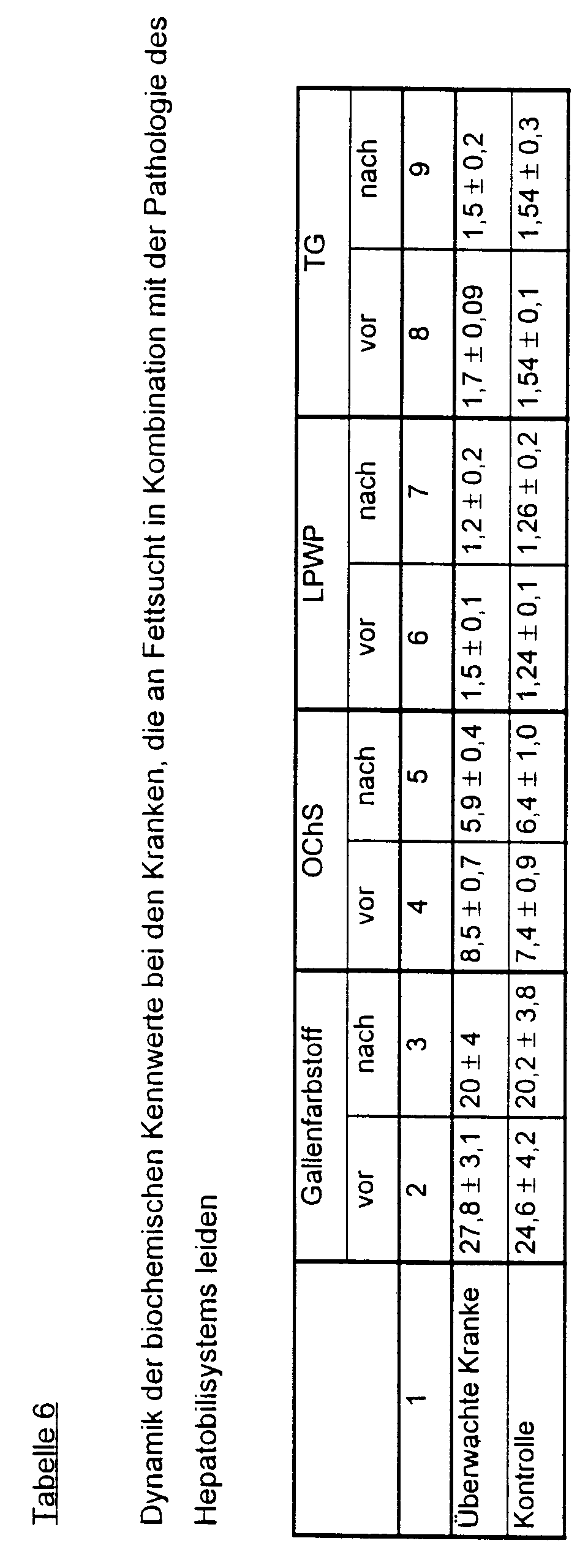
- Wie aus den eingereichten Angaben ersichtlich ist, sind bei den Kranken der gegebenen Gruppe der Pathologie die Abweichungen festzustellen, die für die ganze Gruppe der Korpulenten im großen und ganzen spezifisch sind. Die Erhöhung der Werte des Serumgallenfarbstoffes, die vom Gallenstauungssyndrom bedingt ist, hatte eine signifikanteTendenz zur Abnahme in der Gruppe der Kranken, denen das geprüfte Präparat verabreicht wurde. Es wurde genauso die Verminderung des Appetits, die Abnahme des Hungergefühls und die ausgeprägte Depression von Lipidkennwerten (OChS, LPWP, TG) beobachtet, was es erlaubt, die Verschreibung des Präparates der gegebenen Kategorie der Kranken für überaus zweckmäßig zu halten.
- Auf solche Weise besitzt MILAIF die Eigenschaft der ausgeprägten Normalisierung der Indexzahlen von Cholesterin und Triglyzeriden im Blutserum bei den Kranken mit den kardiovaskulären Erkrankungen, die auf dem Hintergrund der Störungen des Lipidstoffwechsels ablaufen, und vermindert dadurch das Risiko der Entwicklung der ischämischen Herzkrankheit.
- Die Untersuchungen wurden bei 15 onkologischen Kranken im Alter von 31 bis 65 Jahren mit unterschiedlicher Lokalisierung der Geschwülste (Gebärmutterhalskrebs der II. und III. Stufe, Nierenkrebs der III. Stufe, Lymphogranulomatose) durchgeführt. Als Kontrolle dienten 15 Personen im gleichen Alter und mit den gleichen Lokalisierungen von Geschwülsten. Alle Kranken wurden mit Einzeldosen von 2 bis 4 g. und mit einer Gesamtdosis von 40 bis 60 g. behandelt. Bei allen Kranken, denen MILAIF verabreicht wurde, war eine Verminderung der Leukopenie im Vergleich zu der Kontrollgruppe zu vermerken (um 1600 ± 370, P < 0,05). Sogar wenn der Ausgangsspiegel von Leukozyten niedrig war (1,7 x 10⁸ - 1,9 x 10⁸), gelang es, im Laufe einiger Tage diesen bis 3,0 x 10⁸ - 4,0 x 10⁸ und manchmal sogar bis 5,5 x 10⁸ zu erhöhen. Es gelang, eine Erhöhung der Leukozytenzahl bei der Ausnutzung auch der anderen Biostimulatoren zu erzielen, aber die Wirkung von MILAIF zeichnete eine große Stabilität des Effektes aus.
- Die Erhöhung der Leukozytenzahl war stabil und wurde auf dem Hintergrund der fortdauernden Bestrahlung oft beobachtet, was äußerst selten vorkommt, besonders ohne Bluttransfusion. Es gelang, bei allen Kranken einen vollen Kurs der Bestrahlung ohne Unterbrechung, die von der Leukopenie hervorgerufen sein könnte, und ohne Bluttransfusion, durchzuführen.
- Der Prozentgehalt an Monozyten war hoch, aber auch etwas niedriger als im Kontrollfall: bei 10 aus 15 Personen überschritten die Monozyten die Norm nur um 3 bis 5 %, während bei den übrigen auch im Kontrollfall eine bedeutende monozytäre Leukozytose (18 - 26 %) zu vermerken war.
- Bei allen Kranken war die Verminderung der Schwäche zu beobachten, verbesserten sich die Eßlust, der Schlaf und die Stimmung.
- Die durchgeführten Untersuchungen zeugen also davon, daß MILAIF ein Adaptationsmittel ist und den Organismus vor der Wirkung eines solchen schädigenden Faktors schützt wie wiederholter Bestrahlung.
- Der Einfluß von MILAIF ist ebenso bei den Kranken mit der spontanen Leukopenie (5 Personen) und der Leukopenie als Folge der Strahlentherapie (11 Personen) untersucht. Die Indexzahlen wurden bei den Kranken untersucht, denen MILAIF im Laufe von 15, 30 und 60 Tagen verabreicht wurde (1. Etappe), und während einer wiederholten Behandlung nach 12 Monaten (2. Etappe). Die erhaltenen Ergebnisse sind in der Tabelle 7 zusammengefaßt.

- Aus den Angaben der Tabelle 7 läßt sich eine deutliche Dynamik der Vergrößerung der Leukozytenzahl bei den Kranken, die an Leukopenie verschiedener Ätiologie leiden, zurückverfolgen.
- Somit findet die Adaptogenwirkung von MILAIF ihren Niederschlag in der Erhöhung der nicht spezifischen Widerstandsfähigkeit des Organismus bei den Kranken, die an Leukopenie verschiedener Ätiologien leiden.
- Es wurden Kinder im Alter von 3 bis 5 Jahren untersucht, die in einem im Hinblick auf die Ökologie ungünstigen Gebiet wohnen bei denen das Syndrom der Überoxydation festgestellt wurde. Es wurden insgesamt 77 Personen untersucht, von diesen bildeten 56 Personen die Hauptgruppe (1), 21 die Kontrollgruppe (2).
- Den Kindern der Hauptgruppe verabreichte man täglich MILAIF im Laufe von 20 bis 25 Tagen.
- Die Kontrollgruppe wurde in der Krankenstation standardmäßig behandelt.
- Die Kinder der beiden Gruppen wurden sorgfältig vom Kinderarzt, Otorhinolaryngologen, Allergologen, Neuropathologen, Immunologen, Mikrobiologen und anderen Fachleuten untersucht.
- Aus 56 Kindern der Hauptgruppe erwiesen sich 39 als sensibilisiert in Bezug auf die Gewebe von Innenorganen, und aus diesen bei 21 Kindern wurde chronische Gastritis diagnostiziert, bei 18 chronische Colitis mit den Erscheinungen der Dysbakteriose, bei 32 chronische Cholecystitis und Cholecystoangiocholitis.
- Neben den allgemeingültigen Untersuchungen (allgemeine Blutanalyse, Harnanalyse, Kotanalyse, EKG) wurden mit Immunochemieluminiszenzmethoden Untersuchungen des Blutes und des Speichels zur Bestimmung von Antikörpern gegen Organe und Bakterien- auf dem Analysator "Beta-2" durchgeführt, welche auf dem sehr schwachen Leuchten von Biomedien und Zellen in dem sichtbaren Bereich desSpektrums beruhen, das durch die Lipidgebilde bedingt ist.
- Die Änderungen der Kennwerte der Autoimmunisation infolge der Verwendung von MILAIF sind in der Tabelle zusammengefaßt.

- Aus den Angaben der Tabelle 8 ist ersichtlich, daß sich bei den Kindern sowohl der Hauptgruppe als auch der Kontrollgruppe im Blut eine beträchtliche Menge der Antiorganantikörper ansammelt und sich eine ausgeprägte Autoimmunisation zu den Geweben von Milz, Leber, Dick- und Dünndarm sowie Magen herausstellt. Der Vergleich der Therapieergebnisse der Hauptgruppe und der Kontrollgruppe hat gezeigt, daß die Verminderung der Intensität der Autoimmunisation bei den Kindern der Kontrollgruppe in Bezug auf die Verdauungsorgane weniger ausgeprägt war und die Intensität in Bezug auf die Gewebe von Milz, Lunge und Herzen nicht signifikant vermindert wurde.
- Die Verschreibung von MILAIF den Kindern der Hauptgruppe im Laufe von 20-25 Tagen trug zur signifikanten Verminderung der Menge der im Blut und den Geweben von Milz, Niere, Leber, Magen und Darm zirkulierenden autoimmunen Antikörper bei.
- Es ist also zweckmäßig, MILAIF in den Fällen der Erkrankung der Verdauungsorgane zu verschreiben, die von dem autoimmunen Prozeß und der Schwächung der Schutzkräfte des Organismus begleitet werden.
- Untersucht ist der Einfluß von MILAIF auf die Mikroflora bei den Kindern aus den gleichen Gruppen.
- Bei 54,2% der Kinder wurde die Störung eines oder mehrerer Indexzahlen festgestellt, die die Hautflora kennzeichnen, bei 38,2 % kam eine erhöhte Menge der Mikroorganismen pro Einheit der Hautoberfläche vor, bei 36,8 % wurden Mannitzerfallende Bakterien festgestellt, und bei 44,5 % - hämolytische Bakterien, die bei gesundem Organismus des Kindes nicht vorhanden sind.
- Die Störungen der Mikroflora des Darmes wurden durch eine wesentliche Reduzierung der Vermehrungsfähigkeit von Bifidusbakterien, durch die Sichtbarmachung des Colibakteriums mit einer geschwächten fermentativen Aktivität, der Colibazillen in einer laktosenegativen Form sowie durch die Änderung der normalen Verhältnisse zwischen den verschiedenen Vertretern der Darmflora als Folge der Erscheinung einer großen Menge der Coccoformen vom Typ Staphylococcus albus und Streptococcus gekennzeichnet.
- Bei 6,4 % der Kinder sind in den Inokulationsfäkalien Pilze der Art CANDIDA im aktiven Zustand registriert.
- Deshalb war es notwendig, die Entwicklung der Sensibilisierung oder der bakteriellen Infizierung der Kinder mit der pathogenen Autoflora sowie die Möglichkeiten der Behandlung derselben mit MILAIF zu studieren.
- Sensibilisierung an bakterielle Allergene wurde nach der Methode der Immunochemieluminiszenz untersucht.
- Es wurde die Ansammlung der bakteriellen Antikörper im Blut und im Speichel in Bezug auf die Antigene vom Streptococcus, Staphylococcus, Kolibakterium, Proteus, Enterococcus, Pyozyaneusbakterie bestimmt.
- Die Untersuchung der bakteriellen Infizierung und der bakteriellen Sensibilisierung erlaubten es, die immunologischen Reaktionen in Bezug auf die bakteriellen Antigene zu erfassen.
- Am häufigsten sowohl bei den Kindern der Hauptgruppe als auch der Kontrollgruppe war die Sensibilisierung gegen Colibakterien, Staphylococcus und Proteus zu vermerken.
- Es hat sich herausgestellt, daß der Umbau der Mikrobenumgebung bei den Kindern in der Regel mit der Intensivierung der Produktion von Antikörpern in Bezug auf einige Bakterien gleichzeitig begleitet wurde.
- In der Tabelle 9 sind die Angaben angeführt, die bei der Untersuchung der Immunreaktionen in Bezug auf die bakteriellen Antigene bei den Kindern der Hauptgruppe und der Kontrollgruppe erhalten sind.

- Aus den Angaben der Tabelle folgt, daß die Einnahme von MILAIF bei den Kindern, die zu der Hauptgruppe zugerechnet wurden, zur ausgeprägten Verminderung der Konzentration der Antikörper gegen Staphylococcus hämolytikus, Streptococcus, Colibakterium, Enterecoccus und Pyocyaneusbakterie beigetragen hat.
- Es ist also zweckmäßig, MILAIF den Kranken mit den Erscheinungen der Dysbakteriose zu verschreiben, die sich auf dem Hintergrund der Unterdrückung der Schutzkräfte des Organismus entwickelten.
- Auf solche Weise trug die Verwendung von MILAIF bei den Kranken, die an chronischen Cholecystoangiocholiten, Gastriten, Gastroduodeniten, Koliten, oft mit Erscheinungen der Dysbakteriose, die sich auf dem Hintergrund des Syndroms der Peroxydation entwickelte, litten, zur Verminderung der Ausprägung von autoimmunen Reaktionen, hauptsächlich auf Antigene des Magen-Darm-Kanals, und Hyposensibilisierung gleichzeitig an einigen bakteriellen Allergenen bei.
- Der Stamm des Pilzes F. SAMBUCINUM WSB-917 wird für die industrielle Herstellung des Präparates MILAIF verwendet.
- Das anmeldungsgemäße Präparat wird seine Anwendung im Gesundheitswesen finden und kann verwendet werden als:
- zusätzliches Therapiemittel bei Störungen des Stoffwechsels von Lipiden, Cholesterin und Glucose (Atherosklerose, ischämische Herzkrankheit, Leberkrankheiten, Fettsucht, Diabetes zweiten Typs), insbesondere in der Gerontologie;
- prophylaktisches Mittel für somatische Erkrankungen und Komplikationen, die sich auf dem Hintergrund der Strahlentherapie bei onkologisch Kranken entwickeln;
- Hilfsmittel für die Durchführung der Allgemeinstärkungsbehandlung und der Desintoxikationsbehandlung;
- prophylaktisches Mittel für somatische Erkrankungen bei Personen, die unter im Hinblick auf die Ökologie komplizierten Verhältnissen und in Zonen mit erhöhter Strahlung leben und arbeiten;
- Mittel für die Behandlung von Dysbakteriosen
- Mittel für die Korrektur der Spurenelemente.
- Unter Berücksichtigung der autoimmunen Aktivität ist die Verwendung des Präparates auch bei der Transplantation von Organen und Geweben möglich.
- Der Herstellungsprozeß des Präparates umfaßt die folgenden Stufen:
- Vorbereitung und Sterilisation von flüssigem Nährboden; Zubereitung des Inokulationsmyzels vom Pilz; Züchtung vom Myzel in Arbeitsfermentationsapparaten; Konzentration, Isolierung, Trocknung und Auswiegen des Präparates.
- Als Kohlenstoffquelle für das Wachsen des Myzels können verwendet werden: Zuckerrüben- und Zuckerrohrmelassen, Rohzucker, Saccharose, Glucose, technologische Abfallprodukte der Alkohol- und Cognacproduktion (Alkohol- und Cognacschlempen), Milchserum, Säfte von Hackfrüchten und Grünmasse. Als Quellen von Stickstoff, Kalium und Phosphor verwendet man Ammoniumnitrat und saures Kaliumphosphat.
- Die Sterilisation des Nährbodens wird mit Hilfe einer Anlage der kontinuierlichen Sterilisation bei einer Temperatur von 125 ± 2 °C durchgeführt, die Verweilzeit in der Sterilisationszone beträgt 3 Minuten. Das Inokulationsmyzel für den Arbeitsfermentationsapparat wird zuerst in den Prüfgläsern auf einem festen Nährboden, dann in den Kolben auf dem Schwinggerät auf einem flüssigen Nährboden und danach im Inokulator unter den folgenden technologischen Verhältnissen gezüchtet:
Temperatur 25 ± 2 °C pH-Wert 5,5 - 6,2 freie Lüftung 1 m³/m³/min. - Das Inokulationsmaterial ist fertig, wenn die Konzentration der Trockensubstanzen des Myzels im Aufzuchtmedium 9-12 g/l erreicht. 5 bis 10 Vol.-% eines solchen Mediums dienen als Inokulationsmaterial, das unter Einhaltung der Regeln der Aseptik in den Arbeitsfermentationsapparat gebracht wird.
- Die Züchtung des Myzels im Arbeitsapparat erfolgt unter den gleichen Verhältnissen wie auch im Inokulator, auf dem Nährboden mit der gleichen Zusammensetzung. Es ist möglich, auch einen diskontinuierlichen Prozeß durch Abnehmen von Produkt und Nachfüllen von Nährboden (semikontinuierlich) sowie einen kontinuierlichen Prozeß der Züchtung durchzuführen.
- Die nachfolgende Stufe des technologischen Prozesses ist:
- Eindickung des Aufzuchtmediums mit Hilfe von Vakuumfilterapparaten. Ferner erfolgt die Entwässerung des Produktes mit Hilfe von Infrarot-Trockenapparaten unter den schonenden Verhältnissen (bis +50 °C), unter welchen die biologische Wirksamkeit von Komponenten erhalten bleibt.
Die Dauer der Trocknung beträgt 15 bis 20 Minuten.
Ferner wird das Präparat granuliert, tablettiert, ausgewogen und verpackt.
Das auf solche Weise erhaltene Präparat kann ohne Verlust der Aktivität 24 Monate bei einer Raumtemperatur von 17 bis 25 °C gelagert werden. - Das Pilzmyzel wurde unter den Bedingungen der semikontinuierlichen Kultivierung in dem Fermentationsapparat mit einem Rauminhalt von 200 l gezüchtet, unter Ausnutzung des nachfolgenden Nährbodens in Gew.-%:
Rübenmelasse 4 (2 im Hinblick auf reduzierende Stoffe), Ammoniumnitrat 0,3, Saures Kaliumphosphat 0,2, Wasser bis 100 pH-Wert 5,5 - 5,8. - Das Inokulationsmaterial wurde in einer Menge von 5 Vol.-% eingebracht, die Temperatur der Kultivierung betrug 24 ± 1 °C, die Dauer eines Zyklus der Kultivierung - 14 Stunden. Der ASB-Inhalt betrug 20 g in 1 l des Mediums. Die Produktivität des Prozesses ist 1,4 kg/m³/h.
- Das auf solche Weise hergestellte Präparat hatte die nachfolgende Zusammensetzung in Masse-%:
Allgemeines Eiweiß (N x 6,25) 60 Kohlenhydrate 13 Lipide 8 Nukleinsäuren 3 Mineralstoffe 8 Vitamine 2,6 Wasser 5,4 - Das Myzel wurde unter den Bedingungen der semikontinuierlichen Kultivierung in den Fermentationsapparaten mit einem Rauminhalt von 30 l auf einem Nährboden gezüchtet, der die nachfolgende Zusammensetzung in Gew.-% aufweist:
Rohzucker 2 Ammoniumnitrat 0,3 Saures Kaliumphosphat 0,2 Maisquellwasser 0,05 Wasser bis 100 pH-Wert 5,7 - 6,0 - Das Inokulationsmaterial wurde in einer Menge von 8 Vol.-% eingebracht, die Temperatur der Kultivierung - 25 ± 1 °C.
- Die Dauer eines Zyklus betrug 13 Stunden. Ferner nahm man das Abgießen des Aufzuchtmediums im Volumen von 92 % vor, brachte einen neuen Nährboden ein und führte den Züchtungsprozeß weiter; nach 13 Stunden wiederholte man die Arbeitsoperation. Die Konzentration von ASB betrug 20,1 g in l.
Prozeßproduktivität 1,5 kg/m³/h - Das auf solche Weise hergestellte Präparat wies die nachfolgende Zusammensetzung in Masse-% auf:
Allgemeines Eiweiß (N x 6,25) 63 Kohlenhydrate 10 Lipide 4 Nukleinsäuren 6 Mineralstoffe 6 Vitamine 3,1 Wasser 7,9 - Die Züchtung vom Myzel führte man ebenso wie im Beispiel 2 durch, ausgenommen, daß das Inokulationsmaterial in einer Menge von 10 Vol.-% eingebracht wurde. Die Temperatur der Züchtung betrug 26 ± 1 °C, pH-Wert des Mediums 6,0 - 6,2.
- In diesem Fall betrugen die Dauer der Kultivierung 12,5 Stunden und die Speicherung von ASB - 20,2 g in l.
- Die Produktivität des Prozesses betrug 1,6 kg/m³/Stunde.
- Das Präparat wies die nachfolgende Zusammensetzung in Masse-% auf:
Allgemeines Eiweiß (N x 6,25) 61,5 Kohlenhydrate 11,5 Lipide 6 Nukleinsäuren 4,5 Mineralstoffe 7 Vitamine 2,8 Wasser 6,7
Claims (4)
- Verwendung des Stammes vom Pilz FUSARIUM SAMBUCINUM FUCKEL VAR. OSSICOLUM, (BERK. ET CURT.) BULAI WSB-917 (Allunionskollektion von Industriemikroorganismen des Instituts WNIIgenetika, die Kollektionsnummer WKPM F-169) als Produzent physiologisch aktiver Stoffe mit prophylaktischer und therapeutischer Zweckbestimmung.
- Präparat für Prophylaxe und Therapie von Erkrankungen, die mit der Störung des Stoffwechsels zusammenhängen, das eine Adaptogen- und Immunomodulationswirkung besitzt, dadurch gekennzeichnet, daß es infolge der Entwässerung des Aufzuchtmediums enthalten ist, das im Prozeß der Flüssigphasen-Tiefen-Kultivierung der Monokultur des Pilzes F. SAMBUCINUM gebildet wird, die nachfolgende Zusammensetzung in Gew.-% aufweist:
Allgemeines Eiweiß (N x 6,25) von 60 bis 63, Kohlenhydrate von 10 bis 13, Lipide von 4 bis 8, Nukleinsäuren von 3 bis 6, Mineralstoffe von 6 bis 8, Vitamine von 2,6 bis 3,1, Wasser Rest, - Präparat nach Anspruch 2, dadurch gekennzeichnet, daß es in Form von Tabletten, Granulen oder Pulver hergestellt wird.
- Präparat nach Anspruch 2, dadurch gekennzeichnet, daß als Träger des Präparates verschiedene Nahrungsmittel auftreten können.
Applications Claiming Priority (3)
| Application Number | Priority Date | Filing Date | Title |
|---|---|---|---|
| RU9393057876A RU2040932C1 (ru) | 1993-12-17 | 1993-12-17 | Препарат, влияющий на тканевой обмен и применение штамма гриба fusarium sambucinum fuckel var ossicolum (berk.et curf) bilai для его получения |
| RU93057876 | 1993-12-21 | ||
| PCT/RU1994/000260 WO1995017902A1 (en) | 1993-12-17 | 1994-11-23 | Use of a strain of the fungus fusarium as a substance producer and a preparation based on it with adaptogenic and immunomodulating properties |
Publications (3)
| Publication Number | Publication Date |
|---|---|
| EP0699442A1 true EP0699442A1 (de) | 1996-03-06 |
| EP0699442A4 EP0699442A4 (de) | 1997-03-11 |
| EP0699442B1 EP0699442B1 (de) | 1998-09-16 |
Family
ID=20150987
Family Applications (1)
| Application Number | Title | Priority Date | Filing Date |
|---|---|---|---|
| EP95903058A Expired - Lifetime EP0699442B1 (de) | 1993-12-17 | 1994-11-23 | Die verwendung eines stammes des pilzes fusarium zur herstellung von substanzen und eine darauf basierende zubereitung mit adaptiven und immunmodulierenden eigenschaften |
Country Status (6)
| Country | Link |
|---|---|
| US (1) | US5759543A (de) |
| EP (1) | EP0699442B1 (de) |
| AU (1) | AU1206095A (de) |
| DE (1) | DE59406935D1 (de) |
| RU (1) | RU2040932C1 (de) |
| WO (1) | WO1995017902A1 (de) |
Families Citing this family (21)
| Publication number | Priority date | Publication date | Assignee | Title |
|---|---|---|---|---|
| AU6838996A (en) * | 1996-05-27 | 1998-01-05 | Alexei Nikolaevich Parfenov | Use of streptococcus faecium strains and composition containing the same |
| WO2001073104A1 (en) * | 2000-03-24 | 2001-10-04 | Societe Des Produits Nestle S.A. | Beta-glucans from filamentous fungi |
| RU2187109C2 (ru) * | 2000-04-24 | 2002-08-10 | Долгих Владимир Терентьевич | Способ определения нарушения обмена веществ |
| US20070128253A1 (en) * | 2005-04-13 | 2007-06-07 | Ramaekers Joseph C | Encapsulated transfer factor compositions and methods of use |
| US6506413B1 (en) * | 2001-04-30 | 2003-01-14 | Joseph C. Ramaekers | Compositions for treating animal diseases and syndromes |
| RU2223318C2 (ru) * | 2001-08-28 | 2004-02-10 | НИИ онкологии им. проф. Н.Н.Петрова | Способ выявления канцерогенности химических соединений |
| RU2235481C2 (ru) * | 2002-11-20 | 2004-09-10 | Общество с ограниченной ответственностью "Гелла-Фарма" | Способ получения биологически активной добавки к пище (варианты) |
| RU2259209C2 (ru) * | 2004-03-01 | 2005-08-27 | Зуев Евгений Трофимович | Штамм гриба fusarium sambucinum - продуцент биологически активных веществ |
| RU2268620C1 (ru) * | 2004-06-02 | 2006-01-27 | Ооо "Гелла Фарма" | Биологически активный пищевой продукт на основе молочного сырья (варианты) |
| TW200714280A (en) * | 2005-06-01 | 2007-04-16 | Takeda Pharmaceuticals Co | Novel method of treating hyperlipidemia |
| EP1932436A1 (de) * | 2005-08-31 | 2008-06-18 | Obschestvo S Ogranichennoi Otvetstvennostyu Gella- | Biologisch aktives nahrungsmittelprodukt auf milchbasis |
| US20090053197A1 (en) * | 2006-06-14 | 2009-02-26 | Ramaekers Joseph C | Transfer Factor Compositions and Methods |
| US9125874B2 (en) | 2007-11-30 | 2015-09-08 | The Ramaekers Family Trust | Administration of transfer factor for improving reproductive health |
| RU2366697C2 (ru) * | 2007-07-03 | 2009-09-10 | Закрытое Акционерное Общество "Дижафарм" | Средство, обладающее системным действием, его применение, фармкомпозиции, способы лечения и профилактики |
| US20090074751A1 (en) * | 2007-09-18 | 2009-03-19 | Ramaekers Nutrition, Inc. | Growth factor fraction compositions and methods |
| WO2009070788A1 (en) * | 2007-11-30 | 2009-06-04 | The Ramaekers Family Trust | Compositions and methods for enhancing fertility |
| RU2435599C1 (ru) * | 2010-07-21 | 2011-12-10 | Валерий Павлович Герасименя | ПРЕПАРАТ 4-Hydroxy-17R-Methylincisterol, ВЛИЯЮЩИЙ НА ТКАНЕВОЙ ОБМЕН, И ПРИМЕНЕНИЕ ШТАММА ГРИБА Pleurotus 1137 ДЛЯ ЕГО ПОЛУЧЕНИЯ |
| US8268305B1 (en) | 2011-09-23 | 2012-09-18 | Bio-Cat, Inc. | Method and compositions to reduce serum levels of triacylglycerides in human beings using a fungal lipase |
| RU2487930C1 (ru) * | 2012-06-19 | 2013-07-20 | Валерий Павлович Герасименя | ПРЕПАРАТ С ПОЛИФУНКЦИОНАЛЬНОЙ МЕДИКО-БИОЛОГИЧЕСКОЙ АКТИВНОСТЬЮ, ВЛИЯЮЩИЙ НА ТКАНЕВОЙ ОБМЕН, НА ОСНОВЕ ШТАММА ГРИБА Pleurotus ostreatus ВКПМ F-819 |
| RU2551937C1 (ru) * | 2013-12-26 | 2015-06-10 | Государственное бюджетное учреждение здравоохранения Свердловской области "Центр организации специализированных видов медицинской помощи "Институт медицинских клеточных технологий" (ГБУЗСО Институт медицинских клеточных технологий) | Способ восстановления селезенки после лучевой нагрузки |
| CN109512942A (zh) * | 2019-01-09 | 2019-03-26 | 李耀斌 | 一种治疗放化疗引起的白细胞减少的药物组合物 |
Family Cites Families (5)
| Publication number | Priority date | Publication date | Assignee | Title |
|---|---|---|---|---|
| GB1598457A (en) * | 1977-03-22 | 1981-09-23 | Glaxo Lab Ltd | Process for the preparation of a fraction containing peptidoglycan material from streptomyces griseus |
| FR2410658A1 (fr) * | 1977-11-30 | 1979-06-29 | Science Union & Cie | Nouveau produit biologique d'origine fongique, son obtention et son application a la therapeutique |
| US4744984A (en) * | 1985-10-08 | 1988-05-17 | Vetrepharm Research, Inc. | Antiviral immunotherapeutic agent and preparation thereof |
| JPH01228480A (ja) * | 1988-03-09 | 1989-09-12 | Nippon Hai Potsukusu:Kk | 食用担子菌菌糸体培養抽出物の製造方法 |
| KR920010763B1 (ko) * | 1990-12-04 | 1992-12-17 | 일양약품공업 주식회사 | 항종양 면역증강효과가 있는 단백다당체(g 009) |
-
1993
- 1993-12-17 RU RU9393057876A patent/RU2040932C1/ru active
-
1994
- 1994-11-23 US US08/507,376 patent/US5759543A/en not_active Expired - Lifetime
- 1994-11-23 DE DE59406935T patent/DE59406935D1/de not_active Expired - Lifetime
- 1994-11-23 EP EP95903058A patent/EP0699442B1/de not_active Expired - Lifetime
- 1994-11-23 AU AU12060/95A patent/AU1206095A/en not_active Withdrawn
- 1994-11-23 WO PCT/RU1994/000260 patent/WO1995017902A1/ru not_active Ceased
Non-Patent Citations (4)
| Title |
|---|
| DATABASE BIOSIS BIOSCIENCES INFORMATION SERVICE, PHILADELPHIA, PA, US ZUSAMMENFASSUNG 87:488513, POPRAVKO ET AL: "A COMPARITIVE STUDY OF THE FATTY ACID COMPOSITION OF ACYLGLYCERIDES OF THE MYCELIUM OF FUSARIUM-SAMBUCINUM-VAR-OSSICOLUM BERK. EX CURT." XP002025731 & PRIKL BIOKHIM MIKROBIOL , Bd. 23, Nr. 4, 1987, Seiten 478-485, * |
| DATABASE BIOSIS BIOSCIENCES INFORMATION SERVICE, PHILADELPHIA, PA, US ZUSAMMENFASSUNG 93:482332, BABAKHIN ET AL: "PHARMACOLOGICAL CONTROL OF ALLERGY AT THE STAGE OF IGE ANTIBODY PRODUCTION" XP002025730 & KHIM-FARM ZH, Bd. 27, Nr. 2, 1993, Seiten 4-7, * |
| MICROBIOLOGICAL SCIENCES, Bd. 3, Nr. 6, 1986, Seiten 168-171, XP000644746 CANNON: "INTERNATIONAL COMISSION ON THE TAXONOMY OF FUNGI (ICTF): NAME CHANGES IN FUNGI OF MICROBIOLOGICAL, INDUSTRIAL AND MEDICAL IMPORTANCE. PART 1." * |
| See also references of WO9517902A1 * |
Also Published As
| Publication number | Publication date |
|---|---|
| RU2040932C1 (ru) | 1995-08-09 |
| EP0699442B1 (de) | 1998-09-16 |
| US5759543A (en) | 1998-06-02 |
| AU1206095A (en) | 1995-07-17 |
| DE59406935D1 (de) | 1998-10-22 |
| WO1995017902A1 (en) | 1995-07-06 |
| EP0699442A4 (de) | 1997-03-11 |
Similar Documents
| Publication | Publication Date | Title |
|---|---|---|
| EP0699442B1 (de) | Die verwendung eines stammes des pilzes fusarium zur herstellung von substanzen und eine darauf basierende zubereitung mit adaptiven und immunmodulierenden eigenschaften | |
| DE69838988T2 (de) | Verfahren und zusammensetzungen unter verwendung von fermentationsprodukten des roten reises | |
| DE68907057T2 (de) | Nährstoffzusammensetzung und verfahren zu deren herstellung. | |
| DE3752112T2 (de) | Verwendung von Inositoltriphosphat zur Behandlung von Entzündungen | |
| DE68919114T2 (de) | Undenaturiertes Proteinkonzentrat aus Molke. | |
| DE69834633T3 (de) | Oligosaccharide enthaltende ernährungszusammensetzungen | |
| DE69931907T2 (de) | Zusammensetzungen aus hagebutten als anti-entzündliches natürliches arzneimittel zur erleichterung/verringerung von symptomen, die mit entzündungen und arthritis zusammenhängen | |
| Sumi et al. | Vitamin B-6 deficiency in germfree rats | |
| DE69230495T2 (de) | Spurenelementreiches zusatzmittel, verfahren zu dessen herstellung, diese enthaltende zusammensetzung und deren verwendung | |
| DE60005104T2 (de) | Diätzusatz aus fermentierte milchprodukte zur prävention von östeoporose | |
| DE60028613T2 (de) | Schlaffördernde wirkung von nicht-pathogenen milchsäurebakterien | |
| DE60031421T2 (de) | Pflanzenextrakt-mischungen (cissus, vernonia, brillantaisia) und ihre verwendungen | |
| DE4332985A1 (de) | Arzneimittel zur Behandlung der Dysfunktion des exokrinen Pankreas | |
| Cook | The nutritive value of waste-grown algae | |
| DE69434093T2 (de) | Substanz mit immunonodulierender wirkung und zur verringerung der disfunktion des gewebezellenregelungssystems | |
| US6841180B2 (en) | Method for preparing lactic acid fermented solution of mushroom and lactic acid fermented solution of mushroom produced thereby | |
| DE3109335A1 (de) | Die neue, physiologisch wirksame substanz ebelacton und verfahren zur herstellung derselben | |
| DE60133781T2 (de) | Orale zubereitungen mit juckreizlindernder oder antipruritischer wirkung | |
| DE68903065T2 (de) | Aus gingko biloba extrahierter biologischer regulator, wirksam in verschiedenen pathologien. | |
| DE69522723T2 (de) | Antiallergisches Mittel und Nährstoffzusammensetzung, die Glutamin enthalten | |
| DE69101847T2 (de) | Zubereitung für die Verhütung oder die Behandlung von Hypertriglyceridämie. | |
| DE3035193A1 (de) | Neues antibiotikum sf-1130-x(pfeil abwaerts)3(pfeil abwaerts), verfahren zur herstellung desselben sowie mittel, welche das neue antibiotikum | |
| DE3345211C2 (de) | ||
| DE60118888T2 (de) | Verfahren zur erhöhung bzw. verbesserung der synthese von mucin | |
| DE69013425T2 (de) | Pseudomonasmutant, yzh-Stamm und Verfahren zur Herstellung der 851yzh-Nährlösung mittels dieses Stammes. |
Legal Events
| Date | Code | Title | Description |
|---|---|---|---|
| PUAI | Public reference made under article 153(3) epc to a published international application that has entered the european phase |
Free format text: ORIGINAL CODE: 0009012 |
|
| 17P | Request for examination filed |
Effective date: 19950920 |
|
| AK | Designated contracting states |
Kind code of ref document: A1 Designated state(s): CH DE FR GB LI |
|
| A4 | Supplementary search report drawn up and despatched | ||
| AK | Designated contracting states |
Kind code of ref document: A4 Designated state(s): CH DE FR GB LI |
|
| 17Q | First examination report despatched |
Effective date: 19970527 |
|
| GRAG | Despatch of communication of intention to grant |
Free format text: ORIGINAL CODE: EPIDOS AGRA |
|
| GRAG | Despatch of communication of intention to grant |
Free format text: ORIGINAL CODE: EPIDOS AGRA |
|
| GRAH | Despatch of communication of intention to grant a patent |
Free format text: ORIGINAL CODE: EPIDOS IGRA |
|
| GRAH | Despatch of communication of intention to grant a patent |
Free format text: ORIGINAL CODE: EPIDOS IGRA |
|
| GRAA | (expected) grant |
Free format text: ORIGINAL CODE: 0009210 |
|
| AK | Designated contracting states |
Kind code of ref document: B1 Designated state(s): CH DE FR GB LI |
|
| REG | Reference to a national code |
Ref country code: CH Ref legal event code: EP |
|
| GBT | Gb: translation of ep patent filed (gb section 77(6)(a)/1977) |
Effective date: 19980917 |
|
| REF | Corresponds to: |
Ref document number: 59406935 Country of ref document: DE Date of ref document: 19981022 |
|
| REG | Reference to a national code |
Ref country code: CH Ref legal event code: NV Representative=s name: BUECHEL & PARTNER AG PATENTBUERO |
|
| ET | Fr: translation filed | ||
| PLBE | No opposition filed within time limit |
Free format text: ORIGINAL CODE: 0009261 |
|
| STAA | Information on the status of an ep patent application or granted ep patent |
Free format text: STATUS: NO OPPOSITION FILED WITHIN TIME LIMIT |
|
| 26N | No opposition filed | ||
| REG | Reference to a national code |
Ref country code: GB Ref legal event code: IF02 |
|
| PGFP | Annual fee paid to national office [announced via postgrant information from national office to epo] |
Ref country code: DE Payment date: 20131121 Year of fee payment: 20 Ref country code: GB Payment date: 20131120 Year of fee payment: 20 Ref country code: CH Payment date: 20131121 Year of fee payment: 20 Ref country code: FR Payment date: 20131120 Year of fee payment: 20 |
|
| REG | Reference to a national code |
Ref country code: DE Ref legal event code: R071 Ref document number: 59406935 Country of ref document: DE |
|
| REG | Reference to a national code |
Ref country code: CH Ref legal event code: PL |
|
| REG | Reference to a national code |
Ref country code: GB Ref legal event code: PE20 Expiry date: 20141122 |
|
| PG25 | Lapsed in a contracting state [announced via postgrant information from national office to epo] |
Ref country code: GB Free format text: LAPSE BECAUSE OF EXPIRATION OF PROTECTION Effective date: 20141122 |