EP0700000A2 - Système et procédé de combinaison d'un identificateur d'objet global avec une adresse locale d'objet dans un unique pointeur d'objet - Google Patents
Système et procédé de combinaison d'un identificateur d'objet global avec une adresse locale d'objet dans un unique pointeur d'objet Download PDFInfo
- Publication number
- EP0700000A2 EP0700000A2 EP95480098A EP95480098A EP0700000A2 EP 0700000 A2 EP0700000 A2 EP 0700000A2 EP 95480098 A EP95480098 A EP 95480098A EP 95480098 A EP95480098 A EP 95480098A EP 0700000 A2 EP0700000 A2 EP 0700000A2
- Authority
- EP
- European Patent Office
- Prior art keywords
- pointer
- address
- address space
- virtual address
- distributed memory
- Prior art date
- Legal status (The legal status is an assumption and is not a legal conclusion. Google has not performed a legal analysis and makes no representation as to the accuracy of the status listed.)
- Granted
Links
Images


Classifications
-
- G—PHYSICS
- G06—COMPUTING OR CALCULATING; COUNTING
- G06F—ELECTRIC DIGITAL DATA PROCESSING
- G06F9/00—Arrangements for program control, e.g. control units
- G06F9/06—Arrangements for program control, e.g. control units using stored programs, i.e. using an internal store of processing equipment to receive or retain programs
- G06F9/46—Multiprogramming arrangements
- G06F9/465—Distributed object oriented systems
-
- G—PHYSICS
- G06—COMPUTING OR CALCULATING; COUNTING
- G06F—ELECTRIC DIGITAL DATA PROCESSING
- G06F12/00—Accessing, addressing or allocating within memory systems or architectures
- G06F12/02—Addressing or allocation; Relocation
- G06F12/0223—User address space allocation, e.g. contiguous or non contiguous base addressing
- G06F12/0292—User address space allocation, e.g. contiguous or non contiguous base addressing using tables or multilevel address translation means
-
- G—PHYSICS
- G06—COMPUTING OR CALCULATING; COUNTING
- G06F—ELECTRIC DIGITAL DATA PROCESSING
- G06F12/00—Accessing, addressing or allocating within memory systems or architectures
- G06F12/02—Addressing or allocation; Relocation
- G06F12/08—Addressing or allocation; Relocation in hierarchically structured memory systems, e.g. virtual memory systems
- G06F12/10—Address translation
Definitions
- This invention relates generally to addressing objects in an object-oriented programming environment and more particularly to a system and method for combining a global object identifier with a local object address in a single object pointer.
- Multitasking computer systems Large computer systems permitting many users to simultaneously use single computer resources are herein denominated multitasking computer systems. Such multitasking systems can be interconnected through networks to permit concurrent processing over a distributed plurality of computer resources.
- the concurrent activities of a large number of simultaneous users are managed by an operating system, which must provide the necessary data structures for tracking and controlling many concurrent processes.
- Requisite data structures include those needed to manage the distributed memory and the multiple central processing unit (CPU) resources that are used by user processes throughout the network.
- objects include data structures holding information that must be protected from unauthorized access by other user processes.
- Objects are created by the operating system responsive to user requests and are structured to permit access by the requesting user through system routines that protect the integrity of each object.
- an object identifier denominates a value that can be used to uniquely identify an object for the lifetime of that object across some defined domain, such as a single system, a network of systems or the set of all systems in some predefined universe.
- an object address denominates a value that allows a user application to conduct high-performance operations on an object in a local virtual address space assigned to the associated user application process.
- An object address need not be unique in any domain broader than the local virtual address space in which it is used.
- the concepts of object identifier and object address are separate and distinct.
- An object identifier is needed to identify an object having a lifetime that exceeds its local address lifetime.
- Object identifiers are used, for instance, to manage a network of objects, herein denominating a structure embracing a multiplicity of objects linked together by stored object identifiers each linked to an object within the multiplicity.
- object address and object identifier are conceptually distinct and have independent values
- the systems programmer must provide for both. For instance, storage must be allocated for both, storing and updating operations must be allocated for both and so forth. This doubled complexity reduces programming productivity and increases the probability of programming error. There is, accordingly, a clearly-felt need in the art to provide both functions in a single data structure. Although this could be accommodated merely by concatenating the two values into a single double-sized data structure, such a solution offers no reduction in programming complexity because no storage allocation or updating operations are thereby avoided.
- one solution uses a server process that temporarily impersonates the characteristics of a client process when the client process performs a remote procedure call on the server process in a multitasking system.
- This impersonation is accomplished by creating a new object identifier list that is either the same as the client process list or represents the union of the server and client lists.
- Such an access control list is provided in each object to define those identifiers required to access the object.
- access checking software in the operating system may then enable the impersonating process to access the specified object.
- This solution ideally increases programming complexity to accomplish the necessary manipulation of mapping tables that relate object identifiers to local addresses.
- Another solution uses a system for creating "conditional" objects having different object pointers for accessing selected system resources.
- This object-based operating system supports multiple levels of visibility, thereby permitting objects to be manipulated only by processes within the object's "range" of visibility.
- An object or an object network can be moved up to a higher visibility level for more object sharing and down to a lower visibility level for more restricted or privileged access.
- the visibility restriction is achieved by giving each process a pointer (object identifier) to its own process-level container directory and providing for a "public display" container directory permitting interprocess object access.
- Another approach achieves a virtual look-aside facility for maintaining named data objects in class-related data spaces in virtual storage by providing for an ordered list of "major names" within each user process that is sequentially searched for a specified "minor name” to obtain a virtual storage copy of a data object.
- This requires a control structure designed to capture information about the location of data within a tree structure that is implicitly created by a naming technique that is commonly used during routine caching operations. This information by-product, selectively used to improve performance in subsequent transactions, does nothing to reduce the programming complexity associated with object naming conventions.
- an object identifier generator for producing unique identifiers in a distributed computer system by concatenating the identifier of the creating node firstly with a creation time from an associated clock adjusted to ensure uniqueness, secondly with a random name-sequence, and finally with a system version number. This generator ensures the creation of an object identifier that is unique across an indefinite universe of computer systems but does not affect the programming complexity problem.
- Other related approaches include a system environment that employs workspace name tables for linking packaged workspaces (user processes).
- An active workspace accesses a loaded copy of the packaged workspaces using the external names of named objects in a packaged workspace rather than the internal names of its own named objects.
- This system is controlled through a packaged workspace name table stored in the active workspace, which can be merged with other name tables from other packaged workspaces and also shared among a plurality of active workspaces.
- this system merely maps object identifiers to local addresses and does nothing to reduce programming complexity.
- the system of this invention introduces a new data structure and a process that preserves part of the object identifier in each new local address selected for an object that is transferred into a new virtual address space. By preserving this part of the object identifier, a single truncated pointer is then sufficient to carry all object identifier and object address information.
- a local mapping table may be used to manage local address assignments but is not essential to the system of this invention.
- the system of this invention is an object-oriented programming structure suitable for application to multitasking systems.
- object-oriented programming structures include data structures and procedures that control user-definable objects.
- objects are data structures holding information that is used by the operating system or by user applications.
- a "process object” is a particular object type known in the art for storing information required by the operating system to track the status of a particular user process.
- a "process” is the entity to which a virtual memory address space is assigned by the operating system and also is the entity to which process-level objects are assigned. As is known in the art, a particular user may employ multiple processes simultaneously. Whenever a particular user demands system resources, a "top level” process is created to manage all related activities. Any process, including any user process or the top level process, may cause the creation of additional processes, denominated subprocesses or "child” processes. Thus, any "parent” process may create one or more "child” processes.
- Fig. 1 illustrates a computer system 10 that is typical of multitasking computer networks known in the art.
- System 10 includes a high-speed central processing unit (CPU) 12 that concurrently runs the several processes 14, 16, 18 and 20.
- CPU 12 may be either a single processor or may include multiple distributed processors.
- Each process 14-20 is associated with its own virtual memory space, which is mapped in part into high-speed primary memory 22 and in part into lower-speed secondary memory 24 by a virtual memory manager 26.
- Each process 14-20 is allocated a portion of the available computer resources, including selected peripheral devices such as terminals 28 and 30 and other input-output (I/O) devices 32 and 34. Process allocations also include specified sets of data and data structures in the distributed memory 22 and 24.
- I/O input-output
- Multitasking computer system 10 may also include one or more remotely-located computer systems, exemplified by remote computer 38, which may include other terminals, I/O devices, primary and secondary memory devices and the like (not shown). Data communications among CPU 12, peripheral devices 28-34 and remote computer 38 are controlled by a bus interface 40 in one of several fashions known in the art.
- Fig. 2 shows a functional block diagram illustrating the allocation of virtual memory space for several concurrent user processes 14-18.
- the virtual memory space associated with each process includes a virtual address space, exemplified by virtual address space 42 for process 14, that can be accessed by "user mode” programs as well as “kernel mode” programs having system-wide privilege, including "executive” mode 44, "kernel” mode 46 and “hardware” mode 48 privilege levels known in the art.
- the virtual memory space 44-48 allocated to kernel mode is common to all user processes running in the multitasking computer system 10. Thus, a predefined portion (44, 46 and 48) of the virtual memory space associated with each user process is occupied by operating system 36 and its data structures.
- the user mode portion 42 occupies the remainder of the associated virtual memory space assigned to the user process 14.
- kernel mode programs are responsible for objection creation and object transfers between independent user processes, such as an object transfer between user process 14 and 16, for instance.
- operating system 36 through kernel mode programs is privileged to move objects among user processes 14-20 even though each such user process is associated with a completely independent virtual address space, exemplified by virtual address space 42.
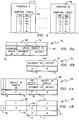
- Fig. 3A illustrates an object identifier 54 that is created by concatenating an address space identifier 56, representing the virtual address space in which the identified object was first created, to a local object address 58, representing the first virtual address for the identified object.
- This particular known method for creating object identifier 54 is arbitrary but useful because it ensures creation of a unique object identifier for each new object in system 10.
- Fig. 3B illustrates a local object address 60 that is created by concatenating a segment identifier 62 in a virtual address space with an offset 64, representing the precise storage location of the object within segment 62 of the associated virtual address space.
- Fig. 4A illustrates the data structure of the object pointer 66 of this invention.
- pointer 66 By defining pointer 66 to be larger than object address 60, enough information can be stored in pointer 66 to identify both object address 60 and object identifier 54.
- the unexpectedly advantageous solution of this invention involves preserving some of object identifier 54 in object address 60. This solution opposes the usual practice of preserving address 60 in identifier 54, and is illustrated in more detail in Fig. 4B, which summarizes the various parsings of this invention for structures 54, 60 and 66.
- Fig. 3B shows object address 60 to be a virtual address logically divided into segment ID 62 and offset 64
- Fig. 3A shows object identifier 54 to be logically divided into address space identifier 56 and local object identifier 58
- the method of this invention imposes a more general and useful parsing on these particular structures.
- This generality can be appreciated from Fig. 3A wherein object identifier 54 is divided into a first part (I) 68 and a second part (J) 70.
- object address 60 is divided into a first part (A) 72 and a second part (B) 74.
- Parts (I) 68 and (J) 70 do not necessarily align with identifiers 56 and 58.
- parts (A) 72 and (B) 74 do not necessarily align with segment identifier 62 and offset 64.
- Pointer 66 includes three or four parts. These are a first part (P) 75 corresponding to first part (I) 68 from object identifier 54; a second part (Q) 76 corresponding to first part (A) 72 from object address 60; a third part (R) 77 corresponding both to second part (J) 70 from object identifier 54 and second part (B) 74 from object address 60; and an optional fourth part (S) 78, which is useful for internal object pointer flagging purposes as discussed below.
- segment ID 62 is 40 bits long
- offset 64 is 24 bits long
- a 32-bit address space identifier 56 permits the combination of up to four billion individual systems divided by the typical number of times each system is reloaded from scratch during its lifetime. Accordingly, a 12B object identifier 54 should be unique across all existing systems over all time. A more general object identifier that is unique across all heterogeneous systems, such as system 10 discussed above in connection with Figs. 1 and 2, merely requires appending an identifier field that uniquely distinguishes them from other system types.
- the one byte type field (S) 78 in Figs. 4A-4B is used in the AS/400 system to distinguish various pointer types and to flag whether the pointer is "resolved” or not.
- object identifier prefix 79 is 7B long
- the 5B overlap of object ID suffix 80 with virtual address 60 is simple to implement when an object is first created because local object identifier 58 is then identical to the object's original virtual address 60 in the base virtual address space.
- An important advantage of the system of this invention is the ease of managing the 5-byte overlap when an object is moved from one process to another. This is accomplished by choosing an available 8B address (A1B1) in the target virtual address space such that the five object identifier suffix bytes are the same as they were in the previous process.
- object address (AB) 72-74 is chosen such that field (B) 74 is equal to field (J) 70, both of which are preserved in pointer field (R) 77.
- object ID suffix 80 With a 40-bit long object ID suffix 80, 24 bits of freedom remain in field (A) 72 for assigning an address based on SID block 82. The 24 bits of freedom in assigning new virtual addresses can be traded off against the number of available address spaces (the size of address space identifier 56).
- the specific field lengths mentioned above for this embodiment are exemplary only and do not serve to limit the application of the system of this invention.
- object identifier suffix 80 may be smaller than SID block 82 for improved address generation flexibility.
- Fig. 5 shows two processes 14 and 16 each including a mapping table exemplified by mapping table 84 in process 14.
- Mapping table 84 may be used to more efficiently allocate local object addresses (AB) in a particular virtual address space, as discussed below.
- AB local object addresses
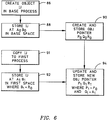
- an object is first created at step 86 in a base process.
- an address generator assigns an address (A0B0) to the locally-created object (IJ).
- An object pointer (P0Q0R0) is then created in the base space at step 90.
- a requirement to move object (IJ) to a first process different from the base process initiates a system response at step 91.
- the address generator chooses A1 in step 92 by using a rule that allocates A1 values for objects restored from other systems, such as selecting from a list of available high-order addresses. Thus, A1 in the first address space is selected from the top of the available address list, although the value A0 (step 88) was selected from the bottom of the available address list in the base space.
- mapping table 84 (Fig. 5) to link the object identifier prefix (I) to SID block value (A) for all objects ever present in virtual address space 14, the local address generator (discussed below in connection with Fig. 8) can quickly select the appropriate value for A1 responsive to the object identifier prefix (I) information contained in field (P) of object pointer (PQR).
- FIG. 7 illustrates an exemplary procedure for handling these internal object pointer updates.
- I object identifier prefix
- step 86 is followed by step 96, wherein a multiplicity of internal object pointers (SPQR) are created for object in the base virtual address space.
- step 98 the original object is linked to this multiplicity of other objects through the storage of internal object pointers (SPQR).
- the flag field (S) is updated for all internal pointers at step 100 by changing the flag field value to a predetermined value S W representing restoration of the base object (IJ) to a first process.
- each internal object pointer (S W PQR) is then asynchronously updated at step 102 to reflect completion of the transfer to the first virtual address space.
- internal pointer update step 102 may be deferred until the first reference to the copied object. Step 102 may then be accomplished in the manner discussed above in connection with mapping table 84.
- the operating system may reserve a specific value of part (A) 72 that represents an "unresolved address". This establishes a range of virtual addressing that is never allocated by the address generator, raising a "segment fault" when referenced with that prefix. Such special value replaces part (Q) 76 when the object address is unresolved. The effect is to conserve object identifier 54 while invalidating local object address 60.
- the system detects a segment fault, which is then used to initiate the "lazy update" of unresolved addresses by replacing part (Q) 76 with the correct part (A) 72 value from mapping table 84.
- This alternative internal pointer flagging scheme can be advantageously used in any system employing a standard storage protection mechanism.
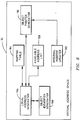
- Fig. 8 provides an exemplary illustration of the data and process objects required in each virtual address space, exemplified by virtual address space 14, for the system of this invention.
- Mapping table 84 is discussed above in connection with Fig. 5.
- the local address generator 104 is also discussed above in connection with Figs. 6 and 7.
- An object identifier generator 106 is coupled to local address generator 104 and is responsible for assigning permanent object identifiers to objects created in virtual address space 14.
- Local address generator 104 is coupled to mapping table 84 and also to an available address list 108, using information from both to select addresses for new and restored objects in the manner discussed above.
- the object pointer generator 110 is coupled to local address generator 104 and from there to object identifier generator 106, thereby permitting the creation of object pointers as discussed above in connection with Figs. 4A-4B.
- an internal pointer updater 112 functions to update all pointers internal to restored objects in the manner discussed above in connection with Fig. 7.
- the program object and data object elements shown in Fig. 8 are also coupled to operating system 36 discussed above in connection with Figs. 1 and 2.
Landscapes
- Engineering & Computer Science (AREA)
- Theoretical Computer Science (AREA)
- Physics & Mathematics (AREA)
- General Engineering & Computer Science (AREA)
- General Physics & Mathematics (AREA)
- Software Systems (AREA)
- Memory System Of A Hierarchy Structure (AREA)
- Memory System (AREA)
- Multi Processors (AREA)
- Information Retrieval, Db Structures And Fs Structures Therefor (AREA)
- Computer And Data Communications (AREA)
Applications Claiming Priority (2)
| Application Number | Priority Date | Filing Date | Title |
|---|---|---|---|
| US299042 | 1994-08-30 | ||
| US08/299,042 US5581765A (en) | 1994-08-30 | 1994-08-30 | System for combining a global object identifier with a local object address in a single object pointer |
Publications (3)
| Publication Number | Publication Date |
|---|---|
| EP0700000A2 true EP0700000A2 (fr) | 1996-03-06 |
| EP0700000A3 EP0700000A3 (fr) | 1997-01-02 |
| EP0700000B1 EP0700000B1 (fr) | 2000-10-04 |
Family
ID=23153058
Family Applications (1)
| Application Number | Title | Priority Date | Filing Date |
|---|---|---|---|
| EP95480098A Expired - Lifetime EP0700000B1 (fr) | 1994-08-30 | 1995-07-24 | Système et procédé de combinaison d'un identificateur d'objet global avec une adresse locale d'objet dans un unique pointeur d'objet |
Country Status (5)
| Country | Link |
|---|---|
| US (1) | US5581765A (fr) |
| EP (1) | EP0700000B1 (fr) |
| JP (1) | JP2986075B2 (fr) |
| CA (1) | CA2153442A1 (fr) |
| DE (1) | DE69519006D1 (fr) |
Cited By (7)
| Publication number | Priority date | Publication date | Assignee | Title |
|---|---|---|---|---|
| WO2000048077A1 (fr) * | 1999-02-11 | 2000-08-17 | Oracle Corporation | Systeme de gestion de memoire independant d'une machine dans un noyau de systeme expert |
| US6434685B1 (en) | 1999-02-11 | 2002-08-13 | Oracle Corp. | Paged memory management system within a run-time environment |
| US6457019B1 (en) | 1999-02-11 | 2002-09-24 | Oracle Corp. | Memory management within a run-time environment |
| EP1482406A1 (fr) * | 2003-05-28 | 2004-12-01 | Sap Ag | Procédé pour adapter un objet en paramétrisant une application |
| US6877161B1 (en) | 1999-02-11 | 2005-04-05 | Oracle International Corp. | Address calculation of invariant references within a run-time environment |
| CN102314514A (zh) * | 2011-09-20 | 2012-01-11 | 北京航空航天大学 | 一种表格数据结构化的作用域方法 |
| WO2013083935A1 (fr) | 2011-12-09 | 2013-06-13 | Polymerexpert Sa | Ciments polymeres pour la fixation de protheses, la reparation osseuse et la vertebroplastie obtenus a partir de formulations monophasiques liquides. |
Families Citing this family (54)
| Publication number | Priority date | Publication date | Assignee | Title |
|---|---|---|---|---|
| US6243762B1 (en) * | 1994-08-08 | 2001-06-05 | Mercury Computer Systems, Inc. | Methods and apparatus for data access and program generation on a multiprocessing computer |
| US5802291A (en) * | 1995-03-30 | 1998-09-01 | Sun Microsystems, Inc. | System and method to control and administer distributed object servers using first class distributed objects |
| SE506535C2 (sv) * | 1995-06-16 | 1998-01-12 | Ericsson Telefon Ab L M | Metod och anordning för att härleda instansinformation i ett informationshanterande system |
| US5736990A (en) * | 1995-08-28 | 1998-04-07 | Mitsubishi Electric Information Technology Center America, Inc. | System for designing a virtual environment utilizing locales |
| US6684259B1 (en) * | 1995-10-11 | 2004-01-27 | Citrix Systems, Inc. | Method for providing user global object name space in a multi-user operating system |
| US5887275A (en) * | 1996-02-08 | 1999-03-23 | Oracle Corporation | Method and apparatus for locating a first set of data using a global identifier and a virtual addressing data structure |
| US5964872A (en) * | 1996-03-15 | 1999-10-12 | Novell, Inc. | Method and system for tailoring common environments |
| US5842196A (en) * | 1996-04-03 | 1998-11-24 | Sybase, Inc. | Database system with improved methods for updating records |
| US5806065A (en) * | 1996-05-06 | 1998-09-08 | Microsoft Corporation | Data system with distributed tree indexes and method for maintaining the indexes |
| US5933820A (en) * | 1996-05-20 | 1999-08-03 | International Business Machines Corporation | System, method, and program for using direct and indirect pointers to logically related data and targets of indexes |
| US5940616A (en) * | 1996-05-31 | 1999-08-17 | International Business Machines Corporation | Tracker class for object-oriented programming environments |
| US5805887A (en) * | 1996-05-31 | 1998-09-08 | International Business Machines Corporation | Universal pointer object |
| US6681239B1 (en) | 1996-12-23 | 2004-01-20 | International Business Machines Corporation | Computer system having shared address space among multiple virtual address spaces |
| US5956723A (en) * | 1997-03-21 | 1999-09-21 | Lsi Logic Corporation | Maintaining identifier information in a memory using unique identifiers as a linked list |
| US5943497A (en) * | 1997-04-30 | 1999-08-24 | International Business Machines Corporation | Object-oriented apparatus and method for controlling configuration of object creation |
| US6023721A (en) * | 1997-05-14 | 2000-02-08 | Citrix Systems, Inc. | Method and system for allowing a single-user application executing in a multi-user environment to create objects having both user-global and system global visibility |
| JPH1196008A (ja) * | 1997-09-19 | 1999-04-09 | Sony Corp | データ構造識別方法および記録媒体 |
| US6687707B1 (en) | 1997-11-28 | 2004-02-03 | International Business Machines Corporation | Unique object identification in a network of computing systems |
| US6516354B2 (en) * | 1997-12-18 | 2003-02-04 | Sun Microsystems, Inc. | Method and apparatus for efficient representation of variable length identifiers in a distributed object system |
| US6247077B1 (en) | 1998-02-06 | 2001-06-12 | Ncr Corporation | Highly-scalable parallel processing computer system architecture |
| US6148349A (en) * | 1998-02-06 | 2000-11-14 | Ncr Corporation | Dynamic and consistent naming of fabric attached storage by a file system on a compute node storing information mapping API system I/O calls for data objects with a globally unique identification |
| US6256740B1 (en) | 1998-02-06 | 2001-07-03 | Ncr Corporation | Name service for multinode system segmented into I/O and compute nodes, generating guid at I/O node and exporting guid to compute nodes via interconnect fabric |
| US6173439B1 (en) * | 1998-03-11 | 2001-01-09 | International Business Machines Corporation | Interface mechanism and method for accessing non-object oriented data from within an object oriented framework |
| GB2335518A (en) * | 1998-03-18 | 1999-09-22 | Ibm | Triggering event causes creation of Coordinator transaction state object |
| US6199059B1 (en) * | 1998-04-22 | 2001-03-06 | International Computex, Inc. | System and method for classifying and retrieving information with virtual object hierarchy |
| US6631366B1 (en) | 1998-10-20 | 2003-10-07 | Sybase, Inc. | Database system providing methodology for optimizing latching/copying costs in index scans on data-only locked tables |
| US6738889B2 (en) | 1999-07-12 | 2004-05-18 | International Business Machines Corporation | Apparatus and method for providing simultaneous local and global addressing with hardware address translation |
| US7337174B1 (en) * | 1999-07-26 | 2008-02-26 | Microsoft Corporation | Logic table abstraction layer for accessing configuration information |
| US7421395B1 (en) * | 2000-02-18 | 2008-09-02 | Microsoft Corporation | System and method for producing unique account names |
| US7346842B1 (en) | 2000-11-02 | 2008-03-18 | Citrix Systems, Inc. | Methods and apparatus for incorporating a partial page on a client |
| US7194743B2 (en) | 2000-12-12 | 2007-03-20 | Citrix Systems, Inc. | Methods and apparatus for communicating changes between a user interface and an executing application using property paths |
| US6981043B2 (en) * | 2001-03-27 | 2005-12-27 | International Business Machines Corporation | Apparatus and method for managing multiple user identities on a networked computer system |
| US7822980B2 (en) * | 2002-03-15 | 2010-10-26 | International Business Machines Corporation | Authenticated identity propagation and translation within a multiple computing unit environment |
| JP4497820B2 (ja) * | 2003-02-21 | 2010-07-07 | キヤノン株式会社 | 情報処理方法、情報処理装置並びに分散処理システム |
| US7904488B2 (en) * | 2004-07-21 | 2011-03-08 | Rockwell Automation Technologies, Inc. | Time stamp methods for unified plant model |
| US7844781B2 (en) * | 2006-02-23 | 2010-11-30 | International Business Machines Corporation | Method, apparatus, and computer program product for accessing process local storage of another process |
| US8627434B2 (en) * | 2009-12-04 | 2014-01-07 | International Business Machines Corporation | Cross security-domain identity context projection within a computing environment |
| CN101867565A (zh) * | 2010-04-13 | 2010-10-20 | 中兴通讯股份有限公司 | 一种移动宽带设备的通用驱动方法及驱动器 |
| US9047196B2 (en) * | 2012-06-19 | 2015-06-02 | Concurix Corporation | Usage aware NUMA process scheduling |
| US9575813B2 (en) | 2012-07-17 | 2017-02-21 | Microsoft Technology Licensing, Llc | Pattern matching process scheduler with upstream optimization |
| US20150180980A1 (en) * | 2013-12-24 | 2015-06-25 | Dropbox, Inc. | Systems and methods for preserving shared virtual spaces on a content management system |
| US10067652B2 (en) | 2013-12-24 | 2018-09-04 | Dropbox, Inc. | Providing access to a cloud based content management system on a mobile device |
| US9544373B2 (en) * | 2013-12-24 | 2017-01-10 | Dropbox, Inc. | Systems and methods for maintaining local virtual states pending server-side storage across multiple devices and users and intermittent network connections |
| US11086521B2 (en) | 2015-01-20 | 2021-08-10 | Ultrata, Llc | Object memory data flow instruction execution |
| EP3248106A4 (fr) * | 2015-01-20 | 2018-09-12 | Ultrata LLC | Index réparti pour matrice de mémoire d'objets tolérante aux pannes |
| US9922201B2 (en) | 2015-04-01 | 2018-03-20 | Dropbox, Inc. | Nested namespaces for selective content sharing |
| US10963430B2 (en) | 2015-04-01 | 2021-03-30 | Dropbox, Inc. | Shared workspaces with selective content item synchronization |
| US9886210B2 (en) | 2015-06-09 | 2018-02-06 | Ultrata, Llc | Infinite memory fabric hardware implementation with router |
| US9479567B1 (en) | 2015-10-29 | 2016-10-25 | Dropbox, Inc. | Synchronization protocol for multi-premises hosting of digital content items |
| CN108885604B (zh) | 2015-12-08 | 2022-04-12 | 乌尔特拉塔有限责任公司 | 存储器结构软件实现方案 |
| EP3959613A4 (fr) * | 2019-04-22 | 2023-04-26 | Winterrowd, Mark, William | Application matérielle de limites sur les aspects de commande, d'espace, de temps, de modularité, de référence, d'initialisation et de mutabilité d'un logiciel |
| US12373213B2 (en) | 2019-04-22 | 2025-07-29 | Whole Sky Technologies Company | Hardware enforcement of boundaries on the control, space, time, modularity, reference, initialization, and mutability aspects of software |
| CN110517186B (zh) * | 2019-07-30 | 2023-07-07 | 金蝶软件(中国)有限公司 | 消除发票印章的方法、装置、存储介质和计算机设备 |
| US11290531B2 (en) | 2019-12-04 | 2022-03-29 | Dropbox, Inc. | Immediate cloud content item creation from local file system interface |
Family Cites Families (15)
| Publication number | Priority date | Publication date | Assignee | Title |
|---|---|---|---|---|
| US4660142A (en) * | 1981-05-22 | 1987-04-21 | Data General Corporation | Digital data processing system employing an object-based addressing system with a single object table |
| US4821184A (en) * | 1981-05-22 | 1989-04-11 | Data General Corporation | Universal addressing system for a digital data processing system |
| US4455602A (en) * | 1981-05-22 | 1984-06-19 | Data General Corporation | Digital data processing system having an I/O means using unique address providing and access priority control techniques |
| US4450522A (en) * | 1981-09-11 | 1984-05-22 | Data General Corporation | Apparatus for deriving addresses of data using displacements from base addresses which change only on call and return |
| US4853842A (en) * | 1985-09-11 | 1989-08-01 | Texas Instruments Incorporated | Computer memory system having persistent objects |
| US4851988A (en) * | 1986-03-31 | 1989-07-25 | Wang Laboratories, Inc. | Loosely-coupled computer system using global identifiers to identify mailboxes and volumes |
| WO1989002129A1 (fr) * | 1987-09-04 | 1989-03-09 | Digital Equipment Corporation | Commande de session dans des reseaux de systemes de traitement de donnees numeriques compatibles avec des protocoles multiples de transfert |
| US5117351A (en) * | 1988-10-21 | 1992-05-26 | Digital Equipment Corporation | Object identifier generator for distributed computer system |
| US5129083A (en) * | 1989-06-29 | 1992-07-07 | Digital Equipment Corporation | Conditional object creating system having different object pointers for accessing a set of data structure objects |
| US5187790A (en) * | 1989-06-29 | 1993-02-16 | Digital Equipment Corporation | Server impersonation of client processes in an object based computer operating system |
| US5062038A (en) * | 1989-12-18 | 1991-10-29 | At&T Bell Laboratories | Information control system |
| US5265206A (en) * | 1990-10-23 | 1993-11-23 | International Business Machines Corporation | System and method for implementing a messenger and object manager in an object oriented programming environment |
| US5297284A (en) * | 1991-04-09 | 1994-03-22 | Microsoft Corporation | Method and system for implementing virtual functions and virtual base classes and setting a this pointer for an object-oriented programming language |
| CA2285096C (fr) * | 1991-11-12 | 2000-05-09 | Ibm Canada Limited-Ibm Canada Limitee | Mise en correspondance logique d'objets informatifs au moyen d'espaces de donnees |
| US5329619A (en) * | 1992-10-30 | 1994-07-12 | Software Ag | Cooperative processing interface and communication broker for heterogeneous computing environments |
-
1994
- 1994-08-30 US US08/299,042 patent/US5581765A/en not_active Expired - Fee Related
-
1995
- 1995-07-07 CA CA002153442A patent/CA2153442A1/fr not_active Abandoned
- 1995-07-24 EP EP95480098A patent/EP0700000B1/fr not_active Expired - Lifetime
- 1995-07-24 DE DE69519006T patent/DE69519006D1/de not_active Expired - Lifetime
- 1995-07-27 JP JP7191414A patent/JP2986075B2/ja not_active Expired - Lifetime
Non-Patent Citations (1)
| Title |
|---|
| None |
Cited By (9)
| Publication number | Priority date | Publication date | Assignee | Title |
|---|---|---|---|---|
| WO2000048077A1 (fr) * | 1999-02-11 | 2000-08-17 | Oracle Corporation | Systeme de gestion de memoire independant d'une machine dans un noyau de systeme expert |
| US6434685B1 (en) | 1999-02-11 | 2002-08-13 | Oracle Corp. | Paged memory management system within a run-time environment |
| US6457019B1 (en) | 1999-02-11 | 2002-09-24 | Oracle Corp. | Memory management within a run-time environment |
| US6499095B1 (en) | 1999-02-11 | 2002-12-24 | Oracle Corp. | Machine-independent memory management system within a run-time environment |
| US6877161B1 (en) | 1999-02-11 | 2005-04-05 | Oracle International Corp. | Address calculation of invariant references within a run-time environment |
| EP1482406A1 (fr) * | 2003-05-28 | 2004-12-01 | Sap Ag | Procédé pour adapter un objet en paramétrisant une application |
| WO2004107167A1 (fr) * | 2003-05-28 | 2004-12-09 | Sap Ag | Procede servant a personnaliser un objet par parametrage d'un programme d'application |
| CN102314514A (zh) * | 2011-09-20 | 2012-01-11 | 北京航空航天大学 | 一种表格数据结构化的作用域方法 |
| WO2013083935A1 (fr) | 2011-12-09 | 2013-06-13 | Polymerexpert Sa | Ciments polymeres pour la fixation de protheses, la reparation osseuse et la vertebroplastie obtenus a partir de formulations monophasiques liquides. |
Also Published As
| Publication number | Publication date |
|---|---|
| EP0700000A3 (fr) | 1997-01-02 |
| JPH0877023A (ja) | 1996-03-22 |
| JP2986075B2 (ja) | 1999-12-06 |
| DE69519006D1 (de) | 2000-11-09 |
| EP0700000B1 (fr) | 2000-10-04 |
| CA2153442A1 (fr) | 1996-03-01 |
| US5581765A (en) | 1996-12-03 |
Similar Documents
| Publication | Publication Date | Title |
|---|---|---|
| US5581765A (en) | System for combining a global object identifier with a local object address in a single object pointer | |
| US6505286B1 (en) | User specifiable allocation of memory for processes in a multiprocessor computer having a non-uniform memory architecture | |
| US6591355B2 (en) | Distributed shared memory system with variable granularity | |
| KR100473162B1 (ko) | 로그인 서비스 변수를 보관하는 방법 | |
| US5655101A (en) | Accessing remote data objects in a distributed memory environment using parallel address locations at each local memory to reference a same data object | |
| CA1236588A (fr) | Systeme de stockage local/global a affectation dynamique | |
| US4742450A (en) | Method to share copy on write segment for mapped files | |
| US6049853A (en) | Data replication across nodes of a multiprocessor computer system | |
| KR0170565B1 (ko) | 메모리 관리 방법, 마이크로커널 구조 데이타 프로세싱 시스템, 운영 체제 퍼스낼리티 시스템 동작 방법, 퍼스낼리티 뉴트럴 서비스 프로그램 실행 방법 및 응용 프로그램 실행방법 | |
| US5123094A (en) | Interprocessor communications includes second CPU designating memory locations assigned to first CPU and writing their addresses into registers | |
| US5239643A (en) | Method for reducing disk I/O accesses in a multi-processor clustered type data processing system | |
| US7149873B2 (en) | Methods and apparatus for a dual address space operating system | |
| EP0323013A2 (fr) | Procédé pour actionner un système à multiprocesseur employant une mémoire virtuelle commune | |
| JPH05210637A (ja) | 同時アクセス管理方法 | |
| JPH0578857B2 (fr) | ||
| WO1998014878A1 (fr) | Procede servant a obtenir un tampon de memoire contigue et a construire une table page | |
| US7493464B2 (en) | Sparse matrix | |
| EP0803090A1 (fr) | Systeme de creation d'identites d'objets globalement uniques | |
| JPH09508734A (ja) | 分散形データベースシステム | |
| US5860141A (en) | Method and apparatus for enabling physical memory larger than corresponding virtual memory | |
| US7058656B2 (en) | System and method of using extensions in a data structure without interfering with applications unaware of the extensions | |
| US5875487A (en) | System and method for providing efficient shared memory in a virtual memory system | |
| US6829761B1 (en) | Method and apparatus for managing shared memory in a run-time environment | |
| EP0319148B1 (fr) | Procédé de commande d'un système multiprocesseur pour le transfert de données entre unités de traitement | |
| EP0747827B1 (fr) | Système et procédé pour une mémoire partagée dans un environnement à plusieurs tâches |
Legal Events
| Date | Code | Title | Description |
|---|---|---|---|
| PUAI | Public reference made under article 153(3) epc to a published international application that has entered the european phase |
Free format text: ORIGINAL CODE: 0009012 |
|
| AK | Designated contracting states |
Kind code of ref document: A2 Designated state(s): DE FR GB |
|
| 17P | Request for examination filed |
Effective date: 19960626 |
|
| PUAL | Search report despatched |
Free format text: ORIGINAL CODE: 0009013 |
|
| AK | Designated contracting states |
Kind code of ref document: A3 Designated state(s): DE FR GB |
|
| GRAG | Despatch of communication of intention to grant |
Free format text: ORIGINAL CODE: EPIDOS AGRA |
|
| GRAG | Despatch of communication of intention to grant |
Free format text: ORIGINAL CODE: EPIDOS AGRA |
|
| 17Q | First examination report despatched |
Effective date: 20000127 |
|
| GRAG | Despatch of communication of intention to grant |
Free format text: ORIGINAL CODE: EPIDOS AGRA |
|
| GRAH | Despatch of communication of intention to grant a patent |
Free format text: ORIGINAL CODE: EPIDOS IGRA |
|
| GRAH | Despatch of communication of intention to grant a patent |
Free format text: ORIGINAL CODE: EPIDOS IGRA |
|
| GRAA | (expected) grant |
Free format text: ORIGINAL CODE: 0009210 |
|
| AK | Designated contracting states |
Kind code of ref document: B1 Designated state(s): DE FR GB |
|
| PG25 | Lapsed in a contracting state [announced via postgrant information from national office to epo] |
Ref country code: FR Free format text: LAPSE BECAUSE OF FAILURE TO SUBMIT A TRANSLATION OF THE DESCRIPTION OR TO PAY THE FEE WITHIN THE PRESCRIBED TIME-LIMIT Effective date: 20001004 |
|
| REF | Corresponds to: |
Ref document number: 69519006 Country of ref document: DE Date of ref document: 20001109 |
|
| PG25 | Lapsed in a contracting state [announced via postgrant information from national office to epo] |
Ref country code: DE Free format text: LAPSE BECAUSE OF FAILURE TO SUBMIT A TRANSLATION OF THE DESCRIPTION OR TO PAY THE FEE WITHIN THE PRESCRIBED TIME-LIMIT Effective date: 20010105 |
|
| EN | Fr: translation not filed | ||
| PG25 | Lapsed in a contracting state [announced via postgrant information from national office to epo] |
Ref country code: GB Free format text: LAPSE BECAUSE OF NON-PAYMENT OF DUE FEES Effective date: 20010724 |
|
| PLBE | No opposition filed within time limit |
Free format text: ORIGINAL CODE: 0009261 |
|
| STAA | Information on the status of an ep patent application or granted ep patent |
Free format text: STATUS: NO OPPOSITION FILED WITHIN TIME LIMIT |
|
| 26N | No opposition filed | ||
| GBPC | Gb: european patent ceased through non-payment of renewal fee |
Effective date: 20010724 |