EP0700941B1 - Verfahren zur Herstellung von kautschukmodifizierten ABS-Formmassen durch nichtwässrige Polymerisation in Gegenwart von Lösungsmitteln - Google Patents
Verfahren zur Herstellung von kautschukmodifizierten ABS-Formmassen durch nichtwässrige Polymerisation in Gegenwart von Lösungsmitteln Download PDFInfo
- Publication number
- EP0700941B1 EP0700941B1 EP95112505A EP95112505A EP0700941B1 EP 0700941 B1 EP0700941 B1 EP 0700941B1 EP 95112505 A EP95112505 A EP 95112505A EP 95112505 A EP95112505 A EP 95112505A EP 0700941 B1 EP0700941 B1 EP 0700941B1
- Authority
- EP
- European Patent Office
- Prior art keywords
- weight
- solvent
- mixture
- monomers
- rubber
- Prior art date
- Legal status (The legal status is an assumption and is not a legal conclusion. Google has not performed a legal analysis and makes no representation as to the accuracy of the status listed.)
- Expired - Lifetime
Links
- 238000004519 manufacturing process Methods 0.000 title claims description 15
- 238000000465 moulding Methods 0.000 title claims description 9
- 238000006116 polymerization reaction Methods 0.000 title description 32
- 229920005989 resin Polymers 0.000 title description 5
- 239000011347 resin Substances 0.000 title description 5
- 229920001971 elastomer Polymers 0.000 claims description 58
- 239000005060 rubber Substances 0.000 claims description 56
- PPBRXRYQALVLMV-UHFFFAOYSA-N Styrene Natural products C=CC1=CC=CC=C1 PPBRXRYQALVLMV-UHFFFAOYSA-N 0.000 claims description 48
- 239000000178 monomer Substances 0.000 claims description 47
- 239000002904 solvent Substances 0.000 claims description 47
- 238000000034 method Methods 0.000 claims description 36
- 239000000203 mixture Substances 0.000 claims description 36
- 230000008569 process Effects 0.000 claims description 22
- 238000002156 mixing Methods 0.000 claims description 18
- 238000006243 chemical reaction Methods 0.000 claims description 17
- 150000002825 nitriles Chemical class 0.000 claims description 10
- LFQSCWFLJHTTHZ-UHFFFAOYSA-N Ethanol Chemical compound CCO LFQSCWFLJHTTHZ-UHFFFAOYSA-N 0.000 claims description 7
- 125000001931 aliphatic group Chemical group 0.000 claims description 7
- 239000011877 solvent mixture Substances 0.000 claims description 7
- 229920001577 copolymer Polymers 0.000 claims description 6
- 229920002857 polybutadiene Polymers 0.000 claims description 6
- 150000004945 aromatic hydrocarbons Chemical class 0.000 claims description 5
- 150000002148 esters Chemical class 0.000 claims description 5
- 229920002554 vinyl polymer Polymers 0.000 claims description 5
- RTZKZFJDLAIYFH-UHFFFAOYSA-N Diethyl ether Chemical compound CCOCC RTZKZFJDLAIYFH-UHFFFAOYSA-N 0.000 claims description 4
- 239000005062 Polybutadiene Substances 0.000 claims description 4
- 125000000391 vinyl group Chemical group [H]C([*])=C([H])[H] 0.000 claims description 4
- 150000002576 ketones Chemical class 0.000 claims description 3
- 238000010923 batch production Methods 0.000 claims 1
- 230000000977 initiatory effect Effects 0.000 claims 1
- YXFVVABEGXRONW-UHFFFAOYSA-N Toluene Chemical compound CC1=CC=CC=C1 YXFVVABEGXRONW-UHFFFAOYSA-N 0.000 description 58
- ZWEHNKRNPOVVGH-UHFFFAOYSA-N 2-Butanone Chemical compound CCC(C)=O ZWEHNKRNPOVVGH-UHFFFAOYSA-N 0.000 description 44
- NLHHRLWOUZZQLW-UHFFFAOYSA-N Acrylonitrile Chemical compound C=CC#N NLHHRLWOUZZQLW-UHFFFAOYSA-N 0.000 description 33
- VLKZOEOYAKHREP-UHFFFAOYSA-N n-Hexane Chemical compound CCCCCC VLKZOEOYAKHREP-UHFFFAOYSA-N 0.000 description 27
- 229920000122 acrylonitrile butadiene styrene Polymers 0.000 description 25
- 239000000243 solution Substances 0.000 description 24
- 229920000642 polymer Polymers 0.000 description 20
- 238000012360 testing method Methods 0.000 description 17
- YAJYJWXEWKRTPO-UHFFFAOYSA-N 2,3,3,4,4,5-hexamethylhexane-2-thiol Chemical compound CC(C)C(C)(C)C(C)(C)C(C)(C)S YAJYJWXEWKRTPO-UHFFFAOYSA-N 0.000 description 16
- OPQYOFWUFGEMRZ-UHFFFAOYSA-N tert-butyl 2,2-dimethylpropaneperoxoate Chemical compound CC(C)(C)OOC(=O)C(C)(C)C OPQYOFWUFGEMRZ-UHFFFAOYSA-N 0.000 description 15
- 238000002347 injection Methods 0.000 description 11
- 239000007924 injection Substances 0.000 description 11
- RFAZFSACZIVZDV-UHFFFAOYSA-N butan-2-one Chemical compound CCC(C)=O.CCC(C)=O RFAZFSACZIVZDV-UHFFFAOYSA-N 0.000 description 10
- 239000000047 product Substances 0.000 description 10
- HIDBROSJWZYGSZ-UHFFFAOYSA-N 1-phenylpyrrole-2,5-dione Chemical compound O=C1C=CC(=O)N1C1=CC=CC=C1 HIDBROSJWZYGSZ-UHFFFAOYSA-N 0.000 description 9
- OKKJLVBELUTLKV-UHFFFAOYSA-N Methanol Chemical compound OC OKKJLVBELUTLKV-UHFFFAOYSA-N 0.000 description 9
- 238000009826 distribution Methods 0.000 description 9
- 238000001704 evaporation Methods 0.000 description 9
- BWSZXUOMATYHHI-UHFFFAOYSA-N tert-butyl octaneperoxoate Chemical compound CCCCCCCC(=O)OOC(C)(C)C BWSZXUOMATYHHI-UHFFFAOYSA-N 0.000 description 9
- 230000008020 evaporation Effects 0.000 description 8
- 238000003756 stirring Methods 0.000 description 8
- 125000003118 aryl group Chemical group 0.000 description 7
- 239000002245 particle Substances 0.000 description 7
- 150000003254 radicals Chemical class 0.000 description 7
- 229920001169 thermoplastic Polymers 0.000 description 7
- 239000004416 thermosoftening plastic Substances 0.000 description 7
- UHOVQNZJYSORNB-UHFFFAOYSA-N Benzene Chemical compound C1=CC=CC=C1 UHOVQNZJYSORNB-UHFFFAOYSA-N 0.000 description 6
- 238000001746 injection moulding Methods 0.000 description 6
- SSDSCDGVMJFTEQ-UHFFFAOYSA-N octadecyl 3-(3,5-ditert-butyl-4-hydroxyphenyl)propanoate Chemical compound CCCCCCCCCCCCCCCCCCOC(=O)CCC1=CC(C(C)(C)C)=C(O)C(C(C)(C)C)=C1 SSDSCDGVMJFTEQ-UHFFFAOYSA-N 0.000 description 6
- KRMVWVVSHRBHJF-UHFFFAOYSA-N 3-(2-ethyl-6-methylphenyl)pyrrole-2,5-dione Chemical compound CCC1=CC=CC(C)=C1C1=CC(=O)NC1=O KRMVWVVSHRBHJF-UHFFFAOYSA-N 0.000 description 5
- 238000003917 TEM image Methods 0.000 description 5
- -1 Vinyl- Chemical group 0.000 description 5
- 230000008901 benefit Effects 0.000 description 5
- 238000011049 filling Methods 0.000 description 5
- 238000012545 processing Methods 0.000 description 5
- 239000007787 solid Substances 0.000 description 5
- XLYOFNOQVPJJNP-UHFFFAOYSA-N water Substances O XLYOFNOQVPJJNP-UHFFFAOYSA-N 0.000 description 5
- YNQLUTRBYVCPMQ-UHFFFAOYSA-N Ethylbenzene Chemical compound CCC1=CC=CC=C1 YNQLUTRBYVCPMQ-UHFFFAOYSA-N 0.000 description 4
- 239000005662 Paraffin oil Substances 0.000 description 4
- WYURNTSHIVDZCO-UHFFFAOYSA-N Tetrahydrofuran Chemical compound C1CCOC1 WYURNTSHIVDZCO-UHFFFAOYSA-N 0.000 description 4
- 150000001875 compounds Chemical class 0.000 description 4
- 238000007872 degassing Methods 0.000 description 4
- 238000005516 engineering process Methods 0.000 description 4
- 230000009477 glass transition Effects 0.000 description 4
- 229920005992 thermoplastic resin Polymers 0.000 description 4
- 239000010409 thin film Substances 0.000 description 4
- SKDGWNHUETZZCS-UHFFFAOYSA-N 2,3-ditert-butylphenol Chemical compound CC(C)(C)C1=CC=CC(O)=C1C(C)(C)C SKDGWNHUETZZCS-UHFFFAOYSA-N 0.000 description 3
- XQMVBICWFFHDNN-UHFFFAOYSA-N 5-amino-4-chloro-2-phenylpyridazin-3-one;(2-ethoxy-3,3-dimethyl-2h-1-benzofuran-5-yl) methanesulfonate Chemical compound O=C1C(Cl)=C(N)C=NN1C1=CC=CC=C1.C1=C(OS(C)(=O)=O)C=C2C(C)(C)C(OCC)OC2=C1 XQMVBICWFFHDNN-UHFFFAOYSA-N 0.000 description 3
- CSCPPACGZOOCGX-UHFFFAOYSA-N Acetone Chemical compound CC(C)=O CSCPPACGZOOCGX-UHFFFAOYSA-N 0.000 description 3
- WEVYAHXRMPXWCK-UHFFFAOYSA-N Acetonitrile Chemical compound CC#N WEVYAHXRMPXWCK-UHFFFAOYSA-N 0.000 description 3
- NIXOWILDQLNWCW-UHFFFAOYSA-M Acrylate Chemical compound [O-]C(=O)C=C NIXOWILDQLNWCW-UHFFFAOYSA-M 0.000 description 3
- XEKOWRVHYACXOJ-UHFFFAOYSA-N Ethyl acetate Chemical compound CCOC(C)=O XEKOWRVHYACXOJ-UHFFFAOYSA-N 0.000 description 3
- NIXOWILDQLNWCW-UHFFFAOYSA-N acrylic acid group Chemical group C(C=C)(=O)O NIXOWILDQLNWCW-UHFFFAOYSA-N 0.000 description 3
- 239000000654 additive Substances 0.000 description 3
- 230000001427 coherent effect Effects 0.000 description 3
- 238000002474 experimental method Methods 0.000 description 3
- 238000010528 free radical solution polymerization reaction Methods 0.000 description 3
- 239000003999 initiator Substances 0.000 description 3
- OFBQJSOFQDEBGM-UHFFFAOYSA-N n-pentane Natural products CCCCC OFBQJSOFQDEBGM-UHFFFAOYSA-N 0.000 description 3
- 230000000379 polymerizing effect Effects 0.000 description 3
- 239000011541 reaction mixture Substances 0.000 description 3
- 238000000926 separation method Methods 0.000 description 3
- 239000003381 stabilizer Substances 0.000 description 3
- 230000003068 static effect Effects 0.000 description 3
- 230000002123 temporal effect Effects 0.000 description 3
- 230000007306 turnover Effects 0.000 description 3
- KDBZVULQVCUNNA-UHFFFAOYSA-N 2,5-di-tert-butylphenol Chemical compound CC(C)(C)C1=CC=C(C(C)(C)C)C(O)=C1 KDBZVULQVCUNNA-UHFFFAOYSA-N 0.000 description 2
- JAHNSTQSQJOJLO-UHFFFAOYSA-N 2-(3-fluorophenyl)-1h-imidazole Chemical compound FC1=CC=CC(C=2NC=CN=2)=C1 JAHNSTQSQJOJLO-UHFFFAOYSA-N 0.000 description 2
- SYBYTAAJFKOIEJ-UHFFFAOYSA-N 3-Methylbutan-2-one Chemical compound CC(C)C(C)=O SYBYTAAJFKOIEJ-UHFFFAOYSA-N 0.000 description 2
- NLZUEZXRPGMBCV-UHFFFAOYSA-N Butylhydroxytoluene Chemical compound CC1=CC(C(C)(C)C)=C(O)C(C(C)(C)C)=C1 NLZUEZXRPGMBCV-UHFFFAOYSA-N 0.000 description 2
- XDTMQSROBMDMFD-UHFFFAOYSA-N Cyclohexane Chemical compound C1CCCCC1 XDTMQSROBMDMFD-UHFFFAOYSA-N 0.000 description 2
- RGSFGYAAUTVSQA-UHFFFAOYSA-N Cyclopentane Chemical compound C1CCCC1 RGSFGYAAUTVSQA-UHFFFAOYSA-N 0.000 description 2
- VZCYOOQTPOCHFL-OWOJBTEDSA-N Fumaric acid Chemical compound OC(=O)\C=C\C(O)=O VZCYOOQTPOCHFL-OWOJBTEDSA-N 0.000 description 2
- KFZMGEQAYNKOFK-UHFFFAOYSA-N Isopropanol Chemical compound CC(C)O KFZMGEQAYNKOFK-UHFFFAOYSA-N 0.000 description 2
- LRHPLDYGYMQRHN-UHFFFAOYSA-N N-Butanol Chemical compound CCCCO LRHPLDYGYMQRHN-UHFFFAOYSA-N 0.000 description 2
- IMNFDUFMRHMDMM-UHFFFAOYSA-N N-Heptane Chemical compound CCCCCCC IMNFDUFMRHMDMM-UHFFFAOYSA-N 0.000 description 2
- MOYAFQVGZZPNRA-UHFFFAOYSA-N Terpinolene Chemical compound CC(C)=C1CCC(C)=CC1 MOYAFQVGZZPNRA-UHFFFAOYSA-N 0.000 description 2
- DKGAVHZHDRPRBM-UHFFFAOYSA-N Tert-Butanol Chemical compound CC(C)(C)O DKGAVHZHDRPRBM-UHFFFAOYSA-N 0.000 description 2
- 239000002253 acid Substances 0.000 description 2
- 239000003963 antioxidant agent Substances 0.000 description 2
- 238000009835 boiling Methods 0.000 description 2
- 230000000739 chaotic effect Effects 0.000 description 2
- 238000004140 cleaning Methods 0.000 description 2
- 238000007334 copolymerization reaction Methods 0.000 description 2
- JHIVVAPYMSGYDF-UHFFFAOYSA-N cyclohexanone Chemical compound O=C1CCCCC1 JHIVVAPYMSGYDF-UHFFFAOYSA-N 0.000 description 2
- HGCIXCUEYOPUTN-UHFFFAOYSA-N cyclohexene Chemical compound C1CCC=CC1 HGCIXCUEYOPUTN-UHFFFAOYSA-N 0.000 description 2
- BGTOWKSIORTVQH-UHFFFAOYSA-N cyclopentanone Chemical compound O=C1CCCC1 BGTOWKSIORTVQH-UHFFFAOYSA-N 0.000 description 2
- 238000007720 emulsion polymerization reaction Methods 0.000 description 2
- LYCAIKOWRPUZTN-UHFFFAOYSA-N ethylene glycol Natural products OCCO LYCAIKOWRPUZTN-UHFFFAOYSA-N 0.000 description 2
- 229920000578 graft copolymer Polymers 0.000 description 2
- PHTQWCKDNZKARW-UHFFFAOYSA-N isoamylol Chemical compound CC(C)CCO PHTQWCKDNZKARW-UHFFFAOYSA-N 0.000 description 2
- ZXEKIIBDNHEJCQ-UHFFFAOYSA-N isobutanol Chemical compound CC(C)CO ZXEKIIBDNHEJCQ-UHFFFAOYSA-N 0.000 description 2
- 239000000314 lubricant Substances 0.000 description 2
- 239000000463 material Substances 0.000 description 2
- 239000011159 matrix material Substances 0.000 description 2
- LVHBHZANLOWSRM-UHFFFAOYSA-N methylenebutanedioic acid Natural products OC(=O)CC(=C)C(O)=O LVHBHZANLOWSRM-UHFFFAOYSA-N 0.000 description 2
- 238000001000 micrograph Methods 0.000 description 2
- 229920002959 polymer blend Polymers 0.000 description 2
- 238000002360 preparation method Methods 0.000 description 2
- 238000005204 segregation Methods 0.000 description 2
- 239000007921 spray Substances 0.000 description 2
- 239000006188 syrup Substances 0.000 description 2
- 235000020357 syrup Nutrition 0.000 description 2
- YLQBMQCUIZJEEH-UHFFFAOYSA-N tetrahydrofuran Natural products C=1C=COC=1 YLQBMQCUIZJEEH-UHFFFAOYSA-N 0.000 description 2
- 239000003039 volatile agent Substances 0.000 description 2
- RYHBNJHYFVUHQT-UHFFFAOYSA-N 1,4-Dioxane Chemical compound C1COCCO1 RYHBNJHYFVUHQT-UHFFFAOYSA-N 0.000 description 1
- BQTPKSBXMONSJI-UHFFFAOYSA-N 1-cyclohexylpyrrole-2,5-dione Chemical group O=C1C=CC(=O)N1C1CCCCC1 BQTPKSBXMONSJI-UHFFFAOYSA-N 0.000 description 1
- SMZOUWXMTYCWNB-UHFFFAOYSA-N 2-(2-methoxy-5-methylphenyl)ethanamine Chemical compound COC1=CC=C(C)C=C1CCN SMZOUWXMTYCWNB-UHFFFAOYSA-N 0.000 description 1
- SBYMUDUGTIKLCR-UHFFFAOYSA-N 2-chloroethenylbenzene Chemical class ClC=CC1=CC=CC=C1 SBYMUDUGTIKLCR-UHFFFAOYSA-N 0.000 description 1
- BWDBEAQIHAEVLV-UHFFFAOYSA-N 6-methylheptan-1-ol Chemical compound CC(C)CCCCCO BWDBEAQIHAEVLV-UHFFFAOYSA-N 0.000 description 1
- DKPFZGUDAPQIHT-UHFFFAOYSA-N Butyl acetate Natural products CCCCOC(C)=O DKPFZGUDAPQIHT-UHFFFAOYSA-N 0.000 description 1
- RWSOTUBLDIXVET-UHFFFAOYSA-N Dihydrogen sulfide Chemical class S RWSOTUBLDIXVET-UHFFFAOYSA-N 0.000 description 1
- ZAFNJMIOTHYJRJ-UHFFFAOYSA-N Diisopropyl ether Chemical compound CC(C)OC(C)C ZAFNJMIOTHYJRJ-UHFFFAOYSA-N 0.000 description 1
- OWYWGLHRNBIFJP-UHFFFAOYSA-N Ipazine Chemical compound CCN(CC)C1=NC(Cl)=NC(NC(C)C)=N1 OWYWGLHRNBIFJP-UHFFFAOYSA-N 0.000 description 1
- 241000446313 Lamella Species 0.000 description 1
- CERQOIWHTDAKMF-UHFFFAOYSA-N Methacrylic acid Chemical compound CC(=C)C(O)=O CERQOIWHTDAKMF-UHFFFAOYSA-N 0.000 description 1
- GYCMBHHDWRMZGG-UHFFFAOYSA-N Methylacrylonitrile Chemical compound CC(=C)C#N GYCMBHHDWRMZGG-UHFFFAOYSA-N 0.000 description 1
- AMQJEAYHLZJPGS-UHFFFAOYSA-N N-Pentanol Chemical compound CCCCCO AMQJEAYHLZJPGS-UHFFFAOYSA-N 0.000 description 1
- 101150004822 PSAN gene Proteins 0.000 description 1
- 230000009102 absorption Effects 0.000 description 1
- 238000010521 absorption reaction Methods 0.000 description 1
- 230000004913 activation Effects 0.000 description 1
- 230000000996 additive effect Effects 0.000 description 1
- 150000001298 alcohols Chemical class 0.000 description 1
- 150000001338 aliphatic hydrocarbons Chemical class 0.000 description 1
- 150000001336 alkenes Chemical class 0.000 description 1
- 125000005907 alkyl ester group Chemical group 0.000 description 1
- XYLMUPLGERFSHI-UHFFFAOYSA-N alpha-Methylstyrene Chemical compound CC(=C)C1=CC=CC=C1 XYLMUPLGERFSHI-UHFFFAOYSA-N 0.000 description 1
- 150000001408 amides Chemical class 0.000 description 1
- 230000003712 anti-aging effect Effects 0.000 description 1
- 230000003078 antioxidant effect Effects 0.000 description 1
- 230000009286 beneficial effect Effects 0.000 description 1
- 238000012662 bulk polymerization Methods 0.000 description 1
- 239000001273 butane Substances 0.000 description 1
- KVNRLNFWIYMESJ-UHFFFAOYSA-N butyronitrile Chemical compound CCCC#N KVNRLNFWIYMESJ-UHFFFAOYSA-N 0.000 description 1
- 230000008859 change Effects 0.000 description 1
- 239000007795 chemical reaction product Substances 0.000 description 1
- 239000003795 chemical substances by application Substances 0.000 description 1
- 239000004927 clay Substances 0.000 description 1
- 239000000470 constituent Substances 0.000 description 1
- HPXRVTGHNJAIIH-UHFFFAOYSA-N cyclohexanol Chemical compound OC1CCCCC1 HPXRVTGHNJAIIH-UHFFFAOYSA-N 0.000 description 1
- 230000003111 delayed effect Effects 0.000 description 1
- 238000010586 diagram Methods 0.000 description 1
- 125000004177 diethyl group Chemical group [H]C([H])([H])C([H])([H])* 0.000 description 1
- 238000004090 dissolution Methods 0.000 description 1
- 239000000975 dye Substances 0.000 description 1
- 239000000806 elastomer Substances 0.000 description 1
- HQQADJVZYDDRJT-UHFFFAOYSA-N ethene;prop-1-ene Chemical group C=C.CC=C HQQADJVZYDDRJT-UHFFFAOYSA-N 0.000 description 1
- 150000002170 ethers Chemical class 0.000 description 1
- 125000001495 ethyl group Chemical group [H]C([H])([H])C([H])([H])* 0.000 description 1
- 239000011552 falling film Substances 0.000 description 1
- 230000002349 favourable effect Effects 0.000 description 1
- 239000000945 filler Substances 0.000 description 1
- 239000010408 film Substances 0.000 description 1
- 239000001530 fumaric acid Substances 0.000 description 1
- 239000011521 glass Substances 0.000 description 1
- 239000008187 granular material Substances 0.000 description 1
- DMEGYFMYUHOHGS-UHFFFAOYSA-N heptamethylene Natural products C1CCCCCC1 DMEGYFMYUHOHGS-UHFFFAOYSA-N 0.000 description 1
- FUZZWVXGSFPDMH-UHFFFAOYSA-N hexanoic acid Chemical compound CCCCCC(O)=O FUZZWVXGSFPDMH-UHFFFAOYSA-N 0.000 description 1
- 229930195733 hydrocarbon Natural products 0.000 description 1
- 150000002430 hydrocarbons Chemical class 0.000 description 1
- 230000010354 integration Effects 0.000 description 1
- 238000002955 isolation Methods 0.000 description 1
- 125000001449 isopropyl group Chemical group [H]C([H])([H])C([H])(*)C([H])([H])[H] 0.000 description 1
- 238000004898 kneading Methods 0.000 description 1
- 150000002688 maleic acid derivatives Chemical class 0.000 description 1
- FPYJFEHAWHCUMM-UHFFFAOYSA-N maleic anhydride Chemical compound O=C1OC(=O)C=C1 FPYJFEHAWHCUMM-UHFFFAOYSA-N 0.000 description 1
- 238000005259 measurement Methods 0.000 description 1
- 239000000155 melt Substances 0.000 description 1
- 238000010327 methods by industry Methods 0.000 description 1
- 125000002496 methyl group Chemical group [H]C([H])([H])* 0.000 description 1
- YKYONYBAUNKHLG-UHFFFAOYSA-N n-Propyl acetate Natural products CCCOC(C)=O YKYONYBAUNKHLG-UHFFFAOYSA-N 0.000 description 1
- IJDNQMDRQITEOD-UHFFFAOYSA-N n-butane Chemical compound CCCC IJDNQMDRQITEOD-UHFFFAOYSA-N 0.000 description 1
- TVMXDCGIABBOFY-UHFFFAOYSA-N octane Chemical compound CCCCCCCC TVMXDCGIABBOFY-UHFFFAOYSA-N 0.000 description 1
- 229910000489 osmium tetroxide Inorganic materials 0.000 description 1
- 239000012285 osmium tetroxide Substances 0.000 description 1
- 150000002978 peroxides Chemical class 0.000 description 1
- 239000002798 polar solvent Substances 0.000 description 1
- 229920002285 poly(styrene-co-acrylonitrile) Polymers 0.000 description 1
- 229920000515 polycarbonate Polymers 0.000 description 1
- 239000004417 polycarbonate Substances 0.000 description 1
- 229920001225 polyester resin Polymers 0.000 description 1
- 239000004645 polyester resin Substances 0.000 description 1
- 239000002952 polymeric resin Substances 0.000 description 1
- 238000001556 precipitation Methods 0.000 description 1
- BDERNNFJNOPAEC-UHFFFAOYSA-N propan-1-ol Chemical compound CCCO BDERNNFJNOPAEC-UHFFFAOYSA-N 0.000 description 1
- 239000003380 propellant Substances 0.000 description 1
- FVSKHRXBFJPNKK-UHFFFAOYSA-N propionitrile Chemical compound CCC#N FVSKHRXBFJPNKK-UHFFFAOYSA-N 0.000 description 1
- 229940090181 propyl acetate Drugs 0.000 description 1
- 238000010526 radical polymerization reaction Methods 0.000 description 1
- 238000010992 reflux Methods 0.000 description 1
- 239000013557 residual solvent Substances 0.000 description 1
- 238000010008 shearing Methods 0.000 description 1
- 229920000638 styrene acrylonitrile Polymers 0.000 description 1
- 229920003002 synthetic resin Polymers 0.000 description 1
- 125000000999 tert-butyl group Chemical group [H]C([H])([H])C(*)(C([H])([H])[H])C([H])([H])[H] 0.000 description 1
- VZCYOOQTPOCHFL-UHFFFAOYSA-N trans-butenedioic acid Natural products OC(=O)C=CC(O)=O VZCYOOQTPOCHFL-UHFFFAOYSA-N 0.000 description 1
- 238000004627 transmission electron microscopy Methods 0.000 description 1
- NQPDZGIKBAWPEJ-UHFFFAOYSA-N valeric acid Chemical compound CCCCC(O)=O NQPDZGIKBAWPEJ-UHFFFAOYSA-N 0.000 description 1
- 239000002351 wastewater Substances 0.000 description 1
- 238000005303 weighing Methods 0.000 description 1
- 239000008096 xylene Substances 0.000 description 1
- 150000003738 xylenes Chemical class 0.000 description 1
Images




Classifications
-
- C—CHEMISTRY; METALLURGY
- C08—ORGANIC MACROMOLECULAR COMPOUNDS; THEIR PREPARATION OR CHEMICAL WORKING-UP; COMPOSITIONS BASED THEREON
- C08F—MACROMOLECULAR COMPOUNDS OBTAINED BY REACTIONS ONLY INVOLVING CARBON-TO-CARBON UNSATURATED BONDS
- C08F279/00—Macromolecular compounds obtained by polymerising monomers on to polymers of monomers having two or more carbon-to-carbon double bonds as defined in group C08F36/00
- C08F279/02—Macromolecular compounds obtained by polymerising monomers on to polymers of monomers having two or more carbon-to-carbon double bonds as defined in group C08F36/00 on to polymers of conjugated dienes
- C08F279/04—Vinyl aromatic monomers and nitriles as the only monomers
Definitions
- the invention relates to a stepwise polymerization process for the production of impact-resistant thermoplastics that can be processed by radicals polymerization of aromatic monoalkenyl monomers, ethylenic unsaturated nitrile monomers and optionally other copolymerizable Vinyl monomers and / or maleic monomers in the presence of preformed, soluble and gel-free rubber as a graft base in the presence of at least two different solvents.
- the invention thus relates a multi-stage solution polymerization process for the production of impact-resistant ABS molding compounds.
- the process according to the invention is characterized by simple polymerization technology and economy and the products of the invention by high Impact resistance, hardness, matt surface, heat resistance and through excellent processing behavior.
- the aim of the invention is an economical, reliable method of manufacture of thermoplastically processable ABS molding compounds that are technically simple devices and ABS with good processing and application properties with excellent impact resistance of the graft rubber delivers.
- non-aqueous production processes are characterized in that no waste water occurs due to improved product properties such as raw clay, high rubber effectiveness, matt surfaces.
- the advantages of non-aqueous manufacturing processes could offer advantages of a simple Reaction process engineering through polymerization at low temperatures - at the inventive method is polymerized at 60 ° to about 120 ° C - and advantageous under normal pressure with low viscosities of less than 500 poise be brought into line with the method according to the invention.
- a A particular advantage of the method according to the invention is that one can use this Process also ABS resins with a high rubber content of up to approximately Can produce 40 wt .-%. Such high rubber ABS resins needed to mix with other thermoplastics to polymer blends.
- the essence of the present invention is the use of a Solvent or a solvent mixture of the named group (B). Surprisingly, it turns out that when using the solvents or mixtures from the named group (A) with (B) in the specified weight ratios 1: 1 to 1: 2.3 of the graft rubber / impact-resistant rubber Thermoplastic resin appears in the divided phase and the thermoplastic resin in the connected phase.
- the non-aqueous polymerization process according to the invention in the presence of at least two different solvents can be batch, batch and be carried out continuously.
- the continuous polymerization procedure is characterized in that the rubber 4. is advantageously dissolved in the Solvent / mixture 5. separated from the solvent / mixture 7.
- the batchwise and batchwise polymerization procedure according to the invention is described in a filled or partially filled mixed mixing kettle with presentation of the Monomers and solvents 1st to 5th, polymerization up to the specified Monomer conversion of 20 to 99 percent by weight according to the 6th and 8th, and carried out with a delayed addition of solvent 7., advantageously after a monomer conversion of 20 to 40% according to requirement 6.
- a feature of all variants of the driving style is the separate metering of 4./5. and 7th, so that in the macroscopically stationary state in the segregated micro-mixed Condition of the characteristics of the stipulations 6th and 8th in a row are passed through, which apparently shows the advantageous structures of the graft rubber particles arise.
- the polymer syrup can be mixed and mixed in a circle shearing devices are pumped.
- Such "loop operations" are the state of the art Technology and can be used in the setting of the Particle size of the rubber may be helpful.
- the polymerization is advantageously at 60 to 120 ° C, preferably carried out at the boiling point of the solvent / polymer mixture. It is beneficial to carry out the polymerization at normal pressure, but is also possible polymerisation at low overpressure up to 3 bar.
- the viscosity of the agitated or transported media is in the range of a maximum of 500 poise, preferably at a maximum of about 100 poise.
- the graft polymer is isolated according to the known prior art by precipitation in solvents, by stripping with water and / or water vapor or by evaporation to the polymer melt on flash evaporators, strand evaporators, Spiral tube evaporators, thin film evaporators, certain thin film evaporators, Falling film evaporators, plate evaporators, screw evaporators etc.
- propellants and entrainer such as Water vapor is possible.
- additives, Stabilizers, anti-aging agents, fillers, lubricants added will. According to the state of the art, these can be the beginning of the polymerization Starting solutions or after the polymerization are added to the polymer.
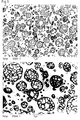
- the impact-resistant ABS molding compositions produced by the process according to the invention after contrasting with osmium tetroxide in an electron microscope image show a polymodal size distribution of the graft rubber with a high proportion of internal graft and a large "rubber phase volume".
- FIG. 1 shows a TEM image for example 1; ultra-thin section + OsO 4 , magnification 12500: 1 in the upper half, 25000: 1 in the lower half
- Known advantageous processing and usage properties and are the target of several process engineering efforts such.
- the graft rubber particles have diameters of ⁇ 0.1 to 10 ⁇ m.
- "chaotic" rubber structures with torn rubber lamellas can also occur.
- Common features of the structures of the rubber particles produced by the process according to the invention are the polymodal size distribution and the apparently "chaotic" variety of the rubber particles.
- the soft phase volume is approximately twice that used Rubber component, as on the large area of the peak G "of the shear modulus curve in Fig. 2 and 4 can be seen.
- the graft rubber / the rubber that the soft phase volume in the ABS resin has a very high efficiency.
- the shear module profiles also show the high glass transition temperatures of over 104 ° C.
- Group (A) solvents are aliphatic hydrocarbons such as butane, Pentane, hexane, heptane, octane or their iso-derivatives, cycloaliphatic Hydrocarbons such as cyclopentane, cyclohexane, alkyl-cyclopentane, alkyl-cyclohexane, aromatic hydrocarbons such as benzene, toluene, xylenes, ethylbenzene. Hexane, toluene and ethylbenzene are preferred.
- Group (B) solvents are alcohols such as methanol, ethanol, propanol, Isopropanol, butanol, isobutanol, tert-butanol, amyl alcohol, isoamyl alcohol, Isooctanol, cyclohexanol; Ketones such as acetone, methyl ethyl ketone, methyl isopropyl ketone, Cyclopentanone, cyclohexanone; Ethers such as tetrahydrofuran, dioxane, Ethylene glycol dimethyl, diethyl, dipropyl, diisoproyl ether; Esters such as ethyl acetate, Propyl acetate, butyl acetate and others, nitriles such as acetonitrile, propionitrile, butyronitrile. Methyl ethyl ketone and tetrahydrofuran are preferred
- Molar mass regulators such as mercaptans and olefins, e.g. tert-dodecyl mercaptan, Cyclohexene, terpinolene and many more in amounts of 0.05 to 1.0% by weight, based on copolymerizing monomers 1st to 3rd.
- Suitable initiators for radical polymerization are graft-active, in Radical disintegrating peroxides and / or azo compounds. These include Azodiisobutyric acid dinitrile, azoisobutyric acid alkyl ester, tert-butyl perester such as tert-butyl perpivalate or peroctoate, or perbenzoate, or perneodecanoate.
- Suitable radical initiators are also peroxide dicarbonates such as dicyclohexyl peroxidicarbonate, Di-isopropyl peroxidicarbonate, di-ethylhexyl peroxidicarbonate. These initiators are in amounts of 0.01 to 0.5 wt .-%, based. on monomers 1st to 3rd used.
- additives such as dyes, antioxidants, lubricants, stabilizers, as known to those skilled in the art.
- Graftable, soluble gums are used as the rubber for the graft rubber base Low gel rubbers in question.
- These are Polybutadienes with a high cis-1,2 content of 8 to 14%, based on on the Double bonds, the molecular weights (weight average) preferably from 50,000 to 500,000, the Styrene copolymers in random or block form, preferably their branched or Star-shaped polymers as they are known in the art for the production of "solution” or "Bulk ABS” are.
- Group 1 monoalkenyl aromatic monomers are styrene, ⁇ -methylstyrene, nucleus-substituted Alkylstyrenes, nucleus-substituted chlorostyrenes.
- Group 2 ethylenically unsaturated nitriles are acrylonitrile and methacrylonitrile.
- Group 3 copolymerizing monomers are acrylic monomers such as methyl (meth) acrylate, Ethyl (meth) acrylate, tert-butyl (meth) acrylate, esters of fumaric, itaconic acid, Maleine derivatives such as maleic anhydride, maleic acid esters, N-substituted Maleimides such as advantageously N-cyclohexyl- or N-phenyl-maleimide, N-alkyl-phenyl-maleimides, further acrylic acid, methacrylic acid, fumaric acid, Itaconic acid or its amides, as the person skilled in the art as copolymerizing Momonere known for the production of "ABS" molding compounds.
- Acrylic monomers such as methyl (meth) acrylate, Ethyl (meth) acrylate, tert-butyl (meth) acrylate, esters of fumaric, itaconic acid
- Maleine derivatives such as maleic anhydride
- ABS resins produced by the process according to the invention can compounded with other thermoplastics according to the conventional state of the art become, among others with polystyrene-co-acrylonitrile, poly-a-methylstyrene-co-acrylonitrile, polycarbonate and aromatic polyester resins.
- the material dried on evaporating dishes at room temperature is granulated and freed of residual volatiles on a degassing extruder and granulated.
- the residual toluene content is 120 ppm, styrene 43 ppm and acrylonitrile 1.5 ppm.
- the spray bodies have a matt surface.
- thermoplastic ABS resin has a favorable relationship between flowability, hardness, impact strength and light raw tone: a k -IZOD (kJ / m 2 ) 23 ° C 30th " -40 ° C 16 MVI (10/200 ° C) (cm 3/10 min.) 27 Vicat B / 120 (° C) 104 Hardness (MPa) 98
- the notched impact strength was determined at room temperature (a k RT) and at -40 ° C (a k -40 ° C) according to ISO 180 / 1A (unit: kJ / m 2 ), the hardness was determined according to DIN 53 456 (unit: N / mm 2 ) and the heat resistance according to Vicat (method B) according to DIN 53 460 (unit: ° C) measured.
- the workability was determined by measuring the volume flow index MVI according to DIN 53 735 U (unit: cm 3/10 min) charkaterintestin: the gloss measurement was in accordance with DIN 67 530 on a flat plate at a reflection angle of 60 ° (reflectometer) using the multi-angle -Reflectometer "Multi-Gloss" by Byk-Mallinckrodt.
- the solids content is 31% by weight, the conversion based on styrene and Acrylonitrile monomers, 56.5 wt .-% and the rubber content of the polymer 30.8% by weight.
- the polymer solution is placed on a 32 mm self-cleaning co-rotating laboratory evaporation screw at 160 to 240 ° C with the addition of 16 g paraffin oil and 1.60 g of IRGANOX-1076® freed from the solvent, the melt into one Stranded and granulated.
- the granules are mass-produced in a weight ratio of 1: 1.2 Styrene / acrylonitrile copolymer mixed on a laboratory extruder and added Standard small test bars hosed.
- the injection molded bodies have a matt surface.
- the residual acrylonitrile content is 1.7 ppm.
- thermoplastic ABS resin thus obtained has a unique combination of flowability, hardness, impact strength and heat resistance with a light raw tone and a low residual monomer acrylonitrile content: Notched impact strength (a k -IZOD) [kJ / m 2 ] 23 ° C 33 " -40 ° C 10th Melt volume index (MVI) [10/220] [cm 3/10 min] 17th Heat resistance (Vicat B / 120) 104 ° C hardness (MPa) 98
- test data are shown in a hexahedron representation in FIG. 2 juxtaposed.
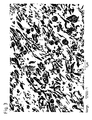
- Example 3 shows a TEM image of a micro section, etched with OsO 4, of the product according to the invention according to Example 2.
- the polymodal and polymorphological rubber size and shape distribution can be seen.
- the polymer solution is on a self-cleaning 32 mm laboratory co-rotating evaporation screw evaporated and on a twin-shaft laboratory extruder homogenized and the strand obtained granulated.
- the rubber content in the infrared was determined to be 14.7% by weight by measuring the absorptions at 975, 914, 760, 706 cm -1 compared to calibration mixtures.
- the injection molded bodies have a matt surface, the residual acrylonitrile content is 1.6 ppm.
- thermoplastic ABS resin thus obtained has a unique combination of flowability, hardness, impact strength and heat resistance with a light raw tone and a low residual monomer acrylonitrile content: Notched impact strength (a k -IZOD) [kJ / m 2 ] 23 ° C 40 " -40 ° C 9 Melt volume index (MVI) [10/220] [cm 3/10 min] 10th Heat resistance (Vicat B / 120) 104 ° C hardness (MPa) 92
- the commercially available non-aqueous polymerization serves as a comparison ABS manufactured by a mass process ("Magnum 3502", DOW), which in Example 2 has already been used.
- the test data are shown in FIG. 4 in a hexahedron representation juxtaposed.
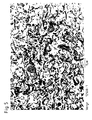
- FIG. 5 shows a TEM image of a micro section, etched with OsO 4, of the product according to the invention according to Example 3.
- the polymodal and polymorphological rubber size and shape distribution can again be seen.
- a solution of 192 g of poly-cis-butadiene ("Buna CB HX 502 C") in 450 g of n-hexane is mixed with 706 g of styrene. After complete mixing, the mixture is heated to 60 ° C. with N 2 and stirring, and 302.5 g of acrylonitrile together with 3.5 g of tert-dodecyl mercaptan are added and the mixture is heated in a 5 liter laboratory reactor at atmospheric pressure. The temperature of the reactor jacket is increased to 75 ° C. and 1.0 g of tert-butyl perpivalate in 60 g of n-hexane are added. The viscosity increases sharply within the next 100 minutes.
- the solution is evaporated on a 32 mm ZSK co-rotating laboratory evaporation screw.
- the solid is mixed with 410 g of mass-produced styrene-acrylonitrile copolymer with an acrylonitrile content of 28% in a conical, counter-rotating twin-shaft laboratory screw from Haake, Düsseldorf, at 117 rpm, extruded and granulated so that a rubber content of 14% by weight results in the end product.
- the spray bodies have a matt surface.
- the material is milky, slightly translucent. Notched impact strength according to ISO 180 / 1A (kJ / m 2 ) 23 ° C 31 MVI (10/200 ° C) (cm 3/10 min.) 14 Glass transition temperature of the resin phase (determined in the torsional vibration test) 108 ° C Glass transition temperature of the soft phase (determined in the torsional vibration test) -95 ° C
- the resulting from the solid and the weight balance of the reactor contents Sales of 84%, based on styrene and acrylonitrile, and a rubber content of 14%.
- the solution is, as described in experiment 1, on the co-rotating laboratory screw together with 16 g paraffin oil and 1.6 g IRGANOX-1076® evaporated and the ABS sprayed into test specimens.
- thermoplastic ABS resin thus obtained has a unique combination of flowability, hardness, impact strength and heat resistance with a light raw tone, matt surface of the test specimens and low residual monomer-acrylonitrile content: Notched impact strength (a k -IZOD) [kJ / m 2 ] 23 ° C 33 " -40 ° C 11 Melt volume index (MVI) [10/220] [cm 3/10 min] 14 Heat resistance (Vicat B / 120) 104 ° C hardness (MPa) 99
- Example 2 For comparison, the commercial, by non-aqueous polymerization was after ABS manufactured by a mass process ("Magnum 3502", DOW), which is also available in Example 2 was used. The test data are in one in FIG Hexahedron representation compared.
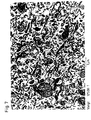
- FIG. 7 shows a TEM image of the micro section, etched with OsO 4, of the product according to the invention according to Example 5. A polymodal and polymorphological rubber size and shape distribution can be seen, which was not yet known in this form.
- the polymer which still contains residual solvent and residual monomers, is mixed in equal parts by weight with a mass-produced styrene / acrylonitrile copolymer (SAN resin) with an acrylonitrile content of 28% by weight and freed of residual volatiles on a degassing extruder, so that an ABS with a rubber content of 13% results.
- SAN resin mass-produced styrene / acrylonitrile copolymer with an acrylonitrile content of 28% by weight and freed of residual volatiles on a degassing extruder, so that an ABS with a rubber content of 13% results.
- Figure 8 is a TEM image of this product and shows the polymodal Size distribution of the rubber particles from 0.1 ⁇ m to about 1.5 ⁇ m, but with more slat structure.
- the polymerization apparatus consists of two series-stirred agitators switched laboratory reactors.
- the first reactor has a filling volume of 3 liters, the second of 6 liters. For better mixing is on both reactors one external loop each with built-in static mixers.
- the fill levels the reactors are controlled by weighing the reactor structures.
- the Reactors are operated with a filling volume of 70%; the first reactor at Normal pressure, the second at about 0 to 1.0 bar overpressure.
- the reactors are filled with polymer solution from the experiment of Example 3.
- the first reactor is heated to 75 ° C, the second reactor to 100 ° C.
- the following metering streams are metered continuously into the first reactor via separate inlets: I. 889 ml / hour a mixture of: 26.7 Wt% toluene 12th % By weight Buna CB HX 502 C, dissolved 44 Wt% styrene 17th % By weight acrylonitrile 0.3 % By weight of tert-dodecyl mercaptan II. 161 ml / hour a mixture of: 99.65 % By weight of methyl ethyl ketone (2-butanone) 0.35 % By weight of tert-butyl perpivalate
- the stationary turnover based on styrene and acrylonitrile, is 42% by weight.
- the polymer syrup which is kept constant in the second reactor at a filling level of 66% by volume, is continuously passed through a 150 ml heat exchanger (with heatable internal static mixing elements of the Sulzer AG type) and freed from volatile constituents in a continuous, multi-stage evaporator cascade according to the state of the art.
- the rubber content is 20% by weight.
- the polymer solution is poured into trays, dried to skins, and these are diluted to a rubber content of 16% by weight on a degassing extruder with mixing with technically mass-produced polystyrene-co-acrylonitrile with 28% by weight acrylonitrile and granulated.
- Conditions of injection molding to standard small test bars Melt temperature 270 ° C Tool temperature 60 ° C Injection time 3.0 sec
- a glass matrix temperature of 119 ° C is determined in the torsional vibration diagram.
- the injection molded blanks were produced analogously to Example No. 8. Glass transition temperature (torsional vibration test) 118 ° C a k -IZOD (kJ / m 2 ) 23 ° C 28
Landscapes
- Chemical & Material Sciences (AREA)
- Health & Medical Sciences (AREA)
- Chemical Kinetics & Catalysis (AREA)
- Medicinal Chemistry (AREA)
- Polymers & Plastics (AREA)
- Organic Chemistry (AREA)
- Graft Or Block Polymers (AREA)
- Polymerisation Methods In General (AREA)
Description
- (B) einem aliphatischen (C1-C8) oder cycloaliphatischen Alkohol, Keton, Ether,
Ester und/oder Nitril
- 1. 90 bis 20 Gewichtsteile Monoalkenylaromat-Monomere oder eine Mischung von Äquivalenten daraus,
- 2. 10 bis 50 Gewichtsteile ethylenisch ungesättigtes Nitril-Monomer oder einer Mischung von Äquivalenten daraus,
- 3. gegebenenfalls 0 bis 30 Gewichtsteile eines weiteren, mit 1. und 2. copolymerisierenden Vinyl-, (Meth)acryl- und/oder Malein-, Fumar-, und/oder Itacon-Monomers oder eine Mischung von Äquivalenten hieraus
- 4. 6 bis 50 Gewichtsteilen eines löslichen, gelfreien, vorgebildeten Polybutadien mit hohem cis-1,2-Anteil von 8 bis 14%, bezogen auf die Doppelbindungen, oder deren Styrol-Copolymere.
- 5. 18 bis 200 Gewichtsteilen eines Lösungsmittels oder eines Lösungsmittelgemisches aus der Gruppe (A)
- 6. bis zu einem Monomerenumsatz, bezogen aus Summe der polymerisierten Monomeren 1. bis 3., von bis zu maximal 45 Gewichtsprozent radikalisch initiiert polymerisiert,
- 7. 18 bis 450 Gewichtsteile eines Lösungsmittels oder eines Lösungsmittelgemisches aus der Gruppe (B) zeitlich oder örtlich getrennt von der Maßgabe 4/5 zusetzt
- 8. die radikalisch initiierte Polymerisation im weiteren Schritt bis zu einem Monomerenumsatz, bezogen auf die Summe der polymerisierenden Monomere 1. bis 3., von 30 bis 99 Gewichtsprozent unter Durchmischen weiter führt.
| Massetemperatur | 230°C |
| Werkzeugtemperatur | 60°C |
| Einspritzzeit | 2,8 Sek. |
| ak-IZOD (kJ/m2) | 23°C | 30 | |
| " | -40°C | 16 | |
| MVI | (10/200°C) | (cm3/10 Min.) | 27 |
| Vicat B/120 | (°C) | 104 | |
| Härte (MPa) | 98 |
| Massetemperatur | 320°C |
| Werkzeugtemperatur | 60°C |
| Einspritzzeit | 2,8 Sek. |
| Kerbschlagzähigkeit (ak-IZOD) | [kJ/m2] 23°C | 33 |
| " | -40°C | 10 |
| Schmelzvolumenindex | (MVI) [10/220] [cm3/10 min] | 17 |
| Wärmeformbeständigkeit | (Vicat B/120) | 104°C |
| Härte | (MPa) | 98 |
| Kerbschlagzähigkeit (ak-IZOD) | [kJ/m2] 23°C | 40 |
| " | -40°C | 9 |
| Schmelzvolumenindex | (MVI) [10/220] [cm3/10 min] | 10 |
| Wärmeformbeständigkeit | (Vicat B/120) | 104°C |
| Härte | (MPa) | 92 |
| Massetemperatur | 230°C |
| Werkzeugtemperatur | 60°C |
| Einspritzzeit | 2,8 Sek. |
| Kerbschlagzähigkeit nach ISO 180/1A | |||
| (kJ/m2) | 23°C | 31 | |
| MVI | (10/200°C) | (cm3/10 Min.) | 14 |
| Glasübergangstemperatur der Harzphase (bestimmt im Torsionsschwingungsversuch) | 108°C | ||
| Glasübergangstemperatur der Weichphase (bestimmt im Torsionsschwingungsversuch) | -95°C |
| Kerbschlagzähigkeit (ak-IZOD) | [kJ/m2] 23°C | 33 |
| " | -40°C | 11 |
| Schmelzvolumenindex | (MVI) [10/220] [cm3/10 min] | 14 |
| Wärmeformbeständigkeit | (Vicat B/120) | 104°C |
| Härte | (MPa) | 99 |
| I. 600 ml einer Mischung aus | 99,8 Gew.-% Methylethylketon |
| 0,12 Gew.-% tert.-Butylperpivalat | |
| 0,08 Gew.-% tert.Butylperoctoat | |
| II. 1400 ml. einer Mischung aus | 33,0 Gew.-% Toluol |
| 11 Gew.-% gelöstem Buna CB | |
| HX 502 C | |
| 40 Gew.-% Styrol | |
| 16 Gew.-% Acrylnitril | |
| 0,1 Gew.-% tert.-Dodecylmercaptan |
| Prüfergebnisse gemessen an Spritzgußkörpern | |
| Massetemperatur 230°C | |
| Werkzeugtemperatur 60°C | |
| Einspritzzeit 2,8 Sek. | |
| Reflektometerwert (Tw= 70°C/20°) | 35 |
| ak-IZOD (kJ/m2) 23°C | 34 |
| " -40°C | 20 |
| MVI (10/220) (cm3/10 Min.) | 14 |
| Vicat B/120 | 99 |
| Härte (MPa) | 95 |
| I. 889 ml/Stde. einer Mischung aus: | |
| 26,7 | Gew.-% Toluol |
| 12 | Gew.-% Buna CB HX 502 C, gelöst |
| 44 | Gew.-% Styrol |
| 17 | Gew.-% Acrylnitril |
| 0,3 | Gew.% tert.-Dodecylmercaptan |
| II. 161 ml/Std. einer Mischung aus: | |
| 99,65 | Gew.-% Methylethylketon (2-Butanon) |
| 0,35 | Gew.-% tert.-Butylperpivalat |
| III. 42 ml/Stde. einer Mischung aus: | |
| 97 Gew.-% | Methylethylketon (2-Butanon) |
| 3 Gew.-% | tert.-Dodecylmercaptan |
| IV. 242 ml/Stde. einer Mischung aus: | |
| 99,1 Gew.-% | Methylethylketon (2-Butanon) |
| 0,7 Gew.-% | tert.-Butylperoctoat |
| Prüfergebnisse gemessen an Spritzgußkörpern: | |
| Massetemperatur: 230°C | |
| Werzeugtemperatur: 60°C | |
| Einspritzzeit: 3,0 Sek. | |
| Reflektometerwert (Tw- 70°/20°C) | 25 |
| ak-IZOD (kJ/m2) 23°C | 30 |
| " -40°C | 16 |
| MVI (10/220) | 16 |
| Vicat B/120 | 104 |
| Härte (MPa) | 98 |
| Bedingungen des Spritzgusses zu Normklein-Prüfstäben: | |
| Massetemperatur | 270°C |
| Werkzeugtemperatur | 60°C |
| Einspritzzeit | 3,0 Sek. |
ak-IZOD (kJ/m2) 23°C: 27
128 ml Butanon-2
0,54 g tert.-Butylperpivalat
innerhalb von 10 Minuten ein.
Nun wird innerhalb von 4 Stunden mit logerithmisch abnehmender Zulaufgeschwindigkeit die Lösung von
400 ml Butanon-2
0,79 g tert.-Butylperpivalat
eingerührt und die Reaktortemperatur langsam auf 87°C angehoben. Man rührt noch 4 Stunden bei 87°C nach.
Man setzt nun die Lösung von
4,8 g Paraffin-Öl
10 ml 2-Butanon
| Glasübergangstemperatur (Torsionsschwingungsversuch) | 118°C |
| ak-IZOD (kJ/m2) 23°C | 28 |
Claims (4)
- Verfahren zur Herstellung von Kautschuk schlagzäh modifizierten ABS-Formmassen durch nichtwässrige Polymerisation, dadurch gekennzeichnet,
daß man mit Hilfe von mindestens zwei verschiedenen Lösungsmitteln nämlichund(A) einem aliphatischen (C4-C10), cycloaliphatischen und/oder aromatischen Kohlenwasserstoff(B) einem aliphatischen (C1-C8) oder cycloaliphatischen Alkohol, Keton, Ether, Ester und/oder Nitrilund1. 90 bis 20 Gewichsteile Monoalkenylaromat-Monomere oder eine Mischung von Äquivalenten daraus,2. 10 bis 50 Gewichsteile ethylenisch ungesättigtes Nitril-Monomer oder einer Mischung von Äquivalenten daraus,in Gegenwart von3. gegebenenfalls 0 bis 30 Gewichtsteile eines weiteren, mit 1. und 2. kopolymerisierenden Vinyl- und/oder Fumar-, und/oder Itacon-Monomer oder eine Mischung von Äquivalenten hierausund4. 6 bis 50 Gewichsteilen eines löslichen, gelfreien, vorgebildeten Polybutadien mit hohem cis-1,2-Anteil von 8 bis 14%, bezogen auf die Doppelbindungen, oder deren Styrol-Copolymere in gerührter Lösung von5. 18 bis 200 Gewichsteilen eines Lösungsmittels oder eines Lösungsmittelgemisches aus der Gruppe (A)6. bis zu einem Monomerenumsatz, bezogen auf Summe der polymerisierten Monomeren 1. bis 3. von bis zu maximal 45 Gew.% radikalisch initiiert polymerisiert,7. 18 bis 450 Gewichsteile eines Lösungsmittels oder eines Lösungsmittelgemisches aus der Gruppe (B) zeitlich oder örtlich getrennt von der Maßgabe 5 zusetzt8. die radikalisch initiierte Polymerisation im weiteren Schritt bis zu einem Monomerenumsatz, bezogen auf die Summe der polymerisierenden Monomere 1. bis 3. von 30 bis 99 Gew.% unter Durchmischen weiter führt. - Verfahren nach Anspruch 1, dadurch gekennzeichnet, daß die Polymerisation als Satzansatz betrieben wird.
- Verfahren nach Anspruch 1, dadurch gekennzeichnet, daß die Polymerisation absatzweise nach Zulaufverfahren betrieben wird mit der Maßnahme des örtlich getrennten Zulaufes von 4./5. mit Lösungsmittel (A) und 7. mit Lösungsmittel (B).
- Verfahren nach Anspruch 1., dadurch gekennzeichnet, daß die Polymerisation fortlaufend (kontinuierlich) betrieben wird mit der Maßnahme des örtlich getrennten Zulaufes von 4./5. mit Lösungsmittel (A) und 7. mit Lösungsmittel (B).
Applications Claiming Priority (2)
| Application Number | Priority Date | Filing Date | Title |
|---|---|---|---|
| DE4429320A DE4429320A1 (de) | 1994-08-18 | 1994-08-18 | Verfahren zur Herstellung von kautschukmodifizierten ABS-Formmassen durch nichtwäßrige Polymerisation in Gegenwart von Lösungsmitteln |
| DE4429320 | 1994-08-18 |
Publications (2)
| Publication Number | Publication Date |
|---|---|
| EP0700941A1 EP0700941A1 (de) | 1996-03-13 |
| EP0700941B1 true EP0700941B1 (de) | 1998-11-25 |
Family
ID=6526008
Family Applications (1)
| Application Number | Title | Priority Date | Filing Date |
|---|---|---|---|
| EP95112505A Expired - Lifetime EP0700941B1 (de) | 1994-08-18 | 1995-08-09 | Verfahren zur Herstellung von kautschukmodifizierten ABS-Formmassen durch nichtwässrige Polymerisation in Gegenwart von Lösungsmitteln |
Country Status (4)
| Country | Link |
|---|---|
| EP (1) | EP0700941B1 (de) |
| JP (1) | JP3564208B2 (de) |
| DE (2) | DE4429320A1 (de) |
| ES (1) | ES2123879T3 (de) |
Families Citing this family (5)
| Publication number | Priority date | Publication date | Assignee | Title |
|---|---|---|---|---|
| DE19610931A1 (de) * | 1996-03-20 | 1997-09-25 | Bayer Ag | Verfahren zur Herstellung von ABS-Formmassen |
| DE19632556A1 (de) | 1996-08-13 | 1998-02-19 | Bayer Ag | Verfahren zur Herstellung von hochkautschukhaltigen ABS-Formmassen |
| DE19742868A1 (de) * | 1997-09-29 | 1999-04-01 | Bayer Ag | Polycarbonat-ABS-Formmassen |
| DE19828541A1 (de) * | 1998-06-26 | 1999-12-30 | Bayer Ag | Flammwidrige Polycarbonat-ABS-Formmassen |
| BR112017014866B1 (pt) * | 2015-01-08 | 2021-10-13 | Nova Chemicals (International) S.A | Métodos para polimerização em fase fluida de um polímero ou copolímero de polietileno |
Family Cites Families (6)
| Publication number | Priority date | Publication date | Assignee | Title |
|---|---|---|---|---|
| US3538190A (en) * | 1967-03-30 | 1970-11-03 | Copolymer Rubber & Chem Corp | Process for preparing improved plastic compositions and the resulting products |
| JPS5230994B2 (de) * | 1972-01-17 | 1977-08-11 | ||
| JPS5230995B2 (de) * | 1972-01-31 | 1977-08-11 | ||
| US3984496A (en) * | 1972-01-31 | 1976-10-05 | Sumitomo Chemical Company, Limited | Process for producing binary or ternary graft-copolymer |
| DE3047293A1 (de) * | 1980-12-16 | 1982-07-29 | Basf Ag, 6700 Ludwigshafen | Verfahren zur herstellung von abs-polymerisaten, verwendung derselben, sowie formteile aus diesen |
| US5166261A (en) | 1990-09-04 | 1992-11-24 | Monsanto Company | High gloss ABS made by continuous process |
-
1994
- 1994-08-18 DE DE4429320A patent/DE4429320A1/de not_active Ceased
-
1995
- 1995-08-09 EP EP95112505A patent/EP0700941B1/de not_active Expired - Lifetime
- 1995-08-09 ES ES95112505T patent/ES2123879T3/es not_active Expired - Lifetime
- 1995-08-09 DE DE59504319T patent/DE59504319D1/de not_active Expired - Fee Related
- 1995-08-15 JP JP22865495A patent/JP3564208B2/ja not_active Expired - Fee Related
Also Published As
| Publication number | Publication date |
|---|---|
| ES2123879T3 (es) | 1999-01-16 |
| DE4429320A1 (de) | 1996-02-22 |
| JP3564208B2 (ja) | 2004-09-08 |
| EP0700941A1 (de) | 1996-03-13 |
| JPH0867723A (ja) | 1996-03-12 |
| DE59504319D1 (de) | 1999-01-07 |
Similar Documents
| Publication | Publication Date | Title |
|---|---|---|
| DE69416497T2 (de) | Mehrstufiges Masse-Polymerisationsverfahren mit kontrollierter Pfropfung, Phasenumkehrung und Vernetzung für die Herstellung von ABS-Pfropfcopolymeren | |
| US4009226A (en) | Abs moulding compositions | |
| DE69810484T2 (de) | Hochglänzende und hochschlagfeste aromatische monovinylidenpolymere | |
| US4009227A (en) | Abs moulding compositions | |
| DE3889555T3 (de) | Kautschukmodifizierte Vinylaromat-Polymerharze und Verfahren zu ihrer Herstellung. | |
| DE60112213T2 (de) | Ölbeständige Kautschuk modifizierte Polystyrenzusammensetzung | |
| EP0678553B1 (de) | Thermoplastische Formmassen vom ABS-Typ | |
| JPH08295710A (ja) | ゴム強化ビニル芳香族共重合体の製造方法 | |
| EP0579140A2 (de) | Teilchenförmiges Pfropfcopolymerisat | |
| EP0253236B1 (de) | Verfahren zur Herstellung thermoplastischer Formmassen | |
| EP0700941B1 (de) | Verfahren zur Herstellung von kautschukmodifizierten ABS-Formmassen durch nichtwässrige Polymerisation in Gegenwart von Lösungsmitteln | |
| KR910003871B1 (ko) | 고무강화 공중합체 및 이의 제조방법 | |
| DE69305092T2 (de) | Harze mit verbesserter wärmeformbarkeit und spannungsrissbeständigkeit | |
| EP0258741A2 (de) | Thermoplastische Formmasse auf Basis von ABS | |
| EP0872520B1 (de) | Emulsionsfrei hergestellte ABS-Formmassen mit sehr hoher Kerbschlagzähigkeit | |
| WO1999067308A1 (de) | Schlagzähes polystyrol mit hoher steifigkeit und zähigkeit | |
| EP0824122B1 (de) | Verfahren zur Herstellung von hochkautschukhaltigen ABS-Formmassen | |
| DE69706759T2 (de) | Verfahren zur Herstellung von ABS Harzen | |
| EP0057845B1 (de) | Verfahren zur Herstellung von Pfropfpolymerisaten | |
| DE1694471C3 (de) | Thermoplastische Massen | |
| EP1274754A1 (de) | Verfahren zur polymerisation von konjugierten diolefinen (dienen) mit katalysatoren der seltenen erden in gegenwart vinylaromatischer lösungsmittel | |
| EP0261396B1 (de) | Thermoplastische Formmasse auf Basis von ABS | |
| DE19610931A1 (de) | Verfahren zur Herstellung von ABS-Formmassen | |
| DE1745164A1 (de) | Pfropfmischpolymerisate und Verfahren zu ihrer Herstellung | |
| EP0049775A2 (de) | Verfahren zur kontinuierlichen Herstellung von mit Kautschuk modifizierten Polymerisaten von Vinylaromaten |
Legal Events
| Date | Code | Title | Description |
|---|---|---|---|
| PUAI | Public reference made under article 153(3) epc to a published international application that has entered the european phase |
Free format text: ORIGINAL CODE: 0009012 |
|
| AK | Designated contracting states |
Kind code of ref document: A1 Designated state(s): BE DE ES FR GB IT NL |
|
| 17P | Request for examination filed |
Effective date: 19960812 |
|
| 17Q | First examination report despatched |
Effective date: 19970317 |
|
| GRAG | Despatch of communication of intention to grant |
Free format text: ORIGINAL CODE: EPIDOS AGRA |
|
| GRAG | Despatch of communication of intention to grant |
Free format text: ORIGINAL CODE: EPIDOS AGRA |
|
| GRAH | Despatch of communication of intention to grant a patent |
Free format text: ORIGINAL CODE: EPIDOS IGRA |
|
| GRAH | Despatch of communication of intention to grant a patent |
Free format text: ORIGINAL CODE: EPIDOS IGRA |
|
| GRAA | (expected) grant |
Free format text: ORIGINAL CODE: 0009210 |
|
| AK | Designated contracting states |
Kind code of ref document: B1 Designated state(s): BE DE ES FR GB IT NL |
|
| REF | Corresponds to: |
Ref document number: 59504319 Country of ref document: DE Date of ref document: 19990107 |
|
| REG | Reference to a national code |
Ref country code: ES Ref legal event code: FG2A Ref document number: 2123879 Country of ref document: ES Kind code of ref document: T3 |
|
| ITF | It: translation for a ep patent filed | ||
| ET | Fr: translation filed | ||
| GBT | Gb: translation of ep patent filed (gb section 77(6)(a)/1977) |
Effective date: 19990218 |
|
| PLBE | No opposition filed within time limit |
Free format text: ORIGINAL CODE: 0009261 |
|
| STAA | Information on the status of an ep patent application or granted ep patent |
Free format text: STATUS: NO OPPOSITION FILED WITHIN TIME LIMIT |
|
| 26N | No opposition filed | ||
| REG | Reference to a national code |
Ref country code: GB Ref legal event code: IF02 |
|
| PGFP | Annual fee paid to national office [announced via postgrant information from national office to epo] |
Ref country code: NL Payment date: 20030731 Year of fee payment: 9 |
|
| PG25 | Lapsed in a contracting state [announced via postgrant information from national office to epo] |
Ref country code: NL Free format text: LAPSE BECAUSE OF NON-PAYMENT OF DUE FEES Effective date: 20050301 |
|
| NLV4 | Nl: lapsed or anulled due to non-payment of the annual fee |
Effective date: 20050301 |
|
| REG | Reference to a national code |
Ref country code: GB Ref legal event code: 732E |
|
| PGFP | Annual fee paid to national office [announced via postgrant information from national office to epo] |
Ref country code: DE Payment date: 20070802 Year of fee payment: 13 |
|
| PGFP | Annual fee paid to national office [announced via postgrant information from national office to epo] |
Ref country code: ES Payment date: 20070926 Year of fee payment: 13 |
|
| PGFP | Annual fee paid to national office [announced via postgrant information from national office to epo] |
Ref country code: GB Payment date: 20070809 Year of fee payment: 13 |
|
| PGFP | Annual fee paid to national office [announced via postgrant information from national office to epo] |
Ref country code: IT Payment date: 20070828 Year of fee payment: 13 |
|
| PGFP | Annual fee paid to national office [announced via postgrant information from national office to epo] |
Ref country code: BE Payment date: 20071018 Year of fee payment: 13 |
|
| REG | Reference to a national code |
Ref country code: GB Ref legal event code: 732E |
|
| PGFP | Annual fee paid to national office [announced via postgrant information from national office to epo] |
Ref country code: FR Payment date: 20070808 Year of fee payment: 13 |
|
| REG | Reference to a national code |
Ref country code: FR Ref legal event code: TP |
|
| GBPC | Gb: european patent ceased through non-payment of renewal fee |
Effective date: 20080809 |
|
| REG | Reference to a national code |
Ref country code: FR Ref legal event code: ST Effective date: 20090430 |
|
| PG25 | Lapsed in a contracting state [announced via postgrant information from national office to epo] |
Ref country code: BE Free format text: LAPSE BECAUSE OF NON-PAYMENT OF DUE FEES Effective date: 20080831 |
|
| PG25 | Lapsed in a contracting state [announced via postgrant information from national office to epo] |
Ref country code: IT Free format text: LAPSE BECAUSE OF NON-PAYMENT OF DUE FEES Effective date: 20080809 Ref country code: FR Free format text: LAPSE BECAUSE OF NON-PAYMENT OF DUE FEES Effective date: 20080901 Ref country code: DE Free format text: LAPSE BECAUSE OF NON-PAYMENT OF DUE FEES Effective date: 20090303 |
|
| REG | Reference to a national code |
Ref country code: ES Ref legal event code: FD2A Effective date: 20080811 |
|
| PG25 | Lapsed in a contracting state [announced via postgrant information from national office to epo] |
Ref country code: GB Free format text: LAPSE BECAUSE OF NON-PAYMENT OF DUE FEES Effective date: 20080809 |
|
| PG25 | Lapsed in a contracting state [announced via postgrant information from national office to epo] |
Ref country code: ES Free format text: LAPSE BECAUSE OF NON-PAYMENT OF DUE FEES Effective date: 20080811 |