EP0701355B1 - Compression de paquets de données - Google Patents
Compression de paquets de données Download PDFInfo
- Publication number
- EP0701355B1 EP0701355B1 EP95401749A EP95401749A EP0701355B1 EP 0701355 B1 EP0701355 B1 EP 0701355B1 EP 95401749 A EP95401749 A EP 95401749A EP 95401749 A EP95401749 A EP 95401749A EP 0701355 B1 EP0701355 B1 EP 0701355B1
- Authority
- EP
- European Patent Office
- Prior art keywords
- message
- data
- packets
- packet
- bit
- Prior art date
- Legal status (The legal status is an assumption and is not a legal conclusion. Google has not performed a legal analysis and makes no representation as to the accuracy of the status listed.)
- Expired - Lifetime
Links
Images

Classifications
-
- H—ELECTRICITY
- H04—ELECTRIC COMMUNICATION TECHNIQUE
- H04L—TRANSMISSION OF DIGITAL INFORMATION, e.g. TELEGRAPHIC COMMUNICATION
- H04L9/00—Cryptographic mechanisms or cryptographic arrangements for secret or secure communications; Network security protocols
- H04L9/40—Network security protocols
Definitions
- the present invention relates to a method of compressing data included in packets constituting protocol data units exchanged by terminals through a network of packet switching.
- the invention relates to a compression process of first packets of data sent by a terminal in second packets of data transmitted through a network of packet switching, the first and second packages each including a header with a constant length and a data field having at plus a maximum length, and a message sent by the terminal consisting of K + 1 first packets successive, K being an integer equal to or greater than one and a priori different from one message to another.
- the main aim of such a method is to reduce the cost of a communication between two terminals, in decreasing the number of second packets compared to number of first matching packets.
- the operator of the packet switching network such as that the TRANSPAC network (registered trademark) assesses the cost of a communication between two terminals in function of a unit of tax, called segment of pricing, which can be an integer sub-multiple the maximum length of the data field for packets in the network.
- segment of pricing can be an integer sub-multiple the maximum length of the data field for packets in the network.
- the length maximum of data fields is 128 bytes
- a price segment has 64 bytes.
- Second packets of compressed data must have a format identical to the first data packets so that the network ignores that the packet data has been compressed. In in other words, compression must be transparent to packet format.
- the invention therefore does not relate to compression data particularly implemented in a DATAMIZER (registered trademark) equipment, according to which not only the data in the data fields first packets are compressed but also the indications contained in the headers of first packages.
- the second packets then have a format different from that of the first packets.
- This second method still has a drawback found in the previous process.
- the data is compressed packet by packet, regardless of message makeup says also sequence, by a succession of firsts packets, that is to say the integer K is always zero.
- a message is a continuous sequence characters sent by a terminal which is not cut in packages only to satisfy the imperatives of switching in the packet network. Ignoring messages, as level data units higher than that of packets, known methods do not can compress a string in a message that is partially included at the end of a first packet given and at the start of a first packet following the first package given.
- a reconstruction sub-header is systematically associated with each of the fields of compressed data, i.e. to each of first data packets and is contained in the data field of a second packet.
- the length of compressed data of a message in the fields of second packet data is then penalized by the number of sub-headers and therefore first packets message.
- the headers of second packets are undefined by compared to the headers of the first packets, which limits the transparency of the compression process by relation to the switching network.
- bits particular, such as bits M and D according to the notice X.25 of C.C.I.T.T. in the headers of the first packets are not carried in the headers of second packages.
- the main objective of the invention is increase the gain of data compression by compared to the aforementioned known methods.
- the invention considers, as a unit of data, each message composed of K + 1 first packets, K being a integer such that K ⁇ 1.
- the invention Since the invention is attached to the concept of message, this one also aims analyze the content of each of the headers first packages. This analysis guides the concatenation of data fields according to messages but also specific requests from terminal. The essential information contained in the headers of the first packets can then be reported in the headers of the second packets. In these conditions, a compression device putting implementing the compression method according to the invention and inserted between a terminal and a network access is completely transparent.
- the first bit in the first K packets of a message is at a first state, and the first bit in the last first packet of the message is in an opposite state to said first state.
- the first bit in the headers of second packets including the data field is at maximum length and is ended with compressed data the message is audit first state, and the first bit in the header of a last second package containing at least the word message end of message and ended with a word of end of message is in the opposite state.
- the first bit in the headers of second packets is systematically audited opposite since the end of the messages in the seconds packets is marked with an end-of-message word.
- the second bit in a first packet is at a first state, whatever the state of the first bit in the first packet, when said terminal wishes to receive a acknowledgment of receipt transmitted by the terminal recipient who acknowledges the first package.
- the data in a first packet containing a second bit in said first state are only not concatenated and compressed with data from very first subsequent packet, the compressed data resulting from data compression in the first packet containing the second bit said first state are immediately transmitted in at least one second package, and a second package containing at least the end-of-message word following this data compressed resulting from compression to a second bit audit first state.
- the third bit changes state only from the last first packet from a first message to the first packet from a second message following the first message.
- the second package containing the end word message following the compressed data resulting from data compression of the first message does not contain other data after said end of message word, and the third bits of second packets containing compressed data resulting from the first and second messages have respectively the states of the third bits contained in the first packages of the first and second messages.
- Another objective of the invention consists in optimize the transit time of the second packets, or rather to look for a packet transit time relatively short with a number of second packets per relatively small unit of time. Of them solutions are recommended by the invention.
- the method comprises triggering of a predetermined time delay in response substantially to the introduction of each first end of message word in second packet during training, and the transmission of said second package being formed when the timer has expired even when the second packet in training course did not reach length Max.
- the data field of this second packet whose formation is stopped by the expiration of the timeout is then ended with an end word of message.
- the method comprises triggering of a predetermined time delay significantly from the start of the training of each second package, and the introduction of a final word intermediate at the end of the data field of said every second packet when timeout has expired even when said every second packet has not reaches the maximum length.
- the predetermined time delay can be negotiated between said terminal and another terminal for which the first data packets are intended, prior to the transmission of the first packets by said terminal.
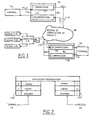
- the methods of compression and decompression according to the invention are used in compression devices and decompression 1A and 2A combined in 3A equipment.
- This 3A equipment is interconnected between a terminal RT type terminal processing equipment DTE data and access from a communication network of termination equipment type RP packets DCE data circuit across a line two-way LTA telephone.
- At least one other terminal TB is connected to the RP network by a line two-way LTB telephone through a 3B equipment containing a compression device 1B and a pressure relief device 2B.
- He will be assumed that the terminal TA, as a terminal transmitter, enters into communication with the terminal TB, as the receiving receiver terminal, although the TA terminal can be in communication with a or several other terminals simultaneously across the RP network.
- a terminal can be a simple user terminal, or a set of X.25 terminals served by an X.25 packet switch, such as shown by compression-decompression equipment 3C in Figure 1.
- the compression and decompression implemented in 3A equipment and 3B relate to an interface between the three lower layers and the four upper layers according to principles of open systems architecture (Open System Interconnection OSI) established by ISO (International Standardization Organization).
- This interface as shown in Figure 2, is located just above layer 3, called network layer, which ensures the establishment and reception of communications and information routing between user terminals across the network.
- the compression and decompression are thus located at packet level according to the X.25 notice, below the transport layer which controls end to end the transfer of information across the network.
- the header of a data packet has three bytes.
- the first four bits of the first byte and the second byte represent the NVL number of the logical channel, permanent virtual circuit or virtual communication, along which the packet is transferred.
- the NVL number as well as the fifth and sixth bits at "1" and “O" of the first byte and the first bit at "O" of the third byte in the header of a data packet are intangible and are systematically reported in the headers of the data packets leaving the compression device 1A, 1B or the decompression device 2A, 2B.
- the third byte includes a number of packet sequence in transmission at three bits P (S) varying from 0 to 7 and incremented successively by modulo 8 unit each time a first packet of data is issued by the TA terminal.
- the three last bits of the third byte contain a receive packet sequence number P (R) introduced in a packet to be sent by the RP network and coming from the receiving terminal TB having received data packets from the other TA terminal after the TA terminal has sent data packets which contain a number P (S) at most equal to P (R) -1 and which have been received by the terminal TB.
- the numbers P (S) and P (R) are changed following the two directions of transmission by a equipment due to concatenations and groupings operated according to the invention.
- the header of a data packet contains also three particular binary words, in the occurrence of three particular bits M, D and Q respectively located in the fifth bit of the third byte and the seventh and eighth bits of the first byte.
- the second and third bits particular D and Q being used less frequently, these are supposed to be, in a first variant, meaningless and positioned as is "O".
- the first particular bit M is linked to the concept data message.
- a data message which is a transport level 4 data unit, is a sequence of contiguous data emitted in K complete packages and one last successive package by a terminal or access to the switching network of packets, K being an integer greater than or equal to zero.
- the M bit constitutes a data mark to follow which is set to "1" in all data packets, except in the last packet of the message, to indicate that other message data will follow in the next package.
- a full package also called a full package, is a packet with a full data field and has a maximum length LMAX typically equal to 128 or 256 bytes.
- the fields of DT11 and DT12 data of the first two PT11 packets and PT12 are complete and contain 128 bytes.
- the DT13 data field of the last PT13 packet of the first message ME1 is incomplete and contains by example 100 bytes, i.e. an ME1 message of 356 bytes.
- a second ME2 message contains only one PT21 packet which is incomplete, the data field DT21 of this packet containing only 70 bytes per example.
- the compression device 1A and the decompression device 2A in the same equipment 3A operate independently of one another. Compression can be performed in device 1A and decompression can be performed in decompression device 2B in other equipment 3B according to the direction of transmission TA to TB, without compression and decompression being performed respectively in equipment 3B and 3A.
- the compression device 1B and the decompression device 2A can be omitted.
- circuits and communications are independent.
- the data packets of some virtual circuits and communications passing through a compression device, respectively decompression, may undergo compression, respectively decompression; the data packets from other circuits and virtual communications can cross the device without modification and are said to be in mode without compression.
- the equipment 3A checks that the remote terminal called, such as the terminal TB, has a decompression device 2B if the virtual communication is at least one-way and the packets are to be compressed in the direction TA to TB, and / or has a compression device 1B if the virtual communication is at least one-way and the packets are to be compressed in the direction TB to TA, and / or has devices decompression and compression 2B and 1B if the virtual communication is bidirectional. For this, the equipment 3A verifies the configuration of the terminal called TB by comparison with terminal addresses written in an address table programmed in memory.
- the devices 1A and 2A in the equipment 3A are inactive for this virtual communication which is in uncompression mode.
- the compression step E2 in Figures 4 and 5 is deleted in non-compression mode.
- the 3A equipment receives a packet call transmitted by the local calling terminal TA, communication is considered compressible if the address of the terminal called TB included in the call packet is contained in the address table.
- the 3A equipment receives a packet call transmitted by the RP network from the terminal remote calling TB, communication is considered as compressible if the address of the calling terminal TB included in the call packet is contained in the address table.
- the corresponding equipment 3A, 3B checks also that the sub-address of the terminal set calling or called be contained in the table Address.
- the devices 3A and 3B negotiate parameters of the data compression function, such as a parameter P O indicating the direction or directions of transmission for which the compression is used, a parameter P 1 indicating the number of code words representative of the dictionary size, and a parameter P 2 indicating the maximum length of character string expressed in bytes, according to CCITT Recommendation V.42 bis, Geneva 1990.
- the parameter P 2 is between 6 and 20.
- three programmable sizes of dictionaries D1, D2 and D3, for example at 40 kbytes, 20 kbytes and 10 kbytes are provided.
- the number of dictionaries of each size is reserved according to the number of virtual circuits to be compressed.
- Two dictionaries are reserved for the two directions of transmission of each circuit or virtual communication.
- the dictionaries are assigned according to the load of the virtual circuits of the equipment and of the negotiation parameters received while prioritizing the large dictionaries.
- the equipment has 60 D1 to 40 dictionaries kbytes and 40 D2 dictionaries at 20 kbytes.
- Gain in compression equal to the instantaneous ratio of the number bits in packets received PT number of bits in the packets transmitted PR is all the greater that the size of the dictionaries is large, and varies so depending on dictionary sizes selected, and therefore the number of circuits and virtual communications to compress.
- Parameters concerning compression and resources are exchanged in call packets and call confirmation, or in packets of data after establishing communication between the terminals.
- the compression method according to the invention is implemented, for example in the compression device 1A of the equipment 3A to which reference will be made. in the following, when the communication is in compression mode at least in the direction TA to TB.
- Data compression uses a predetermined adaptive algorithm of the ZIV-LEMPEL type, close to that specified in Recommendation V.42 bis.
- Such a compression algorithm encodes Redundant strings of several 1-byte characters in code words having a length varying between 9 and 12 bits. Dictionaries of different channels are respectively associated with virtual circuits established and in the directions of transmission. Each dictionary is updated dynamically in normal operation as the bytes of the first outgoing packets from the TA terminal are received in the compression device 1A. The length of code words is constantly compared to that of the character strings so as to test compression efficiency. If the gain in compression is insufficient, i.e. if a set of code words is significantly shorter or or is longer than the character string corresponding, the compression device goes into transparent mode. In this transparent mode, the data is transmitted in uncompressed form after 3A equipment reports this change of operating mode by command codes to the remote equipment 3B. However, the dictionary relating to continuous established virtual communication to be updated in equipment 3A and 3B.
- the compression of data is not performed independently first packet by first packet PT sent by the terminal TA, but message by message.
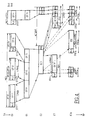
- the method of compression according to the invention includes essentially three stages E1, E2 and E3, after a initial EO packet reception step. All of these steps are described below one after the other in order to facilitate understanding of the process. In practical, these steps are carried out in parallel simultaneously ; one byte in a first PT packet is concatenated and compressed if necessary with following bytes constituting a character string, but without waiting for the reception of the other bytes of that first package or a first next package.
- the TA terminal initially transmits in a circuit virtual device 3A first message ME1 composed of the first three packets PT11, PT12 and PT13 and a second ME2 message composed of a single first PT21 packet, the PT13 and PT21 packets being not full, for example.
- step EO the compression device 1A in particular detects an interruption of flags, and separates the header ET11, ET12, ET13, ET21 and the field DT11, DT12, DT13, DT21 in each first packet received PT11, PT12, PT13, PT21.
- the fifth bit M of the third byte is analyzed in order to prepare the next step E1.
- the bit M of a first packet is in a first binary state "1"
- the bit M in the headers ET11 and ET12 of the first packets PT11 and PT12 the data of the field DT11, DT12 of the first packet are concatenated with the previous data of the same message ME1 in step E1 .
- the concatenation consists in writing the data of the message in an input buffer so as to be read progressively in order to carry out the compression progressively in the next step E2 and to wait for the reception of the data DT12, DT13 in the first packet following PT12 , PT13.
- step E1 the data DT11, DT12 and DT13 in the first message ME1 are concatenated as they were initially before packetization and transmission by first packets in the terminal TA.
- a first packet such as the packet's ET21 header PT21, following a PT13 packet whose bit M is also in the "O" state, this PT21 packet constitutes alone an ME2 message.
- the ET21 header is simply separated from the DT21 data which is gradually written to the input buffer and processed in the next step E2 regardless of data in previous and next packets received in the compression device 1A.
- the concatenated data groups (DT11, DT12, DT13) and (DT21) are compressed according to the algorithm ZIV-LEMPEL type predetermined compression successively and independently of each other at step E2.
- the concatenated data DT11, DT12 and DT13 of the first message ME1 are compressed into DC1 compressed data which is immediately followed by an end of message FM1 which indicates the end of the first message.
- the FM end-of-message has only two bytes when the compressor 1A works in transparent mode.
- DC1 compressed data has a length substantially equal to that of the data DT11, DT12 and DT13, i.e. if the compression device 1A has found that the compression of the first message ME1 does not reduce not the length of the data field of the first message
- the end of message is composed of an escape character and a code end of sequence command, i.e. end message, as defined in Recommendation V.42 bis.
- Uncompressed data will only be transmitted only after the transmission of a code word of switching to transparent PMT mode from device 1A to device 2B.
- the end word of message FM1, FM2 is an analog control code word FLUSH code according to Recommendation V.42 bis.
- the word FM1, FM2 then includes 9 to 12 bits predetermined.
- step E3 the data fields of second packets PR1, PR2 to be transmitted to the packet switching network RP are filled progressively with the data compressed in step E2.
- a first part DC11 of the compressed data DC1 of the first message ME1 having the maximum length LMAX completely fills the second PR1 package.
- this second packet PR1 of compressed data begins to be constituted in step E3 before the end of the complete reception of the first PT11 packet transmitted by the TA terminal.
- a second and last part DC12 of the compressed data DC1 of the first message ME1 are introduced at the beginning of data field of the second packet following PR2 with the end of message FM1.
- the data compressed DC2 of the second message ME2 are also grouped with the end of the DC12 compressed data of the first message ME1 in the second packet PR2.
- the data DC2 with the end word of MF2 message does not completely fill the packet PR2.
- a second packet such as the PR1 packet
- it is transmitted by device 1A to the RP network.
- a second package is not waiting to be completely filled to be transmitted to the RP network, since a such a wait could block the transmission by only partially transmitting a message occupying several second packets and deferring the transmission of the end of the message.
- a timeout TEM1 is triggered in the compression device 1A in response to the closing flag following the last first packet of a message and therefore almost in response to the first end of message word FM1 introduced in a second packet, such as the PR2 package.
- the packet PR2 is filled with the following compressed data, such as the data DC2 with the respective end of message word FM2, that the following compressed data come from one or more messages . If the packet PR2 is completely filled and reaches the length LMAX, before the expiration of the timer TEM1, the full packet PR2 is immediately transmitted to the network RP. On the other hand, if at the end of the time delay TEM1 the packet PR2 is partially filled with compressed data, it is transmitted to the network RP without waiting for the partial or entire compression of the data of the message being received or following not yet received. .
- the reduction in transit time is preferred over the reduction in the number of second packets of compressed data.
- This second embodiment is interesting when the equipment 3A, 3B are connected to a private packet switching network, as a RP network, in which the cost of the communication is not priced according to the number of pricing segments.
- a timer TEM2 also programmable is triggered when the filling of the data field of a second packet begins and at a duration substantially equal to the time maximum transit of a second packet and not of a message, independently of the state of the bit M.
- the expiration of the second time delay TEM2 during the reception of the first message ME1 causes the storage of an intermediate end word FI in a first packet PR1a following the start DDC of the compressed data DC1.
- the intermediate end word FI can succeed any code word in the compressed data.
- an intermediate part IDC of the compressed data DC1 completely fills a second packet PR2a for a duration less than TEM2.
- the end FDC of the data DC1 with the end of message word FM1 and the compressed data DC2 of the following message with the end of message FM2 are transmitted in a third second packet PR3a insofar as the first packet PT21 is received and compressed before the expiration of the timer TEM2 triggered by the filling of the packet PR3a with the end FDC of the compressed data DC1.
- step E3 the headers of the second PR1, PR2 (or PR1a, PR2a, PR3a) packets are formatted as shown in Figure 3, so that the 3A equipment be transparent to communications.
- the insertion of 3A equipment between the terminal 1A and the RP network does not require any adaptation of the network and the terminal, or change terminal subscription settings user 1A to the RP network.
- the equipment 3A simulates the RP network on its ITA interface with terminal 1A, and simulates the TA terminal on its IRA interface with the RP network.
- the equipment is bit-transparent particular M as well as two other bits particular Q and D which are positioned in the headers second packages in the same locations as in the headers of the first packets.
- the bit M in the header ER1, ER2a of a second packet terminated by compressed data DC11, IDC originating from a message ME1 is in the state "1"; in other words, the bit M in a second packet is set to "1" when the data field DC11, IDC of the second packet at a time is at the maximum length LMAX and is not terminated by an end word message.
- Bit M is then in the state "0" in the header ER2, ER3a of the last second packet of compressed data PR2, PR3a containing compressed data of a message ME1, when this last second packet is terminated by a message end word FM2 marking the end of said message ME1 or of a message following ME2 (except in the case where a second bit D is at "1" as will be seen with reference to FIG. 5).
- the RP network can then group the packets of compressed data before transmitting it to 2B decompression device on the remote terminal TB recipient when this one uses a length maximum of package greater than length maximum packet used in the sending terminal YOUR.
- the network RP receives from the terminal TA one or several second consecutive packets full with the bit M set to "1"
- the network groups the compressed data from these packets.
- the positioning of the bit M in compressed data packets is only not used according to a second variant. M bits in all the second packets are then systematically at "0".
- This second variant prohibits any grouping of packets through the RP network in order to optimize the time of transit.
- the packet is not necessarily full, and can have a length less than the maximum length LMAX, as the package pt21 in figure 5.
- FIG. 5 shows several examples of combination of bits D and Q and of grouping of data, the frequency of the bit D in the state "1" being voluntarily increased compared to the practice.
- the messages me , the first and second packets pt and pr and the fields of uncompressed data dt and of compressed data dc are designated by lowercase marks similar to those used in FIG. 4.
- the timers TEM1, TEM2 are not considered, or the second corresponding packets pr1 to pr5 are transmitted by the compression device 1A well before the expiration of the respective timers.
- bit D When bit D is at state "1" in a first full or non-full packet issued by the TA terminal, it prohibits any concatenation and compression with the dt22 data of the first packet following pt22 in steps E1 and E2 in the device compression 1A.
- This prohibition is enforced naturally when the bit M is at "0" in the first packet received, such as the packet pt31 or pt41, but also when the M bit is "1" in the first packet received, such as the pt21 packet, indicating that it belongs to a message me2 to follow in the next package pt22.
- the data compressed from the pt21 packet having bit D at "1" for part finish filling a second pack previous pr1 whose bit D is at "0" and bit M is to "1" since the pr1 package is full and terminated by dc21 data to follow in the second packet following pr2 of the previous message me2, and partly are contained only with an end word of FM message in the second packet following pr2, the bit D is at "1" to request an acknowledgment of the first packet pt21 and whose bit M is the copy of bit M of first packet pt21.
- bit M of packet pr2 is at "1" as that of the pt21 package to indicate that data from the message me2 are to follow in the second package according to pr3.
- the third particular bit Q to which the compression and decompression devices are also transparent is a qualifying binary element defined in Notice X.25.
- the Q bit is available to the user of a transmitting terminal who wishes to transmit data on more than one level and makes it possible to qualify the data transmitted on two levels.
- the Q bit identifies a level of user protocol with respect to higher levels, such as the transport layer, or else differentiates the data proper with respect to procedure control information.
- the sending terminal sets the Q bit of all the data packets included in a complete sequence, that is to say in a message, to the same value.
- the Q bit is always set to "0", as assumed in Figure 4.
- the Q bit is transmitted, according to the invention, in the header proper second packets pr with data compressed dc.
- the compression device 1A proceeds to grouping of data, i.e. concatenation, compression and formation of second packages as described previously in reference to steps EO to E3 or E3a in the figures 4 and 5.
- this change of state of bit Q causes transmission of the second packet of compressed data being constitution, i.e. after compression of data of the last first packet preceding the change of state of bit Q and insertion of a word end of FM message in said second packet in progress of constitution.
- the me3b message differs from the message m3 by a bit D set to "0".
- the message me4b is identical to the message me4.
- the concatenation and compression of message data by message in steps E1 and E2 shown in Figure 5 remain unchanged.
- each second packet receives a number in its header packet sequence P (S) from an output counter modulo 8 in the compression device 1A.
- the number differs from number P (S) in the first one (s) packets from which the compressed data originated included in the second package since, by nature, the compression device 1A emits fewer seconds packets it does receive first packets from terminal.
- the P (S) numbers in the first packets PT11, PT12, PT13 and PT21 shown at figure 4 are 7, 0, 1 and 2 while the numbers P (S) in the second packets PR1 and PR2 are 4 and 5.
Landscapes
- Engineering & Computer Science (AREA)
- Computer Security & Cryptography (AREA)
- Computer Networks & Wireless Communication (AREA)
- Signal Processing (AREA)
- Data Exchanges In Wide-Area Networks (AREA)
- Communication Control (AREA)
- Compression, Expansion, Code Conversion, And Decoders (AREA)
- Synchronisation In Digital Transmission Systems (AREA)
Description
- compression des champs de données premier paquet par premier paquet en des champs de données compressées,
- introduction d'un sous-en-tête à deux octets précédant chaque champ de données compressées, qui permet de reconstruire le premier paquet correspondant, le sous-en-tête comprenant des bits particuliers contenus dans l'en-tête du premier paquet ainsi que la longueur du champ de données compressées,
- concaténation des champs de données compressées avec leurs sous-en-têtes en une suite de données concaténées, et
- découpage de la suite de données concaténées en des éléments de données à la longueur maximale des paquets, et
- formation de chaque second paquet avec un élément de données et un en-tête ne correspondant à aucun des en-têtes des premiers paquets.
- concaténation progressive des champs de données des K+1 premiers paquets de chaque message en des données concaténées,
- compression progressive des données concatenées de chaque message en des données compressées selon un algorithme de compression prédéterminé,
- introduction d'un mot de fin de message à la fin des données compressées de chaque message, et
- formation progressive de seconds paquets ayant des champs de données remplis progressivement par les données compressées au plus jusqu'à la longueur maximale.
- concaténation progressive des champs de données compressées de message précédant les mots de fin de message dans les seconds paquets en des groupes de données compressées concaténées ;
- suppression des mots de fin de message à la fin des groupes de données compressées concaténées ;
- décompression progressive des groupes de données compressées concaténées de message en des données décompressées de messages selon un algorithme de décompression réciproque de l'algorithme de compression prédéterminé ; et
- formation progressive de premiers paquets ayant des champs de données remplis progressivement par les données décompressées de messages au plus jusqu'à la longueur maximale.
- la figure 1 est un bloc-diagramme schématique d'une liaison entre deux terminaux de données d'usager avec des équipements de compression-décompression à travers un réseau de commutation de paquets ;
- la figure 2 montre la structure en niveaux des interfaces d'un équipement avec le terminal respectif et le réseau de commutation de paquets ;
- la figure 3 montre le format connu d'un paquet de données ;
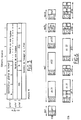
- la figure 4 est un diagramme des étapes essentielles du procédé de compression selon l'invention, relatif à deux messages respectivement à trois et un premiers paquets avec premier bit particulier M positionné ;
- la figure 5 est un diagramme des étapes essentielles du procédé de compression selon l'invention, relatif à quatre messages respectivement à un, trois, un et un premiers paquets avec premier et second bits particuliers M et D positionnés ; et
- la figure 6 est un diagramme des première et dernière étapes essentielles du procédé selon l'invention, relatif à des messages analogues à ceux montrés à la figure 5 dans lesquels un troisième bit particulier Q est positionné.
| Nb. max. de CV | Nb. total de dico | Nb. de D1 à 40 ko | Nb de D2 à 20 ko | Nb de D3 à 10 ko |
| 40 | 80 | 80 | 0 | 0 |
| 50 | 100 | 60 | 40 | 0 |
| 60 | 120 | 40 | 80 | 0 |
| 70 | 140 | 20 | 120 | 0 |
| 80 | 160 | 0 | 160 | 0 |
| 90 | 180 | 0 | 140 | 40 |
| 100 | 200 | 0 | 120 | 80 |
| 110 | 220 | 0 | 100 | 120 |
| 120 | 240 | 0 | 80 | 160 |
| 130 | 260 | 0 | 60 | 200 |
| 140 | 280 | 0 | 40 | 240 |
| 150 | 300 | 0 | 20 | 280 |
| 160 | 320 | 00 | 00 | 320 |
- la réception des seconds paquets PR1, PR2,
- la concaténation progressive des champs de données compressées DC11, DC12, DC2 des messages précédant les mots de fin de message FM1, FM2 dans les seconds paquets en des groupes de données compressées concaténées DC1, DC2,
- la suppression des mots de fin de message FM1, FM2 à la fin des groupes de données compressées concaténées ;
- la décompression progressive des groupes de données compressées concaténées DC1, DC2 des messages en des données décompressées (DT11, DT12, DT13), DT21 des messages selon un algorithme de décompression réciproque de l'algorithme de compression prédéterminé ; et
- la formation progressive de premiers paquets PT11, PT12, PT13, PT21 ayant des champs de données DT11, DT12, DT13, DT21 remplis progressivement par les données décompressées des messages au plus jusqu'à la longueur maximale LMAX en fonction des bits M, D et Q dans les seconds paquets, un premier paquet ne contenant des données décompressées que d'un message.
Claims (12)
- Procédé de compression de premiers paquets de données (PT11, PT12, PT13 ; PT21) émis par un terminal (TA) en des seconds paquets de données (PR1, PR2) transmis à travers un réseau de commutation de paquets (RP), les premiers et seconds paquets comprenant chacun un en-tête (ET11, ET12, ET13, ET21 ; ER1, ER2) ayant une longueur constante et un champ de données (DT11, DT12, DT13, DT21 ; DC11 ; DC12, FM1, DC2, FM2) ayant au plus une longueur maximale (LMAX), et un message (ME1 ; ME2) émis par le terminal (TA) étant constitué de K+1 premiers paquets successifs (PT11, PT12, PT13), K étant un entier égal ou supérieur à un et différent d'un message à l'autre,
caractérisé par les étapes suivantes :concaténation progressive (E1) des champs de données (DT11, DT12, DT13 ; DT21) des K+1 premiers paquets de chaque message (ME1 ; ME2) en des données concaténées,compression progressive (E2) des données concatenées de chaque message en des données compressées (DC1 ; DC2) selon un algorithme de compression prédéterminé,introduction d'un mot de fin de message (FM1 ; FM2) à la fin des données compressées (DC1 ; DC2) de chaque message, etformation progressive (E3) de seconds paquets (PR1, PR2) ayant des champs de données (DC11 ; DC12, FM1, DC2, FM2) remplis progressivement par les données compressées au plus jusqu'à la longueur maximale (LMAX). - Procédé conforme à la revendication 1, selon lequel l'en-tête de chacun des premiers et seconds paquets comprend un premier bit (M), et le premier bit dans les K premiers paquets (PT11, PT12) d'un message est à un premier état, et le premier bit dans le dernier premier paquet (PT3 ; PT4) du message est à un état opposé audit premier état, caractérisé en ce que le premier bit dans les en-têtes (ER1) de seconds paquets (PR1) dont le champ de données est à la longueur maximale (LMAX) et est terminé par des données compressées du message est audit premier état, et le premier bit dans l'en-tête (ER2) d'un dernier second paquet (PR2) contenant au moins le mot de fin de message (FM1) du message et terminé par un mot de fin de message (FM1, FM2) est à l'état opposé.
- Procédé conforme à la revendication 1, selon lequel l'en-tête de chacun des premiers et seconds paquets comprend un premier bit (M), et le premier bit dans les K premiers paquets d'un message est à un premier état, et le premier bit dans le dernier premier paquet (PT3 ; PT4) du message est à un état opposé audit premier état, caractérisé par la mise systématique du premier bit dans les en-têtes des seconds paquets (PR1, PR2) audit état opposé.
- Procédé conforme à l'une quelconque des revendications 1 à 3, comprenant un déclenchement d'une temporisation prédéterminée (TEM1) en réponse sensiblement à l'introduction de chaque premier mot de fin de message (FM1) dans un second paquet (PR2) en cours de formation, et la transmission dudit second paquet en cours de formation lorsque la temporisation a expiré même quand le second paquet en cours de formation n'a pas atteint la longueur maximale (LMAX).
- Procédé conforme à l'une quelconque des revendications 1 à 3, comprenant un déclenchement d'une temporisation prédéterminée (TEM2) sensiblement dès le début de la formation de chaque second paquet (PR1a), et l'introduction d'un mot de fin intermédiaire (FI) à la fin du champ de données dudit chaque second paquet (PR1a) lorsque la temporisation a expiré même quand ledit chaque second paquet n'a pas atteint la longueur maximale (LMAX).
- Procédé conforme à la revendication 4 ou 5, selon lequel la temporisation prédéterminée (TEM1 ; TEM2) est négociée entre ledit terminal (TA) et un autre terminal (TB) auquel les premiers paquets de données sont destinés, préalablement à l'émission des premiers paquets par ledit terminal (TA).
- Procédé conforme à l'une quelconque des revendications 1 à 6, caractérisé en ce que le mot de fin de message (FM) a la taille de mots-codes de données compressées qui sont définis par l'algorithme de compression et auxquels succède le mot de fin de message.
- Procédé conforme à l'une quelconque des revendications 1 à 7, caractérisé en ce que le mot de fin de message (FM) succédant à des données non compressées par l'algorithme de compression a la taille de deux caractères de données non compressées.
- Procédé conforme à l'une quelconque des revendications 1 à 8, selon lequel l'en-tête de chacun des premiers et seconds paquets comprend un second bit (D), le second bit dans un premier paquet (pt21) étant à un premier état lorsque ledit terminal (TA) souhaite recevoir un accusé de réception du premier paquet, caractérisé en ce que
les données (dt21) dans un premier paquet (pt21) contenant un second bit audit premier état ne sont pas concaténées et compressées avec les données (dt22, dt23) de tout premier paquet suivant (pt22, pt23),
les données compressées (dc21) résultant de la compression des données dans le premier paquet (pt21) contenant le second bit audit premier état sont immédiatement transmises dans au moins un second paquet (pr1, pr2), et
un second paquet (pr2) contenant au moins le mot de fin de message (FM) succédant auxdites données compressées résultant de la compression (dc21) a un second bit audit premier état. - Procédé conforme à l'une quelconque des revendications 1 à 9, selon lequel l'en-tête de chacun des premiers et seconds paquets comprend un troisième bit (Q), le troisième bit ne changeant d'état que du dernier premier paquet (pt23) d'un premier message (me2) au premier paquet (pt31) d'un second message (me3b) suivant le premier message, caractérisé en ce que le second paquet (pr4b) contenant le mot de fin de message (FM) succédant aux données compressées (dc22) résultant de la compression des données (dt21, dt22, dt23) du premier message (me2) ne contient pas d'autres données après ledit mot de fin de message (FM), et les troisièmes bits des seconds paquets (pr1, pr2, pr3, pr4b ; pr5b) contenant des données compressées résultant des premier et second messages (me2 ; me3b) ont respectivement les états des troisièmes bits contenus dans les premiers paquets (pt21, pt22, pt23 ; pt31) des premier et second messages.
- Procédé conforme à l'une quelconque des revendications 1 à 10, selon lequel des tailles de dictionnaires de mots-codes sont négociées par ledit terminal (TA) et un autre terminal (TB) auquel les premiers paquets sont destinés, préalablement à l'émission des premiers paquets par ledit terminal (TA), l'algorithme de compression faisant correspondre des chaínes de caractères représentatives de données dans chaque message respectivement à des mots-codes représentatifs de données compressées.
- Procédé de décompression de seconds paquets de données (PR1, PR2) transmis à travers un réseau de commutation de paquets (RP) en des premiers paquets de données (PT11, PT12, PT13; PT21) reçus par un terminal (TA), les premiers et seconds paquets comprenant chacun un en-tête (ET11, ET12, ET13, ET21; ER1, ER2) ayant une longueur constante et un champ de données (DT11, DT12, DT13, DT21; DC11; DC12, FM1, DC2, FM2) ayant au plus une longueur maximale (LMAX), et un message (ME1; ME2) reçu par le terminal (TA) étant constitué de K+1 premiers paquets successifs (PT11, PT12, PT13), K étant un entier égal ou supérieur à un et différent d'un message à l'autre, caractérisé par les étapes suivantes:concaténation progressive (E2) des champs de données compressées de message (DC11, DC12; DC2) précédant des mots de fin de message (FM1 ; FM2) dans les seconds paquets (PR1 ; PR2) en des groupes de données compressées concaténées;suppression des mots de fin de message (FM1 ; FM2) à la fin des groupes de données compressées concaténées;décompression progressive (E1) des groupes de données compressées concaténées en des données décompressées des messages (DT11, DT12, DT13 ; DT21) selon un algorithme de décompression réciproque d'un algorithme de compression prédéterminé; etformation progressive (E0) de premiers paquets (PT11, PT12, PT13; PT21) ayant des champs de données (DT11, DT12, DT13 ; DT21) remplis progressivement par les données décompressées de messages au plus jusqu'à la longueur maximale (LMAX).
Applications Claiming Priority (2)
| Application Number | Priority Date | Filing Date | Title |
|---|---|---|---|
| FR9410881A FR2724515B1 (fr) | 1994-09-09 | 1994-09-09 | Compression de paquets de donnees |
| FR9410881 | 1994-09-09 |
Publications (2)
| Publication Number | Publication Date |
|---|---|
| EP0701355A1 EP0701355A1 (fr) | 1996-03-13 |
| EP0701355B1 true EP0701355B1 (fr) | 2004-11-17 |
Family
ID=9466872
Family Applications (1)
| Application Number | Title | Priority Date | Filing Date |
|---|---|---|---|
| EP95401749A Expired - Lifetime EP0701355B1 (fr) | 1994-09-09 | 1995-07-24 | Compression de paquets de données |
Country Status (4)
| Country | Link |
|---|---|
| EP (1) | EP0701355B1 (fr) |
| AT (1) | ATE282919T1 (fr) |
| DE (1) | DE69533766T2 (fr) |
| FR (1) | FR2724515B1 (fr) |
Family Cites Families (1)
| Publication number | Priority date | Publication date | Assignee | Title |
|---|---|---|---|---|
| FR2687259B1 (fr) * | 1992-02-11 | 1994-05-06 | Ouest Standard Telematique Sa | Procede de compression de donnees pour systeme de transmission par unites de donnees de protocole, procede de decompression et dispositif correspondant. |
-
1994
- 1994-09-09 FR FR9410881A patent/FR2724515B1/fr not_active Expired - Fee Related
-
1995
- 1995-07-24 DE DE69533766T patent/DE69533766T2/de not_active Expired - Fee Related
- 1995-07-24 EP EP95401749A patent/EP0701355B1/fr not_active Expired - Lifetime
- 1995-07-24 AT AT95401749T patent/ATE282919T1/de not_active IP Right Cessation
Also Published As
| Publication number | Publication date |
|---|---|
| EP0701355A1 (fr) | 1996-03-13 |
| FR2724515A1 (fr) | 1996-03-15 |
| DE69533766D1 (de) | 2004-12-23 |
| ATE282919T1 (de) | 2004-12-15 |
| DE69533766T2 (de) | 2005-12-29 |
| FR2724515B1 (fr) | 1996-12-20 |
Similar Documents
| Publication | Publication Date | Title |
|---|---|---|
| EP0559593B1 (fr) | Procédé et dispositif de compression et décompression de données pour un système de transmission | |
| EP0589738B1 (fr) | Procédé et équipement de compression décompression de données pour terminal synchrone | |
| FR2705851A1 (fr) | Modem à grande vitesse procédé et dispositif pour effectuer une compression de données synchrones. | |
| EP0519796B1 (fr) | Dispositif multiplexage à insertion de paquets numériques et avec différents niveaux de priorité dans un canal de transmission | |
| US6985965B2 (en) | Static information knowledge used with binary compression methods | |
| CA1264875A (fr) | Procede et dispositif de transmission de donnees numeriques par messages organises en trames | |
| US6625142B1 (en) | Voice-mail application on the router with no secondary storage available | |
| EP1058477B1 (fr) | Dispositif d'interface entre un équipement ATM et un canal de transmission comportant une liaison radio synchrone | |
| CA2428788C (fr) | Connaissance d'informations statiques utilisee avec des procedes de compression binaire | |
| EP1648133B2 (fr) | Procédé d'encapsulation d'un flot de données | |
| EP2406929A2 (fr) | Procede et dispositif de transmission robuste de flux de paquets de donnees a en-tetes compresses sans augmentation de debit | |
| EP0723355A1 (fr) | Système de transmission à compression de données | |
| WO1997012467A1 (fr) | Procede et systeme pour generer et transmettre rapidement, a l'aide de frequences vocales, une sequence de caracteres | |
| EP0701355B1 (fr) | Compression de paquets de données | |
| FR2804813A1 (fr) | Procede de codage facilitant la restitution sonore des signaux de parole numerises transmis a un terminal d'abonne lors d'une communication telephonique par transmission de paquets et equipement mettant en oeuvre ce procede | |
| EP1647125A1 (fr) | Description de contenu de paquets dans un reseau de communication par paquets | |
| CN119766908B (zh) | 基于imap4协议的tcp压缩流解析方法及系统 | |
| EP1055312B1 (fr) | Procede de transmission de donnees entre deux reseaux en mode paquet | |
| EP0714172A2 (fr) | Compression de données | |
| EP1484931B1 (fr) | Procédé d'émission et de réception de SMS et terminal de télécommunication adapté | |
| EP1401165A1 (fr) | Procédé et dispositif pour la transmission de données via un réseau maillé | |
| WO2011064287A1 (fr) | Dispositif et procédé d'agrégation de données reçues sur une pluralité de liens physiques | |
| WO2026017825A1 (fr) | Gestion de la transmission et de la reception d'un paquet de donnees compresse | |
| FR2823389A1 (fr) | Procede et dispositif de compression et de decompression de codes d'une application ecrite en langage evolue, notamment en telephonie mobile | |
| FR2945692A1 (fr) | Procede d'acces au reseau internet et dispositif associe. |
Legal Events
| Date | Code | Title | Description |
|---|---|---|---|
| PUAI | Public reference made under article 153(3) epc to a published international application that has entered the european phase |
Free format text: ORIGINAL CODE: 0009012 |
|
| 17P | Request for examination filed |
Effective date: 19950728 |
|
| AK | Designated contracting states |
Kind code of ref document: A1 Designated state(s): AT BE CH DE DK ES GB GR IT LI LU NL PT SE |
|
| 17Q | First examination report despatched |
Effective date: 20000320 |
|
| GRAP | Despatch of communication of intention to grant a patent |
Free format text: ORIGINAL CODE: EPIDOSNIGR1 |
|
| GRAS | Grant fee paid |
Free format text: ORIGINAL CODE: EPIDOSNIGR3 |
|
| GRAA | (expected) grant |
Free format text: ORIGINAL CODE: 0009210 |
|
| AK | Designated contracting states |
Kind code of ref document: B1 Designated state(s): AT BE CH DE DK ES GB GR IT LI LU NL PT SE |
|
| PG25 | Lapsed in a contracting state [announced via postgrant information from national office to epo] |
Ref country code: NL Free format text: LAPSE BECAUSE OF FAILURE TO SUBMIT A TRANSLATION OF THE DESCRIPTION OR TO PAY THE FEE WITHIN THE PRESCRIBED TIME-LIMIT Effective date: 20041117 Ref country code: IT Free format text: LAPSE BECAUSE OF FAILURE TO SUBMIT A TRANSLATION OF THE DESCRIPTION OR TO PAY THE FEE WITHIN THE PRE;WARNING: LAPSES OF ITALIAN PATENTS WITH EFFECTIVE DATE BEFORE 2007 MAY HAVE OCCURRED AT ANY TIME BEFORE 2007. THE CORRECT EFFECTIVE DATE MAY BE DIFFERENT FROM THE ONE RECORDED.SCRIBED TIME-LIMIT Effective date: 20041117 Ref country code: AT Free format text: LAPSE BECAUSE OF FAILURE TO SUBMIT A TRANSLATION OF THE DESCRIPTION OR TO PAY THE FEE WITHIN THE PRESCRIBED TIME-LIMIT Effective date: 20041117 |
|
| REG | Reference to a national code |
Ref country code: GB Ref legal event code: FG4D Free format text: NOT ENGLISH |
|
| REG | Reference to a national code |
Ref country code: CH Ref legal event code: EP |
|
| REF | Corresponds to: |
Ref document number: 69533766 Country of ref document: DE Date of ref document: 20041223 Kind code of ref document: P |
|
| PG25 | Lapsed in a contracting state [announced via postgrant information from national office to epo] |
Ref country code: SE Free format text: LAPSE BECAUSE OF FAILURE TO SUBMIT A TRANSLATION OF THE DESCRIPTION OR TO PAY THE FEE WITHIN THE PRESCRIBED TIME-LIMIT Effective date: 20050217 Ref country code: GR Free format text: LAPSE BECAUSE OF FAILURE TO SUBMIT A TRANSLATION OF THE DESCRIPTION OR TO PAY THE FEE WITHIN THE PRESCRIBED TIME-LIMIT Effective date: 20050217 Ref country code: DK Free format text: LAPSE BECAUSE OF FAILURE TO SUBMIT A TRANSLATION OF THE DESCRIPTION OR TO PAY THE FEE WITHIN THE PRESCRIBED TIME-LIMIT Effective date: 20050217 |
|
| PG25 | Lapsed in a contracting state [announced via postgrant information from national office to epo] |
Ref country code: ES Free format text: LAPSE BECAUSE OF FAILURE TO SUBMIT A TRANSLATION OF THE DESCRIPTION OR TO PAY THE FEE WITHIN THE PRESCRIBED TIME-LIMIT Effective date: 20050228 |
|
| GBT | Gb: translation of ep patent filed (gb section 77(6)(a)/1977) |
Effective date: 20050310 |
|
| RAP2 | Party data changed (patent owner data changed or rights of a patent transferred) |
Owner name: SAGEM SA |
|
| NLV1 | Nl: lapsed or annulled due to failure to fulfill the requirements of art. 29p and 29m of the patents act | ||
| REG | Reference to a national code |
Ref country code: GB Ref legal event code: 732E |
|
| PG25 | Lapsed in a contracting state [announced via postgrant information from national office to epo] |
Ref country code: LU Free format text: LAPSE BECAUSE OF NON-PAYMENT OF DUE FEES Effective date: 20050724 Ref country code: GB Free format text: LAPSE BECAUSE OF NON-PAYMENT OF DUE FEES Effective date: 20050724 |
|
| PG25 | Lapsed in a contracting state [announced via postgrant information from national office to epo] |
Ref country code: LI Free format text: LAPSE BECAUSE OF NON-PAYMENT OF DUE FEES Effective date: 20050731 Ref country code: CH Free format text: LAPSE BECAUSE OF NON-PAYMENT OF DUE FEES Effective date: 20050731 Ref country code: BE Free format text: LAPSE BECAUSE OF NON-PAYMENT OF DUE FEES Effective date: 20050731 |
|
| PLBE | No opposition filed within time limit |
Free format text: ORIGINAL CODE: 0009261 |
|
| STAA | Information on the status of an ep patent application or granted ep patent |
Free format text: STATUS: NO OPPOSITION FILED WITHIN TIME LIMIT |
|
| 26N | No opposition filed |
Effective date: 20050818 |
|
| PG25 | Lapsed in a contracting state [announced via postgrant information from national office to epo] |
Ref country code: DE Free format text: LAPSE BECAUSE OF NON-PAYMENT OF DUE FEES Effective date: 20060201 |
|
| REG | Reference to a national code |
Ref country code: CH Ref legal event code: PL |
|
| GBPC | Gb: european patent ceased through non-payment of renewal fee |
Effective date: 20050724 |
|
| BERE | Be: lapsed |
Owner name: S.A. DE TELECOMMUNICATIONS *SAT Effective date: 20050731 |
|
| PG25 | Lapsed in a contracting state [announced via postgrant information from national office to epo] |
Ref country code: PT Free format text: LAPSE BECAUSE OF NON-PAYMENT OF DUE FEES Effective date: 20050417 |