EP0701376A2 - Verfahren und Vorrichtung zur Übertragung eines Videobitstromes über Paketnetze - Google Patents
Verfahren und Vorrichtung zur Übertragung eines Videobitstromes über Paketnetze Download PDFInfo
- Publication number
- EP0701376A2 EP0701376A2 EP95306064A EP95306064A EP0701376A2 EP 0701376 A2 EP0701376 A2 EP 0701376A2 EP 95306064 A EP95306064 A EP 95306064A EP 95306064 A EP95306064 A EP 95306064A EP 0701376 A2 EP0701376 A2 EP 0701376A2
- Authority
- EP
- European Patent Office
- Prior art keywords
- high priority
- segments
- video bitstream
- partition
- low priority
- Prior art date
- Legal status (The legal status is an assumption and is not a legal conclusion. Google has not performed a legal analysis and makes no representation as to the accuracy of the status listed.)
- Withdrawn
Links
Images




Classifications
-
- H—ELECTRICITY
- H04—ELECTRIC COMMUNICATION TECHNIQUE
- H04N—PICTORIAL COMMUNICATION, e.g. TELEVISION
- H04N21/00—Selective content distribution, e.g. interactive television or video on demand [VOD]
- H04N21/40—Client devices specifically adapted for the reception of or interaction with content, e.g. set-top-box [STB]; Operations thereof
- H04N21/43—Processing of content or additional data, e.g. demultiplexing additional data from a digital video stream; Elementary client operations, e.g. monitoring of home network or synchronising decoder's clock; Client middleware
- H04N21/434—Disassembling of a multiplex stream, e.g. demultiplexing audio and video streams, extraction of additional data from a video stream; Remultiplexing of multiplex streams; Extraction or processing of SI; Disassembling of packetised elementary stream
-
- H—ELECTRICITY
- H04—ELECTRIC COMMUNICATION TECHNIQUE
- H04L—TRANSMISSION OF DIGITAL INFORMATION, e.g. TELEGRAPHIC COMMUNICATION
- H04L12/00—Data switching networks
- H04L12/64—Hybrid switching systems
- H04L12/6418—Hybrid transport
-
- H—ELECTRICITY
- H04—ELECTRIC COMMUNICATION TECHNIQUE
- H04N—PICTORIAL COMMUNICATION, e.g. TELEVISION
- H04N19/00—Methods or arrangements for coding, decoding, compressing or decompressing digital video signals
- H04N19/30—Methods or arrangements for coding, decoding, compressing or decompressing digital video signals using hierarchical techniques, e.g. scalability
- H04N19/37—Methods or arrangements for coding, decoding, compressing or decompressing digital video signals using hierarchical techniques, e.g. scalability with arrangements for assigning different transmission priorities to video input data or to video coded data
-
- H—ELECTRICITY
- H04—ELECTRIC COMMUNICATION TECHNIQUE
- H04N—PICTORIAL COMMUNICATION, e.g. TELEVISION
- H04N19/00—Methods or arrangements for coding, decoding, compressing or decompressing digital video signals
- H04N19/60—Methods or arrangements for coding, decoding, compressing or decompressing digital video signals using transform coding
- H04N19/61—Methods or arrangements for coding, decoding, compressing or decompressing digital video signals using transform coding in combination with predictive coding
-
- H—ELECTRICITY
- H04—ELECTRIC COMMUNICATION TECHNIQUE
- H04N—PICTORIAL COMMUNICATION, e.g. TELEVISION
- H04N21/00—Selective content distribution, e.g. interactive television or video on demand [VOD]
- H04N21/20—Servers specifically adapted for the distribution of content, e.g. VOD servers; Operations thereof
- H04N21/23—Processing of content or additional data; Elementary server operations; Server middleware
- H04N21/236—Assembling of a multiplex stream, e.g. transport stream, by combining a video stream with other content or additional data, e.g. inserting a URL [Uniform Resource Locator] into a video stream, multiplexing software data into a video stream; Remultiplexing of multiplex streams; Insertion of stuffing bits into the multiplex stream, e.g. to obtain a constant bit-rate; Assembling of a packetised elementary stream
-
- H—ELECTRICITY
- H04—ELECTRIC COMMUNICATION TECHNIQUE
- H04N—PICTORIAL COMMUNICATION, e.g. TELEVISION
- H04N7/00—Television systems
- H04N7/16—Analogue secrecy systems; Analogue subscription systems
- H04N7/173—Analogue secrecy systems; Analogue subscription systems with two-way working, e.g. subscriber sending a programme selection signal
- H04N7/17309—Transmission or handling of upstream communications
- H04N7/17318—Direct or substantially direct transmission and handling of requests
-
- H—ELECTRICITY
- H04—ELECTRIC COMMUNICATION TECHNIQUE
- H04L—TRANSMISSION OF DIGITAL INFORMATION, e.g. TELEGRAPHIC COMMUNICATION
- H04L12/00—Data switching networks
- H04L12/64—Hybrid switching systems
- H04L12/6418—Hybrid transport
- H04L2012/6445—Admission control
- H04L2012/6448—Medium Access Control [MAC]
- H04L2012/6454—Random, e.g. Ethernet
-
- H—ELECTRICITY
- H04—ELECTRIC COMMUNICATION TECHNIQUE
- H04L—TRANSMISSION OF DIGITAL INFORMATION, e.g. TELEGRAPHIC COMMUNICATION
- H04L12/00—Data switching networks
- H04L12/64—Hybrid switching systems
- H04L12/6418—Hybrid transport
- H04L2012/6464—Priority
-
- H—ELECTRICITY
- H04—ELECTRIC COMMUNICATION TECHNIQUE
- H04L—TRANSMISSION OF DIGITAL INFORMATION, e.g. TELEGRAPHIC COMMUNICATION
- H04L12/00—Data switching networks
- H04L12/64—Hybrid switching systems
- H04L12/6418—Hybrid transport
- H04L2012/6483—Video, e.g. MPEG
Definitions
- This invention relates to video transmission and, more particularly, to a technique for transmitting compressed previously stored video over lossy packet networks in real time so as to reduce the effects of packet losses on the quality of the received video.
- the present invention discloses apparatus and method of transmitting a video bitstream from a transmitter over a packet network to a receiver, the video bitstream including a plurality of high priority segments (high priority partition) and low priority segments (low priority partition).
- the high priority segments contain vital control information such as the codes that define the start of pictures and picture header information.
- the low priority segments contain the rest of the bitstream.
- the high priority and low priority segments may be determined in accordance with the well-known MPEG-2 draft standard (see Generic Coding of Moving Pictures and Associated Audio, Recommendation H.262, ISO/IEC 13818-2, March 1994).
- high priority information representative of the high priority segments
- the low priority partition is sent in real time over the network using a non-guaranteed delivery mechanism.
- the high priority information is received and used to generate the high priority segments.
- the low priority partition is received at the receiver location, its segments are interleaved with each generated high priority segment in real time to recreate the video bitstream.
- the high priority information may be sent as a high priority partition, sent as a high priority format used by the receiver to generate a high priority partition, or sent as a high priority identifier used to identify a high priority partition previously stored at the receiver.
- Analog video signals associated with each video program are received in the standard NTSC, PAL, etc., formats, digitized in digitizer 105, compressed in compressor 110 and the resulting compressed video bitstream is stored in a disc 115.
- the well-known format of a video bitstream of a video segment is shown by 120.
- the illustrative video bitstream data for a video segment includes a plurality of high priority (e.g., HP1) and low priority (e.g., LP1) segments.
- partition boundaries In an encoded bitstream, the partition boundaries (e.g., that between HP1 and LP1) cannot be determined without some processing.
- This "data partitioning" is described in the above-identified MPEG-2 standard as a technique that splits a video bitstream into two layers called partitions.
- a priority breakpoint indicates which syntax elements are placed in partition 0, which is the base partition (also called high priority partition).
- the remainder of the bitstream is placed in partition 1 (which is also called low priority partition).
- priority_breakpoint is given in Table 7-28 on page 113 of the MPEG-2 standard, which is reproduced herein as FIG. 5.
- the video bitstream 120 is obtained from storage 115 and processed by a priority transmitter unit (not shown in FIG. 1) so that the high priority partition (e.g., segments HP1 - HPn) is sent over a high priority channel of a transmission facility and the low priority partition (e.g., segments LP1 - LPn) is sent over a low priority channel of the facility.
- the high priority channel is typically one having a high probability of delivery, while the low priority channel is one having a substantially lower probability of delivery.
- facilities which connect to a packet network may only have channels which operate at one error rate. In such an arrangement, the prior art techniques may not be as useful.
- server processor 130 determines if the high priority information sent to the clients should be sent using the high priority segments themselves (steps 132, 133), sent using a high priority format (steps 132, 134, 135), or sent using a high priority identifier (steps 132, 134, 136) which identifies a previously stored high priority partition at the client or receiver location.
- server processor 130 of the stored bitstream 115 when the high priority information is to be sent as the high priority segments themselves (step 133), server processor 130 of the stored bitstream 115 generates the high priority partition (311 of FIG. 3) and the low priority partition (312 of FIG. 3). In such a case, the server sends the high priority partition followed by the low priority partition segments (step 137) to the client location.
- the server may also send the high priority information in the form of a high priority format (step 135, see FIG. 6) or a high priority identifier (step 136) followed by the low priority partition (step 137) to the client location.
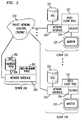
- Such a network includes a server location 200 which connects via packet network 210 to a plurality of clients 220-230.
- Server location 200 includes a video-on-demand server/processor 201 which controls the operation of the hard disc 202 and network interface 203.
- the hard disc 202 is used to store the compressed video bitstreams utilizing one or more of the formats shown in FIG. 3. It should be noted that all of the compressed video data stream need not be stored locally on disc 202, but may be remotely stored, as part of a remote file server, and accessible via facility 204 (e.g., a local area network).
- the network interface 203 is utilized to transmit and receive using the protocols required by the packet network 210.
- the processor 201 performs the functions illustrated at the server portion of the flowchart of FIG. 4.
- the packet network 210 may be an Asynchronous Transfer Mode (ATM) network, an FDDI, an Ethernet or other similar packet networks.
- ATM Asynchronous Transfer Mode
- a client location e.g., 220, includes a network interface 223 for converting communication protocols received from and transmitted over a facility connected to packet network 210.
- a disc 222 is used to store the high priority portion of the video bitstream received by network interface 223.
- the video client processor 221 processes the received video bitstream in accordance with the client functions illustrated in the flowchart of FIG. 4.
- Processor 221 interleaves the high priority data received from disc 222 with the low priority data received by network interface 223 and then sends the interleaved data to decoder 224.
- the output of decoder 224 is the requested video segment which is then displayed on the client monitor 225.
- client 230 includes processor 231, disc 232, network interface 233, decoder 234 and monitor 235.
- Shown by 310 is the raw compressed data stream for video segments 1 - n, where the high priority and low priority portions are HP1 - HPn and LP1 - LPn, respectively.
- the separation between the high priority (e.g., HP1) and low priority (e.g., LP1) data portion can be defined based on priority breakpoints.
- These priority breakpoints can have a variety of values as shown in FIG. 5 which illustrates Table 7-28 of the previously referenced MPEG-2 standard.
- the network server can be arranged to handle any of the breakpoint values shown in Table 7-28 (FIG. 5).
- the network server 200 When data is stored as a raw compressed data stream, the network server 200 must first identify the video segment requested by a client and then process the data stream associated with that requested segment using the particular breakpoint value to identify the high priority data segments. It should be noted that the division between the high priority and low priority partitions varies with the particular video segment and the type of priority breakpoint (see Table 7-28 of FIG. 5) utilized for partitioning. Illustratively, in one embodiment the high priority data portion HP1 includes those data items of priority breakpoint 1 shown in Table 7-28 of FIG. 5.
- any of the priority breakpoints of FIG. 5 can be sent as part of the high priority partition (133 of FIG. 1). However, only priority breakpoints 0-1 would be used if a high priority format (135 of FIG. 1) or high priority identifier (136 of FIG. 1) is used as the high priority information sent to the client.
- HP1 would include sequence start, GOP and picture header 1.
- the picture header also includes a time or frame identifier.
- the sequence start header includes data defining the vertical and horizontal resolution of the video segment.
- a video segment includes multiple pictures (or frames).
- the picture (or frame) rate may be from 24 per second for motion pictures to 30 per second for broadcast television.
- Each picture (or frame) may include a plurality of slices.
- the GOP data is optional, and includes the picture coding utilized for the segment.
- the picture header 1 includes the header information for all slices of picture 1 (or frame 1).
- the low priority data portion LP1 includes the rest of the bitstream for picture 1. Additionally, in accordance with the present invention, the low priority data portion LP1 may include time and frame identifiers corresponding to that of HP1.
- each of the high priority data portions HP2 through HPn include at least the headers for the slices of the associated picture.
- the length of each video segment may be different and have a different number of high priority and low priority data portions within each segment.
- the size of the low priority data portions LP1 - LPn may be different lengths due to picture content.
- network server 200 After identifying these high priority data portions HP1 - HPn, network server 200 then forms the high priority and low priority data segments shown, respectively, by 311 and 312. Shown by 320, the data for video segment 1 has been processed into a high priority data partition 311 and a low priority data partition 312 and stored on disc 202. This processing of the data may be done by server 200 or the data may be received in processed form by server 200 and downloaded to disc 202. Similarly, the data associated with video segments 2 through n have also been stored after having been partitioned into high priority and low priority data portions. When the data or video segments 1 - n are stored using the format 320, then the network server 200 need only transmit the high and low priority partitions of the requested segment to the client without further processing. Thereafter, the server 200 outputs the requested video segment to the client in the format shown by 320.
- Shown in 330 is another format for storing video segment bitstreams.
- This format uses the raw compressed data streams of 310 together with a table 338 which preferably identifies the disc location and time stamp or frame identification for each high priority data portion of each video segment. Alternatively, the length of the high and low priority data portions or perhaps a time stamp or frame identification for each high priority data portion may also be stored in the table 338.
- server 200 can quickly form the high priority data segment 311 and low priority segment 312 using the table entries to quickly locate the high priority data portions HP1 - HPn stored on disc 202. Consequently, server 200 can process a requested video segment by a client in real time and output a data stream of the requested video segment to the client in the format shown by 310.
- server 200 can send high priority information using high priority format 340 or high priority identifier 341.
- This high priority information is used by the receiver to generate a high priority partition - - that is, in our example shown in Table 338, either an international standard, if one exists, or a format previously agreed-to by the client and server 200.
- Another implementation may use a high priority identifier to identify which of several previously stored high priority partitions available at the client receiver is to be interleaved with the low priority partition to reconstruct the original video bitstream.
- the high priority information sent to the client would include either the appropriate high priority format or identifier information.
- the format includes an M and N number and MPEG2 picture level information.
- the MPEG2 picture level information includes an I and, optionally, a P and/or B frame.
- the M specifies the number of B frames between P or I frames + 1 and N specifies the number of B or P frames between I frames + 1, where I is the intra-coded frame, B is the bidirectional coded frame, and P is the predictive coded frame.
- Shown in 602 are several examples of different M and N values for high priority formats 1, 2 and 3.
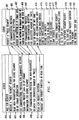
- server 200 is in a wait state, waiting for a client request.
- a client 220 requests a particular video segment.
- network server 200 receives a client's video segment request.
- server 200 reads the high priority data, reads the high priority format or reads the high priority identifier for the entire requested segment. Thus, for example, if the data for a video segment was stored in the format 320, then server 200 need only read out the high priority data segment 311 from disc 202.
- server 200 must process that data to create the high priority data segment 311 from the individual high priority data items HP1 through HPn of 310 of FIG. 3. Even though a video segment is received in its raw compressed data form, it may still be sent to the client in real time. For example, the desired video segment may be broken into multiple sub-segments, each with its own high priority 311 and low priority 312 partitions. Server 200 may then provide an elastic first-in-first-out buffer (p/o processor 201) to store at least one sub-segment.
- p/o processor 201 an elastic first-in-first-out buffer
- the transmission of the first sub-segment is delayed by at least one sub-segment's time period, so that server 200 can set up the HP partition 311 and LP partition 312 for the first sub-segment. Thereafter, while the first sub-segment is being transmitted to the client, the next sub-segment is being received and processed by server 200. In this manner, the HP and LP partitions 311 and 312 can be formed and transmitted to the client in real time from the received raw compressed data stream.
- server 200 would utilize table 338 to identify in real time the high priority data partition in the data stream of the requested video segment.
- server 200 prepares the high priority data for the requested video segment for transmission to the requesting client.
- the server 200 can send information in the form of the high priority data itself, high priority format information, or a high priority identifier, depending on the implementation of the client/server network.
- server 200 selects a packet network 210 communication protocol which ensures guaranteed delivery of the high priority information over the packet network 210 to the requesting client.
- the communication protocol for guaranteed delivery would, of course, be one that is specified by packet network 210.
- Such communication protocols for guaranteed delivery are well known in the art. For example, see “Reliable Stream Transport Service (TCP),” Chapter 12 of the book by D. E. Comer entitled Internetworking with TCP/IP , Volume 1: Principles, Protocols and Architecture, Second Edition, Prentice Hall, 1991.
- TCP Reliable Stream Transport Service
- Such a communication protocol for guaranteed delivery involves the sending of data packets with error detection and, possibly, error correction capability to the client. The client would then, typically, after receiving the packet send an acknowledgment message back to the server 200.
- This acknowledgment message would indicate to server 200 whether client 220 has received the packet with errors or error-free. This acknowledgment message can also be used to alert the server 200 when an out-of-sequence data packet has been received by client 220. If no acknowledgment message is received by server 200 within a predetermined time, server 200 would re-send the data packet.
- step 405 client 220 sets itself to receive using the communication protocol for guaranteed reception and signals the server 200 that it is ready to receive data packets.
- server 200 sends all of the high priority data to client 220.
- step 407 for our example, the client receives the high priority data.
- the previously described communication protocol for guaranteed delivery ensures that the client 220 has received the high priority data error-free from the server 200.
- step 408 client 220 stores the high priority data. Note, because the HP partition (HP1 - HPn) generally represents approximately 0.2 percent of all of the data for a selected video segment, it can easily be stored on the disc (e.g., 222) at the client location.
- the LP partition (LP1 - LPn) for a typical movie video segment would be too large (typically several gigabytes) to be practical for storage at the client location. Because of the low-cost wideband transmission network 210 available, the LP partition can be readily retransmitted any time that the client wants it.
- the high priority information was in the form of a high priority format or identifier, then in steps 407 and 408 they would be received and stored. Alternatively, in step 408 the high priority format may be utilized to generate the high priority partition information which would then be stored.
- the server 200 sets the communication protocol for non-guaranteed delivery of the low priority data of the requested video segment to the client 220.
- the system can limit the number of times that the low priority data of the requested video segment can be sent to the client 220. This ability to multiply send the low priority partition 312 to the client 220 enables the client to have a capability to pause or rewind during the reception of a video segment without having to again receive the high priority partition 311.
- step 410 client 220 sets a communication protocol for the non-guaranteed reception of the low priority partition.
- the client 220 knows to set the non-guaranteed protocol when it receives an end-of-high-priority flag as part of the high priority data reception during step 407.
- server 200 reads from disc 202 the low priority data partition 312, when format 320 is utilized (or creates the low priority data partition 312 when format 310 or 330 is utilized, as previously described).
- server 200 transmits the low priority data partition 312 in real time to client 220.
- the packets containing the LP data may include frame numbers, time stamps, sequence numbers enabling resynchronization to the associated HP data at the client decoder 224 in the case of LP packet loss.
- step 413 in our example, client 220 reads the high priority partition from memory and, in step 414, sends it to video decoder 224.
- step 414 sends it to video decoder 224.
- a high priority identifier was stored in step 408, it would be used to access the high priority partition at the client location. If, however, the high priority format information was stored in step 408, then in step 413 it could be used to generate the high priority partition.
- step 415 client 220 receives the low priority data segment in real time from server 200 and sends it in step 416 to video decoder 224.
- the steps 414 and 416 are coordinated by processor 221 so that the stored high priority partition is interleaved in real time with the received low priority partition sent to video decoder 224.
- the interleaved data would have the original raw compressed data stream format shown by 310.
- Video decoder 224 then converts the interleaved data to the display format needed to enable monitor 225 to display the requested video segment.
- step 417 client 220 can request to replay the video segment. If a control command request is made, in step 418, control returns to step 411.
- a control command request may be the well-known VCR-type request including stop, pause, fast forward, fast backward, replay, etc.
- the stop command instructs the server 200 to not send any additional low priority data.
- the pause command performs the stop command function but additionally causes decoder 224 to hold the last frame.
- the fast forward command causes server 200 to send only MPEG-2 I frames of the low priority partition.
- the fast backward command causes the server 200 to send the I frames in reverse order.
- the replay command causes server 200 to re-send only the low priority partition.
- step 419 control returns to step 402. If no control command request is made, step 420, then processor 221 clears the previously stored high priority data from memory. In step 421 the procedure ends and control returns to the standby state, step 400.
Landscapes
- Engineering & Computer Science (AREA)
- Signal Processing (AREA)
- Multimedia (AREA)
- Computer Networks & Wireless Communication (AREA)
- Data Exchanges In Wide-Area Networks (AREA)
- Two-Way Televisions, Distribution Of Moving Picture Or The Like (AREA)
- Compression Or Coding Systems Of Tv Signals (AREA)
- Television Systems (AREA)
Applications Claiming Priority (4)
| Application Number | Priority Date | Filing Date | Title |
|---|---|---|---|
| US30433994A | 1994-09-12 | 1994-09-12 | |
| US304339 | 1994-11-18 | ||
| US08/342,404 US5481312A (en) | 1994-09-12 | 1994-11-18 | Method of and apparatus for the transmission of high and low priority segments of a video bitstream over packet networks |
| US342404 | 2001-12-27 |
Publications (2)
| Publication Number | Publication Date |
|---|---|
| EP0701376A2 true EP0701376A2 (de) | 1996-03-13 |
| EP0701376A3 EP0701376A3 (de) | 2000-09-20 |
Family
ID=26973967
Family Applications (1)
| Application Number | Title | Priority Date | Filing Date |
|---|---|---|---|
| EP95306064A Withdrawn EP0701376A3 (de) | 1994-09-12 | 1995-08-30 | Verfahren und Vorrichtung zur Übertragung eines Videobitstromes über Paketnetze |
Country Status (3)
| Country | Link |
|---|---|
| US (1) | US5481312A (de) |
| EP (1) | EP0701376A3 (de) |
| JP (2) | JP3739836B2 (de) |
Cited By (7)
| Publication number | Priority date | Publication date | Assignee | Title |
|---|---|---|---|---|
| EP0713338A2 (de) * | 1994-11-18 | 1996-05-22 | AT&T Corp. | Verfahren und Vorrichtung zur Videobitstromübertragung in Paketnetzen |
| GB2377294A (en) * | 2001-03-28 | 2003-01-08 | Hewlett Packard Co | Transmitting information with content appropriate to receiving device and user |
| SG97830A1 (en) * | 2000-01-07 | 2003-08-20 | Matsushita Electric Industrial Co Ltd | Time based multimedia objects streaming apparatus and method |
| US7224841B2 (en) | 2001-10-29 | 2007-05-29 | Parthusceva Ltd. | Method and apparatus for accelerating variable length coding (VLC) decoding in the process of inverse discrete cosine transformation (IDCT) |
| US7493644B1 (en) | 1999-12-28 | 2009-02-17 | Nokia Corporation | Method, apparatus, and system for video fast forward functionality in a mobile phone |
| WO2010054551A1 (zh) * | 2008-11-17 | 2010-05-20 | 华为技术有限公司 | 视频流传输的方法、装置和系统 |
| CN101150595B (zh) * | 2007-11-13 | 2011-07-20 | 腾讯科技(深圳)有限公司 | 一种实时文件传输方法、系统及装置 |
Families Citing this family (157)
| Publication number | Priority date | Publication date | Assignee | Title |
|---|---|---|---|---|
| US6279038B1 (en) * | 1995-04-13 | 2001-08-21 | Global Crossing, North America | Client interface |
| US6643362B2 (en) * | 1998-11-19 | 2003-11-04 | Global Crossing, Ltd. | Call-processing system and method |
| CA2135681C (en) * | 1993-12-30 | 2000-01-18 | Srinivas V. Makam | System and method for directly accessing long-term memory devices |
| WO1996013124A1 (en) * | 1994-10-24 | 1996-05-02 | Intel Corporation | Video indexing protocol |
| US5617541A (en) * | 1994-12-21 | 1997-04-01 | International Computer Science Institute | System for packetizing data encoded corresponding to priority levels where reconstructed data corresponds to fractionalized priority level and received fractionalized packets |
| US6209132B1 (en) * | 1995-06-15 | 2001-03-27 | Intel Corporation | Host apparatus for simulating two way connectivity for one way data streams |
| US5694163A (en) * | 1995-09-28 | 1997-12-02 | Intel Corporation | Method and apparatus for viewing of on-line information service chat data incorporated in a broadcast television program |
| JP2000504906A (ja) * | 1996-02-14 | 2000-04-18 | オリブル コーポレイション リミティド | マルチメディアデータのプログレッシブ非同期伝送方法及びシステム |
| US5918012A (en) * | 1996-03-29 | 1999-06-29 | British Telecommunications Public Limited Company | Hyperlinking time-based data files |
| US5867230A (en) * | 1996-09-06 | 1999-02-02 | Motorola Inc. | System, device, and method for streaming a multimedia file encoded at a variable bitrate |
| US6037991A (en) * | 1996-11-26 | 2000-03-14 | Motorola, Inc. | Method and apparatus for communicating video information in a communication system |
| US5739862A (en) * | 1996-12-23 | 1998-04-14 | Tektronix, Inc. | Reverse playback of MPEG video |
| US6067303A (en) * | 1997-02-25 | 2000-05-23 | International Business Machines Corporation | Method and apparatus for detecting and controlling data stream splicing in ATM networks |
| GB9705719D0 (en) * | 1997-03-20 | 1997-05-07 | Two Way Tv Ltd | Method and apparatus for transmitting data |
| US6006269A (en) * | 1998-03-11 | 1999-12-21 | Hewlett-Packard Company | Admission control system with messages admitted or deferred for re-submission at a later time on a priority basis |
| US6055564A (en) * | 1998-03-11 | 2000-04-25 | Hewlett Packard Company | Admission control where priority indicator is used to discriminate between messages |
| US6775652B1 (en) | 1998-06-30 | 2004-08-10 | At&T Corp. | Speech recognition over lossy transmission systems |
| US6317462B1 (en) * | 1998-10-22 | 2001-11-13 | Lucent Technologies Inc. | Method and apparatus for transmitting MPEG video over the internet |
| US6490705B1 (en) * | 1998-10-22 | 2002-12-03 | Lucent Technologies Inc. | Method and apparatus for receiving MPEG video over the internet |
| US7355608B1 (en) * | 1998-10-28 | 2008-04-08 | International Business Machines Corporation | Method for priority transmission and display of key areas of image data |
| US6859799B1 (en) * | 1998-11-30 | 2005-02-22 | Gemstar Development Corporation | Search engine for video and graphics |
| US6438556B1 (en) * | 1998-12-11 | 2002-08-20 | International Business Machines Corporation | Method and system for compressing data which allows access to data without full uncompression |
| JP3556495B2 (ja) * | 1998-12-15 | 2004-08-18 | 株式会社東芝 | パケットスイッチ及びパケット交換方法 |
| JP2001157183A (ja) * | 1999-11-25 | 2001-06-08 | Nec Corp | テレビ電話システム |
| US7823182B1 (en) * | 1999-12-22 | 2010-10-26 | AT & T Intellectual Property II | Method and system for adaptive transmission of smoothed data over wireless channels |
| US20040073617A1 (en) * | 2000-06-19 | 2004-04-15 | Milliken Walter Clark | Hash-based systems and methods for detecting and preventing transmission of unwanted e-mail |
| KR100946318B1 (ko) | 2000-10-11 | 2010-03-09 | 유나이티드 비디오 프로퍼티즈, 인크. | 데이터의 기억 장치를 주문형 매체 배달 시스템의 서버에제공하기 위한 시스템 및 방법 |
| WO2002078351A1 (de) * | 2001-03-27 | 2002-10-03 | Voxar Ag | Verfahren und vorrichtung zur übertragung von video- und/oder audiodaten |
| KR100539862B1 (ko) * | 2001-04-04 | 2005-12-28 | 삼성전자주식회사 | 부호분할다중접속 이동통신시스템에서 데이타 송/수신장치및 방법 |
| DE10139066A1 (de) * | 2001-08-09 | 2003-02-27 | Rohde & Schwarz | Verfahren und Anordnung zum Verbessern der Empfangseigenschaften von DVB-Signalen |
| US20050021806A1 (en) * | 2001-12-15 | 2005-01-27 | Richardson John William | System and method for delivering data streams of multiple data types at diffferent priority levels |
| US20050060365A1 (en) * | 2002-01-24 | 2005-03-17 | Robinson Scott L. | Context-based information processing |
| US8132250B2 (en) * | 2002-03-08 | 2012-03-06 | Mcafee, Inc. | Message profiling systems and methods |
| US8578480B2 (en) | 2002-03-08 | 2013-11-05 | Mcafee, Inc. | Systems and methods for identifying potentially malicious messages |
| US7096498B2 (en) * | 2002-03-08 | 2006-08-22 | Cipher Trust, Inc. | Systems and methods for message threat management |
| US7903549B2 (en) * | 2002-03-08 | 2011-03-08 | Secure Computing Corporation | Content-based policy compliance systems and methods |
| US7870203B2 (en) | 2002-03-08 | 2011-01-11 | Mcafee, Inc. | Methods and systems for exposing messaging reputation to an end user |
| US20060015942A1 (en) * | 2002-03-08 | 2006-01-19 | Ciphertrust, Inc. | Systems and methods for classification of messaging entities |
| US7694128B2 (en) | 2002-03-08 | 2010-04-06 | Mcafee, Inc. | Systems and methods for secure communication delivery |
| US7693947B2 (en) | 2002-03-08 | 2010-04-06 | Mcafee, Inc. | Systems and methods for graphically displaying messaging traffic |
| US6941467B2 (en) | 2002-03-08 | 2005-09-06 | Ciphertrust, Inc. | Systems and methods for adaptive message interrogation through multiple queues |
| US7458098B2 (en) * | 2002-03-08 | 2008-11-25 | Secure Computing Corporation | Systems and methods for enhancing electronic communication security |
| US8561167B2 (en) * | 2002-03-08 | 2013-10-15 | Mcafee, Inc. | Web reputation scoring |
| US7124438B2 (en) | 2002-03-08 | 2006-10-17 | Ciphertrust, Inc. | Systems and methods for anomaly detection in patterns of monitored communications |
| AU2003230606B2 (en) * | 2002-03-08 | 2009-04-30 | Mcafee, Llc | Systems and methods for enhancing electronic communication security |
| EP1552658A2 (de) * | 2002-07-18 | 2005-07-13 | Koninklijke Philips Electronics N.V. | Adaptative aussonderung von priorisierten übertragungspaketen |
| US8832772B2 (en) | 2002-12-10 | 2014-09-09 | Ol2, Inc. | System for combining recorded application state with application streaming interactive video output |
| US20110126255A1 (en) * | 2002-12-10 | 2011-05-26 | Onlive, Inc. | System and method for remote-hosted video effects |
| US9003461B2 (en) | 2002-12-10 | 2015-04-07 | Ol2, Inc. | Streaming interactive video integrated with recorded video segments |
| US8387099B2 (en) | 2002-12-10 | 2013-02-26 | Ol2, Inc. | System for acceleration of web page delivery |
| US8893207B2 (en) | 2002-12-10 | 2014-11-18 | Ol2, Inc. | System and method for compressing streaming interactive video |
| US9108107B2 (en) | 2002-12-10 | 2015-08-18 | Sony Computer Entertainment America Llc | Hosting and broadcasting virtual events using streaming interactive video |
| US8840475B2 (en) | 2002-12-10 | 2014-09-23 | Ol2, Inc. | Method for user session transitioning among streaming interactive video servers |
| US9032465B2 (en) * | 2002-12-10 | 2015-05-12 | Ol2, Inc. | Method for multicasting views of real-time streaming interactive video |
| US20090118019A1 (en) | 2002-12-10 | 2009-05-07 | Onlive, Inc. | System for streaming databases serving real-time applications used through streaming interactive video |
| US8949922B2 (en) | 2002-12-10 | 2015-02-03 | Ol2, Inc. | System for collaborative conferencing using streaming interactive video |
| KR100541987B1 (ko) * | 2003-06-30 | 2006-01-10 | 삼성전자주식회사 | 우선 순위에 따른 패킷 전송 장치 및 방법 |
| US11201755B2 (en) | 2004-03-16 | 2021-12-14 | Icontrol Networks, Inc. | Premises system management using status signal |
| US8335842B2 (en) | 2004-03-16 | 2012-12-18 | Icontrol Networks, Inc. | Premises management networking |
| US11677577B2 (en) | 2004-03-16 | 2023-06-13 | Icontrol Networks, Inc. | Premises system management using status signal |
| US11582065B2 (en) | 2007-06-12 | 2023-02-14 | Icontrol Networks, Inc. | Systems and methods for device communication |
| US7711796B2 (en) | 2006-06-12 | 2010-05-04 | Icontrol Networks, Inc. | Gateway registry methods and systems |
| US20090077623A1 (en) | 2005-03-16 | 2009-03-19 | Marc Baum | Security Network Integrating Security System and Network Devices |
| US9531593B2 (en) | 2007-06-12 | 2016-12-27 | Icontrol Networks, Inc. | Takeover processes in security network integrated with premise security system |
| US10721087B2 (en) | 2005-03-16 | 2020-07-21 | Icontrol Networks, Inc. | Method for networked touchscreen with integrated interfaces |
| US11316958B2 (en) | 2008-08-11 | 2022-04-26 | Icontrol Networks, Inc. | Virtual device systems and methods |
| US11368429B2 (en) | 2004-03-16 | 2022-06-21 | Icontrol Networks, Inc. | Premises management configuration and control |
| US12063220B2 (en) | 2004-03-16 | 2024-08-13 | Icontrol Networks, Inc. | Communication protocols in integrated systems |
| US11811845B2 (en) | 2004-03-16 | 2023-11-07 | Icontrol Networks, Inc. | Communication protocols over internet protocol (IP) networks |
| US11916870B2 (en) | 2004-03-16 | 2024-02-27 | Icontrol Networks, Inc. | Gateway registry methods and systems |
| US10142392B2 (en) | 2007-01-24 | 2018-11-27 | Icontrol Networks, Inc. | Methods and systems for improved system performance |
| US10348575B2 (en) | 2013-06-27 | 2019-07-09 | Icontrol Networks, Inc. | Control system user interface |
| US11159484B2 (en) | 2004-03-16 | 2021-10-26 | Icontrol Networks, Inc. | Forming a security network including integrated security system components and network devices |
| US20170118037A1 (en) | 2008-08-11 | 2017-04-27 | Icontrol Networks, Inc. | Integrated cloud system for premises automation |
| US9729342B2 (en) | 2010-12-20 | 2017-08-08 | Icontrol Networks, Inc. | Defining and implementing sensor triggered response rules |
| US10522026B2 (en) | 2008-08-11 | 2019-12-31 | Icontrol Networks, Inc. | Automation system user interface with three-dimensional display |
| US11489812B2 (en) | 2004-03-16 | 2022-11-01 | Icontrol Networks, Inc. | Forming a security network including integrated security system components and network devices |
| US10339791B2 (en) | 2007-06-12 | 2019-07-02 | Icontrol Networks, Inc. | Security network integrated with premise security system |
| US11244545B2 (en) | 2004-03-16 | 2022-02-08 | Icontrol Networks, Inc. | Cross-client sensor user interface in an integrated security network |
| US8635350B2 (en) | 2006-06-12 | 2014-01-21 | Icontrol Networks, Inc. | IP device discovery systems and methods |
| US11113950B2 (en) | 2005-03-16 | 2021-09-07 | Icontrol Networks, Inc. | Gateway integrated with premises security system |
| US11343380B2 (en) | 2004-03-16 | 2022-05-24 | Icontrol Networks, Inc. | Premises system automation |
| US10200504B2 (en) | 2007-06-12 | 2019-02-05 | Icontrol Networks, Inc. | Communication protocols over internet protocol (IP) networks |
| US10156959B2 (en) | 2005-03-16 | 2018-12-18 | Icontrol Networks, Inc. | Cross-client sensor user interface in an integrated security network |
| US10237237B2 (en) | 2007-06-12 | 2019-03-19 | Icontrol Networks, Inc. | Communication protocols in integrated systems |
| US9141276B2 (en) | 2005-03-16 | 2015-09-22 | Icontrol Networks, Inc. | Integrated interface for mobile device |
| US11277465B2 (en) | 2004-03-16 | 2022-03-15 | Icontrol Networks, Inc. | Generating risk profile using data of home monitoring and security system |
| JP4526294B2 (ja) * | 2004-04-15 | 2010-08-18 | シャープ株式会社 | ストリームデータ送信装置、受信装置、プログラムを記録した記録媒体、およびシステム |
| US7818444B2 (en) | 2004-04-30 | 2010-10-19 | Move Networks, Inc. | Apparatus, system, and method for multi-bitrate content streaming |
| US8635690B2 (en) | 2004-11-05 | 2014-01-21 | Mcafee, Inc. | Reputation based message processing |
| US10999254B2 (en) | 2005-03-16 | 2021-05-04 | Icontrol Networks, Inc. | System for data routing in networks |
| US20170180198A1 (en) | 2008-08-11 | 2017-06-22 | Marc Baum | Forming a security network including integrated security system components |
| US20120324566A1 (en) | 2005-03-16 | 2012-12-20 | Marc Baum | Takeover Processes In Security Network Integrated With Premise Security System |
| US11615697B2 (en) | 2005-03-16 | 2023-03-28 | Icontrol Networks, Inc. | Premise management systems and methods |
| US20110128378A1 (en) | 2005-03-16 | 2011-06-02 | Reza Raji | Modular Electronic Display Platform |
| US11700142B2 (en) | 2005-03-16 | 2023-07-11 | Icontrol Networks, Inc. | Security network integrating security system and network devices |
| US11496568B2 (en) | 2005-03-16 | 2022-11-08 | Icontrol Networks, Inc. | Security system with networked touchscreen |
| US20150054947A1 (en) | 2005-03-16 | 2015-02-26 | Paul J. Dawes | Device for data routing in networks |
| US7937480B2 (en) * | 2005-06-02 | 2011-05-03 | Mcafee, Inc. | Aggregation of reputation data |
| AU2006346226B8 (en) | 2005-07-20 | 2010-03-25 | Vidyo, Inc. | System and method for a conference server architecture for low delay and distributed conferencing applications |
| US10079839B1 (en) | 2007-06-12 | 2018-09-18 | Icontrol Networks, Inc. | Activation of gateway device |
| US12063221B2 (en) | 2006-06-12 | 2024-08-13 | Icontrol Networks, Inc. | Activation of gateway device |
| US7779156B2 (en) | 2007-01-24 | 2010-08-17 | Mcafee, Inc. | Reputation based load balancing |
| US8179798B2 (en) * | 2007-01-24 | 2012-05-15 | Mcafee, Inc. | Reputation based connection throttling |
| US7949716B2 (en) | 2007-01-24 | 2011-05-24 | Mcafee, Inc. | Correlation and analysis of entity attributes |
| US11706279B2 (en) | 2007-01-24 | 2023-07-18 | Icontrol Networks, Inc. | Methods and systems for data communication |
| US8214497B2 (en) | 2007-01-24 | 2012-07-03 | Mcafee, Inc. | Multi-dimensional reputation scoring |
| US8763114B2 (en) * | 2007-01-24 | 2014-06-24 | Mcafee, Inc. | Detecting image spam |
| CN101030938B (zh) * | 2007-02-05 | 2010-04-14 | 北京大学 | QoS自适应的P2P流媒体数据组织与传输系统及方法 |
| US7633385B2 (en) | 2007-02-28 | 2009-12-15 | Ucontrol, Inc. | Method and system for communicating with and controlling an alarm system from a remote server |
| US8451986B2 (en) | 2007-04-23 | 2013-05-28 | Icontrol Networks, Inc. | Method and system for automatically providing alternate network access for telecommunications |
| US11212192B2 (en) | 2007-06-12 | 2021-12-28 | Icontrol Networks, Inc. | Communication protocols in integrated systems |
| US11601810B2 (en) | 2007-06-12 | 2023-03-07 | Icontrol Networks, Inc. | Communication protocols in integrated systems |
| US11089122B2 (en) | 2007-06-12 | 2021-08-10 | Icontrol Networks, Inc. | Controlling data routing among networks |
| US11237714B2 (en) | 2007-06-12 | 2022-02-01 | Control Networks, Inc. | Control system user interface |
| US10523689B2 (en) | 2007-06-12 | 2019-12-31 | Icontrol Networks, Inc. | Communication protocols over internet protocol (IP) networks |
| US11646907B2 (en) | 2007-06-12 | 2023-05-09 | Icontrol Networks, Inc. | Communication protocols in integrated systems |
| US11218878B2 (en) | 2007-06-12 | 2022-01-04 | Icontrol Networks, Inc. | Communication protocols in integrated systems |
| US11316753B2 (en) | 2007-06-12 | 2022-04-26 | Icontrol Networks, Inc. | Communication protocols in integrated systems |
| US12003387B2 (en) | 2012-06-27 | 2024-06-04 | Comcast Cable Communications, Llc | Control system user interface |
| US12283172B2 (en) | 2007-06-12 | 2025-04-22 | Icontrol Networks, Inc. | Communication protocols in integrated systems |
| US11423756B2 (en) | 2007-06-12 | 2022-08-23 | Icontrol Networks, Inc. | Communication protocols in integrated systems |
| US12184443B2 (en) | 2007-06-12 | 2024-12-31 | Icontrol Networks, Inc. | Controlling data routing among networks |
| US12541237B2 (en) | 2007-08-10 | 2026-02-03 | Icontrol Networks, Inc. | Integrated security system with parallel processing architecture |
| US10223903B2 (en) | 2010-09-28 | 2019-03-05 | Icontrol Networks, Inc. | Integrated security system with parallel processing architecture |
| US11831462B2 (en) | 2007-08-24 | 2023-11-28 | Icontrol Networks, Inc. | Controlling data routing in premises management systems |
| US8185930B2 (en) | 2007-11-06 | 2012-05-22 | Mcafee, Inc. | Adjusting filter or classification control settings |
| US8045458B2 (en) * | 2007-11-08 | 2011-10-25 | Mcafee, Inc. | Prioritizing network traffic |
| US20090125980A1 (en) * | 2007-11-09 | 2009-05-14 | Secure Computing Corporation | Network rating |
| US11916928B2 (en) | 2008-01-24 | 2024-02-27 | Icontrol Networks, Inc. | Communication protocols over internet protocol (IP) networks |
| US8160975B2 (en) * | 2008-01-25 | 2012-04-17 | Mcafee, Inc. | Granular support vector machine with random granularity |
| US8265168B1 (en) * | 2008-02-01 | 2012-09-11 | Zenverge, Inc. | Providing trick mode for video stream transmitted over network |
| US8589503B2 (en) | 2008-04-04 | 2013-11-19 | Mcafee, Inc. | Prioritizing network traffic |
| US20170185278A1 (en) | 2008-08-11 | 2017-06-29 | Icontrol Networks, Inc. | Automation system user interface |
| US11758026B2 (en) | 2008-08-11 | 2023-09-12 | Icontrol Networks, Inc. | Virtual device systems and methods |
| US11729255B2 (en) | 2008-08-11 | 2023-08-15 | Icontrol Networks, Inc. | Integrated cloud system with lightweight gateway for premises automation |
| US10530839B2 (en) | 2008-08-11 | 2020-01-07 | Icontrol Networks, Inc. | Integrated cloud system with lightweight gateway for premises automation |
| US11792036B2 (en) | 2008-08-11 | 2023-10-17 | Icontrol Networks, Inc. | Mobile premises automation platform |
| US11258625B2 (en) | 2008-08-11 | 2022-02-22 | Icontrol Networks, Inc. | Mobile premises automation platform |
| US8638211B2 (en) | 2009-04-30 | 2014-01-28 | Icontrol Networks, Inc. | Configurable controller and interface for home SMA, phone and multimedia |
| US8621638B2 (en) | 2010-05-14 | 2013-12-31 | Mcafee, Inc. | Systems and methods for classification of messaging entities |
| US8836467B1 (en) | 2010-09-28 | 2014-09-16 | Icontrol Networks, Inc. | Method, system and apparatus for automated reporting of account and sensor zone information to a central station |
| US11750414B2 (en) | 2010-12-16 | 2023-09-05 | Icontrol Networks, Inc. | Bidirectional security sensor communication for a premises security system |
| US9147337B2 (en) | 2010-12-17 | 2015-09-29 | Icontrol Networks, Inc. | Method and system for logging security event data |
| JP5895163B2 (ja) * | 2011-03-11 | 2016-03-30 | パナソニックIpマネジメント株式会社 | 無線映像送信装置および無線映像受信装置ならびにこれらを備えた無線映像伝送システム |
| US9122877B2 (en) | 2011-03-21 | 2015-09-01 | Mcafee, Inc. | System and method for malware and network reputation correlation |
| JP5927900B2 (ja) * | 2011-12-22 | 2016-06-01 | 株式会社リコー | 電子機器 |
| US8805418B2 (en) | 2011-12-23 | 2014-08-12 | United Video Properties, Inc. | Methods and systems for performing actions based on location-based rules |
| US8931043B2 (en) | 2012-04-10 | 2015-01-06 | Mcafee Inc. | System and method for determining and using local reputations of users and hosts to protect information in a network environment |
| EP2849393B1 (de) * | 2012-06-29 | 2019-08-28 | Huawei Technologies Co., Ltd. | Verfahren und vorrichtung zur übertragung von videodaten |
| US9398490B2 (en) * | 2013-03-15 | 2016-07-19 | Trane International Inc. | Method of fragmenting a message in a network |
| WO2014209900A1 (en) | 2013-06-23 | 2014-12-31 | Intel Corporation | Selective sharing of user information based on contextual relationship information, such as to crowd-source gifts of interest to a recipient |
| US9516356B2 (en) * | 2013-12-06 | 2016-12-06 | Cable Television Laboratories, Inc. | Parallel scheduling of multilayered media |
| US11405463B2 (en) | 2014-03-03 | 2022-08-02 | Icontrol Networks, Inc. | Media content management |
| US11146637B2 (en) | 2014-03-03 | 2021-10-12 | Icontrol Networks, Inc. | Media content management |
| US10038616B2 (en) | 2014-09-25 | 2018-07-31 | Microsoft Technology Licensing, Llc | Managing classified network streams |
| CN107959658B (zh) * | 2016-10-17 | 2019-04-26 | 视联动力信息技术股份有限公司 | 一种网络会议数据同步方法及其系统 |
Family Cites Families (14)
| Publication number | Priority date | Publication date | Assignee | Title |
|---|---|---|---|---|
| US4748620A (en) * | 1986-02-28 | 1988-05-31 | American Telephone And Telegraph Company, At&T Bell Laboratories | Time stamp and packet virtual sequence numbering for reconstructing information signals from packets |
| US5426513A (en) * | 1989-06-16 | 1995-06-20 | Harris Corporation | Prioritized image transmission system and method |
| US5140417A (en) * | 1989-06-20 | 1992-08-18 | Matsushita Electric Co., Ltd. | Fast packet transmission system of video data |
| IT1237668B (it) * | 1989-10-31 | 1993-06-15 | Telettra Lab Telefon | Sistema e multiplatore/demultiplatore per la trasmissione/ricezione di informazione digitale televisiva. |
| JPH03191627A (ja) * | 1989-12-21 | 1991-08-21 | Toshiba Corp | パケット伝送用帯域分割符号化方式 |
| JPH0817492B2 (ja) * | 1990-08-20 | 1996-02-21 | 松下電器産業株式会社 | 可変レート動画像符号化装置 |
| US5148272A (en) * | 1991-02-27 | 1992-09-15 | Rca Thomson Licensing Corporation | Apparatus for recombining prioritized video data |
| JP3082958B2 (ja) * | 1991-04-26 | 2000-09-04 | 株式会社アイキャット | 画像データ通信装置 |
| US5144425A (en) * | 1991-08-26 | 1992-09-01 | General Electric Company | Apparatus for hierarchically dividing video signals |
| CA2098461A1 (en) * | 1992-06-17 | 1993-12-18 | Antony S. Williams | Method and system for registering data formats for objects |
| US5231486A (en) * | 1992-07-27 | 1993-07-27 | General Electric Company | Data separation processing in a dual channel digital high definition television system |
| US5363141A (en) * | 1993-01-29 | 1994-11-08 | At&T Bell Laboratories | Method and apparatus for transmitting encoded blocks of video signals at different channel rates |
| US5361097A (en) * | 1993-04-02 | 1994-11-01 | Rca Thomson Licensing Corporation | Priority processing of encoded video signal including insertion of datastream null words during priority analysis intervals |
| US5386232A (en) * | 1993-06-16 | 1995-01-31 | Intel Corporation | Method and apparatus for encoding images using a specified data format |
-
1994
- 1994-11-18 US US08/342,404 patent/US5481312A/en not_active Expired - Lifetime
-
1995
- 1995-08-30 EP EP95306064A patent/EP0701376A3/de not_active Withdrawn
- 1995-09-12 JP JP25821495A patent/JP3739836B2/ja not_active Expired - Fee Related
-
2005
- 2005-09-21 JP JP2005273750A patent/JP4584804B2/ja not_active Expired - Fee Related
Non-Patent Citations (1)
| Title |
|---|
| SIRACUSA R J: "FLEXIBLE AND ROBUST PACKET TRANSPORT FOR DIGITAL HDTV", IEEE JOURNAL ON SELECTED AREAS IN COMMUNICATIONS, IEEE SERVICE CENTER, PISCATAWAY, US, vol. 11, no. 1, 1 January 1993 (1993-01-01), pages 88 - 98, XP000378000, ISSN: 0733-8716, DOI: 10.1109/49.210547 * |
Cited By (11)
| Publication number | Priority date | Publication date | Assignee | Title |
|---|---|---|---|---|
| EP0713338A2 (de) * | 1994-11-18 | 1996-05-22 | AT&T Corp. | Verfahren und Vorrichtung zur Videobitstromübertragung in Paketnetzen |
| US7493644B1 (en) | 1999-12-28 | 2009-02-17 | Nokia Corporation | Method, apparatus, and system for video fast forward functionality in a mobile phone |
| SG97830A1 (en) * | 2000-01-07 | 2003-08-20 | Matsushita Electric Industrial Co Ltd | Time based multimedia objects streaming apparatus and method |
| US6917984B1 (en) | 2000-01-07 | 2005-07-12 | Matsushita Electric Industrial Co., Ltd. | Time based multimedia objects streaming apparatus and method |
| US6954796B2 (en) | 2000-01-07 | 2005-10-11 | Matsushita Electric Industrial Co., Ltd. | Time based multimedia objects streaming apparatus and method |
| GB2377294A (en) * | 2001-03-28 | 2003-01-08 | Hewlett Packard Co | Transmitting information with content appropriate to receiving device and user |
| GB2377294B (en) * | 2001-03-28 | 2003-12-24 | Hewlett Packard Co | Improvements relating to data delivery |
| US7224841B2 (en) | 2001-10-29 | 2007-05-29 | Parthusceva Ltd. | Method and apparatus for accelerating variable length coding (VLC) decoding in the process of inverse discrete cosine transformation (IDCT) |
| CN101150595B (zh) * | 2007-11-13 | 2011-07-20 | 腾讯科技(深圳)有限公司 | 一种实时文件传输方法、系统及装置 |
| WO2010054551A1 (zh) * | 2008-11-17 | 2010-05-20 | 华为技术有限公司 | 视频流传输的方法、装置和系统 |
| US8730800B2 (en) | 2008-11-17 | 2014-05-20 | Huawei Technologies Co., Ltd. | Method, apparatus, and system for transporting video streams |
Also Published As
| Publication number | Publication date |
|---|---|
| JP2006050668A (ja) | 2006-02-16 |
| EP0701376A3 (de) | 2000-09-20 |
| JP3739836B2 (ja) | 2006-01-25 |
| JPH0888653A (ja) | 1996-04-02 |
| JP4584804B2 (ja) | 2010-11-24 |
| US5481312A (en) | 1996-01-02 |
Similar Documents
| Publication | Publication Date | Title |
|---|---|---|
| US5481312A (en) | Method of and apparatus for the transmission of high and low priority segments of a video bitstream over packet networks | |
| US5510844A (en) | Video bitstream regeneration using previously agreed to high priority segments | |
| US7610605B2 (en) | Method and apparatus for conversion and distribution of data utilizing trick-play requests and meta-data information | |
| US7502070B2 (en) | Method and apparatus for processing a data series including processing priority data | |
| US7131048B2 (en) | Apparatus for system decoder and method for error correction of packet data | |
| US7024678B2 (en) | Method and apparatus for producing demand real-time television | |
| US7116714B2 (en) | Video coding | |
| US7010032B1 (en) | Moving image coding apparatus and decoding apparatus | |
| US8355437B2 (en) | Video error resilience | |
| US7006575B2 (en) | Picture and sound decoding apparatus picture and sound encoding apparatus and information transmission system | |
| US20020170067A1 (en) | Method and apparatus for broadcasting streaming video | |
| US20100074591A1 (en) | Determining Parameters for Trick Modes of Video Programs | |
| US20050123042A1 (en) | Moving picture streaming file, method and system for moving picture streaming service of mobile communication terminal | |
| JPH11501786A (ja) | 圧縮ビデオ信号受信方法 | |
| JP2006508574A (ja) | 要求に応じたi画像の挿入 | |
| US7937735B2 (en) | Apparatus for the decoding of video data in first and second formats | |
| JP2008523738A (ja) | 高解像度画像フレームバッファ及び低解像度画像フレームバッファを有するメディアプレーヤ | |
| US7433069B2 (en) | Image transmission method and its apparatus | |
| WO2000033568A1 (en) | Method and apparatus for producing demand real-time television | |
| US7269839B2 (en) | Data distribution apparatus and method, and data distribution system | |
| US6847780B2 (en) | Trick-mode stream creation for personal video recording functions | |
| JP2012160982A (ja) | 映像送信装置ならびに映像受信装置、および映像送受信制御装置 |
Legal Events
| Date | Code | Title | Description |
|---|---|---|---|
| PUAI | Public reference made under article 153(3) epc to a published international application that has entered the european phase |
Free format text: ORIGINAL CODE: 0009012 |
|
| AK | Designated contracting states |
Kind code of ref document: A2 Designated state(s): DE GB |
|
| PUAL | Search report despatched |
Free format text: ORIGINAL CODE: 0009013 |
|
| AK | Designated contracting states |
Kind code of ref document: A3 Designated state(s): DE GB |
|
| 17P | Request for examination filed |
Effective date: 20010307 |
|
| 17Q | First examination report despatched |
Effective date: 20061127 |
|
| RAP1 | Party data changed (applicant data changed or rights of an application transferred) |
Owner name: ALCATEL-LUCENT USA INC. |
|
| STAA | Information on the status of an ep patent application or granted ep patent |
Free format text: STATUS: THE APPLICATION HAS BEEN WITHDRAWN |
|
| 18W | Application withdrawn |
Effective date: 20140728 |