EP0701819B1 - Nouvelles compositions contenant de la sertraline et un agoniste ou antagoniste du récepteur 5-HT1D - Google Patents
Nouvelles compositions contenant de la sertraline et un agoniste ou antagoniste du récepteur 5-HT1D Download PDFInfo
- Publication number
- EP0701819B1 EP0701819B1 EP95306249A EP95306249A EP0701819B1 EP 0701819 B1 EP0701819 B1 EP 0701819B1 EP 95306249 A EP95306249 A EP 95306249A EP 95306249 A EP95306249 A EP 95306249A EP 0701819 B1 EP0701819 B1 EP 0701819B1
- Authority
- EP
- European Patent Office
- Prior art keywords
- naphthalene
- mmol
- disorders
- formula
- ethyl acetate
- Prior art date
- Legal status (The legal status is an assumption and is not a legal conclusion. Google has not performed a legal analysis and makes no representation as to the accuracy of the status listed.)
- Expired - Lifetime
Links
- TWYLBVZKCKPAMX-UHFFFAOYSA-N C=Nc1cccc(cc2)c1cc2N Chemical compound C=Nc1cccc(cc2)c1cc2N TWYLBVZKCKPAMX-UHFFFAOYSA-N 0.000 description 1
- ZDWYJINCYGEEJB-UHFFFAOYSA-N Nc1cc(c(N)ccc2)c2cc1 Chemical compound Nc1cc(c(N)ccc2)c2cc1 ZDWYJINCYGEEJB-UHFFFAOYSA-N 0.000 description 1
Classifications
-
- A—HUMAN NECESSITIES
- A61—MEDICAL OR VETERINARY SCIENCE; HYGIENE
- A61K—PREPARATIONS FOR MEDICAL, DENTAL OR TOILETRY PURPOSES
- A61K45/00—Medicinal preparations containing active ingredients not provided for in groups A61K31/00 - A61K41/00
- A61K45/06—Mixtures of active ingredients without chemical characterisation, e.g. antiphlogistics and cardiaca
-
- A—HUMAN NECESSITIES
- A61—MEDICAL OR VETERINARY SCIENCE; HYGIENE
- A61P—SPECIFIC THERAPEUTIC ACTIVITY OF CHEMICAL COMPOUNDS OR MEDICINAL PREPARATIONS
- A61P1/00—Drugs for disorders of the alimentary tract or the digestive system
-
- A—HUMAN NECESSITIES
- A61—MEDICAL OR VETERINARY SCIENCE; HYGIENE
- A61P—SPECIFIC THERAPEUTIC ACTIVITY OF CHEMICAL COMPOUNDS OR MEDICINAL PREPARATIONS
- A61P13/00—Drugs for disorders of the urinary system
- A61P13/02—Drugs for disorders of the urinary system of urine or of the urinary tract, e.g. urine acidifiers
-
- A—HUMAN NECESSITIES
- A61—MEDICAL OR VETERINARY SCIENCE; HYGIENE
- A61P—SPECIFIC THERAPEUTIC ACTIVITY OF CHEMICAL COMPOUNDS OR MEDICINAL PREPARATIONS
- A61P15/00—Drugs for genital or sexual disorders; Contraceptives
-
- A—HUMAN NECESSITIES
- A61—MEDICAL OR VETERINARY SCIENCE; HYGIENE
- A61P—SPECIFIC THERAPEUTIC ACTIVITY OF CHEMICAL COMPOUNDS OR MEDICINAL PREPARATIONS
- A61P25/00—Drugs for disorders of the nervous system
-
- A—HUMAN NECESSITIES
- A61—MEDICAL OR VETERINARY SCIENCE; HYGIENE
- A61P—SPECIFIC THERAPEUTIC ACTIVITY OF CHEMICAL COMPOUNDS OR MEDICINAL PREPARATIONS
- A61P25/00—Drugs for disorders of the nervous system
- A61P25/04—Centrally acting analgesics, e.g. opioids
-
- A—HUMAN NECESSITIES
- A61—MEDICAL OR VETERINARY SCIENCE; HYGIENE
- A61P—SPECIFIC THERAPEUTIC ACTIVITY OF CHEMICAL COMPOUNDS OR MEDICINAL PREPARATIONS
- A61P25/00—Drugs for disorders of the nervous system
- A61P25/06—Antimigraine agents
-
- A—HUMAN NECESSITIES
- A61—MEDICAL OR VETERINARY SCIENCE; HYGIENE
- A61P—SPECIFIC THERAPEUTIC ACTIVITY OF CHEMICAL COMPOUNDS OR MEDICINAL PREPARATIONS
- A61P25/00—Drugs for disorders of the nervous system
- A61P25/20—Hypnotics; Sedatives
-
- A—HUMAN NECESSITIES
- A61—MEDICAL OR VETERINARY SCIENCE; HYGIENE
- A61P—SPECIFIC THERAPEUTIC ACTIVITY OF CHEMICAL COMPOUNDS OR MEDICINAL PREPARATIONS
- A61P25/00—Drugs for disorders of the nervous system
- A61P25/24—Antidepressants
-
- A—HUMAN NECESSITIES
- A61—MEDICAL OR VETERINARY SCIENCE; HYGIENE
- A61P—SPECIFIC THERAPEUTIC ACTIVITY OF CHEMICAL COMPOUNDS OR MEDICINAL PREPARATIONS
- A61P25/00—Drugs for disorders of the nervous system
- A61P25/26—Psychostimulants, e.g. nicotine, cocaine
-
- A—HUMAN NECESSITIES
- A61—MEDICAL OR VETERINARY SCIENCE; HYGIENE
- A61P—SPECIFIC THERAPEUTIC ACTIVITY OF CHEMICAL COMPOUNDS OR MEDICINAL PREPARATIONS
- A61P25/00—Drugs for disorders of the nervous system
- A61P25/28—Drugs for disorders of the nervous system for treating neurodegenerative disorders of the central nervous system, e.g. nootropic agents, cognition enhancers, drugs for treating Alzheimer's disease or other forms of dementia
-
- A—HUMAN NECESSITIES
- A61—MEDICAL OR VETERINARY SCIENCE; HYGIENE
- A61P—SPECIFIC THERAPEUTIC ACTIVITY OF CHEMICAL COMPOUNDS OR MEDICINAL PREPARATIONS
- A61P25/00—Drugs for disorders of the nervous system
- A61P25/30—Drugs for disorders of the nervous system for treating abuse or dependence
-
- A—HUMAN NECESSITIES
- A61—MEDICAL OR VETERINARY SCIENCE; HYGIENE
- A61P—SPECIFIC THERAPEUTIC ACTIVITY OF CHEMICAL COMPOUNDS OR MEDICINAL PREPARATIONS
- A61P3/00—Drugs for disorders of the metabolism
- A61P3/04—Anorexiants; Antiobesity agents
-
- A—HUMAN NECESSITIES
- A61—MEDICAL OR VETERINARY SCIENCE; HYGIENE
- A61P—SPECIFIC THERAPEUTIC ACTIVITY OF CHEMICAL COMPOUNDS OR MEDICINAL PREPARATIONS
- A61P43/00—Drugs for specific purposes, not provided for in groups A61P1/00-A61P41/00
-
- A—HUMAN NECESSITIES
- A61—MEDICAL OR VETERINARY SCIENCE; HYGIENE
- A61P—SPECIFIC THERAPEUTIC ACTIVITY OF CHEMICAL COMPOUNDS OR MEDICINAL PREPARATIONS
- A61P9/00—Drugs for disorders of the cardiovascular system
-
- A—HUMAN NECESSITIES
- A61—MEDICAL OR VETERINARY SCIENCE; HYGIENE
- A61P—SPECIFIC THERAPEUTIC ACTIVITY OF CHEMICAL COMPOUNDS OR MEDICINAL PREPARATIONS
- A61P9/00—Drugs for disorders of the cardiovascular system
- A61P9/12—Antihypertensives
Definitions
- the present invention relates to novel compositions containing the serotonin selective re-uptake inhibitor (SSRI) (1S-cis)-4-(3,4- dichlorophenyl)-1,2,3,4-tetrahydro-N-methyl-1-naphthalenamine (hereinafter sertraline) and an agonist or antagonist of the serotonin 1 (5-HT 1 ) receptor and to the use of such compositions for the preparation of a medicament for treating or preventing a condition selected from mood disorders, including depression, seasonal affective disorders and dysthmia, anxiety disorders including generalized anxiety disorder and panic disorder; agoraphobia, avoidant personality disorder; social phobia; obsessive compulsive disorder; post-traumatic stress disorder; memory disorders including dementia, amnestic disorders and age-associated memory impairment; disorders of eating behavior, including anorexia nervosa and bulimia nervosa; obesity; cluster headache; migraine; pain; Alzheimer's disease; chronic paroxysmal hemicrania; headache associated with vascular disorders;
- United States Patent 4,940,731 issued July 10, 1990 refers to a method of treating premature ejaculation using sertraline.
- United States Patent 4,962,128 issued October 9, 1990 refers to a method of treating anxiety related disorders using sertraline.
- United States Patent 5,130,338 issued July 14, 1992 refers to a method of treating chemical dependencies using sertraline.
- the present invention relates to a pharmaceutical composition for treating or preventing disorders the treatment or prevention of which is facilitated by enhanced serotonergic neurotransmission in a mammal, preferably a human, comprising:
- the present invention also relates to the use of a combination composition for the preparation of a medicament for treating or preventing disorders the treatment or prevention of which is facilitated by enhanced serotonergic neurotransmission in a mammal, preferably a human, said composition comprising :
- the present invention relates to a pharmaceutical composition for treating or preventing a condition selected from mood disorders, including depression, seasonal affective disorders and dysthmia, anxiety disorders including generalized anxiety disorder and panic disorder; agoraphobia, avoidant personality disorder; social phobia; obsessive compulsive disorder; post-traumatic stress disorder; memory disorders including dementia, amnestic disorders and age-associated memory impairment; disorders of eating behavior, including anorexia nervosa and bulimia nervosa; obesity; cluster headache; migraine; pain; Alzheimer's disease; chronic paroxysmal hemicrania; headache associated with vascular disorders; Parkinson's disease, including dementia in Parkinson's disease, neuroleptic-induced parkinsonism and tardive dyskinesias; endocrine disorders such as hyperprolactinaemia; vasospasm (particularly in the cerebral vasculature); hypertension; disorders in the gastrointestinal tract where changes in motility and secretion are involved; sexual dysfunction, including premature ejaculation; and chemical dependencies in
- the present invention also relates to the use of a combination composition for the preparation of a medicament for treating or preventing a condition selected from mood disorders, including depression, seasonal affective disorders and dysthmia, anxiety disorders including generalized anxiety disorder and panic disorder; agoraphobia, avoidant personality disorder; social phobia; obsessive compulsive disorder; post-traumatic stress disorder; memory disorders including dementia, amnestic disorders and age-associated memory impairment; disorders of eating behavior, including anorexia nervosa and bulimia nervosa; obesity; cluster headache; migraine; pain; Alzheimer's disease; chronic paroxysmal hemicrania; headache associated with vascular disorders; Parkinson's disease, including dementia in Parkinson's disease, neuroleptic-induced parkinsonism and tardive dyskinesias; endocrine disorders such as hyperprolactinaemia; vasospasm (particularly in the cerebral vasculature); hypertension; disorders in the gastrointestinal tract where changes in motility and secretion are involved; sexual dysfunction, including premature
- the present invention also relates to a pharmaceutical composition for treating or preventing a condition selected from mood disorders, including depression, seasonal affective disorders and dysthmia, anxiety disorders including generalized anxiety disorder and panic disorder; agoraphobia, avoidant personality disorder; social phobia; obsessive compulsive disorder; post-traumatic stress disorder; memory disorders including dementia, amnestic disorders and age-associated memory impairment; disorders of eating behavior, including anorexia nervosa and bulimia nervosa; obesity; cluster headache; migraine; pain; Alzheimer's disease; chronic paroxysmal hemicrania; headache associated with vascular disorders; Parkinson's disease, including dementia in Parkinson's disease, neuroleptic-induced parkinsonism and tardive dyskinesias; endocrine disorders such as hyperprolactinaemia; vasospasm (particularly in the cerebral vasculature); hypertension; disorders in the gastrointestinal tract where changes in motility and secretion are involved; sexual dysfunction, including premature ejaculation; and chemical dependencies
- the present invention also relates to the use of a combination composition for the preparation of a medicament for treating or preventing a condition selected from mood disorders, including depression, seasonal affective disorders and dysthmia, anxiety disorders including generalized anxiety disorder and panic disorder; agoraphobia, avoidant personality disorder; social phobia; obsessive compulsive disorder; post-traumatic stress disorder; memory disorders including dementia, amnestic disorders and age-associated memory impairment; disorders of eating behavior, including anorexia nervosa and bulimia nervosa; obesity; cluster headache; migraine; pain; Alzheimer's disease; chronic paroxysmal hemicrania; headache associated with vascular disorders; Parkinson's disease, including dementia in Parkinson's disease, neuroleptic-induced parkinsonism and tardive dyskinesias; endocrine disorders such as hyperprolactinaemia; vasospasm (particularly in the cerebral vasculature); hypertension; disorders in the gastrointestinal tract where changes in motility and secretion are involved; sexual dysfunction, including premature
- Enhanced serotonergic neurotransmission when used herein, refers to increasing or improving the neuronal process whereby serotonin is released by a pre-synaptic post-synaptic cell upon excitation and crosses the synapse to stimulate or inhibit the cell.
- “Chemical dependency,” as used herein, means an abnormal craving or desire for, or an addiction to a drug. Such drugs are generally administered to the affected individual by any of a variety of means of administration, including oral, parenteral, nasal or by inhalation. Examples of chemical dependencies treatable by the methods of the present invention are dependencies on alcohol, nicotine, cocaine, heroin, phenolbarbitol, and benzodiazepines ( e.g. , Vallium (trademark)). Treating a chemical dependency,” as used herein, means reducing or alleviating such dependency.
- the compounds of formula I include all optical isomers of formula I (e.g. R and S enantiomers) and their racemic and diastereomeric mixtures.
- R 1 is the R enantiomers at the chiral carbon designated by an asterisk in formula I are preferred. These compounds are useful as intermediates in preparing compounds of formula I.
- alkyl and alkenyl groups referred to herein, as well as the alkyl moieties of other groups referred to herein (e.g. alkoxy), may be linear or branched, and they may also be cyclic (e.g. cyclopropyl, cyclobutyl, cyclopentyl, or cyclohexyl) or be linear or branched and contain cyclic moieties.
- halogen includes fluorine, chlorine, bromine, and iodine.
- Sertraline, (1S-cis)-4-(3,4-dichlorophenyl)-1 ,2,3,4-tetrahydro-N-methyl-1-naphthalenamine, as used herein has the chemical formula C 17 H 17 NCl 2 and the following structural formula Its synthesis is described in United States Patent 4,536,518, assigned to Pfizer Inc.
- Sertraline hydrochloride is useful as an antidepressant and anorectic agent, and is also useful in the treatment of depression, chemical dependencies, anxiety-related disorders and premature ejaculation.
- the combination methods of the invention can be administered together or individually.
- the methods of the invention are administered individually the relative dosages of the active agents are apportioned in the same manner as when the methods of the invention are administered together.
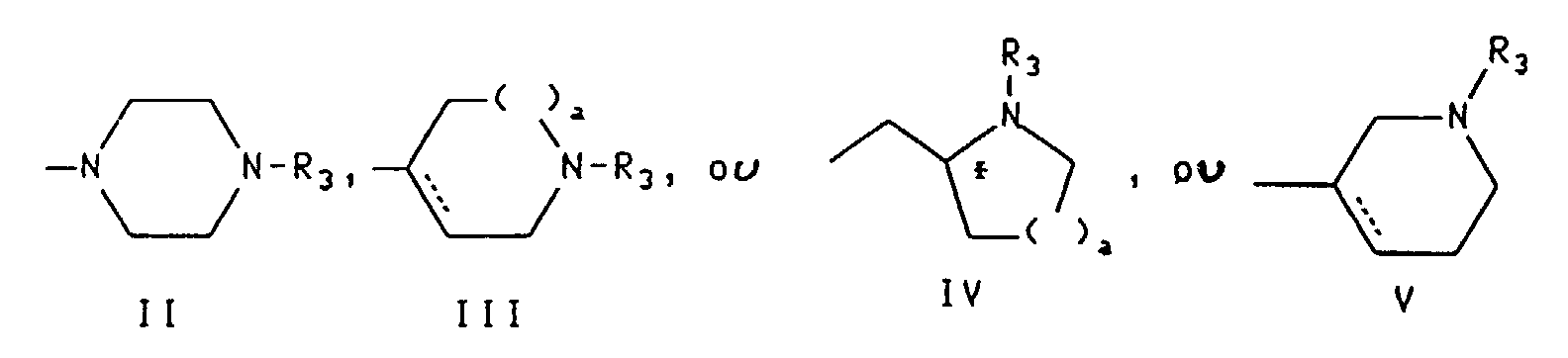
- Preferred embodiments of the present invention include pharmaceutical compositions comprising and methods of administering compounds of formula I, or pharmaceutically acceptable salts of these compounds with a 5-HT re-uptake inhibitor, preferably sertraline, or pharmaceutically acceptable salts or polymorphs thereof; wherein R 1 is
- R 3 is hydrogen or C 1 to C 6 alkyl;
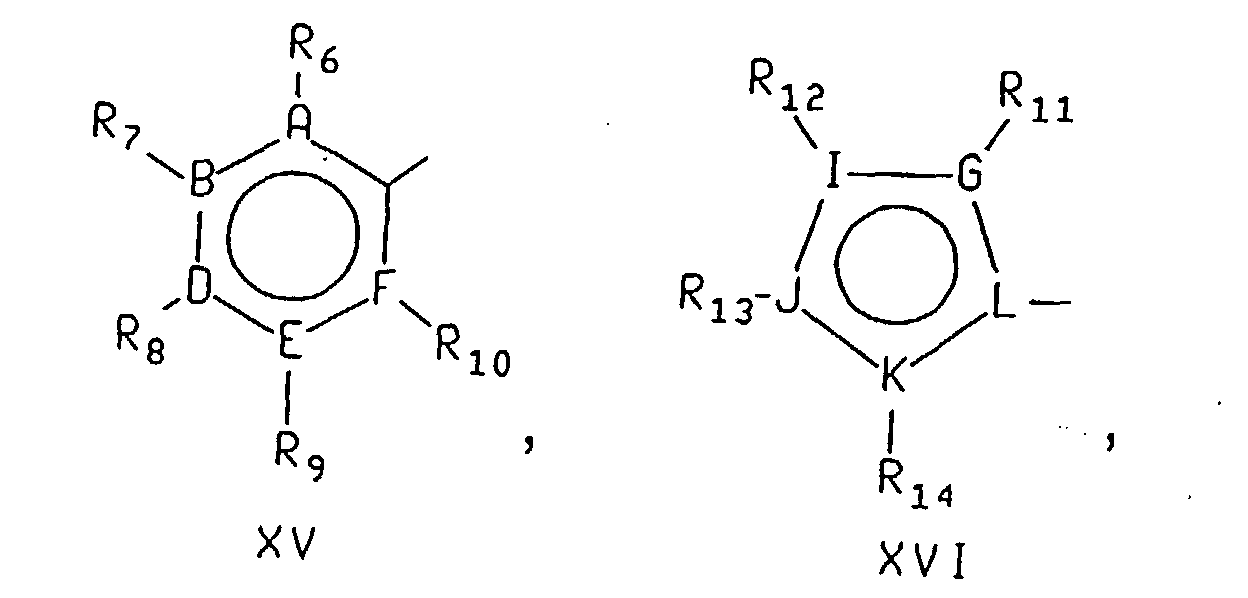
- R 4 is formula XV or formula XVII;
- A, B, D, E, and F are each independently C or N;
- R 6 , R 7 , R 8 , R 9 , R 10 , R 15 , R 16 , R 17 , R 18 , and R 19 are each independently hydrogen, halogen, -CN, or -OR 20 ; and
- R 20 is C 1 to C 6 alkyl.
- Preferred embodiments of the present invention include pharmaceutical compositions comprising and methods of administering compounds of formula I, or pharmaceutically acceptable salts of these compounds with a 5-HT re-uptake inhibitor, preferably sertraline, or pharmaceutically acceptable salts or polymorphs thereof; wherein said compound of formula I is a compound wherein R 1 is formula II, formula III, or formula IV; R 2 is -R 4 ; R 3 is hydrogen or C 1 to C 6 alkyl; R 4 is formula XVII; G, I, J, and K are each independently C, N, or O; L is C; R 11 , R 12 , R 13 , and R 14 are each independently hydrogen, C 1 to C 6 alkyl, or C 1 to C 6 alkylaryl.
- a 5-HT re-uptake inhibitor preferably sertraline, or pharmaceutically acceptable salts or polymorphs thereof
- said compound of formula I is a compound wherein R 1 is formula II, formula III, or formula IV; R 2 is -R 4 ; R 3 is hydrogen or C 1
- Preferred embodiments of the present invention include pharmaceutical compositions comprising and methods of administering the following compounds of formula I, or pharmaceutically acceptable salts of these compounds with sertraline or pharmaceutically acceptable salts or polymorphs thereof:
- R 1 is of the formula II
- enamines of formula VII are generally prepared by this reaction in the presence of an acid catalyst such as, for example, p-toluenesulfonic acid or titanium tetrachloride.
- an acid catalyst such as, for example, p-toluenesulfonic acid or titanium tetrachloride.
- the water formed as a by-product of the reaction may be effectively removed from the reaction as it is formed by the use of a reagent such as molecular sieves or calcium sulfate, or by azeotropic removal employing a Dean Stark trap with a refluxing solvent.
- the reaction is typically run in a reaction inert solvent such as benzene, toluene, tetrahydrofuran, or methylene chloride, at a temperature of from about -78°C to about 150°C.
- a reaction inert solvent such as benzene, toluene, tetrahydrofuran, or methylene chloride
- the preferred temperature for the reaction is from about -78°C to about 25°C.
- the preferred reaction temperature is the boiling temperature of the particular reaction solvent.
- ⁇ tetralones of formula V for example, where R 2 is -OH, -NO 2 , or -NH 2 are known in the literature and can be readily prepared by those skilled in the art, such as, for example 7-amino- ⁇ -tetralone, (J. Med. Chem., 1976 , 19, 472) and 7-hydroxy- ⁇ -tetralone, (Tetrahedron Lett., 1981 , 22, 603).
- Other ⁇ tetralones of formula V are readily prepared using the alkylation, acylation, and organometallic reactions described herein and in standard synthesis texts, for example Organic Synthesis , Wiley , New York ).
- the piperazines of formula VI are commercially available or can be made using methods known in the art.
- the enamines of formula VII may be converted to compounds of formula I by an oxidative process.
- the reaction may be carried out using a variety of methods known in the art.
- the acceptable oxidizing agents are noble metal catalysts, such as, palladium or platinum on activated carbon if desired, chloranil, and sulfur.
- the reactions can be carried out in a reaction inert solvent for example, toluene, xylene, tetrahydrofuran, methylene chloride, preferably toluene or xylene, however a solvent is not always necessary, especially for oxidations carried out with elemental sulfur.
- the oxidation reactions generally proceed at a temperature of about 0°C to about 250°C.
- Preferred temperatures for the oxidation depend on the particular oxidant in use and are about 60°C to about 150°C for noble metal catalytic oxidation, about 150°C to about 250°C for sulfur oxidation and about 0°C to about 100°C for chloranil oxidations. From 1 to 5 equivalents, preferably 2-4 equivalents, of an additive such as dicyclopentadiene or [2,2,2] bicyclooctene may be added to the reaction to reduce the amounts of enamine reduction side products which may form competitively with the desired naphthalene product.
- an additive such as dicyclopentadiene or [2,2,2] bicyclooctene
- Additional compounds of formula I may also be formed using standard chemical transformations on other compounds of formula I.
- these groups may be hydrolyzed in the presence of aqueous acid or base to form -NH 2 and -OH groups, respectively.
- These standard hydrolysis reactions may be carried out in water with any of a variety of acids or bases (for example HCl, HBr, NaOH, or KOH, preferably acid for amidehydrolysis and base for ester hydrolysis) and a cosolvent (methanol or tetrahydrofuran, for example) may be used if desired to promote dissolution of I in the medium.
- the reaction may be carried out at a temperature of from about 0°C to about 150°C.
- the preferred reaction temperature is about 20°C to about 40°C for basic hydrolysis and about the boiling temperature of the mixture for acidic hydrolysis.
- alkylating or acylating agent alkyl halide, mesylate, triflate, etc., or arylalkyl halide, mesylate, triflate, etc., or an alkyl or aryl anhydride, or an alkyl or aryl carboxylic acid chloride, etc.
- Suitable alkylating agents could include compounds of the formulae R 4 -(CH 2 ) b -Y or R 5 -(CH 2 ) b -Y where b is 0 to 3 and Y is a suitable leaving group, such as, for example, Br, I, or triflate.
- the reaction may be carried out in a reaction inert solvent such as tetrahydrofuran and dichloroethane for the alkylating and acylating reactions.
- a reaction inert solvent such as tetrahydrofuran and dichloroethane
- Preferred solvents depend on the solubility of the reagents and the selection thereof would be known to one skilled in the art.
- These alkylation or acylation reactions are carried out at temperatures of between about 0°C to about 200°C depending on the nature of the reaction. Preferred temperatures are between about 0°C to about 75°C for the acylation reactions and between about 25°C to about 100°C for the alkylation reactions.
- Additional compounds of formula I may be prepared by the well known reductive alkylation reaction of the compounds of formula I where R 2 is -NH 2 with aldehydes and ketones in the presence of hydrogen gas and a platinum or palladium catalyst or in the presence of a reducing agent such as sodium cyanoborohydride.
- activated aromatic or heterocyclic compound implies a ring compound of formulae VIII or IX; where Y is a suitable leaving group (for example halogen or trifluoromethanesulfonyloxy) and the ring is rendered susceptible to nucleophilic attack by the presence of one or more nitrogen atoms in the ring or by the presence of one or more electron withdrawing groups (in other words one or more of R 6 , R 7 , R 8 , R 9 , R 10 , R 11 , R 12 , R 13 , or R 14 are halogen, -CF 3 , nitro, cyano, alkoxycarbonyl, amidocarbonyl, etc.) attached to the ring.
- Y is a suitable leaving group (for example halogen or trifluoromethanesulfonyloxy) and the ring is rendered susceptible to nucleophilic attack by the presence of one or more nitrogen atoms in the ring or by the presence of one or more electron withdrawing groups (in other words one or more of
- Solvents suitable for use with the activated aromatic or heterocylic compounds include, for example, dimethylformamide, N-methypyrrolidinone, or methylene chloride and a base (for example triethylamine, 4-dimethylaminopyridine, sodium or potassium carbonate, sodium hydride) may be used to facilitate the process if desired.
- a base for example triethylamine, 4-dimethylaminopyridine, sodium or potassium carbonate, sodium hydride
- Preferred solvents depend on the solubility of the reagents and the selection thereof would be known to one skilled in the art.
- These alkylation or acylation reactions are carried out at temperatures of between about 0°C to about 200°C depending on the nature of the reaction. Preferred temperatures are between about 50°C to about 125°C for these reactions.
- R 2 is one of the claimed alkyl, alkenyl, or alkynyl moieties
- R 2 is CF 3 SO 3
- an appropriate olefin or acetylene compound in the presence of a palladium catalyst.
- the selection of appropriate olefin or acetylene depends on the alkyl, alkenyl, or alkynyl moiety desired in the end product, as would be appreciated by one skilled in the art.
- the alkenyl and alkynyl substituted compounds can be produced using the following reaction scheme:
- the catalyst may be selected from those typically employed for the so-called Heck reaction (palladium acetate, palladium chloride, bis (acetonitrile) palladium chloride, for example).
- the reaction is carried out neat or in a reaction inert solvent such as acetonitrile, dimethylformamide, or N-methylpyrrolidinone.
- the reaction is conveniently run at 20°C to 160°C, preferably 60°C to 130°C. The details of reactions of this type have been well described in the literature (Organic Reactions 1982 , 27, 345).
- the compounds of formulae I and intermediates of formula V where R 2 is CF 3 SO 3 can be prepared by reacting the corresponding R 2 substituted hydroxy compounds of formulae I or V with an activated form of triflic acid, for example, triflic anhydride, acid chloride, N-phenyltrifluoromethanesulfonimide, preferably triflic anhydride, typically in the presence of a base, such as, for example, triethylamine or diisopropylethylamine, preferably triethylamine.
- triflic acid for example, triflic anhydride, acid chloride, N-phenyltrifluoromethanesulfonimide, preferably triflic anhydride
- a base such as, for example, triethylamine or diisopropylethylamine, preferably triethylamine.
- the reaction may be run in an inert solvent, such as, tetrahydrofuran or methylene chloride, at a temperature of from about -78°C to about 25°C, preferably below about 0°C.
- an inert solvent such as, tetrahydrofuran or methylene chloride
- the stannane compounds I and V may be prepared from the compound I (R 2 being CF 3 SO 3 ) following known literature procedures (J. Amer. Chem. Soc., 1987 , 109, 5478).
- a method to prepare compounds of formula I where R 2 is R 4 is accomplished by reacting compounds of formula I where R 2 is bromo, iodo, or -OSO 2 CF 3 with an arylstannane, arylboronic acid, heteroaryl boronic acid, or heteroarylstannane in the presence of a catalyst, preferably tetrakis(triphenylphosphine)palladium, in an inert solvent, and is shown in the following scheme:
- a catalyst preferably tetrakis(triphenylphosphine)palladium
- a method of preparing compounds of formula I and intermediates of formula V where R 2 is -O-R 4 is to react corresponding compounds of formula I or intermediates of formula V where R 2 is -OH with alcohols, for example, ethanol or benzyl alcohol, in the presence of triphenylphosphine and diethyl azodicarboxylate in a Mitsunobu reaction.
- Mitsunobu reactions are known in the art, for example, as disclosed in Synthesis 1981 , 1.
- R 2 is OSO 2 CF 3 with an alcohol or an amine and carbon monoxide in the presence of a palladium catalyst.
- a reducing agent Standard methods known in the art can be used.
- Useful reducing agents include sodium borohydride, lithium aluminum hydride, or borane (or any of its complexes).
- R 2 a ketone or ester carbonyl moiety
- organometallic agents such as alkyl- and aryl lithiums, or Grignard reagents using methods known in the art.
- R 2 contains an amide group
- treatment with a reducing agent such as, for example, lithium aluminum hydride or borane using known methods, produces the corresponding alkylated (or aralkylated) secondary or tertiary amines.
- Another example of the interconversion of compounds of formula I is the reduction of a nitro group of an R 2 substituent including a nitrophenyl or nitropyridyl group to the corresponding amine.
- R 1 and Z are as defined above
- the reaction may be carried out using known nitro group reducing agents and methods, for example, hydrogenation over noble metal catalysts (palladium or platinum on a support, such as carbon, if desired) or by dissolving metal reduction.
- the product of the previous reaction scheme may be cyclized with, for example, dimethylformamide dimethyl acetal or triethyl orthoformate to produce fused imidazole compounds of formula I, as shown below,
- the reaction may be carried out in an inert solvent, such as, for example, dimethylformamide, ethanol, or dimethyl sulfoxide, preferably dimethylformamide.
- an inert solvent such as, for example, dimethylformamide, ethanol, or dimethyl sulfoxide, preferably dimethylformamide.
- the reaction is run at a temperature of from about 20 °C to about 125°C.
- an acid catalyst such as, p-toluenesulfonic acid or camphor sulfonic acid, preferably p-toluenesulfonic acid, may also be used to facilitate the reaction.
- the amidine compounds of formula I can be isolated, especially when the acid catalyst is not used.
- Another method to carry out the reaction shown in the previous scheme employs diethyl ethoxymethylenemalonate, ethoxymethylenemalononitrile, or related reagents preferably ethoxymethylenemalononitrile, as the cyclization reagent.
- This reaction may be run in an inert solvent, such as, acetic acid, ethanol, or isopropanol, preferably isopropanol or acetic acid.
- the reaction temperature should be from about 25°C to about 150°C. The preferred temperature is the reflux temperature of the solvent for convenience and to decrease the reaction time.
- the 8-bromo- ⁇ -tetralone is first reacted with an amine, for example, dibenzylamine to form an enamine X using the same procedure disclosed previously on page 8.
- the enamine X can be dehydrogenated as described above on page 9, chloranil being the preferred reagent with these particular reactants, to yield 1-bromo-7-amine substituted naphthalenes XI.
- Selection of an appropriate amine for the enamine-forming step would be apparent to one skilled in the art, for example, diallylamine and dibenzylamines for instance.
- Palladium is the preferred catalyst, for example tetrakis(triphenylphosphine)palladium, ((Ph 3 P) 4 Pd), or tris(dibenzylidene acetone)dipalladium, (Pd 2 (dba) 3 ), and the reaction follows the same procedures as described above on pages 12 to 14, where R 1 is tetrahydropyridine in a so-called Stille and Heck reactions.
- Compounds of formula I where R 1 is piperidine can be prepared by catalytic hydrogenation of the tetrahydropyridine from the previous paragraph, using standard methods known in the art, generally with palladium on carbon as the catalyst.
- Compounds I where R 1 is piperidine or tetrahydropyridine can be produced, for example, by removal of the benzyl groups (when R 2 is dibenzylamino) by catalytic hydrogenolysis, using a suitable catalyst such as palladium hydroxide, palladium on carbon, or platinum on carbon, preferably palladium hydroxide.
- the reaction is performed in an inert solvent, such as ethanol or ethyl acetate, either with or without a protic acid, such as acetic acid or HCl.
- the preferred acid is acetic acid.
- the resulting compounds are of formula I where R 2 is amino.
- the amino group can be derivatized using standard techniques known in the art and as described previously on pages 10 to 16 to afford further compounds of formula I with substituted amines.
- alkyllithium reagents for example, butyllithium, sec-butyllithium or tert-butyllithium, preferably butyllithium in an inert solvent, as shown below,
- Suitable solvents include, for example, ether or tetrahydrofuran, preferably tetrahydrofuran. Reaction temperatures range from about -110°C to about 0°C.
- the intermediate lithium anions of formula XII thus formed may then be further reacted with a suitable electrophile, selection of which depends on the desired substituent at the R 1 position.
- This step may be accomplished by one of several standard methods known in the art.
- a thiocarbonyl derivative for example a xanthate
- a free radical process both of which are known to those skilled in the art.
- the hydroxyl group may be removed by reduction with a hydride source such as triethylsilane under acidic conditions, using such as, for example, trifluoroacetic acid or boron trifluoride.
- the reduction reaction can be performed neat or in a solvent, such as methylene chloride.
- a further alternative would be to first convert the hydroxyl group to a suitable leaving group, such as tosylate or chloride, using standard methods.
- the leaving group is then removed with a nucleophilic hydride, such as, for example, lithium aluminum hydride.
- a nucleophilic hydride such as, for example, lithium aluminum hydride.
- This last reaction is performed typically in an inert solvent, such as, ether or tetrahydrofuran.
- a reducing agent may be used to reductively remove of the benzylic substituent. Suitable reducing agents include, for example, Raney nickel in ethanol, or sodium or lithium in liquid ammonia.
- Another alternative method for removing the hydroxyl group is to first dehydrate the alcohol XIII, XIV, or XX to an olefin with a reagent such as Burgess salt ( J. Org.
- the alcohol may also be dehydrated to the olefin by treatment with acid such as p-toluenesulfonic acid.
- acid such as p-toluenesulfonic acid.
- XIII the free radical procedure is preferred because it preserves the stereochemical integrity of the chiral center.
- XIV or XX the Burgess salt or acid dehydration procedures are preferred.
- R 2 is, for example, dibenzylamino
- additional compounds of formula I may be prepared by hydrogenolysis and derivatization as described above on pages 10 to 16.
- 8-Bromo- ⁇ -tetralone is first dehydrogenated to form 1-bromo-7-hydroxynaphthalene using an oxidizing reagent, such as, for example, elemental sulfur as described above on page 8 or N-bromosuccinimide.
- An appropriate protecting group is then used to protect the hydroxyl group if desired, formation and selection being within the knowledge of one skilled in the art (e.g., Greene and Wuts, Protective Groups in Organic Synthesis, 2nd edition, Wiley, New York, 1991). This is followed by subsequent replacement of the bromo substituent using methods described previously on pages 16 to 18.
- the hydroxyl protecting group may be removed using standard chemistry, and the free hydroxyl group may be derivatized as described above on pages 10 to 14 to afford compounds of formula I wherein R 2 is attached to the naphthalene ring via a carbon or oxygen atom.
- the protecting group may also serve as an activating group for further transformations, CF 3 SO 3 for example, as described earlier on pages 12 to 14 or may simply be the final R 2 moiety.
- the pressure of each of the above reactions is not critical. Generally, the reactions will be conducted at a pressure of about one to about three atmospheres, preferably at ambient pressure (about one atmosphere).
- United States Patent 4,536,518 describes the synthesis, pharmaceutical composition and use of sertraline for depression and is hereby incorporated by reference in its entirety.
- Sertraline hydrochloride has the chemical formula C 17 H 17 NCl 2 and the following structural formula Its synthesis is described in United States Patent 4,536,518, assigned to Pfizer Inc.
- Sertraline hydrochloride is useful as an antidepressant or an anorectic agent, and is also useful in the treatment of depression, chemical dependencies, anxiety-related disorders and premature ejaculation.
- United States Patent 4,536,518 is hereby incorporated by reference in its entirety.
- the compounds of the formula I which are basic in nature are capable of forming a wide variety of different salts with various inorganic and organic acids. Although such salts must be pharmaceutically acceptable for administration to animals, it is often desirable in practice to initially isolate a compound of the formula I from the reaction mixture as a pharmaceutically unacceptable salt and then simply convert the latter back to the free base compound by treatment with an alkaline reagent, and subsequently convert the free base to a pharmaceutically acceptable acid addition salt.
- the acid addition salts of the base compounds of this invention are readily prepared by treating the base compound with a substantially equivalent amount of the chosen mineral or organic acid in an aqueous solvent medium or in a suitable organic solvent such as methanol or ethanol. Upon careful evaporation of the solvent, the desired solid salt is obtained.
- the acids which are used to prepare the pharmaceutically acceptable acid addition salts of the base compounds of formula I are those which form non-toxic acid addition salts, i.e., salts containing pharmacologically acceptable anions, such as hydrochloride, hydrobromide, hydroiodide, nitrate, sulfate or bisulfate, phosphate or acid phosphate, acetate, lactate, citrate or acid citrate, tartrate or bitartrate, succinate, maleate, fumarate, gluconate, saccharate, benzoate, methanesulfonate and pamoate [i.e., 1,1'-methylene-bis-(2-hydroxy-3-naphthoate)]salts salts.
- non-toxic acid addition salts i.e., salts containing pharmacologically acceptable anions, such as hydrochloride, hydrobromide, hydroiodide, nitrate, sulfate or bisulfate, phosphate or
- Those compounds of the formula I which are also acidic in nature, e.g., where R 2 contains a carboxylate, are capable of forming base salts with various pharmacologically acceptable cations.
- Such salts include the alkali metal or alkaline-earth metal salts and particular, the sodium and potassium salts. These salts are all prepared by conventional techniques.
- the chemical bases which are used as reagents to prepare the pharmaceutically acceptable base salts of the compounds of formula I are those which form non-toxic base salts with the herein described acidic compounds of formula I. These non-toxic base salts include those derived from such pharmacologically acceptable cations as sodium, potassium, calcium and magnesium, etc.
- salts can easily be prepared by treating the corresponding acidic compounds with an aqueous solution containing the desired pharmacologically acceptable cations, and then evaporating the resulting solution to dryness, preferably under reduced pressure.
- they may also be prepared by mixing lower alkanolic solutions of the acidic compounds and the desired alkali metal alkoxide together, and then evaporating the resulting solution to dryness in the same manner as before.
- stoichiometric quantities of reagents are preferably employed in order to ensure completeness of reaction of maximum product of yields of the desired final product.
- the compounds of formula I may advantageously be used in conjunction with one or more other therapeutic agents, for instance, different antidepressant agents such as tricylic antidepressants (e.g., amitripyline, dothiepin, doxepin, trimipramine, butripyline, clomipramine, despramine, imipramine, iprindole, lofepramine, nortriptyline or protriptyline), monoamine oxidase inhibitors (e.g., isocarboxazid, phenelzine or tranylcyclopramine) or 5-HT re-uptake inhibitors (e.g., fluvoxamine, sertraline, fluoxetine or paroxetine), and/or antiparkinsonian agents such as dopaminergic antiparkinsonian agents (e.g., levodopa, preferably in combination with a peripheral decarboxylase inhibitor e.g.
- tricylic antidepressants e.g.,
- the compounds of the formula I and the pharmaceutically acceptable salts thereof in combination with a 5-HT re-uptake inhibitor are useful psychotherapeutics and may be used in the treatment of a condition selected from mood disorders, including depression, seasonal affective disorders and dysthmia, anxiety disorders including generalized anxiety disorder and panic disorder; agoraphobia, avoidant personality disorder; social phobia; obsessive compulsive disorder; post-traumatic stress disorder; memory disorders including dementia, amnestic disorders and age-associated memory impairment; disorders of eating behavior, including anorexia nervosa and bulimia nervosa; obesity; cluster headache; migraine; pain; Alzheimer's disease; chronic paroxysmal hemicrania; headache
- a 5-HT re-uptake inhibitor e.g. ,fluvoxamine, sertraline, fluoxetine or paroxetine
- the combination of a compound of formula I with a 5-HT re-uptake inhibitor is collectively referred to as "the active compounds”
- the active compounds are useful psychotherapeutics
- the affinities of the compounds of formula I for the various serotonin 1 receptors are evaluated using standard radioligand binding assays as described in the literature.
- the 5-HT 1A affinity is measured using the procedure of Hoyer et al. (Brain Res., 1986 , 376, 85).
- the 5-HT 1C affinity is measured using the procedure of Pazos et al. (Eur. J. Pharmacol., 1985 , 106, 539).
- the 5-HT 1D affinity is measured using the procedure of Heuring and Peroutka (J. Neurosci., 1987 , 7, 894).
- 5-HT re-uptake inhibitors preferably sertraline, exihbit positive activity against depression, chemical dependencies, anxiety disorders including panic disorder, generalized anxiety disorder, agoraphobia, simple phobias, social phobia, post-traumatic stress disorder, obsessive-compulsive disorder and avoidant personality disorder; premature ejaculation in mammals, including humans, due in part to their ability to block the synaptosomal uptake of serotonin.
- Activity of the combination of the active compounds as antidepressants and related pharmacological properties are determined by studying (1) their ability to affect the efforts of mice to escape from a swim-tank (Porsolt mouse "behavior despair” test), (2) their ability to potentiate 5-hydroxytryptophan-induced behavioral symptoms in mice in vivo, (3) their ability to antagonize the serotonin-depleting activity of p-chloroamphetamine hydrochloride in rat brain in vivo , (4) their ability to block the uptake of serotonin, norepinephrine and dopamine by synaptosomal rat brain cells in vitro by the method of Koe, B., Journal of Pharmacology and Experimental Therapeutics , 199 (3), pp. 649-661 (1976), and (5) their ability to counteract reserpine hypothermia in mice in vivo (see U.S. Pat. No. 4,029,731).
- compositions of the present invention may be formulated in a conventional manner using one or more pharmaceutically acceptable carriers.
- the active compounds may be formulated for oral, buccal, intranasal, parenteral (e.g., intravenous, intramuscular or subcutaneous) or rectal administration or in a form suitable for administration by inhalation or insufflation.
- the pharmaceutical compositions may take the form of, for example, tablets or capsules prepared by conventional means with pharmaceutically acceptable excipients such as binding agents (e.g. pregelatinised maize starch, polyvinylpyrrolidone or hydroxypropyl methylcellulose); fillers (e.g. lactose, microcrystalline cellulose or calcium phosphate); lubricants (e.g. magnesium stearate, talc or silica); disintegrants (e.g. potato starch or sodium starch glycolate); or wetting agents (e.g. sodium lauryl sulphate).
- binding agents e.g. pregelatinised maize starch, polyvinylpyrrolidone or hydroxypropyl methylcellulose
- fillers e.g. lactose, microcrystalline cellulose or calcium phosphate
- lubricants e.g. magnesium stearate, talc or silica
- disintegrants e.g. potato starch or sodium starch glycolate
- wetting agents
- Liquid preparations for oral administration may take the form of, for example, solutions, syrups or suspensions, or they may be presented as a dry product for constitution with water or other suitable vehicle before use.
- Such liquid preparations may be prepared by conventional means with pharmaceutically acceptable additives such as suspending agents (e.g. sorbitol syrup, methyl cellulose or hydrogenated edible fats); emulsifying agents (e.g. lecithin or acacia); non-aqueous vehicles (e.g. almond oil, oily esters or ethyl alcohol); and preservatives (e.g. methyl or propyl p-hydroxybenzoates or sorbid acid).
- suspending agents e.g. sorbitol syrup, methyl cellulose or hydrogenated edible fats
- emulsifying agents e.g. lecithin or acacia
- non-aqueous vehicles e.g. almond oil, oily esters or ethyl alcohol
- preservatives e.g
- composition may take the form of tablets or lozenges formulated in conventional manner.
- the active compounds may be formulated for parenteral administration by injection, including using conventional catheterization techniques or infusion.
- Formulations for injection may be presented in unit dosage form, e.g. in ampules or in multi-dose containers, with an added preservative.
- the compositions may take such forms as suspensions, solutions or emulsions in oily or aqueous vehicles, and may contain formulating agents such as suspending, stabilizing and/or dispersing agents.
- the active ingredient may be in powder form for reconstitution with a suitable vehicle, e.g. sterile pyrogen-free water, before use.
- the active compounds may also be formulated in rectal compositions such as suppositories or retention enemas, e.g., containing conventional suppository bases such as cocoa butter or other glycerides.
- the active compounds are conveniently delivered in the form of a solution or suspension from a pump spray container that is squeezed or pumped by the patient or as an aerosol spray presentation from a pressurized container or a nebulizer, with the use of a suitable propellant, e.g. dichlorodifluoromethane, trichlorofluoromethane, dichlorotetrafluoroethane, carbon dioxide or other suitable gas.
- a suitable propellant e.g. dichlorodifluoromethane, trichlorofluoromethane, dichlorotetrafluoroethane, carbon dioxide or other suitable gas.
- the dosage unit may be determined by providing a valve to deliver a metered amount.
- the pressurized container or nebulizer may contain a solution or suspension of the active compound.
- Capsules and cartridges (made, for example, from gelatin) for use in an inhaler or insufflator may be formulated containing a powder mix
- a 5-HT re-uptake inhibitor preferably sertraline
- these antidepressant compositions containing a 5-HT re-uptake inhibitor, preferably sertraline, and a compound of formula I are normally administered in dosages ranging from about 0.01 mg. to about 100 mg. per kg. of body weight per day of a 5-HT re-uptake inhibitor, preferably sertraline, preferably from about 0.3 mg. to about 10 mg. per kg. of body weight per day of sertraline; with from about 0.01 mg. to about 100 mg. per kg. of body weight per day of a compound of formula I, preferably from about 0.1 mg. to about 3 mg. per kg. of body weight per day of a compound of formula I, although variations will necessarily occur depending upon the conditions of the subject being treated and the particular route of administration chosen.
- the compounds of formula I may be administered either alone or in combination with pharmaceutically acceptable carriers by either of the routes previously indicated, and that such administration can be carried out in both single and multiple dosages. More particularly, the active compounds can be administered in a wide variety of different dosage forms, i.e., they may be combined with various pharmaceutically-acceptable inert carriers in the form of tablets, capsules, lozenges, troches, hand candies, powders, sprays, aqueous suspension, injectable solutions, elixirs, syrups, and the like.
- Such carriers include solid diluents or fillers, sterile aqueous media and various non-toxic organic solvents, etc.
- oral pharmaceutical formulations can be suitably sweetened and/or flavored by means of various agents of the type commonly employed for such purposes.
- the compounds of formula I are present in such dosage forms at concentration levels ranging from about 0.5% to about 90% by weight of the total composition, i.e., in compounds of formula I are present in such dosage forms at concentration levels ranging from about 0.5% to about 90% by weight of the total composition, i.e., in amounts which are sufficient to provide the desired unit dosage and a 5-HT re-uptake inhibitor, preferably sertraline, is present in such dosage forms at concentration levels ranging from about 0.5% to about 90% by weight of the total composition, i.e., in amounts which are sufficient to provide the desired unit dosage.
- the compounds of this invention may exist in different polymorphic forms, i.e., different crystalline forms.
- a proposed dose of the compounds of formula I in the combination formulation for oral, parenteral, rectal or buccal administration to the average adult human for the treatment of the conditions referred to above is from about 0.01 mg. to about 2000 mg., preferably from about 0.1 mg. to about 200 mg of the active ingredient of formula I per unit dose which could be administered, for example, 1 to 4 times per day.
- a proposed dose of a 5-HT re-uptake inhibitor, preferably sertraline, when used in combination with a compound of formula I according to the methods of the invention, for oral, parenteral or buccal administration to the average adult human for the treatment of the conditions referred to above (e.g. , migraine) is from about 0.1 mg. to about 2000 mg., preferably from about 10 mg. to about 200 mg. of the 5-HT re-uptake inhibitor per unit dose which could be administered, for example, 1 to 4 times per day.
- a preferred dose ratio of sertraline to a compound of formula I, when used in combination with a compound of formula I according to the methods of the invention, for oral, parenteral or buccal administration to the average adult human for the treatment of the conditions referred to above (e.g. , migraine) is from about 0.00005 to about 20,000, preferably from about 0.25 to about 2,000.
- Aerosol combination formulations for treatment of the conditions referred to above are preferably arranged so that each metered dose or "puff" of aerosol contains from about 0.01 mg to about 2000 mg of the compound of formula I, preferably from about 0.1 mg. to about 200 mg. of the compound of formula I.
- Administration may be several times daily, for example 2, 3, 4 or 8 times, giving for example, 1, 2 or 3 doses each time.
- Aerosol formulations for treatment of the conditions referred to above are preferably arranged so that each metered dose or "puff" of aerosol contains from about 0.01 mg. to about 2000 mg. of a 5-HT re-uptake inhibitor, preferably sertraline, preferably from about 10 mg. to about 200 mg of sertraline. Administration may be several times daily, for example 2, 3, 4 or 8 times, giving for example, 1, 2 or 3 doses each time.
- a 5-HT re-uptake inhibitor preferably sertraline
- Administration may be several times daily, for example 2, 3, 4 or 8 times, giving for example, 1, 2 or 3 doses each time.
- the combination methods of the invention can be administered together or individually.
- the methods of the invention are administered individually the relative dosages of the active agents are apportioned in the same manner as when the methods of the invention are administered together.
- Triflate refers to -OSO 2 CF 3 or CF 3 SO 3 .
- the solid which formed was collected, washed with ethyl acetate and then ether, and dried in vacuo. The filtrate was discarded. The solid was vigorously stirred with 1N sodium hydroxide (100 mL) and methylene chloride (100 mL) for 2 hours. The solid which did not dissolve was removed by filtration. The phases were separated from the filtrate and the organic layer was washed with brine, dried over calcium sulfate and concentrated to give 1.01 g of product. The solid was now stirred with dimethyl sulfoxide (DMSO, 150 mL) for 2 hours and filtered again. The undissolved material was discarded. The DMSO was removed at reduced pressure and the residue was taken up in methylene chloride.
- DMSO dimethyl sulfoxide
- the title product was prepared following the procedure of example 3 from 7-amino-1-(4-methyl-1-piperazinyl)-naphthalene(0.15 g, 0.622 mmol) and triethylamine (0.09 mL, 0.68 mmol) and 3-nitrobenzoyl chloride (0.127 mL, 0.684 mmol) in acetonitrile (10 mL) with an overnight reflux.
- the product was purified by silica gel flash chromatography followed by recrystallization from ethyl acetate to yield 0.116 g (47%) of the title product: mp 182-184°C. Analysis calculated for C 22 H 22 N 4 O 3 : C, 67.68; H, 5.68; N, 14.35. Found: C, 67.47; H, 5.64; N, 14.08.
- the title product was prepared following the procedure of example 3 from amino-1-(4-methyl-1-piperazinyl)-naphthalene (0.227 g, 0.94 mmol) and triethylamine (0.133 mL, 0.1.32 mmol) and 1-naphthalenecarboxylic acid chloride (0.25 g, 1.32 mmol) in acetonitrile (10 mL) with stirring overnight at room temperature.
- the product was purified and after chromatography and recrystallization from ethyl acetate yielded 0.213 g (57%) of the title compound and had; mp 217-218°C. Analysis calculated for C 28 H 25 N 3 O: C, 78.96, H, 6.37; N, 10.62. Found: C, 78.66; H, 6.33; N, 10.48.
- the title product was prepared following the procedure of example 3 from 7-amino-1-(4-methyl-1-piperazinyl)-naphthalene(0.24 g, 0.995 mmol) and triethylamine (0.146 mL, 1.09 mmol) and 3-chlorobenzoyl chloride (0.138 mL, 1.09 mmol) in acetonitrile (10 mL) with overnight stirring at room temperature.
- the product was isolated using flash chromatography and trituration from hexane and recrystallization from ethyl acetate (with a seed crystal) to yield 0.076g (20%) of the title compound: mp 147-148°C.
- the title product was prepared following the procedure of example 3 from 7-amino-1-(4-methyl-1-piperazinyl)-naphthalene(0.15 g, 0.622 mmol) and triethylamine (0.09 mL, 0.68 mmol) and 3,5-dinitrobenzoyl chloride (0.158 g, 0.684 mmol) in acetonitrile (10 mL) with overnight stirring at room temperature.
- the product was purified using chromatography and recrystallization from acetonitrile to yield 0.17 g (63%) of the title compound: mp 254-256°C. Analysis calculated for C 22 H 21 N 5 O 5 : C, 60.68; H, 4.86; N, 16.08. Found: C, 60.59; H, 4.73; N, 15.88.
- the title product was prepared following the procedure of example 3 from 7-amino-1-(4-methyl-1-piperazinyl)-naphthalene(0.213 g, 0.883 mmol) and triethylamine (0.258 mL, 1.94 mmol) and 3-cyanobenzoyl chloride (0.322 g, 1.94 mmol) in acetonitrile (10 mL) with stirring at reflux for 2 hours and then at room temperature overnight. The mixture was concentrated and the residue was taken up in methylene chloride. This organic solution was washed with 0.5 N sodium hydroxide, dried over calcium sulfate and concentrated.
- Example 2 The title product from Example 1 (0.50 g, 1.45 mmol) was dissolved in methylene chloride (10 mL) and chilled to 0°C. 1-chloroethyl chloroformate (0.156 mL, 1.45 mmol) was added via syringe. The mixture was allowed to come to room temperature and then refluxed 3 hours. Additional 1-chloroethyl chloroformate (0.1 mL, 0.93 mmol) was added and the mixture was further refluxed overnight. Methanol (10mL) was added and the reaction was refluxed for 2 hours. The mixture was concentrated and the residue was taken up in methylene chloride and extracted with 1N NaOH and brine.
- Triethylamine (0.15 mL, 1.14 mmol) was added and the solution was stirred 2 hours more. The solvent was removed at reduced pressure and the residue was taken up in methylene chloride. The organic solution was washed with saturated sodium bicarbonate and brine, then it was dried over calcium sulfate and concentrated. The product was purified by silica gel flash chromatography (1 x 2 inches). Ethyl acetate/hexane gradient elution of from 1:1 to 3:1 gave 0.15 g of oily product. Trituration with hexane gave 0.11 g (31%) of the title product. A sample recrystallized from methyl cyclohexane was submitted for analysis: mp 159-160°C.
- the title product was prepared following the procedure of example 16 from 7-amino-1-(4-methyl-1-piperazinyl)-naphthalene (0.182 g, 0.755 mmol) and triethylamine (0.201 mL, 1.51 mmol) and hexanoyl chloride (0.211 mL, 1.51 mmol) in acetonitrile (10 mL) with an overnight reflux.
- the product was purified by recrystallization from ethyl acetate/hexane to yield 0.097g (37%) of the title compound: mp 144-146°C. Analysis calculated for C 21 H 29 N 3 O: C, 74.30; H, 8.61; N, 12.38. Found: C, 73.91; H, 8.52; N, 12.22.
- N-benzyloxycarbonylglycine (0.69 g, 3.32 mmol) was dissolved in methylene chloride (10 mL) and carbonyl diimidazole (0.54 g, 3.32 mmol) was added. The solution was stirred for 2 hours; then 7-amino-1-(4-methyl-1-piperizinyl)-naphthalene (0.2 g, 0.83 mmol) was added. The solution was stirred overnight. The reaction was extracted with saturated aqueous potassium carbonate and brine, dried over calcium sulfate and concentrated to give white crystals. Recrystallization from ethyl acetate gave 0.187 g (52 %) of the title product as white crystals: mp 187-188°C. Analysis calculated for C 25 H 28 N 4 O 3 : C, 69.42; H, 6.52; N, 12.95. Found: C, 69.21; H, 6.50; N, 12.79.
- the title product was obtained following the procedure of example 27 by reacting 7-amino-1-(4-methyl-1-piperazinyl)-naphthalene (0.225 g, 0.93 mmol), 2-fluoronitrobenzene (0.255 g, 1.8 mmol), and 4-dimethylaminopyridine (0.167 g, 1.37 mmol) in dry DMF (5 mL) with an overnight reflux.
- the title compound was prepared following the procedure of example 30 from the product of example 29 (0.25 g, 0.75 mmol), acetyl chloride (0.045 mL, 0.80 mmol) and triethylamine (0.11 mL, 0.803 mmol) in tetrahydrofuran (8 mL) with stirring at room temperature for 3 hours.
- the product was isolated by flash chromatography and recrystallization from methylene chloride to yield 0.18g (64%) of the title compound: mp 110-114°C (dec.).
- the combined ether layer was washed with water and brine; then it was dried over magnesium sulfate and concentrated to an orange oil.
- the oil was purified by flash chromatography on silica gel (1 x 6 inches). Elution with a gradient of ethyl acetate and hexane followed by 100% ethyl acetate gave 0.15 9 of orange oily product (65%).
- the oil was dissolved in ether (5 mL) and p-toluene sulfonic acid (0.093 9, 0.489 mmol in ether) was added. An orange solid formed which was collected, rinsed well with ether and ethyl acetate.
- the title product was prepared following the procedure of example 1 from 7-trifluoromethylsulfonyloxy-1-(4-methyl-1-piperazinyl)-naphthalene (0.25 g, 0.67 mmol), 2-ethylsulfonyl-1-chloroethane (0.11 g, 0.7 mmol), triethylamine (0.47 mL, 3.37 mmol), and bis (triphenylphosphine) palladium chloride (0.025 g, 0.036 mmol) in dimethyl formamide (10 mL), the reaction being carried out at reflux for 4 hours followed by stirring at ambient temperature overnight. The product was purified by flash chromatography on silica gel (1 x 4 inches).
- the title product was prepared following the procedure of example 41 from 7-trimethylstannyl-1-(4-methyl-1-piperazinyl)-naphthalene(0.25 g, 0.67 mmol), 3-methylsulfonylamino-1-bromobenzene(0.18 g, 0.72 mmol), triethylamine (0.45 mL, 3.23 mmol), lithium chloride (0.088 9, 2.07 mmol), and bis (triphenylphosphine) palladium chloride (0.025 g, 0.036 mmol) in DMF (12.5 mL) with a heating time of 1.5 hours. The product was obtained in 35% yield.
- the title product was prepared following the procedure of example 41 from 7-trimethylstannyl-1-(4-methyl-1-piperazinyl)-naphthalene (0.25 g, 0.67 mmol), 4-bromobiphenyl (0.17g, 0.73 mmol), triethylamine (0.45 mL, 3.23 mmol), lithium chloride (0.088 g, 2.07 mmol), and bis (triphenylphosphine) palladium chloride (0.025 g, 0.036 mmol) in DMF (12.5 mL) with a heating time of 1 hour at 100 to 115°C. The product obtained was 0.14 g (56%) in yield.
- the title product was prepared following the procedure of example 41 from 7-trimethylstannyl-1-(4-methyl-1-piperazinyl)-naphthalene (0.25 g, 0.67 mmol), 3-5 methoxycarbonyl-1-bromobenzene (0.16 g, 0.74 mmol), triethylamine (0.45 mL, 3.23 mmol), lithium chloride (0.088 9, 2.07 mmol), and bis (triphenylphosphine) palladium chloride (0.025 g, 0.036 mmol) in DMF (12.5 mL) with a heating time of 1.5 hours at 120 to 130°C.
- the product obtained was 0.15 g (63%) in yield as an oil which was converted to a hydrochloride salt with HCl gas in ether.
- the solid was collected under a nitrogen atmosphere and recrystallized from chloroform/ether for analysis: mp 201-203°C; 13 C NMR ⁇ 167.05,147.37,141.78, 137.80, 134.08, 131.87, 130.89, 129.57, 129.07, 128.63, 128.47, 126.28, 125.76, 125.02, 120.59, 116.85, 54.30, 52.33, 49.75, 43.70.
- the title product was prepared following the procedure of example 41 from 7-trimethylstannyl-1-(4-methyl-1-piperazinyl)-naphthalene(0.25 9, 0.67 mmol), 3-fluoro-1-bromobenzene (0.13 g, 0.74 mmol), triethylamine (0.45 mL, 3.23 mmol), lithium chloride (0.088 g, 2.07 mmol), and bis (triphenylphosphine) palladium chloride (0.025 g, 0.036 mmol) in DMF (12.5 mL) with a heating time of 2 hours at 120 to 130°C. The product obtained was 0.13 g (59%) in yield.
- Flash chromatography (4 x 4 inches silica gel) proceeded as follows: methylene chloride (1 L) and 2% methanol / methylene chloride (1.6 L) unweighed white solid 7-dibenzylaminonaphthalene; 15% methanol/methylene chloride (1 L), 25% methanol / methylene chloride (1 L) and 30% methanol / methylene chloride / 0.2% ammonium hydroxide (4 L) product contaminated with water. The combined eluents were concentrated and redissolved in methylene chloride.
- the elution proceeded as follows: 75% methylene chloride / hexane (175 mL) nil; methylene chloride (250 mL) unweighed excess 2-chloro-3-nitropyridine; 2% methanol / methylene chloride (200 mL) nil, (550 mL) 0.373 g of crude product contaminated with 4-dimethylamino-pyridine. This material was triturated with ether and filtered to give 0.17 g of title product as orange crystals.
- Elution proceeded as follows: ethyl acetate (200 mL), nil; 1% triethylamine / 1% methanol / ethyl acetate (500 mL) and 2% triethylamine / 2% methanol / ethyl acetate (500 mL), nil; 5% triethylamine / 5% methanol / ethyl acetate (500 mL) and 10% triethylamine / 10% methanol / ethyl acetate (400 mL), 0.90 g of the title compound as a brown oil.
- Example 70 The S enantiomer of the title compound of Example 70 was prepared using the same procedure set forth in Example 70, except that 1-t-butoxycarbonyl-(S)-prolinal was used in place of 1-t-butoxycarbonyl-(R)-prolinal.
- the S enantiomer of the title compound of example 71 was prepared using the same procedure set forth in Example 71, except that 7-amino-1-(1-t-butoxycarbonyl-pyrrolidin-2-(S)-ylmethyl-naphthalene was used in place of 7-(4-chlorobenzamido)-1-(1-t-butoxycarbonyl-pyrrolidin-2-(R)-ylmethyl)-naphthalene.
- Example 11 The product of Example 11 (7-benzamido-1-(1-piperazinyl)-naphthalene, (0.063 g, 0.19 mmol) was combined with hydrochloric acid in ethanol (4 mL) and refluxed 16 hours. The reaction was concentrated at reduced pressure and the residue was neutralized with 4 N sodium hydroxide and extracted with methylene chloride. The organic phase was washed with brine, dried and concentrated to a tan solid (0.041 g). The solid was recrystallized from ethyl acetate / hexane to give 0.020 g (47%) of the title compound as light tan crystals. mp 184-186°C. HRMS m/e calculated for C 14 H 17 N 3 : 227.1419. Observed m/e 227.1405.
- the product was dissolved in chloroform and HCL gas was bubbled through the solution to form the hydrochloride salt. Concentration of this solution to about 1 mL. at the boil and addition of about 1 mL of ether caused the white crystalline product to precipitate.
- the hydrochloride salt weighted 0.057 g: mp 236-238°C. Analysis calculated for C 22 H 24 N 2 O • HCl: C, 71.63; H, 6.83; N, 7.59. Found: C, 71.31; H, 6.92; N, 7.59.
Landscapes
- Health & Medical Sciences (AREA)
- Public Health (AREA)
- Veterinary Medicine (AREA)
- Chemical & Material Sciences (AREA)
- General Health & Medical Sciences (AREA)
- Pharmacology & Pharmacy (AREA)
- Medicinal Chemistry (AREA)
- Life Sciences & Earth Sciences (AREA)
- Animal Behavior & Ethology (AREA)
- Bioinformatics & Cheminformatics (AREA)
- Engineering & Computer Science (AREA)
- General Chemical & Material Sciences (AREA)
- Nuclear Medicine, Radiotherapy & Molecular Imaging (AREA)
- Organic Chemistry (AREA)
- Chemical Kinetics & Catalysis (AREA)
- Neurology (AREA)
- Neurosurgery (AREA)
- Biomedical Technology (AREA)
- Psychiatry (AREA)
- Pain & Pain Management (AREA)
- Heart & Thoracic Surgery (AREA)
- Epidemiology (AREA)
- Cardiology (AREA)
- Diabetes (AREA)
- Obesity (AREA)
- Anesthesiology (AREA)
- Hematology (AREA)
- Addiction (AREA)
- Hospice & Palliative Care (AREA)
- Urology & Nephrology (AREA)
- Child & Adolescent Psychology (AREA)
- Endocrinology (AREA)
- Reproductive Health (AREA)
- Acyclic And Carbocyclic Compounds In Medicinal Compositions (AREA)
- Pharmaceuticals Containing Other Organic And Inorganic Compounds (AREA)
- Hydrogenated Pyridines (AREA)
- Plural Heterocyclic Compounds (AREA)
- Nitrogen Condensed Heterocyclic Rings (AREA)
- Pyrrole Compounds (AREA)
Claims (9)
- Composition pharmaceutique pour le traitement ou la prévention d'affections dont le traitement ou la prévention est facilité par une neurotransmission sérotoninergique accrue chez un mammifère, comprenant :dans laquelle les quantités de chaque composé actif sont telles que l'association de "b" et "c" soit efficace dans le traitement ou la prévention d'une telle affection.a) un support pharmaceutiquement acceptable ;b) un composé de formuledans laquelle R1 répond à la formule
 R2 représente un groupe
 une ligne discontinue indique la présence facultative d'une double liaison et les groupes aryle précités et les groupements aryle des groupes alkylaryle précités sont choisis, indépendamment, entre des groupes phényle et phényle substitué, ledit groupe phényle substitué pouvant être substitué avec un à trois groupes choisis entre des groupes alkyle en C1 à C4, halogéno, hydroxy, cyano, carboxamido, nitro et alkoxy en C1 à C4 ;R2 is -R4, -O-R4, -O-S(O)2-R4, -NR4R5, R4-(CH2)b-NH(C=X)-(CH2)c-, R4-(CH2)b-O(C=O)NH-(CH2)c-(C=O)NH-, R4-(C=O)NH-(C-O)NH-, -(CH2)b-NH(C=X)-(CH2)c-R4, R4-(CH2)b-O(C=O)-(CH2)c-, -(CH2)b-O(C=O)-(CH2)c-R4, -NH(C=X)NH-R4,. R4-O(C=O)O-, -O(C=O)NH-R4, R4-O(C=O)NH-, -(CH2)b(C=O)-(CH2)c-R4, -NH-S(O)2-R4, -C(OH)R4R5, -CH(OH)-R4, -(C=O)-NR4R5, -CN, -NO2, alkyle en C1 à C6 substitué, alcényle en C1 à C6 substitué ou non substitué ou alcynyle en C1 à C6 substitué ou non substitué, lesdits groupements substitués étant substitués avec un groupement de formule -R4, -R4R5, -O-R4 ou -S(O)d-R4 ;R3 représente l'hydrogène, un groupe CH3OCH2CH2, alkyle en C1 à C6, (alkyle en C1 à C6) aryle ou aryle ;R4 et R5 représentent chacun, indépendamment, un groupe
 l'hydrogène, un groupe -CF3, alkyle en C1 à C6 ou (alkyle en C1 à C6)aryle, sous réserve que, lorsque R2 représente un groupe -R4 ou -OR4, R4 ne représente pas l'hydrogène ou un groupe alkyle en C1 à C6 ;
 R6, R7, R8, R9, R10, R11, R12, R13, R14, R15, R16, R17 et R18 représentent chacun indépendamment, H, un halogène, un groupe -CF3, -(C=O)R20, -CN, -OR20, -NR20R21, -NR20SO2R22, -NR20CO2R22, -N=C-N(CH3)2, -S(O)eR20, -SO2NR20R21, -NO2, aryle, (alkyle en C1 à C6) aryle,-(C=O)OR20, -(C=O)NR20R21, alkyle en C1 à C6, alcényle en C1 à C6 ou alcynyle en C1 à C6 ;R6 et R7, R7 et R8, R8 et R9, R9 et R10, R11 et R12, R12 et R13, R13 et R14, R15 et R16, R16 et R17 et R17 et R18 peuvent être pris conjointement pour former un groupe cycloalkyle penta- à heptagonal, un noyau aryle hexagonal, un groupe cyclohétéroalkyle penta- à heptagonal comprenant un hétéroatome N, O ou S, ou un noyau hétéroaryle penta- à hexagonal ayant 1 ou 2 hétéroatomes N, O ou S ;R19 représente l'hydrogène ou un groupe alkyle en C1 à C3 ;R20 et R21 représentent chacun, indépendamment, l'hydrogène, un groupe alkyle en C1 à C6, aryle ou (alkyle en C1 à C6)aryle, ou bien peuvent être pris conjointement pour former un groupe cycloalkyle en C4 à C7 ;R22 représente un groupe alkyle en C1 à C6, aryle ou (alkyle en C1 à C6)aryle ;A, B, D, E et F représentent chacun, indépendamment, C, N, S ou un groupe (C=O) ;G, I, J et K représentent chacun, indépendamment, C, N, O, S ou un groupe (C=O), sous réserve qu'il existe au plus un des groupes O, (C=O) et S par noyau ;L et Z représentent chacun, indépendamment, C ou N ;M représente C, N ou un groupe (C=O) ;X représente O ou S ;a est égal à 0, 1 ou 2 ;e est égal à 0, 1 ou 2 ;d est égal à 0, 1 ou 2 ;b et c sont chacun égaux, indépendamment, à 0, 1, 2, 3, 4, 5 ou 6, la somme b+c étant au plus égale à 6 ;
ou un de ses sels pharmaceutiquement acceptables ; etc) un inhibiteur de réabsorption de 5-HT ou un de ses sels pharmaceutiquement acceptables ; - Composition pharmaceutique pour le traitement ou la prévention d'une affection faisant partie du groupe comprenant des troubles de l'humeur, comprenant la dépression, des troubles affectifs saisonniers et la dysthymie, des troubles anxieux comprenant l'anxiété généralisée et la panique ; l'agoraphobie, le syndrome d'évitement affectif ; la névrose phobique ; le syndrome obsessionnel compulsif ; le syndrome de stress post-traumatique ; des troubles de la mémoire comprenant la démence, des troubles amnésiques et l'altération de la mémoire due à l'âge ; des troubles du comportement alimentaire, comprenant l'anoxerie mentale et la boulimie mentale ; l'obésité ; les céphalées vasculaires de Horton, la migraine, la douleur, la maladie d'Alzheimer, l'hémicranie paroxystique chronique, les céphalées associées à des troubles vasculaires ; la maladie de Parkinson, y compris la démence dans la maladie de Parkinson, le parkinsonisme induit par les neuroleptiques et les dyskinésies tardives ; des troubles endocriniens tels que l'hyperprolactinémie ; un angiospasme (en particulier dans le système vasculaire cérébral) ; l'hypertension ; des troubles du tractus gastro-intestinal dans lesquels des modifications de la motilité et de la sécrétion sont impliquées ; un dysfonctionnement sexuel, y compris l'éjaculation prématurée ; et des dépendances chimiques chez un mammifère, comprenant :dans laquelle la quantité de chaque composé actif est telle que l'association soit efficace dans le traitement ou la prévention d'une telle affection.a) un support pharmaceutiquement acceptable ;b) un composé de formule I répondant à la définition suivant la revendication 1, ou un de ses sels pharmaceutiquement acceptables ; etc) de la sertraline ou un de ses sels pharmaceutiquement acceptables ou bien une de ses formes polymorphes ;
- Composition pharmaceutique pour le traitement ou la prévention d'affections dont le traitement ou la prévention est facilité par une neurotransmission sérotoninergique accrue suivant la revendication 1, dans laquelle l'inhibiteur de réabsorption de 5-HT est la sertraline ou un de ses sels pharmaceutiquement acceptables ou bien une de ses formes polymorphes.
- Composition pharmaceutique pour le traitement ou la prévention d'une affection faisant partie du groupe comprenant des troubles de l'humeur, comprenant la dépression, des troubles affectifs saisonniers et la dysthymie, des troubles anxieux comprenant l'anxiété généralisée et les attaques de panique ; l'agoraphobie, le syndrome d'évitement affectif ; la névrose phobique ; le syndrome obsessionnel compulsif ; le syndrome de stress post-traumatique ; des troubles de la mémoire comprenant la démence, des troubles amnésiques et l'altération de la mémoire due à l'âge ; des troubles du comportement alimentaire, comprenant l'anorexie mentale et la boulimie mentale ; l'obésité ; les céphalées vasculaires de Horton, la migraine, la douleur, la maladie d'Alzheimer, l'hémicranie paroxystique chronique, les céphalées associées à des troubles vasculaires ; la maladie de Parkinson, y compris la démence dans la maladie de Parkinson, le parkinsonisme induit par les neuroleptiques et les dyskinésies tardives ; des troubles endocriniens tels que l'hyperprolactinémie ; un angiospasme (en particulier dans le système vasculaire cérébral) ; l'hypertension ; des troubles du tractus gastro-intestinal dans lesquels des modifications de la motilité et de la sécrétion sont impliquées ; un dysfonctionnement sexuel, y compris l'éjaculation prématurée ; et des dépendances chimiques chez un mammifère, comprenant :a) un support pharmaceutiquement acceptable ;b) une quantité, efficace pour antagoniser les récepteurs de sérotonine 1 (5-HT1), d'un composé de formule I répondant à la définition suivant la revendication 1, ou d'un de ses sels pharmaceutiquement acceptables ; etc) une quantité, efficace pour inhiber la réabsorption de sérotonine, de sertraline ou d'un de ses sels pharmaceutiquement acceptables ou bien d'une de ses formes polymorphes.
- Composition suivant la revendication 2, dans laquelle le composé de formule I est un composé dans lequel R1 répond à la formule II ; R2 représentre un groupe -R4, -OR4, R4-(CH2)b-NH(C=X)-(CH2)c- ou -(CH2)b-NH(C=O)-(CH2)c-R4 ; R3 représente l'hydrogène ou un groupe alkyle en C1 à C6 ; R4 répond à la formule XV ou à la formule XVII ; A, B, D, E et F représentent chacun, indépendamment, C ou N ; R6, R7, R8, R9, R10, R15, R16, R17, R18 et R19 représentent chacun, indépendamment, l'hydrogène, un halogène, un groupe -CN ou -OR20 ; et R20 représente un groupe alkyle en C1 à C6.
- Composition suivant la revendication 2, dans laquelle le composé de formule I est un composé dans lequel R1 répond à la formule III ; R2 représente un groupe -R4, -OR4, R4-(CH2)b-NH(C=X)-(CH2)c- ou -(CH2)b-NH(C=O)-(CH2)c-R4 ; R4 répond à la formule XV ou à la formule XVII ; R3 représente l'hydrogène ou un groupe alkyle en C1 à C6 ; A, B, D, E et F représentent chacun, indépendamment, C ou N ; R6, R7, R8, R9, R10, R15, R16, R17, R18 et R19 représentent chacun, indépendamment, l'hydrogène, un halogène, un groupe -CN ou -OR20 ; et R20 représente un groupe alkyle en C1 à C6.
- Composition suivant la revendication 2, dans laquelle le composé de formule I est un composé dans lequel R1 représente un groupeR2 représente un groupe -R4, -OR4, R4-(CH2)b-NH(C=X)-(CH2)c- ou -(CH2)b-NH(C=O)-(CH2)c-R4 ; R3 représente l'hydrogène ou un groupe alkyle en C1 à C6 ; R4 répond à la formule XV ou à la formule XVII ; A, B, D, E et F représentent chacun, indépendamment, C ou N ; R6, R7, R8, R9, R10, R15, R16, R17, R18 et R19 représentent chacun, indépendamment, l'hydrogène, un halogène, un groupe -CN ou -OR20 ; et R20 représente un groupe alkyle en C1 à C6.

- Composition suivant la revendication 2, dans laquelle le composé de formule I est un composé dans lequel R1 répond à la formule II, la formule III ou la formule IV ; R2 représente un groupe -R4 ; R3 représente l'hydrogène ou un groupe alkyle en C1 à C6 ; R4 répond à la formule XVII ; G; I, J et K représentent chacun, indépendamment, C, N ou O ; L représente C ; R11, R12, R13 et R14 représentent chacun, indépendamment, l'hydrogène, un groupe alkyle en C1 à C6 ou (alkyle en C1 à C6)aryle.
- Composition suivant la revendication 2, dans laquelle le composé de formule I est un composé choisi entre les suivants :7-(imidazolo[4,5-b]pyridine-1-yl)-1-(1-méthyl-pyrrolidine-3-yl)naphtalène ;7-(4-chlorobenzamido)-1-(pyrrolidine-2-(R)-ylméthyl)-naphtalène ;2-[8-(4-méthylpipérazine-1-yl)naphtalène-2-yloxy]-nicotinonitrile ;1-(4-méthylpipérazine-1-yl)-7-pyrimidine-5-yl)-naphtalène ;7-(5-cyanopyridine-3-yl)-1-(4-méthylpipérazine-1-yl)-naphtalène ;1-(pipérazine-1-yl)-7-(pyrimidine-5-yl)naphtalène ;7-(4-chlorobenzamido-1-(4-méthylpipérazine-1-yl)-naphtalène ;7-(3-méthoxyphényl)-1-(4-méthylpipérazine-1-yl)-naphtalène ;7-(imidazolo [4,5-b]pyridine-1-yl)-1-(4-méthyl-pipérazine-1-yl)naphtalène;4-chlorobenzylamide d'acide 8-(4-méthylpipérazine-1-yl)naphtalène-2-carboxylique ;7-(4-méthoxyphényl)-1-(4-méthylpipérazine-1-yl)-naphtalène ;7-pyrimidine-2-yloxy-1-(4-méthylpipérazine-1-yl)-naphtalène ;7-(benzimidazole-1-yl)-1-(4-méthylpipérazine-1-yl)-naphtalène ; et4-chlorobenzylamide d'acide 8-(1-méthylpipéridine-4-yl)naphtalène-2-carboxylique.
Applications Claiming Priority (2)
| Application Number | Priority Date | Filing Date | Title |
|---|---|---|---|
| US08/306,230 US5597826A (en) | 1994-09-14 | 1994-09-14 | Compositions containing sertraline and a 5-HT1D receptor agonist or antagonist |
| US306230 | 1994-09-14 |
Publications (3)
| Publication Number | Publication Date |
|---|---|
| EP0701819A2 EP0701819A2 (fr) | 1996-03-20 |
| EP0701819A3 EP0701819A3 (fr) | 1999-06-23 |
| EP0701819B1 true EP0701819B1 (fr) | 2000-08-16 |
Family
ID=23184390
Family Applications (1)
| Application Number | Title | Priority Date | Filing Date |
|---|---|---|---|
| EP95306249A Expired - Lifetime EP0701819B1 (fr) | 1994-09-14 | 1995-09-07 | Nouvelles compositions contenant de la sertraline et un agoniste ou antagoniste du récepteur 5-HT1D |
Country Status (10)
| Country | Link |
|---|---|
| US (1) | US5597826A (fr) |
| EP (1) | EP0701819B1 (fr) |
| JP (1) | JPH08109130A (fr) |
| AT (1) | ATE195429T1 (fr) |
| CA (1) | CA2158108C (fr) |
| DE (1) | DE69518373T2 (fr) |
| DK (1) | DK0701819T3 (fr) |
| ES (1) | ES2148445T3 (fr) |
| GR (1) | GR3034353T3 (fr) |
| PT (1) | PT701819E (fr) |
Families Citing this family (61)
| Publication number | Priority date | Publication date | Assignee | Title |
|---|---|---|---|---|
| US6992188B1 (en) | 1995-12-08 | 2006-01-31 | Pfizer, Inc. | Substituted heterocyclic derivatives |
| WO1999001121A1 (fr) | 1997-07-01 | 1999-01-14 | Pfizer Inc. | Sels de sertraline et formes posologiques de sertraline, a liberation prolongee |
| PL337888A1 (en) | 1997-07-03 | 2000-09-11 | Du Pont Pharm Co | Imidazoprimidines and imidazopyridines for use in treating neurological disorders |
| US6228864B1 (en) * | 1997-10-28 | 2001-05-08 | Vivus, Inc. | Administration of 5-HT receptor agonists and antagonists, to treat premature ejaculation |
| US6037360A (en) * | 1997-10-28 | 2000-03-14 | Vivus, Incorporated | Administration of 5-HT3 receptor antagonists to treat premature ejaculation |
| US5922341A (en) * | 1997-10-28 | 1999-07-13 | Vivus, Incorporated | Local administration of pharmacologically active agents to treat premature ejaculation |
| US6168805B1 (en) * | 1998-05-07 | 2001-01-02 | Endo Pharmaceuticals, Inc. | Aqueous process for manufacturing paroxetine solid dispersions |
| US6365589B1 (en) | 1998-07-02 | 2002-04-02 | Bristol-Myers Squibb Pharma Company | Imidazo-pyridines, -pyridazines, and -triazines as corticotropin releasing factor antagonists |
| US6124463A (en) * | 1998-07-02 | 2000-09-26 | Dupont Pharmaceuticals | Benzimidazoles as corticotropin release factor antagonists |
| US6579899B1 (en) | 1998-07-16 | 2003-06-17 | Massachusetts Institute Of Technology | Composition for treatment of stress |
| JP2002520353A (ja) * | 1998-07-16 | 2002-07-09 | マサチューセッツ インスティテュート オブ テクノロジー | ストレスの処置のための組成物 |
| US6197798B1 (en) | 1998-07-21 | 2001-03-06 | Novartis Ag | Amino-benzocycloalkane derivatives |
| US6727283B2 (en) * | 1998-10-13 | 2004-04-27 | Pfizer Inc. | Sertraline oral concentrate |
| AU766202B2 (en) * | 1998-10-13 | 2003-10-09 | Pfizer Products Inc. | Sertraline oral concentrate |
| IL132500A0 (en) | 1998-10-29 | 2001-03-19 | Pfizer Prod Inc | Stereoselective microbial reduction of a racemic tetralone |
| US6337328B1 (en) * | 1999-03-01 | 2002-01-08 | Sepracor, Inc. | Bupropion metabolites and methods of use |
| EA004101B1 (ru) | 1999-09-03 | 2003-12-25 | Эли Лилли Энд Компани | Применение селективных ингибиторов обратного захвата серотонина быстрого запуска для лечения половой дисфункции |
| UA77650C2 (en) * | 1999-12-06 | 2007-01-15 | Lundbeck & Co As H | Use of serotonin reuptake inhibitor in combination with deramcyclane |
| WO2001053260A1 (fr) * | 2000-01-18 | 2001-07-26 | Novartis Ag | Carboxamides utilises comme inhibiteurs de proteine de transfert triglyceridique microsomique et de la secretion d'apolipoproteine b |
| GB2362826A (en) * | 2000-06-02 | 2001-12-05 | Lilly Co Eli | A pharmaceutical composition comprising a serotonin transport inhibitor and a serotonin recptor antagonist |
| IL158590A0 (en) | 2001-06-11 | 2004-05-12 | Biovitrum Ab | Substituted sulfonamide compounds, process for their use as medicament for the treatment of cns disorders, obesity and type ii diabetes |
| WO2003007887A2 (fr) | 2001-07-20 | 2003-01-30 | Merck & Co., Inc. | Imidazoles substitues servant de modulateurs de recepteurs de cannabinoides |
| EP1897881A3 (fr) | 2002-06-20 | 2009-03-18 | Biovitrum AB (publ) | Composés utiles pour le traitement de l'obésité, du diabète de type II et des troubles du système nerveux central |
| EP1513828A1 (fr) * | 2002-06-20 | 2005-03-16 | Biovitrum AB | Composes utiles pour le traitement de l'obesite, du diabete de type ii et des troubles du systeme nerveux central |
| JP4754821B2 (ja) | 2002-06-20 | 2011-08-24 | プロキシマゲン・リミテッド | 肥満症、ii型糖尿病およびcns障害の治療に有用な新規化合物 |
| US20050282814A1 (en) * | 2002-10-03 | 2005-12-22 | Targegen, Inc. | Vasculostatic agents and methods of use thereof |
| US20050070577A1 (en) * | 2003-07-03 | 2005-03-31 | Pfizer Inc. | Compositions containing a serotonin selective reuptake inhibitor and a 5-HT2A receptor antagonist |
| AR047553A1 (es) | 2003-07-04 | 2006-01-25 | Lundbeck & Co As H | La combinacion de un inhibidor de reabsorcion de serotonina y agomelatina |
| WO2005051488A1 (fr) * | 2003-11-26 | 2005-06-09 | Pfizer Products Inc. | Association d'agonistes de la dopamine et d'inhibiteurs de recaptage de la monoamine |
| SE0303480D0 (sv) | 2003-12-19 | 2003-12-19 | Biovitrum Ab | Benzofuranes |
| US20090253908A1 (en) * | 2004-03-11 | 2009-10-08 | Glaxo Group Limited | Novel m3 muscarinic acetylchoine receptor antagonists |
| KR20070011458A (ko) * | 2004-04-08 | 2007-01-24 | 탈자진 인코포레이티드 | 키나제의 벤조트리아진 억제제 |
| MXPA06012777A (es) * | 2004-05-06 | 2007-02-14 | Cydex Inc | Formulaciones de sabor enmascarado que contienen sertralina y eter sulfoalquilico-ciclodextrina. |
| PL382308A1 (pl) | 2004-08-25 | 2007-08-20 | Targegen, Inc. | Związki heterocykliczne i sposoby stosowania |
| US20060247250A1 (en) * | 2005-03-16 | 2006-11-02 | Targegen, Inc. | Pyrimidine inhibitors of kinases |
| NZ563984A (en) * | 2005-06-08 | 2011-11-25 | Targegen Inc | Methods and compositions for the treatment of ocular disorders |
| CA2616383C (fr) * | 2005-07-29 | 2015-06-09 | Concert Pharmaceuticals Inc. | Nouveaux derives de benzo[d][1,3]-dioxol |
| US20080033011A1 (en) * | 2005-07-29 | 2008-02-07 | Concert Pharmaceuticals Inc. | Novel benzo[d][1,3]-dioxol derivatives |
| WO2007027476A2 (fr) * | 2005-08-26 | 2007-03-08 | Xenoport, Inc. | Traitement de l'ejaculation prematuree utilisant des prodrogues de gabapentine et de pregabaline |
| US8604042B2 (en) * | 2005-11-01 | 2013-12-10 | Targegen, Inc. | Bi-aryl meta-pyrimidine inhibitors of kinases |
| US8133900B2 (en) * | 2005-11-01 | 2012-03-13 | Targegen, Inc. | Use of bi-aryl meta-pyrimidine inhibitors of kinases |
| CN103626742B (zh) | 2005-11-01 | 2017-04-26 | 塔格根公司 | 激酶的联-芳基间-嘧啶抑制剂 |
| US20070149508A1 (en) * | 2005-11-02 | 2007-06-28 | Targegen, Inc. | Six membered heteroaromatic inhibitors targeting resistant kinase mutations |
| CA2629514A1 (fr) * | 2005-11-14 | 2007-05-24 | Auspex Pharmaceuticals, Inc. | Phenylpiperidines substituees a activite serotoninergique et proprietes therapeutiques ameliorees |
| US7893053B2 (en) * | 2006-06-16 | 2011-02-22 | Theracos, Inc. | Treating psychological conditions using muscarinic receptor M1 antagonists |
| WO2008073257A1 (fr) * | 2006-12-08 | 2008-06-19 | Xenoport, Inc. | Utilisation de promédicaments à base d'analogues de gaba pour le traitement de certaines maladies |
| GB0701970D0 (en) * | 2007-02-01 | 2007-03-14 | Wilson Stuart | Treatment of protein aggregation diseases |
| CA2698808A1 (fr) | 2007-09-13 | 2009-03-19 | Concert Pharmaceuticals, Inc. | Synthese de benzo[d][1,3]dioxoles et de catechols deuteries, ainsi que de leurs derives |
| AU2009241847B2 (en) | 2008-04-28 | 2014-07-10 | Zogenix, Inc. | Novel formulations for treatment of migraine |
| US8377947B2 (en) * | 2009-03-16 | 2013-02-19 | Chien-Hung Chen | Treating alzheimer's disease and osteoporosis and reducing aging |
| CN102482249B (zh) | 2009-07-08 | 2016-06-08 | 德米拉(加拿大)公司 | 用于治疗皮肤病症或疾病状态的tofa类似物 |
| US8846713B2 (en) | 2010-06-24 | 2014-09-30 | Takeda Pharmaceutical Company Limited | Fused heterocyclic compounds as phosphodiesterases (PDEs) inhibitors |
| CA2816957A1 (fr) | 2010-11-07 | 2012-05-10 | Targegen, Inc. | Compositions et procedes de traitement de la myelofibrose |
| TWI570122B (zh) * | 2011-06-22 | 2017-02-11 | 武田藥品工業股份有限公司 | 稠合雜環化合物之結晶 |
| KR20140138293A (ko) | 2012-03-16 | 2014-12-03 | 액시킨 파마수티컬스 인코포레이티드 | 3,5-다이아미노피라졸 키나아제 억제제 |
| JP6006009B2 (ja) * | 2012-06-14 | 2016-10-12 | ユー・ディー・シー アイルランド リミテッド | 化合物、有機電界発光素子、有機電界発光素子用材料並びに該有機電界発光素子を用いた発光装置、表示装置及び照明装置 |
| US20140206667A1 (en) | 2012-11-14 | 2014-07-24 | Michela Gallagher | Methods and compositions for treating schizophrenia |
| NZ631142A (en) | 2013-09-18 | 2016-03-31 | Axikin Pharmaceuticals Inc | Pharmaceutically acceptable salts of 3,5-diaminopyrazole kinase inhibitors |
| US9546163B2 (en) | 2014-12-23 | 2017-01-17 | Axikin Pharmaceuticals, Inc. | 3,5-diaminopyrazole kinase inhibitors |
| WO2020183011A1 (fr) | 2019-03-14 | 2020-09-17 | Institut Curie | Inhibiteurs de htr1d et leurs utilisations dans le traitement du cancer |
| EP3970710A4 (fr) * | 2019-05-13 | 2023-06-14 | VASTHERA Co. Ltd. | Composition pharmaceutique pour la prévention ou le traitement de maladies cérébrales dégénératives par activation de l'autophagie |
Family Cites Families (16)
| Publication number | Priority date | Publication date | Assignee | Title |
|---|---|---|---|---|
| US4029731A (en) | 1974-11-06 | 1977-06-14 | Pfizer Inc. | Aminophenyltetralin compounds |
| US4536518A (en) | 1979-11-01 | 1985-08-20 | Pfizer Inc. | Antidepressant derivatives of cis-4-phenyl-1,2,3,4-tetrahydro-1-naphthalenamine |
| US4839104A (en) | 1987-06-11 | 1989-06-13 | Pfizer, Inc. | Process for preparing sertraline intermediates |
| US4772288A (en) | 1987-06-15 | 1988-09-20 | Borner William H | Method for producing implantable ligament and tendon prostheses and prostheses produced thereby |
| US4855500A (en) | 1988-05-04 | 1989-08-08 | Pfizer Inc. | Process for preparing a ketimine |
| US4897405A (en) | 1989-04-21 | 1990-01-30 | American Home Products Corporation | Novel naphthalenylalkyl-3H-1,2,3,5-oxathiadiazole 2-oxides useful as antihyperglycemic agents |
| US5130338A (en) * | 1989-08-30 | 1992-07-14 | Pfizer Inc. | Method of treating chemical dependencies using sertraline |
| US4940731A (en) * | 1989-08-30 | 1990-07-10 | Pfizer Inc. | Method of treating premature ejaculation using sertraline |
| US4962128A (en) * | 1989-11-02 | 1990-10-09 | Pfizer Inc. | Method of treating anxiety-related disorders using sertraline |
| IL96891A0 (en) | 1990-01-17 | 1992-03-29 | Merck Sharp & Dohme | Indole-substituted five-membered heteroaromatic compounds,their preparation and pharmaceutical compositions containing them |
| US5082970A (en) | 1991-03-06 | 1992-01-21 | Pfizer Inc. | Process for recycling amine isomer |
| PT533268E (pt) | 1991-09-18 | 2002-02-28 | Glaxo Group Ltd | Derivados de benzanilida como antagonistas de 5-ht1d |
| US5196607A (en) | 1992-02-14 | 1993-03-23 | Pfizer Inc. | Process for preparing ketone enantiomer |
| US5248699A (en) | 1992-08-13 | 1993-09-28 | Pfizer Inc. | Sertraline polymorph |
| ATE201403T1 (de) | 1993-03-16 | 2001-06-15 | Pfizer | Naphtalinderivate |
| EP0773942A1 (fr) * | 1994-07-26 | 1997-05-21 | Pfizer Inc. | Derives 4-indole utilises comme agonistes et antagonistes de la serotonine |
-
1994
- 1994-09-14 US US08/306,230 patent/US5597826A/en not_active Expired - Fee Related
-
1995
- 1995-09-07 DK DK95306249T patent/DK0701819T3/da active
- 1995-09-07 DE DE69518373T patent/DE69518373T2/de not_active Expired - Fee Related
- 1995-09-07 ES ES95306249T patent/ES2148445T3/es not_active Expired - Lifetime
- 1995-09-07 AT AT95306249T patent/ATE195429T1/de not_active IP Right Cessation
- 1995-09-07 EP EP95306249A patent/EP0701819B1/fr not_active Expired - Lifetime
- 1995-09-07 PT PT95306249T patent/PT701819E/pt unknown
- 1995-09-12 CA CA002158108A patent/CA2158108C/fr not_active Expired - Fee Related
- 1995-09-14 JP JP7236951A patent/JPH08109130A/ja active Pending
-
2000
- 2000-09-06 GR GR20000402041T patent/GR3034353T3/el not_active IP Right Cessation
Also Published As
| Publication number | Publication date |
|---|---|
| ATE195429T1 (de) | 2000-09-15 |
| DE69518373D1 (de) | 2000-09-21 |
| DE69518373T2 (de) | 2000-12-21 |
| CA2158108A1 (fr) | 1996-03-15 |
| EP0701819A2 (fr) | 1996-03-20 |
| GR3034353T3 (en) | 2000-12-29 |
| ES2148445T3 (es) | 2000-10-16 |
| US5597826A (en) | 1997-01-28 |
| CA2158108C (fr) | 1999-03-16 |
| JPH08109130A (ja) | 1996-04-30 |
| DK0701819T3 (da) | 2000-10-16 |
| EP0701819A3 (fr) | 1999-06-23 |
| PT701819E (pt) | 2000-12-29 |
Similar Documents
| Publication | Publication Date | Title |
|---|---|---|
| EP0701819B1 (fr) | Nouvelles compositions contenant de la sertraline et un agoniste ou antagoniste du récepteur 5-HT1D | |
| EP0689536B1 (fr) | Derives de naphtalene | |
| CA2243234C (fr) | Derives de la 5h-thiazolo[3,2-a]pyrimidine | |
| CZ179598A3 (cs) | Nové metody a použití | |
| JP2003525941A (ja) | 新規アザインドリル誘導体 | |
| JP2007526876A (ja) | Dpp−iv阻害剤としてのヘキサヒドロピリドイソキノリン | |
| HUP0004334A2 (en) | Substituted 1,2,3,4-tetrahydronaphthalene derivatives, process for producing them and pharmaceutical compositions containing them | |
| EP4592287A1 (fr) | Dérivé de 2h-benzotriazole, son procédé de préparation et composition pharmaceutique le contenant | |
| EP0269755B1 (fr) | DERIVE DE DIBENZ b,e]OXEPIN ET PRODUITS PHARMACEUTIQUES LE CONTENANT EN TANT QU'INGREDIENT ACTIF | |
| WO1998033763A1 (fr) | Derives hydroxy-anilino-substitues de cyclobutene-3,4-diones | |
| KR100335548B1 (ko) | 중추신경계활성을갖는헤테로사이클아민 | |
| EP0767782B1 (fr) | Derives d'aryle et heteroaryle alkoxynaphtalene | |
| KR20010022658A (ko) | 3-치환된 3,4,5,7-테트라히드로-피롤로[3'4':4,5]티에노[2,3-d]피리미딘 유도체, 그의 제법 및 5ht길항제로서의 용도 | |
| JPH01275585A (ja) | 4,5,6,7―テトラハイドロイソチアゾロ〔4,5―c〕ピリジン誘導体及び異性体 | |
| US20010004669A1 (en) | Pyrazinyl-substituted naphthalene derivatives | |
| EP0401779B1 (fr) | Dérivés de 4,5,5a,6-tétrahydro-3H-isoxazolo(5,4,3-k1)acridines, procédé pour leur utilisation comme médicaments | |
| US3960872A (en) | 1 Alkyl-4-(10:oxo or hydroxy-10,11-dihydro-5H-dibenzo[a,d]cyclohepten-5-ylidene)-piperidine compounds | |
| EP0573548B1 (fr) | Agents neuroprotecteurs | |
| US7074927B2 (en) | Heterocyclic amines having central nervous system activity | |
| US3968115A (en) | 1-Alkyl-4-(10 and/or 11)-bromo-10,11-dihydro-5H-dibenzo[a,d]-cyclohepten-5-ylidene piperidine compounds | |
| JPH11504616A (ja) | ジベンズ[cd,f]インドール誘導体 | |
| JPS6322578A (ja) | 活性化合物、その製法及びそれを含む医薬組成物 | |
| MXPA98005698A (en) | Derivatives of 5h-tiazolo [3,2-a] pyramid |
Legal Events
| Date | Code | Title | Description |
|---|---|---|---|
| PUAI | Public reference made under article 153(3) epc to a published international application that has entered the european phase |
Free format text: ORIGINAL CODE: 0009012 |
|
| 17P | Request for examination filed |
Effective date: 19950916 |
|
| AK | Designated contracting states |
Kind code of ref document: A2 Designated state(s): AT BE CH DE DK ES FR GB GR IE IT LI LU NL PT SE |
|
| PUAL | Search report despatched |
Free format text: ORIGINAL CODE: 0009013 |
|
| AK | Designated contracting states |
Kind code of ref document: A3 Designated state(s): AT BE CH DE DK ES FR GB GR IE IT LI LU NL PT SE |
|
| RIC1 | Information provided on ipc code assigned before grant |
Free format text: 6A 61K 45/06 A, 6A 61K 31/135 B, 6A 61K 31/40 B, 6A 61K 31/445 B, 6A 61K 31/495 B, 6A 61K 31/495 J, 6A 61K 31:135 J |
|
| GRAG | Despatch of communication of intention to grant |
Free format text: ORIGINAL CODE: EPIDOS AGRA |
|
| 17Q | First examination report despatched |
Effective date: 19991125 |
|
| GRAG | Despatch of communication of intention to grant |
Free format text: ORIGINAL CODE: EPIDOS AGRA |
|
| GRAH | Despatch of communication of intention to grant a patent |
Free format text: ORIGINAL CODE: EPIDOS IGRA |
|
| GRAH | Despatch of communication of intention to grant a patent |
Free format text: ORIGINAL CODE: EPIDOS IGRA |
|
| GRAA | (expected) grant |
Free format text: ORIGINAL CODE: 0009210 |
|
| AK | Designated contracting states |
Kind code of ref document: B1 Designated state(s): AT BE CH DE DK ES FR GB GR IE IT LI LU NL PT SE |
|
| REF | Corresponds to: |
Ref document number: 195429 Country of ref document: AT Date of ref document: 20000915 Kind code of ref document: T |
|
| REG | Reference to a national code |
Ref country code: CH Ref legal event code: NV Representative=s name: E. BLUM & CO. PATENTANWAELTE Ref country code: CH Ref legal event code: EP |
|
| REG | Reference to a national code |
Ref country code: IE Ref legal event code: FG4D |
|
| REF | Corresponds to: |
Ref document number: 69518373 Country of ref document: DE Date of ref document: 20000921 |
|
| ITF | It: translation for a ep patent filed | ||
| REG | Reference to a national code |
Ref country code: DK Ref legal event code: T3 Ref country code: ES Ref legal event code: FG2A Ref document number: 2148445 Country of ref document: ES Kind code of ref document: T3 |
|
| ET | Fr: translation filed | ||
| REG | Reference to a national code |
Ref country code: PT Ref legal event code: SC4A Free format text: AVAILABILITY OF NATIONAL TRANSLATION Effective date: 20001006 |
|
| PLBE | No opposition filed within time limit |
Free format text: ORIGINAL CODE: 0009261 |
|
| STAA | Information on the status of an ep patent application or granted ep patent |
Free format text: STATUS: NO OPPOSITION FILED WITHIN TIME LIMIT |
|
| 26N | No opposition filed | ||
| REG | Reference to a national code |
Ref country code: GB Ref legal event code: IF02 |
|
| PGFP | Annual fee paid to national office [announced via postgrant information from national office to epo] |
Ref country code: LU Payment date: 20060628 Year of fee payment: 12 |
|
| PGFP | Annual fee paid to national office [announced via postgrant information from national office to epo] |
Ref country code: PT Payment date: 20060629 Year of fee payment: 12 |
|
| PGFP | Annual fee paid to national office [announced via postgrant information from national office to epo] |
Ref country code: GR Payment date: 20060704 Year of fee payment: 12 |
|
| PGFP | Annual fee paid to national office [announced via postgrant information from national office to epo] |
Ref country code: CH Payment date: 20060707 Year of fee payment: 12 |
|
| PGFP | Annual fee paid to national office [announced via postgrant information from national office to epo] |
Ref country code: IE Payment date: 20060720 Year of fee payment: 12 |
|
| PGFP | Annual fee paid to national office [announced via postgrant information from national office to epo] |
Ref country code: GB Payment date: 20060804 Year of fee payment: 12 |
|
| PGFP | Annual fee paid to national office [announced via postgrant information from national office to epo] |
Ref country code: NL Payment date: 20060807 Year of fee payment: 12 Ref country code: AT Payment date: 20060807 Year of fee payment: 12 |
|
| PGFP | Annual fee paid to national office [announced via postgrant information from national office to epo] |
Ref country code: FR Payment date: 20060906 Year of fee payment: 12 |
|
| PGFP | Annual fee paid to national office [announced via postgrant information from national office to epo] |
Ref country code: ES Payment date: 20060925 Year of fee payment: 12 |
|
| PGFP | Annual fee paid to national office [announced via postgrant information from national office to epo] |
Ref country code: DE Payment date: 20060929 Year of fee payment: 12 |
|
| PGFP | Annual fee paid to national office [announced via postgrant information from national office to epo] |
Ref country code: IT Payment date: 20060930 Year of fee payment: 12 |
|
| PGFP | Annual fee paid to national office [announced via postgrant information from national office to epo] |
Ref country code: BE Payment date: 20061005 Year of fee payment: 12 |
|
| REG | Reference to a national code |
Ref country code: CH Ref legal event code: PFA Owner name: PFIZER INC. Free format text: PFIZER INC.#235 EAST 42ND STREET#NEW YORK, N.Y. 10017 (US) -TRANSFER TO- PFIZER INC.#235 EAST 42ND STREET#NEW YORK, N.Y. 10017 (US) |
|
| PGFP | Annual fee paid to national office [announced via postgrant information from national office to epo] |
Ref country code: SE Payment date: 20060908 Year of fee payment: 12 |
|
| REG | Reference to a national code |
Ref country code: PT Ref legal event code: MM4A Free format text: LAPSE DUE TO NON-PAYMENT OF FEES Effective date: 20080307 |
|
| BERE | Be: lapsed |
Owner name: *PFIZER INC. Effective date: 20070930 |
|
| PG25 | Lapsed in a contracting state [announced via postgrant information from national office to epo] |
Ref country code: SE Free format text: LAPSE BECAUSE OF NON-PAYMENT OF DUE FEES Effective date: 20070908 |
|
| PGFP | Annual fee paid to national office [announced via postgrant information from national office to epo] |
Ref country code: DK Payment date: 20060807 Year of fee payment: 12 |
|
| REG | Reference to a national code |
Ref country code: DK Ref legal event code: EBP |
|
| REG | Reference to a national code |
Ref country code: CH Ref legal event code: PL |
|
| EUG | Se: european patent has lapsed | ||
| GBPC | Gb: european patent ceased through non-payment of renewal fee |
Effective date: 20070907 |
|
| PG25 | Lapsed in a contracting state [announced via postgrant information from national office to epo] |
Ref country code: NL Free format text: LAPSE BECAUSE OF NON-PAYMENT OF DUE FEES Effective date: 20080401 Ref country code: PT Free format text: LAPSE BECAUSE OF NON-PAYMENT OF DUE FEES Effective date: 20080307 |
|
| NLV4 | Nl: lapsed or anulled due to non-payment of the annual fee |
Effective date: 20080401 |
|
| REG | Reference to a national code |
Ref country code: IE Ref legal event code: MM4A |
|
| PG25 | Lapsed in a contracting state [announced via postgrant information from national office to epo] |
Ref country code: AT Free format text: LAPSE BECAUSE OF NON-PAYMENT OF DUE FEES Effective date: 20070907 |
|
| PG25 | Lapsed in a contracting state [announced via postgrant information from national office to epo] |
Ref country code: LI Free format text: LAPSE BECAUSE OF NON-PAYMENT OF DUE FEES Effective date: 20070930 Ref country code: DE Free format text: LAPSE BECAUSE OF NON-PAYMENT OF DUE FEES Effective date: 20080401 Ref country code: CH Free format text: LAPSE BECAUSE OF NON-PAYMENT OF DUE FEES Effective date: 20070930 |
|
| PG25 | Lapsed in a contracting state [announced via postgrant information from national office to epo] |
Ref country code: BE Free format text: LAPSE BECAUSE OF NON-PAYMENT OF DUE FEES Effective date: 20070930 |
|
| REG | Reference to a national code |
Ref country code: FR Ref legal event code: ST Effective date: 20080531 |
|
| PG25 | Lapsed in a contracting state [announced via postgrant information from national office to epo] |
Ref country code: FR Free format text: LAPSE BECAUSE OF NON-PAYMENT OF DUE FEES Effective date: 20071001 Ref country code: DK Free format text: LAPSE BECAUSE OF NON-PAYMENT OF DUE FEES Effective date: 20071001 Ref country code: IE Free format text: LAPSE BECAUSE OF NON-PAYMENT OF DUE FEES Effective date: 20070907 |
|
| PG25 | Lapsed in a contracting state [announced via postgrant information from national office to epo] |
Ref country code: GB Free format text: LAPSE BECAUSE OF NON-PAYMENT OF DUE FEES Effective date: 20070907 |
|
| REG | Reference to a national code |
Ref country code: ES Ref legal event code: FD2A Effective date: 20070908 |
|
| PG25 | Lapsed in a contracting state [announced via postgrant information from national office to epo] |
Ref country code: ES Free format text: LAPSE BECAUSE OF NON-PAYMENT OF DUE FEES Effective date: 20070908 |
|
| PG25 | Lapsed in a contracting state [announced via postgrant information from national office to epo] |
Ref country code: GR Free format text: LAPSE BECAUSE OF NON-PAYMENT OF DUE FEES Effective date: 20080402 |
|
| PG25 | Lapsed in a contracting state [announced via postgrant information from national office to epo] |
Ref country code: LU Free format text: LAPSE BECAUSE OF NON-PAYMENT OF DUE FEES Effective date: 20070907 Ref country code: IT Free format text: LAPSE BECAUSE OF NON-PAYMENT OF DUE FEES Effective date: 20070907 |