EP0701995A2 - Verfahren zur Herstellung von aromatischen Aminen aus aliphatischen Aminen sowie deren Herstellung durch aminierende Hydrierung - Google Patents
Verfahren zur Herstellung von aromatischen Aminen aus aliphatischen Aminen sowie deren Herstellung durch aminierende Hydrierung Download PDFInfo
- Publication number
- EP0701995A2 EP0701995A2 EP95112478A EP95112478A EP0701995A2 EP 0701995 A2 EP0701995 A2 EP 0701995A2 EP 95112478 A EP95112478 A EP 95112478A EP 95112478 A EP95112478 A EP 95112478A EP 0701995 A2 EP0701995 A2 EP 0701995A2
- Authority
- EP
- European Patent Office
- Prior art keywords
- oxides
- catalyst
- preparation
- weight
- amines
- Prior art date
- Legal status (The legal status is an assumption and is not a legal conclusion. Google has not performed a legal analysis and makes no representation as to the accuracy of the status listed.)
- Granted
Links
- 150000004982 aromatic amines Chemical class 0.000 title claims abstract description 18
- 238000000034 method Methods 0.000 title claims description 22
- 238000002360 preparation method Methods 0.000 title claims description 13
- -1 aliphatic amines Chemical class 0.000 title claims description 10
- 238000005984 hydrogenation reaction Methods 0.000 title description 4
- 150000001412 amines Chemical class 0.000 title description 2
- 239000003054 catalyst Substances 0.000 claims abstract description 51
- 229910000287 alkaline earth metal oxide Inorganic materials 0.000 claims abstract description 14
- KDLHZDBZIXYQEI-UHFFFAOYSA-N Palladium Chemical compound [Pd] KDLHZDBZIXYQEI-UHFFFAOYSA-N 0.000 claims description 43
- BASFCYQUMIYNBI-UHFFFAOYSA-N platinum Chemical compound [Pt] BASFCYQUMIYNBI-UHFFFAOYSA-N 0.000 claims description 22
- QGZKDVFQNNGYKY-UHFFFAOYSA-N Ammonia Chemical compound N QGZKDVFQNNGYKY-UHFFFAOYSA-N 0.000 claims description 19
- 229910001404 rare earth metal oxide Inorganic materials 0.000 claims description 15
- 239000001257 hydrogen Substances 0.000 claims description 14
- 229910052739 hydrogen Inorganic materials 0.000 claims description 14
- 229910052763 palladium Inorganic materials 0.000 claims description 14
- 239000002638 heterogeneous catalyst Substances 0.000 claims description 12
- UFHFLCQGNIYNRP-UHFFFAOYSA-N Hydrogen Chemical compound [H][H] UFHFLCQGNIYNRP-UHFFFAOYSA-N 0.000 claims description 11
- TWNQGVIAIRXVLR-UHFFFAOYSA-N oxo(oxoalumanyloxy)alumane Chemical compound O=[Al]O[Al]=O TWNQGVIAIRXVLR-UHFFFAOYSA-N 0.000 claims description 10
- 229910021529 ammonia Inorganic materials 0.000 claims description 8
- 239000000203 mixture Substances 0.000 claims description 7
- 239000003513 alkali Substances 0.000 claims description 6
- 150000002989 phenols Chemical class 0.000 claims description 6
- 229910052697 platinum Inorganic materials 0.000 claims description 6
- 150000002431 hydrogen Chemical class 0.000 claims description 5
- 125000006539 C12 alkyl group Chemical group [H]C([H])([H])C([H])([H])C([H])([H])C([H])([H])C([H])([H])C([H])([H])C([H])([H])C([H])([H])C([H])([H])C([H])([H])C([H])([H])C([H])([H])* 0.000 claims description 4
- MCMNRKCIXSYSNV-UHFFFAOYSA-N Zirconium dioxide Chemical compound O=[Zr]=O MCMNRKCIXSYSNV-UHFFFAOYSA-N 0.000 claims description 4
- 125000001424 substituent group Chemical group 0.000 claims description 4
- 125000002347 octyl group Chemical group [H]C([*])([H])C([H])([H])C([H])([H])C([H])([H])C([H])([H])C([H])([H])C([H])([H])C([H])([H])[H] 0.000 claims description 3
- CETPSERCERDGAM-UHFFFAOYSA-N ceric oxide Chemical compound O=[Ce]=O CETPSERCERDGAM-UHFFFAOYSA-N 0.000 claims 1
- 229910000422 cerium(IV) oxide Inorganic materials 0.000 claims 1
- PNEYBMLMFCGWSK-UHFFFAOYSA-N aluminium oxide Inorganic materials [O-2].[O-2].[O-2].[Al+3].[Al+3] PNEYBMLMFCGWSK-UHFFFAOYSA-N 0.000 abstract description 5
- 238000006356 dehydrogenation reaction Methods 0.000 abstract description 5
- 229910052593 corundum Inorganic materials 0.000 abstract description 3
- 229910001845 yogo sapphire Inorganic materials 0.000 abstract description 3
- ISWSIDIOOBJBQZ-UHFFFAOYSA-N Phenol Chemical compound OC1=CC=CC=C1 ISWSIDIOOBJBQZ-UHFFFAOYSA-N 0.000 abstract 1
- 238000005576 amination reaction Methods 0.000 abstract 1
- 229910052761 rare earth metal Inorganic materials 0.000 abstract 1
- 150000002910 rare earth metals Chemical class 0.000 abstract 1
- IVSZLXZYQVIEFR-UHFFFAOYSA-N m-xylene Chemical group CC1=CC=CC(C)=C1 IVSZLXZYQVIEFR-UHFFFAOYSA-N 0.000 description 18
- 238000006243 chemical reaction Methods 0.000 description 15
- IJGRMHOSHXDMSA-UHFFFAOYSA-N Atomic nitrogen Chemical compound N#N IJGRMHOSHXDMSA-UHFFFAOYSA-N 0.000 description 12
- 229910002651 NO3 Inorganic materials 0.000 description 12
- NHNBFGGVMKEFGY-UHFFFAOYSA-N Nitrate Chemical compound [O-][N+]([O-])=O NHNBFGGVMKEFGY-UHFFFAOYSA-N 0.000 description 12
- SVYKKECYCPFKGB-UHFFFAOYSA-N N,N-dimethylcyclohexylamine Chemical compound CN(C)C1CCCCC1 SVYKKECYCPFKGB-UHFFFAOYSA-N 0.000 description 9
- QWBBPBRQALCEIZ-UHFFFAOYSA-N 2,3-dimethylphenol Chemical compound CC1=CC=CC(O)=C1C QWBBPBRQALCEIZ-UHFFFAOYSA-N 0.000 description 8
- CDULGHZNHURECF-UHFFFAOYSA-N 2,3-dimethylaniline 2,4-dimethylaniline 2,5-dimethylaniline 2,6-dimethylaniline 3,4-dimethylaniline 3,5-dimethylaniline Chemical group CC1=CC=C(N)C(C)=C1.CC1=CC=C(C)C(N)=C1.CC1=CC(C)=CC(N)=C1.CC1=CC=C(N)C=C1C.CC1=CC=CC(N)=C1C.CC1=CC=CC(C)=C1N CDULGHZNHURECF-UHFFFAOYSA-N 0.000 description 7
- CPLXHLVBOLITMK-UHFFFAOYSA-N Magnesium oxide Chemical compound [Mg]=O CPLXHLVBOLITMK-UHFFFAOYSA-N 0.000 description 6
- 229910052757 nitrogen Inorganic materials 0.000 description 6
- 230000015572 biosynthetic process Effects 0.000 description 5
- 229910000510 noble metal Inorganic materials 0.000 description 5
- 239000006227 byproduct Substances 0.000 description 4
- 239000000395 magnesium oxide Substances 0.000 description 4
- 0 *c1c(*)c(I*)c(*)c(*)c1O Chemical compound *c1c(*)c(I*)c(*)c(*)c1O 0.000 description 3
- ZSLUVFAKFWKJRC-IGMARMGPSA-N 232Th Chemical compound [232Th] ZSLUVFAKFWKJRC-IGMARMGPSA-N 0.000 description 3
- OYPRJOBELJOOCE-UHFFFAOYSA-N Calcium Chemical compound [Ca] OYPRJOBELJOOCE-UHFFFAOYSA-N 0.000 description 3
- 229910052684 Cerium Inorganic materials 0.000 description 3
- DGAQECJNVWCQMB-PUAWFVPOSA-M Ilexoside XXIX Chemical compound C[C@@H]1CC[C@@]2(CC[C@@]3(C(=CC[C@H]4[C@]3(CC[C@@H]5[C@@]4(CC[C@@H](C5(C)C)OS(=O)(=O)[O-])C)C)[C@@H]2[C@]1(C)O)C)C(=O)O[C@H]6[C@@H]([C@H]([C@@H]([C@H](O6)CO)O)O)O.[Na+] DGAQECJNVWCQMB-PUAWFVPOSA-M 0.000 description 3
- FYYHWMGAXLPEAU-UHFFFAOYSA-N Magnesium Chemical compound [Mg] FYYHWMGAXLPEAU-UHFFFAOYSA-N 0.000 description 3
- 229910052779 Neodymium Inorganic materials 0.000 description 3
- ZLMJMSJWJFRBEC-UHFFFAOYSA-N Potassium Chemical compound [K] ZLMJMSJWJFRBEC-UHFFFAOYSA-N 0.000 description 3
- 229910052776 Thorium Inorganic materials 0.000 description 3
- QCWXUUIWCKQGHC-UHFFFAOYSA-N Zirconium Chemical compound [Zr] QCWXUUIWCKQGHC-UHFFFAOYSA-N 0.000 description 3
- 229910052788 barium Inorganic materials 0.000 description 3
- DSAJWYNOEDNPEQ-UHFFFAOYSA-N barium atom Chemical compound [Ba] DSAJWYNOEDNPEQ-UHFFFAOYSA-N 0.000 description 3
- 229910052791 calcium Inorganic materials 0.000 description 3
- 239000011575 calcium Substances 0.000 description 3
- ZMIGMASIKSOYAM-UHFFFAOYSA-N cerium Chemical compound [Ce][Ce][Ce][Ce][Ce][Ce][Ce][Ce][Ce][Ce][Ce][Ce][Ce][Ce][Ce][Ce][Ce][Ce][Ce][Ce][Ce][Ce][Ce][Ce][Ce][Ce][Ce][Ce][Ce][Ce][Ce][Ce][Ce][Ce][Ce][Ce][Ce][Ce] ZMIGMASIKSOYAM-UHFFFAOYSA-N 0.000 description 3
- 239000007789 gas Substances 0.000 description 3
- 229910052749 magnesium Inorganic materials 0.000 description 3
- 239000011777 magnesium Substances 0.000 description 3
- 238000004519 manufacturing process Methods 0.000 description 3
- QEFYFXOXNSNQGX-UHFFFAOYSA-N neodymium atom Chemical compound [Nd] QEFYFXOXNSNQGX-UHFFFAOYSA-N 0.000 description 3
- 229910052700 potassium Inorganic materials 0.000 description 3
- 239000011591 potassium Substances 0.000 description 3
- 229910052708 sodium Inorganic materials 0.000 description 3
- 239000011734 sodium Substances 0.000 description 3
- XLYOFNOQVPJJNP-UHFFFAOYSA-N water Substances O XLYOFNOQVPJJNP-UHFFFAOYSA-N 0.000 description 3
- 229910052726 zirconium Inorganic materials 0.000 description 3
- QQOMQLYQAXGHSU-UHFFFAOYSA-N 2,3,6-Trimethylphenol Chemical compound CC1=CC=C(C)C(O)=C1C QQOMQLYQAXGHSU-UHFFFAOYSA-N 0.000 description 2
- VFNUNYPYULIJSN-UHFFFAOYSA-N 2,5-diisopropylphenol Chemical compound CC(C)C1=CC=C(C(C)C)C(O)=C1 VFNUNYPYULIJSN-UHFFFAOYSA-N 0.000 description 2
- NXXYKOUNUYWIHA-UHFFFAOYSA-N 2,6-Dimethylphenol Chemical compound CC1=CC=CC(C)=C1O NXXYKOUNUYWIHA-UHFFFAOYSA-N 0.000 description 2
- IXQGCWUGDFDQMF-UHFFFAOYSA-N 2-Ethylphenol Chemical compound CCC1=CC=CC=C1O IXQGCWUGDFDQMF-UHFFFAOYSA-N 0.000 description 2
- 229910052693 Europium Inorganic materials 0.000 description 2
- 229910052777 Praseodymium Inorganic materials 0.000 description 2
- 229910052772 Samarium Inorganic materials 0.000 description 2
- 229910052771 Terbium Inorganic materials 0.000 description 2
- RTAQQCXQSZGOHL-UHFFFAOYSA-N Titanium Chemical compound [Ti] RTAQQCXQSZGOHL-UHFFFAOYSA-N 0.000 description 2
- 229910052769 Ytterbium Inorganic materials 0.000 description 2
- 150000001255 actinides Chemical group 0.000 description 2
- 150000001875 compounds Chemical class 0.000 description 2
- 125000000113 cyclohexyl group Chemical group [H]C1([H])C([H])([H])C([H])([H])C([H])(*)C([H])([H])C1([H])[H] 0.000 description 2
- PAFZNILMFXTMIY-UHFFFAOYSA-N cyclohexylamine Chemical compound NC1CCCCC1 PAFZNILMFXTMIY-UHFFFAOYSA-N 0.000 description 2
- 150000003946 cyclohexylamines Chemical class 0.000 description 2
- 125000001511 cyclopentyl group Chemical group [H]C1([H])C([H])([H])C([H])([H])C([H])(*)C1([H])[H] 0.000 description 2
- 125000001495 ethyl group Chemical group [H]C([H])([H])C([H])([H])* 0.000 description 2
- OGPBJKLSAFTDLK-UHFFFAOYSA-N europium atom Chemical compound [Eu] OGPBJKLSAFTDLK-UHFFFAOYSA-N 0.000 description 2
- 238000002474 experimental method Methods 0.000 description 2
- 238000005470 impregnation Methods 0.000 description 2
- 125000000959 isobutyl group Chemical group [H]C([H])([H])C([H])(C([H])([H])[H])C([H])([H])* 0.000 description 2
- 125000001449 isopropyl group Chemical group [H]C([H])([H])C([H])(*)C([H])([H])[H] 0.000 description 2
- 229910052747 lanthanoid Inorganic materials 0.000 description 2
- 150000002602 lanthanoids Chemical class 0.000 description 2
- 239000007791 liquid phase Substances 0.000 description 2
- AXZKOIWUVFPNLO-UHFFFAOYSA-N magnesium;oxygen(2-) Chemical compound [O-2].[Mg+2] AXZKOIWUVFPNLO-UHFFFAOYSA-N 0.000 description 2
- 125000002496 methyl group Chemical group [H]C([H])([H])* 0.000 description 2
- 125000004108 n-butyl group Chemical group [H]C([H])([H])C([H])([H])C([H])([H])C([H])([H])* 0.000 description 2
- 125000004123 n-propyl group Chemical group [H]C([H])([H])C([H])([H])C([H])([H])* 0.000 description 2
- 239000012071 phase Substances 0.000 description 2
- PUDIUYLPXJFUGB-UHFFFAOYSA-N praseodymium atom Chemical compound [Pr] PUDIUYLPXJFUGB-UHFFFAOYSA-N 0.000 description 2
- KZUNJOHGWZRPMI-UHFFFAOYSA-N samarium atom Chemical compound [Sm] KZUNJOHGWZRPMI-UHFFFAOYSA-N 0.000 description 2
- 238000002791 soaking Methods 0.000 description 2
- 229910052712 strontium Inorganic materials 0.000 description 2
- CIOAGBVUUVVLOB-UHFFFAOYSA-N strontium atom Chemical compound [Sr] CIOAGBVUUVVLOB-UHFFFAOYSA-N 0.000 description 2
- GZCRRIHWUXGPOV-UHFFFAOYSA-N terbium atom Chemical compound [Tb] GZCRRIHWUXGPOV-UHFFFAOYSA-N 0.000 description 2
- 229910052719 titanium Inorganic materials 0.000 description 2
- 239000010936 titanium Substances 0.000 description 2
- NAWDYIZEMPQZHO-UHFFFAOYSA-N ytterbium Chemical compound [Yb] NAWDYIZEMPQZHO-UHFFFAOYSA-N 0.000 description 2
- BPRYUXCVCCNUFE-UHFFFAOYSA-N 2,4,6-trimethylphenol Chemical compound CC1=CC(C)=C(O)C(C)=C1 BPRYUXCVCCNUFE-UHFFFAOYSA-N 0.000 description 1
- KUFFULVDNCHOFZ-UHFFFAOYSA-N 2,4-xylenol Chemical compound CC1=CC=C(O)C(C)=C1 KUFFULVDNCHOFZ-UHFFFAOYSA-N 0.000 description 1
- FHTGJZOULSYEOB-UHFFFAOYSA-N 2,6-di(butan-2-yl)phenol Chemical compound CCC(C)C1=CC=CC(C(C)CC)=C1O FHTGJZOULSYEOB-UHFFFAOYSA-N 0.000 description 1
- AUEZNTKYSSUTGZ-UHFFFAOYSA-N 2,6-dicyclohexylphenol Chemical compound OC1=C(C2CCCCC2)C=CC=C1C1CCCCC1 AUEZNTKYSSUTGZ-UHFFFAOYSA-N 0.000 description 1
- METWAQRCMRWDAW-UHFFFAOYSA-N 2,6-diethylphenol Chemical compound CCC1=CC=CC(CC)=C1O METWAQRCMRWDAW-UHFFFAOYSA-N 0.000 description 1
- IJYMKBRMIMMBQW-UHFFFAOYSA-N 2-butan-2-yl-6-methylphenol Chemical compound CCC(C)C1=CC=CC(C)=C1O IJYMKBRMIMMBQW-UHFFFAOYSA-N 0.000 description 1
- MVRPPTGLVPEMPI-UHFFFAOYSA-N 2-cyclohexylphenol Chemical compound OC1=CC=CC=C1C1CCCCC1 MVRPPTGLVPEMPI-UHFFFAOYSA-N 0.000 description 1
- ILRATNJJRHNQLA-UHFFFAOYSA-N 3-cyclohexyl-2,6-dimethylphenol Chemical compound CC1=C(O)C(C)=CC=C1C1CCCCC1 ILRATNJJRHNQLA-UHFFFAOYSA-N 0.000 description 1
- CYEKUDPFXBLGHH-UHFFFAOYSA-N 3-tert-Butylphenol Chemical compound CC(C)(C)C1=CC=CC(O)=C1 CYEKUDPFXBLGHH-UHFFFAOYSA-N 0.000 description 1
- MNVMYTVDDOXZLS-UHFFFAOYSA-N 4-methoxyguaiacol Natural products COC1=CC=C(O)C(OC)=C1 MNVMYTVDDOXZLS-UHFFFAOYSA-N 0.000 description 1
- 229910052694 Berkelium Inorganic materials 0.000 description 1
- 229910052686 Californium Inorganic materials 0.000 description 1
- 229910052685 Curium Inorganic materials 0.000 description 1
- XBPCUCUWBYBCDP-UHFFFAOYSA-N Dicyclohexylamine Chemical class C1CCCCC1NC1CCCCC1 XBPCUCUWBYBCDP-UHFFFAOYSA-N 0.000 description 1
- 229910052692 Dysprosium Inorganic materials 0.000 description 1
- 229910052690 Einsteinium Inorganic materials 0.000 description 1
- 229910052691 Erbium Inorganic materials 0.000 description 1
- 229910052687 Fermium Inorganic materials 0.000 description 1
- 229910052688 Gadolinium Inorganic materials 0.000 description 1
- 229910052689 Holmium Inorganic materials 0.000 description 1
- 238000003109 Karl Fischer titration Methods 0.000 description 1
- 229910052766 Lawrencium Inorganic materials 0.000 description 1
- WHXSMMKQMYFTQS-UHFFFAOYSA-N Lithium Chemical compound [Li] WHXSMMKQMYFTQS-UHFFFAOYSA-N 0.000 description 1
- 229910052765 Lutetium Inorganic materials 0.000 description 1
- 229910052764 Mendelevium Inorganic materials 0.000 description 1
- 229910052781 Neptunium Inorganic materials 0.000 description 1
- GRYLNZFGIOXLOG-UHFFFAOYSA-N Nitric acid Chemical compound O[N+]([O-])=O GRYLNZFGIOXLOG-UHFFFAOYSA-N 0.000 description 1
- 229910052778 Plutonium Inorganic materials 0.000 description 1
- 229910052773 Promethium Inorganic materials 0.000 description 1
- 229910052775 Thulium Inorganic materials 0.000 description 1
- 238000006887 Ullmann reaction Methods 0.000 description 1
- 229910052770 Uranium Inorganic materials 0.000 description 1
- 229910052768 actinide Inorganic materials 0.000 description 1
- 239000013543 active substance Substances 0.000 description 1
- 239000000654 additive Substances 0.000 description 1
- 125000000217 alkyl group Chemical group 0.000 description 1
- 238000000137 annealing Methods 0.000 description 1
- PWVKJRSRVJTHTR-UHFFFAOYSA-N berkelium atom Chemical compound [Bk] PWVKJRSRVJTHTR-UHFFFAOYSA-N 0.000 description 1
- 229910052790 beryllium Inorganic materials 0.000 description 1
- ATBAMAFKBVZNFJ-UHFFFAOYSA-N beryllium atom Chemical compound [Be] ATBAMAFKBVZNFJ-UHFFFAOYSA-N 0.000 description 1
- 229910052792 caesium Inorganic materials 0.000 description 1
- TVFDJXOCXUVLDH-UHFFFAOYSA-N caesium atom Chemical compound [Cs] TVFDJXOCXUVLDH-UHFFFAOYSA-N 0.000 description 1
- HGLDOAKPQXAFKI-UHFFFAOYSA-N californium atom Chemical compound [Cf] HGLDOAKPQXAFKI-UHFFFAOYSA-N 0.000 description 1
- 239000000969 carrier Substances 0.000 description 1
- UNJPQTDTZAKTFK-UHFFFAOYSA-K cerium(iii) hydroxide Chemical compound [OH-].[OH-].[OH-].[Ce+3] UNJPQTDTZAKTFK-UHFFFAOYSA-K 0.000 description 1
- 239000007795 chemical reaction product Substances 0.000 description 1
- 150000001805 chlorine compounds Chemical class 0.000 description 1
- 230000000052 comparative effect Effects 0.000 description 1
- 239000000470 constituent Substances 0.000 description 1
- 125000004122 cyclic group Chemical group 0.000 description 1
- HPXRVTGHNJAIIH-UHFFFAOYSA-N cyclohexanol Chemical class OC1CCCCC1 HPXRVTGHNJAIIH-UHFFFAOYSA-N 0.000 description 1
- 230000009849 deactivation Effects 0.000 description 1
- DMBHHRLKUKUOEG-UHFFFAOYSA-N diphenylamine Chemical class C=1C=CC=CC=1NC1=CC=CC=C1 DMBHHRLKUKUOEG-UHFFFAOYSA-N 0.000 description 1
- KBQHZAAAGSGFKK-UHFFFAOYSA-N dysprosium atom Chemical compound [Dy] KBQHZAAAGSGFKK-UHFFFAOYSA-N 0.000 description 1
- 230000000694 effects Effects 0.000 description 1
- CKBRQZNRCSJHFT-UHFFFAOYSA-N einsteinium atom Chemical compound [Es] CKBRQZNRCSJHFT-UHFFFAOYSA-N 0.000 description 1
- UYAHIZSMUZPPFV-UHFFFAOYSA-N erbium Chemical compound [Er] UYAHIZSMUZPPFV-UHFFFAOYSA-N 0.000 description 1
- MIORUQGGZCBUGO-UHFFFAOYSA-N fermium Chemical compound [Fm] MIORUQGGZCBUGO-UHFFFAOYSA-N 0.000 description 1
- 150000004675 formic acid derivatives Chemical class 0.000 description 1
- 229910052730 francium Inorganic materials 0.000 description 1
- KLMCZVJOEAUDNE-UHFFFAOYSA-N francium atom Chemical compound [Fr] KLMCZVJOEAUDNE-UHFFFAOYSA-N 0.000 description 1
- UIWYJDYFSGRHKR-UHFFFAOYSA-N gadolinium atom Chemical compound [Gd] UIWYJDYFSGRHKR-UHFFFAOYSA-N 0.000 description 1
- 238000004817 gas chromatography Methods 0.000 description 1
- 229910052735 hafnium Inorganic materials 0.000 description 1
- VBJZVLUMGGDVMO-UHFFFAOYSA-N hafnium atom Chemical compound [Hf] VBJZVLUMGGDVMO-UHFFFAOYSA-N 0.000 description 1
- KJZYNXUDTRRSPN-UHFFFAOYSA-N holmium atom Chemical compound [Ho] KJZYNXUDTRRSPN-UHFFFAOYSA-N 0.000 description 1
- 230000000977 initiatory effect Effects 0.000 description 1
- 238000004898 kneading Methods 0.000 description 1
- CNQCVBJFEGMYDW-UHFFFAOYSA-N lawrencium atom Chemical compound [Lr] CNQCVBJFEGMYDW-UHFFFAOYSA-N 0.000 description 1
- 239000007788 liquid Substances 0.000 description 1
- 229910052744 lithium Inorganic materials 0.000 description 1
- OHSVLFRHMCKCQY-UHFFFAOYSA-N lutetium atom Chemical compound [Lu] OHSVLFRHMCKCQY-UHFFFAOYSA-N 0.000 description 1
- RLSSMJSEOOYNOY-UHFFFAOYSA-N m-cresol Chemical compound CC1=CC=CC(O)=C1 RLSSMJSEOOYNOY-UHFFFAOYSA-N 0.000 description 1
- 239000000463 material Substances 0.000 description 1
- MQVSLOYRCXQRPM-UHFFFAOYSA-N mendelevium atom Chemical compound [Md] MQVSLOYRCXQRPM-UHFFFAOYSA-N 0.000 description 1
- 229910052751 metal Inorganic materials 0.000 description 1
- 239000002184 metal Substances 0.000 description 1
- 229910044991 metal oxide Inorganic materials 0.000 description 1
- 150000004706 metal oxides Chemical class 0.000 description 1
- 238000000465 moulding Methods 0.000 description 1
- RUNWQEQDNMOUGV-UHFFFAOYSA-N n,n-dimethylaniline;2,3-dimethylaniline Chemical compound CN(C)C1=CC=CC=C1.CC1=CC=CC(N)=C1C RUNWQEQDNMOUGV-UHFFFAOYSA-N 0.000 description 1
- LFNLGNPSGWYGGD-UHFFFAOYSA-N neptunium atom Chemical compound [Np] LFNLGNPSGWYGGD-UHFFFAOYSA-N 0.000 description 1
- 150000002823 nitrates Chemical class 0.000 description 1
- 229910017604 nitric acid Inorganic materials 0.000 description 1
- 229910000069 nitrogen hydride Inorganic materials 0.000 description 1
- MWUXSHHQAYIFBG-UHFFFAOYSA-N nitrogen oxide Inorganic materials O=[N] MWUXSHHQAYIFBG-UHFFFAOYSA-N 0.000 description 1
- ORQBXQOJMQIAOY-UHFFFAOYSA-N nobelium Chemical compound [No] ORQBXQOJMQIAOY-UHFFFAOYSA-N 0.000 description 1
- QWVGKYWNOKOFNN-UHFFFAOYSA-N o-cresol Chemical compound CC1=CC=CC=C1O QWVGKYWNOKOFNN-UHFFFAOYSA-N 0.000 description 1
- 150000003891 oxalate salts Chemical class 0.000 description 1
- IWDCLRJOBJJRNH-UHFFFAOYSA-N p-cresol Chemical compound CC1=CC=C(O)C=C1 IWDCLRJOBJJRNH-UHFFFAOYSA-N 0.000 description 1
- 230000000737 periodic effect Effects 0.000 description 1
- OYEHPCDNVJXUIW-UHFFFAOYSA-N plutonium atom Chemical compound [Pu] OYEHPCDNVJXUIW-UHFFFAOYSA-N 0.000 description 1
- 239000000843 powder Substances 0.000 description 1
- VQMWBBYLQSCNPO-UHFFFAOYSA-N promethium atom Chemical compound [Pm] VQMWBBYLQSCNPO-UHFFFAOYSA-N 0.000 description 1
- 239000011814 protection agent Substances 0.000 description 1
- 230000008929 regeneration Effects 0.000 description 1
- 238000011069 regeneration method Methods 0.000 description 1
- 229910052701 rubidium Inorganic materials 0.000 description 1
- IGLNJRXAVVLDKE-UHFFFAOYSA-N rubidium atom Chemical compound [Rb] IGLNJRXAVVLDKE-UHFFFAOYSA-N 0.000 description 1
- 125000002914 sec-butyl group Chemical group [H]C([H])([H])C([H])([H])C([H])(*)C([H])([H])[H] 0.000 description 1
- 229910052596 spinel Inorganic materials 0.000 description 1
- 239000011029 spinel Substances 0.000 description 1
- 238000003786 synthesis reaction Methods 0.000 description 1
- 238000005496 tempering Methods 0.000 description 1
- 238000011144 upstream manufacturing Methods 0.000 description 1
- DNYWZCXLKNTFFI-UHFFFAOYSA-N uranium Chemical compound [U][U][U][U][U][U][U][U][U][U][U][U][U][U][U][U][U][U][U][U][U][U][U][U][U][U][U][U][U][U][U][U][U][U][U][U][U][U][U][U][U][U][U][U][U][U][U][U][U][U][U][U][U][U][U][U][U][U][U][U][U][U][U][U][U][U][U][U][U][U][U][U][U][U][U][U][U][U][U][U][U][U][U][U][U][U][U][U][U][U][U][U][U][U][U][U][U][U][U][U][U][U][U][U][U][U][U][U][U][U][U][U][U][U] DNYWZCXLKNTFFI-UHFFFAOYSA-N 0.000 description 1
- 238000010626 work up procedure Methods 0.000 description 1
Classifications
-
- C—CHEMISTRY; METALLURGY
- C07—ORGANIC CHEMISTRY
- C07C—ACYCLIC OR CARBOCYCLIC COMPOUNDS
- C07C209/00—Preparation of compounds containing amino groups bound to a carbon skeleton
- C07C209/68—Preparation of compounds containing amino groups bound to a carbon skeleton from amines, by reactions not involving amino groups, e.g. reduction of unsaturated amines, aromatisation, or substitution of the carbon skeleton
-
- C—CHEMISTRY; METALLURGY
- C07—ORGANIC CHEMISTRY
- C07C—ACYCLIC OR CARBOCYCLIC COMPOUNDS
- C07C209/00—Preparation of compounds containing amino groups bound to a carbon skeleton
- C07C209/04—Preparation of compounds containing amino groups bound to a carbon skeleton by substitution of functional groups by amino groups
- C07C209/14—Preparation of compounds containing amino groups bound to a carbon skeleton by substitution of functional groups by amino groups by substitution of hydroxy groups or of etherified or esterified hydroxy groups
- C07C209/16—Preparation of compounds containing amino groups bound to a carbon skeleton by substitution of functional groups by amino groups by substitution of hydroxy groups or of etherified or esterified hydroxy groups with formation of amino groups bound to acyclic carbon atoms or to carbon atoms of rings other than six-membered aromatic rings
Definitions
- the present invention relates to a process for the preparation of aromatic amines from aliphatic amines and their production by aminating hydrogenation over noble metal catalysts.
- the one-step conversion of phenols with ammonia and hydrogen into cyclohexylamines in the presence of noble metal catalysts is e.g. known from EP-A-22 751 and EP-A-53 891.
- the formation of the saturated cyclic amines is observed almost exclusively, while aromatic amines are hardly formed.
- EP-A-167 996 describes the direct production of aromatic amines in a two-stage synthesis in a reactor with two reaction zones or in two reactors connected in series.
- the aminating hydrogenation to cyclohexylamine is carried out in the first stage at low temperatures (180 to 210 ° C.) and in the second stage, without prior work-up, at higher temperatures (220 to 250 ° C.) the dehydrogenation to the corresponding aromatic amine is carried out.
- the object of the present invention was therefore to remedy the disadvantages mentioned above.
- the method according to the invention can be carried out as follows:
- the conversion of the aliphatic amines II to the aromatic amines I can be carried out on a heterogeneous catalyst in the liquid phase, preferably in the gas phase at temperatures from 150 to 300 ° C., preferably 170 to 270 ° C., particularly preferably 180 to 250 ° C. and pressures 0.01 to 50 bar, preferably 0.1 to 5 bar, particularly preferably normal pressure (atmospheric pressure).
- the reaction of the phenols III with ammonia and hydrogen to give the aliphatic amines II can be carried out on a heterogeneous catalyst in the liquid phase, preferably in the gas phase at temperatures from 100 to 250 ° C., preferably 120 to 220 ° C., particularly preferably 140 to 200 ° C. and pressures of 0.01 to 50 bar, preferably 0.1 to 5 bar, particularly preferably normal pressure (atmospheric pressure).
- Ammonia and hydrogen - based on the substituted phenol used - are generally used in a molar ratio of 2: 1 to 200: 1, preferably 3: 1 to 100: 1, particularly preferably 4: 1 to 40: 1.
- the molar ratio of ammonia to hydrogen can be 100: 1 to 0.01: 1, preferably 10: 1 to 0.1: 1, particularly preferably 5: 1 to 0.5: 1.
- the two reactions described above can be carried out successively in two reaction zones e.g. be carried out in a tubular reactor.
- the catalyst can be arranged in a fixed bed or in a fluidized bed.
- the heterogeneous catalysts according to the invention have proven themselves as tailor-made catalysts for the second reaction zone.
- Suitable rare earth oxides are the elements of the lanthanide and actinide groups of the periodic table of the elements, such as cerium, praseodymium, neodymium, promethium, samarium, europium, gadolinium, terbium, dysprosium, holmium, erbium, thulium, ytterbium, lutetium, thorium, Protactinium, uranium, neptunium, plutonium, americum, curium, berkelium, californium, einsteinium, fermium, mendelevium, nobelium and lawrencium, preferably cerium, praseodymium, neodymium, samarium, europium, terbium, ytterbium, thorium and protactinium, particularly preferably cerium, prymium , Neodymium and thorium.
- Suitable oxides of subgroup IV are titanium, zirconium and hafnium, preferably titanium and zirconium, particularly preferably zirconium.
- Suitable alkali and / or alkaline earth oxides are lithium, sodium, potassium, rubidium, cesium, francium, beryllium, magnesium, calcium, strontium and barium, preferably sodium, potassium, magnesium, calcium, strontium and barium, particularly preferably sodium, potassium, Magnesium, calcium and barium.
- the active constituents of the catalyst are preferably on rare earth oxides (lanthanides and actinides) or on oxides of subgroup IV and, in the case of platinum / palladium, preferably on carriers composed essentially of aluminum oxide, on rare earth oxides or on oxides of subgroup IV.
- the catalysts can either be kneaded together (in the form of the metal oxides) with aluminum oxide, thermal aftertreatment (tempering) at 400 to 900 ° C. and soaked with a solution containing the noble metal or by soaking the support with a solution of the additives and the hydrogenation metal , for example in the form of solutions of their nitrates, chlorides, formates, oxalates or ammonia and subsequent annealing at 400 to 900 ° C.
- a temperature of 900 to 1,300 ° C. must be reached (see Ullmanns Encyklopadie der Technische Chemie, 3rd edition (1955) volume 6, page 242 to 244, Gmelin, System No. 35, Al Tl 1934 to 1995, pages 26 to 28).
- the noble metal content of the catalyst, based on the support material, is generally 0.0001 to 25% by weight, preferably 0.001 to 20% by weight, particularly preferably 0.05 to 15% by weight.
- the catalysts can be used, for example, in the form of moldings, e.g. Use strands or as powder, depending on the intended use.
- the process according to the invention has the advantage over the known processes that, by using more active and slower deactivating catalysts in the dehydrogenation step, the shutdowns for changing the catalyst in industrial operation are significantly minimized and the capacity is thereby increased.
- the catalysts developed have a higher initial selectivity to the aromatic amine, so that the selectivity is correspondingly better over the entire life.
- All phenols III substituted with inert substituents can be used for the process according to the invention, for example ortho-, meta- and para-cresol, ortho-ethylphenol, ortho-n-butylphenol, ortho-sec.-butylphenol, 2,4-dimethylphenol, 2 , 6-dimethylphenol, 2,3,6-trimethylphenol, 2,4,6-trimethylphenol, 2-cyclohexylphenol, 2,6-dimethyl-3-cyclohexylphenol, 2,6-diethylphenol, 2,5-diisopropylphenol, 2 -Methyl-6-sec-butylphenol, 3-tert-butylphenol, 2,6-di-sec-butylphenol, 2,6-dicyclohexylphenol.
- the compounds made by the process of the invention are e.g. used for the production of active substances in crop protection agents (DE-A-23 05 495, DE-A-26 48 008, DE-A-25 13 732, DE-A-25 15 091).
- the strands are soaked in a impregnation drum with a Pd nitrate solution in such a way that the 5% by weight solution is sprayed hot onto the strands.
- the strands are then dried at 120 ° C. for 4 hours and then calcined at 520 ° C. for 2 hours.
- the catalyst A thus produced (analogous to EP-A-167 996) contains 1% by weight of Pd on a support which consists of 19.4% by weight of magnesium oxide and 80.6% by weight of aluminum oxide.
- 750 ml of catalyst are introduced into an electrically heatable 2.5 l reactor tube of 1 m length.
- the reactor is then heated in nitrogen (100 l / h) to 180 ° C (5 ° C / min) and held there.
- 30 l / h of hydrogen are metered in over the next 4 h.
- the nitrogen is then withdrawn over 4 hours until only hydrogen is passed through the reactor.
- the temperature is first raised to 200 ° C. and held for 2 hours and then increased to 220 ° C. and held again for 2 hours.
- the activated catalyst is used directly for the experiment and kept under nitrogen until the start of the experiment.
- the reaction is brought to reaction temperature under normal pressure in NH3 (90 l / h) / H2 (210 l / h) - stream.
- the temperature in the upstream evaporator is set to the same value.
- 100 ml / h of feed are metered into the gas stream via the evaporator.
- the liquid reaction products are condensed out via a two-stage intensive cooler with a downstream cold trap and analyzed by gas chromatography. After the end of the test day, the mixture is flushed with ammonia / hydrogen for a further 1 h and finally cooled under nitrogen.
- the feed for the tests for the dehydrogenation step is produced over several weeks in the apparatus at 180 ° C. analogously to EP-A-167 996.
- the dimethylcyclohexylamine produced has the following composition. 2.7% m-xylene 86.0% dimethylcyclohexylamine (DMCHA) 3.7% dimethylphenol (DMP) 7.3% dimethylaniline (xylidine) 4.9% water (Karl Fischer titration)
- DMCHA dimethylcyclohexylamine
- DMP dimethylphenol
- xylidine 7.3% dimethylaniline
- the feed is dehydrated daily on the activated catalyst. After the end of the feed, the reactor is cooled in a stream of nitrogen and the catalyst is kept under nitrogen overnight. If the xylidine content drops below 60% (GC area percent), the reaction temperature is increased by 10 ° C. The results are shown in the table below.
- Catalyst B is produced in the same way as catalyst A, but Pt nitrate is used instead of Pd nitrate.
- the catalyst produced in this way contains 1% by weight of Pt. Duration [d] Temp. [8 ° C] Xylidine [%] DMCHA / O [%] m-xylene [%] DMP [%] 5 210 71 9.3 13.3 1.1 10th 210 67 17.7 9.8 2.9 19th 220 70.2 7.2 14.8 4.8 36 230 66.5 8.4 14.5 8th
- this catalyst deactivates much more slowly than catalyst A. However, it forms more m-xylene.
- Catalyst C is prepared in accordance with catalyst A, but instead of the Pd nitrate solution, a solution is used which contains Pd nitrate and Pt nitrate in equal amounts.
- the catalyst produced in this way contains 0.5% by weight of Pt and 0.5% by weight of Pd.
- Duration [d] Temp. [8 ° C] Xylidine [%] DMCHA / O [%] m-xylene [%] DMP [%] 3rd 210 71.4 21 5.1 1.1 10th 210 64.1 28.4 5.1 1.2 20th 220 76.6 13 7 2.2 40 220 71.8 21.6 4.4 1.1
- the strands are soaked in a impregnation drum with a Pd nitrate solution in such a way that the 5% by weight solution is sprayed hot onto the strands.
- the strands are then dried at 120 ° C. for 4 hours and then calcined at 520 ° C. for 2 hours.
- the catalyst produced in this way contains 1% by weight of Pd. Duration [d] Temp. [8 ° C] Xylidine [%] DMCHA / O [%] m-xylene [%] DMP [%] 2nd 220 86.7 4.3 5.5 1.2 10th 220 74.3 16 5.2 3rd 20th 220 68.6 25.9 3.3 1.3 40 230 73 19.7 4th 2.1
- this catalyst has a very high initial activity and deactivates very slowly.
- Catalyst E is prepared in accordance with catalyst D, but Pt nitrate is used instead of Pd nitrate.
- the catalyst produced in this way contains 1% by weight of Pt. Duration [d] Temp. [8 ° C] Xylidine [%] DMCHA / O [%] m-xylene [%] DMP [%] 4th 210 64.3 17.9 7.8 0.8 10th 210 62.1 24th 5.7 0.7 14 220 71.8 12.5 10.4 0.7
- this catalyst deactivates much more slowly than catalyst A. However, it forms more m-xylene.
- Catalyst F is prepared in accordance with catalyst A, but ZrO2 strands and, instead of the Pd nitrate solution, a solution is used which contains Pd nitrate and Pt nitrate in equal amounts.
- the catalyst thus produced contains 0.5% by weight of Pt and 0.5% by weight of Pd.
- Duration [d] Temp. [8 ° C] Xylidine [%] DMCHA / O [%] m-xylene [%] DMP [%] 3rd 210 72.4 19.6 5.2 0.1 8th 210 70.7 23.0 4.4 0.1 10th 210 68.8 25.0 4.2 0.1
- this catalyst has a high activity and deactivates very slowly.
Landscapes
- Chemical & Material Sciences (AREA)
- Organic Chemistry (AREA)
- Chemical Kinetics & Catalysis (AREA)
- Organic Low-Molecular-Weight Compounds And Preparation Thereof (AREA)
- Low-Molecular Organic Synthesis Reactions Using Catalysts (AREA)
- Catalysts (AREA)
Abstract
Description
- Die vorliegende Erfindung betrifft ein Verfahren zur Herstellung von aromatischen Aminen aus aliphatischen Aminen sowie deren Herstellung durch aminierende Hydrierung an Edelmetallkatalysatoren.
- Aus der US-A-5 072 044 ist die Dehydrierung von Cyclohexylaminen zu den entsprechenden aromatischen Aminen an Li-dotierten Pd-Katalysatoren bekannt. Die Umsetzung benötigt hohe Reaktionstemperaturen von 360 bis 380°C, die die Bildung von unerwünschten Nebenprodukten fördern.
- Die einstufige Überführung von Phenolen mit Ammoniak und Wasserstoff in Cyclohexylamine in Gegenwart von Edelmetallkatalysatoren ist z.B. aus EP-A-22 751 und EP-A-53 891 bekannt. Dabei wird fast ausschließlich die Bildung der gesättigten cyclischen Amine beobachtet, während aromatische Amine kaum entstehen.
- Das EP-A-167 996 beschreibt die direkte Herstellung von aromatischen Aminen in einer zweistufigen Synthese in einem Reaktor mit zwei Reaktionszonen bzw. in zwei hintereinandergeschalteten Reaktoren. Hierbei wird in der ersten Stufe bei niedrigen Temp. (180 bis 210°C) die aminierende Hydrierung zum Cyclohexylamin und in der zweiten Stufe, ohne vorherige Aufarbeitung, bei höheren Temperaturen (220 bis 250°C) die Dehydrierung zum entsprechenden aromatischen Amin durchgeführt. Eine Beschreibung geeigneter Katalysatoren findet sich beispielsweise in der DE-A-32 09 148, der EP-A-53 699, der EP-A-53 817 oder EP-A-53 818. Im längeren Betrieb zeigt sich aber, daß der in der 2. Stufe eingesetzte Pd-Katalysator, der 1 Gew.-% Pd auf einem Träger von 19,4 Gew.-% MgO und 80,6 Gew.-% Al₂O₃ enthält, wesentlich schneller desaktiviert als der Katalysator der 1. Stufe, so daß die Anlage häufig zum Katalysatorwechsel bzw. -regeneration abgestellt werden muß.
- Der vorliegenden Erfindung lag daher die Aufgabe zugrunde, den zuvor genannten Nachteilen abzuhelfen.
- Demgemäß wurde ein neues und verbessertes Verfahren zur Herstellung von aromatischen Aminen der allgemeinen Formel I

in der R¹, R², R³, R⁴ und R⁵ für Wasserstoff, C₁- bis C₁₂-Alkyl und C₃- bis C₁₂-Cycloalkyl, aus aliphatischen Aminen der allgemeinen Formel II
in der R¹, R², R³, R⁴ und R⁵ die obengenannten Bedeutungen haben, bei Temperaturen von 150 bis 300°C und Drücken von 0,01 bis 50 bar in Gegenwart eines Heterogenkatalysators gefunden, welches dadurch gekennzeichnet ist, daß der Heterogenkatalysator aus 30 bis 100 Gew.-% - a) Palladium auf Oxiden der seltenen Erden und/oder auf Oxiden der IV. Nebengruppe oder
- b) Platin/Palladium-Gemischen auf Aluminiumoxid und/oder Oxiden der seltenen Erden und/oder Oxiden der IV. Nebengruppe
- Das erfindungsgemäße Verfahren läßt sich wie folgt durchführen:
Die Umsetzung von den aliphatischen Aminen II zu den aromatischen Aminen I kann an einem Heterogenkatalysator in der Flüssigphase, bevorzugt in der Gasphase bei Temperaturen von 150 bis 300°C, bevorzugt 170 bis 270°C, besonders bevorzugt 180 bis 250°C und Drücken von 0,01 bis 50 bar, bevorzugt 0,1 bis 5 bar, besonders bevorzugt Normaldruck (Atmosphärendruck) durchgeführt werden. - Die Umsetzung von den Phenolen III mit Ammoniak und Wasserstoff zu den aliphatischen Aminen II kann an einem Heterogenkatalysator in der Flüssigphase, bevorzugt in der Gasphase bei Temperaturen von 100 bis 250°C, bevorzugt 120 bis 220°C, besonders bevorzugt 140 bis 200°C und Drücken von 0,01 bis 50 bar, bevorzugt 0,1 bis 5 bar, besonders bevorzugt Normaldruck (Atmosphärendruck) durchgeführt werden.
- Ammoniak und Wasserstoff werden - bezogen auf das eingesetzte substituierte Phenol - in der Regel in einem Molverhältnis von 2:1 bis 200:1, bevorzugt 3:1 bis 100:1, besonders bevorzugt 4:1 bis 40:1 eingesetzt. Das Molverhältnis von Ammoniak zu Wasserstoff kann 100:1 bis 0,01:1, bevorzugt 10:1 bis 0,1:1, besonders bevorzugt 5:1 bis 0,5:1 betragen.
- Die beiden zuvor beschriebenen Reaktionen können nacheinander in zwei Reaktionszonen z.B. in einem Rohrreaktor durchgeführt werden.
- Im Prinzip kommt es aber nur darauf an, eine Rückvermischung vom Ausgang der Anlage, d.h. dem Ende der letzten Reaktionszone zum Eingang, d.h. dem Beginn der ersten Reaktionszone zu vermeiden, was sich in Rohrreaktoren und der sich darin ausbildenden Pfropfenströmung am leichtesten erreichen läßt.
- Der Katalysator kann jeweils in einem Festbett oder auch im Wirbelbett angeordnet sein. Als maßgeschneiderte Katalysatoren für die zweite Reaktionszone bewähren sich die erfindungsgemäßen Heterogenkatalysatoren.
- Als Heterogenkatalysatoren eignen sich solche die aus 30 bis 100 Gew.-%, bevorzugt 50 bis 100 Gew.-%, besonders bevorzugt 70 bis 100 Gew.-%
- a) Palladium auf Oxiden der seltenen Erden und/oder auf Oxiden der IV. Nebengruppe oder
- b) Platin/Palladium-Gemischen auf Aluminiumoxid und/oder Oxiden der seltenen Erden und/oder Oxiden der IV. Nebengruppe
- Als Oxide der seltenen Erden eignen sich die Elemente der Lanthaniden- und der Actinidengruppe des Periodensystems der Elemente wie Cer, Praseodym, Neodym, Promethium, Samarium, Europium, Gadolinium, Terbium, Dysprosium, Holmium, Erbium, Thulium, Ytterbium, Lutetium, Thorium, Protactinium, Uran, Neptunium, Plutonium, Americum, Curium, Berkelium, Californium, Einsteinium, Fermium, Mendelevium, Nobelium und Lawrencium, bevorzugt Cer, Praseodym, Neodym, Samarium, Europium, Terbium, Ytterbium, Thorium und Protactinium, besonders bevorzugt Cer, Praseodym, Neodym und Thorium.
- Als Oxide der IV. Nebengruppe eignen sich Titan, Zirkon und Hafnium, bevorzugt Titan und Zirkon, besonders bevorzugt Zirkon.
- Als Alkali- und/oder Erdalkalioxide eignen sich Lithium, Natrium, Kalium, Rubidium, Caesium, Francium, Beryllium, Magnesium, Calcium, Strontium und Barium, bevorzugt Natrium, Kalium, Magnesium, Calcium, Strontium und Barium, besonders bevorzugt Natrium, Kalium, Magnesium, Calcium und Barium.
- Die aktiven Bestandteile des Katalysators (Edelmetalle) befinden sich bei reinem Palladium vorzugsweise auf Oxiden der seltenen Erden (Lanthaniden und Actiniden) oder auf Oxiden der IV. Nebengruppe und beim Platin/Palladium vorzugsweise auf im wesentlichen aus Aluminiumoxid aufgebauten Trägern, auf Oxiden der seltenen Erden oder auf Oxiden der IV. Nebengruppe.
- Die Katalysatoren können entweder durch gemeinsames Kneten der Zusätze (in Form der Metalloxide) mit Aluminiumoxid, thermische Nachbehandlung (Tempern) bei 400 bis 900°C und Tränken mit einer das Edelmetall enthaltenden Lösung oder durch Tränken des Trägers mit einer Lösung der Zusätze und des Hydriermetalls, z.B. in Form von Lösungen ihrer Nitrate, Chloride, Formiate, Oxalate oder Ammoniakate und darauf folgendes Tempern bei 400 bis 900°C hergestellt werden. Bei der Spinellbildung muß nach dem Kneten bzw. Tränken des Aluminiumoxids mit dem Oxid bzw. der Lösung der Zusatzkomponente eine Temperatur von 900 bis 1 300°C erreicht werden (siehe Ullmanns Encyklopädie der technischen Chemie, 3. Auflage (1955) Band 6, Seite 242 bis 244, Gmelin, System-Nr. 35, Al Tl 1934 bis 1995, Seite 26 bis 28).
- Der Edelmetallgehalt des Katalysators, bezogen auf das Trägermaterial, liegt in der Regel bei 0,0001 bis 25 Gew.-%, bevorzugt 0,001 bis 20 Gew.-%, besonders bevorzugt 0,05 bis 15 Gew.-%. Man kann die Katalysatoren beispielsweise in Form von Formkörpern, z.B. Strängen oder als Pulver, je nach vorgesehenem Verwendungszweck einsetzen.
- Das erfindungsgemäße Verfahren hat gegenüber den bekannten Verfahren den Vorteil, daß durch den Einsatz von aktiveren und langsamer desaktivierenden Katalysatoren im Dehydrierschritt die Abstellungen zum Katalysatorwechsel im technischen Betrieb deutlich minimiert werden und dadurch die Kapazität erhöht wird. Darüber hinaus haben die entwickelten Katalysatoren eine höhere Anfangsselektivität zum aromatischen Amin, so daß die Selektivität über die gesamte Laufzeit entsprechend besser ist.
- Die Bildung von normalerweise typischen Nebenprodukten, wie Cyclohexanolen, Dicyclohexylaminen, Diphenylaminen u.a. kann bei diesem Verfahren weitgehend unterdrückt werden, so daß keine oder nur Spuren dieser Nebenprodukte auftreten.
- Die Substituenten R¹, R², R³, R⁴ und R⁵ in den Verbindungen I, II und III haben folgende Bedeutungen:
- Wasserstoff,
- C₁- bis C₁₂-Alkyl, bevorzugt C₁- bis C₈-Alkyl, besonders bevorzugt C₁- bis C₄-Alkyl wie Methyl, Ethyl, n-Propyl, iso-Propyl, n-Butyl, iso-Butyl, sec.-Butyl und tert.-Butyl,
- C₃- bis C₁₂-Cycloalkyl, bevorzugt C₅- bis C₈-Cycloalkyl, besonders bevorzugt C₅- bis C₆-Cycloalkyl wie Cyclopentyl und Cyclohexyl.
- Alle mit inerten Substituenten substituierte Phenole III können für das erfindungsgemäße Verfahren eingesetzt werden, beispielsweise ortho-, meta- und para-Kresol, ortho-Ethylphenol, ortho-n-Butylphenol, ortho-sec.-Butylphenol, 2,4-Dimethylphenol, 2,6-Dimethylphenol, 2,3,6-Trimethylphenol, 2,4,6-Trimethylphenol, 2-Cyclohexylphenol, 2,6-Dimethyl-3-cyclohexyl-phenol, 2,6-Diethylphenol, 2,5-Diisopropylphenol, 2-Methyl-6-sec.-butylphenol, 3-tert.-Butylphenol, 2,6-Di-sec.-Butylphenol, 2,6-Dicyclohexylphenol.
- Die nach dem Verfahren der Erfindung hergestellten Verbindungen werden z.B. zur Herstellung von Wirkstoffen in Pflanzenschutzmitteln verwendet (DE-A-23 05 495, DE-A-26 48 008, DE-A-25 13 732, DE-A-25 15 091).
- 8 kg Aluminiumoxid werden mit 2 kg Magnesiumoxid (jeweils berechnet auf reines Al₂O₃ und MgO) unter Zugabe von ca. 10 Litern Wasser geknetet und anschließend im Extruder zu 4 mm Strängen verformt. Die erhaltenen Stränge werden bei 120°C 6 h getrocknet und danach bei 450°C 2 h getempert.
- Die Stränge werden in einer Imprägniertrommel mit einer Pd-nitratlösung derart getränkt, daß die 5 Gew.-%ige Lösung heiß auf die Stränge gesprüht wird. Die Stränge werden dann bei 120°C 4 h getrocknet und danach bei 520°C 2 h calziniert.
- Der so hergestellte Katalysator A (analog EP-A-167 996) enthält 1 Gew.-% Pd auf einen Träger, der aus 19,4 Gew.-% Magnesiumoxid und 80,6 Gew.-% Aluminiumoxid besteht.
- In ein elektrisch beheizbares 2,5 l fassendes Reaktorrohr von 1 m Länge werden 750 ml Katalysator eingefüllt. Der Reaktor wird dann im Stickstoff (100 l/h) auf 180°C (5°C/min) aufgeheizt und dabei gehalten. Während der nächsten 4 h wird 30 l/h Wasserstoff zudosiert. Anschließend wird der Stickstoff über 4 Stunden zurückgenommen, bis nur noch Wasserstoff durch den Reaktor gefahren wird. Dann wird die Temperatur zunächst auf 200°C vorgefahren und 2 h gehalten und anschließend auf 220°C erhöht und erneut 2 h gehalten. Der aktivierte Katalysator wird direkt für den Versuch eingesetzt und bis Versuchsbeginn unter Stickstoff gehalten.
- Zur Reaktion wird unter Normaldruck im NH₃(90 l/h)/H₂(210 l/h) - Strom auf Reaktionstemperatur gebracht. Die Temperatur im vorgeschalteten Verdampfer wird auf den gleichen Wert eingestellt. Zum Gasstrom werden 100 ml/h Zulauf über den Verdampfer eindosiert. Nach dem Reaktor werden die flüssigen Reaktionsprodukte über einen zweistufigen Intensivkühler mit nachgeschalteter Kühlfalle auskondensiert und gaschromatographisch analysiert. Nach Ende des Versuchstages wird noch 1 h mit Ammoniak/Wasserstoff gespült und schließlich unter Stickstoff abgekühlt.
- Der Zulauf für die Versuche zum Dehydrierschritt wird über mehrere Wochen in der Apparatur bei 180°C analog EP-A-167 996 hergestellt. Das hergestellte Dimethylcyclohexylamin hat folgende Zusammensetzung.
2,7 % m-Xylol
86,0 % Dimethylcyclohexylamin (DMCHA)
3,7 % Dimethylphenol (DMP)
7,3 % Dimethylanilin (Xylidin)
4,9 % Wasser (Karl-Fischer-Titration)
Am aktivierten Katalysator wird der Zulauf tageweise dehydriert. Nach Zulaufende wird der Reaktor im Stickstoffstrom abgekühlt und der Katalysator über Nacht unter Stickstoff gehalten. Wenn der Xylidingehalt unter 60 % (GC-Flächenprozent) sinkt, wird die Reaktionstemperatur um 10°C erhöht. Die Ergebnisse zeigt nachfolgende Tabelle.Dauer [d] Temp. [8°C] Xylidin [%] DMCHA/O [%] m-Xylol [%] DMP [%] 2 220 74,6 21,2 3 0,1 8 230 62,6 33,4 2,8 0,4 12 240 61,6 33,4 3,3 0,9 15 250 61,7 30 3,9 11,5 - Man erkennt die schnelle Desaktivierung des Katalysators, die durch häufiges Vorfahren der Temperatur ausgeglichen werden muß.
- Man verfährt entsprechend Beispiel 1, verwendet aber den Katalysator B.
- Katalysator B wird entsprechend Katalysator A hergestellt, jedoch wird anstelle von Pd-nitrat Pt-nitrat eingesetzt. Der so hergestellte Katalysator enthält 1 Gew.-% Pt.
Dauer [d] Temp. [8°C] Xylidin [%] DMCHA/O [%] m-Xylol [%] DMP [%] 5 210 71 9,3 13,3 1,1 10 210 67 17,7 9,8 2,9 19 220 70,2 7,2 14,8 4,8 36 230 66,5 8,4 14,5 8 - Man erkennt, daß dieser Katalysator wesentlich langsamer als Katalysator A desaktiviert. Allerdings bildet er mehr m-Xylol.
- Man verfährt entsprechend Beispiel 1, verwendet aber den Katalysator C. Katalysator C wird entsprechend Katalysator A hergestellt, jedoch wird anstelle der Pd-nitrat Lösung eine Lösung verwendet, die in gleichen Mengen Pd-nitrat und Pt-nitrat enthält. Der so hergestellte Katalysator enthält 0.5 Gew.-% Pt und 0.5 Gew.-% Pd.
Dauer [d] Temp. [8°C] Xylidin [%] DMCHA/O [%] m-Xylol [%] DMP [%] 3 210 71,4 21 5,1 1,1 10 210 64,1 28,4 5,1 1,2 20 220 76,6 13 7 2,2 40 220 71,8 21,6 4,4 1,1 - Man erkennt, daß dieser Katalysator sowohl sehr langsam desaktiviert als auch wenig Nebenprodukte liefert.
- Man verfährt entsprechend Beispiel 1, verwendet aber den Katalysator D.
- 6 kg frisch gefälltes Cerhydroxid werden mit 60 g Salpetersäure und 120 g Wasser 3 h geknetet und anschließend im Extruder zu 4 mm Strängen verformt. Die erhaltenen Stränge werden bei 120°C 16 h getrocknet und danach bei 520°C 3 h getempert.
- Die Stränge werden in einer Imprägniertrommel mit einer Pd-nitratlösung derart getränkt, daß die 5 Gew.-%ige Lösung heiß auf die Stränge gesprüht wird. Die Stränge werden dann bei 120°C 4 h getrocknet und danach bei 520°C 2 h calziniert.
- Der so hergestellte Katalysator enthält 1 Gew.-% Pd.
Dauer [d] Temp. [8°C] Xylidin [%] DMCHA/O [%] m-Xylol [%] DMP [%] 2 220 86,7 4,3 5,5 1,2 10 220 74,3 16 5,2 3 20 220 68,6 25,9 3,3 1,3 40 230 73 19,7 4 2,1 - Man erkennt, daß dieser Katalysator eine sehr hohe Anfangsaktivität hat und sehr langsam desaktiviert.
- Man verfährt entsprechend Beispiel 1, verwendet aber den Katalysator E. Katalysator E wird entsprechend Katalysator D hergestellt, jedoch wird anstelle von Pd-nitrat Pt-nitrat eingesetzt. Der so hergestellte Katalysator enthält 1 Gew.-% Pt.
Dauer [d] Temp. [8°C] Xylidin [%] DMCHA/O [%] m-Xylol [%] DMP [%] 4 210 64,3 17,9 7,8 0,8 10 210 62,1 24 5,7 0,7 14 220 71,8 12,5 10,4 0,7 - Man erkennt, daß dieser Katalysator wesentlich langsamer desaktiviert als Katalysator A. Allerdings bildet er mehr m-Xylol.
- Man verfährt entsprechend Beispiel 1, verwendet aber den Katalysator F. Katalysator F wird entsprechend Katalysator A hergestellt, jedoch werden ZrO₂-Stränge und anstelle der Pd-nitrat-Lösung eine Lösung verwendet, die in gleichen Mengen Pd-nitrat und Pt-nitrat enthält. Der so hergestellte Katalysator enthält 0,5 Gew.-% Pt und 0,5 Gew.-% Pd.
Dauer [d] Temp. [8°C] Xylidin [%] DMCHA/O [%] m-Xylol [%] DMP [%] 3 210 72,4 19,6 5,2 0,1 8 210 70,7 23,0 4,4 0,1 10 210 68,8 25,0 4,2 0,1 - Man erkennt, daß dieser Katalysator eine hohe Aktivität hat und sehr langsam desaktiviert.

in der R¹, R², R³, R⁴ und R⁵ die obengenannten Bedeutungen haben, mit Ammoniak und Wasserstoff bei Temperaturen von 100 bis 250°C und Drücken von 0,01 bis 50 bar in Gegenwart eines obengenannten Katalysators.
Claims (8)
- Verfahren zur Herstellung von aromatischen Aminen der allgemeinen Formel I
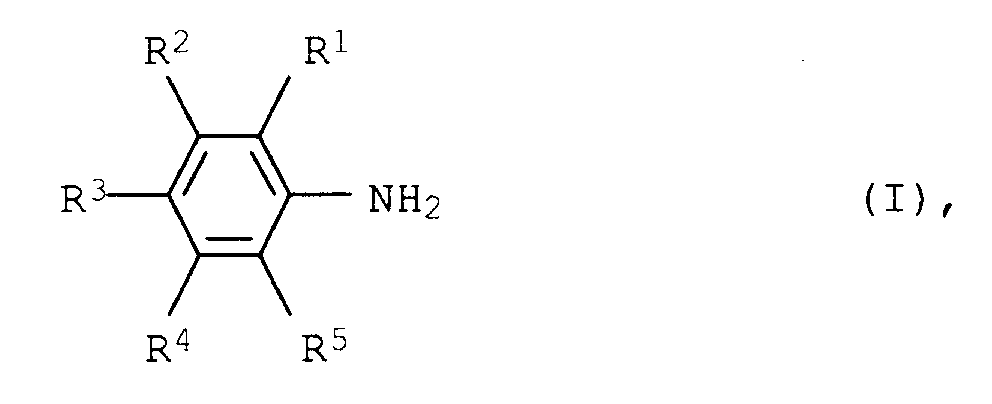
 a) Palladium auf Oxiden der seltenen Erden und/oder auf Oxiden der IV. Nebengruppe oderb) Platin/Palladium-Gemischen auf Aluminiumoxid und/oder Oxiden der seltenen Erden und/oder Oxiden der IV. Nebengruppeund 0 bis 70 Gew.-% Alkali- und/oder Erdalkalioxid besteht.
 - Verfahren zur Herstellung von aromatischen Aminen der Formel I nach Anspruch 1, dadurch gekennzeichnet, daß man die aliphatischen Amine der Formel II durch Umsetzung von Phenolen der allgemeinen Formel III

- Verfahren zur Herstellung von aromatischen Aminen der Formel I nach Anspruch 1, dadurch gekennzeichnet, daß man Heterogenkatalysatoren einsetzt, die aus 50 bis 100 Gew.-%a) Palladium auf Oxiden der seltenen Erden und/oder auf Oxiden der IV. Nebengruppe oderb) Platin/Palladium-Gemischen auf Aluminiumoxid und/oder Oxiden der seltenen Erden und/oder Oxiden der IV. Nebengruppeund 0 bis 50 Gew.-% Alkali- und/oder Erdalkalioxid bestehen.
- Verfahren zur Herstellung von aromatischen Aminen der Formel I nach Anspruch 1, dadurch gekennzeichnet, daß man Heterogenkatalysatoren einsetzt, die aus 70 bis 100 Gew.-%a) Palladium auf Oxiden der seltenen Erden und/oder auf Oxiden der IV. Nebengruppe oderb) Platin/Palladium-Gemischen auf Aluminiumoxid und/oder Oxiden der seltenen Erden und/oder Oxiden der IV. Nebengruppeund 0 bis 30 Gew.-% Alkali- und/oder Erdalkalioxid bestehen.
- Verfahren zur Herstellung von aromatischen Aminen der Formel I nach Anspruch 1, dadurch gekennzeichnet, daß man Heterogenkatalysatoren einsetzt, die als Oxid der selten Erden aus 30 bis 100 Gew.-% CeO₂ bestehen.
- Verfahren zur Herstellung von aromatischen Aminen der Formel I nach Anspruch 1, dadurch gekennzeichnet, daß man Heterogenkatalysatoren einsetzt, die als Oxid der selten Erden aus 30 bis 100 Gew.-% ZrO₂ bestehen.
- Verfahren zur Herstellung von aromatischen Aminen der Formel I nach Anspruch 1, dadurch gekennzeichnet, daß die Substituenten R¹, R², R³, R⁴ und R⁵ für Wasserstoff, C₁- bis C₈-Alkyl und C₅- bis C₈-Cycloalkyl stehen.
- Verfahren zur Herstellung von aromatischen Aminen der Formel I nach Anspruch 1, dadurch gekennzeichnet, daß die Substituenten R¹, R², R³, R⁴ und R⁵ für Wasserstoff, C₁- bis C₄-Alkyl und C₅- und C₆-Cycloalkyl stehen.
Applications Claiming Priority (2)
| Application Number | Priority Date | Filing Date | Title |
|---|---|---|---|
| DE4429014 | 1994-08-16 | ||
| DE4429014A DE4429014A1 (de) | 1994-08-16 | 1994-08-16 | Verfahren zur Herstellung von cyclischen Aminen |
Publications (3)
| Publication Number | Publication Date |
|---|---|
| EP0701995A2 true EP0701995A2 (de) | 1996-03-20 |
| EP0701995A3 EP0701995A3 (de) | 1996-05-22 |
| EP0701995B1 EP0701995B1 (de) | 1998-12-23 |
Family
ID=6525807
Family Applications (1)
| Application Number | Title | Priority Date | Filing Date |
|---|---|---|---|
| EP95112478A Expired - Lifetime EP0701995B1 (de) | 1994-08-16 | 1995-08-09 | Verfahren zur Herstellung von aromatischen Aminen aus aliphatischen Aminen sowie deren Herstellung durch aminierende Hydrierung |
Country Status (6)
| Country | Link |
|---|---|
| US (1) | US5663438A (de) |
| EP (1) | EP0701995B1 (de) |
| JP (1) | JPH08176075A (de) |
| AT (1) | ATE174897T1 (de) |
| DE (2) | DE4429014A1 (de) |
| ES (1) | ES2126818T3 (de) |
Cited By (7)
| Publication number | Priority date | Publication date | Assignee | Title |
|---|---|---|---|---|
| EP1053944A1 (de) | 1999-05-21 | 2000-11-22 | Groupe Guillin | Verpackungsverfahren sowie verpackung zum konservieren und/oder kochen oder aufwärmen von nahrungsmitteln |
| US6376103B1 (en) | 1995-10-03 | 2002-04-23 | Osram Sylvania Inc. | Advanced Mo-based composite powders for thermal spray applications |
| EP1231160A1 (de) | 2001-02-12 | 2002-08-14 | Sealed Air S.A.S. | Verpackung zum konservieren und kochen oder aufwärmen von Nahrungsmitteln |
| WO2006136571A1 (de) * | 2005-06-23 | 2006-12-28 | Basf Aktiengesellschaft | Verfahren zur kontinuierlichen herstellung eines amins |
| WO2006136573A1 (de) * | 2005-06-23 | 2006-12-28 | Basf Aktiengesellschaft | Verfahren zur kontinuierlichen herstellung eines amins |
| WO2007077148A1 (de) * | 2006-01-05 | 2007-07-12 | Basf Se | Verfahren zur kontinuierlichen herstellung eines primären aromatischen amins |
| WO2012034933A1 (de) | 2010-09-17 | 2012-03-22 | Basf Se | Verfahren zur herstellung von aromatischen aminen |
Families Citing this family (4)
| Publication number | Priority date | Publication date | Assignee | Title |
|---|---|---|---|---|
| DE19750789A1 (de) * | 1997-11-06 | 1999-05-20 | Beseitigung Von Umweltschaeden | Trägerkatalysator und Verfahren zur Herstellung von Fluorkohlenwasserstoffen |
| DE102011006685A1 (de) | 2010-04-06 | 2011-10-06 | Basf Se | Verfahren zur Herstellung von 2-Methyltetrahydrofuran aus 2-Methylfuran in der Flüssigphase |
| CN102731318B (zh) * | 2012-06-29 | 2016-01-20 | 华东理工大学 | 一种制备3,5-二甲基苯胺的方法 |
| CN105793341A (zh) | 2013-12-06 | 2016-07-20 | 巴斯夫欧洲公司 | 包含四氢呋喃衍生物和1,2-环己烷二甲酸酯的软化剂组合物 |
Citations (11)
| Publication number | Priority date | Publication date | Assignee | Title |
|---|---|---|---|---|
| DE2305495A1 (de) | 1972-02-07 | 1973-08-23 | Ciba Geigy Ag | Halogenacetanilide zur beeinflussung des pflanzenwachstums |
| DE2513732A1 (de) | 1974-04-02 | 1975-10-16 | Ciba Geigy Ag | Mikrobizide und wachstumsregulierende mittel |
| DE2515091A1 (de) | 1974-04-09 | 1975-10-23 | Ciba Geigy Ag | Mikrobizide mittel |
| DE2648008A1 (de) | 1976-10-23 | 1978-05-03 | Basf Ag | Acetanilide |
| EP0022751A1 (de) | 1979-07-13 | 1981-01-21 | Ciba-Geigy Ag | Verfahren zur Herstellung von 2,6-Dialkylcyclohexylaminen |
| EP0053891A1 (de) | 1980-12-04 | 1982-06-16 | Diemoulders Proprietary Limited | Apparat zum Ausgeben von Flüssigkeiten |
| EP0053818A1 (de) | 1980-12-04 | 1982-06-16 | BASF Aktiengesellschaft | Verfahren zur Herstellung von Cyclohexylaminen durch Hydrierung von aromatischen Aminen |
| EP0053699A1 (de) | 1980-12-05 | 1982-06-16 | BASF Aktiengesellschaft | 2'-Phenylhydrazino-2-cyanacrylsäureester und diese enthaltende Herbizide |
| DE3209148A1 (de) | 1982-03-13 | 1983-09-22 | Basf Ag, 6700 Ludwigshafen | Verfahren zur herstellung von pyrazolen durch katalytische dehydrierung von pyrazolinen |
| EP0167996A1 (de) | 1984-07-12 | 1986-01-15 | BASF Aktiengesellschaft | Verfahren zur Herstellung von cyclischen, am Ring substituierten primären Aminen |
| US5072044A (en) | 1990-11-30 | 1991-12-10 | E. I. Du Pont De Nemours And Company | Preparation of ortho-phenylenediamine |
Family Cites Families (1)
| Publication number | Priority date | Publication date | Assignee | Title |
|---|---|---|---|---|
| DE3039085A1 (de) * | 1980-10-16 | 1982-05-27 | Basf Ag, 6700 Ludwigshafen | Verfahren zur herstellung von primaeren aromatischen aminen aus cyclischen ketonen |
-
1994
- 1994-08-16 DE DE4429014A patent/DE4429014A1/de not_active Withdrawn
-
1995
- 1995-08-09 AT AT95112478T patent/ATE174897T1/de active
- 1995-08-09 EP EP95112478A patent/EP0701995B1/de not_active Expired - Lifetime
- 1995-08-09 DE DE59504619T patent/DE59504619D1/de not_active Expired - Lifetime
- 1995-08-09 ES ES95112478T patent/ES2126818T3/es not_active Expired - Lifetime
- 1995-08-15 JP JP7208244A patent/JPH08176075A/ja active Pending
- 1995-08-17 US US08/516,147 patent/US5663438A/en not_active Expired - Lifetime
Patent Citations (12)
| Publication number | Priority date | Publication date | Assignee | Title |
|---|---|---|---|---|
| DE2305495A1 (de) | 1972-02-07 | 1973-08-23 | Ciba Geigy Ag | Halogenacetanilide zur beeinflussung des pflanzenwachstums |
| DE2513732A1 (de) | 1974-04-02 | 1975-10-16 | Ciba Geigy Ag | Mikrobizide und wachstumsregulierende mittel |
| DE2515091A1 (de) | 1974-04-09 | 1975-10-23 | Ciba Geigy Ag | Mikrobizide mittel |
| DE2648008A1 (de) | 1976-10-23 | 1978-05-03 | Basf Ag | Acetanilide |
| EP0022751A1 (de) | 1979-07-13 | 1981-01-21 | Ciba-Geigy Ag | Verfahren zur Herstellung von 2,6-Dialkylcyclohexylaminen |
| EP0053891A1 (de) | 1980-12-04 | 1982-06-16 | Diemoulders Proprietary Limited | Apparat zum Ausgeben von Flüssigkeiten |
| EP0053818A1 (de) | 1980-12-04 | 1982-06-16 | BASF Aktiengesellschaft | Verfahren zur Herstellung von Cyclohexylaminen durch Hydrierung von aromatischen Aminen |
| EP0053817A1 (de) | 1980-12-04 | 1982-06-16 | BASF Aktiengesellschaft | Verfahren zur Herstellung von cycloaliphatischen Aminen |
| EP0053699A1 (de) | 1980-12-05 | 1982-06-16 | BASF Aktiengesellschaft | 2'-Phenylhydrazino-2-cyanacrylsäureester und diese enthaltende Herbizide |
| DE3209148A1 (de) | 1982-03-13 | 1983-09-22 | Basf Ag, 6700 Ludwigshafen | Verfahren zur herstellung von pyrazolen durch katalytische dehydrierung von pyrazolinen |
| EP0167996A1 (de) | 1984-07-12 | 1986-01-15 | BASF Aktiengesellschaft | Verfahren zur Herstellung von cyclischen, am Ring substituierten primären Aminen |
| US5072044A (en) | 1990-11-30 | 1991-12-10 | E. I. Du Pont De Nemours And Company | Preparation of ortho-phenylenediamine |
Cited By (11)
| Publication number | Priority date | Publication date | Assignee | Title |
|---|---|---|---|---|
| US6376103B1 (en) | 1995-10-03 | 2002-04-23 | Osram Sylvania Inc. | Advanced Mo-based composite powders for thermal spray applications |
| EP1053944A1 (de) | 1999-05-21 | 2000-11-22 | Groupe Guillin | Verpackungsverfahren sowie verpackung zum konservieren und/oder kochen oder aufwärmen von nahrungsmitteln |
| FR2793771A1 (fr) | 1999-05-21 | 2000-11-24 | Philippe Beaufils | Procede de conditionnement et conditionnement pour la conservation et/ou la cuisson ou le rechauffage de produits alimentaires |
| WO2000071421A1 (fr) | 1999-05-21 | 2000-11-30 | Groupe Guillin | Procede de conditionnement et conditionnement pour la conservation et/ou la cuisson ou le rechauffage de produits alimentaires |
| EP1231160A1 (de) | 2001-02-12 | 2002-08-14 | Sealed Air S.A.S. | Verpackung zum konservieren und kochen oder aufwärmen von Nahrungsmitteln |
| WO2006136571A1 (de) * | 2005-06-23 | 2006-12-28 | Basf Aktiengesellschaft | Verfahren zur kontinuierlichen herstellung eines amins |
| WO2006136573A1 (de) * | 2005-06-23 | 2006-12-28 | Basf Aktiengesellschaft | Verfahren zur kontinuierlichen herstellung eines amins |
| US7767855B2 (en) | 2005-06-23 | 2010-08-03 | Basf Se | Method for the continuous production of an amine |
| WO2007077148A1 (de) * | 2006-01-05 | 2007-07-12 | Basf Se | Verfahren zur kontinuierlichen herstellung eines primären aromatischen amins |
| WO2012034933A1 (de) | 2010-09-17 | 2012-03-22 | Basf Se | Verfahren zur herstellung von aromatischen aminen |
| EP2439189A1 (de) | 2010-09-17 | 2012-04-11 | Basf Se | Verfahren zur Herstellung von aromatischen Aminen |
Also Published As
| Publication number | Publication date |
|---|---|
| ES2126818T3 (es) | 1999-04-01 |
| ATE174897T1 (de) | 1999-01-15 |
| EP0701995A3 (de) | 1996-05-22 |
| DE59504619D1 (de) | 1999-02-04 |
| JPH08176075A (ja) | 1996-07-09 |
| EP0701995B1 (de) | 1998-12-23 |
| US5663438A (en) | 1997-09-02 |
| DE4429014A1 (de) | 1996-02-22 |
Similar Documents
| Publication | Publication Date | Title |
|---|---|---|
| EP0697395B1 (de) | Verfahren zur Herstellung von Diaminen durch katalytische Aminierung von Aminoalkoholen | |
| EP0053818A1 (de) | Verfahren zur Herstellung von Cyclohexylaminen durch Hydrierung von aromatischen Aminen | |
| EP0701995B1 (de) | Verfahren zur Herstellung von aromatischen Aminen aus aliphatischen Aminen sowie deren Herstellung durch aminierende Hydrierung | |
| DE1200821B (de) | Verfahren zur Hydrierung von carbonylgruppen-freien organischen Verbindungen | |
| EP0324984A1 (de) | Verfahren zur Herstellung eines Gemisches aus Cyclohexylamin und Dicyclohexylamin unter Einsatz eines Ruthenium-Katalysators | |
| DE1289530B (de) | Verfahren zur Herstellung von Aminobenzolen | |
| EP1081130B1 (de) | Verfahren zur Herstellung von Alkanolaminen mit verbesserter Farbqualität | |
| EP0796839B1 (de) | Verfahren zur Herstellung eines Gemisches von Amino-methyl-cyclohexanen und Diamino-methyl-cyclohexanen | |
| DE3130082C2 (de) | Verfahren zur Herstellung von 2-Aminopropandiol-(1,3)(Serinol) | |
| EP0351661A1 (de) | Ruthenium-Trägerkatalysator, seine Herstellung und sein Einsatz bei der Herstellung von gegebenenfalls substituiertem Cyclohexylamin und gegebenenfalls substituiertem Dicyclohexylamin | |
| EP0602499B1 (de) | Verfahren zur Herstellung eines Gemisches von Cyclohexanon und Cyclohexanol | |
| DE2249089C2 (de) | Verfahren zur Herstellung von gegebenenfalls substituiertem Diphenylamin | |
| EP0501265A1 (de) | Verfahren zur Herstellung eines Gemisches aus Cyclohexylamin und Dicyclohexylamin unter Einsatz eines Edelmetall-Trägerkatalysators | |
| EP0347796B1 (de) | Verfahren zur Herstellung von 4-Chlor-2,5-dimethoxyanilin | |
| EP0446783B1 (de) | Verfahren zur Herstellung von N-aryl-substituierten 2-Aminoalkyl-2-hydroxy-alkylaminen und N-arylsubstituierten Piperazinen | |
| EP0535484A2 (de) | Verfahren zur Herstellung von Diphenylaminen | |
| EP0494455A1 (de) | Verfahren zur Herstellung von Diphenylaminen | |
| EP0167996A1 (de) | Verfahren zur Herstellung von cyclischen, am Ring substituierten primären Aminen | |
| EP1291081B1 (de) | Verfahren zur Herstellung von Pyrrolen | |
| CH618619A5 (de) | ||
| EP0503347A1 (de) | Verfahren zur Herstellung eines Gemisches von, gegebenenfalls substituiertem, Cyclohexylamin und gegebenenfalls substituiertem Dicyclohexylamin unter Ver- wendung eines Palladium/Al2O3 Katalysators. | |
| DE2214512A1 (de) | ||
| DE3783762T2 (de) | Verfahren zur herstellung von anilinen, katalysator dazu und verfahren zur herstellung des katalysators. | |
| EP0010245B1 (de) | Verfahren zur Herstellung von epsilon-Caprolactam durch katalytische Umlagerung von Cyclohexanonoxim | |
| EP0507118B1 (de) | Verfahren zur Herstellung von aromatischen Aminen |
Legal Events
| Date | Code | Title | Description |
|---|---|---|---|
| PUAI | Public reference made under article 153(3) epc to a published international application that has entered the european phase |
Free format text: ORIGINAL CODE: 0009012 |
|
| AK | Designated contracting states |
Kind code of ref document: A2 Designated state(s): AT BE CH DE ES GB IT LI NL |
|
| PUAL | Search report despatched |
Free format text: ORIGINAL CODE: 0009013 |
|
| AK | Designated contracting states |
Kind code of ref document: A3 Designated state(s): AT BE CH DE ES GB IT LI NL |
|
| 17P | Request for examination filed |
Effective date: 19960424 |
|
| 17Q | First examination report despatched |
Effective date: 19970424 |
|
| GRAG | Despatch of communication of intention to grant |
Free format text: ORIGINAL CODE: EPIDOS AGRA |
|
| GRAG | Despatch of communication of intention to grant |
Free format text: ORIGINAL CODE: EPIDOS AGRA |
|
| GRAH | Despatch of communication of intention to grant a patent |
Free format text: ORIGINAL CODE: EPIDOS IGRA |
|
| GRAH | Despatch of communication of intention to grant a patent |
Free format text: ORIGINAL CODE: EPIDOS IGRA |
|
| GRAA | (expected) grant |
Free format text: ORIGINAL CODE: 0009210 |
|
| AK | Designated contracting states |
Kind code of ref document: B1 Designated state(s): AT BE CH DE ES GB IT LI NL |
|
| REF | Corresponds to: |
Ref document number: 174897 Country of ref document: AT Date of ref document: 19990115 Kind code of ref document: T |
|
| REG | Reference to a national code |
Ref country code: CH Ref legal event code: EP |
|
| REF | Corresponds to: |
Ref document number: 59504619 Country of ref document: DE Date of ref document: 19990204 |
|
| GBT | Gb: translation of ep patent filed (gb section 77(6)(a)/1977) |
Effective date: 19990115 |
|
| ITF | It: translation for a ep patent filed | ||
| REG | Reference to a national code |
Ref country code: ES Ref legal event code: FG2A Ref document number: 2126818 Country of ref document: ES Kind code of ref document: T3 |
|
| PLBE | No opposition filed within time limit |
Free format text: ORIGINAL CODE: 0009261 |
|
| STAA | Information on the status of an ep patent application or granted ep patent |
Free format text: STATUS: NO OPPOSITION FILED WITHIN TIME LIMIT |
|
| 26N | No opposition filed | ||
| REG | Reference to a national code |
Ref country code: GB Ref legal event code: IF02 |
|
| PGFP | Annual fee paid to national office [announced via postgrant information from national office to epo] |
Ref country code: AT Payment date: 20130828 Year of fee payment: 19 Ref country code: ES Payment date: 20130926 Year of fee payment: 19 Ref country code: NL Payment date: 20130822 Year of fee payment: 19 |
|
| PGFP | Annual fee paid to national office [announced via postgrant information from national office to epo] |
Ref country code: GB Payment date: 20130902 Year of fee payment: 19 |
|
| PGFP | Annual fee paid to national office [announced via postgrant information from national office to epo] |
Ref country code: IT Payment date: 20130822 Year of fee payment: 19 |
|
| PGFP | Annual fee paid to national office [announced via postgrant information from national office to epo] |
Ref country code: BE Payment date: 20130926 Year of fee payment: 19 |
|
| PGFP | Annual fee paid to national office [announced via postgrant information from national office to epo] |
Ref country code: CH Payment date: 20140826 Year of fee payment: 20 |
|
| PGFP | Annual fee paid to national office [announced via postgrant information from national office to epo] |
Ref country code: DE Payment date: 20141031 Year of fee payment: 20 |
|
| REG | Reference to a national code |
Ref country code: NL Ref legal event code: V1 Effective date: 20150301 |
|
| REG | Reference to a national code |
Ref country code: AT Ref legal event code: MM01 Ref document number: 174897 Country of ref document: AT Kind code of ref document: T Effective date: 20140809 |
|
| GBPC | Gb: european patent ceased through non-payment of renewal fee |
Effective date: 20140809 |
|
| PG25 | Lapsed in a contracting state [announced via postgrant information from national office to epo] |
Ref country code: IT Free format text: LAPSE BECAUSE OF NON-PAYMENT OF DUE FEES Effective date: 20140809 Ref country code: NL Free format text: LAPSE BECAUSE OF NON-PAYMENT OF DUE FEES Effective date: 20150301 Ref country code: BE Free format text: LAPSE BECAUSE OF NON-PAYMENT OF DUE FEES Effective date: 20140831 |
|
| PG25 | Lapsed in a contracting state [announced via postgrant information from national office to epo] |
Ref country code: AT Free format text: LAPSE BECAUSE OF NON-PAYMENT OF DUE FEES Effective date: 20140809 |
|
| PG25 | Lapsed in a contracting state [announced via postgrant information from national office to epo] |
Ref country code: GB Free format text: LAPSE BECAUSE OF NON-PAYMENT OF DUE FEES Effective date: 20140809 |
|
| REG | Reference to a national code |
Ref country code: DE Ref legal event code: R071 Ref document number: 59504619 Country of ref document: DE |
|
| REG | Reference to a national code |
Ref country code: CH Ref legal event code: PL |
|
| REG | Reference to a national code |
Ref country code: ES Ref legal event code: FD2A Effective date: 20150925 |
|
| PG25 | Lapsed in a contracting state [announced via postgrant information from national office to epo] |
Ref country code: ES Free format text: LAPSE BECAUSE OF NON-PAYMENT OF DUE FEES Effective date: 20140810 |