EP0702310B1 - Système de recouvrement de données, système de traitement de données, procédé de recouvrement de données et procédé de traitement de données - Google Patents
Système de recouvrement de données, système de traitement de données, procédé de recouvrement de données et procédé de traitement de données Download PDFInfo
- Publication number
- EP0702310B1 EP0702310B1 EP95114379A EP95114379A EP0702310B1 EP 0702310 B1 EP0702310 B1 EP 0702310B1 EP 95114379 A EP95114379 A EP 95114379A EP 95114379 A EP95114379 A EP 95114379A EP 0702310 B1 EP0702310 B1 EP 0702310B1
- Authority
- EP
- European Patent Office
- Prior art keywords
- node
- interval
- binary tree
- length
- nodes
- Prior art date
- Legal status (The legal status is an assumption and is not a legal conclusion. Google has not performed a legal analysis and makes no representation as to the accuracy of the status listed.)
- Expired - Lifetime
Links
Images


























Classifications
-
- G—PHYSICS
- G06—COMPUTING OR CALCULATING; COUNTING
- G06F—ELECTRIC DIGITAL DATA PROCESSING
- G06F16/00—Information retrieval; Database structures therefor; File system structures therefor
- G06F16/90—Details of database functions independent of the retrieved data types
- G06F16/903—Querying
- G06F16/90335—Query processing
- G06F16/90344—Query processing by using string matching techniques
-
- Y—GENERAL TAGGING OF NEW TECHNOLOGICAL DEVELOPMENTS; GENERAL TAGGING OF CROSS-SECTIONAL TECHNOLOGIES SPANNING OVER SEVERAL SECTIONS OF THE IPC; TECHNICAL SUBJECTS COVERED BY FORMER USPC CROSS-REFERENCE ART COLLECTIONS [XRACs] AND DIGESTS
- Y10—TECHNICAL SUBJECTS COVERED BY FORMER USPC
- Y10S—TECHNICAL SUBJECTS COVERED BY FORMER USPC CROSS-REFERENCE ART COLLECTIONS [XRACs] AND DIGESTS
- Y10S707/00—Data processing: database and file management or data structures
- Y10S707/99951—File or database maintenance
- Y10S707/99952—Coherency, e.g. same view to multiple users
- Y10S707/99953—Recoverability
Definitions
- This invention relates to data processing systems and data processing methods which process data of a code string in order to find all the occurrences of a specified key string in the code string. More specifically, the invention relates to such data processing systems and methods which use a binary tree to represent the data of the code string.
- a code string retrieval technique may be applied to dictionaries and indexes; more specifically, it is applied to the pattern matching in a text editor, text database, and voice recognition, to pattern analysis in such fields as DNA study, or to substitutional coding.
- the simplest code string retrieval method is to match a key string against a code string sequentially from the beginning to the end. However, in this method, the retrieval time increases as the character string s becomes longer.
- a Trie is a tree data structure consisting of a root, a plurality of nodes, and ends, and a sequence of labels attached to each edge between each two nodes from the root to an end node (leaf) constitute the character string wi.
- a leaf corresponds to the character string wi (a full character string).
- a character string generated by the labels on the path from the root to a node x is considered to be a prefix (a leading substring) of a character string generated by the labels from the root to a leaf.
- Data structures that have been used in data retrieval are based on the Trie described above.
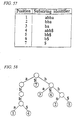
- a position tree one of data structures, is a Trie which uses substring identifiers, each starting at each sequential position of the code string s, as character strings.
- a substring identifier is defined as the shortest unique character string starting at each sequential position.
- Figure 57 is an example of table (dictionary) containing positions and substring identifiers for the code string "abbabb$". In this figure, the symbol $ is a dummy code appended at the end of the code string to identify the position.
- Figure 58 is an example of a position tree representing the dictionary for the code string "abbabb$".
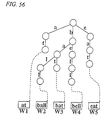
- a suffix tree is a Trie which uses a suffix (a trailing substring) of the code string s as the character string wi.
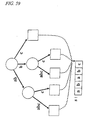
- Figure 59 shows an example of a suffix tree.
- a suffix tree is the simplest form of a Trie. That is, a suffix tree is a tree structure T in which the labels, each attached to a path from the root to a leaf (end node), generate a suffix of the code string s.
- a leaf corresponds to the end of a suffix (end of s).
- T consists of all combinations of paths from the root to a leaf, and includes all the generated suffixes.
- a path from the root to a leaf via the node x corresponds to a suffix of the code string s with a character string generated from the root to the node x as a prefix.
- a directed acyclic word graph is a graph created by merging particular paths of a suffix tree.
- Figure 60 shows an example of a directed acyclic word graph.
- a Trie reflects all the suffixes of the code string s. Therefore, if only a part of the code string s is changed, all the suffixes before the changed character are affected and so the whole Trie is affected. This is more prominent as the changed character is closer to the end of the code string s.
- Another known method is to divide a code string into a plurality of substrings and, for each of them, a Trie is created individually.
- This method there are two problems with this method.
- One problem is that, if a portion of the code string corresponding to the key string is divided and if the first half belongs to one Trie and the last half to another, it is impossible to search for that portion with the key string.
- Another problem is that, for a variable-length substring, data processing such as editing or retrieval cannot be done efficiently. For example, a substring changes and variable in length when edited. So, to process a substring, it is always necessary to match a substring with a particular position within the code string.
- a substring is difficult to process not only in data retrieval but also in many other data processing fields such as data compression or character string editing. Editing of a character string (sentence) is an example of data processing of substrings.
- the position of a data item in a data string is not always discrete; it is not always "n-th position" as in the above character string; in many cases, an interval represented by a real number in the floating-point format is used to specify a range of one data value.
- the value of a signal from a circuit is represented by L (low), H (high), and F (floating, undefined).
- 0 is stored in the interval [1..3], N in the interval [4..5], 0 in the interval [6..9], 1 in the interval [10..15], and 0 in the interval [16..16].
- a code string is divided into a sequence of code strings of the same value, that is, into intervals.
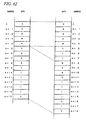
- Figure 61 shows how the code string in Table 1 is represented in the first method.
- the position of each code value is proportional to the difference between the address of storage at which the code value is stored and the start address of storage where the code string is stored. This makes it possible to identify the address of a particular code value by performing usual calculation (add, subtract, multiply, and divide).
- Another method is to store pairs, each consisting of a code value and a range of a substring where that code consecutively occurs, in a consecutive storage area in the order in which the substrings appear (second method).
- Figure 63 shows the code string in Table 1 stored in the second method.
- the amount of memory depends on the number of consecutive code value intervals. That is, it depends, not on the number of positions, but on the number of intervals, increasing the memory efficiency.
- a continuous range of code values can be identified by data.
- length precision discrete or continuous
- floating-point numbers may be processed easily.
- a binary search tree is conveniently used in the binary search method.
- a substring at the center of a code string is used as the root node.
- Each node is assigned a substring range data as well as the code value of the substring.
- Substring data may be represented by the start point and the end point of the range or only by the start point of the range with the end point obtaining from the start point of the next substring.
- Figure 64 shows an example of a sub-tree corresponding to the data in Table 1. In this figure, to each node the start point of the corresponding substring (in the circle) and the code value of the substring (below the circle) are assigned.
- a sub-tree consisting of nodes that are at the end, one of them (for example, the node at the left) corresponds to the substring preceding the above-described node and the right sub-tree corresponds to the substring that follows the above-described node.
- the position of a substring s changed, it is necessary to change all the data following the change point.
- Figure 65 is an example of data stored in the conventional third method.
- An advantage of this method is that, when a substring is expanded or reduced, only the length of the interval of the expanded or reduced substring need be changed.
- a disadvantage of this method is that, when obtaining the code at a particular position, the lengths of the intervals from the start or the end to the corresponding position must be added up.
- the binary search method cannot be used because information about a particular interval gives us only the information about the length of the interval.
- Figure 66 shows a data structure represented in the fourth method.
- the fourth method eliminates the need for transferring data in memory when adding, deleting, dividing, or merging one or more intervals. However, to locate a particular position, this method still requires us to add up the lengths of intervals.
- This invention seeks to solve the problems of the prior art described above.
- This data processing system and data processing method are particularly suitable for implementing the above described data retrieval system and data retrieval method. More specifically, it is another object of this invention to provide a data processing system and a data processing method which allow us to update data simply. It is another object of this invention to provide a data processing system and a data processing method which use memory efficiently.
- an invention according to claim 1 is a data processing system for processing data of a code string divided into a sequence of intervals each having a length defined by the number of code elements in the interval in order to find a specified position in said code string, said data processing system comprising a binary tree generating means for generating a binary tree having a plurality of nodes representing respective positions of said intervals in said code string, said nodes being allocated to respective ones of said intervals in said code string, said nodes being connected from a root node of said tree to leaf nodes thereof in a tree-like structure, each node between said root node and said leaf nodes being a root node of a sub-tree and being connected to a preceding node defined as the left-child node corresponding to an interval in said code string preceding the interval corresponding to the node in question and/or to a following node defined as the right-child node corresponding to an interval in said code string corresponding to an interval in said code string following the interval corresponding to the node
- the invention of claim 20 realizes the invention of claim 1 from a methodological standpoint and is a data processing method for processing data of a code string divided into a sequence of intervals each having a length.defined by the number of code elements in the interval in order to find a specified position in said code string, said data processing method comprising a binary tree generating process for generating a binary tree having a plurality of nodes representing respective positions of said intervals in said code string, said nodes being allocated to respective ones of said intervals in said code string, said nodes being connected from a root node of said tree to leaf nodes thereof in a tree-like structure, each node between said root node and said leaf nodes being a root node of a sub-tree and being connected to a preceding node defined as the left-child node corresponding to an interval in said code string preceding the interval corresponding to the node in question and/or to a following node defined as the right-child node corresponding to an interval in said code string following the interval corresponding to the node
- the position of a node interval within the code string can be calculated, during retrieval or some other processing, based on the interval length of the preceding (following) node.
- the net interval length of a node can be calculated by subtracting the total of the interval lengths of the preceding and following nodes from the partial interval length of the node. Therefore, the code element at a specific position within a code string can be identified easily by comparing the specified position with the position and the interval length of each node.
- the positional relation among nodes can be represented by the relation among nodes, the position of each node being calculated by the partial interval length of other nodes. This means that a change in part of an interval affects only the changed node and one or more nodes on the path from that node to the root, thus simplifying the change procedure.
- the interval retrieving means identifies an interval in which a specified position is included by moving the current node sequentially from the root to lower-level nodes, one level at a time, to compare the range of the current node with the specified position.
- claims 2 and 21 can be symmetrically applied by calculating the range of the current node based on the length of the following node.
- the (net) interval length of a node and the partial interval length of the preceding node or the following node of the node is added up as the current node is moved from the specified node to the root node, one node at a time.
- This process determines the position of the specified node through the interval lengths of the nodes that are right or left to the specified node in L-C-R order. According to the invention as claimed in claims 3 and 22, this simple procedure provided allows the position of the specified node to be identified, making it possible to perform various types of processing.
- the interval of the specified node is easily identified; that is, the beginning position is the position following (+1) the partial interval length of the left child of the specified node and the terminating position is the position determined by subtracting the partial interval length of the right child of the specified node from the partial interval length of the specified node.
- An invention according to claim 5 is a data processing system as claimed in claim 1, further comprising binary tree updating means for updating the binary tree, when the interval is changed, according to the contents of the change.
- the invention of claim 23 realizes the invention of the claim 5 from a methodological standpoint and is a data processing method as claimed in claim 20, 21, or 22, further comprising a binary tree updating process for updating said binary tree, when said interval is changed, according to the contents of the change.
- the binary tree updating means updates a binary tree when an interval is changed, eliminating the need to re-generates the binary tree.
- An invention according to claim 6 is a data processing system as claimed in claim 5, wherein the binary tree updating means comprises: interval length changing means for changing the interval length; deleting means for deleting the node corresponding to a deleted interval from the binary tree when the interval is deleted; and adding means for adding a node corresponding to an added interval when an interval is added.
- the interval length changing means, the deleting means, or the adding means updates the binary tree when an interval length is changed, an interval is deleted, or an interval is added. Combining these means allows complex processing to be performed; for example, the intervals in a code string may be exchanged.
- the data processing system eliminates the need to move all the nodes corresponding to the intervals following the changed node, enhancing data processing efficiency.
- processing is simplified because there is no need to change the partial interval lengths except that for the root.
- An invention according to claim 9 is a data processing system as claimed in claim 6, wherein the adding means adds the node corresponding to the interval, which is to be added, to the binary tree, adjusts the connection sequence of the nodes, and adjusts the interval length of each node.
- the adding means adjusts the connection sequence and interval lengths of nodes to maintain the integrity of a binary tree.
- the interval lengths are adjusted simply by adding the length of the added interval to each node on the path from the parent of the added node to the root.
- An invention according to claim 11 is a data processing system as claimed in claim 6, wherein said adding means comprises means to move the node immediately preceding and following a position, at which a node is to be added, to said root node by means of splaying one at a time, means to add said node corresponding to an interval, which is to be added, at a position immediately following said immediately-preceding node or at a position immediately before said immediately-following node, and means to add the interval length of the added node to the partial interval length of said immediately-preceding or immediately-following node or said added node, as necessary.
- processing is simplified because partial interval lengths need be changed (increased) only for a small number of nodes including the root node.
- An invention according to claim 12 is a data processing system as claimed in claim 6, wherein said adding means comprises means to add said node corresponding to said interval, which is to be added, to said binary tree with the interval length of the node being 0, means to move the added node to the root node of said binary tree by means of splaying, and means to increase the partial interval length of the node, moved to the root, by the interval length of the added interval.
- processing is performed speedily because the partial interval length of a node need be increased only once using the desired addition algorithm.
- An invention according to claim 13 is a data processing system as claimed in claim 6, wherein the deleting means comprises means for deleting from the binary tree the node of the interval to be deleted, means for adjusting the connection among the nodes, and adjusts the interval length of each node.
- the deleting means adjusts the node connection sequence and the interval lengths to maintain the integrity, such as the sequence of the remaining intervals, of the binary tree.
- An invention according to claim 14 is a data processing system as claimed in claim 6, wherein said deleting means comprises means for moving said node corresponding to said interval, which is to be deleted, to the root node by means of splaying, means for moving the node immediately preceding or following the node, which is to be deleted, to the root node by means of splaying, means for decreasing the partial interval length of said immediately-preceding or immediately-following node, which is the root node, by the interval length of said node to be deleted, and means for deleting said node to be deleted.
- processing is performed speedily because only the node of the root need be adjusted during deletion.
- An invention according to claim 15 is a data processing system as claimed in claim 5, further comprising structure adjusting means for adjusting the structure of the binary tree by changing the connection sequence of the nodes.
- the invention of claim 25 realizes the invention of the claim 15 from a methodological standpoint and is a data processing method as claimed in claim 23, further comprising a structure adjusting process for adjusting the structure of said binary tree by changing the connection sequence of said nodes.
- the structure adjustment prevents only a particular part of the binary tree from being increased, making a plurality of paths, each from the root to a node, approximately equal in length. In this way, it prevents the data processing time from being increased just because the associated path is too long, thereby making various types of data processing, such as retrieval or update, more efficient.
- the structure adjustment is performed according to the status of the binary tree, because a plurality of processing types are combined to change the structure of a specified range of the binary tree.
- An invention according to claim 17 is a data processing system as claimed in claim 15, wherein said structure adjusting means comprises means for adjusting said binary tree by means of splaying through which a target node, which is any of said nodes, is moved to said root node.
- a target node is moved to the root by means of splaying and, at the same time, the length of a path from a node, which is on the path from the target node to the original root, is reduced in most cases. Because of this, various types of processing for the binary tree is performed speedily.
- one type of binary tree representing the sequence of lines and another type of tree representing the content of each line are created separately. Therefore, when either the sequence of lines or the content of a line is changed, there is no need for changing the other type of binary tree. This ensures efficient code string processing.
- data can be represented as a single simply-structured binary tree.
- representing consecutive characters or blanks with a single node increases both processing efficiency and memory efficiency.
- Each "means” mentioned in this specification refers to a conceptual equivalent of each function of this embodiment; that is, there is not always a one-to-one correspondence between means and particular pieces of hardware or software routines.
- One piece of hardware sometimes comprises different means.
- a computer serves as a means when executing an instruction, but serves as another means when executing another instruction.
- one means may be implemented by one instruction in some cases, but by a plurality of instructions in some other cases.
- the computer used in the embodiment usually consists of the CPU (central processing unit) and main storage composed of RAM (random-access memory).
- CPU central processing unit
- main storage composed of RAM (random-access memory).
- the computer has input devices such as a keyboard and a mouse, external storage units such as a hard disk, output devices such as a CRT display or a printer, and other required input/output control circuits.
- input devices such as a keyboard and a mouse
- external storage units such as a hard disk
- output devices such as a CRT display or a printer
- the computer may be built in any configuration, and one or more components may be added, changed or removed as far as the configuration does not depart from the characteristics of this invention.
- the embodiment may be built on a computer network to which a plurality of computers are connected.
- Any type of CPU may be used, a plurality of CPUs may be used at the same time, or a single CPU may be used in the time-sharing manner to process a plurality of processes concurrently.
- Other types of input device pointing devices such as a touch panel, light pen, and track ball, image input devices such as a digitizer, image reader, and video camera, voice recognition devices, or various types of sensors
- pointing devices such as a touch panel, light pen, and track ball
- image input devices such as a digitizer, image reader, and video camera, voice recognition devices, or various types of sensors
- Other external storage devices floppy disk device, RAM card reader, magnetic tape device, optical disk device, magneto-optical (MO) disk device, bubble memory device, and flash memory card
- Other output devices liquid crystal display, plasma display device, video projector, LED display device, voice generator, and voice synthesizer
- a program executing each function of this embodiment runs as an application program under the operating system (OS).
- OS operating system
- the machine language generated by compiling a program coded in a high-level language or assembler is used.
- the software configuration of this computer is free, and may be changed as far as this invention is implemented.
- the OS need not always be used, and any programming language may be used.
- An interpreter such as BASIC may be used to code a program.
- the program may be stored on any storage device. It may be in ROM (Read-Only Memory) or it may be on an external storage device such as a hard disk; in the latter case, the program is loaded (read) into main memory when the computer or the process is started.
- the program may be divided into a plurality of modules which are stored on an external storage device. In this case, only the modules necessary for processing are read into main memory. Each program module may be stored on a storage device most suitable for it.
- sequence of steps of a procedure used in this embodiment may be changed, a plurality of steps may be executed concurrently, or the steps may be executed in a different sequence each time the program is executed, as far as the steps do not depart from the characteristics of this invention.
- the ability to change the sequence of execution is implemented by the menu-driven interface which allows the user to select processing he wants to execute.
- the "input” mentioned in this specification implies not only the input of data but also other types of processing closely related with data input. They include the echo-back, modification, and editing of entered data.
- the "output” mentioned in this specification implies not only the output of data but also other types of processing closely related with data output. They include the entry of ranges to be output or instruction of screen scrolling. Also, input and output may be integrated into an interactive input/output operation and, through this integrated operation, the user may select, specify or identify processing to be performed.
- Data (information) or data storage means mentioned in this specification may exist on the computer in any form.
- data which is described in this specification to reside on a hard disk, may be in main storage, an external storage unit, CPU register, or cache memory.
- data may be held in any form.
- data may be stored in a file or in memory or a disk to allow direct access by means of physical addresses.
- the code of a character string may be represented in characters or words.
- Data may be stored for any period of time; it may be volatile after a specified time. Data not to be changed, for example dictionary data, may be stored in ROM.
- references in this specification to a specific item do not imply that only that item is used. That is, in this invention, general items needed for the operation of this invention, such as pointers, counters, flags, parameters, and buffers are used as necessary.
- information necessary for each portion of this embodiment is obtained from other portions holding the information.
- information may be obtained by accessing variables or memory holding necessary information.
- Information may be erased or deleted, not only by deleting the information from a storage area, but also by setting a flag indicating the erasure of the information.
- the first embodiment corresponds to a data processing system (corresponds to claims 1 - 17) and a data processing method (corresponds to claims 20 - 25) that is executed on this data processing system.
- Figure 1 is a block diagram showing the configuration of the first embodiment.
- This data processing system and a data processing method are particularly suitable for implementing the data retrieval system and the data retrieval method described above. That is, the data processing system and the data processing method in the first embodiment use a substring as an interval to further increase efficiency of various types of processing including data retrieval.
- the data processing system and the data processing method in this embodiment use, not a code string, but first and second substrings of a code string.
- the data processing system in the first embodiment has the binary tree generating means 32 for generating the binary tree 31 representing the range of each interval based on the intervals in a code string, the interval retrieving means 33 for retrieving an interval corresponding to the specified position according to the binary tree 31, and the binary tree updating means 34 for updating the binary tree 31 according to the contents of a change when an interval is changed.
- the binary tree updating means 34 has the interval length changing means 41 for changing an interval length, the deleting means 42 for deleting a node corresponding to a deleted interval, and the adding means 43 for adding a node corresponding to an added interval.
- the data processing system in the sixth embodiment has the structure adjusting means 45 for adjusting the structure of a binary tree by changing the connection sequence of the nodes.
- the first embodiment which has the above configuration performs the following operation: that is, it allows the user to store a code string containing a plurality of intervals, to obtain a code value at a specific position within a code string, and to edit a code string as he or she wants.
- the binary tree generating means 32 generates the binary tree 31 representing the range of each interval according to the intervals in the code string.
- the binary tree may also be generated, with the use of the adding means 43, by adding a node each time an interval is entered.
- a code string and the intervals may be entered, for example, via the keyboard.
- the binary tree 31 is a tree-like data structure consisting of nodes, each corresponding to an interval, connected from the root to the ends. On the end side of each node, the preceding node, which corresponds to the preceding interval of the node and/or the following node, which corresponds to the following interval of the node, is connected. And, in each node, the sum of the interval length of the node itself and the total interval length of the nodes on the end side of the node (sub-tree), is set. This sum is called a partial interval length.
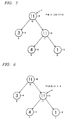
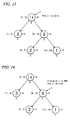
- Figure 2 shows an example of the binary tree 31 used in the first embodiment
- Figure 3 explains the binary tree 31 in Figure 2.
- the binary tree 31 in the first embodiment is a tree, consisting of nodes A, B, C, D, and E corresponding to the intervals [1..3], [4..5], [6..9], [10..15], and [16..16] respectively, connected with node B as the root.
- node A corresponding to the interval [1..3] which precedes node B and nodes D, C, and E corresponding to the intervals which follow node B are connected.
- node C corresponding to the interval which precedes node D and node E corresponding to the interval which follows node D are connected.
- the partial interval lengths 3, 16, 4, 11, and 1 each representing the sum of the length of the node itself and the total of the lengths of the nodes on the end side of that node are set.
- the sum (11) of the length (6) of the interval [10..15] corresponding to. node D and the total of the lengths (4 and 1) of the intervals [6..9] and [16..16] is set.
- the data processing system in the first embodiment which has one node for each interval as described above, requires as many data blocks as intervals and so eliminates the need to use as many memory units as there are codes (positions), thereby increasing memory usage efficiency.
- a binary tree in which data storage areas for the nodes are connected by pointers does not require a large consecutive area and therefore uses memory efficiently.
- the ability to use a precision most suitable for each interval allows the user to use any type of interval data such as floating-point data.
- the position of the interval of a node can be calculated, during retrieval or some other processing, based on the interval length of the preceding (following) node.
- the net interval length of a node can be calculated by subtracting the total of the interval lengths of the preceding and following nodes, contained in the sub-tree connected to the node, from the partial interval length of the node.
- the interval length of the preceding (following) node can be obtained from the partial interval length of the left (right) child. Therefore, the code at a specific position within a code string can be identified easily by comparing the specified position with the position and the interval length of each node.
- the interval position of a node can be calculated by the total of the interval lengths of the preceding (following) nodes.
- the positional relation among nodes can be represented by the relation among nodes, the position of each node being calculated by the partial interval length of other nodes.
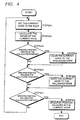
- Figure 4 is a flowchart showing the retrieval procedure used by the data processing system in the first embodiment.
- the interval retrieving means 33 performs the following procedure while moving the current node pointed to by the pointer from the root (step 241) to lower-level nodes, one level at a time.
- the interval retrieving means 33 calculates the range of the current node based on the interval lengths of the current node and the lower-level nodes (step 242), and compares the calculated range with the specified position. If the specified position precedes the calculated range (step 243), the interval retrieving means 33 moves the current node to the preceding node (step 244); if the specified position follows the calculated range (step 245), the interval retrieving means 33 moves the current node to the following node (step 246); if the specified position is included in the calculated range (step 247), the specified range is included in the current node (step 248).
- the substantial specified position in the whole tree is not changed.
- the representation of the specified position is updated based on the relative position of the current node.
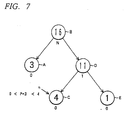
- n has a preceding node (hereafter called a "left child") and if: [Formula 2] P ⁇ Partial interval length of the left child of n then, the interval retrieving means 33 changes n to the left child of n.
- n has a following node (hereafter called a "right child") and if: [Formula 4] P > (partial interval length of n - partial interval length of the right child of n) then, the interval retrieving means 33 changes P to: [Formula 6] P - (partial interval length of n - partial interval length of the right child of n) and changes n to the right child of n.
- n is a node corresponding to the interval containing the specified position. This means that the interval of the current node includes the specified position if the specified position follows the interval preceding the current node and if the specified position is within the net interval length of the current node.
- n has no left child and if: [Formula 11] P ⁇ 0 or, if n has no right child and if: [Formula 13] P > n then, the interval containing the specified position is not yet stored. This means that the specified position is not included in any interval if it is before the first node or after the last node. This can be said regardless of the presence of the right or left child, when n is the root node.
- the interval represented by the retrieved node n is [specified position - (P - partial interval length of the left child of n) + ⁇ (minimum positional unit) .. specified position + (partial interval length of n - partial interval length of the right child of n - P)].
- the interval retrieving means 33 compares the specified position with the range of the current node while moving the current node downward, one level at a time, from the root. This simple procedure identifies an interval containing the specified position, facilitating various types of processing such as retrieval.
- a right interval or a left interval means that the specified interval is on the right or on the left of the root interval.
- Figure 8 is a flowchart showing an example of a procedure for identifying the interval corresponding to the specified node.
- the partial interval length of the left child of the current node that is specified is first set to the left interval length (step 281).
- the left interval (length) is the total interval (length) preceding the specified node.
- step 282 the current node becomes the root (step 282). That is, the current node is moved to the parent with the old current node as the child node (step 283). At this time, when the child node, which was the old current node, is the right child of the current node (step 284), the sum of the net interval length of the current node and the partial interval length of the left child of the current node is calculated (step 286) and the sum is added to the left interval length (step 286).
- the partial interval length of a node represents the total (interval length) of the net interval length of the nodes included in the subtree rooted at the node.
- the sum of the net interval length of the current node and the partial interval length of the left child of the current node is calculated by subtracting the partial interval lengths of the right child (the old current node) from the partial interval length of the current node.
- the left end of the specified node is immediately left to the left interval; that is, it is calculated by adding 1 to the left interval length (step 287). If an interval is represented in a floating-point number, the value of the left interval length is the left end of the interval. The right end of the specified node is obtained by adding the net interval length of the specified node to the left interval length (step 288).
- the right interval of the specified node begins at the position following (adding 1 to) the right-end value of the specified node, and ends at the end of the whole interval represented by the binary tree. This end is represented by the value of the partial interval length of the root.
- Figure 9 is an another example of a flowchart of a procedure for identifying an interval corresponding to the specified node.
- the left interval that is on the left of the specified node interval is determined, and the right side of the specified node interval is calculated based on the left interval length.
- the lengths of both the right interval and the left interval are obtained, and the interval of the specified node is determined as an interval between these two intervals.
- the specified node is first set to the current node, with the partial interval length of the left child of the current node being the left interval length and with the partial interval length of the right child of the current node being the right interval length (step 291). Then, the following steps are repeated until the current node becomes the root node (step 292).
- the current node is moved to its parent with the old current node as the child node (step 293). And, when the old current node is the right child (step 295), the sum of the net interval length of the new current node and the partial interval length of the left child of the new current node is added to the left interval length (step 296); when the old current node is the left child (step 295), the sum of the net interval length of the new current node and the partial interval length of the right child of the new current node is added to the right interval length (step 297).
- the sum of the net interval length of the current node and the partial interval length of the left (right) child of the current node is calculated by subtracting the partial interval lengths of the right (left) child from the partial interval length of the current node.
- the interval of the specified node is identified as the interval between the left interval and the right interval (step 298).
- the right end of the specified node may be calculated by subtracting the right interval length from the partial interval length of the root.
- the total interval length of a preceding (following) nodes is sequentially added up as the current node moves from the specified node to the root node, as described above.
- This process determines the position of the specified node through the interval lengths of nodes those are right or left to the specified node.
- This simple procedure provided in the sixth embodiment allows the position of the specified node to be identified, making it possible to perform various types of processing (claims 3, 25).
- Figure 10 is a functional block diagram showing an example of hardware configuration for use in the retrieval described above. That is, there are as many information areas as the nodes, each area consisting of the pointer storage area P and the partial interval length storage area L. These areas are contained in a fixed-length array. The nodes are linked by two-way pointers allowing pointer storage areas to be referenced bi-directionally.
- control section C accesses pointers to reference each node, and the operation section A accesses the partial interval length of each node to calculate interval lengths.
- the pointer or the storage address of the current node is stored in the current register CR.
- Information on the nodes, such as information on an old node after the current node is moved, is stored in the auxiliary register SR.
- the interval length register LR is used as necessary to calculate partial interval lengths.
- Hardware having this configuration may be used in various types of processing described below.
- the binary tree updating means 34 updates the binary tree 31 according to the contents of the change. Because, in the first embodiment, the binary tree 31 is changed in this manner when an interval is changed, there is no need to re-generate the binary tree 31.
- the interval length changing means 41 changes the corresponding interval length in the binary tree 31.
- the deleting means 42 deletes the node corresponding to the deleted interval from the binary tree 31.
- the adding means 43 adds the node corresponding to the added interval to the binary tree 31.
- the interval length changing means, the deleting means, or the adding means updates the binary tree 31 when an interval length is changed, an interval is deleted, or an interval is added. Combining these means allows complex processing to be performed; for example, the intervals in a code string may be exchanged.
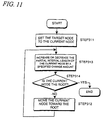
- Figure 11 is a flowchart showing the procedure for changing an interval length.
- the target node is first set to the current node (step 311). Then, the current node is moved toward the root (step 312) until it becomes the root (step 314) while increasing or decreasing the partial interval length of each current node by a specified change amount.
- the data processing system in the sixth embodiment eliminates the need to move all the nodes corresponding to the intervals following the changed node, enhancing data processing efficiency.
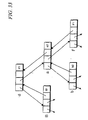
- Figure 15 is a flowchart showing the procedure for adding and deleting an interval in the first embodiment.
- the adding means 43 When adding an interval, the adding means 43 adds to the binary tree 31 a node for an interval to be added (step 351), adjusts the node connection sequence (step 352), and adjusts the interval length of each node (step 353). In the first embodiment, the adding means 43 adjusts the interval lengths to maintain the integrity of the binary tree 31.
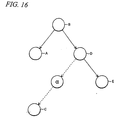
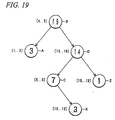
- any known method for adding a node may be used compatibly. For example, in Figure 2, when an interval [10..12] with the length of 3 is added before the interval [10..15] with the intervals [10..15] and [16..16] being moved to the intervals [13..18] and [19..19], respectively, the new node is added in one of three ways shown in Figures 16, 17, and 18.
- the adding means 43 finds the sum of the partial interval lengths of the children (0 if there is no child) and the length of the interval to be added, and uses the result as the partial interval length of the node. And, to each node on the path from the parent of the new node to the root, the adding means 43 adds the length of the new interval.
- the interval lengths are adjusted simply by adding the length of the new interval to each node on the path from the parent of the added node to the root.
- Figure 19 shows the binary tree 31 to which a node has been added at the position ⁇ shown in Figure 17.
- the deleting means 42 When deleting an interval, deletes from the binary tree 31 the node corresponding to the interval to be deleted, adjusts the connection among the nodes, and, as necessary (step 354), adjusts the partial interval lengths ( Figure 35/step 353). In the first embodiment, the deleting means 42 adjusts the node connection sequence and the interval lengths to maintain the integrity, such as the sequence of the remaining intervals, of the binary tree 31.
- any known method for deletion and adjustment may be used compatibly.
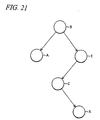
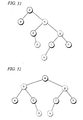
- the structure after deletion may be the one shown in Figure 20 or the one shown in Figure 21.
- the following discussion focuses on the case that the only nodes whose parent nodes are changed after deletion are the child nodes of the deleted node. In other cases, the binary tree 31 is changed as necessary during structure adjustment, described below, before or after node deletion.
- the partial interval length is reduced by (partial interval length of the deleted node) - (partial interval length of the node (left child) preceding the deleted node) - (partial interval length of the node (right child) following the deleted node) which is the net interval length of the deleted node.
- the partial interval length of the former child is added to the partial interval length.
- Figure 22 shows the binary tree 31 from which a node has been deleted.
- the structure adjusting means 45 changes the connection sequence of nodes to maintain the balance of the number of nodes in the binary tree 31 (step 355)
- This structure adjustment method prevents a particular part of the binary tree 31 from being increased, making a plurality of paths, each from the root to a node, approximately equal in length. In this way, it prevents the data processing time from being increased just because the associated path is too long, thereby making various types of data processing, such as retrieval or update, more efficient.
- Another structure adjustment method eliminates variations in processing times of retrieval, addition, and deletion for a binary tree.
- Structure adjustment is necessary for node deletion, addition, or reference.
- a plurality of structure adjustment methods are known. Any of them may be used. Partial interval lengths should be adjusted as the tree structure is changed according to the structure adjustment method to be used.
- the length of a path from the root to a node is usually made proportional to the logarithm of the total number of nodes through structure adjustment. For this reason, the time required for processing, such as retrieval, interval length adjustment, and structure adjustment, is approximately proportional to the logarithm of the total number of intervals.
- Rotation, double rotation (zig-zig), or double rotation (zig-zag), which maintains the node sequence and the structure of a specified range of the binary tree 31, is used in the structure adjustment procedure as an operation unit.
- the actual structure adjustment procedure is composed of these units.
- the following shows an example in which a conventional structure adjustment procedure unit is applied to the whole or an part of a path from the root to a node.
- Performing rotation on the binary tree 31 in Figure 23 results in the binary tree 31 shown in Figure 24.
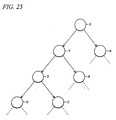
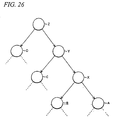
- Performing double rotation (zig-zig) on the binary tree 31 in Figure 25 results in the binary tree 31 shown in Figure 26.
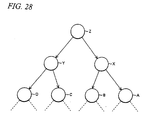
- Performing double rotation (zig-zag) on the binary tree 31. in Figure 27 results in the binary tree 31 shown in Figure 28.
- the partial interval length before change is S(n) and the partial interval length after change is SS(n).
- SS(n) to be set in each node after execution of an operation unit is calculated as follows; based on the partial interval length S(n) before the operation unit is executed. Note that the nodes except X, Y, and Z need not be changed.
- the partial interval length may also be calculated after the net interval length of X, Y, and Z are calculated.
- the structure adjustment is performed according to the status of the binary tree 31, because a plurality of processing types are combined to change the structure of a specified range of the binary tree 31.
- One method prevents a binary tree from growing vertically to keep the time of one operation within a specified time (e.g., red-black tree).
- the other method reduces the total time of the operation (that is, reduces the average time for one operation) although it does not keep the time of one operation within a specified time (e.g., splay tree).
- a change in the structure may be processed by a combination of the above processing types (operation units).
- splay tree (splaying) as an example of structure adjustment (claim 17, and explains how splaying changes the structure of a binary tree and how the partial interval length of each node is changed during this change.
- Splaying changes the structure of a binary tree so that any particular node (target node) becomes the root (Reference: Robert Endre Tarjan. "4.3 Self-Adjusting binary trees (pp. 53 - 56)" in Data Structures and Network Algorithms).
- Splaying is usually applied to nodes retrieved, added, or deleted; more specifically, it is applied to a node where a key match condition occurred during retrieval (or a node last accessed when no key match condition occurred), a node added during node addition, or the parent node of a node deleted during node deletion.
- one of rotation, double rotation (zig-zig), and double rotation (zig-zag) which satisfies the condition is applied repeatedly, with the target node as the node farthest from the root, until the target node becomes the root.
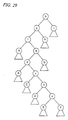
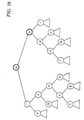
- Figure 29 shows an example of a binary tree.
- a circle indicates a node
- a triangle indicates a sub-tree whose root is indicated by a circle.
- Binary tree data like this is structured in a list format by connecting the data items in the nodes via pointers.
- Figure 30 is a conceptual diagram showing the format of data contained each node. As this figure shows, data contained in each node consists of a pointer to the right child, a pointer to the left child, a pointer to the higher-level node (parent), and the partial interval length of the node.
- Figure 31 is a conceptual diagram showing how data items in the nodes, which are part of the binary tree shown in Figure 29, are connected via pointers.
- each node (a, b, c, A, B, C) is represented by a symbol immediately followed by a number, such as a1, b1, c1, A1, B1, and C1.
- a new subscript follows the symbol a, such as a2 or a3.
- the net interval length of node a before splaying is calculated by subtracting the partial interval length (F1) of node F, which is the right child of node a, and the partial interval length (E1) of node E, which is the left child of node a, from the partial interval length of node a (a1), as shown below.
- double rotation (zig-zig) is first applied to nodes a, b, c, E, and D. This operation replaces node a with node c, and moves node a to the right child position of node d.
- Figure 32 shows how the binary tree looks like after double rotation (zig-zig) has been applied.
- Figure 33 shows how the pointers in the data items at node d and lower-level nodes in Figure 31, which have been restructured as shown in Figure 32, are linked.
- node B which is the left child of node d
- node a which is the right child of node d
- the lower-level nodes have been changed.
- the execution of splaying moves target node a to the root and, at the same time, reduces the length of a path from node b, c, d, e, f, or g, which was on a path from target node a to the old root node h, to the root, thereby enabling various types of operation on this binary tree to be performed speedily (claim 17).
- Comparing the binary tree before splaying ( Figure 29) with the binary tree after splaying ( Figure 36) indicates that the length of a path from each node to the root has been changed as shown below. Node Before splaying After splaying b 6 3 c 5 4 d 4 2 e 3 3 f 2 1 g 1 2
- the net interval length of node a after splaying is calculated by subtracting the partial interval length (h5) of node h, which is the right child of node a, and the partial interval length (f4) of node f, which is the left child of node a, from the partial interval length (a5) of node a.
- the beginning position is the position immediately following the partial interval length of the left child of the specified node
- the ending position is the position corresponding to the value obtained by subtracting the partial interval length of the right child of the specified node from the partial interval length of the specified node.
- the partial interval length of the node to be added is calculated by adding the length of the new interval to the partial interval lengths of the right and left children (claim 11).
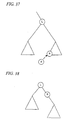
- Figure 37 shows a part of the binary tree before an interval is added through splaying. Assume that this part of the binary tree is located at a non-root position within a larger binary tree. As shown in this figure, an interval indicated by node X is added immediately after the interval corresponding to node L. In this case, node X should be added to the leftmost position in the subtree whose root is the right child of node L, as the left child of the left most node of the subtree indicated by R. Conceptually, this is equivalent to adding node X between node L and node R.
- the partial interval length of node X in Figure 39 is calculated by adding the length of the new interval to the partial interval length of node L (the root node) in Figure 58 where the binary tree after splaying is shown.
- the partial interval length of node L in Figure 39 is calculated by subtracting the partial interval length of node R from the partial interval length of node L in Figure 38.
- splaying may be executed on node L first, followed by the splaying with node R, to make the binary tree as shown in Figure 40, and then node X may be added as the right child of node L.
- Figure 41 shows the binary tree to which node X has been added as the right child of node L.
- the nodes on the path from the parent of node X to the root are node L and node R. This means that, when the partial interval lengths are changed (increased), those of only these two nodes need be changed, making the procedure simpler (claim 11).
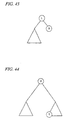
- node X may be used as the right child of node L as shown in Figure 43, as well as node L may be used as the left child of node X as shown in Figure 42.
- processing may be performed as follows. First, a node corresponding to the new interval is added using some method, with the net interval length of the node being 0.
- the partial interval length of the added node is the sum of the partial interval lengths of the right and left children.
- splaying is executed to move the added node to the root of the binary tree, and the partial interval length of the node moved to the root is increased by the net interval length of the added interval (claim 12). This means that the partial interval length of the node need be increased only once during execution of a desired addition algorithm, increasing the processing speed.
- Splaying may also be used to delete a node (interval). To do so, the node to be deleted is first moved to the root through execution of splaying.
- Figure 44 shows how the binary tree looks like after node X, which is to be deleted, has been moved to the root through execution of splaying. In this figure, node X to be deleted corresponds to the interval immediately before node R.
- Figure 45 shows how the binary tree looks like after node R, which immediately follows node X to be deleted, has been moved to the root through execution of splaying. And, the partial interval length of node R, which is now the root, is decreased by the net interval length of node X and, finally, node X is deleted (claim 14)
- Figure 46 shows how the binary tree looks like after node X has been deleted. This means that only the partial interval length of the root node need be adjusted during deletion, increasing the processing speed.
- Rebalancing is performed by sequentially applying a combination of these operations.
- Balancing after inserting one node requires a series of promote operations ended by up to two single rotations (pp. 50 in the reference given above), while balancing after deleting one node requires a series of demote operations ended by up to three single rotations (pp. 51 in the reference given above).
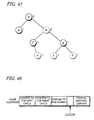
- each node has an integer rank such as 1 or 2, as shown in Figure 47.
- the rank of node x is represented by rank (x)
- the parent of node x is represented by p (x)
- the grandparent of node x is represented by p2 (x). Then, the following must be satisfied:
- a node whose parent has a rank that is larger than that of the node by 1 or that is undefined is called a black node
- a node whose parent has a rank equal to that of the node is called a red node.
- a black node is represented by a solid line
- a red node is represented by a dashed line.
- FIG. 48 shows the format of information on a node in the balanced binary tree example.
- the nodes in this tree are linked by pointers, as in Figure 33.
- the partial interval length of each node (a, b, c) is represented by the same symbol immediately followed by a numerical subscript (a1, b1, c1).
- a new numerical subscript immediately follows the symbol, such as a2 and a3.
- Figure 50 shows rebalancing that is performed when condition 2 is not satisfied. That is, nodes x, f, g, and h in Figure 49 correspond to (a) in Figure 50. Therefore, the color of node g is changed to red, and the colors of child nodes f and h are changed from red to black so that rank (g) is one level higher than other nodes.
- Figure 51 shows how the binary tree looks like after the node colors have been changed.
- a prior art which allows the sequence of a node to be obtained from the node in the binary tree (U.S. patent 5384568).
- This prior art (hereafter called a "prior system") is common to the present invention in that sequenced nodes are processed.
- the prior system processes only the sequence of nodes, not intervals; in the prior system, each node contains the number of nodes of a sub-tree whose root is the node itself.
- the present invention is superior to the prior system in that intervals are processed.
- the prior system follows a path from a specified node to the root to calculate the sequence number of the specified node from its address; however, it cannot retrieve a node when a value within an interval is given.
- the present invention is superior to the prior system in that it can retrieve a node when a value within an interval is given. To execute this retrieval, the present invention uses a method different from that used in the prior system; that is, it follows a path from the root to the specified node.
- the prior system adds a node only to the beginning (leftmost position), deletes a node only from the end (rightmost position), and moves any node to the beginning (leftmost position) during update operation; however, it does not add or delete a node to or from other positions.
- the present invention is superior to the prior system in that it can add or delete a node (interval) to or from any position.
- a binary tree representing text may be configured in the data processing system in which text consisting of a plurality of lines is held.
- the second embodiment corresponds to claim 18. That is, the first binary tree represents the sequence of lines.
- This binary tree contains a plurality of nodes, each corresponding to a line, with the interval length of each node being 1.
- a second binary tree represents a code string of each line.
- Each secondary binary tree is associated with the corresponding node in the first binary tree through a pointer.
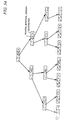
- Figure 53 shows a binary tree representing the following lines. xyz st (blank line) (blank line) abcdef
- the first binary tree representing the sequence of lines and each of the second binary trees representing the contents of each line are created separately. Therefore, when either the sequence of lines or the content of each line is changed, there is no need for changing the other type of binary tree. This ensures efficient code string processing.
- the third embodiment corresponds to claim 19.
- the maximum number of characters of a line is fixed to a large number, n, and blanks are padded in the positions containing no character.
- a binary tree is composed of a sequence of code strings beginning at the start (or the end). Then, the j-th code from the beginning of line i begins at a position in the whole text represented by the following formula. [Formula 53] (i - 1) x n + j
- Figure 54 is an example of a binary tree representing the above text with n being 10.
- data may be represented by a single simply-structured binary tree.
- a sequence of a plurality of the same character or a sequence of blanks are represented by a single node with the character as the label and with the interval length represented by the number of consecutive characters, processing and memory efficiency are increased.
- consecutive eight blanks and two blank lines are represented as 28 blanks by a single node.
- the data processing system in the third embodiment is particularly suitable when data containing many sequences of the same code.
- bit-string data such as a facsimile image
- compressing bit-string data with the use of a binary tree in the third embodiment allows any bit in the bit string to be identified as 1 or 0. This is different from a conventional technique.
- bit string usually consists of a plurality of 0s and 1s that appear alternately.
- bit data is compressed by sequentially recording the numbers of consecutive 0s and 1s (run-length-encoding).
- run-length-encoding it is necessary to restore all the preceding bits or to accumulate the lengths of the intervals in order to determine the value of a bit (0 or 1) or to restore a portion of data that appears in the middle of data.
- a binary tree in the third embodiment requires only as many nodes as the number of intervals and, in addition, makes it possible to restore, or determine the value of, a bit that is in the middle of data.
- a code string in this invention is not restricted to a character string. It may be any type of code, such as a voice pattern code or DNA base layout code.
- a substring in a code string may be processed indirectly, for example, by marking a boundary through a pointer. This method eliminates the need to process a part of code string data, for example, by transferring it to another storage area.
- the label attached to an edge or a node in a tree or binary tree need not be one-character code.
- trailing string and “leading string” should be exchanged in this specification.
- characters are obtained from the end of a key string.
- the leading (preceding) node and the trailing (following) node in the first embodiment should also be exchanged.
- this invention provides a data processing system which processes data efficiently.
Landscapes
- Engineering & Computer Science (AREA)
- Databases & Information Systems (AREA)
- Theoretical Computer Science (AREA)
- Computational Linguistics (AREA)
- Data Mining & Analysis (AREA)
- Physics & Mathematics (AREA)
- General Engineering & Computer Science (AREA)
- General Physics & Mathematics (AREA)
- Information Retrieval, Db Structures And Fs Structures Therefor (AREA)
Claims (25)
- Système de traitement de données pour traiter des données d'une chaíne de codes divisée selon une séquence d'intervalles dont chacun présente une longueur qui est définie par le nombre d'éléments de code dans l'intervalle afin de trouver une position spécifiée dans ladite chaíne de codes, ledit système de traitement de données comprenant un moyen de génération d'arborescence binaire (32) pour générer une arborescence binaire (31) comportant une pluralité de noeuds représentant des positions respectives desdits intervalles dans ladite chaíne de codes ;
lesdits noeuds étant alloués à des intervalles respectifs desdits intervalles dans ladite chaíne de codes ;
lesdits noeuds étant connectés depuis un noeud de racine de ladite arborescence à ses noeuds de feuille selon une structure similaire à une arborescence ;
chaque noeud entre ledit noeud de racine et lesdits noeuds de feuille étant un noeud de racine d'une sous-arborescence et étant connecté à un noeud précédent qui est défini en tant que noeud enfant gauche qui correspond à un intervalle dans ladite chaíne de codes qui précède l'intervalle qui correspond au noeud en question et/ou à un noeud suivant qui est défini en tant que noeud enfant droit qui correspond à un intervalle dans ladite chaíne de codes qui suit l'intervalle qui correspond au noeud en question,
caractérisé en ce que :à chaque noeud est assignée une longueur d'intervalle partielle qui est définie en tant que la somme de la longueur de l'intervalle qui correspond au noeud en question et des longueurs des intervalles qui correspondent aux noeuds éventuels sur le côté de feuille du noeud en question, et parun moyen pour identifier le noeud qui correspond à l'intervalle qui inclut la position spécifiée en traitant les noeuds en partant du noeud de racine, ledit moyen incluant :un moyen pour sélectionner le noeud enfant gauche du noeud courant en tant que noeud courant suivant si la position spécifiée est inférieure ou égale à la longueur d'intervalle partielle du noeud enfant gauche ;un moyen pour sélectionner le noeud enfant droit en tant que noeud courant suivant et pour mettre à jour la représentation de la position spécifiée conformément à la position du noeud enfant droit par rapport au noeud courant, si la position spécifiée est supérieure à la longueur d'intervalle partielle du noeud courant moins la longueur d'intervalle partielle du noeud enfant droit ; etun moyen pour identifier que la position spécifiée est incluse dans l'intervalle qui correspond au noeud courant si la position spécifiée est supérieure à la longueur d'intervalle partielle du noeud enfant gauche et est inférieure ou égale à la longueur d'intervalle partielle du noeud courant moins la longueur partielle du noeud enfant droit. - Système de traitement de données selon la revendication 1, comprenant en outre un moyen de recherche d'intervalle (33) pour identifier l'intervalle dans ladite séquence d'intervalles qui inclut ladite position spécifiée dans ladite chaíne de codes, dans lequel ledit moyen de recherche d'intervalle comprend :un moyen pour sélectionner le noeud courant au moyen d'un pointeur ;un moyen pour déplacer ledit pointeur depuis ledit noeud de racine jusqu'à l'un desdits noeuds de feuille ;un moyen pour calculer la plage de positions dans ladite chaíne de codes de l'intervalle qui correspond au noeud courant sur la base de la longueur d'intervalle soit dudit noeud précédent, soit dudit noeud suivant en connexion directe sur le côté de noeud de feuille du noeud courant ou d'un noeud de niveau inférieur qui est ledit noeud suivant, soit de ces deux noeuds ;un moyen pour comparer la plage ainsi calculée avec ladite position spécifiée ;un moyen pour déplacer le pointeur jusqu'au noeud précédent en tant que noeud courant suivant lorsque la position spécifiée précède la plage calculée ;un moyen pour déplacer le pointeur jusqu'au noeud suivant en tant que noeud courant suivant lorsque la position spécifiée suit la plage calculée ; etun moyen pour identifier que la position spécifiée est incluse dans l'intervalle qui correspond au noeud courant lorsque la position spécifiée est incluse dans la plage calculée.
- Système de traitement de données selon la revendication 1, comprenant en outre un moyen d'identification pour identifier l'intervalle dans ladite séquence d'intervalles qui correspond à un noeud spécifié qui est n'importe quel noeud donné dans ladite arborescence binaire (31), dans lequel le moyen d'identification comprend :un moyen pour sélectionner le noeud courant au moyen d'un pointeur ;un moyen pour déplacer ledit pointeur depuis le noeud courant en direction de son noeud parent, qui est un noeud de niveau supérieur dudit noeud courant, à raison d'un niveau de noeud à la fois, jusqu'à ce que ledit noeud de racine soit atteint ;un moyen pour additionner la longueur d'intervalle du noeud courant et la longueur d'intervalle partielle du noeud précédent ou du noeud suivant du noeud courant chaque fois que le noeud courant est déplacé, en fonction de si un noeud enfant qui est ledit noeud courant avant que ledit pointeur ne soit déplacé est ledit noeud précédent ou ledit noeud suivant ; etun moyen pour identifier l'intervalle qui correspond audit noeud courant en calculant soit une longueur d'intervalle gauche qui est la longueur d'intervalle totale des noeuds qui précèdent ledit noeud courant selon un ordre L-C-R, soit une longueur d'intervalle droit qui est la longueur d'intervalle totale des noeuds qui suivent ledit noeud courant selon un ordre L-C-R, soit les deux longueurs.
- Système de traitement de données selon la revendication 1, comprenant en outre un moyen d'identification pour identifier l'intervalle dans ladite séquence d'intervalles qui correspond à un noeud spécifié qui est n'importe quel noeud donné dans ladite arborescence binaire (31), dans lequel le moyen d'identification déplace ledit noeud courant jusqu'audit noeud de racine au moyen d'un effet d'écartement.
- Système de traitement de données selon la revendication 1, 2 ou 3, comprenant en outre un moyen de mise à jour d'arborescence binaire (34) pour mettre à jour ladite arborescence binaire (31) lorsque ledit intervalle est modifié, conformément au contenu de la modification.
- Système de traitement de données selon la revendication 5, dans lequel ledit moyen de mise à jour d'arborescence binaire (34) comprend :un moyen de modification de longueur d'intervalle (41) pour modifier ladite longueur d'intervalle ;un moyen de suppression (42) pour supprimer le noeud qui correspond à un intervalle supprimé de ladite arborescence binaire (31) lorsque ledit intervalle est supprimé de ladite chaíne de codes ; etun moyen d'addition (43) pour additionner un noeud qui correspond à un intervalle additionné à ladite arborescence binaire lorsqu'un intervalle est additionné à ladite chaíne de codes.
- Système de traitement de données selon la revendication 6; dans lequel ledit moyen de modification de longueur d'intervalle (41) comprend un moyen pour modifier ladite longueur d'intervalle partielle de chaque noeud de façon séquentielle depuis ledit noeud qui correspond audit intervalle, dont la longueur doit être modifiée, jusqu'audit noeud de racine d'une valeur égale à la longueur modifiée.
- Système de traitement de données selon la revendication 6, dans lequel ledit moyen de modification de longueur d'intervalle (41) comprend un moyen pour déplacer le noeud qui correspond audit intervalle, dont la longueur doit être modifiée, jusqu'audit noeud de racine au moyen d'un effet d'écartement, et pour augmenter. ou diminuer ladite longueur d'intervalle partielle du noeud de racine d'une valeur égale à la longueur modifiée.
- Système de traitement de données selon la revendication 6, dans lequel ledit moyen d'addition (43) comprend :un moyen pour additionner ledit noeud qui correspond audit intervalle, lequel doit être additionné, à ladite arborescence binaire (31);un moyen pour régler la séquence de connexion desdits noeuds ; etun moyen pour régler ladite longueur d'intervalle de chaque noeud.
- Système de traitement de données selon la revendication 9, dans lequel ledit moyen d'addition (43) comprend un moyen pour utiliser la somme de ladite longueur d'intervalle partielle dudit noeud additionné et de la longueur d'intervalle partielle dudit noeud de niveau inférieur du noeud courant en tant que dite longueur d'intervalle partielle dudit noeud additionné et, pour les noeuds sur le chemin depuis le noeud parent auquel le noeud additionné est connecté de façon directe en tant que noeud de niveau inférieur jusqu'audit noeud de racine, un moyen pour additionner la longueur d'intervalle du noeud additionné à la longueur d'intervalle partielle de chacun des noeuds.
- Système de traitement de données selon la revendication 6, dans lequel ledit moyen d'addition (43) comprend :un moyen pour déplacer les noeuds précédant et suivant immédiatement une position au niveau de laquelle un noeud doit être additionné jusqu'audit noeud de racine au moyen d'un effet d'écartement à raison d'un à la fois ;un moyen pour additionner ledit noeud qui correspond à un intervalle, lequel doit être additionné, en une position qui suit immédiatement ledit noeud immédiatement précédent ou en une position immédiatement avant ledit noeud immédiatement suivant ; etun moyen pour additionner la longueur d'intervalle du noeud additionné à la longueur d'intervalle partielle dudit noeud immédiatement précédent ou immédiatement suivant dudit noeud additionné si nécessaire.
- Système de traitement de données selon la revendication 6, dans lequel ledit moyen d'addition (43) comprend :un moyen pour additionner ledit noeud qui correspond audit intervalle, lequel doit être additionné, à ladite arborescence binaire, la longueur d'intervalle du noeud étant de 0 ;un moyen pour déplacer le noeud additionné jusqu'au noeud de racine de ladite arborescence binaire au moyen d'un effet d'écartement ; etun moyen pour augmenter la longueur d'intervalle partielle du noeud, qui est déplacé jusqu'au noeud de racine, de la longueur d'intervalle de l'intervalle additionné.
- Système de traitement de données selon la revendication 6, dans lequel ledit moyen de suppression (42) comprend :un moyen pour supprimer de l'arborescence binaire ledit noeud dudit intervalle à supprimer ;un moyen pour régler la connexion entre les noeuds ; etun moyen pour régler ladite longueur d'intervalle de chaque noeud.
- Système de traitement de données selon la revendication 6, dans lequel ledit moyen de suppression (42) comprend :un moyen pour déplacer ledit noeud qui correspond audit intervalle, lequel doit être supprimé, jusqu'au noeud de racine au moyen d'un effet d'écartement ;un moyen pour déplacer le noeud qui précède immédiatement ou qui suit immédiatement le noeud, lequel doit être supprimé, jusqu'au noeud de racine au moyen d'un effet d'écartement ;un moyen pour diminuer la longueur d'intervalle partielle dudit noeud immédiatement précédent ou immédiatement suivant, qui est le noeud de racine, de la longueur d'intervalle dudit noeud à supprimer ; etun moyen pour supprimer ledit noeud à supprimer.
- Système de traitement de données selon la revendication 5, comprenant en outre un moyen de réglage de structure (45) pour régler la structure de ladite arborescence binaire (31) en modifiant la séquence de connexion desdits noeuds.
- Système de traitement de données selon la revendication 15, dans lequel ledit moyen de réglage de structure (45) comprend un moyen pour mettre en oeuvre une rotation, une rotation double (zigzig) et une rotation double (zigzag) en tant que procédure de réglage de structure pour modifier la structure tout en maintenant la séquence desdits noeuds de ladite arborescence binaire (31).
- Système de traitement de données selon la revendication 15, dans lequel ledit moyen de réglage de structure (45) comprend un moyen pour régler ladite arborescence binaire au moyen d'un effet d'écartement selon lequel un noeud cible, qui est n'importe lequel desdits noeuds, est déplacé jusqu'audit noeud de racine.
- Système de traitement de données selon la revendication 2, dans lequel :ladite chaíne de codes est du texte qui contient une pluralité de lignes de caractères en tant que dits éléments de code ;lesdits intervalles dans ladite chaíne de codes sont les lignes qui sont incluses dans le texte ; etledit moyen de génération d'arborescence binaire (32) comprend un moyen pour générer une première arborescence binaire qui comporte une pluralité de noeuds représentant la séquence de lignes, les noeuds de ladite première arborescence binaire étant alloués à des lignes respectives desdites lignes dans le texte et une seconde arborescence binaire qui comporte une pluralité de noeuds représentant la séquence d'éléments de code dans chaque ligne, les noeuds de ladite seconde arborescence binaire étant alloués à des caractères respectifs desdits caractères dans la ligne en question.
- Système de traitement de données selon la revendication 2, dans lequel :ladite chaíne de codes est du texte qui contient une pluralité de lignes de caractères en tant que dits éléments de code, lesdites lignes étant d'une longueur fixe ; etledit moyen de génération d'arborescence binaire (32) comprend un moyen pour établir un caractère vierge en une position dans ladite chaíne de codes au niveau de laquelle aucun caractère n'est présent dans le texte et un moyen pour générer ladite arborescence binaire (31) en représentant chaque sous-chaíne du texte à l'aide d'un unique noeud, ledit noeud comportant une séquence de caractères et/ou de caractères vierges survenant de façon consécutive dans la sous-chaíne en question en tant qu'étiquette dudit noeud et comportant le nombre de caractères consécutifs dans la sous-chaíne en question en tant que longueur de l'intervalle correspondant audit noeud.
- Procédé de traitement de données pour traiter des données d'une chaíne de codes divisée selon une séquence d'intervalles dont chacun présente une longueur qui est définie par le nombre d'éléments de code dans l'intervalle afin de trouver une position spécifiée dans ladite chaíne de codes, ledit procédé de traitement de données comprenant un processus de génération d'arborescence binaire pour générer une arborescence binaire (31) comportant une pluralité de noeuds représentant des positions respectives desdits intervalles dans ladite chaíne de codes ;
lesdits noeuds étant alloués à des intervalles respectifs desdits intervalles dans ladite chaíne de codes ;
lesdits noeuds étant connectés depuis un noeud de racine de ladite arborescence à ses noeuds de feuille selon une structure similaire à une arborescence ;
chaque noeud entre ledit noeud de racine et lesdits noeuds de feuille étant un noeud de racine d'une sous-arborescence et étant connecté à un noeud précédent qui est défini en tant que noeud enfant gauche qui correspond à un intervalle dans ladite chaíne de codes qui précède l'intervalle qui correspond au noeud en question et/ou à un noeud suivant qui est défini en tant que noeud enfant droit qui correspond à un intervalle dans ladite chaíne de codes qui suit l'intervalle qui correspond au noeud en question,
caractérisé en ce que :à chaque noeud est assignée une longueur d'intervalle partielle qui est définie en tant que la somme de la longueur de l'intervalle qui correspond au noeud en question et des longueurs des intervalles qui correspondent aux noeuds éventuels sur le côté de feuille du noeud en question, et parl'identification du noeud qui correspond à l'intervalle qui inclut la position spécifiée en traitant les noeuds en partant du noeud de racine, au moyen de ce qui suit :la sélection du noeud enfant gauche du noeud courant en tant que noeud courant suivant si la position spécifiée est inférieure ou égale à la longueur d'intervalle partielle du noeud enfant gauche ;la sélection du noeud enfant droit en tant que noeud courant suivant ;la mise à jour de la représentation de la position spécifiée conformément à la position du noeud enfant droit par rapport au noeud courant si la position spécifiée est supérieure à la longueur d'intervalle partielle du noeud courant moins la longueur d'intervalle partielle du noeud enfant droit ; etl'identification du fait que la position spécifiée est incluse dans l'intervalle qui correspond au noeud courant si la position spécifiée est supérieure à la longueur d'intervalle partielle du noeud enfant gauche et est inférieure ou égale à la longueur d'intervalle partielle du noeud courant moins la longueur partielle du noeud enfant droit. - Procédé de traitement de données selon la revendication 20, comprenant en outre un processus de recherche d'intervalle pour identifier l'intervalle dans ladite séquence d'intervalles qui inclut ladite position spécifiée dans ladite chaíne de codes, dans lequel ledit processus de recherche d'intervalle, de façon séquentielle, :sélectionne le noeud courant au moyen d'un pointeur ;déplace ledit pointeur depuis ledit noeud de racine jusqu'à l'un desdits noeuds de feuille ;calcule la plage de positions dans ladite chaíne de codes de l'intervalle qui correspond au noeud courant sur la base de la longueur d'intervalle de soit ledit noeud précédent, de soit ledit noeud suivant en connexion directe sur le côté de noeud de feuille du noeud courant, de soit ces deux noeuds ;compare la plage ainsi calculée avec ladite position spécifiée ;déplace le pointeur jusqu'au noeud précédent en tant que noeud courant suivant lorsque la position spécifiée précède la plage calculée ;déplace le pointeur jusqu'au noeud suivant en tant que noeud courant suivant lorsque la position spécifiée suit la plage calculée ; etidentifie que la position spécifiée est incluse dans l'intervalle qui correspond au noeud courant lorsque la position spécifiée est incluse dans la plage calculée.
- Procédé de traitement de données selon la revendication 20, comprenant en outre un processus d'identification pour identifier l'intervalle dans ladite séquence d'intervalles qui correspond à un noeud spécifié qui est n'importe quel noeud donné dans ladite arborescence binaire (31), dans lequel le processus d'identification :sélectionne le noeud courant au moyen d'un pointeur ;déplace ledit pointeur depuis le noeud courant en direction de son noeud parent, qui est un noeud de niveau supérieur dudit noeud courant, à raison d'un niveau de noeud à la fois, jusqu'à ce que ledit noeud de racine soit atteint ;additionne la longueur d'intervalle du noeud courant et la longueur d'intervalle partielle du noeud précédent ou du noeud suivant du noeud courant chaque fois que le noeud courant est déplacé, en fonction de si un noeud enfant qui est ledit noeud courant avant que ledit pointeur ne soit déplacé est ledit noeud précédent ou ledit noeud suivant ; etidentifie l'intervalle qui correspond audit noeud courant en calculant soit une longueur d'intervalle gauche qui est la longueur d'intervalle totale des noeuds qui précèdent ledit noeud courant selon un ordre L-C-R, soit une longueur d'intervalle droit qui est la longueur d'intervalle totale des noeuds qui suivent ledit noeud courant selon un ordre L-C-R, soit les deux longueurs.
- Procédé de traitement de données selon la revendication 20, 21 ou 22, comprenant en outre un processus de mise à jour d'arborescence binaire pour mettre à jour ladite arborescence binaire (31) lorsque ledit intervalle est modifié, conformément au contenu de la modification.
- Procédé de traitement de données selon la revendication 23, dans lequel ledit processus de mise à jour d'arborescence binaire comprend :un processus de modification de longueur d'intervalle (étape 353) pour modifier ladite longueur d'intervalle ;un processus de suppression (étape 351) pour supprimer le noeud qui correspond à un intervalle supprimé de ladite arborescence binaire lorsque ledit intervalle est supprimé de ladite chaíne de codes ; etun processus d'addition (étape 351) pour additionner un noeud qui correspond à un intervalle additionné à ladite arborescence binaire lorsqu'un intervalle est additionné à ladite chaíne de codes.
- Procédé de traitement de données selon la revendication 23, comprenant en outre un processus de réglage de structure (étape 355) pour régler la structure de ladite arborescence binaire (31) en modifiant la séquence de connexion desdits noeuds.
Applications Claiming Priority (3)
| Application Number | Priority Date | Filing Date | Title |
|---|---|---|---|
| JP219145/94 | 1994-09-13 | ||
| JP21914594 | 1994-09-13 | ||
| JP21914594 | 1994-09-13 |
Related Child Applications (1)
| Application Number | Title | Priority Date | Filing Date |
|---|---|---|---|
| EP01107745 Division | 2001-04-02 |
Publications (2)
| Publication Number | Publication Date |
|---|---|
| EP0702310A1 EP0702310A1 (fr) | 1996-03-20 |
| EP0702310B1 true EP0702310B1 (fr) | 2002-07-10 |
Family
ID=16730925
Family Applications (1)
| Application Number | Title | Priority Date | Filing Date |
|---|---|---|---|
| EP95114379A Expired - Lifetime EP0702310B1 (fr) | 1994-09-13 | 1995-09-13 | Système de recouvrement de données, système de traitement de données, procédé de recouvrement de données et procédé de traitement de données |
Country Status (3)
| Country | Link |
|---|---|
| US (1) | US5778371A (fr) |
| EP (1) | EP0702310B1 (fr) |
| DE (1) | DE69527331T2 (fr) |
Families Citing this family (38)
| Publication number | Priority date | Publication date | Assignee | Title |
|---|---|---|---|---|
| DE4435902A1 (de) * | 1994-10-07 | 1996-04-11 | Siemens Nixdorf Inf Syst | Permanentspeicher |
| US6035326A (en) * | 1997-05-07 | 2000-03-07 | International Business Machines Corporation | Mapping table lookup optimization system |
| US6304878B1 (en) | 1998-11-23 | 2001-10-16 | Microsoft Corporation | Method and system for improved enumeration of tries |
| US6298321B1 (en) * | 1998-11-23 | 2001-10-02 | Microsoft Corporation | Trie compression using substates and utilizing pointers to replace or merge identical, reordered states |
| JP3566111B2 (ja) * | 1998-11-30 | 2004-09-15 | 松下電器産業株式会社 | 記号辞書作成方法及び記号辞書検索方法 |
| FI991262L (fi) * | 1999-06-02 | 2000-12-03 | Nokia Networks Oy | Digitaaliseen trie-rakenteeseen perustuva muisti |
| US6802059B1 (en) * | 1999-08-02 | 2004-10-05 | Ricoh Corporation | Transforming character strings that are contained in a unit of computer program code |
| US6675169B1 (en) | 1999-09-07 | 2004-01-06 | Microsoft Corporation | Method and system for attaching information to words of a trie |
| US7139765B1 (en) * | 2000-04-03 | 2006-11-21 | Alan Balkany | Hierarchical method for storing data with improved compression |
| US7174340B1 (en) * | 2000-08-17 | 2007-02-06 | Oracle International Corporation | Interval-based adjustment data includes computing an adjustment value from the data for a pending adjustment in response to retrieval of an adjusted data value from a database |
| US6563439B1 (en) * | 2000-10-31 | 2003-05-13 | Intel Corporation | Method of performing Huffman decoding |
| US6636167B1 (en) * | 2000-10-31 | 2003-10-21 | Intel Corporation | Method of generating Huffman code length information |
| AU2003214975A1 (en) * | 2002-02-01 | 2003-09-02 | John Fairweather | System and method for navigating data |
| US7401092B2 (en) * | 2003-06-26 | 2008-07-15 | Standbysoft Llc | Method and apparatus for exchanging sub-hierarchical structures within a hierarchical file system |
| US8037102B2 (en) | 2004-02-09 | 2011-10-11 | Robert T. and Virginia T. Jenkins | Manipulating sets of hierarchical data |
| US8176051B2 (en) * | 2004-05-27 | 2012-05-08 | International Business Machines Corporation | Search via fast case insensitive ASCII tree |
| US9646107B2 (en) | 2004-05-28 | 2017-05-09 | Robert T. and Virginia T. Jenkins as Trustee of the Jenkins Family Trust | Method and/or system for simplifying tree expressions such as for query reduction |
| US7761474B2 (en) * | 2004-06-30 | 2010-07-20 | Sap Ag | Indexing stored data |
| US7620632B2 (en) | 2004-06-30 | 2009-11-17 | Skyler Technology, Inc. | Method and/or system for performing tree matching |
| WO2006029508A1 (fr) * | 2004-09-13 | 2006-03-23 | Solace Systems Inc. | Concordance d'abonnements a geometrie hautement variable pour un reseau d'acheminement de contenus |
| US7801923B2 (en) | 2004-10-29 | 2010-09-21 | Robert T. and Virginia T. Jenkins as Trustees of the Jenkins Family Trust | Method and/or system for tagging trees |
| US7627591B2 (en) | 2004-10-29 | 2009-12-01 | Skyler Technology, Inc. | Method and/or system for manipulating tree expressions |
| US7630995B2 (en) | 2004-11-30 | 2009-12-08 | Skyler Technology, Inc. | Method and/or system for transmitting and/or receiving data |
| US7636727B2 (en) | 2004-12-06 | 2009-12-22 | Skyler Technology, Inc. | Enumeration of trees from finite number of nodes |
| US7512617B2 (en) * | 2004-12-29 | 2009-03-31 | Sap Aktiengesellschaft | Interval tree for identifying intervals that intersect with a query interval |
| US8316059B1 (en) | 2004-12-30 | 2012-11-20 | Robert T. and Virginia T. Jenkins | Enumeration of rooted partial subtrees |
| US8234309B2 (en) * | 2005-01-31 | 2012-07-31 | International Business Machines Corporation | Method for automatically modifying a tree structure |
| US8615530B1 (en) | 2005-01-31 | 2013-12-24 | Robert T. and Virginia T. Jenkins as Trustees for the Jenkins Family Trust | Method and/or system for tree transformation |
| US7681177B2 (en) | 2005-02-28 | 2010-03-16 | Skyler Technology, Inc. | Method and/or system for transforming between trees and strings |
| US8356040B2 (en) | 2005-03-31 | 2013-01-15 | Robert T. and Virginia T. Jenkins | Method and/or system for transforming between trees and arrays |
| US7899821B1 (en) | 2005-04-29 | 2011-03-01 | Karl Schiffmann | Manipulation and/or analysis of hierarchical data |
| US8190625B1 (en) * | 2006-03-29 | 2012-05-29 | A9.Com, Inc. | Method and system for robust hyperlinking |
| US7627615B2 (en) * | 2006-10-30 | 2009-12-01 | Oracle International Corporation | Copy-on-write versioning of documents |
| US10642918B2 (en) * | 2013-03-15 | 2020-05-05 | University Of Florida Research Foundation, Incorporated | Efficient publish/subscribe systems |
| US10333696B2 (en) | 2015-01-12 | 2019-06-25 | X-Prime, Inc. | Systems and methods for implementing an efficient, scalable homomorphic transformation of encrypted data with minimal data expansion and improved processing efficiency |
| US10528488B1 (en) * | 2017-03-30 | 2020-01-07 | Pure Storage, Inc. | Efficient name coding |
| US10528556B1 (en) * | 2017-12-31 | 2020-01-07 | Allscripts Software, Llc | Database methodology for searching encrypted data records |
| CN116805537B (zh) * | 2023-08-22 | 2023-11-07 | 江汉大学附属医院(武汉市第六医院) | 用于心肺康复管理系统的数据处理方法 |
Family Cites Families (21)
| Publication number | Priority date | Publication date | Assignee | Title |
|---|---|---|---|---|
| US4754489A (en) * | 1985-10-15 | 1988-06-28 | The Palantir Corporation | Means for resolving ambiguities in text based upon character context |
| EP0333181B1 (fr) * | 1988-03-18 | 1996-07-03 | Kabushiki Kaisha Toshiba | Dispositif de recherche de chaîne de données |
| GB8815978D0 (en) * | 1988-07-05 | 1988-08-10 | British Telecomm | Method & apparatus for encoding decoding & transmitting data in compressed form |
| US5121493A (en) * | 1990-01-19 | 1992-06-09 | Amalgamated Software Of North America, Inc. | Data sorting method |
| US5062143A (en) * | 1990-02-23 | 1991-10-29 | Harris Corporation | Trigram-based method of language identification |
| US5293466A (en) * | 1990-08-03 | 1994-03-08 | Qms, Inc. | Method and apparatus for selecting interpreter for printer command language based upon sample of print job transmitted to printer |
| EP0470798B1 (fr) * | 1990-08-06 | 1997-10-29 | Fujitsu Limited | Système de recherche par dictionnaire |
| US5150430A (en) * | 1991-03-15 | 1992-09-22 | The Board Of Trustees Of The Leland Stanford Junior University | Lossless data compression circuit and method |
| US5276741A (en) * | 1991-05-16 | 1994-01-04 | Trw Financial Systems & Services, Inc. | Fuzzy string matcher |
| US5150425A (en) * | 1991-08-30 | 1992-09-22 | Eastman Kodak Company | Character recognition method using correlation search |
| US5265065A (en) * | 1991-10-08 | 1993-11-23 | West Publishing Company | Method and apparatus for information retrieval from a database by replacing domain specific stemmed phases in a natural language to create a search query |
| WO1994001828A1 (fr) * | 1992-07-02 | 1994-01-20 | Wellfleet Communications | Procede et appareil de traitement de paquets de donnees |
| ATE260486T1 (de) * | 1992-07-31 | 2004-03-15 | Ibm | Auffindung von zeichenketten in einer datenbank von zeichenketten |
| GB9220404D0 (en) * | 1992-08-20 | 1992-11-11 | Nat Security Agency | Method of identifying,retrieving and sorting documents |
| US5442350A (en) * | 1992-10-29 | 1995-08-15 | International Business Machines Corporation | Method and means providing static dictionary structures for compressing character data and expanding compressed data |
| JP2964831B2 (ja) * | 1993-03-31 | 1999-10-18 | 富士ゼロックス株式会社 | 構造データ処理装置 |
| JPH07107303A (ja) * | 1993-09-30 | 1995-04-21 | Nec Corp | ハフマン符号の復号化方法 |
| US5396670A (en) * | 1993-10-08 | 1995-03-14 | Guardian Products, Inc. | Sling for a patient lifter |
| US5384568A (en) * | 1993-12-02 | 1995-01-24 | Bell Communications Research, Inc. | Data compression |
| US5561421A (en) * | 1994-07-28 | 1996-10-01 | International Business Machines Corporation | Access method data compression with system-built generic dictionaries |
| US5610603A (en) * | 1995-09-28 | 1997-03-11 | International Business Machines Corporation | Sort order preservation method used with a static compression dictionary having consecutively numbered children of a parent |
-
1995
- 1995-09-12 US US08/526,872 patent/US5778371A/en not_active Expired - Lifetime
- 1995-09-13 EP EP95114379A patent/EP0702310B1/fr not_active Expired - Lifetime
- 1995-09-13 DE DE69527331T patent/DE69527331T2/de not_active Expired - Lifetime
Also Published As
| Publication number | Publication date |
|---|---|
| DE69527331T2 (de) | 2003-02-27 |
| US5778371A (en) | 1998-07-07 |
| EP0702310A1 (fr) | 1996-03-20 |
| DE69527331D1 (de) | 2002-08-14 |
Similar Documents
| Publication | Publication Date | Title |
|---|---|---|
| EP0702310B1 (fr) | Système de recouvrement de données, système de traitement de données, procédé de recouvrement de données et procédé de traitement de données | |
| US5799299A (en) | Data processing system, data retrieval system, data processing method and data retrieval method | |
| Clark et al. | Efficient suffix trees on secondary storage | |
| US5627748A (en) | Method of identifying pattern matches in parameterized strings and square matrices | |
| JP3771271B2 (ja) | コンパクト0完全木における順序付けられたキーの集まりの記憶と検索のための装置及び方法 | |
| US5717912A (en) | Method and apparatus for rapid full text index creation | |
| Aoe et al. | An efficient implementation of trie structures | |
| US6470347B1 (en) | Method, system, program, and data structure for a dense array storing character strings | |
| US6862599B2 (en) | Software-based methodology for the storage and retrieval of diverse information | |
| EP0293161B1 (fr) | Système pour le traitement des caractères avec fonctions pour faire un test d'orthographe | |
| US5655129A (en) | Character-string retrieval system and method | |
| US7103536B1 (en) | Symbol dictionary compiling method and symbol dictionary retrieving method | |
| JPH06222903A (ja) | 文字データを圧縮し圧縮済みデータを展開するための静的辞書構造を提供する方法および手段 | |
| AU2004225060B2 (en) | A computer implemented compact 0-complete tree dynamic storage structure and method of processing stored data | |
| US6941314B2 (en) | User selectable editing protocol for fast flexible search engine | |
| Andersson et al. | Suffix trees on words | |
| US6304878B1 (en) | Method and system for improved enumeration of tries | |
| Kärkkäinen et al. | Full-text indexes in external memory | |
| Arroyuelo et al. | Space-efficient construction of Lempel–Ziv compressed text indexes | |
| JP3565840B2 (ja) | 文書管理方法および文書管理装置 | |
| JP2768921B2 (ja) | データ検索装置、データ処理装置、データ検索方法及びデータ処理方法 | |
| JP2829259B2 (ja) | データ処理装置、データ検索装置、データ処理方法及びデータ検索方法 | |
| Köppl et al. | Near-real-time Solutions for Online String Problems | |
| Navarro | (Worst-Case) Optimal Adaptive Dynamic Bitvectors | |
| JP3062119B2 (ja) | 文字列探索用テーブル、その作成方法及び文字列探索方法 |
Legal Events
| Date | Code | Title | Description |
|---|---|---|---|
| PUAI | Public reference made under article 153(3) epc to a published international application that has entered the european phase |
Free format text: ORIGINAL CODE: 0009012 |
|
| AK | Designated contracting states |
Kind code of ref document: A1 Designated state(s): DE FR GB |
|
| 17P | Request for examination filed |
Effective date: 19960425 |
|
| 17Q | First examination report despatched |
Effective date: 19990816 |
|
| GRAG | Despatch of communication of intention to grant |
Free format text: ORIGINAL CODE: EPIDOS AGRA |
|
| GRAG | Despatch of communication of intention to grant |
Free format text: ORIGINAL CODE: EPIDOS AGRA |
|
| GRAH | Despatch of communication of intention to grant a patent |
Free format text: ORIGINAL CODE: EPIDOS IGRA |
|
| GRAG | Despatch of communication of intention to grant |
Free format text: ORIGINAL CODE: EPIDOS AGRA |
|
| GRAH | Despatch of communication of intention to grant a patent |
Free format text: ORIGINAL CODE: EPIDOS IGRA |
|
| GRAH | Despatch of communication of intention to grant a patent |
Free format text: ORIGINAL CODE: EPIDOS IGRA |
|
| GRAA | (expected) grant |
Free format text: ORIGINAL CODE: 0009210 |
|
| AK | Designated contracting states |
Kind code of ref document: B1 Designated state(s): DE FR GB |
|
| REG | Reference to a national code |
Ref country code: GB Ref legal event code: FG4D |
|
| REF | Corresponds to: |
Ref document number: 69527331 Country of ref document: DE Date of ref document: 20020814 |
|
| ET | Fr: translation filed | ||
| PLBE | No opposition filed within time limit |
Free format text: ORIGINAL CODE: 0009261 |
|
| STAA | Information on the status of an ep patent application or granted ep patent |
Free format text: STATUS: NO OPPOSITION FILED WITHIN TIME LIMIT |
|
| 26N | No opposition filed |
Effective date: 20030411 |
|
| REG | Reference to a national code |
Ref country code: GB Ref legal event code: 746 Effective date: 20070318 |
|
| PGFP | Annual fee paid to national office [announced via postgrant information from national office to epo] |
Ref country code: GB Payment date: 20090909 Year of fee payment: 15 |
|
| PGFP | Annual fee paid to national office [announced via postgrant information from national office to epo] |
Ref country code: DE Payment date: 20090910 Year of fee payment: 15 |
|
| PGFP | Annual fee paid to national office [announced via postgrant information from national office to epo] |
Ref country code: FR Payment date: 20091012 Year of fee payment: 15 |
|
| GBPC | Gb: european patent ceased through non-payment of renewal fee |
Effective date: 20100913 |
|
| REG | Reference to a national code |
Ref country code: FR Ref legal event code: ST Effective date: 20110531 |
|
| REG | Reference to a national code |
Ref country code: DE Ref legal event code: R119 Ref document number: 69527331 Country of ref document: DE Effective date: 20110401 |
|
| PG25 | Lapsed in a contracting state [announced via postgrant information from national office to epo] |
Ref country code: DE Free format text: LAPSE BECAUSE OF NON-PAYMENT OF DUE FEES Effective date: 20110401 Ref country code: FR Free format text: LAPSE BECAUSE OF NON-PAYMENT OF DUE FEES Effective date: 20100930 |
|
| PG25 | Lapsed in a contracting state [announced via postgrant information from national office to epo] |
Ref country code: GB Free format text: LAPSE BECAUSE OF NON-PAYMENT OF DUE FEES Effective date: 20100913 |