EP0702329B1 - Verfahren und Vorrichtung zum Determinieren von Positionsführungszeilen für handgeschriebene Daten - Google Patents
Verfahren und Vorrichtung zum Determinieren von Positionsführungszeilen für handgeschriebene Daten Download PDFInfo
- Publication number
- EP0702329B1 EP0702329B1 EP95306087A EP95306087A EP0702329B1 EP 0702329 B1 EP0702329 B1 EP 0702329B1 EP 95306087 A EP95306087 A EP 95306087A EP 95306087 A EP95306087 A EP 95306087A EP 0702329 B1 EP0702329 B1 EP 0702329B1
- Authority
- EP
- European Patent Office
- Prior art keywords
- row
- handwritten
- filtered pixels
- filtered
- pixels
- Prior art date
- Legal status (The legal status is an assumption and is not a legal conclusion. Google has not performed a legal analysis and makes no representation as to the accuracy of the status listed.)
- Expired - Lifetime
Links
Images




Classifications
-
- G—PHYSICS
- G06—COMPUTING OR CALCULATING; COUNTING
- G06V—IMAGE OR VIDEO RECOGNITION OR UNDERSTANDING
- G06V30/00—Character recognition; Recognising digital ink; Document-oriented image-based pattern recognition
- G06V30/10—Character recognition
- G06V30/14—Image acquisition
- G06V30/146—Aligning or centring of the image pick-up or image-field
-
- G—PHYSICS
- G06—COMPUTING OR CALCULATING; COUNTING
- G06V—IMAGE OR VIDEO RECOGNITION OR UNDERSTANDING
- G06V30/00—Character recognition; Recognising digital ink; Document-oriented image-based pattern recognition
- G06V30/10—Character recognition
Definitions
- This invention relates to the field of formatting handwritten data displayed on computer systems.
- a typical computer system may include a central processing unit (CPU), main memory such as random access memory (RAM), a data entry device including a positioning device, a mass storage device such as one or more disk drives, a display and/or a printer.
- CPU central processing unit
- RAM random access memory
- data entry device including a positioning device, a mass storage device such as one or more disk drives, a display and/or a printer.
- the data entry device often consists of a keyboard, on which a user enters data by typing.
- the positioning device of a previously known computer system may have consisted of a "mouse" or other cursor positioning device.
- the positioning of typewritten characters or words on a computer display is a common operation for previously known computers. This positioning is usually done using the baseline of a character or word.
- a baseline is the horizontal line on which text characters or words "hang.”
- the computer can correctly position the character or word relative to other characters or words.
- the baseline information about each character is usually stored in computer memory.
- Computer systems have also developed that can accept handwritten data entry rather than keyboard data entry. These systems are often characterized by the use of a pen, stylus, or other writing device, to enter handwritten data directly on the display of the computer system. Alternatively, these systems may provide for a user to enter data on a digitizing tablet or other input device, with the image of the written input displayed on a separate computer display output device.
- the writing device for entering handwritten or freestyle stroke input information is not limited to a pen or stylus, but may be any input device such as a mouse, trackball, pointer, or even a user's fingers. Such systems are not necessarily limited to receiving data generated by human users; for example, machine generated data may also be inputted into and accepted by such systems.
- Pen-based computers Computers in one class of handwriting entry computer systems are referred to as "pen-based” computers.
- a writer can input information on a display by "writing” directly on the display.
- a writing device such as a pen or stylus, is used to enter information on the display.
- a user touches the stylus to the display and writes as he or she would on a piece of paper, by making a series of pen strokes to form letters or words.
- a line appears on the display that follows the path of travel of the pen point so that the pen strokes appear on the display just as ink would appear on a handwritten page.
- Pen-based computers typically have a display surface that serves as both an input receiving device and as an output display device.
- a disadvantage with pen-based computer systems is the proper formatting of handwritten information. Specifically, these systems have difficulty accurately positioning handwritten characters or words relative to each other. This is because, as with unlined paper, it is often hard for a user to write in a straight line. Furthermore, unlike typewritten characters or words, where the computer inherently knows the baseline, pen-based computers systems do not know the baseline of the handwritten characters or words. This is because every time a person handwrites a character or word it may appear differently and thus the baseline may be different. Also, the computer may not immediately attempt to perform character recognition and may thus not even know what the character or word is supposed to be. Moreover a person may not properly align all of the characters in a word. The result is that computer systems that accept handwritten data entry have not been able to accurately position and display handwritten words or characters in a straight line.
- a positional guideline such as a baseline or ascender line
- This positional guideline could then be used to accurately position handwritten data on a computer display and would further allow for easy insertion and deletion of handwritten data.
- the guideline could also be used to change the appearance of handwritten data such as by italicizing.
- EP-A-0 017 090 describes a device, for positioning handwritten data on a display, comprising a receiver for receiving input of handwritten data; a display for displaying said handwritten data; a data entry device for entering a handwritten block of said handwritten data; a positional identifier for identifying a positional guideline for said handwritten block; and a data positioner for positioning said handwritten block on said display based on said positional guideline of said handwritten block.
- the invention also includes a method for positioning handwritten data on a display comprising:
- the device and method of the invention are able to identify a positional guideline, such as a baseline or ascender line, of handwritten data, and are able to use the positional guideline to accurately position handwritten data on a computer display.
- the positional guideline may be used to change the appearance of handwritten data, such as by italicizing the data.
- the present invention is a method and apparatus for determining the positional guidelines of handwritten data with specific reference to the determination of handwritten baselines or ascender line.
- the preferred embodiment of this invention can determine either the baseline or ascender line of a handwritten block of data.
- a display is preferably provided onto which a user directly handwrites data.
- the system preferably stores enough information about the data so that it can identify the row and column location of every digitized point or "pixel" that makes up the handwritten data.
- the system creates a list (the "Row List") based on the locations of the pixels that make up handwritten data.
- Each position in the list represents a row location that the handwritten data intersect.
- the value of each position in the list represents the number of pixels of the handwritten data that are located on that particular row. .
- the Row List is preferably created by scanning each row that the handwritten data are on (from the top row of the data to the bottom row of the data) and counting the number of pixels in that row that the data intersect.
- the Row List of a handwritten word with few or no ascenders or "descenders appears.as a bell shaped curve when graphed. It has been empirically found that the baseline of such words is located at the lowest part of the curve's descent, and the ascender line is located at the lowest part-of the curve's ascent. Thus if all handwritten words had few orno ascenders or descenders, the system could identify the baseline of these words by scanning from the row with highest number of pixels -- i.e., the highest point of the curve, towards the end of the descent portion of the curve, until it found the row with the lowest number of pixels -- i.e., the lowest point of the curve's descent.
- the system could identify the ascender line in a similar manner by scanning from the highest point on the curve towards the beginning of the ascent portion of the curve until it found the lowest part of the curve's ascent.
- a particularly preferred embodiment of this invention solves this problem by filtering the Row List, preferably using a wide moving average, to create a "Filtered Row List.”
- the baseline or ascender line is then determined by analyzing this Filtered Row List.
- a moving average assigns a value to a particular row that is an average of the values of a selected number or rows before, including and after that particular row.
- the moving average value of that row will be somewhere between its original high value and the low values of the surrounding rows.
- This particularly preferred embodiment of the invention then stores two numbers: (1) the row number of the row with the most filtered pixels -- i.e, the top of the bell shaped curve, and (2) a minimum value.
- the minimum value equals the value of the point represented by the row with the fewest filtered pixels after the row with the most filtered pixels -- i.e., the lowest point of the curve's descent.
- the minimum value equals the value of the point represented by the row with the fewest filtered pixels before the row with the most filtered pixels -- i.e., the lowest point of the curve's ascent.
- the baseline or ascender line of a handwritten word is identified by scanning the Filtered Row List (forward from the top of the bell for baseline detection, backward from top of the bell for ascender line detection) and looking for the first of either (1) a plateau of filtered row values -- the row corresponding to the first row value of the plateau encountered is the baseline/ascender line, or (2) the row represented by the first point that is the lowest point encountered on the curve's ascent or descent -- i.e., the first row encountered whose value equals the minimum value calculated above.
- the system will first encounter situation (1) and the correct baseline, or ascender line, will be calculated. If, however, there are few descenders or ascenders in the handwritten word, the system will first encounter situation (2) and again the correct baseline or ascender line will be determined.
- spikes other than those caused by ascenders and descenders, may appear in the Row Lists of many words. These "random" spikes may appear because of various idiosyncrasies in a particular user's handwriting. As with ascender and descender spikes, these random spikes become plateaus in the Filtered Row List. To make sure that the plateau the system identifies in situation (1) is the descender or ascender plateau and not one these "random" plateaus, the system performs two tests. First the system makes sure that the values of the rows in the plateau of rows are at most a predetermined percentage of the row with the highest value. For determining baselines, it-has been empirically determined that the percentage should be about 50% of the row with the highest value.
- the percentage for determining ascenders has been found to be about 66%.
- the system makes sure that the plateau is at least a predetermined number of rows wide. It has been empirically determined that the steeper the bell shaped curve created by the graph of the Filtered Pixel List, the smaller this predetermined number of rows needs to be.
- the predetermined number of rows has been empirically determined to preferably be equal to the difference between the row number of the row with the highest value, and the row number of the first row whose value is less than or equal to the predetermined percentage of the row with the highest value.
- the present invention is preferably used with pen-based computer operating systems such as PenPoint", manufactured by GOTM Corporation, of Foster City, California, and Microsoft Windows for PenTM from Microsoft Corporation, of Redmond, Washington.
- PenPoint manufactured by GOTM Corporation, of Foster City, California
- Microsoft Windows for PenTM from Microsoft Corporation, of Redmond, Washington.
- the invention can be used with other operating systems (both pen-based and non-pen based) as well.
- Pen-based operating systems such as PenPoint
- PenPoint provide input/output information to applications running under the operating system and provide certain functions and utilities that can be used by the applications.
- PenPointTM provides certain data about stylus position and movement (such as “pen down,” “pen up,” “pen into proximity,” “pen out of proximity,” pen position, and a record of pen movement), provides certain handwriting recognition algorithms, and provides access to a number of standard commands.
- FIG. 1A illustrates a preferred embodiment of a handwriting entry computer 10 of a type with which the present invention may be used.
- Computer 10 has a thin, flat housing 100.
- the front of the housing 105 features a position sensing display panel 110 and a power switch 120.
- Input/output (I/O) ports for a disk drive, communications, and a printer, a power supply socket, and a contrast control (not-visible) are preferably located along the back side 115 of housing 105.
- the position sensing display-panel 110 preferably has an electrostatic position sensing surface preferably combined with a monochrome liquid crystal display.
- The'display preferably has a position sensing resolution of approximately 1000 "pixels" per inch (1000 dpi).
- the position sensing surface preferably senses the position of a special stylus 125 when the tip of the stylus contacts, or is brought into close proximity with, the surface.
- the stylus may be used to write characters, words or illustrations on the display, as well as to select and manipulate displayed items.
- the handling of handwritten input generally depends on the specific software application being used.
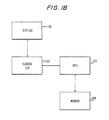
- FIG. 1B is a block diagram representing a preferred embodiment of the handwriting computer of FIG. 1A. It includes a central processing unit (CPU) 130 that receives input from screen I/O 135. This input has been entered onto screen I/O 135 using stylus 145. CPU 130 sends processed output to screen I/O 135. CPU 130 also sends and receives data from memory 140.
- CPU 130 is a 80486 or 80586 processor -- preferably an I486® or PENTIUM® processor made by Intel Corp. of Santa Clara, California, although any other suitable processor may be used.
- handwritten input is preferably recorded as a series of strokes.
- Each stroke preferably is determined by the movement of the stylus from a "pen down” event (i.e., the stylus tip making contact with the display) to an immediately following "pen up” event (i.e., the stylus tip terminating contact with the display).
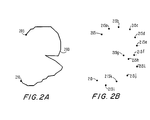
- FIGS. 2A and 2B illustrate how data points for a stroke are recorded for one preferred embodiment of the invention.
- FIG. 2A is an enlarged view of a handwritten stroke 200 that represents the numeral "3."
- the beginning point of stroke 200 that is the point where the stylus first makes contact with the display, is at point 205.
- the end point of stroke 200 that is the point where the stylus is lifted from the display, is at point 210.
- the display is-continually sampled at a rapid rate (in one preferred embodiment, approximately 200 times per second), to determine whether the stylus is contacting the display, and, if so, the coordinates of the point of contact.
- a rapid rate in one preferred embodiment, approximately 200 times per second
- contact may include remaining within a given small distance of the display.
- the stroke recording process begins when the tip of the stylus makes contact with the display. A "pen down” event is recorded, and the coordinates of the contact point are stored. At each succeeding sampling interval, the new position of the stylus is determined.
- FIG. 2B illustrates the positions 215a to 2151 of the stylus for each sampling interval between the "pen down” event at point 205 and the "pen up” event at point 210. (In practice, there would probably be many more points sampled.)
- Stroke 200 can thus be described in terms of the coordinates of "pen down” point 205, intermediate positions 215a to 2151, and "pen up” point 210.
- the line segments between each pair of successive intermediate positions can be described as “segments.”
- Handwritten input to the computer usually does not consist of a single stroke. Instead, handwriting generally includes letters, numbers or words made up of groups of separate strokes. Strokes that are part of the same handwritten entry typically are closely spaced both in time and in position.
- the "pen down" event of a subsequent stroke occurs within approximately 500 milliseconds (the actual duration of the interval is user selectable) of the "pen up" event of the preceding stroke, the subsequent stroke is considered to be part of the same handwritten entry as the preceding stroke.
- the second stroke is made without the stylus being brought out of proximity with, or raised more than approximately one-half inch above, the display screen between the "pen up" event of the first stroke and the "pen down” event of the second stroke.
- input means other than a handheld stylus may be used to provide input to the invention.
- input produced by a keyboard, a mouse, a mouse-pen, a light pen, a finger (in conjunction with a touch sensitive panel), a scanner, a video digitizer, or a digitizing pad may be used.
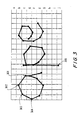
- FIG. 3 is a coordinate diagram of the handwritten word "ape.”
- the letters a-j represent rows that segments of "ape" might possibly intersect.
- the Row List of "ape” is constructed by counting the number of horizontal pixels that the word intersects at each row and storing that number in the appropriate row location in the list. Thus, for example, row d intersects "ape" in 9 places and so row location d in the Row List would contain the value 9.
- This particularly preferred embodiment of the invention constructs this Row List by looking at each successive pair of points that make up the word and increasing the row locations in the Row List that are between that pair by one.
- the system first gets points 301 and 302 of the word "ape" and increments the values of rows c and b (the segment connecting points 301 and 302 spans these two rows) in the Row List by one.
- the system then gets point 303 and increments the value of row b (the segment between 302 and 303 spans row b only) by one.
- the system then gets point 304 and increments the values of rows c and d by one. This continues until all pixels in the word "ape" have been processed. At this point, the Row List is complete.
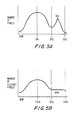
- FIG. 4A is a graph of the Row List of a word with few or no descending or ascending characters.
- the baseline which is the row with the least number of pixels on the descent from the peak representing the row with the most pixels 401, is identified as 402.
- the ascender line which is the row with the smallest number of pixels on the ascent from the peak, is identified as 403. It should be noted that while FIG. 3 depicts the top row of the word as the first row in the Row List and the bottom row of the word as the last row in the Row List, this invention is not limited to such an approach.
- the first row in the Row List may be the bottom row of the word and the last row in the Row List the top row of the word. In this situation, 402 would represent the ascender line and 403 would represent the baseline.
- the baseline or ascender line of words with Row Lists having graphs similar to FIG. 4A could be identified by scanning from 401 down the curve until the lowest part of the curve's descent 402 or ascent 403 is found.
- FIG. 5A is a graph of the Row List of a word with many descenders.
- a spike 504 occurs to the right of the bell shaped curve.
- the baseline 502 is no longer the row with the least number of pixels on the descent from the row with the most pixels 501. Instead the row with the least number of pixels is row 503.
- the method for identifying the baseline on the graph of-FIG. 4A would not work on the graph of FIG. 5A.
- FIG. 5B is a graph of the Filtered Row List of the word with many descenders graphed in FIG. 5A.
- spike 504 has been transformed into plateau 504a.
- the beginning row 502a of this plateau is the same row as the baseline 502.
- FIG. 4B is a graph of the Filtered Row List of the word with few descenders or ascenders of FIG. 4A. As can be seen the Row List has been "flattened" by the wide moving average. Nevertheless, baseline 402a is the same row as the original baseline 402, and ascender line 403a is the same row as original ascender line 403.
- FIG. 5B can be ascertained by scanning in the appropriate direction from the highest point of the respective curve -- 401a or 501a, and looking for the first of either (1) the first row encountered that is part of a plateau as described previously or (2) the first row encountered that is lowest part of the curve's ascent or descent as appropriate.
- the system would scan from 401a forward towards the end of the curve and would first encounter 402a -- the first row that is the lowest part of the curve's descent. This would be the baseline.
- the system would scan from 5 Ola-forward towards the end of the curve and would first encounter plateau 504a.
- the first row 502a of plateau 504a would be the baseline.
- FIG. 6 is a flow chart of the preferred embodiment of the method of the present invention for determining the baseline or ascender line of handwritten data.
- the method starts at step 601.
- a user enters a group of strokes that represent handwritten data (hereinafter "word” will be used to represent handwritten "data") and the locations of those strokes are stored as a sequence of (x,y) coordinate pairs.
- the system calculates the number of pixels per horizontal row of that word -- the Row List.
- the system filters the Row List using a wide moving average to create a Filtered Row List.
- the system analyzes the Filtered Row List to determine the baseline and/or ascender line for the given word.
- the method ends at step 606.
- FIG. 7 is a flow chart of the preferred embodiment of the calculation of the Row List at step 603.
- the system determines the height of the word by subtracting the smallest y stroke coordinate in the word from the largest y stroke coordinate in the word. This number represents the number of rows in Row List.
- steps 702-708 the system identifies each segment of each stroke that makes up the word and counts the number of pixels per horizontal row that the segment intersects. This number is inserted in the appropriate location in the Row List.
- step 702 the system obtains the first stroke in the word.
- step 703 the system gets the coordinates of the first point in the stroke and makes this the current point.
- test 704 the system checks to see if it is done with the stroke. If it is not, the system moves to step 705 and gets the coordinates of the next point in the stroke.
- step 706 every horizontal row location in the Row List between the y coordinates of the current point and next point in the stroke is incremented by one. The system then makes the next point the current point and loops back to test 704.
- test 704 If the system is done with the stroke (test 704) the system moves to test 708. At test 708 the system checks to see if it is done with the word. If there are more strokes in the word the system moves to step 707. At step 707 the system gets the next stroke in the word. From step 707 the system loops back to step 703 to get the first point in the next stroke.
- test 708 If the system is done with the word (test 708) the system now has a complete Row List of the handwritten word.
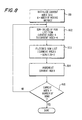
- FIG. 8 is a flow chart of the preferred embodiment of the calculation of the Filtered Row List from the Row List at step 604.
- a row index counter is set to 0.
- Steps 802-805 form a loop that creates the Filtered Row List.
- the value of the sum created in 802 is divided by the total number of rows summed, and this value is placed in the current index location of the Filtered Row List.
- the index is incremented by one.
- the system checks to see whether the current index value is greater than the number of rows in the word (previously obtained at step 701). If not, the system goes back to step 802. If the current index is greater than the number of rows in the word, the Filtered Row List is complete.
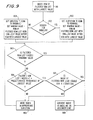
- FIG. 9 is a flow chart of the preferred embodiment of the determination of the baseline or ascender line by analyzing the Filtered Row List at step 605.
- an index is assigned to be the row number of the row with the largest value of the Filtered Row List. This row is represented by the top of the bell shaped curve.
- the system checks to see if it is searching for the baseline of the word. This information has been previously supplied to the system.
- step 903 sets the scanning direction of the Filtered Row List to forward and assigns a minimum value to be equal to the row with the smallest value after the row with the largest value. If at test 902 the system is searching for the ascender line and not the baseline, the system moves to step 904 and the scanning direction is set to backward and the minimum value is assigned to be equal to the row with the smallest value before the row with the largest value.
- test 905 the system checks to see if the value of the row in the Filtered Row List that the index points to is equal to the minimum value. If the test is true then the system moves to step 909 and the baseline or ascender line is assigned to be the current index. This test identifies baselines in words with graphs similar to FIG. 4B.
- test 905 If test 905 is false then the system moves to test 906 and begins to look for a possible plateau.
- the system checks to see if the value of the row in the Filtered Row List that the index points to is less than are equal to a predetermined percentage of the value of the row in the Filtered Row List with the highest value. For determining baselines, it has been determined by testing that the predetermined percentage should be about 50% of the row with the largest value in the Filtered Row List (about 66% for determining ascender lines).
- test 906 checks to see if the row values of the Filtered Row List a predetermined number of rows (x) after the current index are the same as the value of the row that the current index points to. If they are, then the system moves to step 909 and the baseline or ascender line is assigned to be the current index.
- the combination of tests 906 and 907 identify baselines in words with graphs that have plateaus similar to the plateau of FIG. 5B. The baseline row of such words is the first row in that plateau.
- the predetermined number of rows (x) to check that yields the best results equals the difference between the row number represented by the peak of the graph in the Filtered Row List and the first index after the peak whose value is a predetermined percentage of the peak. It has been empirically determined that this predetermined percentage be 50% for baseline, and 66% for ascender line.
- step 908 moves the index in the appropriate direction, and loops back to test 905.
- the previously described method for determining positional guidelines may be performed at any time after the entry of the handwritten data.
- this positional guideline will not necessarily be the positional guideline of every character in the word, but will instead be the "average” positional guideline for the entire word, which can be used for alignment of the word with other words.
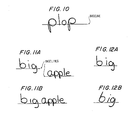
- FIG. 10 it can be seen all the individual character baselines in the word "plop" are either above or below the baseline of the entire word. If, however, the invention is used to determine the positional guideline of individual characters, then each character would be positioned relative to the other characters in the word using their individual positional guidelines -- thus creating a single guideline for the entire word.
- Knowing the baseline or ascender line of a word can be used for various operations. First, one can position words relative to each other using their known baselines as a guide. For example the words in FIG. 11A can be repositioned as in FIG. 11B by aligning their baselines. Additionally, handwritten text can be "rotated" around its baseline or ascender line creating an italicized effect such as illustrated by FIGS. 12A and B. This can be done by increasing the x coordinates of all the points in the word above the baseline by an increasing amount with distance from the baseline, while decreasing the x coordinates of all points in the word below the baseline by the same increasing amount.
- a handwritten word can be inserted before or between other words by preferably having the user write the word to be inserted at any position on the display, and then having the user indicate, in some manner, where the word is to be inserted.
- the system would then preferably shift the words after the insertion point an appropriate amount, determine the positional guideline of the word to be inserted, and reposition the inserted word at the location indicated by the user using the positional guidelines of the existing text and inserted word as repositioning guides.
- the user would identify, in some manner, the word to be deleted, and the system would remove that word from the display and shift the words surrounding the deleted word back using their positional guidelines as repositioning guides.
Landscapes
- Engineering & Computer Science (AREA)
- Computer Vision & Pattern Recognition (AREA)
- Physics & Mathematics (AREA)
- General Physics & Mathematics (AREA)
- Multimedia (AREA)
- Theoretical Computer Science (AREA)
- Character Discrimination (AREA)
- Radar Systems Or Details Thereof (AREA)
- Position Input By Displaying (AREA)
- User Interface Of Digital Computer (AREA)
- Image Analysis (AREA)
- Character Input (AREA)
Claims (30)
- Vorrichtung (10) zum Positionieren handschriftlicher Daten auf einer Anzeigeeinrichtung, die umfasst:eine Empfangseinrichtung (110) zum Empfangen der Eingabe handschriftlicher Daten;eine Anzeigeeinrichtung (110) zum Anzeigen der handschriftlichen Daten;eine Dateneingabevorrichtung (125) zum Eingeben eines handschriftlichen Blocks der handschriftlichen Daten;einen Positions-Kennzeichner (130), der eine Positions-Leitlinie für den hand-schriftlichen Block kennzeichnet; undeinen Daten-Positionierer (130), der den handschriftlichen Block auf der Grund-lage der Positions-Leitlinie des handschriftlichen Blocks auf der Anzeigeeinrichtung positioniert, dadurch gekennzeichnet, dass der Positions-Kennzeichner aufweist:einen Zähler, der die Zahl von Pixeln pro horizontaler Reihe des handschriftlichen Blocks bestimmt;ein Filter, das die Zahl gefilterter Pixel pro Reihe durch Filtern der Zahl von Pixeln pro horizontaler Reihe über mehrere Reihen bestimmt; undeinen Analysator, der die gefilterten Pixel pro Reihe analysiert, um die Positions-Richtlinie für den handschriftlichen Block zu bestimmen.
- Vorrichtung nach Anspruch 1, wobei die Positions-Leitlinie eine Grundlinie des handschriftlichen Blocks ist.
- Vorrichtung nach Anspruch 1, wobei die Positions-Leitlinie eine Oberlängenlinie des handschriftlichen Blocks ist.
- Vorrichtung nach Anspruch 1,wobei die Anzeigeeinrichtung (110) ein Empfänger zum Empfangen von Eingaben ist.
- Vorrichtung nach Anspruch 1, wobei die Dateneingabevorrichtung ein Stift ist.
- Vorrichtung nach Anspruch 1, wobei das Filter die Zahl gefilterter Pixel pro Reihe anhand der Zahl von Pixeln pro horizontaler Reihe unter Verwendung eines breiten gleitenden Durchschnitts bestimmt.
- Vorrichtung nach Anspruch 6, wobei für jede horizontale Reihe der breite gleitenden Durchschnitt der Durchschnitt der Zahl von Pixeln in der Reihe und maximal einer vorgegebenen Zahl horizontaler Reihen vor und nach der horizontalen Reihe ist.
- Vorrichtung nach Anspruch 7, wobei die vorgegebene Zahl 16 ist.
- Vorrichtung nach Anspruch 1, wobei der Zähler umfasst:einen Strich-Kennzeichner, der die Striche (200) der handschriftlichen Daten kennzeichnet;einen Punkt-Kennzeichner, der die Punkte (215) der Striche kennzeichnet;einen Reihen-Kennzeichner, der die Reihenpositionen der Punkte der Striche kennzeichnet;einen Inkrementierer, der die Zahl von Pixeln pro horizontaler Reihe für jede Reihe zwischen den Reihenposition der Punkte der Striche inkrementiert.
- Vorrichtung nach Anspruch 1, wobei die Zahl gefilterter Pixel pro Reihe durch eine Kurve dargestellt werden kann und die Vorrichtung des Weiteren umfasst:einen Kennzeichner für die Reihe mit den meisten gefilterten Pixel, der eine Reihe mit den meisten gefilterten Pixeln auf der Kurve kennzeichnet;einen Kennzeichner für die Reihe mit den wenigsten gefilterten Pixeln, der die erste Reihe mit den wenigsten gefilterten Pixeln kennzeichnet, die bei einer Abtastung beginnend mit der Reihe mit den meisten gefilterten Pixeln abgetastet wird;einen Plateaureihen-Kennzeichner, der ein Plateau von Reihen kennzeichnet, wobei das Plateau von Reihen eine vorgegebene Zahl aufeinanderfolgender Reihen mit dem gleichen Wert gefilterter Pixel umfasst; undeinen ersten Reihen-Kennzeichner, der die erste Reihe des Plateaus von Reihen kennzeichnet, die bei einer Abtastung beginnend mit der Reihe mit den meisten gefilterten Pixeln abgetastet wird.
- Vorrichtung nach Anspruch 10, wobei der Analysator die Positions-Leitlinie als die erste Reihe bestimmt, die bei einer Abtastung beginnend mit der Reihe mit den meisten gefilterten Pixeln abgetastet wird, d.h., (a) die Reihe mit den wenigsten gefilterten Pixeln oder (b) die erste Reihe in dem Plateau von Reihen ist.
- Vorrichtung nach Anspruch 10, wobei die Zahl gefilterter Pixel in der ersten Reihe des Plateaus von Reihen niedriger ist als ein vorgegebener Anteil der Zahl gefilterter Pixel in der Reihe mit den meisten gefilterten Pixeln oder ihm entspricht.
- Vorrichtung nach Anspruch 12, wobei der vorgegebene Anteil ungefähr 50 % beträgt.
- Vorrichtung nach Anspruch 12, wobei der vorgegebene Anteil ungefähr 66 % beträgt.
- Vorrichtung nach Anspruch 12, wobei die vorgegebene Zahl aufeinanderfolgender Reihen die Differenz zwischen den Reihenzahlen (a) der Reihe mit den meisten gefilterten Pixeln und (b) der ersten Reihe nach der Reihe mit den meisten gefilterten Pixeln ist, deren Zahl gefilterter Pixel niedriger ist als der vorgegebene Anteil der Zahl gefilterter Pixel in der Reihe mit den meisten gefilterten Pixeln oder ihm entspricht.
- Verfahren zum Positionieren handschriftlicher Daten auf einer Anzeigeeinrichtung, die umfasst:Empfangen der Eingabe handschriftlicher Daten;Anzeigen der handschriftlichen Daten;Eingeben eines handschriftlichen Blocks der handschriftlichen Daten;Kennzeichnen einer Positions-Leitlinie für den handschriftlichen Block; undPositionieren des handschriftlichen Blocks auf der Anzeigeeinrichtung auf der Grundlage der Positions-Leitlinie des handschriftlichen Blocks, dadurch gekennzeichnet, dass der Schritt des Identifizierens einer Positions-Leitlinie einschließt:Bestimmen der Zahl von Pixeln pro horizontaler Reihe des handschriftlichen Blocks;Bestimmen der Zahl gefilterter Pixel pro Reihe durch Filtern der Zahl von Pixeln pro horizontaler Reihe über mehrere Reihen; undAnalysieren der gefilterten Pixel pro Reihe, um die Positions-Leitlinie für den handschriftlichen Block zu bestimmen.
- Verfahren nach Anspruch 16, wobei die Positions-Leitlinie eine Grundlinie des handschriftlichen Blocks ist.
- Verfahren nach Anspruch 16, wobei die Positions-Leitlinie eine Oberlängenlinie des handschriftlichen Blocks ist.
- Verfahren nach Anspruch 16, wobei die Anzeigeeinrichtung die handschriftlichen Daten empfängt und anzeigt.
- Verfahren nach Anspruch 16, wobei ein Stift verwendet wird, um den handschrift-lichen Block der handschriftlichen Daten einzugeben.
- Verfahren nach Anspruch 16, wobei ein breiter gleitender Durchschnitt verwendet wird, um die Zahl gefilterter Pixel pro Reihe anhand der Zahl von Pixeln pro horizontaler Reihe zu bestimmen.
- Verfahren nach Anspruch 21, wobei für jede horizontale Reihe der breite gleitende Durchschnitt der Durchschnitt der Zahl von Pixeln in der horizontalen Reihe und maximal einer vorgegebenen Zahl horizontaler Reihen vor und nach der horizontalen Reihe ist.
- Verfahren nach Anspruch 22, wobei die vorgegebene Zahl 16 ist.
- Verfahren nach Anspruch 17, wobei das Bestimmen der Zahl von Pixeln pro horizontaler Reihe umfasst:Kennzeichnen der Striche der handschriftlichen Daten;Kennzeichnen der Punkte der Striche;Kennzeichnen der Reihenpositionen der Punkte der Striche;Inkrementieren der Zahl von Pixeln pro horizontaler Reihe für jede Reihe zwischen den Reihenpositionen der Punkte der Striche.
- Verfahren nach Anspruch 17, wobei die Zahl gefilterter Pixel pro Reihe durch eine Kurve dargestellt werden kann und das Verfahren des Weiteren umfasst:Kennzeichnen einer Reihe mit den meisten gefilterten Pixeln auf der Kurve;Kennzeichnen einer Reihe mit den wenigsten gefilterten Pixeln auf der Kurve;Kennzeichnen der ersten Reihe mit den wenigsten gefilterten Pixeln, die in einer Abtastung beginnend mit der Reihe mit den meisten gefilterten Pixeln abgetastet wird;Kennzeichnen eines Plateaus von Reihen, wobei das Plateau von Reihen eine vorgegebene Zahl aufeinanderfolgender Reihen mit dem gleichen Wert gefilterter Pixel umfasst; undKennzeichnen der ersten Reihe des Plateaus von Reihen, die in einer Abtastung beginnend mit der Reihe mit den meisten gefilterten Pixeln abgetastet wird.
- Verfahren nach Anspruch 25, wobei die Positions-Leitlinie als die erste Reihe bestimmt wird, die bei einer Abtastung beginnend mit der Reihe mit den meisten gefilterten Pixeln abgetastet wird, d.h. (a) die Reihe mit den wenigsten gefilterten Pixeln oder (b) die erste Reihe in dem Plateau von Reihen ist.
- Verfahren nach Anspruch 25, wobei die Zahl gefilterter Pixeln in der ersten Reihe des Plateaus von Reihen niedriger ist als ein vorgegebener Anteil der Zahl gefilterter Pixel in der Reihe mit den meisten gefilterten Pixeln oder ihm entspricht.
- Vorrichtung nach Anspruch 27, wobei der vorgegebene Anteil ungefähr 50 % beträgt. .
- Vorrichtung nach Anspruch 27, wobei der vorgegebene Anteil ungefähr 66 % beträgt.
- Verfahren nach Anspruch 27, wobei die vorgegebene Zahl aufeinanderfolgender Reihen die Differenz zwischen den Reihenzahlen (a) der Reihe mit den meisten gefilterten Pixeln und (b) der ersten Reihe nach der Reihe mit den meisten gefilterten Pixeln ist, deren Zahl gefilterter Pixel niedriger ist als der vorgegebene Anteil der Zahl gefilterter Pixel in der Reihe mit den meisten gefilterten Pixeln oder ihm entspricht.
Applications Claiming Priority (2)
| Application Number | Priority Date | Filing Date | Title |
|---|---|---|---|
| US08/307,374 US5633957A (en) | 1994-09-16 | 1994-09-16 | Method and apparatus for determining positional guidelines of handwritten data |
| US307374 | 1994-09-16 |
Publications (3)
| Publication Number | Publication Date |
|---|---|
| EP0702329A2 EP0702329A2 (de) | 1996-03-20 |
| EP0702329A3 EP0702329A3 (de) | 1997-02-26 |
| EP0702329B1 true EP0702329B1 (de) | 2003-02-26 |
Family
ID=23189478
Family Applications (1)
| Application Number | Title | Priority Date | Filing Date |
|---|---|---|---|
| EP95306087A Expired - Lifetime EP0702329B1 (de) | 1994-09-16 | 1995-08-31 | Verfahren und Vorrichtung zum Determinieren von Positionsführungszeilen für handgeschriebene Daten |
Country Status (6)
| Country | Link |
|---|---|
| US (1) | US5633957A (de) |
| EP (1) | EP0702329B1 (de) |
| JP (1) | JP3020223B2 (de) |
| AT (1) | ATE233419T1 (de) |
| CA (1) | CA2157646A1 (de) |
| DE (1) | DE69529714T2 (de) |
Families Citing this family (18)
| Publication number | Priority date | Publication date | Assignee | Title |
|---|---|---|---|---|
| US6434581B1 (en) | 1991-03-20 | 2002-08-13 | Microsoft Corporation | Script character processing method for interactively adjusting space between writing element |
| US5953735A (en) * | 1991-03-20 | 1999-09-14 | Forcier; Mitchell D. | Script character processing method and system with bit-mapped document editing |
| US5220649A (en) * | 1991-03-20 | 1993-06-15 | Forcier Mitchell D | Script/binary-encoded-character processing method and system with moving space insertion mode |
| IL112420A (en) * | 1995-01-23 | 1999-05-09 | Advanced Recognition Tech | Handwriting recognition with reference line estimation |
| US6081621A (en) * | 1996-10-01 | 2000-06-27 | Canon Kabushiki Kaisha | Positioning templates in optical character recognition systems |
| US6731309B1 (en) | 1998-08-28 | 2004-05-04 | Corel Corporation | Real time preview |
| MXPA01003116A (es) * | 1998-09-30 | 2003-05-15 | Siemens Ag Oesterreich | Procedimiento para determinar la posicion de renglones de texto en tareas de reconocimiento de texto. |
| US7031553B2 (en) | 2000-09-22 | 2006-04-18 | Sri International | Method and apparatus for recognizing text in an image sequence of scene imagery |
| US6823084B2 (en) | 2000-09-22 | 2004-11-23 | Sri International | Method and apparatus for portably recognizing text in an image sequence of scene imagery |
| WO2002025575A2 (en) * | 2000-09-22 | 2002-03-28 | Sri International | Method and apparatus for portably recognizing text in an image sequence of scene imagery |
| US7096432B2 (en) * | 2002-05-14 | 2006-08-22 | Microsoft Corporation | Write anywhere tool |
| US7724956B2 (en) | 2003-02-28 | 2010-05-25 | Gannon Technologies Group Llc | Systems and methods for identifying characters and words in a document |
| US7187801B2 (en) * | 2003-03-31 | 2007-03-06 | Microsoft Corporation | Multiple handwriting recognition engine selection |
| US7360157B1 (en) * | 2003-09-19 | 2008-04-15 | Microsoft Corporation | Aligning content in an electronic document |
| JP5299349B2 (ja) * | 2010-04-30 | 2013-09-25 | ブラザー工業株式会社 | 入力制御装置、入力制御方法及び入力制御プログラム |
| JP5683375B2 (ja) * | 2011-05-02 | 2015-03-11 | シャープ株式会社 | 表示装置および表示プログラム |
| JP6119366B2 (ja) * | 2013-03-27 | 2017-04-26 | ブラザー工業株式会社 | 補正装置 |
| US11455762B2 (en) | 2017-12-14 | 2022-09-27 | Adobe Inc. | Text border tool and enhanced corner options for background shading |
Family Cites Families (12)
| Publication number | Priority date | Publication date | Assignee | Title |
|---|---|---|---|---|
| US4251799A (en) * | 1979-03-30 | 1981-02-17 | International Business Machines Corporation | Optical character recognition using baseline information |
| CA1223366A (en) * | 1984-09-27 | 1987-06-23 | Abijah S. Fox | System for automatic adjustment and editing of handwritten text images |
| JPH0731714B2 (ja) * | 1986-05-29 | 1995-04-10 | インタ−ナショナル ビジネス マシ−ンズ コ−ポレ−ション | 文字成分切出し方法 |
| US5216725A (en) * | 1990-10-31 | 1993-06-01 | Environmental Research Institute Of Michigan | Apparatus and method for separating handwritten characters by line and word |
| US5327342A (en) * | 1991-03-31 | 1994-07-05 | Roy Prannoy L | Method and apparatus for generating personalized handwriting |
| US5172422A (en) * | 1991-05-13 | 1992-12-15 | Eastman Kodak Company | Fast character segmentation of skewed text lines for optical character recognition |
| CA2077970C (en) * | 1991-11-19 | 1999-02-23 | Daniel P. Huttenlocher | Optical word recognition by examination of word shape |
| JPH05197477A (ja) * | 1992-01-20 | 1993-08-06 | Mitsubishi Electric Corp | 手書き情報入力装置 |
| JPH05282091A (ja) * | 1992-04-02 | 1993-10-29 | Mitsubishi Electric Corp | 任意サイズ文字の入力装置 |
| JP2989072B2 (ja) * | 1992-06-24 | 1999-12-13 | シャープ株式会社 | 手書き文字入力装置 |
| US5491758A (en) * | 1993-01-27 | 1996-02-13 | International Business Machines Corporation | Automatic handwriting recognition using both static and dynamic parameters |
| US5396566A (en) * | 1993-03-04 | 1995-03-07 | International Business Machines Corporation | Estimation of baseline, line spacing and character height for handwriting recognition |
-
1994
- 1994-09-16 US US08/307,374 patent/US5633957A/en not_active Expired - Lifetime
-
1995
- 1995-08-31 EP EP95306087A patent/EP0702329B1/de not_active Expired - Lifetime
- 1995-08-31 DE DE69529714T patent/DE69529714T2/de not_active Expired - Lifetime
- 1995-08-31 AT AT95306087T patent/ATE233419T1/de not_active IP Right Cessation
- 1995-09-06 CA CA002157646A patent/CA2157646A1/en not_active Abandoned
- 1995-09-14 JP JP26236595A patent/JP3020223B2/ja not_active Expired - Lifetime
Also Published As
| Publication number | Publication date |
|---|---|
| JPH08227338A (ja) | 1996-09-03 |
| ATE233419T1 (de) | 2003-03-15 |
| US5633957A (en) | 1997-05-27 |
| EP0702329A2 (de) | 1996-03-20 |
| DE69529714D1 (de) | 2003-04-03 |
| CA2157646A1 (en) | 1996-03-17 |
| DE69529714T2 (de) | 2003-10-02 |
| EP0702329A3 (de) | 1997-02-26 |
| JP3020223B2 (ja) | 2000-03-15 |
Similar Documents
| Publication | Publication Date | Title |
|---|---|---|
| EP0702329B1 (de) | Verfahren und Vorrichtung zum Determinieren von Positionsführungszeilen für handgeschriebene Daten | |
| EP0739521B1 (de) | Verfahren zur handschrift-eingangsaufteilung | |
| CA2076506C (en) | Apparatus and method for reducing system overhead while inking strokes in a finger or stylus-based input device of a data processing system | |
| US6603881B2 (en) | Spatial sorting and formatting for handwriting recognition | |
| US5867150A (en) | Graphic indexing system | |
| US5652806A (en) | Input device with data targeting to determine an entry field for a block of stroke data | |
| US7885464B2 (en) | Apparatus, method, and program for handwriting recognition | |
| EP1588232B1 (de) | System und verfahren zur texteingabe auf wortbasis mit kontinuierlichen betätigungen | |
| EP1703364B1 (de) | Erkennung einer wort- oder zeichengrenzenbasierten ausstreichungsbewegung | |
| CA2178962C (en) | Method of joining handwritten input | |
| US5956423A (en) | Method and system for data entry of handwritten symbols | |
| US20070097102A1 (en) | Temporary Lines for Writing | |
| US5926567A (en) | Method and apparatus for storing and rapidly displaying graphic data | |
| GB2313993A (en) | Method and system for facilitating user input into a GUI window using a stylus | |
| US20040141646A1 (en) | Arabic handwriting recognition using feature matching | |
| US5614926A (en) | Word processor with a handwriting text processing function | |
| JPH08292942A (ja) | 文字列予測方法及び文書作成装置 | |
| JPH0778262A (ja) | 罫線入力装置 | |
| JPH09106442A (ja) | オンライン文字認識装置 |
Legal Events
| Date | Code | Title | Description |
|---|---|---|---|
| PUAI | Public reference made under article 153(3) epc to a published international application that has entered the european phase |
Free format text: ORIGINAL CODE: 0009012 |
|
| AK | Designated contracting states |
Kind code of ref document: A2 Designated state(s): AT BE CH DE DK ES FR GB IE IT LI NL SE |
|
| PUAL | Search report despatched |
Free format text: ORIGINAL CODE: 0009013 |
|
| AK | Designated contracting states |
Kind code of ref document: A3 Designated state(s): AT BE CH DE DK ES FR GB IE IT LI NL SE |
|
| 17P | Request for examination filed |
Effective date: 19970815 |
|
| 17Q | First examination report despatched |
Effective date: 19991103 |
|
| RTI1 | Title (correction) |
Free format text: METHOD AND APPARATUS FOR DETERMINING POSITIONAL GUIDELINES OF HANDWRITTEN DATA |
|
| GRAG | Despatch of communication of intention to grant |
Free format text: ORIGINAL CODE: EPIDOS AGRA |
|
| RTI1 | Title (correction) |
Free format text: METHOD AND APPARATUS FOR DETERMINING POSITIONAL GUIDELINES OF HANDWRITTEN DATA |
|
| GRAG | Despatch of communication of intention to grant |
Free format text: ORIGINAL CODE: EPIDOS AGRA |
|
| GRAH | Despatch of communication of intention to grant a patent |
Free format text: ORIGINAL CODE: EPIDOS IGRA |
|
| GRAH | Despatch of communication of intention to grant a patent |
Free format text: ORIGINAL CODE: EPIDOS IGRA |
|
| GRAA | (expected) grant |
Free format text: ORIGINAL CODE: 0009210 |
|
| AK | Designated contracting states |
Designated state(s): AT BE CH DE DK ES FR GB IE IT LI NL SE |
|
| PG25 | Lapsed in a contracting state [announced via postgrant information from national office to epo] |
Ref country code: NL Free format text: LAPSE BECAUSE OF FAILURE TO SUBMIT A TRANSLATION OF THE DESCRIPTION OR TO PAY THE FEE WITHIN THE PRESCRIBED TIME-LIMIT Effective date: 20030226 Ref country code: LI Free format text: LAPSE BECAUSE OF FAILURE TO SUBMIT A TRANSLATION OF THE DESCRIPTION OR TO PAY THE FEE WITHIN THE PRESCRIBED TIME-LIMIT Effective date: 20030226 Ref country code: IT Free format text: LAPSE BECAUSE OF FAILURE TO SUBMIT A TRANSLATION OF THE DESCRIPTION OR TO PAY THE FEE WITHIN THE PRE;WARNING: LAPSES OF ITALIAN PATENTS WITH EFFECTIVE DATE BEFORE 2007 MAY HAVE OCCURRED AT ANY TIME BEFORE 2007. THE CORRECT EFFECTIVE DATE MAY BE DIFFERENT FROM THE ONE RECORDED.SCRIBED TIME-LIMIT Effective date: 20030226 Ref country code: CH Free format text: LAPSE BECAUSE OF FAILURE TO SUBMIT A TRANSLATION OF THE DESCRIPTION OR TO PAY THE FEE WITHIN THE PRESCRIBED TIME-LIMIT Effective date: 20030226 Ref country code: BE Free format text: LAPSE BECAUSE OF FAILURE TO SUBMIT A TRANSLATION OF THE DESCRIPTION OR TO PAY THE FEE WITHIN THE PRESCRIBED TIME-LIMIT Effective date: 20030226 Ref country code: AT Free format text: LAPSE BECAUSE OF FAILURE TO SUBMIT A TRANSLATION OF THE DESCRIPTION OR TO PAY THE FEE WITHIN THE PRESCRIBED TIME-LIMIT Effective date: 20030226 |
|
| REG | Reference to a national code |
Ref country code: GB Ref legal event code: FG4D |
|
| REG | Reference to a national code |
Ref country code: CH Ref legal event code: EP |
|
| REG | Reference to a national code |
Ref country code: IE Ref legal event code: FG4D |
|
| REF | Corresponds to: |
Ref document number: 69529714 Country of ref document: DE Date of ref document: 20030403 Kind code of ref document: P |
|
| PG25 | Lapsed in a contracting state [announced via postgrant information from national office to epo] |
Ref country code: SE Free format text: LAPSE BECAUSE OF FAILURE TO SUBMIT A TRANSLATION OF THE DESCRIPTION OR TO PAY THE FEE WITHIN THE PRESCRIBED TIME-LIMIT Effective date: 20030526 Ref country code: DK Free format text: LAPSE BECAUSE OF FAILURE TO SUBMIT A TRANSLATION OF THE DESCRIPTION OR TO PAY THE FEE WITHIN THE PRESCRIBED TIME-LIMIT Effective date: 20030526 |
|
| NLV1 | Nl: lapsed or annulled due to failure to fulfill the requirements of art. 29p and 29m of the patents act | ||
| ET | Fr: translation filed | ||
| PG25 | Lapsed in a contracting state [announced via postgrant information from national office to epo] |
Ref country code: ES Free format text: LAPSE BECAUSE OF FAILURE TO SUBMIT A TRANSLATION OF THE DESCRIPTION OR TO PAY THE FEE WITHIN THE PRESCRIBED TIME-LIMIT Effective date: 20030828 |
|
| PG25 | Lapsed in a contracting state [announced via postgrant information from national office to epo] |
Ref country code: IE Free format text: LAPSE BECAUSE OF NON-PAYMENT OF DUE FEES Effective date: 20030901 |
|
| PLBE | No opposition filed within time limit |
Free format text: ORIGINAL CODE: 0009261 |
|
| STAA | Information on the status of an ep patent application or granted ep patent |
Free format text: STATUS: NO OPPOSITION FILED WITHIN TIME LIMIT |
|
| 26N | No opposition filed |
Effective date: 20031127 |
|
| REG | Reference to a national code |
Ref country code: IE Ref legal event code: MM4A |
|
| REG | Reference to a national code |
Ref country code: GB Ref legal event code: 732E Free format text: REGISTERED BETWEEN 20120412 AND 20120418 |
|
| REG | Reference to a national code |
Ref country code: DE Ref legal event code: R082 Ref document number: 69529714 Country of ref document: DE Representative=s name: BARDEHLE PAGENBERG PARTNERSCHAFT MBB PATENTANW, DE Effective date: 20120329 Ref country code: DE Ref legal event code: R082 Ref document number: 69529714 Country of ref document: DE Representative=s name: BOEHMERT & BOEHMERT ANWALTSPARTNERSCHAFT MBB -, DE Effective date: 20120329 Ref country code: DE Ref legal event code: R081 Ref document number: 69529714 Country of ref document: DE Owner name: QUALCOMM INCORPORATED, SAN DIEGO, US Free format text: FORMER OWNER: COMPAQ COMPUTER CORP., HOUSTON, TEX., US Effective date: 20120329 Ref country code: DE Ref legal event code: R081 Ref document number: 69529714 Country of ref document: DE Owner name: HEWLETT-PACKARD DEVELOPMENT COMPANY, L.P., HOU, US Free format text: FORMER OWNER: COMPAQ COMPUTER CORP., HOUSTON, TEX., US Effective date: 20120329 |
|
| REG | Reference to a national code |
Ref country code: FR Ref legal event code: TP Owner name: HEWLETT-PACKARD DEVELOPMENT COMPANY, L.P., US Effective date: 20131018 |
|
| REG | Reference to a national code |
Ref country code: DE Ref legal event code: R082 Ref document number: 69529714 Country of ref document: DE Representative=s name: BARDEHLE PAGENBERG PARTNERSCHAFT MBB PATENTANW, DE |
|
| PGFP | Annual fee paid to national office [announced via postgrant information from national office to epo] |
Ref country code: DE Payment date: 20140901 Year of fee payment: 20 |
|
| REG | Reference to a national code |
Ref country code: FR Ref legal event code: TP Owner name: QUALCOMM INCORPORATED(1/3), US Effective date: 20141002 Ref country code: FR Ref legal event code: CA Effective date: 20141002 |
|
| PGFP | Annual fee paid to national office [announced via postgrant information from national office to epo] |
Ref country code: FR Payment date: 20140725 Year of fee payment: 20 Ref country code: GB Payment date: 20140725 Year of fee payment: 20 |
|
| REG | Reference to a national code |
Ref country code: DE Ref legal event code: R082 Ref document number: 69529714 Country of ref document: DE Representative=s name: BARDEHLE PAGENBERG PARTNERSCHAFT MBB PATENTANW, DE Effective date: 20141023 Ref country code: DE Ref legal event code: R081 Ref document number: 69529714 Country of ref document: DE Owner name: QUALCOMM INCORPORATED, SAN DIEGO, US Free format text: FORMER OWNER: HEWLETT-PACKARD DEVELOPMENT COMPANY, L.P., HOUSTON, TEX., US Effective date: 20141023 |
|
| REG | Reference to a national code |
Ref country code: GB Ref legal event code: 732E Free format text: REGISTERED BETWEEN 20150305 AND 20150311 |
|
| REG | Reference to a national code |
Ref country code: DE Ref legal event code: R071 Ref document number: 69529714 Country of ref document: DE |
|
| REG | Reference to a national code |
Ref country code: GB Ref legal event code: PE20 Expiry date: 20150830 |
|
| PG25 | Lapsed in a contracting state [announced via postgrant information from national office to epo] |
Ref country code: GB Free format text: LAPSE BECAUSE OF EXPIRATION OF PROTECTION Effective date: 20150830 |