EP0702342A2 - Anlage zur individuellen und identifizierbaren Hilfe - Google Patents
Anlage zur individuellen und identifizierbaren Hilfe Download PDFInfo
- Publication number
- EP0702342A2 EP0702342A2 EP95480114A EP95480114A EP0702342A2 EP 0702342 A2 EP0702342 A2 EP 0702342A2 EP 95480114 A EP95480114 A EP 95480114A EP 95480114 A EP95480114 A EP 95480114A EP 0702342 A2 EP0702342 A2 EP 0702342A2
- Authority
- EP
- European Patent Office
- Prior art keywords
- call
- transmitter
- message
- individual
- instruction
- Prior art date
- Legal status (The legal status is an assumption and is not a legal conclusion. Google has not performed a legal analysis and makes no representation as to the accuracy of the status listed.)
- Granted
Links
Images

Classifications
-
- G—PHYSICS
- G08—SIGNALLING
- G08B—SIGNALLING SYSTEMS, e.g. PERSONAL CALLING SYSTEMS; ORDER TELEGRAPHS; ALARM SYSTEMS
- G08B25/00—Alarm systems in which the location of the alarm condition is signalled to a central station, e.g. fire or police telegraphic systems
- G08B25/01—Alarm systems in which the location of the alarm condition is signalled to a central station, e.g. fire or police telegraphic systems characterised by the transmission medium
- G08B25/016—Personal emergency signalling and security systems
-
- G—PHYSICS
- G08—SIGNALLING
- G08B—SIGNALLING SYSTEMS, e.g. PERSONAL CALLING SYSTEMS; ORDER TELEGRAPHS; ALARM SYSTEMS
- G08B25/00—Alarm systems in which the location of the alarm condition is signalled to a central station, e.g. fire or police telegraphic systems
- G08B25/003—Address allocation methods and details
Definitions
- the invention relates to an individual assistance installation identified by radio waves.
- Personalized assistance systems are of great use not only in establishments for the elderly or disabled, but also in establishments of the clinical or hospital type, or any other establishment receiving a population in common services.
- a call device is provided in each room of the establishment, for example of the call button type.
- the button in each room is connected by wire to a surveillance room where there is a table with an indicator or a bell corresponding to each room.
- a surveillance room where there is a table with an indicator or a bell corresponding to each room.
- the call button can of course be replaced by a zipper or a pear, and the call bell by an indicator light or the like.
- More elaborate systems provide in each room a second button called the acknowledgment button, which is intended to be actuated by the person intervening to assist the resident of the room, so as to cause the interruption of the call signal to the level of the surveillance room.
- the acknowledgment button When a member of staff intervenes in a room, he actuates the acknowledgment button, which interrupts the call signal.
- Wired systems having many drawbacks due to the importance of the work required as well as installation and maintenance costs, it has been imagined to replace the electric wires by a radio link. Thus, the system is freed from physical links, and becomes easy and quick to install.
- radio systems allow the call button to be replaced or supplemented by a portable transmitter permanently worn by each resident. This not only improves the geographic scope of the system, which is no longer limited by the wired installation, but also the quality of monitoring, since radio transmitters allow calls in cases emergency resulting in the impossibility of reaching a fixed button, as after a fall for example.
- each resident has an individual transmitter with a call button.
- a surveillance center is provided, connected to one or more receiving antennas covering the surveillance territory (one floor, one building, a set of buildings, a park, etc.). This central unit manages the transmission of call information to traditional indicators, bells, indicators, or to portable indication devices ("beeps") from the person or persons responsible.
- Known radio systems generally have an acknowledgment signaling means in each room, either in the form of a fixed acknowledgment button, or in the form of a magnetic detector with which the transmitters are fitted, and which triggers the emission of a so-called acknowledgment signal.
- the surveillance personnel carry a validation means, such as a portable magnet, which they need only approach the transmitter to trigger the emission of the acknowledgment message.
- the acknowledgment message carried out for example by magnetic cancellation of the call message, does not allow an identification of the staff who intervened. It is therefore impossible to identify personnel answering patient calls through the facility, except by using additional means of transmission.
- rescuers may, in turn, need to call for help. It then activates the rescued resident's call transmitter again. But this second call will only cause a signal to the staff who have already been warned and are therefore already on the scene.
- An object of the invention is to eliminate these drawbacks by satisfactorily responding to the shortcomings of the current devices.
- the invention relates to an assistance installation individual identified by radio waves, comprising individual transmitters for the transmission of calls by radio waves and a call management center, in which each call transmitter comprises a transmission device by radio waves connected to a logic circuit , itself connected to at least one physical actuation means triggering the transmission of a call message, each call transmitter further comprising an individual identification code which is contained in any message transmitted by the transmitter call, characterized in that the installation also includes a plurality of individual control transmitters, each control transmitter comprising a device for signaling radio instructions connected to a logic circuit, itself connected to a means of physical actuation of acknowledgment triggering the production of an acknowledgment message instruction, and a means of physical actuation of emergency triggering call the production of an emergency call message instruction, each call transmitter comprising a means for detecting the instruction signals, connected to its logic circuit, tripping selectively, when activated, according to the instruction, the emission of acknowledgment messages or emergency call messages.
- each control transmitter comprises an individual identification code which is contained in any instruction transmitted to the call transmitter by the control transmitter to be contained in any message transmitted in application of this instruction by the transmitter call.
- the instruction signals are infrared signals.
- Each call transmitter can further comprise a magnetic detector connected to the logic circuit, transmitting an unidentified acknowledgment instruction, and possibly a second magnetic detector connected to the logic circuit, transmitting an emergency call message, the two detectors magnetic then being arranged in separate locations distant from each other.
- Call transmitters can advantageously be provided with a quiet indicator triggered by the sending of a call message and either timed or stopped by the sending of a message or emergency call.
- the control transmitters can be provided with an indicator for confirmation of the transfer of instruction signals.
- Each control transmitter can further comprise a coding signal detector connected to the logic circuit for programming the identification code of the control transmitter, the coding of the transmitters being carried out by means of at least one detection device.
- coding of transmitters comprising one or more selectors and a physical actuation means connected to a device for producing coding signals.
- the identification codes of the control transmitters consist of an identification by function or service and an individual identification.
- the assistance facilities identified are generally intended for establishments accommodating people requiring frequent or permanent assistance, which will be called supervised persons, assisted persons or patients.
- Supervision and assistance is generally carried out by members of the personnel called surveillance or assistance persons, or even rescuers.
- An example of an individual assistance installation identified 1 according to the invention comprises, on the one hand, a call management center 2, connected to a series of main antennas 3 and possibly a plurality of secondary or relay antennas 4, and on the other hand, one or more individual call transmitters 5 which are assigned to each monitored person, and one or more control transmitters 6 which are assigned to or to members of the surveillance staff called by their functions to intervene in the event of a call.
- the call messages received by the management center can be signaled by display devices 7, visual or audible, by being assigned either totally centralized to a surveillance room, or selectively by department, by department, by floor. , etc. In general, this signaling mode is supplemented by individual signaling carried out by means of a people search device 8 connected to portable signaling devices 9, called "beeps".
- a printer 10 can also be provided, recording successively the calls.
- the call transmitters 5 can transmit call messages identifying the patient as well as acknowledgment messages and so-called emergency or second level messages identifying the rescuer, on instruction transmitted by the transmitter. control 6 thereof.
- the rescuer can either "acknowledge" a call or request assistance in turn, without their message then coming back to itself.
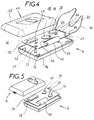
- the call transmitters 5 consist of a box 11 containing a printed circuit 12.
- the call transmitters 5 can be carried simply in the pocket in the manner of a holder. key, pin, or even clipped for example.
- the call transmitter 5 according to the invention comprises a cord 13 allowing it to be worn around the neck, the transmitter is thus permanently visible and easy to actuate by the patient.
- the cord 13 advantageously functions as an antenna.
- the housing 11 can be made for example of rigid plastic material, having an ergonomic shape for easy gripping and devoid of sharp edges, with clean colors, in to facilitate its use by patients even with reduced physical and / or mental resources.
- the housing 11 is composed in the embodiment shown of two molded half-shells 14,15 joined together at a median plane forming a plane of symmetry, by clipping or by means of screws.
- the housing is preferably sealed, and then includes a peripheral sealing gasket (not shown) at the interface between the two half-shells.
- the printed circuit 12 is disposed on supports 16,17 molded in one piece with the lower half-shell 14, and held when the housing is closed by similar supports symmetrically arranged, which are molded on the upper half-shell 15 of the housing 11.
- the call transmitter 5 comprises a main actuation button 18 which appears clearly visible in the middle of the front face of the upper half-shell 14 when the housing 11 is closed.
- the call transmitter 5 also comprises a radio signal detector 19 for the purpose of detecting instructions from one of the control transmitters 6, these instructions being hereinafter called assistance instructions.
- the transmission of the instructions between the control transmitter 6 and the call transmitter 5 is done by means of infrared signals. It is understood that other modes of transmission are conceivable, in particular, transmission by radio waves in other frequency ranges.
- the infrared detector 19 is here arranged under the actuation button 18, the latter being made of a material transparent to infrared signals.
- a tranquilization indicator light 20 is provided, the ignition of which is triggered by the emission of the call signal.
- additional actuation means are provided.
- the main call button 18 is doubled by one or more call buttons 21, 22 actuated by pulling the cord 13 acting as an antenna. These buttons are arranged symmetrically at the end of the printed circuit 12.
- the printed circuit 12 is slidably mounted over a short distance between the supports 16, 17 which then play the role of slides. More specifically, the upper 15 and lower 14 elements of the housing have centering studs 23, 24 facing each other which come into contact when the housing 1 1 is closed.
- the printed circuit 12 is provided with two elongated openings 25, 26 for the passage of the centering pads, which thus have the effect of limiting the sliding travel of the printed circuit 12.
- An element made of elastic material 27 ensures the return to the position of the circuit 12 when the traction on the cord ceases.
- the printed circuit 12 comprises a logic circuit containing an individual identification code, this logic circuit being connected to a device for transmitting radio messages 28.
- An energy source is provided in the form of a battery 29 which is mounted in a lateral recess 30 of rectangular shape of the circuit and connected to the logic circuit.
- the logic circuit is also connected, on the one hand, to the main call button 18 and to the additional push buttons 21, 22 by pulling the cord, and on the other hand to the signal detector 19.
- each call transmitter 5 further comprises a magnetic field detector 31, arranged for example near one end of the housing, and connected to the logic circuit. This detector makes it possible to control the transmission of an acknowledgment message by means of a magnet or a magnetic transmitter, the acknowledgment then being anonymous.
- a second magnetic detector may be provided, at a separate location, for example a side face, distant from the first magnetic detector. This second magnetic detector may make it possible to control the transmission of a second level call message by means of the same magnet, the second level call also being anonymous.
- a rescuer who does not have an identified control transmitter can, using a simple magnet, order the transmission either of an acknowledgment message or of a call message from second level (not identified), depending on the location where it will place this magnet on the rescued person's call transmitter.
- the logic circuit is produced by a microcontroller 32, which can be, for example, a usual CMOS type microcontroller.
- the signal detector 19 which here is an infrared detector, is advantageously constituted by an infrared diode or phototransistor, coupled to an amplification chain.
- the magnetic detector 31 is simply an ILS cell.
- a Hall effect or magneto-resistive sensor may be used.
- the radio transmitter is a frequency modulation transmitter.
- it is for example a quartz transmitter.
- Frequency modulation allows high quality and reliability of the transmission, compared to phase or amplitude modulation subject to parasitic reflections and attenuations which practically limit the transmission to a shorter range.
- the microcontroller 32 permanently includes a parameter or code for identifying the patient, which can be fixed once and for all during assembly before closing the housing 11, or can be parameterized by means of the infrared detector 19.
- This identification code is contained in each message sent by the transmission device controlled by the microcontroller according to the instructions received.
- the microcontroller 32 If the instruction comes from the main call button 18 or one or more of the additional call buttons 21, 22, the microcontroller 32 then commands the transmission of a call signal.
- the microcontroller 32 then commands the transmission either of an unidentified acknowledgment message or of an unidentified emergency call message.
- the microcontroller 32 controls, according to the instructions received via this infrared detector 19, an identified end of call or acknowledgment signal, containing the code of the rescued person and that of the rescuer, that is an identified second level call signal, containing the code of the rescued person and the code of the rescuer.
- the control unit 2 which detects the call signal from the transmitter 5, distinguishes the second level call, containing the code of the rescuer, from a "normal" call, which would be transmitted to the intention of the same person who is already helping.
- This second level call is then transmitted to a second level monitoring staff, for example the hierarchical superior, or a colleague.
- control transmitter 6 which is assigned to the surveillance personnel.
- It also consists of a box 33 containing a printed circuit 34.
- the box 33 of the control transmitter 6 preferably has a different shape and / or color from the box 11 of the call transmitter 5.
- buttons 35, 36 for example of different shapes or colors.
- the first button 35 is said acknowledgment button (identified) and the other button 36 is called second degree or emergency call button.
- a transmission device 37 for the production of radio instructions to a call transmitter.
- the instruction transmission being carried out here by infrared, it is an infrared diode.
- the printed circuit 34 comprises a logic circuit connected, on the one hand, to the instruction transmission device 37, which is here an infrared diode, and on the other hand, to the buttons 35, 36 sensitive to depression.
- This logic circuit is a microcontroller 38 of the same type as that of the call transmitters 5.
- the microcontroller 38 permanently comprises a parameter or identification code of the monitoring person, which can also be definitively fixed during assembly before closing of the housing 33, or else be configurable, for example by means of the buttons 35 , 36.
- control transmitter 6 could comprise an infrared detector, for example by means of which a configuration instruction could be transmitted.
- This configuration could also in a simple variant be adjusted by means of a series of switches, for example three arranged on the wafer inside the housing, accessible only to a technician by opening the housing.
- the logic circuit is designed so that the identification code is contained in each instruction produced by the instruction transmission device 37 of the control transmitter 6, so as to be contained in the message transmitted by the transmitter d call 5.
- the logic circuit thus controls the production of an infrared instruction comprising a function code (acknowledgment, second call) and an identification code which is its own code.
- the instruction relates to an identified acknowledgment signal.
- the instruction relates to a second level call signal, also identified.
- the infrared diode 37 located on the top of the housing 33 of the control transmitter 6
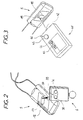
- the infrared detector 19 on the call transmitter 5 which is generally arranged on the use face of the housing 11 of the call transmitter 5 (see FIG. 2).
- An indicator light 39 confirming the transfer of instructions may be provided near the actuation buttons.
- the logic circuit is also connected to an energy source in the form of a battery 40.
- identification codes of the surveillance persons may be function or service codes, or individual codes, or even composite codes containing the two items of information.
- the call transmitter could be present as a wall transmitter.
- This embodiment can be used as a replacement for the portable transmitter.
- it will advantageously be present as a complement or double of the portable transmitters.
- the wall transmitter also consists of a box containing a printed circuit.
- the call is triggered by means of a call bulb connected by a cord to the box.
- This pear replaces the button on the portable transmitter.
- other means of triggering the call can be envisaged, such as pedals, zippers, cushions sensitive to crushing, cry detectors, etc.
- the box has a button called the acknowledgment button, which will then be an unidentified acknowledgment, and a second button called the second level call button, also unidentified.
- a button called the acknowledgment button which will then be an unidentified acknowledgment
- a second button called the second level call button also unidentified.
- the wall transmitter can also include a detachment system for tearing off the pear cord.
- the wall transmitter includes an instruction signal detector, for example an infrared detector, for the transmission by a control transmitter of an instruction to transmit an identified acknowledgment or a second call. level identified.
- an instruction signal detector for example an infrared detector
- Each wall transmitter could of course include a second call bulb, each of the two call pears having its own identifier code, or both the same code.
- this wall transmitter is analogous to portable transmitters.
- the call transmitter 5 could be a mixed wall / portable transmitter comprising a portable element in the form of a transmitter transmitter and a fixed element acting as a wall support.
- the transmitter is similar to the portable transmitters described above, with an additional interface for contact with the support in the wall position.
- the wall mount includes call pears, which can transmit a call command to the transmitter through the wall mounted interface of the transmitter.
- the support also advantageously has a tranquilization indicator and acknowledgment and emergency call buttons, so as to offer the same options as a permanent wall transmitter.
- the codes of the various elements of the installation are, in the simplest way, numerical codes.
- the coding of the call transmitters is carried out via the call button, and the coding of the control transmitters is carried out via either the acknowledgment button or the second call button level. It suffices to hold down this button for a relatively long time, for example 10 seconds, so as to position the logic circuit in programming mode. The button is then pressed a number of times corresponding to the transmitter code, the last press being also long (10 seconds) in order to signal the exit from the programming mode.
- This programming mode of the microcontrollers 32 and 38 is known per se.
- the programming of the call transmitter is carried out by means of a coding device or coder 41 using infrared light signals, comprising an infrared diode 42, one or more selectors 43, 44 and an actuation button. 45 ( Figure 3).
- the selector is placed in the position corresponding to the desired code, the diode of the detector of the call transmitter or the control transmitter is approached, and the programming signals are triggered by pressing the button.
- the transmission is certified by a control lamp 46.
- Radio messages transmitted to the control center always include the digital code of the caller. If it is a message ordered by a control transmitter (identified acknowledgment message or emergency message), it also contains the digital code of the control transmitter.
- the control unit is then provided with an equivalence table making it possible to associate with each transmitter code a label specific to the establishment, which is transmitted to the signaling devices (light panels, sound calls, "beeps").
Landscapes
- Engineering & Computer Science (AREA)
- Computer Security & Cryptography (AREA)
- Business, Economics & Management (AREA)
- Emergency Management (AREA)
- Physics & Mathematics (AREA)
- General Physics & Mathematics (AREA)
- Mobile Radio Communication Systems (AREA)
- Alarm Systems (AREA)
- Telephone Function (AREA)
- Stringed Musical Instruments (AREA)
- Pinball Game Machines (AREA)
Applications Claiming Priority (2)
| Application Number | Priority Date | Filing Date | Title |
|---|---|---|---|
| FR9410509 | 1994-08-26 | ||
| FR9410509A FR2724037A1 (fr) | 1994-08-26 | 1994-08-26 | Installation d'assistance individuelle identifiee |
Publications (3)
| Publication Number | Publication Date |
|---|---|
| EP0702342A2 true EP0702342A2 (de) | 1996-03-20 |
| EP0702342A3 EP0702342A3 (de) | 1996-04-17 |
| EP0702342B1 EP0702342B1 (de) | 2000-12-27 |
Family
ID=9466625
Family Applications (1)
| Application Number | Title | Priority Date | Filing Date |
|---|---|---|---|
| EP95480114A Expired - Lifetime EP0702342B1 (de) | 1994-08-26 | 1995-08-23 | Anlage zur individuellen und identifizierbaren Hilfe |
Country Status (4)
| Country | Link |
|---|---|
| EP (1) | EP0702342B1 (de) |
| AT (1) | ATE198383T1 (de) |
| DE (1) | DE69519709D1 (de) |
| FR (1) | FR2724037A1 (de) |
Cited By (1)
| Publication number | Priority date | Publication date | Assignee | Title |
|---|---|---|---|---|
| ES2162572A1 (es) * | 1999-07-26 | 2001-12-16 | Garrido Jesus Maria Idoate | Sistema de seguridad para parada de emergencia en maquinas. |
Family Cites Families (4)
| Publication number | Priority date | Publication date | Assignee | Title |
|---|---|---|---|---|
| FR2576125B1 (fr) * | 1985-01-11 | 1987-10-02 | Hall Gerard | Dispositif d'alarme a deux etats pour la protection des biens et des personnes |
| DE3740632A1 (de) * | 1987-09-12 | 1989-03-30 | Wolfgang G Prenosil | Sendervorrichtung |
| US5086391A (en) * | 1989-02-24 | 1992-02-04 | Chambers Bryan R | Remote controller for activating speech messages and for contacting emergency services |
| US5070320A (en) * | 1989-06-12 | 1991-12-03 | Ralph Ramono | Alarm system |
-
1994
- 1994-08-26 FR FR9410509A patent/FR2724037A1/fr active Granted
-
1995
- 1995-08-23 DE DE69519709T patent/DE69519709D1/de not_active Expired - Lifetime
- 1995-08-23 EP EP95480114A patent/EP0702342B1/de not_active Expired - Lifetime
- 1995-08-23 AT AT95480114T patent/ATE198383T1/de active
Non-Patent Citations (1)
| Title |
|---|
| None |
Cited By (1)
| Publication number | Priority date | Publication date | Assignee | Title |
|---|---|---|---|---|
| ES2162572A1 (es) * | 1999-07-26 | 2001-12-16 | Garrido Jesus Maria Idoate | Sistema de seguridad para parada de emergencia en maquinas. |
Also Published As
| Publication number | Publication date |
|---|---|
| EP0702342B1 (de) | 2000-12-27 |
| DE69519709D1 (de) | 2001-02-01 |
| FR2724037A1 (fr) | 1996-03-01 |
| ATE198383T1 (de) | 2001-01-15 |
| FR2724037B1 (de) | 1997-03-07 |
| EP0702342A3 (de) | 1996-04-17 |
Similar Documents
| Publication | Publication Date | Title |
|---|---|---|
| CA2432805C (fr) | Systeme d'alerte a declenchements multiples par emetteurs et recepteur-vibreur portable | |
| JP5767439B2 (ja) | 防災装置および防災装置用操作スイッチ装置 | |
| CA3013793A1 (fr) | Article vestimentaire intelligent et communicant, procede et installation de communication bidirectionnelle avec un tel article vestimentaire | |
| US11080985B2 (en) | Alarm triggering device and circuitry therefor | |
| EP0841646A1 (de) | Drahtloses Steuerungs- und/oder Messsystem für Fahrrad | |
| US10147304B1 (en) | Handheld emergency communications and location information systems | |
| GB2067803A (en) | Emergency call system | |
| EP0702342B1 (de) | Anlage zur individuellen und identifizierbaren Hilfe | |
| FR2740426A1 (fr) | Dispositif de communication et d'alerte pour plongeur sous-marin | |
| EP0628938A1 (de) | Fernalarmsystem | |
| EP1565896B1 (de) | Sicherheitssystem für personen mit dem risiko in wasser zu fallen | |
| FR2672410A1 (fr) | Dispositif de surveillance et de protection anti-vol. | |
| US20170116844A1 (en) | Adaptive alert device | |
| FR2936340A1 (fr) | Dispositif d'alarme par detection distante de l'inactivite humaine protegeant le travailleur isole ou la personne isolee evoluant au sein d'un espace confine | |
| WO1998045969A1 (fr) | Dispositif de communication et d'alerte pour plongeur sous-marin | |
| FR2604319A1 (fr) | Poste telephonique, notamment pour appel d'urgence de numeros preselectionnes | |
| FR2608928A1 (fr) | Dispositif pour la signalisation a distance ou autonome, de l'etat vide ou de l'arret du goutte a goutte, d'un flacon de perfusion | |
| CA2292735A1 (fr) | Dispositif d'identification et de localisation d'une personne | |
| FR2627883A3 (fr) | Radiocommande portative pour grilles, portails, boxes et similaires | |
| FR2701616A1 (fr) | Système électronique de transmission à radiofréquence. | |
| EP1941478A1 (de) | Sicherheitssystem, sicherheitsendgerät und alarmsystem | |
| BE1018065A3 (fr) | Systeme de detection pour boite a lettres. | |
| FR2806508A1 (fr) | Installation pour la protection et la detection de personnes exposees aux risques de chutes dans l'eau ou d'eloignement | |
| EP0452194A1 (de) | Verfahren und Anordnung zur Personenüberwachung mittels Bewegungsdetektor | |
| EP1035721A1 (de) | Fernsteuerschnittstelle für ein Telefon zum Aussenden eines Alarmsignals und Telefon mit dieser Schnittstelle |
Legal Events
| Date | Code | Title | Description |
|---|---|---|---|
| PUAI | Public reference made under article 153(3) epc to a published international application that has entered the european phase |
Free format text: ORIGINAL CODE: 0009012 |
|
| PUAL | Search report despatched |
Free format text: ORIGINAL CODE: 0009013 |
|
| AK | Designated contracting states |
Kind code of ref document: A2 Designated state(s): AT BE CH DE DK ES FR GB GR IE IT LI LU MC NL PT SE |
|
| AK | Designated contracting states |
Kind code of ref document: A3 Designated state(s): AT BE CH DE DK ES FR GB GR IE IT LI LU MC NL PT SE |
|
| 17P | Request for examination filed |
Effective date: 19961014 |
|
| GRAG | Despatch of communication of intention to grant |
Free format text: ORIGINAL CODE: EPIDOS AGRA |
|
| 17Q | First examination report despatched |
Effective date: 19990730 |
|
| GRAG | Despatch of communication of intention to grant |
Free format text: ORIGINAL CODE: EPIDOS AGRA |
|
| GRAG | Despatch of communication of intention to grant |
Free format text: ORIGINAL CODE: EPIDOS AGRA |
|
| GRAH | Despatch of communication of intention to grant a patent |
Free format text: ORIGINAL CODE: EPIDOS IGRA |
|
| GRAH | Despatch of communication of intention to grant a patent |
Free format text: ORIGINAL CODE: EPIDOS IGRA |
|
| GRAA | (expected) grant |
Free format text: ORIGINAL CODE: 0009210 |
|
| AK | Designated contracting states |
Kind code of ref document: B1 Designated state(s): AT BE CH DE DK ES FR GB GR IE IT LI LU MC NL PT SE |
|
| PG25 | Lapsed in a contracting state [announced via postgrant information from national office to epo] |
Ref country code: SE Free format text: THE PATENT HAS BEEN ANNULLED BY A DECISION OF A NATIONAL AUTHORITY Effective date: 20001227 Ref country code: NL Free format text: LAPSE BECAUSE OF FAILURE TO SUBMIT A TRANSLATION OF THE DESCRIPTION OR TO PAY THE FEE WITHIN THE PRESCRIBED TIME-LIMIT Effective date: 20001227 Ref country code: IT Free format text: LAPSE BECAUSE OF FAILURE TO SUBMIT A TRANSLATION OF THE DESCRIPTION OR TO PAY THE FEE WITHIN THE PRESCRIBED TIME-LIMIT;WARNING: LAPSES OF ITALIAN PATENTS WITH EFFECTIVE DATE BEFORE 2007 MAY HAVE OCCURRED AT ANY TIME BEFORE 2007. THE CORRECT EFFECTIVE DATE MAY BE DIFFERENT FROM THE ONE RECORDED. Effective date: 20001227 Ref country code: IE Free format text: LAPSE BECAUSE OF FAILURE TO SUBMIT A TRANSLATION OF THE DESCRIPTION OR TO PAY THE FEE WITHIN THE PRESCRIBED TIME-LIMIT Effective date: 20001227 Ref country code: GR Free format text: LAPSE BECAUSE OF NON-PAYMENT OF DUE FEES Effective date: 20001227 Ref country code: GB Free format text: LAPSE BECAUSE OF FAILURE TO SUBMIT A TRANSLATION OF THE DESCRIPTION OR TO PAY THE FEE WITHIN THE PRESCRIBED TIME-LIMIT Effective date: 20001227 Ref country code: ES Free format text: THE PATENT HAS BEEN ANNULLED BY A DECISION OF A NATIONAL AUTHORITY Effective date: 20001227 Ref country code: AT Free format text: LAPSE BECAUSE OF FAILURE TO SUBMIT A TRANSLATION OF THE DESCRIPTION OR TO PAY THE FEE WITHIN THE PRESCRIBED TIME-LIMIT Effective date: 20001227 |
|
| REF | Corresponds to: |
Ref document number: 198383 Country of ref document: AT Date of ref document: 20010115 Kind code of ref document: T |
|
| REG | Reference to a national code |
Ref country code: CH Ref legal event code: EP |
|
| REF | Corresponds to: |
Ref document number: 69519709 Country of ref document: DE Date of ref document: 20010201 |
|
| REG | Reference to a national code |
Ref country code: IE Ref legal event code: FG4D Free format text: FRENCH |
|
| PG25 | Lapsed in a contracting state [announced via postgrant information from national office to epo] |
Ref country code: PT Free format text: LAPSE BECAUSE OF FAILURE TO SUBMIT A TRANSLATION OF THE DESCRIPTION OR TO PAY THE FEE WITHIN THE PRESCRIBED TIME-LIMIT Effective date: 20010327 Ref country code: DK Free format text: LAPSE BECAUSE OF FAILURE TO SUBMIT A TRANSLATION OF THE DESCRIPTION OR TO PAY THE FEE WITHIN THE PRESCRIBED TIME-LIMIT Effective date: 20010327 |
|
| PG25 | Lapsed in a contracting state [announced via postgrant information from national office to epo] |
Ref country code: DE Free format text: LAPSE BECAUSE OF FAILURE TO SUBMIT A TRANSLATION OF THE DESCRIPTION OR TO PAY THE FEE WITHIN THE PRESCRIBED TIME-LIMIT Effective date: 20010328 |
|
| NLV1 | Nl: lapsed or annulled due to failure to fulfill the requirements of art. 29p and 29m of the patents act | ||
| GBV | Gb: ep patent (uk) treated as always having been void in accordance with gb section 77(7)/1977 [no translation filed] |
Effective date: 20001227 |
|
| PG25 | Lapsed in a contracting state [announced via postgrant information from national office to epo] |
Ref country code: LU Free format text: LAPSE BECAUSE OF NON-PAYMENT OF DUE FEES Effective date: 20010823 |
|
| PG25 | Lapsed in a contracting state [announced via postgrant information from national office to epo] |
Ref country code: LI Free format text: LAPSE BECAUSE OF NON-PAYMENT OF DUE FEES Effective date: 20010831 Ref country code: CH Free format text: LAPSE BECAUSE OF NON-PAYMENT OF DUE FEES Effective date: 20010831 Ref country code: BE Free format text: LAPSE BECAUSE OF NON-PAYMENT OF DUE FEES Effective date: 20010831 |
|
| PLBE | No opposition filed within time limit |
Free format text: ORIGINAL CODE: 0009261 |
|
| STAA | Information on the status of an ep patent application or granted ep patent |
Free format text: STATUS: NO OPPOSITION FILED WITHIN TIME LIMIT |
|
| REG | Reference to a national code |
Ref country code: IE Ref legal event code: FD4D |
|
| 26N | No opposition filed | ||
| BERE | Be: lapsed |
Owner name: MU13 COMMUNICATION-SANTE Effective date: 20010831 |
|
| PG25 | Lapsed in a contracting state [announced via postgrant information from national office to epo] |
Ref country code: MC Free format text: LAPSE BECAUSE OF NON-PAYMENT OF DUE FEES Effective date: 20020301 |
|
| REG | Reference to a national code |
Ref country code: CH Ref legal event code: PL |
|
| PG25 | Lapsed in a contracting state [announced via postgrant information from national office to epo] |
Ref country code: FR Free format text: LAPSE BECAUSE OF NON-PAYMENT OF DUE FEES Effective date: 20020430 |
|
| REG | Reference to a national code |
Ref country code: FR Ref legal event code: ST |