EP0702344A1 - Bande d'étiquettes et procédé de fabrication de celle-ci - Google Patents
Bande d'étiquettes et procédé de fabrication de celle-ci Download PDFInfo
- Publication number
- EP0702344A1 EP0702344A1 EP95114332A EP95114332A EP0702344A1 EP 0702344 A1 EP0702344 A1 EP 0702344A1 EP 95114332 A EP95114332 A EP 95114332A EP 95114332 A EP95114332 A EP 95114332A EP 0702344 A1 EP0702344 A1 EP 0702344A1
- Authority
- EP
- European Patent Office
- Prior art keywords
- label substrate
- label
- adhesive layer
- layer
- process sheet
- Prior art date
- Legal status (The legal status is an assumption and is not a legal conclusion. Google has not performed a legal analysis and makes no representation as to the accuracy of the status listed.)
- Granted
Links
- 238000000034 method Methods 0.000 title claims abstract description 167
- 239000000758 substrate Substances 0.000 claims abstract description 294
- 239000010410 layer Substances 0.000 claims abstract description 206
- 239000012790 adhesive layer Substances 0.000 claims abstract description 186
- 238000005096 rolling process Methods 0.000 claims abstract description 11
- 230000013011 mating Effects 0.000 claims abstract description 8
- 238000007639 printing Methods 0.000 claims description 50
- 239000003795 chemical substances by application Substances 0.000 claims description 29
- 239000011248 coating agent Substances 0.000 claims description 21
- 238000000576 coating method Methods 0.000 claims description 21
- 238000005520 cutting process Methods 0.000 claims description 9
- 238000003475 lamination Methods 0.000 claims description 6
- 239000000853 adhesive Substances 0.000 description 31
- 230000015572 biosynthetic process Effects 0.000 description 24
- 239000000123 paper Substances 0.000 description 14
- 239000002904 solvent Substances 0.000 description 13
- 230000001070 adhesive effect Effects 0.000 description 8
- 238000004519 manufacturing process Methods 0.000 description 8
- 230000014509 gene expression Effects 0.000 description 7
- 238000010438 heat treatment Methods 0.000 description 6
- 239000002699 waste material Substances 0.000 description 6
- 239000011888 foil Substances 0.000 description 5
- 239000000428 dust Substances 0.000 description 4
- 239000000839 emulsion Substances 0.000 description 4
- 238000007645 offset printing Methods 0.000 description 4
- 239000002985 plastic film Substances 0.000 description 4
- 229920001296 polysiloxane Polymers 0.000 description 4
- 239000004820 Pressure-sensitive adhesive Substances 0.000 description 3
- TXFPEBPIARQUIG-UHFFFAOYSA-N 4'-hydroxyacetophenone Chemical compound CC(=O)C1=CC=C(O)C=C1 TXFPEBPIARQUIG-UHFFFAOYSA-N 0.000 description 2
- 239000004793 Polystyrene Substances 0.000 description 2
- ATUOYWHBWRKTHZ-UHFFFAOYSA-N Propane Chemical compound CCC ATUOYWHBWRKTHZ-UHFFFAOYSA-N 0.000 description 2
- 239000002253 acid Substances 0.000 description 2
- 239000011230 binding agent Substances 0.000 description 2
- YXVFYQXJAXKLAK-UHFFFAOYSA-N biphenyl-4-ol Chemical compound C1=CC(O)=CC=C1C1=CC=CC=C1 YXVFYQXJAXKLAK-UHFFFAOYSA-N 0.000 description 2
- 230000003247 decreasing effect Effects 0.000 description 2
- 239000000975 dye Substances 0.000 description 2
- QWVGKYWNOKOFNN-UHFFFAOYSA-N o-cresol Chemical compound CC1=CC=CC=C1O QWVGKYWNOKOFNN-UHFFFAOYSA-N 0.000 description 2
- 229920006255 plastic film Polymers 0.000 description 2
- 229920002223 polystyrene Polymers 0.000 description 2
- 229920005989 resin Polymers 0.000 description 2
- 239000011347 resin Substances 0.000 description 2
- 229920002050 silicone resin Polymers 0.000 description 2
- 239000000126 substance Substances 0.000 description 2
- LIZLYZVAYZQVPG-UHFFFAOYSA-N (3-bromo-2-fluorophenyl)methanol Chemical compound OCC1=CC=CC(Br)=C1F LIZLYZVAYZQVPG-UHFFFAOYSA-N 0.000 description 1
- GSCLSACFHWKTQU-UHFFFAOYSA-N 2'-chloro-6'-(diethylamino)spiro[2-benzofuran-3,9'-xanthene]-1-one Chemical compound O1C(=O)C2=CC=CC=C2C21C1=CC(Cl)=CC=C1OC1=CC(N(CC)CC)=CC=C21 GSCLSACFHWKTQU-UHFFFAOYSA-N 0.000 description 1
- KGRVJHAUYBGFFP-UHFFFAOYSA-N 2,2'-Methylenebis(4-methyl-6-tert-butylphenol) Chemical compound CC(C)(C)C1=CC(C)=CC(CC=2C(=C(C=C(C)C=2)C(C)(C)C)O)=C1O KGRVJHAUYBGFFP-UHFFFAOYSA-N 0.000 description 1
- ISPYQTSUDJAMAB-UHFFFAOYSA-N 2-chlorophenol Chemical compound OC1=CC=CC=C1Cl ISPYQTSUDJAMAB-UHFFFAOYSA-N 0.000 description 1
- NSOYUYYTMRZCLE-UHFFFAOYSA-N 4-[2-(4-hydroxy-3-methylphenyl)ethyl]-2-methylphenol Chemical compound C1=C(O)C(C)=CC(CCC=2C=C(C)C(O)=CC=2)=C1 NSOYUYYTMRZCLE-UHFFFAOYSA-N 0.000 description 1
- 229940073735 4-hydroxy acetophenone Drugs 0.000 description 1
- 229920002134 Carboxymethyl cellulose Polymers 0.000 description 1
- 229920000298 Cellophane Polymers 0.000 description 1
- JOYRKODLDBILNP-UHFFFAOYSA-N Ethyl urethane Chemical compound CCOC(N)=O JOYRKODLDBILNP-UHFFFAOYSA-N 0.000 description 1
- YCKRFDGAMUMZLT-UHFFFAOYSA-N Fluorine atom Chemical compound [F] YCKRFDGAMUMZLT-UHFFFAOYSA-N 0.000 description 1
- 108010010803 Gelatin Proteins 0.000 description 1
- 229920000663 Hydroxyethyl cellulose Polymers 0.000 description 1
- 239000004354 Hydroxyethyl cellulose Substances 0.000 description 1
- 239000004372 Polyvinyl alcohol Substances 0.000 description 1
- 229920002125 Sokalan® Polymers 0.000 description 1
- 229920002472 Starch Polymers 0.000 description 1
- XTXRWKRVRITETP-UHFFFAOYSA-N Vinyl acetate Chemical compound CC(=O)OC=C XTXRWKRVRITETP-UHFFFAOYSA-N 0.000 description 1
- LZBCVRCTAYKYHR-UHFFFAOYSA-N acetic acid;chloroethene Chemical compound ClC=C.CC(O)=O LZBCVRCTAYKYHR-UHFFFAOYSA-N 0.000 description 1
- -1 acryl Chemical group 0.000 description 1
- NIXOWILDQLNWCW-UHFFFAOYSA-N acrylic acid group Chemical group C(C=C)(=O)O NIXOWILDQLNWCW-UHFFFAOYSA-N 0.000 description 1
- 229920006243 acrylic copolymer Polymers 0.000 description 1
- 229920000800 acrylic rubber Polymers 0.000 description 1
- XAGFODPZIPBFFR-UHFFFAOYSA-N aluminium Chemical compound [Al] XAGFODPZIPBFFR-UHFFFAOYSA-N 0.000 description 1
- 229910052782 aluminium Inorganic materials 0.000 description 1
- 239000007864 aqueous solution Substances 0.000 description 1
- IMHDGJOMLMDPJN-UHFFFAOYSA-N biphenyl-2,2'-diol Chemical group OC1=CC=CC=C1C1=CC=CC=C1O IMHDGJOMLMDPJN-UHFFFAOYSA-N 0.000 description 1
- IISBACLAFKSPIT-UHFFFAOYSA-N bisphenol A Chemical compound C=1C=C(O)C=CC=1C(C)(C)C1=CC=C(O)C=C1 IISBACLAFKSPIT-UHFFFAOYSA-N 0.000 description 1
- 239000001768 carboxy methyl cellulose Substances 0.000 description 1
- 235000010948 carboxy methyl cellulose Nutrition 0.000 description 1
- 239000008112 carboxymethyl-cellulose Substances 0.000 description 1
- 239000001913 cellulose Substances 0.000 description 1
- 229920002678 cellulose Polymers 0.000 description 1
- 235000010980 cellulose Nutrition 0.000 description 1
- 230000003111 delayed effect Effects 0.000 description 1
- 238000001035 drying Methods 0.000 description 1
- 229920001971 elastomer Polymers 0.000 description 1
- 239000012467 final product Substances 0.000 description 1
- 229910052731 fluorine Inorganic materials 0.000 description 1
- 239000011737 fluorine Substances 0.000 description 1
- 229920000159 gelatin Polymers 0.000 description 1
- 239000008273 gelatin Substances 0.000 description 1
- 235000019322 gelatine Nutrition 0.000 description 1
- 235000011852 gelatine desserts Nutrition 0.000 description 1
- 239000012943 hotmelt Substances 0.000 description 1
- 235000019447 hydroxyethyl cellulose Nutrition 0.000 description 1
- 238000010030 laminating Methods 0.000 description 1
- 230000000670 limiting effect Effects 0.000 description 1
- 239000000463 material Substances 0.000 description 1
- 238000002844 melting Methods 0.000 description 1
- 230000008018 melting Effects 0.000 description 1
- 125000000956 methoxy group Chemical group [H]C([H])([H])O* 0.000 description 1
- 239000000203 mixture Substances 0.000 description 1
- 229920002401 polyacrylamide Polymers 0.000 description 1
- 229920000058 polyacrylate Polymers 0.000 description 1
- 239000004584 polyacrylic acid Substances 0.000 description 1
- 229920000728 polyester Polymers 0.000 description 1
- 229920002451 polyvinyl alcohol Polymers 0.000 description 1
- 229920000915 polyvinyl chloride Polymers 0.000 description 1
- 239000004800 polyvinyl chloride Substances 0.000 description 1
- 239000001294 propane Substances 0.000 description 1
- 230000002441 reversible effect Effects 0.000 description 1
- 238000007650 screen-printing Methods 0.000 description 1
- 230000035945 sensitivity Effects 0.000 description 1
- 239000008107 starch Substances 0.000 description 1
- 235000019698 starch Nutrition 0.000 description 1
- 229920006163 vinyl copolymer Polymers 0.000 description 1
Images



Classifications
-
- G—PHYSICS
- G09—EDUCATION; CRYPTOGRAPHY; DISPLAY; ADVERTISING; SEALS
- G09F—DISPLAYING; ADVERTISING; SIGNS; LABELS OR NAME-PLATES; SEALS
- G09F3/00—Labels, tag tickets, or similar identification or indication means; Seals; Postage or like stamps
- G09F3/08—Fastening or securing by means not forming part of the material of the label itself
- G09F3/10—Fastening or securing by means not forming part of the material of the label itself by an adhesive layer
-
- B—PERFORMING OPERATIONS; TRANSPORTING
- B31—MAKING ARTICLES OF PAPER, CARDBOARD OR MATERIAL WORKED IN A MANNER ANALOGOUS TO PAPER; WORKING PAPER, CARDBOARD OR MATERIAL WORKED IN A MANNER ANALOGOUS TO PAPER
- B31D—MAKING ARTICLES OF PAPER, CARDBOARD OR MATERIAL WORKED IN A MANNER ANALOGOUS TO PAPER, NOT PROVIDED FOR IN SUBCLASSES B31B OR B31C
- B31D1/00—Multiple-step processes for making flat articles ; Making flat articles
- B31D1/02—Multiple-step processes for making flat articles ; Making flat articles the articles being labels or tags
- B31D1/021—Making adhesive labels having a multilayered structure, e.g. provided on carrier webs
-
- G—PHYSICS
- G09—EDUCATION; CRYPTOGRAPHY; DISPLAY; ADVERTISING; SEALS
- G09F—DISPLAYING; ADVERTISING; SIGNS; LABELS OR NAME-PLATES; SEALS
- G09F3/00—Labels, tag tickets, or similar identification or indication means; Seals; Postage or like stamps
- G09F3/02—Forms or constructions
-
- Y—GENERAL TAGGING OF NEW TECHNOLOGICAL DEVELOPMENTS; GENERAL TAGGING OF CROSS-SECTIONAL TECHNOLOGIES SPANNING OVER SEVERAL SECTIONS OF THE IPC; TECHNICAL SUBJECTS COVERED BY FORMER USPC CROSS-REFERENCE ART COLLECTIONS [XRACs] AND DIGESTS
- Y10—TECHNICAL SUBJECTS COVERED BY FORMER USPC
- Y10S—TECHNICAL SUBJECTS COVERED BY FORMER USPC CROSS-REFERENCE ART COLLECTIONS [XRACs] AND DIGESTS
- Y10S428/00—Stock material or miscellaneous articles
- Y10S428/906—Roll or coil
-
- Y—GENERAL TAGGING OF NEW TECHNOLOGICAL DEVELOPMENTS; GENERAL TAGGING OF CROSS-SECTIONAL TECHNOLOGIES SPANNING OVER SEVERAL SECTIONS OF THE IPC; TECHNICAL SUBJECTS COVERED BY FORMER USPC CROSS-REFERENCE ART COLLECTIONS [XRACs] AND DIGESTS
- Y10—TECHNICAL SUBJECTS COVERED BY FORMER USPC
- Y10S—TECHNICAL SUBJECTS COVERED BY FORMER USPC CROSS-REFERENCE ART COLLECTIONS [XRACs] AND DIGESTS
- Y10S428/00—Stock material or miscellaneous articles
- Y10S428/914—Transfer or decalcomania
-
- Y—GENERAL TAGGING OF NEW TECHNOLOGICAL DEVELOPMENTS; GENERAL TAGGING OF CROSS-SECTIONAL TECHNOLOGIES SPANNING OVER SEVERAL SECTIONS OF THE IPC; TECHNICAL SUBJECTS COVERED BY FORMER USPC CROSS-REFERENCE ART COLLECTIONS [XRACs] AND DIGESTS
- Y10—TECHNICAL SUBJECTS COVERED BY FORMER USPC
- Y10T—TECHNICAL SUBJECTS COVERED BY FORMER US CLASSIFICATION
- Y10T156/00—Adhesive bonding and miscellaneous chemical manufacture
- Y10T156/10—Methods of surface bonding and/or assembly therefor
- Y10T156/1052—Methods of surface bonding and/or assembly therefor with cutting, punching, tearing or severing
- Y10T156/1062—Prior to assembly
- Y10T156/1075—Prior to assembly of plural laminae from single stock and assembling to each other or to additional lamina
-
- Y—GENERAL TAGGING OF NEW TECHNOLOGICAL DEVELOPMENTS; GENERAL TAGGING OF CROSS-SECTIONAL TECHNOLOGIES SPANNING OVER SEVERAL SECTIONS OF THE IPC; TECHNICAL SUBJECTS COVERED BY FORMER USPC CROSS-REFERENCE ART COLLECTIONS [XRACs] AND DIGESTS
- Y10—TECHNICAL SUBJECTS COVERED BY FORMER USPC
- Y10T—TECHNICAL SUBJECTS COVERED BY FORMER US CLASSIFICATION
- Y10T428/00—Stock material or miscellaneous articles
- Y10T428/14—Layer or component removable to expose adhesive
-
- Y—GENERAL TAGGING OF NEW TECHNOLOGICAL DEVELOPMENTS; GENERAL TAGGING OF CROSS-SECTIONAL TECHNOLOGIES SPANNING OVER SEVERAL SECTIONS OF THE IPC; TECHNICAL SUBJECTS COVERED BY FORMER USPC CROSS-REFERENCE ART COLLECTIONS [XRACs] AND DIGESTS
- Y10—TECHNICAL SUBJECTS COVERED BY FORMER USPC
- Y10T—TECHNICAL SUBJECTS COVERED BY FORMER US CLASSIFICATION
- Y10T428/00—Stock material or miscellaneous articles
- Y10T428/14—Layer or component removable to expose adhesive
- Y10T428/1424—Halogen containing compound
- Y10T428/1433—Coloring agent containing
-
- Y—GENERAL TAGGING OF NEW TECHNOLOGICAL DEVELOPMENTS; GENERAL TAGGING OF CROSS-SECTIONAL TECHNOLOGIES SPANNING OVER SEVERAL SECTIONS OF THE IPC; TECHNICAL SUBJECTS COVERED BY FORMER USPC CROSS-REFERENCE ART COLLECTIONS [XRACs] AND DIGESTS
- Y10—TECHNICAL SUBJECTS COVERED BY FORMER USPC
- Y10T—TECHNICAL SUBJECTS COVERED BY FORMER US CLASSIFICATION
- Y10T428/00—Stock material or miscellaneous articles
- Y10T428/14—Layer or component removable to expose adhesive
- Y10T428/1438—Metal containing
- Y10T428/1448—Coloring agent containing
-
- Y—GENERAL TAGGING OF NEW TECHNOLOGICAL DEVELOPMENTS; GENERAL TAGGING OF CROSS-SECTIONAL TECHNOLOGIES SPANNING OVER SEVERAL SECTIONS OF THE IPC; TECHNICAL SUBJECTS COVERED BY FORMER USPC CROSS-REFERENCE ART COLLECTIONS [XRACs] AND DIGESTS
- Y10—TECHNICAL SUBJECTS COVERED BY FORMER USPC
- Y10T—TECHNICAL SUBJECTS COVERED BY FORMER US CLASSIFICATION
- Y10T428/00—Stock material or miscellaneous articles
- Y10T428/14—Layer or component removable to expose adhesive
- Y10T428/1452—Polymer derived only from ethylenically unsaturated monomer
- Y10T428/1457—Silicon
-
- Y—GENERAL TAGGING OF NEW TECHNOLOGICAL DEVELOPMENTS; GENERAL TAGGING OF CROSS-SECTIONAL TECHNOLOGIES SPANNING OVER SEVERAL SECTIONS OF THE IPC; TECHNICAL SUBJECTS COVERED BY FORMER USPC CROSS-REFERENCE ART COLLECTIONS [XRACs] AND DIGESTS
- Y10—TECHNICAL SUBJECTS COVERED BY FORMER USPC
- Y10T—TECHNICAL SUBJECTS COVERED BY FORMER US CLASSIFICATION
- Y10T428/00—Stock material or miscellaneous articles
- Y10T428/14—Layer or component removable to expose adhesive
- Y10T428/1467—Coloring agent
-
- Y—GENERAL TAGGING OF NEW TECHNOLOGICAL DEVELOPMENTS; GENERAL TAGGING OF CROSS-SECTIONAL TECHNOLOGIES SPANNING OVER SEVERAL SECTIONS OF THE IPC; TECHNICAL SUBJECTS COVERED BY FORMER USPC CROSS-REFERENCE ART COLLECTIONS [XRACs] AND DIGESTS
- Y10—TECHNICAL SUBJECTS COVERED BY FORMER USPC
- Y10T—TECHNICAL SUBJECTS COVERED BY FORMER US CLASSIFICATION
- Y10T428/00—Stock material or miscellaneous articles
- Y10T428/14—Layer or component removable to expose adhesive
- Y10T428/1471—Protective layer
-
- Y—GENERAL TAGGING OF NEW TECHNOLOGICAL DEVELOPMENTS; GENERAL TAGGING OF CROSS-SECTIONAL TECHNOLOGIES SPANNING OVER SEVERAL SECTIONS OF THE IPC; TECHNICAL SUBJECTS COVERED BY FORMER USPC CROSS-REFERENCE ART COLLECTIONS [XRACs] AND DIGESTS
- Y10—TECHNICAL SUBJECTS COVERED BY FORMER USPC
- Y10T—TECHNICAL SUBJECTS COVERED BY FORMER US CLASSIFICATION
- Y10T428/00—Stock material or miscellaneous articles
- Y10T428/14—Layer or component removable to expose adhesive
- Y10T428/1476—Release layer
-
- Y—GENERAL TAGGING OF NEW TECHNOLOGICAL DEVELOPMENTS; GENERAL TAGGING OF CROSS-SECTIONAL TECHNOLOGIES SPANNING OVER SEVERAL SECTIONS OF THE IPC; TECHNICAL SUBJECTS COVERED BY FORMER USPC CROSS-REFERENCE ART COLLECTIONS [XRACs] AND DIGESTS
- Y10—TECHNICAL SUBJECTS COVERED BY FORMER USPC
- Y10T—TECHNICAL SUBJECTS COVERED BY FORMER US CLASSIFICATION
- Y10T428/00—Stock material or miscellaneous articles
- Y10T428/14—Layer or component removable to expose adhesive
- Y10T428/1486—Ornamental, decorative, pattern, or indicia
-
- Y—GENERAL TAGGING OF NEW TECHNOLOGICAL DEVELOPMENTS; GENERAL TAGGING OF CROSS-SECTIONAL TECHNOLOGIES SPANNING OVER SEVERAL SECTIONS OF THE IPC; TECHNICAL SUBJECTS COVERED BY FORMER USPC CROSS-REFERENCE ART COLLECTIONS [XRACs] AND DIGESTS
- Y10—TECHNICAL SUBJECTS COVERED BY FORMER USPC
- Y10T—TECHNICAL SUBJECTS COVERED BY FORMER US CLASSIFICATION
- Y10T428/00—Stock material or miscellaneous articles
- Y10T428/14—Layer or component removable to expose adhesive
- Y10T428/149—Sectional layer removable
-
- Y—GENERAL TAGGING OF NEW TECHNOLOGICAL DEVELOPMENTS; GENERAL TAGGING OF CROSS-SECTIONAL TECHNOLOGIES SPANNING OVER SEVERAL SECTIONS OF THE IPC; TECHNICAL SUBJECTS COVERED BY FORMER USPC CROSS-REFERENCE ART COLLECTIONS [XRACs] AND DIGESTS
- Y10—TECHNICAL SUBJECTS COVERED BY FORMER USPC
- Y10T—TECHNICAL SUBJECTS COVERED BY FORMER US CLASSIFICATION
- Y10T428/00—Stock material or miscellaneous articles
- Y10T428/14—Layer or component removable to expose adhesive
- Y10T428/149—Sectional layer removable
- Y10T428/1495—Adhesive is on removable layer
-
- Y—GENERAL TAGGING OF NEW TECHNOLOGICAL DEVELOPMENTS; GENERAL TAGGING OF CROSS-SECTIONAL TECHNOLOGIES SPANNING OVER SEVERAL SECTIONS OF THE IPC; TECHNICAL SUBJECTS COVERED BY FORMER USPC CROSS-REFERENCE ART COLLECTIONS [XRACs] AND DIGESTS
- Y10—TECHNICAL SUBJECTS COVERED BY FORMER USPC
- Y10T—TECHNICAL SUBJECTS COVERED BY FORMER US CLASSIFICATION
- Y10T428/00—Stock material or miscellaneous articles
- Y10T428/15—Sheet, web, or layer weakened to permit separation through thickness
-
- Y—GENERAL TAGGING OF NEW TECHNOLOGICAL DEVELOPMENTS; GENERAL TAGGING OF CROSS-SECTIONAL TECHNOLOGIES SPANNING OVER SEVERAL SECTIONS OF THE IPC; TECHNICAL SUBJECTS COVERED BY FORMER USPC CROSS-REFERENCE ART COLLECTIONS [XRACs] AND DIGESTS
- Y10—TECHNICAL SUBJECTS COVERED BY FORMER USPC
- Y10T—TECHNICAL SUBJECTS COVERED BY FORMER US CLASSIFICATION
- Y10T428/00—Stock material or miscellaneous articles
- Y10T428/28—Web or sheet containing structurally defined element or component and having an adhesive outermost layer
- Y10T428/2839—Web or sheet containing structurally defined element or component and having an adhesive outermost layer with release or antistick coating
Definitions
- the present invention relates to a label continuum formed of a plurality of continued labels and a producing method thereof and, in particular, the so-called non-separable type of label continuum with no release paper which is particularly suitable for e.g. price tag or bar-code label and a producing method thereof.
- Such continuum of labels with a heat-active type of pressure-sensitive adhesive layer formed on one side thereof can be used in a rolled form without any release paper on the back side thereof. That is to say, if such continuum of labels are rolled up, they don't adhere because such a label has no adhesiveness before pressure sensitivity is imparted by melting the sensitive layer.
- Such prior art non-separable type label requires a large-scale producing equipment, which is inevitably expensive, and the label's substrate is required to be heat-resistant such as paper since it has to be heated to activate the adhesive agent.
- the substrate is required to be safe against any of the components of the adhesive forming the adhesive layer, consequently, the width of selection is quite limited.
- the object of the present invention is to widen the range of selection for the label substrate and the adhesive layer, to provide a label continuum which can be produced in a variegated small lot fashion and a producing method thereof.
- a first aspect of the invention relates to a label continuum comprising a long label substrate, an adhesive layer formed on the back of the label substrate, a heat-sensitive developing layer formed on the surface of the label substrate and a release layer formed on the surface of the label substrate opposite to the above-described adhesive layer when the label substrate is rolled up.
- the label substrate has formed on its opposite side a heat-sensitive developing layer which is developed when heated.
- the adhesive layer is formed on the back of the label substrate, hence the adhesive layer can be formed on the surface of label substrate at the room temperature.
- the range of adhesives to be selected for formation of the adhesive layer can be broadened regardless of the label substrate's properties.
- the label substrate may be selected a thermal paper made to develop when heated, while as printer may be used any kind thereof including those by the use of a transfer foil which requires rather intensive heating.
- a second aspect of the invention relates to a label continuum comprising a long label substrate, an adhesive layer formed on the back of the label substrate, a heat-sensitive developing layer formed on the surface of the label substrate, a printed layer formed on the surface of the heat-sensitive developing layer on the surface of the label substrate and a release layer formed on the surface of the label substrate opposite to the adhesive layer when the label substrate is rolled up.
- the heat-sensitive developing layer is formed on the surface opposite to that the adhesive layer is formed thereon, hence development takes place upon heating.
- the adhesive layer is formed on the back of the label substrate, hence the adhesive layer can be formed on the surface of the label substrate at the room temperature.
- a label substrate When a label substrate is selected, therefore, it is all right even if it is an extremely thin tape relatively low in heat resistance. And, since the solvent or the like in the dissolved adhesive agent is removed before the adhesive layer is formed and prior to transfer thereof, the range of adhesives to be selected for formation of the adhesive layer can be broadened regardless of the label substrate's properties. Further, as the label substrate may be selected a thermal paper made to develop when heated, while as printer may be used any kind thereof including those by the use of a transfer foil which requires rather intensive heating.
- the release layer may as well be formed by printing or coating of a release agent.
- the label substrate is unrolled, for it is rolled up with the release layer formed on the surface of the label substrate and the adhesive layer on the back thereof false-stuck to each other.
- the release agent is printed or coated to the surface of the label substrate or of the printed layer, unrolling takes place even when adhesive layer formed on the back of the label substrate and the release layer on the surface thereof, each layer oppositely false-stuck, hence the label can be cut off piecewise from the label continuum.
- the release layer may as well be formed by lamination of a film or sheet excelled in releasability.
- the label substrate is unrolled, for it is rolled up with the release layer formed on the surface of the label substrate and the adhesive layer on the back thereof false-stuck to each other.
- the release layer is formed by lamination of a film or sheet excelled in releasability on the label substrate, unrolling takes place even when the release layer on the surface of the label substrate and adhesive layer formed on the back thereof, each layer oppositely false-stuck, hence the label can be cut off piecewise from the label continuum.
- a third aspect of the invention relates to a label continuum comprising a long label substrate, an adhesive layer formed on the back of the label substrate, a heat-sensitive developing layer formed on the surface of the label substrate and a printed layer excelled in releasability formed on the surface of the label substrate opposite to the adhesive layer.
- the label substrate has formed thereon the heat-sensitive developing layer on the side opposite to the adhesive layer side, hence it is developed on heating.
- the adhesive layer is formed on the back of the label substrate, hence the adhesive layer can be formed on the label substrate at the room temperature.
- the range of adhesives to be selected for formation of the adhesive layer can be broadened regardless of the label substrate's properties.
- the label substrate may be selected a thermal paper made to develop when heated, while as printer may be used any kind thereof including those by the use of a transfer foil which requires rather intensive heating.
- the printed layer may as well be formed with a printing ink by printing or coating.
- the rolled up label substrate is unrolled, for the label substrate is rolled up such that the printed layer excelled in releasability is formed on the surface of the label substrate and is false-stuck to the adhesive layer formed on the back of the label substrate.
- the printed layer excelled in releasability is formed on the surface of the label substrate, hence even if the label substrate is rolled up such that the adhesive layer formed on the back of the label substrate and the printed layer formed on the surface thereof are oppositely false-stuck, the label substrate can be unrolled and labels can be cut piecewise from the label continuum.
- the release layer may as well be formed together with the printed layer on the surface of the label substrate opposed to the adhesive layer when the label substrate is rolled up.
- the printed layer is formed on the surface of the label substrate and on the surface of this label substrate the release layer excelled in releasability is formed, hence even if the label substrate is rolled up with the printed layer and/or release layer formed on the surface thereof and the adhesive layer formed on the back side are oppositely false-stuck to each other, the label substrate is unrolled and the individual labels can be cut piecewise from the label continuum.
- a fourth aspect of the invention relates to a label continuum comprising a long label substrate, an adhesive layer transferred to the back of the label substrate to be formed thereon and a release layer formed on the surface of the label substrate and the label substrate is so rolled up that the release layer and the adhesive layer are false-stuck to each other.
- the label substrate is rolled up so that the release layer formed on the surface of the label substrate and the adhesive layer formed on the back thereof are oppositely false-stuck to each other, it can be unrolled with ease.
- the adhesive layer is formed on the back of the label substrate, hence the adhesive layer can be formed on the surface of the label substrate at the room temperature.
- a label substrate When a label substrate is selected, therefore, it is all right even if it is an extremely thin tape relatively low in heat resistance. And, since the solvent and the like in the dissolved adhesive agent are removed before the adhesive layer is formed and prior to transfer thereof, the range of adhesives to be selected for formation of the adhesive layer can be broadened regardless of the label substrate's properties. Further, as the label substrate may be selected a thermal paper made to develop when heated, while as printer may be used any kind thereof including those by the use of a transfer foil which requires rather intensive heating.
- the printed layer may be formed on the surface of the label substrate and the release layer may be formed on the surface of the printed layer.
- the rolled up label substrate can be unrolled with ease.
- the printed layer is formed on the surface of the label substrate and the release layer is formed on the surface of the printed layer, hence if the label substrate is rolled up with the adhesive layer formed on the back of the label substrate and the release layer formed on its surface are oppositely false-stuck to each other, the label substrate is unrolled and the individual labels can be cut off piecewise from the label continuum.
- the printed layer may be formed on the release layer and on the label substrate and the printed layer may be formed with a printing ink excellent in releasability.
- the printed layer since the printed layer is formed on the release layer and on the label substrate and the printing ink used is excelled in releasability, the rolled label substrate can be unrolled with ease.
- the printed layer is formed on the release layer which is formed on the surface of the label substrate, and the printed layer is formed with the printing ink excellent in releasability, hence if the label substrate is rolled up with the release layer formed on the label substrate and the adhesive layer formed on the back thereof are oppositely false-stuck to each other, the label substrate is unrolled and the individual labels can be cut off piecewise from the label continuum.
- the label substrate may have formed thereon a heat-sensitive developing layer on the side opposite to the adhesive layer side of the label substrate.
- a heat-sensitive developing layer since the heat-sensitive developing layer is formed on the side opposite to the adhensive layer side of the label substrate, development takes place when heated.
- the label substrate has formed thereon the heat-sensitive developing layer on the side opposite to the adhesive layer side of the label substrate, hence printing can be done by a thermal printer or the like with relative ease.
- a fifth aspect of the invention relates to a method of producing a label continuum comprising a step 1 of preparing a process sheet having at least either of its surfaces releasable and of forming an adhesive layer on the process sheet's releasable surface, a step 2 of preparing a long label substrate with its back the adhesive layer is to be transferred and stuck to and of matting together the back of the label substrate and the adhesive layer of the process sheet, a step 3 of forming a release layer on the surface of the label substrate, a step 4 of releasing only the process sheet from the surface of the adhesive layer transferred to the back of the label substrate and a step 5 of rolling up the label substrate so that the release layer and the adhesive layer are false-stuck to each other.
- the adhesive layer is formed on the label substrate's surface by the use of the process sheet having releasability, hence the adhesive layer is transferred to the surface of the long label substrate from the process sheet when it is pressed against the long label substrate.
- the adhesive layer formed on the surface of the process sheet having releasability and the surface of the long label substrate which the adhesive layer is transferred and stuck to are pressed together and the adhesive layer is transferred from the process sheet's surface to the back of the long label substrate at the room temperature, hence even if the label substrate is relatively low in heat resistance and extremely thin, an adhesive layer can be formed.
- the width of selection for the label substrates and adhesive agents for formation of the adhesive layers is by far greater and this is suited for variegated small lot production.
- the process sheet can be reused many times over, this being advantageous for reuse of resources as well as for dust saving.
- a sixth aspect of the invention relates to a method of producing a label continuum comprising a step 1 of preparing a process sheet having at least either of its surfaces releasable and of forming an adhesive layer on the process sheet's releasable surface, a step 2 of preparing a long label substrate with its back the adhesive layer is to be transferred and stuck to and of matting together the back of the label substrate and the adhesive layer of the process sheet, a step 3 of forming a printed layer on the surface of the label substrate, a step 4 of forming the release layer on the surface of the label substrate, a step 5 of releasing only the process sheet from the surface of the adhesive layer transferred to the back of the label substrate and a step 6 of rolling up the label substrate so that the release layer and the adhesive layer are false-stuck to each other.
- the adhesive layer is formed on the label substrate's surface by the use of the process sheet having releasability, hence the adhesive layer is transferred to the surface of the long label substrate from the process sheet when it is pressed against the long label substrate.
- the adhesive layer formed on the surface of the process sheet having releasability and the surface of the long label substrate which the adhesive layer is transferred and stuck to are pressed together and the adhesive layer is transferred from the process sheet's surface to the back of the long label substrate at the room temperature, hence even if the label substrate is relatively low in heat resistance and extremely thin, an adhesive layer can be formed.
- the width of selection for the label substrates and adhesive agents for formation of the adhesive layers is by far greater and this is suited for variegated small lot production.
- the process sheet can be reused many times over, this being advantageous for reuse of resources as well as for dust saving.
- the step of releasing only the process sheet from the surface of the adhesive layer transferred to the back of the label substrate may include a step of slitting the label substrate and the process sheet together with other layers laminated in a previous step in a proper width.
- the process sheet and the long label substrate are cut together with the other layers.
- the adhesive layers are formed as a plurality of label substrates of the predetermined width, waste parts should occur in both side borders of each label substrate, it is possible in this invention that the long label substrate wider than the label substrates and process sheet are first prepared and then piled one upon another by the use of the adhesive layer and then slit to have its width adjusted to the predetermined value and it is possible to have the adhesive layer formed on the process sheet's surface having releasability and narrow margins on both right and left ends of the process sheet and the waste parts in both side borders are decreased, this enabling in formation of more label substrates of the predetermined width and being very useful.
- the step of releasing only the process sheet from the surface of the adhesive layer transferred to the back of the label substrate may include a step of die-cutting to a proper width together with other layers laminated in a previous step.
- the process sheet is not cut and the label substrate and other layer are cut together.
- the wide and long label substrate and the process sheet are prepared, these are laid one upon the other by means of adhesive layer and then die-cut the label substrates in a proper width. The label intended first can thus be properly formed, this being very useful.
- the step of forming the release layer on the surface of the label substrate may include a step of printing or coating a release agent on the surface of the label substrate.
- the rolled up label continuum is unrolled.
- the adhesive layer can be transferred from the process sheet to the back of the long label substrate by the action of the process sheet.
- the step of forming the release layer on the surface of the label substrate may include a step of forming a release layer on the surface of the label substrate through lamination of films or sheets excelled in releasability.
- the label substrate since the label substrate is rolled up with the release layer and the adhesive layer thereof false-stuck to each other, the rolled up label continuum is unrolled.
- an adhesive layer is formed on the releasable surface of the process sheet and when the adhesive layer is transferred to the back of the long label substrate, it is possible to transfer the adhesive layer from the process sheet to the back of the long label substrate by the action of the process sheet excelled in releasability.
- a seventh aspect of the invention relates to a method of producing a label continuum comprising a step 1 of preparing a process sheet having at least either of its surfaces releasable and of forming an adhesive layer on the process sheet's releasable surface, a step 2 of preparing a long label substrate with its back the adhesive layer is to be transferred and stuck to and of mating together the back of the label substrate and the adhensive layer of the process sheet, a step 3 of forming on the surface of the label substrate a printed layer excelled in releasability, a step 4 of releasing only the process sheet from the surface of the adhesive layer transferred to the back of the label substrate and a step 5 of rolling up the label substrate so that the release layer and the adhesive layer are false-stuck to each other.
- the adhesive layer is formed on the surface of the sheet by the use of the process sheet having releasability, hence the adhesive layer is transferred from the process sheet to the surface of the long label substrate when they are put together.
- the adhesive layer formed on the surface of the process sheet having releasability and the surface of the long label substrate which the adhesive layer is transferred to are put together and the adhesive layer is transferred from the surface of the process sheet to the back of the long label substrate at the room temperature, hence even if the label substrate is relatively low in heat resistance and extremely thin, the adhesive layer can be formed.
- the width of selection for the label substrates and the adhesive agents for formation of the adhesive layer is quite large and the method of the invention is suited for variegated small lot production.
- the process sheet can be reused many times over, this being advantageous for reuse of resources as well as for dust saving.
- the step 5 may include a step of slitting the label substrate laminated in the steps 1-4 in a proper width and the process sheet together with other layers formed.
- the process sheet and the long label substrate are cut together with other layers.
- the adhesive layers are formed as a plurality of label substrates of the predetermined width, waste parts should occur in both side borders of each substrate, it is possible in this invention that first the long label substrates and process sheet are prepared and then they are piled one upon another by the use of the adhesive layer and then slit to have its width adjusted to the predetermined value and, it is possible to have the adhesive layer formed on the process sheet's surface having releasability and narrow margins on both right and left ends of the process sheet and the waste parts in both side borders are decreased, this enabling formation of more label substrates of the predetermined width, and being very useful.
- the step 5 may include a step of die-cutting the label substrates laminated in the steps 1-4 together with other layers in the predetermined width.
- the process sheet is not cut, while the label substrate is cut together with the other layers.
- the wide and long label substrate and the process sheet are prepared, they are laid one upon the other by means of the adhesive layers, and by die-cutting the label substrate in a proper width for formation of a proper label width, the predetermined labels can be formed, this being very useful.
- the step 4 may include a step of printing or coating a printing ink excelled in releasability on the surface of the label substrate.
- the label substrate is rolled up for the printed layer of the label substrate and/or release layer and the adhesive layer are oppositely false-stuck to each other, the rolled label continuum is unrolled.
- the adhesive layer is formed on the release surface of the process sheet, and when it is mated with the back of the long label substrate bonded through transfer of the adhesive layer, it is possible to transfer the adhesive layer from the process sheet to the back of the long label substrate through the action of the process sheet excelled in releasability.
- the step 4 may include a step of forming the printed layer and of forming a release layer excelled in releasability on the surface of the label substrate.
- the label substrate is rolled up so that the printed layer of the label substrate and/or the release layer and the adhesive layer are false-stuck, the rolled up label continuum is unrolled.
- the adhesive layer is formed on the release surface of the process sheet and when it is mated with the back of the long label substrate which the adhesive layer is transferred and stuck to, it is possible to have the adhesive layer from the process sheet to the long label substrate by the action of the process sheet excelled in releasability.
- An eighth aspect of the invention relates to a method of producing a label continuum comprising a step 1 of preparing a process sheet having at least either of its surfaces releasable and of forming an adhesive layer on the process sheet's releasable surface, a step 2 of preparing a long label substrate with its back the adhesive layer is transferred and stuck to and of mating together the back of the label substrate and the adhesive layer of the process sheet, a step 3 of forming a releasable layer on the surface of the label substrate, a step 4 of releasing only the process sheet from the surface of the adhesive layer transferred to the back of the label substrate and a step 5 of rolling up the label substrate so that the release layer and the adhesive layer are oppositely false-stuck.
- the adhesive layer is formed by the use of the process sheet having releasability in the sheet's surface, the adhesive layer is transferred to the surface of the long label substrate from the process sheet when it is mated with the long label substrate.
- the adhesive layer formed on the release surface of the process sheet and the the surface of the long label substrate which the adhesion layer is transferred and stuck to are mated together and since the adhesive layer is transferred from the surface of the process sheet to the back of the long label substrate, the adhesive layer can be formed even if the label substrate is relatively low in heat resistance and extremely thin.
- the adhesive layer is formed when the adhesive agent used for formation of the adhesive layer is transferred with the solvent removed, there is no risk of the label substrate affected by the solvent or the like.
- the width of selection for adhesives used for formation of label substrate and adhesive layer is extremely large and the invention is very suited for variegated small lot production.
- the process sheet can be reused many times over, this being advantageous for reuse of resources as well as for dust saving.
- the step 1 may include the step of preparing the releasable process sheet by printing or coating the sheet's surface with releasing agent.
- the adhesive layer is formed by the process sheet made releasable by printing or coating the surface of the sheet with a release agent, hence the adhesive layer is transferred from the process sheet to the surface of the long label substrate when it is put on the long label substrate surface.
- the adhesive layer is formed on the releasable surface of the process sheet and when it is mated with the back of the long label substrate which the adhesive layer is transferred and stuck to, it is possible to transfer the adhesive layer from the process sheet to the back of the long label substrate by the action of the release agent.
- the step 2 may include a step of preparing the wide and long label substrate and mating the back of the label substrate on the adhesive layer of the process sheet and rolled up after slitting in a proper width.
- the adhesive layer formed on the process sheet is transferred to the back of the label substrate.
- waste parts may result in the side borders but, according to the invention, first long label substrate wider than the label substrate of the predetermined width and the process sheet is prepared, and the label substrate is formed by slitting it in a proper width, the adhesive layer formed on the releasable surface of the process sheet can be formed with some excessive side parts of the process sheet can be formed, the waste parts on both sides of the process sheet can be reduced, and the label substrate of the predetermined width can be increased, this being very useful.
- the steps 3 and 4 may include the step of unrolling the rolled up label substrate for formation of printed and/or release layers.
- roll-like laminates of label substrate and the process sheet with an adhesive layer in between are unrolled for formation of the printed layer and/or release layer. According to this invention, it is possible to have the printed layer and/or release layer formed in the predetermined position properly, this being very useful.
- Fig. 1 is an embodiment of the present invention pertaining to a label continuum, of which (A) is a perspective view and (B) is a sectional view.
- Fig. 2 is an illustratory view showing an example of the method of producing what is shown in Fig. 1, showing the first half of the process.
- Fig. 3 is another illustratory view showing an example of the method of producing what is shown in Fig. 1, showing the second half of the process.
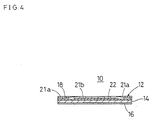
- Fig. 4 is a sectional view of a label continuum as another embodiment of the invention.
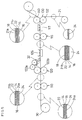
- Fig. 5 is an illustratory view showing another example of method of producing what is shown in Fig. 4.
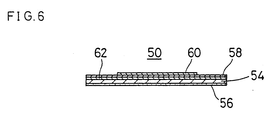
- Fig. 6 is a sectional view showing another embodiment of the invention pertaining to a continuum of label.
- Fig. 7 is an illustratory view showing an example of method of producing what is shown in Fig. 6.
- Fig. 1 is an embodiment of the present invention pertaining to a label continuum, of which (A) is a perspective view and (B) is a sectional view.
- Fig. 2 and Fig. 3 are illustratory views showing an example of producing method shown in Fig. 1, of which Fig. 2 shows the first half of the process and Fig. 3 shows the second half thereof.
- a label continuum 10 is an embodiment of the invention, forming as a belt-like repetition of a plurality of labels 12, each label 12 is separated by cutting along the border line therebetween.
- the printed layer 20 is formed intermittently, i.e. with the predetermined spaces between the expressions of adjacent labels 12 having border line therebetween.
- the label continuum 10 is rolled up before use as labels with the release layer 18 and the adhesive layer 16 false-stuck to each other.
- a heat-sensitive developing layer 22 is formed on the release surface 18 of the label substrate 14.
- the long label substrate 14 in this embodiment is made of, for example, paper, synthetic paper, plastic film or sheet such as of cellophane, polystyrene and polyester or aluminum foil.
- paper, synthetic paper, plastic film or sheet such as of cellophane, polystyrene and polyester or aluminum foil.
- a cutter In order to cut the long belt type of label continuum without seams between the individual labels 12, however, such material is required to be cut by hand or proper machine such as a cutter. It is also possible to provide seams at the predetermined intervals (not shown) for cutting off each oblong label 12.
- the adhesive layer 16 formed by application of an adhesive agent to the back of the label substrate 14 is for imparting adhesive force to each label 12 and for this purpose known adhesive agents such as of acrylic copolymer or rubber-type adhesive agent are used.
- the heat-sensitive developing layer 22 is formed on the surface of the label substrate 14 by coating and drying a heat-sensitive developing agents including a mixture of e.g. transparent or single-color leuco dyes, acid substance and binders.
- leuco dyes may be cited, for example, crystal violet lactone, 3-indolino-3-P-dimethylaminonphenyl-6-dimethylaminophthalid, 3-diethylamino-7-chlorofluoran, 2-diethylamino-7-cyclohexylaminofluoran, 3-diethylamino-5-methyl-7-t-buthylfluoran, 3-diethylamino-6-methyl-7-anilinofluoran, and 3-diethylamino-6-methyl-7-P-butylanilinofluoran.
- acid substances may be cited, for example, 2,2-bis (4'-oxyphenyl) propane, 4-phenylphenol, 4-hydroxyacetophenone, 2,2'-dihydroxydiphenyl, 2,2'-methylene bis (4-methyl-6-t-butylphenol), 4, 4'-isopropylidenediphenol, 4,4'-isopropyriden bis (2-chlorophenol), 4,4'-isopropyridene bis (2-methylphenol), 4,4'-ethylene bis (2-methylphenol) and 4,4'-thiobis (6-t-buthyl-3-methylphenol).
- 2,2-bis (4'-oxyphenyl) propane 4-phenylphenol, 4-hydroxyacetophenone, 2,2'-dihydroxydiphenyl, 2,2'-methylene bis (4-methyl-6-t-butylphenol), 4, 4'-isopropylidenediphenol, 4,4'-isopropyriden bis (2-chlorophenol), 4,4'-isopropyridene bis (2-methylphenol), 4,
- binders may be cited, for example, aqueous solution or emulsion of polyvinyl alcohol, methoxy cellulose, hydroxyethyl cellulose, carboxymethyl cellulose, polyacrylamide, polyacrylic acid, starch, gelatin, polystyrene, vinyl chloride-acetic acid vinyl copolymer.
- the heat-sensitive developing layer 22 is developed when heated by the thermal head etc. of a printer.
- the printed layer 20 is formed for expression on the display parts of the individual labels 12 at the predetermined intervals with the border lines therebetween.
- This printed layer 20 is formed using a general printing ink by a known printing method such as planographic printing, relief printing or offset printing.
- the release layer 18 on the surface of the label substrate 14 over the heat-sensitive developing layer 22 and the printed layer 20 is formed by printing or coating of the release agent such as silicone resin which, for instance, can be cured without affecting the heat-sensitive developing layer 22.
- the release agent such as silicone resin which, for instance, can be cured without affecting the heat-sensitive developing layer 22.
- the release agent constituting the release layer 18 may preferably be selected as the release agent constituting the release layer 18 UV silicone (the so-called silicone of the UV-hardening type) and EB silicone (the so-called silicone of the electronic ray curing type) being cured by UV or electronic ray without affecting the heat-sensitive developing layer 22.
- UV silicone the so-called silicone of the UV-hardening type
- EB silicone the so-called silicone of the electronic ray curing type
- the release layer 18 may be formed by laminating and bonding a film or sheet excelled in releasability.
- a rolled up long belt-like process sheet 24 made of rolled paper, plastic film or sheet is provided.
- This process sheet 24 is used only in the producing process only and is-no longer included in the finished label continuum 10.
- a release layer 24a made by printing or coating a release agent such as silicone resin or fluorine resin.
- An adhesive coating device 100 includes two rollers 102a and 102b. The roller 102a has its lower part dipped in the adhesive agent 26 in a pan 104.
- the adhesive agent 26 is printed on or applied to the surface of the release layer 24a of the process sheet 24 led to the position.
- adhesive agent coating device may as well be used a gravure roll coater, reverse roll coater or air knife coater and a known printing machine such as a screen printing machine may also be used.
- the process sheet 24 printed or coated with the adhesive layer 26 may be led to a drier 106 including, for example, a heater.
- the adhesive agent 26 printed or coated on the process sheet 24 is dried for formation of the adhesive layer 16.
- a drier 106 including, for example, a heater.
- the adhesive agent 26 printed or coated on the process sheet 24 is dried for formation of the adhesive layer 16.
- the adhesive agent 26 one of water-soluble aqueous resin such as of EVA type, vinyl acetate type and acrylic type or solvent type adhesive agent comprising polyvinyl chloride, urethane, acryl etc.
- a dryer is used, while a cooler is to be used when the adhesive agent used is of the hot melt type such as of the rubber type or EVA type.
- the paper 14a of the label substrate 14, too, is formed in the same width as that of the process sheet 24 and on the surface of the paper 14a as the label substrate 14 is already formed the heat-sensitive developing layer 22.
- the heat-sensitive developing layer 22 is formed on the side opposite to the aforementioned adhesive layer 26.
- the laminate of the process sheet 24, adhesive layer 26 and the label substrate 14 is, before it is led to the next printing process or the like, slit in approximately the same width as the width of the label continuum 10 as the final product by a slitter 108 and then rolled up after slitting.
- a laminate 30 of the process sheet 24 and the label substrate 14 is false-stuck by the adhesive layer 26 and rolled up and led to the next step of printing and release agent coating device shown in Fig. 3.
- the rolled up laminate 30 is loaded on the production system shown in Fig. 3, the laminate 30 is unrolled and led to the printing device 110 for formation of the printed layer 20.
- This printing device 110 is for printing the expression constituting each label 12, for example, letters such as trade name, proper patterns etc. by a known printing device for planographic, relief printing or offset printing.
- the laminate 30 with printed layer 20 thereon is led to a release agent coating device 120 to have the release layer 18 formed on the surface of the printed layer 20 on the label substrate 14.
- This release agent coating device 120 is made up of a main roller 122a and a roller 122b formed opposite to the main roller 122a.
- the main roller 122a has its lower part dipped in a dissolved release agent 32 in a pan 124 and the release agent 32 is applied by the main roller 122a to the surface of the label substrate 14 of the laminate 30 passing through between the main roller 122a and the roller 122b.
- the laminate 30 printed or coated with the release agent 32 is moved to a dryer 126 including e.g. a heater.
- the release agent 32 printed or coated on the laminate is dried and the release layer 18 is formed.
- the label continuum 10 of the laminate 30 with release layer 18 formed thereon is led to the process sheet removing device 130.
- This process sheet removing device 130 includes a roller 132 and peel the process sheet 24 off from the surface of the adhesive layer 16 of the laminate 30 and the peeled process sheet 24 is rolled up for reuse.
- the laminate 30 constituting the label continuum 10 is rolled up with its both sides or either side being slit by a slitter 140 to make its width to be optimum. It may as well be possible to die-cut the label substrate 14, adhesive layer 16, printed layer 10 and heat-sensitive developing layer 22 only to be finished by cutting.
- Fig. 4 is a sectional view of the label continuum as another embodiment of the present invention
- Fig. 5 is an illustratory view showing another example of method of producing what is shown in Fig. 4.
- a first printed layer 21a is formed by a printing ink excelled in releasability where the release layer 18 is not formed on the surface of the label substrate 14 and a second printed layer 21b is formed in a portion of the surface of the label substrate 14 between the release layer 18 and the label substrate 14.
- the heat-sensitive developing layer 22 is formed on the surface of the release layer surface 18 side of the label substrate 14. This means that the release layer 18 is formed on the surface of the label substrate 14, that is to say, on the surface of the surface of the heat-sensitive layer 22 and the second printed layer 21b.
- the second printed layer 21b is formed with an ordinary printing ink and is formed intermittently at a constant distance between the expression of the individual labels 12 so that the expression of each label 12 is formed apart from its border line.
- this embodiment is shown on the surface of the heat-sensitive developing layer 22 the second printed layer 21b forming the expression of each label 12 apart from its border line.
- This second printed layer 21b is printed and formed with an ordinary printing ink by a known method of printing such as planographic, relief printing and offset printing. However, this second printing layer 21b may not be formed.
- the laminate 30 of the label substrate 14 and the process sheet 24 for the first half of the producing process is produced by the same device as shown in Fig. 2, the producing device for the second half of the producing process for the label continuum 10 shown in Fig. 4 is shown in Fig. 5.
- the rolled laminate 30 is loaded in the producing device shown in Fig. 5 and is unrolled and led to a printing device 110 for formation of the second printed layer 21b.
- This printing device 110 is for printing the expression constituting each label 12 and, for example, letters such as trade name and proper pattern are printed by a known printing device such as planographic, relief printing and offset printing machine.
- This release agent coating device 120 includes the main roller 122a and the roller 122b formed opposite to the main roller 122a. And, the main roller 122a has its lower part dipped in the release agent 32 in the pan 124 and the release agent 32 is applied to the laminate 30 through between the main roller 122a and the roller 122b by means of the main roller 122a.
- the laminate 30 with the release agent 32 printed on or applied to is moved to the dryer 126 including, for example, a heater.
- the release agent 32 printed on or applied to the laminate is dried to form the release layer 18.
- the laminate 30 is led to a printing device 115 for forming the first printed layer 21a with a printing ink excellent in releasability where the release layer 18 is not formed.
- the laminate 30 with the first printed layer 21a formed thereon is sent to a dryer 117.
- the process sheet removing device 130 includes the roller 132, and the process sheet 24 is removed from the surface of the adhesive layer 16 of the laminate 30 and rolled up for reuse.
- the laminate 30 constituting the label continuum 10 is rolled up with its both side or either side being slit by the slitter 140 with its width to become optimum.
- slitting die-cutting may be possible.
- Fig. 6 is a sectional view of the label continuum as another embodiment of the invention
- Fig. 7 is an illustratory view showing an example of method of producing what is shown in Fig. 6.
- This label continuum 50 has a release layer 58 formed on the surface of a label substrate 54, being different from the examples shown in Figs. 1 and 4. Further, a first printed layer 60 is formed on the surface of the release layer 58. It is same as in the examples shown in Fig. 1 and Fig. 4 that an adhesive layer 56 is formed on the back of the label substrate 54, and it is also same as in the examples shown in Fig. 1 and Fig. 4 that a heat-sensitive developing layer 62 is formed on the surface of the label substrate 54.
- a laminate 70 of the label substrate 54 and a process sheet 64 for the first half of the production process is produced by the same device as shown in Fig. 2.
- the production device for the second half of the production process for the label continuum 50 shown in Fig. 6 is so arranged that a release agent 72 is printed on or applied to the surface of the label substrate 54 of the laminate 70 by means of a release agent coating device 220 and the release agent 72 so printed or applied to is cured by the curing device for formation of the release layer 58 and downstream the printed layer 60 is formed on the release layer 58 by the use of a printing device 210, as shown in Fig. 7.
- a slitter 240 for slitting the label substrate 54 for its width adjusted to the optimum width of the label continuum 50 is positioned downstream immediately before rolling up but after the process sheet 64 is stripped from the pressure sensitive type adhesive layer 56 by a process sheet removing device 230.
Landscapes
- Physics & Mathematics (AREA)
- General Physics & Mathematics (AREA)
- Engineering & Computer Science (AREA)
- Theoretical Computer Science (AREA)
- Making Paper Articles (AREA)
- Laminated Bodies (AREA)
- Adhesive Tapes (AREA)
Applications Claiming Priority (15)
| Application Number | Priority Date | Filing Date | Title |
|---|---|---|---|
| JP24718894 | 1994-09-14 | ||
| JP247188/94 | 1994-09-14 | ||
| JP24718894 | 1994-09-14 | ||
| JP336324/94 | 1994-12-22 | ||
| JP33632394A JP3734181B2 (ja) | 1994-09-14 | 1994-12-22 | ラベル連続体およびその製造方法 |
| JP33632494 | 1994-12-22 | ||
| JP33632194A JPH08137399A (ja) | 1994-09-14 | 1994-12-22 | ラベル連続体およびその製造方法 |
| JP336322/94 | 1994-12-22 | ||
| JP33632294 | 1994-12-22 | ||
| JP33632294A JPH08137400A (ja) | 1994-09-14 | 1994-12-22 | ラベル連続体およびその製造方法 |
| JP336323/94 | 1994-12-22 | ||
| JP33632494A JPH08137402A (ja) | 1994-09-14 | 1994-12-22 | ラベル連続体およびその製造方法 |
| JP336321/94 | 1994-12-22 | ||
| JP33632394 | 1994-12-22 | ||
| JP33632194 | 1994-12-22 |
Publications (2)
| Publication Number | Publication Date |
|---|---|
| EP0702344A1 true EP0702344A1 (fr) | 1996-03-20 |
| EP0702344B1 EP0702344B1 (fr) | 2002-02-06 |
Family
ID=27530140
Family Applications (1)
| Application Number | Title | Priority Date | Filing Date |
|---|---|---|---|
| EP95114332A Expired - Lifetime EP0702344B1 (fr) | 1994-09-14 | 1995-09-12 | Bande d'étiquettes et procédé de fabrication de celle-ci |
Country Status (5)
| Country | Link |
|---|---|
| US (2) | US5723190A (fr) |
| EP (1) | EP0702344B1 (fr) |
| CA (1) | CA2158074C (fr) |
| DE (1) | DE69525296T2 (fr) |
| DK (1) | DK0702344T3 (fr) |
Cited By (3)
| Publication number | Priority date | Publication date | Assignee | Title |
|---|---|---|---|---|
| NL1009547C2 (nl) * | 1998-07-03 | 2000-01-07 | Borne B V Van De | Werkwijze en inrichting voor het verschaffen van bedrukte, zelfklevende folie. |
| WO2014090026A1 (fr) * | 2012-12-15 | 2014-06-19 | Zhao Dezheng | Machine à tissu sec/mouillé d'immersion du type à contact par pression |
| CN105229717A (zh) * | 2013-05-22 | 2016-01-06 | Nec飞鼎克株式会社 | 标签条及其制造方法 |
Families Citing this family (20)
| Publication number | Priority date | Publication date | Assignee | Title |
|---|---|---|---|---|
| US6053231A (en) * | 1995-03-23 | 2000-04-25 | Osaka Sealing Printing Co., Ltd. | Bonding apparatus for cutting label continuum having labels formed thereon and bonding label to object |
| JP3405127B2 (ja) * | 1997-06-03 | 2003-05-12 | セイコーエプソン株式会社 | ラミネートテープおよび被ラミネート用テープ、並びにラミネートテープの被ラミネート用テープへの貼着方法およびその装置 |
| JP2000021983A (ja) | 1998-07-07 | 2000-01-21 | Mitsubishi Electric Corp | 半導体装置およびその製造方法 |
| US6182572B1 (en) * | 1998-08-29 | 2001-02-06 | Malessa Partners, L.L.C. | Method and apparatus for producing multiple cut business forms |
| ATE265367T1 (de) * | 1999-10-05 | 2004-05-15 | Timothy J Flynn | Briefumschlag |
| US6656555B1 (en) * | 1999-10-13 | 2003-12-02 | Malessa Partners, L.L.C. | Integrated forms and method of making such forms |
| US6797333B2 (en) | 2001-06-18 | 2004-09-28 | Print-O-Tape, Inc. | Post-cure treatment of silicone coating for liners in pressure-sensitive labels |
| GB0215374D0 (en) * | 2002-07-03 | 2002-08-14 | Wade Richard | Applying adhesive labels to products and product containers |
| US20030017208A1 (en) * | 2002-07-19 | 2003-01-23 | Francis Ignatious | Electrospun pharmaceutical compositions |
| US6852191B2 (en) * | 2002-08-01 | 2005-02-08 | Equipements De Transformation Imac | Method and apparatus for manufacturing pressure sensitive adhesive label stocks with printing under adhesive and product produced thereby |
| US20050196604A1 (en) * | 2004-03-05 | 2005-09-08 | Unifoil Corporation | Metallization process and product produced thereby |
| US7306844B2 (en) * | 2004-03-10 | 2007-12-11 | Avery Dennison Corporation | Labels and labeling process |
| USD558831S1 (en) * | 2004-04-15 | 2008-01-01 | Avery Dennison Corporation | Sheet of insertable reference divider tab labels |
| GB2435256A (en) * | 2006-02-15 | 2007-08-22 | Markem Tech Ltd | Label attachment in both of two directions |
| US8445104B2 (en) * | 2006-05-18 | 2013-05-21 | MAXStick Products Ltd. | Thermally printable adhesive label |
| EP1862391B1 (fr) * | 2006-06-02 | 2010-04-07 | Impaxx Machine Systems, Inc. | Dispositif et procédé d'application d'étiquettes adhésives sans revêtement sensibles à la pression sur des articles |
| USD589092S1 (en) * | 2008-03-19 | 2009-03-24 | Glover Antonio S | Combined illuminated post and sign |
| DE102010020209A1 (de) * | 2010-05-12 | 2011-11-17 | X-Label Gmbh - Holding | Haftetikettenverbund und Verfahren zur Herstellung eines bedruckten Haftetikettenverbundes |
| US9132618B2 (en) | 2011-10-11 | 2015-09-15 | Ward Kraft, Inc. | Coating of acrylic adhesive labels |
| KR101358932B1 (ko) * | 2012-03-28 | 2014-02-05 | 유응렬 | 악세서리 마스크 구조체 |
Citations (7)
| Publication number | Priority date | Publication date | Assignee | Title |
|---|---|---|---|---|
| US4370370A (en) * | 1981-06-08 | 1983-01-25 | Ricoh Company, Ltd. | Thermosensitive recording adhesive label |
| US4388362A (en) * | 1980-10-17 | 1983-06-14 | Ricoh Co., Ltd. | Released heat-sensitive recording paper |
| FR2559425A1 (fr) * | 1984-02-13 | 1985-08-16 | Nashua Corp | Matiere composite thermosensible d'enregistrement d'une image resistant aux solvants |
| GB2235176A (en) * | 1989-08-21 | 1991-02-27 | Osaka Sealing Label Print | Method of producing a continuum of labels |
| EP0579423A1 (fr) * | 1992-07-13 | 1994-01-19 | Moore Business Forms, Inc. | Etiquettes sans feuille de séparation |
| EP0579430A1 (fr) * | 1992-07-15 | 1994-01-19 | Moore Business Forms, Inc. | Stock d'étiquettes sans feuille de séparation |
| EP0600622A1 (fr) * | 1992-11-30 | 1994-06-08 | Moore Business Forms, Inc. | Label pour bagage, dépourvu de revêtement de détachement, imprimé par impression thermique |
Family Cites Families (10)
| Publication number | Priority date | Publication date | Assignee | Title |
|---|---|---|---|---|
| US3650880A (en) * | 1968-11-20 | 1972-03-21 | Hooker Chemical Corp | Porous polyurethanes and method of manufacture |
| US3630802A (en) * | 1970-07-13 | 1971-12-28 | Theodore J Dettling | Method and apparatus for producing a coated substrate and a laminated product |
| US4345954A (en) * | 1979-03-23 | 1982-08-24 | Polaroid Corporation | Method of making laminates |
| US4420515A (en) * | 1981-08-21 | 1983-12-13 | Sicpa Holding, S.A. | Metallization process for protecting documents of value |
| DE3671577D1 (de) * | 1985-02-14 | 1990-06-28 | Bando Chemical Ind | Verfahren zum schneiden einer halbleiterscheibe in wuerfel. |
| GB8911354D0 (en) * | 1989-05-17 | 1989-07-05 | Mono Web Ltd | Improvements relating to coating of substrates |
| US5000809A (en) * | 1989-12-21 | 1991-03-19 | E. I. Du Pont De Nemours And Company | Lamination coating process using polyesterurethane coating |
| JPH0895494A (ja) * | 1994-09-26 | 1996-04-12 | Petsutaa:Kk | ラベル連続体およびその製造方法 |
| US5508247A (en) * | 1994-09-26 | 1996-04-16 | Ricoh Electronics, Inc. | Linerless direct thermal label |
| US5895705A (en) * | 1997-07-11 | 1999-04-20 | Highland Industries, Inc. | Awning and backlit sign fabric having a selectively eradicable ink layer and a process for producing same |
-
1995
- 1995-09-11 US US08/526,839 patent/US5723190A/en not_active Expired - Lifetime
- 1995-09-12 EP EP95114332A patent/EP0702344B1/fr not_active Expired - Lifetime
- 1995-09-12 DE DE69525296T patent/DE69525296T2/de not_active Expired - Lifetime
- 1995-09-12 DK DK95114332T patent/DK0702344T3/da active
- 1995-09-12 CA CA002158074A patent/CA2158074C/fr not_active Expired - Fee Related
-
1997
- 1997-08-21 US US08/915,948 patent/US6030482A/en not_active Expired - Fee Related
Patent Citations (7)
| Publication number | Priority date | Publication date | Assignee | Title |
|---|---|---|---|---|
| US4388362A (en) * | 1980-10-17 | 1983-06-14 | Ricoh Co., Ltd. | Released heat-sensitive recording paper |
| US4370370A (en) * | 1981-06-08 | 1983-01-25 | Ricoh Company, Ltd. | Thermosensitive recording adhesive label |
| FR2559425A1 (fr) * | 1984-02-13 | 1985-08-16 | Nashua Corp | Matiere composite thermosensible d'enregistrement d'une image resistant aux solvants |
| GB2235176A (en) * | 1989-08-21 | 1991-02-27 | Osaka Sealing Label Print | Method of producing a continuum of labels |
| EP0579423A1 (fr) * | 1992-07-13 | 1994-01-19 | Moore Business Forms, Inc. | Etiquettes sans feuille de séparation |
| EP0579430A1 (fr) * | 1992-07-15 | 1994-01-19 | Moore Business Forms, Inc. | Stock d'étiquettes sans feuille de séparation |
| EP0600622A1 (fr) * | 1992-11-30 | 1994-06-08 | Moore Business Forms, Inc. | Label pour bagage, dépourvu de revêtement de détachement, imprimé par impression thermique |
Cited By (5)
| Publication number | Priority date | Publication date | Assignee | Title |
|---|---|---|---|---|
| NL1009547C2 (nl) * | 1998-07-03 | 2000-01-07 | Borne B V Van De | Werkwijze en inrichting voor het verschaffen van bedrukte, zelfklevende folie. |
| EP0978325A1 (fr) * | 1998-07-03 | 2000-02-09 | Van de Borne B.V. | Procédé et dispositif pour la fabrication d'un film imprimé et auto-collant |
| WO2014090026A1 (fr) * | 2012-12-15 | 2014-06-19 | Zhao Dezheng | Machine à tissu sec/mouillé d'immersion du type à contact par pression |
| CN105229717A (zh) * | 2013-05-22 | 2016-01-06 | Nec飞鼎克株式会社 | 标签条及其制造方法 |
| CN105229717B (zh) * | 2013-05-22 | 2019-01-18 | Nec飞鼎克株式会社 | 标签条及其制造方法 |
Also Published As
| Publication number | Publication date |
|---|---|
| US5723190A (en) | 1998-03-03 |
| EP0702344B1 (fr) | 2002-02-06 |
| DK0702344T3 (da) | 2002-03-18 |
| US6030482A (en) | 2000-02-29 |
| CA2158074A1 (fr) | 1996-03-15 |
| DE69525296T2 (de) | 2002-10-17 |
| CA2158074C (fr) | 2004-11-09 |
| DE69525296D1 (de) | 2002-03-21 |
Similar Documents
| Publication | Publication Date | Title |
|---|---|---|
| US5723190A (en) | Label continuum and producing method thereof | |
| US5855722A (en) | Label continuum and producing method thereof | |
| US4285999A (en) | Method and apparatus involving adhesive backed photographs | |
| US8398117B1 (en) | Sheet with wristband | |
| JPH04825B2 (fr) | ||
| CA1275237C (fr) | Materiaux et materiels de lettrage | |
| US7828333B1 (en) | Label sheet with wristband | |
| US8181994B1 (en) | Sheet with wristband | |
| JP3415973B2 (ja) | ラベル連続体の製造方法 | |
| JP3734184B2 (ja) | 封緘ラベル連続体の製造方法 | |
| CN1137456C (zh) | 标签连续体及其制造方法 | |
| JP3423122B2 (ja) | ラベル連続体およびその製造方法 | |
| JP3766713B2 (ja) | 台紙なしラベル | |
| JP3669446B2 (ja) | 接着テープ | |
| JP3403872B2 (ja) | 感熱発色ラベルの連続体およびその製法 | |
| JP3734181B2 (ja) | ラベル連続体およびその製造方法 | |
| JP2002258755A (ja) | ラベル連続体 | |
| JPH08134414A (ja) | 接着テープおよびその製造方法 | |
| JPH0895493A (ja) | 接着テープおよびその製造方法 | |
| JPH08134412A (ja) | 接着テープおよびその製造方法 | |
| JPH08134413A (ja) | 接着テープおよびその製造方法 | |
| JP3712705B2 (ja) | 感熱発色ラベルの連続体 | |
| JPH08137402A (ja) | ラベル連続体およびその製造方法 | |
| JPH08137399A (ja) | ラベル連続体およびその製造方法 | |
| JPH08134410A (ja) | 接着テープおよびその製造方法 |
Legal Events
| Date | Code | Title | Description |
|---|---|---|---|
| PUAI | Public reference made under article 153(3) epc to a published international application that has entered the european phase |
Free format text: ORIGINAL CODE: 0009012 |
|
| AK | Designated contracting states |
Kind code of ref document: A1 Designated state(s): BE CH DE DK FR GB IT LI NL |
|
| 17P | Request for examination filed |
Effective date: 19960916 |
|
| 17Q | First examination report despatched |
Effective date: 19970606 |
|
| GRAG | Despatch of communication of intention to grant |
Free format text: ORIGINAL CODE: EPIDOS AGRA |
|
| GRAG | Despatch of communication of intention to grant |
Free format text: ORIGINAL CODE: EPIDOS AGRA |
|
| GRAH | Despatch of communication of intention to grant a patent |
Free format text: ORIGINAL CODE: EPIDOS IGRA |
|
| GRAH | Despatch of communication of intention to grant a patent |
Free format text: ORIGINAL CODE: EPIDOS IGRA |
|
| GRAA | (expected) grant |
Free format text: ORIGINAL CODE: 0009210 |
|
| REG | Reference to a national code |
Ref country code: GB Ref legal event code: IF02 |
|
| AK | Designated contracting states |
Kind code of ref document: B1 Designated state(s): BE CH DE DK FR GB IT LI NL |
|
| REG | Reference to a national code |
Ref country code: CH Ref legal event code: EP |
|
| REG | Reference to a national code |
Ref country code: DK Ref legal event code: T3 |
|
| REF | Corresponds to: |
Ref document number: 69525296 Country of ref document: DE Date of ref document: 20020321 |
|
| REG | Reference to a national code |
Ref country code: CH Ref legal event code: NV Representative=s name: ROTTMANN, ZIMMERMANN + PARTNER AG |
|
| PLBE | No opposition filed within time limit |
Free format text: ORIGINAL CODE: 0009261 |
|
| STAA | Information on the status of an ep patent application or granted ep patent |
Free format text: STATUS: NO OPPOSITION FILED WITHIN TIME LIMIT |
|
| 26N | No opposition filed |
Effective date: 20021107 |
|
| PGFP | Annual fee paid to national office [announced via postgrant information from national office to epo] |
Ref country code: DK Payment date: 20090922 Year of fee payment: 15 |
|
| PGFP | Annual fee paid to national office [announced via postgrant information from national office to epo] |
Ref country code: NL Payment date: 20090922 Year of fee payment: 15 |
|
| PGFP | Annual fee paid to national office [announced via postgrant information from national office to epo] |
Ref country code: CH Payment date: 20091029 Year of fee payment: 15 |
|
| PGFP | Annual fee paid to national office [announced via postgrant information from national office to epo] |
Ref country code: BE Payment date: 20090914 Year of fee payment: 15 |
|
| BERE | Be: lapsed |
Owner name: *PETTER CO. LTD Effective date: 20100930 |
|
| REG | Reference to a national code |
Ref country code: NL Ref legal event code: V1 Effective date: 20110401 |
|
| REG | Reference to a national code |
Ref country code: CH Ref legal event code: PL |
|
| REG | Reference to a national code |
Ref country code: DK Ref legal event code: EBP |
|
| PG25 | Lapsed in a contracting state [announced via postgrant information from national office to epo] |
Ref country code: BE Free format text: LAPSE BECAUSE OF NON-PAYMENT OF DUE FEES Effective date: 20100930 Ref country code: CH Free format text: LAPSE BECAUSE OF NON-PAYMENT OF DUE FEES Effective date: 20100930 Ref country code: LI Free format text: LAPSE BECAUSE OF NON-PAYMENT OF DUE FEES Effective date: 20100930 |
|
| PG25 | Lapsed in a contracting state [announced via postgrant information from national office to epo] |
Ref country code: NL Free format text: LAPSE BECAUSE OF NON-PAYMENT OF DUE FEES Effective date: 20110401 |
|
| PG25 | Lapsed in a contracting state [announced via postgrant information from national office to epo] |
Ref country code: DK Free format text: LAPSE BECAUSE OF NON-PAYMENT OF DUE FEES Effective date: 20100930 |
|
| PGFP | Annual fee paid to national office [announced via postgrant information from national office to epo] |
Ref country code: GB Payment date: 20120917 Year of fee payment: 18 |
|
| PGFP | Annual fee paid to national office [announced via postgrant information from national office to epo] |
Ref country code: IT Payment date: 20120926 Year of fee payment: 18 Ref country code: DE Payment date: 20120924 Year of fee payment: 18 Ref country code: FR Payment date: 20120927 Year of fee payment: 18 |
|
| GBPC | Gb: european patent ceased through non-payment of renewal fee |
Effective date: 20130912 |
|
| REG | Reference to a national code |
Ref country code: FR Ref legal event code: ST Effective date: 20140530 |
|
| REG | Reference to a national code |
Ref country code: DE Ref legal event code: R119 Ref document number: 69525296 Country of ref document: DE Effective date: 20140401 |
|
| PG25 | Lapsed in a contracting state [announced via postgrant information from national office to epo] |
Ref country code: GB Free format text: LAPSE BECAUSE OF NON-PAYMENT OF DUE FEES Effective date: 20130912 |
|
| PG25 | Lapsed in a contracting state [announced via postgrant information from national office to epo] |
Ref country code: IT Free format text: LAPSE BECAUSE OF NON-PAYMENT OF DUE FEES Effective date: 20130912 Ref country code: DE Free format text: LAPSE BECAUSE OF NON-PAYMENT OF DUE FEES Effective date: 20140401 Ref country code: FR Free format text: LAPSE BECAUSE OF NON-PAYMENT OF DUE FEES Effective date: 20130930 |