EP0702708B1 - Akustisch wirksame plastisole - Google Patents
Akustisch wirksame plastisole Download PDFInfo
- Publication number
- EP0702708B1 EP0702708B1 EP94919590A EP94919590A EP0702708B1 EP 0702708 B1 EP0702708 B1 EP 0702708B1 EP 94919590 A EP94919590 A EP 94919590A EP 94919590 A EP94919590 A EP 94919590A EP 0702708 B1 EP0702708 B1 EP 0702708B1
- Authority
- EP
- European Patent Office
- Prior art keywords
- weight
- plastisol
- plastisols
- compositions
- parts
- Prior art date
- Legal status (The legal status is an assumption and is not a legal conclusion. Google has not performed a legal analysis and makes no representation as to the accuracy of the status listed.)
- Expired - Lifetime
Links
- 229920001944 Plastisol Polymers 0.000 title claims abstract description 71
- 239000004999 plastisol Substances 0.000 title claims abstract description 71
- 239000000203 mixture Substances 0.000 claims abstract description 44
- 229920001577 copolymer Polymers 0.000 claims abstract description 32
- -1 alkyl methacrylate Chemical compound 0.000 claims abstract description 16
- PPBRXRYQALVLMV-UHFFFAOYSA-N Styrene Natural products C=CC1=CC=CC=C1 PPBRXRYQALVLMV-UHFFFAOYSA-N 0.000 claims abstract description 13
- VVQNEPGJFQJSBK-UHFFFAOYSA-N Methyl methacrylate Chemical compound COC(=O)C(C)=C VVQNEPGJFQJSBK-UHFFFAOYSA-N 0.000 claims abstract description 12
- 239000002245 particle Substances 0.000 claims abstract description 11
- 229920001519 homopolymer Polymers 0.000 claims abstract description 10
- 238000005299 abrasion Methods 0.000 claims abstract description 7
- 238000000576 coating method Methods 0.000 claims description 26
- 239000004014 plasticizer Substances 0.000 claims description 21
- CERQOIWHTDAKMF-UHFFFAOYSA-N Methacrylic acid Chemical compound CC(=C)C(O)=O CERQOIWHTDAKMF-UHFFFAOYSA-N 0.000 claims description 9
- 239000000945 filler Substances 0.000 claims description 9
- 239000000654 additive Substances 0.000 claims description 8
- 238000004132 cross linking Methods 0.000 claims description 8
- 229910052751 metal Inorganic materials 0.000 claims description 7
- 239000002184 metal Substances 0.000 claims description 7
- 239000004604 Blowing Agent Substances 0.000 claims description 6
- 239000000178 monomer Substances 0.000 claims description 5
- 150000001732 carboxylic acid derivatives Chemical class 0.000 claims description 4
- 229920000768 polyamine Polymers 0.000 claims description 4
- 229920001228 polyisocyanate Polymers 0.000 claims description 4
- 239000005056 polyisocyanate Substances 0.000 claims description 4
- 239000000758 substrate Substances 0.000 claims description 4
- ASRMWYDEZPXXBA-UHFFFAOYSA-N (sulfonylamino)urea Chemical class NC(=O)NN=S(=O)=O ASRMWYDEZPXXBA-UHFFFAOYSA-N 0.000 claims description 2
- 150000004008 N-nitroso compounds Chemical class 0.000 claims description 2
- 125000000751 azo group Chemical group [*]N=N[*] 0.000 claims description 2
- 238000005260 corrosion Methods 0.000 claims description 2
- 230000007797 corrosion Effects 0.000 claims description 2
- 239000003822 epoxy resin Substances 0.000 claims description 2
- LNEPOXFFQSENCJ-UHFFFAOYSA-N haloperidol Chemical compound C1CC(O)(C=2C=CC(Cl)=CC=2)CCN1CCCC(=O)C1=CC=C(F)C=C1 LNEPOXFFQSENCJ-UHFFFAOYSA-N 0.000 claims description 2
- 229940042795 hydrazides for tuberculosis treatment Drugs 0.000 claims description 2
- 229920000647 polyepoxide Polymers 0.000 claims description 2
- 125000000472 sulfonyl group Chemical group *S(*)(=O)=O 0.000 claims description 2
- 230000008878 coupling Effects 0.000 claims 2
- 238000010168 coupling process Methods 0.000 claims 2
- 238000005859 coupling reaction Methods 0.000 claims 2
- 125000004209 (C1-C8) alkyl group Chemical group 0.000 claims 1
- 125000005907 alkyl ester group Chemical group 0.000 claims 1
- 229920000620 organic polymer Polymers 0.000 claims 1
- 230000000694 effects Effects 0.000 abstract description 8
- 238000013016 damping Methods 0.000 abstract description 7
- XLYOFNOQVPJJNP-UHFFFAOYSA-N water Substances O XLYOFNOQVPJJNP-UHFFFAOYSA-N 0.000 abstract description 5
- 239000004576 sand Substances 0.000 abstract description 3
- 230000002349 favourable effect Effects 0.000 abstract 1
- 229920000642 polymer Polymers 0.000 description 19
- 239000011248 coating agent Substances 0.000 description 16
- 238000000034 method Methods 0.000 description 11
- 239000010410 layer Substances 0.000 description 7
- 230000000052 comparative effect Effects 0.000 description 6
- ZVFDTKUVRCTHQE-UHFFFAOYSA-N Diisodecyl phthalate Chemical compound CC(C)CCCCCCCOC(=O)C1=CC=CC=C1C(=O)OCCCCCCCC(C)C ZVFDTKUVRCTHQE-UHFFFAOYSA-N 0.000 description 5
- CERQOIWHTDAKMF-UHFFFAOYSA-M Methacrylate Chemical compound CC(=C)C([O-])=O CERQOIWHTDAKMF-UHFFFAOYSA-M 0.000 description 5
- VYPSYNLAJGMNEJ-UHFFFAOYSA-N Silicium dioxide Chemical compound O=[Si]=O VYPSYNLAJGMNEJ-UHFFFAOYSA-N 0.000 description 5
- HBGGXOJOCNVPFY-UHFFFAOYSA-N diisononyl phthalate Chemical compound CC(C)CCCCCCOC(=O)C1=CC=CC=C1C(=O)OCCCCCCC(C)C HBGGXOJOCNVPFY-UHFFFAOYSA-N 0.000 description 5
- 238000004519 manufacturing process Methods 0.000 description 5
- 229920003229 poly(methyl methacrylate) Polymers 0.000 description 5
- 239000004926 polymethyl methacrylate Substances 0.000 description 5
- OSSNTDFYBPYIEC-UHFFFAOYSA-N 1-ethenylimidazole Chemical compound C=CN1C=CN=C1 OSSNTDFYBPYIEC-UHFFFAOYSA-N 0.000 description 4
- SOGAXMICEFXMKE-UHFFFAOYSA-N Butylmethacrylate Chemical compound CCCCOC(=O)C(C)=C SOGAXMICEFXMKE-UHFFFAOYSA-N 0.000 description 4
- VTYYLEPIZMXCLO-UHFFFAOYSA-L Calcium carbonate Chemical compound [Ca+2].[O-]C([O-])=O VTYYLEPIZMXCLO-UHFFFAOYSA-L 0.000 description 4
- 239000010426 asphalt Substances 0.000 description 4
- QQVHEQUEHCEAKS-UHFFFAOYSA-N diundecyl benzene-1,2-dicarboxylate Chemical compound CCCCCCCCCCCOC(=O)C1=CC=CC=C1C(=O)OCCCCCCCCCCC QQVHEQUEHCEAKS-UHFFFAOYSA-N 0.000 description 4
- 230000003116 impacting effect Effects 0.000 description 4
- 239000000463 material Substances 0.000 description 4
- 238000005259 measurement Methods 0.000 description 4
- 239000000049 pigment Substances 0.000 description 4
- PKQYSCBUFZOAPE-UHFFFAOYSA-N 1,2-dibenzyl-3-methylbenzene Chemical compound C=1C=CC=CC=1CC=1C(C)=CC=CC=1CC1=CC=CC=C1 PKQYSCBUFZOAPE-UHFFFAOYSA-N 0.000 description 3
- 229910000831 Steel Inorganic materials 0.000 description 3
- 239000002318 adhesion promoter Substances 0.000 description 3
- 238000005516 engineering process Methods 0.000 description 3
- 239000011888 foil Substances 0.000 description 3
- 238000009472 formulation Methods 0.000 description 3
- 230000009477 glass transition Effects 0.000 description 3
- 125000002887 hydroxy group Chemical group [H]O* 0.000 description 3
- 239000010959 steel Substances 0.000 description 3
- OZAIFHULBGXAKX-UHFFFAOYSA-N 2-(2-cyanopropan-2-yldiazenyl)-2-methylpropanenitrile Chemical compound N#CC(C)(C)N=NC(C)(C)C#N OZAIFHULBGXAKX-UHFFFAOYSA-N 0.000 description 2
- SMZOUWXMTYCWNB-UHFFFAOYSA-N 2-(2-methoxy-5-methylphenyl)ethanamine Chemical compound COC1=CC=C(C)C=C1CCN SMZOUWXMTYCWNB-UHFFFAOYSA-N 0.000 description 2
- NIXOWILDQLNWCW-UHFFFAOYSA-N 2-Propenoic acid Natural products OC(=O)C=C NIXOWILDQLNWCW-UHFFFAOYSA-N 0.000 description 2
- BKMAEERFCKIKJR-UHFFFAOYSA-N 2-tridecoxycarbonylbenzoic acid Chemical compound CCCCCCCCCCCCCOC(=O)C1=CC=CC=C1C(O)=O BKMAEERFCKIKJR-UHFFFAOYSA-N 0.000 description 2
- 229910002016 Aerosil® 200 Inorganic materials 0.000 description 2
- 239000004156 Azodicarbonamide Substances 0.000 description 2
- IRIAEXORFWYRCZ-UHFFFAOYSA-N Butylbenzyl phthalate Chemical compound CCCCOC(=O)C1=CC=CC=C1C(=O)OCC1=CC=CC=C1 IRIAEXORFWYRCZ-UHFFFAOYSA-N 0.000 description 2
- OKTJSMMVPCPJKN-UHFFFAOYSA-N Carbon Chemical compound [C] OKTJSMMVPCPJKN-UHFFFAOYSA-N 0.000 description 2
- ZAMOUSCENKQFHK-UHFFFAOYSA-N Chlorine atom Chemical compound [Cl] ZAMOUSCENKQFHK-UHFFFAOYSA-N 0.000 description 2
- MQIUGAXCHLFZKX-UHFFFAOYSA-N Di-n-octyl phthalate Natural products CCCCCCCCOC(=O)C1=CC=CC=C1C(=O)OCCCCCCCC MQIUGAXCHLFZKX-UHFFFAOYSA-N 0.000 description 2
- 229910000639 Spring steel Inorganic materials 0.000 description 2
- BZHJMEDXRYGGRV-UHFFFAOYSA-N Vinyl chloride Chemical compound ClC=C BZHJMEDXRYGGRV-UHFFFAOYSA-N 0.000 description 2
- 238000007792 addition Methods 0.000 description 2
- XOZUGNYVDXMRKW-AATRIKPKSA-N azodicarbonamide Chemical compound NC(=O)\N=N\C(N)=O XOZUGNYVDXMRKW-AATRIKPKSA-N 0.000 description 2
- 235000019399 azodicarbonamide Nutrition 0.000 description 2
- TZCXTZWJZNENPQ-UHFFFAOYSA-L barium sulfate Chemical compound [Ba+2].[O-]S([O-])(=O)=O TZCXTZWJZNENPQ-UHFFFAOYSA-L 0.000 description 2
- SESFRYSPDFLNCH-UHFFFAOYSA-N benzyl benzoate Chemical compound C=1C=CC=CC=1C(=O)OCC1=CC=CC=C1 SESFRYSPDFLNCH-UHFFFAOYSA-N 0.000 description 2
- BCSGAWBQJHXXSE-UHFFFAOYSA-N bis(11-methyldodecyl) benzene-1,2-dicarboxylate Chemical compound CC(C)CCCCCCCCCCOC(=O)C1=CC=CC=C1C(=O)OCCCCCCCCCCC(C)C BCSGAWBQJHXXSE-UHFFFAOYSA-N 0.000 description 2
- BJQHLKABXJIVAM-UHFFFAOYSA-N bis(2-ethylhexyl) phthalate Chemical compound CCCCC(CC)COC(=O)C1=CC=CC=C1C(=O)OCC(CC)CCCC BJQHLKABXJIVAM-UHFFFAOYSA-N 0.000 description 2
- YKGYQYOQRGPFTO-UHFFFAOYSA-N bis(8-methylnonyl) hexanedioate Chemical compound CC(C)CCCCCCCOC(=O)CCCCC(=O)OCCCCCCCC(C)C YKGYQYOQRGPFTO-UHFFFAOYSA-N 0.000 description 2
- 229910000019 calcium carbonate Inorganic materials 0.000 description 2
- BRPQOXSCLDDYGP-UHFFFAOYSA-N calcium oxide Chemical compound [O-2].[Ca+2] BRPQOXSCLDDYGP-UHFFFAOYSA-N 0.000 description 2
- 239000000292 calcium oxide Substances 0.000 description 2
- ODINCKMPIJJUCX-UHFFFAOYSA-N calcium oxide Inorganic materials [Ca]=O ODINCKMPIJJUCX-UHFFFAOYSA-N 0.000 description 2
- 125000003178 carboxy group Chemical group [H]OC(*)=O 0.000 description 2
- 239000000460 chlorine Substances 0.000 description 2
- 229910052801 chlorine Inorganic materials 0.000 description 2
- 238000010276 construction Methods 0.000 description 2
- 239000003431 cross linking reagent Substances 0.000 description 2
- DOIRQSBPFJWKBE-UHFFFAOYSA-N dibutyl phthalate Chemical compound CCCCOC(=O)C1=CC=CC=C1C(=O)OCCCC DOIRQSBPFJWKBE-UHFFFAOYSA-N 0.000 description 2
- 235000014113 dietary fatty acids Nutrition 0.000 description 2
- USIUVYZYUHIAEV-UHFFFAOYSA-N diphenyl ether Chemical compound C=1C=CC=CC=1OC1=CC=CC=C1 USIUVYZYUHIAEV-UHFFFAOYSA-N 0.000 description 2
- KYBYPDUGGWLXNO-GRVYQHKQSA-N ethane-1,2-diamine;(9z,12z)-octadeca-9,12-dienoic acid Chemical compound NCCN.CCCCC\C=C/C\C=C/CCCCCCCC(O)=O.CCCCC\C=C/C\C=C/CCCCCCCC(O)=O KYBYPDUGGWLXNO-GRVYQHKQSA-N 0.000 description 2
- 238000002474 experimental method Methods 0.000 description 2
- 239000000194 fatty acid Substances 0.000 description 2
- 229930195729 fatty acid Natural products 0.000 description 2
- 229910021485 fumed silica Inorganic materials 0.000 description 2
- 239000013538 functional additive Substances 0.000 description 2
- 125000000524 functional group Chemical group 0.000 description 2
- ZZUFCTLCJUWOSV-UHFFFAOYSA-N furosemide Chemical compound C1=C(Cl)C(S(=O)(=O)N)=CC(C(O)=O)=C1NCC1=CC=CO1 ZZUFCTLCJUWOSV-UHFFFAOYSA-N 0.000 description 2
- 238000001879 gelation Methods 0.000 description 2
- UDKSLGIUCGAZTK-UHFFFAOYSA-N phenyl pentadecane-1-sulfonate Chemical compound CCCCCCCCCCCCCCCS(=O)(=O)OC1=CC=CC=C1 UDKSLGIUCGAZTK-UHFFFAOYSA-N 0.000 description 2
- 125000002924 primary amino group Chemical group [H]N([H])* 0.000 description 2
- 238000001228 spectrum Methods 0.000 description 2
- 238000003860 storage Methods 0.000 description 2
- 238000002076 thermal analysis method Methods 0.000 description 2
- JAHNSTQSQJOJLO-UHFFFAOYSA-N 2-(3-fluorophenyl)-1h-imidazole Chemical compound FC1=CC=CC(C=2NC=CN=2)=C1 JAHNSTQSQJOJLO-UHFFFAOYSA-N 0.000 description 1
- KXGFMDJXCMQABM-UHFFFAOYSA-N 2-methoxy-6-methylphenol Chemical compound [CH]OC1=CC=CC([CH])=C1O KXGFMDJXCMQABM-UHFFFAOYSA-N 0.000 description 1
- QTWJRLJHJPIABL-UHFFFAOYSA-N 2-methylphenol;3-methylphenol;4-methylphenol Chemical compound CC1=CC=C(O)C=C1.CC1=CC=CC(O)=C1.CC1=CC=CC=C1O QTWJRLJHJPIABL-UHFFFAOYSA-N 0.000 description 1
- ALKCLFLTXBBMMP-UHFFFAOYSA-N 3,7-dimethylocta-1,6-dien-3-yl hexanoate Chemical compound CCCCCC(=O)OC(C)(C=C)CCC=C(C)C ALKCLFLTXBBMMP-UHFFFAOYSA-N 0.000 description 1
- NBOCQTNZUPTTEI-UHFFFAOYSA-N 4-[4-(hydrazinesulfonyl)phenoxy]benzenesulfonohydrazide Chemical compound C1=CC(S(=O)(=O)NN)=CC=C1OC1=CC=C(S(=O)(=O)NN)C=C1 NBOCQTNZUPTTEI-UHFFFAOYSA-N 0.000 description 1
- 239000004215 Carbon black (E152) Substances 0.000 description 1
- 239000004971 Cross linker Substances 0.000 description 1
- 229920002943 EPDM rubber Polymers 0.000 description 1
- 239000004593 Epoxy Substances 0.000 description 1
- 229910019142 PO4 Inorganic materials 0.000 description 1
- ISWSIDIOOBJBQZ-UHFFFAOYSA-N Phenol Chemical compound OC1=CC=CC=C1 ISWSIDIOOBJBQZ-UHFFFAOYSA-N 0.000 description 1
- XSQUKJJJFZCRTK-UHFFFAOYSA-N Urea Chemical compound NC(N)=O XSQUKJJJFZCRTK-UHFFFAOYSA-N 0.000 description 1
- VRFNYSYURHAPFL-UHFFFAOYSA-N [(4-methylphenyl)sulfonylamino]urea Chemical compound CC1=CC=C(S(=O)(=O)NNC(N)=O)C=C1 VRFNYSYURHAPFL-UHFFFAOYSA-N 0.000 description 1
- 238000010521 absorption reaction Methods 0.000 description 1
- 230000002730 additional effect Effects 0.000 description 1
- 230000000996 additive effect Effects 0.000 description 1
- WNLRTRBMVRJNCN-UHFFFAOYSA-N adipic acid Chemical class OC(=O)CCCCC(O)=O WNLRTRBMVRJNCN-UHFFFAOYSA-N 0.000 description 1
- 150000001338 aliphatic hydrocarbons Chemical class 0.000 description 1
- 125000005250 alkyl acrylate group Chemical group 0.000 description 1
- 125000000217 alkyl group Chemical group 0.000 description 1
- 230000003712 anti-aging effect Effects 0.000 description 1
- 230000002238 attenuated effect Effects 0.000 description 1
- 238000005452 bending Methods 0.000 description 1
- 229960002903 benzyl benzoate Drugs 0.000 description 1
- 239000004202 carbamide Substances 0.000 description 1
- 125000004432 carbon atom Chemical group C* 0.000 description 1
- 239000006229 carbon black Substances 0.000 description 1
- 238000006243 chemical reaction Methods 0.000 description 1
- 239000003795 chemical substances by application Substances 0.000 description 1
- 238000013329 compounding Methods 0.000 description 1
- 150000001875 compounds Chemical class 0.000 description 1
- 229930003836 cresol Natural products 0.000 description 1
- 229920006037 cross link polymer Polymers 0.000 description 1
- 230000007423 decrease Effects 0.000 description 1
- UCVPKAZCQPRWAY-UHFFFAOYSA-N dibenzyl benzene-1,2-dicarboxylate Chemical compound C=1C=CC=C(C(=O)OCC=2C=CC=CC=2)C=1C(=O)OCC1=CC=CC=C1 UCVPKAZCQPRWAY-UHFFFAOYSA-N 0.000 description 1
- 229960002380 dibutyl phthalate Drugs 0.000 description 1
- 150000001993 dienes Chemical class 0.000 description 1
- 239000000539 dimer Substances 0.000 description 1
- 239000006185 dispersion Substances 0.000 description 1
- 229920001971 elastomer Polymers 0.000 description 1
- 239000000806 elastomer Substances 0.000 description 1
- 239000000839 emulsion Substances 0.000 description 1
- 230000007613 environmental effect Effects 0.000 description 1
- SUPCQIBBMFXVTL-UHFFFAOYSA-N ethyl 2-methylprop-2-enoate Chemical compound CCOC(=O)C(C)=C SUPCQIBBMFXVTL-UHFFFAOYSA-N 0.000 description 1
- 150000004665 fatty acids Chemical class 0.000 description 1
- 238000005187 foaming Methods 0.000 description 1
- 238000010438 heat treatment Methods 0.000 description 1
- 229930195733 hydrocarbon Natural products 0.000 description 1
- 150000002430 hydrocarbons Chemical class 0.000 description 1
- 239000011256 inorganic filler Substances 0.000 description 1
- 229910003475 inorganic filler Inorganic materials 0.000 description 1
- 239000012948 isocyanate Substances 0.000 description 1
- 150000002513 isocyanates Chemical class 0.000 description 1
- 229910044991 metal oxide Inorganic materials 0.000 description 1
- 150000004706 metal oxides Chemical class 0.000 description 1
- LVHBHZANLOWSRM-UHFFFAOYSA-N methylenebutanedioic acid Natural products OC(=O)CC(=C)C(O)=O LVHBHZANLOWSRM-UHFFFAOYSA-N 0.000 description 1
- 239000010445 mica Substances 0.000 description 1
- 229910052618 mica group Inorganic materials 0.000 description 1
- 150000002832 nitroso derivatives Chemical class 0.000 description 1
- 125000002347 octyl group Chemical group [H]C([*])([H])C([H])([H])C([H])([H])C([H])([H])C([H])([H])C([H])([H])C([H])([H])C([H])([H])[H] 0.000 description 1
- 229920001568 phenolic resin Polymers 0.000 description 1
- 239000005011 phenolic resin Substances 0.000 description 1
- 235000021317 phosphate Nutrition 0.000 description 1
- 150000003013 phosphoric acid derivatives Chemical class 0.000 description 1
- XNGIFLGASWRNHJ-UHFFFAOYSA-L phthalate(2-) Chemical compound [O-]C(=O)C1=CC=CC=C1C([O-])=O XNGIFLGASWRNHJ-UHFFFAOYSA-L 0.000 description 1
- 229920001200 poly(ethylene-vinyl acetate) Polymers 0.000 description 1
- 229920002689 polyvinyl acetate Polymers 0.000 description 1
- 239000011118 polyvinyl acetate Substances 0.000 description 1
- 239000000843 powder Substances 0.000 description 1
- 230000002265 prevention Effects 0.000 description 1
- 239000003380 propellant Substances 0.000 description 1
- 239000006077 pvc stabilizer Substances 0.000 description 1
- 230000005855 radiation Effects 0.000 description 1
- 238000010526 radical polymerization reaction Methods 0.000 description 1
- 238000000518 rheometry Methods 0.000 description 1
- 150000003349 semicarbazides Chemical class 0.000 description 1
- 239000002356 single layer Substances 0.000 description 1
- 239000003760 tallow Substances 0.000 description 1
- 239000010455 vermiculite Substances 0.000 description 1
- 229910052902 vermiculite Inorganic materials 0.000 description 1
- 235000019354 vermiculite Nutrition 0.000 description 1
- XOOUIPVCVHRTMJ-UHFFFAOYSA-L zinc stearate Chemical compound [Zn+2].CCCCCCCCCCCCCCCCCC([O-])=O.CCCCCCCCCCCCCCCCCC([O-])=O XOOUIPVCVHRTMJ-UHFFFAOYSA-L 0.000 description 1
Images


Classifications
-
- G—PHYSICS
- G10—MUSICAL INSTRUMENTS; ACOUSTICS
- G10K—SOUND-PRODUCING DEVICES; METHODS OR DEVICES FOR PROTECTING AGAINST, OR FOR DAMPING, NOISE OR OTHER ACOUSTIC WAVES IN GENERAL; ACOUSTICS NOT OTHERWISE PROVIDED FOR
- G10K11/00—Methods or devices for transmitting, conducting or directing sound in general; Methods or devices for protecting against, or for damping, noise or other acoustic waves in general
- G10K11/16—Methods or devices for protecting against, or for damping, noise or other acoustic waves in general
- G10K11/162—Selection of materials
-
- B—PERFORMING OPERATIONS; TRANSPORTING
- B60—VEHICLES IN GENERAL
- B60R—VEHICLES, VEHICLE FITTINGS, OR VEHICLE PARTS, NOT OTHERWISE PROVIDED FOR
- B60R13/00—Elements for body-finishing, identifying, or decorating; Arrangements or adaptations for advertising purposes
- B60R13/08—Insulating elements, e.g. for sound insulation
-
- C—CHEMISTRY; METALLURGY
- C08—ORGANIC MACROMOLECULAR COMPOUNDS; THEIR PREPARATION OR CHEMICAL WORKING-UP; COMPOSITIONS BASED THEREON
- C08K—Use of inorganic or non-macromolecular organic substances as compounding ingredients
- C08K5/00—Use of organic ingredients
- C08K5/0008—Organic ingredients according to more than one of the "one dot" groups of C08K5/01 - C08K5/59
- C08K5/0016—Plasticisers
-
- C—CHEMISTRY; METALLURGY
- C09—DYES; PAINTS; POLISHES; NATURAL RESINS; ADHESIVES; COMPOSITIONS NOT OTHERWISE PROVIDED FOR; APPLICATIONS OF MATERIALS NOT OTHERWISE PROVIDED FOR
- C09D—COATING COMPOSITIONS, e.g. PAINTS, VARNISHES OR LACQUERS; FILLING PASTES; CHEMICAL PAINT OR INK REMOVERS; INKS; CORRECTING FLUIDS; WOODSTAINS; PASTES OR SOLIDS FOR COLOURING OR PRINTING; USE OF MATERIALS THEREFOR
- C09D125/00—Coating compositions based on homopolymers or copolymers of compounds having one or more unsaturated aliphatic radicals, each having only one carbon-to-carbon double bond, and at least one being terminated by an aromatic carbocyclic ring; Coating compositions based on derivatives of such polymers
- C09D125/02—Homopolymers or copolymers of hydrocarbons
- C09D125/04—Homopolymers or copolymers of styrene
- C09D125/08—Copolymers of styrene
-
- C—CHEMISTRY; METALLURGY
- C09—DYES; PAINTS; POLISHES; NATURAL RESINS; ADHESIVES; COMPOSITIONS NOT OTHERWISE PROVIDED FOR; APPLICATIONS OF MATERIALS NOT OTHERWISE PROVIDED FOR
- C09D—COATING COMPOSITIONS, e.g. PAINTS, VARNISHES OR LACQUERS; FILLING PASTES; CHEMICAL PAINT OR INK REMOVERS; INKS; CORRECTING FLUIDS; WOODSTAINS; PASTES OR SOLIDS FOR COLOURING OR PRINTING; USE OF MATERIALS THEREFOR
- C09D133/00—Coating compositions based on homopolymers or copolymers of compounds having one or more unsaturated aliphatic radicals, each having only one carbon-to-carbon double bond, and at least one being terminated by only one carboxyl radical, or of salts, anhydrides, esters, amides, imides, or nitriles thereof; Coating compositions based on derivatives of such polymers
- C09D133/04—Homopolymers or copolymers of esters
- C09D133/06—Homopolymers or copolymers of esters of esters containing only carbon, hydrogen and oxygen, the oxygen atom being present only as part of the carboxyl radical
-
- C—CHEMISTRY; METALLURGY
- C09—DYES; PAINTS; POLISHES; NATURAL RESINS; ADHESIVES; COMPOSITIONS NOT OTHERWISE PROVIDED FOR; APPLICATIONS OF MATERIALS NOT OTHERWISE PROVIDED FOR
- C09D—COATING COMPOSITIONS, e.g. PAINTS, VARNISHES OR LACQUERS; FILLING PASTES; CHEMICAL PAINT OR INK REMOVERS; INKS; CORRECTING FLUIDS; WOODSTAINS; PASTES OR SOLIDS FOR COLOURING OR PRINTING; USE OF MATERIALS THEREFOR
- C09D133/00—Coating compositions based on homopolymers or copolymers of compounds having one or more unsaturated aliphatic radicals, each having only one carbon-to-carbon double bond, and at least one being terminated by only one carboxyl radical, or of salts, anhydrides, esters, amides, imides, or nitriles thereof; Coating compositions based on derivatives of such polymers
- C09D133/04—Homopolymers or copolymers of esters
- C09D133/06—Homopolymers or copolymers of esters of esters containing only carbon, hydrogen and oxygen, the oxygen atom being present only as part of the carboxyl radical
- C09D133/10—Homopolymers or copolymers of methacrylic acid esters
- C09D133/12—Homopolymers or copolymers of methyl methacrylate
-
- B—PERFORMING OPERATIONS; TRANSPORTING
- B60—VEHICLES IN GENERAL
- B60R—VEHICLES, VEHICLE FITTINGS, OR VEHICLE PARTS, NOT OTHERWISE PROVIDED FOR
- B60R13/00—Elements for body-finishing, identifying, or decorating; Arrangements or adaptations for advertising purposes
- B60R13/08—Insulating elements, e.g. for sound insulation
- B60R13/0861—Insulating elements, e.g. for sound insulation for covering undersurfaces of vehicles, e.g. wheel houses
-
- Y—GENERAL TAGGING OF NEW TECHNOLOGICAL DEVELOPMENTS; GENERAL TAGGING OF CROSS-SECTIONAL TECHNOLOGIES SPANNING OVER SEVERAL SECTIONS OF THE IPC; TECHNICAL SUBJECTS COVERED BY FORMER USPC CROSS-REFERENCE ART COLLECTIONS [XRACs] AND DIGESTS
- Y10—TECHNICAL SUBJECTS COVERED BY FORMER USPC
- Y10T—TECHNICAL SUBJECTS COVERED BY FORMER US CLASSIFICATION
- Y10T428/00—Stock material or miscellaneous articles
- Y10T428/31504—Composite [nonstructural laminate]
- Y10T428/31678—Of metal
- Y10T428/31692—Next to addition polymer from unsaturated monomers
-
- Y—GENERAL TAGGING OF NEW TECHNOLOGICAL DEVELOPMENTS; GENERAL TAGGING OF CROSS-SECTIONAL TECHNOLOGIES SPANNING OVER SEVERAL SECTIONS OF THE IPC; TECHNICAL SUBJECTS COVERED BY FORMER USPC CROSS-REFERENCE ART COLLECTIONS [XRACs] AND DIGESTS
- Y10—TECHNICAL SUBJECTS COVERED BY FORMER USPC
- Y10T—TECHNICAL SUBJECTS COVERED BY FORMER US CLASSIFICATION
- Y10T428/00—Stock material or miscellaneous articles
- Y10T428/31504—Composite [nonstructural laminate]
- Y10T428/31855—Of addition polymer from unsaturated monomers
Definitions
- the invention relates to the use of sprayable Plastisol compositions for sound absorption.
- the sound absorbing properties of polymer coatings are in the range of the glass transition temperature of the Polymer system most pronounced because in this temperature range due to the viscoelasticity of the polymer mechanical energy of the vibrations over molecular Flow processes are converted into heat.
- Conventional sprayable coating materials on the basis PVC plastisols e.g. as underbody protection in Automotive applications are widely used, show in Service temperature range from -20 ° C to + 60 ° C no noteworthy sound-absorbing effect because the maximum of Glass transition depending on the plasticizer content at about -20 ° C to -50 ° C.
- DE-A-3444863 describes compositions which the PVC or vinyl chloride / vinyl acetate copolymers, if appropriate Methyl methacrylate homopolymers or copolymers, contain a plasticizer mixture and inert fillers.
- the plasticizer mixture consists of the methyl methacrylate polymer compatible plasticizers and plasticizers for the vinyl chloride polymers with the optionally existing methacrylate polymers incompatible are.
- the plastisols thus obtained face each other conventional PVC plastisols improved sound absorbing Properties on. Especially at temperatures above however, the sound-absorbing effect drops from around 30 ° C again.
- DE-C-3830345 proposes a sprayable plastisol composition before consisting of a mixture of one first polymer component, which after gelling the Plastisol forms the continuous phase and one second weakly crosslinked polymer component, which after the gelling of the plastisol is only swollen and in the dispersed continuous phase, the continuous phase essentially for the mechanical Properties such as abrasion resistance, low-temperature flexibility, Hardness and liability on the surface is responsible, while the finely divided swollen polymer phase in essential for the sound absorbing properties of the worn coating is responsible.
- DE-C-4013318 proposes two-layer Coatings from an inner, soft Layer consist and a top layer, which is essentially prevents abrasion of the entire coating.
- DE-C-4013318 is capable of both structure-borne noise dampen as well as those caused by impacting particles Reduce noise, however, need to for this purpose two coatings in succession on the Substrates are applied. This means warehousing of two materials as well as double application devices. To simplify the application in motor vehicle construction it is desirable to provide coatings that can be applied in one layer and preferably with existing application device can be used.
- EP-A-0544201 describes plastisol compositions the basis of acrylic ester copolymers and plasticizers, where the copolymers as main components 98 to 50% by weight an alkyl acrylate and / or an alkyl methacrylate with an alkyl group of 1 to 8 carbon atoms and 2 to Contain 50% by weight of a diene monomer.
- the plastisols for soundproofing steel plates are suitable, concrete indications of their effect for structure-borne noise reduction and / or reduction the noise caused by impacting particles and / or prevention of air vibrations in cavities are missing, however.
- this document cannot be deduced whether the plastisol compositions disclosed there Soundproofing that can also be used when fillers are added Properties and mechanical properties to have.
- the invention is therefore based on the object of a coating for rigid substrates, especially for sheet metal in the underbody area of motor vehicles including to develop the wheel arches, which dampens structure-borne noise acts as well as protecting against corrosion and abrasion, a substantial reduction in impact from particles caused noises and what more as a single-layer coating with existing plastisol application devices applicable and preferred is chlorine free.
- Particularly suitable styrene copolymers are in DE-A-4034725 specified that are expressly part of this Are invention.
- copolymers of methyl methacrylate with 5 to 48% by weight of a C2 to C8 alkyl ester of methacrylic acid and 0.5 to 4% by weight of an adhesion-promoting and / or crosslinking agent acting comonomers for the inventive Plastisols suitable without the addition of PVC and a second plasticizer is necessary.
- an adhesion promoter Comonomers for the methacrylate copolymers are N-vinylimidazole or acrylic acid or methacrylic acid especially suitable.
- Alkyl methacrylate homopolymers in particular the C 2 -C 8 -alkyl esters of methacrylic acid, which may contain 0.5 to 4% by weight of an adhesion-promoting and / or cross-linking comonomer, are also suitable for the plastisols according to the invention.
- N-vinylimidazole or acrylic acid, methacrylic acid or itaconic acid are also particularly suitable as adhesion-promoting comonomers for the alkyl methacrylate homopolymers.
- Ethyl methacrylate has proven to be a particularly suitable alkyl methacrylate.
- compositions according to the invention can also combinations of the above styrene copolymers and the copolymers of methyl methacrylate or the alkyl methacrylate homopolymers either as Combination of two or even a combination of all three Polymers are used.
- cross-linking comonomer for both the methacrylate copolymers as well as for the styrene copolymers those functional monomers suitable that additionally for the olefinically unsaturated double bond functional group included during the radical Polymerization to produce the copolymer is not reacts, but only during the gelation of the Plastisol are available for cross-linking reactions.
- This additional functional group can e.g. a Epoxy, (blocked) isocyanate or hydroxy group.
- plasticizers Suitable plasticizer are e.g. Paul E. Bruins, Plasticizer Technology [Weinhold Publ. Corp., New York], Vol. 1, pp. 228-232).
- Alkyl phthalates are preferred such as dibutyl phthalate, dioctyl phthalate, benzyl butyl phthalate, Dibenzyl phthalate, diisononyl phthalate (DINP), diisodecyl phthalate (DIDP) and diundecyl phthalate (DIUP).
- plasticizers are also suitable from the group of organic phosphates, adipates and sebazate or also benzyl benzoate, alkyl sulfonic acid esters of phenol or cresol, dibenzyltoluene or diphenyl ether.
- the selection criteria for the preferred used On the one hand, plasticizers depend on the polymer composition as well as viscosity Gelation conditions of the plastisol and the desired ones acoustic properties.
- Suitable as fillers for the plastisols according to the invention all known fillers, e.g. Calcium carbonate in the form of various chalks, heavy spar, Mica, vermiculite, particularly preferred is spar spar.
- Comonomers can be the plastisols according to the invention contain reactive additives.
- hydroxy-functional comonomers can be added di- or polyisocyanates, preferably blocked or microencapsulated are preferred for epoxy-functional comonomers
- Amino and / or hydroxy functional additives can be used will.
- the polyaminoamides can preferably can also be added if there is no cross-linking effect Comonomer was copolymerized into the copolymer because this with the excess carboxyl groups of or the copolymers can react crosslinking.
- the plastisol compositions can also Mixtures of copolymers can also contain both the plastisols based on the styrene copolymers also the plastisols based on the methacrylate copolymers Methyl methacrylate homopolymer included as an additive.
- the plastisols according to the invention can, if appropriate other auxiliaries and additives, as in the Plastisol technology are common.
- auxiliaries and additives e.g. Color pigments, anti-aging agents, rheology aids as well as blowing agents for the production of foamed plastisols.
- blowing agents all blowing agents known per se, preferably organic Blowing agents from the class of azo compounds, N-nitroso compounds, Sulfonyl hydrazides or sulfonyl semicarbazides.
- Azobisisobutyronitrile and especially the azodicarbonamide from the class of nitroso compounds is exemplary called the di-nitrosopentamethylenetetramine in the class of sulfohydrazides, 4,4'-oxybis (benzenesulfonic acid hydrazide) and from the class of semicarbazides called p-toluenesulfonylsemicarbazide.
- the foamed plastisols are particularly suitable for Reduction of noise from moving motor vehicles through impacting particles (stones and grit, sand, Water). Since mainly this Wheel arches and parts of the vehicle floor are affected, the foamed plastisols are also preferred in these Areas used.
- foamed plastisols Another area of application for the foamed plastisols is the use as so-called "pillar-fillers" in Cavities such as the roof spars or the A, B and / or C pillars of a motor vehicle.
- pillar-fillers a plug through the foamed plastisol the whole Cross section of the cavity blocked to prevent to swing the air columns enclosed in the spars can start.
- the plastisols according to the invention are surprisingly distinguished by a high loss factor like him is necessary for effective structure-borne noise reduction.
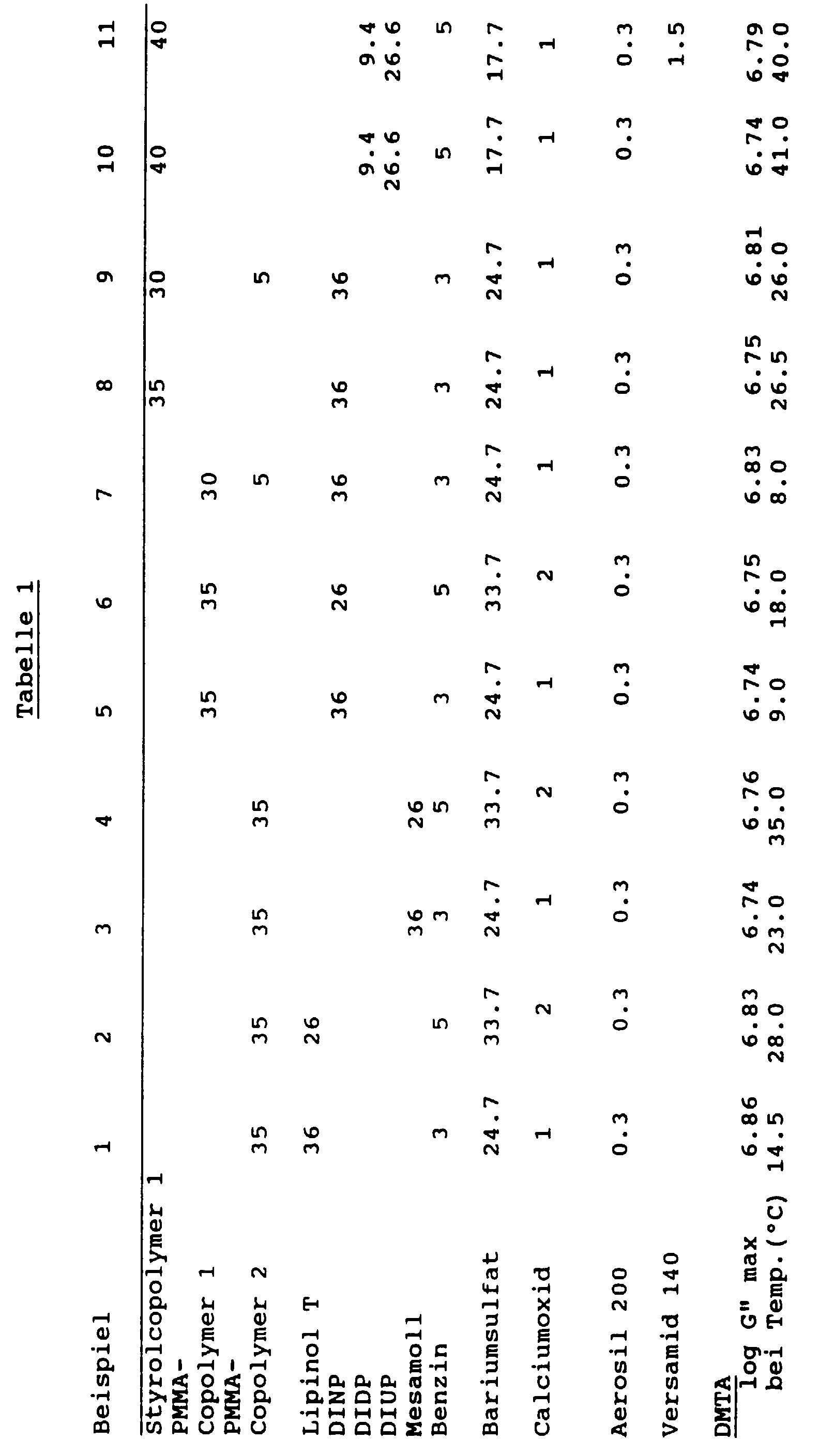
- This loss factor was determined either by usual methods with the help of dynamic mechanical thermal analysis (DMTA) determined or by the bending vibration testtician.
- DMTA dynamic mechanical thermal analysis
- a plastisol with the following composition was produced on the basis of methacrylate polymers: PMMA copolymer 2 15.0 parts PMMA polymer 3 15.0 parts Lipinol T 26.97 pieces Chalk, ground 5.0 parts Calcium oxide powder 3.50 parts Barium sulfate 22.0 parts Adhesion promoter (phenolic resin) 2.0 parts Aliphatic hydrocarbons 3.5 parts Carbon black pigment 0.03 parts,
- a Plastisol of Example 19 used, in addition to 7 Parts of a propellant paste consisting of 40 parts Lipinol T, 15 parts calcium carbonate, 15 parts urea, 7.5 parts of zinc stearate and 22.5 parts of azodicarbonamide were added.
- Attenuation measurements were made with the plastisol of Example 19 carried out according to the colonel method, in addition were with the plastisols of Examples 19 and 20 measure coated sheets using the APAMAT method.
- Paste-type emulsion PVC 32.0 parts Dioctyl phthalate 30.0 parts Ground natural chalk 16.5 parts Felled chalk 6.0 parts Calcium oxide 3.0 parts Color pigment (mixture of metal oxides) 1.0 parts Pigment black 0.1 parts PVC stabilizers 1.0 parts Adhesion promoter 2.0 parts Fumed silica 0.4 parts Hydrocarbon mixture 8.0 parts.
- the styrene copolymer 1 of Examples 8 to 12 and 14 to 18 is a styrene copolymer with 6.4% methacrylic acid as in DE-A-4034725 describes the styrene copolymer 2 contains 7.5% methacrylic acid.
- the PMMA copolymer 1 is a carboxyl group-containing one Methyl methacrylate copolymer consisting of about 63% methyl methacrylate, about 35% butyl methacrylate and about 2% Methacrylic acid.
- the PMMA copolymer 2 contains about 83% methyl methacrylate, about 15% butyl methacrylate and about 2% N-vinylimidazole.
- the loss modulus G " is measured in Pa and has its maximum in the range of the glass transition temperature of the corresponding Coating material.
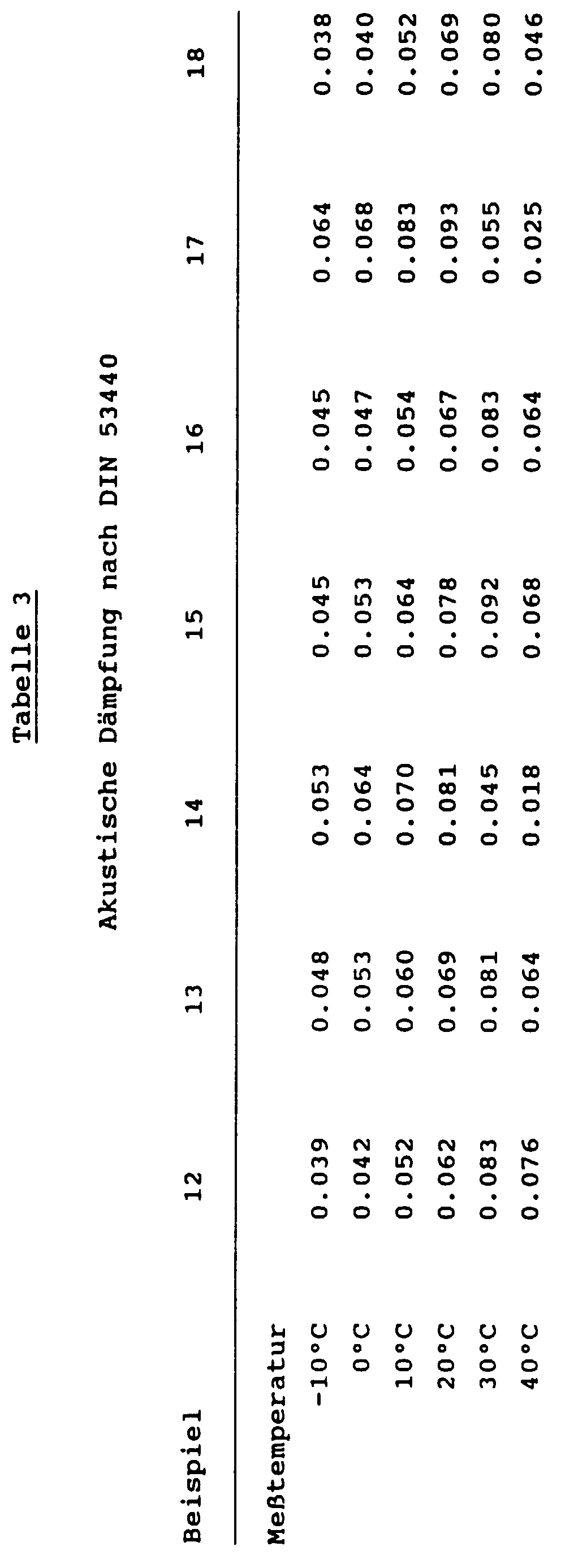
- the acoustic damping values (dcombi) in Table 3 were determined according to DIN 53440 - the colonel method (at 200 Hz), it was standardized to a covering weight of 50%, i.e. the weight of the coating with the acoustic damping plastisol was 50% of the sheet weight.
- the Dimensions of the spring steel sheets were 240 x 10 mm, 1 mm Thickness.
- the sheet metal strip was along for a length of 200 mm coated the plastisol according to the invention.
- the plastisols were applied thinly using a Primer on the measuring strip (spring steel) applied and gelled at 160 ° C for 25 min.
- Figures 1 and 2 show the combined loss factor at 200 Hz of coated steel strips according to DIN 53440 Part 3.
- Figure 3 shows the graphical representation of the Measurement results of the sheets, which according to the APAMAT method in Dependence on the frequency was measured.
- FIG. 1 shows the temperature dependence of the loss factor of a conventional PVC plastisol in comparative experiment ( 1,2 ) in comparison to examples 14 ( 3,5 ) and 18 ( 4,6 ) according to the invention with 2 different layer thicknesses of the plastisol on the steel strip.
- FIG. 2 shows the dependence of the loss factor on the coating weight of the coating.
- Curve 1 shows the conventional PVC plastisol of the comparative example
- curves 2 and 3 show examples 14 and 18 according to the invention
- curve 4 shows example 19 according to the invention. This illustration shows that even at high coating weights with PVC plastisols very low attenuation values are to be achieved, whereas with the inventive plastisols starting at a coating weight of 50% fully adequate loss factors of about 0.1 (curves 2,3,4) can be achieved.
- Figure 3 shows the measurement results of the compositions according to Example 19 (curve 3 ) and Example 20 (curve 4 ) against a conventional PVC plastisol of the comparative example (curve 1 ) and a PP / EPDM plate (curve 2 ), which was applied to the measuring plate .
- This illustration also makes it clear that especially at the higher frequencies from about 1000 Hz, at which the human ear is particularly sensitive, the noise is significantly more attenuated (curves 3, 4 ) if the sheets are coated with the plastisols according to the invention, as if the prior art (curve 1,2 ) is applied.
Landscapes
- Chemical & Material Sciences (AREA)
- Engineering & Computer Science (AREA)
- Organic Chemistry (AREA)
- Life Sciences & Earth Sciences (AREA)
- Materials Engineering (AREA)
- Wood Science & Technology (AREA)
- Acoustics & Sound (AREA)
- Physics & Mathematics (AREA)
- Medicinal Chemistry (AREA)
- Polymers & Plastics (AREA)
- Chemical Kinetics & Catalysis (AREA)
- Health & Medical Sciences (AREA)
- Mechanical Engineering (AREA)
- Multimedia (AREA)
- Paints Or Removers (AREA)
- Compositions Of Macromolecular Compounds (AREA)
- Soundproofing, Sound Blocking, And Sound Damping (AREA)
Description

| PMMA-Copolymer 2 | 15.0 Teile |
| PMMA-Polymer 3 | 15.0 Teile |
| Lipinol T | 26.97 Teile |
| Kreide, gemahlen | 5.0 Teile |
| Calciumoxidpulver | 3.50 Teile |
| Bariumsulfat | 22.0 Teile |
| Haftvermittler (Phenolharz) | 2.0 Teile |
| Aliphatische Kohlenwasserstoffe | 3.5 Teile |
| Rußpigment | 0.03 Teile, |
| Emulsions-PVC vom Pastentyp | 32.0 Teile |
| Dioctylphthalat | 30.0 Teile |
| Gemahlene natürliche Kreide | 16.5 Teile |
| Gefällte Kreide | 6.0 Teile |
| Calciumoxid | 3.0 Teile |
| Farbpigment (Mischung von Metalloxiden) | 1.0 Teile |
| Pigmentruß | 0.1 Teile |
| PVC-Stabilisatoren | 1.0 Teile |
| Haftvermittler | 2.0 Teile |
| Pyrogene Kieselsäure | 0.4 Teile |
| Kohlenwasserstoffgemisch | 8.0 Teile. |
| Kurve | Formulierung | Dicke der Beschichtung |
| 1 | Vergleichsbeispiel | 2.27 mm |
| 2 | Vergleichsbeispiel | 4.52 mm |
| 3 | Beispiel 14 | 2.0 mm |
| 4 | Beispiel 18 | 2.0 mm |
| 5 | Beispiel 14 | 4.0 mm |
| 6 | Beispiel 18 | 4.0 mm. |
Aus dieser Darstellung ist zu entnehmen, daß selbst bei hohen Belagsgewichten mit PVC-Plastisolen nur sehr niedrige Dämpfungswerte zu erreichen sind, wogegen mit den erfindungsgemäßen Plastisolen bereits ab einem Belaggewicht von 50 % völlig ausreichende Verlustfaktoren von etwa 0.1 (Kurven 2,3,4) zu erzielen sind.
Claims (7)
- Verwendung von spritzbaren Plastisol-Zusammensetzungen auf der Basis von pulverförmigen organischen Polymeren und Weichmachern, gekennzeichnet durch einen Gehalt ana) 5 bis 60 Gew.% mindestens eines pulverförmigen Styrolcopolymeren, das 2 bis 20 Gew.% einer olefinisch ungesättigten Carbonsäure als Comonomer enthält, und/oder Alkylmethacrylathomopolymeren und/oder Copolymeren des Methylmethacrylates,b) 5 bis 65 Gew.% Weichmacher,c) 0 bis 40 Gew.% Füllstoffen,d) 2 bis 40 Gew.% reaktive Zusätze, ausgewählt aus der Gruppe der ggf. hydroxyfunktionellen blockierten oder mikroverkapselten Di- oder Polyisocyanate; Amino- und/ oder hydroxyfunktionelle Zusätze, insbesondere Di- oder Polyamine oder Polyaminoamide; Epoxiharze,e) ggf. weiteren Hilfs- und Zusatzstoffen, wobei die Summe der Einzelkomponenten 100 Gew.% beträgt,
zur körperschalldämpfenden und/oder die durch aufprallende Teilchen hervorgerufenen Geräusche reduzierenden und/oder Luftschwingungen in Hohlräumen verhindernden Beschichtungen von steifen Substraten, insbesondere Blechen an oder in Kraftfahrzeugen. - Verwendung von Plastisolzusammensetzungen nach Anspruch 1, dadurch gekennzeichnet, daß das Styrolcopolymer 2 bis 20 Gew.% einer olefinisch ungesättigten Carbonsäure sowie 0.2 bis 5 Gew.% eines weiteren vernetzend wirkenden Comonomeren, bezogen auf die Monomerzusammensetzung, enthält.
- Verwendung von Plastisolzusammensetzungen nach Anspruch 1, dadurch gekennzeichnet, daß das Methylmethacrylatcopolymer 5 bis 48 Gew.% eines C2- bis C8-Alkylester der Methacrylsäure und 0.5 bis 4 Gew.% eines haftvermittelnden und/oder vernetzend wirkenden Comonomeren bezogen auf die Monomerzusammensetzung enthält.
- Verwendung von Plastisolzusammensetzungen nach Anspruch 1, dadurch gekennzeichnet, daß das Alkylmethacrylathomopolymer ein C1-C8-Alkylester der Methacrylsäure ist und gegebenenfalls 0.5 bis 4 Gew.% eines haftvermittelnden und/oder vernetzend wirkenden Comonomeren bezogen auf die Monomerzusammensetzung, enthält.
- Verwendung von geschäumten Plastisolzusammensetzungen gemäß mindestens einem der Ansprüche 1 bis 4, dadurch gekennzeichnet, daß die Zusammensetzung ein Treibmittel enthält.
- Verwendung von Zusammensetzungen gemäß Anspruch 5, dadurch gekennzeichnet, daß das Treibmittel aus der Gruppe der Azoverbindungen, N-Nitrosoverbindungen, Sulfonylhydrazide oder Sulfonylsemicarbazide ausgewählt wird.
- Verwendung von Zusammensetzungen gemäß mindestens einem der Ansprüche 1 bis 6, dadurch gekennzeichnet, daß die Beschichtungen gleichzeitig die Substrate vor Abrieb und/oder Korrosion schützen.
Applications Claiming Priority (3)
| Application Number | Priority Date | Filing Date | Title |
|---|---|---|---|
| DE4318712 | 1993-06-07 | ||
| DE4318712A DE4318712A1 (de) | 1993-06-07 | 1993-06-07 | Akustisch wirksame Plastisole |
| PCT/EP1994/001767 WO1994029394A1 (de) | 1993-06-07 | 1994-05-31 | Akustisch wirksame plastisole |
Publications (2)
| Publication Number | Publication Date |
|---|---|
| EP0702708A1 EP0702708A1 (de) | 1996-03-27 |
| EP0702708B1 true EP0702708B1 (de) | 1998-03-11 |
Family
ID=6489703
Family Applications (1)
| Application Number | Title | Priority Date | Filing Date |
|---|---|---|---|
| EP94919590A Expired - Lifetime EP0702708B1 (de) | 1993-06-07 | 1994-05-31 | Akustisch wirksame plastisole |
Country Status (10)
| Country | Link |
|---|---|
| US (1) | US5741824A (de) |
| EP (1) | EP0702708B1 (de) |
| JP (1) | JPH08511047A (de) |
| KR (1) | KR960702857A (de) |
| CN (1) | CN1056398C (de) |
| AT (1) | ATE163964T1 (de) |
| CA (1) | CA2164696A1 (de) |
| DE (2) | DE4318712A1 (de) |
| ES (1) | ES2113110T3 (de) |
| WO (1) | WO1994029394A1 (de) |
Cited By (1)
| Publication number | Priority date | Publication date | Assignee | Title |
|---|---|---|---|---|
| US8137500B2 (en) | 2005-01-22 | 2012-03-20 | Henkel Kgaa | Sprayable low-viscosity rubber damping compounds |
Families Citing this family (23)
| Publication number | Priority date | Publication date | Assignee | Title |
|---|---|---|---|---|
| US6559213B2 (en) | 1995-03-16 | 2003-05-06 | Henkel-Teroson Gmbh | Plastisol composition |
| DE19824468B4 (de) * | 1997-06-06 | 2007-04-12 | Volkswagen Ag | Verfahren zum Beschichten einer Kraftfahrzeugkarosserie und Kraftfahrzeugkarosserie |
| US6129175A (en) * | 1999-05-07 | 2000-10-10 | Radians, Inc. | Acoustical control plastisol earpieces |
| EP1283229B1 (de) * | 2000-05-16 | 2005-12-14 | Sunstar Giken Kabushiki Kaisha | Plastisolzusammensetzung |
| US6531541B1 (en) | 2000-05-19 | 2003-03-11 | Ppg Industries Ohio, Inc. | Coating compositions, coated substrates and methods for inhibiting sound transmission through a substrate |
| JP3913444B2 (ja) | 2000-05-23 | 2007-05-09 | アイシン化工株式会社 | 防音アンダーコート用アクリルゾル |
| KR100435366B1 (ko) * | 2001-09-17 | 2004-06-10 | 현대자동차주식회사 | 데드너용 아크릴계 수지조성물 |
| JP4543676B2 (ja) * | 2003-12-24 | 2010-09-15 | Dic株式会社 | 制振性水性塗料組成物 |
| US7288290B2 (en) * | 2004-05-26 | 2007-10-30 | Ppg Industries Ohio, Inc. | Process for applying multi-component composite coatings to substrates to provide sound damping and print-through resistance |
| US7019102B2 (en) | 2004-06-18 | 2006-03-28 | Henkel Kommanditgesellschaft Auf Aktien | Blocked polyurethane prepolymers useful in coating compositions |
| WO2006105620A1 (en) * | 2004-06-25 | 2006-10-12 | Ferro (Belgium) S.P.R.L. | Acoustic sealant composition |
| CN101501748B (zh) | 2006-04-19 | 2012-12-05 | 伊格尼斯创新有限公司 | 有源矩阵显示器的稳定驱动设计 |
| EP2176355A1 (de) * | 2007-08-02 | 2010-04-21 | Dow Global Technologies Inc. | Dämpfender duroplast |
| DE102007040304A1 (de) * | 2007-08-24 | 2009-02-26 | Evonik Röhm Gmbh | Verbesserte Bindemittel für Plastisole |
| CN104870104B (zh) | 2012-12-19 | 2018-09-28 | 汉高股份有限及两合公司 | 部件的声阻尼和/或隔音方法 |
| WO2014124269A1 (en) | 2013-02-11 | 2014-08-14 | Henkel Ag & Co. Kgaa | Liquid rubber damping composition |
| US9327769B2 (en) | 2014-09-05 | 2016-05-03 | Toyota Motor Engineering & Manufacturing North America, Inc. | Vehicles having internal body cavity seals and methods of assembling the same |
| US20160075891A1 (en) * | 2014-09-16 | 2016-03-17 | Eastman Chemical Company | Polymeric compositions with improved noise suppression |
| US20160075855A1 (en) | 2014-09-16 | 2016-03-17 | Eastman Chemical Company | Polymeric compositions with improved noise suppression |
| CN105644460A (zh) * | 2016-03-23 | 2016-06-08 | 北京兴科迪科技有限公司 | 一种防噪音的汽车内饰结构材料和形成方法 |
| US9920192B2 (en) | 2016-05-19 | 2018-03-20 | Eastman Chemical Company | Polymeric compositions with improved noise suppression |
| EP3458533A1 (de) * | 2016-05-19 | 2019-03-27 | Eastman Chemical Company | Verbesserte geräuschdämpfer aus acryl in form einer flüssigkeit |
| WO2019012426A1 (en) * | 2017-07-14 | 2019-01-17 | 3M Innovative Properties Company | NOISE CONTROL ARTICLE |
Family Cites Families (6)
| Publication number | Priority date | Publication date | Assignee | Title |
|---|---|---|---|---|
| DE3444863A1 (de) * | 1984-12-08 | 1986-07-17 | Teroson Gmbh, 6900 Heidelberg | Spritzbare plastisolzusammensetzung und deren verwendung zur schalldaempfung |
| DE3514753A1 (de) * | 1985-04-24 | 1986-10-30 | Rütgerswerke AG, 6000 Frankfurt | Spritzbare antidroehnmassen |
| DE3830345C1 (de) * | 1988-09-07 | 1989-11-02 | Teroson Gmbh, 6900 Heidelberg, De | |
| DE4013318A1 (de) * | 1990-04-26 | 1991-10-31 | Teroson Gmbh | Zweischichtige beschichtung und verfahren zu deren herstellung |
| DE4034725A1 (de) * | 1990-10-31 | 1992-05-07 | Teroson Gmbh | Plastisolzusammensetzung |
| JP3049894B2 (ja) * | 1991-11-27 | 2000-06-05 | 日本ゼオン株式会社 | アクリル酸エステル系共重合体プラスチゾル組成物 |
-
1993
- 1993-06-07 DE DE4318712A patent/DE4318712A1/de not_active Ceased
-
1994
- 1994-05-31 DE DE59405435T patent/DE59405435D1/de not_active Expired - Fee Related
- 1994-05-31 EP EP94919590A patent/EP0702708B1/de not_active Expired - Lifetime
- 1994-05-31 AT AT94919590T patent/ATE163964T1/de not_active IP Right Cessation
- 1994-05-31 WO PCT/EP1994/001767 patent/WO1994029394A1/de not_active Ceased
- 1994-05-31 ES ES94919590T patent/ES2113110T3/es not_active Expired - Lifetime
- 1994-05-31 CA CA002164696A patent/CA2164696A1/en not_active Abandoned
- 1994-05-31 CN CN94192372A patent/CN1056398C/zh not_active Expired - Fee Related
- 1994-05-31 US US08/557,038 patent/US5741824A/en not_active Expired - Fee Related
- 1994-05-31 KR KR1019950705428A patent/KR960702857A/ko not_active Ceased
- 1994-05-31 JP JP7501263A patent/JPH08511047A/ja not_active Ceased
Cited By (1)
| Publication number | Priority date | Publication date | Assignee | Title |
|---|---|---|---|---|
| US8137500B2 (en) | 2005-01-22 | 2012-03-20 | Henkel Kgaa | Sprayable low-viscosity rubber damping compounds |
Also Published As
| Publication number | Publication date |
|---|---|
| ES2113110T3 (es) | 1998-04-16 |
| ATE163964T1 (de) | 1998-03-15 |
| CN1056398C (zh) | 2000-09-13 |
| US5741824A (en) | 1998-04-21 |
| CA2164696A1 (en) | 1994-12-22 |
| CN1124971A (zh) | 1996-06-19 |
| KR960702857A (ko) | 1996-05-23 |
| WO1994029394A1 (de) | 1994-12-22 |
| DE4318712A1 (de) | 1994-12-08 |
| EP0702708A1 (de) | 1996-03-27 |
| DE59405435D1 (de) | 1998-04-16 |
| JPH08511047A (ja) | 1996-11-19 |
Similar Documents
| Publication | Publication Date | Title |
|---|---|---|
| EP0702708B1 (de) | Akustisch wirksame plastisole | |
| EP0766714B1 (de) | Akustisch wirksame plastisole | |
| DE2852828C2 (de) | Verfahren zur Herstellung einer körperschalldämpfenden Beschichtung | |
| EP0453917B1 (de) | Zweischichtige Beschichtung und Verfahren zu deren Herstellung | |
| EP1838778B2 (de) | Spritzbare, niedrigviskose kautschuk-dämpfungsmassen | |
| DE4129666C2 (de) | Verfahren zur Herstellung eines viscoelastischen Dämpfungsschaums mit adhäsiver Oberfläche | |
| EP0351611A2 (de) | Masse-Feder-Systeme für Schallschutzzwecke | |
| DE1200458B (de) | Schwingungsdaempfende Materialien mit grosser Temperaturbandbreite hoher Wirksamkeit aus Mischungen hochpolymerer Stoffe mit aeusseren Weichmachern | |
| DE3830345C1 (de) | ||
| EP0185267B1 (de) | Spritzbare Plastisolzusammensetzung und deren Verwendung zur Schalldämpfung | |
| DE4441656A1 (de) | Elastomerprodukte mit akustischen Dämpfungseigenschaften | |
| DE102005052130A1 (de) | Spritzbare Akustikmassen | |
| DE2918079C2 (de) | ||
| DE2260998A1 (de) | Energieabsorbierendes gemisch | |
| DE69131434T2 (de) | Polyvinylchloridzusammensetzung | |
| DE3448259C2 (de) | Fahrzeuginnenteil aus Kunststoff | |
| DE2137199B2 (de) | Elastisches Kraftfahrzeugbau-Kunststoff-Formteil, Verfahren zu seiner Herstellung sowie seine Verwendung in Kraftfahrzeugen | |
| DE2025456A1 (en) | Vibration proof sandwich structure | |
| DE1301663B (de) | Verbundsysteme aus harten Platten mit schwingungsdaempfenden viskoelastischen Zwischenschichten hoher Temperaturbandbreite | |
| MXPA96006637A (en) | Active plastisols acusticame | |
| DD250323A1 (de) | Dicht- und antidroehnmasse |
Legal Events
| Date | Code | Title | Description |
|---|---|---|---|
| PUAI | Public reference made under article 153(3) epc to a published international application that has entered the european phase |
Free format text: ORIGINAL CODE: 0009012 |
|
| 17P | Request for examination filed |
Effective date: 19951129 |
|
| AK | Designated contracting states |
Kind code of ref document: A1 Designated state(s): AT BE DE ES FR GB IT NL PT SE |
|
| RAP1 | Party data changed (applicant data changed or rights of an application transferred) |
Owner name: HENKEL TEROSON GMBH |
|
| 17Q | First examination report despatched |
Effective date: 19960628 |
|
| GRAG | Despatch of communication of intention to grant |
Free format text: ORIGINAL CODE: EPIDOS AGRA |
|
| GRAG | Despatch of communication of intention to grant |
Free format text: ORIGINAL CODE: EPIDOS AGRA |
|
| GRAG | Despatch of communication of intention to grant |
Free format text: ORIGINAL CODE: EPIDOS AGRA |
|
| GRAH | Despatch of communication of intention to grant a patent |
Free format text: ORIGINAL CODE: EPIDOS IGRA |
|
| GRAH | Despatch of communication of intention to grant a patent |
Free format text: ORIGINAL CODE: EPIDOS IGRA |
|
| GRAA | (expected) grant |
Free format text: ORIGINAL CODE: 0009210 |
|
| AK | Designated contracting states |
Kind code of ref document: B1 Designated state(s): AT BE DE ES FR GB IT NL PT SE |
|
| REF | Corresponds to: |
Ref document number: 163964 Country of ref document: AT Date of ref document: 19980315 Kind code of ref document: T |
|
| ET | Fr: translation filed | ||
| REF | Corresponds to: |
Ref document number: 59405435 Country of ref document: DE Date of ref document: 19980416 |
|
| REG | Reference to a national code |
Ref country code: ES Ref legal event code: FG2A Ref document number: 2113110 Country of ref document: ES Kind code of ref document: T3 |
|
| GBT | Gb: translation of ep patent filed (gb section 77(6)(a)/1977) |
Effective date: 19980429 |
|
| ITF | It: translation for a ep patent filed | ||
| REG | Reference to a national code |
Ref country code: PT Ref legal event code: SC4A Free format text: AVAILABILITY OF NATIONAL TRANSLATION Effective date: 19980313 |
|
| PLBE | No opposition filed within time limit |
Free format text: ORIGINAL CODE: 0009261 |
|
| STAA | Information on the status of an ep patent application or granted ep patent |
Free format text: STATUS: NO OPPOSITION FILED WITHIN TIME LIMIT |
|
| 26N | No opposition filed | ||
| PGFP | Annual fee paid to national office [announced via postgrant information from national office to epo] |
Ref country code: AT Payment date: 20000511 Year of fee payment: 7 |
|
| PGFP | Annual fee paid to national office [announced via postgrant information from national office to epo] |
Ref country code: NL Payment date: 20000531 Year of fee payment: 7 |
|
| PGFP | Annual fee paid to national office [announced via postgrant information from national office to epo] |
Ref country code: PT Payment date: 20010507 Year of fee payment: 8 |
|
| PG25 | Lapsed in a contracting state [announced via postgrant information from national office to epo] |
Ref country code: AT Free format text: LAPSE BECAUSE OF NON-PAYMENT OF DUE FEES Effective date: 20010531 |
|
| PG25 | Lapsed in a contracting state [announced via postgrant information from national office to epo] |
Ref country code: NL Free format text: LAPSE BECAUSE OF NON-PAYMENT OF DUE FEES Effective date: 20011201 |
|
| REG | Reference to a national code |
Ref country code: GB Ref legal event code: IF02 |
|
| NLV4 | Nl: lapsed or anulled due to non-payment of the annual fee |
Effective date: 20011201 |
|
| PG25 | Lapsed in a contracting state [announced via postgrant information from national office to epo] |
Ref country code: PT Free format text: LAPSE BECAUSE OF NON-PAYMENT OF DUE FEES Effective date: 20021130 |
|
| REG | Reference to a national code |
Ref country code: PT Ref legal event code: MM4A Free format text: LAPSE DUE TO NON-PAYMENT OF FEES Effective date: 20021130 |
|
| PGFP | Annual fee paid to national office [announced via postgrant information from national office to epo] |
Ref country code: SE Payment date: 20030507 Year of fee payment: 10 |
|
| PGFP | Annual fee paid to national office [announced via postgrant information from national office to epo] |
Ref country code: FR Payment date: 20030508 Year of fee payment: 10 |
|
| PGFP | Annual fee paid to national office [announced via postgrant information from national office to epo] |
Ref country code: GB Payment date: 20030528 Year of fee payment: 10 |
|
| PGFP | Annual fee paid to national office [announced via postgrant information from national office to epo] |
Ref country code: ES Payment date: 20030529 Year of fee payment: 10 |
|
| PGFP | Annual fee paid to national office [announced via postgrant information from national office to epo] |
Ref country code: DE Payment date: 20030612 Year of fee payment: 10 |
|
| PGFP | Annual fee paid to national office [announced via postgrant information from national office to epo] |
Ref country code: BE Payment date: 20030729 Year of fee payment: 10 |
|
| PG25 | Lapsed in a contracting state [announced via postgrant information from national office to epo] |
Ref country code: GB Free format text: LAPSE BECAUSE OF NON-PAYMENT OF DUE FEES Effective date: 20040531 Ref country code: BE Free format text: LAPSE BECAUSE OF NON-PAYMENT OF DUE FEES Effective date: 20040531 |
|
| PG25 | Lapsed in a contracting state [announced via postgrant information from national office to epo] |
Ref country code: SE Free format text: LAPSE BECAUSE OF NON-PAYMENT OF DUE FEES Effective date: 20040601 Ref country code: ES Free format text: LAPSE BECAUSE OF NON-PAYMENT OF DUE FEES Effective date: 20040601 |
|
| BERE | Be: lapsed |
Owner name: *HENKEL TEROSON G.M.B.H. Effective date: 20040531 |
|
| PG25 | Lapsed in a contracting state [announced via postgrant information from national office to epo] |
Ref country code: DE Free format text: LAPSE BECAUSE OF NON-PAYMENT OF DUE FEES Effective date: 20041201 |
|
| GBPC | Gb: european patent ceased through non-payment of renewal fee | ||
| PG25 | Lapsed in a contracting state [announced via postgrant information from national office to epo] |
Ref country code: FR Free format text: LAPSE BECAUSE OF NON-PAYMENT OF DUE FEES Effective date: 20050131 |
|
| EUG | Se: european patent has lapsed | ||
| EUG | Se: european patent has lapsed | ||
| REG | Reference to a national code |
Ref country code: FR Ref legal event code: ST |
|
| PG25 | Lapsed in a contracting state [announced via postgrant information from national office to epo] |
Ref country code: IT Free format text: LAPSE BECAUSE OF NON-PAYMENT OF DUE FEES;WARNING: LAPSES OF ITALIAN PATENTS WITH EFFECTIVE DATE BEFORE 2007 MAY HAVE OCCURRED AT ANY TIME BEFORE 2007. THE CORRECT EFFECTIVE DATE MAY BE DIFFERENT FROM THE ONE RECORDED. Effective date: 20050531 |
|
| REG | Reference to a national code |
Ref country code: ES Ref legal event code: FD2A Effective date: 20040601 |