EP0702727B1 - Colorants pour une reaction de detection a haute sensibilite d'adn a deux brins - Google Patents
Colorants pour une reaction de detection a haute sensibilite d'adn a deux brins Download PDFInfo
- Publication number
- EP0702727B1 EP0702727B1 EP94917278A EP94917278A EP0702727B1 EP 0702727 B1 EP0702727 B1 EP 0702727B1 EP 94917278 A EP94917278 A EP 94917278A EP 94917278 A EP94917278 A EP 94917278A EP 0702727 B1 EP0702727 B1 EP 0702727B1
- Authority
- EP
- European Patent Office
- Prior art keywords
- dye
- fluorescent compound
- group
- nucleic acid
- dsdna
- Prior art date
- Legal status (The legal status is an assumption and is not a legal conclusion. Google has not performed a legal analysis and makes no representation as to the accuracy of the status listed.)
- Expired - Lifetime
Links
- 108020004414 DNA Proteins 0.000 title claims abstract description 86
- 102000053602 DNA Human genes 0.000 title claims abstract description 49
- 238000001514 detection method Methods 0.000 title claims abstract description 29
- 239000000975 dye Substances 0.000 title abstract description 113
- 230000035945 sensitivity Effects 0.000 title abstract description 12
- 150000007523 nucleic acids Chemical class 0.000 claims abstract description 37
- 102000039446 nucleic acids Human genes 0.000 claims abstract description 36
- 108020004707 nucleic acids Proteins 0.000 claims abstract description 36
- 239000007850 fluorescent dye Substances 0.000 claims abstract description 25
- 238000001502 gel electrophoresis Methods 0.000 claims abstract description 4
- ACOJCCLIDPZYJC-UHFFFAOYSA-M thiazole orange Chemical group CC1=CC=C(S([O-])(=O)=O)C=C1.C1=CC=C2C(C=C3N(C4=CC=CC=C4S3)C)=CC=[N+](C)C2=C1 ACOJCCLIDPZYJC-UHFFFAOYSA-M 0.000 claims description 27
- 238000000034 method Methods 0.000 claims description 16
- RDOWQLZANAYVLL-UHFFFAOYSA-N phenanthridine Chemical compound C1=CC=C2C3=CC=CC=C3C=NC2=C1 RDOWQLZANAYVLL-UHFFFAOYSA-N 0.000 claims description 16
- 125000004432 carbon atom Chemical group C* 0.000 claims description 15
- QTANTQQOYSUMLC-UHFFFAOYSA-O Ethidium cation Chemical group C12=CC(N)=CC=C2C2=CC=C(N)C=C2[N+](CC)=C1C1=CC=CC=C1 QTANTQQOYSUMLC-UHFFFAOYSA-O 0.000 claims description 14
- DZBUGLKDJFMEHC-UHFFFAOYSA-N acridine Chemical compound C1=CC=CC2=CC3=CC=CC=C3N=C21 DZBUGLKDJFMEHC-UHFFFAOYSA-N 0.000 claims description 11
- -1 alkylene amine Chemical class 0.000 claims description 9
- IOJUPLGTWVMSFF-UHFFFAOYSA-N benzothiazole Chemical compound C1=CC=C2SC=NC2=C1 IOJUPLGTWVMSFF-UHFFFAOYSA-N 0.000 claims description 9
- SMWDFEZZVXVKRB-UHFFFAOYSA-N Quinoline Chemical compound N1=CC=CC2=CC=CC=C21 SMWDFEZZVXVKRB-UHFFFAOYSA-N 0.000 claims description 8
- 125000003277 amino group Chemical group 0.000 claims description 8
- RPNUMPOLZDHAAY-UHFFFAOYSA-N Diethylenetriamine Chemical compound NCCNCCN RPNUMPOLZDHAAY-UHFFFAOYSA-N 0.000 claims description 6
- 125000004433 nitrogen atom Chemical group N* 0.000 claims description 4
- BCMCBBGGLRIHSE-UHFFFAOYSA-N 1,3-benzoxazole Chemical compound C1=CC=C2OC=NC2=C1 BCMCBBGGLRIHSE-UHFFFAOYSA-N 0.000 claims description 3
- HYZJCKYKOHLVJF-UHFFFAOYSA-N 1H-benzimidazole Chemical compound C1=CC=C2NC=NC2=C1 HYZJCKYKOHLVJF-UHFFFAOYSA-N 0.000 claims description 3
- GJCOSYZMQJWQCA-UHFFFAOYSA-N 9H-xanthene Chemical compound C1=CC=C2CC3=CC=CC=C3OC2=C1 GJCOSYZMQJWQCA-UHFFFAOYSA-N 0.000 claims 2
- PIICEJLVQHRZGT-UHFFFAOYSA-N Ethylenediamine Chemical compound NCCN PIICEJLVQHRZGT-UHFFFAOYSA-N 0.000 claims 2
- QDLAGTHXVHQKRE-UHFFFAOYSA-N lichenxanthone Natural products COC1=CC(O)=C2C(=O)C3=C(C)C=C(OC)C=C3OC2=C1 QDLAGTHXVHQKRE-UHFFFAOYSA-N 0.000 claims 2
- PYADVBBPPYGPGF-UHFFFAOYSA-N 3,3-dimethylbutane-2,2-diamine Chemical compound CC(C)(C)C(C)(N)N PYADVBBPPYGPGF-UHFFFAOYSA-N 0.000 claims 1
- 239000000178 monomer Substances 0.000 claims 1
- 230000027455 binding Effects 0.000 abstract description 20
- 239000000499 gel Substances 0.000 description 32
- 238000001962 electrophoresis Methods 0.000 description 16
- ZMMJGEGLRURXTF-UHFFFAOYSA-N ethidium bromide Chemical compound [Br-].C12=CC(N)=CC=C2C2=CC=C(N)C=C2[N+](CC)=C1C1=CC=CC=C1 ZMMJGEGLRURXTF-UHFFFAOYSA-N 0.000 description 16
- 229960005542 ethidium bromide Drugs 0.000 description 16
- 239000000203 mixture Substances 0.000 description 15
- 229910052757 nitrogen Inorganic materials 0.000 description 15
- 239000000523 sample Substances 0.000 description 15
- YBJHBAHKTGYVGT-ZKWXMUAHSA-N (+)-Biotin Chemical compound N1C(=O)N[C@@H]2[C@H](CCCCC(=O)O)SC[C@@H]21 YBJHBAHKTGYVGT-ZKWXMUAHSA-N 0.000 description 14
- 239000002585 base Substances 0.000 description 14
- OKKJLVBELUTLKV-UHFFFAOYSA-N Methanol Chemical compound OC OKKJLVBELUTLKV-UHFFFAOYSA-N 0.000 description 12
- 239000000243 solution Substances 0.000 description 12
- 235000020958 biotin Nutrition 0.000 description 9
- 230000015572 biosynthetic process Effects 0.000 description 8
- 229960002685 biotin Drugs 0.000 description 7
- 239000011616 biotin Substances 0.000 description 7
- 239000012634 fragment Substances 0.000 description 7
- 238000003786 synthesis reaction Methods 0.000 description 7
- YMWUJEATGCHHMB-UHFFFAOYSA-N Dichloromethane Chemical compound ClCCl YMWUJEATGCHHMB-UHFFFAOYSA-N 0.000 description 6
- FAPWRFPIFSIZLT-UHFFFAOYSA-M Sodium chloride Chemical compound [Na+].[Cl-] FAPWRFPIFSIZLT-UHFFFAOYSA-M 0.000 description 6
- 238000010494 dissociation reaction Methods 0.000 description 6
- 230000005593 dissociations Effects 0.000 description 6
- 238000009830 intercalation Methods 0.000 description 6
- 238000000926 separation method Methods 0.000 description 6
- HIXDQWDOVZUNNA-UHFFFAOYSA-N 2-(3,4-dimethoxyphenyl)-5-hydroxy-7-methoxychromen-4-one Chemical compound C=1C(OC)=CC(O)=C(C(C=2)=O)C=1OC=2C1=CC=C(OC)C(OC)=C1 HIXDQWDOVZUNNA-UHFFFAOYSA-N 0.000 description 5
- 125000003118 aryl group Chemical group 0.000 description 5
- 150000001875 compounds Chemical class 0.000 description 5
- RTZKZFJDLAIYFH-UHFFFAOYSA-N ether Substances CCOCC RTZKZFJDLAIYFH-UHFFFAOYSA-N 0.000 description 5
- 239000002773 nucleotide Substances 0.000 description 5
- 125000003729 nucleotide group Chemical group 0.000 description 5
- 238000010186 staining Methods 0.000 description 5
- QGKMIGUHVLGJBR-UHFFFAOYSA-M (4z)-1-(3-methylbutyl)-4-[[1-(3-methylbutyl)quinolin-1-ium-4-yl]methylidene]quinoline;iodide Chemical compound [I-].C12=CC=CC=C2N(CCC(C)C)C=CC1=CC1=CC=[N+](CCC(C)C)C2=CC=CC=C12 QGKMIGUHVLGJBR-UHFFFAOYSA-M 0.000 description 4
- QTBSBXVTEAMEQO-UHFFFAOYSA-N Acetic acid Chemical compound CC(O)=O QTBSBXVTEAMEQO-UHFFFAOYSA-N 0.000 description 4
- IJGRMHOSHXDMSA-UHFFFAOYSA-N Atomic nitrogen Chemical compound N#N IJGRMHOSHXDMSA-UHFFFAOYSA-N 0.000 description 4
- 108090001008 Avidin Proteins 0.000 description 4
- LFQSCWFLJHTTHZ-UHFFFAOYSA-N Ethanol Chemical compound CCO LFQSCWFLJHTTHZ-UHFFFAOYSA-N 0.000 description 4
- 108020004682 Single-Stranded DNA Proteins 0.000 description 4
- 238000003556 assay Methods 0.000 description 4
- 125000003178 carboxy group Chemical group [H]OC(*)=O 0.000 description 4
- 230000000295 complement effect Effects 0.000 description 4
- 230000005284 excitation Effects 0.000 description 4
- 239000007787 solid Substances 0.000 description 4
- 230000009870 specific binding Effects 0.000 description 4
- 238000005406 washing Methods 0.000 description 4
- IAZDPXIOMUYVGZ-UHFFFAOYSA-N Dimethylsulphoxide Chemical compound CS(C)=O IAZDPXIOMUYVGZ-UHFFFAOYSA-N 0.000 description 3
- 238000010521 absorption reaction Methods 0.000 description 3
- 125000000217 alkyl group Chemical group 0.000 description 3
- 239000007864 aqueous solution Substances 0.000 description 3
- 239000000872 buffer Substances 0.000 description 3
- 125000005842 heteroatom Chemical group 0.000 description 3
- 125000000623 heterocyclic group Chemical group 0.000 description 3
- QJGQUHMNIGDVPM-UHFFFAOYSA-N nitrogen group Chemical group [N] QJGQUHMNIGDVPM-UHFFFAOYSA-N 0.000 description 3
- 239000011780 sodium chloride Substances 0.000 description 3
- 125000001424 substituent group Chemical group 0.000 description 3
- AAAXMNYUNVCMCJ-UHFFFAOYSA-N 1,3-diiodopropane Chemical compound ICCCI AAAXMNYUNVCMCJ-UHFFFAOYSA-N 0.000 description 2
- MUDSDYNRBDKLGK-UHFFFAOYSA-N 4-methylquinoline Chemical compound C1=CC=C2C(C)=CC=NC2=C1 MUDSDYNRBDKLGK-UHFFFAOYSA-N 0.000 description 2
- LRFVTYWOQMYALW-UHFFFAOYSA-N 9H-xanthine Chemical compound O=C1NC(=O)NC2=C1NC=N2 LRFVTYWOQMYALW-UHFFFAOYSA-N 0.000 description 2
- KCXVZYZYPLLWCC-UHFFFAOYSA-N EDTA Chemical compound OC(=O)CN(CC(O)=O)CCN(CC(O)=O)CC(O)=O KCXVZYZYPLLWCC-UHFFFAOYSA-N 0.000 description 2
- XEKOWRVHYACXOJ-UHFFFAOYSA-N Ethyl acetate Chemical compound CCOC(C)=O XEKOWRVHYACXOJ-UHFFFAOYSA-N 0.000 description 2
- CSNNHWWHGAXBCP-UHFFFAOYSA-L Magnesium sulfate Chemical compound [Mg+2].[O-][S+2]([O-])([O-])[O-] CSNNHWWHGAXBCP-UHFFFAOYSA-L 0.000 description 2
- JUJWROOIHBZHMG-UHFFFAOYSA-N Pyridine Chemical compound C1=CC=NC=C1 JUJWROOIHBZHMG-UHFFFAOYSA-N 0.000 description 2
- UIIMBOGNXHQVGW-UHFFFAOYSA-M Sodium bicarbonate Chemical compound [Na+].OC([O-])=O UIIMBOGNXHQVGW-UHFFFAOYSA-M 0.000 description 2
- NINIDFKCEFEMDL-UHFFFAOYSA-N Sulfur Chemical compound [S] NINIDFKCEFEMDL-UHFFFAOYSA-N 0.000 description 2
- 239000008049 TAE buffer Substances 0.000 description 2
- FZWLAAWBMGSTSO-UHFFFAOYSA-N Thiazole Chemical compound C1=CSC=N1 FZWLAAWBMGSTSO-UHFFFAOYSA-N 0.000 description 2
- HGEVZDLYZYVYHD-UHFFFAOYSA-N acetic acid;2-amino-2-(hydroxymethyl)propane-1,3-diol;2-[2-[bis(carboxymethyl)amino]ethyl-(carboxymethyl)amino]acetic acid Chemical compound CC(O)=O.OCC(N)(CO)CO.OC(=O)CN(CC(O)=O)CCN(CC(O)=O)CC(O)=O HGEVZDLYZYVYHD-UHFFFAOYSA-N 0.000 description 2
- 239000011543 agarose gel Substances 0.000 description 2
- 150000001336 alkenes Chemical class 0.000 description 2
- 125000004429 atom Chemical group 0.000 description 2
- 150000001615 biotins Chemical class 0.000 description 2
- 238000005251 capillar electrophoresis Methods 0.000 description 2
- 238000005515 capillary zone electrophoresis Methods 0.000 description 2
- 229910052799 carbon Inorganic materials 0.000 description 2
- 238000005119 centrifugation Methods 0.000 description 2
- 238000006243 chemical reaction Methods 0.000 description 2
- 239000003153 chemical reaction reagent Substances 0.000 description 2
- 239000003795 chemical substances by application Substances 0.000 description 2
- 238000012875 competitive assay Methods 0.000 description 2
- 125000004122 cyclic group Chemical group 0.000 description 2
- 230000036425 denaturation Effects 0.000 description 2
- 238000004925 denaturation Methods 0.000 description 2
- GNBHRKFJIUUOQI-UHFFFAOYSA-N fluorescein Chemical compound O1C(=O)C2=CC=CC=C2C21C1=CC=C(O)C=C1OC1=CC(O)=CC=C21 GNBHRKFJIUUOQI-UHFFFAOYSA-N 0.000 description 2
- 231100001261 hazardous Toxicity 0.000 description 2
- 125000002887 hydroxy group Chemical group [H]O* 0.000 description 2
- 238000007901 in situ hybridization Methods 0.000 description 2
- 230000002687 intercalation Effects 0.000 description 2
- 238000002372 labelling Methods 0.000 description 2
- LQNUZADURLCDLV-UHFFFAOYSA-N nitrobenzene Chemical compound [O-][N+](=O)C1=CC=CC=C1 LQNUZADURLCDLV-UHFFFAOYSA-N 0.000 description 2
- JRZJOMJEPLMPRA-UHFFFAOYSA-N olefin Natural products CCCCCCCC=C JRZJOMJEPLMPRA-UHFFFAOYSA-N 0.000 description 2
- 239000008188 pellet Substances 0.000 description 2
- 125000003367 polycyclic group Chemical group 0.000 description 2
- 125000002924 primary amino group Chemical group [H]N([H])* 0.000 description 2
- 238000000746 purification Methods 0.000 description 2
- 238000010791 quenching Methods 0.000 description 2
- 230000000171 quenching effect Effects 0.000 description 2
- 230000005855 radiation Effects 0.000 description 2
- 238000010992 reflux Methods 0.000 description 2
- 239000012146 running buffer Substances 0.000 description 2
- 238000011896 sensitive detection Methods 0.000 description 2
- 125000000446 sulfanediyl group Chemical group *S* 0.000 description 2
- 229910052717 sulfur Inorganic materials 0.000 description 2
- 239000011593 sulfur Substances 0.000 description 2
- 238000012546 transfer Methods 0.000 description 2
- 238000013519 translation Methods 0.000 description 2
- XFNJVJPLKCPIBV-UHFFFAOYSA-N trimethylenediamine Chemical compound NCCCN XFNJVJPLKCPIBV-UHFFFAOYSA-N 0.000 description 2
- PIEPQKCYPFFYMG-UHFFFAOYSA-N tris acetate Chemical compound CC(O)=O.OCC(N)(CO)CO PIEPQKCYPFFYMG-UHFFFAOYSA-N 0.000 description 2
- 125000000349 (Z)-3-carboxyprop-2-enoyl group Chemical group O=C([*])/C([H])=C([H])\C(O[H])=O 0.000 description 1
- RYHBNJHYFVUHQT-UHFFFAOYSA-N 1,4-Dioxane Chemical compound C1COCCO1 RYHBNJHYFVUHQT-UHFFFAOYSA-N 0.000 description 1
- 125000001917 2,4-dinitrophenyl group Chemical group [H]C1=C([H])C(=C([H])C(=C1*)[N+]([O-])=O)[N+]([O-])=O 0.000 description 1
- PIQIJEKKSIMMRO-UHFFFAOYSA-N 2-(3-iodopropyl)-1,3-thiazole Chemical compound ICCCC1=NC=CS1 PIQIJEKKSIMMRO-UHFFFAOYSA-N 0.000 description 1
- HMSQEZHZIBDYLR-UHFFFAOYSA-N 2-(3-iodopropyl)-4-methylquinoline Chemical compound C1=CC=C2C(C)=CC(CCCI)=NC2=C1 HMSQEZHZIBDYLR-UHFFFAOYSA-N 0.000 description 1
- AXIOCPPVDNZDCF-UHFFFAOYSA-N 3,3-dimethylbutane-2,2-diamine;1,3-thiazole Chemical compound C1=CSC=N1.CC(C)(C)C(C)(N)N AXIOCPPVDNZDCF-UHFFFAOYSA-N 0.000 description 1
- IRNRNPNZAKHEAW-UHFFFAOYSA-N 3-methyl-1,3-benzothiazole-2-thione Chemical compound C1=CC=C2SC(=S)N(C)C2=C1 IRNRNPNZAKHEAW-UHFFFAOYSA-N 0.000 description 1
- HRPVXLWXLXDGHG-UHFFFAOYSA-N Acrylamide Chemical compound NC(=O)C=C HRPVXLWXLXDGHG-UHFFFAOYSA-N 0.000 description 1
- 229920000936 Agarose Polymers 0.000 description 1
- ROFVEXUMMXZLPA-UHFFFAOYSA-N Bipyridyl Chemical group N1=CC=CC=C1C1=CC=CC=N1 ROFVEXUMMXZLPA-UHFFFAOYSA-N 0.000 description 1
- OKTJSMMVPCPJKN-UHFFFAOYSA-N Carbon Chemical compound [C] OKTJSMMVPCPJKN-UHFFFAOYSA-N 0.000 description 1
- 108020004635 Complementary DNA Proteins 0.000 description 1
- 108020004394 Complementary RNA Proteins 0.000 description 1
- WQZGKKKJIJFFOK-QTVWNMPRSA-N D-mannopyranose Chemical compound OC[C@H]1OC(O)[C@@H](O)[C@@H](O)[C@@H]1O WQZGKKKJIJFFOK-QTVWNMPRSA-N 0.000 description 1
- XUIIKFGFIJCVMT-GFCCVEGCSA-N D-thyroxine Chemical compound IC1=CC(C[C@@H](N)C(O)=O)=CC(I)=C1OC1=CC(I)=C(O)C(I)=C1 XUIIKFGFIJCVMT-GFCCVEGCSA-N 0.000 description 1
- 230000007023 DNA restriction-modification system Effects 0.000 description 1
- 230000004568 DNA-binding Effects 0.000 description 1
- YDQJXVYGARVLRT-UHFFFAOYSA-N Lepidine Natural products C=1C=CC(CC=2NC=CN=2)=CC=1OC=1C(OC)=CC=CC=1CC1=NC=CN1 YDQJXVYGARVLRT-UHFFFAOYSA-N 0.000 description 1
- 238000000636 Northern blotting Methods 0.000 description 1
- 108020004711 Nucleic Acid Probes Proteins 0.000 description 1
- 108091028043 Nucleic acid sequence Proteins 0.000 description 1
- OAICVXFJPJFONN-UHFFFAOYSA-N Phosphorus Chemical compound [P] OAICVXFJPJFONN-UHFFFAOYSA-N 0.000 description 1
- 238000002105 Southern blotting Methods 0.000 description 1
- 108010090804 Streptavidin Proteins 0.000 description 1
- OKJPEAGHQZHRQV-UHFFFAOYSA-N Triiodomethane Natural products IC(I)I OKJPEAGHQZHRQV-UHFFFAOYSA-N 0.000 description 1
- ULHRKLSNHXXJLO-UHFFFAOYSA-L Yo-Pro-1 Chemical compound [I-].[I-].C1=CC=C2C(C=C3N(C4=CC=CC=C4O3)C)=CC=[N+](CCC[N+](C)(C)C)C2=C1 ULHRKLSNHXXJLO-UHFFFAOYSA-L 0.000 description 1
- DPKHZNPWBDQZCN-UHFFFAOYSA-N acridine orange free base Chemical compound C1=CC(N(C)C)=CC2=NC3=CC(N(C)C)=CC=C3C=C21 DPKHZNPWBDQZCN-UHFFFAOYSA-N 0.000 description 1
- 125000002252 acyl group Chemical group 0.000 description 1
- 238000013019 agitation Methods 0.000 description 1
- 229910001516 alkali metal iodide Inorganic materials 0.000 description 1
- 125000003545 alkoxy group Chemical group 0.000 description 1
- 125000004414 alkyl thio group Chemical group 0.000 description 1
- 230000029936 alkylation Effects 0.000 description 1
- 238000005804 alkylation reaction Methods 0.000 description 1
- 125000002947 alkylene group Chemical group 0.000 description 1
- SHGAZHPCJJPHSC-YCNIQYBTSA-N all-trans-retinoic acid Chemical compound OC(=O)\C=C(/C)\C=C\C=C(/C)\C=C\C1=C(C)CCCC1(C)C SHGAZHPCJJPHSC-YCNIQYBTSA-N 0.000 description 1
- 150000001408 amides Chemical class 0.000 description 1
- 150000001412 amines Chemical class 0.000 description 1
- 230000003466 anti-cipated effect Effects 0.000 description 1
- XKRFYHLGVUSROY-UHFFFAOYSA-N argon Substances [Ar] XKRFYHLGVUSROY-UHFFFAOYSA-N 0.000 description 1
- 229910052786 argon Inorganic materials 0.000 description 1
- 150000001491 aromatic compounds Chemical class 0.000 description 1
- QVGXLLKOCUKJST-UHFFFAOYSA-N atomic oxygen Chemical compound [O] QVGXLLKOCUKJST-UHFFFAOYSA-N 0.000 description 1
- 229940125717 barbiturate Drugs 0.000 description 1
- HNYOPLTXPVRDBG-UHFFFAOYSA-N barbituric acid Chemical compound O=C1CC(=O)NC(=O)N1 HNYOPLTXPVRDBG-UHFFFAOYSA-N 0.000 description 1
- WZJYKHNJTSNBHV-UHFFFAOYSA-N benzo[h]quinoline Chemical compound C1=CN=C2C3=CC=CC=C3C=CC2=C1 WZJYKHNJTSNBHV-UHFFFAOYSA-N 0.000 description 1
- HSDAJNMJOMSNEV-UHFFFAOYSA-N benzyl chloroformate Chemical compound ClC(=O)OCC1=CC=CC=C1 HSDAJNMJOMSNEV-UHFFFAOYSA-N 0.000 description 1
- 125000001584 benzyloxycarbonyl group Chemical group C(=O)(OCC1=CC=CC=C1)* 0.000 description 1
- 230000008033 biological extinction Effects 0.000 description 1
- 238000010804 cDNA synthesis Methods 0.000 description 1
- 244000309466 calf Species 0.000 description 1
- 125000002837 carbocyclic group Chemical group 0.000 description 1
- 150000001720 carbohydrates Chemical class 0.000 description 1
- 125000002915 carbonyl group Chemical group [*:2]C([*:1])=O 0.000 description 1
- 150000003857 carboxamides Chemical class 0.000 description 1
- 125000004181 carboxyalkyl group Chemical group 0.000 description 1
- 150000001768 cations Chemical class 0.000 description 1
- 210000004027 cell Anatomy 0.000 description 1
- 229910052798 chalcogen Inorganic materials 0.000 description 1
- 150000001787 chalcogens Chemical class 0.000 description 1
- 239000002738 chelating agent Substances 0.000 description 1
- 210000000349 chromosome Anatomy 0.000 description 1
- 239000002299 complementary DNA Substances 0.000 description 1
- 239000003184 complementary RNA Substances 0.000 description 1
- 230000009918 complex formation Effects 0.000 description 1
- 229940125904 compound 1 Drugs 0.000 description 1
- 229940125782 compound 2 Drugs 0.000 description 1
- 229940126214 compound 3 Drugs 0.000 description 1
- 238000001218 confocal laser scanning microscopy Methods 0.000 description 1
- 230000021615 conjugation Effects 0.000 description 1
- 239000003246 corticosteroid Substances 0.000 description 1
- 229960001334 corticosteroids Drugs 0.000 description 1
- 125000004093 cyano group Chemical group *C#N 0.000 description 1
- 125000000753 cycloalkyl group Chemical group 0.000 description 1
- 238000004163 cytometry Methods 0.000 description 1
- 125000004663 dialkyl amino group Chemical group 0.000 description 1
- 238000010790 dilution Methods 0.000 description 1
- 239000012895 dilution Substances 0.000 description 1
- 239000000539 dimer Substances 0.000 description 1
- 230000000694 effects Effects 0.000 description 1
- 230000005684 electric field Effects 0.000 description 1
- 229940011871 estrogen Drugs 0.000 description 1
- 239000000262 estrogen Substances 0.000 description 1
- GTSMOYLSFUBTMV-UHFFFAOYSA-N ethidium homodimer Chemical compound [H+].[H+].[Cl-].[Cl-].[Cl-].[Cl-].C12=CC(N)=CC=C2C2=CC=C(N)C=C2C(C)=[N+]1CCCNCCNCCC[N+](C1=CC(N)=CC=C1C1=CC=C(N)C=C11)=C1C1=CC=CC=C1 GTSMOYLSFUBTMV-UHFFFAOYSA-N 0.000 description 1
- 235000019439 ethyl acetate Nutrition 0.000 description 1
- 238000002474 experimental method Methods 0.000 description 1
- 238000000684 flow cytometry Methods 0.000 description 1
- 238000001917 fluorescence detection Methods 0.000 description 1
- 238000002073 fluorescence micrograph Methods 0.000 description 1
- 238000000799 fluorescence microscopy Methods 0.000 description 1
- 238000001943 fluorescence-activated cell sorting Methods 0.000 description 1
- 150000008377 fluorones Chemical class 0.000 description 1
- 229910052736 halogen Inorganic materials 0.000 description 1
- 125000005843 halogen group Chemical group 0.000 description 1
- 150000002367 halogens Chemical class 0.000 description 1
- 238000004128 high performance liquid chromatography Methods 0.000 description 1
- PNDPGZBMCMUPRI-UHFFFAOYSA-N iodine Chemical compound II PNDPGZBMCMUPRI-UHFFFAOYSA-N 0.000 description 1
- INQOMBQAUSQDDS-UHFFFAOYSA-N iodomethane Chemical compound IC INQOMBQAUSQDDS-UHFFFAOYSA-N 0.000 description 1
- 125000005647 linker group Chemical group 0.000 description 1
- 238000011068 loading method Methods 0.000 description 1
- 229910052943 magnesium sulfate Inorganic materials 0.000 description 1
- 229940041290 mannose Drugs 0.000 description 1
- 239000000463 material Substances 0.000 description 1
- 239000012528 membrane Substances 0.000 description 1
- 229910021645 metal ion Inorganic materials 0.000 description 1
- WDWDWGRYHDPSDS-UHFFFAOYSA-N methanimine Chemical compound N=C WDWDWGRYHDPSDS-UHFFFAOYSA-N 0.000 description 1
- 239000003471 mutagenic agent Substances 0.000 description 1
- 231100000707 mutagenic chemical Toxicity 0.000 description 1
- 230000003505 mutagenic effect Effects 0.000 description 1
- 230000036963 noncompetitive effect Effects 0.000 description 1
- 239000002853 nucleic acid probe Substances 0.000 description 1
- 239000012044 organic layer Substances 0.000 description 1
- 229910052760 oxygen Inorganic materials 0.000 description 1
- 239000001301 oxygen Substances 0.000 description 1
- 244000045947 parasite Species 0.000 description 1
- 239000002245 particle Substances 0.000 description 1
- 239000003208 petroleum Substances 0.000 description 1
- 150000005053 phenanthridines Chemical class 0.000 description 1
- WTJKGGKOPKCXLL-RRHRGVEJSA-N phosphatidylcholine Chemical compound CCCCCCCCCCCCCCCC(=O)OC[C@H](COP([O-])(=O)OCC[N+](C)(C)C)OC(=O)CCCCCCCC=CCCCCCCCC WTJKGGKOPKCXLL-RRHRGVEJSA-N 0.000 description 1
- 229910052698 phosphorus Inorganic materials 0.000 description 1
- 239000011574 phosphorus Substances 0.000 description 1
- 150000004885 piperazines Chemical class 0.000 description 1
- 239000013612 plasmid Substances 0.000 description 1
- 238000003752 polymerase chain reaction Methods 0.000 description 1
- 229920001184 polypeptide Polymers 0.000 description 1
- 108090000765 processed proteins & peptides Proteins 0.000 description 1
- 102000004196 processed proteins & peptides Human genes 0.000 description 1
- 238000012545 processing Methods 0.000 description 1
- GGHDAUPFEBTORZ-UHFFFAOYSA-N propane-1,1-diamine Chemical compound CCC(N)N GGHDAUPFEBTORZ-UHFFFAOYSA-N 0.000 description 1
- 108090000623 proteins and genes Proteins 0.000 description 1
- 102000004169 proteins and genes Human genes 0.000 description 1
- 125000002577 pseudohalo group Chemical group 0.000 description 1
- UMJSCPRVCHMLSP-UHFFFAOYSA-N pyridine Natural products COC1=CC=CN=C1 UMJSCPRVCHMLSP-UHFFFAOYSA-N 0.000 description 1
- 239000011541 reaction mixture Substances 0.000 description 1
- 238000011084 recovery Methods 0.000 description 1
- 238000006268 reductive amination reaction Methods 0.000 description 1
- 230000002829 reductive effect Effects 0.000 description 1
- 230000000717 retained effect Effects 0.000 description 1
- 210000001995 reticulocyte Anatomy 0.000 description 1
- 229930002330 retinoic acid Natural products 0.000 description 1
- 239000004576 sand Substances 0.000 description 1
- 238000002791 soaking Methods 0.000 description 1
- 229910000030 sodium bicarbonate Inorganic materials 0.000 description 1
- 238000001228 spectrum Methods 0.000 description 1
- 238000010561 standard procedure Methods 0.000 description 1
- 150000007979 thiazole derivatives Chemical class 0.000 description 1
- 125000003396 thiol group Chemical group [H]S* 0.000 description 1
- 210000001541 thymus gland Anatomy 0.000 description 1
- 229940034208 thyroxine Drugs 0.000 description 1
- XUIIKFGFIJCVMT-UHFFFAOYSA-N thyroxine-binding globulin Natural products IC1=CC(CC([NH3+])C([O-])=O)=CC(I)=C1OC1=CC(I)=C(O)C(I)=C1 XUIIKFGFIJCVMT-UHFFFAOYSA-N 0.000 description 1
- 238000004448 titration Methods 0.000 description 1
- 238000000954 titration curve Methods 0.000 description 1
- 229960001727 tretinoin Drugs 0.000 description 1
- 238000012800 visualization Methods 0.000 description 1
- 150000003732 xanthenes Chemical class 0.000 description 1
- 229940075420 xanthine Drugs 0.000 description 1
Images


Classifications
-
- C—CHEMISTRY; METALLURGY
- C07—ORGANIC CHEMISTRY
- C07D—HETEROCYCLIC COMPOUNDS
- C07D417/00—Heterocyclic compounds containing two or more hetero rings, at least one ring having nitrogen and sulfur atoms as the only ring hetero atoms, not provided for by group C07D415/00
- C07D417/02—Heterocyclic compounds containing two or more hetero rings, at least one ring having nitrogen and sulfur atoms as the only ring hetero atoms, not provided for by group C07D415/00 containing two hetero rings
- C07D417/06—Heterocyclic compounds containing two or more hetero rings, at least one ring having nitrogen and sulfur atoms as the only ring hetero atoms, not provided for by group C07D415/00 containing two hetero rings linked by a carbon chain containing only aliphatic carbon atoms
-
- C—CHEMISTRY; METALLURGY
- C07—ORGANIC CHEMISTRY
- C07D—HETEROCYCLIC COMPOUNDS
- C07D221/00—Heterocyclic compounds containing six-membered rings having one nitrogen atom as the only ring hetero atom, not provided for by groups C07D211/00 - C07D219/00
- C07D221/02—Heterocyclic compounds containing six-membered rings having one nitrogen atom as the only ring hetero atom, not provided for by groups C07D211/00 - C07D219/00 condensed with carbocyclic rings or ring systems
- C07D221/04—Ortho- or peri-condensed ring systems
- C07D221/06—Ring systems of three rings
- C07D221/10—Aza-phenanthrenes
- C07D221/12—Phenanthridines
-
- C—CHEMISTRY; METALLURGY
- C07—ORGANIC CHEMISTRY
- C07D—HETEROCYCLIC COMPOUNDS
- C07D405/00—Heterocyclic compounds containing both one or more hetero rings having oxygen atoms as the only ring hetero atoms, and one or more rings having nitrogen as the only ring hetero atom
- C07D405/02—Heterocyclic compounds containing both one or more hetero rings having oxygen atoms as the only ring hetero atoms, and one or more rings having nitrogen as the only ring hetero atom containing two hetero rings
- C07D405/12—Heterocyclic compounds containing both one or more hetero rings having oxygen atoms as the only ring hetero atoms, and one or more rings having nitrogen as the only ring hetero atom containing two hetero rings linked by a chain containing hetero atoms as chain links
-
- C—CHEMISTRY; METALLURGY
- C07—ORGANIC CHEMISTRY
- C07D—HETEROCYCLIC COMPOUNDS
- C07D417/00—Heterocyclic compounds containing two or more hetero rings, at least one ring having nitrogen and sulfur atoms as the only ring hetero atoms, not provided for by group C07D415/00
- C07D417/14—Heterocyclic compounds containing two or more hetero rings, at least one ring having nitrogen and sulfur atoms as the only ring hetero atoms, not provided for by group C07D415/00 containing three or more hetero rings
-
- C—CHEMISTRY; METALLURGY
- C09—DYES; PAINTS; POLISHES; NATURAL RESINS; ADHESIVES; COMPOSITIONS NOT OTHERWISE PROVIDED FOR; APPLICATIONS OF MATERIALS NOT OTHERWISE PROVIDED FOR
- C09B—ORGANIC DYES OR CLOSELY-RELATED COMPOUNDS FOR PRODUCING DYES, e.g. PIGMENTS; MORDANTS; LAKES
- C09B23/00—Methine or polymethine dyes, e.g. cyanine dyes
- C09B23/02—Methine or polymethine dyes, e.g. cyanine dyes the polymethine chain containing an odd number of >CH- or >C[alkyl]- groups
- C09B23/04—Methine or polymethine dyes, e.g. cyanine dyes the polymethine chain containing an odd number of >CH- or >C[alkyl]- groups one >CH- group, e.g. cyanines, isocyanines, pseudocyanines
-
- C—CHEMISTRY; METALLURGY
- C12—BIOCHEMISTRY; BEER; SPIRITS; WINE; VINEGAR; MICROBIOLOGY; ENZYMOLOGY; MUTATION OR GENETIC ENGINEERING
- C12Q—MEASURING OR TESTING PROCESSES INVOLVING ENZYMES, NUCLEIC ACIDS OR MICROORGANISMS; COMPOSITIONS OR TEST PAPERS THEREFOR; PROCESSES OF PREPARING SUCH COMPOSITIONS; CONDITION-RESPONSIVE CONTROL IN MICROBIOLOGICAL OR ENZYMOLOGICAL PROCESSES
- C12Q1/00—Measuring or testing processes involving enzymes, nucleic acids or microorganisms; Compositions therefor; Processes of preparing such compositions
- C12Q1/68—Measuring or testing processes involving enzymes, nucleic acids or microorganisms; Compositions therefor; Processes of preparing such compositions involving nucleic acids
- C12Q1/6813—Hybridisation assays
- C12Q1/6816—Hybridisation assays characterised by the detection means
-
- G—PHYSICS
- G01—MEASURING; TESTING
- G01N—INVESTIGATING OR ANALYSING MATERIALS BY DETERMINING THEIR CHEMICAL OR PHYSICAL PROPERTIES
- G01N27/00—Investigating or analysing materials by the use of electric, electrochemical, or magnetic means
- G01N27/26—Investigating or analysing materials by the use of electric, electrochemical, or magnetic means by investigating electrochemical variables; by using electrolysis or electrophoresis
- G01N27/416—Systems
- G01N27/447—Systems using electrophoresis
- G01N27/44704—Details; Accessories
- G01N27/44717—Arrangements for investigating the separated zones, e.g. localising zones
- G01N27/44721—Arrangements for investigating the separated zones, e.g. localising zones by optical means
- G01N27/44726—Arrangements for investigating the separated zones, e.g. localising zones by optical means using specific dyes, markers or binding molecules
Definitions
- the field of this invention is nucleic acid intercalating fluorescent dyes.
- the standard procedure for the detection of dsDNA on agarose or acrylamide gels, or in capillary electrophoresis utilizes the phenanthridinium dye, ethidium bromide.
- the detection on gels is accomplished in one of two ways. In one procedure, at the conclusion of gel electrophoresis, the gel is placed in an aqueous solution of ethidium bromide, allowed to equilibrate with the dye solution and is then transferred briefly to a dye-free solution to increase the amount of dye in the gel. The DNA-containing bands are then visualized by near-UV radiation on a transilluminator.
- ethidium bromide at low concentration is incorporated into the running buffer for the electrophoretic separation and the visualization is performed as described above without further manipulation.
- the latter procedure is also employed for the detection of dsDNA components separated by capillary zone electrophoresis in systems that allow on-line fluorescence detection.
- ethidium bromide a mutagen
- the detection involves the use of a UV-transilluminator. Consequently, the user is exposed to harmful near-UV radiation.
- the detection limit is about 1 ng of dsDNA in 1 mm x 5 mm band on a gel.
- Ethidium acridine heterodimers are reported by Gaugain et al (1978) Biochemistry 17 : 5071-5078 which have greater binding affinity to DNA and increased fluorescence upon binding over the monomeric forms. Increased fluorescence upon binding with dsDNA has also been shown for dimers of thiazole orange and oxazole yellow (Rye et al (1992) Nucleic Acids Res. 20 : 2803-2812.
- compositions are fluorescent dyes providing high sensitivity for detection of double-stranded DNA (dsDNA) in solution or in gels.
- dsDNA double-stranded DNA
- These compounds are characterized by the presence of a polycationic chain, a high affinity for dsDNA as compared to available analogs, and a high fluorescence enhancement upon binding to dsDNA.
- fluorescent dyes particularly phenanthridinium and asymmetric cyanine polycationic dyes
- the subject dyes have a much higher binding affinity for dsDNA without loss of the fluorescence enhancement of the commercially available analogs.
- the higher binding affinity less dye need be used for binding to the dsDNA, and more extensive washing can be employed to remove the background dye, with subsequent lesser loss of the dye which is intercalated in the dsDNA.
- asymmetric cyanine derivatives not only does one have the enhanced stability of the intercalated complex, but also one obtains an increased enhancement upon intercalation and ability to illuminate with green light, which eliminates the potential for hazardous UV exposure, that is associated with the transilluminators now used for the detection of DNA on gels stained with ethidium bromide.
- the subject dyes are characterized by having at least one polycationic chain linked to an annular member, where the annular member will normally be carbon or nitrogen.
- the side chain will have at least two positive charges, under the conditions in which the dye is used, and usually not more than five positive charges, more usually not more than about four positive charges.
- the positive charges will be based on amino groups, although other elements which can support a positive charge, such as sulfur, phosphorus, iodine, to the extent that these cations are stable under the conditions of use, may also find application.
- the amino groups which are internal to the chain will be at least disubstituted and may be tri- or tetrasubstituted.
- the terminal amino group may be monosubstituted to tetrasubstituted.
- the nitrogens will be separated by at least two carbon atoms, although where heterocyclic groups are involved, such as piperazines or bipyridyl, the nitrogen atoms may be spaced by only one carbon atom, preferably at least two carbon atoms.
- the nitrogens may be substituted by any convenient group, usually of not more than ten carbon atoms, more usually not more than six carbon atoms, which may be alkyl, aryl, cycloalkyl, or with a heterocyclic group, or the nitrogen may be part of a heterocycic ring.
- alkylene amines will be employed, where the alkylene is of two to three carbon atoms, and the nitrogens, if substituted are substituted with lower alkyl groups of from 1-3 carbon atoms.
- the side chain will be linear, with the sole branches being bonded to the heteroatoms in the chain.
- the dyes which find use may be intercalating dyes or non-intercalating dyes where the binding is related to the opposite charges of the dye and the nucleic acid. In each instance, it is observed that there is a substantial enhancement of fluorescence upon binding of the dye to the nucleic acid.
- Various dyes may find use, particularly monomeric dyes, such as ethidium bromide, thiazole orange, fluorescein, thiazole blue, acridine orange and derivatives thereof. Of particular interest are those dyes which generally bind to nucleic acids, but intercalate into double-stranded nucleic acid.
- the fluorophoric moieties may be cyclic, or polycyclic, particularly polycyclic, aromatic having at least two rings, and not more than six rings, more usually not more than five rings, where at least two of the rings are fused, usually not more than four of the rings being fused.
- the aromatic compound may be carbocyclic or heterocyclic, particularly having from 1-3, more usually 1-2 nitrogen atoms as heteroannular atoms. Other heteroannular atoms include oxygen and sulfur (chalcogen).
- the rings may be substituted by a wide variety of substituents, which substituents may include alkyl groups of from 1-4 carbon atoms, usually 1-2 carbon atoms, oxy, which includes hydroxy, alkoxy and carboxy ester, generally of from 1-4 carbon atoms, amino, including mono- and disubstituted amino, particularly mono- and dialkyl amino, of from 0-8, usually 0-6 carbon atoms, thio, particularly alkylthio from 1-4, usually 1-2 carbon atoms, cyano, non-oxo-carbonyl, such as carboxy and derivatives thereof, particularly carboxamide or carboxyalkyl, of from 1-8, usually 1-6 carbon atoms, oxo-carbonyl or acyl, generally from 1-4 carbon atoms, halo, particularly of atomic number 9-35.
- substituents may include alkyl groups of from 1-4 carbon atoms, usually 1-2 carbon atoms, oxy, which includes hydroxy, alkoxy and carboxy este
- Fluorophore moieties of particular interest will involve two ring systems, which are joined by a bond or a linking group having one or more ethylenic groups which are in conjugation with the aromatic moieties.
- Aromatic groups of interest include phenanthridine (benzquinoline), benzimidazole, benzthiazole, benzoxazole, quinoline, acridine and xanthine.
- Illustrative groups include thiazole orange, thiazole blue, ethidium, fluorescein, acridine, phenanthridine, xanthenes, and fluorones.
- the side chain(s) may be linked to the fluorophore by any convenient means.
- the heteroatom of the side group may be used to substitute an active halogen or pseudohalogen, undergo reductive amination with a carbonyl group, be reacted with a carboxy group to form an amide, which, if desired, may then be reduced to a methylene amine.
- analogous techniques may be employed, which find description in the literature.
- the subject compounds find use as labelling agents, where the compounds are used in a process for detection of nucleic acid.
- Such applications include fluorescence in situ hybridization and flow cytometric analysis of cell populations.
- the subject compositions can find use in separations employing an electrical field, as in electrophoresis.
- the nucleic acid, usually DNA, and the dye may be brought together in appropriately buffered medium and incubated for sufficient time for the dye to non-covalently bind and intercalate in the nucleic acid.
- the combined ratio of dye to double stranded nucleic acid may be varied widely ranging from about one molecule of dye per base pair to as little as one molecule of dye per 400 base pairs, or fewer, usually as few as one molecule of dye per 100 base pairs, depending upon the desired degree of sensitivity. Below about 15 bp/dye molecule, the increase in emission upon further addition of dye is not as efficient as above 15 bp/dye.
- Dye present in excess of one dye for four base pairs or more may result in significant quenching, so that any increase in the amount of dye above a molar ratio of one dye molecule for four base pairs may not be desirable.
- the amount of dye combined with the DNA may be in a ratio of 1 per 2 base pairs or even 1 per 1 base pair or even greater ratios, where quenching is not observed.
- the amount of dye will range from about one molecule of intercalated dye for 4 to 100 base pairs, usually about 10 to 50 base pairs, for optimum results.
- the amount of nucleic acid will generally be conventional amounts employed for electrophoresis, generally ranging from about 5 pg/ ⁇ l to 5 ng/ ⁇ l. Because of the fluorescent efficiency, capillary electrophoresis can be performed efficiently.
- Various conventional buffers may be employed, such as tris-acetate or tris-borate, generally present in the range of about 1-50 mM, more usually in the range of about 1-20 mM, to provide a pH in the range of about 5-10, more usually about 7-9.
- a metal ion chelator may be present in a minor amount, generally from about 0.05-0.5 mM. Conveniently, EDTA may be employed.
- the dye and nucleic acid may be incubated, usually for at least about 5 minutes and not more than about 2 hours, where complex formation will normally be complete in less than about 1 hour, usually in about 30 min., at room temperature.
- the incubated solution may be used directly or further diluted, as appropriate, prior to application to the gel.
- the electrophoresis may be performed in any convenient and conventional manner, where the bands may now be detected by fluorescence of the non-covalently bound and intercalated dye.
- the electrophoresis ensures that unbound dye is removed from the region of the bands and the dye is found to be retained in the nucleic acid, so that individual bands may readily be detected by fluorescence scanning.
- any conventional detection system may be employed for detecting the individual bands.
- the excitation light will be chosen to be within a major absorption band of the absorbing dye.
- a system which has been found to be convenient employs a long-pass dichroic beam splitter to reflect the laser beam down through a microscope objective and onto the sample.
- the fluorescence emission is collected by the objective and passed through the beam splitter to a photodetector.
- the fluorescence emission is then passed through a spatial filter to effect confocal detection in a long-pass or band-pass color or interference filter before reaching a photomultiplier tube.
- An appropriate servomotor-driven XY translation stage is employed with a 2.5 ⁇ m resolution to translate the gel past the laser beam at a convenient speed, nearly about 1-5 cm/sec.
- a microcomputer may be employed to control the XY translation stage and to acquire and display images.
- the fluorescence images may then be pseudo-colored and coded to represent different intensity levels and contrast stretched with a histogram equalization method to enhance the images.
- the image columns that enclose the nucleic acid bands may be extracted and integrated.
- the nucleic acid may be readily isolated free of the intercalated fluorescent dye for further use.
- alkali metal iodide e.g. 1-10 ng nucleic acid (1-5 ⁇ g/ml nucleic acid) and about 1-10 ⁇ g/ml of Glassmilk
- the resulting pellet is isolated.
- an appropriate ethanolic buffered aqueous solution usually 1:1
- the subject intercalating fluorescent dyes in the electrophoresis, greatly enhanced sensitivities are achieved due to the high level of fluorescence intensity which is obtained as well as the much lower background fluorescence.
- Sizes and amounts of DNA fragments in mixtures of unknown composition can be determined with a total amount of material ranging from 100 pg to 1 ng depending on the complexity of the mixture and the size range of the fragments.
- the subject method can find application in the detection of nucleic acid of less than about 5 ng, particularly less than about 1 ng, frequently less than about 100 pg, even less than about 50 pg.
- compositions comprising dsDNA and the subject dyes at substantial saturation may be employed, where the dsDNA is joined to an entity for binding to another entity, either covalently or non-covalently.
- the entities will be either referred to as specific binding pairs, since the entities will have specific affinity for a complementary entity, as compared to diverse other types of molecules, or covalently binding functionalities for reacting with other molecules, such as polypeptides or saccharides.
- the particular length of the dsDNA is not critical to this invention and may be varied in accordance wit the fluorescence intensity desired per molecule, purpose of the label, convenience, and the like.
- the dsDNA should provide means for binding to another molecule. This can be achieved in a wide variety of ways, depending upon the manner in which the label is to be employed.
- the dsDNA may include biotin conjugated nucleotides, one or more biotins, where the biotin will bind to avidin or streptavidin (hereafter both will be referred to as "avidin”).
- the biotins may vary from one biotin per nucleotide to 0.1% of the nucleotides depending on the nature of the procedures and conditions.
- any molecule may be employed, particularly a small organic molecule (less than about 2 kdal) which is unlikely to be encountered in the sample of interest, where the small organic molecule has a specific receptor or antibody, particularly monoclonal antibody, to which it specifically binds.
- thyroxine, corticosteroids, estrogens, retinoic acid, mannose may be used with proteins which bind specifically to such molecules.
- synthetic molecules may be employed for which antibodies have been produced, such as 2,4-dinitrophenyl, barbiturate and phosphatidylcholine. These molecules may be included during synthesis of the DNA by being linked to an internal or terminal nucleotide, where the DNA is synthesized in accordance with conventional automatic procedures, or may be added after synthesis of the DNA by linking to either available hydroxyl or amino groups.
- the binding entity may be an active functionality for covalently bonding to a molecule having a functionality capable of forming a stable covalent link, such as amino, hydroxyl, thio, carboxyl, activated olefin or aryl, or the like where the functionality is other than a naturally occurring functionality of the nucleotide.
- the label may be modified with an activated olefin, such as maleyl, for reaction with a thiol group or a carboxyl for reaction with an amine.
- an activated olefin such as maleyl
- a thiol group for reaction with an amine.
- many different types of molecules may be fluorescently labeled for use in diagnostics, both competitive assays and non-competitive assays, histology, cytology, separations such as electrophoresis, HPLC and FACS.
- the strands of DNA may take various structures.
- the dsDNA may comprise two strands, where the strands may be completely or only partially overlapping, where the ends may extend in the 5' and/or 3' directions, so that one strand may be substantially longer than the other strand, where the other strand may bind either 5' proximal, 3' proximal or centrally.
- the two strands may overlap to provide for staggered ends, where the single stranded portions of the DNA may then be used to bind to complementary sequences.
- one may provide a single strand with an inverted repeat, so that the strand loops back on itself to provide the double stranded portion.
- the hairpin structure may be used solely for labeling, or a single stranded portion of the hairpin may be employed for hybridizing to a complementary sequence.
- the hybridizing single stranded portion may be an extension at either the 5' or 3' end to provide for a staggered terminus or may be present in the loop of the hairpin.
- the subject labels may be used in a wide variety of environments and contexts to provide for high levels of fluorescence intensity without interference from the molecules to which the labels bind, either directly or indirectly, the media employed or the conditions employed.
- the subject labels may be employed in specific binding pair assays, where the label may be readily linked to another molecule through a specific binding pair combination.
- diagnostic assays one may combine an avidin conjugated antibody, where the antibody binds to a molecule of interest, to a biotin labeled DNA dye composition to provide for fluorescent labeled antibody.
- the antibody may be labeled with biotin, so that avidin may act as a bridge between the biotin labeled antibody and the biotin labeled DNA dye composition.
- the fluorescent label may be added after combining the sample with a complementary specific binding pair member and carrying out the assay, followed by addition of label and removal of any nonspecifically bound label.
- a single stranded DNA sequence is provided as part of the label, this can be used for hybridizing to complementary DNA or RNA sequences.
- the presence of the non-covalently bound and intercalated dye greatly enhances the stability of the dsDNA.
- single stranded DNA or RNA there will be no need for providing for denaturation conditions.
- the subject molecules may be used as probes to identify DNA sequences under a wide variety of conditions, including electrophoresis, polymerase chain reactions, where the single stranded sequence may serve as a primer, in Southern blotting and in Northern blotting.
- the subject dyes may be preprepared with the single-stranded nucleic acid chain, so as to provide a composition where the dye is present and at least about 25% of saturation, and up to about 100% of saturation.
- the single-strand will be of at least about 50 bases, more usually at least about 100 bases, and may be a kb or more.
- a reagent is provided which can be used directly for detection of a sample comprising single-stranded DNA.
- the sample may be probed for a number of different sequences, by using different probes with different dyes, where the probe may be added concurrently or consecutively, preferably consecutively, washing away excess single-stranded probe and dye prior to the addition of the next dye.
- This may find use in making chromosomes with triplex formation, in transferring to nucleic acid in a gel or on a membrane, etc .
- the fluorescer intercalated DNA may be bound to a particle, e.g. magnetic, to be removed after use as a transfer agent.
- the subject compounds may be used with advantage with a confocal fluorescence imaging system, where less than 100 pg of DNA can be detected with some dyes while with other combinations, less than about 5 pg of DNA can be detected.
- the subject fluorescent labels provide for high sensitivity in detecting target epitopes, particularly at low levels.
- Kits can be provided where the fluorescent molecules in the kit are characterized by having absorption maxima within a relatively narrow range, generally from about 460 to 540 nm, and emission maxima spaced apart by at least about 15 nm, preferably at least about 25 nm, usually not exceeding about 100 nm.
- reagents can be prepared, where the dye is combined with the nucleic acid probe and supplied in the container, for convenience, for use directly.
- the kits may have two or more containers containing different probes with different dyes, or two or more probes having the same dye, or combinations thereof. Alternatively, the probes and dyes may be maintained separately in separate containers.
- Reactive cyanine dye intermediates were synthesized as outlined in FIG. 1.
- Compound 1 was produced in high yield by alkylation of lepidine with 5 equivalents of 1,3-diiodopropane in refluxing dioxane, while compound 2 was formed quantitatively when 3 equivalents of iodomethane were reacted with 3-methylbenzothiazole-2-thione in refluxing ethanol and precipitated with ether.
- Iodopropyl-lepidine 1 reacted in under 15 minutes with benzothiazole derivative 2 by the method of Brooker et al . ((1941) J. Am. Chem. Soc. 63 : 3192-3203; Booker et al .
- the phenanthridinium derivative 5 was suspended in anhydrous pyridine.
- Carbobenzyloxychloride (2.2 equivalents) was added dropwise at 0°C, the reaction mixture stirred at room temperature for 12 hours, precipitated with ether/petroleum ether, the solid suspended in CH 2 Cl 2 and washed with 10% NaHCO 3 .
- the organic layer was dried with MgSO 4 , concentrated, and purified by flash column MeOH:CH 2 Cl 2 (1:50).
- the tan solid was suspended in anhydrous nitrobenzene, 5 equivalents 1,3-diiodopropane added. The mixture was heated at 160°C in a sand bath for 4 hours, then 6 was precipitated with ether.
- Tetramethylethanediamine thiazole orange and propanediamine ethidium were synthesized by procedures similar to those described above.
- Dye (7.9x10 -7 M) was added to DNA solutions (10-500 ng/ml) in 4 mM TAE buffer at pH 8.2 at room temperature. Excitation was at 488 nm and, for each dye, fluorescence was measured at emission maximum of its DNA complex. The inset shows the region of the titration curve from 10-100 ng DNA/ml in an expanded form.
- N,N'-tetramethyl-1,3-diaminopropanethiazole orange With both N,N'-tetramethyl-1,3-diaminopropanethiazole orange and thiazole orange, a linear dependence of fluorescence emission on dsDNA concentration was obtained from 10-500 ng dsDNA/ml. It should be noted that N,N'-tetramethyl-1,3-diaminopropane thiazole orange gave more than twice the fluorescence signal as thiazole orange. Moreover, the dsDNA determination could be readily extended to lower DNA concentrations with the former dye.
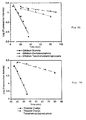
- the gel was scanned with a laser-excited fluorescence gel scanner. Image processing was performed on each lane with ImageTM software to obtain a fluorescence intensity plot for each time interval.
- the log plot of fluorescence intensity against time indicates that the loss of dye follows first order kinetics and allows determination of the t1 ⁇ 2 for the dissociation of the dsDNA-dye complex.
- 50 ng aliquots of plasmid M13 linearized with Hin dIII were mixed with the dye at DNA bp:dye.of 2:1 in 4 mM TAE, pH 8.2, and applied to the gel at 5 min intervals.
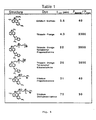
- compositions provide a new and important class of DNA binding fluorescers. These compositions provide for enhanced fluorescence, showing enhanced binding of the fluorescer where the half times under electrophoretic conditions are substantially enhanced in comparison to the generally available analogs.
- the equilibrium between free dye and dye bound to the DNA is greatly favored as to bound dye as compared to the analogs without the polycationic side chains.
- the advantage of tighter binding is that staining of gels (detection of DNA and solution) car be accomplished with 10-fold less dye than with ethidium bromide.
- more extensive washing of the gel after staining is possible with much less loss of bound dye, which translates to a 10-fold improvement in the sensitivity of dsDNA detection.
- the dsDNA dye complexes are much more stable than those formed with thiazole orange, while they retain both the high extinction coefficient at about 500 nm and the high fluorescence enhancement on binding to dsDNA (> 3000-fold).
- These new dyes thus allow post-staining of gels for dsDNA detection with 10-fold higher sensitivity than is attainable with thiazole orange and also permit more sensitive detection of dsDNA in solution.
- efficient excitation of these dsDNA-dye complexes with green light eliminates the potential for hazardous UV exposure that is associated with the transilluminators now universally used for the detection of DNA on gels stained with ethidium bromide. These dyes find particular application with sensitive gel scanners that employ excitation in the visible region of the spectrum.
- Electrophoresis was performed in a Mini-Protean II apparatus (BioRad, Richmond, CA) in 1 mm thick, vertical 0.9% agarose gels run at 10 V/cm in 40 mM Tris acetate - 10 mM EDTA (TAE), pH 8.2. Gels were pre-electrophoresed for 1 hour prior to sample loading. Dye solutions were freshly prepared from concentrated stock dyes (1 x 10 -4 M in MeOH or DMSO), before each experiment by dilution into 4 mM TAE containing 50 mM NaCl, pH 8.2.
- the off-rates of the dye from dsDNA-dye complexes were measured by the following assay. ⁇ DNA/ Hin dIII was mixed with each dye at a DNA base pairs-to-dye ratio of 2:1 for ethidium bromide and thiazole orange and 5:1 for the other dyes. Equal loads of the mixture were loaded on a gel at 5-15 min (as appropriate) time intervals in the course of electrophoresis. The amount of dye remaining in each band as a function of time of electrophoresis was determined by scanning with an argon ion laser-excited fluorescence gel scanner (Quesada et al. (1991) Biotechniques 10, 616-625; Mathies and Huang (1992) Nature 359, 167-169).
- Samples containing amounts varying from 5 to 30 ng of ⁇ DNA/HindIII fragments were electrophoresed in duplicate sets on the same gel. After 45 minutes of electrophoresis, the gels were cut in half and stained in 40 mM TAE buffer. One half of a gel was soaked in N,N'-tetramethyl-1,3-diaminopropane thiazole orange (2x10 -8 M) and the other half in thiazole orange (2x10 -7 M). One half of a second gel was soaked in diethylenetriamine ethidium (2x10 -7 M) and the other half in ethidium (2x10 -6 M), all in 40 mM TAE. After soaking for 40 min, the gels were transferred for 20 min to a dye-free 40 mM TAE solution and then scanned as described above.
Landscapes
- Chemical & Material Sciences (AREA)
- Organic Chemistry (AREA)
- Life Sciences & Earth Sciences (AREA)
- Health & Medical Sciences (AREA)
- Molecular Biology (AREA)
- Physics & Mathematics (AREA)
- Zoology (AREA)
- Wood Science & Technology (AREA)
- Proteomics, Peptides & Aminoacids (AREA)
- Analytical Chemistry (AREA)
- Biochemistry (AREA)
- General Health & Medical Sciences (AREA)
- Engineering & Computer Science (AREA)
- Immunology (AREA)
- Electrochemistry (AREA)
- General Engineering & Computer Science (AREA)
- Pathology (AREA)
- General Physics & Mathematics (AREA)
- Biotechnology (AREA)
- Microbiology (AREA)
- Chemical Kinetics & Catalysis (AREA)
- Spectroscopy & Molecular Physics (AREA)
- Bioinformatics & Cheminformatics (AREA)
- Biophysics (AREA)
- Genetics & Genomics (AREA)
- Measuring Or Testing Involving Enzymes Or Micro-Organisms (AREA)
- Investigating Or Analysing Biological Materials (AREA)
- Quinoline Compounds (AREA)
- Other In-Based Heterocyclic Compounds (AREA)
- Saccharide Compounds (AREA)
- Plural Heterocyclic Compounds (AREA)
- Investigating Or Analysing Materials By The Use Of Chemical Reactions (AREA)
Abstract
Claims (13)
- Composé fluorescent comprenant un seul groupe fluorophore monomère sélectionné dans le groupe consistant en benzimidazole, benzothiazole, benzoxazole, phenanthridine, quinoléïne, acridine, et xanthène lié de manière covalente à une chaíne ayant au moins deux charges positives et où, quand ledit composé fluorescent comprend de la phénanthridine, il contient un groupe aminé à la position 3 ou 8 de la fraction de phénanthridine.
- Composé fluorescent selon la revendication 1, où ledit groupe fluorophore est un groupe éthidium.
- Composé fluorescent selon la revendication 1, où ledit groupe fluorophore est un groupe thiazole orange.
- Composé fluorescent selon la revendication 1, où ledit composé fluorescent comprend au moins une quinoléïne et un benzothiazole.
- Composé fluorescent selon la revendication 1, où ledit composé fluorescent comprend une phénanthridine.
- Composé fluorescent selon l'une quelconque des revendications 1 à 5, où ladite chaíne a deux à cinq atomes d'azote.
- Composé fluorescent selon la revendication 6, où ladite chaíne est une alkylène amine de deux à cinq atomes d'azote.
- Thiazole tétraméthyl propane diamine ou tétraméthyl éthane diamine.
- Ethidium éthane diamine ou diéthylènetriamine.
- Composé fluorescent comprenant un groupe fluorophore sélectionné dans le groupe consistant en benzimidazole, benzothiazole, benzoxazole, phénanthridine, quinoléïne, acridine et xanthène lié de manière covalente à une chaíne ayant au moins deux charges positives, où ladite chaíne a un groupe amino terminal qui, quand il est substitué, le groupe substitué sur le groupe amino terminal ne contient pas plus de 10 atomes de carbone et qui, quand ledit composé fluorescent comprend de la phénanthridine, il contient un groupe aminé à la position 3 ou 8 de la fraction de phénanthridine.
- Molécule d'acide nucléique à laquelle est lié de manière non covalente au moins un composé fluorescent selon l'une quelconque des revendications 1 à 10.
- Acide nucléique selon la revendication 11, où ledit acide nucléique est un ADN à deux brins.
- Méthode pour accomplir une électrophorèse sur gel en utilisant un colorant fluorescent pour la détection de l'acide nucléique, qui comprend l'utilisation, pour ledit colorant fluorescent, d'un composé fluorescent selon l'une quelconque des revendications 1 à 10.
Applications Claiming Priority (3)
| Application Number | Priority Date | Filing Date | Title |
|---|---|---|---|
| US08/060,910 US5312921A (en) | 1990-03-14 | 1993-05-14 | Dyes designed for high sensitivity detection of double-stranded DNA |
| US60910 | 1993-05-14 | ||
| PCT/US1994/004695 WO1994026931A1 (fr) | 1993-05-14 | 1994-04-28 | Colorants pour une reaction de detection a haute sensibilite d'adn a deux brins |
Publications (3)
| Publication Number | Publication Date |
|---|---|
| EP0702727A1 EP0702727A1 (fr) | 1996-03-27 |
| EP0702727A4 EP0702727A4 (fr) | 1998-05-06 |
| EP0702727B1 true EP0702727B1 (fr) | 2000-11-29 |
Family
ID=22032503
Family Applications (1)
| Application Number | Title | Priority Date | Filing Date |
|---|---|---|---|
| EP94917278A Expired - Lifetime EP0702727B1 (fr) | 1993-05-14 | 1994-04-28 | Colorants pour une reaction de detection a haute sensibilite d'adn a deux brins |
Country Status (7)
| Country | Link |
|---|---|
| US (1) | US5312921A (fr) |
| EP (1) | EP0702727B1 (fr) |
| JP (2) | JPH09500403A (fr) |
| AU (1) | AU673936B2 (fr) |
| CA (1) | CA2162710C (fr) |
| DE (1) | DE69426359T2 (fr) |
| WO (1) | WO1994026931A1 (fr) |
Families Citing this family (38)
| Publication number | Priority date | Publication date | Assignee | Title |
|---|---|---|---|---|
| US5571388A (en) * | 1984-03-29 | 1996-11-05 | Li-Cor, Inc. | Sequencing near infrared and infrared fluorescense labeled DNA for detecting using laser diodes and suitable labels thereof |
| US5783687A (en) * | 1990-03-14 | 1998-07-21 | The Regents Of The University Of California | Dyes designed for high sensitivity detection of double-stranded DNA |
| US5763162A (en) | 1990-03-14 | 1998-06-09 | The Regents Of University Of California | Multichromophore fluorescent DNA intercalation complexes |
| US5808077A (en) * | 1993-06-30 | 1998-09-15 | Abbott Laboratories | Intercalators having affinity for DNA and methods of use |
| ATE264307T1 (de) * | 1993-06-30 | 2004-04-15 | Abbott Lab | Interkalatoren mit affinität für dna und ihre anwendung |
| US5925517A (en) * | 1993-11-12 | 1999-07-20 | The Public Health Research Institute Of The City Of New York, Inc. | Detectably labeled dual conformation oligonucleotide probes, assays and kits |
| DE69533660T2 (de) * | 1994-04-29 | 2005-11-10 | Johnson & Johnson Clinical Diagnostics, Inc. | Homogenes Verfahren zum Nachweis von Doppelstrang-Nukleinsäuren mittels fluoreszierender Farbstoffe und dafür nützliche Kits |
| US5565554A (en) * | 1994-07-29 | 1996-10-15 | The Regents Of The University Of California | Dimeric fluorescent energy transfer dyes comprising asymmetric cyanine azole-indolenine chromophores |
| US6127134A (en) * | 1995-04-20 | 2000-10-03 | Carnegie Mellon University | Difference gel electrophoresis using matched multiple dyes |
| US6426190B1 (en) | 1995-04-20 | 2002-07-30 | Carnegie Mellon University | Difference detection methods using matched multiple dyes |
| US6008373A (en) * | 1995-06-07 | 1999-12-28 | Carnegie Mellon University | Fluorescent labeling complexes with large stokes shift formed by coupling together cyanine and other fluorochromes capable of resonance energy transfer |
| US5929227A (en) * | 1995-07-12 | 1999-07-27 | The Regents Of The University Of California | Dimeric fluorescent energy transfer dyes comprising asymmetric cyanine azole-indolenine chromophores |
| JPH10509053A (ja) | 1995-09-08 | 1998-09-08 | スクリプトジェン・ファーマスーティカルズ,インコーポレイテッド | Rnaに対する親和性を有する化合物のためのスクリーン |
| JP3425830B2 (ja) * | 1995-10-06 | 2003-07-14 | シスメックス株式会社 | 新規化合物とその用途 |
| US5730849A (en) * | 1996-09-30 | 1998-03-24 | Bio-Rad Laboratories, Inc. | High sensitivity dyes as stains for RNA bands in denaturing gels |
| JP2001514511A (ja) * | 1997-03-05 | 2001-09-11 | スクリプトゲン ファーマシューティカルズ インク | 核酸への親和性を持つ化合物同定のための蛍光異方性を用いたスクリーニング |
| US5823097A (en) * | 1997-06-10 | 1998-10-20 | Dirck; Ronald L. | Device for storing and transferring waste cooking oil |
| US6037130A (en) * | 1998-07-28 | 2000-03-14 | The Public Health Institute Of The City Of New York, Inc. | Wavelength-shifting probes and primers and their use in assays and kits |
| DE19960924C2 (de) * | 1999-12-17 | 2002-08-01 | Therapeutics Gmbh G.O.T. | Amphiphile Polyamine, deren Anwendungen |
| JP2001181295A (ja) * | 1999-12-24 | 2001-07-03 | Asahi Denka Kogyo Kk | 成型体の製造方法 |
| US6368864B1 (en) * | 2000-05-05 | 2002-04-09 | Coulter International Corp. | Dyes and methods of reticulocyte enumeration |
| EP1451350A4 (fr) * | 2001-11-05 | 2006-05-10 | Transgenomic Inc | Procedes, systemes et trousses d'analyse de polynucleotides |
| US6838289B2 (en) * | 2001-11-14 | 2005-01-04 | Beckman Coulter, Inc. | Analyte detection system |
| US6887668B2 (en) * | 2002-04-19 | 2005-05-03 | Beckman Coulter, Inc. | Nucleic acid separation and detection by electrophoresis with a counter-migrating high-affinity intercalating dye |
| US8669052B2 (en) | 2008-06-10 | 2014-03-11 | Rapid Pathogen Screening, Inc. | Lateral flow nucleic acid detector |
| JP5306811B2 (ja) * | 2005-05-11 | 2013-10-02 | ライフ テクノロジーズ コーポレーション | 2本鎖dnaへの高い選択性を有する蛍光化学物質及びそれらの使用 |
| CN100381502C (zh) * | 2006-04-19 | 2008-04-16 | 天津城市建设学院 | 一种噻唑橙类菁染料的固相合成方法 |
| US20100041045A1 (en) * | 2007-11-15 | 2010-02-18 | Sigma-Aldrich Co. | Nucleic acid fluorescent stains |
| US20090131279A1 (en) * | 2007-11-15 | 2009-05-21 | Sigma Aldrich Company | Nucleic acid fluorescent stains |
| US9068981B2 (en) | 2009-12-04 | 2015-06-30 | Rapid Pathogen Screening, Inc. | Lateral flow assays with time delayed components |
| US8609433B2 (en) * | 2009-12-04 | 2013-12-17 | Rapid Pathogen Screening, Inc. | Multiplanar lateral flow assay with sample compressor |
| US20130196310A1 (en) | 2008-05-20 | 2013-08-01 | Rapid Pathogen Screening, Inc. | Method and Device for Combined Detection of Viral and Bacterial Infections |
| US8962260B2 (en) | 2008-05-20 | 2015-02-24 | Rapid Pathogen Screening, Inc. | Method and device for combined detection of viral and bacterial infections |
| US8815609B2 (en) | 2008-05-20 | 2014-08-26 | Rapid Pathogen Screening, Inc. | Multiplanar lateral flow assay with diverting zone |
| US20110086359A1 (en) * | 2008-06-10 | 2011-04-14 | Rapid Pathogen Screening, Inc. | Lateral flow assays |
| CA2768391C (fr) | 2009-07-21 | 2016-09-06 | Gen-Probe Incorporated | Procedes et compositions pour la detection quantitative de sequences d'acides nucleiques sur une gamme dynamique etendue |
| US10808287B2 (en) | 2015-10-23 | 2020-10-20 | Rapid Pathogen Screening, Inc. | Methods and devices for accurate diagnosis of infections |
| CN114716431B (zh) * | 2022-02-17 | 2022-11-11 | 北京富百科生物技术有限公司 | 一种菲啶和苯并噻唑共轭链接的荧光染料合成和应用 |
Family Cites Families (4)
| Publication number | Priority date | Publication date | Assignee | Title |
|---|---|---|---|---|
| US4883867A (en) * | 1985-11-01 | 1989-11-28 | Becton, Dickinson And Company | Detection of reticulocytes, RNA or DNA |
| US4937198A (en) * | 1989-07-28 | 1990-06-26 | Becton, Dickinson And Company | Novel fluorescent dye |
| WO1993006482A1 (fr) * | 1991-09-16 | 1993-04-01 | Molecular Probes, Inc. | Dimeres de colorants de cyanine asymetriques |
| US5321130A (en) * | 1992-02-10 | 1994-06-14 | Molecular Probes, Inc. | Unsymmetrical cyanine dyes with a cationic side chain |
-
1993
- 1993-05-14 US US08/060,910 patent/US5312921A/en not_active Expired - Lifetime
-
1994
- 1994-04-28 CA CA002162710A patent/CA2162710C/fr not_active Expired - Fee Related
- 1994-04-28 JP JP6525478A patent/JPH09500403A/ja active Pending
- 1994-04-28 AU AU69046/94A patent/AU673936B2/en not_active Ceased
- 1994-04-28 DE DE69426359T patent/DE69426359T2/de not_active Expired - Fee Related
- 1994-04-28 WO PCT/US1994/004695 patent/WO1994026931A1/fr not_active Ceased
- 1994-04-28 EP EP94917278A patent/EP0702727B1/fr not_active Expired - Lifetime
-
1998
- 1998-07-15 JP JP10200542A patent/JP3130872B2/ja not_active Expired - Fee Related
Also Published As
| Publication number | Publication date |
|---|---|
| EP0702727A4 (fr) | 1998-05-06 |
| DE69426359D1 (de) | 2001-01-04 |
| CA2162710C (fr) | 2002-04-16 |
| JP3130872B2 (ja) | 2001-01-31 |
| AU6904694A (en) | 1994-12-12 |
| AU673936B2 (en) | 1996-11-28 |
| US5312921A (en) | 1994-05-17 |
| WO1994026931A1 (fr) | 1994-11-24 |
| CA2162710A1 (fr) | 1994-11-24 |
| JPH11323173A (ja) | 1999-11-26 |
| DE69426359T2 (de) | 2001-05-17 |
| JPH09500403A (ja) | 1997-01-14 |
| EP0702727A1 (fr) | 1996-03-27 |
Similar Documents
| Publication | Publication Date | Title |
|---|---|---|
| EP0702727B1 (fr) | Colorants pour une reaction de detection a haute sensibilite d'adn a deux brins | |
| US5783687A (en) | Dyes designed for high sensitivity detection of double-stranded DNA | |
| US5977344A (en) | DNA complexes with dyes designed for energy transfer as fluorescent markers | |
| US5763162A (en) | Multichromophore fluorescent DNA intercalation complexes | |
| US5565554A (en) | Dimeric fluorescent energy transfer dyes comprising asymmetric cyanine azole-indolenine chromophores | |
| US5929227A (en) | Dimeric fluorescent energy transfer dyes comprising asymmetric cyanine azole-indolenine chromophores | |
| US5616502A (en) | Non-specific protein staining using merocyanine dyes | |
| JP3895369B2 (ja) | エネルギー転移連結の色素によりラベルされたプローブ | |
| JP2809340B2 (ja) | 共有シアニン染料オリゴヌクレオチド結合体 | |
| US6150107A (en) | Methods of sequencing and detection using energy transfer labels with cyanine dyes as donor chromophores | |
| US20020012947A1 (en) | Biomarkers for the labeling, visual detection and quantification of biomolecules | |
| US11597842B2 (en) | Labeling dye and kit including same | |
| US8658434B2 (en) | Fluorescent pyrene compounds | |
| US6335446B1 (en) | Quinolinium- and pyridinium-based fluorescent dye compounds | |
| EP0520014B1 (fr) | Sondes fluorescentes multichromophores | |
| JP2002508515A (ja) | 複合生物学的材料中の新規な生物学的に活性な化合物を検出するための毛管電気泳動法 | |
| Zeng et al. | Improved Stability and Electrophoretic Properties of Preformed Fluorescent Cationic Dye–DNA Complexes in a Taps–Tetrapentylammonium Buffer in Agarose Slab Gels | |
| US6979575B1 (en) | Fluorochromes for labelling biomolecules and polymer particles and bioanalytical and screening methods based thereon | |
| JP3706636B2 (ja) | 核酸ハイブリッド体の検出方法、プローブ、標的核酸の有無の確認方法、および2本鎖核酸ハイブリッド内のミスマッチの検出方法 |
Legal Events
| Date | Code | Title | Description |
|---|---|---|---|
| PUAI | Public reference made under article 153(3) epc to a published international application that has entered the european phase |
Free format text: ORIGINAL CODE: 0009012 |
|
| 17P | Request for examination filed |
Effective date: 19951204 |
|
| AK | Designated contracting states |
Kind code of ref document: A1 Designated state(s): DE FR GB |
|
| RHK1 | Main classification (correction) |
Ipc: C12Q 1/68 |
|
| A4 | Supplementary search report drawn up and despatched |
Effective date: 19980318 |
|
| AK | Designated contracting states |
Kind code of ref document: A4 Designated state(s): AT BE CH DE DK ES FR GB GR IE IT LI LU MC NL PT SE |
|
| 17Q | First examination report despatched |
Effective date: 19990924 |
|
| GRAG | Despatch of communication of intention to grant |
Free format text: ORIGINAL CODE: EPIDOS AGRA |
|
| GRAG | Despatch of communication of intention to grant |
Free format text: ORIGINAL CODE: EPIDOS AGRA |
|
| GRAH | Despatch of communication of intention to grant a patent |
Free format text: ORIGINAL CODE: EPIDOS IGRA |
|
| GRAH | Despatch of communication of intention to grant a patent |
Free format text: ORIGINAL CODE: EPIDOS IGRA |
|
| RBV | Designated contracting states (corrected) |
Designated state(s): DE FR GB |
|
| GRAA | (expected) grant |
Free format text: ORIGINAL CODE: 0009210 |
|
| AK | Designated contracting states |
Kind code of ref document: B1 Designated state(s): DE FR GB |
|
| REF | Corresponds to: |
Ref document number: 69426359 Country of ref document: DE Date of ref document: 20010104 |
|
| ET | Fr: translation filed | ||
| PLBE | No opposition filed within time limit |
Free format text: ORIGINAL CODE: 0009261 |
|
| STAA | Information on the status of an ep patent application or granted ep patent |
Free format text: STATUS: NO OPPOSITION FILED WITHIN TIME LIMIT |
|
| 26N | No opposition filed | ||
| REG | Reference to a national code |
Ref country code: GB Ref legal event code: IF02 |
|
| PGFP | Annual fee paid to national office [announced via postgrant information from national office to epo] |
Ref country code: FR Payment date: 20090417 Year of fee payment: 16 Ref country code: DE Payment date: 20090429 Year of fee payment: 16 |
|
| PGFP | Annual fee paid to national office [announced via postgrant information from national office to epo] |
Ref country code: GB Payment date: 20090429 Year of fee payment: 16 |
|
| GBPC | Gb: european patent ceased through non-payment of renewal fee |
Effective date: 20100428 |
|
| REG | Reference to a national code |
Ref country code: FR Ref legal event code: ST Effective date: 20101230 |
|
| PG25 | Lapsed in a contracting state [announced via postgrant information from national office to epo] |
Ref country code: DE Free format text: LAPSE BECAUSE OF NON-PAYMENT OF DUE FEES Effective date: 20101103 |
|
| PG25 | Lapsed in a contracting state [announced via postgrant information from national office to epo] |
Ref country code: GB Free format text: LAPSE BECAUSE OF NON-PAYMENT OF DUE FEES Effective date: 20100428 |
|
| PG25 | Lapsed in a contracting state [announced via postgrant information from national office to epo] |
Ref country code: FR Free format text: LAPSE BECAUSE OF NON-PAYMENT OF DUE FEES Effective date: 20100430 |