EP0702855B1 - Betätigungsvorrichtung für einen rolladen mit mini-lamellen - Google Patents
Betätigungsvorrichtung für einen rolladen mit mini-lamellen Download PDFInfo
- Publication number
- EP0702855B1 EP0702855B1 EP94920290A EP94920290A EP0702855B1 EP 0702855 B1 EP0702855 B1 EP 0702855B1 EP 94920290 A EP94920290 A EP 94920290A EP 94920290 A EP94920290 A EP 94920290A EP 0702855 B1 EP0702855 B1 EP 0702855B1
- Authority
- EP
- European Patent Office
- Prior art keywords
- motor
- baton
- actuator
- signal
- blind
- Prior art date
- Legal status (The legal status is an assumption and is not a legal conclusion. Google has not performed a legal analysis and makes no representation as to the accuracy of the status listed.)
- Expired - Lifetime
Links
- 230000004044 response Effects 0.000 claims abstract description 20
- 230000009467 reduction Effects 0.000 claims description 39
- 230000008878 coupling Effects 0.000 claims description 14
- 238000010168 coupling process Methods 0.000 claims description 14
- 238000005859 coupling reaction Methods 0.000 claims description 14
- 230000033001 locomotion Effects 0.000 claims description 11
- 238000000034 method Methods 0.000 claims description 4
- 230000004913 activation Effects 0.000 claims 1
- 235000014676 Phragmites communis Nutrition 0.000 description 16
- 239000003990 capacitor Substances 0.000 description 12
- 230000003287 optical effect Effects 0.000 description 7
- 230000008859 change Effects 0.000 description 6
- 239000002184 metal Substances 0.000 description 6
- 229910052751 metal Inorganic materials 0.000 description 6
- 238000001514 detection method Methods 0.000 description 5
- 239000002991 molded plastic Substances 0.000 description 4
- 230000000994 depressogenic effect Effects 0.000 description 3
- 230000000881 depressing effect Effects 0.000 description 2
- 230000002035 prolonged effect Effects 0.000 description 2
- 239000000853 adhesive Substances 0.000 description 1
- 230000001070 adhesive effect Effects 0.000 description 1
- DMFGNRRURHSENX-UHFFFAOYSA-N beryllium copper Chemical compound [Be].[Cu] DMFGNRRURHSENX-UHFFFAOYSA-N 0.000 description 1
- 230000005540 biological transmission Effects 0.000 description 1
- 238000004891 communication Methods 0.000 description 1
- 238000010276 construction Methods 0.000 description 1
- 238000013461 design Methods 0.000 description 1
- 238000010586 diagram Methods 0.000 description 1
- 230000000694 effects Effects 0.000 description 1
- 238000004134 energy conservation Methods 0.000 description 1
- 239000003292 glue Substances 0.000 description 1
- 238000009434 installation Methods 0.000 description 1
- 238000004519 manufacturing process Methods 0.000 description 1
- 239000000463 material Substances 0.000 description 1
- 230000007246 mechanism Effects 0.000 description 1
- 238000012986 modification Methods 0.000 description 1
- 230000004048 modification Effects 0.000 description 1
- 238000013021 overheating Methods 0.000 description 1
- 230000002093 peripheral effect Effects 0.000 description 1
- 239000004033 plastic Substances 0.000 description 1
- 238000012545 processing Methods 0.000 description 1
- 230000001902 propagating effect Effects 0.000 description 1
- 230000001105 regulatory effect Effects 0.000 description 1
- 239000007787 solid Substances 0.000 description 1
- 239000002904 solvent Substances 0.000 description 1
- 125000006850 spacer group Chemical group 0.000 description 1
- 210000003462 vein Anatomy 0.000 description 1
Images


Classifications
-
- E—FIXED CONSTRUCTIONS
- E06—DOORS, WINDOWS, SHUTTERS, OR ROLLER BLINDS IN GENERAL; LADDERS
- E06B—FIXED OR MOVABLE CLOSURES FOR OPENINGS IN BUILDINGS, VEHICLES, FENCES OR LIKE ENCLOSURES IN GENERAL, e.g. DOORS, WINDOWS, BLINDS, GATES
- E06B9/00—Screening or protective devices for wall or similar openings, with or without operating or securing mechanisms; Closures of similar construction
- E06B9/24—Screens or other constructions affording protection against light, especially against sunshine; Similar screens for privacy or appearance; Slat blinds
- E06B9/26—Lamellar or like blinds, e.g. venetian blinds
- E06B9/36—Lamellar or like blinds, e.g. venetian blinds with vertical lamellae ; Supporting rails therefor
- E06B9/368—Driving means other than pulling cords
-
- E—FIXED CONSTRUCTIONS
- E06—DOORS, WINDOWS, SHUTTERS, OR ROLLER BLINDS IN GENERAL; LADDERS
- E06B—FIXED OR MOVABLE CLOSURES FOR OPENINGS IN BUILDINGS, VEHICLES, FENCES OR LIKE ENCLOSURES IN GENERAL, e.g. DOORS, WINDOWS, BLINDS, GATES
- E06B9/00—Screening or protective devices for wall or similar openings, with or without operating or securing mechanisms; Closures of similar construction
- E06B9/24—Screens or other constructions affording protection against light, especially against sunshine; Similar screens for privacy or appearance; Slat blinds
- E06B9/26—Lamellar or like blinds, e.g. venetian blinds
- E06B9/28—Lamellar or like blinds, e.g. venetian blinds with horizontal lamellae, e.g. non-liftable
- E06B9/30—Lamellar or like blinds, e.g. venetian blinds with horizontal lamellae, e.g. non-liftable liftable
- E06B9/303—Lamellar or like blinds, e.g. venetian blinds with horizontal lamellae, e.g. non-liftable liftable with ladder-tape
- E06B9/307—Details of tilting bars and their operation
-
- E—FIXED CONSTRUCTIONS
- E06—DOORS, WINDOWS, SHUTTERS, OR ROLLER BLINDS IN GENERAL; LADDERS
- E06B—FIXED OR MOVABLE CLOSURES FOR OPENINGS IN BUILDINGS, VEHICLES, FENCES OR LIKE ENCLOSURES IN GENERAL, e.g. DOORS, WINDOWS, BLINDS, GATES
- E06B9/00—Screening or protective devices for wall or similar openings, with or without operating or securing mechanisms; Closures of similar construction
- E06B9/24—Screens or other constructions affording protection against light, especially against sunshine; Similar screens for privacy or appearance; Slat blinds
- E06B9/26—Lamellar or like blinds, e.g. venetian blinds
- E06B9/28—Lamellar or like blinds, e.g. venetian blinds with horizontal lamellae, e.g. non-liftable
- E06B9/30—Lamellar or like blinds, e.g. venetian blinds with horizontal lamellae, e.g. non-liftable liftable
- E06B9/32—Operating, guiding, or securing devices therefor
-
- E—FIXED CONSTRUCTIONS
- E06—DOORS, WINDOWS, SHUTTERS, OR ROLLER BLINDS IN GENERAL; LADDERS
- E06B—FIXED OR MOVABLE CLOSURES FOR OPENINGS IN BUILDINGS, VEHICLES, FENCES OR LIKE ENCLOSURES IN GENERAL, e.g. DOORS, WINDOWS, BLINDS, GATES
- E06B9/00—Screening or protective devices for wall or similar openings, with or without operating or securing mechanisms; Closures of similar construction
- E06B9/24—Screens or other constructions affording protection against light, especially against sunshine; Similar screens for privacy or appearance; Slat blinds
- E06B9/26—Lamellar or like blinds, e.g. venetian blinds
- E06B9/36—Lamellar or like blinds, e.g. venetian blinds with vertical lamellae ; Supporting rails therefor
- E06B9/362—Travellers; Lamellae suspension stems
- E06B9/364—Operating mechanisms therein
-
- E—FIXED CONSTRUCTIONS
- E06—DOORS, WINDOWS, SHUTTERS, OR ROLLER BLINDS IN GENERAL; LADDERS
- E06B—FIXED OR MOVABLE CLOSURES FOR OPENINGS IN BUILDINGS, VEHICLES, FENCES OR LIKE ENCLOSURES IN GENERAL, e.g. DOORS, WINDOWS, BLINDS, GATES
- E06B9/00—Screening or protective devices for wall or similar openings, with or without operating or securing mechanisms; Closures of similar construction
- E06B9/24—Screens or other constructions affording protection against light, especially against sunshine; Similar screens for privacy or appearance; Slat blinds
- E06B9/26—Lamellar or like blinds, e.g. venetian blinds
- E06B9/28—Lamellar or like blinds, e.g. venetian blinds with horizontal lamellae, e.g. non-liftable
- E06B2009/285—Means for actuating a rod (being tilt rod or lift rod)
-
- Y—GENERAL TAGGING OF NEW TECHNOLOGICAL DEVELOPMENTS; GENERAL TAGGING OF CROSS-SECTIONAL TECHNOLOGIES SPANNING OVER SEVERAL SECTIONS OF THE IPC; TECHNICAL SUBJECTS COVERED BY FORMER USPC CROSS-REFERENCE ART COLLECTIONS [XRACs] AND DIGESTS
- Y02—TECHNOLOGIES OR APPLICATIONS FOR MITIGATION OR ADAPTATION AGAINST CLIMATE CHANGE
- Y02A—TECHNOLOGIES FOR ADAPTATION TO CLIMATE CHANGE
- Y02A30/00—Adapting or protecting infrastructure or their operation
- Y02A30/24—Structural elements or technologies for improving thermal insulation
-
- Y—GENERAL TAGGING OF NEW TECHNOLOGICAL DEVELOPMENTS; GENERAL TAGGING OF CROSS-SECTIONAL TECHNOLOGIES SPANNING OVER SEVERAL SECTIONS OF THE IPC; TECHNICAL SUBJECTS COVERED BY FORMER USPC CROSS-REFERENCE ART COLLECTIONS [XRACs] AND DIGESTS
- Y02—TECHNOLOGIES OR APPLICATIONS FOR MITIGATION OR ADAPTATION AGAINST CLIMATE CHANGE
- Y02B—CLIMATE CHANGE MITIGATION TECHNOLOGIES RELATED TO BUILDINGS, e.g. HOUSING, HOUSE APPLIANCES OR RELATED END-USER APPLICATIONS
- Y02B80/00—Architectural or constructional elements improving the thermal performance of buildings
-
- Y—GENERAL TAGGING OF NEW TECHNOLOGICAL DEVELOPMENTS; GENERAL TAGGING OF CROSS-SECTIONAL TECHNOLOGIES SPANNING OVER SEVERAL SECTIONS OF THE IPC; TECHNICAL SUBJECTS COVERED BY FORMER USPC CROSS-REFERENCE ART COLLECTIONS [XRACs] AND DIGESTS
- Y10—TECHNICAL SUBJECTS COVERED BY FORMER USPC
- Y10S—TECHNICAL SUBJECTS COVERED BY FORMER USPC CROSS-REFERENCE ART COLLECTIONS [XRACs] AND DIGESTS
- Y10S160/00—Flexible or portable closure, partition, or panel
- Y10S160/17—Venetian blinds, motor driven
Definitions
- the abutment surface 102 of the first travel limiter 98 contacts the first spring arm 108 of the reed switch 106 to urge the first spring arm 108 against the stationary center arm 110 of the reed switch 106.
- the abutment surface 104 of the second travel limiter 100 contacts the second spring arm 112 of the reed switch 106 to urge the second spring arm 112 against the stationary center arm 110 of the reed switch 106.
- R2 and C2 are selected to require that the output signal of the first NAND gate inverter 148 remains FALSE for at least three hundred thirty milliseconds (330ms) before the capacitor C2 fully discharges to enable energization of the motor 60.
- the skilled artisan will further appreciate that when a two-position switch 154 having an "ON" position and an “OFF" position ( Figures 1 and 7) is manually moved to the "OFF" position, voltage from the power supply 42 is conducted to the capacitor C2 to prevent the automatic energization of the motor 60 described above.
- the motor 60 may nevertheless be energized when the two-position switch 154 is in the "OFF” position, however, by manually depressing a thumbswitch 156 ( Figures 1 and 7), as more fully disclosed below.
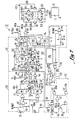
- Figure 7 shows that the motor run flip-flop 160 is electrically connected to a type 4013 "D" motor direction flip-flop 162. Like the motor run flip-flop 160, the motor direction flip-flop 162 is in the "toggle" configuration.
- the motor run flip-flop 160 generates either a "motor run” or “motor stop” output signal, while the motor direction flip-flop 162 generates either a "clockwise” or “counterclockwise” output signal.
- the motor run flip-flop 160 receives a clocking signal, it changes state.
- the motor run flip-flop 160 is reset to a "stop motor” state, it toggles the motor direction flip-flop 162 via a line 163 to change state.
- the motor run flip-flop 160 Upon receiving the second clocking signal, the motor run flip-flop 160 toggles the motor direction flip-flop 162 to change state (i.e., to counterclockwise). Then, manipulation of the user signal generator 31 to generate yet a third user command signal (or again depressing the thumbswitch 156) causes the motor run flip-flop to generate a "motor run" signal. Yet a fourth signal causes the motor 60 to again stop, and so on.
- the motor direction flip-flop 162 In describing this means of changing the state of the motor run flip-flop 160 in response to travel motion limitations, the motor direction flip-flop 162 generates either a clockwise ("CW") output signal or a counterclockwise (“CCW”) output signal, as mentioned above and indicated in Figure 7 by lines CW and CCW.
- clockwise rotation of the motor 60 corresponds to opening the blind 14, while counterclockwise rotation of the motor 60 corresponds to closing, i.e., shutting, the blind 14.
- Both NAND gates 170, 172 receive input signals from a type 4093 direction NAND gate 174.
- the direction NAND gate 174 receives an input signal indicating the direction of actual rotation of the motor 60 (i.e., the "motor run CW” signal or the "motor run CCW” signal.
- the "motor run CW” signal has been designated “DRCW”
- the "motor run CCW” signal has been designated “DRCCW”
- the generation of both the "DRCW” and “DRCCW” signals is discussed more fully below.
- the USW NAND gate 170 receives an input signal from the reed switch 106 when the abutment surface 102 of the travel limiter 98 ( Figure 4) urges the first arm 108 against the center arm 110 of the switch 106, indicating that the rack gear 94 (and, hence, the motor 60) has reached the predetermined upper, i.e., clockwise, limit of travel.
- the LSW NAND gate 172 receives an input signal from the reed switch 106 when the abutment surface 104 of the travel limiter 100 ( Figure 4) urges the second arm 112 against the center arm 110 of the switch 106, indicating that the rack gear 94 (and, hence, the motor 60) has reached the predetermined lower, i.e., counterclockwise, limit of travel.
- the reed switch 106 when the motor 60 is rotating clockwise and the upper (i.e., clockwise) limit of rotation is reached, the reed switch 106 generates a signal which is sent via the following path to change the state of the motor run flip-flop 160 to cause the motor 60 to stop: USW NAND gate 170, first limit switch NAND gate 164, third limit switch NAND gate 168.
- the reed switch 106 when the motor 60 is rotating counterclockwise and the lower (i.e., counterclockwise) limit of rotation is reached, the reed switch 106 generates a signal which is sent via the following path to change the state of the motor run flip-flop 160 to cause the motor 60 to stop: LSW NAND gate 172, second limit switch NAND gate 166, third limit switch NAND gate 168.
- the daylight detector 134 shown in Figure 7 the purpose of which is to energize the motor 60 to open or close the blind 14 upon detection of a predetermined level of light that is present at the daylight sensor 28, the daylight sensor 28 is electrically connected to a first type 2N3904 transistor Q2. Accordingly, when light impinges upon the daylight sensor 28, the sensor 28 sends a signal to the transistor Q2.
- the CCW NAND gate motor controller 190 receives a DRCCW input signal from the flip-flop CCW NAND gate 178 only when the motor run flip-flop 160 inputs a "motor run” signal to the CCW NAND gate 178 and when the motor direction flip-flop 162 inputs a "CCW” signal to the NAND gate 178. Also, the CCW NAND gate motor controller 190 can receive an input DRCCW signal from the second stage 186.
- the CW NAND gate motor controller 188 Upon receipt of either of its input DRCW signals, the CW NAND gate motor controller 188 sends the DRCW signal to a type 2N3904 CW gating transistor Q7 to turn on the gating transistor Q7, and the gating transistor Q7 then turns on a type 2N4403 CW power transistor Q6 and a type 2N4401 CW power transistor Q5.
- the CW power transistors Q6, Q5 complete the electrical path (starting at a terminal 204) from the power supply 42, to the motor 60, and to ground (represented at a ground terminal 206) such that the motor 60 is caused to rotate clockwise to thereby move the blind 14 toward the open configuration.
Landscapes
- Engineering & Computer Science (AREA)
- Structural Engineering (AREA)
- Architecture (AREA)
- Civil Engineering (AREA)
- Operating, Guiding And Securing Of Roll- Type Closing Members (AREA)
- Fluid-Damping Devices (AREA)
- Lock And Its Accessories (AREA)
- Seats For Vehicles (AREA)
- Blinds (AREA)
- Rollers For Roller Conveyors For Transfer (AREA)
Claims (10)
- Aktuator (10) zum Drehen eines Bedienstocks (12) einer Jalousie (14), umfassend:dadurch gekennzeichnet, daß der Aktuator außerdem aufweist:eine mit dem Stock (12) zusammenwirkende Kupplung (82, 84);einen mit der Kupplung (82, 84) über ein Getriebe (56) zusammenwirkenden Elektromotor (60);einen Rotor (76) des Motors (60), der mit dem Getriebe (56) gekoppelt ist, um den Stock (12) in die eine oder die andere Richtung zu drehen,ein den Motor (60) aufnehmendes Gehäuse (30);eine Hohlkupplung (22, 82) mit einem Kanal (84), der derart gestaltet ist, daß er den Stock (12) eng sitzend aufnimmt, so daß der Aktuator (10) verschieblich mit dem Stock (12) im wesentlichen überall entlang der Längsrichtung des Stocks (12) in Eingriff bringbar ist;ein Befestigungselement (23), welches an dem Gehäuse (30) angebracht und mit einer Kopfschiene (24) oder einer anderen Fläche in der Nachbarschaft des Stocks (12) verbindbar ist, um eine Relativbewegung zwischen der Fläche (24) und dem Gehäuse (30) zu verhindern; undmindestens eine Gleichstrombatterie (42), die in dem Gehäuse (30) gelagert und elektrisch mit dem Motor (60) verbunden ist, um den Motor selektiv zu speisen damit dieser den Stock (12) dreht und dadurch die Lamellen zum Drehen bringt.
- Aktuator nach Anspruch 1,
dadurch gekennzeichnet, daß er eine elektronische Schaltung (52) mit einem Leistungsschalter aufweist, der einen Offenzustand aufweist, in welchem der elektrischen Stromkreis von der Batterie (42) zu dem Motor (60) geöffnet ist, und einen Schließzustand, in welchem der elektrische Stromkreis von der Batterie (42) zu dem Motor (60) geschlossen ist, wobei der Leistungsschalter ansprechend auf ein Steuersignal bewegbar ist. - Aktuator nach Anspruch 2,
dadurch gekennzeichnet, daß das Steuersignal durch einen Tageslichtsensor (28) ansprechend darauf erzeugt wird, daß eine vorbestimmte Lichtmenge auf den Tageslichtsensor (28) fällt, wodurch der Tageslichtsensor (28) elektrisch mit dem Leistungsschalter verbunden wird. - Aktuator nach Anspruch 2,
dadurch gekennzeichnet, daß das Steuersignal durch einen Signalsensor (29) ansprechend auf ein Benutzerbefehlssignal erzeugt wird, wobei der Signalsensor (29) elektrisch mit dem Leistungsschalter verbunden ist. - Aktuator nach Anspruch 4,
dadurch gekennzeichnet, daß er außerdem einen Hand-Benutzerbefehlssignalgenerator (31) zum selektiven Erzeugen des Benutzerbefehlssignals aufweist. - Aktuator nach einem der vorhergehenden Ansprüche,
dadurch gekennzeichnet, daß das Getriebe (56) mehrere Untersetzungszahnräder aufweist, um den Stock (12) mit einem Bruchteil der Winkelgeschwindigkeit des Rotors (76) zu drehen, ferner eine Zahnstange (94) zum Betätigen eines Grenzschalters (106), um den Motor (60) auszuschalten, wenn die Jalousie (14) eine vorbestimmte Stellung einnimmt. - Aktuator nach Anspruch 3,
dadurch gekennzeichnet, daß der Tageslichtsensor (28) und der Signalsensor (29) Lichtdetektoren mit einem Dunkelstrom von gleich oder weniger 2 x 10⁻⁹ Ampere sind. - Aktuator nach Anspruch 3,
dadurch gekennzeichnet, daß die elektronische Schaltung außer-dem einen Flankendetektor (138) aufweist, um ein Aktivieren des Motors (60) für eine vorbestimmte Zeitspanne nach der Erzeugung des Steuersignals durch den Tageslichtsensor (28) oder durch den Befehlssignalgenerator (31) zu verhindern. - Aktuator nach einem der vorhergehenden Ansprüche,
dadurch gekennzeichnet, daß das Befestigungselement einen Feststeller (23) aufweist, der in der Lage ist, den Aktuator (10) an einer Kopfschiene (24) der Jalousie (14) oder an einem Fensterrahmen (18) zu befestigen, und der Aktuator ein Lichtrohr (26) aufweist, welches, wenn der Aktuator (10) an der Kopfschiene (24) oder dem Fensterrahmen (18) befestigt wird, einen Lichtkanal von einem Fenster (20) zu einem im Inneren des Gehäuses (30) gelagerten Tageslichtsensor (28) bildet. - Verfahren zum Bewegen der Lamellen (16) einer Jalousie (14) durch Drehen des Bedienstocks (12) der Jalousie (14), umfassend die Schritte:dadurch gekennzeichnet, daß das Verfahren die zusätzlichen folgenden Schritte aufweist:a) Bereitstellen eines Elektromotors (60) und eines den Motor (60) aufnehmenden Gehäuses (30);b) Koppeln eines Rotors (76) des Motors (60) mit dem Stock (12) über ein Getriebe (56);(c) Erfassen eines vorbestimmten elektromagnetischen Signals, um einen elektrischen Stromkreis (52) zwischen einer Energiequelle und dem Motor (60) zum Schließen zu bringen, damit der Stock (12) gedreht wird;(d) Bereitstellen mindestens einer Gleichstrombatterie (42), die in dem Gehäuse (30) als Energiequelle gelagert wird, und elektrisches Verbinden der Batterie (42) mit dem Motor (60), um den Motor (60) selektiv zu speisen und damit den Stock (12) in die eine oder andere Richtung zu drehen und dadurch eine Drehung der Lamellen (16) zu veranlassen;(e) Bereitstellen einer Hohlkupplung (22, 82) mit einem Kanal (84), der so aufgebaut ist, daß er den Stock (12) eng sitzend in sich aufnimmt, wodurch der Aktuator (10) verschieblich zusammenwirkt mit dem Stock (12) im wesentlichen irgendwo an einer Stelle in Längsrichtung des Stocks (12); und(f) Befestigen des die Batterie (42) und den Motor (60) enthaltenden Gehäuses (30) an einer Kopfschiene (24) oder einer anderen dem Stock (12) benachbarten Fläche mit Hilfe eines Befestigungselements (23), welches an dem Gehäuse (30) befestigt wird, um eine Relativ-Drehbewegung zwischen der Fläche (24) und dem Gehäuse (30) zu verhindern.
Applications Claiming Priority (3)
| Application Number | Priority Date | Filing Date | Title |
|---|---|---|---|
| US76556 | 1993-06-11 | ||
| US08/076,556 US5444339A (en) | 1993-06-11 | 1993-06-11 | Mini-blind actuator |
| PCT/US1994/006986 WO1994029944A1 (en) | 1993-06-11 | 1994-06-06 | Mini-blind actuator |
Publications (3)
| Publication Number | Publication Date |
|---|---|
| EP0702855A1 EP0702855A1 (de) | 1996-03-27 |
| EP0702855A4 EP0702855A4 (de) | 1996-09-04 |
| EP0702855B1 true EP0702855B1 (de) | 1998-07-29 |
Family
ID=22132771
Family Applications (1)
| Application Number | Title | Priority Date | Filing Date |
|---|---|---|---|
| EP94920290A Expired - Lifetime EP0702855B1 (de) | 1993-06-11 | 1994-06-06 | Betätigungsvorrichtung für einen rolladen mit mini-lamellen |
Country Status (7)
| Country | Link |
|---|---|
| US (1) | US5444339A (de) |
| EP (1) | EP0702855B1 (de) |
| AT (1) | ATE169163T1 (de) |
| AU (1) | AU677353B2 (de) |
| CA (1) | CA2125241C (de) |
| DE (1) | DE69412096D1 (de) |
| WO (1) | WO1994029944A1 (de) |
Families Citing this family (44)
| Publication number | Priority date | Publication date | Assignee | Title |
|---|---|---|---|---|
| US5698958A (en) * | 1993-06-11 | 1997-12-16 | Harmonic Design, Inc. | Head rail-mounted actuator for window coverings |
| US5495153A (en) * | 1993-06-11 | 1996-02-27 | Harmonic Design, Inc. | Head rail-mounted mini-blind actuator for vertical blinds and pleated shades |
| US5603371A (en) * | 1995-06-05 | 1997-02-18 | Gregg; Richard D. | Electronic power angling rod for a window blind |
| US6388404B1 (en) | 1996-01-03 | 2002-05-14 | Decotex 2000 Corporation | Remote controlled window treatment and/or lighting system |
| USD392490S (en) | 1996-02-26 | 1998-03-24 | Makita Corporation | Automatic venetian blind opener and closer |
| US6369530B2 (en) | 1996-09-06 | 2002-04-09 | Hunter Douglas Inc. | Battery-powered wireless remote-control motorized window covering assembly having controller components |
| US5793174A (en) * | 1996-09-06 | 1998-08-11 | Hunter Douglas Inc. | Electrically powered window covering assembly |
| FR2754117B1 (fr) * | 1996-09-30 | 1998-11-27 | Somfy | Dispositif de commande pour moteur asynchrone de store ou volet roulant |
| US5845695A (en) * | 1997-05-05 | 1998-12-08 | All-Teck Blinds, P.T.B. Inc. | Traversing and rotating wand for vertical blinds |
| EP0895211A1 (de) * | 1997-07-29 | 1999-02-03 | Somfy | Steuerungsanlage für ein oder mehrere Stellglieder |
| US6338289B1 (en) | 1998-06-02 | 2002-01-15 | New Bright Industrial Co., Ltd. | Gear box having plastic helical gears and L-shaped axles |
| ES2143957B1 (es) | 1998-06-17 | 2000-12-01 | C A S Locks S L | Unidad motorizada accionable a distancia para desplazamiento de cortinas instaladas en rieles. |
| TW392783U (en) * | 1998-08-27 | 2000-06-01 | Hu Yu Min | Electric curtain with learning ability |
| US6371192B1 (en) * | 1999-01-11 | 2002-04-16 | Hunter Douglas Inc. | Headrail, including a trap door for accessing batteries for powered coverings for architectual openings |
| CA2313716C (en) * | 1999-07-14 | 2008-09-30 | Hunter Douglas Industries B.V. | Drive mechanism and head rail for a blind |
| US20030205978A1 (en) * | 2002-05-02 | 2003-11-06 | Pao-Chen Lee | Apparatus for controlling extension and retraction of a shielding member |
| US6967418B2 (en) * | 2003-05-23 | 2005-11-22 | Somfy Sas | Magnetic brake for powered window covering |
| US7259485B2 (en) * | 2003-05-23 | 2007-08-21 | Somfy Sas | Magnetic brake for window covering powered by DC motor |
| US7002310B2 (en) * | 2004-02-25 | 2006-02-21 | Somfy Sas | Piezo-based encoder with magnetic brake for powered window covering |
| US6794778B1 (en) * | 2003-05-23 | 2004-09-21 | Harmonic Design, Inc. | Braking system for powered window covering |
| TWM245911U (en) * | 2003-07-16 | 2004-10-11 | Nien Made Entpr Co Ltd | Electric curtain easy in replacing batteries |
| US7389806B2 (en) * | 2005-02-24 | 2008-06-24 | Lawrence Kates | Motorized window shade system |
| US7926371B2 (en) * | 2006-04-05 | 2011-04-19 | Linak A/S | Linear actuator for a piece of furniture |
| US7941245B1 (en) | 2007-05-22 | 2011-05-10 | Pradeep Pranjivan Popat | State-based system for automated shading |
| US20090308543A1 (en) * | 2008-06-13 | 2009-12-17 | Lawrence Kates | Motorized window shade system and mount |
| US8246415B2 (en) * | 2009-11-18 | 2012-08-21 | New Bright Industrial Co., Ltd. | Gear box for use in toy vehicles |
| US8659246B2 (en) | 2010-02-23 | 2014-02-25 | Homerun Holdings Corporation | High efficiency roller shade |
| US9194179B2 (en) | 2010-02-23 | 2015-11-24 | Qmotion Incorporated | Motorized shade with the transmission wire passing through the support shaft |
| US9249623B2 (en) | 2010-02-23 | 2016-02-02 | Qmotion Incorporated | Low-power architectural covering |
| US8575872B2 (en) | 2010-02-23 | 2013-11-05 | Homerun Holdings Corporation | High efficiency roller shade and method for setting artificial stops |
| US8820388B2 (en) * | 2010-10-18 | 2014-09-02 | Qmotion Incorporated | Motorizable shade system and method |
| US8939190B2 (en) * | 2010-10-18 | 2015-01-27 | QMotion Limited | Motorizable tilt shade system and method |
| US9091115B2 (en) | 2010-10-18 | 2015-07-28 | Qmotion Incorporated | Motorizable tilt shade system and method |
| US9206638B1 (en) * | 2012-06-05 | 2015-12-08 | Gholamali Malekpour | Motorized blind control devices, methods of use thereof |
| USD728165S1 (en) * | 2013-12-02 | 2015-04-28 | Osborn Medical Corp. | Lower leg protector |
| FR3024746B1 (fr) * | 2014-08-07 | 2018-03-02 | Somfy Sas | Actionneur electromecanique d'orientation de store et gamme d'actionneurs electromecaniques |
| USD797060S1 (en) * | 2016-09-28 | 2017-09-12 | AXIS Labs, Inc. | Lift-control device for window coverings |
| US11414927B1 (en) * | 2018-04-29 | 2022-08-16 | Pradeep Pranjivan Popat | External motorized actuator for wand-operated venetian blinds |
| US11608679B2 (en) * | 2019-10-31 | 2023-03-21 | Daniel Schmidt | Automated tilt wand controller for window blinds |
| US11624234B2 (en) * | 2020-01-06 | 2023-04-11 | Sunsa, Inc. | Motorized blind actuator wand |
| CN111946233A (zh) * | 2020-08-20 | 2020-11-17 | 倍莱德节能科技有限公司 | 一种光控百叶门 |
| WO2024021893A1 (zh) * | 2022-07-25 | 2024-02-01 | 卧安科技(深圳)有限公司 | 百叶窗控制器 |
| USD1106093S1 (en) * | 2024-02-29 | 2025-12-16 | Dongguan Ridong Intelligent Equipment Co., Ltd. | Smart curtain controller |
| JP1798041S (ja) * | 2024-06-30 | 2025-05-09 | 電動ブラインド用モータ |
Family Cites Families (14)
| Publication number | Priority date | Publication date | Assignee | Title |
|---|---|---|---|---|
| US595343A (en) * | 1897-12-14 | Solar rays | ||
| US2083726A (en) * | 1935-03-01 | 1937-06-15 | Mason Frederick William | Blind control |
| US2962647A (en) * | 1956-04-16 | 1960-11-29 | Arnold L Borenstein | Light sensitive motor control |
| US3064131A (en) * | 1959-12-21 | 1962-11-13 | Lemual G Brown | Solar operated louver apparatus |
| CH554996A (de) * | 1972-06-22 | 1974-10-15 | Staefa Control System Ag | Storeneinrichtung. |
| US4096903A (en) * | 1974-07-05 | 1978-06-27 | Ringle Iii John | Power drive for a venetian blind |
| SE450143B (sv) * | 1982-05-21 | 1987-06-09 | Ambient Energy Design | Anordning for samtidigt oppnande och stengande av grupp av persienner |
| US4644990A (en) * | 1985-09-03 | 1987-02-24 | William F. Dunn | Automatic closing system for window blinds |
| US4902953A (en) * | 1988-08-19 | 1990-02-20 | Kraft David W | Motorized window blind electrical actuator |
| SE500651C2 (sv) * | 1989-01-20 | 1994-08-01 | Ambient Energy Design | Anordning för reglering av drivmotorn hos fönsterjalusier eller markiser |
| US4914360A (en) * | 1989-03-10 | 1990-04-03 | Hsieh Chi Sheng | Venetian blind controller |
| US4979550A (en) * | 1989-04-25 | 1990-12-25 | Long Richard G | Window blind control apparatus |
| CA2004866C (en) * | 1989-12-21 | 1994-03-01 | Nien Ming | Attachable hand-operated/automatic dual usage venetian blind controller |
| US5175478A (en) * | 1991-09-24 | 1992-12-29 | Waller Chen | Electrically operated driving shaft control device for a window blind |
-
1993
- 1993-06-11 US US08/076,556 patent/US5444339A/en not_active Expired - Lifetime
-
1994
- 1994-06-06 CA CA002125241A patent/CA2125241C/en not_active Expired - Lifetime
- 1994-06-06 AT AT94920290T patent/ATE169163T1/de not_active IP Right Cessation
- 1994-06-06 DE DE69412096T patent/DE69412096D1/de not_active Expired - Lifetime
- 1994-06-06 AU AU71142/94A patent/AU677353B2/en not_active Expired
- 1994-06-06 EP EP94920290A patent/EP0702855B1/de not_active Expired - Lifetime
- 1994-06-06 WO PCT/US1994/006986 patent/WO1994029944A1/en not_active Ceased
Also Published As
| Publication number | Publication date |
|---|---|
| AU7114294A (en) | 1995-01-03 |
| EP0702855A4 (de) | 1996-09-04 |
| CA2125241C (en) | 2003-05-27 |
| EP0702855A1 (de) | 1996-03-27 |
| DE69412096D1 (de) | 1998-09-03 |
| WO1994029944A1 (en) | 1994-12-22 |
| AU677353B2 (en) | 1997-04-17 |
| CA2125241A1 (en) | 1994-12-12 |
| ATE169163T1 (de) | 1998-08-15 |
| US5444339A (en) | 1995-08-22 |
Similar Documents
| Publication | Publication Date | Title |
|---|---|---|
| AU677353B2 (en) | Mini-blind actuator | |
| EP0702854B2 (de) | In der kopfschiene montierte betätigungsvorrichtung für einen rolladen mit mini-lamellen | |
| US5517094A (en) | Head rail-mounted mini-blind actuator | |
| EP0803145B1 (de) | In der kopfschiene montierte betätigungsvorrichtung für vertikale jalousien und faltvorhänge | |
| US5698958A (en) | Head rail-mounted actuator for window coverings | |
| US5729103A (en) | Head rail-mounted actuator for window coverings | |
| US6060852A (en) | Head rail-mounted actuator for window covering | |
| US7673667B2 (en) | Low power, high resolution position encoder for motorized window covering | |
| CN1004938B (zh) | 自动可调的板式百叶窗 | |
| KR102061020B1 (ko) | 시스템루버 구동 장치 | |
| US20030145957A1 (en) | Low power, high resolution position encoder for motorized window covering | |
| US20030145955A1 (en) | System and method for controlling a motorized window covering | |
| US20050022946A1 (en) | Drive mechanism for motorized window coverings | |
| CA2204643C (en) | Head rail-mounted mini-blind actuator for vertical blinds and pleated shades |
Legal Events
| Date | Code | Title | Description |
|---|---|---|---|
| PUAI | Public reference made under article 153(3) epc to a published international application that has entered the european phase |
Free format text: ORIGINAL CODE: 0009012 |
|
| 17P | Request for examination filed |
Effective date: 19951218 |
|
| AK | Designated contracting states |
Kind code of ref document: A1 Designated state(s): AT BE CH DE DK ES FR GB GR IE IT LI LU MC NL PT SE |
|
| RIN1 | Information on inventor provided before grant (corrected) |
Inventor name: WALKER, WINSTON, G. Inventor name: DOMEL, DOUGLAS, R. |
|
| A4 | Supplementary search report drawn up and despatched |
Effective date: 19960716 |
|
| AK | Designated contracting states |
Kind code of ref document: A4 Designated state(s): AT BE CH DE DK ES FR GB GR IE IT LI LU MC NL PT SE |
|
| 17Q | First examination report despatched |
Effective date: 19961108 |
|
| GRAG | Despatch of communication of intention to grant |
Free format text: ORIGINAL CODE: EPIDOS AGRA |
|
| GRAG | Despatch of communication of intention to grant |
Free format text: ORIGINAL CODE: EPIDOS AGRA |
|
| GRAH | Despatch of communication of intention to grant a patent |
Free format text: ORIGINAL CODE: EPIDOS IGRA |
|
| GRAH | Despatch of communication of intention to grant a patent |
Free format text: ORIGINAL CODE: EPIDOS IGRA |
|
| GRAA | (expected) grant |
Free format text: ORIGINAL CODE: 0009210 |
|
| AK | Designated contracting states |
Kind code of ref document: B1 Designated state(s): AT BE CH DE DK ES FR GB GR IE IT LI LU MC NL PT SE |
|
| PG25 | Lapsed in a contracting state [announced via postgrant information from national office to epo] |
Ref country code: NL Free format text: LAPSE BECAUSE OF FAILURE TO SUBMIT A TRANSLATION OF THE DESCRIPTION OR TO PAY THE FEE WITHIN THE PRESCRIBED TIME-LIMIT Effective date: 19980729 Ref country code: LI Free format text: LAPSE BECAUSE OF FAILURE TO SUBMIT A TRANSLATION OF THE DESCRIPTION OR TO PAY THE FEE WITHIN THE PRESCRIBED TIME-LIMIT Effective date: 19980729 Ref country code: IT Free format text: LAPSE BECAUSE OF FAILURE TO SUBMIT A TRANSLATION OF THE DESCRIPTION OR TO PAY THE FEE WITHIN THE PRESCRIBED TIME-LIMIT;WARNING: LAPSES OF ITALIAN PATENTS WITH EFFECTIVE DATE BEFORE 2007 MAY HAVE OCCURRED AT ANY TIME BEFORE 2007. THE CORRECT EFFECTIVE DATE MAY BE DIFFERENT FROM THE ONE RECORDED. Effective date: 19980729 Ref country code: GR Free format text: LAPSE BECAUSE OF NON-PAYMENT OF DUE FEES Effective date: 19980729 Ref country code: FR Free format text: LAPSE BECAUSE OF FAILURE TO SUBMIT A TRANSLATION OF THE DESCRIPTION OR TO PAY THE FEE WITHIN THE PRESCRIBED TIME-LIMIT Effective date: 19980729 Ref country code: ES Free format text: THE PATENT HAS BEEN ANNULLED BY A DECISION OF A NATIONAL AUTHORITY Effective date: 19980729 Ref country code: CH Free format text: LAPSE BECAUSE OF FAILURE TO SUBMIT A TRANSLATION OF THE DESCRIPTION OR TO PAY THE FEE WITHIN THE PRESCRIBED TIME-LIMIT Effective date: 19980729 Ref country code: BE Free format text: LAPSE BECAUSE OF FAILURE TO SUBMIT A TRANSLATION OF THE DESCRIPTION OR TO PAY THE FEE WITHIN THE PRESCRIBED TIME-LIMIT Effective date: 19980729 Ref country code: AT Free format text: LAPSE BECAUSE OF FAILURE TO SUBMIT A TRANSLATION OF THE DESCRIPTION OR TO PAY THE FEE WITHIN THE PRESCRIBED TIME-LIMIT Effective date: 19980729 |
|
| REF | Corresponds to: |
Ref document number: 169163 Country of ref document: AT Date of ref document: 19980815 Kind code of ref document: T |
|
| REG | Reference to a national code |
Ref country code: CH Ref legal event code: EP |
|
| REF | Corresponds to: |
Ref document number: 69412096 Country of ref document: DE Date of ref document: 19980903 |
|
| PG25 | Lapsed in a contracting state [announced via postgrant information from national office to epo] |
Ref country code: SE Free format text: LAPSE BECAUSE OF FAILURE TO SUBMIT A TRANSLATION OF THE DESCRIPTION OR TO PAY THE FEE WITHIN THE PRESCRIBED TIME-LIMIT Effective date: 19981029 Ref country code: PT Free format text: LAPSE BECAUSE OF FAILURE TO SUBMIT A TRANSLATION OF THE DESCRIPTION OR TO PAY THE FEE WITHIN THE PRESCRIBED TIME-LIMIT Effective date: 19981029 Ref country code: DK Free format text: LAPSE BECAUSE OF FAILURE TO SUBMIT A TRANSLATION OF THE DESCRIPTION OR TO PAY THE FEE WITHIN THE PRESCRIBED TIME-LIMIT Effective date: 19981029 |
|
| PG25 | Lapsed in a contracting state [announced via postgrant information from national office to epo] |
Ref country code: DE Free format text: LAPSE BECAUSE OF FAILURE TO SUBMIT A TRANSLATION OF THE DESCRIPTION OR TO PAY THE FEE WITHIN THE PRESCRIBED TIME-LIMIT Effective date: 19981030 |
|
| REG | Reference to a national code |
Ref country code: IE Ref legal event code: FG4D |
|
| EN | Fr: translation not filed | ||
| NLV1 | Nl: lapsed or annulled due to failure to fulfill the requirements of art. 29p and 29m of the patents act | ||
| RAP2 | Party data changed (patent owner data changed or rights of a patent transferred) |
Owner name: HARMONIC DESIGN, INC. |
|
| REG | Reference to a national code |
Ref country code: CH Ref legal event code: PL |
|
| PLBE | No opposition filed within time limit |
Free format text: ORIGINAL CODE: 0009261 |
|
| STAA | Information on the status of an ep patent application or granted ep patent |
Free format text: STATUS: NO OPPOSITION FILED WITHIN TIME LIMIT |
|
| PG25 | Lapsed in a contracting state [announced via postgrant information from national office to epo] |
Ref country code: LU Free format text: LAPSE BECAUSE OF NON-PAYMENT OF DUE FEES Effective date: 19990606 Ref country code: IE Free format text: LAPSE BECAUSE OF NON-PAYMENT OF DUE FEES Effective date: 19990606 |
|
| 26N | No opposition filed | ||
| REG | Reference to a national code |
Ref country code: IE Ref legal event code: MM4A |
|
| REG | Reference to a national code |
Ref country code: GB Ref legal event code: IF02 |
|
| PGFP | Annual fee paid to national office [announced via postgrant information from national office to epo] |
Ref country code: MC Payment date: 20020603 Year of fee payment: 9 |
|
| PG25 | Lapsed in a contracting state [announced via postgrant information from national office to epo] |
Ref country code: MC Free format text: LAPSE BECAUSE OF NON-PAYMENT OF DUE FEES Effective date: 20030630 |
|
| REG | Reference to a national code |
Ref country code: GB Ref legal event code: 732E |
|
| PGFP | Annual fee paid to national office [announced via postgrant information from national office to epo] |
Ref country code: GB Payment date: 20130627 Year of fee payment: 20 |
|
| REG | Reference to a national code |
Ref country code: GB Ref legal event code: PE20 Expiry date: 20140605 |
|
| PG25 | Lapsed in a contracting state [announced via postgrant information from national office to epo] |
Ref country code: GB Free format text: LAPSE BECAUSE OF EXPIRATION OF PROTECTION Effective date: 20140605 |