EP0702942A1 - Einrichtung zum Messen der Zahnbeweglichkeit - Google Patents
Einrichtung zum Messen der Zahnbeweglichkeit Download PDFInfo
- Publication number
- EP0702942A1 EP0702942A1 EP95306654A EP95306654A EP0702942A1 EP 0702942 A1 EP0702942 A1 EP 0702942A1 EP 95306654 A EP95306654 A EP 95306654A EP 95306654 A EP95306654 A EP 95306654A EP 0702942 A1 EP0702942 A1 EP 0702942A1
- Authority
- EP
- European Patent Office
- Prior art keywords
- teeth
- oscillation
- tooth
- oscillate
- signals
- Prior art date
- Legal status (The legal status is an assumption and is not a legal conclusion. Google has not performed a legal analysis and makes no representation as to the accuracy of the status listed.)
- Withdrawn
Links
- 208000009596 Tooth Mobility Diseases 0.000 title 1
- 238000004458 analytical method Methods 0.000 claims abstract description 18
- 230000001133 acceleration Effects 0.000 claims abstract description 17
- 230000010355 oscillation Effects 0.000 claims description 29
- 230000006870 function Effects 0.000 claims description 13
- 238000012545 processing Methods 0.000 claims description 12
- 230000005540 biological transmission Effects 0.000 claims description 8
- 239000000523 sample Substances 0.000 claims description 8
- 238000000034 method Methods 0.000 claims description 7
- 230000003239 periodontal effect Effects 0.000 claims description 5
- 238000006243 chemical reaction Methods 0.000 claims description 4
- 230000004044 response Effects 0.000 claims 1
- 238000005259 measurement Methods 0.000 description 22
- 238000012937 correction Methods 0.000 description 6
- 238000001453 impedance spectrum Methods 0.000 description 6
- 208000006735 Periostitis Diseases 0.000 description 4
- 210000003460 periosteum Anatomy 0.000 description 4
- 238000004364 calculation method Methods 0.000 description 3
- 208000037265 diseases, disorders, signs and symptoms Diseases 0.000 description 3
- 210000001519 tissue Anatomy 0.000 description 3
- 238000010586 diagram Methods 0.000 description 2
- 230000000694 effects Effects 0.000 description 2
- 238000011156 evaluation Methods 0.000 description 2
- 210000003456 pulmonary alveoli Anatomy 0.000 description 2
- 230000035945 sensitivity Effects 0.000 description 2
- 210000004872 soft tissue Anatomy 0.000 description 2
- 230000003068 static effect Effects 0.000 description 2
- 238000002560 therapeutic procedure Methods 0.000 description 2
- 238000011282 treatment Methods 0.000 description 2
- 230000002159 abnormal effect Effects 0.000 description 1
- 230000006399 behavior Effects 0.000 description 1
- 238000006073 displacement reaction Methods 0.000 description 1
- 230000003203 everyday effect Effects 0.000 description 1
- 230000004927 fusion Effects 0.000 description 1
- 239000007943 implant Substances 0.000 description 1
- 210000004283 incisor Anatomy 0.000 description 1
- 238000010348 incorporation Methods 0.000 description 1
- 230000010354 integration Effects 0.000 description 1
- 208000028169 periodontal disease Diseases 0.000 description 1
- 238000011160 research Methods 0.000 description 1
- 238000001228 spectrum Methods 0.000 description 1
- 230000006641 stabilisation Effects 0.000 description 1
- 238000011105 stabilization Methods 0.000 description 1
- 238000010972 statistical evaluation Methods 0.000 description 1
- 238000006467 substitution reaction Methods 0.000 description 1
- 230000002194 synthesizing effect Effects 0.000 description 1
Images


Classifications
-
- A—HUMAN NECESSITIES
- A61—MEDICAL OR VETERINARY SCIENCE; HYGIENE
- A61B—DIAGNOSIS; SURGERY; IDENTIFICATION
- A61B5/00—Measuring for diagnostic purposes; Identification of persons
- A61B5/103—Measuring devices for testing the shape, pattern, colour, size or movement of the body or parts thereof, for diagnostic purposes
- A61B5/11—Measuring movement of the entire body or parts thereof, e.g. head or hand tremor or mobility of a limb
- A61B5/1111—Detecting tooth mobility
-
- A—HUMAN NECESSITIES
- A61—MEDICAL OR VETERINARY SCIENCE; HYGIENE
- A61B—DIAGNOSIS; SURGERY; IDENTIFICATION
- A61B5/00—Measuring for diagnostic purposes; Identification of persons
- A61B5/0048—Detecting, measuring or recording by applying mechanical forces or stimuli
- A61B5/0051—Detecting, measuring or recording by applying mechanical forces or stimuli by applying vibrations
-
- A—HUMAN NECESSITIES
- A61—MEDICAL OR VETERINARY SCIENCE; HYGIENE
- A61B—DIAGNOSIS; SURGERY; IDENTIFICATION
- A61B9/00—Instruments for examination by percussion; Pleximeters
-
- A—HUMAN NECESSITIES
- A61—MEDICAL OR VETERINARY SCIENCE; HYGIENE
- A61B—DIAGNOSIS; SURGERY; IDENTIFICATION
- A61B5/00—Measuring for diagnostic purposes; Identification of persons
- A61B5/68—Arrangements of detecting, measuring or recording means, e.g. sensors, in relation to patient
- A61B5/6801—Arrangements of detecting, measuring or recording means, e.g. sensors, in relation to patient specially adapted to be attached to or worn on the body surface
- A61B5/6813—Specially adapted to be attached to a specific body part
- A61B5/6814—Head
- A61B5/682—Mouth, e.g., oral cavity; tongue; Lips; Teeth
-
- A—HUMAN NECESSITIES
- A61—MEDICAL OR VETERINARY SCIENCE; HYGIENE
- A61B—DIAGNOSIS; SURGERY; IDENTIFICATION
- A61B5/00—Measuring for diagnostic purposes; Identification of persons
- A61B5/72—Signal processing specially adapted for physiological signals or for diagnostic purposes
- A61B5/7235—Details of waveform analysis
- A61B5/7253—Details of waveform analysis characterised by using transforms
- A61B5/7257—Details of waveform analysis characterised by using transforms using Fourier transforms
Definitions
- the present invention relates to a apparatus for measuring the degree of oscillation of teeth including periodontal tissue.
- Measurement of the degree of oscillation or looseness of teeth is an examination item which is indispensable in dental therapy. This is performed for, for example, ascertaining the progression of periodontal disease, ascertaining the strength of bridges and post crowns in restorative treatments, identifying teeth which have undergone osseous fusion, ascertaining the completion of stabilization in orthodontic therapy, and ascertaining the conditions of rooting of implants.
- this prior art apparatus uses an analog type white noise generator as the oscillating signal generator. Accordingly, because of the effect of the vibrational characteristics of the driver and other components, it is not possible to make the oscillating force constant at various different frequencies. Furthermore, with the white noise generator, it is necessary to perform a window function processing when a fast Fourier transform processing (hereafter referred to as "FFT processing") is performed. However, the FFT processing itself requires an additional amount of time, and a part of the weak electrical signal that is painstakingly obtained by the measuring apparatus must be discarded.
- FFT processing fast Fourier transform processing
- a load cell which measures contact pressure is inserted between the driver and the impedance head.
- This load cell has a sensor which is attached to a plate spring so as to detect strain, and the mass of the impedance head resonate at about 700 Hz.
- the apparatus has drawbacks. Almost all of the signal components obtained from the impedance head are near 700 Hz, and other frequency components are inputted only to a slight extent.
- Embodiments of the present invention may solve the problems in the prior art apparatuses.
- teeth are standing in the alveolus in a "loose” state via soft tissue that is known as the periosteum.
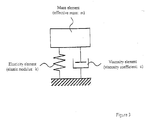
- the tooth shows rotational movement and parallel movement mainly through deformation of the periosteum. Accordingly, the movement of the tooth can be roughly approximated by means of a simple resonance model (viscous attenuation model with one degree of freedom) consisting of elasticity, viscosity and mass elements.
- Embodiments of the present invention are made with the recognition of the fact described above; and in embodiments of the present invention, the degree of oscillation of teeth is measured using physical quantities obtained for the respective elements.
- a unique structure for measuring the degree of oscillation of teeth that comprises: a digital type oscillating signal generator which digitizes oscillation waveforms and stores the resulting digital signals in a memory and further successively performs D/A conversion on the stored digital signals so as to reproduce the signals as analog signals having a desired frequency and waveform; a driver which converts the electrical signals sent from the oscillating signal generator into a mechanical vibration so as to oscillate the teeth; an impedance head which detects the power required by the driver to cause the teeth to oscillate and the acceleration involved in the oscillation; and an analysis device which puts the data detected by the impedance head in a Fourier transform processing, determines a transmission function of power relative to acceleration, and approximates the vibration of the teeth and periodontal tissue in the vicinity of the resonance point by means of a simple resonance model that consists of elasticity, viscosity and mass elements so as to obtain physical quantities for the respective elements.
- the measuring apparatus embodying the present invention includes a digital type oscillating signal generator 10, a driver 14, an impedance head 16 and an analysis device 18.
- the digital type oscillating signal generator 10 digitizes oscillation waveforms and stores the resulting digital signals in a memory and then successively execute D/A conversion on the stored digital signals so as to reproduce analog signals that have a desired frequency and waveform.
- the driver 14 causes teeth 12 to oscillate by converting the electrical signals supplied from the digital type oscillating signal generator 10 into a mechanical vibration.
- the impedance head 16 detects the power required in order to cause the teeth 12 to oscillate, and it also simultaneously detects the acceleration involved in the oscillation.
- the analysis device 18 takes in the data detected by the impedance head 16 and performs predetermined calculations and output.
- the digital type oscillating signal generator 10 comprises a clock generator 20 which generates digital clock pulses, a counter 22 which adds up the clock pulses, a waveform memory 24 which stores digitized oscillation waveform data and outputs data corresponding to the values indicated by the counter 22, a D/A converter 26 which converts data from the waveform memory 24 into analog signals, and an external noise filter 28 which cuts out external noise such as power supply hum, etc.
- the waveform and frequency of the oscillating signal are changeable manually or by commands from the analysis device 18.
- the generator 10 supplies clock pulses required for the incorporation of data or FFT processing to the analysis device 18.
- the oscillating signal used in embodiments of the present invention is quasi-random noise which is widely used in industrial applications. This signal is created by synthesizing sine waves of respective frequencies which are the object of analysis by the FFT processing.
- the oscillating signal used in embodiments of the present invention is obtained by superimposing 41 sine waves at 100 Hz intervals between a 1 and 5 kHz range with a fixed amplitude and random phases.
- the amplitudes of the original waveforms at each frequency are finely adjusted so that a more or less constant oscillating force is obtained at each frequency.
- the output from the oscillating signal generator 10 is amplified by a power amplifier 30 and is sent to the driver 14.
- the driver 14 converts this signal into a mechanical vibration and causes the target tooth 12 to oscillate.
- the impedance head 16 is provided so as to be between the driver 14 and the tooth 12, and a probe 32 which prevents slipping of the tooth 12 during measurement is attached to the tip of the power pick-up of the impedance head 16.
- the mass which is, for example,. 0.922 g, of the probe 32 and the tip part of the power pick-up (these parts will be referred to collectively as the "probe 32" hereinafter) is measured beforehand and stored in an arithmetic unit 42 of the analysis device 18 as a correction mass that is used for calculation of a correction series (described later).
- the information on the power required to apply an oscillation to the tooth 12 and on the acceleration involved in the oscillation is obtained as electrical signals from the impedance head 16 in real time.
- the thus obtained electrical signals are amplified by respective charge amplifiers 34 and 36; afterward, frequency components not needed for measurement are cut out by band-pass filters 38 and 40, and the signals are then inputted into the analysis device 18.
- the analysis device 18 includes an arithmetic unit 42, an A/D converter 44, a monitor 46, a keyboard 48, a printer 50 and an auxiliary storage medium 52.
- the power signals and acceleration signals inputted into the analysis device 18 are respectively converted into digital signals by the A/D converter 44 and sent to the arithmetic unit 42.
- these signals are subjected to an FFT processing.
- the transmission function of the two values (power/acceleration) obtained by the FFT processing is determined in real time. In order to reduce measurement error, this operation is repeated a prescribed number of times so as to average the results. The function thus obtained will be referred to below as the "average transmission function".
- a correction coefficient series is calculated.
- the driver 14 is first held in the hand with nothing in contact with the probe 32, and the average transmission function of the probe 32 is measured by the method described above.
- the measured function should be a constant which is independent of the frequency; however, because of slight differences in the sensitivity of the power pick-up and acceleration pick-up of the impedance head 16, the function usually includes a small error.
- This error is treated as a sensitivity difference peculiar to the measuring apparatus and is corrected in the following manner: the average transmission function of the probe 32 is divided by the correction mass, a correction coefficient series is calculated using the reciprocal of the value thus obtained, and then this series is stored in the memory of the arithmetic unit 42.
- the probe 32 is brought so as to make contact with the tooth 12 lightly, and the average transmission function at this point is measured.
- the function thus measured is multiplied by the correction coefficient series and then integrated over frequency.
- the result is the mechanical impedance spectrum of the tooth and periodontal tissue.
- the above integration is done by multiplication of jw wherein j is an imaginary unit and w is an angular velocity.
- teeth are in fact implanted to stand loosely in the alveolus via soft tissue known as the periosteum; and therefore, when an oscillation is applied to one point on the surface of a tooth, the tooth shows rotational movement and parallel movement mainly through deformation of the periosteum. In the vicinity of the point where the oscillation is applied, these movements can be approximated as parallel movement.
- a rough approximation can be made using the simple resonance model shown in Figure 3.
- n Number of data ⁇ i : Angular velocity of the i-th datum
- R i Real component of the i-th mechanical impedance datum
- I i Imaginary component of the i-th mechanical impedance datum
- the respective physical quantities of the elasticity, viscosity and mass elements are determined as the elastic modulus k, viscosity coefficient c, and effective mass m.
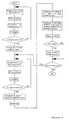
- Figure 4 shows a print-out of an example of measurement of the lower incisors measured by the measuring apparatus embodying the present invention and the analysis results. The same is displayed on a monitor.
- a statistical evaluation can be obtained which may be used to determine whether or not the measurement results obtained for a given tooth are within normal ranges. Furthermore, by measuring only the teeth of a particular disorder, it may be possible to discover peculiar patterns for that disorder by comparing the results of measurement of the disorder with the results obtained for healthy teeth.
- evaluations are made on the vibrational characteristics of teeth using respective physical quantities obtained for elasticity, viscosity and mass elements.
- the quantities may be observed individually, or may be summarized in terms of values such as resonance frequencies, attenuation rations, etc.
Landscapes
- Health & Medical Sciences (AREA)
- Life Sciences & Earth Sciences (AREA)
- Surgery (AREA)
- Animal Behavior & Ethology (AREA)
- Veterinary Medicine (AREA)
- Engineering & Computer Science (AREA)
- Biomedical Technology (AREA)
- Heart & Thoracic Surgery (AREA)
- Medical Informatics (AREA)
- Molecular Biology (AREA)
- Physics & Mathematics (AREA)
- Biophysics (AREA)
- General Health & Medical Sciences (AREA)
- Public Health (AREA)
- Pathology (AREA)
- Dentistry (AREA)
- Oral & Maxillofacial Surgery (AREA)
- Physiology (AREA)
- Dental Tools And Instruments Or Auxiliary Dental Instruments (AREA)
- Measurement Of Mechanical Vibrations Or Ultrasonic Waves (AREA)
Applications Claiming Priority (2)
| Application Number | Priority Date | Filing Date | Title |
|---|---|---|---|
| JP257601/94 | 1994-09-26 | ||
| JP6257601A JP2863448B2 (ja) | 1994-09-26 | 1994-09-26 | 歯の動揺度測定装置 |
Publications (1)
| Publication Number | Publication Date |
|---|---|
| EP0702942A1 true EP0702942A1 (de) | 1996-03-27 |
Family
ID=17308538
Family Applications (1)
| Application Number | Title | Priority Date | Filing Date |
|---|---|---|---|
| EP95306654A Withdrawn EP0702942A1 (de) | 1994-09-26 | 1995-09-20 | Einrichtung zum Messen der Zahnbeweglichkeit |
Country Status (4)
| Country | Link |
|---|---|
| US (1) | US5680874A (de) |
| EP (1) | EP0702942A1 (de) |
| JP (1) | JP2863448B2 (de) |
| DE (1) | DE702942T1 (de) |
Cited By (7)
| Publication number | Priority date | Publication date | Assignee | Title |
|---|---|---|---|---|
| WO2000075624A1 (en) * | 1999-06-04 | 2000-12-14 | The University Of Sydney | A device for evaluating the dynamic, mechanical properties of materials |
| AU765184B2 (en) * | 1999-06-04 | 2003-09-11 | University Of Sydney, The | A device for evaluating the dynamic, mechanical properties of materials |
| RU2279261C1 (ru) * | 2005-04-12 | 2006-07-10 | Татьяна Андреевна Гайдарова | Способ определения подвижности зуба |
| RU2436542C1 (ru) * | 2010-05-11 | 2011-12-20 | Александр Владимирович Делец | Способ определения степени подвижности зубов |
| WO2012091671A1 (en) * | 2010-12-29 | 2012-07-05 | Osstell Ab | Dental attachment quality testing device |
| US8391958B2 (en) | 2003-06-19 | 2013-03-05 | Osstell Ab | Method and arrangement relating to testing objects |
| US8979532B2 (en) | 2003-06-19 | 2015-03-17 | Osstell Ab | Dental attachment quality testing device |
Families Citing this family (15)
| Publication number | Priority date | Publication date | Assignee | Title |
|---|---|---|---|---|
| US5911694A (en) * | 1996-08-22 | 1999-06-15 | Olympus Optical Co., Ltd. | Endoceliac physical quantity measuring apparatus having excellent measuring resolution |
| US5951292A (en) * | 1998-09-18 | 1999-09-14 | Lee; Sheng Yang | Method of detecting periodontal disease by detecting the natural frequency of a tooth. |
| EP1223862A4 (de) * | 1999-09-30 | 2004-10-20 | Vine Brook Res Corp | Implantierbarer mechanischer kräftesensor |
| TWI238053B (en) * | 2002-11-19 | 2005-08-21 | Miracle One Technology Co Ltd | Device for detecting stability of tooth or artificial implant |
| US20070270684A1 (en) * | 2004-06-21 | 2007-11-22 | Integration Diagnostics Ltd. | Method and Arrangement Relating to Testing Objects |
| AU2006230551A1 (en) * | 2005-03-31 | 2006-10-05 | Perio-Imaging Inc. | Ultrasonic periodontal system and method of using |
| US8460216B2 (en) * | 2009-12-24 | 2013-06-11 | Bao Tran | Systems and methods of analyzing vibrations imparted to tissues and teeth |
| RU2630355C2 (ru) * | 2014-06-04 | 2017-09-07 | Сергей Дарчоевич Арутюнов | Устройство для определения подвижности зубов |
| WO2017218951A1 (en) | 2016-06-17 | 2017-12-21 | Align Technology, Inc. | Orthodontic appliance performance monitor |
| EP3471599B1 (de) | 2016-06-17 | 2025-11-19 | Align Technology, Inc. | Intraorale geräte mit sensor |
| RU177114U1 (ru) * | 2017-03-09 | 2018-02-08 | Кирилл Анатольевич Морозов | Устройство для измерения устойчивости зубов и имплантатов к силовым нагрузкам |
| JP7288670B2 (ja) * | 2017-03-10 | 2023-06-08 | ユニヴァーシティ オブ ワシントン | 医療用インプラントの安定性を測定および評価するための方法およびシステム |
| WO2019118876A1 (en) * | 2017-12-15 | 2019-06-20 | Align Technology, Inc. | Closed loop adaptive orthodontic treatment methods and apparatuses |
| RU191595U1 (ru) * | 2019-06-25 | 2019-08-13 | Владимир Юрьевич Шефов | Стоматологический измерительный инструмент для определения плотности проксимальных контактов |
| CN111110382A (zh) * | 2020-03-12 | 2020-05-08 | 上海市东方医院(同济大学附属东方医院) | 一种振动反馈的种植牙动度检测装置 |
Citations (4)
| Publication number | Priority date | Publication date | Assignee | Title |
|---|---|---|---|---|
| JPS62172946A (ja) | 1986-01-24 | 1987-07-29 | 株式会社ニコン | 歯の機械インピ−ダンス測定装置 |
| US4881552A (en) * | 1988-01-20 | 1989-11-21 | Measurement Resources Inc. | Tooth stability monitor |
| JPH0262251A (ja) | 1988-08-29 | 1990-03-02 | Mitsubishi Electric Corp | サーマルヘッドの発熱量制御方法 |
| EP0427146A1 (de) * | 1989-11-06 | 1991-05-15 | Nikon Corporation | Schwingungsgradmessvorrichtung |
Family Cites Families (7)
| Publication number | Priority date | Publication date | Assignee | Title |
|---|---|---|---|---|
| US3883954A (en) * | 1973-07-30 | 1975-05-20 | Threshold Tech | Method and apparatus for recording occlusal vibrations |
| US3943913A (en) * | 1974-06-10 | 1976-03-16 | Johnson Robert J | Apparatus and method for determining tooth mobility |
| US4058115A (en) * | 1974-11-06 | 1977-11-15 | Forster F M O | Method and apparatus for examining human periodontal tissues |
| US4646754A (en) * | 1985-02-19 | 1987-03-03 | Seale Joseph B | Non-invasive determination of mechanical characteristics in the body |
| US4904184A (en) * | 1989-01-17 | 1990-02-27 | Murphy Gordon J | Periodontal probe instrument |
| US5131844A (en) * | 1991-04-08 | 1992-07-21 | Foster-Miller, Inc. | Contact digitizer, particularly for dental applications |
| US5518008A (en) * | 1994-08-25 | 1996-05-21 | Spectral Sciences Research Corporation | Structural analyzer, in particular for medical implants |
-
1994
- 1994-09-26 JP JP6257601A patent/JP2863448B2/ja not_active Expired - Lifetime
-
1995
- 1995-08-30 US US08/521,185 patent/US5680874A/en not_active Expired - Fee Related
- 1995-09-20 DE DE0702942T patent/DE702942T1/de active Pending
- 1995-09-20 EP EP95306654A patent/EP0702942A1/de not_active Withdrawn
Patent Citations (4)
| Publication number | Priority date | Publication date | Assignee | Title |
|---|---|---|---|---|
| JPS62172946A (ja) | 1986-01-24 | 1987-07-29 | 株式会社ニコン | 歯の機械インピ−ダンス測定装置 |
| US4881552A (en) * | 1988-01-20 | 1989-11-21 | Measurement Resources Inc. | Tooth stability monitor |
| JPH0262251A (ja) | 1988-08-29 | 1990-03-02 | Mitsubishi Electric Corp | サーマルヘッドの発熱量制御方法 |
| EP0427146A1 (de) * | 1989-11-06 | 1991-05-15 | Nikon Corporation | Schwingungsgradmessvorrichtung |
Non-Patent Citations (1)
| Title |
|---|
| H. OKA ET AL.: "AUTOMATIC DIAGNOSIS SYSTEM OF TOOTH MOBILITY FOR CLINICAL USE", MEDICAL PROGRESS THROUGH TECHNOLOGY, vol. 16, no. 3, BERLIN DE, pages 117 - 124, XP000159425 * |
Cited By (8)
| Publication number | Priority date | Publication date | Assignee | Title |
|---|---|---|---|---|
| WO2000075624A1 (en) * | 1999-06-04 | 2000-12-14 | The University Of Sydney | A device for evaluating the dynamic, mechanical properties of materials |
| AU765184B2 (en) * | 1999-06-04 | 2003-09-11 | University Of Sydney, The | A device for evaluating the dynamic, mechanical properties of materials |
| US6790186B1 (en) | 1999-06-04 | 2004-09-14 | University Of Sydney | Device for evaluating the dynamic, mechanical properties of materials |
| US8391958B2 (en) | 2003-06-19 | 2013-03-05 | Osstell Ab | Method and arrangement relating to testing objects |
| US8979532B2 (en) | 2003-06-19 | 2015-03-17 | Osstell Ab | Dental attachment quality testing device |
| RU2279261C1 (ru) * | 2005-04-12 | 2006-07-10 | Татьяна Андреевна Гайдарова | Способ определения подвижности зуба |
| RU2436542C1 (ru) * | 2010-05-11 | 2011-12-20 | Александр Владимирович Делец | Способ определения степени подвижности зубов |
| WO2012091671A1 (en) * | 2010-12-29 | 2012-07-05 | Osstell Ab | Dental attachment quality testing device |
Also Published As
| Publication number | Publication date |
|---|---|
| JPH0889517A (ja) | 1996-04-09 |
| DE702942T1 (de) | 1996-12-12 |
| US5680874A (en) | 1997-10-28 |
| JP2863448B2 (ja) | 1999-03-03 |
Similar Documents
| Publication | Publication Date | Title |
|---|---|---|
| EP0702942A1 (de) | Einrichtung zum Messen der Zahnbeweglichkeit | |
| Swami et al. | Current trends to measure implant stability | |
| Meredith | A review of nondestructive test methods and their application to measure the stability and osseointegration of bone anchored endosseous implants | |
| US8979532B2 (en) | Dental attachment quality testing device | |
| US6712778B1 (en) | Implantable mechanical force sensor | |
| WO1991006245A1 (en) | Vibrational analysis of bones | |
| US20020143268A1 (en) | Bone implant testing | |
| WO2001019248A1 (en) | Device and method for establishing stability in an implant or unit | |
| EP0427146B1 (de) | Schwingungsgradmessvorrichtung | |
| Varadhan et al. | Tooth mobility measurements-realities and limitations | |
| Dario et al. | Electronic monitoring of dental implant osseointegration | |
| US3094115A (en) | Tooth mobility indicator | |
| Qi et al. | Resonance frequency analysis for evaluation of the connecting condition between fixed prostheses and their abutment teeth: An in vitro and finite element analysis study | |
| Daly et al. | The response of the human periodontal ligament to torsional loading—I. Experimental methods | |
| US4881552A (en) | Tooth stability monitor | |
| JP4719869B2 (ja) | 計測機能を備えた歯科用超音波スケーラ | |
| Mall et al. | Validation of implant stability: a measure of implant permanence | |
| JP3257563B2 (ja) | 硬さ測定装置および硬さ測定用プローブ | |
| JP4232876B2 (ja) | 歯肉診査用触覚センサー | |
| RU2210309C2 (ru) | Способ диагностики жевательной функции | |
| JPS62172946A (ja) | 歯の機械インピ−ダンス測定装置 | |
| Oka et al. | Impact response of periodontal tissues | |
| Swain et al. | An improved impact technique for monitoring percutaneous implant integrity. | |
| JP3095181B2 (ja) | 顎関節部軟組織の力学特性測定装置 | |
| JPH0325175B2 (de) |
Legal Events
| Date | Code | Title | Description |
|---|---|---|---|
| PUAI | Public reference made under article 153(3) epc to a published international application that has entered the european phase |
Free format text: ORIGINAL CODE: 0009012 |
|
| AK | Designated contracting states |
Kind code of ref document: A1 Designated state(s): DE FR GB IT |
|
| ITCL | It: translation for ep claims filed |
Representative=s name: JACOBACCI CASETTA & PERANI S.P.A. |
|
| 17P | Request for examination filed |
Effective date: 19960525 |
|
| EL | Fr: translation of claims filed | ||
| RAP3 | Party data changed (applicant data changed or rights of an application transferred) |
Owner name: TAKUNO, TETSUO |
|
| DET | De: translation of patent claims | ||
| 17Q | First examination report despatched |
Effective date: 19981028 |
|
| GRAG | Despatch of communication of intention to grant |
Free format text: ORIGINAL CODE: EPIDOS AGRA |
|
| GRAG | Despatch of communication of intention to grant |
Free format text: ORIGINAL CODE: EPIDOS AGRA |
|
| GRAH | Despatch of communication of intention to grant a patent |
Free format text: ORIGINAL CODE: EPIDOS IGRA |
|
| GRAH | Despatch of communication of intention to grant a patent |
Free format text: ORIGINAL CODE: EPIDOS IGRA |
|
| STAA | Information on the status of an ep patent application or granted ep patent |
Free format text: STATUS: THE APPLICATION IS DEEMED TO BE WITHDRAWN |
|
| 18D | Application deemed to be withdrawn |
Effective date: 20020403 |